<?xml version="1.0" encoding="ISO-8859-1"?><article xmlns:mml="http://www.w3.org/1998/Math/MathML" xmlns:xlink="http://www.w3.org/1999/xlink" xmlns:xsi="http://www.w3.org/2001/XMLSchema-instance">
<front>
<journal-meta>
<journal-id>0034-7515</journal-id>
<journal-title><![CDATA[Revista Cubana de Farmacia]]></journal-title>
<abbrev-journal-title><![CDATA[Rev Cubana Farm]]></abbrev-journal-title>
<issn>0034-7515</issn>
<publisher>
<publisher-name><![CDATA[Editorial Ciencias Médicas]]></publisher-name>
</publisher>
</journal-meta>
<article-meta>
<article-id>S0034-75152015000300012</article-id>
<title-group>
<article-title xml:lang="en"><![CDATA[Gastroprotective effects of D-002 (beeswax alcohols) and Lyprinol® on experimentally-induced gastric ulceration in rats]]></article-title>
<article-title xml:lang="es"><![CDATA[Efectos gastroprotectores del D-002 (alcoholes de cera de abejas) y el Lyprinol® sobre la úlcera gástrica experimental en ratas]]></article-title>
</title-group>
<contrib-group>
<contrib contrib-type="author">
<name>
<surname><![CDATA[Ravelo Calzado]]></surname>
<given-names><![CDATA[Yazmin]]></given-names>
</name>
<xref ref-type="aff" rid="A01"/>
</contrib>
<contrib contrib-type="author">
<name>
<surname><![CDATA[Molina Cuevas]]></surname>
<given-names><![CDATA[Vivian]]></given-names>
</name>
<xref ref-type="aff" rid="A01"/>
</contrib>
<contrib contrib-type="author">
<name>
<surname><![CDATA[Carbajal Quintana]]></surname>
<given-names><![CDATA[Daisy]]></given-names>
</name>
<xref ref-type="aff" rid="A01"/>
</contrib>
<contrib contrib-type="author">
<name>
<surname><![CDATA[Más Ferreiro]]></surname>
<given-names><![CDATA[Rosa]]></given-names>
</name>
<xref ref-type="aff" rid="A01"/>
</contrib>
<contrib contrib-type="author">
<name>
<surname><![CDATA[Zamora Rodríguez]]></surname>
<given-names><![CDATA[Zullyt]]></given-names>
</name>
<xref ref-type="aff" rid="A01"/>
</contrib>
</contrib-group>
<aff id="A01">
<institution><![CDATA[,Centro de Investigaciones Científicas Centro de Productos Naturales ]]></institution>
<addr-line><![CDATA[La Habana ]]></addr-line>
<country>Cuba</country>
</aff>
<pub-date pub-type="pub">
<day>00</day>
<month>09</month>
<year>2015</year>
</pub-date>
<pub-date pub-type="epub">
<day>00</day>
<month>09</month>
<year>2015</year>
</pub-date>
<volume>49</volume>
<numero>3</numero>
<fpage>0</fpage>
<lpage>0</lpage>
<copyright-statement/>
<copyright-year/>
<self-uri xlink:href="http://scielo.sld.cu/scielo.php?script=sci_arttext&amp;pid=S0034-75152015000300012&amp;lng=en&amp;nrm=iso"></self-uri><self-uri xlink:href="http://scielo.sld.cu/scielo.php?script=sci_abstract&amp;pid=S0034-75152015000300012&amp;lng=en&amp;nrm=iso"></self-uri><self-uri xlink:href="http://scielo.sld.cu/scielo.php?script=sci_pdf&amp;pid=S0034-75152015000300012&amp;lng=en&amp;nrm=iso"></self-uri><kwd-group>
<kwd lng="en"><![CDATA[D-002]]></kwd>
<kwd lng="en"><![CDATA[Lyprinol]]></kwd>
<kwd lng="en"><![CDATA[ethanol ulcers]]></kwd>
<kwd lng="en"><![CDATA[pylorus ligation]]></kwd>
<kwd lng="en"><![CDATA[gastroprotection]]></kwd>
<kwd lng="es"><![CDATA[D&#8210;002]]></kwd>
<kwd lng="es"><![CDATA[Lyprinol]]></kwd>
<kwd lng="es"><![CDATA[úlcera gástricas por etanol]]></kwd>
<kwd lng="es"><![CDATA[ligadura del píloro]]></kwd>
<kwd lng="es"><![CDATA[gastroprotección]]></kwd>
</kwd-group>
</article-meta>
</front><body><![CDATA[ <p align="right"> <font face="Verdana, Arial, Helvetica, sans-serif" size="2"><b>PRODUCTOS    NATURALES</b></font></p>     <p align="right">&nbsp;</p>     <p><font face="Verdana, Arial, Helvetica, sans-serif" size="4"> <b>Gastroprotective    effects of D-002 (beeswax alcohols) and Lyprinol<sup>&#174;</sup> on experimentally-induced    gastric ulceration in rats</b></font></p>     <p>&nbsp;</p>     <p><b><font face="Verdana, Arial, Helvetica, sans-serif" size="4">Efectos gastroprotectores    del D-002 (alcoholes de cera de abejas) y el Lyprinol&reg; sobre la &uacute;lcera    g&aacute;strica experimental en ratas</font></b></p>     <p>&nbsp;</p>     <p>&nbsp;</p>     <p><b><font face="Verdana, Arial, Helvetica, sans-serif" size="2">MSc. Yazmin    Ravelo Calzado, Dra. C. Vivian Molina Cuevas, Dra C. Daisy Carbajal Quintana,    Dra. C. Rosa M&#225;s Ferreiro, Dra C. Zullyt Zamora Rodr&#237;guez</font></b><font face="Verdana, Arial, Helvetica, sans-serif" size="2">    </font></p>     <p><font face="Verdana, Arial, Helvetica, sans-serif" size="2">Centro de Productos    Naturales, (CPN), Centro de Investigaciones Cient&#237;ficas (CNIC). La Habana,    Cuba. </font></p>     <p>&nbsp;</p>     ]]></body>
<body><![CDATA[<p>&nbsp;</p> <hr size="1" noshade>     <p><font face="Verdana, Arial, Helvetica, sans-serif" size="2"><b>ABSTRACT</b>    </font></p>     <p><b>I<font face="Verdana, Arial, Helvetica, sans-serif" size="2">ntroduction:</font></b><font face="Verdana, Arial, Helvetica, sans-serif" size="2">    D-002, a mixture of beeswax alcohols, has been effective in osteoarthritis models    and for reducing osteoarthritis symptoms. Unlike the classic anti-inflammatory    drugs, D-002 elicits gastroprotective rather than gastrotoxic effects. Lyprinol,    used for ameliorating inflammation and arthritic symptoms, improves gastrointestinal    dysfunction symptoms in osteoarthritis subjects. Both D-002 and Lyprinol inhibit    cyclooxygenase and 5?lipoxygenase activities, and have been similarly effective    for reducing inflammation experimentally.    <br>   <b>Objective:</b> to compare the effects of D-002 and Lyprinol on gastric mucosa    of normal and experimentally-induced ulcer rats.    <br>   <b>Methods:</b> ulcer indexes were measured in normal rats and in rats with    ethanol or pylorus ligation-induced ulcers, in which gastric volume and mucus    secretion were also measured. Normal rats were randomized into a vehicle control,    one acetic salicylic acid (150 mg/kg), three D-002, three Lyprinol groups; rats    with ethanol-ulcers into a vehicle control, three D-002 and three Lyprinol-treated    groups; and the experiment on pylorus ligation included a negative control and    eight pylorus-ligated groups: one vehicle control, three D-002, three Lyprinol,    one omeprazole 10 mg/kg. In all cases, D-002 and Lyprinol (50, 200 and 400 mg/kg)    were given orally.    <br>   <b>Results:</b> unlike D-002 and Lyprinol (50-400 mg/kg), acetic salicylic acid    increased ulcer indexes and the incidence of ulcers versus the vehicle control.    Single oral doses of D-002 (50-400 mg/kg) or Lyprinol (200 and 400 mg/kg) decreased    significantly (p&lt;0.01) and in a similar way ulcer indexes versus the ethanol-positive    control. D-002 and Lyprinol (50-400 mg/kg) lowered significantly (p&lt;0.01)    and comparably ulcer indexes in rats with pylorus ligation versus the positive    controls. D-002 (200 and 400 mg/kg) decreased gastric volume and increased gastric    mucus secretion versus the positive control whereas only Lyprinol 400 mg/kg    increased the gastric mucus secretion but without modifying the gastric volume.    Omeprazole significantly reduced ulcer index (p&lt;0.05) and gastric volume    (p&lt; 0.01), with no change in mucus secretion.     <br>   <b>Conclusion:</b> D-002 and Lyprinol did not show gastrotoxic effects and similar    efficacy in protecting against ethanol and pylorus ligation-induced gastric    ulceration in rats</font></p>     <p><font face="Verdana, Arial, Helvetica, sans-serif" size="2"><b>Keywords: </b>D-002,    Lyprinol, ethanol ulcers, pylorus ligation, gastroprotection.</font></p> <hr size="1" noshade>     <p> <font face="Verdana, Arial, Helvetica, sans-serif" size="2"><b>RESUMEN</b>    </font></p>     <p> <font face="Verdana, Arial, Helvetica, sans-serif" size="2"><b>Introducci&#243;n:</b>    el D&#8210;002, una mezcla de alcoholes de la cera de abejas, efectivo en modelos    de osteoartritis y para reducir los s&#237;ntomas de la misma. A diferencia    de los medicamentos antiinflamatorios cl&#225;sicos el D&#8210;002 produce efectos    gastroprotectores m&#225;s que efectos gastrot&#243;xicos. El Lyprinol, usado    para disminuir la inflamaci&#243;n y los s&#237;ntomas artr&#237;ticos, mejora    los s&#237;ntomas de disfunci&#243;n gastrointestinal en sujetos con dicha enfermedad.    D&#8210;002 y Lyprinol inhiben las actividades de cyclooxigenasa y 5&#8210;lipooxigenasa,    y son similarmente efectivos para reducir la inflamaci&#243;n en modelos experimentales.    </font>    ]]></body>
<body><![CDATA[<br>   <font face="Verdana, Arial, Helvetica, sans-serif" size="2"><b>Objetivo:</b>    comparar los efectos del D&#8210;002 y el Lyprinol sobre la mucosa g&#225;strica    de ratas normales y de ratas con &#250;lcera g&#225;strica inducida experimentalmente.    </font>    <br>   <font face="Verdana, Arial, Helvetica, sans-serif" size="2"><b>M&#233;todos:</b>    se determin&#243; el &#237;ndice de &#250;lcera en ratas normales y en ratas    con &#250;lceras g&#225;stricas inducidas por etanol e inducidas por ligadura    de p&#237;loro, en las cuales se midi&#243; el volumen g&#225;strico y la secreci&#243;n    de mucus. Las ratas normales se distribuyeron en un grupo control (veh&#237;culo),    uno con &#225;cido acetil salic&#237;lico (150 mg/kg), tres con D&#8210;002    y tres con Lyprinol; las ratas con &#250;lcera inducida por etanol en un grupo    control (veh&#237;culo), tres con D&#8210;002 y tres con Lyprinol; y el experimento    con ligadura de p&#237;loro en un grupo control (veh&#237;culo), tres D&#8210;002,    tres Lyprinol y uno con omeprazol (10 mg/kg). En todos los casos, el D&#8210;002    y el Lyprinol (50, 200 y 400 mg/kg) se administraron por v&#237;a oral. </font>    <br>   <font face="Verdana, Arial, Helvetica, sans-serif" size="2"><b>Resultados:</b>    el &#225;cido acetil salic&#237;lico, no el D&#8210;002 ni el Lyprinol (50&#8210;400    mg/kg), increment&#243; el &#237;ndice de &#250;lceras y la incidencia de &#250;lceras    comparadas con el grupo control. Dosis orales &#250;nicas de D&#8210;002 (50&#8210;400    mg/kg) o Lyprinol (200 y 400 mg/kg) redujeron significativa (p&lt;0,01) y similarmente    el &#237;ndice de &#250;lceras comparado con el grupo control positivo con &#250;lceras    por etanol. El D&#8210;002 y el Lyprinol (50&#8210;400 mg/kg) redujeron significativamente    (p&lt;0,01) y comparablemente el &#237;ndice de &#250;lceras en ratas con ligadura    de p&#237;loro comparado con el grupo control positivo. El D&#8210;002 (200    y 400 mg/kg) redujo el volumen g&#225;strico e increment&#243; la secreci&#243;n    de mucus g&#225;strico respecto al grupo control positivo; mientras solo el    Lyprinol 400 mg/kg aument&#243; la secreci&#243;n de mucus g&#225;strico pero    sin modificar el volumen g&#225;strico. El omeprazol redujo significativamente    el &#237;ndice de &#250;lcera (p&lt;0,05) y el volumen g&#225;strico (p&lt;0,01),    sin modificar la secreci&#243;n de mucus. </font>    <br>   <font face="Verdana, Arial, Helvetica, sans-serif" size="2"><b>Conclusiones:    </b> el D&#8210;002 y el Lyprinol no presentaron efectos gastrot&#243;xicos,    y protegieron con eficacia similar de las &#250;lceras g&#225;stricas inducidas    por etanol y por ligadura del p&#237;loro en ratas. </font></p>     <p><font face="Verdana, Arial, Helvetica, sans-serif" size="2"><b>Palabras clave:    </b> D&#8210;002, Lyprinol, &#250;lcera g&#225;stricas por etanol, ligadura    del p&#237;loro, gastroprotecci&#243;n. </font></p> <hr size="1" noshade>     <p>&nbsp;</p>     <p>&nbsp;</p>     <p><font face="Verdana, Arial, Helvetica, sans-serif" size="3"><b>INTRODUCTION</b>    </font></p>     <p><font face="Verdana, Arial, Helvetica, sans-serif" size="2"> Inflammation is    a normal host response against deleterious stimuli. Acute inflammation involves    short-term responses to pro-inflammatory injuries and further repair, but if    this mechanism fail it may evolves to chronic inflammation, which has been linked    with long-standing diseases, including osteoarthritis.<sup>1 </sup>The inflammatory    response involves the increased production of arachidonic acid from membrane    phospholipids, whichis then metabolized by cyclooxygenase (COX) and lipoxygenase    (LOX) pathways to produce prostaglandins (PG), thromboxanes, prostacyclins,    and leukotrienes (LT). <sup>2</sup> </font></p>     <p><font face="Verdana, Arial, Helvetica, sans-serif" size="2"> Currently non    selective non-steroidal anti-inflammatory drugs (NSAIDs) and COX-2 inhibitors,    very effective to treat inflammation and associated pain, are among the most    prescribed drugs worldwide. Basically, NSAIDs and COX-2 inhibitors display their    anti-inflammatory effects by inhibiting the COX pathway, but such a mechanism    also supports some of their relevant drug-related adverse effects, like gastric    damage and bronchospasm linked with COX-1 inhibition, and cardiovascular adverse    side effects caused by COX2 inhibition.<sup>3</sup> NSAIDs-induced gastric damage,    a relative limitation for their clinical use, results from the curtailed production    of gastroprotective PG and the displacement of the arachidonic acid metabolism    towards the LOX pathway, which increases the synthesis of pro-inflammatory and    gastrotoxic LT, so that increased concentrations of LTB<sub>4</sub> have been    found on the walls of NSAID-induced gastric ulcers, which attract leukocytes    and contribute to cause stomach ulceration,<sup>4 </sup>enhancing the gastrotoxicity    due to the PG deficit.<sup>3</sup> </font></p>     ]]></body>
<body><![CDATA[<p><font face="Verdana, Arial, Helvetica, sans-serif" size="2">Keeping in mind    the extended use of NSAIDs for vascular prevention, which is the case for acetic    salicylic acid (ASA), and inflammation-related diseases, like osteoarthritis,    the incidence of NSAIDs-related gastric damage and complications have been increasing,    a trends predicted to continue due the increase on life expectancy, so that    special recommendations for their use in the elderly have been reported.<sup>5    </sup>This background supports the search of effective and safer anti-inflammatory    substances, like dual inhibitors of COX and 5-LOX, which cut PG synthesis and    provide anti-inflammatory effects, but also prevent the switch to an increased    LT production by inhibiting 5-LOX, thus reducing the occurrence of gastric adverse    effects.<sup>6 </sup>The inhibition of LTB<sub>4 </sub>synthesis, therefore,    seems to be a relevant target of anti-inflammatory drugs devoid of gastrotoxicity.<sup>7</sup>    </font></p>     <p><font face="Verdana, Arial, Helvetica, sans-serif" size="2">D-002, a mixture    of six beeswax alcohols with triacontanol as the main component, has been effective    for lowering experimental inflammation<sup>8 </sup>and OA symptoms.<sup>9</sup>    D-002 was also found to inhibit both COX and 5-LOX activity, <sup>10</sup>and    to lower LTB<sub>4 </sub>levelsin the pleural exudates of rats with carrageenan-induced    pleurisy.<sup>7</sup>Unlike the classic anti-inflammatory drugs, however, D-002    has shown to cause gastroprotective, rather than gastrotoxic effects, in experimental<sup>11,12    </sup>and clinical studies.<sup>13 </sup>Although the dual inhibition of COX    and 5-LOX may support the lack of D-002 gastrotoxicity; this mechanism alone    cannot explain the gastroprotective effect of D-002, which involves antioxidant    effects on the gastric mucosa and increased gastric mucus secretion.<sup>11,12</sup>    </font></p>     <p><font face="Verdana, Arial, Helvetica, sans-serif" size="2"> Lyprinol, trade    mark of a lipid extract from green-lipped mussel (GLM) (<em>Perna canaliculus</em>),    inhibits COX and 5-LOX enzymes and reduces the production of LTB<sub>4.</sub>    Lyprinol has been used for the symptomatic relief of inflammatory conditions,    including arthritis, not only without causing the adverse effects of NSAIDs,    but even improving symptoms of gastrointestinal dysfunction in OA subjects.<sup>14</sup>    </font></p>     <p><font face="Verdana, Arial, Helvetica, sans-serif" size="2"> A previous study    found that D-002 and Lyprinol were similarly effective for lowering the oedema    in the model of carrageenan-induced pleurisy,<sup>15 </sup> but their effects    on gastric ulceration had not been compared yet. </font></p>     <p><font face="Verdana, Arial, Helvetica, sans-serif" size="2"> This study compares    the effects of single oral doses of D-002 and Lyprinol on gastric ulceration    in rats. </font></p>     <p>&nbsp;</p>     <p><font face="Verdana, Arial, Helvetica, sans-serif" size="3"><b>METHODS</b></font><font face="Verdana, Arial, Helvetica, sans-serif" size="2">    </font></p>     <p><font face="Verdana, Arial, Helvetica, sans-serif" size="2"> ANIMALS </font></p>     <p><font face="Verdana, Arial, Helvetica, sans-serif" size="2"> Male <i>Sprague    Dawley</i> rats (250-300g) from the National Center for Laboratory Animal Production    (CENPALAB, Havana, Cuba) were used for the study and adapted for 7 days to the    following conditions: temperature (22-23 <sup>o</sup>C), relative humidity (55-60    %) and 12 hours dark/light cycles. Food and water were freely supplied<i>. </i>The    animals had fasted for 24 h prior to the experiments. </font></p>     <p><font face="Verdana, Arial, Helvetica, sans-serif" size="2"> The experiments    were performed in accordance with the care and use of experimental animals prescribed    by the Cuban Guidelines for the care of laboratory animals and the Cuban Code    of Good Laboratory Practice (GLP), after obtaining the approval of the Institutional    Board for animal use.The study protocol and animals use were approved prior    to the study by the Institutional Animal Ethics Committee (No 035/2011). </font></p>     ]]></body>
<body><![CDATA[<p><font face="Verdana, Arial, Helvetica, sans-serif" size="2"> ADMINISTRATION    AND DOSAGE </font></p>     <p><font face="Verdana, Arial, Helvetica, sans-serif" size="2"> The batch of D-002,    supplied by the Plants of Natural Products (National Center for Scientific Research,    Havana City, Cuba) was used after corroborate its quality criteria. Batch composition,    assessed with a validated gas chromatographic method,<sup>16 </sup>was as follows:    1-tetracosanol (5 %), 1-hexacosanol (10.2 %), 1-octacosanol (14 %), 1-triacontanol    (34.21 %), 1-dotriacontanol (24.24 %) and 1-tetratriacontanol (3.03 %). Purity    (total content of these alcohols) was 90.7 %. </font></p>     <p><font face="Verdana, Arial, Helvetica, sans-serif" size="2"> Lyprinol soft    gel capsules (Blackmores, Australia, batch: 252918) used for the experiments    contained 50 mg of the lipid extract from GLM diluted in olive oil and Vitamin    E. GLM contain free fatty acids, mainly omega-3 polyunsaturated fatty acids    (PUFAs), such as eicosapentaenoic acid (18 %) and docosahexanoic acid (15%),    palmitic acid (16 %), cholesterol (<u>&#8776;</u>30 %), sterol esters, triglycerides,    and polar lipids, as reported. <sup>17 </sup>The content of the capsules was    directly drawn with a syringe and used in the experiments. </font></p>     <p><font face="Verdana, Arial, Helvetica, sans-serif" size="2"> Omeprazole (lote    OE513187) from Laboratorios NOVATEC (La Habana, Cuba), was dissolved in acacia    gum/water vehicle (10 mg/mL) and then used in the experiments. D-002 and Lyprinol    were suspended in 2 % Tween 65/water, respectively, while ASA (from the Cuban    Pharmaceutical Industry, Havana, Cuba) was dissolved in acacia gum/water vehicle    (10 mg/mL). All treatments (vehicle, D-002, Lyprinol, Aspirin and Omeprazole)    were administered orally by gastric gavage (5mL/kg). </font></p>     <p><font face="Verdana, Arial, Helvetica, sans-serif" size="2">EXPERIMENTAL DESIGN    </font></p>     <p><font face="Verdana, Arial, Helvetica, sans-serif" size="2"> Three experiments    were performed for comparing the effects of single oral doses of D-002 and Lyprinol    on gastric ulceration in rats. The first experiment investigated the potential    gastro-toxic effects of D-002 and Lyprinol in normal rats, while the two other    series compared the effects of both substances on ethanol and pylorus ligation-induced    ulcers in rats by assessing their effects on ulcer index. </font></p>     <p><font face="Verdana, Arial, Helvetica, sans-serif" size="2"> EFFECTS ON THE    GASTRIC MUCOSA OF NORMAL RATS </font></p>     <p><font face="Verdana, Arial, Helvetica, sans-serif" size="2"> Rats were randomized    into eight groups (10 rats per group): a vehicle control, three treated with    D-002 (50, 200 and 400 mg/kg), three treated with Lyprinol (50, 200 and 400    mg/kg) and one with aspirin (150 mg/kg). </font></p>     <p><font face="Verdana, Arial, Helvetica, sans-serif" size="2"> All treatments    were administered for seven days. After the last administration, rats were fasted    for 24 h with free access to water and then they were sacrificed by using an    overdose of thiopental anaesthesia (80 mg/kg). The stomachs were immediately    removed for quantifying the lesions. </font></p>     <p><font face="Verdana, Arial, Helvetica, sans-serif" size="2">EFFECTS ON ETHANOL    INDUCED GASTRIC ULCERS IN RATS</font><font face="Verdana, Arial, Helvetica, sans-serif" size="2">    </font></p>     ]]></body>
<body><![CDATA[<p><font face="Verdana, Arial, Helvetica, sans-serif" size="2"> Seven groups of    10 rats each one were treated with the control vehicle; D-002 (50, 200 and 400    mg/kg) or Lyprinol (50, 200 and 400 mg/kg) one hour prior to oral administration    of ethanol (60 % ethanol; 1 mL/200 g).<sup>18</sup> The animals were sacrificed    after one hour under an overdose of thiopental anesthesia and their stomachs    were washed with cold saline and removed for examining the ulcer index microscopically.    </font></p>     <p><font face="Verdana, Arial, Helvetica, sans-serif" size="2">EFFECTS ON PYLORUS    LIGATION INDUCED GASTRIC ULCERS IN RATS </font></p>     <p><font face="Verdana, Arial, Helvetica, sans-serif" size="2"> Rats were randomized    into nine groups of 10 rats each one, a negative control and eight pylorus-ligated    groups that were orally administered with the vehicle (positive control), D-002    (50, 200 and 400 mg/kg), Lyprinol (50, 200 and 400 mg/kg) or omeprazole 10 mg/kg,    respectively. </font></p>     <p><font face="Verdana, Arial, Helvetica, sans-serif" size="2"> After one hour,    the rats were anaesthetized with thiopental (40 mg/kg, i.p), the abdomen was    cut open, the pyloric end was ligated without damaging the blood supply and    the abdominal cavity was closed. The rats were anaesthetized and sacrificed    four hours after pylorus ligation, the stomachs were removed and opened along    the greater curvature and the ulcer indexes were measured. The volume of gastric    juice, the mucus weight/stomach weight ratio and the concentrations of total    hydroxyperoxides (THP) in gastric mucus were also measured. </font></p>     <p><font face="Verdana, Arial, Helvetica, sans-serif" size="2">EVALUATION OF GASTRIC    ULCERATION</font><font face="Verdana, Arial, Helvetica, sans-serif" size="2">    </font></p>     <p><font face="Verdana, Arial, Helvetica, sans-serif" size="2"> The lesions in    the gastric mucosa were examined macroscopically using magnification 3x. Ulcer    indexes were determined as the sum of the lengths of the whole gastric lesions    (in mm). Two independent, blinded observers performed the observations and measurements    of lesion lengths. <sup>19</sup> </font></p>     <p><font face="Verdana, Arial, Helvetica, sans-serif" size="2">GASTRIC JUICE VOLUME</font><b><font face="Verdana, Arial, Helvetica, sans-serif" size="2">    </font></b></p>     <p><font face="Verdana, Arial, Helvetica, sans-serif" size="2"> The gastric contents    were collected and centrifuged at 3000 rpm<sup>-1</sup> for 10 min. The supernatant    was used for determining the gastric volume. </font></p>     <p><font face="Verdana, Arial, Helvetica, sans-serif" size="2">MUCUS WEIGHT/STOMACH    WEIGHT RATIO </font></p>     <p><font face="Verdana, Arial, Helvetica, sans-serif" size="2"> Stomachs were    weighed in <i>Mettler</i> Toledo balance, opened along the greater curvature    and then the mucus was scraped gently with a scalpel and weighed immediately    in the <i>Mettler</i> Toledo balance (model: AG204, manufacturer: <i>DeltaRange<sup>&#174;</sup></i>,    precision: 0.0001g). The amount of mucus was expressed as the mucus weight/stomach    weight ratio. </font></p>     ]]></body>
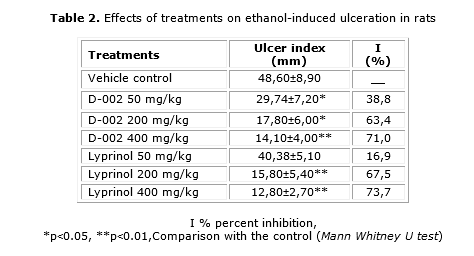
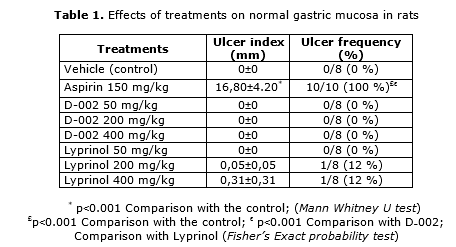
<body><![CDATA[<p><font face="Verdana, Arial, Helvetica, sans-serif" size="2">MEASUREMENT OF    LIPID PEROXIDATION</font><font face="Verdana, Arial, Helvetica, sans-serif" size="2">    </font></p>     <p><font face="Verdana, Arial, Helvetica, sans-serif" size="2"> The stomachs were    washed with normal saline, cut into small pieces and homogenized in a Potter-Elvehjem    glass homogenizer in ice cold 0.15 M KCl to obtain 20 % homogenates used for    the determination of THP,<sup>20 </sup>a marker of lipid peroxidation.In brief    0.1 mL of the homogenatewas allowed to react with 0.9 mL of Fox reactive (88    mg of butylated hydroxytoluene, 7.6 mg of orange xylenol, 9.8 mg of ammonium    sulphate were dissolved in a 9:1 mixture of methanol:sulphuric acid). This mixture    was incubated at 37 &#186;C for 30 min and then cooled. This mixture was centrifuged    at 2400xg for 10 min and the absorbance of the supernatant was measured at 560    nm. The concentrations of THP were calculated from a standard calibration curve    generated with cumene hydroperoxide. THP values were expressed as mol/mg of    tissue protein. </font></p>     <p><font face="Verdana, Arial, Helvetica, sans-serif" size="2">STATISTICAL ANALYSES    </font></p>     <p><font face="Verdana, Arial, Helvetica, sans-serif" size="2"> Comparisons among    groups were done with the <i>Kruskal Wallis test</i>, paired comparisons between    each treated and control groups with the <i>Mann-Whitney U</i> <i>test</i> and    categorical data (ulcer frequency) with the <i>Fisher&#8217;s Exact Probability    test</i>. Statistical significance was chosen for &#945;=0.05. Data were processed    with the <i>Statistics Software for Windows</i> (Release 6.1 Stat Soft Inc,    Tulsa OK, USA). </font></p>     <p>&nbsp;</p>     <p><font face="Verdana, Arial, Helvetica, sans-serif" size="3"><b>RESULTS </b>    </font></p>     <p><font face="Verdana, Arial, Helvetica, sans-serif" size="2"> EFFECTS ON THE    GASTRIC MUCOSA OF NORMAL RATS </font></p>     <p><font face="Verdana, Arial, Helvetica, sans-serif" size="2"> No rat from the    vehicle control group, but all treated with aspirin 150 mg/kg exhibited gastric    ulceration, so that both the ulcer index and the frequency of rats with gastric    ulcers were significantly higher in the aspirin group as compared to the vehicle    control. By contrast, no rat treated with D-002 (50&#727;400 mg/kg), and only    two treated with Lyprinol at 200 and 400 mg/kg, respectively, displayed gastric    ulcers. In consequence, ulcer index and frequency of animals with gastric ulceration    in these two groups were similar to those of the control group (<a href="#t1">Table    1</a>). </font></p>     <p align="center"><img src="/img/revistas/far/v49n3/t0112315.gif" width="456" height="247"><a name="t1"></a></p>     <p><font face="Verdana, Arial, Helvetica, sans-serif" size="2">EFFECTS ON ETHANOL-INDUCED    GASTRIC ULCERS </font></p>     ]]></body>
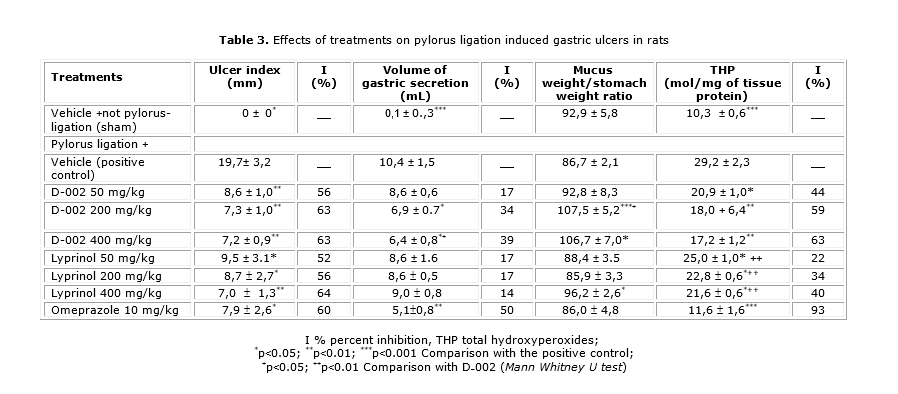
<body><![CDATA[<p><font face="Verdana, Arial, Helvetica, sans-serif" size="2"> Pre-treatment    of rats with single oral doses of D-002 (50-400 mg/kg) decreased significantly    and markedly (38.8% to 71.0 %) the ulcer index induced by ethanol as compared    to the positive control (<a href="#t2">table 2</a>). In turn, Lyprinol 200 and    400 mg/kg, not 50 mg/kg, reduced significantly and markedly (67.5 % and 73.7    %) the ulcer index in this model. The reductions of ulcer index with both substances    were similar. </font></p>     <p align="center"><img src="/img/revistas/far/v49n3/t0212315.gif" width="474" height="256"><a name="t2"></a></p>     <p><font face="Verdana, Arial, Helvetica, sans-serif" size="2"> EFFECTS ON PYLORUS    LIGATION INDUCED GASTRIC ULCERS </font></p>     <p><font face="Verdana, Arial, Helvetica, sans-serif" size="2"> <a href="/img/revistas/far/v49n3/t0312315.gif">Table    3</a> summarizes the effects of treatments on pylorus ligation-induced gastric    damage in rats. Oral acute administration of D-002 (50&#727;400 mg/kg) produced    significant decreases (56 &#727;63 %) of the ulcer index as compared with the    positive control group, and statistically similar reductions (52&#727; 64 %)    were found with Lyprinol (50&#727;400 mg/kg) (table 3). Also, all doses of both    substances (50, 200 and 400 mg/kg) reduced significantly THP concentrations    in the mucus (44, 59 and 63 % with D&#727;002; respectively; 22, 34 and 40 %    with Lyprinol, respectively), but D-002 was more effective than Lyprinol for    lowering this variable across all the dose range. Also, D-002 (200 and 400 mg/kg)    decreased the gastric volume (34 and 39 %, respectively) and increased gastric    mucus secretion versus the positive control; meanwhile only the highest dose    of Lyprinol (400 mg/kg) increased significantly the gastric mucus secretion    but without modifying the gastric volume. Omeprazole 10 mg/kg significantly    reduced ulcer index (60 %), gastric volume (50 %) and mucus THP values (93 %),    but unchanged mucus secretion.</font></p>     <p>&nbsp;</p>     <p><font face="Verdana, Arial, Helvetica, sans-serif" size="3"><b>DISCUSSION</b></font><font face="Verdana, Arial, Helvetica, sans-serif" size="2"><b>    </b> </font></p>     <p><font face="Verdana, Arial, Helvetica, sans-serif" size="2"> Inflammation of    the gastric mucosa may affect its own defensive protection, which may lead to    gastric mucosal ulceration. Effective management of gastric ulceration, which    results from the imbalance between gastroprotective and aggressive factors,    would primarily depends on the reduction of the aggressive factors, the reinforcement    of protective factors or a combination of both.<sup>21</sup> </font></p>     <p><font face="Verdana, Arial, Helvetica, sans-serif" size="2">Gastric ulcers    may arise frequently due to the chronic use of external aggressive factors,    such as NSAIDs, stress, smoking, and alcohol consumption.<sup>21 </sup>Nowadays,    drug-induced damage to the gastrointestinal tract has become a health problem,    in great part due to the extensive use of NSAIDs, <sup>3 </sup>which could increase    dramatically if its use for chemoprotection against different cancers is expanded.<sup>22</sup>    </font></p>     <p><font face="Verdana, Arial, Helvetica, sans-serif" size="2">In this study,    it was demonstrated that the repeated oral administration of D-002 or Lyprinol    (50-400 mg/kg) did not induce gastric ulceration in rats, differently from aspirin    (150 mg/kg), which produced evident ulcers in all treated rats, as expected.    Beyond this lack of gastrotoxic effects caused by either D-002 or Lyprinol,    both substances (50 &#8211; 400 mg/kg) demonstrated to be similarly effective    for protecting against gastric ulceration induced by ethanol or pylorus ligation,    this study being the first one reporting such effect for Lyprinol (<i>Entrez    PubMed</i>, up to April 2014). </font></p>     <p><font face="Verdana, Arial, Helvetica, sans-serif" size="2"> We found that    the decrease of pylorus ligation-induced gastric ulceration produced by both    D-002 and Lyprinol was accompanied by a reduction of lipid peroxidation (assessed    by THP levels). The gastroprotective effect of D-002, not of Lyprinol, on pylorus    ligation-induced ulceration also involves a decrease of gastric volume and an    increase of gastric mucus secretion, in agreement with previous findings found    in other ulcer models<sup>11 </sup>and Omeprazole, a classic proton pump inhibitor    used as reference drug, was able to reduce the ulcer index, the gastric volume,    and THP concentrations, in agreement with its antisecretory, antiapoptoticand    antioxidant effects.<sup>23 </sup>These results agree with those of other authors,<sup>24    </sup>but diverge of those of pantoprazole, which was ineffective in this model.<sup>25</sup>    </font></p>     ]]></body>
<body><![CDATA[<p><font face="Verdana, Arial, Helvetica, sans-serif" size="2"> The gastric ulceration    produced by pyloric ligation is caused by the increased accumulation of gastric    acid and pepsin, leading to auto-digestion of gastric mucosa. Defensive factors    like the mucus are known to protect the submucosal layers from the back-diffusion    of hydrogen ions. Administration of D-002 and the highest doses of Lyprinol    significantly increased mucus secretion, which accounts for a reinforcement    of the defensive factors acting on the gastric mucosa. D-002 also significantly    reduced the gastric volume. Both D-002 and Lyprinol significantly decreased    the concentrations of THP in mucosa homogenates when compared to the control    group of animals. The antioxidant effect of D-002 on the gastric mucosa is consistent    with previous reports, <sup>12 </sup>meanwhile the effect on lipid peroxidation    of Lyprinol on this target is documented for the first time and must be corroborate    for further studies. D-002, however, was more effective than Lyprinol regarding    for lowering the extent of lipid peroxidation in gastric homogenates. The decrease    on lipid peroxidation could play an important role in the protection of the    gastric mucosa, as oxidative damage is accepted to be a common factor in the    pathogenesis of gastric ulceration.<sup>26</sup> </font></p>     <p><font face="Verdana, Arial, Helvetica, sans-serif" size="2"> Indeed, dual inhibition    of D-002 and Lyprinol on COX and LOX pathways could be beneficial in limiting    inflammation when compared to the conventional NSAIDs; and the joint blockade    of both pathways may also lower the incidence of gastric ulceration. </font></p>     <p>&nbsp; </p>     <p> <font face="Verdana, Arial, Helvetica, sans-serif" size="2"><b><font size="3">CONCLUSION    </font> </b> </font></p>     <p><font face="Verdana, Arial, Helvetica, sans-serif" size="2"> This study demonstrates    that instead to be gastrotoxic, oral administration of D-002 and Lyprinol similarly    protected against ethanol and pylorus ligation-induced gastric ulceration.In    pylorus-ligated rats, D-002 and Lyprinol increased mucus secretion but D-002    displayed the greatest reduction of lipid peroxidation. Taken together, these    data merit further research and enhance our understanding of the gastric safety    of two dual inhibitors of COX and 5-LOX enzymes, namely D-002 and Lyprinol,    which seem to reinforce some defensive factors on the gastric mucosa. </font></p>     <p>&nbsp;</p>     <p><font face="Verdana, Arial, Helvetica, sans-serif" size="3"><b>REFERENCES</b>    </font></p>     <!-- ref --><p><font face="Verdana, Arial, Helvetica, sans-serif" size="2">1. Berenbaum F.    Osteoarthritis as an inflammatory disease (osteoarthritis is not osteoarthrosis!).    Osteoarthritis Cartilage 2013; 21: 16&#8211;21.     </font></p>     <p><font face="Verdana, Arial, Helvetica, sans-serif" size="2">2. Gajraj NM. Cyclooxygenase-2    Inhibitors. Anesthesia &amp; Analgesia 2003; 96: 1720-1738. </font></p>     ]]></body>
<body><![CDATA[<!-- ref --><p><font face="Verdana, Arial, Helvetica, sans-serif" size="2">3. Takeuchi K.    Pat hogenesis of NSAID-induced gastric damage: importance of cyclooxygenase    inhibition and gastric hypermotility. World J Gastroenterol 2012; 18:2147-2160.        </font></p>     <!-- ref --><p><font face="Verdana, Arial, Helvetica, sans-serif" size="2">4. Hudson N, Balsitis    M, Everitt S, Hawkey CJ. Enhanced gastric mucosal leukotriene B4 synthesis in    patients taking non-steroidal anti-inflammatory drugs. Gut 1993; 34: 742&#8211;747.        </font></p>     <!-- ref --><p><font face="Verdana, Arial, Helvetica, sans-serif" size="2">5. Harirforoosh    S, Asghar W, Jamali F. Adverse effects of nonsteroidal antiinflammatory drugs:    an update of gastrointestinal, cardiovascular and renal complications. J Pharm    Pharm Sci 2013;16: 821-847.     </font></p>     <!-- ref --><p><font face="Verdana, Arial, Helvetica, sans-serif" size="2">6. Landa P, Kutil    Z, Temml V, Malik J, Kokoska L, Widowitz U, <i>et al</i>. Inhibition of in vitro    leukotriene B4 biosynthesis in human neutrophil granulocytes and docking studies    of natural quinones. Nat Prod Commun 2013; 8:105-108.     </font></p>     <!-- ref --><p><font face="Verdana, Arial, Helvetica, sans-serif" size="2">7. Altavilla D,    Minutoli L, Polito F, Irrera N, Arena S, Magno C, <i>et al</i>. Effects of flavocoxid,    a dual inhibitor of COX and 5-lipoxygenase enzymes, on benign prostatic hyperplasia.    Br J Pharmacol 2012; 167: 95-108.     </font></p>     ]]></body>
<body><![CDATA[<!-- ref --><p>8. <font face="Verdana, Arial, Helvetica, sans-serif" size="2"> Carbajal D,    Molina V, Vald&#233;s S, Arruzazabala ML, M&#225;s R, Magraner J. Anti-inflammatory    activity of D-002: an active product isolated from beeswax. Prostagl Leukotr    Essent Fatty Acids 1998; 59: 235-238.     </font></p>     <!-- ref --><p><font face="Verdana, Arial, Helvetica, sans-serif" size="2">9. Rodr&#237;guez    I, Mendoza S, Illnait J, Mas R, Fern&#225;ndez JC, Fern&#225;ndez L, <i>et al.</i>Effects    of D-002, a mixture of beeswax alcohols, on osteoarthritis symptoms: a randomized    placebo-controlled study. IOSR J Pharmacy 2012, 2:1-9.     </font></p>     <!-- ref --><p><font face="Verdana, Arial, Helvetica, sans-serif" size="2"> 10. P&#233;rez    Y, Oyarz&#225;bal A, Ravelo Y, M&#225;s R, Jim&#233;nez S and Molina V. Inhibition    of COX and 5-LOX enzymes by D-002 (beeswax alcohols). Current Top Nutraceutical    Research 2014, 12 (1/2): 13-18.     </font></p>     <!-- ref --><p><font face="Verdana, Arial, Helvetica, sans-serif" size="2"> 11. Carbajal D,    Molina V, Noa M, Valdes S, Arruzazabala ML, Aguilar A, <i>et al</i>. Effects    of D-002 on gastric mucus composition in ethanol induced ulcer. Pharmacol Res    2000; 42: 329-32.     </font></p>     <!-- ref --><p><font face="Verdana, Arial, Helvetica, sans-serif" size="2"> 12. Molina V,    Vald&#233;s S, Carbajal D, Arruzazabala ML, Men&#233;ndez R, Mas R. Antioxidant    effects of D-002 on gastric mucosa of rats with experimentally-induced injury.    J. Med. Food. 2001; 4: 79-83.     </font></p>     ]]></body>
<body><![CDATA[<!-- ref --><p><font face="Verdana, Arial, Helvetica, sans-serif" size="2"> 13. Illnait J,    Rodr&#237;guez I, Molina V, Mendoza S, Mas R, Fern&#225;ndez L, <i>et al. </i>Effects    of D-002 (beeswax alcohols) on gastrointestinal symptoms and oxidative markers    in middle-aged and older subjects. Lat Am J Pharm 2013; 32: 166-174.     </font></p>     <!-- ref --><p><font face="Verdana, Arial, Helvetica, sans-serif" size="2"> 14. Coulson S,    Butt H, Vecchio P, Gramotnev H, Vitetta L. Green-lipped mussel extract (Perna    canaliculus) and glucosamine sulphate in patients with knee osteoarthritis:    therapeutic efficacy and effects on gastrointestinal microbiota profiles. Inflammopharmacology    2013; 21:79-90.     </font></p>     <!-- ref --><p><font face="Verdana, Arial, Helvetica, sans-serif" size="2"> 15. Ravelo Y,    Molina V, P&#233;rez Y, Oyarz&#225;bal A, Jim&#233;nez S, Mas R. Anti-oedema    effects of D-002 and Lyprinol on the carrageenan-induced pleurisy in rats. Int    J Pharm Scienc Review Res 2013; 23(1): 24-28.     </font></p>     <!-- ref --><p><font face="Verdana, Arial, Helvetica, sans-serif" size="2"> 16. Gonz&#225;lez    V, Marrero D, Sierra R, Vel&#225;zquez C, Vicente R. Nuevo m&#233;todo por Cromatograf&#237;a    Gaseosa Capilar para el an&#225;lisis del ingrediente activo D-002. Revista    CENIC Ciencias Qu&#237;micas 2008; 39: 123-124.     </font></p>     <!-- ref --><p><font face="Verdana, Arial, Helvetica, sans-serif" size="2"> 17. Murphy KJ,    Mooney BD, Mann NJ, Nichols PD, Sinclair AJ. Lipid, FA, and sterol composition    of New Zealand green lipped mussel (Perna canaliculus) and Tasmanian blue mussel    (Mytilus edulis). Lipids 2002; 37:587&#8211;595 </font><!-- ref --><p><font face="Verdana, Arial, Helvetica, sans-serif" size="2"> 18. Zengil H,    Onuk E, Ercan ZS, Tker RK. Protective effect of iloprost and UK 38 485 against    gastric mucosal damage induced by various stimuli. Prostagl, Leukotr Med 1987;    30: 61-67.     </font></p>     <!-- ref --><p><font face="Verdana, Arial, Helvetica, sans-serif" size="2"> 19. Ohara A, Sugiyama    S, Hoshino H, Hamajima E, Goto H, Tsukamoto Y, <i>et al</i>. Reduction of adverse    effects of indometacin by anti-allergic drugs in rat stomachs. Arzneim-Forsch    Drug Res 1992; 42 (II): 9.     </font></p>     <!-- ref --><p><font face="Verdana, Arial, Helvetica, sans-serif" size="2">20. Jiang Zy, Hunt    JV, Wolff SP. Detection of lipid hydroperoxides using the FOX method. Anal Biochem    1992; 384-389.     </font></p>     <!-- ref --><p><font face="Verdana, Arial, Helvetica, sans-serif" size="2"> 21. Tytqat GN.    Etiopathogenic principles and ulcer disease classification. Dig Dis 2011; 29:    454-458.    </font></p>     <!-- ref --><p><font face="Verdana, Arial, Helvetica, sans-serif" size="2">22. Mikulec CD,    Rundhaug JE Simper MSLubet RA,Fischer SM. The chemopreventive efficacies of    nonsteroidal anti-inflammatory drugs: the relationship of short-term biomarkers    to long-term skin tumor outcome. Cancer Prev Res. 2013; 6: 675-85.     </font></p>     <!-- ref --><p><font face="Verdana, Arial, Helvetica, sans-serif" size="2"> 23. Biswas K,    Bandyopadhyay U, Chatoopadhyay I, Varadaraj A, Ali E, Ranajit K, <i>et al</i>.    A novel anti oxidant and antiapoptotic role of omeprazole to block gastric ulcer    through scavenging of hydroxyl radical. J Biol Chem 2003; 278: 10993-11001.        </font></p>     <!-- ref --><p><font face="Verdana, Arial, Helvetica, sans-serif" size="2"> 24. Livingston    Raja NR, Sundar K. Psidium guajava Linn confers gastro protective effects on    rats. Eur Rev Med Pharmacol Sci 2012;16: 151-156.     </font></p>     <!-- ref --><p><font face="Verdana, Arial, Helvetica, sans-serif" size="2">25. Dae-Kwon Bae,    >Dongsun ParkSun Hee LeeGoeun YangYun-Hui Yang, <i>et al</i>. Different antiulcer    activities of pantoprazole in stress, alcohol and pylorus ligation-Induced ulcer    models. Lab Anim Res 2011; 27: 47&#8211;52 </font><!-- ref --><p><font face="Verdana, Arial, Helvetica, sans-serif" size="2"> 26. Bindu S, Mazumder    S, Dey S, Pal C, Goyal M, Alam A, <i>et al</i>. Non-steroidal anti-inflammatory    drug induces proinflammatory damage in gastric mucosa through NF-&#954;B activation    and neutrophil infiltration: Anti-inflammatory role of heme oxygenase-1 against    non-steroidal anti-inflammatory drug. Free Radic Biol Med 2013; 65: 456-67.        </font></p>     <p>&nbsp;</p>     <p>&nbsp;</p>     <p><font face="Verdana, Arial, Helvetica, sans-serif" size="2">Recibido: 23 de    enero de 2015. </font>    <br>   <font face="Verdana, Arial, Helvetica, sans-serif" size="2">Aprobado: 15 de    febrero de 2015. </font></p>     ]]></body>
<body><![CDATA[<p>&nbsp;</p>     <p>&nbsp;</p>     <p><font face="Verdana, Arial, Helvetica, sans-serif" size="2"><i>Vivian Molina    Cuevas</i> . Centro de Productos Naturales, (CPN), Centro de Investigaciones    Cient&#237;ficas (CNIC). Calle 198 e/ 19 y 21 Atabey, Playa, La Habana, Cuba.    Tel&#233;fono: 2714225, 2714200, 2714212 Correo electr&#243;nico: <a href="mailto:vivian.molina@cnic.edu.cu">vivian.molina@cnic.edu.cu</a>    </font></p>      ]]></body><back>
<ref-list>
<ref id="B1">
<label>1</label><nlm-citation citation-type="journal">
<person-group person-group-type="author">
<name>
<surname><![CDATA[Berenbaum]]></surname>
<given-names><![CDATA[F]]></given-names>
</name>
</person-group>
<article-title xml:lang="en"><![CDATA[Osteoarthritis as an inflammatory disease (osteoarthritis is not osteoarthrosis)]]></article-title>
<source><![CDATA[Osteoarthritis Cartilage]]></source>
<year>2013</year>
<volume>21</volume>
<page-range>16-21</page-range></nlm-citation>
</ref>
<ref id="B2">
<label>2</label><nlm-citation citation-type="journal">
<person-group person-group-type="author">
<name>
<surname><![CDATA[Gajraj]]></surname>
<given-names><![CDATA[NM]]></given-names>
</name>
</person-group>
<article-title xml:lang="en"><![CDATA[Cyclooxygenase-2 Inhibitors]]></article-title>
<source><![CDATA[Anesthesia & amp; Analgesia]]></source>
<year>2003</year>
<volume>96</volume>
<page-range>1720-1738</page-range></nlm-citation>
</ref>
<ref id="B3">
<label>3</label><nlm-citation citation-type="journal">
<person-group person-group-type="author">
<name>
<surname><![CDATA[Takeuchi]]></surname>
<given-names><![CDATA[K]]></given-names>
</name>
</person-group>
<article-title xml:lang="en"><![CDATA[Pat hogenesis of NSAID-induced gastric damage: importance of cyclooxygenase inhibition and gastric hypermotility]]></article-title>
<source><![CDATA[World J Gastroenterol]]></source>
<year>2012</year>
<volume>18</volume>
<page-range>2147-2160</page-range></nlm-citation>
</ref>
<ref id="B4">
<label>4</label><nlm-citation citation-type="journal">
<person-group person-group-type="author">
<name>
<surname><![CDATA[Hudson]]></surname>
<given-names><![CDATA[N]]></given-names>
</name>
<name>
<surname><![CDATA[Balsitis]]></surname>
<given-names><![CDATA[M]]></given-names>
</name>
<name>
<surname><![CDATA[Everitt]]></surname>
<given-names><![CDATA[S]]></given-names>
</name>
<name>
<surname><![CDATA[Hawkey]]></surname>
<given-names><![CDATA[CJ]]></given-names>
</name>
</person-group>
<article-title xml:lang="en"><![CDATA[Enhanced gastric mucosal leukotriene B4 synthesis in patients taking non-steroidal anti-inflammatory drugs]]></article-title>
<source><![CDATA[Gut]]></source>
<year>1993</year>
<volume>34</volume>
<page-range>742-747</page-range></nlm-citation>
</ref>
<ref id="B5">
<label>5</label><nlm-citation citation-type="journal">
<person-group person-group-type="author">
<name>
<surname><![CDATA[Harirforoosh]]></surname>
<given-names><![CDATA[S]]></given-names>
</name>
<name>
<surname><![CDATA[Asghar]]></surname>
<given-names><![CDATA[W]]></given-names>
</name>
<name>
<surname><![CDATA[Jamali]]></surname>
<given-names><![CDATA[F]]></given-names>
</name>
</person-group>
<article-title xml:lang="en"><![CDATA[Adverse effects of nonsteroidal antiinflammatory drugs: an update of gastrointestinal, cardiovascular and renal complications]]></article-title>
<source><![CDATA[J Pharm Pharm Sci]]></source>
<year>2013</year>
<volume>16</volume>
<page-range>821-847</page-range></nlm-citation>
</ref>
<ref id="B6">
<label>6</label><nlm-citation citation-type="journal">
<person-group person-group-type="author">
<name>
<surname><![CDATA[Landa]]></surname>
<given-names><![CDATA[P]]></given-names>
</name>
<name>
<surname><![CDATA[Kutil]]></surname>
<given-names><![CDATA[Z]]></given-names>
</name>
<name>
<surname><![CDATA[Temml]]></surname>
<given-names><![CDATA[V]]></given-names>
</name>
<name>
<surname><![CDATA[Malik]]></surname>
<given-names><![CDATA[J]]></given-names>
</name>
<name>
<surname><![CDATA[Kokoska]]></surname>
<given-names><![CDATA[L]]></given-names>
</name>
<name>
<surname><![CDATA[Widowitz]]></surname>
<given-names><![CDATA[U]]></given-names>
</name>
</person-group>
<article-title xml:lang="en"><![CDATA[Inhibition of in vitro leukotriene B4 biosynthesis in human neutrophil granulocytes and docking studies of natural quinones]]></article-title>
<source><![CDATA[Nat Prod Commun]]></source>
<year>2013</year>
<volume>8</volume>
<page-range>105-108</page-range></nlm-citation>
</ref>
<ref id="B7">
<label>7</label><nlm-citation citation-type="journal">
<person-group person-group-type="author">
<name>
<surname><![CDATA[Altavilla]]></surname>
<given-names><![CDATA[D]]></given-names>
</name>
<name>
<surname><![CDATA[Minutoli]]></surname>
<given-names><![CDATA[L]]></given-names>
</name>
<name>
<surname><![CDATA[Polito]]></surname>
<given-names><![CDATA[F]]></given-names>
</name>
<name>
<surname><![CDATA[Irrera]]></surname>
<given-names><![CDATA[N]]></given-names>
</name>
<name>
<surname><![CDATA[Arena]]></surname>
<given-names><![CDATA[S]]></given-names>
</name>
<name>
<surname><![CDATA[Magno]]></surname>
<given-names><![CDATA[C]]></given-names>
</name>
</person-group>
<article-title xml:lang="en"><![CDATA[Effects of flavocoxid, a dual inhibitor of COX and 5-lipoxygenase enzymes, on benign prostatic hyperplasia]]></article-title>
<source><![CDATA[Br J Pharmacol]]></source>
<year>2012</year>
<volume>167</volume>
<page-range>95-108</page-range></nlm-citation>
</ref>
<ref id="B8">
<label>8</label><nlm-citation citation-type="journal">
<person-group person-group-type="author">
<name>
<surname><![CDATA[Carbajal]]></surname>
<given-names><![CDATA[D]]></given-names>
</name>
<name>
<surname><![CDATA[Molina]]></surname>
<given-names><![CDATA[V]]></given-names>
</name>
<name>
<surname><![CDATA[Valdés]]></surname>
<given-names><![CDATA[S]]></given-names>
</name>
<name>
<surname><![CDATA[Arruzazabala]]></surname>
<given-names><![CDATA[ML]]></given-names>
</name>
<name>
<surname><![CDATA[Más]]></surname>
<given-names><![CDATA[R]]></given-names>
</name>
<name>
<surname><![CDATA[Magraner]]></surname>
<given-names><![CDATA[J]]></given-names>
</name>
</person-group>
<article-title xml:lang="en"><![CDATA[Anti-inflammatory activity of D-002: an active product isolated from beeswax]]></article-title>
<source><![CDATA[Prostagl Leukotr Essent Fatty Acids]]></source>
<year>1998</year>
<volume>59</volume>
<page-range>235-238</page-range></nlm-citation>
</ref>
<ref id="B9">
<label>9</label><nlm-citation citation-type="journal">
<person-group person-group-type="author">
<name>
<surname><![CDATA[Rodríguez]]></surname>
<given-names><![CDATA[I]]></given-names>
</name>
<name>
<surname><![CDATA[Mendoza]]></surname>
<given-names><![CDATA[S]]></given-names>
</name>
<name>
<surname><![CDATA[Illnait]]></surname>
<given-names><![CDATA[J]]></given-names>
</name>
<name>
<surname><![CDATA[Mas]]></surname>
<given-names><![CDATA[R]]></given-names>
</name>
<name>
<surname><![CDATA[Fernández]]></surname>
<given-names><![CDATA[JC]]></given-names>
</name>
<name>
<surname><![CDATA[Fernández]]></surname>
<given-names><![CDATA[L]]></given-names>
</name>
</person-group>
<article-title xml:lang="en"><![CDATA[Effects of D-002, a mixture of beeswax alcohols, on osteoarthritis symptoms: a randomized placebo-controlled study]]></article-title>
<source><![CDATA[IOSR J Pharmacy]]></source>
<year>2012</year>
<volume>2</volume>
<page-range>1-9</page-range></nlm-citation>
</ref>
<ref id="B10">
<label>10</label><nlm-citation citation-type="journal">
<person-group person-group-type="author">
<name>
<surname><![CDATA[Pérez]]></surname>
<given-names><![CDATA[Y]]></given-names>
</name>
<name>
<surname><![CDATA[Oyarzábal]]></surname>
<given-names><![CDATA[A]]></given-names>
</name>
<name>
<surname><![CDATA[Ravelo]]></surname>
<given-names><![CDATA[Y]]></given-names>
</name>
<name>
<surname><![CDATA[Más]]></surname>
<given-names><![CDATA[R]]></given-names>
</name>
<name>
<surname><![CDATA[Jiménez]]></surname>
<given-names><![CDATA[S]]></given-names>
</name>
<name>
<surname><![CDATA[Molina]]></surname>
<given-names><![CDATA[V]]></given-names>
</name>
</person-group>
<article-title xml:lang="en"><![CDATA[Inhibition of COX and 5-LOX enzymes by D-002 (beeswax alcohols)]]></article-title>
<source><![CDATA[Current Top Nutraceutical Research]]></source>
<year>2014</year>
<volume>12</volume>
<numero>1/2</numero>
<issue>1/2</issue>
<page-range>13-18</page-range></nlm-citation>
</ref>
<ref id="B11">
<label>11</label><nlm-citation citation-type="journal">
<person-group person-group-type="author">
<name>
<surname><![CDATA[Carbajal]]></surname>
<given-names><![CDATA[D]]></given-names>
</name>
<name>
<surname><![CDATA[Molina]]></surname>
<given-names><![CDATA[V]]></given-names>
</name>
<name>
<surname><![CDATA[Noa]]></surname>
<given-names><![CDATA[M]]></given-names>
</name>
<name>
<surname><![CDATA[Valdes]]></surname>
<given-names><![CDATA[S]]></given-names>
</name>
<name>
<surname><![CDATA[Arruzazabala]]></surname>
<given-names><![CDATA[ML]]></given-names>
</name>
<name>
<surname><![CDATA[Aguilar]]></surname>
<given-names><![CDATA[A]]></given-names>
</name>
</person-group>
<article-title xml:lang="en"><![CDATA[Effects of D-002 on gastric mucus composition in ethanol induced ulcer]]></article-title>
<source><![CDATA[Pharmacol Res]]></source>
<year>2000</year>
<volume>42</volume>
<page-range>329-32</page-range></nlm-citation>
</ref>
<ref id="B12">
<label>12</label><nlm-citation citation-type="journal">
<person-group person-group-type="author">
<name>
<surname><![CDATA[Molina]]></surname>
<given-names><![CDATA[V]]></given-names>
</name>
<name>
<surname><![CDATA[Valdés]]></surname>
<given-names><![CDATA[S]]></given-names>
</name>
<name>
<surname><![CDATA[Carbajal]]></surname>
<given-names><![CDATA[D]]></given-names>
</name>
<name>
<surname><![CDATA[Arruzazabala]]></surname>
<given-names><![CDATA[ML]]></given-names>
</name>
<name>
<surname><![CDATA[Menéndez]]></surname>
<given-names><![CDATA[R]]></given-names>
</name>
<name>
<surname><![CDATA[Mas]]></surname>
<given-names><![CDATA[R]]></given-names>
</name>
</person-group>
<article-title xml:lang="en"><![CDATA[Antioxidant effects of D-002 on gastric mucosa of rats with experimentally-induced injury]]></article-title>
<source><![CDATA[J Med Food]]></source>
<year>2001</year>
<volume>4</volume>
<page-range>79-83</page-range></nlm-citation>
</ref>
<ref id="B13">
<label>13</label><nlm-citation citation-type="journal">
<person-group person-group-type="author">
<name>
<surname><![CDATA[Illnait]]></surname>
<given-names><![CDATA[J]]></given-names>
</name>
<name>
<surname><![CDATA[Rodríguez]]></surname>
<given-names><![CDATA[I]]></given-names>
</name>
<name>
<surname><![CDATA[Molina]]></surname>
<given-names><![CDATA[V]]></given-names>
</name>
<name>
<surname><![CDATA[Mendoza]]></surname>
<given-names><![CDATA[S]]></given-names>
</name>
<name>
<surname><![CDATA[Mas]]></surname>
<given-names><![CDATA[R]]></given-names>
</name>
<name>
<surname><![CDATA[Fernández]]></surname>
<given-names><![CDATA[L]]></given-names>
</name>
</person-group>
<article-title xml:lang="en"><![CDATA[Effects of D-002 (beeswax alcohols) on gastrointestinal symptoms and oxidative markers in middle-aged and older subjects]]></article-title>
<source><![CDATA[Lat Am J Pharm]]></source>
<year>2013</year>
<volume>32</volume>
<page-range>166-174</page-range></nlm-citation>
</ref>
<ref id="B14">
<label>14</label><nlm-citation citation-type="journal">
<person-group person-group-type="author">
<name>
<surname><![CDATA[Coulson]]></surname>
<given-names><![CDATA[S]]></given-names>
</name>
<name>
<surname><![CDATA[Butt]]></surname>
<given-names><![CDATA[H]]></given-names>
</name>
<name>
<surname><![CDATA[Vecchio]]></surname>
<given-names><![CDATA[P]]></given-names>
</name>
<name>
<surname><![CDATA[Gramotnev]]></surname>
<given-names><![CDATA[H]]></given-names>
</name>
<name>
<surname><![CDATA[Vitetta]]></surname>
<given-names><![CDATA[L]]></given-names>
</name>
</person-group>
<article-title xml:lang="en"><![CDATA[Green-lipped mussel extract (Perna canaliculus) and glucosamine sulphate in patients with knee osteoarthritis: therapeutic efficacy and effects on gastrointestinal microbiota profiles]]></article-title>
<source><![CDATA[Inflammopharmacology]]></source>
<year>2013</year>
<volume>21</volume>
<page-range>79-90</page-range></nlm-citation>
</ref>
<ref id="B15">
<label>15</label><nlm-citation citation-type="journal">
<person-group person-group-type="author">
<name>
<surname><![CDATA[Ravelo]]></surname>
<given-names><![CDATA[Y]]></given-names>
</name>
<name>
<surname><![CDATA[Molina]]></surname>
<given-names><![CDATA[V]]></given-names>
</name>
<name>
<surname><![CDATA[Pérez]]></surname>
<given-names><![CDATA[Y]]></given-names>
</name>
<name>
<surname><![CDATA[Oyarzábal]]></surname>
<given-names><![CDATA[A]]></given-names>
</name>
<name>
<surname><![CDATA[Jiménez]]></surname>
<given-names><![CDATA[S]]></given-names>
</name>
<name>
<surname><![CDATA[Mas]]></surname>
<given-names><![CDATA[R]]></given-names>
</name>
</person-group>
<article-title xml:lang="en"><![CDATA[Anti-oedema effects of D-002 and Lyprinol on the carrageenan-induced pleurisy in rats]]></article-title>
<source><![CDATA[Int J Pharm Scienc Review Res]]></source>
<year>2013</year>
<volume>23</volume>
<numero>1</numero>
<issue>1</issue>
<page-range>24-28</page-range></nlm-citation>
</ref>
<ref id="B16">
<label>16</label><nlm-citation citation-type="journal">
<person-group person-group-type="author">
<name>
<surname><![CDATA[González]]></surname>
<given-names><![CDATA[V]]></given-names>
</name>
<name>
<surname><![CDATA[Marrero]]></surname>
<given-names><![CDATA[D]]></given-names>
</name>
<name>
<surname><![CDATA[Sierra]]></surname>
<given-names><![CDATA[R]]></given-names>
</name>
<name>
<surname><![CDATA[Velázquez]]></surname>
<given-names><![CDATA[C]]></given-names>
</name>
<name>
<surname><![CDATA[Vicente]]></surname>
<given-names><![CDATA[R]]></given-names>
</name>
</person-group>
<article-title xml:lang="es"><![CDATA[Nuevo método por Cromatografía Gaseosa Capilar para el análisis del ingrediente activo D-002]]></article-title>
<source><![CDATA[Revista CENIC Ciencias Químicas]]></source>
<year>2008</year>
<volume>39</volume>
<page-range>123-124</page-range></nlm-citation>
</ref>
<ref id="B17">
<label>17</label><nlm-citation citation-type="journal">
<person-group person-group-type="author">
<name>
<surname><![CDATA[Murphy]]></surname>
<given-names><![CDATA[KJ]]></given-names>
</name>
<name>
<surname><![CDATA[Mooney]]></surname>
<given-names><![CDATA[BD]]></given-names>
</name>
<name>
<surname><![CDATA[Mann]]></surname>
<given-names><![CDATA[NJ]]></given-names>
</name>
<name>
<surname><![CDATA[Nichols]]></surname>
<given-names><![CDATA[PD]]></given-names>
</name>
<name>
<surname><![CDATA[Sinclair]]></surname>
<given-names><![CDATA[AJ]]></given-names>
</name>
</person-group>
<article-title xml:lang="unknown"><![CDATA[Lipid, FA, and sterol composition of New Zealand green lipped mussel (Perna canaliculus) and Tasmanian blue mussel (Mytilus edulis)]]></article-title>
<source><![CDATA[Lipids]]></source>
<year>2002</year>
<volume>37</volume>
<page-range>587-595</page-range></nlm-citation>
</ref>
<ref id="B18">
<label>18</label><nlm-citation citation-type="journal">
<person-group person-group-type="author">
<name>
<surname><![CDATA[Zengil]]></surname>
<given-names><![CDATA[H]]></given-names>
</name>
<name>
<surname><![CDATA[Onuk]]></surname>
<given-names><![CDATA[E]]></given-names>
</name>
<name>
<surname><![CDATA[Ercan]]></surname>
<given-names><![CDATA[ZS]]></given-names>
</name>
<name>
<surname><![CDATA[Tker]]></surname>
<given-names><![CDATA[RK]]></given-names>
</name>
</person-group>
<article-title xml:lang="en"><![CDATA[Protective effect of iloprost and UK 38 485 against gastric mucosal damage induced by various stimuli]]></article-title>
<source><![CDATA[Prostagl Leukotr Med]]></source>
<year>1987</year>
<volume>30</volume>
<page-range>61-67</page-range></nlm-citation>
</ref>
<ref id="B19">
<label>19</label><nlm-citation citation-type="journal">
<person-group person-group-type="author">
<name>
<surname><![CDATA[Ohara]]></surname>
<given-names><![CDATA[A]]></given-names>
</name>
<name>
<surname><![CDATA[Sugiyama]]></surname>
<given-names><![CDATA[S]]></given-names>
</name>
<name>
<surname><![CDATA[Hoshino]]></surname>
<given-names><![CDATA[H]]></given-names>
</name>
<name>
<surname><![CDATA[Hamajima]]></surname>
<given-names><![CDATA[E]]></given-names>
</name>
<name>
<surname><![CDATA[Goto]]></surname>
<given-names><![CDATA[H]]></given-names>
</name>
<name>
<surname><![CDATA[Tsukamoto]]></surname>
<given-names><![CDATA[Y]]></given-names>
</name>
</person-group>
<article-title xml:lang="en"><![CDATA[Reduction of adverse effects of indometacin by anti-allergic drugs in rat stomachs]]></article-title>
<source><![CDATA[Arzneim-Forsch Drug Res]]></source>
<year>1992</year>
<volume>42</volume>
<numero>II</numero>
<issue>II</issue>
<page-range>9</page-range></nlm-citation>
</ref>
<ref id="B20">
<label>20</label><nlm-citation citation-type="journal">
<person-group person-group-type="author">
<name>
<surname><![CDATA[Jiang]]></surname>
<given-names><![CDATA[Zy]]></given-names>
</name>
<name>
<surname><![CDATA[Hunt]]></surname>
<given-names><![CDATA[JV]]></given-names>
</name>
<name>
<surname><![CDATA[Wolff]]></surname>
<given-names><![CDATA[SP]]></given-names>
</name>
</person-group>
<article-title xml:lang="en"><![CDATA[Detection of lipid hydroperoxides using the FOX method]]></article-title>
<source><![CDATA[Anal Biochem]]></source>
<year>1992</year>
<page-range>384-389</page-range></nlm-citation>
</ref>
<ref id="B21">
<label>21</label><nlm-citation citation-type="journal">
<person-group person-group-type="author">
<name>
<surname><![CDATA[Tytqat]]></surname>
<given-names><![CDATA[GN]]></given-names>
</name>
</person-group>
<article-title xml:lang="en"><![CDATA[Etiopathogenic principles and ulcer disease classification]]></article-title>
<source><![CDATA[Dig Dis]]></source>
<year>2011</year>
<volume>29</volume>
<page-range>454-458</page-range></nlm-citation>
</ref>
<ref id="B22">
<label>22</label><nlm-citation citation-type="journal">
<person-group person-group-type="author">
<name>
<surname><![CDATA[Mikulec]]></surname>
<given-names><![CDATA[CD]]></given-names>
</name>
<name>
<surname><![CDATA[Rundhaug]]></surname>
<given-names><![CDATA[JE]]></given-names>
</name>
<name>
<surname><![CDATA[Simper]]></surname>
<given-names><![CDATA[MS]]></given-names>
</name>
<name>
<surname><![CDATA[Lubet]]></surname>
<given-names><![CDATA[RA]]></given-names>
</name>
<name>
<surname><![CDATA[Fischer]]></surname>
<given-names><![CDATA[SM]]></given-names>
</name>
</person-group>
<article-title xml:lang="en"><![CDATA[The chemopreventive efficacies of nonsteroidal anti-inflammatory drugs: the relationship of short-term biomarkers to long-term skin tumor outcome]]></article-title>
<source><![CDATA[Cancer Prev Res]]></source>
<year>2013</year>
<volume>6</volume>
<page-range>675-85</page-range></nlm-citation>
</ref>
<ref id="B23">
<label>23</label><nlm-citation citation-type="journal">
<person-group person-group-type="author">
<name>
<surname><![CDATA[Biswas]]></surname>
<given-names><![CDATA[K]]></given-names>
</name>
<name>
<surname><![CDATA[Bandyopadhyay]]></surname>
<given-names><![CDATA[U]]></given-names>
</name>
<name>
<surname><![CDATA[Chatoopadhyay]]></surname>
<given-names><![CDATA[I]]></given-names>
</name>
<name>
<surname><![CDATA[Varadaraj]]></surname>
<given-names><![CDATA[A]]></given-names>
</name>
<name>
<surname><![CDATA[Ali]]></surname>
<given-names><![CDATA[E]]></given-names>
</name>
<name>
<surname><![CDATA[Ranajit]]></surname>
<given-names><![CDATA[K]]></given-names>
</name>
</person-group>
<article-title xml:lang="en"><![CDATA[A novel anti oxidant and antiapoptotic role of omeprazole to block gastric ulcer through scavenging of hydroxyl radical]]></article-title>
<source><![CDATA[J Biol Chem]]></source>
<year>2003</year>
<volume>278</volume>
<page-range>10993-11001</page-range></nlm-citation>
</ref>
<ref id="B24">
<label>24</label><nlm-citation citation-type="journal">
<person-group person-group-type="author">
<name>
<surname><![CDATA[Livingston Raja]]></surname>
<given-names><![CDATA[NR]]></given-names>
</name>
<name>
<surname><![CDATA[Sundar]]></surname>
<given-names><![CDATA[K]]></given-names>
</name>
</person-group>
<article-title xml:lang="en"><![CDATA[Psidium guajava Linn confers gastro protective effects on rats]]></article-title>
<source><![CDATA[Eur Rev Med Pharmacol Sci]]></source>
<year>2012</year>
<volume>16</volume>
<page-range>151-156</page-range></nlm-citation>
</ref>
<ref id="B25">
<label>25</label><nlm-citation citation-type="journal">
<person-group person-group-type="author">
<name>
<surname><![CDATA[Dae-Kwon]]></surname>
<given-names><![CDATA[Bae]]></given-names>
</name>
<name>
<surname><![CDATA[Dongsun Park]]></surname>
<given-names><![CDATA[Sun]]></given-names>
</name>
<name>
<surname><![CDATA[Hee Lee]]></surname>
<given-names><![CDATA[Goeun]]></given-names>
</name>
<name>
<surname><![CDATA[YangYun-Hui]]></surname>
<given-names><![CDATA[Yang]]></given-names>
</name>
</person-group>
<article-title xml:lang="en"><![CDATA[Different antiulcer activities of pantoprazole in stress, alcohol and pylorus ligation-Induced ulcer models]]></article-title>
<source><![CDATA[Lab Anim Res]]></source>
<year>2011</year>
<volume>27</volume>
<page-range>47-52</page-range></nlm-citation>
</ref>
<ref id="B26">
<label>26</label><nlm-citation citation-type="journal">
<person-group person-group-type="author">
<name>
<surname><![CDATA[Bindu]]></surname>
<given-names><![CDATA[S]]></given-names>
</name>
<name>
<surname><![CDATA[Mazumder]]></surname>
<given-names><![CDATA[S]]></given-names>
</name>
<name>
<surname><![CDATA[Dey]]></surname>
<given-names><![CDATA[S]]></given-names>
</name>
<name>
<surname><![CDATA[Pal]]></surname>
<given-names><![CDATA[C]]></given-names>
</name>
<name>
<surname><![CDATA[Goyal]]></surname>
<given-names><![CDATA[M]]></given-names>
</name>
<name>
<surname><![CDATA[Alam]]></surname>
<given-names><![CDATA[A]]></given-names>
</name>
</person-group>
<article-title xml:lang="en"><![CDATA[Non-steroidal anti-inflammatory drug induces proinflammatory damage in gastric mucosa through NF-B activation and neutrophil infiltration: Anti-inflammatory role of heme oxygenase-1 against non-steroidal anti-inflammatory drug]]></article-title>
<source><![CDATA[Free Radic Biol Med]]></source>
<year>2013</year>
<volume>65</volume>
<page-range>456-67</page-range></nlm-citation>
</ref>
</ref-list>
</back>
</article>