<?xml version="1.0" encoding="ISO-8859-1"?><article xmlns:mml="http://www.w3.org/1998/Math/MathML" xmlns:xlink="http://www.w3.org/1999/xlink" xmlns:xsi="http://www.w3.org/2001/XMLSchema-instance">
<front>
<journal-meta>
<journal-id>0034-7515</journal-id>
<journal-title><![CDATA[Revista Cubana de Farmacia]]></journal-title>
<abbrev-journal-title><![CDATA[Rev Cubana Farm]]></abbrev-journal-title>
<issn>0034-7515</issn>
<publisher>
<publisher-name><![CDATA[Editorial Ciencias Médicas]]></publisher-name>
</publisher>
</journal-meta>
<article-meta>
<article-id>S0034-75152015000400010</article-id>
<title-group>
<article-title xml:lang="en"><![CDATA[Stability of 50mg-Beeswax alcohols tablets (Abexol®) packed in high-density polyethylene flasks]]></article-title>
<article-title xml:lang="es"><![CDATA[Estabilidad de tabletas con 50 mg de alcoholes de cera de abejas (Abexol®) en frascos de polietileno de alta densidad]]></article-title>
</title-group>
<contrib-group>
<contrib contrib-type="author">
<name>
<surname><![CDATA[González-Canavaciolo]]></surname>
<given-names><![CDATA[Víctor Luis]]></given-names>
</name>
<xref ref-type="aff" rid="A01"/>
</contrib>
<contrib contrib-type="author">
<name>
<surname><![CDATA[Sierra-Pérez]]></surname>
<given-names><![CDATA[Roxana de la Caridad]]></given-names>
</name>
<xref ref-type="aff" rid="A01"/>
</contrib>
<contrib contrib-type="author">
<name>
<surname><![CDATA[Morales-Rico]]></surname>
<given-names><![CDATA[Carmen Luisa]]></given-names>
</name>
<xref ref-type="aff" rid="A01"/>
</contrib>
<contrib contrib-type="author">
<name>
<surname><![CDATA[Vicente-Murillo]]></surname>
<given-names><![CDATA[Roxana]]></given-names>
</name>
<xref ref-type="aff" rid="A01"/>
</contrib>
<contrib contrib-type="author">
<name>
<surname><![CDATA[Rodríguez-Leyes]]></surname>
<given-names><![CDATA[Eduardo Antonio]]></given-names>
</name>
<xref ref-type="aff" rid="A01"/>
</contrib>
<contrib contrib-type="author">
<name>
<surname><![CDATA[Marrero-Delange]]></surname>
<given-names><![CDATA[David]]></given-names>
</name>
<xref ref-type="aff" rid="A01"/>
</contrib>
</contrib-group>
<aff id="A01">
<institution><![CDATA[,Centro de Productos Naturales del Centro Nacional de Investigaciones Científicas  ]]></institution>
<addr-line><![CDATA[La Habana ]]></addr-line>
<country>Cuba</country>
</aff>
<pub-date pub-type="pub">
<day>00</day>
<month>12</month>
<year>2015</year>
</pub-date>
<pub-date pub-type="epub">
<day>00</day>
<month>12</month>
<year>2015</year>
</pub-date>
<volume>49</volume>
<numero>4</numero>
<fpage>0</fpage>
<lpage>0</lpage>
<copyright-statement/>
<copyright-year/>
<self-uri xlink:href="http://scielo.sld.cu/scielo.php?script=sci_arttext&amp;pid=S0034-75152015000400010&amp;lng=en&amp;nrm=iso"></self-uri><self-uri xlink:href="http://scielo.sld.cu/scielo.php?script=sci_abstract&amp;pid=S0034-75152015000400010&amp;lng=en&amp;nrm=iso"></self-uri><self-uri xlink:href="http://scielo.sld.cu/scielo.php?script=sci_pdf&amp;pid=S0034-75152015000400010&amp;lng=en&amp;nrm=iso"></self-uri><kwd-group>
<kwd lng="en"><![CDATA[beeswax alcohols]]></kwd>
<kwd lng="en"><![CDATA[Abexol]]></kwd>
<kwd lng="en"><![CDATA[fatty alcohols]]></kwd>
<kwd lng="en"><![CDATA[stability]]></kwd>
<kwd lng="en"><![CDATA[tablets]]></kwd>
<kwd lng="es"><![CDATA[alcoholes de la cera de abejas]]></kwd>
<kwd lng="es"><![CDATA[Abexol]]></kwd>
<kwd lng="es"><![CDATA[alcoholes grasos]]></kwd>
<kwd lng="es"><![CDATA[estabilidad]]></kwd>
</kwd-group>
</article-meta>
</front><body><![CDATA[ <p align="right"> <font size="2" face="Verdana"><b>PRODUCTOS NATURALES</b></font></p>     <p align="right">&nbsp;</p>     <p><font size="4" face="Verdana"><b>Stability of 50mg-Beeswax alcohols tablets    (Abexol<sup>&#174;</sup>) packed in high-density polyethylene flasks</b></font></p>     <p></p>     <p></p>     <p></p>     <p></p>     <p></p>     <p></p>     <p></p>     ]]></body>
<body><![CDATA[<p></p>     <p></p>     <p></p>     <p></p>     <p></p>     <p></p>     <p></p>     <p></p>     <p></p>     <p></p>     ]]></body>
<body><![CDATA[<p></p>     <p> </p>     <p> </p>     <p>&nbsp;</p>     <p><font size="3" face="Verdana"><b>Estabilidad de tabletas con 50 mg de alcoholes    de cera de abejas (Abexol<sup>&#174;</sup>) en frascos de polietileno de alta    densidad</b></font></p>     <p>&nbsp;</p>     <p>&nbsp;</p>     <p><font size="2" face="Verdana"> <b>Dr.C. V&#237;ctor Luis Gonz&#225;lez-Canavaciolo,    MSc. Roxana de la Caridad Sierra-P&#233;rez, Lic. Carmen Luisa Morales-Rico,    Ing. Roxana Vicente-Murillo, Dr.C. Eduardo Antonio Rodr&#237;guez-Leyes, Dr.C.    David Marrero-Delange </b></font></p>     <p> <font size="2" face="Verdana"> Centro de Productos Naturales del Centro Nacional    de Investigaciones Cient&#237;ficas. La Habana, Cuba. </font></p>     <p>&nbsp;</p>     ]]></body>
<body><![CDATA[<p>&nbsp;</p> <hr>     <p><font size="2" face="Verdana"><b>ABSTRACT </b> </font></p>     <p><font size="2" face="Verdana"><b>Introduction: </b> beeswax alcohols, consisting    in a reproducible mixture of six primary fatty alcohols from 24 to 34 carbon    atoms purified from <i>Apis mellifera</i> beeswax, has been shown to produce    antioxidant and gastroprotective effects. This substance is used to manufacture    <i>Abexol<sup>&#174;</sup></i> 50 mg tablets, the finished form used in clinical    studies and in routine practice.    <br>   </font><font size="2" face="Verdana"><b>Objective: </b> to determine the stability    of 50 mg&#8210;Beeswax alcohols tablets (Abexol<sup>&#174;</sup>) packed in    high&#8210;density polyethylene flasks.    <br>   </font><font size="2" face="Verdana"><b>Methods:</b> samples from three batches    of Abexol<sup>&#174;</sup> 50 mg tablets packed in white high density polyethylene    flasks (<i>Rainbow &amp; Nature, Sydney</i>, Australia) were put into cardboard    boxes and kept under climatic conditions of the zone IV (30&#177;2 &ordm;C,    70&#177;5 % of relative humidity) for five years.    <br>   </font><font size="2" face="Verdana"><b>Results:</b> all parameters tested were    within specifications throughout the whole study: appearance (white round tablets    with intact surfaces), average weight (initial average weight&#177;7,5 %), total    content of the six fatty alcohols (50&#177;3.75 mg), disintegration time (&lt;15    min), hardness (&#707;3 kg/cm<sup>2</sup>) and microbiological content (&#8804;1    000 bacteria/g and &#8804;100 fungi/g, absence of <i>E. coli,S. aureus, Pseudomonas,    Salmonella </i>and<i> C. albicans</i>)<i>. </i>This result is consistent with    the data of a previous stability study of Abexol<sup>&#174;</sup> 50 mg tablets    manufactured in Cuba and packed in blisters of polyvinyl chloride and aluminum.    <br>   </font><font size="2" face="Verdana"><b>Conclusions: </b> the results of the    present<i> </i>study support that Abexol<sup>&#174;</sup>50mg tablets packed    in white high density polyethylene flasks and stored at the conditions of the    climatic zone IV have a shelf life of 5 years. </font></p>     <p> <font size="2" face="Verdana"><b>Keywords:</b> beeswax alcohols, Abexol, fatty    alcohols, stability, tablets. </font></p> <hr>     <p><font size="2" face="Verdana"><b>RESUMEN </b> </font></p>     <p> <font size="2" face="Verdana"><b>Introducci&#243;n: </b> los alcoholes de    la cera de abejas constituyen una<b> </b>mezcla reproducible de seis alcoholes    grasos primarios de 24 a 34 &#225;tomos de carbono purificados de la cera de    <i>Apis mellifera</i>. Esta sustancia, con efectos antioxidantes y gastroprotectores,    es empleada para la elaboraci&#243;n de las tabletas de Abexol<sup>&#174;</sup>    con dosis de 50 mg de alcoholes, forma farmac&#233;utica terminada utilizada    en los ensayos cl&#237;nicos y en la pr&#225;ctica de rutina.    ]]></body>
<body><![CDATA[<br>   </font><font size="2" face="Verdana"><b>Objetivo: </b> determinar la estabilidad    de las tabletas con 50 mg de alcoholes de cera de abejas (Abexol<sup>&#174;</sup>)    en frascos de polietileno de alta densidad.    <br>   </font><font size="2" face="Verdana"><b>M&#233;todos:</b> muestras de tres lotes    de tabletas de Abexol<sup>&#174;</sup> con dosis de 50 mg envasadas en frascos    de polietileno de alta densidad ( <i>Rainbow &amp; Nature, Sydney</i>, Australia)    se pusieron en cajas de cart&#243;n y se mantuvieron en las condiciones de la    zona clim&#225;tica IV (30&#177;2 &ordm;C, 70&#177;5 % de humedad relativa)    durante cinco a&#241;os.    <br>   </font><font size="2" face="Verdana"><b>Resultados:</b> los par&#225;metros    evaluados se mantuvieron dentro de sus especificaciones de calidad durante todo    el estudio: apariencia (tabletas blancas redondas con superficies enteras),    peso promedio (inicial&#177;7,5 %), contenido total de los seis alcoholes grasos    (50&#177;3,75 mg), tiempo de desintegraci&#243;n (&lt;15 min), dureza (&#707;3    kg/cm<sup>2</sup>) y contenido microbiol&#243;gico (&#8804;1 000 bacterias/g    y &#8804;100 hongos/g, ausencia de <i>E. coli,</i> <i>S. aureus, Pseudomonas,    Salmonella </i>y<i> C. albicans</i>)<i>. </i>Este resultado es consistente con    los datos de un estudio previo de estabilidad de tabletas de Abexol<sup>&#174;</sup>    con dosis de 50 mg, fabricadas en Cuba y envasadas en bl&#237;steres de cloruro    de polivinilo y aluminio.    <br>   </font><font size="2" face="Verdana"><b>Conclusiones: </b> los resultados del    presente<i> </i>estudio sustentan que las tabletas de Abexol<sup>&#174;</sup>    con dosis de 50 mg, envasadas en frascos de polietileno de alta densidad y almacenadas    en las condiciones de la zona clim&#225;tica IV, presentan un tiempo de vida    &#250;til de cinco a&#241;os. </font></p>     <p> <font size="2" face="Verdana"><b>Palabras clave:</b> alcoholes de la cera    de abejas, Abexol, alcoholes grasos, estabilidad, tabletas. </font></p> <hr>     <p>&nbsp;</p>    <p>&nbsp;</p>     <p> <font size="2" face="Verdana"><b><font size="3">INTRODUCTION</font></b> </font></p>     <p><font size="2" face="Verdana"> Beeswax alcohols (BWA) (formerly coded as D-002)    is an active substance purified from the beeswax of <i>Apis mellifera</i>, mainly    composed by a mixture of saturated linear fatty alcohols from 24 to 34 carbon    atoms in reproducible proportions.<sup>1 </sup>BWA has been shown to produce    antioxidant and gastroprotective effects in pharmacological and clinical studies.<sup>2-4    </sup>Since 1999, BWA (Abexol<sup>&#174;</sup>) 50mg tablets packed in polyvinyl    chloride (PVC) /aluminum blisters have been marketed in Cuba as an antioxidant    nutritional supplement. </font></p>     <p><font size="2" face="Verdana"> Stability studies have demonstrated the high    intrinsic stability of BWA (active substance and tablets),<sup>5-6</sup> consistent    with the low reactivity of the fatty alcohols that compose this substance. No    degradation products were found under conditions of thermolysis, hydrolysis,    oxidation, and photolysis. <sup>5</sup> Six months accelerated studies conducted    at 40 &#176;C and 75 % of relative humidity (RH), and three years stability    studies performed under the conditions of the climatic zones II and IV also    proven the high stability of the active substance and of the tablets packaged    in polyethylene bags and PVC/aluminum blisters, respectively, as containers.<sup>5    </sup>These results corroborated those of the differential scanning calorimetry    study, which demonstrated the high thermal stability of BWA up to 200 &#176;C    and its null interaction with the excipients used in the tablet formulation.<sup>6</sup>    </font></p>     ]]></body>
<body><![CDATA[<p><font size="2" face="Verdana"> BWA has been approved as functional food or    as a supplement in some Asian countries. While originally BWA tablets were packed    in PVC/aluminum blisters, these new markets have demanded their packing in high    density polyethylene (HDPE) flasks, following a common current tendency for    this kind of products. Previous data, however, were not enough to extrapolate    the stability of BWA tablets packed in blisters to flasks. In light of these    issues, the aim of the present work was to determine the shelf life of BWA tablets    in their new primary container. </font></p>     <p>&nbsp;</p>     <p> <font size="2" face="Verdana"><b><font size="3">METHODS</font></b> </font></p>     <p><font size="2" face="Verdana"> REAGENTS AND CHEMICALS </font></p>     <p><font size="2" face="Verdana"> BWA active substance was provided by the National    Centre for Scientific Research (Cuba). Fatty alcohols reference standards and    N-methyl, N-trimethylsilyltrifluoroacetamide (MSTFA) were purchased from <i>Sigma</i>    (USA). The analytical grade hexane and chloroform were purchased from <i>Merck</i>    (Germany).</font></p>     <p><font size="2" face="Verdana"> EQUIPMENTS </font></p>     <p><font size="2" face="Verdana"> The gas chromatographic (GC) analysis was performed    by using an Agilent 6890N gas chromatograph (USA) equipped with flame ionization    detector, a <i>Chemstation software</i>, version 3.03.01, and an HP-5 fused-silica    capillary column (30 m x 0,25 mm id, 0,25 &#181;m film-thickness, Agilent, USA).    Analytic balance (<i>Mettler</i> Toledo, Switzerland), dry thermostat (Lab-<i>Line    Instr.,</i> USA), Monsanto hardness tester and disintegrator tester ( <i>PharmaTest</i>,    Germany) were also used. </font></p>     <p><font size="2" face="Verdana"> STABILITY STUDIES </font></p>     <p><font size="2" face="Verdana"> Samples of the industrial batches 51265, 51266    and 52058, consisting of BWA 50 mg tablets packed in white HDPE bottles with    snap hinge top caps of the same material and tamper evident closures (90 tablets/bottle)    were supplied by <i>Rainbow &amp; Nature</i> (Sydney, Australia). Bottles were    packed into cardboard boxes and kept under climatic zone IV conditions: 30&#177;2    &ordm;C and 70&#177;5 % RH for five years. Studies followed the regulations    issued by the International Conference on Harmonization<sup>7,8 </sup>and by    the regulatory Cuban agency CECMED.<sup>9 </sup> </font></p>     <p><font size="2" face="Verdana"> The assayed parameters, tested at initial time    (t=0) and every 12 months, should be within the quality specifications of these    tablets, unpublished data stated in the chemical pharmaceutical part of the    Dossier submitted to the regulatory agencies that approved this product. Such    parameters were the following (limits and number of replies in parentheses):    appearance (white round tablets with intact surfaces, assayed with 20 tablets),    average mass (initial average mass&#177;7,5 %, assayed with 20 tablets), total    content of the six fatty alcohols (50&#177;3,75 mg, assayed with 20 tablets,    n=3), disintegration time (&lt;15 min, n=6), hardness (&#707;<b> </b>3 kg/cm<sup>2</sup>,    n=10) and microbiological content (&#8804;1 000 bacteria/g and &#8804;100 fungi/g,    absence of <i>E. coli,</i> <i>S. aureus, Pseudomonas, Salmonella and C. albicans,    </i>assayed with 100 tablets)<i>. </i>The content of the six high molecular    weight alcohols was assayed by a validated stability-indicating GC method that    uses 1-eicosanol as internal standard.<sup>10 </sup> The total content of the    six alcohols, determined at different times, were compared to baseline values    with the <i>t</i> <i>Student</i> test (p=0.05). The other previously mentioned    parameters were assayed by <i>USP</i> methods.<sup>11</sup> </font></p>     ]]></body>
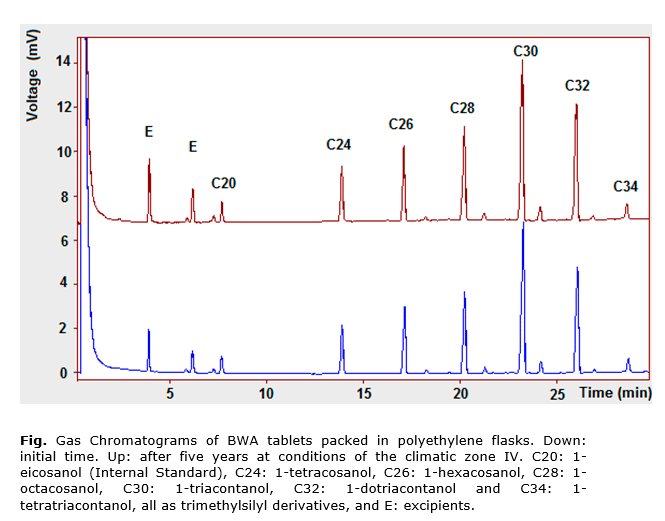
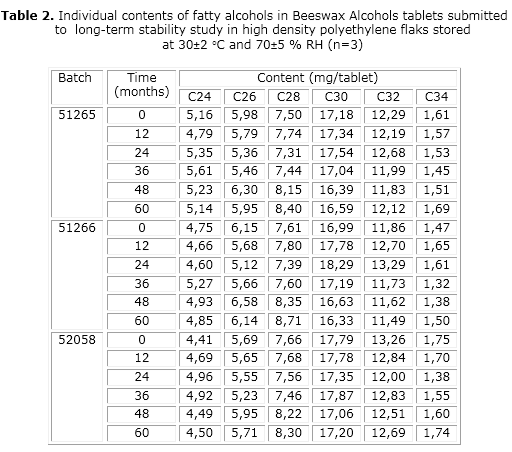
<body><![CDATA[<p><font size="2" face="Verdana"> PREPARATION OF SAMPLE SOLUTION AND GC ASSAY    </font></p>     <p><font size="2" face="Verdana"> Twenty tablets were weighed and the tablets    were transferred into dry mortar. Tablets powder equivalent to 25 mg of BWA    was quantitatively transferred to a test tube were 3 mL of Internal standard    solution (0,4 mg 1-eicosanol/mL in chloroform) and 2 mL chloroform were added.    Test tube was heated at 65 &#186;C for 15 minutes, with occasional shaking.    This solution was hot filtered through Whatman 1 filter paper to another test    tube, and 3 mL n-hexane was added. The tube was heated at 65 &#186;C for 3 minutes,    with occasional shaking. Afterwards, the tube was let to stand at 25 &#186;C    for 5 minutes and the solution was filtered through <i>Whatman</i> 1 filter    paper. A 0,5 mL aliquot was transferred to a 4 mL vial with screw cap, were    0,05 mL MSTFA and 0,5 mL chloroform was added. The vial was heated at 65 &#176;C    for 15 minutes. Samples were prepared by triplicate. </font></p>     <p><font size="2" face="Verdana"> A volume of 0,5 &#181;L of the sample solution    was injected in the GC equipment in splitless mode. The oven was heated from    70 &#176;C (1 min) to 200 &#176;C (at 30 &#176;C/min), and from 200 to 320 &#176;C    (at 8 &#176;C/min) with 15 min isothermal at the final temperature. Hydrogen    was used as carrier gas (at 1 mL/min), and detector and injector temperature    was 320 &#176;C. </font></p>     <p>&nbsp;</p>     <p> <font size="2" face="Verdana"><b><font size="3">RESULTS </font></b> </font></p>     <p><font size="2" face="Verdana"> No individual out of specification values were    observed for assayed parameters during all the study. Average mass, hardness,    disintegration time and BWA content (<a href="/img/revistas/far/v49n4/t0110415.gif">table 1</a>), as    well as organoleptic characteristics and microbiological content, were within    specifications. On its side, the individual contents of the six fatty alcohols,    determined by gas chromatography (<a href="#tab2">table 2</a> and <a href="/img/revistas/far/v49n4/f0110415.gif">fig</a>.),    matched with the initial contents, keeping the relative proportions that define    BWA&#8217;s identity. Likewise, the small variations in BWA&#8217;s content    were within the permitted dispersion of the analytical method (&#8804;2 %).<sup>9</sup>    Data analysis show that the mean content of BWA in the tablets packed in HDPE    flasks and stored for 5 years under 30&#177;2 &ordm;C/70 &#177;5 % RH did not    differ statistically from the initial content. </font></p>     <p align="center"><img src="/img/revistas/far/v49n4/t0210415.gif" width="512" height="452"><a name="tab2"></a></p>     <p>&nbsp;</p>     <p> <font size="2" face="Verdana"><b><font size="3">DISCUSSION</font></b> </font></p>     <p><font size="2" face="Verdana"> This long-term stability study support the high    stability of Abexol tablets, which did not undergo evident degradation after    60 months at the conditions of the climatic zone IV. Although disintegration    time and hardness (tablet breaking force) increased during the study, final    values agreed the specifications limits of these parameters; therefore, bioavailability    of BWA should not be affected after 60 months of tablet storage at these conditions.    This behavior evidences a cohesion increase of the tablet components on aging    under high-humidity conditions, which has been too observed by other authors.<sup>12    </sup> </font></p>     ]]></body>
<body><![CDATA[<p><font size="2" face="Verdana"> The high stability observed in this study is    consistent with the result of a stability study of these tablets conducted in    Australia in conditions of the climatic zone II (<i>Rainbow &amp; Nature</i>    <i>LTD</i>, Sydney, Australia, 2011, unpublished data). Additionally, these    results represent new evidences of the high stability of this product, coherent    with those of the stability study of BWA tablets manufactured in Cuba and packed    in PVC /aluminum blisters,<sup>5 </sup>and with a previous study by Differential    Scanning Calorimetry that demonstrated the high thermal stability of the active    substance and its null interaction with the excipients.<sup>6</sup> </font></p>     <p><font size="2" face="Verdana"> Long<b>-</b>term stability<b> </b>studies, so-called    real-time stability<b> </b>studies, define the shelf life of a product. The    results of this<i> </i> study support that Abexol<sup>&#174;</sup> (BWA) 50    mg tablets packed in white high density polyethylene flasks and stored at the    conditions of the climatic zone IV have a shelf life of 5 years. </font></p>     <p>&nbsp;</p>     <p> <font size="2" face="Verdana"><b><font size="3">REFERENCES </font></b> </font></p>     <!-- ref --><p><font size="2" face="Verdana"> 1. Gonz&#225;lez V, Sierra R, Magraner J, Rodr&#237;guez-Leyes    E. M&#233;todo para la determinaci&#243;n por cromatograf&#237;a de gases del    contenido de D-002, una nueva sustancia biologicamente activa purificada de    la cera de abejas. Rev CENIC Cien Quim. 2006;37(1):21-2.     </font></p>     <!-- ref --><p><font size="2" face="Verdana"> 2. L&#243;pez E, Illnait J, Molina V, Oyarz&#225;bal    A, Fern&#225;ndez L, P&#233;rez Y, et al. Effects of D-002 (beeswax alcohols)    on lipid peroxidation in middle-aged and older subjects. Latin Am J Pharm. 2008;27:695-703.        </font></p>     <!-- ref --><p><font size="2" face="Verdana"> 3. P&#233;rez Y, Oyarz&#225;bal A, Mas R, Molina    V, Jim&#233;nez S. Protective effect of D002, a mixture of beeswax alcohols    against indomethacin-induced gastric ulcers and mechanism of action. J Nat Med.    2013;67(1):182-9.     </font></p>     ]]></body>
<body><![CDATA[<!-- ref --><p><font size="2" face="Verdana"> 4. Illnait J, Rodriguez I, Molina V, Mendoza    S, Mas R, Fern&#225;ndez L, et al. Effects of D-002 (beeswax Alcohols) on gastrointestinal    symptoms and oxidative markers in middle-aged and older subjects. Lat Am J Pharm.    2013;32:166-74.     </font></p>     <!-- ref --><p><font size="2" face="Verdana"> 5. Gonz&#225;lez VL, Sierra R, Marrero D, Rodr&#237;guez    EA. Estudios de estabilidad del D002, mezcla de alcoholes grasos purificados    de la cera de abejas, ingrediente activo y tabletas (3 a&#241;os). Rev Cub Qu&#237;m.    2011;XXIII(3):46-51.     </font></p>     <!-- ref --><p><font size="2" face="Verdana"> 6. Gonz&#225;lez VL, Marrero D, Sierra R, Mart&#237;nez    L. Estudios organol&#233;pticos, fisicoqu&#237;micos microbiol&#243;gicos e    interacci&#243;n con excipientes farmac&#233;uticos de un extracto purificado    de cera de Apis mellifera. Rev Cub Farm. 2010;44(3):354-9.     </font></p>     <!-- ref --><p><font size="2" face="Verdana"> 7. European Agency for the Evaluation of Medicinal    Products. ICH Q1AR Stability Testing Guideline: Stability Testing of New Drug    Substances and Products, London: EAENP; 2000.     </font></p>     <!-- ref --><p><font size="2" face="Verdana"> 8. Grimm W. Extension of the International Conference    on Harmonization Tripartite Guideline for Stability Testing of New Drug Substances    and Products to Countries of Climatic Zones III and IV. Drug Develop &amp; Indust    Pharm. 1998;24:313-25.     </font></p>     ]]></body>
<body><![CDATA[<p><font size="2" face="Verdana"> 9. CECMED. Requerimientos de los estudios de    estabilidad para el registro de productos farmac&#233;uticos nuevos y conocidos.    Centro de Control de Medicamentos, Equipos y Dispositivos. , Regulaci&#243;n    23; 2000. </font></p>     <!-- ref --><p><font size="2" face="Verdana"> 10. Marrero D, Gonz&#225;lez VL, Sierra R, Rodr&#237;guez    EA, Vicente R, Vel&#225;zquez C. Validaci&#243;n de una nueva metodolog&#237;a    anal&#237;tica por CG capilar para la determinaci&#243;n de D002 en tabletas    con dosis de 50 mg. Rev Cub Qu&#237;m. 2009;XX(3):27-31.     </font></p>     <!-- ref --><p><font size="2" face="Verdana"> 11. The United States Pharmacopeial Convention.    United Stated Pharmacopoeia 33 and National Formulary 28. Supplement 1. (Monograph    on CD-ROM). Rockville, MD: USPC, Inc; 2010.     </font></p>     <!-- ref --><p><font size="2" face="Verdana"> 12. Chowhan ZT, Amaro A. The Effect of Low-    and High-Humidity Aging on the Hardness, Disintegration Time and Dissolution    Rate of Tribasic Calcium Phosphate-Based Tablets. Drug Dev Ind Pharm 1979;5(6):545-562.        </font></p>     <p>&nbsp;</p>     <p>&nbsp;</p>     <p><font size="2" face="Verdana">Recibido: 16 de julio de 2014.    ]]></body>
<body><![CDATA[<br>   </font><font size="2" face="Verdana">Aprobado: 1 de mayo de 2015.</font></p>     <p>&nbsp;</p>     <p>&nbsp;</p>     <p> <font size="2" face="Verdana"><i>V&#237;ctor Luis Gonz&#225;lez-Canavaciolo.</i>    Centro de Productos Naturales. Centro Nacional de Investigaciones Cient&#237;ficas.    Calle 198, s.n., e/ 19 y 21, Atabey, Playa, La Habana, Cuba. </font><font size="2" face="Verdana">Tel&#233;fono:    271 42 25. Correo electr&#243;nico: <a href="mailto:victor.gonzalez@cnic.edu.cu">victor.gonzalez@cnic.edu.cu</a></font></p>      ]]></body><back>
<ref-list>
<ref id="B1">
<label>1</label><nlm-citation citation-type="journal">
<person-group person-group-type="author">
<name>
<surname><![CDATA[González]]></surname>
<given-names><![CDATA[V]]></given-names>
</name>
<name>
<surname><![CDATA[Sierra]]></surname>
<given-names><![CDATA[R]]></given-names>
</name>
<name>
<surname><![CDATA[Magraner]]></surname>
<given-names><![CDATA[J]]></given-names>
</name>
<name>
<surname><![CDATA[Rodríguez-Leyes]]></surname>
<given-names><![CDATA[E]]></given-names>
</name>
</person-group>
<article-title xml:lang="es"><![CDATA[Método para la determinación por cromatografía de gases del contenido de D-002, una nueva sustancia biologicamente activa purificada de la cera de abejas]]></article-title>
<source><![CDATA[Rev CENIC Cien Quim]]></source>
<year>2006</year>
<volume>37</volume>
<numero>1</numero>
<issue>1</issue>
<page-range>21-2</page-range></nlm-citation>
</ref>
<ref id="B2">
<label>2</label><nlm-citation citation-type="journal">
<person-group person-group-type="author">
<name>
<surname><![CDATA[López]]></surname>
<given-names><![CDATA[E]]></given-names>
</name>
<name>
<surname><![CDATA[Illnait]]></surname>
<given-names><![CDATA[J]]></given-names>
</name>
<name>
<surname><![CDATA[Molina]]></surname>
<given-names><![CDATA[V]]></given-names>
</name>
<name>
<surname><![CDATA[Oyarzábal]]></surname>
<given-names><![CDATA[A]]></given-names>
</name>
<name>
<surname><![CDATA[Fernández]]></surname>
<given-names><![CDATA[L]]></given-names>
</name>
<name>
<surname><![CDATA[Pérez]]></surname>
<given-names><![CDATA[Y]]></given-names>
</name>
</person-group>
<article-title xml:lang="en"><![CDATA[Effects of D-002 (beeswax alcohols) on lipid peroxidation in middle-aged and older subjects]]></article-title>
<source><![CDATA[Latin Am J Pharm]]></source>
<year>2008</year>
<volume>27</volume>
<page-range>695-703</page-range></nlm-citation>
</ref>
<ref id="B3">
<label>3</label><nlm-citation citation-type="journal">
<person-group person-group-type="author">
<name>
<surname><![CDATA[Pérez]]></surname>
<given-names><![CDATA[Y]]></given-names>
</name>
<name>
<surname><![CDATA[Oyarzábal]]></surname>
<given-names><![CDATA[A]]></given-names>
</name>
<name>
<surname><![CDATA[Mas]]></surname>
<given-names><![CDATA[R]]></given-names>
</name>
<name>
<surname><![CDATA[Molina]]></surname>
<given-names><![CDATA[V]]></given-names>
</name>
<name>
<surname><![CDATA[Jiménez]]></surname>
<given-names><![CDATA[S]]></given-names>
</name>
</person-group>
<article-title xml:lang="en"><![CDATA[Protective effect of D002, a mixture of beeswax alcohols against indomethacin-induced gastric ulcers and mechanism of action]]></article-title>
<source><![CDATA[J Nat Med]]></source>
<year>2013</year>
<volume>67</volume>
<numero>1</numero>
<issue>1</issue>
<page-range>182-9</page-range></nlm-citation>
</ref>
<ref id="B4">
<label>4</label><nlm-citation citation-type="journal">
<person-group person-group-type="author">
<name>
<surname><![CDATA[Illnait]]></surname>
<given-names><![CDATA[J]]></given-names>
</name>
<name>
<surname><![CDATA[Rodriguez]]></surname>
<given-names><![CDATA[I]]></given-names>
</name>
<name>
<surname><![CDATA[Molina]]></surname>
<given-names><![CDATA[V]]></given-names>
</name>
<name>
<surname><![CDATA[Mendoza]]></surname>
<given-names><![CDATA[S]]></given-names>
</name>
<name>
<surname><![CDATA[Mas]]></surname>
<given-names><![CDATA[R]]></given-names>
</name>
<name>
<surname><![CDATA[Fernández]]></surname>
<given-names><![CDATA[L]]></given-names>
</name>
</person-group>
<article-title xml:lang="en"><![CDATA[Effects of D-002 (beeswax Alcohols) on gastrointestinal symptoms and oxidative markers in middle-aged and older subjects]]></article-title>
<source><![CDATA[Lat Am J Pharm]]></source>
<year>2013</year>
<volume>32</volume>
<page-range>166-74</page-range></nlm-citation>
</ref>
<ref id="B5">
<label>5</label><nlm-citation citation-type="journal">
<person-group person-group-type="author">
<name>
<surname><![CDATA[González]]></surname>
<given-names><![CDATA[VL]]></given-names>
</name>
<name>
<surname><![CDATA[Sierra]]></surname>
<given-names><![CDATA[R]]></given-names>
</name>
<name>
<surname><![CDATA[Marrero]]></surname>
<given-names><![CDATA[D]]></given-names>
</name>
<name>
<surname><![CDATA[Rodríguez]]></surname>
<given-names><![CDATA[EA]]></given-names>
</name>
</person-group>
<article-title xml:lang="pt"><![CDATA[Estudios de estabilidad del D002, mezcla de alcoholes grasos purificados de la cera de abejas, ingrediente activo y tabletas (3 años)]]></article-title>
<source><![CDATA[Rev Cub Quím]]></source>
<year>2011</year>
<volume>XXIII</volume>
<numero>3</numero>
<issue>3</issue>
<page-range>46-51</page-range></nlm-citation>
</ref>
<ref id="B6">
<label>6</label><nlm-citation citation-type="journal">
<person-group person-group-type="author">
<name>
<surname><![CDATA[González]]></surname>
<given-names><![CDATA[VL]]></given-names>
</name>
<name>
<surname><![CDATA[Marrero]]></surname>
<given-names><![CDATA[D]]></given-names>
</name>
<name>
<surname><![CDATA[Sierra]]></surname>
<given-names><![CDATA[R]]></given-names>
</name>
<name>
<surname><![CDATA[Martínez]]></surname>
<given-names><![CDATA[L]]></given-names>
</name>
</person-group>
<article-title xml:lang="es"><![CDATA[Estudios organolépticos, fisicoquímicos microbiológicos e interacción con excipientes farmacéuticos de un extracto purificado de cera de Apis mellifera]]></article-title>
<source><![CDATA[Rev Cub Farm]]></source>
<year>2010</year>
<volume>44</volume>
<numero>3</numero>
<issue>3</issue>
<page-range>354-9</page-range></nlm-citation>
</ref>
<ref id="B7">
<label>7</label><nlm-citation citation-type="book">
<collab>European Agency for the Evaluation of Medicinal Products</collab>
<source><![CDATA[ICH Q1AR Stability Testing Guideline: Stability Testing of New Drug Substances and Products,]]></source>
<year>2000</year>
<publisher-loc><![CDATA[London ]]></publisher-loc>
<publisher-name><![CDATA[EAENP]]></publisher-name>
</nlm-citation>
</ref>
<ref id="B8">
<label>8</label><nlm-citation citation-type="journal">
<person-group person-group-type="author">
<name>
<surname><![CDATA[Grimm]]></surname>
<given-names><![CDATA[W]]></given-names>
</name>
</person-group>
<article-title xml:lang="en"><![CDATA[Extension of the International Conference on Harmonization Tripartite Guideline for Stability Testing of New Drug Substances and Products to Countries of Climatic Zones III and IV]]></article-title>
<source><![CDATA[Drug Develop & Indust Pharm]]></source>
<year>1998</year>
<volume>24</volume>
<page-range>313-25</page-range></nlm-citation>
</ref>
<ref id="B9">
<label>9</label><nlm-citation citation-type="">
<collab>CECMED^dCentro de Control de Medicamentos, Equipos y Dispositivos</collab>
<source><![CDATA[Requerimientos de los estudios de estabilidad para el registro de productos farmacéuticos nuevos y conocidos, Regulación 23]]></source>
<year>2000</year>
</nlm-citation>
</ref>
<ref id="B10">
<label>10</label><nlm-citation citation-type="journal">
<person-group person-group-type="author">
<name>
<surname><![CDATA[Marrero]]></surname>
<given-names><![CDATA[D]]></given-names>
</name>
<name>
<surname><![CDATA[González]]></surname>
<given-names><![CDATA[VL]]></given-names>
</name>
<name>
<surname><![CDATA[Sierra]]></surname>
<given-names><![CDATA[R]]></given-names>
</name>
<name>
<surname><![CDATA[Rodríguez]]></surname>
<given-names><![CDATA[EA]]></given-names>
</name>
<name>
<surname><![CDATA[Vicente]]></surname>
<given-names><![CDATA[R]]></given-names>
</name>
<name>
<surname><![CDATA[Velázquez]]></surname>
<given-names><![CDATA[C]]></given-names>
</name>
</person-group>
<article-title xml:lang="es"><![CDATA[Validación de una nueva metodología analítica por CG capilar para la determinación de D002 en tabletas con dosis de 50 mg]]></article-title>
<source><![CDATA[Rev Cub Quím]]></source>
<year>2009</year>
<volume>XX</volume>
<numero>3</numero>
<issue>3</issue>
<page-range>27-31</page-range></nlm-citation>
</ref>
<ref id="B11">
<label>11</label><nlm-citation citation-type="book">
<collab>The United States Pharmacopeial Convention</collab>
<source><![CDATA[United Stated Pharmacopoeia 33 and National Formulary 28.Supplement 1. (Monograph on CD-ROM).]]></source>
<year>2010</year>
<publisher-loc><![CDATA[Rockville, MD ]]></publisher-loc>
<publisher-name><![CDATA[USPC, Inc]]></publisher-name>
</nlm-citation>
</ref>
<ref id="B12">
<label>12</label><nlm-citation citation-type="journal">
<person-group person-group-type="author">
<name>
<surname><![CDATA[Chowhan]]></surname>
<given-names><![CDATA[ZT]]></given-names>
</name>
<name>
<surname><![CDATA[Amaro]]></surname>
<given-names><![CDATA[A]]></given-names>
</name>
</person-group>
<article-title xml:lang="en"><![CDATA[The Effect of Low- and High-Humidity Aging on the Hardness, Disintegration Time and Dissolution Rate of Tribasic Calcium Phosphate-Based Tablets]]></article-title>
<source><![CDATA[Drug Dev Ind Pharm]]></source>
<year>1979</year>
<volume>5</volume>
<numero>6</numero>
<issue>6</issue>
<page-range>545-562</page-range></nlm-citation>
</ref>
</ref-list>
</back>
</article>
