<?xml version="1.0" encoding="ISO-8859-1"?><article xmlns:mml="http://www.w3.org/1998/Math/MathML" xmlns:xlink="http://www.w3.org/1999/xlink" xmlns:xsi="http://www.w3.org/2001/XMLSchema-instance">
<front>
<journal-meta>
<journal-id>0034-7523</journal-id>
<journal-title><![CDATA[Revista Cubana de Medicina]]></journal-title>
<abbrev-journal-title><![CDATA[Rev cubana med]]></abbrev-journal-title>
<issn>0034-7523</issn>
<publisher>
<publisher-name><![CDATA[Centro Nacional de Información de Ciencias MédicasEditorial Ciencias Médicas]]></publisher-name>
</publisher>
</journal-meta>
<article-meta>
<article-id>S0034-75232010000200002</article-id>
<title-group>
<article-title xml:lang="es"><![CDATA[Interferón alfa 2b recombinante más ribavirina en el tratamiento de la hepatitis crónica C]]></article-title>
<article-title xml:lang="en"><![CDATA[Recombinant Interferon alfa-2b plus Ribavirin in treatment of chronic hepatitis C]]></article-title>
</title-group>
<contrib-group>
<contrib contrib-type="author">
<name>
<surname><![CDATA[Sánchez Rodríguez]]></surname>
<given-names><![CDATA[Yoan Antonio]]></given-names>
</name>
<xref ref-type="aff" rid="A01"/>
</contrib>
<contrib contrib-type="author">
<name>
<surname><![CDATA[Arús Soler]]></surname>
<given-names><![CDATA[Enrique]]></given-names>
</name>
<xref ref-type="aff" rid="A01"/>
</contrib>
<contrib contrib-type="author">
<name>
<surname><![CDATA[Grá Oramas]]></surname>
<given-names><![CDATA[Bienvenido]]></given-names>
</name>
<xref ref-type="aff" rid="A01"/>
</contrib>
<contrib contrib-type="author">
<name>
<surname><![CDATA[López Saura]]></surname>
<given-names><![CDATA[Pedro]]></given-names>
</name>
<xref ref-type="aff" rid="A02"/>
</contrib>
<contrib contrib-type="author">
<name>
<surname><![CDATA[Nodarse Cuní]]></surname>
<given-names><![CDATA[Hugo]]></given-names>
</name>
<xref ref-type="aff" rid="A02"/>
</contrib>
</contrib-group>
<aff id="A01">
<institution><![CDATA[,Instituto de Gastroenterología  ]]></institution>
<addr-line><![CDATA[La Habana ]]></addr-line>
<country>Cuba</country>
</aff>
<aff id="A02">
<institution><![CDATA[,Centro de Ingeniería Genética y Biotecnología  ]]></institution>
<addr-line><![CDATA[La Habana ]]></addr-line>
<country>Cuba</country>
</aff>
<pub-date pub-type="pub">
<day>00</day>
<month>06</month>
<year>2010</year>
</pub-date>
<pub-date pub-type="epub">
<day>00</day>
<month>06</month>
<year>2010</year>
</pub-date>
<volume>49</volume>
<numero>2</numero>
<fpage>0</fpage>
<lpage>0</lpage>
<copyright-statement/>
<copyright-year/>
<self-uri xlink:href="http://scielo.sld.cu/scielo.php?script=sci_arttext&amp;pid=S0034-75232010000200002&amp;lng=en&amp;nrm=iso"></self-uri><self-uri xlink:href="http://scielo.sld.cu/scielo.php?script=sci_abstract&amp;pid=S0034-75232010000200002&amp;lng=en&amp;nrm=iso"></self-uri><self-uri xlink:href="http://scielo.sld.cu/scielo.php?script=sci_pdf&amp;pid=S0034-75232010000200002&amp;lng=en&amp;nrm=iso"></self-uri><abstract abstract-type="short" xml:lang="es"><p><![CDATA[El virus de la hepatitis C se ha convertido en la causa principal de hepatitis crónica, cirrosis hepática, hepatocarcinoma, y trasplante de hígado a nivel mundial. OBJETIVO: El presente estudio estuvo dirigido a determinar la evolución virológica, bioquímica e histológica de los pacientes con hepatitis crónica C bajo terapia combinada Interferón a 2b recombinante más ribavirina e identifica los principales factores asociados a las tasas obtenidas de respuesta virológica sostenida. MÉTODOS: Ensayo clínico-terapéutico fase IV, abierto, no controlado y multicéntrico rectorado por el Instituto de Gastroenterología y el Centro de Ingeniería Genética y Biotecnología en el período comprendido de mayo de 2001 a mayo de 2006. La muestra estuvo conformada por 122 pacientes con hepatitis crónica C que cumplieron con criterios de inclusión y exclusión predeterminados. Se utilizó interferón a 2b recombinante (3 millones de unidades 3 veces por semana) más ribavirina (1 000 o 1 200 mg diarios en dependencia del peso corporal) durante 48 sem. RESULTADOS: Se obtuvo una tasa de respuesta virológica y bioquímica sostenida a la semana 72 de 32,8 y 50,8 % respectivamente. Un 41,3 % del total de pacientes experimentó mejoría histológica a expensas de la reducción de la fibrosis y pocos cambios en la inflamación. CONCLUSIONES: Teniendo en cuenta la tasa de respuesta global obtenida, se consideró como tratamiento eficaz para la hepatitis crónica C y se recomendó profundizar en el conocimiento de las características de la infección en Cuba así como en opciones de tratamiento más eficaces para esta enfermedad.]]></p></abstract>
<abstract abstract-type="short" xml:lang="en"><p><![CDATA[The hepatitis C virus becomes in leading cause of chronic hepatitis, hepatic cirrhosis, hepatocarcinoma and liver transplant at world level. OBJECTIVE: The aim of present study is to determine the virological, biochemical and histological course of patients presenting with Chronic hepatitis C under a combination of recombinant Interferon alfa-2b plus Ribavirin and to identify the main factors associated with the rates obtained of virological response. METHODS: A non-controlled and multicenter phase IV clinical-therapeutical trial was sponsored by the Institute of Gastroenterology and the Genetics and Biotechnology Engineering Center from May, 2002 to May, 2006. Sample included 122 patients diagnosed with chronic hepatitis C fulfilling the predetermined inclusion and exclusion criteria. Recombinant Interferon alfa-2b (3 millions of t.i.d units) was used plus Ribavirin (1000 or 1200 mg daily depending on the body weight) during 48 weeks. RESULTS: We achieved a sustained biochemical and virological response rate of 32.8 and 50.8 %, respectively at week 72. A 41.3,% from the total of patients had a histological improvement at the expense of reduction of fibrosis and a few changes in inflammation level. CONCLUSIONS: Raking into account the global response rate achieved this combined treatment was considered effectiveness for chronic hepatitis C and we recommended to deepen in the knowledge of infection in Cuba, as well as in more efficient treatment options for this disease.]]></p></abstract>
<kwd-group>
<kwd lng="es"><![CDATA[Hepatitis crónica C]]></kwd>
<kwd lng="es"><![CDATA[interferón a 2b]]></kwd>
<kwd lng="es"><![CDATA[ribavirina]]></kwd>
<kwd lng="es"><![CDATA[respuesta virológica sostenida]]></kwd>
<kwd lng="en"><![CDATA[Chronic hepatitis C]]></kwd>
<kwd lng="en"><![CDATA[Interferon a 2b]]></kwd>
<kwd lng="en"><![CDATA[Ribavirin]]></kwd>
<kwd lng="en"><![CDATA[sustained virological response]]></kwd>
</kwd-group>
</article-meta>
</front><body><![CDATA[ <p align="right"><font face="Verdana" size="2"><B>TRABAJOS ORIGINALES </B></font></p>     <p><B> </B></p> <B>    <P>      <P>      <P>  </B>     <P><b><font face="Verdana" size="4">Interfer&oacute;n alfa 2b recombinante m&aacute;s    ribavirina en el tratamiento de la hepatitis cr&oacute;nica C</font></b>     <P>  <B>     <P>     <P><font face="Verdana" size="3"><b>Recombinant Interferon alfa-2b plus Ribavirin    in treatment of chronic hepatitis C</b></font>      <P>      ]]></body>
<body><![CDATA[<P>      <P>      <P>      <P><font face="Verdana" size="2">Yoan Antonio S&aacute;nchez Rodr&iacute;guez<SUP>I</SUP>;    Enrique Ar&uacute;s Soler<SUP>II</SUP>; Bienvenido Gr&aacute; Oramas<SUP>III</SUP>;    Pedro L&oacute;pez Saura<SUP>IV</SUP>; Hugo Nodarse Cun&iacute;<SUP>V</SUP></font>  </B>      <P>      <P>      <P><font face="Verdana" size="2"><SUP>I</SUP>Especialista de I Grado en Gastroenterolog&iacute;a.    Instituto de Gastroenterolog&iacute;a. La Habana, Cuba.    <br>   </font><font face="Verdana" size="2"><SUP>II</SUP>Doctor en Ciencias M&eacute;dicas.    Especialista de II Grado en Gastroenterolog&iacute;a. Instituto de Gastroenterolog&iacute;a.    La Habana, Cuba.    <br>   </font><font face="Verdana" size="2"><SUP>III</SUP>Doctor en Ciencias M&eacute;dicas.    Especialista de II Grado en Anatom&iacute;a Patol&oacute;gica. Investigador    Auxiliar. Profesor Auxiliar. Instituto Nacional de Gastroenterolog&iacute;a.    La Habana, Cuba.    <br>   </font><font face="Verdana" size="2"><SUP>IV</SUP>Doctor en Ciencias Biol&oacute;gicas.    Investigador Titular. Profesor Titular. Centro de Ingenier&iacute;a Gen&eacute;tica    y Biotecnolog&iacute;a. La Habana, Cuba.    ]]></body>
<body><![CDATA[<br>   </font><font face="Verdana" size="2"><SUP>V</SUP>M&aacute;ster en Ciencias Farmac&eacute;uticas.    Investigador Agregado. Centro de Ingenier&iacute;a Gen&eacute;tica y Biotecnolog&iacute;a.    La Habana, Cuba. </font>     <P>      <P>     <P>  <hr size="1" noshade>     <P>      <P>      <P>      <P>      <P><font face="Verdana" size="2"><B>RESUMEN</B> </font>     <P>      ]]></body>
<body><![CDATA[<P><font face="Verdana" size="2">El virus de la hepatitis C se ha convertido en    la causa principal de hepatitis cr&oacute;nica, cirrosis hep&aacute;tica, hepatocarcinoma,    y trasplante de h&iacute;gado a nivel mundial.     <br>   </font><font face="Verdana" size="2"><B>OBJETIVO</B>: El presente estudio estuvo    dirigido a determinar la evoluci&oacute;n virol&oacute;gica, bioqu&iacute;mica    e histol&oacute;gica de los pacientes con hepatitis cr&oacute;nica C bajo terapia    combinada Interfer&oacute;n <font face="Symbol">a</font> 2b recombinante m&aacute;s    ribavirina e identifica los principales factores asociados a las tasas obtenidas    de respuesta virol&oacute;gica sostenida. </font>     <br>   <font face="Verdana" size="2"><B>M&Eacute;TODOS</B>: Ensayo cl&iacute;nico-terap&eacute;utico    fase IV, abierto, no controlado y multic&eacute;ntrico rectorado por el Instituto    de Gastroenterolog&iacute;a y el Centro de Ingenier&iacute;a Gen&eacute;tica    y Biotecnolog&iacute;a en el per&iacute;odo comprendido de mayo de 2001 a mayo    de 2006. La muestra estuvo conformada por 122 pacientes con hepatitis cr&oacute;nica    C que cumplieron con criterios de inclusi&oacute;n y exclusi&oacute;n predeterminados.    Se utiliz&oacute; interfer&oacute;n<font face="Symbol"> a</font> 2b recombinante    (3 millones de unidades 3 veces por semana) m&aacute;s ribavirina (1 000 o 1    200 mg diarios en dependencia del peso corporal) durante 48 sem.    <br>   </font><font face="Verdana" size="2"><B>RESULTADOS</B>: Se obtuvo una tasa de    respuesta virol&oacute;gica y bioqu&iacute;mica sostenida a la semana 72 de    32,8 y 50,8 % respectivamente. Un 41,3 % del total de pacientes experiment&oacute;    mejor&iacute;a histol&oacute;gica a expensas de la reducci&oacute;n de la fibrosis    y pocos cambios en la inflamaci&oacute;n. </font>     <br>   <font face="Verdana" size="2"><B>CONCLUSIONES</B>: Teniendo en cuenta la tasa    de respuesta global obtenida, se consider&oacute; como tratamiento eficaz para    la hepatitis cr&oacute;nica C y se recomend&oacute; profundizar en el conocimiento    de las caracter&iacute;sticas de la infecci&oacute;n en Cuba as&iacute; como    en opciones de tratamiento m&aacute;s eficaces para esta enfermedad. </font>      <P>      <P><font face="Verdana" size="2"><B>Palabras clave</B>: Hepatitis cr&oacute;nica    C, interfer&oacute;n <font face="Symbol">a </font>2b<I>,</I><B><I> </I></B>ribavirina,    respuesta virol&oacute;gica sostenida. </font>  <hr size="1" noshade>     <p><b><font size="2" face="Verdana">ABSTRACT</font></b></p>     <p><font face="Verdana" size="2"> The hepatitis C virus becomes in leading cause    of chronic hepatitis, hepatic cirrhosis, hepatocarcinoma and liver transplant    at world level. <b>    <br>   OBJECTIVE</b>: The aim of present study is to determine the virological, biochemical    and histological course of patients presenting with Chronic hepatitis C under    a combination of recombinant Interferon alfa-2b plus Ribavirin and to identify    the main factors associated with the rates obtained of virological response.<b>    ]]></body>
<body><![CDATA[<br>   METHODS</b>: A non-controlled and multicenter phase IV clinical-therapeutical    trial was sponsored by the Institute of Gastroenterology and the Genetics and    Biotechnology Engineering Center from May, 2002 to May, 2006. Sample included    122 patients diagnosed with chronic hepatitis C fulfilling the predetermined    inclusion and exclusion criteria. Recombinant Interferon alfa-2b (3 millions    of t.i.d units) was used plus Ribavirin (1000 or 1200 mg daily depending on    the body weight) during 48 weeks. <b>    <br>   RESULTS</b>: We achieved a sustained biochemical and virological response rate    of 32.8 and 50.8 %, respectively at week 72. A 41.3,% from the total of patients    had a histological improvement at the expense of reduction of fibrosis and a    few changes in inflammation level. <b>    <br>   CONCLUSIONS</b>: Raking into account the global response rate achieved this    combined treatment was considered effectiveness for chronic hepatitis C and    we recommended to deepen in the knowledge of infection in Cuba, as well as in    more efficient treatment options for this disease. </font> </p>     <p><font face="Verdana" size="2"><b>Key words</b>: Chronic hepatitis C, Interferon    <font face="Symbol">a</font> 2b, Ribavirin, sustained virological response.</font>  <hr size="1" noshade>     <p>&nbsp;</p>     <p>&nbsp;</p>     <P>     <P>      <P><font face="Verdana" size="3"><B>INTRODUCCI&Oacute;N</B> </font>      <P>      ]]></body>
<body><![CDATA[<P><font face="Verdana" size="2">El virus de la hepatitis C (VHC) desde su primera    descripci&oacute;n en 1989<SUP>1</SUP> ha sido motivo de m&uacute;ltiples investigaciones.<SUP>2,3</SUP>    Es el mayor agente causal de hepatitis cr&oacute;nica, cirrosis hep&aacute;tica    y carcinoma hepatocelular y se estima que ha infectado aproximadamente entre    170 y 200 millones de personas en el mundo.<SUP>3,4</SUP> </font>      <P><font face="Verdana" size="2">Cuba, pa&iacute;s en desarrollo, con una prevalencia    de VHC de 0,7 %, mantiene una incidencia anual de 12 casos por 100 000 habitantes.<SUP>5    </SUP> </font>     <P><font face="Verdana" size="2">El tratamiento actual contra este virus va encaminado    a la obtenci&oacute;n de la respuesta virol&oacute;gica sostenida (RVS), definida    como la no detecci&oacute;n del ARN-VHC en suero, 6 meses despu&eacute;s de    finalizada la terapia antiviral. </font>      <P><font face="Verdana" size="2">El empleo de los interferones en las hepatitis    virales se justifica por su efecto antiviral, antiinflamatorio, antifibr&oacute;tico    y anticarcinogen&eacute;tico.<SUP>6</SUP> Sin embargo, los resultados de la    monoterapia con interfer&oacute;n (IFN) en pacientes <font color="#000000"><i>naive</i></font>    (sin antecedentes de tratamiento antiviral o paciente virgen) con hepatitis    cr&oacute;nica C (HCC), comprobaron que el r&eacute;gimen terap&eacute;utico    <FONT  COLOR="#000200">de monoterapia con IFN s</FONT>olo permit&iacute;a alcanzar hasta    17 % de RVS.<SUP>7</SUP> </font>      <P><font face="Verdana" size="2">En un ensayo cl&iacute;nico cubano controlado,    aleatorizado, con IFN monoterapia durante 9 meses, se logr&oacute; una tasa    de respuesta bioqu&iacute;mica sostenida de 33,3 % en el grupo en tratamiento    y 0 % para el grupo control, pero este ensayo tuvo la limitante de no contar    con estudios virol&oacute;gicos.<SUP>8</SUP> </font>     <P><font face="Verdana" size="2">La combinaci&oacute;n de la ribavirina con el    IFN permite desarrollar una respuesta frente a varias prote&iacute;nas virales    de predominio CD<FONT  COLOR="#000200"> 4</FONT> tipo 1, que podr&iacute;a justificar la RVS.<SUP>9</SUP>    </font>     <P><font face="Verdana" size="2">En un ensayo cl&iacute;nico con terapia combinada,    IFN m&aacute;s ribavirina, donde se estudiaron 912 pacientes con HCC, se obtuvo    en el grupo que us&oacute; la combinaci&oacute;n durante 48 sem, 38 % de RVS    contra 13 % en el grupo que us&oacute; monoterapia con IFN por igual tiempo.<SUP>10    </SUP>Otros investigadores obtuvieron similares resultados con igual periodo    de tratamiento.<SUP>11,12</SUP> </font>      <P><font face="Verdana" size="2">En otro estudio cubano, aleatorizado, a doble    ciegas y controlado con 47 pacientes afectos de HCC y tratados con terapia combinada,    se obtuvo un 65 % de negativizaci&oacute;n del ARN viral, 73 % de mejor&iacute;a    histol&oacute;gica y 72 % de normalizaci&oacute;n de las transaminasas. La evaluaci&oacute;n    global de los pacientes en este estudio mostr&oacute; un 46 % de respuesta completa.<SUP>13</SUP>    </font>      <P><font face="Verdana" size="2">Con el surgimiento del interfer&oacute;n pegilado    se abre una nueva brecha en el tratamiento de la HCC.<SUP>14 </SUP>Se han realizado    varios estudios con este medicamento, pero la investigaci&oacute;n que devino    pauta en el tratamiento de esta enfermedad fue la del griego <I>Hadziyannes</I>,    et al.<SUP>15</SUP> en la que con una serie de 1 311 casos, concluy&oacute;    que el tratamiento con peginterfer&oacute;n <font face="Symbol">a</font> 2&#170;    m&aacute;s ribavirina es efectivo y debe ser individualizado seg&uacute;n el    genotipo. </font>      <P><font face="Verdana" size="2">Con vistas a generalizar en nuestro pa&iacute;s    el uso de la terapia combinada IFN <font face="Symbol">a</font> 2b recombinante    m&aacute;s ribavirina se realiz&oacute; este estudio, encaminado a determinar    la evoluci&oacute;n virol&oacute;gica, bioqu&iacute;mica e histol&oacute;gica    de pacientes cr&oacute;nicamente infectados por el virus de la hepatitis C,    bajo tratamiento combinado con interfer&oacute;n <font face="Symbol">a</font>    2b recombinante m&aacute;s ribavirina durante 48 sem. Se procedi&oacute;, adem&aacute;s,    a identificar los principales factores asociados a las tasas de respuesta virol&oacute;gica    sostenida obtenidas al final del ensayo.</font>      ]]></body>
<body><![CDATA[<P>      <P>      <P>      <P><font face="Verdana" size="3"><B>M&Eacute;TODOS</B> </font>      <P><font face="Verdana" size="2">Se realiz&oacute; un ensayo cl&iacute;nico fase    IV, abierto, no controlado y multic&eacute;ntrico, que rectoraron el Instituto    de Gastroenterolog&iacute;a y el Centro de Ingenier&iacute;a Gen&eacute;tica    y Biotecnolog&iacute;a, en el per&iacute;odo de mayo de 2001 a mayo de 2006.    Se estudiaron 122 pacientes con HCC y cifras de alanin aminotransferasas (ALAT),    al menos, 2 veces por encima del valor normal, anticuerpos contra el VHC y ARN-VHC    en suero, as&iacute; como un da&ntilde;o hep&aacute;tico caracter&iacute;stico    de hepatitis cr&oacute;nica seg&uacute;n los resultados de una biopsia realizada    en los 12 meses previos a su inclusi&oacute;n. Los pacientes reclutados fueron    mayores de 18 a&ntilde;os de edad y ofrecieron su consentimiento por escrito    para participar en el estudio. Se excluyeron mujeres en edad f&eacute;rtil que    no utilicen alg&uacute;n anticonceptivo no hormonal, embarazadas o que lacten,    pacientes con cualquier enfermedad cr&oacute;nica descompensada, cifras bajas    de hemoglobina o con historia de hipersensibilidad a alguno de los componentes    de la terapia. </font>      <P><font face="Verdana" size="2">Se realiz&oacute; un an&aacute;lisis por intenci&oacute;n    de tratar. </font>     <P><font face="Verdana" size="2">El interfer&oacute;n se indic&oacute; a una dosis    de 3 millones de unidades, por v&iacute;a intramuscular, 3 veces por sem y la    ribavirina 2 veces al d&iacute;a por v&iacute;a oral hasta cumplir con la dosis    total de 1 000 o 1 200 mg/d&iacute;a seg&uacute;n correspondiera de acuerdo    al peso corporal, ambos durante 48 sem. </font>      <P><font face="Verdana" size="2">La terapia fue llevada a cabo de manera ambulatoria    por lo que fue solicitada la colaboraci&oacute;n del nivel primario de salud.    </font>     <P><font face="Verdana" size="2">La eficacia primaria se evalu&oacute; por la    <B>respuesta virol&oacute;gica sostenida</B>, definida por la negativizaci&oacute;n    del PCR-ARN-VHC 24 sem despu&eacute;s de finalizado el tratamiento, mientras    que la eficacia secundaria estuvo dada por las cifras de ALAT y el resultado    de la biopsia hep&aacute;tica a la sem 72. Las muestras de tejido hep&aacute;tico    fueron evaluadas por un solo pat&oacute;logo de acuerdo al &Iacute;ndice de    actividad histol&oacute;gica de Knodell. </font>      <P><font face="Verdana" size="2">Para estudiar el comportamiento de las variables    involucradas se estimaron las medidas de tendencia central y dispersi&oacute;n,    as&iacute; como la distribuci&oacute;n de frecuencias. Se realizaron los an&aacute;lisis    univariado y multivariado final (regresi&oacute;n log&iacute;stica m&uacute;ltiple)    pertinentes, teniendo en consideraci&oacute;n la naturaleza de cada variable    y su distribuci&oacute;n. </font>     ]]></body>
<body><![CDATA[<P><font face="Verdana" size="2">Para el procesamiento de los datos nos auxiliamos    del Software Estad&iacute;stico Profesional SPSS Versi&oacute;n 15.0.</font>     <P>      <P>      <P><font face="Verdana" size="3"><B>RESULTADOS</B> </font>      <P>      <P><font face="Verdana" size="2">La baja incidencia de pacientes con fibrosis    hep&aacute;tica severa o cirrosis constituida 17(13,9 %), as&iacute; como el    puntaje de Knodell presente al inicio de la terapia, en nuestra serie, fueron    similares a los reportados en otros estudios.<SUP>10,11</SUP> El antecedente    de patolog&iacute;a hep&aacute;tica m&aacute;s frecuente fue la esteatosis y    los porcentajes de presentaci&oacute;n de pacientes <font color="#000000"><i>naive</i></font>    y no respondedores fueron 59 y 41 % respectivamente. </font>      <P><font face="Verdana" size="2">El valor de la media para el &iacute;ndice de    masa corporal (IMC) se encontr&oacute; por encima del rango normal (18,5-24,9)    lo que nos permiti&oacute; conocer sobre la tendencia al sobrepeso y la obesidad    presente en nuestros casos. </font>     <P><font face="Verdana" size="2">Los niveles de ARN-VHC fueron indetectables solo    en 40 (32,8 %) pacientes al final del per&iacute;odo de seguimiento, a pesar    de haber obtenido una cifra mayor al final del tratamiento (<a href="/img/revistas/med/v49n2/f0102210.gif">Fig.    1</a>). </font>      
<P><font face="Verdana" size="2">La hemoglobina y las transaminasas, al contrario    de lo que ocurri&oacute; con las plaquetas, experimentaron un r&aacute;pido    descenso con el inicio de la terapia, pero despu&eacute;s se recuperaron y alcanzaron    valores cercanos a aquellos pretratamiento. Al final de la terapia obtuvimos    105 (86,1 %) pacientes con cifras de ALAT normales, de los cuales solo 62 (50,8    %) continuaron con igual condici&oacute;n de manera sostenida, coincidiendo    con lo reportado incluso, en relaci&oacute;n con el empleo del interfer&oacute;n    pegilado.<SUP>14,15 </SUP>(<a href="/img/revistas/med/v49n2/f0202210.gif">Fig. 2</a>) </font>      
<P>      ]]></body>
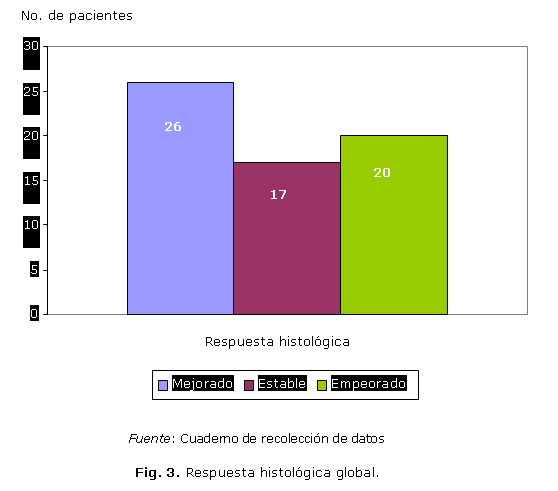
<body><![CDATA[<P><font face="Verdana" size="2">De los 63 casos en los que fue posible disponer    de una segunda biopsia hep&aacute;tica, en 26 (41,3 %) pacientes se observ&oacute;    mejor&iacute;a (<a href="#fig3">Fig. 3</a><a name="fig3"></a>). Dicho resultado    se encuentra incluido dentro del rango de respuesta histol&oacute;gica que reportan    la mayor&iacute;a de los estudios sobre terap&eacute;utica en HCC, el cual oscila    entre 30-63 %.<SUP>10-12 </SUP> </font>      <P align="center"><img src="/img/revistas/med/v49n2/f0302210.gif" width="558" height="491"><a name="fig3"></a>      
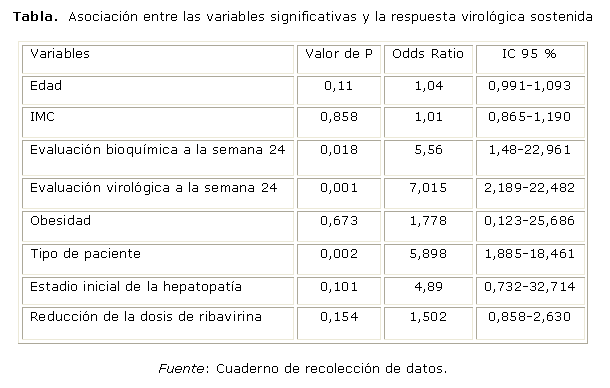
<P>     <P><font face="Verdana" size="2">El &iacute;ndice de masa corporal (IMC) elevado    y la obesidad guardaron relaci&oacute;n significativa con los valores de RVS    (P=0,03). Se obtuvo una asociaci&oacute;n importante entre el tipo de paciente    (<font color="#000000"><i>naive</i></font> o no respondedor) y la RVS, lo que    coincide ampliamente con lo reportado en otras casu&iacute;sticas.<SUP>10-12</SUP>    </font>      <P><font face="Verdana" size="2">Se demostr&oacute; que la reducci&oacute;n de    la dosis de ribavirina guardaba relaci&oacute;n con la respuesta virol&oacute;gica    a la semana 72, y al evaluar la asociaci&oacute;n entre las variables obtenidas    del an&aacute;lisis univariado y las tasas de RVS, la evaluaci&oacute;n virol&oacute;gica    a la sem 24 result&oacute; la variable de mayor significaci&oacute;n cl&iacute;nica    y estad&iacute;stica (<a href="/img/revistas/med/v49n2/t0102210.gif">tabla</a>). </font>      
<P>  <B>     <P>      <P><font face="Verdana" size="3">DISCUSI&Oacute;N</font>  </B>      <P>      <P><font face="Verdana" size="2">La importancia de alcanzar la RVS se ha demostrado    en diferentes estudios al mejorar la calidad de vida de los pacientes,<SUP>16    </SUP>mejorar la actividad histol&oacute;gica, e incluso el riesgo de desarrollar    un hepatocarcinoma.<SUP>17</SUP> Actualmente, contin&uacute;an las investigaciones    sobre los factores implicados en la selecci&oacute;n de pacientes con mayores    posibilidades de aclarar el virus, aunque un reciente estudio publicado demuestra    la persistencia de peque&ntilde;as cantidades de ARN viral en macr&oacute;fagos    y linfocitos 9 a&ntilde;os despu&eacute;s de que se alcanzara una RVS.<SUP>18</SUP>    </font>     ]]></body>
<body><![CDATA[<P><font face="Verdana" size="2">Cl&iacute;nicamente, cuando evaluamos las tasas    de RVS con el empleo de terapias modernas, es f&aacute;cil comprender que a&uacute;n    falta mucho para llegar al tratamiento ideal que podamos considerar como efectivo    sostenido en HCC. Por tal motivo, en nuestra opini&oacute;n debe considerarse    exitoso el haber obtenido un porcentaje no desestimable de pacientes en los    que se logr&oacute;, al menos, frenar la actividad necroinflamatoria y la fibrosis,    como es el caso de los pacientes con histolog&iacute;a estable tras cumplir    el tratamiento. </font>     <P><font face="Verdana" size="2">La categor&iacute;a respuesta global depende    directa y proporcionalmente de la RVS a la semana 72.<SUP>19 </SUP>A su vez,    esta depende de una serie de factores claramente definidos como los relacionados    con el propio paciente, los relacionados con el virus o con el tratamiento impuesto.<SUP>14</SUP>    De estos tres grupos, menci&oacute;n especial merecen los factores virol&oacute;gicos,    pues se ha sugerido que una carga viral basal baja permite obtener tasas de    RVS mayores que en los pacientes con carga viral pretratamiento m&aacute;s alta.    Por otra parte, los pacientes con genotipos 2 y 3 son los mejores respondedores    dentro de los 6 genotipos que se han descrito hasta el presente.<SUP>15</SUP>    </font>      <P><font face="Verdana" size="2">En nuestro estudio no fue posible incluir estas    dos variables (genotipo y carga viral) con vistas a esclarecer las causas del    porcentaje menor de RVS obtenido (32,9 %) en comparaci&oacute;n con otras series.<SUP>9-12</SUP>    No obstante, en trabajos muy recientes como el de <i>Wright M</i> et al.<SUP>20</SUP>    este autor obtiene una tasa de RVS muy similar a la nuestra (33 %) que, incluso,    fue menor en los pacientes con genotipo 1. Los escasos estudios cubanos publicados    sobre genotipaje de VHC realizados hasta la fecha resaltan la prevalencia del    genotipo 1 en Cuba<SUP>21 </SUP>y esto, de cierta forma, acent&uacute;a la desventaja    en la obtenci&oacute;n de mayores tasas de RVS.<SUP> </SUP> </font>      <P><font face="Verdana" size="2">El mecanismo fisiopatol&oacute;gico que ha intentado    explicar la relaci&oacute;n inversa IMC-RVS, se apoya en la relaci&oacute;n    que existe entre el s&iacute;ndrome metab&oacute;lico de obesidad-h&iacute;gado    graso y la resistencia a la insulina e hiperinsulinemia. La hiperinsulinemia    tiene la capacidad de bloquear el efecto terap&eacute;utico del IFN, al disminuir    su capacidad de producir PKR (prote&iacute;na kinasa dependiente de ARN de doble    cadena) e IRF-1 (enzima esencial en la s&iacute;ntesis end&oacute;gena de IFN)    y de potenciar la replicaci&oacute;n viral.<SUP>22-24</SUP> </font>     <P><font face="Verdana" size="2">Se ha observado que en pacientes no respondedores    a IFN existe un descenso en la expresi&oacute;n de los receptores para IFN alfa    y en los niveles de ARNm que induce la s&iacute;ntesis de estos receptores.    Las prote&iacute;nas virales NS5A y E2 bloquean la inducci&oacute;n de ISG (grupo    de genes sensibles al IFN) mediante la actuaci&oacute;n sobre PKR y al inhibir    la activaci&oacute;n &oacute;ptima de las prote&iacute;nas STAT.<SUP>25</SUP>    </font>     <P><font face="Verdana" size="2">Un factor fundamental para conseguir una RVS    es la adherencia al tratamiento, y se ha postulado que el haber consumido, al    menos, el 80 % de las dosis recomendada de IFN-ribavirina durante, al menos,    el 80 % del tiempo recomendado, incrementa las posibilidades de respuesta frente    a los menos cumplidores.<SUP>16 </SUP>En nuestra serie, demostramos que la adherencia    al tratamiento fue una variable asociada significativamente a la RVS y ello    pudiera contribuir a la interpretaci&oacute;n de nuestros resultados. </font>     <P><font face="Verdana" size="2">Con la obtenci&oacute;n de un valor de OR igual    a 7,015 en relaci&oacute;n con la variable evaluaci&oacute;n virol&oacute;gica    a la sem 24 se interpreta que es 7 veces m&aacute;s probable que un paciente    que sea respondedor virol&oacute;gico a la sem 24, tambi&eacute;n lo sea a la    sem 72, y desde el punto de vista pr&aacute;ctico, este dato representa una    herramienta de incalculable valor, incluso costo-efectivo, en la conducta a    asumir frente a estos pacientes. </font>      <P><font face="Verdana" size="2">Finalmente, la administraci&oacute;n de esta    terapia combinada a pacientes afectos de HCC nos ha permitido obtener tasas    de respuesta virol&oacute;gica y bioqu&iacute;mica sostenidas similares a las    observadas en otros estudios. Un n&uacute;mero no despreciable de pacientes    present&oacute; mejor&iacute;a histol&oacute;gica dada por un descenso en la    fibrosis sin modificaci&oacute;n importante de la inflamaci&oacute;n y, en muchos    de ellos se logr&oacute;, al menos, detener la actividad de la enfermedad. Aunque    se identificaron una serie de variables asociadas con las tasas finales de RVS,    la evaluaci&oacute;n virol&oacute;gica y bioqu&iacute;mica a la sem 24 y el    tipo de paciente previo a la terapia resultaron ser las m&aacute;s significativas.</font>     <P>      <P>      ]]></body>
<body><![CDATA[<P>      <P>      <P><font face="Verdana" size="2"><B><font size="3">REFERENCIAS BIBLIOGR&Aacute;FICAS</font></B>    </font>      <P>      <!-- ref --><P><font face="Verdana" size="2">1. Choo QL, Kuo G, Weiner AJ. Isolation of a    cDNA clone derived from a blood-borne non-A, non-B viral hepatitis genome. Science.<I>    </I>1989;244:359-61. </font>    <P><font face="Verdana" size="2">2. Rod&eacute;s J, Arroyo V, Bruguera M. Gastroenterolog&iacute;a    y Hepatolog&iacute;a. 2006;92:101-49. </font>     <!-- ref --><P><font face="Verdana" size="2">3. Penin F, Dubuisson J, Rey FA. Structural biology    of hepatitis C virus. Hepatology.<I> </I>2004;39:519. </font>    <!-- ref --><P><font face="Verdana" size="2">4. Shepard CW, Finelli L, Alter MJ. Global epidemiology    of hepatitis C virus infection. Lancet<I> </I>Infect Dis. 2005;5:558-67. </font>    <!-- ref --><P><font face="Verdana" size="2">5. Direcci&oacute;n Nacional de Higiene y Epidemiolog&iacute;a.    Informe Anual 2008. La Habana: Ministerio de Salud P&uacute;blica; 2008. </font>    <!-- ref --><P><font face="Verdana" size="2">6. Neumann AU, Lam NP, Dahari H. Hepatitis C    viral dynamics in vivo and the antiviral efficacy of interferon-alpha therapy.    Science<I>. </I>1998;282:103-7. </font>    <!-- ref --><P><font face="Verdana" size="2">7. Myers RP, Poynard T, Regimbeau C. Interferon    for interferon na&iuml;ve patients with chronic hepatitis C. Cochrane Database    Syst Rev. 2002;(2):CD000370. </font>    <!-- ref --><P><font face="Verdana" size="2">8. Ar&uacute;s SE, Infante VM, Padr&oacute;n    GJ. Interfer&oacute;n alfa-2b Recombinante en Hepatitis C Cr&oacute;nica: Resultados    del Tratamiento y Determinaci&oacute;n de Anticuerpos Anti-interfer&oacute;n.    Biotecnolog&iacute;a Aplicada. 1997;14(4):242-7. </font>    <!-- ref --><P><font face="Verdana" size="2">9. Kamal SM, Fehr J, Roesle B. Peginterferon    alone or with ribavirin enhances HCV-specific CD4+ T-helper 1 responses in patients    with chronic hepatitis C. Gastroenterology. 2002;123:1070-83. </font>    <P><font face="Verdana" size="2">10. McHutchison JG, Gordon SC, Schiff ER, Shiffman    ML, Lee WM, Rustgi VK, et al. Interferon <font face="Symbol">a</font> 2b alone    or in combination with Ribavirin as initial treatment for chronic hepatitis    C. N Engl J Med. 1998;339:1485-92. </font>      <P><font face="Verdana" size="2">11. Davis GL, Esteban-Mur R, Rustgi V, Hoefs    J, Gordon ST, Trepo C, et al. Interferon <font face="Symbol">a</font> 2b alone    or in combination with Ribavirin for the treatment of relapse of chronic hepatitis    C. N Engl J Med. 1998;339:1493-9. </font>      <!-- ref --><P><font face="Verdana" size="2">12. Poynard T, Marcellin P, Lee SS, Niederau    C, Minuk GS, Ideo G, et al. Randomized trials of interferon alfa 2b plus ribavirin    for 48 weeks or for 24 weeks versus interferon alfa 2b plus placebo for 48 weeks    for treatment of chronic infection with hepatitis C virus. International Hepatitis    Interventional Therapy Group (IHIT). Lancet<I>. </I>1998;352:1426-32. </font>    <!-- ref --><P><font face="Verdana" size="2">13. Galb&aacute;n E, Vega H. Interfer&oacute;n    alfa-2b en hepatitis cr&oacute;nica C. Combinaci&oacute;n con Ribavirina. Gen<I>.    </I>2000;54(3):169-86. </font>    <!-- ref --><P><font face="Verdana" size="2">14. Moreno-Otero R. Therapeutic modalities in    hepatitis C: challenges and development. J Viral Hepat. 2005;12(1):10-9. </font>    <P><font face="Verdana" size="2">15. Hadziyannis SJ, Sette H Jr, Morgan TR, Balan    V, Diago M, Marcellin P, et al. Peginterfer&oacute;n-<font face="Symbol">a</font>    2&#170; and Ribavirin combination therapy in chronic hepatitis C. Ann Intern    Med. 2004;140:346-55. </font>      <!-- ref --><P><font face="Verdana" size="2">16. Diago M, P&eacute;rez C. Paciente con genotipo    1 y carga viral alta. En: Diago M, Moreno-Otero R. Situaciones cl&iacute;nicas    en hepatitis virales. Espa&ntilde;a: Editorial Grupo Acci&oacute;n M&eacute;dica,    2005. p. 3-15. </font>    <!-- ref --><P><font face="Verdana" size="2">17. Ikeda K, Saitoh, Arase Y. Effect of interferon    therapy on hepatocellular carcinogenesis in patients with chronic hepatitis    type C:a long-term observation study of 1, 643 patients using statistical bias    correction with proportional hazard analysis. Hepatology.<I> </I>1999;29:1124-30.    </font>    <P><font face="Verdana" size="2">18. Radkowski M, Jablonska J, Wilkinson J. Persistence    of hepatitis C virus in patients successfully treated for chronic hepatitis    C [abstract]. Hepatology. 2004;40(Suppl1):180 A. </font>      <!-- ref --><P><font face="Verdana" size="2">19. Pawlotsky JM. Therapy of hepatitis C: from    empiricism to eradication. Hepatology. 2006;43(Suppl1):S207-20. </font>    <P><font face="Verdana" size="2">20. Wright M, Forton D, Main J. Treatment of    histologically mild hepatitis C virus infection with interferon and ribavirin:    a multicenter randomized controlled trial. J Viral Hepat. 2005;12(1):58-66.    </font>     <!-- ref --><P><font face="Verdana" size="2">21. Roca J, Massot A, Padr&oacute;n G. Hepatitis    C virus genotyping in developing countries: Results from Cuba, India and Turkey.    Biotecnolog&iacute;a Aplicada. 1999;16:88-92. </font>    <P><font face="Verdana" size="2">22. Sanyal AJ, Chand N, Comar K. Hyperinsulinism    blocks the inhbition of hepatitis C virus (HCV) replication by interferon: a    potential mechanism for failure of interferon therapy in subjects with HCV and    non alcoholic fatty liver disease [abstract]. Hepatology. 2004;40(Suppl1):179A.    </font>      <!-- ref --><P><font face="Verdana" size="2">23. Ratziu V, Heurtier A, Bonyhay L. Review article:    an unexpected virus-host interaction-the hepatitis C virus-diabetes link. Aliment    Pharmacol Ther. 2005 Nov;22 Suppl 2:56-60. </font>    <!-- ref --><P><font face="Verdana" size="2">24. Ratziu V, Trabut JB, Poynard T. Fat, diabetes,    and liver injury in chronic hepatitis C. Curr Gastroenterol Rep. 2004 Feb;6(1):22-9.    </font>    <P><font face="Verdana" size="2">25. Katze MG, He Y, Gale M, Jr. Viruses and interferon:    a fight for supremacy. Nat Rev Inmunol. 2002;2:675-87.</font>     <P>     ]]></body>
<body><![CDATA[<P>      <P>      <P>      <P><font face="Verdana" size="2">Recibido: 2 de noviembre de 2009.    <br>   </font><font face="Verdana" size="2">Aprobado: 10 de noviembre de 2009.</font>      <P>     <P>     <P>      <P>      <P><font face="Verdana" size="2">Dr. <I>Yoan Antonio S&aacute;nchez Rodr&iacute;guez.</I>    Instituto de Gastroenterolog&iacute;a. Calle 25 # 503 entre H e I, Vedado, CP    10 400. La Habana, Cuba. Correo electr&oacute;nico: <U><FONT  COLOR="#0000ff"><a href="mailto:yoan.sanchez@infomed.sld.cu">yoan.sanchez@infomed.sld.cu</a></FONT></U>    </font>      ]]></body>
<body><![CDATA[ ]]></body><back>
<ref-list>
<ref id="B1">
<label>1</label><nlm-citation citation-type="journal">
<person-group person-group-type="author">
<name>
<surname><![CDATA[Choo]]></surname>
<given-names><![CDATA[QL]]></given-names>
</name>
<name>
<surname><![CDATA[Kuo]]></surname>
<given-names><![CDATA[G]]></given-names>
</name>
<name>
<surname><![CDATA[Weiner]]></surname>
<given-names><![CDATA[AJ]]></given-names>
</name>
</person-group>
<article-title xml:lang="en"><![CDATA[Isolation of a cDNA clone derived from a blood-borne non-A, non-B viral hepatitis genome]]></article-title>
<source><![CDATA[Science.]]></source>
<year>1989</year>
<volume>244</volume>
<page-range>359-61</page-range></nlm-citation>
</ref>
<ref id="B2">
<label>2</label><nlm-citation citation-type="journal">
<person-group person-group-type="author">
<name>
<surname><![CDATA[Rodés]]></surname>
<given-names><![CDATA[J]]></given-names>
</name>
<name>
<surname><![CDATA[Arroyo]]></surname>
<given-names><![CDATA[V]]></given-names>
</name>
<name>
<surname><![CDATA[Bruguera]]></surname>
<given-names><![CDATA[M]]></given-names>
</name>
</person-group>
<article-title xml:lang="es"><![CDATA[Gastroenterología]]></article-title>
<source><![CDATA[Hepatología.]]></source>
<year>2006</year>
<volume>92</volume>
<page-range>101-49</page-range></nlm-citation>
</ref>
<ref id="B3">
<label>3</label><nlm-citation citation-type="journal">
<person-group person-group-type="author">
<name>
<surname><![CDATA[Penin]]></surname>
<given-names><![CDATA[F]]></given-names>
</name>
<name>
<surname><![CDATA[Dubuisson]]></surname>
<given-names><![CDATA[J]]></given-names>
</name>
<name>
<surname><![CDATA[Rey]]></surname>
<given-names><![CDATA[FA]]></given-names>
</name>
</person-group>
<article-title xml:lang="en"><![CDATA[Structural biology of hepatitis C virus]]></article-title>
<source><![CDATA[Hepatology.]]></source>
<year>2004</year>
<volume>39</volume>
<page-range>519</page-range></nlm-citation>
</ref>
<ref id="B4">
<label>4</label><nlm-citation citation-type="journal">
<person-group person-group-type="author">
<name>
<surname><![CDATA[Shepard]]></surname>
<given-names><![CDATA[CW]]></given-names>
</name>
<name>
<surname><![CDATA[Finelli]]></surname>
<given-names><![CDATA[L]]></given-names>
</name>
<name>
<surname><![CDATA[Alter]]></surname>
<given-names><![CDATA[MJ]]></given-names>
</name>
</person-group>
<article-title xml:lang="en"><![CDATA[Global epidemiology of hepatitis C virus infection]]></article-title>
<source><![CDATA[Lancet Infect Dis.]]></source>
<year>2005</year>
<volume>5</volume>
<page-range>558-67</page-range></nlm-citation>
</ref>
<ref id="B5">
<label>5</label><nlm-citation citation-type="book">
<collab>Dirección Nacional de Higiene y Epidemiología</collab>
<source><![CDATA[Informe Anual 2008]]></source>
<year>2008</year>
<publisher-loc><![CDATA[La Habana ]]></publisher-loc>
<publisher-name><![CDATA[Ministerio de Salud Pública]]></publisher-name>
</nlm-citation>
</ref>
<ref id="B6">
<label>6</label><nlm-citation citation-type="journal">
<person-group person-group-type="author">
<name>
<surname><![CDATA[Neumann]]></surname>
<given-names><![CDATA[AU]]></given-names>
</name>
<name>
<surname><![CDATA[Lam]]></surname>
<given-names><![CDATA[NP]]></given-names>
</name>
<name>
<surname><![CDATA[Dahari]]></surname>
<given-names><![CDATA[H]]></given-names>
</name>
</person-group>
<article-title xml:lang="en"><![CDATA[Hepatitis C viral dynamics in vivo and the antiviral efficacy of interferon-alpha therapy]]></article-title>
<source><![CDATA[Science.]]></source>
<year>1998</year>
<volume>282</volume>
<page-range>103-7</page-range></nlm-citation>
</ref>
<ref id="B7">
<label>7</label><nlm-citation citation-type="journal">
<person-group person-group-type="author">
<name>
<surname><![CDATA[Myers]]></surname>
<given-names><![CDATA[RP]]></given-names>
</name>
<name>
<surname><![CDATA[Poynard]]></surname>
<given-names><![CDATA[T]]></given-names>
</name>
<name>
<surname><![CDATA[Regimbeau]]></surname>
<given-names><![CDATA[C]]></given-names>
</name>
</person-group>
<article-title xml:lang="en"><![CDATA[Interferon for interferon naïve patients with chronic hepatitis C]]></article-title>
<source><![CDATA[Cochrane Database Syst Rev.]]></source>
<year>2002</year>
<numero>2</numero>
<issue>2</issue>
<page-range>CD000370</page-range></nlm-citation>
</ref>
<ref id="B8">
<label>8</label><nlm-citation citation-type="journal">
<person-group person-group-type="author">
<name>
<surname><![CDATA[Arús]]></surname>
<given-names><![CDATA[SE]]></given-names>
</name>
<name>
<surname><![CDATA[Infante]]></surname>
<given-names><![CDATA[VM]]></given-names>
</name>
<name>
<surname><![CDATA[Padrón]]></surname>
<given-names><![CDATA[GJ]]></given-names>
</name>
</person-group>
<article-title xml:lang="es"><![CDATA[Interferón alfa-2b Recombinante en Hepatitis C Crónica: Resultados del Tratamiento y Determinación de Anticuerpos Anti-interferón]]></article-title>
<source><![CDATA[Biotecnología Aplicada.]]></source>
<year>1997</year>
<volume>14</volume>
<numero>4</numero>
<issue>4</issue>
<page-range>242-7</page-range></nlm-citation>
</ref>
<ref id="B9">
<label>9</label><nlm-citation citation-type="journal">
<person-group person-group-type="author">
<name>
<surname><![CDATA[Kamal]]></surname>
<given-names><![CDATA[SM]]></given-names>
</name>
<name>
<surname><![CDATA[Fehr]]></surname>
<given-names><![CDATA[J]]></given-names>
</name>
<name>
<surname><![CDATA[Roesle]]></surname>
<given-names><![CDATA[B]]></given-names>
</name>
</person-group>
<article-title xml:lang="en"><![CDATA[Peginterferon alone or with ribavirin enhances HCV-specific CD4+ T-helper 1 responses in patients with chronic hepatitis C]]></article-title>
<source><![CDATA[Gastroenterology.]]></source>
<year>2002</year>
<volume>123</volume>
<page-range>1070-83</page-range></nlm-citation>
</ref>
<ref id="B10">
<label>10</label><nlm-citation citation-type="journal">
<person-group person-group-type="author">
<name>
<surname><![CDATA[McHutchison]]></surname>
<given-names><![CDATA[JG]]></given-names>
</name>
<name>
<surname><![CDATA[Gordon]]></surname>
<given-names><![CDATA[SC]]></given-names>
</name>
<name>
<surname><![CDATA[Schiff]]></surname>
<given-names><![CDATA[ER]]></given-names>
</name>
<name>
<surname><![CDATA[Shiffman]]></surname>
<given-names><![CDATA[ML]]></given-names>
</name>
<name>
<surname><![CDATA[Lee]]></surname>
<given-names><![CDATA[WM]]></given-names>
</name>
<name>
<surname><![CDATA[Rustgi]]></surname>
<given-names><![CDATA[VK]]></given-names>
</name>
</person-group>
<article-title xml:lang="en"><![CDATA[Interferon a 2b alone or in combination with Ribavirin as initial treatment for chronic hepatitis C]]></article-title>
<source><![CDATA[N Engl J Med.]]></source>
<year>1998</year>
<volume>339</volume>
<page-range>1485-92</page-range></nlm-citation>
</ref>
<ref id="B11">
<label>11</label><nlm-citation citation-type="journal">
<person-group person-group-type="author">
<name>
<surname><![CDATA[Davis]]></surname>
<given-names><![CDATA[GL]]></given-names>
</name>
<name>
<surname><![CDATA[Esteban-Mur]]></surname>
<given-names><![CDATA[R]]></given-names>
</name>
<name>
<surname><![CDATA[Rustgi]]></surname>
<given-names><![CDATA[V]]></given-names>
</name>
<name>
<surname><![CDATA[Hoefs]]></surname>
<given-names><![CDATA[J]]></given-names>
</name>
<name>
<surname><![CDATA[Gordon]]></surname>
<given-names><![CDATA[ST]]></given-names>
</name>
<name>
<surname><![CDATA[Trepo]]></surname>
<given-names><![CDATA[C]]></given-names>
</name>
</person-group>
<article-title xml:lang="en"><![CDATA[Interferon a 2b alone or in combination with Ribavirin for the treatment of relapse of chronic hepatitis C]]></article-title>
<source><![CDATA[N Engl J Med.]]></source>
<year>1998</year>
<volume>339</volume>
<page-range>1493-9</page-range></nlm-citation>
</ref>
<ref id="B12">
<label>12</label><nlm-citation citation-type="journal">
<person-group person-group-type="author">
<name>
<surname><![CDATA[Poynard]]></surname>
<given-names><![CDATA[T]]></given-names>
</name>
<name>
<surname><![CDATA[Marcellin]]></surname>
<given-names><![CDATA[P]]></given-names>
</name>
<name>
<surname><![CDATA[Lee]]></surname>
<given-names><![CDATA[SS]]></given-names>
</name>
<name>
<surname><![CDATA[Niederau]]></surname>
<given-names><![CDATA[C]]></given-names>
</name>
<name>
<surname><![CDATA[Minuk]]></surname>
<given-names><![CDATA[GS]]></given-names>
</name>
<name>
<surname><![CDATA[Ideo]]></surname>
<given-names><![CDATA[G]]></given-names>
</name>
</person-group>
<article-title xml:lang="en"><![CDATA[Randomized trials of interferon alfa 2b plus ribavirin for 48 weeks or for 24 weeks versus interferon alfa 2b plus placebo for 48 weeks for treatment of chronic infection with hepatitis C virus: International Hepatitis Interventional Therapy Group (IHIT)]]></article-title>
<source><![CDATA[Lancet.]]></source>
<year>1998</year>
<volume>352</volume>
<page-range>1426-32</page-range></nlm-citation>
</ref>
<ref id="B13">
<label>13</label><nlm-citation citation-type="journal">
<person-group person-group-type="author">
<name>
<surname><![CDATA[Galbán]]></surname>
<given-names><![CDATA[E]]></given-names>
</name>
<name>
<surname><![CDATA[Vega]]></surname>
<given-names><![CDATA[H]]></given-names>
</name>
</person-group>
<article-title xml:lang="es"><![CDATA[Interferón alfa-2b en hepatitis crónica C: Combinación con Ribavirina]]></article-title>
<source><![CDATA[Gen.]]></source>
<year>2000</year>
<volume>54</volume>
<numero>3</numero>
<issue>3</issue>
<page-range>169-86</page-range></nlm-citation>
</ref>
<ref id="B14">
<label>14</label><nlm-citation citation-type="journal">
<person-group person-group-type="author">
<name>
<surname><![CDATA[Moreno-Otero]]></surname>
<given-names><![CDATA[R]]></given-names>
</name>
</person-group>
<article-title xml:lang="en"><![CDATA[Therapeutic modalities in hepatitis C: challenges and development]]></article-title>
<source><![CDATA[J Viral Hepat.]]></source>
<year>2005</year>
<volume>12</volume>
<numero>1</numero>
<issue>1</issue>
<page-range>10-9</page-range></nlm-citation>
</ref>
<ref id="B15">
<label>15</label><nlm-citation citation-type="journal">
<person-group person-group-type="author">
<name>
<surname><![CDATA[Hadziyannis]]></surname>
<given-names><![CDATA[SJ]]></given-names>
</name>
<name>
<surname><![CDATA[Sette H]]></surname>
<given-names><![CDATA[Jr]]></given-names>
</name>
<name>
<surname><![CDATA[Morgan]]></surname>
<given-names><![CDATA[TR]]></given-names>
</name>
<name>
<surname><![CDATA[Balan]]></surname>
<given-names><![CDATA[V]]></given-names>
</name>
<name>
<surname><![CDATA[Diago]]></surname>
<given-names><![CDATA[M]]></given-names>
</name>
<name>
<surname><![CDATA[Marcellin]]></surname>
<given-names><![CDATA[P]]></given-names>
</name>
</person-group>
<article-title xml:lang="en"><![CDATA[Peginterferón-a 2ª and Ribavirin combination therapy in chronic hepatitis C]]></article-title>
<source><![CDATA[Ann Intern Med.]]></source>
<year>2004</year>
<volume>140</volume>
<page-range>346-55</page-range></nlm-citation>
</ref>
<ref id="B16">
<label>16</label><nlm-citation citation-type="book">
<person-group person-group-type="author">
<name>
<surname><![CDATA[Diago]]></surname>
<given-names><![CDATA[M]]></given-names>
</name>
<name>
<surname><![CDATA[Pérez]]></surname>
<given-names><![CDATA[C]]></given-names>
</name>
</person-group>
<article-title xml:lang="es"><![CDATA[Paciente con genotipo 1 y carga viral alta]]></article-title>
<person-group person-group-type="editor">
<name>
<surname><![CDATA[Diago]]></surname>
<given-names><![CDATA[M]]></given-names>
</name>
<name>
<surname><![CDATA[Moreno-Otero]]></surname>
<given-names><![CDATA[R]]></given-names>
</name>
</person-group>
<source><![CDATA[Situaciones clínicas en hepatitis virales]]></source>
<year>2005</year>
<page-range>3-15</page-range><publisher-name><![CDATA[Editorial Grupo Acción Médica]]></publisher-name>
</nlm-citation>
</ref>
<ref id="B17">
<label>17</label><nlm-citation citation-type="journal">
<person-group person-group-type="author">
<name>
<surname><![CDATA[Ikeda]]></surname>
<given-names><![CDATA[K]]></given-names>
</name>
<name>
<surname><![CDATA[Saitoh, Arase]]></surname>
<given-names><![CDATA[Y]]></given-names>
</name>
</person-group>
<article-title xml:lang="en"><![CDATA[Effect of interferon therapy on hepatocellular carcinogenesis in patients with chronic hepatitis type C: a long-term observation study of 1, 643 patients using statistical bias correction with proportional hazard analysis]]></article-title>
<source><![CDATA[Hepatology]]></source>
<year>1999</year>
<volume>29</volume>
<page-range>1124-30</page-range></nlm-citation>
</ref>
<ref id="B18">
<label>18</label><nlm-citation citation-type="journal">
<person-group person-group-type="author">
<name>
<surname><![CDATA[Radkowski]]></surname>
<given-names><![CDATA[M]]></given-names>
</name>
<name>
<surname><![CDATA[Jablonska]]></surname>
<given-names><![CDATA[J]]></given-names>
</name>
<name>
<surname><![CDATA[Wilkinson]]></surname>
<given-names><![CDATA[J]]></given-names>
</name>
</person-group>
<article-title xml:lang="en"><![CDATA[Persistence of hepatitis C virus in patients successfully treated for chronic hepatitis C]]></article-title>
<source><![CDATA[Hepatology]]></source>
<year>2004</year>
<volume>40</volume>
<numero>^sSuppl1</numero>
<issue>^sSuppl1</issue>
<supplement>Suppl1</supplement>
<page-range>180 A</page-range></nlm-citation>
</ref>
<ref id="B19">
<label>19</label><nlm-citation citation-type="journal">
<person-group person-group-type="author">
<name>
<surname><![CDATA[Pawlotsky]]></surname>
<given-names><![CDATA[JM]]></given-names>
</name>
</person-group>
<article-title xml:lang="en"><![CDATA[Therapy of hepatitis C: from empiricism to eradication]]></article-title>
<source><![CDATA[Hepatology]]></source>
<year>2006</year>
<volume>43</volume>
<numero>^sSuppl1</numero>
<issue>^sSuppl1</issue>
<supplement>Suppl1</supplement>
<page-range>S207-20</page-range></nlm-citation>
</ref>
<ref id="B20">
<label>20</label><nlm-citation citation-type="journal">
<person-group person-group-type="author">
<name>
<surname><![CDATA[Wright]]></surname>
<given-names><![CDATA[M]]></given-names>
</name>
<name>
<surname><![CDATA[Forton]]></surname>
<given-names><![CDATA[D]]></given-names>
</name>
<name>
<surname><![CDATA[Main]]></surname>
<given-names><![CDATA[J]]></given-names>
</name>
</person-group>
<article-title xml:lang="en"><![CDATA[reatment of histologically mild hepatitis C virus infection with interferon and ribavirin: a multicenter randomized controlled trial]]></article-title>
<source><![CDATA[J Viral Hepat.]]></source>
<year>2005</year>
<volume>12</volume>
<numero>1</numero>
<issue>1</issue>
<page-range>58-66</page-range></nlm-citation>
</ref>
<ref id="B21">
<label>21</label><nlm-citation citation-type="journal">
<person-group person-group-type="author">
<name>
<surname><![CDATA[Roca]]></surname>
<given-names><![CDATA[J]]></given-names>
</name>
<name>
<surname><![CDATA[Massot]]></surname>
<given-names><![CDATA[A]]></given-names>
</name>
<name>
<surname><![CDATA[Padrón]]></surname>
<given-names><![CDATA[G]]></given-names>
</name>
</person-group>
<article-title xml:lang="en"><![CDATA[Hepatitis C virus genotyping in developing countries: Results from Cuba, India and Turkey]]></article-title>
<source><![CDATA[Biotecnología Aplicada.]]></source>
<year>1999</year>
<volume>16</volume>
<page-range>88-92</page-range></nlm-citation>
</ref>
<ref id="B22">
<label>22</label><nlm-citation citation-type="journal">
<person-group person-group-type="author">
<name>
<surname><![CDATA[Sanyal]]></surname>
<given-names><![CDATA[AJ]]></given-names>
</name>
<name>
<surname><![CDATA[Chand]]></surname>
<given-names><![CDATA[N]]></given-names>
</name>
<name>
<surname><![CDATA[Comar]]></surname>
<given-names><![CDATA[K]]></given-names>
</name>
</person-group>
<article-title xml:lang="en"><![CDATA[Hyperinsulinism blocks the inhbition of hepatitis C virus (HCV) replication by interferon: a potential mechanism for failure of interferon therapy in subjects with HCV and non alcoholic fatty liver disease]]></article-title>
<source><![CDATA[Hepatology]]></source>
<year>2004</year>
<volume>40</volume>
<numero>^sSuppl1</numero>
<issue>^sSuppl1</issue>
<supplement>Suppl1</supplement>
<page-range>179A</page-range></nlm-citation>
</ref>
<ref id="B23">
<label>23</label><nlm-citation citation-type="journal">
<person-group person-group-type="author">
<name>
<surname><![CDATA[Ratziu]]></surname>
<given-names><![CDATA[V]]></given-names>
</name>
<name>
<surname><![CDATA[Heurtier]]></surname>
<given-names><![CDATA[A]]></given-names>
</name>
<name>
<surname><![CDATA[Bonyhay]]></surname>
<given-names><![CDATA[L]]></given-names>
</name>
</person-group>
<article-title xml:lang="en"><![CDATA[Review article: an unexpected virus-host interaction-the hepatitis C virus-diabetes link]]></article-title>
<source><![CDATA[Aliment Pharmacol Ther.]]></source>
<year>2005</year>
<month> N</month>
<day>ov</day>
<volume>22</volume>
<numero>^s2</numero>
<issue>^s2</issue>
<supplement>2</supplement>
<page-range>56-60</page-range></nlm-citation>
</ref>
<ref id="B24">
<label>24</label><nlm-citation citation-type="journal">
<person-group person-group-type="author">
<name>
<surname><![CDATA[Ratziu]]></surname>
<given-names><![CDATA[V]]></given-names>
</name>
<name>
<surname><![CDATA[Trabut]]></surname>
<given-names><![CDATA[JB]]></given-names>
</name>
<name>
<surname><![CDATA[Poynard]]></surname>
<given-names><![CDATA[T]]></given-names>
</name>
</person-group>
<article-title xml:lang="en"><![CDATA[Fat, diabetes, and liver injury in chronic hepatitis C]]></article-title>
<source><![CDATA[Curr Gastroenterol Rep]]></source>
<year>2004</year>
<month> F</month>
<day>eb</day>
<volume>6</volume>
<numero>1</numero>
<issue>1</issue>
<page-range>22-9</page-range></nlm-citation>
</ref>
<ref id="B25">
<label>25</label><nlm-citation citation-type="journal">
<person-group person-group-type="author">
<name>
<surname><![CDATA[Katze]]></surname>
<given-names><![CDATA[MG]]></given-names>
</name>
<name>
<surname><![CDATA[He]]></surname>
<given-names><![CDATA[Y]]></given-names>
</name>
<name>
<surname><![CDATA[Gale]]></surname>
<given-names><![CDATA[M]]></given-names>
</name>
</person-group>
<article-title xml:lang="en"><![CDATA[Viruses and interferon: a fight for supremacy]]></article-title>
<source><![CDATA[Nat Rev Inmunol.]]></source>
<year>2002</year>
<volume>2</volume>
<page-range>675-87</page-range></nlm-citation>
</ref>
</ref-list>
</back>
</article>