<?xml version="1.0" encoding="ISO-8859-1"?><article xmlns:mml="http://www.w3.org/1998/Math/MathML" xmlns:xlink="http://www.w3.org/1999/xlink" xmlns:xsi="http://www.w3.org/2001/XMLSchema-instance">
<front>
<journal-meta>
<journal-id>0034-7531</journal-id>
<journal-title><![CDATA[Revista Cubana de Pediatría]]></journal-title>
<abbrev-journal-title><![CDATA[Rev Cubana Pediatr]]></abbrev-journal-title>
<issn>0034-7531</issn>
<publisher>
<publisher-name><![CDATA[Centro Nacional de Información de Ciencias MédicasEditorial Ciencias Médicas]]></publisher-name>
</publisher>
</journal-meta>
<article-meta>
<article-id>S0034-75311999000400006</article-id>
<title-group>
<article-title xml:lang="es"><![CDATA[Respuesta a los esteroides en el síndrome nefrótico idiopático]]></article-title>
</title-group>
<contrib-group>
<contrib contrib-type="author">
<name>
<surname><![CDATA[Durán Álvarez]]></surname>
<given-names><![CDATA[Sandalio]]></given-names>
</name>
<xref ref-type="aff" rid="A01"/>
</contrib>
<contrib contrib-type="author">
<name>
<surname><![CDATA[Valdés Mesa]]></surname>
<given-names><![CDATA[Mario]]></given-names>
</name>
</contrib>
</contrib-group>
<aff id="A01">
<institution><![CDATA[,Hospital Pediátrico Docente William Soler  ]]></institution>
<addr-line><![CDATA[Ciudad de la Habana ]]></addr-line>
<country>Cuba</country>
</aff>
<pub-date pub-type="pub">
<day>00</day>
<month>12</month>
<year>1999</year>
</pub-date>
<pub-date pub-type="epub">
<day>00</day>
<month>12</month>
<year>1999</year>
</pub-date>
<volume>71</volume>
<numero>4</numero>
<fpage>222</fpage>
<lpage>227</lpage>
<copyright-statement/>
<copyright-year/>
<self-uri xlink:href="http://scielo.sld.cu/scielo.php?script=sci_arttext&amp;pid=S0034-75311999000400006&amp;lng=en&amp;nrm=iso"></self-uri><self-uri xlink:href="http://scielo.sld.cu/scielo.php?script=sci_abstract&amp;pid=S0034-75311999000400006&amp;lng=en&amp;nrm=iso"></self-uri><self-uri xlink:href="http://scielo.sld.cu/scielo.php?script=sci_pdf&amp;pid=S0034-75311999000400006&amp;lng=en&amp;nrm=iso"></self-uri><abstract abstract-type="short" xml:lang="es"><p><![CDATA[Se analiza retrospectivamente la respuesta a la prednisona de 290 niños con síndrome nefrótico idiopático; de éstos, 190 lo constituían varones. En el estudio con microscopia óptica de las biopsias renales 234 pacientes mostraron lesión mínima y sólo 5 (2,2 %) no respondieron inicialmente al tratamiento; 27 de ellos (11,6 %) no recayeron en un período de seguimiento de 5 años o más. Veinte y seis niños (9,0 %) tenían glomeruloesclerosis focal segmentaria en la biopsia renal y 17 de éstos no respondieron a la prednisona; todos los que respondieron presentaron recaídas evolutivamente. Treinta niños (11,0 %) mostraban proliferación mesangial difusa y 8 (26,7 %) no respondieron al tratamiento; 1 solo paciente con proliferación mesangial difusa no recayó y en este niño el cuadro nefrótico coincidió con una picadura de abeja. Se considera actualmente que por el reducido porcentaje de niños con lesión mínima que no responden a la prednisona, la biopsia renal se debe reservar para los que no responden a este tratamiento.]]></p></abstract>
<abstract abstract-type="short" xml:lang="en"><p><![CDATA[The response to prednisone treatment by 290 children -190 males- with idiophatic nephrotic syndrome was retrospectively analyzed. The study of kidney biopsies by optical microscopy revealed that 234 had minimal changes and only 5(2,2 %) did not response to initial treatment; 27(11,6 %) did not have any relapse ina a 5 year or over follow- up period. Twenty-six children (9 %) suffered from focal segmental glomerulosclerosis acording to their kidney biopsies, 17 of them did not respond to prednisone treatment whereas the others who did, had relapses in their recovery. Thirtly children (11,0 %) showed diffuse messangial proliferation and 8 (26,7 %) did not respond to treatment. Only one child with this disease did not have any relapse and his nephrotic condition coincided with a bee sting. At present, it is believed that since the percent of children with minimal change disease who did not respond to prednisone therapy is low, kidney biopsy should be reserved for those who do not react to the treatment.]]></p></abstract>
<kwd-group>
<kwd lng="es"><![CDATA[SINDROME NEFROTICO]]></kwd>
<kwd lng="es"><![CDATA[PREDNISONA]]></kwd>
<kwd lng="en"><![CDATA[NEPHROTIC SYNDROME]]></kwd>
<kwd lng="en"><![CDATA[PREDNISONE]]></kwd>
</kwd-group>
</article-meta>
</front><body><![CDATA[ <BR>       <br> Hospital Pedi&aacute;trico Docente "William Soler" Ciudad de La Habana  <h2>  Respuesta a los esteroides en el s&iacute;ndrome nefr&oacute;tico idiop&aacute;tico</h2>  <i><a href="#*">Dr. Sandalio Dur&aacute;n &Aacute;lvarez<sup>1</sup> y  Dr. Mario Vald&eacute;s Mesa<sup>2</sup></a></i>  <h4>  RESUMEN</h4>  Se analiza retrospectivamente la respuesta a la prednisona de 290 ni&ntilde;os  con s&iacute;ndrome nefr&oacute;tico idiop&aacute;tico; de &eacute;stos,  190 lo constitu&iacute;an varones. En el estudio con microscopia &oacute;ptica  de las biopsias renales 234 pacientes mostraron lesi&oacute;n m&iacute;nima  y s&oacute;lo 5 (2,2 %) no respondieron inicialmente al tratamiento; 27  de ellos (11,6 %) no recayeron en un per&iacute;odo de seguimiento de 5  a&ntilde;os o m&aacute;s. Veinte y seis ni&ntilde;os (9,0 %) ten&iacute;an  glomeruloesclerosis focal segmentaria en la biopsia renal y 17 de &eacute;stos  no respondieron a la prednisona; todos los que respondieron presentaron  reca&iacute;das evolutivamente. Treinta ni&ntilde;os (11,0 %) mostraban  proliferaci&oacute;n mesangial difusa y 8 (26,7 %) no respondieron al tratamiento;  1 solo paciente con proliferaci&oacute;n mesangial difusa no recay&oacute;  y en este ni&ntilde;o el cuadro nefr&oacute;tico coincidi&oacute; con una  picadura de abeja. Se considera actualmente que por el reducido porcentaje  de ni&ntilde;os con lesi&oacute;n m&iacute;nima que no responden a la prednisona,  la biopsia renal se debe reservar para los que no responden a este tratamiento.      <p><i>Descriptores DeCS:</i> SINDROME NEFROTICO/quimioterapia; PREDNISONA/uso  terap&eacute;utico.  <dir>  <dir>  <dir>&nbsp;</dir>  </dir>  </dir>  El s&iacute;ndrome nefr&oacute;tico idiop&aacute;tico (SNI) es una entidad  cl&iacute;nica que se caracteriza por proteinuria masiva, hipoalbuminemia,  hiperlipidemia y edema. H&iacute;sticamente tiene alteraciones no espec&iacute;ficas  del glom&eacute;rulo, con inclusion de la lesi&oacute;n m&iacute;nima (LM),  la glomeruloesclerosis focal segmentaria (GFS) y la proliferaci&oacute;n  mesangial difusa (PMD). Estos hallazgos est&aacute;n asociados con la fusi&oacute;n  de los procesos basales podocitarios en la microscopia electr&oacute;nica  y ausencia de dep&oacute;sitos significativos de inmunoglobulinas y complemento.      <p>La prednisona se considera la droga de elecci&oacute;n para el tratamiento  del ni&ntilde;o con SNI.<sup>1</sup>      <p>La mayor&iacute;a de estos pacientes, 89 % de la serie de <i>White </i>y  otros,<sup>2</sup> 87 % en el estudio de <i>Kleinknecht</i> y <i>Gubler</i><sup>3</sup>  y 86 % de los que se reportaron con anterioridad,<sup>4 </sup>responden  al tratamiento con prednisona, para desaparecer la proteinuria en las primeras  4 semanas.      <p>En 84,5 % de los ni&ntilde;os con s&iacute;ndrome nefr&oacute;tico la  biopsia renal muestra una LM<sup>5</sup> y entre 7 y 18 % de los pacientes  presentan GFS.<sup>5-7</sup> Aunque los enfermos con LM comparten con la  GFS y la PMD una cl&iacute;nica recurrente y respuesta variable a los esteroides,  la interrelaci&oacute;n entre estas glomerulopat&iacute;as tiene a&uacute;n  algunas controversias.<sup>8-13</sup>      <p>Como los criterios de biopsia renal en ni&ntilde;os nefr&oacute;ticos  se han modificado considerablemente,<sup>14,15</sup> se analiza retrospectivamente  la respuesta al tratamiento esteroideo de los ni&ntilde;os con SNI, a los  cuales se les realiz&oacute; biopsia renal entre 1970 y 1986, ambos inclusive,  y se atendieron en nuestro Centro.  <h4>  M&Eacute;TODOS</h4>  Se hace una revisi&oacute;n de la respuesta al tratamiento con prednisona  de los ni&ntilde;os nefr&oacute;ticos tratados en el Hospital Pedi&aacute;trico  Docente "William Soler", entre 1970 y 1986. Se incluyen en el estudio los  pacientes con biopsia renal &uacute;til para diagn&oacute;stico con microscopia  &oacute;ptica y con seguimiento mayor de 6 meses. Para ello se revisaron  los res&uacute;menes de historias cl&iacute;nicas de la consulta de nefr&oacute;ticos.      <p>El tratamiento en todos los casos consisti&oacute; en prednisona a la  dosis de 60 mg/m<sup>2</sup> de superficie corporal y por d&iacute;a durante  4 semanas, seguido por prednisona a una dosis de 40 mg/m<sup>2</sup> de  superficie corporal en d&iacute;as alternos o en 3 d&iacute;as consecutivos  de la semana para descansar 4 durante un per&iacute;odo de 4 semanas m&aacute;s.  Los pacientes tratados hasta 1975 por lo general recibieron un curso m&aacute;s  prolongado de prednisona en d&iacute;as alternos y dosis decrecientes.  <h4>  Control sem&aacute;ntico</h4>  S&iacute;ndrome nefr&oacute;tico: proteinuria igual o mayor de 2,0 g/m<sup>2</sup>  de superficie corporal y por d&iacute;a, alb&uacute;mina en sangre menor  de 25 g/L, colesterol mayor de 250 mg % o 6,5 mmol/L y edema.      <p>Reca&iacute;da: reaparici&oacute;n de proteinuria igual o mayor de 2,0  g/m<sup>2 </sup>de superficie corporal y por d&iacute;a, despu&eacute;s  de un per&iacute;odo m&aacute;s o menos prolongado sin excreci&oacute;n  urinaria de prote&iacute;nas. Puede acompa&ntilde;arse o no de edema.      <p>Sin reca&iacute;das: paciente con SNI que responde al tratamiento y  que no reaparece proteinuria en un per&iacute;odo de 5 a&ntilde;os o m&aacute;s.      ]]></body>
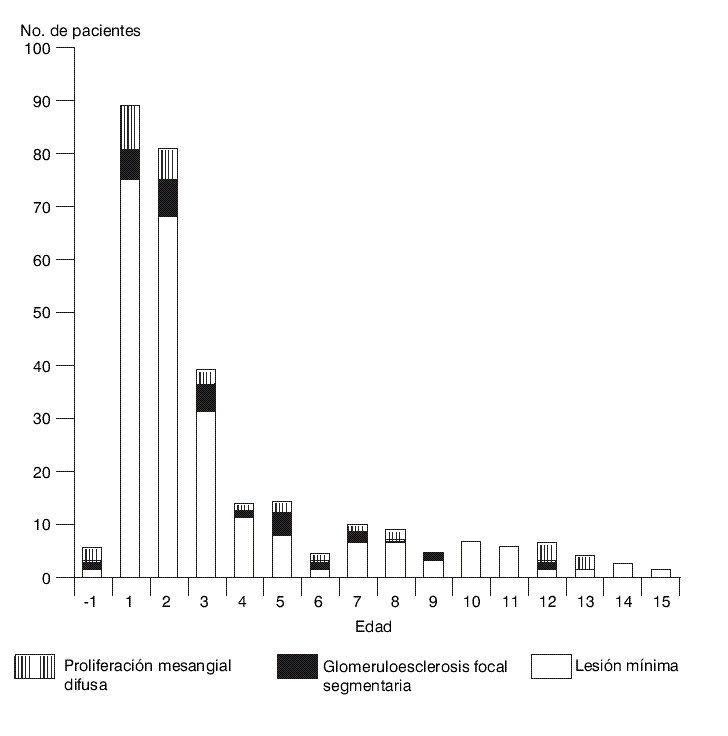
<body><![CDATA[<p>Reca&iacute;das aisladas: las que se presentan despu&eacute;s de un  per&iacute;odo de 6 meses del cuadro nefr&oacute;tico anterior.      <p>Reca&iacute;das frecuentes: las que ocurren antes de los 6 meses del  cuadro nefr&oacute;tico anterior.      <p>No respuesta: no desaparici&oacute;n de la proteinuria despu&eacute;s  de concluir la cuarta semana de tratamiento con prednisona a la dosis de  60 mg/m<sup>2</sup> de superficie corporal y por d&iacute;a.      <p>S&oacute;lo se incluyen en este estudio los pacientes con SNI, o sea,  los que h&iacute;sticamente presentan LM, GFS o PMD.  <h4>  RESULTADOS</h4>  Durante el per&iacute;odo analizado se atendieron 332 ni&ntilde;os con  criterios de SNI, pero s&oacute;lo incluimos en el estudio 290 que reun&iacute;an  los criterios escogidos para este an&aacute;lisis; 42 fueron excluidos  por biopsia renal no &uacute;til o abandono del seguimiento. De estos pacientes,  190 eran varones para un predominio masculino de 1,9:1.      <p>La edad de comienzo del s&iacute;ndrome nefr&oacute;tico puede verse  en la figura y la respuesta al tratamiento en la tabla.      <center>        <p><a href="/img/revistas/ped/v71n4/ped0106499.gif"><img SRC="/img/revistas/ped/v71n4/ped0106499.gif" ALT="Figura1" BORDER=1 height=169 width=167></a>          
<br>     <i>FIG. </i>Histograma de 290 pacientes con s&iacute;ndrome nefr&oacute;tico  idiop&aacute;tico.      <p>    <br>  </center>    ]]></body>
<body><![CDATA[<p>    <center>TABLA.<i> Respuesta al tratamiento en los distintos tipos de lesi&oacute;n</i></center>        <center><table CELLPADDING=5 >  <tr>  <td VALIGN=TOP WIDTH="9%">Tipo de lesi&oacute;n&nbsp;</td>    <td VALIGN=TOP COLSPAN="10" WIDTH="91%">      <center>Respuesta a la prednisona</center>  </td>  </tr>    <tr>  <td VALIGN=TOP WIDTH="9%">&nbsp;</td>    <td VALIGN=TOP WIDTH="9%">      <center>NR</center>  </td>    <td VALIGN=TOP WIDTH="9%">      <center>%</center>  </td>    <td VALIGN=TOP WIDTH="9%">      <center>RA</center>  </td>    <td VALIGN=TOP WIDTH="9%">      <center>%</center>  </td>    <td VALIGN=TOP WIDTH="9%">      <center>RF</center>  </td>    <td VALIGN=TOP WIDTH="9%">      <center>%</center>  </td>    <td VALIGN=TOP WIDTH="9%">      ]]></body>
<body><![CDATA[<center>RE</center>  </td>    <td VALIGN=TOP WIDTH="9%">      <center>%</center>  </td>    <td VALIGN=TOP WIDTH="9%">      <center>Total</center>  </td>    <td VALIGN=TOP WIDTH="9%">      <center>%</center>  </td>  </tr>    <tr>  <td VALIGN=TOP WIDTH="9%">LM</td>    <td VALIGN=TOP WIDTH="9%">      <center>27</center>  </td>    <td VALIGN=TOP WIDTH="9%">      <center>(11,6)</center>  </td>    <td VALIGN=TOP WIDTH="9%">      <center>121</center>  </td>    <td VALIGN=TOP WIDTH="9%">      <center>(51,7)</center>  </td>    <td VALIGN=TOP WIDTH="9%">      <center>81</center>  </td>    <td VALIGN=TOP WIDTH="9%">      <center>(34,5)</center>  </td>    <td VALIGN=TOP WIDTH="9%">      ]]></body>
<body><![CDATA[<center>5</center>  </td>    <td VALIGN=TOP WIDTH="9%">      <center>(2,2)</center>  </td>    <td VALIGN=TOP WIDTH="9%">      <center>234</center>  </td>    <td VALIGN=TOP WIDTH="9%">      <center>(80,0)</center>  </td>  </tr>    <tr>  <td VALIGN=TOP WIDTH="9%">GFS</td>    <td VALIGN=TOP WIDTH="9%">      <center>0</center>  </td>    <td VALIGN=TOP WIDTH="9%">      <center>(0,0)</center>  </td>    <td VALIGN=TOP WIDTH="9%">      <center>3</center>  </td>    <td VALIGN=TOP WIDTH="9%">      <center>(11,5)</center>  </td>    <td VALIGN=TOP WIDTH="9%">      <center>6</center>  </td>    <td VALIGN=TOP WIDTH="9%">      <center>(23,0)</center>  </td>    <td VALIGN=TOP WIDTH="9%">      ]]></body>
<body><![CDATA[<center>17</center>  </td>    <td VALIGN=TOP WIDTH="9%">      <center>(65,5)</center>  </td>    <td VALIGN=TOP WIDTH="9%">      <center>26</center>  </td>    <td VALIGN=TOP WIDTH="9%">      <center>(9,0)</center>  </td>  </tr>    <tr>  <td VALIGN=TOP WIDTH="9%">OMD</td>    <td VALIGN=TOP WIDTH="9%">      <center>1*</center>  </td>    <td VALIGN=TOP WIDTH="9%">      <center>(3,3)</center>  </td>    <td VALIGN=TOP WIDTH="9%">      <center>10</center>  </td>    <td VALIGN=TOP WIDTH="9%">      <center>(33,3)</center>  </td>    <td VALIGN=TOP WIDTH="9%">      <center>11</center>  </td>    <td VALIGN=TOP WIDTH="9%">      <center>(36,7)</center>  </td>    <td VALIGN=TOP WIDTH="9%">      ]]></body>
<body><![CDATA[<center>8</center>  </td>    <td VALIGN=TOP WIDTH="9%">      <center>(26,7)</center>  </td>    <td VALIGN=TOP WIDTH="9%">      <center>30</center>  </td>    <td VALIGN=TOP WIDTH="9%">      <center>(11,0)</center>  </td>  </tr>  </table></center>    <dir>      <center>* Coincidi&oacute; el cuadro nefr&oacute;tico con una picadura  de abeja.      <br>LM= lesi&oacute;n m&iacute;nima; GFS = glomeruloesclerosis focal segmentaria;  PMD=proliferaci&oacute;n mesangial difusa; NR=no reca&iacute;das; RA=reca&iacute;das  aisladas; RF=reca&iacute;das frecuentes; RE=resistencia a los esteroides.</center>  </dir>        <p>    <br>En la distribuci&oacute;n por sexo de los distintos tipos de lesi&oacute;n  hubo predominio masculino: LM= 2,0:1; GFS= 1,9:1; PMD= 1,3:1.  <h4>  DISCUSI&Oacute;N</h4>  La mayor prevalencia del sexo masculino hallada en esta serie ha sido reportada  en la literatura pedi&aacute;trica, con una relaci&oacute;n aproximada  de 2:1,<sup>16,17</sup> pero se se&ntilde;ala una afectaci&oacute;n similar  para uno y otro sexos en adultos y adolescentes.<sup>18-20</sup>      <p>En este estudio el 80 % de los pacientes mostraba LM en la biopsia renal,  que como se sabe es la lesi&oacute;n m&aacute;s frecuente en el SNI del  ni&ntilde;o. Nueve por ciento de los pacientes ten&iacute;a GFS y 11 %  PMD. De los pacientes con LM s&oacute;lo 2,2 % no respondi&oacute; a la  prednisona, mientras 65,5 % de los que presentaban GFS y 26,7 % de los  que ten&iacute;an PMD no respondieron al tratamiento. De los pacientes  con LM 11,6 % no recay&oacute; en un per&iacute;odo de 5 a&ntilde;os o  m&aacute;s de evoluci&oacute;n, mientras que los que mostraban otro tipo  de lesi&oacute;n y respondieron al tratamiento todos recayeron, excepto  un paciente con PMD que su cuadro nefr&oacute;tico coincidi&oacute; con  una picadura de abeja.      <p>En el estudio de <i>White </i>y otros<sup>2</sup> s&oacute;lo el 2 %  de los pacientes con LM no respondi&oacute; a la prednisona y del grupo  total 89 % respondi&oacute; a los esteroides. En el reporte de 665 ni&ntilde;os  estudiados por <i>Kleinknecht</i> y <i>Gubler</i><sup>3</sup> 87 % respondi&oacute;  y de los 290 de nuestro estudio 89,7 % respondi&oacute; al tratamiento.  En el adulto se reporta una respuesta que oscila entre 78 y 94 % en los  pacientes que tienen LM.<sup>18,21,22</sup>      ]]></body>
<body><![CDATA[<p>Encontramos GFS en 9 % de las biopsias renales y present&oacute; resistencia  al tratamiento esteroideo el 65,5 % de los ni&ntilde;os con este tipo de  lesi&oacute;n. Por las caracter&iacute;sticas evolutivas de los pacientes  con esta lesi&oacute;n se recomiendan tratamientos combinados y "agresivos"  en estos casos;<sup>23,24</sup> otros m&aacute;s pesimistas niegan efectos  beneficiosos de la ciclofosfamida en estos ni&ntilde;os.<sup>25</sup>      <p>Se ha se&ntilde;alado la imposibilidad de diferenciar mediante la cl&iacute;nica  y el laboratorio entre una LM y una PMD,<sup>26</sup> pero en nuestros  casos existe una diferencia notable en la respuesta inicial a la prednisona  en estos 2 grupos de pacientes (resistencia de 2,2 % en la LM y de 26,7  % en la PMD).      <p>Actualmente realizamos biopsia renal a los ni&ntilde;os que no responden  al tratamiento y a los que presentan reca&iacute;das frecuentes o son esteroideo-dependientes  y decidimos utilizar ciclofosfamida, aunque el valor de la biopsia renal  en estos &uacute;ltimos pacientes es una cuesti&oacute;n discutida por  algunos,<sup>27 </sup>y otros recomiendan la biopsia solamente en los ni&ntilde;os  que no responden porque la mayor&iacute;a de los respondedores tienen un  pron&oacute;stico favorable, independientemente de la histolog&iacute;a  renal, seg&uacute;n se&ntilde;alan.<sup>28-30</sup>      <p>El 10,3 % del total de nuestros casos no respondi&oacute; al tratamiento,  pero s&oacute;lo no respondi&oacute; el 2,2 % de los que ten&iacute;an  LM y de los que respondieron para no recaer o presentar reca&iacute;das  aisladas o frecuentes el 88 % ten&iacute;a LM.      <p>El bajo porcentaje de lesiones no m&iacute;nimas que responden inicialmente  al tratamiento nos hace considerar que podemos reservar la biopsia renal  para los pacientes que no responden a la prednisona y para aqu&eacute;llos  que presentan resistencia tard&iacute;a y que no fueron analizados en este  estudio.      <p>Sin embargo, precisar el tipo de lesi&oacute;n en un recaedor frecuente  en que se decide utilizar tratamiento inmunosupresor nos ayuda a guiar  mejor la terap&eacute;utica, pues al final el pron&oacute;stico pudiera  ser muy diferente entre la LM y las no m&iacute;nimas.  <h4>  SUMMARY</h4>  The response to prednisone treatment by 290 children -190 males- with idiophatic  nephrotic syndrome was retrospectively analyzed. The study of kidney biopsies  by optical microscopy revealed that 234 had minimal changes and only 5(2,2  %) did not response to initial treatment; 27(11,6 %) did not have any relapse  ina a 5 year or over follow- up period. Twenty-six children (9 %) suffered  from focal segmental glomerulosclerosis acording to their kidney biopsies,  17 of them did not respond to prednisone treatment whereas the others who  did, had relapses in their recovery. Thirtly children (11,0 %) showed diffuse  messangial proliferation and 8 (26,7 %) did not respond to treatment. Only  one child with this disease did not have any relapse and his nephrotic  condition coincided with a bee sting. At present, it is believed that since  the percent of children with minimal change disease who did not respond  to prednisone therapy is low, kidney biopsy should be reserved for those  who do not react to the treatment.      <p><i>Subject headings: </i>NEPHROTIC SYNDROME/drug therapy; PREDNISONE/therapeutic  use.  <h4>  REFERENCIAS BIBLIOGR&Aacute;FICAS</h4>    <ol>      <!-- ref --><li>  Saxena KM, Crawfor JD. The treatment of nephrosis. N Engl J Med 1989;272:522-6.</li>    <li>  White RHR, Glasgow EF, Mills RJ. Clinicopathological studies of nephrotic  syndrome in childhood. Lancet 1970;1:1353-9.</li>        <li>  Kleinknecht C, Gubler MC. Nephrose. <i>En: </i>Nephr&oacute;logie Pediatrique,  3rd. ed, Royer P, Mathieu R, Habib R, Broyer M (eds) Par&iacute;s: Flammarion  Medicine Science; 1983:274-93.</li>        ]]></body>
<body><![CDATA[<li>  Dur&aacute;n S, Cubero O, L&oacute;pez J, Aguilar J, Llapur JR: S&iacute;ndrome  nefr&oacute;tico: Correlaci&oacute;n entre histolog&iacute;a y respuesta  a los esteroides. Rev Cubana Pediatr 1976;48:533-46.</li>        <li>  International Study of Kidney Disease. The primary nephrotic syndrome in  children. Identification of patients with minimal change nephrotic syndrome  from initial response to prednisolone. J Pediatr 1981;98:561-4.</li>        <li>  Al-Eisa A, Carter JE, Lirenman DS, Magil AB. Childhood IgM nephropathy:  comparison with minimal change disease. Nephron 1996;72:37-43.</li>        <li>  Rydel JJ, Korbert SM, Borok RZ, Schwartz MM. Focal segmental glomerular  sclerosis in adults: Presentaction and response to treatment. Am J Kidney  Dis 1995;25:534-42.</li>        <li>  Border WA. Distinguishing minimal-change disease from mesangial disorder.  Kidney Int 1988;34:419-34.</li>        <li>  Danhal J, Godfrin Y, Soulilou JP. New insight into the pathogenesis of  the "idiopathic nephrotic syndrome". Nephrol Dial Transplat 1995;10:1979-82.</li>        <li>  Habit R, Churg J. Minimal change disease, mesangial proliferative glomerulonephritis  and focal sclerosis: Individual entities or spectrum of disease? <i>En:</i>  Nephrology, Robinson R, ed. New York: Springer; 1984:634-44;vol. 1.</li>        <li>  Habib R. A story of glomerulonephritis: A pathologist's experience. Pediatr  Nephrol 1993;7:336-46.</li>        <li>  Tejani A. Morphological transition in minimal change nephrotic syndrome.  Nephron 1985;39:157-9.</li>        <li>  Lightic G, Ben-Izhak O, Levy J, Allou V. Childhood minimal change disease  and focal segmental glomerulonephritis: A spectroum of disease? Am J Nephrol  1991;11:325-31.</li>        ]]></body>
<body><![CDATA[<li>  Sch&auml;rer K, Feueberg R, Schaefer F, Waldheer E, T&ouml;nschoff B, Mehls  O. Changing indications for kidney biopsy in children. Pediatr Nephrol  1997;11:C29, 57 (resumen).</li>        <li>  Loirat C, Baudouin V, Cloarec S, Penchmaur M. Traitement de lanephrose  de l'enfant. Arch Pediatr 1998;9(Suppl 2):142s-155s.</li>        <li>  Hayslett JP, Kasharkan M, Benech KG, Sparge BH, Freedman LR, Epstein FH.  Clinicopathological correlation in the nephrotic syndrome due to primary  renal disease. Medicine 1973;52:95-120.</li>        <li>  International Study of Kidney Disease in Children. Nephrotic syndrome:  Prediction of histopathology from clinical and laboratory characteristics  at time of diagnosis. Kidney Int 1978;13:159-65.</li>        <li>  Hopper J, Ryan P, Lee JC, Rosenan W. Lipoid nephrosis in 31 adult patients  renal biopsy study by ligth, electron and fluorescence microscopy with  experience in treatment. Medicine 1970;49:321-41.</li>        <li>  Cameron JS, Turner DR, Ogg GS, Sharpstone R, Brown CB. The nephrotic syndrome  in adults with minimal change glomerular lesions. Quart J Med 1974;43:461-8.</li>        <li>  Baqi N, Singh A, Balachandra S, Ahmed H, Nicastri A, Kytinsky S, et al.  The paucity of minimal change disease in adolescents with primary nephrotic  syndrome. Pediatr Nephrol 1998;12:105-7.</li>        <li>  Jao W, Poliak VE, Norris SH, Lewy P, Pirani GC. Lipoid nephrosis. Medicine  1973;52:455-8.</li>        <li>  Lim WS, Sibley R, Spargo B. Adult lipoid nephrosis: Clinicopathological  correlations. Ann Int Med 1974;91:314-20.</li>        <li>  Tune BM, Kirpekar R, Sibley RK, Resnik VM, Griswold WR, Mendoza SA. Intravenous  methylprednisolone and oral alkylanting agent therapy of Prednisolone-resistant  pediatric focal segmental glomerulosclerosis: A long-term follow-up. Clin  Nephrol 1995;43:84-8.</li>        ]]></body>
<body><![CDATA[<li>  Mendoza SA, Tune BM. Management of the difficult nephrotic patient. Pediatr  Clin North Am 1995;42:1459-68.</li>        <li>  Tarshih P, Tobin JN, Bernstein J, Edelman CD. Cyclophosphamide does not  benefit patients with focal segmental glomerulonephritis. A report of the  International Study of Kidney Disease in Children. Pediatr Nephrol 1996;10:590-3.</li>        <li>  Abdurraman MS, Elidrissi ATH, Mahmoud K, Al-Rasmeed S, Al-Mugeirin M. Failure  of clinical and laboratory characteristics to differentiate proliferative  mesangial glomerulonephristis from minimal-change nephrotic syndrome. Acta  Pediatr 1993;82:579-81.</li>        <li>  Primack WA, Schulman Sl, Kaplan BS, An Analysis of the approach to management  of childbood nephrotic syndrome by pediatric Nephrologists. Am J Kidney  Dis 1994;23:524-7.</li>        <li>  Schulman SL, Kaiser BA, Polinsky MS, Shrihivasan R, Baluarte HJ. Predicting  the response to cytotoxic therapy for childhood nephrotic syndrome: Superiority  of response to corticosteroid therapy over histopathologic patterns. J  Pediatr 1988;113:996-1001.</li>        <li>  Mattoo TK. Kidney biopsy prior to cyclophosphamide therapy in primary nephrotic  syndrome. Pediatr Nephrol 1991;5:617-9.</li>        <li>  Garin EH, Pryor ND, Fennell RS, Cichard GA. Pattern of response to prednisone  in idiophatic minimal lesion nephrotic syndrome as a criterion for selecting  patients for cyclophosphamide therapy. J Pediatr 1978;92:304-8.</li>      </ol>        <p>    <br>Recibido: 8 de abril de 1999. Aprobado: 11 de junio de 1999.      ]]></body>
<body><![CDATA[<br>Dr.<i>Sandalio Dur&aacute;n &Aacute;lvarez</i>. Hospital Pedi&aacute;trico  Docente "William Soler". 100 y Perla, municipio Boyeros, Ciudad de La Habana,  Cuba.      <br>&nbsp;      <br>&nbsp;  <dir><a NAME="*"></a><sup>1</sup> Profesor Consultante de Pediatr&iacute;a. Facultad    de Ciencias M&eacute;dicas "Enrique Cabrera". Secretario General del Instituto    Superior de Ciencias M&eacute;dicas de La Habana.     <br>   <sup>2</sup> Especialista de I Grado en Pediatr&iacute;a. Asistente de Pediatr&iacute;a.        <br>   &nbsp;     &nbsp;        <p>&nbsp; </dir>         ]]></body><back>
<ref-list>
<ref id="B1">
<nlm-citation citation-type="journal">
<person-group person-group-type="author">
<name>
<surname><![CDATA[Saxena]]></surname>
<given-names><![CDATA[KM]]></given-names>
</name>
<name>
<surname><![CDATA[Crawfor]]></surname>
<given-names><![CDATA[JD]]></given-names>
</name>
</person-group>
<article-title xml:lang="en"><![CDATA[The treatment of nephrosis]]></article-title>
<source><![CDATA[N Engl J Med]]></source>
<year>1989</year>
<volume>272</volume>
<page-range>522-6</page-range></nlm-citation>
</ref>
<ref id="B2">
<nlm-citation citation-type="journal">
<person-group person-group-type="author">
<name>
<surname><![CDATA[White]]></surname>
<given-names><![CDATA[RHR]]></given-names>
</name>
<name>
<surname><![CDATA[Glasgow]]></surname>
<given-names><![CDATA[EF]]></given-names>
</name>
<name>
<surname><![CDATA[Mills]]></surname>
<given-names><![CDATA[RJ]]></given-names>
</name>
</person-group>
<article-title xml:lang="en"><![CDATA[Clinicopathological studies of nephrotic syndrome in childhood]]></article-title>
<source><![CDATA[Lancet]]></source>
<year>1970</year>
<volume>1</volume>
<page-range>1353-9</page-range></nlm-citation>
</ref>
<ref id="B3">
<nlm-citation citation-type="journal">
<person-group person-group-type="author">
<name>
<surname><![CDATA[Durán]]></surname>
<given-names><![CDATA[S]]></given-names>
</name>
<name>
<surname><![CDATA[Cubero]]></surname>
<given-names><![CDATA[O]]></given-names>
</name>
<name>
<surname><![CDATA[López]]></surname>
<given-names><![CDATA[J]]></given-names>
</name>
<name>
<surname><![CDATA[Aguilar]]></surname>
<given-names><![CDATA[J]]></given-names>
</name>
<name>
<surname><![CDATA[Llapur]]></surname>
<given-names><![CDATA[JR]]></given-names>
</name>
</person-group>
<article-title xml:lang="es"><![CDATA[Síndrome nefrótico: Correlación entre histología y respuesta a los esteroides]]></article-title>
<source><![CDATA[Rev Cubana Pediatr]]></source>
<year>1976</year>
<volume>48</volume>
<page-range>533-46</page-range></nlm-citation>
</ref>
<ref id="B4">
<nlm-citation citation-type="journal">
<collab>International Study of Kidney Disease</collab>
<article-title xml:lang="en"><![CDATA[The primary nephrotic syndrome in children: Identification of patients with minimal change nephrotic syndrome from initial response to prednisolone]]></article-title>
<source><![CDATA[J Pediatr]]></source>
<year>1981</year>
<volume>98</volume>
<page-range>561-4</page-range></nlm-citation>
</ref>
<ref id="B5">
<nlm-citation citation-type="journal">
<person-group person-group-type="author">
<name>
<surname><![CDATA[Al-Eisa]]></surname>
<given-names><![CDATA[A]]></given-names>
</name>
<name>
<surname><![CDATA[Carter]]></surname>
<given-names><![CDATA[JE]]></given-names>
</name>
<name>
<surname><![CDATA[Lirenman]]></surname>
<given-names><![CDATA[DS]]></given-names>
</name>
<name>
<surname><![CDATA[Magil]]></surname>
<given-names><![CDATA[AB]]></given-names>
</name>
</person-group>
<article-title xml:lang="en"><![CDATA[Childhood IgM nephropathy: comparison with minimal change disease]]></article-title>
<source><![CDATA[Nephron]]></source>
<year>1996</year>
<volume>72</volume>
<page-range>37-43</page-range></nlm-citation>
</ref>
<ref id="B6">
<nlm-citation citation-type="journal">
<person-group person-group-type="author">
<name>
<surname><![CDATA[Rydel]]></surname>
<given-names><![CDATA[JJ]]></given-names>
</name>
<name>
<surname><![CDATA[Korbert]]></surname>
<given-names><![CDATA[SM]]></given-names>
</name>
<name>
<surname><![CDATA[Borok]]></surname>
<given-names><![CDATA[RZ]]></given-names>
</name>
<name>
<surname><![CDATA[Schwartz]]></surname>
<given-names><![CDATA[MM]]></given-names>
</name>
</person-group>
<article-title xml:lang="en"><![CDATA[Focal segmental glomerular sclerosis in adults: Presentaction and response to treatment]]></article-title>
<source><![CDATA[Am J Kidney Dis]]></source>
<year>1995</year>
<volume>25</volume>
<page-range>534-42</page-range></nlm-citation>
</ref>
<ref id="B7">
<nlm-citation citation-type="journal">
<person-group person-group-type="author">
<name>
<surname><![CDATA[Border]]></surname>
<given-names><![CDATA[WA]]></given-names>
</name>
</person-group>
<article-title xml:lang="en"><![CDATA[Distinguishing minimal-change disease from mesangial disorder]]></article-title>
<source><![CDATA[Kidney Int]]></source>
<year>1988</year>
<volume>34</volume>
<page-range>419-34</page-range></nlm-citation>
</ref>
<ref id="B8">
<nlm-citation citation-type="journal">
<person-group person-group-type="author">
<name>
<surname><![CDATA[Danhal]]></surname>
<given-names><![CDATA[J]]></given-names>
</name>
<name>
<surname><![CDATA[Godfrin]]></surname>
<given-names><![CDATA[Y]]></given-names>
</name>
<name>
<surname><![CDATA[Soulilou]]></surname>
<given-names><![CDATA[JP]]></given-names>
</name>
</person-group>
<article-title xml:lang="en"><![CDATA[New insight into the pathogenesis of the "idiopathic nephrotic syndrome"]]></article-title>
<source><![CDATA[Nephrol Dial Transplat]]></source>
<year>1995</year>
<volume>10</volume>
<page-range>1979-82</page-range></nlm-citation>
</ref>
<ref id="B9">
<nlm-citation citation-type="book">
<person-group person-group-type="author">
<name>
<surname><![CDATA[Habit]]></surname>
<given-names><![CDATA[R]]></given-names>
</name>
<name>
<surname><![CDATA[Churg]]></surname>
<given-names><![CDATA[J]]></given-names>
</name>
</person-group>
<article-title xml:lang="en"><![CDATA[Minimal change disease, mesangial proliferative glomerulonephritis and focal sclerosis: Individual entities or spectrum of disease?]]></article-title>
<person-group person-group-type="editor">
<name>
<surname><![CDATA[Robinson]]></surname>
<given-names><![CDATA[R]]></given-names>
</name>
</person-group>
<source><![CDATA[Nephrology]]></source>
<year>1984</year>
<page-range>634-44</page-range><publisher-loc><![CDATA[New York ]]></publisher-loc>
<publisher-name><![CDATA[Springer]]></publisher-name>
</nlm-citation>
</ref>
<ref id="B10">
<nlm-citation citation-type="journal">
<person-group person-group-type="author">
<name>
<surname><![CDATA[Habib]]></surname>
<given-names><![CDATA[R]]></given-names>
</name>
</person-group>
<article-title xml:lang="en"><![CDATA[A story of glomerulonephritis: A pathologist's experience]]></article-title>
<source><![CDATA[Pediatr Nephrol]]></source>
<year>1993</year>
<volume>7</volume>
<page-range>336-46</page-range></nlm-citation>
</ref>
<ref id="B11">
<nlm-citation citation-type="journal">
<person-group person-group-type="author">
<name>
<surname><![CDATA[Tejani]]></surname>
<given-names><![CDATA[A]]></given-names>
</name>
</person-group>
<article-title xml:lang="en"><![CDATA[Morphological transition in minimal change nephrotic syndrome]]></article-title>
<source><![CDATA[Nephron]]></source>
<year>1985</year>
<volume>39</volume>
<page-range>157-9</page-range></nlm-citation>
</ref>
<ref id="B12">
<nlm-citation citation-type="journal">
<person-group person-group-type="author">
<name>
<surname><![CDATA[Lightic]]></surname>
<given-names><![CDATA[G]]></given-names>
</name>
<name>
<surname><![CDATA[Ben-Izhak]]></surname>
<given-names><![CDATA[O]]></given-names>
</name>
<name>
<surname><![CDATA[Levy]]></surname>
<given-names><![CDATA[J]]></given-names>
</name>
<name>
<surname><![CDATA[Allou]]></surname>
<given-names><![CDATA[V]]></given-names>
</name>
</person-group>
<article-title xml:lang="en"><![CDATA[Childhood minimal change disease and focal segmental glomerulonephritis: A spectroum of disease]]></article-title>
<source><![CDATA[Am J Nephrol]]></source>
<year>1991</year>
<volume>11</volume>
<page-range>325-31</page-range></nlm-citation>
</ref>
<ref id="B13">
<nlm-citation citation-type="journal">
<person-group person-group-type="author">
<name>
<surname><![CDATA[Schärer]]></surname>
<given-names><![CDATA[K]]></given-names>
</name>
<name>
<surname><![CDATA[Feueberg]]></surname>
<given-names><![CDATA[R]]></given-names>
</name>
<name>
<surname><![CDATA[Schaefer]]></surname>
<given-names><![CDATA[F]]></given-names>
</name>
<name>
<surname><![CDATA[Waldheer]]></surname>
<given-names><![CDATA[E]]></given-names>
</name>
<name>
<surname><![CDATA[Tönschoff]]></surname>
<given-names><![CDATA[B]]></given-names>
</name>
<name>
<surname><![CDATA[Mehls]]></surname>
<given-names><![CDATA[O]]></given-names>
</name>
</person-group>
<article-title xml:lang="en"><![CDATA[Changing indications for kidney biopsy in children]]></article-title>
<source><![CDATA[Pediatr Nephrol]]></source>
<year>1997</year>
<volume>11</volume>
<page-range>C29, 57 (resumen)</page-range></nlm-citation>
</ref>
<ref id="B14">
<nlm-citation citation-type="journal">
<person-group person-group-type="author">
<name>
<surname><![CDATA[Loirat]]></surname>
<given-names><![CDATA[C]]></given-names>
</name>
<name>
<surname><![CDATA[Baudouin]]></surname>
<given-names><![CDATA[V]]></given-names>
</name>
<name>
<surname><![CDATA[Cloarec]]></surname>
<given-names><![CDATA[S]]></given-names>
</name>
<name>
<surname><![CDATA[Penchmaur]]></surname>
<given-names><![CDATA[M]]></given-names>
</name>
</person-group>
<article-title xml:lang="en"><![CDATA[Traitement de lanephrose de l'enfant]]></article-title>
<source><![CDATA[Arch Pediatr]]></source>
<year>1998</year>
<volume>9</volume>
<numero>^s(Suppl 2)</numero>
<issue>^s(Suppl 2)</issue>
<supplement>(Suppl 2)</supplement>
<page-range>142s-155s</page-range></nlm-citation>
</ref>
<ref id="B15">
<nlm-citation citation-type="journal">
<person-group person-group-type="author">
<name>
<surname><![CDATA[Hayslett]]></surname>
<given-names><![CDATA[JP]]></given-names>
</name>
<name>
<surname><![CDATA[Kasharkan]]></surname>
<given-names><![CDATA[M]]></given-names>
</name>
<name>
<surname><![CDATA[Benech]]></surname>
<given-names><![CDATA[KG]]></given-names>
</name>
<name>
<surname><![CDATA[Sparge]]></surname>
<given-names><![CDATA[BH]]></given-names>
</name>
<name>
<surname><![CDATA[Freedman]]></surname>
<given-names><![CDATA[LR]]></given-names>
</name>
<name>
<surname><![CDATA[Epstein]]></surname>
<given-names><![CDATA[FH]]></given-names>
</name>
</person-group>
<article-title xml:lang="en"><![CDATA[Clinicopathological correlation in the nephrotic syndrome due to primary renal disease]]></article-title>
<source><![CDATA[Medicine]]></source>
<year>1973</year>
<volume>52</volume>
<page-range>95-120</page-range></nlm-citation>
</ref>
<ref id="B16">
<nlm-citation citation-type="journal">
<collab>International Study of Kidney Disease in Children</collab>
<article-title xml:lang="en"><![CDATA[Nephrotic syndrome: Prediction of histopathology from clinical and laboratory characteristics at time of diagnosis]]></article-title>
<source><![CDATA[Kidney Int]]></source>
<year>1978</year>
<volume>13</volume>
<page-range>159-65</page-range></nlm-citation>
</ref>
<ref id="B17">
<nlm-citation citation-type="journal">
<person-group person-group-type="author">
<name>
<surname><![CDATA[Hopper]]></surname>
<given-names><![CDATA[J]]></given-names>
</name>
<name>
<surname><![CDATA[Ryan]]></surname>
<given-names><![CDATA[P]]></given-names>
</name>
<name>
<surname><![CDATA[Lee]]></surname>
<given-names><![CDATA[JC]]></given-names>
</name>
<name>
<surname><![CDATA[Rosenan]]></surname>
<given-names><![CDATA[W]]></given-names>
</name>
</person-group>
<article-title xml:lang="en"><![CDATA[Lipoid nephrosis in 31 adult patients renal biopsy study by ligth, electron and fluorescence microscopy with experience in treatment]]></article-title>
<source><![CDATA[Medicine]]></source>
<year>1970</year>
<volume>49</volume>
<page-range>321-41</page-range></nlm-citation>
</ref>
<ref id="B18">
<nlm-citation citation-type="journal">
<person-group person-group-type="author">
<name>
<surname><![CDATA[Cameron]]></surname>
<given-names><![CDATA[JS]]></given-names>
</name>
<name>
<surname><![CDATA[Turner]]></surname>
<given-names><![CDATA[DR]]></given-names>
</name>
<name>
<surname><![CDATA[Ogg]]></surname>
<given-names><![CDATA[GS]]></given-names>
</name>
<name>
<surname><![CDATA[Sharpstone]]></surname>
<given-names><![CDATA[R]]></given-names>
</name>
<name>
<surname><![CDATA[Brown]]></surname>
<given-names><![CDATA[CB]]></given-names>
</name>
</person-group>
<article-title xml:lang="en"><![CDATA[The nephrotic syndrome in adults with minimal change glomerular lesions]]></article-title>
<source><![CDATA[Quart J Med]]></source>
<year>1974</year>
<volume>43</volume>
<page-range>461-8</page-range></nlm-citation>
</ref>
<ref id="B19">
<nlm-citation citation-type="journal">
<person-group person-group-type="author">
<name>
<surname><![CDATA[Baqi]]></surname>
<given-names><![CDATA[N]]></given-names>
</name>
<name>
<surname><![CDATA[Singh]]></surname>
<given-names><![CDATA[A]]></given-names>
</name>
<name>
<surname><![CDATA[Balachandra]]></surname>
<given-names><![CDATA[S]]></given-names>
</name>
<name>
<surname><![CDATA[Ahmed]]></surname>
<given-names><![CDATA[H]]></given-names>
</name>
<name>
<surname><![CDATA[Nicastri]]></surname>
<given-names><![CDATA[A]]></given-names>
</name>
<name>
<surname><![CDATA[Kytinsky]]></surname>
<given-names><![CDATA[S]]></given-names>
</name>
</person-group>
<article-title xml:lang="en"><![CDATA[The paucity of minimal change disease in adolescents with primary nephrotic syndrome]]></article-title>
<source><![CDATA[Pediatr Nephrol]]></source>
<year>1998</year>
<volume>12</volume>
<page-range>105-7</page-range></nlm-citation>
</ref>
<ref id="B20">
<nlm-citation citation-type="journal">
<person-group person-group-type="author">
<name>
<surname><![CDATA[Jao]]></surname>
<given-names><![CDATA[W]]></given-names>
</name>
<name>
<surname><![CDATA[Poliak]]></surname>
<given-names><![CDATA[VE]]></given-names>
</name>
<name>
<surname><![CDATA[Norris]]></surname>
<given-names><![CDATA[SH]]></given-names>
</name>
<name>
<surname><![CDATA[Lewy]]></surname>
<given-names><![CDATA[P]]></given-names>
</name>
<name>
<surname><![CDATA[Pirani]]></surname>
<given-names><![CDATA[GC]]></given-names>
</name>
</person-group>
<article-title xml:lang="en"><![CDATA[Lipoid nephrosis]]></article-title>
<source><![CDATA[Medicine]]></source>
<year>1973</year>
<volume>52</volume>
<page-range>455-8</page-range></nlm-citation>
</ref>
<ref id="B21">
<nlm-citation citation-type="journal">
<person-group person-group-type="author">
<name>
<surname><![CDATA[Lim]]></surname>
<given-names><![CDATA[WS]]></given-names>
</name>
<name>
<surname><![CDATA[Sibley]]></surname>
<given-names><![CDATA[R]]></given-names>
</name>
<name>
<surname><![CDATA[Spargo]]></surname>
<given-names><![CDATA[B]]></given-names>
</name>
</person-group>
<article-title xml:lang="en"><![CDATA[Adult lipoid nephrosis: Clinicopathological correlations]]></article-title>
<source><![CDATA[Ann Int Med]]></source>
<year>1974</year>
<volume>91</volume>
<page-range>314-20</page-range></nlm-citation>
</ref>
<ref id="B22">
<nlm-citation citation-type="journal">
<person-group person-group-type="author">
<name>
<surname><![CDATA[Tune]]></surname>
<given-names><![CDATA[BM]]></given-names>
</name>
<name>
<surname><![CDATA[Kirpekar]]></surname>
<given-names><![CDATA[R]]></given-names>
</name>
<name>
<surname><![CDATA[Sibley]]></surname>
<given-names><![CDATA[RK]]></given-names>
</name>
<name>
<surname><![CDATA[Resnik]]></surname>
<given-names><![CDATA[VM]]></given-names>
</name>
<name>
<surname><![CDATA[Griswold]]></surname>
<given-names><![CDATA[WR]]></given-names>
</name>
<name>
<surname><![CDATA[Mendoza]]></surname>
<given-names><![CDATA[SA]]></given-names>
</name>
</person-group>
<article-title xml:lang="en"><![CDATA[Intravenous methylprednisolone and oral alkylanting agent therapy of Prednisolone-resistant pediatric focal segmental glomerulosclerosis: A long-term follow-up]]></article-title>
<source><![CDATA[Clin Nephrol]]></source>
<year>1995</year>
<volume>43</volume>
<page-range>84-8</page-range></nlm-citation>
</ref>
<ref id="B23">
<nlm-citation citation-type="journal">
<person-group person-group-type="author">
<name>
<surname><![CDATA[Mendoza]]></surname>
<given-names><![CDATA[SA]]></given-names>
</name>
<name>
<surname><![CDATA[Tune]]></surname>
<given-names><![CDATA[BM]]></given-names>
</name>
</person-group>
<article-title xml:lang="en"><![CDATA[Management of the difficult nephrotic patient]]></article-title>
<source><![CDATA[Pediatr Clin North Am]]></source>
<year>1995</year>
<volume>42</volume>
<page-range>1459-68</page-range></nlm-citation>
</ref>
<ref id="B24">
<nlm-citation citation-type="journal">
<person-group person-group-type="author">
<name>
<surname><![CDATA[Tarshih]]></surname>
<given-names><![CDATA[P]]></given-names>
</name>
<name>
<surname><![CDATA[Tobin]]></surname>
<given-names><![CDATA[JN]]></given-names>
</name>
<name>
<surname><![CDATA[Bernstein]]></surname>
<given-names><![CDATA[J]]></given-names>
</name>
<name>
<surname><![CDATA[Edelman]]></surname>
<given-names><![CDATA[CD]]></given-names>
</name>
</person-group>
<article-title xml:lang="en"><![CDATA[Cyclophosphamide does not benefit patients with focal segmental glomerulonephritis: A report of the International Study of Kidney Disease in Children]]></article-title>
<source><![CDATA[Pediatr Nephrol]]></source>
<year>1996</year>
<volume>10</volume>
<page-range>590-3</page-range></nlm-citation>
</ref>
<ref id="B25">
<nlm-citation citation-type="journal">
<person-group person-group-type="author">
<name>
<surname><![CDATA[Abdurraman]]></surname>
<given-names><![CDATA[MS]]></given-names>
</name>
<name>
<surname><![CDATA[Elidrissi]]></surname>
<given-names><![CDATA[ATH]]></given-names>
</name>
<name>
<surname><![CDATA[Mahmoud]]></surname>
<given-names><![CDATA[K]]></given-names>
</name>
<name>
<surname><![CDATA[Al-Rasmeed]]></surname>
<given-names><![CDATA[S]]></given-names>
</name>
<name>
<surname><![CDATA[Al-Mugeirin]]></surname>
<given-names><![CDATA[M]]></given-names>
</name>
</person-group>
<article-title xml:lang="en"><![CDATA[Failure of clinical and laboratory characteristics to differentiate proliferative mesangial glomerulonephristis from minimal-change nephrotic syndrome]]></article-title>
<source><![CDATA[Acta Pediatr]]></source>
<year>1993</year>
<volume>82</volume>
<page-range>579-81</page-range></nlm-citation>
</ref>
<ref id="B26">
<nlm-citation citation-type="journal">
<person-group person-group-type="author">
<name>
<surname><![CDATA[Primack]]></surname>
<given-names><![CDATA[WA]]></given-names>
</name>
<name>
<surname><![CDATA[Schulman]]></surname>
<given-names><![CDATA[Sl]]></given-names>
</name>
<name>
<surname><![CDATA[Kaplan]]></surname>
<given-names><![CDATA[BS]]></given-names>
</name>
</person-group>
<article-title xml:lang="en"><![CDATA[An Analysis of the approach to management of childbood nephrotic syndrome by pediatric Nephrologists]]></article-title>
<source><![CDATA[Am J Kidney Dis]]></source>
<year>1994</year>
<volume>23</volume>
<page-range>524-7</page-range></nlm-citation>
</ref>
<ref id="B27">
<nlm-citation citation-type="journal">
<person-group person-group-type="author">
<name>
<surname><![CDATA[Schulman]]></surname>
<given-names><![CDATA[SL]]></given-names>
</name>
<name>
<surname><![CDATA[Kaiser]]></surname>
<given-names><![CDATA[BA]]></given-names>
</name>
<name>
<surname><![CDATA[Polinsky]]></surname>
<given-names><![CDATA[MS]]></given-names>
</name>
<name>
<surname><![CDATA[Shrihivasan]]></surname>
<given-names><![CDATA[R]]></given-names>
</name>
<name>
<surname><![CDATA[Baluarte]]></surname>
<given-names><![CDATA[HJ]]></given-names>
</name>
</person-group>
<article-title xml:lang="en"><![CDATA[Predicting the response to cytotoxic therapy for childhood nephrotic syndrome: Superiority of response to corticosteroid therapy over histopathologic patterns]]></article-title>
<source><![CDATA[J Pediatr]]></source>
<year>1988</year>
<volume>113</volume>
<page-range>996-1001</page-range></nlm-citation>
</ref>
<ref id="B28">
<nlm-citation citation-type="journal">
<person-group person-group-type="author">
<name>
<surname><![CDATA[Mattoo]]></surname>
<given-names><![CDATA[TK]]></given-names>
</name>
</person-group>
<article-title xml:lang="en"><![CDATA[Kidney biopsy prior to cyclophosphamide therapy in primary nephrotic syndrome]]></article-title>
<source><![CDATA[Pediatr Nephrol]]></source>
<year>1991</year>
<volume>5</volume>
<page-range>617-9</page-range></nlm-citation>
</ref>
<ref id="B29">
<nlm-citation citation-type="journal">
<person-group person-group-type="author">
<name>
<surname><![CDATA[Garin]]></surname>
<given-names><![CDATA[EH]]></given-names>
</name>
<name>
<surname><![CDATA[Pryor]]></surname>
<given-names><![CDATA[ND]]></given-names>
</name>
<name>
<surname><![CDATA[Fennell]]></surname>
<given-names><![CDATA[RS]]></given-names>
</name>
<name>
<surname><![CDATA[Cichard]]></surname>
<given-names><![CDATA[GA]]></given-names>
</name>
</person-group>
<article-title xml:lang="en"><![CDATA[Pattern of response to prednisone in idiophatic minimal lesion nephrotic syndrome as a criterion for selecting patients for cyclophosphamide therapy]]></article-title>
<source><![CDATA[J Pediatr]]></source>
<year>1978</year>
<volume>92</volume>
<page-range>304-8</page-range></nlm-citation>
</ref>
</ref-list>
</back>
</article>