<?xml version="1.0" encoding="ISO-8859-1"?><article xmlns:mml="http://www.w3.org/1998/Math/MathML" xmlns:xlink="http://www.w3.org/1999/xlink" xmlns:xsi="http://www.w3.org/2001/XMLSchema-instance">
<front>
<journal-meta>
<journal-id>0034-7531</journal-id>
<journal-title><![CDATA[Revista Cubana de Pediatría]]></journal-title>
<abbrev-journal-title><![CDATA[Rev Cubana Pediatr]]></abbrev-journal-title>
<issn>0034-7531</issn>
<publisher>
<publisher-name><![CDATA[Centro Nacional de Información de Ciencias MédicasEditorial Ciencias Médicas]]></publisher-name>
</publisher>
</journal-meta>
<article-meta>
<article-id>S0034-75312012000400003</article-id>
<title-group>
<article-title xml:lang="es"><![CDATA[Morbilidad asociada a la edad gestacional en neonatos prematuros tardíos]]></article-title>
<article-title xml:lang="en"><![CDATA[Gestational age-associated morbidity in late preterm neonates]]></article-title>
</title-group>
<contrib-group>
<contrib contrib-type="author">
<name>
<surname><![CDATA[Mendoza Tascón]]></surname>
<given-names><![CDATA[Luís Alfonso]]></given-names>
</name>
<xref ref-type="aff" rid="A01"/>
</contrib>
<contrib contrib-type="author">
<name>
<surname><![CDATA[Rueda Giraldo]]></surname>
<given-names><![CDATA[Diana Maria]]></given-names>
</name>
<xref ref-type="aff" rid="A02"/>
</contrib>
<contrib contrib-type="author">
<name>
<surname><![CDATA[Gallego Henao]]></surname>
<given-names><![CDATA[Katherine Paola]]></given-names>
</name>
<xref ref-type="aff" rid="A03"/>
</contrib>
<contrib contrib-type="author">
<name>
<surname><![CDATA[Vásquez Martínez]]></surname>
<given-names><![CDATA[Milton Fabián]]></given-names>
</name>
<xref ref-type="aff" rid="A04"/>
</contrib>
<contrib contrib-type="author">
<name>
<surname><![CDATA[Celis Quintero]]></surname>
<given-names><![CDATA[Jenny Lorena]]></given-names>
</name>
<xref ref-type="aff" rid="A02"/>
</contrib>
<contrib contrib-type="author">
<name>
<surname><![CDATA[de León Suárez]]></surname>
<given-names><![CDATA[Juan Carlos]]></given-names>
</name>
<xref ref-type="aff" rid="A04"/>
</contrib>
<contrib contrib-type="author">
<name>
<surname><![CDATA[Acuña Polo]]></surname>
<given-names><![CDATA[María]]></given-names>
</name>
<xref ref-type="aff" rid="A04"/>
</contrib>
</contrib-group>
<aff id="A02">
<institution><![CDATA[,Clínica Comfenalco-UniLibre  ]]></institution>
<addr-line><![CDATA[Cali ]]></addr-line>
<country>Colombia</country>
</aff>
<aff id="A03">
<institution><![CDATA[,Hospital Evaristo García  ]]></institution>
<addr-line><![CDATA[Cali ]]></addr-line>
<country>Colombia</country>
</aff>
<aff id="A04">
<institution><![CDATA[,Hospital Tomás Uribe Uribe  ]]></institution>
<addr-line><![CDATA[Tuluá ]]></addr-line>
<country>Colombia</country>
</aff>
<aff id="A01">
<institution><![CDATA[,Fundación Hospital San José de Buga  ]]></institution>
<addr-line><![CDATA[Valle del Cauca ]]></addr-line>
<country>Colombia</country>
</aff>
<pub-date pub-type="pub">
<day>00</day>
<month>12</month>
<year>2012</year>
</pub-date>
<pub-date pub-type="epub">
<day>00</day>
<month>12</month>
<year>2012</year>
</pub-date>
<volume>84</volume>
<numero>4</numero>
<fpage>345</fpage>
<lpage>356</lpage>
<copyright-statement/>
<copyright-year/>
<self-uri xlink:href="http://scielo.sld.cu/scielo.php?script=sci_arttext&amp;pid=S0034-75312012000400003&amp;lng=en&amp;nrm=iso"></self-uri><self-uri xlink:href="http://scielo.sld.cu/scielo.php?script=sci_abstract&amp;pid=S0034-75312012000400003&amp;lng=en&amp;nrm=iso"></self-uri><self-uri xlink:href="http://scielo.sld.cu/scielo.php?script=sci_pdf&amp;pid=S0034-75312012000400003&amp;lng=en&amp;nrm=iso"></self-uri><abstract abstract-type="short" xml:lang="es"><p><![CDATA[Objetivo: comparar la morbilidad a corto plazo, intervenciones, estancia hospitalaria y los costos de prematuros de 34 semanas, con prematuros mayores a 34 semanas (35-36 semanas), hospitalizados en la Unidad de Cuidados Intensivos Neonatales de la Fundación Hospital San José de Buga, Colombia, entre el 19 de septiembre de 2005 y el 18 de septiembre de 2011. Métodos: estudio de cohorte retrospectivo, con 40 recién nacidos de 34 semanas de gestación y 129 de 35-36. Se evaluaron factores materno-neonatales y terapias aplicadas. El análisis incluyó estadísticas descriptivas y análisis bivariado. Para las asociaciones se empleó el riesgo relativo con su intervalo de confianza de 95 %, así como la prueba de chi² de Pearson de independencia. Resultados: se hallaron morbilidades respiratorias en el 32,5 %, ictericia en el 29 %, morbilidades gastrointestinales en el 13,6 %, metabólicas en el 13,6 %, cardiacas en el 1,8 %, hematológicas en el 1,2 %, e hipotermia y sepsis también en el 1,2 %. La falla renal se produjo en el 0,6 %, sin diferencias estadísticas entre los 2 grupos. Se halló diferencia estadísticamente significativa (p< 0,05) para tiempo de ayuno (&gt; 2 días), administración de nutrición parenteral, horas de oxigenoterapia (&gt; 2 y 5 días), horas de ventilación mecánica y estancia prolongada (&gt; 7 días), y fueron los neonatos de 34 semanas los más afectados. El peso, talla y perímetro cefálico al nacer y egreso, fueron menores en aquellos de 34 semanas, mientras el retardo del crecimiento intrauterino fue superior en los de 35 y 36 semanas (26,4 vs. 7,5 %; RR: 1,3; IC 95 %: 1,1-1,5; p< 0,05). La atención hospitalaria de los neonatos de 34 semanas, resulta, por tanto, ser 1,6 y 0,6 veces más costosa en dinero, que la de los de 35 y 36 semanas. Conclusiones: el prematuro tardío debe considerarse inmaduro y con riesgo de morbilidad y mortalidad. Estos tienen gran incidencia de ictericia, morbilidad respiratoria, gastrointestinal y metabólica. Pero, los de 34 semanas, comparados con los de 35 y 36 semanas, requieren más intervenciones.]]></p></abstract>
<abstract abstract-type="short" xml:lang="en"><p><![CDATA[Objective: to compare the short-term morbidity, the number of interventions, the length of stay at hospital and the incurred costs between 34-weeks neonates and over-34 weeks newborns, who had been admitted to the neonatal intensive care units of Fundacion Hospital San Jose de Buga in Colombia from September 19th 2005 to September 18th 2011. Methods: retrospective cohort study in forty 34-weeks newborns and one hundred twenty nine 35-36 weeks neonates. Maternal and neonatal factors as well as applied therapies were evaluated. The analysis covered summary statistics and bivariate analysis. For finding association, the relative risk with 95 % confidence interval, and the Pearson's chi square test of independence were used. Results: respiratory morbidity was found in 32.5 % of patients, jaundice in 29 %, gastrointestinal morbidity in 13.6 %, metabolic morbidity in 13.6 %, cardiac morbidity in 1.8 %, hematological morbidity in 1.2 % and hypothermia and sepsis were seen in 1.2 % of patients. Renal failure affected 0.6 % of neonates, without statistical difference between the groups. There was statistically significant difference (p< 0,05) for fasting time (over 2 days), parenteral nutrition and time of oxygen therapy (more than 2 and 5 days, respectively), time of mechanical ventilation and long stays at hospital (over 7 days); the 34-weeks neonates were the most affected in terms of morbidity. Weight, size and head perimeter figures at birth and at discharge from the hospital were lower in the 34 weeks group, whereas the delayed intrauterine growth was greater in the 35 and 36 weeks neonates (26,4 vs. 7,5 %; RR: 1,3; IC 95 %: 1,1-1,5; p< 0,05). The care of 34 week neonates at hospital is, therefore, 1.6 and 0.6 times more expensive than that of 35 and 36-weeks newborns. Conclusions: the late preterm infant should be considered as immature with morbidity and mortality risks. The incidence of jaundice, respiratory, gastrointestinal and metabolic morbidities is high; however, the 34-week newborns require more interventions than the 35 and 36 weeks neonates.]]></p></abstract>
<kwd-group>
<kwd lng="es"><![CDATA[prematuro tardío]]></kwd>
<kwd lng="es"><![CDATA[morbilidad a corto plazo]]></kwd>
<kwd lng="es"><![CDATA[peso al nacer]]></kwd>
<kwd lng="en"><![CDATA[late preterm infant]]></kwd>
<kwd lng="en"><![CDATA[short-term morbidity]]></kwd>
<kwd lng="en"><![CDATA[birthweight]]></kwd>
</kwd-group>
</article-meta>
</front><body><![CDATA[ <div align="right">     <p><font size="2" face="Verdana"> <b>ART&Iacute;CULO ORIGINAL</b></font></p>    <p>&nbsp;</p></div>    <P>      <P>     <P>     <P><font size="4"><b><font face="Verdana">Morbilidad asociada a la edad  gestacional en neonatos prematuros tard&iacute;os </font></b></font>     <P>&nbsp;     <P><font size="2"><b><font face="Verdana" size="3">Gestational  age-associated morbidity in late preterm neonates </font> </b> </font>     <P>&nbsp;     ]]></body>
<body><![CDATA[<P>&nbsp;      <P>     <P>     <P><font size="2" face="Verdana"><b>MSc. Dr. Lu&iacute;s Alfonso Mendoza  Tasc&oacute;n,<sup>I</sup> Dra. Diana Maria Rueda Giraldo,<sup>II</sup> Dra. Katherine  Paola Gallego Henao,<sup>III</sup> Dr. Milton Fabi&aacute;n V&aacute;squez Mart&iacute;nez,<sup>IV</sup>  Dra. Jenny Lorena Celis Quintero,<sup>II</sup> Dr. Juan Carlos de Le&oacute;n  Su&aacute;rez,<sup>IV</sup> Dra. Mar&iacute;a Acu&ntilde;a Polo<sup>IV</sup> </b></font>      <P>     <P><font size="2" face="Verdana"><sup>I</sup>Fundaci&oacute;n Hospital San  Jos&eacute; de Buga. Unidad Central del Valle. Tulu&aacute;, Colombia.    <br> </font><font size="2" face="Verdana"><sup>II</sup>Cl&iacute;nica  Comfenalco-UniLibre. Cali, Colombia.     <br> </font><font size="2" face="Verdana"><sup>III</sup>Hospital  &quot;Evaristo Garc&iacute;a&quot;. Cali, Colombia.     <br> </font><font size="2" face="Verdana"><sup>IV</sup>Hospital  &quot;Tom&aacute;s Uribe Uribe&quot;. Tulu&aacute;, Colombia. </font>     <P>&nbsp;     ]]></body>
<body><![CDATA[<P>&nbsp;  <hr size="1" noshade>     <P>     <P><b><font size="2" face="Verdana">RESUMEN </font></b>      <P>     <P><b><font size="2" face="Verdana">Objetivo: </font></b><font size="2" face="Verdana">comparar  la morbilidad a corto plazo, intervenciones, estancia hospitalaria y los costos  de prematuros de 34 semanas, con prematuros mayores a 34 semanas (35-36 semanas),  hospitalizados en la Unidad de Cuidados Intensivos Neonatales de la Fundaci&oacute;n  Hospital San Jos&eacute; de Buga, Colombia, entre el 19 de septiembre de 2005  y el 18 de septiembre de 2011.     <br> </font><font size="2" face="Verdana"><b>M&eacute;todos:</b>  estudio de cohorte retrospectivo, con 40 reci&eacute;n nacidos de 34 semanas de  gestaci&oacute;n y 129 de 35-36. Se evaluaron factores materno-neonatales y terapias  aplicadas. El an&aacute;lisis incluy&oacute; estad&iacute;sticas descriptivas  y an&aacute;lisis bivariado. Para las asociaciones se emple&oacute; el riesgo  relativo con su intervalo de confianza de 95 %, as&iacute; como la prueba de chi<sup>2</sup>  de Pearson de independencia.    <br> </font><font size="2" face="Verdana"><b>Resultados:</b>  se hallaron morbilidades respiratorias en el 32,5 %, ictericia en el 29 %, morbilidades  gastrointestinales en el 13,6 %, metab&oacute;licas en el 13,6 %, cardiacas en  el 1,8 %, hematol&oacute;gicas en el 1,2 %, e hipotermia y sepsis tambi&eacute;n  en el 1,2 %. La falla renal se produjo en el 0,6 %, sin diferencias estad&iacute;sticas  entre los 2 grupos. Se hall&oacute; diferencia estad&iacute;sticamente significativa  (p&lt; 0,05) para tiempo de ayuno (&gt; 2 d&iacute;as), administraci&oacute;n  de nutrici&oacute;n parenteral, horas de oxigenoterapia (&gt; 2 y 5 d&iacute;as),  horas de ventilaci&oacute;n mec&aacute;nica y estancia prolongada (&gt; 7 d&iacute;as),  y fueron los neonatos de 34 semanas los m&aacute;s afectados. El peso, talla y  per&iacute;metro cef&aacute;lico al nacer y egreso, fueron menores en aquellos  de 34 semanas, mientras el retardo del crecimiento intrauterino fue superior en  los de 35 y 36 semanas (26,4 <i>vs.</i> 7,5 %; RR: 1,3; IC 95 %: 1,1-1,5; p&lt;  0,05). La atenci&oacute;n hospitalaria de los neonatos de 34 semanas, resulta,  por tanto, ser 1,6 y 0,6 veces m&aacute;s costosa en dinero, que la de los de  35 y 36 semanas.     <br> </font><font size="2" face="Verdana"><b>Conclusiones:</b>  el prematuro tard&iacute;o debe considerarse inmaduro y con riesgo de morbilidad  y mortalidad. Estos tienen gran incidencia de ictericia, morbilidad respiratoria,  gastrointestinal y metab&oacute;lica. Pero, los de 34 semanas, comparados con  los de 35 y 36 semanas, requieren m&aacute;s intervenciones. </font>     <P>     <P><b><font size="2" face="Verdana">Palabras  clave:</font></b><font size="2" face="Verdana"> prematuro tard&iacute;o, morbilidad  a corto plazo, peso al nacer.</font> <hr size="1" noshade>     ]]></body>
<body><![CDATA[<p><font size="2" face="Verdana"><b>ABSTRACT</b></font></p>    <p><font size="2" face="Verdana"><b>Objective:</b>  to compare the short-term morbidity, the number of interventions, the length of  stay at hospital and the incurred costs between 34-weeks neonates and over-34  weeks newborns, who had been admitted to the neonatal intensive care units of  Fundacion Hospital San Jose de Buga in Colombia from September 19th 2005 to September  18th 2011.    <br> <b>Methods:</b> retrospective cohort study in forty 34-weeks newborns  and one hundred twenty nine 35-36 weeks neonates. Maternal and neonatal factors  as well as applied therapies were evaluated. The analysis covered summary statistics  and bivariate analysis. For finding association, the relative risk with 95 % confidence  interval, and the Pearson's chi square test of independence were used.    <br> <b>Results:</b>  respiratory morbidity was found in 32.5 % of patients, jaundice in 29 %, gastrointestinal  morbidity in 13.6 %, metabolic morbidity in 13.6 %, cardiac morbidity in 1.8 %,  hematological morbidity in 1.2 % and hypothermia and sepsis were seen in 1.2 %  of patients. Renal failure affected 0.6 % of neonates, without statistical difference  between the groups. There was statistically significant difference (p&lt; 0,05)  for fasting time (over 2 days), parenteral nutrition and time of oxygen therapy  (more than 2 and 5 days, respectively), time of mechanical ventilation and long  stays at hospital (over 7 days); the 34-weeks neonates were the most affected  in terms of morbidity. Weight, size and head perimeter figures at birth and at  discharge from the hospital were lower in the 34 weeks group, whereas the delayed  intrauterine growth was greater in the 35 and 36 weeks neonates (26,4 vs. 7,5  %; RR: 1,3; IC 95 %: 1,1-1,5; p&lt; 0,05). The care of 34 week neonates at hospital  is, therefore, 1.6 and 0.6 times more expensive than that of 35 and 36-weeks newborns.    <br>  <b>Conclusions:</b> the late preterm infant should be considered as immature with  morbidity and mortality risks. The incidence of jaundice, respiratory, gastrointestinal  and metabolic morbidities is high; however, the 34-week newborns require more  interventions than the 35 and 36 weeks neonates.</font></p>    <p><font size="2" face="Verdana"><b>Key  words: </b>late preterm infant, short-term morbidity, birthweight.</font> <hr size="1" noshade>      <p>&nbsp;</p>    <p>&nbsp;</p>    <p><b><font size="3" face="Verdana">INTRODUCCI&Oacute;N </font></b>  </p>    <P>     ]]></body>
<body><![CDATA[<P><font size="2" face="Verdana">El parto prematuro es el factor determinante  m&aacute;s importante de morbilidad y mortalidad neonatal en los pa&iacute;ses  desarrollados,<sup>1</sup> que ocurre de manera espont&aacute;nea o por intervenci&oacute;n  obst&eacute;trica.<sup>2</sup> El t&eacute;rmino prematuro tard&iacute;o (PT)  fue definido por los participantes en un taller en 2005 en el <i>Eunice</i> <i>Kennedy  Shriver National Institutes of Child Health, and Human Development of the National  Institutes of Health</i> que define como prematuro tard&iacute;o, al neonato nacido  de 34 y 36 semanas de gestaci&oacute;n.<sup>3</sup> </font>     <P>     <P><font size="2" face="Verdana">El  porcentaje de PT vivos en los Estados Unidos aument&oacute; entre 1990 y 2006  del 7,3 al 9,14 %, un aumento del 25 %.<sup>4</sup> Este aumento represent&oacute;  el 84 % del aumento en la tasa de nacimientos prematuros durante ese mismo periodo.  Alrededor de 75 % de los partos prematuros son clasificados como PT,<sup>5</sup>  y cerca de la tercera parte terminan hospitalizados en la Unidad de Cuidados Intensivos  Neonatales (UCIN).<sup>6</sup> Este aumento se cree es atribuible, en gran parte,  al aumento de intervenciones obst&eacute;tricas, a menudo como resultado de complicaciones  maternas o condiciones m&eacute;dicas preexistentes (trastornos hipertensivos  del embarazo, diabetes y asma).<sup>7</sup> </font>     <P>     <P><font size="2" face="Verdana">Comparado  con el reci&eacute;n nacido a t&eacute;rmino (RNT), el PT presenta mayor &iacute;ndice  de morbilidad y mortalidad, debido a las caracter&iacute;sticas espec&iacute;ficas  lim&iacute;trofes que presentan en los diferentes &oacute;rganos.<sup>1,8-13</sup>  El objetivo de este trabajo es comparar la morbilidad a corto plazo, las intervenciones,  la estancia hospitalaria y los costos de prematuros de 34 semanas con prematuros  mayores a 34 semanas (35-36 semanas), hospitalizados en la UCIN de la Fundaci&oacute;n  Hospital San Jos&eacute; de Buga, Colombia, entre el 19 de septiembre de 2005  y el 18 de septiembre de 2011. </font>     <P>&nbsp;     <P>     <P><font size="3"><b><font face="Verdana">M&Eacute;TODOS  </font></b></font>     <P>     <P><font size="2" face="Verdana">Se realiz&oacute; un estudio  de cohorte retrospectivo, con 169 PT, que se obtuvieron de los 500 PT de los 2  724 ingresos neonatales hospitalarios entre el 19 de septiembre de 2005 y el 18  de septiembre de 2011. Se incluyeron neonatos de ambos sexos con edad gestacional  entre 34 y 36 semanas de gestaci&oacute;n, egresados vivos. Fueron excluidos aquellos  con malformaciones cong&eacute;nitas mayores y cromosomopat&iacute;as compatibles  y no compatibles con la vida, y otros cuyo ingreso hubiese sido por ausencia de  madre o acudiente, o datos incompletos. </font>     ]]></body>
<body><![CDATA[<P>     <P><font size="2" face="Verdana">Con  el programa Epidat&#174; 3.1 se calcul&oacute; el tama&ntilde;o de muestra, teniendo  en cuenta una proporci&oacute;n de casos expuestos de 34 % y una proporci&oacute;n  de controles expuestos de 12 %, con una relaci&oacute;n de expuestos y no expuestos  de 1:3, un nivel de confianza de 95 % y un poder de 80 %, con correcci&oacute;n  de Yates. Nuestra poblaci&oacute;n de estudio fue de 169 neonatos, que nacieron  entre las 34-36 semanas de gestaci&oacute;n: 40 de 34 semanas de gestaci&oacute;n,  y 129 de 35-36 semanas de gestaci&oacute;n, que se extrajeron de la poblaci&oacute;n  mediante un muestreo aleatorio simple. </font>     <P>     <P><font size="2" face="Verdana">Se  consider&oacute; como exposiciones fijas la edad gestacional de 34 semanas a 36  semanas, determinada por el <i>test</i> de Ballard modificado, realizado al momento  del ingreso del reci&eacute;n nacido, y teniendo en cuenta fecha de &uacute;ltima  menstruaci&oacute;n o estudio ecogr&aacute;fico temprano. Los eventos a determinar  son las morbilidades a corto plazo, es decir, ocurridas al nacer y durante la  hospitalizaci&oacute;n, as&iacute; como las terapias e intervenciones realizadas  y los costos generados por estas atenciones en moneda colombiana. </font>     <P>      <P><font size="2" face="Verdana">Las fuentes de la informaci&oacute;n fueron una  base de datos que se lleva prospectivamente y las historias cl&iacute;nicas (materna,  gestacional y neonatal). Para el an&aacute;lisis estad&iacute;stico, los datos  fueron trasladados a Stata&#174; 11.0<b><font color="#FF0000">. </font></b>Las  variables continuas se expresaron acordando su distribuci&oacute;n para comparar  diferencias, y se evaluaron empleando la prueba de Mann-Whitney. Algunas variables  se agruparan en rangos para su an&aacute;lisis. Las variables categ&oacute;ricas  se expresaron en frecuencias y proporciones, y fueron comparadas usando la prueba  de chi<sup>2</sup>. Para determinar la asociaci&oacute;n entre cada variable y  prematuridad tard&iacute;a de riesgo, se calcul&oacute; el riesgo relativo (RR)  con intervalo de confianza del 95 % (IC 95 %). Se cont&oacute; con la autorizaci&oacute;n  del Comit&eacute; de &Eacute;tica de las instituciones participantes, <font color="#333333">que  consider&oacute;</font> el estudio de <i>bajo riesgo</i> por carecer de intervenciones  que causen da&ntilde;o f&iacute;sico o psicol&oacute;gico. Adem&aacute;s, carece  de conflicto de intereses desde el punto de vista de patrocinios o remuneraci&oacute;n  alguna. </font>     <P>&nbsp;     <P>     <P><font size="3"><b><font face="Verdana">RESULTADOS </font></b></font>      <P>     ]]></body>
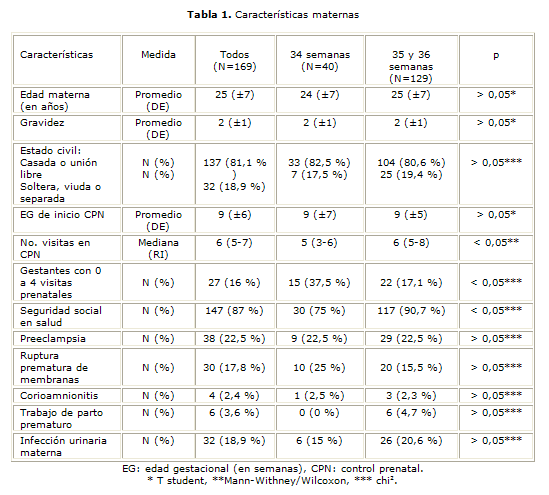
<body><![CDATA[<P><font size="2" face="Verdana">Durante el periodo del estudio, 169 neonatos  PT fueron incluidos, 40 de 34 semanas y 129 de 35 y 36 semanas. El 50 % (n= 20)  de los reci&eacute;n nacidos de 34 semanas nacieron por ces&aacute;rea, y el 54,3  % (n= 70) de los prematuros de 35-36 semanas tambi&eacute;n nacieron por esta  v&iacute;a (p&gt; 0,05). El 87 % (n= 147) ten&iacute;a alg&uacute;n r&eacute;gimen  de seguridad social en salud (30,8 % al contributivo y el 56,2 % al subsidiado),  mientras el 13 % (n= 22) carec&iacute;a de &eacute;l. </font>     <P>     <P><font size="2" face="Verdana">Se  encontraron diferencias estad&iacute;sticamente significativas para n&uacute;mero  de visitas prenatales y seguridad social en salud (p&lt; 0,05). Los neonatos de  34 semanas tuvieron 5 visitas (RI: 3-6) y los de 35-36 semanas 6 visitas (RI:  5-8). El 25 % de las madres de los reci&eacute;n nacidos de 34 semanas <i>vs.</i>  el 9,3 % de las madres de los de 35-36 semanas no tuvieron seguridad social en  salud. El realizar menos de 5 visitas prenatales (RR: 2,1; IC 95 %: 1,3-3,6; p&lt;  0,05) y el carecer de seguridad social en salud (RR: 2,2; IC 95 %: 1,3-3,9; p&lt;  0,05), estuvieron asociados a nacer de 34 semanas. Para el resto de variables  no se hall&oacute; diferencia estad&iacute;stica (<a href="#tab1">tabla 1</a>).  </font>     <P align="center"><font size="2" face="Verdana"> <img src="/img/revistas/ped/v84n4/t0103412.gif" width="549" height="495"></font>  <a name="tab1"></a>     
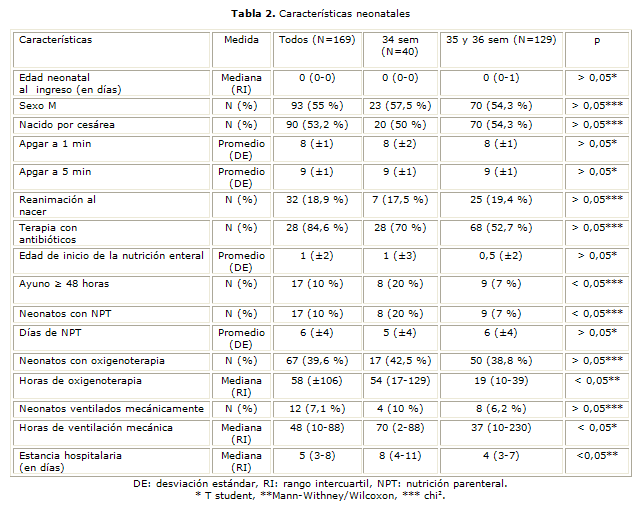
<P><font size="2" face="Verdana">El promedio de edad de los  neonatos del estudio fue 0 d&iacute;as (&#177; 0), el 55 % (n= 93) de los prematuros  fueron varones y el 53,3 % (n= 90) nacieron por ces&aacute;rea. Se hall&oacute;  diferencia estad&iacute;sticamente significativa para n&uacute;mero de reci&eacute;n  nacidos con nutrici&oacute;n parenteral (NPT), ya que el 20 % (n= 8) de los de  34 semanas recibieron NPT, mientras solo el 7 % (n= 9) de los de 35-36 semanas  (p&lt; 0,05) necesit&oacute; de ese recurso. Los neonatos de 35-36 semanas requirieron  m&aacute;s horas de oxigenoterapia y de ventilaci&oacute;n mec&aacute;nica (p&lt;  0,05). Los reci&eacute;n nacidos de 34 semanas tuvieron una estancia hospitalaria  m&aacute;s larga que los de 35-36 semanas, diferencia que fue estad&iacute;sticamente  significativa (p&lt; 0,05). Para las otras variables no se hall&oacute; diferencia  estad&iacute;stica (<a href="/img/revistas/ped/v84n4/t0203412.gif">tabla  2</a>). </font>     
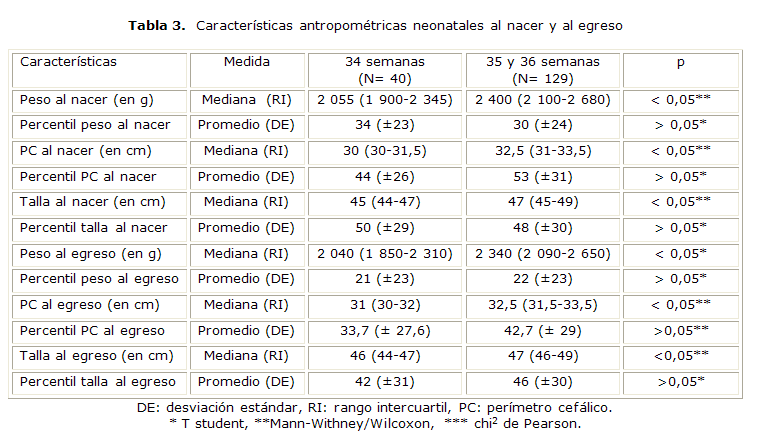
<P><font size="2" face="Verdana"> </font><font size="2" face="Verdana">Al  momento del ingreso, los neonatos de 34 semanas tuvieron menos peso, menos talla  y menos per&iacute;metro cef&aacute;lico que los de 35-36 semanas (p&lt; 0,05),  aunque no se hallaron diferencias estad&iacute;sticamente significativas para  los promedios de los percentiles de peso, talla y per&iacute;metro cef&aacute;lico  al nacer (<a href="/img/revistas/ped/v84n4/t0303412.gif">tabla 3</a>); sin  embargo, el 26,4 % de los neonatos de 35 y 36 semanas tuvieron un peso al nacer  por debajo del percentil 10, mientras que esto ocurri&oacute; en el 7,5 % de los  de 34 semanas (p&lt; 0,05), hallazgo no identificado para percentil de la talla  y el per&iacute;metro cef&aacute;lico al nacer. En cuanto a los percentiles de  los par&aacute;metros antropom&eacute;tricos al egreso, se encontr&oacute; que  el 39,4 % de los neonatos de 35 y 36 semanas egresaron con un peso por debajo  del percentil 10, mientras esto ocurri&oacute; en el 42,5 % de los de 34 semanas,  diferencia que no es estad&iacute;sticamente significativa. Tampoco se hall&oacute;  diferencia estad&iacute;sticamente significativa para percentil de talla y per&iacute;metro  cef&aacute;lico al egreso. </font>     
<P><font size="2" face="Verdana"> </font><font size="2" face="Verdana">Se  hallaron morbilidades respiratorias (maladaptaci&oacute;n pulmonar y la taquipnea  transitoria principalmente) en el 32,5 % (n= 55), ictericia en el 29 % (n= 49),  retardo del crecimiento extrauterino (RCEU) en el 23,7 % (n= 40), morbilidad gastrointestinal  en el 13,6 % (n= 23), metab&oacute;lica en el 13,6 % (n= 23), y cardiaca, hematol&oacute;gica,  infecciosa, hipotermia y renal con menos del 2 %, sin embargo, sin diferencia  estad&iacute;sticamente significativa entre los 2 grupos (p&gt; 0,05). No hubo  complicaciones neurol&oacute;gicas, s&iacute;ndrome de escape de aire, retinopat&iacute;a  de la prematuridad, ni tampoco mortalidad entre los 2 grupos (<a href="#tab4">tabla  4</a>). Por otra parte, se encontr&oacute; m&aacute;s bajo peso al nacer (p&lt;  10) entre los neonatos de 35-36 semanas que entre los de 34 semanas, diferencia  que fue estad&iacute;sticamente significativa, con RR de 2,9 (IC 95 %: 1,1-7,6,  p&lt; 0,05). </font>     <div class=Section1>     <p class=MsoNormalCxSpFirst align=center style='text-align:center;line-height: normal'><b><span lang=ES-CO style='font-size:10.0pt;font-family:Verdana'>Tabla  4. </span></b><span lang=ES-CO style='font-size:10.0pt;font-family:Verdana'>Morbilidad  neonatal</span></p>    <div align=center><a name="tab4"></a> <table class=MsoNormalTable border=1 cellspacing=3 cellpadding=0 width=580  style='width:578.75pt'> <tr style='height:46.55pt'> <td nowrap valign=top style='padding:0cm 5.4pt 0cm 5.4pt;height:46.55pt'>      ]]></body>
<body><![CDATA[<p class=MsoNormalCxSpMiddle style='line-height:normal'><span lang=ES-CO   style='font-size:10.0pt;font-family:Verdana'>    <br> Morbilidad</span></p></td><td nowrap valign=top style='padding:0cm 5.4pt 0cm 5.4pt;height:46.55pt'>      <p class=MsoNormalCxSpMiddle align=center style='text-align:center;   line-height:normal'><span lang=IT style='font-size:10.0pt;font-family:Verdana'>    <br>  Todos     <br> (N= 169)</span></p></td><td nowrap valign=top style='padding:0cm 5.4pt 0cm 5.4pt;height:46.55pt'>      <p class=MsoNormalCxSpMiddle align=center style='text-align:center;   line-height:normal'><span lang=IT style='font-size:10.0pt;font-family:Verdana'>    <br>  34 semanas     <br> (N= 40)</span></p></td><td width=102 valign=top style='width:76.35pt;padding:0cm 5.4pt 0cm 5.4pt;   height:46.55pt'>     <p class=MsoNormalCxSpMiddle align=center style='text-align:center;   line-height:normal'><span lang=IT style='font-size:10.0pt;font-family:Verdana'>35  y 36 semanas (N=129)</span></p></td><td width=132 valign=top style='width:99.15pt;padding:0cm 5.4pt 0cm 5.4pt;   height:46.55pt'>     <p class=MsoNormalCxSpMiddle align=center style='text-align:center;   line-height:normal'><span lang=IT style='font-size:10.0pt;font-family:Verdana'>    ]]></body>
<body><![CDATA[<br>  RR (IC 95 %)</span></p></td><td width=76 nowrap valign=top style='width:57.3pt;padding:0cm 5.4pt 0cm 5.4pt;   height:46.55pt'>     <p class=MsoNormalCxSpMiddle align=center style='text-align:center;   line-height:normal'><span lang=IT style='font-size:10.0pt;font-family:Verdana'>p</span></p></td></tr>  <tr style='height:8.75pt'> <td nowrap valign=top style='padding:0cm 5.4pt 0cm 5.4pt;height:8.75pt'>      <p class=MsoNormalCxSpMiddle style='line-height:normal'><span lang=ES-CO   style='font-size:10.0pt;font-family:Verdana'>RCIU N (%) </span></p></td><td nowrap valign=top style='padding:0cm 5.4pt 0cm 5.4pt;height:8.75pt'>      <p class=MsoNormalCxSpMiddle align=center style='text-align:center;   line-height:normal'><span lang=ES-CO style='font-size:10.0pt;font-family:   Verdana'>41 (24,3 %)</span></p></td><td nowrap valign=top style='padding:0cm 5.4pt 0cm 5.4pt;height:8.75pt'>      <p class=MsoNormalCxSpMiddle align=center style='text-align:center;   line-height:normal'><span lang=ES-CO style='font-size:10.0pt;font-family:   Verdana'>3 (7,5 %)</span></p></td><td width=102 valign=top style='width:76.35pt;padding:0cm 5.4pt 0cm 5.4pt;   height:8.75pt'>     <p class=MsoNormalCxSpMiddle align=center style='text-align:center;   line-height:normal'><span lang=ES-CO style='font-size:10.0pt;font-family:   Verdana'>34 (26,4 %)</span></p></td><td width=132 valign=top style='width:99.15pt;padding:0cm 5.4pt 0cm 5.4pt;   height:8.75pt'>     <p class=MsoNormalCxSpMiddle align=center style='text-align:center;   line-height:normal'><span lang=ES-CO style='font-size:10.0pt;font-family:   Verdana'>1,3 (1,1-1,5)</span></p></td><td width=76 nowrap valign=top style='width:57.3pt;padding:0cm 5.4pt 0cm 5.4pt;   height:8.75pt'>     <p class=MsoNormalCxSpMiddle align=center style='text-align:center;   line-height:normal'><span lang=ES-CO style='font-size:10.0pt;font-family:   Verdana'>&lt; 0,05</span></p></td></tr> <tr style='height:10.55pt'> <td nowrap valign=top style='padding:0cm 5.4pt 0cm 5.4pt;height:10.55pt'>      <p class=MsoNormalCxSpMiddle style='line-height:normal'><span lang=ES-CO   style='font-size:10.0pt;font-family:Verdana'>RCEU N (%) </span></p></td><td nowrap valign=top style='padding:0cm 5.4pt 0cm 5.4pt;height:10.55pt'>      <p class=MsoNormalCxSpMiddle align=center style='text-align:center;   line-height:normal'><span lang=ES-CO style='font-size:10.0pt;font-family:   Verdana'>70 (41,4 %)</span></p></td><td nowrap valign=top style='padding:0cm 5.4pt 0cm 5.4pt;height:10.55pt'>      ]]></body>
<body><![CDATA[<p class=MsoNormalCxSpMiddle align=center style='text-align:center;   line-height:normal'><span lang=ES-CO style='font-size:10.0pt;font-family:   Verdana'>17 (42,5 %)</span></p></td><td width=102 valign=top style='width:76.35pt;padding:0cm 5.4pt 0cm 5.4pt;   height:10.55pt'>     <p class=MsoNormalCxSpMiddle align=center style='text-align:center;   line-height:normal'><span lang=ES-CO style='font-size:10.0pt;font-family:   Verdana'>53 (40,9 %)</span></p></td><td width=132 valign=top style='width:99.15pt;padding:0cm 5.4pt 0cm 5.4pt;   height:10.55pt'>     <p class=MsoNormalCxSpMiddle align=center style='text-align:center;   line-height:normal'><span lang=ES-CO style='font-size:10.0pt;font-family:   Verdana'>1,1 (0,6-1,9)</span></p></td><td width=76 nowrap valign=top style='width:57.3pt;padding:0cm 5.4pt 0cm 5.4pt;   height:10.55pt'>     <p class=MsoNormalCxSpMiddle align=center style='text-align:center;   line-height:normal'><span lang=ES-CO style='font-size:10.0pt;font-family:   Verdana'>&gt; 0,05</span></p></td></tr> <tr style='height:64.85pt'> <td nowrap valign=top style='padding:0cm 5.4pt 0cm 5.4pt;height:64.85pt'>      <p class=MsoNormalCxSpMiddle style='line-height:normal'><span lang=ES-CO   style='font-size:10.0pt;font-family:Verdana'>Morbilidad respiratoria     <br> Enfermedad  de membrana hialina    <br> Maladaptación y TT    <br> Neumonía    <br> Otras </span></p></td><td nowrap valign=top style='padding:0cm 5.4pt 0cm 5.4pt;height:64.85pt'>      <p class=MsoNormalCxSpMiddle align=center style='text-align:center;   line-height:normal'><span lang=ES-CO style='font-size:10.0pt;font-family:   Verdana'>55 (32,5 %)    ]]></body>
<body><![CDATA[<br> 2 (1,2 %)    <br> 31 (18,3 %)    <br> 2 (1,2 %)    <br> 15 (8,9  %)</span></p></td><td nowrap valign=top style='padding:0cm 5.4pt 0cm 5.4pt;height:64.85pt'>      <p class=MsoNormalCxSpMiddle align=center style='text-align:center;   line-height:normal'><span lang=ES-CO style='font-size:10.0pt;font-family:   Verdana'>13 (25 %)    <br> 1 (2,5 %)    <br> 6 (15 %)    <br> 0 (0 %)    <br> 6 (15 %)</span></p></td><td width=102 valign=top style='width:76.35pt;padding:0cm 5.4pt 0cm 5.4pt;   height:64.85pt'>     <p class=MsoNormalCxSpMiddle align=center style='text-align:center;   line-height:normal'><span lang=ES-CO style='font-size:10.0pt;font-family:   Verdana'>42 (15,5 %)    ]]></body>
<body><![CDATA[<br> 1 (0,8 %)    <br> 29 (22,5 %)    <br> 2 (1,6 %)    <br> 9 (7 %)</span></p></td><td width=132 valign=top style='width:99.15pt;padding:0cm 5.4pt 0cm 5.4pt;   height:64.85pt'>     <p class=MsoNormalCxSpMiddle align=center style='text-align:center;   line-height:normal'><span lang=ES-CO style='font-size:10.0pt;font-family:   Verdana'>1 (0,8-1,2)</span></p></td><td width=76 nowrap valign=top style='width:57.3pt;padding:0cm 5.4pt 0cm 5.4pt;   height:64.85pt'>     <p class=MsoNormalCxSpMiddle align=center style='text-align:center;   line-height:normal'><span lang=ES-CO style='font-size:10.0pt;font-family:   Verdana'>&gt; 0,05</span></p></td></tr> <tr style='height:12.35pt'> <td nowrap valign=top style='padding:0cm 5.4pt 0cm 5.4pt;height:12.35pt'>      <p class=MsoNormalCxSpMiddle style='line-height:normal'><span lang=ES-CO   style='font-size:10.0pt;font-family:Verdana'>Ictericia</span></p></td><td nowrap valign=top style='padding:0cm 5.4pt 0cm 5.4pt;height:12.35pt'>      <p class=MsoNormalCxSpMiddle align=center style='text-align:center;   line-height:normal'><span lang=ES-CO style='font-size:10.0pt;font-family:   Verdana'>49 (29 %)</span></p></td><td nowrap valign=top style='padding:0cm 5.4pt 0cm 5.4pt;height:12.35pt'>      <p class=MsoNormalCxSpMiddle align=center style='text-align:center;   line-height:normal'><span lang=ES-CO style='font-size:10.0pt;font-family:   Verdana'>9 (22,5 %)</span></p></td><td width=102 valign=top style='width:76.35pt;padding:0cm 5.4pt 0cm 5.4pt;   height:12.35pt'>     <p class=MsoNormalCxSpMiddle align=center style='text-align:center;   line-height:normal'><span lang=ES-CO style='font-size:10.0pt;font-family:   Verdana'>40 (31 %)</span></p></td><td width=132 valign=top style='width:99.15pt;padding:0cm 5.4pt 0cm 5.4pt;   height:12.35pt'>     ]]></body>
<body><![CDATA[<p class=MsoNormalCxSpMiddle align=center style='text-align:center;   line-height:normal'><span lang=ES-CO style='font-size:10.0pt;font-family:   Verdana'>1,1 (0,9-1,3)</span></p></td><td width=76 nowrap valign=top style='width:57.3pt;padding:0cm 5.4pt 0cm 5.4pt;   height:12.35pt'>     <p class=MsoNormalCxSpMiddle align=center style='text-align:center;   line-height:normal'><span lang=ES-CO style='font-size:10.0pt;font-family:   Verdana'>&gt; 0,05</span></p></td></tr> <tr style='height:49.4pt'> <td nowrap valign=top style='padding:0cm 5.4pt 0cm 5.4pt;height:49.4pt'>      <p class=MsoNormalCxSpMiddle style='line-height:12.0pt'><span lang=ES-CO   style='font-size:10.0pt;font-family:Verdana'>Morbilidad gastrointestinal     <br>  Intolerancia a la VO    <br> RGE demostrado    <br> ECN    <br> Otras </span></p></td><td nowrap valign=top style='padding:0cm 5.4pt 0cm 5.4pt;height:49.4pt'>      <p class=MsoNormalCxSpMiddle align=center style='text-align:center;   line-height:12.0pt'><span lang=ES-CO style='font-size:10.0pt;font-family:   Verdana'>23 (13,6 %)    <br> 2 (1,2 %)    <br> 2 (1,2 %)    ]]></body>
<body><![CDATA[<br> 4 (2,4 %)    <br> 5 (3 %)</span></p></td><td nowrap valign=top style='padding:0cm 5.4pt 0cm 5.4pt;height:49.4pt'>      <p class=MsoNormalCxSpMiddle align=center style='text-align:center;   line-height:12.0pt'><span lang=ES-CO style='font-size:10.0pt;font-family:   Verdana'>6 (15 %)    <br> 1 (2,5 %)    <br> 1 (2,5 %)    <br> 2 (5 %)    <br> 1 (2,5 %)</span></p></td><td width=102 valign=top style='width:76.35pt;padding:0cm 5.4pt 0cm 5.4pt;   height:49.4pt'>     <p class=MsoNormalCxSpMiddle align=center style='text-align:center;   line-height:12.0pt'><span lang=ES-CO style='font-size:10.0pt;font-family:   Verdana'>17 (13,2 %)    <br> 1 (0,8 %)    <br> 1 (0,8 %)    ]]></body>
<body><![CDATA[<br> 2 (1,6 %)    <br> 4 (3,1 %)</span></p></td><td width=132 valign=top style='width:99.15pt;padding:0cm 5.4pt 0cm 5.4pt;   height:49.4pt'>     <p class=MsoNormalCxSpMiddle align=center style='text-align:center;   line-height:12.0pt'><span lang=ES-CO style='font-size:10.0pt;font-family:   Verdana'>1,2 (0,3-3,4)</span></p></td><td width=76 nowrap valign=top style='width:57.3pt;padding:0cm 5.4pt 0cm 5.4pt;   height:49.4pt'>     <p class=MsoNormalCxSpMiddle align=center style='text-align:center;   line-height:12.0pt'><span lang=ES-CO style='font-size:10.0pt;font-family:   Verdana'>&gt; 0,05</span></p></td></tr> <tr style='height:43.6pt'> <td nowrap valign=top style='padding:0cm 5.4pt 0cm 5.4pt;height:43.6pt'>      <p class=MsoNormalCxSpMiddle style='line-height:normal'><span lang=ES-CO   style='font-size:10.0pt;font-family:Verdana'>Morbilidad metabólica     <br> Hipoglicemia    <br>  Hiponatremia     <br> Otras </span></p></td><td nowrap valign=top style='padding:0cm 5.4pt 0cm 5.4pt;height:43.6pt'>      <p class=MsoNormalCxSpMiddle align=center style='text-align:center;   line-height:normal'><span lang=ES-CO style='font-size:10.0pt;font-family:   Verdana'>23 (13,6 %)    <br> 18 (1,2 %)    ]]></body>
<body><![CDATA[<br> 2 (1,2 %)    <br> 1 (3 %)</span></p></td><td nowrap valign=top style='padding:0cm 5.4pt 0cm 5.4pt;height:43.6pt'>      <p class=MsoNormalCxSpMiddle align=center style='text-align:center;   line-height:normal'><span lang=ES-CO style='font-size:10.0pt;font-family:   Verdana'>5 (12,5 %)    <br> 4 (10 %)    <br> 1 (2,5 %)    <br> 0 (0 %)</span></p></td><td width=102 valign=top style='width:76.35pt;padding:0cm 5.4pt 0cm 5.4pt;   height:43.6pt'>     <p class=MsoNormalCxSpMiddle align=center style='text-align:center;   line-height:normal'><span lang=ES-CO style='font-size:10.0pt;font-family:   Verdana'>18 (14 %)    <br> 14 (0,8 %)    <br> 1 (0,8 %)    <br> 1 (0,8 %)</span></p></td><td width=132 valign=top style='width:99.15pt;padding:0cm 5.4pt 0cm 5.4pt;   height:43.6pt'>     ]]></body>
<body><![CDATA[<p class=MsoNormalCxSpMiddle align=center style='text-align:center;   line-height:normal'><span lang=ES-CO style='font-size:10.0pt;font-family:   Verdana'>1,02 (0,8-1,3)</span></p></td><td width=76 nowrap valign=top style='width:57.3pt;padding:0cm 5.4pt 0cm 5.4pt;   height:43.6pt'>     <p class=MsoNormalCxSpMiddle align=center style='text-align:center;   line-height:normal'><span lang=ES-CO style='font-size:10.0pt;font-family:   Verdana'>&gt; 0,05</span></p></td></tr> <tr style='height:24.4pt'> <td nowrap valign=top style='padding:0cm 5.4pt 0cm 5.4pt;height:24.4pt'>      <p class=MsoNormalCxSpMiddle style='line-height:normal'><span lang=ES-CO   style='font-size:10.0pt;font-family:Verdana'>Morbilidad cardiaca     <br> Ductus  arterioso permeable </span></p></td><td nowrap valign=top style='padding:0cm 5.4pt 0cm 5.4pt;height:24.4pt'>      <p class=MsoNormalCxSpMiddle align=center style='text-align:center;   line-height:normal'><span lang=ES-CO style='font-size:10.0pt;font-family:   Verdana'>3 (1,8 %)    <br> 3 (1,8 %)</span></p></td><td nowrap valign=top style='padding:0cm 5.4pt 0cm 5.4pt;height:24.4pt'>      <p class=MsoNormalCxSpMiddle align=center style='text-align:center;   line-height:normal'><span lang=ES-CO style='font-size:10.0pt;font-family:   Verdana'>1 (2,5 %)    <br> 1 (2,5 %)</span></p></td><td width=102 valign=top style='width:76.35pt;padding:0cm 5.4pt 0cm 5.4pt;   height:24.4pt'>     <p class=MsoNormalCxSpMiddle align=center style='text-align:center;   line-height:normal'><span lang=ES-CO style='font-size:10.0pt;font-family:   Verdana'>2 (1,6 %)    <br> 2 (1,6 %)</span></p></td><td width=132 valign=top style='width:99.15pt;padding:0cm 5.4pt 0cm 5.4pt;   height:24.4pt'>     ]]></body>
<body><![CDATA[<p class=MsoNormalCxSpMiddle align=center style='text-align:center;   line-height:normal'><span lang=ES-CO style='font-size:10.0pt;font-family:   Verdana'>1,6 (0,03-32)</span></p></td><td width=76 nowrap valign=top style='width:57.3pt;padding:0cm 5.4pt 0cm 5.4pt;   height:24.4pt'>     <p class=MsoNormalCxSpMiddle align=center style='text-align:center;   line-height:normal'><span lang=ES-CO style='font-size:10.0pt;font-family:   Verdana'>&gt; 0,05</span></p></td></tr> <tr style='height:40.6pt'> <td nowrap valign=top style='padding:0cm 5.4pt 0cm 5.4pt;height:40.6pt'>      <p class=MsoNormalCxSpMiddle style='line-height:normal'><span lang=ES-CO   style='font-size:10.0pt;font-family:Verdana'>Morbilidad hematológica     <br> Anemia    <br>  Otra </span></p></td><td nowrap valign=top style='padding:0cm 5.4pt 0cm 5.4pt;height:40.6pt'>      <p class=MsoNormalCxSpMiddle align=center style='text-align:center;   line-height:normal'><span lang=ES-CO style='font-size:10.0pt;font-family:   Verdana'>2 (1,2 %)    <br> 1 (0,6 %)    <br> 1 (0,6 %)</span></p></td><td nowrap valign=top style='padding:0cm 5.4pt 0cm 5.4pt;height:40.6pt'>      <p class=MsoNormalCxSpMiddle align=center style='text-align:center;   line-height:normal'><span lang=ES-CO style='font-size:10.0pt;font-family:   Verdana'>1 (2,5 %)    <br> 1 (2,5 %)    ]]></body>
<body><![CDATA[<br> 0 (0 %)</span></p></td><td width=102 valign=top style='width:76.35pt;padding:0cm 5.4pt 0cm 5.4pt;   height:40.6pt'>     <p class=MsoNormalCxSpMiddle align=center style='text-align:center;   line-height:normal'><span lang=ES-CO style='font-size:10.0pt;font-family:   Verdana'>1 (0,8 %)    <br> 0 (0 %)    <br> 1 (0,8 %)</span></p></td><td width=132 valign=top style='width:99.15pt;padding:0cm 5.4pt 0cm 5.4pt;   height:40.6pt'>     <p class=MsoNormalCxSpMiddle style='line-height:normal'><span lang=ES-CO   style='font-size:10.0pt;font-family:Verdana'>3,2 (0,04-259,6)</span></p></td><td width=76 nowrap valign=top style='width:57.3pt;padding:0cm 5.4pt 0cm 5.4pt;   height:40.6pt'>     <p class=MsoNormalCxSpMiddle align=center style='text-align:center;   line-height:normal'><span lang=ES-CO style='font-size:10.0pt;font-family:   Verdana'>&gt; 0,05</span></p></td></tr> <tr style='height:12.75pt'> <td nowrap valign=top style='padding:0cm 5.4pt 0cm 5.4pt;height:12.75pt'>      <p class=MsoNormalCxSpMiddle style='line-height:normal'><span lang=ES-CO   style='font-size:10.0pt;font-family:Verdana'>Hipotermia</span></p></td><td nowrap valign=top style='padding:0cm 5.4pt 0cm 5.4pt;height:12.75pt'>      <p class=MsoNormalCxSpMiddle align=center style='text-align:center;   line-height:normal'><span lang=ES-CO style='font-size:10.0pt;font-family:   Verdana'>2 (1,2 %)</span></p></td><td nowrap valign=top style='padding:0cm 5.4pt 0cm 5.4pt;height:12.75pt'>      <p class=MsoNormalCxSpMiddle align=center style='text-align:center;   line-height:normal'><span lang=ES-CO style='font-size:10.0pt;font-family:   Verdana'>0 (0 %)</span></p></td><td width=102 valign=top style='width:76.35pt;padding:0cm 5.4pt 0cm 5.4pt;   height:12.75pt'>     <p class=MsoNormalCxSpMiddle align=center style='text-align:center;   line-height:normal'><span lang=ES-CO style='font-size:10.0pt;font-family:   Verdana'>2 (1,6 %)</span></p></td><td width=132 valign=top style='width:99.15pt;padding:0cm 5.4pt 0cm 5.4pt;   height:12.75pt'>     ]]></body>
<body><![CDATA[<p class=MsoNormalCxSpMiddle align=center style='text-align:center;   line-height:normal'><span lang=ES-CO style='font-size:10.0pt;font-family:   Verdana'>1,3 (1,2-1,4)</span></p></td><td width=76 nowrap valign=top style='width:57.3pt;padding:0cm 5.4pt 0cm 5.4pt;   height:12.75pt'>     <p class=MsoNormalCxSpMiddle align=center style='text-align:center;   line-height:normal'><span lang=ES-CO style='font-size:10.0pt;font-family:   Verdana'>&gt; 0,05</span></p></td></tr> <tr style='height:7.7pt'> <td nowrap valign=top style='padding:0cm 5.4pt 0cm 5.4pt;height:7.7pt'>      <p class=MsoNormalCxSpMiddle style='line-height:normal'><span lang=ES-CO   style='font-size:10.0pt;font-family:Verdana'>Morbilidad infecciosa: sepsis</span></p></td><td nowrap valign=top style='padding:0cm 5.4pt 0cm 5.4pt;height:7.7pt'>      <p class=MsoNormalCxSpMiddle align=center style='text-align:center;   line-height:normal'><span lang=ES-CO style='font-size:10.0pt;font-family:   Verdana'>2 (1,2 %)</span></p></td><td nowrap valign=top style='padding:0cm 5.4pt 0cm 5.4pt;height:7.7pt'>      <p class=MsoNormalCxSpMiddle align=center style='text-align:center;   line-height:normal'><span lang=ES-CO style='font-size:10.0pt;font-family:   Verdana'>1 (2,5 %)</span></p></td><td width=102 valign=top style='width:76.35pt;padding:0cm 5.4pt 0cm 5.4pt;   height:7.7pt'>     <p class=MsoNormalCxSpMiddle align=center style='text-align:center;   line-height:normal'><span lang=ES-CO style='font-size:10.0pt;font-family:   Verdana'>1 (0,8 %)</span></p></td><td width=132 valign=top style='width:99.15pt;padding:0cm 5.4pt 0cm 5.4pt;   height:7.7pt'>     <p class=MsoNormalCxSpMiddle align=center style='text-align:center;   line-height:normal'><span lang=ES-CO style='font-size:10.0pt;font-family:   Verdana'>0,7 (0,2-2,6)</span></p></td><td width=76 nowrap valign=top style='width:57.3pt;padding:0cm 5.4pt 0cm 5.4pt;   height:7.7pt'>     <p class=MsoNormalCxSpMiddle align=center style='text-align:center;   line-height:normal'><span lang=ES-CO style='font-size:10.0pt;font-family:   Verdana'>&gt;0,05</span></p></td></tr> <tr style='height:20.55pt'> <td nowrap valign=top style='padding:0cm 5.4pt 0cm 5.4pt;height:20.55pt'>      <p class=MsoNormalCxSpMiddle style='line-height:normal'><span lang=ES-CO   style='font-size:10.0pt;font-family:Verdana'>Morbilidad renal: falla renal</span></p></td><td nowrap valign=top style='padding:0cm 5.4pt 0cm 5.4pt;height:20.55pt'>      <p class=MsoNormalCxSpMiddle align=center style='text-align:center;   line-height:normal'><span lang=ES-CO style='font-size:10.0pt;font-family:   Verdana'>1 (0,6 %)</span></p></td><td nowrap valign=top style='padding:0cm 5.4pt 0cm 5.4pt;height:20.55pt'>      ]]></body>
<body><![CDATA[<p class=MsoNormalCxSpMiddle align=center style='text-align:center;   line-height:normal'><span lang=ES-CO style='font-size:10.0pt;font-family:   Verdana'>0 (0 %)</span></p></td><td width=102 valign=top style='width:76.35pt;padding:0cm 5.4pt 0cm 5.4pt;   height:20.55pt'>     <p class=MsoNormalCxSpMiddle align=center style='text-align:center;   line-height:normal'><span lang=ES-CO style='font-size:10.0pt;font-family:   Verdana'>1 (0,8 %)</span></p></td><td width=132 valign=top style='width:99.15pt;padding:0cm 5.4pt 0cm 5.4pt;   height:20.55pt'>     <p class=MsoNormalCxSpMiddle align=center style='text-align:center;   line-height:normal'><span lang=ES-CO style='font-size:10.0pt;font-family:   Verdana'>1,3 (1,2-1,4)</span></p></td><td width=76 nowrap valign=top style='width:57.3pt;padding:0cm 5.4pt 0cm 5.4pt;   height:20.55pt'>     <p class=MsoNormalCxSpMiddle align=center style='text-align:center;   line-height:normal'><span lang=ES-CO style='font-size:10.0pt;font-family:   Verdana'>&gt; 0,05</span></p></td></tr> </table></div>    <p class=MsoNormalCxSpMiddle align=center style='text-align:center;line-height: normal'><span style='font-size:10.0pt;font-family:Verdana'>*** Chi<sup>2</sup>  de Pearson,  RCIU: retardo de crecimiento intrauterino, TT: taquipnea transitoria,  </span></p>    <p class=MsoNormalCxSpMiddle align=center style='text-align:center;line-height: normal'><span style='font-size:10.0pt;font-family:Verdana'>VO: vía oral, RGE:  reflujo gastroesofágico, ECN: enterocolitis necrotizante.</span></p></div>    <P>&nbsp;      <P><font size="2" face="Verdana"> </font><font size="2" face="Verdana">Los reci&eacute;n  nacidos de 34 semanas tuvieron m&aacute;s riesgo de recibir NPT (RR: 2,2; IC 95  %: 1,2-4; p&lt; 0,05), ox&iacute;geno por m&aacute;s de 48 horas (RR: 2,2; IC  95 %: 1,2-3,9; p&lt; 0,05), ox&iacute;geno por m&aacute;s de 5 d&iacute;as (RR:  2,2; IC 95 %: 1,1-4,7; p&lt; 0,05) y m&aacute;s de una semana de hospitalizaci&oacute;n  (RR: 2,8; IC 95 %: 1,6-4,6; p&lt; 0,05) (<a href="/img/revistas/ped/v84n4/t0503412.gif">tabla  5</a>). Dos de los neonatos de entre 35-36 semanas tuvieron 230 y 354 horas de  ventilaci&oacute;n, lo cual afect&oacute; el promedio de ventilaci&oacute;n mec&aacute;nica  en este grupo, sin embargo no hubo diferencia estad&iacute;sticamente significativa  por encima de las 72 horas de ventilaci&oacute;n mec&aacute;nica entre los 2 grupos.  El 20 % de los neonatos de 34 semanas tuvieron ayuno por 2 d&iacute;as o m&aacute;s,  mientras esto ocurri&oacute; en el 7 % de los de 35-36 semanas (RR: 2,2; IC 95  %: 1,2-4; p&lt; 0,05). El 7,5 % de los prematuros de 34 semanas tardaron m&aacute;s  de 7 d&iacute;as en recibir alimento, mientras esto aconteci&oacute; solo en el  3,1 % de 35-36 semanas. El 50 % de los reci&eacute;n nacidos de 34 semanas permanecieron  hospitalizados por m&aacute;s de 7 d&iacute;as, mientras esto ocurri&oacute; en  el 19,4 % de los de 35 y 36 semanas (RR: 2,8; IC 95 %: 1,6-4,6; p&lt; 0,001).  Mientras los costos de la atenci&oacute;n a un neonato de 34 semanas le reporta  a las aseguradoras en salud USD 3 138,34, con uno de 35 semanas la suma es de  USD 1 957,82 y de 36 semanas USD 1 192,50; es decir, la atenci&oacute;n a un neonato  de 34 semanas resulta ser 160 % y 60 % veces m&aacute;s costosa, que a uno de  35 y 36 semanas. </font>     
<P>     <P>&nbsp;     ]]></body>
<body><![CDATA[<P><font size="2" face="Verdana"><b><font size="3">DISCUSI&Oacute;N  </font></b></font>     <P>     <P><font size="2" face="Verdana">Con este trabajo se propuso  evaluar la morbilidad neonatal en PT, comparando, adem&aacute;s, los resultados  de los prematuros de 34 semanas y de 35 a 36 semanas. </font>     <P>     <P><font size="2" face="Verdana">En  los &uacute;ltimos a&ntilde;os, los prematuros supusieron un 9-12,5 % de todos  los nacimientos en Estados Unidos,<sup>14-18</sup> lo cual, asociado al aumento  de nacimiento de pret&eacute;rminos entre las 34 y 36 semanas, constituyen m&aacute;s  del 70 % de estos nacimientos.<sup>16,19,20</sup> </font>     <P>     <P><font size="2" face="Verdana">El  87 % de nuestros neonatos ten&iacute;an seguridad social en salud. El 53,3 % nacieron  por ces&aacute;rea (por enfermedades maternas y neonatales), que incluyeron principalmente  preeclampsia (26,2 %), ruptura prematura de membranas (17,8 %) y trabajo de parto  prematuro espont&aacute;neo (3,6 %). Este aumento de nacimiento de PT puede estar  asociado a cambios demogr&aacute;ficos, tratamiento de infertilidad, incremento  de la edad materna, aumento de gestaciones m&uacute;ltiples, comorbilidades maternas  y neonatales (preeclampsia, corioamnionitis, desprendimiento de placenta, ruptura  prematura de membranas, partos prematuros previos, compromiso fetal, intervalo  corto entre gestaciones, oligohidramnios y sangrado en el embarazo).<sup>21</sup>  </font>     <P>     <P><font size="2" face="Verdana">El control prenatal es una de las  conductas que permiten reducir la morbilidad y mortalidad materno-perinatal. Al  momento del nacimiento, (34-36 semanas) una gestante debe, como m&iacute;nimo,  haber realizado entre 5 y 8 visitas a los controles prenatales en nuestro pa&iacute;s.  Encontramos que 37,5 % (n= 15) de madres de neonatos de 34 semanas realizaron  menos de 5 visitas prenatales, y entre ellas 5 (12,5 %) no tuvieron ning&uacute;n  control prenatal, mientras que 17,1 % (n= 22) de gestantes que tuvieron hijos  entre 35-36 semanas tuvieron menos de 5 controles, y 4 (3,1 %) ninguna visita  prenatal. Se evidencia entonces que, el hecho de no realizar control prenatal  o asistir menos de 5 veces a control prenatal, est&aacute; asociado a tener un  neonato de 34 semanas (RR: 2,1; IC 95 %: 1,3-3,6; p&lt; 0,05). </font>     <P>     ]]></body>
<body><![CDATA[<P><font size="2" face="Verdana">Los  prematuros de 34 semanas requirieron m&aacute;s NPT (RR: 2,2; IC 95 %: 1,2-4;  p&lt; 0,05), m&aacute;s de 48 horas de oxigenoterapia (RR: 2,2; IC 95 %: 1,2-3,9;  p&lt; 0,05) y oxigenoterapia por m&aacute;s de 5 d&iacute;as (RR: 2,2; IC 95 %:  1,12-4,7; p&lt; 0,05) que los de 35-36 semanas. </font>     <P>     <P><font size="2" face="Verdana">Los  PT tienen mayor riesgo de desarrollar dificultad respiratoria cuando se comparan  con los RNT (28,9<i> vs. </i>4,2 % respectivamente), con un riesgo 9 veces mayor.  La insuficiencia respiratoria se incrementa significativamente con cada semana  por debajo de la 39 semanas de gestaci&oacute;n: 30 x 1 000 nacidos vivos (NV)  a las 34 semanas, 14 x 1 000 NV a las 35 semanas y 7,1 x 1 000 NV a las 36 semanas  de gestaci&oacute;n.<sup>22</sup> Los PT, cuando son comparados con los RNT, requirieron  m&aacute;s surfactante, mayor frecuencia y horas de oxigenoterapia, y m&aacute;s  horas de ventilaci&oacute;n mec&aacute;nica.<sup>23</sup> </font>     <P>     <P><font size="2" face="Verdana">El  ayuno por 48 horas o m&aacute;s fue mayor entre los neonatos de 34 semanas, comparado  con los de 35 y 36 semanas. El 7,5 % de prematuros de 34 semanas tardaron m&aacute;s  de 7 d&iacute;as en recibir alimento, mientras esto aconteci&oacute; solo en el  3,1 % de los de 35-36 semanas. </font>     <P>     <P><font size="2" face="Verdana">Los  prematuros de 34 semanas egresaron con m&aacute;s bajo peso de la UCIN cuando  se compararon con aquellos de 35 y 36 semanas (2 040 g; IC 95 %: 1 850-2 310 g  <i>vs.</i> 2 340 g; IC 95 %: 2 090-2 310 respectivamente; p&lt; 0,05). El 24,3  % de todos los PT nacieron con peso inferior al percentil 10. Mientras el 10 %  de los neonatos de 34 semanas nacieron con peso inferior al percentil 10, el grupo  de 35-36 semanas fue el m&aacute;s afectado, con 26,4 % (RR: 1,3; IC 95 %: 1,1-1,5;  p&lt; 0,05). No se hall&oacute; diferencia estad&iacute;sticamente significativa  entre los promedios de los percentiles de peso, talla, per&iacute;metro cef&aacute;lico  al nacer y al egreso hospitalario, pero s&iacute; hubo una diferencia estad&iacute;sticamente  significativa para retardo del crecimiento intrauterino (RCIU) entre los dos tipos  de PT comparados, hallazgo similar al de <i>Rojas P</i> y otros.<sup>23</sup>  </font>     <P>     <P><font size="2" face="Verdana">Se encontr&oacute; que 41,4 % tuvo  RCEU, el 32,5 % morbilidad respiratoria, el 29 % ictericia, el 13,6 % morbilidad  gastrointestinal y metab&oacute;lica, el 1,8 % ductus arterioso permeable, el  2,4 % hipotermia, el 1,2 % morbilidad hematol&oacute;gica y sepsis, mientras el  0,6 % falla renal aguda; sin embargo, no hubo diferencia estad&iacute;sticamente  significativa al comparar la morbilidad de los neonatos de 34 con los de 35 y  36 semanas. En ninguno de los neonatos se encontraron complicaciones neurol&oacute;gicas,  o de otro tipo. A pesar de que no hallamos mortalidad en este grupo de neonatos,  los PT representan el 70 % de nacimientos prematuros, y su mortalidad a las 34  semanas de edad gestacional es 1,1 x 1 000 NV, 1,5 x 1 000 NV a las 35 semanas  y 0,5 x 1 000 NV a las 36 semanas, en relaci&oacute;n con la del RNT, que es de  0,2 x 1 000 NV.<sup>20</sup> </font>     <P>     ]]></body>
<body><![CDATA[<P><font size="2" face="Verdana">Si bien  los PT no tienen una elevada mortalidad y morbilidad de forma individual, s&iacute;  suponen en su conjunto, por su frecuencia, un problema neonatal. Los PT experimentan  morbilidad durante la hospitalizaci&oacute;n con una frecuencia 7 veces mayor  que los RNT.<sup>21</sup> El 75 % de estos reci&eacute;n nacidos presentan uno  o m&aacute;s problemas o intervenciones, lo cual indica que su morbilidad no es  despreciable,<sup>20</sup>como por ejemplo, la hipoglicemia, la necesidad de infusiones  de soluciones glucosadas endovenosas<sup>24</sup> y la hipotermia, que se presenta  con una relaci&oacute;n aproximada de 10:1 entre PT cuando se compara con neonatos  nacidos a t&eacute;rmino.<sup>24</sup> Igualmente se presentan problemas relacionados  con la alimentaci&oacute;n, como la alteraci&oacute;n de la motilidad intestinal,  la incoordinaci&oacute;n de la succi&oacute;n-degluci&oacute;n,<sup>24</sup> problemas  respiratorios (3,6-28,9 %), ictericia<sup>16,24</sup> e inmadurez inmunol&oacute;gica,<sup>25</sup>  que se traduce en mayor riesgo de infecciones.<b><font color="#FF0000"> </font></b><i>Demestre  X</i> y otros,<sup>26</sup> informan una incidencia de problemas neonatales en  PT, como son, la hiperbilirrubinemia (16,1 %), problemas respiratorios (13,6 %),  taquipnea transitoria (9,4 %), hipoglicemia (4,7 %), enfermedad de membrana hialina  (3,2 %) y apneas (2,3 %), cifras muy similares a las halladas en nuestro trabajo.  </font>     <P>     <P><font size="2" face="Verdana">Otro aspecto importante es la hospitalizaci&oacute;n  prolongada de estos neonatos. <i>Pulver</i> y otros<sup>20</sup> informan que  el 40 % de PT tuvieron una hospitalizaci&oacute;n prolongada (definida como el  alta de la madre antes que la del neonato), la cual fue m&aacute;s frecuente entre  los nacidos de 34 semanas, comparado con los nacidos a la semana 36. En este trabajo,  los neonatos de 34 semanas tuvieron una mediana de d&iacute;as de hospitalizaci&oacute;n  de 8 (RI: 4-11 d&iacute;as), mientras los neonatos pret&eacute;rmino entre 35  y 36 semanas permanecieron en la UCIN 4 d&iacute;as (3-7 d&iacute;as), lo cual  configura a la edad de 34 semanas en un riesgo de estancia mayor a 7 d&iacute;as  (RR: 2,8; IC 95 %: 1,6-4,6; p&lt; 0,05). Para <i>Rojas P</i> y otros,<sup>23</sup>  los neonatos PT tuvieron una estancia hospitalaria m&aacute;s prolongada que los  de 37-41 semanas (9 d&iacute;as; RI: 4-16 d&iacute;as <i>vs.</i> 4 d&iacute;as;  RI: 2-8 d&iacute;as respectivamente; p&lt; 0,001). Esta estancia prolongada estuvo  directamente asociada a los costos generados por las atenciones hospitalarias,  y fue 1,6 y 0,6 veces m&aacute;s costoso atender a un neonato de 34, que a uno  de 35 y 36 respectivamente. </font>     <P>     <P><font size="2" face="Verdana">En esta  poblaci&oacute;n estudiada no se registraron muertes, sin embargo, la mortalidad  del PT es superior a la del RNT. Las tasas de mortalidad por cada 1 000 NV para  los neonatos de 34 semanas es de 7,1 (RR: 9,5; IC 95 %: 8,4-10,8; p&lt; 0,05),  35 semanas de 4,8 (RR: 5,6; IC 95 %: 5,6-7,2) y para 36 semanas de 2,8 (RR: 3,7;  IC 95 %: 3,3-4,2; p&lt; 0,05). Despu&eacute;s de corregir por anomal&iacute;as  cong&eacute;nitas, la prematuridad tard&iacute;a aumenta el riesgo de muerte en  el per&iacute;odo neonatal temprano 4,5-5,6 veces, la muerte neonatal tard&iacute;a  2-2,9 veces, la muerte posneonatal 2-2,6 veces y la mortalidad infantil 2,5-3,2  veces, cifras superiores a las presentadas en RNT.<sup>21</sup> </font>     <P>     <P><font size="2" face="Verdana">La  principal limitaci&oacute;n del estudio fue que la muestra se recogi&oacute; desde  el a&ntilde;o 2005, lo cual causa problemas con la calidad de los datos, pues  hubo variables que pudieron ser importantes y no fueron evaluadas, como algunos  aspectos de la nutrici&oacute;n enteral como kcal/kg, dosis de aumento, tiempo  en alcanzar las 120 kcal/kg/d&iacute;a, por ejemplo. </font>     <P>     <P><font size="2" face="Verdana">Una  perspectiva futura es la realizaci&oacute;n de un estudio prospectivo que compare  los resultados en cuanto a morbilidad y mortalidad del neonato PT, con el RNT.  Se debe siempre considerar al PT un neonato inmaduro (no deben ser considerados  casi maduros) y con riesgos de morbilidad, con capacidad de respuesta compensadora  limitada frente a los cambios extrauterinos, con mayores ingresos a las UCIN,  con mayor estancia hospitalaria e involucrando alto costo de salud. Por lo anterior,  ameritan una vigilancia estricta desde el momento del nacimiento, para evitar  complicaciones potencialmente letales. </font>     <P>&nbsp;     ]]></body>
<body><![CDATA[<P>     <P>     <P><b><font size="3" face="Verdana">  REFERENCIAS BIBLIOGR&Aacute;FICAS </font></b>     <P>     <!-- ref --><P><font size="2" face="Verdana">1.  Kramer MS, Demissie K, Yang H, Platt RW, Sauv&eacute; R, Liston R. The contribution  of mild and moderate preterm birth to infant mortality. Fetal and Infant Health  Study Group of the Canadian Perinatal Surveillance System. JAMA. 2000;284(7):843-9.      </font>     <!-- ref --><P><font size="2" face="Verdana">2. Klebanoff MA. Conceptualizing categories  of preterm birth. Prenat Neonatal Med. 1998;3(1):13-5.     </font>     <!-- ref --><P><font size="2" face="Verdana">3.  Raju TN, Higgins RD, Stark AR, Leveno KJ. Optimizing care and outcome for late-preterm  (near-term) infants: a summary of the workshop sponsored by the National Institute  of Child Health and Human Development. Pediatrics. 2006;118:1207-14.     </font>     ]]></body>
<body><![CDATA[<!-- ref --><P><font size="2" face="Verdana">4.  Hamilton BE, Martin JA, Ventura SJ. Births: preliminary data for 2008. Natl Vital  Stat Rep. 2010;58(16):1-17.     </font>     <!-- ref --><P><font size="2" face="Verdana">5. Adamkin  D. Late preterm infants: severe hyperbilirubinemia and postnatal glucose homeostasis.  J Perinatol. 2009;29:S12-7.     </font>     <!-- ref --><P><font size="2" face="Verdana">6. Villar  J, Abalos E, Carroli G, Giordano D, Wojdyla D, Piaggio G, et al. Heterogeneity  of perinatal outcomes in the preterm delivery syndrome. Obstet Gynecol. 2004;104(1):78-87.      </font>     <!-- ref --><P><font size="2" face="Verdana">7. Joseph KS. Obstetric intervention,  stillbirth, and preterm birth. Semin Perinatol. 2002;26(4):250-9.     </font>     <!-- ref --><P><font size="2" face="Verdana">8.  Laptook A, Jackson GL. Cold Stress and hypoglycemia in the late preterm (&quot;near-term&quot;)  infant: impact on nursery of admission. Semin Perinatol. 2006;30:24-7.     </font>      ]]></body>
<body><![CDATA[<!-- ref --><P><font size="2" face="Verdana">9. Neu J. Gastrointestinal maturation and feeding.  Semin Perinatol. 2006;30:77-80.     </font>     <!-- ref --><P><font size="2" face="Verdana">10. Kien  CL, McClead RE, Cordero L Jr. Effects of lactose intake on lactose digestion and  colonic fermentation in preterm infants. J Pediatr. 1998;133:401-5.     </font>     <!-- ref --><P><font size="2" face="Verdana">11.  Gartner LM, Herschel M. Jaundice and breastfeeding. Pediatr Clin North Am. 2002;48:389-99.      </font>     <!-- ref --><P><font size="2" face="Verdana">12. Ward RM. Drug disposition in the  late preterm (&quot;near-term&quot;) newborn. Semin Perinatol. 2006;30:48-59.      </font>     <!-- ref --><P><font size="2" face="Verdana">13. Clapp DW. Developmental regulation  of the immune system. Semin Perinatol. 2006;30:69-72.     </font>     ]]></body>
<body><![CDATA[<!-- ref --><P><font size="2" face="Verdana">14.  Hoyert DL, Mathews TJ, Menacker F, Strobino DM, Guyer B. Annual summary of vital  statistics: 2004. Pediatrics. 2006;117:168-83.     </font>     <!-- ref --><P><font size="2" face="Verdana">15.  Watchko JF. Hyperbilirubinemia and bilirubin toxicity in the late preterm infant.  Clin Perinatol. 2006;33:839-52.     </font>     <!-- ref --><P><font size="2" face="Verdana">16. Watchko  JF. Identification of neonates at risk for hazardous hyperbilirubinemia: emerging  clinical insights. Pediatr Clin North Am. 2009;56:671-87.     </font>     <!-- ref --><P><font size="2" face="Verdana">17.  Bhutani VK, Johnson L. Kernicterus in late preterm infants cared for as term healthy  infants. Semin Perinatol. 2006;30:89-97.     </font>     <!-- ref --><P><font size="2" face="Verdana">18.  McIntire D, Leveno K. Neonatal Mortality and Morbidity Rates in Late Preterm Births  Compared With Births at Term. Obstetrics &amp; Gynecology. 2008;111(1):35-41.      </font>     ]]></body>
<body><![CDATA[<!-- ref --><P><font size="2" face="Verdana">19. Cohen-Wolkowiez M, Moran C, Benjamin  D, Cotten CM, Clark RH, Benjamin DK Jr, et al. Early and Late Onset Sepsis in  Late Preterm Infants. Ped Infect Dis. 2009;28:1052-6.     </font>     <!-- ref --><P><font size="2" face="Verdana">20.  Pulver L, Denney J, Silver R, Young P. Morbidity and Discharge Timing of Late  Preterm Newborns. Clinical Pediatrics. 2010;49:1061-7.     </font>     <!-- ref --><P><font size="2" face="Verdana">21.  Engle W. Morbidity and Mortality in Late Preterm and Early Term Newborns: A Continuum.  Clin Perinatol. 2011;38:493-516.     </font>     <!-- ref --><P><font size="2" face="Verdana">22.  Mohan S, Jain L. Late Preterm Birth: Preventable Prematurity? Clin Perinatol.  2011;38:547-55.     </font>     <!-- ref --><P><font size="2" face="Verdana">23. Rojas P, Pav&oacute;n  A, Rosso M, Losada A. Complicaciones a corto plazo de los reci&eacute;n nacidos  pret&eacute;rmino tard&iacute;os. An Pediatr (Barc). 2011;75(3):169-74.     </font>      ]]></body>
<body><![CDATA[<!-- ref --><P><font size="2" face="Verdana">24. Lupiani P, Pozo E, Alvarez N, Cerrudo P,  Cerrudo P, L&oacute;pez S. Prematuros tardios. Problemas y seguimiento en Atencion  Primaria. Can Pediatr. 2011;35(2):109-14.     </font>     <!-- ref --><P><font size="2" face="Verdana">25.  Hanson L, Korotkova M, Lundin S. The transfer of immunity from mother to child.  Annals of New York Academy of Sciences. 2003;987:199-206.     </font>     <!-- ref --><P><font size="2" face="Verdana">26.  Demestre X, Raspall F, Martinez S, Vila C, Elizari MJ, Sala P. Prematuros tard&iacute;os:  una poblaci&oacute;n de riesgo infravalorada. An Pediatr (Barc). 2009;71(4):291-8.      </font>     <P>&nbsp;     <P>&nbsp;     <P>     <P>     ]]></body>
<body><![CDATA[<P>     <P><font size="2" face="Verdana">Recibido: 16 de marzo  de 2012.     <br> </font><font size="2" face="Verdana">Aprobado: 21 de mayo de 2012.  </font>     <P>&nbsp;     <P>&nbsp;     <P>     <P>     <P><font size="2" face="Verdana"><i>Lu&iacute;s Alfonso  Mendoza Tasc&oacute;n</i>. Fundaci&oacute;n Hospital San Jos&eacute; de Buga.  Carrera 8 No. 17-20, Buga. Valle del Cauca, Colombia. Correo electr&oacute;nico:  <a href="mailto:lamendozat@gmail.com">lamendozat@gmail.com</a></font>       ]]></body><back>
<ref-list>
<ref id="B1">
<label>1</label><nlm-citation citation-type="journal">
<person-group person-group-type="author">
<name>
<surname><![CDATA[Kramer]]></surname>
<given-names><![CDATA[MS]]></given-names>
</name>
<name>
<surname><![CDATA[Demissie]]></surname>
<given-names><![CDATA[K]]></given-names>
</name>
<name>
<surname><![CDATA[Yang]]></surname>
<given-names><![CDATA[H]]></given-names>
</name>
<name>
<surname><![CDATA[Platt]]></surname>
<given-names><![CDATA[RW]]></given-names>
</name>
<name>
<surname><![CDATA[Sauvé]]></surname>
<given-names><![CDATA[R]]></given-names>
</name>
<name>
<surname><![CDATA[Liston]]></surname>
<given-names><![CDATA[R]]></given-names>
</name>
</person-group>
<article-title xml:lang="en"><![CDATA[The contribution of mild and moderate preterm birth to infant mortality: Fetal and Infant Health Study Group of the Canadian Perinatal Surveillance System]]></article-title>
<source><![CDATA[JAMA.]]></source>
<year>2000</year>
<volume>284</volume>
<numero>7</numero>
<issue>7</issue>
<page-range>843-9</page-range></nlm-citation>
</ref>
<ref id="B2">
<label>2</label><nlm-citation citation-type="journal">
<person-group person-group-type="author">
<name>
<surname><![CDATA[Klebanoff]]></surname>
<given-names><![CDATA[MA]]></given-names>
</name>
</person-group>
<article-title xml:lang="en"><![CDATA[Conceptualizing categories of preterm birth]]></article-title>
<source><![CDATA[Prenat Neonatal Med.]]></source>
<year>1998</year>
<volume>3</volume>
<numero>1</numero>
<issue>1</issue>
<page-range>13-5</page-range></nlm-citation>
</ref>
<ref id="B3">
<label>3</label><nlm-citation citation-type="journal">
<person-group person-group-type="author">
<name>
<surname><![CDATA[Raju]]></surname>
<given-names><![CDATA[TN]]></given-names>
</name>
<name>
<surname><![CDATA[Higgins]]></surname>
<given-names><![CDATA[RD]]></given-names>
</name>
<name>
<surname><![CDATA[Stark]]></surname>
<given-names><![CDATA[AR]]></given-names>
</name>
<name>
<surname><![CDATA[Leveno]]></surname>
<given-names><![CDATA[KJ]]></given-names>
</name>
</person-group>
<article-title xml:lang="en"><![CDATA[Optimizing care and outcome for late-preterm (near-term) infants: a summary of the workshop sponsored by the National Institute of Child Health and Human Development]]></article-title>
<source><![CDATA[Pediatrics.]]></source>
<year>2006</year>
<volume>118</volume>
<page-range>1207-14</page-range></nlm-citation>
</ref>
<ref id="B4">
<label>4</label><nlm-citation citation-type="journal">
<person-group person-group-type="author">
<name>
<surname><![CDATA[Hamilton]]></surname>
<given-names><![CDATA[BE]]></given-names>
</name>
<name>
<surname><![CDATA[Martin]]></surname>
<given-names><![CDATA[JA]]></given-names>
</name>
<name>
<surname><![CDATA[Ventura]]></surname>
<given-names><![CDATA[SJ]]></given-names>
</name>
</person-group>
<article-title xml:lang="en"><![CDATA[Births: preliminary data for 2008]]></article-title>
<source><![CDATA[Natl Vital Stat Rep.]]></source>
<year>2010</year>
<volume>58</volume>
<numero>16</numero>
<issue>16</issue>
<page-range>1-17</page-range></nlm-citation>
</ref>
<ref id="B5">
<label>5</label><nlm-citation citation-type="journal">
<person-group person-group-type="author">
<name>
<surname><![CDATA[Adamkin]]></surname>
<given-names><![CDATA[D]]></given-names>
</name>
</person-group>
<article-title xml:lang="en"><![CDATA[Late preterm infants: severe hyperbilirubinemia and postnatal glucose homeostasis]]></article-title>
<source><![CDATA[J Perinatol.]]></source>
<year>2009</year>
<volume>29</volume>
<page-range>S12-7</page-range></nlm-citation>
</ref>
<ref id="B6">
<label>6</label><nlm-citation citation-type="journal">
<person-group person-group-type="author">
<name>
<surname><![CDATA[Villar]]></surname>
<given-names><![CDATA[J]]></given-names>
</name>
<name>
<surname><![CDATA[Abalos]]></surname>
<given-names><![CDATA[E]]></given-names>
</name>
<name>
<surname><![CDATA[Carroli]]></surname>
<given-names><![CDATA[G]]></given-names>
</name>
<name>
<surname><![CDATA[Giordano]]></surname>
<given-names><![CDATA[D]]></given-names>
</name>
<name>
<surname><![CDATA[Wojdyla]]></surname>
<given-names><![CDATA[D]]></given-names>
</name>
<name>
<surname><![CDATA[Piaggio]]></surname>
<given-names><![CDATA[G]]></given-names>
</name>
</person-group>
<article-title xml:lang="en"><![CDATA[Heterogeneity of perinatal outcomes in the preterm delivery syndrome]]></article-title>
<source><![CDATA[Obstet Gynecol.]]></source>
<year>2004</year>
<volume>104</volume>
<numero>1</numero>
<issue>1</issue>
<page-range>78-87</page-range></nlm-citation>
</ref>
<ref id="B7">
<label>7</label><nlm-citation citation-type="journal">
<person-group person-group-type="author">
<name>
<surname><![CDATA[Joseph]]></surname>
<given-names><![CDATA[KS]]></given-names>
</name>
</person-group>
<article-title xml:lang="en"><![CDATA[Obstetric intervention, stillbirth, and preterm birth]]></article-title>
<source><![CDATA[Semin Perinatol.]]></source>
<year>2002</year>
<volume>26</volume>
<numero>4</numero>
<issue>4</issue>
<page-range>250-9</page-range></nlm-citation>
</ref>
<ref id="B8">
<label>8</label><nlm-citation citation-type="journal">
<person-group person-group-type="author">
<name>
<surname><![CDATA[Laptook]]></surname>
<given-names><![CDATA[A]]></given-names>
</name>
<name>
<surname><![CDATA[Jackson]]></surname>
<given-names><![CDATA[GL]]></given-names>
</name>
</person-group>
<article-title xml:lang="en"><![CDATA[Cold Stress and hypoglycemia in the late preterm ("near-term") infant: impact on nursery of admission]]></article-title>
<source><![CDATA[Semin Perinatol.]]></source>
<year>2006</year>
<volume>30</volume>
<page-range>24-7</page-range></nlm-citation>
</ref>
<ref id="B9">
<label>9</label><nlm-citation citation-type="journal">
<person-group person-group-type="author">
<name>
<surname><![CDATA[Neu]]></surname>
<given-names><![CDATA[J]]></given-names>
</name>
</person-group>
<article-title xml:lang="en"><![CDATA[Gastrointestinal maturation and feeding]]></article-title>
<source><![CDATA[Semin Perinatol.]]></source>
<year>2006</year>
<volume>30</volume>
<page-range>77-80</page-range></nlm-citation>
</ref>
<ref id="B10">
<label>10</label><nlm-citation citation-type="journal">
<person-group person-group-type="author">
<name>
<surname><![CDATA[Kien]]></surname>
<given-names><![CDATA[CL]]></given-names>
</name>
<name>
<surname><![CDATA[McClead]]></surname>
<given-names><![CDATA[RE]]></given-names>
</name>
<name>
<surname><![CDATA[Cordero L]]></surname>
<given-names><![CDATA[Jr]]></given-names>
</name>
</person-group>
<article-title xml:lang="en"><![CDATA[Effects of lactose intake on lactose digestion and colonic fermentation in preterm infants]]></article-title>
<source><![CDATA[J Pediatr.]]></source>
<year>1998</year>
<volume>133</volume>
<page-range>401-5</page-range></nlm-citation>
</ref>
<ref id="B11">
<label>11</label><nlm-citation citation-type="journal">
<person-group person-group-type="author">
<name>
<surname><![CDATA[Gartner]]></surname>
<given-names><![CDATA[LM]]></given-names>
</name>
<name>
<surname><![CDATA[Herschel]]></surname>
<given-names><![CDATA[M]]></given-names>
</name>
</person-group>
<article-title xml:lang="en"><![CDATA[Jaundice and breastfeeding]]></article-title>
<source><![CDATA[Pediatr Clin North Am.]]></source>
<year>2002</year>
<volume>48</volume>
<page-range>389-99</page-range></nlm-citation>
</ref>
<ref id="B12">
<label>12</label><nlm-citation citation-type="journal">
<person-group person-group-type="author">
<name>
<surname><![CDATA[Ward]]></surname>
<given-names><![CDATA[RM]]></given-names>
</name>
</person-group>
<article-title xml:lang="en"><![CDATA[Drug disposition in the late preterm ("near-term") newborn]]></article-title>
<source><![CDATA[Semin Perinatol.]]></source>
<year>2006</year>
<volume>30</volume>
<page-range>48-59</page-range></nlm-citation>
</ref>
<ref id="B13">
<label>13</label><nlm-citation citation-type="journal">
<person-group person-group-type="author">
<name>
<surname><![CDATA[Clapp]]></surname>
<given-names><![CDATA[DW]]></given-names>
</name>
</person-group>
<article-title xml:lang="en"><![CDATA[Developmental regulation of the immune system]]></article-title>
<source><![CDATA[Semin Perinatol.]]></source>
<year>2006</year>
<volume>30</volume>
<page-range>69-72</page-range></nlm-citation>
</ref>
<ref id="B14">
<label>14</label><nlm-citation citation-type="journal">
<person-group person-group-type="author">
<name>
<surname><![CDATA[Hoyert]]></surname>
<given-names><![CDATA[DL]]></given-names>
</name>
<name>
<surname><![CDATA[Mathews]]></surname>
<given-names><![CDATA[TJ]]></given-names>
</name>
<name>
<surname><![CDATA[Menacker]]></surname>
<given-names><![CDATA[F]]></given-names>
</name>
<name>
<surname><![CDATA[Strobino]]></surname>
<given-names><![CDATA[DM]]></given-names>
</name>
<name>
<surname><![CDATA[Guyer]]></surname>
<given-names><![CDATA[B]]></given-names>
</name>
</person-group>
<article-title xml:lang="en"><![CDATA[Annual summary of vital statistics: 2004]]></article-title>
<source><![CDATA[Pediatrics.]]></source>
<year>2006</year>
<volume>117</volume>
<page-range>168-83</page-range></nlm-citation>
</ref>
<ref id="B15">
<label>15</label><nlm-citation citation-type="journal">
<person-group person-group-type="author">
<name>
<surname><![CDATA[Watchko]]></surname>
<given-names><![CDATA[JF]]></given-names>
</name>
</person-group>
<article-title xml:lang="en"><![CDATA[Hyperbilirubinemia and bilirubin toxicity in the late preterm infant]]></article-title>
<source><![CDATA[Clin Perinatol.]]></source>
<year>2006</year>
<volume>33</volume>
<page-range>839-52</page-range></nlm-citation>
</ref>
<ref id="B16">
<label>16</label><nlm-citation citation-type="journal">
<person-group person-group-type="author">
<name>
<surname><![CDATA[Watchko]]></surname>
<given-names><![CDATA[JF]]></given-names>
</name>
</person-group>
<article-title xml:lang="en"><![CDATA[Identification of neonates at risk for hazardous hyperbilirubinemia: emerging clinical insights]]></article-title>
<source><![CDATA[Pediatr Clin North Am.]]></source>
<year>2009</year>
<volume>56</volume>
<page-range>671-87</page-range></nlm-citation>
</ref>
<ref id="B17">
<label>17</label><nlm-citation citation-type="journal">
<person-group person-group-type="author">
<name>
<surname><![CDATA[Bhutani]]></surname>
<given-names><![CDATA[VK]]></given-names>
</name>
<name>
<surname><![CDATA[Johnson]]></surname>
<given-names><![CDATA[L]]></given-names>
</name>
</person-group>
<article-title xml:lang="en"><![CDATA[Kernicterus in late preterm infants cared for as term healthy infants]]></article-title>
<source><![CDATA[Semin Perinatol.]]></source>
<year>2006</year>
<volume>30</volume>
<page-range>89-97</page-range></nlm-citation>
</ref>
<ref id="B18">
<label>18</label><nlm-citation citation-type="journal">
<person-group person-group-type="author">
<name>
<surname><![CDATA[McIntire]]></surname>
<given-names><![CDATA[D]]></given-names>
</name>
<name>
<surname><![CDATA[Leveno]]></surname>
<given-names><![CDATA[K]]></given-names>
</name>
</person-group>
<article-title xml:lang="en"><![CDATA[Neonatal Mortality and Morbidity Rates in Late Preterm Births Compared With Births at Term]]></article-title>
<source><![CDATA[Obstetrics & Gynecology.]]></source>
<year>2008</year>
<volume>111</volume>
<numero>1</numero>
<issue>1</issue>
<page-range>35-41</page-range></nlm-citation>
</ref>
<ref id="B19">
<label>19</label><nlm-citation citation-type="journal">
<person-group person-group-type="author">
<name>
<surname><![CDATA[Cohen-Wolkowiez]]></surname>
<given-names><![CDATA[M]]></given-names>
</name>
<name>
<surname><![CDATA[Moran]]></surname>
<given-names><![CDATA[C]]></given-names>
</name>
<name>
<surname><![CDATA[Benjamin]]></surname>
<given-names><![CDATA[D]]></given-names>
</name>
<name>
<surname><![CDATA[Cotten]]></surname>
<given-names><![CDATA[CM]]></given-names>
</name>
<name>
<surname><![CDATA[Clark]]></surname>
<given-names><![CDATA[RH]]></given-names>
</name>
<name>
<surname><![CDATA[Benjamin]]></surname>
<given-names><![CDATA[DK Jr]]></given-names>
</name>
</person-group>
<article-title xml:lang="en"><![CDATA[Early and Late Onset Sepsis in Late Preterm Infants]]></article-title>
<source><![CDATA[Ped Infect Dis.]]></source>
<year>2009</year>
<volume>28</volume>
<page-range>1052-6</page-range></nlm-citation>
</ref>
<ref id="B20">
<label>20</label><nlm-citation citation-type="journal">
<person-group person-group-type="author">
<name>
<surname><![CDATA[Pulver]]></surname>
<given-names><![CDATA[L]]></given-names>
</name>
<name>
<surname><![CDATA[Denney]]></surname>
<given-names><![CDATA[J]]></given-names>
</name>
<name>
<surname><![CDATA[Silver]]></surname>
<given-names><![CDATA[R]]></given-names>
</name>
<name>
<surname><![CDATA[Young]]></surname>
<given-names><![CDATA[P]]></given-names>
</name>
</person-group>
<article-title xml:lang="en"><![CDATA[Morbidity and Discharge Timing of Late Preterm Newborns]]></article-title>
<source><![CDATA[Clinical Pediatrics.]]></source>
<year>2010</year>
<volume>49</volume>
<page-range>1061-7</page-range></nlm-citation>
</ref>
<ref id="B21">
<label>21</label><nlm-citation citation-type="journal">
<person-group person-group-type="author">
<name>
<surname><![CDATA[Engle]]></surname>
<given-names><![CDATA[W]]></given-names>
</name>
</person-group>
<article-title xml:lang="en"><![CDATA[Morbidity and Mortality in Late Preterm and Early Term Newborns: A Continuum]]></article-title>
<source><![CDATA[Clin Perinatol.]]></source>
<year>2011</year>
<volume>38</volume>
<page-range>493-516</page-range></nlm-citation>
</ref>
<ref id="B22">
<label>22</label><nlm-citation citation-type="journal">
<person-group person-group-type="author">
<name>
<surname><![CDATA[Mohan]]></surname>
<given-names><![CDATA[S]]></given-names>
</name>
<name>
<surname><![CDATA[Jain]]></surname>
<given-names><![CDATA[L]]></given-names>
</name>
</person-group>
<article-title xml:lang="en"><![CDATA[Late Preterm Birth: Preventable Prematurity?]]></article-title>
<source><![CDATA[Clin Perinatol.]]></source>
<year>2011</year>
<volume>38</volume>
<page-range>547-55</page-range></nlm-citation>
</ref>
<ref id="B23">
<label>23</label><nlm-citation citation-type="journal">
<person-group person-group-type="author">
<name>
<surname><![CDATA[Rojas]]></surname>
<given-names><![CDATA[P]]></given-names>
</name>
<name>
<surname><![CDATA[Pavón]]></surname>
<given-names><![CDATA[A]]></given-names>
</name>
<name>
<surname><![CDATA[Rosso]]></surname>
<given-names><![CDATA[M]]></given-names>
</name>
<name>
<surname><![CDATA[Losada]]></surname>
<given-names><![CDATA[A]]></given-names>
</name>
</person-group>
<article-title xml:lang="es"><![CDATA[Complicaciones a corto plazo de los recién nacidos pretérmino tardíos]]></article-title>
<source><![CDATA[An Pediatr (Barc).]]></source>
<year>2011</year>
<volume>75</volume>
<numero>3</numero>
<issue>3</issue>
<page-range>169-74</page-range></nlm-citation>
</ref>
<ref id="B24">
<label>24</label><nlm-citation citation-type="journal">
<person-group person-group-type="author">
<name>
<surname><![CDATA[Lupiani]]></surname>
<given-names><![CDATA[P]]></given-names>
</name>
<name>
<surname><![CDATA[Pozo]]></surname>
<given-names><![CDATA[E]]></given-names>
</name>
<name>
<surname><![CDATA[Alvarez]]></surname>
<given-names><![CDATA[N]]></given-names>
</name>
<name>
<surname><![CDATA[Cerrudo]]></surname>
<given-names><![CDATA[P]]></given-names>
</name>
<name>
<surname><![CDATA[Cerrudo]]></surname>
<given-names><![CDATA[P]]></given-names>
</name>
<name>
<surname><![CDATA[López]]></surname>
<given-names><![CDATA[S]]></given-names>
</name>
</person-group>
<article-title xml:lang="es"><![CDATA[Prematuros tardios: Problemas y seguimiento en Atencion Primaria]]></article-title>
<source><![CDATA[Can Pediatr.]]></source>
<year>2011</year>
<volume>35</volume>
<numero>2</numero>
<issue>2</issue>
<page-range>109-14</page-range></nlm-citation>
</ref>
<ref id="B25">
<label>25</label><nlm-citation citation-type="journal">
<person-group person-group-type="author">
<name>
<surname><![CDATA[Hanson]]></surname>
<given-names><![CDATA[L]]></given-names>
</name>
<name>
<surname><![CDATA[Korotkova]]></surname>
<given-names><![CDATA[M]]></given-names>
</name>
<name>
<surname><![CDATA[Lundin]]></surname>
<given-names><![CDATA[S]]></given-names>
</name>
</person-group>
<article-title xml:lang="en"><![CDATA[The transfer of immunity from mother to child]]></article-title>
<source><![CDATA[Annals of New York Academy of Sciences]]></source>
<year>2003</year>
<volume>987</volume>
<page-range>199-206</page-range></nlm-citation>
</ref>
<ref id="B26">
<label>26</label><nlm-citation citation-type="journal">
<person-group person-group-type="author">
<name>
<surname><![CDATA[Demestre]]></surname>
<given-names><![CDATA[X]]></given-names>
</name>
<name>
<surname><![CDATA[Raspall]]></surname>
<given-names><![CDATA[F]]></given-names>
</name>
<name>
<surname><![CDATA[Martinez]]></surname>
<given-names><![CDATA[S]]></given-names>
</name>
<name>
<surname><![CDATA[Vila]]></surname>
<given-names><![CDATA[C]]></given-names>
</name>
<name>
<surname><![CDATA[Elizari]]></surname>
<given-names><![CDATA[MJ]]></given-names>
</name>
<name>
<surname><![CDATA[Sala]]></surname>
<given-names><![CDATA[P]]></given-names>
</name>
</person-group>
<article-title xml:lang="es"><![CDATA[Prematuros tardíos: una población de riesgo infravalorada]]></article-title>
<source><![CDATA[An Pediatr (Barc).]]></source>
<year>2009</year>
<volume>71</volume>
<numero>4</numero>
<issue>4</issue>
<page-range>291-8</page-range></nlm-citation>
</ref>
</ref-list>
</back>
</article>