<?xml version="1.0" encoding="ISO-8859-1"?><article xmlns:mml="http://www.w3.org/1998/Math/MathML" xmlns:xlink="http://www.w3.org/1999/xlink" xmlns:xsi="http://www.w3.org/2001/XMLSchema-instance">
<front>
<journal-meta>
<journal-id>0034-7531</journal-id>
<journal-title><![CDATA[Revista Cubana de Pediatría]]></journal-title>
<abbrev-journal-title><![CDATA[Rev Cubana Pediatr]]></abbrev-journal-title>
<issn>0034-7531</issn>
<publisher>
<publisher-name><![CDATA[Centro Nacional de Información de Ciencias MédicasEditorial Ciencias Médicas]]></publisher-name>
</publisher>
</journal-meta>
<article-meta>
<article-id>S0034-75312017000200005</article-id>
<title-group>
<article-title xml:lang="en"><![CDATA[Autoserum skin tests in allergic patients, and in autistic patients and their mothers]]></article-title>
<article-title xml:lang="es"><![CDATA[Pruebas dermatológicas con autosuero en pacientes alérgicos y en pacientes autistas y sus madres]]></article-title>
</title-group>
<contrib-group>
<contrib contrib-type="author">
<name>
<surname><![CDATA[de Almeida Cardoso]]></surname>
<given-names><![CDATA[Roberto Ronald]]></given-names>
</name>
<xref ref-type="aff" rid="A01"/>
</contrib>
</contrib-group>
<aff id="A01">
<institution><![CDATA[,Faculdades Integradas do Planalto Central Departamento de Alergia e Inmunología ]]></institution>
<addr-line><![CDATA[Brasília DF ]]></addr-line>
<country>Brazil</country>
</aff>
<pub-date pub-type="pub">
<day>00</day>
<month>06</month>
<year>2017</year>
</pub-date>
<pub-date pub-type="epub">
<day>00</day>
<month>06</month>
<year>2017</year>
</pub-date>
<volume>89</volume>
<numero>2</numero>
<fpage>145</fpage>
<lpage>152</lpage>
<copyright-statement/>
<copyright-year/>
<self-uri xlink:href="http://scielo.sld.cu/scielo.php?script=sci_arttext&amp;pid=S0034-75312017000200005&amp;lng=en&amp;nrm=iso"></self-uri><self-uri xlink:href="http://scielo.sld.cu/scielo.php?script=sci_abstract&amp;pid=S0034-75312017000200005&amp;lng=en&amp;nrm=iso"></self-uri><self-uri xlink:href="http://scielo.sld.cu/scielo.php?script=sci_pdf&amp;pid=S0034-75312017000200005&amp;lng=en&amp;nrm=iso"></self-uri><kwd-group>
<kwd lng="en"><![CDATA[allergy]]></kwd>
<kwd lng="en"><![CDATA[autism]]></kwd>
<kwd lng="en"><![CDATA[anti-IgE receptor]]></kwd>
<kwd lng="en"><![CDATA[anti-IgE]]></kwd>
<kwd lng="en"><![CDATA[IgE]]></kwd>
<kwd lng="en"><![CDATA[skin test]]></kwd>
<kwd lng="es"><![CDATA[alergia]]></kwd>
<kwd lng="es"><![CDATA[autismo]]></kwd>
<kwd lng="es"><![CDATA[receptor de anti-IgE]]></kwd>
<kwd lng="es"><![CDATA[anti-IgE]]></kwd>
<kwd lng="es"><![CDATA[IgE]]></kwd>
<kwd lng="es"><![CDATA[prueba dermatológica]]></kwd>
</kwd-group>
</article-meta>
</front><body><![CDATA[ <p align="right"><font face="Verdana" size="2"><b>Rev Cubana Pediatr. 2017;89(2)</b></font>  </p>     <p align="right"><font face="Verdana, Arial, Helvetica, sans-serif" size="2"><strong>ORIGINAL    ARTICLE</strong> </font></p>     <p>&nbsp; </p>     <p><font face="Verdana, Arial, Helvetica, sans-serif" size="2"><strong><font size="4">Autoserum    skin tests in allergic patients, and in autistic patients and their mothers</font></strong></font></p>     <p>&nbsp;</p>     <p><font face="Verdana, Arial, Helvetica, sans-serif" size="2"><strong><font size="3">Pruebas    dermatol&oacute;gicas con autosuero en pacientes al&eacute;rgicos y en pacientes    autistas y sus madres</font><font size="4"> </font> </strong> </font></p>     <p>&nbsp;</p>     <p>&nbsp;</p>     <p> <font face="Verdana, Arial, Helvetica, sans-serif" size="2"><strong>Roberto    Ronald de Almeida Cardoso</strong> </font></p>     <p><font face="Verdana, Arial, Helvetica, sans-serif" size="2"> Departamento de    Alergia e Inmunopatolog&#237;a. Faculdades Integradas do Planalto Central (FACIPLAC).    Curso de Medicina. Bras&#237;lia DF, Brazil. </font></p>     ]]></body>
<body><![CDATA[<p>&nbsp;</p>     <p>&nbsp;</p> <hr>     <p><font face="Verdana, Arial, Helvetica, sans-serif" size="2"><strong>ABSTRACT</strong>    </font></p>     <p><font face="Verdana, Arial, Helvetica, sans-serif" size="2"><strong>Introduction:</strong>    allergies are frequently found among patients with autism and autism shows an    increased frequency among the allergic patients. <br/>   <strong>Objective:</strong> to demonstrate that allergies and autism share some    similar immunological patterns.     <br>   </font><font face="Verdana, Arial, Helvetica, sans-serif" size="2"><strong>Methods:    </strong> the autoserum skin test (ASST) was used to demonstrate the presence    of anti-IgE and/or anti-IgE receptor antibodies (Fc&#949;RI&#945;).     <br>   </font><font face="Verdana, Arial, Helvetica, sans-serif" size="2"><strong>Results:    </strong> the ASST demonstrated similar frequency, positives/positives and negatives/negatives,    considering allergic and autistic patients. These similarities didn't exist    when comparing with the control group. A positive correlation had been found    with the results of autistic patients and their mothers.     <br>   </font><font face="Verdana, Arial, Helvetica, sans-serif" size="2"><strong>Conclusions:</strong>    autistic and allergic patients share some immunological similarities. Both differ    from normal controls. It is not uncommon autistics with allergic symptoms and    allergic patients with autism. If the immunological findings represent a clinical    bridge between both processes, it is under discussion. Also it was demonstrated    a possible genetic correlation between the patients with autism and their mothers.    </font></p>     <p><font face="Verdana, Arial, Helvetica, sans-serif" size="2"><strong>Key words:</strong>    allergy; autism; anti-IgE receptor; anti-IgE; IgE; skin test. </font></p> <hr>     <p><font size="2"><b><font face="Verdana, Arial, Helvetica, sans-serif">RESUMEN</font></b></font></p>     <p><b><font face="Verdana, Arial, Helvetica, sans-serif" size="2">Introducci&oacute;n:</font></b><font face="Verdana, Arial, Helvetica, sans-serif" size="2">    las alergias se encuentran con frecuencia en pacientes autistas y asimismo el    autismo muestra una gran presencia entre los pacientes al&eacute;rgicos.     ]]></body>
<body><![CDATA[<br>   <b>Objetivo: </b>demostrar que las alergias y el autismo comparten algunos patrones    inmunol&oacute;gicos similares.    <br>   <b>M&eacute;todos:</b> la prueba dermatol&oacute;gica con autosuero se utiliz&oacute;    para demostrar la presencia de anti-IgE y/o de anticuerpos de receptores de    Ig/E (Fc&#949;RI&#945;).    <br>   <b>Resultados:</b> la prueba ASST confirm&oacute; la frecuencia similar de positivos/positivos    y de negativos/negativos en pacientes al&eacute;rgicos y en pacientes autistas.    Estas similitudes no existieron cuando se realiz&oacute; la comparaci&oacute;n    con el grupo control. Se hab&iacute;a hallado una correlaci&oacute;n positiva    con los resultados obtenidos en pacientes autistas y sus madres.    <br>   <b>Conclusiones:</b> los pacientes autistas y los pacientes al&eacute;rgicos    comparten ciertas similitudes inmunol&oacute;gicas. Ambos se diferencian del    grupo de controles sin estas condiciones. Resulta frecuente encontrar pacientes    autistas con s&iacute;ntomas al&eacute;rgicos y pacientes al&eacute;rgicos con    signos de autismo. Es motivo de an&aacute;lisis si los hallazgos inmunol&oacute;gicos    representan un puente cl&iacute;nico entre ambos procesos. Asimismo se mostr&oacute;    una posible correlaci&oacute;n gen&eacute;tica entre los pacientes con autismo    y sus madres.</font></p>     <p><font face="Verdana, Arial, Helvetica, sans-serif" size="2"><b>Palabras clave:    </b>alergia; autismo; receptor de anti-IgE; anti-IgE; IgE; prueba dermatol&oacute;gica.    </font>    <br> </p> <hr>     <p>&nbsp;</p>     <p>&nbsp;</p>     <p><font face="Verdana, Arial, Helvetica, sans-serif" size="2"><strong><font size="3">INTRODUCTION</font></strong>    </font></p>     <p><font face="Verdana, Arial, Helvetica, sans-serif" size="2">Infantile autism    was first described by Leo Kanner (1894-1981) in 1943.<sup>1</sup> It is defined    by DSM-IV criteria as a childhood behavioral and neurological disorder with    onset prior to three years of age.<sup>2</sup> In 1978 in the United States    0.01 % of the children showed autistic symptoms.<sup>3</sup> In 2008 this percentage    increased to 0.88 %.<sup>4,5</sup> </font></p>     ]]></body>
<body><![CDATA[<p><font face="Verdana, Arial, Helvetica, sans-serif" size="2"> The history of    allergies comes about two thousand years ago. As to autism, its frequency is    rising. Food allergies, for example, have increased about 1,2 percentage point    per decade.<sup>6</sup> </font></p>     <p><font face="Verdana, Arial, Helvetica, sans-serif" size="2"> This paper attempts    to demonstrate some immunological aspects common in the autism and in the allergies.    </font></p>     <p><font face="Verdana, Arial, Helvetica, sans-serif" size="2"> We studied the    presence of anti-IgE and/or anti-IgE receptor antibodies in both groups) through    ASST procedure technique.<sup>7-9</sup> </font></p>     <p>&nbsp;</p>     <p> <font face="Verdana, Arial, Helvetica, sans-serif" size="2"><strong><font size="3">METHODS</font></strong>    </font></p>     <p><font face="Verdana, Arial, Helvetica, sans-serif" size="2"> A cross-sectional    study was conducted with 251 residents of Bras&#237;lia, Brazil, between 2012    and 2014. These individuals were divided in four groups. </font></p>     <p><font face="Verdana, Arial, Helvetica, sans-serif" size="2"> The allergic patients    were a group of patients from a private clinic, all with respiratory allergic    processes (asthma and/or rhinitis) associated with cutaneous processes (atopic    derrmatitis). The patients or their parents who arrived at the clinic with the    mentioned symptoms were asked if they would like to participate in the study.    This group contains 104 individuals, ages between 5 and 74 years, 50 males and    54 females. </font></p>     <p><font face="Verdana, Arial, Helvetica, sans-serif" size="2"> The control group    were the non-allergic companion of allergic patients, medicine students and    some internal collaborators who volunteered to participate in the research.    The group was composed of 63 people, aged between 4 and 71 years, 20 males and    43 females. </font><font face="Verdana, Arial, Helvetica, sans-serif" size="2">The    autistic patients were referred through groups of autistic relatives in Bras&#237;lia,    DF. These patients with autism without allergy were 42, all males, ages between    3 and 14 years. </font></p>     <p><font face="Verdana, Arial, Helvetica, sans-serif" size="2"> The mothers of    the autistic patients were those of the children who participate the study,    42, ages between 25 and 62 years. </font></p>     <p><font face="Verdana, Arial, Helvetica, sans-serif" size="2"> When the evaluation    of the autistic and their mothers was considered concluded, the evaluations    of the allergic ones were finished. </font></p>     ]]></body>
<body><![CDATA[<p><font face="Verdana, Arial, Helvetica, sans-serif" size="2"> Drugs that might    interfere with the ASST results were not used for seven days before and on the    day of the test. </font></p>     <p><font face="Verdana, Arial, Helvetica, sans-serif" size="2"> The procedure    (ASST) was the following:<sup>1,8</sup> 0.05 mL of the patient's own serum was    intradermally injected in the forearm skin; 0.05 mL of saline was used as control.    The papule diameters were measured 15 minutes after injections. The result was    considered positive when the serum papule diameter was at least 3.0 mm or greater    than the diameter obtained with the saline. The ASST is a routine procedure    with the patients evaluation in allergy clinics. It is in accordance with ethical    standards. </font></p>     <p><font face="Verdana, Arial, Helvetica, sans-serif" size="2"> The diagnosis    of allergy was established through the history, clinical, and routine laboratorial    findings. With the autistics the diagnosis was clinical and based on the criteria    for autistic disorder as defined in the Diagnostic and Statistical Manual of    Mental Disorders, Fourth Edition, Text Revision (DSM-IV).<sup>10</sup> </font></p>     <p><font face="Verdana, Arial, Helvetica, sans-serif" size="2"> For statistical    evaluation, the chi-squared and the Fisher's method were used based on the number    of the patients in the groups and the variables studied. The variable used in    the study was the results of the ASST test, positive or negative, in each of    studied groups. </font></p>     <p>&nbsp; </p>     <p> <font face="Verdana, Arial, Helvetica, sans-serif" size="2"><strong><font size="3">RESULTS</font></strong>    </font></p>     <p><font face="Verdana, Arial, Helvetica, sans-serif" size="2"> The first hypothesis    to be tested is whether the presence of anti-IgE and/or anti-IgE receptor antibodies    in autistic patients is independent from the presence of these antibodies in    their non-autistic mothers (<a href="#tab1">table 1</a>). </font></p>     <p align="center"><font face="Verdana, Arial, Helvetica, sans-serif" size="2"><a name="tab1"></a>    <img src="/img/revistas/ped/v89n2/t0105217.gif" width="579" height="272"> </font></p>     <p align="center">&nbsp;</p>     <p><font face="Verdana, Arial, Helvetica, sans-serif" size="2"> The chance of    autistic patients with the presence of the antibodies (positive test) having    mothers with the same antibodies is 15.12, and the chance of autistic patients    without the presence of the antibodies (negative test) having mothers with no    antibodies is 1.5. Positive autistic patients are 22.5 times more likely to    have positive mothers than autistic patients without these antibodies (negative).    </font></p>     ]]></body>
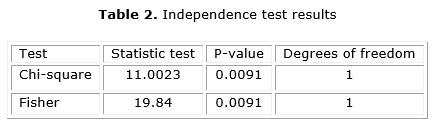
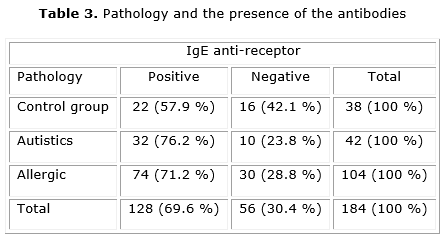
<body><![CDATA[<p><font face="Verdana, Arial, Helvetica, sans-serif" size="2"> <a href="#tab2">Table    2</a> shows the results of chi-squared (X<sup>2</sup>) and Fisher's exact test.    The null hypothesis is that when one data set is independent from other data    set. In other words, we are testing if there is no association between the presence    of antibodies in autistic patients, normal subjects, and in their mothers. </font></p>     <p align="center"><font face="Verdana, Arial, Helvetica, sans-serif" size="2"><a name="tab2"></a>    <img src="/img/revistas/ped/v89n2/t0205217.gif" width="436" height="127"> </font></p>     <p><font face="Verdana, Arial, Helvetica, sans-serif" size="2"> According to the    chi-square test and Fisher's exact test, assuming a 95-percent level of reliability,    the variables are dependent: negative autistic patients are associated with    negative mothers and positive autistic patients are associated with positive    mothers. </font></p>     <p><font face="Verdana, Arial, Helvetica, sans-serif" size="2"> The second hypothesis    test verifies if the presence of antibodies distribution is homogeneous in three    groups. It verifies if the presence of the antibodies depends on the type of    pathology. <a href="#tab3">Table 3 </a>shows the proportions in the three groups    analyzed: control group with no disease; autistic patients group; and allergic    patients group.</font></p>     <p align="center"><a name="tab3"></a><img src="/img/revistas/ped/v89n2/t0305217.gif" width="448" height="241"></p>     <p align="left"><font face="Verdana, Arial, Helvetica, sans-serif" size="2"><a href="#tab4">Table    4</a> shows the result of the chi-square test for homogeneity. The test verifies    if groups with some pathology-autism or allergy-differ from the control group.    </font></p>     <p align="center"><font face="Verdana, Arial, Helvetica, sans-serif" size="2"><br/>   <a name="tab4"></a><img src="/img/revistas/ped/v89n2/t0405217.gif" width="481" height="120"> </font></p>     <p align="left"><font face="Verdana, Arial, Helvetica, sans-serif" size="2">Based    on the X<sup>2</sup> test, the hypothesis of similarity between groups was rejected.    It is thus possible to affirm that the presence of antibodies occurs heterogeneously    among autistic and allergic patients, and the control group. </font></p>     <p>&nbsp; </p>     <p> <font face="Verdana, Arial, Helvetica, sans-serif" size="2"><strong><font size="3">DISCUSSION</font></strong>    </font></p>     ]]></body>
<body><![CDATA[<p><font face="Verdana, Arial, Helvetica, sans-serif" size="2"> The conexion of    autism with allergies is an up to date discussion. In this paper it will be    tried to find an immunological bridge between both pathologies. </font></p>     <p><font face="Verdana, Arial, Helvetica, sans-serif" size="2"> Hypothesis to    explain the autism are multiples. Increased gut permeability has been considered.    It facilitates a direct or an undirect aggression by microorganisms For example,    the measles virus cross-reacts with the cell junction filaments affecting the    intestinal mucosa's integrity and cell to cell communication, thereby producing    a leaking effect and disfunction in intestinal absorption. This provokes the    absorption of undesirable substances, such as phenolic amines, which are known    to be deleterious for the autistics.<sup>11,12</sup> </font></p>     <p><font face="Verdana, Arial, Helvetica, sans-serif" size="2"> The innoculation    with pertussis toxin can produce a separation of the G-alpha protein from the    retinoid receptor which the consequent increasing in the autism symptoms. </font></p>     <p><font face="Verdana, Arial, Helvetica, sans-serif" size="2"> Autistic patients    strongly react to inflammatory processes. Vaccines, such as measles, pertussis    and rubella can trigger strong reactions in the form of fever, urticaria, angioedema    and lethargy, which can last for more than 24 hours. Some authors considered    the use of these vaccines as a precipitant factor of autistic symptoms.<sup>13</sup>    </font></p>     <p><font face="Verdana, Arial, Helvetica, sans-serif" size="2"> The influence    of agrochemicals has been considered. Diets can influence the autistic behaviour.    As so, gluten and casein, which are important allergens, have been incriminated    for triggering autistic symptoms once they form opioids that cause a disruption    both of neuroregulation and brain development.<sup>14</sup> By other way, some    foods which can help autistics can also help the allergics. For example, the    camel milk improves the autistic behaviour and ameliorates allergic symptoms.<sup>15-17</sup>    </font></p>     <p><font face="Verdana, Arial, Helvetica, sans-serif" size="2"> Genetic transmission    can be considered in autism. When the HLA is HREs, DR3, DR43 or DR5 there is    the possiblity that the disease will be more severe.<sup>18</sup> In this paper    we show a significant statistical correlation between mothers and their autistic    children (<a href="#tab1">table 1</a>) 47,6 % of autistic patients present allergies,    mainly skin and food allergies.<sup>19,20 </sup>Changes in the gut barrier,    microorganisms, foods, environment (hygiene hypothesis), autoimmunity, etc.,    need to be considered in the physiopathology of allergies and autism. </font></p>     <p><font face="Verdana, Arial, Helvetica, sans-serif" size="2"> Allergies are    more frequent in autistic than in non-autistic patients. The allergy's severity    is proportional to the degree of autism. Sixty-one percent of severe autistics    have allergies, while 25 percent of moderately autistic children show less severe    allergies.<sup>21</sup> </font></p>     <p><font face="Verdana, Arial, Helvetica, sans-serif" size="2"> With the allergic    patients, the immunological pattern Th1/Th2 tends to go to Th2 with the consequent    increasing of IgE, IL-4, IL-5, IL-9, IL-13 and eotaxin-3 with an attendant increase    in eosinophil and mast cell survival. There is also an increase of C4B null    allele, a reduction of TCD4+ lymphocytes. Most of these findings are found also    in autistic patients.<sup>4.22</sup> </font></p>     <p><font face="Verdana, Arial, Helvetica, sans-serif" size="2"> Autoimmunity plays    part in allergies and autism.<sup>23</sup> Antibodies against neuronal cells,    anti-MBP (myelin basic protein) and anti-MAG (myelin associated glycoprotein)    are found in both groups. Anti-measles, herpes virus and <em>Chlamidia pneumoniae</em>    antibodies or streptococcal M protein are more elevated in the autism associated    with allergies than in non-allergic autistic patients.<sup>24</sup> </font></p>     <p><font face="Verdana, Arial, Helvetica, sans-serif" size="2"> Allergic and autistic    patients show a sort of immunological disruption. Repeated infections, mostly    ear and upper respiratory tract infections, prolonged course of illnesses, and    multiple drug reactions take part in the pathological day-by-day of them. Chronic    infections predispose the sensitization to food proteins. Increased TNF-&#945;    associated with a reduction of counter regulatory cytokines helps the development    of gut problems, with attendant adverse reactions to environmental factors.<sup>23</sup>    </font></p>     ]]></body>
<body><![CDATA[<p><font face="Verdana, Arial, Helvetica, sans-serif" size="2"> In the allergic    diseases, as in chronic allergic urticaria, it is usual to detect an increased    presence of anti-IgE and anti-IgE receptors antibodies. In this paper an identical    proportion of these antibodies in autistic and in the allergic patients is demonstrated    and also a correlation between ASST results in autistic patients and their mothers,    which can mean a genetic correlation between them (<a href="#tab3">table 3</a>).    </font></p>     <p><font face="Verdana, Arial, Helvetica, sans-serif" size="2"> Based on the analysis    of our data it is possible to conclude that the presence of the anti-IgE and/or    anti-receptor IgE antibodies in autistic patients is strongly associated with    the presence of the same antibodies in their mothers. This may indicate that    in autism genetics, the presence of these antibodies may be a marker of heredity,    which may also be a marker of autism. </font></p>     <p><font face="Verdana, Arial, Helvetica, sans-serif" size="2"> The similarity    of results in positive non-autistic allergic patients (71.1 %) and positive    autistic patients (76.1 %) shows that the presence of the antibodies may be    a common factor in the two conditions. Furthermore, the results showed evidence    that the presence of the antibodies in autism and allergy occurs differently    in the control group (<a href="#tab4">table 4</a>). </font></p>     <p><font face="Verdana, Arial, Helvetica, sans-serif" size="2"> Is there a link    between autism and allergy? When it is observed similar clinical and immunological    findings in autistic and allergic individuals this just meaning a coincidental    ocurrence? These are questions to be answered with further studies. </font></p>     <p>&nbsp; </p>     <p> <font face="Verdana, Arial, Helvetica, sans-serif" size="2"><strong><font size="3">Conflicts    of interest </font></strong> </font></p>     <p><font face="Verdana, Arial, Helvetica, sans-serif" size="2">No potential conflict    of interest was reported </font></p>     <p>&nbsp; </p>     <p> <font face="Verdana, Arial, Helvetica, sans-serif" size="2"><strong><font size="3">REFERENCES</font></strong></font></p>     <!-- ref --><p><font face="Verdana, Arial, Helvetica, sans-serif" size="2">1. Kanner L. Autistic    disturbances of affective contact. Nerv Child. 1943;2:217-50.     </font></p>     <!-- ref --><p><font face="Verdana, Arial, Helvetica, sans-serif" size="2"> 2. Wolraich MI,    Felice M, Drostart D. The classification of child and adolescent mental diagnoses    in primary care. Elk Grove Village. IL. American Academy of Pediatrics. 1996:316-7.        </font></p>     <!-- ref --><p><font face="Verdana, Arial, Helvetica, sans-serif" size="2"> 3. Brudnak MA.    Application of genomeceuticals to the molecular and immunological aspects of    autism. Medical Hypothesis. 2001;57:186-91.     </font></p>     <!-- ref --><p><font face="Verdana, Arial, Helvetica, sans-serif" size="2"> 4. Theoharides    TC, Asadi S, Patel AB. Focal brain inflammation and autism. J Neuroinflammation.    2013;10:46.     </font></p>     <!-- ref --><p><font face="Verdana, Arial, Helvetica, sans-serif" size="2"> 5. Baio J. Prevalence    of autism spectrum, disorders-autism and developmental disabilities monitoring    network, 14 Sites, United States, 2008. Morbidity and Mortality Weekly Report.    2012,61:1-19.     </font></p>     <!-- ref --><p><font face="Verdana, Arial, Helvetica, sans-serif" size="2"> 6. Keet CA, Savage    JH, Seopaul S, Peng RD, Wood RA. Matsui EC. Temporal trends and racial/ethnic    disparity in self-reported pediatric food allergy in the United States. Ann    Allerg, Asthma Immunol. 2014;112:222-9.     </font></p>     <p><font face="Verdana, Arial, Helvetica, sans-serif" size="2"> 7. Sajedi V, Movahedi    M, Aghamohamadi A, Ghareguzlou Ml. Comparison between sensitivity of autologous    skin serum test and autologous plasma skin test in patients with chronic idiopathic    urticaria for detection of antibody against IgE or IgE receptor (Fc&#949;RI&#945;).    Iran J Allerg Asthma Immunol. 2011;10:111-7. </font></p>     <!-- ref --><p><font face="Verdana, Arial, Helvetica, sans-serif" size="2"> 8. Shankar DSK,    Ramnane M, Rajouria EA. Etiological approach to chronic urticaria. Indian J    Dermatol. 2010;55:33-8.     </font></p>     <!-- ref --><p><font face="Verdana, Arial, Helvetica, sans-serif" size="2"> 9. Schoepke N,    Doumoulakis G, Maurer M. Diagnosis of urticaria. Indian J Dermatol. 2013,58:211-8.        </font></p>     <!-- ref --><p><font face="Verdana, Arial, Helvetica, sans-serif" size="2"> 10. American Psychiatric    Association. Diagnostic and statistical manual of mental disorders. Tech. Rep.    DSM-IV-TR. Washington DC, USA: American Psychiatric Association; 2000.     </font></p>     <!-- ref --><p><font face="Verdana, Arial, Helvetica, sans-serif" size="2"> 11. Theoharides    TC, Doyle R, Francis K, Conti P, Kalogeromitros D. Novel therapeutic targets    for autism. Trends Pharmacol Sci. 2008;29:375-82.     </font></p>     ]]></body>
<body><![CDATA[<!-- ref --><p><font face="Verdana, Arial, Helvetica, sans-serif" size="2"> 12. Waring RH,    Klovrza LV. Sulphur metabolism in autism. J Nutritional Environ Med. 2000;10:25-32.        </font></p>     <!-- ref --><p><font face="Verdana, Arial, Helvetica, sans-serif" size="2"> 13. Wakefield    AJ, Murch SH, Anthony A, Linnell J, Casson DM, Malik M, et al. Ileal-lymphoid-nodular    hyperplasia, non-specific colitis, and pervasive developmental disorder in children.    Lancet. 1998;351:637-41.     </font></p>     <!-- ref --><p><font face="Verdana, Arial, Helvetica, sans-serif" size="2"> 14. Panksepp J.    A neurochemical theory of autism. Trends Neuroscience. 1979;2:174-7.     </font></p>     <!-- ref --><p><font face="Verdana, Arial, Helvetica, sans-serif" size="2"> 15. Adams CM.    Patient report: Autism spectrum disorder treated with camel milk. Glob Adv Health    Med. 2013;2:78-80.     </font></p>     <!-- ref --><p><font face="Verdana, Arial, Helvetica, sans-serif" size="2"> 16. Al-Ayadhi    LY, Elamin LE. Camel milk as a potential therapy as an antioxidant in autism    spectrum disorder (ASD). Evid Based Complement Alternat Med. 2013, article ID    602834.     </font></p>     ]]></body>
<body><![CDATA[<!-- ref --><p><font face="Verdana, Arial, Helvetica, sans-serif" size="2"> 17. Shabo Y, Barzel    R, Margoulis M, Yagil R. Camel milk for food allergies in children. Israel M    Ass J. 2005;7:796-8.     </font></p>     <!-- ref --><p><font face="Verdana, Arial, Helvetica, sans-serif" size="2"> 18. Megson MN.    Is autism a G-alpha protein defect reversible with natural vitamin A? Med Hypothesis.    2000;54:979-83.     </font></p>     <!-- ref --><p><font face="Verdana, Arial, Helvetica, sans-serif" size="2"> 19. Alberti A,    Pirrone P, Elia M, Waring RH, Romano C. Sulphation deficit in low-functioning    autistic children. A pilot study. Biol Psychiatry. 1992;33:607-16.     </font></p>     <!-- ref --><p><font face="Verdana, Arial, Helvetica, sans-serif" size="2"> 20.<strong> </strong>Mostafa    GA, Al-Ayadhi LY. The possible relationship between allergic manifestations    and elevated serum levels of brain specific auto-antibodies in autistic children.    J Neuroimmunol. 2013;261:77-81.     </font></p>     <!-- ref --><p><font face="Verdana, Arial, Helvetica, sans-serif" size="2"> 21. Cohly HH,    Panja A. Immunological findings in autism. Int Rev Neurobiol. 2005;71:317-41.        </font></p>     ]]></body>
<body><![CDATA[<!-- ref --><p><font face="Verdana, Arial, Helvetica, sans-serif" size="2"> 22. Dochniak MJ.    Autism spectrum disorders-exogenous protein insult. Med Hypothesis. 2007;2007:545-9.        </font></p>     <!-- ref --><p><font face="Verdana, Arial, Helvetica, sans-serif" size="2"> 23. Theoharides    TC, Angelidou A, Alysandratos KD, Zhang H, Asadi S, Francis K, et al. Mast cell    activation and autism. Biochim Biophys Acta. 2012;1822:34-41.     </font></p>     <!-- ref --><p><font face="Verdana, Arial, Helvetica, sans-serif" size="2"> 24. Fombonne E.    The epidemiology of autism: a review. Psychol Med. 1999;29:769-86.     </font></p>     <p>&nbsp;</p>     <p>&nbsp;</p>     <p><font face="Verdana, Arial, Helvetica, sans-serif" size="2">Recibido: 20 de    abril de 2016. <strong> <br/>   </strong> Aprobado: 15 de noviembre de 2016. </font></p>     <p>&nbsp;</p>     ]]></body>
<body><![CDATA[<p>&nbsp;</p>      ]]></body><back>
<ref-list>
<ref id="B1">
<label>1</label><nlm-citation citation-type="journal">
<person-group person-group-type="author">
<name>
<surname><![CDATA[Kanner]]></surname>
<given-names><![CDATA[L]]></given-names>
</name>
</person-group>
<article-title xml:lang="en"><![CDATA[Autistic disturbances of affective contact]]></article-title>
<source><![CDATA[Nerv Child]]></source>
<year>1943</year>
<volume>2</volume>
<page-range>217-50</page-range></nlm-citation>
</ref>
<ref id="B2">
<label>2</label><nlm-citation citation-type="journal">
<person-group person-group-type="author">
<name>
<surname><![CDATA[Wolraich]]></surname>
<given-names><![CDATA[MI]]></given-names>
</name>
<name>
<surname><![CDATA[Felice]]></surname>
<given-names><![CDATA[M]]></given-names>
</name>
<name>
<surname><![CDATA[Drostart]]></surname>
<given-names><![CDATA[D]]></given-names>
</name>
</person-group>
<article-title xml:lang="en"><![CDATA[The classification of child and adolescent mental diagnoses in primary care]]></article-title>
<source><![CDATA[Elk Grove Village. IL. American Academy of Pediatrics]]></source>
<year>1996</year>
<page-range>316-7</page-range></nlm-citation>
</ref>
<ref id="B3">
<label>3</label><nlm-citation citation-type="journal">
<person-group person-group-type="author">
<name>
<surname><![CDATA[Brudnak]]></surname>
<given-names><![CDATA[MA]]></given-names>
</name>
</person-group>
<article-title xml:lang="en"><![CDATA[Application of genomeceuticals to the molecular and immunological aspects of autism]]></article-title>
<source><![CDATA[Medical Hypothesis]]></source>
<year>2001</year>
<volume>57</volume>
<page-range>186-91</page-range></nlm-citation>
</ref>
<ref id="B4">
<label>4</label><nlm-citation citation-type="journal">
<person-group person-group-type="author">
<name>
<surname><![CDATA[Theoharides]]></surname>
<given-names><![CDATA[TC]]></given-names>
</name>
<name>
<surname><![CDATA[Asadi]]></surname>
<given-names><![CDATA[S]]></given-names>
</name>
<name>
<surname><![CDATA[Patel]]></surname>
<given-names><![CDATA[AB]]></given-names>
</name>
</person-group>
<article-title xml:lang="en"><![CDATA[Focal brain inflammation and autism]]></article-title>
<source><![CDATA[J Neuroinflammation]]></source>
<year>2013</year>
<volume>10</volume>
<page-range>46</page-range></nlm-citation>
</ref>
<ref id="B5">
<label>5</label><nlm-citation citation-type="journal">
<person-group person-group-type="author">
<name>
<surname><![CDATA[Baio]]></surname>
<given-names><![CDATA[J]]></given-names>
</name>
</person-group>
<article-title xml:lang="en"><![CDATA[Prevalence of autism spectrum, disorders-autism and developmental disabilities monitoring network, 14 Sites, United States, 2008]]></article-title>
<source><![CDATA[Morbidity and Mortality Weekly Report]]></source>
<year>2012</year>
<volume>61</volume>
<page-range>1-19</page-range></nlm-citation>
</ref>
<ref id="B6">
<label>6</label><nlm-citation citation-type="journal">
<person-group person-group-type="author">
<name>
<surname><![CDATA[Keet]]></surname>
<given-names><![CDATA[CA]]></given-names>
</name>
<name>
<surname><![CDATA[Savage]]></surname>
<given-names><![CDATA[JH]]></given-names>
</name>
<name>
<surname><![CDATA[Seopaul]]></surname>
<given-names><![CDATA[S]]></given-names>
</name>
<name>
<surname><![CDATA[Peng]]></surname>
<given-names><![CDATA[RD]]></given-names>
</name>
<name>
<surname><![CDATA[Wood]]></surname>
<given-names><![CDATA[RA]]></given-names>
</name>
<name>
<surname><![CDATA[Matsui]]></surname>
<given-names><![CDATA[EC]]></given-names>
</name>
</person-group>
<article-title xml:lang="en"><![CDATA[Temporal trends and racial/ethnic disparity in self-reported pediatric food allergy in the United States]]></article-title>
<source><![CDATA[Ann Allerg, Asthma Immunol]]></source>
<year>2014</year>
<volume>112</volume>
<page-range>222-9</page-range></nlm-citation>
</ref>
<ref id="B7">
<label>7</label><nlm-citation citation-type="journal">
<person-group person-group-type="author">
<name>
<surname><![CDATA[Sajedi]]></surname>
<given-names><![CDATA[V]]></given-names>
</name>
<name>
<surname><![CDATA[Movahedi]]></surname>
<given-names><![CDATA[M]]></given-names>
</name>
<name>
<surname><![CDATA[Aghamohamadi]]></surname>
<given-names><![CDATA[A]]></given-names>
</name>
<name>
<surname><![CDATA[Ghareguzlou]]></surname>
<given-names><![CDATA[Ml]]></given-names>
</name>
</person-group>
<article-title xml:lang="en"><![CDATA[Comparison between sensitivity of autologous skin serum test and autologous plasma skin test in patients with chronic idiopathic urticaria for detection of antibody against IgE or IgE receptor (FceRIa)]]></article-title>
<source><![CDATA[Iran J Allerg Asthma Immunol]]></source>
<year>2011</year>
<volume>10</volume>
<page-range>111-7</page-range></nlm-citation>
</ref>
<ref id="B8">
<label>8</label><nlm-citation citation-type="journal">
<person-group person-group-type="author">
<name>
<surname><![CDATA[Shankar]]></surname>
<given-names><![CDATA[DSK]]></given-names>
</name>
<name>
<surname><![CDATA[Ramnane]]></surname>
<given-names><![CDATA[M]]></given-names>
</name>
<name>
<surname><![CDATA[Rajouria]]></surname>
<given-names><![CDATA[EA]]></given-names>
</name>
</person-group>
<article-title xml:lang="en"><![CDATA[Etiological approach to chronic urticaria]]></article-title>
<source><![CDATA[Indian J Dermatol]]></source>
<year>2010</year>
<volume>55</volume>
<page-range>33-8</page-range></nlm-citation>
</ref>
<ref id="B9">
<label>9</label><nlm-citation citation-type="journal">
<person-group person-group-type="author">
<name>
<surname><![CDATA[Schoepke]]></surname>
<given-names><![CDATA[N]]></given-names>
</name>
<name>
<surname><![CDATA[Doumoulakis]]></surname>
<given-names><![CDATA[G]]></given-names>
</name>
<name>
<surname><![CDATA[Maurer]]></surname>
<given-names><![CDATA[M]]></given-names>
</name>
</person-group>
<article-title xml:lang="en"><![CDATA[Diagnosis of urticaria]]></article-title>
<source><![CDATA[Indian J Dermatol]]></source>
<year>2013</year>
<volume>58</volume>
<page-range>211-8</page-range></nlm-citation>
</ref>
<ref id="B10">
<label>10</label><nlm-citation citation-type="book">
<collab>American Psychiatric Association</collab>
<source><![CDATA[Diagnostic and statistical manual of mental disorders: Tech. Rep. DSM-IV-TR]]></source>
<year>2000</year>
<publisher-loc><![CDATA[Washington DC^eUSA USA]]></publisher-loc>
<publisher-name><![CDATA[American Psychiatric Association]]></publisher-name>
</nlm-citation>
</ref>
<ref id="B11">
<label>11</label><nlm-citation citation-type="journal">
<person-group person-group-type="author">
<name>
<surname><![CDATA[Theoharides]]></surname>
<given-names><![CDATA[TC]]></given-names>
</name>
<name>
<surname><![CDATA[Doyle]]></surname>
<given-names><![CDATA[R]]></given-names>
</name>
<name>
<surname><![CDATA[Francis]]></surname>
<given-names><![CDATA[K]]></given-names>
</name>
<name>
<surname><![CDATA[Conti]]></surname>
<given-names><![CDATA[P]]></given-names>
</name>
<name>
<surname><![CDATA[Kalogeromitros]]></surname>
<given-names><![CDATA[D]]></given-names>
</name>
</person-group>
<article-title xml:lang="en"><![CDATA[Novel therapeutic targets for autism]]></article-title>
<source><![CDATA[Trends Pharmacol Sci]]></source>
<year>2008</year>
<volume>29</volume>
<page-range>375-82</page-range></nlm-citation>
</ref>
<ref id="B12">
<label>12</label><nlm-citation citation-type="journal">
<person-group person-group-type="author">
<name>
<surname><![CDATA[Waring]]></surname>
<given-names><![CDATA[RH]]></given-names>
</name>
<name>
<surname><![CDATA[Klovrza]]></surname>
<given-names><![CDATA[LV]]></given-names>
</name>
</person-group>
<article-title xml:lang="en"><![CDATA[Sulphur metabolism in autism]]></article-title>
<source><![CDATA[J Nutritional Environ Med]]></source>
<year>2000</year>
<volume>10</volume>
<page-range>25-32</page-range></nlm-citation>
</ref>
<ref id="B13">
<label>13</label><nlm-citation citation-type="journal">
<person-group person-group-type="author">
<name>
<surname><![CDATA[Wakefield]]></surname>
<given-names><![CDATA[AJ]]></given-names>
</name>
<name>
<surname><![CDATA[Murch]]></surname>
<given-names><![CDATA[SH]]></given-names>
</name>
<name>
<surname><![CDATA[Anthony]]></surname>
<given-names><![CDATA[A]]></given-names>
</name>
<name>
<surname><![CDATA[Linnell]]></surname>
<given-names><![CDATA[J]]></given-names>
</name>
<name>
<surname><![CDATA[Casson]]></surname>
<given-names><![CDATA[DM]]></given-names>
</name>
<name>
<surname><![CDATA[Malik]]></surname>
<given-names><![CDATA[M]]></given-names>
</name>
</person-group>
<article-title xml:lang="en"><![CDATA[Ileal-lymphoid-nodular hyperplasia, non-specific colitis, and pervasive developmental disorder in children]]></article-title>
<source><![CDATA[Lancet]]></source>
<year>1998</year>
<volume>351</volume>
<page-range>637-41</page-range></nlm-citation>
</ref>
<ref id="B14">
<label>14</label><nlm-citation citation-type="journal">
<person-group person-group-type="author">
<name>
<surname><![CDATA[Panksepp]]></surname>
<given-names><![CDATA[J]]></given-names>
</name>
</person-group>
<article-title xml:lang="en"><![CDATA[A neurochemical theory of autism]]></article-title>
<source><![CDATA[Trends Neuroscience]]></source>
<year>1979</year>
<volume>2</volume>
<page-range>174-7</page-range></nlm-citation>
</ref>
<ref id="B15">
<label>15</label><nlm-citation citation-type="journal">
<person-group person-group-type="author">
<name>
<surname><![CDATA[Adams]]></surname>
<given-names><![CDATA[CM]]></given-names>
</name>
</person-group>
<article-title xml:lang="en"><![CDATA[Patient report: Autism spectrum disorder treated with camel milk]]></article-title>
<source><![CDATA[Glob Adv Health Med]]></source>
<year>2013</year>
<volume>2</volume>
<page-range>78-80</page-range></nlm-citation>
</ref>
<ref id="B16">
<label>16</label><nlm-citation citation-type="journal">
<person-group person-group-type="author">
<name>
<surname><![CDATA[Al-Ayadhi]]></surname>
<given-names><![CDATA[LY]]></given-names>
</name>
<name>
<surname><![CDATA[Elamin]]></surname>
<given-names><![CDATA[LE]]></given-names>
</name>
</person-group>
<article-title xml:lang="en"><![CDATA[Camel milk as a potential therapy as an antioxidant in autism spectrum disorder (ASD)]]></article-title>
<source><![CDATA[Evid Based Complement Alternat Med]]></source>
<year>2013</year>
</nlm-citation>
</ref>
<ref id="B17">
<label>17</label><nlm-citation citation-type="journal">
<person-group person-group-type="author">
<name>
<surname><![CDATA[Shabo]]></surname>
<given-names><![CDATA[Y]]></given-names>
</name>
<name>
<surname><![CDATA[Barzel]]></surname>
<given-names><![CDATA[R]]></given-names>
</name>
<name>
<surname><![CDATA[Margoulis]]></surname>
<given-names><![CDATA[M]]></given-names>
</name>
<name>
<surname><![CDATA[Yagil]]></surname>
<given-names><![CDATA[R]]></given-names>
</name>
</person-group>
<article-title xml:lang="en"><![CDATA[Camel milk for food allergies in children]]></article-title>
<source><![CDATA[Israel M Ass J]]></source>
<year>2005</year>
<volume>7</volume>
<page-range>796-8</page-range></nlm-citation>
</ref>
<ref id="B18">
<label>18</label><nlm-citation citation-type="journal">
<person-group person-group-type="author">
<name>
<surname><![CDATA[Megson]]></surname>
<given-names><![CDATA[MN]]></given-names>
</name>
</person-group>
<article-title xml:lang="en"><![CDATA[Is autism a G-alpha protein defect reversible with natural vitamin A]]></article-title>
<source><![CDATA[Med Hypothesis]]></source>
<year>2000</year>
<volume>54</volume>
<page-range>979-83</page-range></nlm-citation>
</ref>
<ref id="B19">
<label>19</label><nlm-citation citation-type="journal">
<person-group person-group-type="author">
<name>
<surname><![CDATA[Alberti]]></surname>
<given-names><![CDATA[A]]></given-names>
</name>
<name>
<surname><![CDATA[Pirrone]]></surname>
<given-names><![CDATA[P]]></given-names>
</name>
<name>
<surname><![CDATA[Elia]]></surname>
<given-names><![CDATA[M]]></given-names>
</name>
<name>
<surname><![CDATA[Waring]]></surname>
<given-names><![CDATA[RH]]></given-names>
</name>
<name>
<surname><![CDATA[Romano]]></surname>
<given-names><![CDATA[C]]></given-names>
</name>
</person-group>
<article-title xml:lang="en"><![CDATA[Sulphation deficit in low-functioning autistic children: A pilot study]]></article-title>
<source><![CDATA[Biol Psychiatry]]></source>
<year>1992</year>
<volume>33</volume>
<page-range>607-16</page-range></nlm-citation>
</ref>
<ref id="B20">
<label>20</label><nlm-citation citation-type="journal">
<person-group person-group-type="author">
<name>
<surname><![CDATA[Mostafa]]></surname>
<given-names><![CDATA[GA]]></given-names>
</name>
<name>
<surname><![CDATA[Al-Ayadhi]]></surname>
<given-names><![CDATA[LY]]></given-names>
</name>
</person-group>
<article-title xml:lang="en"><![CDATA[The possible relationship between allergic manifestations and elevated serum levels of brain specific auto-antibodies in autistic children]]></article-title>
<source><![CDATA[J Neuroimmunol]]></source>
<year>2013</year>
<volume>261</volume>
<page-range>77-81</page-range></nlm-citation>
</ref>
<ref id="B21">
<label>21</label><nlm-citation citation-type="journal">
<person-group person-group-type="author">
<name>
<surname><![CDATA[Cohly]]></surname>
<given-names><![CDATA[HH]]></given-names>
</name>
<name>
<surname><![CDATA[Panja]]></surname>
<given-names><![CDATA[A]]></given-names>
</name>
</person-group>
<article-title xml:lang="en"><![CDATA[Immunological findings in autism]]></article-title>
<source><![CDATA[Int Rev Neurobiol]]></source>
<year>2005</year>
<volume>71</volume>
<page-range>317-41</page-range></nlm-citation>
</ref>
<ref id="B22">
<label>22</label><nlm-citation citation-type="journal">
<person-group person-group-type="author">
<name>
<surname><![CDATA[Dochniak]]></surname>
<given-names><![CDATA[MJ]]></given-names>
</name>
</person-group>
<article-title xml:lang="en"><![CDATA[Autism spectrum disorders-exogenous protein insult]]></article-title>
<source><![CDATA[Med Hypothesis]]></source>
<year>2007</year>
<volume>2007</volume>
<page-range>545-9</page-range></nlm-citation>
</ref>
<ref id="B23">
<label>23</label><nlm-citation citation-type="journal">
<person-group person-group-type="author">
<name>
<surname><![CDATA[Theoharides]]></surname>
<given-names><![CDATA[TC]]></given-names>
</name>
<name>
<surname><![CDATA[Angelidou]]></surname>
<given-names><![CDATA[A]]></given-names>
</name>
<name>
<surname><![CDATA[Alysandratos]]></surname>
<given-names><![CDATA[KD]]></given-names>
</name>
<name>
<surname><![CDATA[Zhang]]></surname>
<given-names><![CDATA[H]]></given-names>
</name>
<name>
<surname><![CDATA[Asadi]]></surname>
<given-names><![CDATA[S]]></given-names>
</name>
<name>
<surname><![CDATA[Francis]]></surname>
<given-names><![CDATA[K]]></given-names>
</name>
</person-group>
<article-title xml:lang="en"><![CDATA[Mast cell activation and autism]]></article-title>
<source><![CDATA[Biochim Biophys Acta]]></source>
<year>2012</year>
<volume>1822</volume>
<page-range>34-41</page-range></nlm-citation>
</ref>
<ref id="B24">
<label>24</label><nlm-citation citation-type="journal">
<person-group person-group-type="author">
<name>
<surname><![CDATA[Fombonne]]></surname>
<given-names><![CDATA[E]]></given-names>
</name>
</person-group>
<article-title xml:lang="en"><![CDATA[The epidemiology of autism: a review]]></article-title>
<source><![CDATA[Psychol Med]]></source>
<year>1999</year>
<volume>29</volume>
<page-range>769-86</page-range></nlm-citation>
</ref>
</ref-list>
</back>
</article>