<?xml version="1.0" encoding="ISO-8859-1"?><article xmlns:mml="http://www.w3.org/1998/Math/MathML" xmlns:xlink="http://www.w3.org/1999/xlink" xmlns:xsi="http://www.w3.org/2001/XMLSchema-instance">
<front>
<journal-meta>
<journal-id>0138-6557</journal-id>
<journal-title><![CDATA[Revista Cubana de Medicina Militar]]></journal-title>
<abbrev-journal-title><![CDATA[Rev Cub Med Mil]]></abbrev-journal-title>
<issn>0138-6557</issn>
<publisher>
<publisher-name><![CDATA[Centro Nacional de Información de Ciencias MédicasEditorial Ciencias Médicas]]></publisher-name>
</publisher>
</journal-meta>
<article-meta>
<article-id>S0138-65571997000200004</article-id>
<title-group>
<article-title xml:lang="es"><![CDATA[Actividad hepatoprotectora del "ergopanin" melito]]></article-title>
<article-title xml:lang="en"><![CDATA[Hepatoprotective activity of "ERGOPANIN" MELITO]]></article-title>
</title-group>
<contrib-group>
<contrib contrib-type="author">
<name>
<surname><![CDATA[Pérez de Alejo]]></surname>
<given-names><![CDATA[José L.]]></given-names>
</name>
<xref ref-type="aff" rid="A01"/>
</contrib>
<contrib contrib-type="author">
<name>
<surname><![CDATA[Sotolongo Baró]]></surname>
<given-names><![CDATA[María del C.]]></given-names>
</name>
</contrib>
<contrib contrib-type="author">
<name>
<surname><![CDATA[Miranda Flores]]></surname>
<given-names><![CDATA[Roberto]]></given-names>
</name>
</contrib>
<contrib contrib-type="author">
<name>
<surname><![CDATA[Rodríguez Rodríguez]]></surname>
<given-names><![CDATA[Gilda]]></given-names>
</name>
</contrib>
</contrib-group>
<aff id="A01">
<institution><![CDATA[,Instituto Superior de Medicina Militar Dr. Luis Díaz Soto  ]]></institution>
<addr-line><![CDATA[Ciudad de La Habana ]]></addr-line>
<country>Cuba</country>
</aff>
<pub-date pub-type="pub">
<day>00</day>
<month>12</month>
<year>1997</year>
</pub-date>
<pub-date pub-type="epub">
<day>00</day>
<month>12</month>
<year>1997</year>
</pub-date>
<volume>26</volume>
<numero>2</numero>
<fpage>104</fpage>
<lpage>109</lpage>
<copyright-statement/>
<copyright-year/>
<self-uri xlink:href="http://scielo.sld.cu/scielo.php?script=sci_arttext&amp;pid=S0138-65571997000200004&amp;lng=en&amp;nrm=iso"></self-uri><self-uri xlink:href="http://scielo.sld.cu/scielo.php?script=sci_abstract&amp;pid=S0138-65571997000200004&amp;lng=en&amp;nrm=iso"></self-uri><self-uri xlink:href="http://scielo.sld.cu/scielo.php?script=sci_pdf&amp;pid=S0138-65571997000200004&amp;lng=en&amp;nrm=iso"></self-uri><abstract abstract-type="short" xml:lang="es"><p><![CDATA[Se ensaya farmacológicamente la actividad hepatoprotectora del "ergopanin" melito en un modelo experimental de hepatoxicidad por tetracloruro de carbono (C14C) con administración intra peritoneal (IP) y a la dosis de 0,5 ml/kg, 2 veces por semana, durante 3 semanas. La actividad hepatoprotectora se evalúa mediante valores de transaminasas (pirúvica y oxalacética) y examen histológico a la segunda y tercera semanas de administrado el Cl4C. Se encuentra que el preparado "ergopanin" en dosis de 10 mg/kg reduce a valores normales las concentraciones de ambas transaminasas a la segunda y tercera semanas de tratamiento, disminuyendo a su vez el grado de los índices histológicos medidos en el mismo período.]]></p></abstract>
<abstract abstract-type="short" xml:lang="en"><p><![CDATA[The hepatoprotective activity of "ergopanin" melito was pharmacologically assayed in an experimental model of hepatotoxicity due to carbon tetrachloride (C14C) by intraperitoneal route and with a dose of 0,5 ml/kg, twice a week for 3 weeks. The hepatoprotective activity was evaluated by th determination of transaminase (pyruvic and oxaloacetic) values and histologic examination at the second and third weeks after the administration of C14C. It was found that the preparation "ergopanin" in a dose of 10 mg/hg reduces the concentrations of both transaminases to normal values at the second and third weeks of treatment, decreasing the degree of the histologic indexes measured during the same period.]]></p></abstract>
<kwd-group>
<kwd lng="es"><![CDATA[HÍGADO]]></kwd>
<kwd lng="es"><![CDATA[GINSEN]]></kwd>
<kwd lng="es"><![CDATA[EXTRACTOS VEGETALES]]></kwd>
<kwd lng="es"><![CDATA[ALANINA AMINOTRASNFERASA]]></kwd>
<kwd lng="es"><![CDATA[ASPARTATO AMINOTRANSFERASA]]></kwd>
<kwd lng="es"><![CDATA[TETRACLORURO DE CARBONO]]></kwd>
<kwd lng="es"><![CDATA[RATA]]></kwd>
<kwd lng="en"><![CDATA[LIVER]]></kwd>
<kwd lng="en"><![CDATA[GINSEN]]></kwd>
<kwd lng="en"><![CDATA[PLANT EXTRACTS]]></kwd>
<kwd lng="en"><![CDATA[ALANINE AMINOTRANSFERASE]]></kwd>
<kwd lng="en"><![CDATA[ASPARTATE AMINOTRANSFERASE]]></kwd>
<kwd lng="en"><![CDATA[CARBON TETRACHLORIDE]]></kwd>
<kwd lng="en"><![CDATA[RATS]]></kwd>
</kwd-group>
</article-meta>
</front><body><![CDATA[ Instituto Superior de Medicina Militar "Dr. Luis D&iacute;az Soto". Laboratorio  de Medicina Herbaria <H2> Actividad hepatoprotectora del "ergopanin" melito</H2><I>My.  Jos&eacute; L. P&eacute;rez de Alejo,<SUP>1</SUP> Dra. Mar&iacute;a del C. Sotolongo  Bar&oacute;,<SUP>2</SUP> T&eacute;c. Roberto Miranda Flores<SUP>3 </SUP>y T&eacute;c.  Gilda Rodr&iacute;guez Rodr&iacute;guez<SUP>3</SUP></I> <OL>     <LI> Licenciado en  Bioqu&iacute;mica. Investigador Auxiliar.</LI>    <LI> Especialista de I grado en  Anatom&iacute;a Patol&oacute;gica.</LI>    <LI> T&eacute;cnico en Investigaciones  Fisiol&oacute;gicas.</LI>    </OL><H4> RESUMEN</H4>Se ensaya farmacol&oacute;gicamente  la actividad hepatoprotectora del "ergopanin" melito en un modelo experimental  de hepatoxicidad por tetracloruro de carbono (C14C) con administraci&oacute;n  intra peritoneal (IP) y a la dosis de 0,5 ml/kg, 2 veces por semana, durante 3  semanas. La actividad hepatoprotectora se eval&uacute;a mediante valores de transaminasas  (pir&uacute;vica y oxalac&eacute;tica) y examen histol&oacute;gico a la segunda  y tercera semanas de administrado el Cl4C. Se encuentra que el preparado "ergopanin"  en dosis de 10 mg/kg reduce a valores normales las concentraciones de ambas transaminasas  a la segunda y tercera semanas de tratamiento, disminuyendo a su vez el grado  de los &iacute;ndices histol&oacute;gicos medidos en el mismo per&iacute;odo.      <P><I>Descriptores DeCS:</I> H&Iacute;GADO/anatom&iacute;a &amp; histolog&iacute;a;  GINSEN/efectos de drogas; EXTRACTOS VEGETALES/farmacolog&iacute;a; ALANINA AMINOTRASNFERASA/sangre;  ASPARTATO AMINOTRANSFERASA/sangre; TETRACLORURO DE CARBONO/toxicidad; RATA.     <P>El  "ergopanin" melito es un producto elaborado a partir de sustancias naturales,  en cuya composici&oacute;n interviene el extracto fluido de <I>Polyscia fruticosa  (aralia),</I> como principio activo. La <I>Polyscia fruticosa</I> ha sido empleada  en pa&iacute;ses como China, Viet Nam, Laos y Cambodia como estimulante, cuyos  efectos son comparables al del <I>Panax ginseng,</I> planta conocida como "elixir  de la vida" y a la cual se le atribuyen m&uacute;ltiples propiedades medicinales  desde tiempos ascentrales. <I>El Panax fruticosum,</I> nombre que se le da a la  <I>Polyscia fruticosa</I> en otros pa&iacute;ses, se cultiva en Cuba como planta  ornamental y es muy frecuente verla en jardines y patios. <I>P&eacute;rez de Alejo  et al.</I> han demostrado en estudios experimentales que tanto el extracto fluido  como el preparado "ergopanin", aumentan la resistencia de los animales a la fatiga.<SUP>1</SUP>  En la Academia     <P>de Medicina Militar de Viet Nam, en un ensayo cl&iacute;nico  controlado se demostr&oacute; que a la dosis de 0,23-0,50 g (polvo seco) o en  infusi&oacute;n, el <I>Panax fruticosum</I> aumentaba la resistencia del cuerpo  humano.<SUP>2</SUP> En estudios cromatogr&aacute;ficos en capa delgada, recientemente  realizados por <I>P&eacute;rez de Alejo et al.</I> se comprob&oacute; que la <I>Polyscia  fruticosa,</I> nativa de Cuba, tiene una composici&oacute;n en sapon&oacute;sidos  triterp&eacute;nicos <I>(Pana&oacute;sidos)</I> muy similar al del <I>Panax ginseng</I>.      <P>Se ha determinado por diversos investigadores mediante m&eacute;todos cromatogr&aacute;ficos  la composici&oacute;n, as&iacute; como las estructuras de los sapon&oacute;sidos  triterp&eacute;nicos que componen al <I>Panax ginseng</I> y a los cuales se les  atribuyen la mayor&iacute;a de las propiedades medicinales. De esta forma se han  podido identificar en el <I>ginseng</I> 9 ginsen&oacute;sidos conocidos<SUP>3</SUP>  como RO, RB1, Rb2, Rc, Rd, Re, Rf1, Rg1, y Rg2. Composiciones similares al del  ginseng han sido tambi&eacute;n encontradas en especies relacionadas, como son  los casos del <I>Panax quinquefolium y Panax japonicum.</I><SUP>4</SUP>     <P><I>T.B.  Ng et al.</I> demostraron que los ginsen&oacute;sidos Rb1, Rb2, Rc y Rg1 suprimen  la lipog&eacute;nesis y lipolisis inducida por corticostropina en adipocitos aislados  de ratas;<SUP>5,6</SUP> <I>Tsang et al.</I> demostraron que el extracto butan&oacute;lico  de ginsen&oacute;sidos inhibe la captaci&oacute;n de GABA, &aacute;cido glut&aacute;mico,  dopamina, noradrenalina y serotonina por los sinaptosomas de cerebro de ratas.<SUP>7</SUP>  <I>Hiquino et al.</I> demuestran la actibidad antihepatot&oacute;xica de algunos  ginsen&oacute;sidos del <I>Panax ginseng</I> en un modelo de hepatotoxicidad inducida  por tetracloruro de carbono y galactosamina.<SUP>8</SUP>     ]]></body>
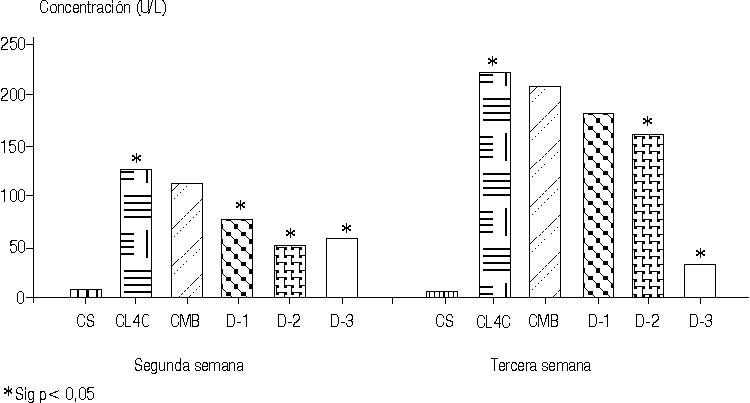
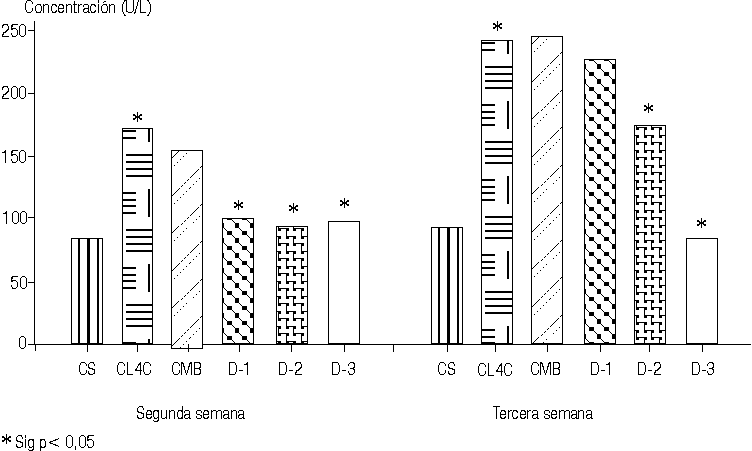
<body><![CDATA[<P>Teniendo en cuenta  los reportes de la literatura sobre la actividad de los pana&oacute;sidos y de  la composici&oacute;n similar de la <I>Polyscia;</I> nos dimos a la tarea de probar  actividad hepatoprotectora del "ergopanin" melito. <H4> M&Eacute;TODOS</H4>La  <I>Polyscia fruticosa</I> fue obtenida en los jardines del "Parque Almendares"  en Ciudad de La Habana e identificada bot&aacute;nicamente por el doctor <I>V&iacute;ctor  Fuentes Fiallo</I> del Instituto Nacional de Investigaciones Fundamentales de  la Agricultura Tropical (INIFAT). El polvo se obtuvo a partir de la corteza de  las ra&iacute;ces, que despu&eacute;s de limpias de arena y tierra, fueron cortadas  en trozos peque&ntilde;os y secados en horno a 40&deg;; despu&eacute;s de secas  fueron trituradas hasta polvo fino. Con el polvo de <I>Polyscia</I> fue elaborado  por el departamento de fitoqu&iacute;mica de nuestro laboratorio un extracto fluido  por percolaci&oacute;n con pH de 6,35, IR de 1,369; d=0, 9488 y s&oacute;lidos  totales de 7,3 g/100 mL y un contenido alcoh&oacute;lico de 57,64 %. El extracto  fluido fue utilizado como principio activo en la elaboraci&oacute;n del "ergopanin"  melito por el departamento de f&oacute;rmulas farmac&eacute;uticas de nuestro  laboratorio. De igual forma se prepar&oacute; un melito blanco, sin principio  activo, y con los dem&aacute;s ingredientes del preparado para ser utilizado en  el grupo control.     <P>Para evaluar el efecto hepatoprotector del "ergopanin" melito  fue seleccionado un modelo experimental de hepatotoxicidad en ratas por tetracloruro  de carbono descrito por <I>Reckhgel</I><SUP>9</SUP> en 1967. La dosis de tetracloruro  de carbono empleada fue de 0,5 mL/kg de peso por v&iacute;a intraperitoneal (ip),  administrado 2 veces/sem durante 3 semanas.     <P>Fueron ensayados los siguientes  grupos experimentales: <OL>     <LI> Grupo control salina</LI>    <LI> Grupo control tetracloruro  (Cl4C)</LI>    <LI> Grupo experimental dosis-1 + Cl4C</LI>    <LI> Grupo experimental  dosis- 2 + Cl4C</LI>    <LI> Grupo experimental dosis-3 + Cl4C</LI>    </OL>Las dosis  1, 2 y 3 se corresponden con 2,5, 10 y 25 mg/kg de peso respectivamente, calculada  a partir del principio activo del melito y administradas a los animales por v&iacute;a  oral en vol&uacute;menes de 1 ml, 5 d&iacute;as antes y durante las 3 semanas  de duraci&oacute;n del experimento. En la segunda y tercera semanas, fueron tomadas  muestras de sangre para las determinaciones de transaminasas pir&uacute;vica y  oxalac&eacute;tica y al finalizar el experimento en la tercera semana, fueron  sacrificados los animales y tomados los h&iacute;gados para realizarles examen  histol&oacute;gico. Los datos fueron analizados estad&iacute;sticamente por <I>test</I>  no param&eacute;trico de Friedman, seg&uacute;n paquete estad&iacute;stico computadorizado  CSS/PC con p &lt; 0,05. <H4> RESULTADOS</H4>Los valores de transaminasa glut&aacute;mico  pir&uacute;vica disminuyeron significativa mente en la segunda semana de tratamiento  en las 3 dosis empleadas del "ergopanin" melito, con valores muy significativos  (p &lt; 0,002) en la primera y segunda dosis. En la tercera semana de tratamiento  tambi&eacute;n se produce una disminuci&oacute;n significativa en los valores  de esta enzima en la segunda y tercera dosis, con valores muy significativos (p  &lt; 0,002) en la dosis-3; sin embargo, en la tercera semana la dosis-1 no fue  efectiva en la recuperaci&oacute;n del valor enzim&aacute;tico en lo que respecta  a la transaminasa glut&aacute;mico pir&uacute;vica (tabla 1, figuras 1 y 2). Similar  comportamiento se observa para la transaminasa glut&aacute;mico oxalac&eacute;tica  en la segunda semana de tratamiento y tercera semana con valores muy significativos  (p &lt; 0,002) para la dosis-3 que van desde 241,20 U/I en el grupo CL4C hasta  83,80 U/I en la dosis-3. Estos resultados en los valores de las transaminasas  se interpretan como actividad hepatoprotectora del "ergopanin" melito a las dosis  utilizadas.     <CENTER><A HREF="/img/revistas/mil/v26n2/f104297.gif"><IMG SRC="/img/revistas/mil/v26n2/f104297.gif" ALT="Figura 1" VSPACE=5 BORDER=1 HEIGHT=148 WIDTH=246></A></CENTER>FIGURA  1. <I>Concentraci&oacute;n de TGP (media, valores) a la 2da. y 3ra. semanas en  los diferentes grupos de estudio.</I>     
]]></body>
<body><![CDATA[<CENTER><A HREF="/img/revistas/mil/v26n2/f204297.gif"><IMG SRC="/img/revistas/mil/v26n2/f204297.gif" ALT="Figura 2" VSPACE=5 BORDER=1 HEIGHT=144 WIDTH=239></A></CENTER>FIGURA  2. <I>Concentraci&oacute;n de TGO (media, valores) a la 2da. y 3ra. semanas en  los diferentes grupos de estudio.</I>     
<P>TABLA 1. <I>Valores de TGP y TGO (media,  DE) en la segunda y tercera semana en los diferentes grupos de estudios</I>     <CENTER><TABLE BORDER CELLPADDING=5 >  <TR> <TD VALIGN=TOP WIDTH="11%">&nbsp;</TD><TD VALIGN=TOP COLSPAN="4" WIDTH="44%">     <CENTER>Segunda  semana</CENTER></TD><TD VALIGN=TOP COLSPAN="4" WIDTH="44%">     <CENTER>Tercera semana</CENTER></TD></TR>  <TR> <TD VALIGN=TOP WIDTH="11%">&nbsp;</TD><TD VALIGN=TOP COLSPAN="2" WIDTH="22%">     <CENTER>TSP</CENTER></TD><TD VALIGN=TOP COLSPAN="2" WIDTH="22%">      <CENTER>TG</CENTER></TD><TD VALIGN=TOP COLSPAN="2" WIDTH="22%">     <CENTER>TSP</CENTER></TD><TD VALIGN=TOP COLSPAN="2" WIDTH="22%">      <CENTER>TGO</CENTER></TD></TR> <TR> <TD VALIGN=TOP WIDTH="11%">&nbsp;</TD><TD VALIGN=TOP WIDTH="11%">      <CENTER>X</CENTER></TD><TD VALIGN=TOP WIDTH="11%">     ]]></body>
<body><![CDATA[<CENTER>DE</CENTER></TD><TD VALIGN=TOP WIDTH="11%">      <CENTER>X</CENTER></TD><TD VALIGN=TOP WIDTH="11%">     <CENTER>DE</CENTER></TD><TD VALIGN=TOP WIDTH="11%">      <CENTER>X</CENTER></TD><TD VALIGN=TOP WIDTH="11%">     <CENTER>DE</CENTER></TD><TD VALIGN=TOP WIDTH="11%">      <CENTER>X</CENTER></TD><TD VALIGN=TOP WIDTH="11%">     <CENTER>DE</CENTER></TD></TR>  <TR> <TD VALIGN=TOP WIDTH="11%">Control sal.</TD><TD VALIGN=TOP WIDTH="11%">     <CENTER>7,21</CENTER></TD><TD VALIGN=TOP WIDTH="11%">      <CENTER>2,32</CENTER></TD><TD VALIGN=TOP WIDTH="11%">     <CENTER>81,20</CENTER></TD><TD VALIGN=TOP WIDTH="11%">      ]]></body>
<body><![CDATA[<CENTER>3,99</CENTER></TD><TD VALIGN=TOP WIDTH="11%">     <CENTER>5,18</CENTER></TD><TD VALIGN=TOP WIDTH="11%">      <CENTER>2,55</CENTER></TD><TD VALIGN=TOP WIDTH="11%">     <CENTER>93,70</CENTER></TD><TD VALIGN=TOP WIDTH="11%">      <CENTER>28,04</CENTER></TD></TR> <TR> <TD VALIGN=TOP WIDTH="11%">Control melito  blanco</TD><TD VALIGN=TOP WIDTH="11%">     <CENTER>123,5</CENTER></TD><TD VALIGN=TOP WIDTH="11%">      <CENTER>17,3</CENTER></TD><TD VALIGN=TOP WIDTH="11%">     <CENTER>175,25</CENTER></TD><TD VALIGN=TOP WIDTH="11%">      <CENTER>19,30</CENTER></TD><TD VALIGN=TOP WIDTH="11%">     <CENTER>227,70</CENTER></TD><TD VALIGN=TOP WIDTH="11%">      ]]></body>
<body><![CDATA[<CENTER>10,24</CENTER></TD><TD VALIGN=TOP WIDTH="11%">     <CENTER>237,70</CENTER></TD><TD VALIGN=TOP WIDTH="11%">      <CENTER>19,50</CENTER></TD></TR> <TR> <TD VALIGN=TOP WIDTH="11%">Control CL4C</TD><TD VALIGN=TOP WIDTH="11%">      <CENTER>106,24</CENTER></TD><TD VALIGN=TOP WIDTH="11%">     <CENTER>21,61</CENTER></TD><TD VALIGN=TOP WIDTH="11%">      <CENTER>156,60</CENTER></TD><TD VALIGN=TOP WIDTH="11%">     <CENTER>28,01</CENTER></TD><TD VALIGN=TOP WIDTH="11%">      <CENTER>211,58</CENTER></TD><TD VALIGN=TOP WIDTH="11%">     <CENTER>39,42</CENTER></TD><TD VALIGN=TOP WIDTH="11%">      <CENTER>241,20</CENTER></TD><TD VALIGN=TOP WIDTH="11%">     ]]></body>
<body><![CDATA[<CENTER>52,84</CENTER></TD></TR>  <TR> <TD VALIGN=TOP WIDTH="11%">Exp. dosis-1+ CL4C</TD><TD VALIGN=TOP WIDTH="11%">      <CENTER>77,07</CENTER></TD><TD VALIGN=TOP WIDTH="11%">     <CENTER>14,15</CENTER></TD><TD VALIGN=TOP WIDTH="11%">      <CENTER>108,40</CENTER></TD><TD VALIGN=TOP WIDTH="11%">     <CENTER>28,62</CENTER></TD><TD VALIGN=TOP WIDTH="11%">      <CENTER>189,60</CENTER></TD><TD VALIGN=TOP WIDTH="11%">     <CENTER>31,28</CENTER></TD><TD VALIGN=TOP WIDTH="11%">      <CENTER>227,00</CENTER></TD><TD VALIGN=TOP WIDTH="11%">     <CENTER>55,15</CENTER></TD></TR>  <TR> <TD VALIGN=TOP WIDTH="11%">Exp. dosis-2+ CL4C</TD><TD VALIGN=TOP WIDTH="11%">      <CENTER>54,62</CENTER></TD><TD VALIGN=TOP WIDTH="11%">     ]]></body>
<body><![CDATA[<CENTER>16,29</CENTER></TD><TD VALIGN=TOP WIDTH="11%">      <CENTER>94,50</CENTER></TD><TD VALIGN=TOP WIDTH="11%">     <CENTER>20,39</CENTER></TD><TD VALIGN=TOP WIDTH="11%">      <CENTER>172,60</CENTER></TD><TD VALIGN=TOP WIDTH="11%">     <CENTER>12,83</CENTER></TD><TD VALIGN=TOP WIDTH="11%">      <CENTER>174,80</CENTER></TD><TD VALIGN=TOP WIDTH="11%">     <CENTER>55,19</CENTER></TD></TR>  <TR> <TD VALIGN=TOP WIDTH="11%">Exp. dosis-3+ CL4C</TD><TD VALIGN=TOP WIDTH="11%">      <CENTER>63,72</CENTER></TD><TD VALIGN=TOP WIDTH="11%">     <CENTER>10,34</CENTER></TD><TD VALIGN=TOP WIDTH="11%">      <CENTER>99,25</CENTER></TD><TD VALIGN=TOP WIDTH="11%">     ]]></body>
<body><![CDATA[<CENTER>17,17</CENTER></TD><TD VALIGN=TOP WIDTH="11%">      <CENTER>24,27</CENTER></TD><TD VALIGN=TOP WIDTH="11%">     <CENTER>11,27</CENTER></TD><TD VALIGN=TOP WIDTH="11%">      <CENTER>83,80</CENTER></TD><TD VALIGN=TOP WIDTH="11%">     <CENTER>17,92</CENTER></TD></TR>  <TR> <TD VALIGN=TOP WIDTH="11%">(1) SE</TD><TD VALIGN=TOP WIDTH="11%">     <CENTER>p  &lt; 0,002</CENTER></TD><TD VALIGN=TOP WIDTH="11%">&nbsp;</TD><TD VALIGN=TOP WIDTH="11%">      <CENTER>p &lt; 0,002</CENTER></TD><TD VALIGN=TOP WIDTH="11%">&nbsp;</TD><TD VALIGN=TOP WIDTH="11%">      <CENTER>p &lt; 0,002</CENTER></TD><TD VALIGN=TOP WIDTH="11%">&nbsp;</TD><TD VALIGN=TOP WIDTH="11%">      <CENTER>p &lt; 0,002</CENTER></TD><TD VALIGN=TOP WIDTH="11%">&nbsp;</TD></TR> <TR> <TD VALIGN=TOP WIDTH="11%">(2)  SE</TD><TD VALIGN=TOP WIDTH="11%">     <CENTER>p &lt; 0,01</CENTER></TD><TD VALIGN=TOP WIDTH="11%">&nbsp;</TD><TD VALIGN=TOP WIDTH="11%">      ]]></body>
<body><![CDATA[<CENTER>p &lt; 0,01</CENTER></TD><TD VALIGN=TOP WIDTH="11%">&nbsp;</TD><TD VALIGN=TOP WIDTH="11%">      <CENTER>ns</CENTER></TD><TD VALIGN=TOP WIDTH="11%">&nbsp;</TD><TD VALIGN=TOP WIDTH="11%">      <CENTER>ns</CENTER></TD><TD VALIGN=TOP WIDTH="11%">&nbsp;</TD></TR> <TR> <TD VALIGN=TOP WIDTH="11%">(3)  SE</TD><TD VALIGN=TOP WIDTH="11%">     <CENTER>p &lt; 0,01</CENTER></TD><TD VALIGN=TOP WIDTH="11%">&nbsp;</TD><TD VALIGN=TOP WIDTH="11%">      <CENTER>p &lt; 0,002</CENTER></TD><TD VALIGN=TOP WIDTH="11%">&nbsp;</TD><TD VALIGN=TOP WIDTH="11%">      <CENTER>p &lt; 0,05</CENTER></TD><TD VALIGN=TOP WIDTH="11%">&nbsp;</TD><TD VALIGN=TOP WIDTH="11%">      <CENTER>p &lt; 0,01</CENTER></TD><TD VALIGN=TOP WIDTH="11%">&nbsp;</TD></TR> <TR> <TD VALIGN=TOP WIDTH="11%">(4)  SE</TD><TD VALIGN=TOP WIDTH="11%">     <CENTER>p &lt; 0,002</CENTER></TD><TD VALIGN=TOP WIDTH="11%">&nbsp;</TD><TD VALIGN=TOP WIDTH="11%">      <CENTER>p &lt; 0,002</CENTER></TD><TD VALIGN=TOP WIDTH="11%">&nbsp;</TD><TD VALIGN=TOP WIDTH="11%">      <CENTER>p &lt; 0,02</CENTER></TD><TD VALIGN=TOP WIDTH="11%">&nbsp;</TD><TD VALIGN=TOP WIDTH="11%">      ]]></body>
<body><![CDATA[<CENTER>p &lt; 0,02</CENTER></TD><TD VALIGN=TOP WIDTH="11%">&nbsp;</TD></TR> <TR> <TD VALIGN=TOP WIDTH="11%">(5)  SE</TD><TD VALIGN=TOP WIDTH="11%">     <CENTER>ns</CENTER></TD><TD VALIGN=TOP WIDTH="11%">&nbsp;</TD><TD VALIGN=TOP WIDTH="11%">      <CENTER>ns</CENTER></TD><TD VALIGN=TOP WIDTH="11%">&nbsp;</TD><TD VALIGN=TOP WIDTH="11%">      <CENTER>ns</CENTER></TD><TD VALIGN=TOP WIDTH="11%">&nbsp;</TD><TD VALIGN=TOP WIDTH="11%">      <CENTER>ns</CENTER></TD><TD VALIGN=TOP WIDTH="11%">&nbsp;</TD></TR> </TABLE></CENTER>Leyenda:  X. Media     <BR>DE. Desviaci&oacute;n est&aacute;ndar     <BR>SE. Significaci&oacute;n  estad&iacute;stica     <BR>COMPARACIONES: (1). Salina vs CL4C     <BR>(2). CL4C vs dosis-1      <BR>(3). CL4C vs dosis-2     ]]></body>
<body><![CDATA[<BR>(4). CL4C vs dosis-3     <BR>(5). CL4C vs Melito blanco      <P>En la tabla 2 se muestran los resultados del examen histol&oacute;gico de los  h&iacute;gados de las ratas en los diferentes grupos de estudios y el grupo CL4C  corresponde el mayor grado de hepatoxicidad y una disminuci&oacute;n progresiva  de este grado en la medida que aumenta la dosis del "ergopanin" melito en los  animales tratados. A&uacute;n se observa un grado moderado de necrosis centrolobulillar  en esta tercera semana de tratamiento.     <P>TABLA 2.<I> Resultados histol&oacute;gicos  a la tercera semana de administrado el CL4C (media) en los grupos de estudio</I>      <CENTER><TABLE BORDER CELLPADDING=5 > <TR> <TD VALIGN=TOP WIDTH="17%">&nbsp;</TD><TD VALIGN=TOP WIDTH="17%">      <CENTER>Cont. Sal.</CENTER></TD><TD VALIGN=TOP WIDTH="17%">     <CENTER>CL4C</CENTER></TD><TD VALIGN=TOP WIDTH="17%">      <CENTER>Dosis-1</CENTER></TD><TD VALIGN=TOP WIDTH="17%">     <CENTER>Dosis-2</CENTER></TD><TD VALIGN=TOP WIDTH="17%">      <CENTER>Dosis-3</CENTER></TD></TR> <TR> <TD VALIGN=TOP WIDTH="17%">Congesti&oacute;n</TD><TD VALIGN=TOP WIDTH="17%">      ]]></body>
<body><![CDATA[<CENTER>2</CENTER></TD><TD VALIGN=TOP WIDTH="17%">     <CENTER>0</CENTER></TD><TD VALIGN=TOP WIDTH="17%">      <CENTER>0</CENTER></TD><TD VALIGN=TOP WIDTH="17%">     <CENTER>0</CENTER></TD><TD VALIGN=TOP WIDTH="17%">      <CENTER>0</CENTER></TD></TR> <TR> <TD VALIGN=TOP WIDTH="17%">Necrosis centrolobulillar</TD><TD VALIGN=TOP WIDTH="17%">      <CENTER>0</CENTER></TD><TD VALIGN=TOP WIDTH="17%">     <CENTER>4</CENTER></TD><TD VALIGN=TOP WIDTH="17%">      <CENTER>3</CENTER></TD><TD VALIGN=TOP WIDTH="17%">     <CENTER>2</CENTER></TD><TD VALIGN=TOP WIDTH="17%">      <CENTER>2</CENTER></TD></TR> <TR> <TD VALIGN=TOP WIDTH="17%">Infiltraci&oacute;n  grasa</TD><TD VALIGN=TOP WIDTH="17%">     ]]></body>
<body><![CDATA[<CENTER>0</CENTER></TD><TD VALIGN=TOP WIDTH="17%">      <CENTER>2</CENTER></TD><TD VALIGN=TOP WIDTH="17%">     <CENTER>3</CENTER></TD><TD VALIGN=TOP WIDTH="17%">      <CENTER>1</CENTER></TD><TD VALIGN=TOP WIDTH="17%">     <CENTER>1</CENTER></TD></TR>  <TR> <TD VALIGN=TOP WIDTH="17%">Infiltrado mononuclear</TD><TD VALIGN=TOP WIDTH="17%">      <CENTER>0</CENTER></TD><TD VALIGN=TOP WIDTH="17%">     <CENTER>2</CENTER></TD><TD VALIGN=TOP WIDTH="17%">      <CENTER>2</CENTER></TD><TD VALIGN=TOP WIDTH="17%">     <CENTER>1</CENTER></TD><TD VALIGN=TOP WIDTH="17%">      <CENTER>1</CENTER></TD></TR> <TR> <TD VALIGN=TOP WIDTH="17%">Degeneraci&oacute;n  hialina</TD><TD VALIGN=TOP WIDTH="17%">     ]]></body>
<body><![CDATA[<CENTER>0</CENTER></TD><TD VALIGN=TOP WIDTH="17%">      <CENTER>1</CENTER></TD><TD VALIGN=TOP WIDTH="17%">     <CENTER>0</CENTER></TD><TD VALIGN=TOP WIDTH="17%">      <CENTER>1</CENTER></TD><TD VALIGN=TOP WIDTH="17%">     <CENTER>0</CENTER></TD></TR>  <TR> <TD VALIGN=TOP WIDTH="17%">Hemorragia intraparenquimatosa</TD><TD VALIGN=TOP WIDTH="17%">      <CENTER>0</CENTER></TD><TD VALIGN=TOP WIDTH="17%">     <CENTER>0</CENTER></TD><TD VALIGN=TOP WIDTH="17%">      <CENTER>0</CENTER></TD><TD VALIGN=TOP WIDTH="17%">     <CENTER>0</CENTER></TD><TD VALIGN=TOP WIDTH="17%">      <CENTER>0</CENTER></TD></TR> <TR> <TD VALIGN=TOP WIDTH="17%">Tumefacci&oacute;n  hep&aacute;tica</TD><TD VALIGN=TOP WIDTH="17%">     ]]></body>
<body><![CDATA[<CENTER>0</CENTER></TD><TD VALIGN=TOP WIDTH="17%">      <CENTER>0</CENTER></TD><TD VALIGN=TOP WIDTH="17%">     <CENTER>0</CENTER></TD><TD VALIGN=TOP WIDTH="17%">      <CENTER>0</CENTER></TD><TD VALIGN=TOP WIDTH="17%">     <CENTER>0</CENTER></TD></TR>  </TABLE></CENTER>GRADOS DE CALIFICACI&Oacute;N: 0. Nada 1. Ligero 2. Moderado  3. Severo 4. Muy severo     <P>De todo esto es necesario concluir que el retorno de  la transaminasa glut&aacute;mico pir&uacute;vica y oxalac&eacute;tica a valores  normales para las ratas en los grupos de tratamiento con las dosis de 2,5; 10  y 25 mg/kg de peso, corroboran actividad hepatoprotectora del "ergopanin" melito.  Adem&aacute;s, en la tercera semana de tratamiento con las diferentes dosis del  "ergopanin" melito se observaron signos significativos de recuperaci&oacute;n  celular y menos hepatotoxicidad, que aumenta seg&uacute;n aumentan las dosis.  <H4> SUMMARY</H4>The hepatoprotective activity of "ergopanin" melito was pharmacologically  assayed in an experimental model of hepatotoxicity due to carbon tetrachloride  (C14C) by intraperitoneal route and with a dose of 0,5 ml/kg, twice a week for  3 weeks. The hepatoprotective activity was evaluated by th determination of transaminase  (pyruvic and oxaloacetic) values and histologic examination at the second and  third weeks after the administration of C14C. It was found that the preparation  "ergopanin" in a dose of 10 mg/hg reduces the concentrations of both transaminases  to normal values at the second and third weeks of treatment, decreasing the degree  of the histologic indexes measured during the same period.     <P><I>Subject headings:</I>  LIVER/anatomy&amp;histology; GINSEN/drug effects; PLANT EXTRACTS/pharmacology;ALANINE  AMINOTRANSFERASE/blood; ASPARTATE AMINOTRANSFERASE/blood; CARBON TETRACHLORIDE/toxicity;  RATS. <H4> REFERENCIAS BIBLIOGR&Aacute;FICAS</H4>    <!-- ref --><P> 1. P&eacute;rez de Alejo  JL, Miranda R, Rodr&iacute;guez G. "Ergopanin". Un melito con actividad estimulante  y/o ergog&eacute;nica. Rev Cubana Med Milit 1996;25(1):37-40.<!-- ref --><P> 2. Dotat  L. Las plantas y especies medicinales de Vietnam. Ed Hanoi 1981;t1:44-53.<!-- ref --><P>  3. Rosella MA col. Anal&iacute;tica de panax ginseng meyer (araliaceae) y especies  relacionadas. II. TLC de ginsen&oacute;sidos. Acta Farm Bonarence 1985;4(1):27-32.<!-- ref --><P>  4. Rosella MA. Estado actual del conocimiento del panax ginseng C.A. meyer y especies  relacionadas. Acta Farm Bonaerence;1(1):39-47.<!-- ref --><P> 5. Ng TB, Li WW, Yeung HW.  Effects of ginsenosides, lectins and Momordica charantia insulin-like peptide  on corticosterone production by isolatet rat adrenal cell. J Ethnopaharmacol 1987;21:21-9.<!-- ref --><P>  6. Ng TB, Wong CM, Yeung HW. Effect of ginsenosides Rg1. Rc, and Rb2 on hormone-induced  lipolisis and lipogenesis in rat epididymal fat cell. J Ethnopharmacol 1986;16:191-9.<!-- ref --><P>  7. Tsang D, Yeung HW, Tso WW, Peck H. Ginseng saponins: Influence of neurotransmitter  uptake in rat brain synaptosomes. Planta M&eacute;dica 1985;2:221-4.<!-- ref --><P> 8.  Hiroshi H. Antihepatotoxic actions of ginsenosides from panax ginseng roots. Planta  M&eacute;dica 1984;9:62-4.<!-- ref --><P> 9. Reckhgel R. Hepatotoxicity of carbon tetraclorure.  Clin Biochem Acta 1967;2(1):24-9.Recibido: 12 de marzo de 1997. Aprobado:  17 de abril de 1997     <P>My.<I> Jos&eacute; L P&eacute;rez de Alejo</I>. Instituto  Superior de Medicina Militar "Dr. Luis D&iacute;az Soto". Avenida Monumental,  Habana del Este, CP 11700. Ciudad de La Habana, Cuba.      ]]></body><back>
<ref-list>
<ref id="B1">
<label>1</label><nlm-citation citation-type="journal">
<person-group person-group-type="author">
<name>
<surname><![CDATA[Pérez de Alejo]]></surname>
<given-names><![CDATA[JL]]></given-names>
</name>
<name>
<surname><![CDATA[Miranda]]></surname>
<given-names><![CDATA[R]]></given-names>
</name>
<name>
<surname><![CDATA[Rodríguez]]></surname>
<given-names><![CDATA[G]]></given-names>
</name>
</person-group>
<article-title xml:lang="es"><![CDATA["Ergopanin": Un melito con actividad estimulante y/o ergogénica]]></article-title>
<source><![CDATA[Rev Cubana Med Milit]]></source>
<year>1996</year>
<volume>25</volume>
<numero>1</numero>
<issue>1</issue>
<page-range>37-40</page-range></nlm-citation>
</ref>
<ref id="B2">
<label>2</label><nlm-citation citation-type="book">
<person-group person-group-type="author">
<name>
<surname><![CDATA[Dotat]]></surname>
<given-names><![CDATA[L]]></given-names>
</name>
</person-group>
<source><![CDATA[Las plantas y especies medicinales de Vietnam]]></source>
<year>1981</year>
<page-range>44-53</page-range><publisher-name><![CDATA[Ed Hanoi]]></publisher-name>
</nlm-citation>
</ref>
<ref id="B3">
<label>3</label><nlm-citation citation-type="journal">
<person-group person-group-type="author">
<name>
<surname><![CDATA[Rosella]]></surname>
<given-names><![CDATA[MA]]></given-names>
</name>
</person-group>
<article-title xml:lang="es"><![CDATA[Analítica de panax ginseng meyer (araliaceae) y especies relacionadas: II. TLC de ginsenósidos]]></article-title>
<source><![CDATA[Acta Farm Bonarence]]></source>
<year>1985</year>
<volume>4</volume>
<numero>1</numero>
<issue>1</issue>
<page-range>27-32</page-range></nlm-citation>
</ref>
<ref id="B4">
<label>4</label><nlm-citation citation-type="journal">
<person-group person-group-type="author">
<name>
<surname><![CDATA[Rosella]]></surname>
<given-names><![CDATA[MA]]></given-names>
</name>
</person-group>
<article-title xml:lang="es"><![CDATA[Estado actual del conocimiento del panax ginseng C.A. meyer y especies relacionadas]]></article-title>
<source><![CDATA[Acta Farm Bonaerence]]></source>
<year></year>
<volume>1</volume>
<numero>1</numero>
<issue>1</issue>
<page-range>39-47</page-range></nlm-citation>
</ref>
<ref id="B5">
<label>5</label><nlm-citation citation-type="journal">
<person-group person-group-type="author">
<name>
<surname><![CDATA[Ng]]></surname>
<given-names><![CDATA[TB]]></given-names>
</name>
<name>
<surname><![CDATA[Li]]></surname>
<given-names><![CDATA[WW]]></given-names>
</name>
<name>
<surname><![CDATA[Yeung]]></surname>
<given-names><![CDATA[HW]]></given-names>
</name>
</person-group>
<article-title xml:lang="en"><![CDATA[Effects of ginsenosides, lectins and Momordica charantia insulin-like peptide on corticosterone production by isolatet rat adrenal cell]]></article-title>
<source><![CDATA[J Ethnopaharmacol]]></source>
<year>1987</year>
<volume>21</volume>
<page-range>21-9</page-range></nlm-citation>
</ref>
<ref id="B6">
<label>6</label><nlm-citation citation-type="journal">
<person-group person-group-type="author">
<name>
<surname><![CDATA[Ng]]></surname>
<given-names><![CDATA[TB]]></given-names>
</name>
<name>
<surname><![CDATA[Wong]]></surname>
<given-names><![CDATA[CM]]></given-names>
</name>
<name>
<surname><![CDATA[Yeung]]></surname>
<given-names><![CDATA[HW]]></given-names>
</name>
</person-group>
<article-title xml:lang="en"><![CDATA[Effect of ginsenosides Rg1: Rc, and Rb2 on hormone-induced lipolisis and lipogenesis in rat epididymal fat cell]]></article-title>
<source><![CDATA[J Ethnopharmacol]]></source>
<year>1986</year>
<volume>16</volume>
<page-range>191-9</page-range></nlm-citation>
</ref>
<ref id="B7">
<label>7</label><nlm-citation citation-type="journal">
<person-group person-group-type="author">
<name>
<surname><![CDATA[Tsang]]></surname>
<given-names><![CDATA[D]]></given-names>
</name>
<name>
<surname><![CDATA[Yeung]]></surname>
<given-names><![CDATA[HW]]></given-names>
</name>
<name>
<surname><![CDATA[Tso]]></surname>
<given-names><![CDATA[WW]]></given-names>
</name>
<name>
<surname><![CDATA[Peck]]></surname>
<given-names><![CDATA[H]]></given-names>
</name>
</person-group>
<article-title xml:lang="en"><![CDATA[Ginseng saponins: Influence of neurotransmitter uptake in rat brain synaptosomes]]></article-title>
<source><![CDATA[Planta Médica]]></source>
<year>1985</year>
<volume>2</volume>
<page-range>221-4</page-range></nlm-citation>
</ref>
<ref id="B8">
<label>8</label><nlm-citation citation-type="journal">
<person-group person-group-type="author">
<name>
<surname><![CDATA[Hiroshi]]></surname>
<given-names><![CDATA[H]]></given-names>
</name>
</person-group>
<article-title xml:lang="en"><![CDATA[Antihepatotoxic actions of ginsenosides from panax ginseng roots]]></article-title>
<source><![CDATA[Planta Médica]]></source>
<year>1984</year>
<volume>9</volume>
<page-range>62-4</page-range></nlm-citation>
</ref>
<ref id="B9">
<label>9</label><nlm-citation citation-type="journal">
<person-group person-group-type="author">
<name>
<surname><![CDATA[Reckhgel]]></surname>
<given-names><![CDATA[R]]></given-names>
</name>
</person-group>
<article-title xml:lang="en"><![CDATA[Hepatotoxicity of carbon tetraclorure]]></article-title>
<source><![CDATA[Clin Biochem Acta]]></source>
<year>1967</year>
<volume>2</volume>
<numero>1</numero>
<issue>1</issue>
<page-range>24-9</page-range></nlm-citation>
</ref>
</ref-list>
</back>
</article>
