<?xml version="1.0" encoding="ISO-8859-1"?><article xmlns:mml="http://www.w3.org/1998/Math/MathML" xmlns:xlink="http://www.w3.org/1999/xlink" xmlns:xsi="http://www.w3.org/2001/XMLSchema-instance">
<front>
<journal-meta>
<journal-id>0138-6557</journal-id>
<journal-title><![CDATA[Revista Cubana de Medicina Militar]]></journal-title>
<abbrev-journal-title><![CDATA[Rev Cub Med Mil]]></abbrev-journal-title>
<issn>0138-6557</issn>
<publisher>
<publisher-name><![CDATA[Centro Nacional de Información de Ciencias MédicasEditorial Ciencias Médicas]]></publisher-name>
</publisher>
</journal-meta>
<article-meta>
<article-id>S0138-65571998000100006</article-id>
<title-group>
<article-title xml:lang="es"><![CDATA[Monitoreo de la resistencia bacteriana in vitro a los antimicrobianos durante 5 años]]></article-title>
<article-title xml:lang="en"><![CDATA[Monitoring of in vitro bacterial resistance to antimicrobial agents during a 5-year period]]></article-title>
</title-group>
<contrib-group>
<contrib contrib-type="author">
<name>
<surname><![CDATA[Nodarse Hernández]]></surname>
<given-names><![CDATA[Rafael]]></given-names>
</name>
<xref ref-type="aff" rid="A01"/>
</contrib>
</contrib-group>
<aff id="A01">
<institution><![CDATA[,Instituto Superior de Medicina Militar Dr. Luis Díaz Soto  ]]></institution>
<addr-line><![CDATA[Ciudad de La Habana ]]></addr-line>
<country>Cuba</country>
</aff>
<pub-date pub-type="pub">
<day>00</day>
<month>06</month>
<year>1998</year>
</pub-date>
<pub-date pub-type="epub">
<day>00</day>
<month>06</month>
<year>1998</year>
</pub-date>
<volume>27</volume>
<numero>1</numero>
<fpage>34</fpage>
<lpage>38</lpage>
<copyright-statement/>
<copyright-year/>
<self-uri xlink:href="http://scielo.sld.cu/scielo.php?script=sci_arttext&amp;pid=S0138-65571998000100006&amp;lng=en&amp;nrm=iso"></self-uri><self-uri xlink:href="http://scielo.sld.cu/scielo.php?script=sci_abstract&amp;pid=S0138-65571998000100006&amp;lng=en&amp;nrm=iso"></self-uri><self-uri xlink:href="http://scielo.sld.cu/scielo.php?script=sci_pdf&amp;pid=S0138-65571998000100006&amp;lng=en&amp;nrm=iso"></self-uri><abstract abstract-type="short" xml:lang="es"><p><![CDATA[Se realizó el monitoreo de la resistencia bacteriana "in vitro" en el ISMM "Dr. Luis Díaz Soto" en un período de 5 años (1989-1993) con el fin de conocer si se produjo disminución y el posible efecto causal que sobre ésta tuvo la creación del Comité Fármaco-Terapéutico, rector de la política del uso de antibióticos en el centro. Se analizó el comportamiento de 6 221 cepas bacterianas aisladas en ese quinquenio frente a los 14 antibióticos que conforman el antibiograma tradicional y que fueron agrupados para el estudio en 3 grupos: betalactámicos, aminoglucósidos y otros. Se observó que la resistencia bacteriana disminuyó en los 3 grupos, analizados en conjunto, y sólo aumentó individualmente frente a la tetraciclina en cifra poco apreciable. Se consideró que la causa de la disminución radicó en la carencia de antibióticos en el país, lo que ha colocado a muchos de ellos en estado de reposo y ha obligado a los médicos a realizar un uso más racional de los existentes.]]></p></abstract>
<abstract abstract-type="short" xml:lang="en"><p><![CDATA[A monitoring of "in vitro" bacterial resistance was carried out at "Dr. Luis Díaz Soto" Higher Institute of Military Medicine during a 5-year period (1989-1993) with the objective of knowing whether there was a reduction and the possible causative effect on such reduction of the creation of the Pharmaco-Therapeutic Commitee which directs the policy regarding the use of antibiotics in the center. The behaviour of 6 221 bacterial strains isolated during the 5-year period against a number of 14 antibiotics belonging to the traditional antibiogram, was analyzed. These antibiotics were grouped for the study of 3 groups: Bectalactamic; aminoglycosides, and others. It was observed that bacterial resistance was reduced in the 3 groups which were analyzed together, and it only increased individually against tetracycline with no significant figures. It was considered that the cause of this reduction was the result of the scarcy availability of antibiotics in the country, fact that has resulted in a rest of some of the above mentioned antibiotics together with the fact that most of the physicians have a more rational use of the ones available.]]></p></abstract>
<kwd-group>
<kwd lng="es"><![CDATA[RESISTENCIA MICROBIANA A LAS DROGAS]]></kwd>
<kwd lng="es"><![CDATA[MONITOREO DE DROGAS]]></kwd>
<kwd lng="es"><![CDATA[ANTIBIOTICOS]]></kwd>
<kwd lng="es"><![CDATA[TEST DE SENSIBILIDAD MICROBIANA]]></kwd>
<kwd lng="es"><![CDATA[BACTERIAS]]></kwd>
<kwd lng="en"><![CDATA[DRUG RESISTANCE]]></kwd>
<kwd lng="en"><![CDATA[MICROBIAL]]></kwd>
<kwd lng="en"><![CDATA[DRUG MONITORING]]></kwd>
<kwd lng="en"><![CDATA[ANTIBIOTICS]]></kwd>
<kwd lng="en"><![CDATA[MICROBIAL SENSITIVITY]]></kwd>
<kwd lng="en"><![CDATA[BACTRIA]]></kwd>
</kwd-group>
</article-meta>
</front><body><![CDATA[ Instituto Superior de Medicina Militar "Dr. Luis D&iacute;az Soto". Laboratorio  de Microbiolog&iacute;a <H2> Monitoreo de la resistencia bacteriana <I>in vitro</I>  a los antimicrobianos durante 5 a&ntilde;os</H2><I>Dr</I>. <I>Rafael Nodarse Hern&aacute;ndez<SUP>1</SUP></I>      <P><I>1</I> Especialista de I Grado en Microbiolog&iacute;a. <H4> RESUMEN</H4>Se  realiz&oacute; el monitoreo de la resistencia bacteriana "in vitro" en el ISMM  "Dr. Luis D&iacute;az Soto" en un per&iacute;odo de 5 a&ntilde;os (1989-1993)  con el fin de conocer si se produjo disminuci&oacute;n y el posible efecto causal  que sobre &eacute;sta tuvo la creaci&oacute;n del Comit&eacute; F&aacute;rmaco-Terap&eacute;utico,  rector de la pol&iacute;tica del uso de antibi&oacute;ticos en el centro. Se analiz&oacute;  el comportamiento de 6 221 cepas bacterianas aisladas en ese quinquenio frente  a los 14 antibi&oacute;ticos que conforman el antibiograma tradicional y que fueron  agrupados para el estudio en 3 grupos: betalact&aacute;micos, aminogluc&oacute;sidos  y otros. Se observ&oacute; que la resistencia bacteriana disminuy&oacute; en los  3 grupos, analizados en conjunto, y s&oacute;lo aument&oacute; individualmente  frente a la tetraciclina en cifra poco apreciable. Se consider&oacute; que la  causa de la disminuci&oacute;n radic&oacute; en la carencia de antibi&oacute;ticos  en el pa&iacute;s, lo que ha colocado a muchos de ellos en estado de reposo y  ha obligado a los m&eacute;dicos a realizar un uso m&aacute;s racional de los  existentes.     <P><I>Descriptores DeCS:</I> RESISTENCIA MICROBIANA A LAS DROGAS;  MONITOREO DE DROGAS; ANTIBIOTICOS/farmacolog&iacute;a; TEST DE SENSIBILIDAD MICROBIANA;  BACTERIAS/efectos de drogas; BACTERIAS/aislamiento &amp; purificaci&oacute;n.      <P>La era de la quimioterapia para las enfermedades infecciosas tiene ahora m&aacute;s  de 40 a&ntilde;os, esos a&ntilde;os han estado marcados por el continuo desarrollo  e introducci&oacute;n de nuevos y potentes agentes antimicrobianos; sin embargo  los datos sobre los patrones globales del uso de antibi&oacute;ticos en los hospitales  han aparecido en la literatura desde hace poco m&aacute;s de 2 d&eacute;cadas.<SUP>1</SUP>  Su estudio ha mostrado que una tercera parte de la poblaci&oacute;n hospitalizada  recibe antibi&oacute;ticoterapia y este hecho tiene como corolario la selecci&oacute;n  de bacterias resistentes a los antibi&oacute;ticos administrados. Aunque las bacterias  resistentes "a todo" resultan excepcionales, no es raro encontrar cepas sensibles  a una sola clase de antibi&oacute;ticos o incluso a ninguno de los que se tienen  a mano.<SUP>2</SUP>     <P>Las bacterias han desarrollado m&uacute;ltiples y variadas  formas de resistencia a los antimicrobianos, incluso a los m&aacute;s modernos.  Bacterias de diversas especies han conseguido, mediante mutaciones en el ADN,  generar nuevas enzimas betalactamasas "de amplio espectro" que son capaces de  inactivar a nuevos f&aacute;rmacos utilizados en su contra. Estas propiedades  son transferidas mediante pl&aacute;smidos, no s&oacute;lo a la descendencia de  una especie bacteriana, sino incluso a otras especies.<SUP>3,4</SUP>     <P>El aumento  de la resistencia bacteriana en los hospitales es un hecho evidente, que ha sido  reportado en Cuba<SUP>5</SUP> y en muchos pa&iacute;ses del mundo;<SUP>6</SUP>  pero el personal m&eacute;dico no siempre ha tenido una clara comprensi&oacute;n  de este fen&oacute;meno y del papel modulador que sobre &eacute;l tiene la aplicaci&oacute;n  de una correcta pol&iacute;tica de uso de los antibi&oacute;ticos.<SUP>7</SUP>  Con la creaci&oacute;n de los comit&eacute;s f&aacute;rmaco-terap&eacute;uticos  en cada hospital para regular dicha pol&iacute;tica, Cuba ha dado un paso necesario,  encaminado a enfrentar este problema. <H4> M&Eacute;TODOS</H4>Para estudiar la  resistencia bacteriana en el per&iacute;odo de 1989 a 1993 en el ISMM "Dr. Luis  D&iacute;az Soto" se analiz&oacute; el comportamiento de 6 221 cepas aisladas  en pacientes ingresados, frente a los 14 antibi&oacute;ticos tradicionalmente  probados en el pa&iacute;s, divididos en 3 grupos seg&uacute;n su clasificaci&oacute;n  qu&iacute;mica: betalact&aacute;micos, aminogluc&oacute;sidos y otros.     <P>El an&aacute;lisis  de la resistencia se realiz&oacute; sobre la base de los resultados obtenidos  en los antibiogramas confeccionados en el Laboratorio de Microbiolog&iacute;a  del ISMM, mediante la t&eacute;cnica estandarizada de <I>Bauer-Kirby</I>, com&uacute;n  a todos los laboratorios cubanos. (INHEM. Procedimientos para la realizaci&oacute;n  del antibiograma seg&uacute;n la t&eacute;cnica de discos estandarizada de Bauer-Kirby.  La Habana 1982).     <P>Toda la informaci&oacute;n fue procesada mediante el programa  computarizado aplicado a la Microbiolog&iacute;a creado al efecto por el Centro  de Automatizaci&oacute;n de las FAR.<SUP>8</SUP> <H4> RESULTADOS</H4>Se tom&oacute;  el a&ntilde;o 1989 como fecha de inicio y de comparaci&oacute;n de los resultados  con los otros a&ntilde;os, por causa de que en ese a&ntilde;o a&uacute;n no se  hab&iacute;a trazado en el hospital una pol&iacute;tica general en el uso de antimicrobianos.      <P>Para los betalact&aacute;micos la resistencia bacteriana disminuy&oacute;,  pero la mayor&iacute;a de sus porcentajes permanecieron elevados a&uacute;n, sobre  todo en la penicilina. (tabla 1)     <P>TABLA 1. <I>Porcentajes de resistencia bacteriana  frente a antibi&oacute;ticos del grupo beta-lact&aacute;micos.</I>     ]]></body>
<body><![CDATA[<CENTER><TABLE BORDER CELLPADDING=5 >  <TR> <TD VALIGN=TOP WIDTH="17%">&nbsp;</TD><TD VALIGN=TOP COLSPAN="5" WIDTH="83%">     <CENTER>Agente  % de Resistencia</CENTER></TD></TR> <TR> <TD VALIGN=TOP WIDTH="17%">Antimicrobiano&nbsp;</TD><TD VALIGN=TOP WIDTH="17%">      <CENTER>1989</CENTER></TD><TD VALIGN=TOP WIDTH="17%">     <CENTER>1990</CENTER></TD><TD VALIGN=TOP WIDTH="17%">      <CENTER>1991</CENTER></TD><TD VALIGN=TOP WIDTH="17%">     <CENTER>1992</CENTER></TD><TD VALIGN=TOP WIDTH="17%">      <CENTER>1993</CENTER></TD></TR> <TR> <TD VALIGN=TOP WIDTH="17%">Penicilina</TD><TD VALIGN=TOP WIDTH="17%">      <CENTER>99,0</CENTER></TD><TD VALIGN=TOP WIDTH="17%">     <CENTER>85,0</CENTER></TD><TD VALIGN=TOP WIDTH="17%">      <CENTER>82,5</CENTER></TD><TD VALIGN=TOP WIDTH="17%">     ]]></body>
<body><![CDATA[<CENTER>87,0</CENTER></TD><TD VALIGN=TOP WIDTH="17%">      <CENTER>73,5</CENTER></TD></TR> <TR> <TD VALIGN=TOP WIDTH="17%">Ampicill&iacute;n</TD><TD VALIGN=TOP WIDTH="17%">      <CENTER>88,5</CENTER></TD><TD VALIGN=TOP WIDTH="17%">     <CENTER>78,3</CENTER></TD><TD VALIGN=TOP WIDTH="17%">      <CENTER>74,6</CENTER></TD><TD VALIGN=TOP WIDTH="17%">     <CENTER>45,5</CENTER></TD><TD VALIGN=TOP WIDTH="17%">      <CENTER>59,5</CENTER></TD></TR> <TR> <TD VALIGN=TOP WIDTH="17%">Meticill&iacute;n</TD><TD VALIGN=TOP WIDTH="17%">      <CENTER>60,0</CENTER></TD><TD VALIGN=TOP WIDTH="17%">     <CENTER>28,0</CENTER></TD><TD VALIGN=TOP WIDTH="17%">      <CENTER>-</CENTER></TD><TD VALIGN=TOP WIDTH="17%">     ]]></body>
<body><![CDATA[<CENTER>39,5</CENTER></TD><TD VALIGN=TOP WIDTH="17%">      <CENTER>47,5</CENTER></TD></TR> <TR> <TD VALIGN=TOP WIDTH="17%">Carbenicilina</TD><TD VALIGN=TOP WIDTH="17%">      <CENTER>65,5</CENTER></TD><TD VALIGN=TOP WIDTH="17%">     <CENTER>63,5</CENTER></TD><TD VALIGN=TOP WIDTH="17%">      <CENTER>62,5</CENTER></TD><TD VALIGN=TOP WIDTH="17%">     <CENTER>67,3</CENTER></TD><TD VALIGN=TOP WIDTH="17%">      <CENTER>54,8</CENTER></TD></TR> <TR> <TD VALIGN=TOP WIDTH="17%">Cefaloridina</TD><TD VALIGN=TOP WIDTH="17%">      <CENTER>69,3</CENTER></TD><TD VALIGN=TOP WIDTH="17%">     <CENTER>54,1</CENTER></TD><TD VALIGN=TOP WIDTH="17%">      <CENTER>50,5</CENTER></TD><TD VALIGN=TOP WIDTH="17%">     ]]></body>
<body><![CDATA[<CENTER>54,0</CENTER></TD><TD VALIGN=TOP WIDTH="17%">      <CENTER>56,5</CENTER></TD></TR> </TABLE></CENTER>&nbsp;     <P>Se observ&oacute; una  disminuci&oacute;n paulatina de los porcentajes de resistencia para los aminogluc&oacute;sidos  y se notaron valores aceptablemente bajos de ellos, sobre todo de amikacina. Este  f&aacute;rmaco ostent&oacute; la cifra m&aacute;s baja del estudio (tabla 2).      <P>El grupo "otros" present&oacute; la tetraciclina como el &uacute;nico antibi&oacute;tico  del estudio frente al cual las bacterias aumentaron su resistencia, aunque en  cifras poco apreciables (tabla 3).     <P>TABLA 2. <I>Porcentajes de resistencia bacteriana  frente a antibi&oacute;ticos del grupo aminoglucosidos</I>     <CENTER><TABLE BORDER CELLPADDING=5 >  <TR> <TD VALIGN=TOP WIDTH="17%">&nbsp;</TD><TD VALIGN=TOP COLSPAN="5" WIDTH="83%">     <CENTER>Agente  % de Resistencia</CENTER></TD></TR> <TR> <TD VALIGN=TOP WIDTH="17%">Antimicrobiano&nbsp;</TD><TD VALIGN=TOP WIDTH="17%">      <CENTER>1989</CENTER></TD><TD VALIGN=TOP WIDTH="17%">     <CENTER>1990</CENTER></TD><TD VALIGN=TOP WIDTH="17%">      <CENTER>1991</CENTER></TD><TD VALIGN=TOP WIDTH="17%">     ]]></body>
<body><![CDATA[<CENTER>1992</CENTER></TD><TD VALIGN=TOP WIDTH="17%">      <CENTER>1993</CENTER></TD></TR> <TR> <TD VALIGN=TOP WIDTH="17%">Estreptomicina</TD><TD VALIGN=TOP WIDTH="17%">      <CENTER>61,3</CENTER></TD><TD VALIGN=TOP WIDTH="17%">     <CENTER>44,0</CENTER></TD><TD VALIGN=TOP WIDTH="17%">      <CENTER>47,8</CENTER></TD><TD VALIGN=TOP WIDTH="17%">     <CENTER>48,5</CENTER></TD><TD VALIGN=TOP WIDTH="17%">      <CENTER>33,6</CENTER></TD></TR> <TR> <TD VALIGN=TOP WIDTH="17%">Kanamicina</TD><TD VALIGN=TOP WIDTH="17%">      <CENTER>64,8</CENTER></TD><TD VALIGN=TOP WIDTH="17%">     <CENTER>51,6</CENTER></TD><TD VALIGN=TOP WIDTH="17%">      <CENTER>48,5</CENTER></TD><TD VALIGN=TOP WIDTH="17%">     ]]></body>
<body><![CDATA[<CENTER>45,3</CENTER></TD><TD VALIGN=TOP WIDTH="17%">      <CENTER>38,0</CENTER></TD></TR> <TR> <TD VALIGN=TOP WIDTH="17%">Gentamicina</TD><TD VALIGN=TOP WIDTH="17%">      <CENTER>20,3</CENTER></TD><TD VALIGN=TOP WIDTH="17%">     <CENTER>13,6</CENTER></TD><TD VALIGN=TOP WIDTH="17%">      <CENTER>23,2</CENTER></TD><TD VALIGN=TOP WIDTH="17%">     <CENTER>27,3</CENTER></TD><TD VALIGN=TOP WIDTH="17%">      <CENTER>17,3</CENTER></TD></TR> <TR> <TD VALIGN=TOP WIDTH="17%">Amikacina</TD><TD VALIGN=TOP WIDTH="17%">      <CENTER>9,75</CENTER></TD><TD VALIGN=TOP WIDTH="17%">     <CENTER>6,5</CENTER></TD><TD VALIGN=TOP WIDTH="17%">      <CENTER>8,1</CENTER></TD><TD VALIGN=TOP WIDTH="17%">     ]]></body>
<body><![CDATA[<CENTER>9,0</CENTER></TD><TD VALIGN=TOP WIDTH="17%">      <CENTER>5,8</CENTER></TD></TR> </TABLE></CENTER>TABLA 3. <I>Porcentajes de resistencia  bacteriana frente a antibi&oacute;ticos del grupo "otros".</I> <TABLE BORDER CELLPADDING=5 >  <TR> <TD VALIGN=TOP WIDTH="17%">&nbsp;</TD><TD VALIGN=TOP COLSPAN="5" WIDTH="83%">     <CENTER>Agente  % de Resistencia</CENTER></TD></TR> <TR> <TD VALIGN=TOP WIDTH="17%">Antimicrobiano&nbsp;</TD><TD VALIGN=TOP WIDTH="17%">      <CENTER>1989</CENTER></TD><TD VALIGN=TOP WIDTH="17%">     <CENTER>1990</CENTER></TD><TD VALIGN=TOP WIDTH="17%">      <CENTER>1991</CENTER></TD><TD VALIGN=TOP WIDTH="17%">     <CENTER>1992</CENTER></TD><TD VALIGN=TOP WIDTH="17%">      <CENTER>1993</CENTER></TD></TR> <TR> <TD VALIGN=TOP WIDTH="17%">Eritromicina</TD><TD VALIGN=TOP WIDTH="17%">      <CENTER>48,0</CENTER></TD><TD VALIGN=TOP WIDTH="17%">     <CENTER>41,0</CENTER></TD><TD VALIGN=TOP WIDTH="17%">      ]]></body>
<body><![CDATA[<CENTER>45,5</CENTER></TD><TD VALIGN=TOP WIDTH="17%">     <CENTER>50,5</CENTER></TD><TD VALIGN=TOP WIDTH="17%">      <CENTER>31,5</CENTER></TD></TR> <TR> <TD VALIGN=TOP WIDTH="17%">Tetraciclina</TD><TD VALIGN=TOP WIDTH="17%">      <CENTER>55,2</CENTER></TD><TD VALIGN=TOP WIDTH="17%">     <CENTER>48,6</CENTER></TD><TD VALIGN=TOP WIDTH="17%">      <CENTER>47,8</CENTER></TD><TD VALIGN=TOP WIDTH="17%">     <CENTER>53,0</CENTER></TD><TD VALIGN=TOP WIDTH="17%">      <CENTER>57,2</CENTER></TD></TR> <TR> <TD VALIGN=TOP WIDTH="17%">Cloranfenicol</TD><TD VALIGN=TOP WIDTH="17%">      <CENTER>58,5</CENTER></TD><TD VALIGN=TOP WIDTH="17%">     <CENTER>42,0</CENTER></TD><TD VALIGN=TOP WIDTH="17%">      ]]></body>
<body><![CDATA[<CENTER>46,1</CENTER></TD><TD VALIGN=TOP WIDTH="17%">     <CENTER>47,3</CENTER></TD><TD VALIGN=TOP WIDTH="17%">      <CENTER>47,6</CENTER></TD></TR> <TR> <TD VALIGN=TOP WIDTH="17%">Colimic&iacute;n</TD><TD VALIGN=TOP WIDTH="17%">      <CENTER>35,6</CENTER></TD><TD VALIGN=TOP WIDTH="17%">     <CENTER>30,8</CENTER></TD><TD VALIGN=TOP WIDTH="17%">      <CENTER>31,8</CENTER></TD><TD VALIGN=TOP WIDTH="17%">     <CENTER>32,5</CENTER></TD><TD VALIGN=TOP WIDTH="17%">      <CENTER>22,6</CENTER></TD></TR> <TR> <TD VALIGN=TOP WIDTH="17%">Novobiocina</TD><TD VALIGN=TOP WIDTH="17%">      <CENTER>23,5</CENTER></TD><TD VALIGN=TOP WIDTH="17%">     <CENTER>9,0</CENTER></TD><TD VALIGN=TOP WIDTH="17%">      ]]></body>
<body><![CDATA[<CENTER>12,5</CENTER></TD><TD VALIGN=TOP WIDTH="17%">     <CENTER>15,5</CENTER></TD><TD VALIGN=TOP WIDTH="17%">      <CENTER>9,5</CENTER></TD></TR> </TABLE>    <CENTER><IMG SRC="/img/revistas/mil/v27n1/f106198.gif" ALT="Figura" VSPACE=10 HEIGHT=351 WIDTH=326></CENTER>    
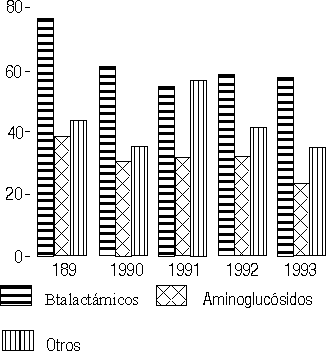
<CENTER>Fig.  <I>Resistencia bacteriana global frente a los 3 grupos de antimicrobianos usados.</I></CENTER>    <P>Se  analiz&oacute; globalmente el comportamiento de la resistencia bacteriana frente  a los 3 grupos de antimicrobianos probados, tomando en comjunto las resistencias  individuales de cada grupo (fig) y se observ&oacute; que en los 3 grupos hubo  una disminuci&oacute;n paulatina al final del per&iacute;odo y se mantuvo inalterable  la relaci&oacute;n entre ellos (betalact&aacute;micos/porcentajes altos, aminogluc&oacute;sidos/porcentajes  bajos y "otros"/porcentajes intermedios) y tom&oacute; como referencia la cifra  de 50 % de resistencia. <H4> DISCUSI&Oacute;N</H4>Se demostr&oacute; que un correcto  uso de los agentes antimicrobianos, que incluir&iacute;a el control en la aplicaci&oacute;n  de los medicamentos de este tipo as&iacute; como no utilizar alguno de ellos temporalmente  (per&iacute;odo de reposo) con la consiguiente multiplicaci&oacute;n de cepas  sensibles, puede disminuir la resistencia bacteriana. Estudios desarrollados en  Cuba y en otros pa&iacute;ses as&iacute; lo confirman.<SUP>9,10</SUP>     <P>Aunque  en el ISMM fue creado un Comit&eacute; F&aacute;rmaco-Terap&eacute;utico en 1990,  encargado de aplicar una pol&iacute;tica de antibi&oacute;ticos, no se lleg&oacute;  a instrumentar completamente en lo concerniente a su control y restricci&oacute;n  temporal, por lo que se consider&oacute; que &eacute;sta no fue la causa de la  disminuci&oacute;n paulatina de la resistencia bacteriana en el centro. Sin embargo,  la creaci&oacute;n del Comit&eacute; s&iacute; ha influido sobre el personal m&eacute;dico  en cuanto a adquirir un mayor conocimiento del problema y la necesidad de realizar  un uso riguroso de los medicamentos.     <P>A partir de 1990 cuando el pa&iacute;s  enfrent&oacute; el denominado per&iacute;odo especial, las carencias de antibi&oacute;ticos  fueron cada vez mayores. Estas carencias obligaron al m&eacute;dico de asistencia  a un uso cada vez m&aacute;s racional de aquellos a su alcance y colocaron algunos  de estos f&aacute;rmacos en estado de reposo obligado, producido por su inexistencia.  Ambas circunstancias con el paso del tiempo han ejercido su influencia sobre los  microorganismos y han dado por resultado la disminuci&oacute;n paulatina de la  resistencia bacteriana observada en este estudio.     <P>Como conclusi&oacute;n esto  no quiere decir que las carencias de medicamentos sean un hecho deseable como  forma de controlar la resistencia bacteriana, sino que &eacute;stas han permitido  demostrar que con un uso m&aacute;s racional de los antimicrobianos es posible  disminuir la aparici&oacute;n de cepas resistentes a ellos y mantener un nivel  de resistencia dentro de l&iacute;mites aceptables. <H4> SUMMARY</H4>A monitoring  of "in vitro" bacterial resistance was carried out at "Dr. Luis D&iacute;az Soto"  Higher Institute of Military Medicine during a 5-year period (1989-1993) with  the objective of knowing whether there was a reduction and the possible causative  effect on such reduction of the creation of the Pharmaco-Therapeutic Commitee  which directs the policy regarding the use of antibiotics in the center. The behaviour  of 6 221 bacterial strains isolated during the 5-year period against a number  of 14 antibiotics belonging to the traditional antibiogram, was analyzed. These  antibiotics were grouped for the study of 3 groups: Bectalactamic; aminoglycosides,  and others. It was observed that bacterial resistance was reduced in the 3 groups  which were analyzed together, and it only increased individually against tetracycline  with no significant figures. It was considered that the cause of this reduction  was the result of the scarcy availability of antibiotics in the country, fact  that has resulted in a rest of some of the above mentioned antibiotics together  with the fact that most of the physicians have a more rational use of the ones  available.     <P><I>Subject headings:</I> DRUG RESISTANCE; MICROBIAL; DRUG MONITORING;  ANTIBIOTICS/pharmacology; MICROBIAL SENSITIVITY/drug effects; BACTRIA/isolation  &amp; purification. <H4> REFERENCIAS BIBLIOGR&Aacute;FICAS</H4>    ]]></body>
<body><![CDATA[<!-- ref --><P><FONT SIZE=-1>1.  Eickoff TC. Antibi&oacute;ticos e infecciones. En: Bennet JV. Infecciones hospitalarias.  La Habana: Editorial Cient&iacute;fico- T&eacute;cnica, 1982:275-7.</FONT><!-- ref --><P><FONT SIZE=-1>2.  Brun-Buisson Ch. Des germes si ordinaires. Recherche 1994; 266:706-7.</FONT><!-- ref --><P><FONT SIZE=-1>3.  Nordman P. Characterization of a novel extended-expectrum betalactamase from Ps.  aeruginosa. Antimicrob Agents Chemother 1993;37(5):962.</FONT><!-- ref --><P><FONT SIZE=-1>4.  Georgopapadakou NH. Penicillin-binding proteins and bacterial resistance to beta-lactams.  Antimicrob Agents Chemoter 1993; 37(10):2045-53.</FONT><!-- ref --><P><FONT SIZE=-1>5.  Patallo N. Situaci&oacute;n actual de las infecciones hospitalarias. Washington,  DC: OPS, 1991:124-39.</FONT><!-- ref --><P><FONT SIZE=-1>6. Al&oacute;s JI. Resistencia  bacteriana a los antibi&oacute;ticos: the never ending story. Med Clin 1994;103(3):34-5.</FONT><!-- ref --><P><FONT SIZE=-1>7.  Cabrera N. Comportamiento de la resistencia "in vitro" despu&eacute;s de aplicar  una pol&iacute;tica de uso de antimicrobianos. Rev Cubana Epidemiol 1993;31(2):100-8.</FONT><!-- ref --><P><FONT SIZE=-1>8.  Nodarse R. Sistema de procesamiento de informaci&oacute;n de muestras microbiol&oacute;gicas  positivas. En: Libro de Res&uacute;menes del I Congreso Latinoamericano de Inform&aacute;tica  en Salud. La Habana: Editorial MINSAP, 1992:143.</FONT><!-- ref --><P><FONT SIZE=-1>9.  Cabrera N. Efecto de una pol&iacute;tica de control de antimicrobianos en la sensibilidad  de los microorganismos. En: Libro de Res&uacute;menes del Taller Internacional  Antibi&oacute;ticos'93. La Habana: Editorial MINSAP, 1993:30.</FONT><!-- ref --><P><FONT SIZE=-1>10.  Soogard H. Antibiotic-resistance gram-negative bacilli in a urological ward for  male patients during a 9 year period: relation ship to antibiotic consumption.  J Infect Dis 1974; 130:646.</FONT>Recibido: 14 de marzo de 1996. Aprobado:  13 de julio de 1997.     <P>Dr. <I>Rafael Nodarse Hern&aacute;ndez.</I> Instituto  Superior de Medicina Militar "Dr. Luis D&iacute;az Soto", Avenida Monumental,  Habana del Este, CP 11700. Ciudad de La Habana. Cuba.       ]]></body><back>
<ref-list>
<ref id="B1">
<label>1</label><nlm-citation citation-type="book">
<person-group person-group-type="author">
<name>
<surname><![CDATA[Eickoff]]></surname>
<given-names><![CDATA[TC]]></given-names>
</name>
</person-group>
<article-title xml:lang="es"><![CDATA[Antibióticos e infecciones]]></article-title>
<person-group person-group-type="editor">
<name>
<surname><![CDATA[Bennet]]></surname>
<given-names><![CDATA[JV]]></given-names>
</name>
</person-group>
<source><![CDATA[Infecciones hospitalarias]]></source>
<year>1982</year>
<page-range>275-7</page-range><publisher-loc><![CDATA[La Habana ]]></publisher-loc>
<publisher-name><![CDATA[Editorial Científico- Técnica]]></publisher-name>
</nlm-citation>
</ref>
<ref id="B2">
<label>2</label><nlm-citation citation-type="journal">
<person-group person-group-type="author">
<name>
<surname><![CDATA[Brun-Buisson]]></surname>
<given-names><![CDATA[Ch]]></given-names>
</name>
</person-group>
<article-title xml:lang="fr"><![CDATA[Des germes si ordinaires]]></article-title>
<source><![CDATA[Recherche]]></source>
<year>1994</year>
<volume>266</volume>
<page-range>706-7</page-range></nlm-citation>
</ref>
<ref id="B3">
<label>3</label><nlm-citation citation-type="journal">
<person-group person-group-type="author">
<name>
<surname><![CDATA[Nordman]]></surname>
<given-names><![CDATA[P]]></given-names>
</name>
</person-group>
<article-title xml:lang="en"><![CDATA[Characterization of a novel extended-expectrum betalactamase from Ps. aeruginosa]]></article-title>
<source><![CDATA[Antimicrob Agents Chemother]]></source>
<year>1993</year>
<volume>37</volume>
<numero>5</numero>
<issue>5</issue>
<page-range>962</page-range></nlm-citation>
</ref>
<ref id="B4">
<label>4</label><nlm-citation citation-type="journal">
<person-group person-group-type="author">
<name>
<surname><![CDATA[Georgopapadakou]]></surname>
<given-names><![CDATA[NH]]></given-names>
</name>
</person-group>
<article-title xml:lang="en"><![CDATA[Penicillin-binding proteins and bacterial resistance to beta-lactams]]></article-title>
<source><![CDATA[Antimicrob Agents Chemoter]]></source>
<year>1993</year>
<volume>37</volume>
<numero>10</numero>
<issue>10</issue>
<page-range>2045-53</page-range></nlm-citation>
</ref>
<ref id="B5">
<label>5</label><nlm-citation citation-type="book">
<person-group person-group-type="author">
<name>
<surname><![CDATA[Patallo]]></surname>
<given-names><![CDATA[N]]></given-names>
</name>
</person-group>
<source><![CDATA[Situación actual de las infecciones hospitalarias]]></source>
<year>1991</year>
<page-range>124-39</page-range><publisher-loc><![CDATA[Washington, DC ]]></publisher-loc>
<publisher-name><![CDATA[OPS]]></publisher-name>
</nlm-citation>
</ref>
<ref id="B6">
<label>6</label><nlm-citation citation-type="journal">
<person-group person-group-type="author">
<name>
<surname><![CDATA[Alós]]></surname>
<given-names><![CDATA[JI]]></given-names>
</name>
</person-group>
<article-title xml:lang="es"><![CDATA[Resistencia bacteriana a los antibióticos: the never ending story]]></article-title>
<source><![CDATA[Med Clin]]></source>
<year>1994</year>
<volume>103</volume>
<numero>3</numero>
<issue>3</issue>
<page-range>34-5</page-range></nlm-citation>
</ref>
<ref id="B7">
<label>7</label><nlm-citation citation-type="journal">
<person-group person-group-type="author">
<name>
<surname><![CDATA[Cabrera]]></surname>
<given-names><![CDATA[N]]></given-names>
</name>
</person-group>
<article-title xml:lang="es"><![CDATA[Comportamiento de la resistencia "in vitro" después de aplicar una política de uso de antimicrobianos]]></article-title>
<source><![CDATA[Rev Cubana Epidemiol]]></source>
<year>1993</year>
<volume>31</volume>
<numero>2</numero>
<issue>2</issue>
<page-range>100-8</page-range></nlm-citation>
</ref>
<ref id="B8">
<label>8</label><nlm-citation citation-type="book">
<person-group person-group-type="author">
<name>
<surname><![CDATA[Nodarse]]></surname>
<given-names><![CDATA[R]]></given-names>
</name>
</person-group>
<article-title xml:lang="es"><![CDATA[Sistema de procesamiento de información de muestras microbiológicas positivas]]></article-title>
<source><![CDATA[Libro de Resúmenes del I Congreso Latinoamericano de Informática en Salud]]></source>
<year>1992</year>
<page-range>143</page-range><publisher-loc><![CDATA[La Habana ]]></publisher-loc>
<publisher-name><![CDATA[Editorial MINSAP]]></publisher-name>
</nlm-citation>
</ref>
<ref id="B9">
<label>9</label><nlm-citation citation-type="book">
<person-group person-group-type="author">
<name>
<surname><![CDATA[Cabrera]]></surname>
<given-names><![CDATA[N]]></given-names>
</name>
</person-group>
<article-title xml:lang="es"><![CDATA[Efecto de una política de control de antimicrobianos en la sensibilidad de los microorganismos]]></article-title>
<source><![CDATA[Libro de Resúmenes del Taller Internacional Antibióticos'93]]></source>
<year>1993</year>
<page-range>30</page-range><publisher-loc><![CDATA[La Habana ]]></publisher-loc>
<publisher-name><![CDATA[Editorial MINSAP]]></publisher-name>
</nlm-citation>
</ref>
<ref id="B10">
<label>10</label><nlm-citation citation-type="journal">
<person-group person-group-type="author">
<name>
<surname><![CDATA[Soogard]]></surname>
<given-names><![CDATA[H]]></given-names>
</name>
</person-group>
<article-title xml:lang="en"><![CDATA[Antibiotic-resistance gram-negative bacilli in a urological ward for male patients during a 9 year period: relation ship to antibiotic consumption]]></article-title>
<source><![CDATA[J Infect Dis]]></source>
<year>1974</year>
<volume>130</volume>
<page-range>646</page-range></nlm-citation>
</ref>
</ref-list>
</back>
</article>
