<?xml version="1.0" encoding="ISO-8859-1"?><article xmlns:mml="http://www.w3.org/1998/Math/MathML" xmlns:xlink="http://www.w3.org/1999/xlink" xmlns:xsi="http://www.w3.org/2001/XMLSchema-instance">
<front>
<journal-meta>
<journal-id>0138-6557</journal-id>
<journal-title><![CDATA[Revista Cubana de Medicina Militar]]></journal-title>
<abbrev-journal-title><![CDATA[Rev Cub Med Mil]]></abbrev-journal-title>
<issn>0138-6557</issn>
<publisher>
<publisher-name><![CDATA[Centro Nacional de Información de Ciencias MédicasEditorial Ciencias Médicas]]></publisher-name>
</publisher>
</journal-meta>
<article-meta>
<article-id>S0138-65572000000300005</article-id>
<title-group>
<article-title xml:lang="es"><![CDATA[Valores de referencia para la determinación de riboflavina sérica]]></article-title>
</title-group>
<contrib-group>
<contrib contrib-type="author">
<name>
<surname><![CDATA[Pérez Gastell]]></surname>
<given-names><![CDATA[Pedro Luis]]></given-names>
</name>
<xref ref-type="aff" rid="A01"/>
</contrib>
<contrib contrib-type="author">
<name>
<surname><![CDATA[Hernández Royero]]></surname>
<given-names><![CDATA[Ricardo]]></given-names>
</name>
</contrib>
<contrib contrib-type="author">
<name>
<surname><![CDATA[Amador Armenteros]]></surname>
<given-names><![CDATA[Armando]]></given-names>
</name>
</contrib>
</contrib-group>
<aff id="A01">
<institution><![CDATA[,Instituto Superior de Medicina Militar Dr. Luis Díaz Soto.  ]]></institution>
<addr-line><![CDATA[Ciudad de La Habana ]]></addr-line>
<country>Cuba</country>
</aff>
<pub-date pub-type="pub">
<day>00</day>
<month>12</month>
<year>2000</year>
</pub-date>
<pub-date pub-type="epub">
<day>00</day>
<month>12</month>
<year>2000</year>
</pub-date>
<volume>29</volume>
<numero>3</numero>
<fpage>179</fpage>
<lpage>184</lpage>
<copyright-statement/>
<copyright-year/>
<self-uri xlink:href="http://scielo.sld.cu/scielo.php?script=sci_arttext&amp;pid=S0138-65572000000300005&amp;lng=en&amp;nrm=iso"></self-uri><self-uri xlink:href="http://scielo.sld.cu/scielo.php?script=sci_abstract&amp;pid=S0138-65572000000300005&amp;lng=en&amp;nrm=iso"></self-uri><self-uri xlink:href="http://scielo.sld.cu/scielo.php?script=sci_pdf&amp;pid=S0138-65572000000300005&amp;lng=en&amp;nrm=iso"></self-uri><abstract abstract-type="short" xml:lang="es"><p><![CDATA[Los valores de referencia para la cuantificación de riboflavina (vitamina B2) sérica fueron establecidos en el presente trabajo a partir de una muestra del personal que recibe asistencia en los servicios del Instituto Superior de Medicina Militar "Dr. Luis Díaz Soto". Se estudiaron 88 sujetos de uno y otro sexos, con edades entre 17 y 50 a. Todos cumplían la condición de supuestamente sanos según criterios aplicados. La vitamina B2 fue cuantificada por un proceder analítico de tipo fluorimétrico desarrollado por Natelson y otros. Mediante el control de calidad de esta técnica se pudieron obtener resultados aceptables en la precisión con coeficientes de variación de 5,27 y 3,74 % para la reproducibilidad y repetibilidad respectivamente, y en la exactitud con coeficiente de correlación de 0,99 y un índice de recuperación de 96,96 %. Según el análisis estadístico de los datos de la muestra se estableció que la variable vitamina B2 tenía una distribución logarítmica normal. No se encontraron diferencias significativas según el sexo. El recorrido de valores de referencia cuantificados se enmarcó en un límite mínimo de 5,01 &micro;g/100 mL y máximo de 9,57 &micro;g/100 mL, con una media de 7,29 m g/100 mL, expresado como X ? 2DE. Estos valores se insertan razonablemente en el entorno de los recorridos informados por otros autores, obtenidos por iguales o diferentes métodos.]]></p></abstract>
<abstract abstract-type="short" xml:lang="en"><p><![CDATA[Reference values for quantification of serum riboflavin (vitamin B2 ) were set in the present paper on the basis of a sample of patients who received medical assistance in the different departments of "Dr Luis Díaz Soto" Higher Institute of Military Medicine. 88 subjects of both sexes aged 17-50 years were studied. All of them fulfilled the condition of being supposed healthy subjects according to applied criteria. Vitamin B2 was quantified by fluorometric analytical method developed by Natelson et al. Through the quality control of this technique, acceptable results were achieved in precision, with variation coefficients of 5.27 and 3.74 % for reproducibility and repeatability respectively, and in accuracy with correlation coefficient of 0.99 and a recovery index of 96.96 %. According to the statistical analysis of data from the sample, it was shown that vitamin B2 variable had normal logarithmic distribution. No significant differences were found between sexes. The quantified reference values range was set within a minimum limit of 5.01 &micro;g/100 mL and a maximum limit of 9.57 &micro;g/100 mL, with a mean value of 7.29 &micro;g/100 mL, expressed as X? 2DS. These values are reasonably included in the context of those reference ranges reported by other authors and obtained by the same or different methods.]]></p></abstract>
<kwd-group>
<kwd lng="es"><![CDATA[RIBOFLAVINA]]></kwd>
<kwd lng="es"><![CDATA[VALORES DE REFERENCIA]]></kwd>
<kwd lng="es"><![CDATA[CONTROL DE CALIDAD]]></kwd>
<kwd lng="en"><![CDATA[RIBOFLAVIN]]></kwd>
<kwd lng="en"><![CDATA[REFERENCE VALUES]]></kwd>
<kwd lng="en"><![CDATA[QUALITY CONTROL]]></kwd>
</kwd-group>
</article-meta>
</front><body><![CDATA[ <P>Instituto Superior de Medicina Militar "Dr. Luis D&iacute;az Soto" <H2> Valores  de referencia para la determinaci&oacute;n de riboflavina s&eacute;rica</H2><I>Dr.  Pedro Luis P&eacute;rez Gastell,<SUP>1</SUP> Dr. Ricardo Hern&aacute;ndez Royero,<SUP>2</SUP>  y Lic. Armando Amador Armenteros <SUP>3</SUP></I>     <P><B>RESUMEN</B>     <P>Los valores  de referencia para la cuantificaci&oacute;n de riboflavina (vitamina B<SUB>2</SUB>)  s&eacute;rica fueron establecidos en el presente trabajo a partir de una muestra  del personal que recibe asistencia en los servicios del Instituto Superior de  Medicina Militar "Dr. Luis D&iacute;az Soto". Se estudiaron 88 sujetos de uno  y otro sexos, con edades entre 17 y 50 a. Todos cumpl&iacute;an la condici&oacute;n  de supuestamente sanos seg&uacute;n criterios aplicados. La vitamina B<SUB>2</SUB>  fue cuantificada por un proceder anal&iacute;tico de tipo fluorim&eacute;trico  desarrollado por <I>Natelson</I> y otros. Mediante el control de calidad de esta  t&eacute;cnica se pudieron obtener resultados aceptables en la precisi&oacute;n  con coeficientes de variaci&oacute;n de 5,27 y 3,74 % para la reproducibilidad  y repetibilidad respectivamente, y en la exactitud con coeficiente de correlaci&oacute;n  de 0,99 y un &iacute;ndice de recuperaci&oacute;n de 96,96 %. Seg&uacute;n el  an&aacute;lisis estad&iacute;stico de los datos de la muestra se estableci&oacute;  que la variable vitamina B<SUB>2 </SUB>ten&iacute;a una distribuci&oacute;n logar&iacute;tmica  normal. No se encontraron diferencias significativas seg&uacute;n el sexo. El  recorrido de valores de referencia cuantificados se enmarc&oacute; en un l&iacute;mite  m&iacute;nimo de 5,01 &micro;g/100 mL y m&aacute;ximo de 9,57 &micro;g/100 mL,  con una media de 7,29 m g/100 mL, expresado como X ? 2DE. Estos valores se insertan  razonablemente en el entorno de los recorridos informados por otros autores, obtenidos  por iguales o diferentes m&eacute;todos.     <P><I>Descriptores DeCS:</I> RIBOFLAVINA/sangre;  VALORES DE REFERENCIA; CONTROL DE CALIDAD.     <P>La riboflavina, clasificada como  vitamina B<B><SUB>2</SUB>,<SUB> </SUB></B>est&aacute; presente en la sangre y  tejidos en forma de riboflavina libre, de mononucle&oacute;tido de flavina (FMN)  y dinucle&oacute;tido de adenina y flavina (FAD); cofactores de enzimas deshidrogenasas,  L y D amino&aacute;cido oxidasas y xantina oxidasas. Se excreta por la orina como  uroflavina y est&aacute; presente en el h&iacute;gado, cereales, levaduras, leche,  huevo y ve-getales verdes.<SUP>1</SUP> Su necesidad diaria es de 1-2 mg.     <P>El  s&iacute;ndrome de deficiencia se caracteriza por molestia en la garganta, hiperemia,  edema de mucosa far&iacute;ngea y bucal, queilosis, estomatitis angular, glositis,  dermatitis seborreica y anemia normoc&iacute;tica normocr&oacute;mica por hiperplasia  de la serie roja de la m&eacute;dula &oacute;sea. En realidad su deficiencia aparece  casi siempre combinada con otras deficiencias vitam&iacute;nicas.<SUP>1,2</SUP>      <P>Muchos autores han determinado la riboflavina en orina,<SUP>3-8</SUP> o en  suero por diferentes procedimientos como el de cromatograf&iacute;a l&iacute;quida  de alta resoluci&oacute;n (HPLC),<SUP>8-11</SUP> enzim&aacute;ticos como el de  la glutati&oacute;n reductasa<SUP>12-14</SUP> o fluorim&eacute;tricos.<SUP>15,16</SUP>      <P>Por la necesidad imperante que tienen muchos m&eacute;dicos de conocer el estado  vitam&iacute;nico de sus pacientes, y porque en muchos centros hospitalarios no  existen t&eacute;cnicas para su detecci&oacute;n, se ha propuesto instrumentar  y estandarizar un procedimiento para la cuantificaci&oacute;n de riboflavina.  <H4> M&Eacute;TODOS</H4>La investigaci&oacute;n comprendi&oacute; el per&iacute;odo  de junio de 1997 a junio de 1998. Se seleccion&oacute; una muestra de 88 individuos  supuestamente sanos, entre 17 y 50 a, de uno y otro sexos que recibieron asistencia  en los servicios del Instituto Superior de Medicina Militar (ISMM) "Dr. Luis D&iacute;az  Soto".     <P>Se cuantific&oacute; la riboflavina s&eacute;rica mediante el m&eacute;todo  anal&iacute;tico de Natelson y otros.<SUP>15</SUP>     <P><I>Control de calidad del  procedimiento t&eacute;cnico</I>     ]]></body>
<body><![CDATA[<P>Para establecer la calidad de los procedimientos  t&eacute;cnicos se determin&oacute; la precisi&oacute;n y la exactitud.     <P><I>Precisi&oacute;n</I>.  Se calcularon la media (X), la desviaci&oacute;n est&aacute;ndar (DE) y el coeficiente  de variaci&oacute;n (CV), y a partir de estos se determinaron los valores m&aacute;ximos  y m&iacute;nimos de reproducibilidad y repetibilidad. Para los an&aacute;lisis  ulteriores se utilizaron los valores de reproducibilidad.     <P><I>Exactitud</I>.  Se prepar&oacute; una curva de calibraci&oacute;n montada varias veces, con patrones  de 5,10, 20 y 40 m g/dL, y se calcul&oacute; el promedio de intercepto, pendiente  y coeficiente de correlaci&oacute;n.     <P>Se estudi&oacute; el &iacute;ndice de  recuperaci&oacute;n.     <P>Se calcul&oacute; la varianza del m&eacute;todo, dato  necesario para el c&aacute;lculo de los valores de referencia.     <P><I>An&aacute;lisis  estad&iacute;stico.</I> Se determin&oacute; el tipo de distribuci&oacute;n de  los valores mediante la prueba de bondad de ajuste para una distribuci&oacute;n  normal (chi cuadrado) y el gr&aacute;fico de distribuci&oacute;n de frecuencia.      <P>Se estableci&oacute; el recorrido de referencia, estimado seg&uacute;n tipo  de distribuci&oacute;n en el intervalo X + 2DE de la muestra seleccionada.     <P>Se  calcul&oacute; la varianza estimada (VE) para establecer unida a la varianza del  m&eacute;todo (VM), la varianza poblacional (VP) seg&uacute;n la f&oacute;rmula  siguiente:     <P>VE = VM+VP     <P>Se despeja de la manera siguiente:     ]]></body>
<body><![CDATA[<P>VP=VE-VM     <P>El  valor de la VP se utiliz&oacute; para calcular el recorrido de referencia de la  poblaci&oacute;n.     <P>Para el an&aacute;lisis estad&iacute;stico se utiliz&oacute;  el paquete STATISTIC. <H4> RESULTADOS</H4>El CV obtenido en el an&aacute;lisis  de la reproducibilidad fue de 5,27 % (tabla 1).     <P>El control de la exactitud  present&oacute; un coeficiente de correlaci&oacute;n de 0,99 y un &iacute;ndice  de recuperaci&oacute;n del 96,96 %. <DIR> <DIR> <DIR> <DIR>TABLA 1. <I>An&aacute;lisis  de la precisi&oacute;n</I></DIR></DIR></DIR></DIR>&nbsp;     <CENTER><TABLE CELLPADDING=4 >  <TR> <TD VALIGN=TOP WIDTH="33%"></TD><TD VALIGN=TOP WIDTH="33%">     <CENTER>Repetibilidad  n= 20</CENTER></TD><TD VALIGN=TOP WIDTH="33%">     <CENTER>Reproducibilidad n=20</CENTER></TD></TR>  <TR> <TD VALIGN=TOP WIDTH="33%">X</TD><TD VALIGN=TOP WIDTH="33%">     <CENTER>11,709</CENTER></TD><TD VALIGN=TOP WIDTH="33%">      <CENTER>11,4045</CENTER></TD></TR> <TR> <TD VALIGN=TOP WIDTH="33%">DE</TD><TD VALIGN=TOP WIDTH="33%">      <CENTER>0,4388</CENTER></TD><TD VALIGN=TOP WIDTH="33%">     ]]></body>
<body><![CDATA[<CENTER>0,60109</CENTER></TD></TR>  <TR> <TD VALIGN=TOP WIDTH="33%">X + 2DE</TD><TD VALIGN=TOP WIDTH="33%">     <CENTER>12,5866</CENTER></TD><TD VALIGN=TOP WIDTH="33%">      <CENTER>12,6066</CENTER></TD></TR> <TR> <TD VALIGN=TOP WIDTH="33%">X - 2DE</TD><TD VALIGN=TOP WIDTH="33%">      <CENTER>10,8314</CENTER></TD><TD VALIGN=TOP WIDTH="33%">     <CENTER>10,2023</CENTER></TD></TR>  <TR> <TD VALIGN=TOP WIDTH="33%">CV</TD><TD VALIGN=TOP WIDTH="33%">     <CENTER>3,74  %</CENTER></TD><TD VALIGN=TOP WIDTH="33%">     <CENTER>5,27 %</CENTER></TD></TR> </TABLE></CENTER><DIR>  <DIR> <DIR> <DIR>El resultado de la VM fue 0,36.</DIR></DIR></DIR></DIR>Los valores  de riboflavina no mostraron diferencia significativa entre los grupos del sexo  femenino y masculino, en la aplicaci&oacute;n de la prueba estad&iacute;stica  t de Student (p > 0,05). Al no existir diferencias significativas, se unieron  todos los valores en un solo grupo y se aplic&oacute;, como indican algunos autores,<SUP>17,18</SUP>  el m&eacute;todo estad&iacute;stico para buscar el tipo de distribuci&oacute;n  (prueba de bondad de ajuste para una distribuci&oacute;n normal) y el gr&aacute;fico  de distribuci&oacute;n de frecuencia, lo que dio como resultado que la hip&oacute;tesis  acerca de que los valores s&eacute;ricos de riboflavina en la muestra de la poblaci&oacute;n  estudiada se distribuyeran normalmente deb&iacute;a ser rechazada con una p >  0,05 (tabla 2), por lo que la distribuci&oacute;n es log-normal. <DIR> <DIR> <DIR>  <DIR>TABLA 2. <I>An&aacute;lisis de la distribuci&oacute;n de los valores obtenidos</I></DIR></DIR></DIR></DIR>&nbsp;      <CENTER><TABLE CELLPADDING=4 > <TR> <TD VALIGN=TOP WIDTH="50%">N&nbsp;</TD><TD VALIGN=TOP WIDTH="50%">      <CENTER>88</CENTER></TD></TR> <TR> <TD VALIGN=TOP WIDTH="50%">X</TD><TD VALIGN=TOP WIDTH="50%">      <CENTER>7,53056818</CENTER></TD></TR> <TR> <TD VALIGN=TOP WIDTH="50%">DE</TD><TD VALIGN=TOP WIDTH="50%">      ]]></body>
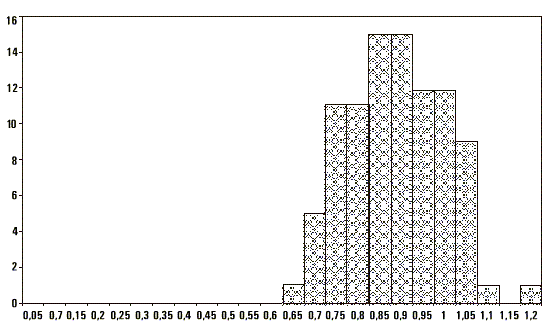
<body><![CDATA[<CENTER>1,97035871</CENTER></TD></TR> </TABLE></CENTER><DIR> <DIR> <DIR> <DIR>      <CENTER>p > 0,05.</CENTER></DIR></DIR></DIR></DIR>Los criterios de la distribuci&oacute;n  Gausiana no se pueden aplicar directamente a la distribuci&oacute;n lognormal,  por lo que se decidi&oacute; calcular el promedio geom&eacute;trico (Xg), que  se determina igual que la media aritm&eacute;tica pero a partir de los logaritmos  de los datos originales (tabla 3). <DIR> <DIR> <DIR> <DIR>TABLA 3. <I>An&aacute;lisis  de la distribuci&oacute;n de los valores transformados logar&iacute;tmicamente</I></DIR></DIR></DIR></DIR>&nbsp;      <CENTER><TABLE CELLPADDING=4 > <TR> <TD VALIGN=TOP WIDTH="50%">N&nbsp;</TD><TD VALIGN=TOP WIDTH="50%">      <CENTER>88</CENTER></TD></TR> <TR> <TD VALIGN=TOP WIDTH="50%">Xg</TD><TD VALIGN=TOP WIDTH="50%">      <CENTER>0,86267631</CENTER></TD></TR> <TR> <TD VALIGN=TOP WIDTH="50%">DE</TD><TD VALIGN=TOP WIDTH="50%">      <CENTER>0,11094898</CENTER></TD></TR> </TABLE></CENTER>&nbsp; <DIR> <DIR> <DIR>  <DIR>     <CENTER>p>0,05.</CENTER></DIR></DIR></DIR></DIR>Se aplic&oacute; nuevamente  la prueba de bondad de ajuste y el gr&aacute;fico de distribuci&oacute;n de frecuencia  (fig.) y result&oacute; que la hip&oacute;tesis acerca de que la poblaci&oacute;n  se distribuyera normalmente no debi&oacute; ser rechazada con una p &lt; 0,05  (tabla 3).     <P>Para poder establecer el recorrido de referencia de la muestra estimada  hubo que hallar el antilogaritmo de la X y la DE y se le estim&oacute; la varianza  (VE) (tabla 4). <DIR> <DIR> <DIR> <DIR>TABLA 4. <I>Resultados de los antilogaritmos  y de la varianza</I></DIR></DIR></DIR></DIR>    <CENTER><TABLE CELLPADDING=4 > <TR>  <TD VALIGN=TOP WIDTH="50%">X&nbsp;</TD><TD VALIGN=TOP WIDTH="50%">     <CENTER>7,29</CENTER></TD></TR>  <TR> <TD VALIGN=TOP WIDTH="50%">DE</TD><TD VALIGN=TOP WIDTH="50%">     ]]></body>
<body><![CDATA[<CENTER>1,29</CENTER></TD></TR>  <TR> <TD VALIGN=TOP WIDTH="50%">X+2DE</TD><TD VALIGN=TOP WIDTH="50%">     <CENTER>9,87</CENTER></TD></TR>  <TR> <TD VALIGN=TOP WIDTH="50%">X - 2DE</TD><TD VALIGN=TOP WIDTH="50%">     <CENTER>4,71</CENTER></TD></TR>  <TR> <TD VALIGN=TOP WIDTH="50%">VE</TD><TD VALIGN=TOP WIDTH="50%">     <CENTER>1,6641</CENTER></TD></TR>  </TABLE></CENTER>Al utilizar la varianza estimada (VE), junto a la varianza del  m&eacute;todo (VM), se calcul&oacute; la varianza de la poblaci&oacute;n (VP).  <DIR> <DIR> <DIR> <DIR>VP=VE-VM     <BR>VP=1,6641-0,36     <BR>VP=1,30</DIR></DIR></DIR></DIR>Se  hall&oacute; la ra&iacute;z cuadrada al valor de la VP y se obtuvo la DE igual  a 1,1401, a partir de lo cual se estableci&oacute; el recorrido de referencia  para la poblaci&oacute;n, expresado este como X ? 2DE (tabla 5). <DIR> <DIR> <DIR>  <DIR>TABLA 5. <I>Recorrido de referencia poblacional</I></DIR></DIR></DIR></DIR>&nbsp;      <CENTER><TABLE CELLPADDING=4 > <TR> <TD VALIGN=TOP WIDTH="50%">X&nbsp;</TD><TD VALIGN=TOP WIDTH="50%">      <CENTER>7,29</CENTER></TD></TR> <TR> <TD VALIGN=TOP WIDTH="50%">DE</TD><TD VALIGN=TOP WIDTH="50%">      <CENTER>1,14</CENTER></TD></TR> <TR> <TD VALIGN=TOP WIDTH="50%">2DE</TD><TD VALIGN=TOP WIDTH="50%">      <CENTER>2,134</CENTER></TD></TR> <TR> <TD VALIGN=TOP WIDTH="50%">X - 2DE</TD><TD VALIGN=TOP WIDTH="50%">      ]]></body>
<body><![CDATA[<CENTER>5,01</CENTER></TD></TR> <TR> <TD VALIGN=TOP WIDTH="50%">X+2DE</TD><TD VALIGN=TOP WIDTH="50%">      <CENTER>9,57</CENTER></TD></TR> </TABLE></CENTER>El valor del recorrido de referencia  calculado para la poblaci&oacute;n estudiada fue de 5,01 a 9,57 m g/100 mL, con  una X de 7,29 m g/100 mL seg&uacute;n el m&eacute;todo estad&iacute;stico aplicado.      <CENTER><A HREF="/img/revistas/mil/v29n3/f0105300.gif"><IMG SRC="/img/revistas/mil/v29n3/f0105300.gif" ALT="Fig. Distribución de frecuencias con los valores transformados logarítmicamente." BORDER=1 HEIGHT=258 WIDTH=435></A></CENTER>    
<CENTER>Fig.  Distribuci&oacute;n de frecuencias con los valores transformados logar&iacute;tmicamente.</CENTER>    <CENTER>&nbsp;</CENTER><H4>  DISCUSI&Oacute;N</H4>El CV obtenido en la precisi&oacute;n se categoriz&oacute;  de bueno al igual que el coeficiente de correlaci&oacute;n y el &iacute;ndice  de recuperaci&oacute;n en la exactitud de acuerdo con la escala internacional  establecida.     <P><I>Natelson</I> con la t&eacute;cnica de referencia encontr&oacute;  en su trabajo<SUP>15</SUP> de 1 a 85 m g/100 mL (promedio 25) y <I>Henry</I><SUP>19  </SUP>de 2,6 a 3,7 m g//100 mL. Este &uacute;ltimo utiliz&oacute; adem&aacute;s  un m&eacute;todo microbiol&oacute;gico y hall&oacute; valores de 4 a 24 m g/100  mL. <I>Heil</I><SUP>20</SUP> encontr&oacute; de 4 a 24 m g/100 mL con el uso de  HPLC.     <P>Las diferencias encontradas en el presente trabajo, con los datos reportados  por los autores mencionados, pudieran radicar en los h&aacute;bitos alimentarios  de las diferentes poblaciones estudiadas y en la diferencia de las fechas en que  se realizaron los estudios; aunque tambi&eacute;n podr&iacute;an imputarse a detalles  en la ejecuci&oacute;n del procedimiento y a los equipos utilizados. Como este  proceder se control&oacute; rigurosamente, la hip&oacute;tesis m&aacute;s probable  ser&iacute;a atribuir a las diferencias de las poblaciones, la causa de estas  divergencias.     <P>El proceder de <I>Natelson,</I> a pesar de ser laborioso y de  no constituir una microt&eacute;cnica, demostr&oacute; poseer precisi&oacute;n  y exactitud. Otra ventaja que presenta es que los reactivos utilizados son de  f&aacute;cil adquisici&oacute;n y preparaci&oacute;n. Por tales razones, y valorada  la importancia cl&iacute;nica de poder contar con la cuantificaci&oacute;n de  la riboflavina s&eacute;rica, se decidi&oacute; implementar esta t&eacute;cnica  en el servicio de Laboratorio Cl&iacute;nico del ISMM "Dr Luis D&iacute;az Soto".      <P>Por limitaci&oacute;n de recursos materiales solo se cuantific&oacute; la riboflavina  dentro del complejo B, pero debe recordarse que las deficiencias de vitaminas  de este grupo suelen estar relacionadas entre s&iacute;, y la cuantificaci&oacute;n  de una de ellas, en la mayor&iacute;a de los casos puede servir como dato orientador  sobre el estado nutricional del sujeto y para sustentar recomendaciones terap&eacute;uticas  que procedan.     <P>La investigaci&oacute;n realizada evidenci&oacute; que la aplicaci&oacute;n  en el ISMM "Dr. Luis D&iacute;az Soto" del procedimiento de Natelson fue preciso  y exacto, comprobada por los valores del coeficiente de variaci&oacute;n y el  &iacute;ndice de recuperaci&oacute;n obtenidos. La diferencia de sexo no influy&oacute;  en los valores promedio de la poblaci&oacute;n adulta estudiada. Los valores de  referencia establecidos mediante este estudio para la determinaci&oacute;n de  riboflavina s&eacute;rica en el &aacute;rea de salud sometida a investigaci&oacute;n  fueron de 5,01 a 9,57 m g/100 mL. <H4> SUMMARY</H4>Reference values for quantification  of serum riboflavin (vitamin B<SUB>2 </SUB>) were set in the present paper on  the basis of a sample of patients who received medical assistance in the different  departments of "Dr Luis D&iacute;az Soto" Higher Institute of Military Medicine.  88 subjects of both sexes aged 17-50 years were studied. All of them fulfilled  the condition of being supposed healthy subjects according to applied criteria.  Vitamin B<SUB>2</SUB> was quantified by fluorometric analytical method developed  by Natelson et al. Through the quality control of this technique, acceptable results  were achieved in precision, with variation coefficients of 5.27 and 3.74 % for  reproducibility and repeatability respectively, and in accuracy with correlation  coefficient of 0.99 and a recovery index of 96.96 %. According to the statistical  analysis of data from the sample, it was shown that vitamin B<SUB>2</SUB> variable  had normal logarithmic distribution. No significant differences were found between  sexes. The quantified reference values range was set within a minimum limit of  5.01 &micro;g/100 mL and a maximum limit of 9.57 &micro;g/100 mL, with a mean  value of 7.29 &micro;g/100 mL, expressed as X? 2DS. These values are reasonably  included in the context of those reference ranges reported by other authors and  obtained by the same or different methods.     ]]></body>
<body><![CDATA[<P><I>Subject headings:</I> RIBOFLAVIN/blood;  REFERENCE VALUES; QUALITY CONTROL. <H4> REFERENCIAS BIBLIOGR&Aacute;FICAS</H4><OL>      <!-- ref --><LI> Braunwald E.Harrison: Principios de Medicina Interna. 8 ed. M&eacute;xico:  Interpanamericana;1994.112-40.</LI>    <!-- ref --><LI> Fischbach F. Laboratory &amp; diagnostic  test. 4 ed. Philadelphia: J.B. Lipincott; 1992.1385-412.</LI>    <!-- ref --><LI> Wu-ZL,Chen-FX,Lai-YH.  Mechanism and prevention of hemolysis in jaundiced infants in phototherapy. Chung  Hua. I Hsuch tsa chin 1994;74(6):364-6, 364-9.</LI>    <!-- ref --><LI> Mack CP. Myocardial flavin  reductase and riboflavin: a potential role in decreasing reoxigenation injury.  Biochem Biophys Res Commun 1995;212(1):35-40.</LI>    <!-- ref --><LI> Kodentsova V, Urzheinskaia  OA. Vitamin Metabolism in children with insulin-dependent diabetes mellitus. Vopr  Med Khim 1994;40(4):33-8.</LI>    <!-- ref --><LI> Thilothammal N. Baen K, Gandhimathy S. Testing  compliance of drug taking o simple bed side methed. Indian Pediatr 1995;32(3):295-9.</LI>    <!-- ref --><LI>  Kondesntsova V, Urzhsinslciaa OA, Abramova El. Refining Criterio for providing  adults and 12-14 year old children with vitamins B1 and B2. Vopr Med Kim 1994;40  (6):45-8.</LI>    <!-- ref --><LI> Porcelli PJ, Adcok EW, Del Paggio D. Plasma and urine riboflavin  and piridoxine concentrations in enterally fed very-low-birth-weight neonates.  J Pediatr Gastroenterol Nutr 1996;23(2):141-6.</LI>    <!-- ref --><LI> Zemileni J, Link G, Bitsch  I. Intrauterine vitamine B2 uptake of preterm and full-term infants. Pediatr Res  1995;38(4):585-91.</LI>    <!-- ref --><LI> Kodentsova V, Urzhesinskaia OA. Determining riboflavin  in biological samples. Prike Biokhim Mikrobiol 1994;30 (4-5):603-9.</LI>    <!-- ref --><LI> Zempleni  J, Galloway JR, MC Cormick B. The Identification and Kinetics of 7 alphahydroxy  riboflavin in blood plasma from humans followings oral administration of riboflavin  suplements. Int J Vitam Nutr Res 1996;66(2):151-7.</LI>    <!-- ref --><LI> Dror Y, Stern F Komanitsky  M. Optimal and stable conditions for the determination of entrocite glutathione  reductase activation coeficient to evaluate riboflavin status. Int J Vitam Nutr  Res 1994;64(4):257-62.</LI>    <!-- ref --><LI> Mulherim DM, Thunan Dl, Situnayake RD. Glutathione  reductase activity, riboflavin status, and disease activity in reumathoid arthritis.  Am Rheum Dis 1996;55(11):837-40.</LI>    <!-- ref --><LI> Ramos JL, Barreto, OC, Nonoyama K. Vitamine  depender erithrocyte enzynes in newboms in relation to gestational age and birth  weight. J Perinat Med 1996;24(3):221-5.</LI>    <!-- ref --><LI> Natelson S. Microt&eacute;cnica  de Qu&iacute;mica Cl&iacute;nica. Barcelona: Torray SA;1964:426-9.</LI>    <!-- ref --><LI> Kondentsova  V, Vrzhesinokaya ON, Spinchev VB. Fluorometric riboflavin in plasma boy riboflavin  biding as a method for vitamin B2 status assessmin Ann Nutr Metabol 1995;39(6):335-60.</LI>    <!-- ref --><LI>  Thielmann K. Principios de metodolog&iacute;a en bioqu&iacute;mica cl&iacute;nica.  La Habana: Organismos; 1973. 23-7.</LI>    <!-- ref --><LI> Boquet E, Castillo M, C&aacute;ceres  A, Dybkaer R, Escutia V, Francini G. Mejor&iacute;a continua de la calidad. Gu&iacute;a  para los laboratorios cl&iacute;nicos de Am&eacute;rica Latina, M&eacute;xico  DF: Panamericana;1995:53-6</LI>    <!-- ref --><LI> Henry J. Diagn&oacute;stico y tratamiento  clinicos por el laboratorio 9 ed. Cient&iacute;fico y T&eacute;cnica;1993:52-4.</LI>    <!-- ref --><LI>  Heil W, Koberstein R. Zaurta B. Reference Ranges for adults and children. Pre-analytical  considerations. Boehringer Manheim;1997:42-3.</LI>    </OL>Recibido: 26 de mayo del  2000. Aprobado: 29 de junio del 2000.     <BR> Dr. <I>Pedro Luis P&eacute;rez Castell</I>.  Instituto Superior de Medicina Militar "Dr. Luis D&iacute;az Soto". Avenida Monumental,  Habana del Este, CP 11700, Ciudad de La Habana, Cuba.       ]]></body><back>
<ref-list>
<ref id="B1">
<nlm-citation citation-type="book">
<person-group person-group-type="author">
<name>
<surname><![CDATA[Braunwald]]></surname>
<given-names><![CDATA[E]]></given-names>
</name>
</person-group>
<source><![CDATA[Harrison: Principios de Medicina Interna]]></source>
<year>1994</year>
<edition>8 ed</edition>
<page-range>112-40.</page-range><publisher-loc><![CDATA[México ]]></publisher-loc>
<publisher-name><![CDATA[Interpanamericana]]></publisher-name>
</nlm-citation>
</ref>
<ref id="B2">
<nlm-citation citation-type="book">
<person-group person-group-type="author">
<name>
<surname><![CDATA[Fischbach]]></surname>
<given-names><![CDATA[F]]></given-names>
</name>
</person-group>
<source><![CDATA[Laboratory & diagnostic test]]></source>
<year>1992</year>
<edition>4 ed</edition>
<page-range>1385-412.</page-range><publisher-loc><![CDATA[Philadelphia ]]></publisher-loc>
<publisher-name><![CDATA[J.B. Lipincott]]></publisher-name>
</nlm-citation>
</ref>
<ref id="B3">
<nlm-citation citation-type="journal">
<person-group person-group-type="author">
<name>
<surname><![CDATA[Wu]]></surname>
<given-names><![CDATA[ZL]]></given-names>
</name>
<name>
<surname><![CDATA[Chen]]></surname>
<given-names><![CDATA[FX]]></given-names>
</name>
<name>
<surname><![CDATA[Lai]]></surname>
<given-names><![CDATA[YH]]></given-names>
</name>
</person-group>
<article-title xml:lang="en"><![CDATA[Mechanism and prevention of hemolysis in jaundiced infants in phototherapy: Chung Hua]]></article-title>
<source><![CDATA[I Hsuch tsa chin]]></source>
<year>1994</year>
<volume>74</volume>
<numero>6</numero>
<issue>6</issue>
<page-range>364-6, 364-9</page-range></nlm-citation>
</ref>
<ref id="B4">
<nlm-citation citation-type="journal">
<person-group person-group-type="author">
<name>
<surname><![CDATA[Mack]]></surname>
<given-names><![CDATA[CP]]></given-names>
</name>
</person-group>
<article-title xml:lang="en"><![CDATA[Myocardial flavin reductase and riboflavin: a potential role in decreasing reoxigenation injury]]></article-title>
<source><![CDATA[Biochem Biophys Res Commun]]></source>
<year>1995</year>
<volume>212</volume>
<numero>1</numero>
<issue>1</issue>
<page-range>35-40</page-range></nlm-citation>
</ref>
<ref id="B5">
<nlm-citation citation-type="journal">
<person-group person-group-type="author">
<name>
<surname><![CDATA[Kodentsova]]></surname>
<given-names><![CDATA[V]]></given-names>
</name>
<name>
<surname><![CDATA[Urzheinskaia]]></surname>
<given-names><![CDATA[OA]]></given-names>
</name>
</person-group>
<article-title xml:lang="en"><![CDATA[Vitamin Metabolism in children with insulin-dependent diabetes mellitus]]></article-title>
<source><![CDATA[Vopr Med Khim]]></source>
<year>1994</year>
<volume>40</volume>
<numero>4</numero>
<issue>4</issue>
<page-range>33-8</page-range></nlm-citation>
</ref>
<ref id="B6">
<nlm-citation citation-type="journal">
<person-group person-group-type="author">
<name>
<surname><![CDATA[Thilothammal]]></surname>
<given-names><![CDATA[N]]></given-names>
</name>
<name>
<surname><![CDATA[Baen]]></surname>
<given-names><![CDATA[K]]></given-names>
</name>
<name>
<surname><![CDATA[Gandhimathy]]></surname>
<given-names><![CDATA[S]]></given-names>
</name>
</person-group>
<article-title xml:lang="en"><![CDATA[Testing compliance of drug taking o simple bed side methed]]></article-title>
<source><![CDATA[Indian Pediatr]]></source>
<year>1995</year>
<volume>32</volume>
<numero>3</numero>
<issue>3</issue>
<page-range>295-9</page-range></nlm-citation>
</ref>
<ref id="B7">
<nlm-citation citation-type="journal">
<person-group person-group-type="author">
<name>
<surname><![CDATA[Kondesntsova]]></surname>
<given-names><![CDATA[V]]></given-names>
</name>
<name>
<surname><![CDATA[Urzhsinslciaa]]></surname>
<given-names><![CDATA[OA]]></given-names>
</name>
<name>
<surname><![CDATA[Abramova]]></surname>
<given-names><![CDATA[El]]></given-names>
</name>
</person-group>
<article-title xml:lang="en"><![CDATA[Refining Criterio for providing adults and 12-14 year old children with vitamins B1 and B2]]></article-title>
<source><![CDATA[Vopr Med Kim]]></source>
<year>1994</year>
<volume>40</volume>
<numero>6</numero>
<issue>6</issue>
<page-range>45-8</page-range></nlm-citation>
</ref>
<ref id="B8">
<nlm-citation citation-type="journal">
<person-group person-group-type="author">
<name>
<surname><![CDATA[Porcelli]]></surname>
<given-names><![CDATA[PJ]]></given-names>
</name>
<name>
<surname><![CDATA[Adcok]]></surname>
<given-names><![CDATA[EW]]></given-names>
</name>
<name>
<surname><![CDATA[Del Paggio]]></surname>
<given-names><![CDATA[D]]></given-names>
</name>
</person-group>
<article-title xml:lang="en"><![CDATA[Plasma and urine riboflavin and piridoxine concentrations in enterally fed very-low-birth-weight neonates]]></article-title>
<source><![CDATA[J Pediatr Gastroenterol Nutr]]></source>
<year>1996</year>
<volume>23</volume>
<numero>2</numero>
<issue>2</issue>
<page-range>141-6</page-range></nlm-citation>
</ref>
<ref id="B9">
<nlm-citation citation-type="journal">
<person-group person-group-type="author">
<name>
<surname><![CDATA[Zemileni]]></surname>
<given-names><![CDATA[J]]></given-names>
</name>
<name>
<surname><![CDATA[Link]]></surname>
<given-names><![CDATA[G]]></given-names>
</name>
<name>
<surname><![CDATA[Bitsch]]></surname>
<given-names><![CDATA[I]]></given-names>
</name>
</person-group>
<article-title xml:lang="en"><![CDATA[Intrauterine vitamine B2 uptake of preterm and full-term infants]]></article-title>
<source><![CDATA[Pediatr Res]]></source>
<year>1995</year>
<volume>38</volume>
<numero>4</numero>
<issue>4</issue>
<page-range>585-91</page-range></nlm-citation>
</ref>
<ref id="B10">
<nlm-citation citation-type="journal">
<person-group person-group-type="author">
<name>
<surname><![CDATA[Kodentsova]]></surname>
<given-names><![CDATA[V]]></given-names>
</name>
<name>
<surname><![CDATA[Urzhesinskaia]]></surname>
<given-names><![CDATA[OA]]></given-names>
</name>
</person-group>
<article-title xml:lang="en"><![CDATA[Determining riboflavin in biological samples]]></article-title>
<source><![CDATA[Prike Biokhim Mikrobiol]]></source>
<year>1994</year>
<volume>30</volume>
<numero>4-5</numero>
<issue>4-5</issue>
<page-range>603-9</page-range></nlm-citation>
</ref>
<ref id="B11">
<nlm-citation citation-type="journal">
<person-group person-group-type="author">
<name>
<surname><![CDATA[Zempleni]]></surname>
<given-names><![CDATA[J]]></given-names>
</name>
<name>
<surname><![CDATA[Galloway]]></surname>
<given-names><![CDATA[JR]]></given-names>
</name>
<name>
<surname><![CDATA[MC Cormick]]></surname>
<given-names><![CDATA[B]]></given-names>
</name>
</person-group>
<article-title xml:lang="en"><![CDATA[The Identification and Kinetics of 7 alphahydroxy riboflavin in blood plasma from humans followings oral administration of riboflavin suplements]]></article-title>
<source><![CDATA[Int J Vitam Nutr Res]]></source>
<year>1996</year>
<volume>66</volume>
<numero>2</numero>
<issue>2</issue>
<page-range>151-7</page-range></nlm-citation>
</ref>
<ref id="B12">
<nlm-citation citation-type="journal">
<person-group person-group-type="author">
<name>
<surname><![CDATA[Dror]]></surname>
<given-names><![CDATA[Y]]></given-names>
</name>
<name>
<surname><![CDATA[Stern]]></surname>
<given-names><![CDATA[F]]></given-names>
</name>
<name>
<surname><![CDATA[Komanitsky]]></surname>
<given-names><![CDATA[M]]></given-names>
</name>
</person-group>
<article-title xml:lang="en"><![CDATA[Optimal and stable conditions for the determination of entrocite glutathione reductase activation coeficient to evaluate riboflavin status]]></article-title>
<source><![CDATA[Int J Vitam Nutr Res]]></source>
<year>1994</year>
<volume>64</volume>
<numero>4</numero>
<issue>4</issue>
<page-range>257-62</page-range></nlm-citation>
</ref>
<ref id="B13">
<nlm-citation citation-type="journal">
<person-group person-group-type="author">
<name>
<surname><![CDATA[Mulherim]]></surname>
<given-names><![CDATA[DM]]></given-names>
</name>
<name>
<surname><![CDATA[Thunan]]></surname>
<given-names><![CDATA[Dl]]></given-names>
</name>
<name>
<surname><![CDATA[Situnayake]]></surname>
<given-names><![CDATA[RD]]></given-names>
</name>
</person-group>
<article-title xml:lang="en"><![CDATA[Glutathione reductase activity, riboflavin status, and disease activity in reumathoid arthritis]]></article-title>
<source><![CDATA[Am Rheum Dis]]></source>
<year>1996</year>
<volume>55</volume>
<numero>11</numero>
<issue>11</issue>
<page-range>837-40</page-range></nlm-citation>
</ref>
<ref id="B14">
<nlm-citation citation-type="journal">
<person-group person-group-type="author">
<name>
<surname><![CDATA[Ramos]]></surname>
<given-names><![CDATA[JL]]></given-names>
</name>
<name>
<surname><![CDATA[Barreto]]></surname>
<given-names><![CDATA[OC]]></given-names>
</name>
<name>
<surname><![CDATA[Nonoyama]]></surname>
<given-names><![CDATA[K]]></given-names>
</name>
</person-group>
<article-title xml:lang="en"><![CDATA[Vitamine depender erithrocyte enzynes in newboms in relation to gestational age and birth weight]]></article-title>
<source><![CDATA[J Perinat Med]]></source>
<year>1996</year>
<volume>24</volume>
<numero>3</numero>
<issue>3</issue>
<page-range>221-5</page-range></nlm-citation>
</ref>
<ref id="B15">
<nlm-citation citation-type="book">
<person-group person-group-type="author">
<name>
<surname><![CDATA[Natelson]]></surname>
<given-names><![CDATA[S]]></given-names>
</name>
</person-group>
<source><![CDATA[Microtécnica de Química Clínica]]></source>
<year>1964</year>
<page-range>426-9</page-range><publisher-loc><![CDATA[Barcelona ]]></publisher-loc>
<publisher-name><![CDATA[Torray SA]]></publisher-name>
</nlm-citation>
</ref>
<ref id="B16">
<nlm-citation citation-type="journal">
<person-group person-group-type="author">
<name>
<surname><![CDATA[Kondentsova]]></surname>
<given-names><![CDATA[V]]></given-names>
</name>
<name>
<surname><![CDATA[Vrzhesinokaya]]></surname>
<given-names><![CDATA[ON]]></given-names>
</name>
<name>
<surname><![CDATA[Spinchev]]></surname>
<given-names><![CDATA[VB]]></given-names>
</name>
</person-group>
<article-title xml:lang="en"><![CDATA[Fluorometric riboflavin in plasma boy riboflavin biding as a method for vitamin B2 status assessmin]]></article-title>
<source><![CDATA[Ann Nutr Metabol]]></source>
<year>1995</year>
<volume>39</volume>
<numero>6</numero>
<issue>6</issue>
<page-range>335-60</page-range></nlm-citation>
</ref>
<ref id="B17">
<nlm-citation citation-type="book">
<person-group person-group-type="author">
<name>
<surname><![CDATA[Thielmann]]></surname>
<given-names><![CDATA[K]]></given-names>
</name>
</person-group>
<source><![CDATA[Principios de metodología en bioquímica clínica]]></source>
<year>1973</year>
<page-range>23-7</page-range><publisher-loc><![CDATA[La Habana ]]></publisher-loc>
<publisher-name><![CDATA[Organismos]]></publisher-name>
</nlm-citation>
</ref>
<ref id="B18">
<nlm-citation citation-type="book">
<person-group person-group-type="author">
<name>
<surname><![CDATA[Boquet]]></surname>
<given-names><![CDATA[E]]></given-names>
</name>
<name>
<surname><![CDATA[Castillo]]></surname>
<given-names><![CDATA[M]]></given-names>
</name>
<name>
<surname><![CDATA[Cáceres]]></surname>
<given-names><![CDATA[A]]></given-names>
</name>
<name>
<surname><![CDATA[Dybkaer]]></surname>
<given-names><![CDATA[R]]></given-names>
</name>
<name>
<surname><![CDATA[Escutia]]></surname>
<given-names><![CDATA[V]]></given-names>
</name>
<name>
<surname><![CDATA[Francini]]></surname>
<given-names><![CDATA[G]]></given-names>
</name>
</person-group>
<source><![CDATA[Mejoría continua de la calidad: Guía para los laboratorios clínicos de América Latina]]></source>
<year>1995</year>
<page-range>53-6</page-range><publisher-loc><![CDATA[México DF ]]></publisher-loc>
<publisher-name><![CDATA[Panamericana]]></publisher-name>
</nlm-citation>
</ref>
<ref id="B19">
<nlm-citation citation-type="book">
<person-group person-group-type="author">
<name>
<surname><![CDATA[Henry]]></surname>
<given-names><![CDATA[J]]></given-names>
</name>
</person-group>
<source><![CDATA[Diagnóstico y tratamiento clinicos por el laboratorio]]></source>
<year>1993</year>
<edition>9 ed</edition>
<page-range>52-4</page-range><publisher-name><![CDATA[Científico y Técnica]]></publisher-name>
</nlm-citation>
</ref>
<ref id="B20">
<nlm-citation citation-type="book">
<person-group person-group-type="author">
<name>
<surname><![CDATA[Heil]]></surname>
<given-names><![CDATA[W]]></given-names>
</name>
<name>
<surname><![CDATA[Koberstein]]></surname>
<given-names><![CDATA[R]]></given-names>
</name>
<name>
<surname><![CDATA[Zaurta]]></surname>
<given-names><![CDATA[B]]></given-names>
</name>
</person-group>
<source><![CDATA[Reference Ranges for adults and children: Pre-analytical considerations]]></source>
<year>1997</year>
<page-range>42-3</page-range><publisher-name><![CDATA[Boehringer Manheim]]></publisher-name>
</nlm-citation>
</ref>
</ref-list>
</back>
</article>