<?xml version="1.0" encoding="ISO-8859-1"?><article xmlns:mml="http://www.w3.org/1998/Math/MathML" xmlns:xlink="http://www.w3.org/1999/xlink" xmlns:xsi="http://www.w3.org/2001/XMLSchema-instance">
<front>
<journal-meta>
<journal-id>0138-6557</journal-id>
<journal-title><![CDATA[Revista Cubana de Medicina Militar]]></journal-title>
<abbrev-journal-title><![CDATA[Rev Cub Med Mil]]></abbrev-journal-title>
<issn>0138-6557</issn>
<publisher>
<publisher-name><![CDATA[Centro Nacional de Información de Ciencias MédicasEditorial Ciencias Médicas]]></publisher-name>
</publisher>
</journal-meta>
<article-meta>
<article-id>S0138-65572010000100003</article-id>
<title-group>
<article-title xml:lang="es"><![CDATA[Hábitos y estilos de vida asociados al síndrome metabólico]]></article-title>
<article-title xml:lang="en"><![CDATA[Habits and lifestyles associated with the metabolic syndrome]]></article-title>
</title-group>
<contrib-group>
<contrib contrib-type="author">
<name>
<surname><![CDATA[Arpa Gámez]]></surname>
<given-names><![CDATA[Ángel]]></given-names>
</name>
<xref ref-type="aff" rid="A01"/>
</contrib>
<contrib contrib-type="author">
<name>
<surname><![CDATA[González Sotolongo]]></surname>
<given-names><![CDATA[Odalys]]></given-names>
</name>
<xref ref-type="aff" rid="A01"/>
</contrib>
<contrib contrib-type="author">
<name>
<surname><![CDATA[Vega Fernández]]></surname>
<given-names><![CDATA[Cosette]]></given-names>
</name>
<xref ref-type="aff" rid="A01"/>
</contrib>
</contrib-group>
<aff id="A01">
<institution><![CDATA[,Instituto Superior de Medicina Militar Dr. Luis Díaz Soto  ]]></institution>
<addr-line><![CDATA[La Habana ]]></addr-line>
<country>Cuba</country>
</aff>
<pub-date pub-type="pub">
<day>00</day>
<month>03</month>
<year>2010</year>
</pub-date>
<pub-date pub-type="epub">
<day>00</day>
<month>03</month>
<year>2010</year>
</pub-date>
<volume>39</volume>
<numero>1</numero>
<fpage>0</fpage>
<lpage>0</lpage>
<copyright-statement/>
<copyright-year/>
<self-uri xlink:href="http://scielo.sld.cu/scielo.php?script=sci_arttext&amp;pid=S0138-65572010000100003&amp;lng=en&amp;nrm=iso"></self-uri><self-uri xlink:href="http://scielo.sld.cu/scielo.php?script=sci_abstract&amp;pid=S0138-65572010000100003&amp;lng=en&amp;nrm=iso"></self-uri><self-uri xlink:href="http://scielo.sld.cu/scielo.php?script=sci_pdf&amp;pid=S0138-65572010000100003&amp;lng=en&amp;nrm=iso"></self-uri><abstract abstract-type="short" xml:lang="es"><p><![CDATA[OBJETIVO: Determinar la posible relación entre los hábitos y estilos de vida y el síndrome metabólico, y a su vez conocer cómo se comporta cada variable que constituye el síndrome con el estilo de vida. MÉTODOS: Se diseñó una investigación observacional analítica en la cual se estudia un grupo de 123 oficiales a quienes se les toma las variables que constituyen el síndrome metabólico según los criterios del Adult Treatment Panel III y el IB para evaluar hábitos y estilos de vida. Se relaciona el estilo de vida con el síndrome metabólico y con cada uno de sus criterios diagnósticos. RESULTADOS: El grupo de individuos con síndrome metabólico mostraron un valor medio de IB de 1,87 (desviación estándar [DE]: 0,65), muy inferior a quienes no presentaron el síndrome (4,06; DE: 1,07), con diferencia significativa. Todas las variables que constituyen el síndrome metabólico se deterioraban en la medida que el IB demostraba peores estilos de vida. En la medida que se sumaban en los individuos un mayor número de criterios diagnósticos de síndrome metabólico, la media del puntaje del IB decrecía significativamente, de 4,31 (DE: 1,08) entre quienes no presentaban ningún criterio diagnóstico a 1,00 entre aquellos que reunían los 5 criterios. CONCLUSIONES: Existe asociación entre los hábitos y estilos de vida y la presencia del síndrome metabólico en general y de cada una de sus variables constituyentes.]]></p></abstract>
<abstract abstract-type="short" xml:lang="en"><p><![CDATA[OBJECTIVE: To determine the possible relation between habits and lifestyles and the metabolic syndrome and at the same time, to know the behavior of each variable that is the syndrome with relation to the lifestyle. METHODS: An analytical and observational research was designed to study a group of 123 officers whose variables of metabolic syndrome we took according to the criteria of the Adult Treatment Panel II and the Breslow's index to assess the habits and lifestyles. Authors related the lifestyle and the metabolic syndrome and to each of their diagnostic criteria. RESULTS: The group of subjects presenting metabolic syndrome showed a Breslow's average index of 1.87 (SD): 0.65 very low compared with those without this syndrome (4.06; SD: 1.07) with a significant difference. All variables of metabolic syndrome were deteriorated insofar as that the Breslow's showed the poor lifestyles. In the subjects with a increasing number diagnostic criteria of metabolic criteria the average marks of the Breslow's index decreased significantly from 4.31 (SD: 1.08) among those without diagnostic criterion to 1,00 among those fulfilling the 5 criteria. CONCLUSIONS: There is an association between the habits and the lifestyles and the presence of metabolic syndrome in general and of each constituent variable.]]></p></abstract>
<kwd-group>
<kwd lng="es"><![CDATA[Hábitos y estilos de vida]]></kwd>
<kwd lng="es"><![CDATA[síndrome metabólico]]></kwd>
<kwd lng="en"><![CDATA[Habits and lifestyles]]></kwd>
<kwd lng="en"><![CDATA[metabolic syndrome]]></kwd>
</kwd-group>
</article-meta>
</front><body><![CDATA[ <P ALIGN="RIGHT"><FONT FACE="Verdana, Arial, Helvetica, sans-serif" SIZE="2"><B>TRABAJOS  ORIGINALES</B></FONT></P>    <P>&nbsp;</P>    <P><FONT FACE="Verdana, Arial, Helvetica, sans-serif" SIZE="4"><B>H&aacute;bitos  y estilos de vida asociados al s&iacute;ndrome metab&oacute;lico</B></FONT></P><B>    <P>      <P>&nbsp;    <P><FONT FACE="Verdana, Arial, Helvetica, sans-serif" SIZE="3">Habits and lifestyles  associated with the metabolic syndrome</FONT>    <P>&nbsp;    <P>&nbsp;    <P>     <P>     ]]></body>
<body><![CDATA[<P><FONT FACE="Verdana, Arial, Helvetica, sans-serif" SIZE="2">My.  &Aacute;ngel Arpa G&aacute;mez<SUP>I</SUP>; My. Odalys Gonz&aacute;lez Sotolongo<SUP>II</SUP>;  Tte. Cosette Vega Fern&aacute;ndez<SUP>III</SUP></FONT></B>     <P>      <P><FONT FACE="Verdana, Arial, Helvetica, sans-serif" SIZE="2"><SUP>I</SUP>Doctor    en Ciencias M&eacute;dicas. Especialista de II Grado en Medicina Interna. Profesor    Titular. Instituto Superior de Medicina Militar &quot;Dr. Luis D&iacute;az Soto&quot;.    La Habana, Cuba.    <BR>   </FONT><FONT FACE="Verdana, Arial, Helvetica, sans-serif" SIZE="2"><SUP>II</SUP>Especialista    de II Grado en Endocrinolog&iacute;a. Instructora. Instituto Superior de Medicina    Militar &quot;Dr. Luis D&iacute;az Soto&quot;. La Habana, Cuba.    <BR>   </FONT><FONT FACE="Verdana, Arial, Helvetica, sans-serif" SIZE="2"><SUP>III</SUP>Especialista    de I Grado en Medicina General Integral. Instituto Superior de Medicina Militar    &quot;Dr. Luis D&iacute;az Soto&quot;. La Habana, Cuba.</FONT>     <P>&nbsp;    <P>&nbsp;    <P><hr size="1" noshade>    <P><FONT FACE="Verdana, Arial, Helvetica, sans-serif" SIZE="2"><B>RESUMEN  </B></FONT></P>    <P><FONT FACE="Verdana, Arial, Helvetica, sans-serif" SIZE="2"><B>OBJETIVO:  </B>Determinar la posible relaci&oacute;n entre los h&aacute;bitos y estilos de  vida y el s&iacute;ndrome metab&oacute;lico, y a su vez conocer c&oacute;mo se  comporta cada variable que constituye el s&iacute;ndrome con el estilo de vida.    ]]></body>
<body><![CDATA[<BR></FONT><FONT FACE="Verdana, Arial, Helvetica, sans-serif" SIZE="2"><B>M&Eacute;TODOS:  </B>Se dise&ntilde;&oacute; una investigaci&oacute;n observacional anal&iacute;tica  en la cual se estudia un grupo de 123 oficiales a quienes se les toma las variables  que constituyen el s&iacute;ndrome metab&oacute;lico seg&uacute;n los criterios  del Adult Treatment Panel III<I> </I>y el IB para evaluar h&aacute;bitos y estilos  de vida. Se relaciona el estilo de vida con el s&iacute;ndrome metab&oacute;lico  y con cada uno de sus criterios diagn&oacute;sticos.    <BR></FONT><FONT FACE="Verdana, Arial, Helvetica, sans-serif" SIZE="2"><B>RESULTADOS:  </B>El grupo de individuos con s&iacute;ndrome metab&oacute;lico mostraron un  valor medio de IB de 1,87 (desviaci&oacute;n est&aacute;ndar [DE]: 0,65), muy  inferior a quienes no presentaron el s&iacute;ndrome (4,06; DE: 1,07), con diferencia  significativa. Todas las variables que constituyen el s&iacute;ndrome metab&oacute;lico  se deterioraban en la medida que el IB demostraba peores estilos de vida. En la  medida que se sumaban en los individuos un mayor n&uacute;mero de criterios diagn&oacute;sticos  de s&iacute;ndrome metab&oacute;lico, la media del puntaje del IB decrec&iacute;a  significativamente, de 4,31 (DE: 1,08) entre quienes no presentaban ning&uacute;n  criterio diagn&oacute;stico a 1,00 entre aquellos que reun&iacute;an los 5 criterios.    <BR></FONT><FONT FACE="Verdana, Arial, Helvetica, sans-serif" SIZE="2"><B>CONCLUSIONES:  </B>Existe asociaci&oacute;n entre los h&aacute;bitos y estilos de vida y la presencia  del s&iacute;ndrome metab&oacute;lico en general y de cada una de sus variables  constituyentes. </FONT>    <P>     <P><FONT FACE="Verdana, Arial, Helvetica, sans-serif" SIZE="2"><B>Palabras  clave:</B> H&aacute;bitos y estilos de vida, s&iacute;ndrome metab&oacute;lico.<hr size="1" noshade>  </FONT>    <P>     <P><FONT FACE="Verdana, Arial, Helvetica, sans-serif" SIZE="2"><B>ABSTRACT  </B></FONT>    <P><FONT FACE="Verdana, Arial, Helvetica, sans-serif" SIZE="2"><B>OBJECTIVE:</B>  To determine the possible relation between habits and lifestyles and the metabolic  syndrome and at the same time, to know the behavior of each variable that is the  syndrome with relation to the lifestyle.    <BR></FONT><FONT FACE="Verdana, Arial, Helvetica, sans-serif" SIZE="2"><B>METHODS:</B>  An analytical and observational research was designed to study a group of 123  officers whose variables of metabolic syndrome we took according to the criteria  of the Adult Treatment Panel II and the Breslow's index to assess the habits and  lifestyles. Authors related the lifestyle and the metabolic syndrome and to each  of their diagnostic criteria.    <BR></FONT><FONT FACE="Verdana, Arial, Helvetica, sans-serif" SIZE="2"><B>RESULTS:  </B>The group of subjects presenting metabolic syndrome showed a Breslow's average  index of 1.87 (SD): 0.65 very low compared with those without this syndrome (4.06;  SD: 1.07) with a significant difference. All variables of metabolic syndrome were  deteriorated insofar as that the Breslow's showed the poor lifestyles. In the  subjects with a increasing number diagnostic criteria of metabolic criteria the  average marks of the Breslow's index decreased significantly from 4.31 (SD: 1.08)  among those without diagnostic criterion to 1,00 among those fulfilling the 5  criteria.    ]]></body>
<body><![CDATA[<BR></FONT><FONT FACE="Verdana, Arial, Helvetica, sans-serif" SIZE="2"><B>CONCLUSIONS:  </B>There is an association between the habits and the lifestyles and the presence  of metabolic syndrome in general and of each constituent variable. </FONT>    <P>      <P><FONT FACE="Verdana, Arial, Helvetica, sans-serif" SIZE="2"><B>Key words:</B>  Habits and lifestyles, metabolic syndrome. <hr size="1" noshade></FONT>    <P>&nbsp;</P>    <P>&nbsp;</P>    <P>      <P>     <P><FONT FACE="Verdana, Arial, Helvetica, sans-serif" SIZE="2"><B><FONT SIZE="3">INTRODUCCI&Oacute;N</FONT></B>  </FONT>    <P><FONT FACE="Verdana, Arial, Helvetica, sans-serif" SIZE="2">El s&iacute;ndrome  metab&oacute;lico (SM) constituye una constelaci&oacute;n de alteraciones cl&iacute;nicas  y humorales que confluyen en un mismo individuo y relacionadas patog&eacute;nicamente  por diversos mecanismos no totalmente esclarecidos pero donde indudablemente juegan  un papel importante ciertos factores gen&eacute;ticos y ambientales. </FONT>    <P><FONT FACE="Verdana, Arial, Helvetica, sans-serif" SIZE="2">Dentro  de los factores ambientales, los llamados h&aacute;bitos y estilos de vida tienen  una funci&oacute;n determinante. </FONT>    ]]></body>
<body><![CDATA[<P><FONT FACE="Verdana, Arial, Helvetica, sans-serif" SIZE="2">El  estilo de vida es un modo de vida individual. Se relaciona estrechamente con la  esfera conductual y motivacional del ser humano.<SUP>1</SUP> Dentro de las m&uacute;ltiples  dimensiones que abarca este concepto, dos de ellas se relacionan directamente  con el SM: la actividad f&iacute;sica y los h&aacute;bitos de alimentaci&oacute;n.  </FONT>    <P><FONT FACE="Verdana, Arial, Helvetica, sans-serif" SIZE="2">La &quot;occidentalizaci&oacute;n&quot;  de los h&aacute;bitos diet&eacute;ticos y la &quot;motorizaci&oacute;n&quot; de  la sociedad parecen desempe&ntilde;ar una funci&oacute;n importante.<SUP>2</SUP>  A medida que la sociedad del llamado Tercer Mundo se &quot;desarrolla y moderniza&quot;  cambia su estilo de vida y se asemeja a la del llamado Mundo Occidental: aumenta  el sedentarismo, la ingesta de productos ricos en grasa saturada, muy hipercal&oacute;ricos  y elaborados con apenas productos naturales, en un proceso que algunos han nombrado  pintorescamente como &quot;coca-colonizaci&oacute;n&quot;<SUP>3</SUP> y otros  &quot;efecto McDonald&quot;. </FONT>    <P><FONT FACE="Verdana, Arial, Helvetica, sans-serif" SIZE="2">La  disminuci&oacute;n progresiva de la actividad f&iacute;sica que vienen experimentando  las sociedades humanas desde hace d&eacute;cadas ha sido claramente asociada al  SM, la diabetes mellitus y la morbilidad-mortalidad por enfermedades cardiovasculares.<SUP>4-8</SUP>  Esto se explica por el incremento en el transporte motorizado, el advenimiento  de la televisi&oacute;n,<SUP>9,10</SUP> la computaci&oacute;n y los videojuegos.  En particular la poblaci&oacute;n infantil y juvenil parece ser la m&aacute;s  afectada;<SUP>11-13</SUP> se reporta una prevalencia cada vez m&aacute;s elevada  del SM en estos grupos de edades. </FONT>    <P><FONT FACE="Verdana, Arial, Helvetica, sans-serif" SIZE="2">Conocer  tales h&aacute;bitos y estilos de vida en una poblaci&oacute;n determinada contribuir&iacute;a  a detectar factores de riesgo modificables, que a trav&eacute;s de los trastornos  metab&oacute;licos que implican, propiciar&iacute;an la alta incidencia y prevalencia  de las enfermedades cardiovasculares. </FONT>    <P><FONT FACE="Verdana, Arial, Helvetica, sans-serif" SIZE="2">El  &iacute;ndice de Breslow (IB) constituye una forma sencilla y pr&aacute;ctica  de valorar algunos de estos h&aacute;bitos y estilos de vida, ya validada en las  publicaciones internacionales, por lo que se decide emplear en el estudio de una  poblaci&oacute;n de oficiales con el objetivo de determinar su relaci&oacute;n  con el SM y por tanto, su utilidad para valorar el riesgo en estas personas y  consecuentemente, recomendar modificaciones en los mismos. </FONT>    <P>&nbsp;    <P>     <P><FONT FACE="Verdana, Arial, Helvetica, sans-serif" SIZE="2"><B><FONT SIZE="3">M&Eacute;TODOS</FONT></B>  </FONT>    <P><FONT FACE="Verdana, Arial, Helvetica, sans-serif" SIZE="2">Se dise&ntilde;&oacute;  un estudio observacional anal&iacute;tico, de tipo retrospectivo y corte transversal,  para el cual se escogi&oacute; como poblaci&oacute;n a estudiar los oficiales  activos de una unidad militar en el per&iacute;odo de marzo 2008 a febrero 2009.  A todos los oficiales se les tomaron los datos generales y las variables cl&iacute;nicas  y humorales que constituyen el SM, seg&uacute;n los criterios del ATP III (anexo  1) y se les aplic&oacute; el cuestionario que constituye el IB (anexo 2). </FONT>    <P><FONT FACE="Verdana, Arial, Helvetica, sans-serif" SIZE="2">Para  algunos an&aacute;lisis se dividieron en 2 grupos: aquellos con SM seg&uacute;n  los criterios se&ntilde;alados y los que no presentaban el s&iacute;ndrome. Se  relacionaron las diferentes variables que constituyen el SM con el IB. Se emplearon  m&eacute;todos estad&iacute;sticos descriptivos y comparaci&oacute;n de medias  entre grupos, con significaci&oacute;n de alfa &lt; 0,05.</FONT>    ]]></body>
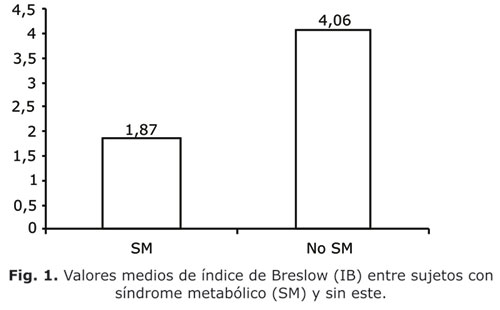
<body><![CDATA[<P>&nbsp;    <P>     <P><FONT FACE="Verdana, Arial, Helvetica, sans-serif" SIZE="2"><B><FONT SIZE="3">RESULTADOS</FONT></B>  </FONT>    <P><FONT FACE="Verdana, Arial, Helvetica, sans-serif" SIZE="2">De los 123  sujetos estudiados, 16 cumpl&iacute;an los criterios diagn&oacute;sticos del ATP  III para el SM, lo cual constituye el 13 % de la poblaci&oacute;n analizada. </FONT>    <P><FONT FACE="Verdana, Arial, Helvetica, sans-serif" SIZE="2">Cuando  se comparan ambos grupos, es decir, pacientes con SM y sin este (<A HREF="#fig1">Fig.  1</A>), se observa que el valor medio del IB fue muy inferior en el primero (1,87,  desviaci&oacute;n est&aacute;ndar [DE]: 0,65) que en el segundo (4,06; DE: 1,07),  con diferencia significativa.</FONT>    <P ALIGN="CENTER"><A NAME="fig1"></A><A HREF="#fig1"><IMG SRC="/img/revistas/mil/v39n1/f0103110.jpg" WIDTH="500" HEIGHT="310" BORDER="0"></A>    
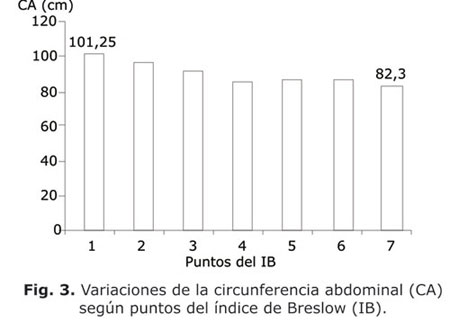
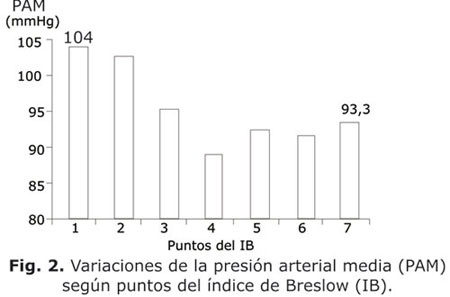
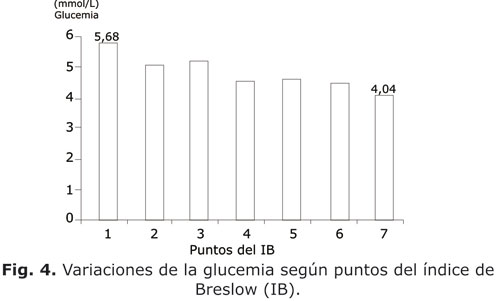
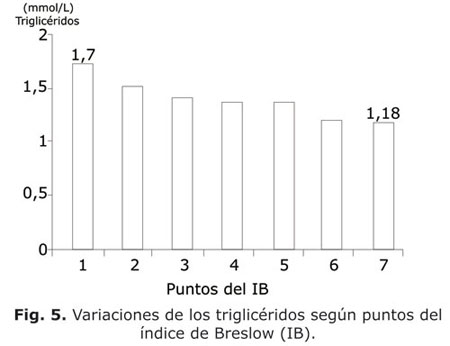
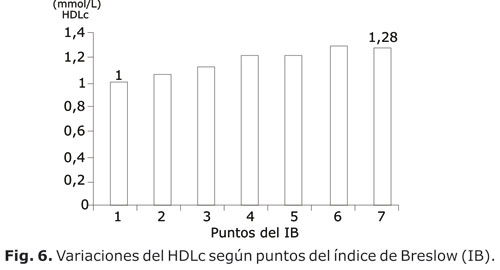
<P><FONT FACE="Verdana, Arial, Helvetica, sans-serif" SIZE="2">    <BR>En  las <A HREF="#fig2">figuras 2</A>, <A HREF="#fig3">3</A>, <A HREF="#fig4">4</A>,  <A HREF="#fig5">5</A> y <A HREF="#fig6">6</A> se presenta el comportamiento de  las medias de las variables que constituyen criterios diagn&oacute;sticos del  SM en su relaci&oacute;n con el puntaje del IB entre todos los sujetos estudiados.  En todas las figuras es evidente como las medias de las variables del SM (tensi&oacute;n  arterial, circunferencia abdominal, glucemia, triglic&eacute;ridos y HDLc) variaban  en la medida que el puntaje alcanzado en el IB aumentaba de 1 a 7 puntos. En todos  los casos ocurri&oacute; una tendencia a la disminuci&oacute;n de estas medias,  excepto con el HDLc en que hubo un incremento. Al comparar las medias entre el  grupo con puntaje 1 y el grupo con puntaje 7, hubo siempre diferencias significativas  (p&lt; 0,05).</FONT>    <P ALIGN="CENTER"><A NAME="fig2"></A><A HREF="#fig2"><IMG SRC="/img/revistas/mil/v39n1/f0203110.jpg" WIDTH="500" HEIGHT="330" BORDER="0"></A>    
<P ALIGN="CENTER">    ]]></body>
<body><![CDATA[<BR><A NAME="fig3"></A><A HREF="#fig3"><IMG SRC="/img/revistas/mil/v39n1/f0303110.jpg" WIDTH="500" HEIGHT="358" BORDER="0"></A>    
<P ALIGN="CENTER">    <BR><A NAME="fig4"></A><A HREF="#fig4"><IMG SRC="/img/revistas/mil/v39n1/f0403110.jpg" WIDTH="500" HEIGHT="301" BORDER="0"></A>    
<P ALIGN="CENTER">    <BR>    <P ALIGN="CENTER"><A NAME="fig5"></A><A HREF="#fig5"><IMG SRC="/img/revistas/mil/v39n1/f0503110.jpg" WIDTH="500" HEIGHT="384" BORDER="0"></A>    
<P ALIGN="CENTER"><A NAME="fig6"></A><A HREF="#fig6"><IMG SRC="/img/revistas/mil/v39n1/f0603110.jpg" WIDTH="500" HEIGHT="270" BORDER="0"></A>    
<P ALIGN="LEFT">&nbsp;    <P ALIGN="LEFT"><FONT FACE="Verdana, Arial, Helvetica, sans-serif" SIZE="2"><B><FONT SIZE="3">DISCUSI&Oacute;N</FONT></B>  </FONT>    <P><FONT FACE="Verdana, Arial, Helvetica, sans-serif" SIZE="2">En los resultados  presentados se han tratado de relacionar los h&aacute;bitos y estilos de vida  con el SM en su conjunto y con los criterios diagn&oacute;sticos que lo constituyen.  Para este fin se utiliz&oacute; el IB, un sistema de preguntas sencillas que tratan  de evaluar diversos aspectos relacionados con h&aacute;bitos y estilos de vida  que tienen que ver con el riesgo vascular. Este &iacute;ndice, validado desde  hace m&aacute;s de 30 a&ntilde;os de edad<SUP>14</SUP> se caracteriza por su sencillez  y demostrada utilidad en los problemas de salud de que se ocupa este trabajo.<SUP>15</SUP>  </FONT>    ]]></body>
<body><![CDATA[<P><FONT FACE="Verdana, Arial, Helvetica, sans-serif" SIZE="2">La poblaci&oacute;n  estudiada de oficiales present&oacute; una prevalencia del SM de 13 %. Aunque  no se pretende establecer tasas de prevalencia del SM en este estudio, ya que  la poblaci&oacute;n analizada no lo permite, la cifra obtenida es semejante pero  ligeramente superior a la reportada en una investigaci&oacute;n m&aacute;s amplia  efectuada por uno de los autores de este trabajo, tambi&eacute;n en una poblaci&oacute;n  militar, quien encontr&oacute; un 10,4 %. Cifra semejante se obtuvo en una investigaci&oacute;n  en una poblaci&oacute;n civil laboralmente activa<SUP>16</SUP> y en personal militar.<SUP>17</SUP>  </FONT>    <P><FONT FACE="Verdana, Arial, Helvetica, sans-serif" SIZE="2">Estos porcentajes  pueden parecer muy inferiores a los reportados en la literatura internacional,<SUP>18-20</SUP>  pero se explican por proceder en este caso de una poblaci&oacute;n laboralmente  activa, con l&iacute;mites de edades estrechos y porque las consecuencias del  SM (cardiopat&iacute;a isqu&eacute;mica, enfermedad cerebrovascular, diabetes  mellitus, etc.) constituyen muchas veces causa de bajas m&eacute;dicas entre los  oficiales. </FONT>    <P><FONT FACE="Verdana, Arial, Helvetica, sans-serif" SIZE="2">En  la figura 1 se hace evidente que entre los sujetos con diagn&oacute;stico de SM  se reportan los peores h&aacute;bitos y estilos de vida, con diferencias significativas  de los valores medios de puntos de IB entre ambos grupos (con SM o sin este).  Esta figura destaca la importancia de los h&aacute;bitos y estilos de vida saludables  en la g&eacute;nesis del SM, lo cual ha sido reiteradamente se&ntilde;alado en  otros estudios.<SUP>9-11</SUP> </FONT>    <P><FONT FACE="Verdana, Arial, Helvetica, sans-serif" SIZE="2">Tal  an&aacute;lisis se refuerza en las figuras 2, 3, 4, 5 y 6, en las cuales se individualizan  las diferentes variables que constituyen el SM. </FONT>    <P><FONT FACE="Verdana, Arial, Helvetica, sans-serif" SIZE="2">La  figura 2 permite asociar los h&aacute;bitos y estilos de vida no saludables con  un deterioro de las cifras de tensi&oacute;n arterial medias y resalta la importancia  de mejorar los primeros como terap&eacute;utica no medicamentosa en el control  de la hipertensi&oacute;n arterial, lo cual es indicado en todas las gu&iacute;as  de hipertensi&oacute;n y se&ntilde;alado reiteradamente por diversos autores<SUP>21,22</SUP>  con respecto, principalmente a los h&aacute;bitos diet&eacute;ticos y la actividad  f&iacute;sica. </FONT>    <P><FONT FACE="Verdana, Arial, Helvetica, sans-serif" SIZE="2">La  figura 3 muestra un hecho importante: el v&iacute;nculo innegable entre los estilos  de vida y la grasa corporal. Si se reconoce, como han hecho muchos,<SUP>23-25</SUP>  la funci&oacute;n del tejido adiposo en la serie de acontecimientos que llevan  a la insulinorresistencia, al estado inflamatorio y protromb&oacute;tico cr&oacute;nicos  que constituyen el SM, entonces no hay duda que el estilo de vida es un determinante  de primer orden en el desarrollo del s&iacute;ndrome. </FONT>    <P><FONT FACE="Verdana, Arial, Helvetica, sans-serif" SIZE="2">La  glucemia fue otra variable que se asoci&oacute; al estilo de vida, aunque movi&eacute;ndose  siempre en valores medios normales. La glucemia es una variable poco confiable  para detectar el trastorno subyacente en estos sujetos, ya que la hiperinsulinemia  compensadora logra mantener un equilibrio en el metabolismo gluc&iacute;dico hasta  etapas m&aacute;s avanzadas. La poblaci&oacute;n estudiada ten&iacute;a una edad  media de 34 a&ntilde;os (dato no presentado), es decir, la reserva pancre&aacute;tica  para vencer la insulinorresistencia estaba a&uacute;n intacta. De todas maneras,  desde etapas tempranas ya comienzan a existir indicios de un deterioro del metabolismo  gluc&iacute;dico que llevar&aacute;, inexorablemente, a la diabetes mellitus de  no corregirse a tiempo los h&aacute;bitos y estilos de vida nocivos para el funcionamiento  endocrino del p&aacute;ncreas. </FONT>    <P><FONT FACE="Verdana, Arial, Helvetica, sans-serif" SIZE="2">Los  triglic&eacute;ridos se movieron tambi&eacute;n acorde con el estilo de vida.  Esto es otro hallazgo coherente con los mecanismos fisiopatol&oacute;gicos invocados  en el SM muy relacionados con la acumulaci&oacute;n central de la grasa y la insulinorresistencia.  El sedentarismo y los malos h&aacute;bitos diet&eacute;ticos, medidos a trav&eacute;s  del IB permiten la acumulaci&oacute;n de grasa visceral, la cual provoca un aflujo  aumentado de &aacute;cidos grasos al h&iacute;gado, con el consiguiente incremento  de la s&iacute;ntesis hep&aacute;tica de VLDL ricas en triglic&eacute;ridos.<SUP>26</SUP>  La insulinorresistencia puede favorecer esta hiperproducci&oacute;n de triglic&eacute;ridos,  ya que se conoce que en condiciones fisiol&oacute;gicas, la insulina inhibe la  s&iacute;ntesis de VLDL<SUP>27</SUP> al degradar a las apo B.<SUP>28</SUP> Adem&aacute;s,  la insulinorresistencia disminuye la concentraci&oacute;n de la lipoprote&iacute;nlipasa  del tejido adiposo y muscular, impidiendo el aclaramiento de los triglic&eacute;ridos  de la circulaci&oacute;n.<SUP>29</SUP> Por tanto, la hipertrigliceridemia es un  buen marcador de resistencia a la insulina y uno de los criterios importantes  para el diagn&oacute;stico del SM.<SUP>30</SUP> </FONT>    <P><FONT FACE="Verdana, Arial, Helvetica, sans-serif" SIZE="2">Las  HDL muestran la progresi&oacute;n inversa esperada, es decir, a medida que mejoran  los estilos de vida hay un incremento en sus valores, reforzando la funci&oacute;n  protectora de un estilo de vida sano. La funci&oacute;n protectora de las HDL  ha sido reiteradamente se&ntilde;alada. En el SM se halla una disminuci&oacute;n  de los niveles de HDL. En presencia de hipertrigliceridemia, las HDL disminuyen  su contenido en &eacute;steres de colesterol e incrementan su concentraci&oacute;n  de triglic&eacute;ridos, lo que las hace m&aacute;s peque&ntilde;as y densas.  Estos cambios en su composici&oacute;n facilitan que sean retiradas de la circulaci&oacute;n,  disminuyendo sus niveles.<SUP>31,32</SUP> </FONT>    <P><FONT FACE="Verdana, Arial, Helvetica, sans-serif" SIZE="2">En  la asociaci&oacute;n de causalidad entre los h&aacute;bitos y estilos de vida  y el SM puede inferirse que la expresividad cl&iacute;nica del SM y el riesgo  vascular (definidos a trav&eacute;s del n&uacute;mero de criterios diagn&oacute;sticos  que se agrupan en un individuo) se incrementan en la medida que se deterioran  los estilos de vida. </FONT>    ]]></body>
<body><![CDATA[<P><FONT FACE="Verdana, Arial, Helvetica, sans-serif" SIZE="2">Este  estudio presenta algunas limitaciones en su concepci&oacute;n. La ventaja que  se le se&ntilde;al&oacute; al IB (su sencillez) constituye, a su vez, su principal  debilidad ya que puede dudarse que un sistema constituido por solo 7 preguntas  que admiten solamente respuestas categ&oacute;ricas (s&iacute; o no) mida con  precisi&oacute;n algo tan complejo y multidimensional como los estilos de vida  saludables. En segundo lugar, hay preguntas que pueden parecer algo ambiguas,  por ejemplo, &quot;comer entre comidas&quot;, se refiere a la ingesti&oacute;n  desordenada de alimentos sin horarios establecidos o pude incluir las meriendas  que, en realidad, son recomendadas en los regimenes diet&eacute;ticos saludables.  </FONT>    <P><FONT FACE="Verdana, Arial, Helvetica, sans-serif" SIZE="2">Sin embargo,  los resultados obtenidos son muy coherentes con lo esperado de acuerdo con el  estado del conocimiento alrededor del objeto de estudio y permiten concluir que  existe asociaci&oacute;n entre los h&aacute;bitos y estilos de vida y la presencia  del SM en general y de cada una de sus variables constituyentes, con una evidente  relaci&oacute;n &quot;dosis-respuesta&quot; entre ambos.</FONT>    <P>&nbsp;    <P><FONT FACE="Verdana, Arial, Helvetica, sans-serif" SIZE="2"><B>Anexo  1.</B> Criterios diagn&oacute;sticos de s&iacute;ndrome metab&oacute;lico seg&uacute;n  el Adult Treatment Panel III (ATP III)</FONT>    <BLOCKQUOTE>    <P><FONT FACE="Verdana, Arial, Helvetica, sans-serif" SIZE="2">1.  Circunferencia abdominal: &gt; 102 cm (hombres), &gt; 88 cm (mujeres)</FONT></P>    <P><FONT FACE="Verdana, Arial, Helvetica, sans-serif" SIZE="2">2.  Presi&oacute;n arterial: &gt; 130/ 85 mmHg.</FONT></P>    <P><FONT FACE="Verdana, Arial, Helvetica, sans-serif" SIZE="2">3.  Glucemia: &gt; 6,0 mml/L</FONT></P>    <P><FONT FACE="Verdana, Arial, Helvetica, sans-serif" SIZE="2">4.  Triglic&eacute;ridos: &gt; 1,7 mmol/L</FONT></P>    <P><FONT FACE="Verdana, Arial, Helvetica, sans-serif" SIZE="2">5.  HDL: &lt; 1,0 mmol/L (hombres), &lt; 1,3 mmol/L (mujeres)</FONT></P></BLOCKQUOTE>    ]]></body>
<body><![CDATA[<P><FONT FACE="Verdana, Arial, Helvetica, sans-serif" SIZE="2">    <BR>(El  diagn&oacute;stico se establece con 3 o m&aacute;s criterios).</FONT>    <P>&nbsp;    <P><FONT FACE="Verdana, Arial, Helvetica, sans-serif" SIZE="2"><B>Anexo  2.</B> &Iacute;ndice de Breslow</FONT>    <BLOCKQUOTE>    <P><FONT FACE="Verdana, Arial, Helvetica, sans-serif" SIZE="2">1.  &iquest;Ud. desayuna casi todos los d&iacute;as?</FONT></P>    <P><FONT FACE="Verdana, Arial, Helvetica, sans-serif" SIZE="2">2.  &iquest;Ud. participa en actividades deportivas al menos 3 veces por semana?</FONT></P>    <P><FONT FACE="Verdana, Arial, Helvetica, sans-serif" SIZE="2">3.  &iquest;Ud. duerme de 7 a 8 h casi todos los d&iacute;as?</FONT></P>    <P><FONT FACE="Verdana, Arial, Helvetica, sans-serif" SIZE="2">4.  &iquest;Ud. toma bebidas alcoh&oacute;licas en cantidades menores de 8 oz. a la  semana?</FONT></P>    <P><FONT FACE="Verdana, Arial, Helvetica, sans-serif" SIZE="2">5.  &iquest;Ud. evita comer entre comidas?</FONT></P>    ]]></body>
<body><![CDATA[<P><FONT FACE="Verdana, Arial, Helvetica, sans-serif" SIZE="2">6.  &iquest;Ud. evita fumar?</FONT></P>    <P><FONT FACE="Verdana, Arial, Helvetica, sans-serif" SIZE="2">7.  &iquest;Ud. mantiene su peso corporal controlado?</FONT></P></BLOCKQUOTE>    <P><FONT FACE="Verdana, Arial, Helvetica, sans-serif" SIZE="2">    <BR>Se  obtiene un punto por cada respuesta afirmativa (s&iacute;) y cero punto por cada  respuesta negativa (no). La pregunta 6 significa &quot;fuma o no fuma&quot;. La  pregunta 7 se responde de acuerdo con el &iacute;ndice de masa corporal: &quot;s&iacute;&quot;:  IMC&lt; 25 kg/m2; &quot;no&quot;: IMC= 25 kg/m2.</FONT></P>    <P>&nbsp;</P>    <P><FONT FACE="Verdana, Arial, Helvetica, sans-serif" SIZE="2"><B><FONT SIZE="3">REFERENCIAS  BIBLIOGR&Aacute;FICAS</FONT></B> </FONT></P>    <!-- ref --><P><FONT FACE="Verdana, Arial, Helvetica, sans-serif" SIZE="2">1.  de la LLera Su&aacute;rez E. Modo y estilo de vida. En: Alvarez Sintes R. Temas  de Medicina General Integral. Vol I. Salud y Medicina. La Habana: Ed. Ciencias  M&eacute;dicas; 2001. p. 39-41. </FONT>    <!-- ref --><P><FONT FACE="Verdana, Arial, Helvetica, sans-serif" SIZE="2">2.  Yazaki Y, Kadowaki T. Combating diabetes and obesity in Japan. Nature<I> </I>Med.<I>  </I>2006;12:73-4. </FONT>    <!-- ref --><P><FONT FACE="Verdana, Arial, Helvetica, sans-serif" SIZE="2">3.  Mart&iacute;nez Calatrava M, Mart&iacute;nez Larrat MT, Serrano R&iacute;os M.  S&iacute;ndrome de resistencia a la insulina y s&iacute;ndrome metab&oacute;lico:  similitudes y diferencias. S&iacute;ndrome metab&oacute;lico: concepto, fisiopatolog&iacute;a  y epidemiolog&iacute;a. Cardiovascular Risk Factors. 2003;12(2):89-95. </FONT>    <!-- ref --><P><FONT FACE="Verdana, Arial, Helvetica, sans-serif" SIZE="2">4.  Helmrich SP, Ragland DR, Leung, RW. Physical activity and reduced occurrence of  non-insulin-dependent diabetes mellitus. N Engl J Med.<I> </I>1991;325:147-52.  Available from: <U><FONT  COLOR="#0000ff"><A HREF="http://content.nejm.org/cgi/content/abstract/325/3/147" TARGET="_blank">http://content.nejm.org/cgi/content/abstract/325/3/147</A></FONT></U>  </FONT>    <!-- ref --><P><FONT FACE="Verdana, Arial, Helvetica, sans-serif" SIZE="2">5. Hu FB,  Leitzmann MF, Stampfer MJ. Physical activity and television watching in relation  to risk for type 2 diabetes mellitus in men. Arch Intern Med.<I> </I>2001;161:1542-8.  Available from: <U><FONT  COLOR="#0000ff"><A HREF="http://archinte.ama-assn.org/cgi/content/abstract/161/12/1542" TARGET="_blank">http://archinte.ama-assn.org/cgi/content/abstract/161/12/1542</A></FONT></U>  </FONT>    <!-- ref --><P><FONT FACE="Verdana, Arial, Helvetica, sans-serif" SIZE="2">6. Manson  JE, Nathan DM, Krolewski AS. A prospective study of exercise and incidence of  diabetes among US male physicians. JAMA<I>. </I>1992;268:63-7. Available from:  <U><FONT  COLOR="#0000ff"><A HREF="http://jama.ama-assn.org/cgi/content/abstract/268/1/63" TARGET="_blank">http://jama.ama-assn.org/cgi/content/abstract/268/1/63</A></FONT></U>  </FONT>    <!-- ref --><P><FONT FACE="Verdana, Arial, Helvetica, sans-serif" SIZE="2">7. Laaksonen  DE, Lakka HM, Salonen JT. Low levels of leisure-time physical activity and cardiorespiratory  fitness predict development of the metabolic syndrome. Diabetes Care.<I> </I>2002;25:1612-8.  Available from: <U><FONT  COLOR="#0000ff"><A HREF="http://care.diabetesjournals.org/content/25/9/1612.full" TARGET="_blank">http://care.diabetesjournals.org/content/25/9/1612.full</A></FONT></U>  </FONT>    <!-- ref --><P><FONT FACE="Verdana, Arial, Helvetica, sans-serif" SIZE="2">8. Graff-Iversen  S, Skurtveit S, Nybo A, Ross GB. Trends when it comes to occupational physical  activity among Norwegians aged 40.42 years during the period 1974-94. Tidsskr  Nor Laegeforen.<I> </I>2001;121:2584-8. </FONT>    <!-- ref --><P><FONT FACE="Verdana, Arial, Helvetica, sans-serif" SIZE="2">9.  Ekelund U, Brage S, Froberg K.<B> </B>TV Viewing and Physical Activity Are Independently  Associated with Metabolic Risk in Children: The European Youth Heart Study. PLoS  Med. 2006;3(12):e488. </FONT>    <!-- ref --><P><FONT FACE="Verdana, Arial, Helvetica, sans-serif" SIZE="2">10.  Pei-Chia Chang, Tsai-Chung Li, Ming-Tsang Wu. Association between television viewing  and the risk of metabolic syndrome in a community-based population BMC Public  Health. 2008;8:93. </FONT>    <!-- ref --><P><FONT FACE="Verdana, Arial, Helvetica, sans-serif" SIZE="2">11.  Marshall, SJ; Biddle, SJ; Gorely T. Relationships between media use, body fatness  and physical activity in children and youth: A meta-analysis. Int J Obes Relat  Metab Disord<I>. </I>2004;28:1238-46. </FONT>    <!-- ref --><P><FONT FACE="Verdana, Arial, Helvetica, sans-serif" SIZE="2">12.  Hancox RJ, Milne BJ, Poulton R. Association between child and adolescent television  viewing and adult health: A longitudinal birth cohort study. Lancet<I>. </I>2004;364:257-62.  </FONT>    <!-- ref --><P><FONT FACE="Verdana, Arial, Helvetica, sans-serif" SIZE="2">13. Berkey  CS, Rockett HR, Gillman MW, Colditz GA. One-year changes in activity and in inactivity  among 10- to 15-year-old boys and girls: Relationship to change in body mass index.  Pediatrics<I>. </I>2003;111:836-43. </FONT>    <!-- ref --><P><FONT FACE="Verdana, Arial, Helvetica, sans-serif" SIZE="2">14.  Belloc NB, Brewlow I. Relationship of physical health status and health practices.  Prev Med. 1972;1:409-21. </FONT>    <!-- ref --><P><FONT FACE="Verdana, Arial, Helvetica, sans-serif" SIZE="2">15.  Yokohama H, Hirose H, Ohgo H. Associations among lifestyle status, serum adiponectin  and insulin resistance. Internal Medicine. 2004;43(6):453-7.</FONT>    <!-- ref --><P><FONT FACE="Verdana, Arial, Helvetica, sans-serif" SIZE="2">16.  del R&iacute;o A, Ferreira IJ, Casanovas JA. Temas de actualidad en Cardiolog&iacute;a  preventiva: el s&iacute;ndrome metab&oacute;lico. Rev Esp Cardiol. 2005;5:13-23.  </FONT>    <!-- ref --><P><FONT FACE="Verdana, Arial, Helvetica, sans-serif" SIZE="2">17. Banduceau  B, Gaigts F, Bordier L. Epidemiology of the metabolic syndrome in 2045 French  Military personnel (EPIMIL study). Diabetes Metab. 2005;31:353-9. </FONT>    <!-- ref --><P><FONT FACE="Verdana, Arial, Helvetica, sans-serif" SIZE="2">18.  Ford ES, Giles WH, Mokdad AH. Increasing prevalence of the metabolic syndrome  among US adults. Diabetes Care. 2004;27:2444-9. </FONT>    <!-- ref --><P><FONT FACE="Verdana, Arial, Helvetica, sans-serif" SIZE="2">19.  Rielly MP, Rider DJ. The metabolic syndrome: more than the sum of its parts? Circulation.  2003;108:1546-51. </FONT>    <!-- ref --><P><FONT FACE="Verdana, Arial, Helvetica, sans-serif" SIZE="2">20.  Balkau BJ, Vernay M, Mhamdi L. The frequency and incidence of the NCEP metabolic  syndrome in the French DESIR study. The European Association for the Study of  Diabetes. Abstract Volume of 38<SUP>th</SUP> Annual Meeting 2002;A15:37. </FONT>    <!-- ref --><P><FONT FACE="Verdana, Arial, Helvetica, sans-serif" SIZE="2">21.  Apple L, Brands M, Daniels S, et al. Approaches to prevent and treat hypertension:  A scientific statement from the American Heart Association. Hypertension. 2006;47:296-308.  </FONT>    <!-- ref --><P><FONT FACE="Verdana, Arial, Helvetica, sans-serif" SIZE="2">22. Sarma  S, Schulze P. Exercise as a physiologic intervention to counteract hypertension:  Can a good idea go bad? Hypertension. 2007;50:294-6. </FONT>    <!-- ref --><P><FONT FACE="Verdana, Arial, Helvetica, sans-serif" SIZE="2">23.  Grundy SM. What is the contribution of obesity to the metabolic syndrome? Endocrinol  Metab Clin North Am. 2004;33:267-82. </FONT>    <!-- ref --><P><FONT FACE="Verdana, Arial, Helvetica, sans-serif" SIZE="2">24.  Nakamura H, Ito H, Egam Y et al. Waist circumference is the main determinant of  elevated C-reactive protein in metabolic syndrome. Diabetes Res Clin Pract. 2008;79:330-6.  </FONT>    <!-- ref --><P><FONT FACE="Verdana, Arial, Helvetica, sans-serif" SIZE="2">25. Goodpaster  BH, Krishanaswami S, Harris TB. Obesity, regional body fat distribution, and the  metabolic syndrome in older men and women<I> </I>Arch Intern Med<I>.</I>&#160;2005;165:777-83.  </FONT>    <!-- ref --><P><FONT FACE="Verdana, Arial, Helvetica, sans-serif" SIZE="2">26. Lewis  GF, Uffelman KD, Szeto LW, et al. Interaction between free fatty acids and insulin  in the acute control of very low density lipoprotein production in humans. J Clin  Invest. 1995;95:158-66. </FONT>    <!-- ref --><P><FONT FACE="Verdana, Arial, Helvetica, sans-serif" SIZE="2">27.  Lewis GF, Steiner G. Acute effects of insulin in the control of state. Diabetes  Care. 1996;19:390-3. </FONT>    <!-- ref --><P><FONT FACE="Verdana, Arial, Helvetica, sans-serif" SIZE="2">28.  Taghibiglou C, Rashid-Kolvear F, Van Iderstine SC. Hepatic very low density lipoprotein-ApoB  overproduction is associated with attenuated hepatic insulin signaling and overexpression  of protein-tyrosine phosphatase 1B in a fructosefed hamster model of insulin resistance.  J Biol Chem. 2002;277:793-803. </FONT>    <!-- ref --><P><FONT FACE="Verdana, Arial, Helvetica, sans-serif" SIZE="2">29.  Eckel RH, Yost TJ, Jensen DR. Alterations in lipoprotein lipase in insulin resistance.  Int J Obes Relat Metab Disrod. 1995;19:S16-S21. </FONT>    <!-- ref --><P><FONT FACE="Verdana, Arial, Helvetica, sans-serif" SIZE="2">30.  Eckel RH, Grundy SM, Zimmet PZ. The metabolic syndrome. Lancet. 2005;365:1415-28.  </FONT>    <!-- ref --><P><FONT FACE="Verdana, Arial, Helvetica, sans-serif" SIZE="2">31. Murakami  T, Michelagnoli S, Longhi R. Triglycerides are major determinants of cholesterol  esterification/transfer and HDL remodeling in human plasma. Arterioscler Trhomb  Vasc Biol. 1995;15:1819-28. </FONT>    <!-- ref --><P><FONT FACE="Verdana, Arial, Helvetica, sans-serif" SIZE="2">32.  Brinton EA, Eisenberg S, Breslow JL. Increased apo A-I and apo A-II lipoprotein-cholesterol  levels with or without hypertriglyceridemia. J Clin Invest. 1991;87:536-44.</FONT>    <P>&nbsp;    <P>&nbsp;    ]]></body>
<body><![CDATA[<P>      <P>     <P><FONT FACE="Verdana, Arial, Helvetica, sans-serif" SIZE="2">Recibido: 22  de octubre de 2009.    <BR></FONT><FONT FACE="Verdana, Arial, Helvetica, sans-serif" SIZE="2">Aprobado:  26 de noviembre de 2009.</FONT>    <P>&nbsp;    <P>&nbsp;    <P>     <P>     <P><FONT FACE="Verdana, Arial, Helvetica, sans-serif" SIZE="2">Tte.  Cor. <I>Tom&aacute;s Ariel Lombardo Vaillant</I>. Instituto Superior de Medicina  Militar &quot;Dr. Luis D&iacute;az Soto&quot;. Ave Monumental y Carretera de Asilo.  Habana del Este. La Habana, Cuba. Correo electr&oacute;nico: <U><FONT COLOR="#0000ff"><A HREF="mailto:tomariel@infomed.sld.cu">tomariel@infomed.sld.cu</A></FONT></U>  </FONT>       ]]></body><back>
<ref-list>
<ref id="B1">
<label>1</label><nlm-citation citation-type="book">
<person-group person-group-type="author">
<name>
<surname><![CDATA[de la LLera Suárez]]></surname>
<given-names><![CDATA[E]]></given-names>
</name>
</person-group>
<article-title xml:lang="es"><![CDATA[Modo y estilo de vida]]></article-title>
<person-group person-group-type="editor">
<name>
<surname><![CDATA[Alvarez Sintes]]></surname>
<given-names><![CDATA[R]]></given-names>
</name>
</person-group>
<source><![CDATA[Temas de Medicina General Integral]]></source>
<year>2001</year>
<page-range>39-41</page-range><publisher-loc><![CDATA[La Habana ]]></publisher-loc>
<publisher-name><![CDATA[Ciencias Médicas]]></publisher-name>
</nlm-citation>
</ref>
<ref id="B2">
<label>2</label><nlm-citation citation-type="journal">
<person-group person-group-type="author">
<name>
<surname><![CDATA[Yazaki]]></surname>
<given-names><![CDATA[Y]]></given-names>
</name>
<name>
<surname><![CDATA[Kadowaki]]></surname>
<given-names><![CDATA[T]]></given-names>
</name>
</person-group>
<article-title xml:lang="en"><![CDATA[Combating diabetes and obesity in Japan]]></article-title>
<source><![CDATA[Nature Med.]]></source>
<year>2006</year>
<volume>12</volume>
<page-range>73-4</page-range></nlm-citation>
</ref>
<ref id="B3">
<label>3</label><nlm-citation citation-type="journal">
<person-group person-group-type="author">
<name>
<surname><![CDATA[Martínez Calatrava]]></surname>
<given-names><![CDATA[M]]></given-names>
</name>
<name>
<surname><![CDATA[Martínez Larrat]]></surname>
<given-names><![CDATA[MT]]></given-names>
</name>
<name>
<surname><![CDATA[Serrano Ríos]]></surname>
<given-names><![CDATA[M]]></given-names>
</name>
</person-group>
<article-title xml:lang="es"><![CDATA[Síndrome de resistencia a la insulina y síndrome metabólico: similitudes y diferencias. Síndrome metabólico: concepto, fisiopatología y epidemiología]]></article-title>
<source><![CDATA[Cardiovascular Risk Factors.]]></source>
<year>2003</year>
<volume>12</volume>
<numero>2</numero>
<issue>2</issue>
<page-range>89-95</page-range></nlm-citation>
</ref>
<ref id="B4">
<label>4</label><nlm-citation citation-type="journal">
<person-group person-group-type="author">
<name>
<surname><![CDATA[Helmrich]]></surname>
<given-names><![CDATA[SP]]></given-names>
</name>
<name>
<surname><![CDATA[Ragland]]></surname>
<given-names><![CDATA[DR]]></given-names>
</name>
<name>
<surname><![CDATA[Leung]]></surname>
<given-names><![CDATA[RW]]></given-names>
</name>
</person-group>
<article-title xml:lang="en"><![CDATA[Physical activity and reduced occurrence of non-insulin-dependent diabetes mellitus]]></article-title>
<source><![CDATA[N Engl J Med]]></source>
<year>1991</year>
<volume>325</volume>
<page-range>147-52</page-range></nlm-citation>
</ref>
<ref id="B5">
<label>5</label><nlm-citation citation-type="journal">
<person-group person-group-type="author">
<name>
<surname><![CDATA[Hu]]></surname>
<given-names><![CDATA[FB]]></given-names>
</name>
<name>
<surname><![CDATA[Leitzmann]]></surname>
<given-names><![CDATA[MF]]></given-names>
</name>
<name>
<surname><![CDATA[Stampfer]]></surname>
<given-names><![CDATA[MJ]]></given-names>
</name>
</person-group>
<article-title xml:lang="en"><![CDATA[Physical activity and television watching in relation to risk for type 2 diabetes mellitus in men]]></article-title>
<source><![CDATA[Arch Intern Med]]></source>
<year>2001</year>
<volume>161</volume>
<page-range>1542-8</page-range></nlm-citation>
</ref>
<ref id="B6">
<label>6</label><nlm-citation citation-type="journal">
<person-group person-group-type="author">
<name>
<surname><![CDATA[Manson]]></surname>
<given-names><![CDATA[JE]]></given-names>
</name>
<name>
<surname><![CDATA[Nathan]]></surname>
<given-names><![CDATA[DM]]></given-names>
</name>
<name>
<surname><![CDATA[Krolewski]]></surname>
<given-names><![CDATA[AS]]></given-names>
</name>
</person-group>
<article-title xml:lang="en"><![CDATA[A prospective study of exercise and incidence of diabetes among US male physicians]]></article-title>
<source><![CDATA[JAMA]]></source>
<year>1992</year>
<volume>268</volume>
<page-range>63-7</page-range></nlm-citation>
</ref>
<ref id="B7">
<label>7</label><nlm-citation citation-type="journal">
<person-group person-group-type="author">
<name>
<surname><![CDATA[Laaksonen]]></surname>
<given-names><![CDATA[DE]]></given-names>
</name>
<name>
<surname><![CDATA[Lakka]]></surname>
<given-names><![CDATA[HM]]></given-names>
</name>
<name>
<surname><![CDATA[Salonen]]></surname>
<given-names><![CDATA[JT]]></given-names>
</name>
</person-group>
<article-title xml:lang="en"><![CDATA[Low levels of leisure-time physical activity and cardiorespiratory fitness predict development of the metabolic syndrome]]></article-title>
<source><![CDATA[Diabetes Care]]></source>
<year>2002</year>
<volume>25</volume>
<page-range>1612-8</page-range></nlm-citation>
</ref>
<ref id="B8">
<nlm-citation citation-type="journal">
<person-group person-group-type="author">
<name>
<surname><![CDATA[.Graff-Iversen]]></surname>
<given-names><![CDATA[S]]></given-names>
</name>
<name>
<surname><![CDATA[Skurtveit]]></surname>
<given-names><![CDATA[S]]></given-names>
</name>
<name>
<surname><![CDATA[Nybo]]></surname>
<given-names><![CDATA[A]]></given-names>
</name>
<name>
<surname><![CDATA[Ross]]></surname>
<given-names><![CDATA[GB]]></given-names>
</name>
</person-group>
<article-title xml:lang="en"><![CDATA[Trends when it comes to occupational physical activity among Norwegians aged 40: 42 years during the period 1974-94]]></article-title>
<source><![CDATA[Tidsskr Nor Laegeforen.]]></source>
<year>2001</year>
<volume>121</volume>
<page-range>2584-8</page-range></nlm-citation>
</ref>
<ref id="B9">
<label>9</label><nlm-citation citation-type="journal">
<person-group person-group-type="author">
<name>
<surname><![CDATA[Ekelund]]></surname>
<given-names><![CDATA[U]]></given-names>
</name>
<name>
<surname><![CDATA[Brage]]></surname>
<given-names><![CDATA[S]]></given-names>
</name>
<name>
<surname><![CDATA[Froberg]]></surname>
<given-names><![CDATA[K]]></given-names>
</name>
</person-group>
<article-title xml:lang="en"><![CDATA[TV Viewing and Physical Activity Are Independently Associated with Metabolic Risk in Children: The European Youth Heart Study]]></article-title>
<source><![CDATA[PLoS Med.]]></source>
<year>2006</year>
<volume>3</volume>
<numero>12</numero>
<issue>12</issue>
<page-range>e488</page-range></nlm-citation>
</ref>
<ref id="B10">
<label>10</label><nlm-citation citation-type="journal">
<person-group person-group-type="author">
<name>
<surname><![CDATA[Pei-Chia]]></surname>
<given-names><![CDATA[Chang]]></given-names>
</name>
<name>
<surname><![CDATA[Tsai-Chung]]></surname>
<given-names><![CDATA[Li]]></given-names>
</name>
<name>
<surname><![CDATA[Ming-Tsang]]></surname>
<given-names><![CDATA[Wu]]></given-names>
</name>
</person-group>
<article-title xml:lang="en"><![CDATA[Association between television viewing and the risk of metabolic syndrome in a community-based population]]></article-title>
<source><![CDATA[BMC Public Health.]]></source>
<year>2008</year>
<volume>8</volume>
<page-range>93</page-range></nlm-citation>
</ref>
<ref id="B11">
<label>11</label><nlm-citation citation-type="journal">
<person-group person-group-type="author">
<name>
<surname><![CDATA[Marshall]]></surname>
<given-names><![CDATA[SJ]]></given-names>
</name>
<name>
<surname><![CDATA[Biddle]]></surname>
<given-names><![CDATA[SJ]]></given-names>
</name>
<name>
<surname><![CDATA[Gorely]]></surname>
<given-names><![CDATA[T]]></given-names>
</name>
</person-group>
<article-title xml:lang="en"><![CDATA[Relationships between media use, body fatness and physical activity in children and youth: A meta-analysis]]></article-title>
<source><![CDATA[Int J Obes Relat Metab Disord]]></source>
<year>2004</year>
<volume>28</volume>
<page-range>1238-46</page-range></nlm-citation>
</ref>
<ref id="B12">
<label>12</label><nlm-citation citation-type="journal">
<person-group person-group-type="author">
<name>
<surname><![CDATA[Hancox]]></surname>
<given-names><![CDATA[RJ]]></given-names>
</name>
<name>
<surname><![CDATA[Milne]]></surname>
<given-names><![CDATA[BJ]]></given-names>
</name>
<name>
<surname><![CDATA[Poulton]]></surname>
<given-names><![CDATA[R]]></given-names>
</name>
</person-group>
<article-title xml:lang="en"><![CDATA[Association between child and adolescent television viewing and adult health: A longitudinal birth cohort study]]></article-title>
<source><![CDATA[Lancet.]]></source>
<year>2004</year>
<volume>364</volume>
<page-range>257-62</page-range></nlm-citation>
</ref>
<ref id="B13">
<label>13</label><nlm-citation citation-type="journal">
<person-group person-group-type="author">
<name>
<surname><![CDATA[Berkey]]></surname>
<given-names><![CDATA[CS]]></given-names>
</name>
<name>
<surname><![CDATA[Rockett]]></surname>
<given-names><![CDATA[HR]]></given-names>
</name>
<name>
<surname><![CDATA[Gillman]]></surname>
<given-names><![CDATA[MW]]></given-names>
</name>
<name>
<surname><![CDATA[Colditz]]></surname>
<given-names><![CDATA[GA]]></given-names>
</name>
</person-group>
<article-title xml:lang="en"><![CDATA[One-year changes in activity and in inactivity among 10- to 15-year-old boys and girls: Relationship to change in body mass index]]></article-title>
<source><![CDATA[Pediatrics.]]></source>
<year>2003</year>
<volume>111</volume>
<page-range>836-43</page-range></nlm-citation>
</ref>
<ref id="B14">
<label>14</label><nlm-citation citation-type="journal">
<person-group person-group-type="author">
<name>
<surname><![CDATA[Belloc]]></surname>
<given-names><![CDATA[NB]]></given-names>
</name>
<name>
<surname><![CDATA[Brewlow]]></surname>
<given-names><![CDATA[I]]></given-names>
</name>
</person-group>
<article-title xml:lang="en"><![CDATA[Relationship of physical health status and health practices]]></article-title>
<source><![CDATA[Prev Med.]]></source>
<year>1972</year>
<volume>1</volume>
<page-range>409-21</page-range></nlm-citation>
</ref>
<ref id="B15">
<label>15</label><nlm-citation citation-type="journal">
<person-group person-group-type="author">
<name>
<surname><![CDATA[Yokohama]]></surname>
<given-names><![CDATA[H]]></given-names>
</name>
<name>
<surname><![CDATA[Hirose]]></surname>
<given-names><![CDATA[H]]></given-names>
</name>
<name>
<surname><![CDATA[Ohgo]]></surname>
<given-names><![CDATA[H]]></given-names>
</name>
</person-group>
<article-title xml:lang="en"><![CDATA[Associations among lifestyle status, serum adiponectin and insulin resistance]]></article-title>
<source><![CDATA[Internal Medicine.]]></source>
<year>2004</year>
<volume>43</volume>
<numero>6</numero>
<issue>6</issue>
<page-range>453-7</page-range></nlm-citation>
</ref>
<ref id="B16">
<label>16</label><nlm-citation citation-type="journal">
<person-group person-group-type="author">
<name>
<surname><![CDATA[del Río]]></surname>
<given-names><![CDATA[A]]></given-names>
</name>
<name>
<surname><![CDATA[Ferreira]]></surname>
<given-names><![CDATA[IJ]]></given-names>
</name>
<name>
<surname><![CDATA[Casanovas]]></surname>
<given-names><![CDATA[JA]]></given-names>
</name>
</person-group>
<article-title xml:lang="es"><![CDATA[Temas de actualidad en Cardiología preventiva: el síndrome metabólico]]></article-title>
<source><![CDATA[Rev Esp Cardiol.]]></source>
<year>2005</year>
<volume>5</volume>
<page-range>13-23</page-range></nlm-citation>
</ref>
<ref id="B17">
<label>17</label><nlm-citation citation-type="journal">
<person-group person-group-type="author">
<name>
<surname><![CDATA[Banduceau]]></surname>
<given-names><![CDATA[B]]></given-names>
</name>
<name>
<surname><![CDATA[Gaigts]]></surname>
<given-names><![CDATA[F]]></given-names>
</name>
<name>
<surname><![CDATA[Bordier]]></surname>
<given-names><![CDATA[L]]></given-names>
</name>
</person-group>
<article-title xml:lang="en"><![CDATA[Epidemiology of the metabolic syndrome in 2045 French Military personnel (EPIMIL study)]]></article-title>
<source><![CDATA[Diabetes Metab.]]></source>
<year>2005</year>
<volume>31</volume>
<page-range>353-9</page-range></nlm-citation>
</ref>
<ref id="B18">
<label>18</label><nlm-citation citation-type="journal">
<person-group person-group-type="author">
<name>
<surname><![CDATA[Ford]]></surname>
<given-names><![CDATA[ES]]></given-names>
</name>
<name>
<surname><![CDATA[Giles]]></surname>
<given-names><![CDATA[WH]]></given-names>
</name>
<name>
<surname><![CDATA[Mokdad]]></surname>
<given-names><![CDATA[AH]]></given-names>
</name>
</person-group>
<article-title xml:lang="en"><![CDATA[Increasing prevalence of the metabolic syndrome among US adults]]></article-title>
<source><![CDATA[Diabetes Care.]]></source>
<year>2004</year>
<volume>27</volume>
<page-range>2444-9</page-range></nlm-citation>
</ref>
<ref id="B19">
<label>19</label><nlm-citation citation-type="journal">
<person-group person-group-type="author">
<name>
<surname><![CDATA[Rielly]]></surname>
<given-names><![CDATA[MP]]></given-names>
</name>
<name>
<surname><![CDATA[Rider]]></surname>
<given-names><![CDATA[DJ]]></given-names>
</name>
</person-group>
<article-title xml:lang="en"><![CDATA[The metabolic syndrome: more than the sum of its parts]]></article-title>
<source><![CDATA[Circulation.]]></source>
<year>2003</year>
<volume>108</volume>
<page-range>1546-51</page-range></nlm-citation>
</ref>
<ref id="B20">
<label>20</label><nlm-citation citation-type="">
<person-group person-group-type="author">
<name>
<surname><![CDATA[Balkau]]></surname>
<given-names><![CDATA[BJ]]></given-names>
</name>
<name>
<surname><![CDATA[Vernay]]></surname>
<given-names><![CDATA[M]]></given-names>
</name>
<name>
<surname><![CDATA[Mhamdi]]></surname>
<given-names><![CDATA[L]]></given-names>
</name>
</person-group>
<source><![CDATA[The frequency and incidence of the NCEP metabolic syndrome in the French DESIR study: The European Association for the Study of Diabetes]]></source>
<year>2002</year>
<page-range>37</page-range></nlm-citation>
</ref>
<ref id="B21">
<label>21</label><nlm-citation citation-type="journal">
<person-group person-group-type="author">
<name>
<surname><![CDATA[Apple]]></surname>
<given-names><![CDATA[L]]></given-names>
</name>
<name>
<surname><![CDATA[Brands]]></surname>
<given-names><![CDATA[M]]></given-names>
</name>
<name>
<surname><![CDATA[Daniels]]></surname>
<given-names><![CDATA[S]]></given-names>
</name>
</person-group>
<article-title xml:lang="en"><![CDATA[Approaches to prevent and treat hypertension: A scientific statement from the American Heart Association]]></article-title>
<source><![CDATA[Hypertension.]]></source>
<year>2006</year>
<volume>47</volume>
<page-range>296-308</page-range></nlm-citation>
</ref>
<ref id="B22">
<label>22</label><nlm-citation citation-type="journal">
<person-group person-group-type="author">
<name>
<surname><![CDATA[Sarma]]></surname>
<given-names><![CDATA[S]]></given-names>
</name>
<name>
<surname><![CDATA[Schulze]]></surname>
<given-names><![CDATA[P]]></given-names>
</name>
</person-group>
<article-title xml:lang="en"><![CDATA[Exercise as a physiologic intervention to counteract hypertension: Can a good idea go bad?]]></article-title>
<source><![CDATA[Hypertension.]]></source>
<year>2007</year>
<volume>50</volume>
<page-range>294-6</page-range></nlm-citation>
</ref>
<ref id="B23">
<label>23</label><nlm-citation citation-type="journal">
<person-group person-group-type="author">
<name>
<surname><![CDATA[Grundy]]></surname>
<given-names><![CDATA[SM]]></given-names>
</name>
</person-group>
<article-title xml:lang="en"><![CDATA[What is the contribution of obesity to the metabolic syndrome]]></article-title>
<source><![CDATA[Endocrinol Metab Clin North Am.]]></source>
<year>2004</year>
<volume>33</volume>
<page-range>267-82</page-range></nlm-citation>
</ref>
<ref id="B24">
<label>24</label><nlm-citation citation-type="journal">
<person-group person-group-type="author">
<name>
<surname><![CDATA[Nakamura]]></surname>
<given-names><![CDATA[H]]></given-names>
</name>
<name>
<surname><![CDATA[Ito]]></surname>
<given-names><![CDATA[H]]></given-names>
</name>
<name>
<surname><![CDATA[Egam]]></surname>
<given-names><![CDATA[Y]]></given-names>
</name>
</person-group>
<article-title xml:lang="en"><![CDATA[Waist circumference is the main determinant of elevated C-reactive protein in metabolic syndrome]]></article-title>
<source><![CDATA[Diabetes Res Clin Pract.]]></source>
<year>2008</year>
<volume>79</volume>
<page-range>330-6</page-range></nlm-citation>
</ref>
<ref id="B25">
<label>25</label><nlm-citation citation-type="journal">
<person-group person-group-type="author">
<name>
<surname><![CDATA[Goodpaster]]></surname>
<given-names><![CDATA[BH]]></given-names>
</name>
<name>
<surname><![CDATA[Krishanaswami]]></surname>
<given-names><![CDATA[S]]></given-names>
</name>
<name>
<surname><![CDATA[Harris]]></surname>
<given-names><![CDATA[TB]]></given-names>
</name>
</person-group>
<article-title xml:lang="en"><![CDATA[Obesity, regional body fat distribution, and the metabolic syndrome in older men and women]]></article-title>
<source><![CDATA[Arch Intern]]></source>
<year>Med.</year>
<month> 2</month>
<day>00</day>
<volume>165</volume>
<page-range>777-83</page-range></nlm-citation>
</ref>
<ref id="B26">
<label>26</label><nlm-citation citation-type="journal">
<person-group person-group-type="author">
<name>
<surname><![CDATA[Lewis]]></surname>
<given-names><![CDATA[GF]]></given-names>
</name>
<name>
<surname><![CDATA[Uffelman]]></surname>
<given-names><![CDATA[KD]]></given-names>
</name>
<name>
<surname><![CDATA[Szeto]]></surname>
<given-names><![CDATA[LW]]></given-names>
</name>
</person-group>
<article-title xml:lang="en"><![CDATA[Interaction between free fatty acids and insulin in the acute control of very low density lipoprotein production in humans]]></article-title>
<source><![CDATA[J Clin Invest.]]></source>
<year>1995</year>
<volume>95</volume>
<page-range>158-66</page-range></nlm-citation>
</ref>
<ref id="B27">
<label>27</label><nlm-citation citation-type="journal">
<person-group person-group-type="author">
<name>
<surname><![CDATA[Lewis]]></surname>
<given-names><![CDATA[GF]]></given-names>
</name>
<name>
<surname><![CDATA[Steiner]]></surname>
<given-names><![CDATA[G]]></given-names>
</name>
</person-group>
<article-title xml:lang="en"><![CDATA[Acute effects of insulin in the control of state]]></article-title>
<source><![CDATA[Diabetes Care.]]></source>
<year>1996</year>
<volume>19</volume>
<page-range>390-3</page-range></nlm-citation>
</ref>
<ref id="B28">
<label>28</label><nlm-citation citation-type="journal">
<person-group person-group-type="author">
<name>
<surname><![CDATA[Taghibiglou]]></surname>
<given-names><![CDATA[C]]></given-names>
</name>
<name>
<surname><![CDATA[Rashid-Kolvear]]></surname>
<given-names><![CDATA[F]]></given-names>
</name>
<name>
<surname><![CDATA[Van Iderstine]]></surname>
<given-names><![CDATA[SC]]></given-names>
</name>
</person-group>
<article-title xml:lang="en"><![CDATA[Hepatic very low density lipoprotein-ApoB overproduction is associated with attenuated hepatic insulin signaling and overexpression of protein-tyrosine phosphatase 1B in a fructosefed hamster model of insulin resistance]]></article-title>
<source><![CDATA[J Biol Chem.]]></source>
<year>2002</year>
<volume>277</volume>
<page-range>793-803</page-range></nlm-citation>
</ref>
<ref id="B29">
<label>29</label><nlm-citation citation-type="journal">
<person-group person-group-type="author">
<name>
<surname><![CDATA[Eckel]]></surname>
<given-names><![CDATA[RH]]></given-names>
</name>
<name>
<surname><![CDATA[Yost]]></surname>
<given-names><![CDATA[TJ]]></given-names>
</name>
<name>
<surname><![CDATA[Jensen]]></surname>
<given-names><![CDATA[DR]]></given-names>
</name>
</person-group>
<article-title xml:lang="en"><![CDATA[Alterations in lipoprotein lipase in insulin resistance]]></article-title>
<source><![CDATA[Int J Obes Relat Metab Disrod]]></source>
<year>1995</year>
<volume>19</volume>
<page-range>S16-S21</page-range></nlm-citation>
</ref>
<ref id="B30">
<label>30</label><nlm-citation citation-type="journal">
<person-group person-group-type="author">
<name>
<surname><![CDATA[Eckel]]></surname>
<given-names><![CDATA[RH]]></given-names>
</name>
<name>
<surname><![CDATA[Grundy]]></surname>
<given-names><![CDATA[SM]]></given-names>
</name>
<name>
<surname><![CDATA[Zimmet]]></surname>
<given-names><![CDATA[PZ]]></given-names>
</name>
</person-group>
<article-title xml:lang="en"><![CDATA[The metabolic syndrome]]></article-title>
<source><![CDATA[Lancet.]]></source>
<year>2005</year>
<volume>365</volume>
<page-range>1415-28</page-range></nlm-citation>
</ref>
<ref id="B31">
<label>31</label><nlm-citation citation-type="journal">
<person-group person-group-type="author">
<name>
<surname><![CDATA[Murakami]]></surname>
<given-names><![CDATA[T]]></given-names>
</name>
<name>
<surname><![CDATA[Michelagnoli]]></surname>
<given-names><![CDATA[S]]></given-names>
</name>
<name>
<surname><![CDATA[Longhi]]></surname>
<given-names><![CDATA[R]]></given-names>
</name>
</person-group>
<article-title xml:lang="en"><![CDATA[Triglycerides are major determinants of cholesterol esterification/transfer and HDL remodeling in human plasma]]></article-title>
<source><![CDATA[Arterioscler Trhomb Vasc Biol.]]></source>
<year>1995</year>
<volume>15</volume>
<page-range>1819-28</page-range></nlm-citation>
</ref>
<ref id="B32">
<label>32</label><nlm-citation citation-type="journal">
<person-group person-group-type="author">
<name>
<surname><![CDATA[Brinton]]></surname>
<given-names><![CDATA[EA]]></given-names>
</name>
<name>
<surname><![CDATA[Eisenberg]]></surname>
<given-names><![CDATA[S]]></given-names>
</name>
<name>
<surname><![CDATA[Breslow]]></surname>
<given-names><![CDATA[JL]]></given-names>
</name>
</person-group>
<article-title xml:lang="en"><![CDATA[Increased apo A-I and apo A-II lipoprotein-cholesterol levels with or without hypertriglyceridemia]]></article-title>
<source><![CDATA[J Clin Invest.]]></source>
<year>1991</year>
<volume>87</volume>
<page-range>536-44</page-range></nlm-citation>
</ref>
</ref-list>
</back>
</article>