<?xml version="1.0" encoding="ISO-8859-1"?><article xmlns:mml="http://www.w3.org/1998/Math/MathML" xmlns:xlink="http://www.w3.org/1999/xlink" xmlns:xsi="http://www.w3.org/2001/XMLSchema-instance">
<front>
<journal-meta>
<journal-id>0138-6557</journal-id>
<journal-title><![CDATA[Revista Cubana de Medicina Militar]]></journal-title>
<abbrev-journal-title><![CDATA[Rev Cub Med Mil]]></abbrev-journal-title>
<issn>0138-6557</issn>
<publisher>
<publisher-name><![CDATA[Centro Nacional de Información de Ciencias MédicasEditorial Ciencias Médicas]]></publisher-name>
</publisher>
</journal-meta>
<article-meta>
<article-id>S0138-65572011000100011</article-id>
<title-group>
<article-title xml:lang="es"><![CDATA[Efectos adversos del tratamiento con interferón alfa-2b humano recombinante y rivabirina en pacientes con hepatitis crónica C]]></article-title>
<article-title xml:lang="en"><![CDATA[Adverse effects of treatment with the recombinant human type 2b alpha Interferon and rivabirine in patients presenting with chronic hepatitis C]]></article-title>
</title-group>
<contrib-group>
<contrib contrib-type="author">
<name>
<surname><![CDATA[Mulet Pérez]]></surname>
<given-names><![CDATA[Agustín]]></given-names>
</name>
<xref ref-type="aff" rid="A01"/>
</contrib>
<contrib contrib-type="author">
<name>
<surname><![CDATA[Pullés Labadié]]></surname>
<given-names><![CDATA[Menelio]]></given-names>
</name>
<xref ref-type="aff" rid="A01"/>
</contrib>
<contrib contrib-type="author">
<name>
<surname><![CDATA[Gámez Escalona]]></surname>
<given-names><![CDATA[Martha]]></given-names>
</name>
<xref ref-type="aff" rid="A01"/>
</contrib>
<contrib contrib-type="author">
<name>
<surname><![CDATA[Mulet Gámez]]></surname>
<given-names><![CDATA[Agustín]]></given-names>
</name>
<xref ref-type="aff" rid="A01"/>
</contrib>
<contrib contrib-type="author">
<name>
<surname><![CDATA[Díaz Santos]]></surname>
<given-names><![CDATA[Oscar]]></given-names>
</name>
<xref ref-type="aff" rid="A01"/>
</contrib>
<contrib contrib-type="author">
<name>
<surname><![CDATA[Infante Velázquez]]></surname>
<given-names><![CDATA[Mirtha]]></given-names>
</name>
<xref ref-type="aff" rid="A02"/>
</contrib>
</contrib-group>
<aff id="A01">
<institution><![CDATA[,Hospital Universitario Provincial Vladimir Ilich Lenin  ]]></institution>
<addr-line><![CDATA[Holguín ]]></addr-line>
<country>Cuba</country>
</aff>
<aff id="A02">
<institution><![CDATA[,Hospital Militar Central Dr. Luis Díaz Soto  ]]></institution>
<addr-line><![CDATA[La Habana ]]></addr-line>
<country>Cuba</country>
</aff>
<pub-date pub-type="pub">
<day>00</day>
<month>03</month>
<year>2011</year>
</pub-date>
<pub-date pub-type="epub">
<day>00</day>
<month>03</month>
<year>2011</year>
</pub-date>
<volume>40</volume>
<numero>1</numero>
<fpage>76</fpage>
<lpage>84</lpage>
<copyright-statement/>
<copyright-year/>
<self-uri xlink:href="http://scielo.sld.cu/scielo.php?script=sci_arttext&amp;pid=S0138-65572011000100011&amp;lng=en&amp;nrm=iso"></self-uri><self-uri xlink:href="http://scielo.sld.cu/scielo.php?script=sci_abstract&amp;pid=S0138-65572011000100011&amp;lng=en&amp;nrm=iso"></self-uri><self-uri xlink:href="http://scielo.sld.cu/scielo.php?script=sci_pdf&amp;pid=S0138-65572011000100011&amp;lng=en&amp;nrm=iso"></self-uri><abstract abstract-type="short" xml:lang="es"><p><![CDATA[INTRODUCCIÓN: el tratamiento de la hepatitis crónica C continúa siendo un reto. La combinación que mejores resultados ha demostrado, es la de interferón con ribavirina, pero puede originar efectos adversos con dificultades para la adherencia al tratamiento que en ocasiones, incluso, obligan a suspenderlo. OBJETIVO: identificar las reacciones adversas del tratamiento de la combinación de interferón con ribavirina. MÉTODOS: se realizó un estudio de una serie de 13 pacientes con hepatitis crónica C, atendidos durante los años 2006 y 2007 en consulta especializada del Hospital Universitario "Vladimir Ilich Lenin" tratados con interferón alfa-2b humano recombinante y ribavirina (Heberviron). RESULTADOS: la fiebre, cefalea, escalofríos, astenia, mialgias y artralgias fueron los efectos adversos más frecuentes, así como síntomas digestivos: anorexia, náuseas, epigastralgia; psíquicos: depresión; hematológicos: anemia y leucopenia. Se observó hipotiroidismo asociado a un cuadro reumatoide en una paciente en la que fue necesario suspender el tratamiento, así como en uno con trombopenia y otro con leucopenia. CONCLUSIONES: al indicar tratamiento con Heberviron al paciente con hepatitis crónica C, hay que tener presente, la frecuencia y magnitud de los efectos secundarios, pues pueden interferir con la adherencia y la respuesta al tratamiento, y ocasionar un impacto negativo en la calidad de vida de los pacientes.]]></p></abstract>
<abstract abstract-type="short" xml:lang="en"><p><![CDATA[INTRODUCTION: The treatment of chronic hepatitis C is still a challenge. The combination with the better results is that of interferon with ribavirin, but it may to create adverse effects including difficulties to follow the treatment which on occasions, even to oblige us to suspend it. OBJECTIVE: To identify the adverse reactions to treatment with the combination of interferon and ribavirin. METHODS: A study was conducted in 13 patients presenting with chronic hepatitis C seen during 2006 and 2007 in the specialized consultation of the "Vladimir Ilich Lenin" University Hospital treated with human recombinant alpha-2b interferon (Heberviron). RESULTS: Fever, headache, chills, asthenia, myalgias and arthralgias were the more frequent adverse effects, as well as digestive symptoms: anorexia, nauseas, epigastralgia and the psychic type: depression, and hematologic type: anemia and leukopenia. Also, there was a hypothyroidism associated with a rheumatoid picture in a patient being necessary to suspend the treatment, as well as in another presenting with thrombopenia and another one with leukopenia. CONCLUSIONS: Prescribing the treatment with Heberviron in the patient with chronic hepatitis C, we must to take into account the frequency and magnitude of side effects, since it may be to interfere with fulfilment of and with the response to treatment and also to create a negative impact in the quality of life of patients.]]></p></abstract>
<kwd-group>
<kwd lng="es"><![CDATA[Hepatitis crónica C]]></kwd>
<kwd lng="es"><![CDATA[tratamiento con interferón y ribavirina]]></kwd>
<kwd lng="es"><![CDATA[Heberviron]]></kwd>
<kwd lng="es"><![CDATA[efectos adversos]]></kwd>
<kwd lng="en"><![CDATA[Chronic hepatitis C]]></kwd>
<kwd lng="en"><![CDATA[treatment with interferon and ribavirin]]></kwd>
<kwd lng="en"><![CDATA[Heberviron]]></kwd>
<kwd lng="en"><![CDATA[adverse effects]]></kwd>
</kwd-group>
</article-meta>
</front><body><![CDATA[ <div align="right">       <p><font size="2" face="Verdana"><B>INFORME CORTO</B></font></p>       <p>&nbsp;</p> </div> <B>     <P>      <P><font size="4" face="Verdana">Efectos adversos del tratamiento con interfer&oacute;n    alfa-2b humano recombinante y rivabirina en pacientes con hepatitis cr&oacute;nica    C</font> </B>      <p>&nbsp;</p>    <P>      <P><font size="3" face="Verdana"><b>Adverse effects of treatment with the recombinant    human type 2b alpha Interferon and rivabirine in patients presenting with chronic    hepatitis C </b></font>     <P>     <P>     ]]></body>
<body><![CDATA[<P>      <P>      <P><font size="2" face="Verdana"><B>Dr. C. Agust&iacute;n Mulet P&eacute;rez<SUP>I</SUP>;    Dr. Menelio Pull&eacute;s Labadi&eacute;<SUP>II</SUP>; Dra. Martha G&aacute;mez    Escalona<SUP>III</SUP>; Dr. Agust&iacute;n Mulet G&aacute;mez<SUP>IV</SUP>;<SUP>    </SUP>Dr. Oscar D&iacute;az Santos<SUP>V</SUP>;<SUP> </SUP>Dra. C. Mirtha Infante    Vel&aacute;zquez<SUP>VI</SUP></B> </font>     <P>      <P><font size="2" face="Verdana"><SUP>I</SUP>Doctor en Ciencias M&eacute;dicas.    Especialista de II Grado en Gastroenterolog&iacute;a. Profesor Titular. Hospital    Universitario Provincial &quot;Vladimir Ilich Lenin&quot;. Holgu&iacute;n, Cuba.    <br>   </font><font size="2" face="Verdana"><SUP>II</SUP>Especialista de I Grado en    Gastroenterolog&iacute;a. Instructor. Hospital Universitario Provincial &quot;Vladimir    Ilich Lenin&quot;. Holgu&iacute;n, Cuba.    <br>   </font><font size="2" face="Verdana"><SUP>III</SUP>Especialista de II Grado    en Anatom&iacute;a Patol&oacute;gica. Profesora Auxiliar de Anatom&iacute;a    Patol&oacute;gica. Hospital Universitario Provincial &quot;Vladimir Ilich Lenin&quot;.    Holgu&iacute;n, Cuba.    <br>   </font><font size="2" face="Verdana"><SUP>IV</SUP>Especialista de I Grado en    Medicina General Integral. Instructor. Hospital Universitario Provincial &quot;Vladimir    Ilich Lenin&quot;. Holgu&iacute;n, Cuba.    <br>   </font><font size="2" face="Verdana"><SUP>V</SUP>Especialista de I Grado en    Anestesiolog&iacute;a y Reanimaci&oacute;n. Asistente. Hospital Universitario    Provincial &quot;Vladimir Ilich Lenin&quot;. Holgu&iacute;n, Cuba.    <br>   </font><font size="2" face="Verdana"><SUP>VI</SUP>Doctora en Ciencias M&eacute;dicas.    Especialista de II Grado en Gastroenterolog&iacute;a. Profesora Auxiliar. Hospital    Militar Central &quot;Dr. Luis D&iacute;az Soto&quot;. La Habana, Cuba. </font>     ]]></body>
<body><![CDATA[<P>     <P> <hr size="1" noshade>     <P> <font size="2" face="Verdana"><B>RESUMEN </B></font>      <P><font size="2" face="Verdana"><B>INTRODUCCI&Oacute;N:</b> el tratamiento de    la hepatitis cr&oacute;nica C contin&uacute;a siendo un reto. La combinaci&oacute;n    que mejores resultados ha demostrado, es la de interfer&oacute;n con ribavirina,    pero puede originar efectos adversos con dificultades para la adherencia al    tratamiento que en ocasiones, incluso, obligan a suspenderlo.    <br>   </font><font size="2" face="Verdana"><B>OBJETIVO</B>: identificar las reacciones    adversas del tratamiento de la combinaci&oacute;n de interfer&oacute;n con ribavirina.    <br>   </font><font size="2" face="Verdana"><B>M&Eacute;TODOS</B>: se realiz&oacute;    un estudio de una serie de 13 pacientes con hepatitis cr&oacute;nica C, atendidos    durante los a&ntilde;os 2006 y 2007 en consulta especializada del Hospital Universitario    &quot;Vladimir Ilich Lenin&quot; tratados con interfer&oacute;n alfa-2b humano    recombinante y ribavirina (Heberviron).    <br>   </font><font size="2" face="Verdana"><B>RESULTADOS: </B>la fiebre, cefalea,    escalofr&iacute;os, astenia, mialgias y artralgias fueron los efectos adversos    m&aacute;s frecuentes, as&iacute; como s&iacute;ntomas digestivos: anorexia,    n&aacute;useas, epigastralgia; ps&iacute;quicos: depresi&oacute;n; hematol&oacute;gicos:    anemia y leucopenia. Se observ&oacute; hipotiroidismo asociado a un cuadro reumatoide    en una paciente en la que fue necesario suspender el tratamiento, as&iacute;    como en uno con trombopenia y otro con leucopenia.    <br>   </font><font size="2" face="Verdana"><B>CONCLUSIONES:</B> al indicar tratamiento    con Heberviron al paciente con hepatitis cr&oacute;nica C, hay que tener presente,    la frecuencia y magnitud de los efectos secundarios, pues pueden interferir    con la adherencia y la respuesta al tratamiento, y ocasionar un impacto negativo    en la calidad de vida de los pacientes. </font>      <P>      <P><font size="2" face="Verdana"><B>Palabras clave:</B> Hepatitis cr&oacute;nica    C, tratamiento con interfer&oacute;n y ribavirina, Heberviron, efectos adversos.    </font> <hr size="1" noshade>     ]]></body>
<body><![CDATA[<P>      <P> <font size="2" face="Verdana"><B>ABSTRACT </B></font>      <P><font size="2" face="Verdana"><B>INTRODUCTION:</b> The treatment of chronic    hepatitis C is still a challenge. The combination with the better results is    that of interferon with ribavirin, but it may to create adverse effects including    difficulties to follow the treatment which on occasions, even to oblige us to    suspend it.    <br>   </font><font size="2" face="Verdana"><B>OBJECTIVE:</B> To identify the adverse    reactions to treatment with the combination of interferon and ribavirin.    <br>   </font><font size="2" face="Verdana"><B>METHODS:</B> A study was conducted in    13 patients presenting with chronic hepatitis C seen during 2006 and 2007 in    the specialized consultation of the &quot;Vladimir Ilich Lenin&quot; University    Hospital treated with human recombinant alpha-2b interferon (Heberviron).    <br>   </font><font size="2" face="Verdana"><B>RESULTS:</B> Fever, headache, chills,    asthenia, myalgias and arthralgias were the more frequent adverse effects, as    well as digestive symptoms: anorexia, nauseas, epigastralgia and the psychic    type: depression, and hematologic type: anemia and leukopenia. Also, there was    a hypothyroidism associated with a rheumatoid picture in a patient being necessary    to suspend the treatment, as well as in another presenting with thrombopenia    and another one with leukopenia.    <br>   </font><font size="2" face="Verdana"><B>CONCLUSIONS:</B> Prescribing the treatment    with Heberviron in the patient with chronic hepatitis C, we must to take into    account the frequency and magnitude of side effects, since it may be to interfere    with fulfilment of and with the response to treatment and also to create a negative    impact in the quality of life of patients. </font>      <P><font size="2" face="Verdana"><B>Key words</B>: Chronic hepatitis C, treatment    with interferon and ribavirin, Heberviron, adverse effects. </font> <hr size="1" noshade>     <p>&nbsp;</p>    <P>     ]]></body>
<body><![CDATA[<P>      <P>      <P><font size="3" face="Verdana"><B>INTRODUCCI&Oacute;N</B></font><font size="2" face="Verdana">    </font>     <P><font size="2" face="Verdana">El tratamiento de la hepatitis cr&oacute;nica    C contin&uacute;a siendo un reto para la comunidad cient&iacute;fica internacional.    A pesar de las diversas propuestas de medicamentos antivirales no se ha logrado    un f&aacute;rmaco que re&uacute;na una alta efectividad y escasos efectos secundarios.    La combinaci&oacute;n terap&eacute;utica que mejores resultados ha demostrado    hasta la fecha, en comparaci&oacute;n a la monoterapia con el interfer&oacute;n,    es la combinaci&oacute;n de interfer&oacute;n (de elecci&oacute;n el pegilado    o peginterfer&oacute;n) con ribavirina empleada a dosis dependientes del peso    corporal.<SUP>1</SUP> </font>     <P><font size="2" face="Verdana">En Cuba se produce y se emplea el Heberviron,<SUP>2</SUP>    presentaci&oacute;n comercial que en un mismo juego trae 3 bulbos de interfer&oacute;n    de 3 000 000 UI y 42 tabletas de ribavirina de 200 mg que son suficientes para    el tratamiento de una semana a raz&oacute;n de un bulbo por v&iacute;a subcut&aacute;nea    o intramuscular 3 veces por semana, en d&iacute;as alternos, y ribavirina en    dosis de 1 200 a 1 300 mg. El tratamiento est&aacute;ndar se extiende 48 semanas.    </font>      <P><font size="2" face="Verdana">Uno de los principales problemas que trae consigo    este tratamiento son los efectos adversos que originan dificultades en la adherencia    al tratamiento y en ocasiones, incluso, obligan a suspenderlo.<SUP>3</SUP> </font>     <P><font size="2" face="Verdana">Esta investigaci&oacute;n tiene la finalidad    de identificar los principales efectos adversos de este tratamiento en pacientes    con hepatitis cr&oacute;nica C. </font>     <P>     <P><font size="2" face="Verdana"><B><font size="3">M&Eacute;TODOS</font></B> </font>     <P><font size="2" face="Verdana">Se realiz&oacute; un estudio de serie de casos    de 13 pacientes con hepatitis cr&oacute;nica C atendidos durante el 2006 y 2007    en la consulta especializada del Hospital Universitario &quot;Vladimir Ilich    Lenin&quot; y tratados con Interfer&oacute;n alfa-2b humano recombinante y ribavirina    (Heberviron), con las dosis de esta &uacute;ltima, en dependencia del peso corporal.    Se revisaron las historias cl&iacute;nicas ambulatorias para extraer el dato    primario. </font>     ]]></body>
<body><![CDATA[<P><font size="2" face="Verdana">Se tomaron los efectos adversos generales, alteraciones    hematol&oacute;gicas, y efectos adversos de otros sistemas: digestivos, psicosexuales,    cardiovasculares y endocrino-autoinmunes. </font>     <P><font size="2" face="Verdana">Se confeccionaron tablas de distribuci&oacute;n    de frecuencias y porcentajes. </font>     <P>     <P>      <P><font size="3" face="Verdana"><B>RESULTADOS</B> </font>     <P><font size="2" face="Verdana">Los efectos adversos de tipo general, clasificados    como muy probables, es decir, la fiebre con escalofr&iacute;os, cefalea, artralgias    y mialgias fueron de tipo leve a moderados y se controlaron mediante tratamiento    sintom&aacute;tico de analg&eacute;sicos y psicoterapia de apoyo (<a href="#tab1">tabla    1</a>). </font>      <P align="center"><img src="/img/revistas/mil/v40n1/t0111111.gif" width="526" height="284"><a name="tab1"></a>     
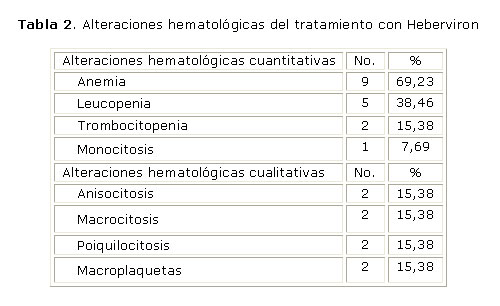
<P><font size="2" face="Verdana">En las alteraciones hematol&oacute;gicas, tambi&eacute;n    clasificadas como muy probables, tanto de las cuantitativas como de las cualitativas,    predomin&oacute; la anemia (menor de 120 g/L). </font><font size="2" face="Verdana">Le    sigui&oacute; la leucopenia (menor de 4 x 10<SUP>9</SUP>), uno de los efectos    m&aacute;s importantes de la combinaci&oacute;n utilizada, aunque ambos medicamentos    la pueden originar por separado. En una paciente la leucopenia se clasific&oacute;    como efecto adverso grave y motiv&oacute; la suspensi&oacute;n del tratamiento    (<a href="#tab2">tabla 2</a>). </font>     <P align="center"><img src="/img/revistas/mil/v40n1/t0211111.gif" width="500" height="306"> <a name="tab2"></a>     
<P align="center">     ]]></body>
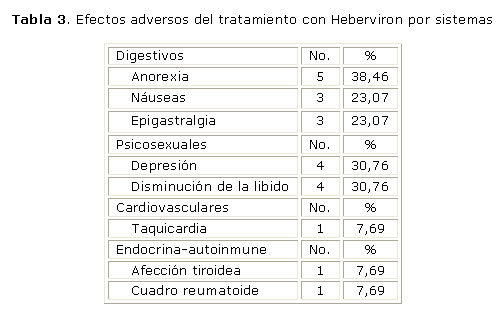
<body><![CDATA[<P><font size="2" face="Verdana">La trombopenia solo se observ&oacute; en 2 pacientes,    en uno fue leve y reversible aun cuando se continu&oacute; el tratamiento; en    el otro, con una cirrosis hep&aacute;tica por virus C, la magnitud de la trombopenia    hizo necesaria la suspensi&oacute;n del tratamiento. En ambos pacientes estas    reacciones adversas fueron reversibles. La monocitosis se observ&oacute; en    un solo paciente y fue reversible tambi&eacute;n. </font>     <P><font size="2" face="Verdana">Las alteraciones morfol&oacute;gicas cualitativas    encontradas en el estudio de la sangre perif&eacute;rica (anisocitosis, poiquilocitosis,    macrocitosis y macroplaquetas) tambi&eacute;n fueron reversibles. </font>     <P><font size="2" face="Verdana">En la <a href="#tab3">tabla 3</a> se aprecia    un grupo de efectos adversos por sistemas. Las manifestaciones digestivas fueron    muy vinculadas por los pacientes, a la ingesti&oacute;n de las tabletas de ribavirina    y al d&iacute;a de administraci&oacute;n del interfer&oacute;n. Fueron de leves    a moderadas y se controlaron con tratamiento sintom&aacute;tico. </font>      <P align="center"><img src="/img/revistas/mil/v40n1/t0311111.gif" width="504" height="322"><a name="tab3"></a>     
<P><font size="2" face="Verdana">La depresi&oacute;n fue de car&aacute;cter leve    y moderado y pudo ser controlada con tratamiento y psicoterapia de apoyo. En    una misma paciente se present&oacute; una afecci&oacute;n tiroidea que se manifest&oacute;    como un hipotiroidismo con s&iacute;ntomas t&iacute;picos, TSH elevada y un    cuadro reumatoideo con factor reumatoideo positivo, fue necesario suspender    el tratamiento. Es importante se&ntilde;alar que las manifestaciones reumatoides    han ido regresando sin tratamiento espec&iacute;fico. El hipotiroidismo requiri&oacute;    tratamiento con levotiroxina s&oacute;dica. </font>     <P>     <P>      <P><font size="3" face="Verdana"><B>DISCUSI&Oacute;N</B> </font>     <P><font size="2" face="Verdana">La hepatitis cr&oacute;nica C constituye la causa    fundamental de hepatopat&iacute;a cr&oacute;nica, incluyendo cirrosis hep&aacute;tica    y hepatocarcinoma. Es tambi&eacute;n la principal indicaci&oacute;n de trasplante    hep&aacute;tico.<SUP>4,5</SUP> </font>     <P><font size="2" face="Verdana">A pesar de la b&uacute;squeda y ensayo de otras    opciones terap&eacute;uticas, el tratamiento actual es la administraci&oacute;n    combinada de interfer&oacute;n y ribavirina.<SUP>6,7</SUP> </font>     ]]></body>
<body><![CDATA[<P><font size="2" face="Verdana">Se ha reportado que hasta un 10 % de los pacientes    a quienes se les ha indicado a tratamiento, presentan un grupo de efectos secundarios    y reacciones adversas de diferentes intensidad y gravedad.<SUP>3</SUP> </font>      <P><font size="2" face="Verdana">La fatiga, astenia, anorexia, cefalea y fiebre    as&iacute; como las mialgias y las artralgias son los s&iacute;ntomas generales    m&aacute;s referidos en la literatura, con una frecuencia aproximada del 30-56    %. Habitualmente se presentan al principio del tratamiento, luego, y de forma    progresiva, existe una adaptaci&oacute;n del organismo a dichos s&iacute;ntomas    de modo que muchos de los pacientes dejan de referirlos entre la 2&#170; y 4&#170;    semanas de tratamiento.<SUP>3</SUP> Los principales efectos adversos encontrados,    de tipo general, se corresponden con los reportados para la terapia combinada,    en particular la fiebre con escalofr&iacute;os, la cefalea, las artralgias y    las mialgias.<SUP>2</SUP> </font>      <P><font size="2" face="Verdana">En las alteraciones hematol&oacute;gicas, tambi&eacute;n    clasificadas como muy probables, entre las cuantitativas la anemia es reportada    como consecuencia de la ribavirina, aunque en menor cuant&iacute;a tambi&eacute;n    es se&ntilde;alada en la monoterapia con interfer&oacute;n. Se produce por diferentes    mecanismos. La ribavirina ejerce su acci&oacute;n de manera directa sobre la    membrana eritrocitaria ocasionando hem&oacute;lisis.<SUP>8</SUP> Por su parte    el interfer&oacute;n act&uacute;a sobre la m&eacute;dula &oacute;sea interfiriendo    sobre la hematopoyesis. Se plantea que los pacientes con una mayor predisposici&oacute;n    a sufrir anemia ser&iacute;an las mujeres y aquellos con niveles bajos de hemoglobina    al inicio del tratamiento, as&iacute; como los que desde la etapa inicial del    tratamiento se produce una disminuci&oacute;n del aclaraci&oacute;n renal de    la creatinina. </font>      <P><font size="2" face="Verdana">En las alteraciones cualitativas la monocitosis    es descrita en otros estudios con una mayor frecuencia. De forma habitual estas    alteraciones son reversibles.<SUP>3,9,10</SUP> </font>     <P><font size="2" face="Verdana">Los s&iacute;ntomas digestivos que se reportan    con mayor frecuencia son las n&aacute;useas, los v&oacute;mitos, las diarreas    y con menor frecuencia el dolor abdominal.<SUP>3</SUP> </font>     <P><font size="2" face="Verdana">En la esfera neurops&iacute;quica, la irritabilidad,    el insomnio y sobre todo la depresi&oacute;n son se&ntilde;aladas. Aunque los    estudios realizados son preliminares, parece ser que el alfa-interfer&oacute;n    afecta de manera directa al sistema nervioso central, act&uacute;a sobre las    v&iacute;as neuroendocrinas y determinados neurotransmisores. El interfer&oacute;n    puede inducir diferentes citoquinas: IL-1, IL-2, IL-6 y tumor necrosis-alfa    (TNF-alfa), sustancias que intervienen en la aparici&oacute;n de sintomatolog&iacute;a    neuropsiqui&aacute;trica. </font>      <P><font size="2" face="Verdana">El interfer&oacute;n alfa y la ACTH est&aacute;n    antig&eacute;nica y estructuralmente relacionados, por lo tanto el interfer&oacute;n    aumentar&iacute;a los niveles de cortisol. Este podr&iacute;a ser un mecanismo    de explicaci&oacute;n de la depresi&oacute;n inducida por IFN, pues la actividad    del eje hipot&aacute;lamo-hipofisario-suprarenal est&aacute; amentada durante    la depresi&oacute;n.<SUP>3,11</SUP> </font>     <P><font size="2" face="Verdana">Con respecto a la paciente que present&oacute;    una afecci&oacute;n tiroidea, manifestada como un hipotiroidismo con s&iacute;ntomas    t&iacute;picos y con TSH elevada, as&iacute; como un cuadro reumatoide con factor    reumatoideo positivo, es un hecho conocido que el empleo de diversas preparaciones    con interfer&oacute;n ha sido asociado a un incremento de afecciones autoinmunes    como tiroiditis y conectivopat&iacute;as. Aunque en un inicio se consideraba    una contraindicaci&oacute;n formal la existencia de una disfunci&oacute;n tiroidea,    ya no es as&iacute;. Se recomienda realizar el tratamiento siempre y cuando    la afecci&oacute;n tiroidea est&aacute; controlada. </font>      <P><font size="2" face="Verdana">En la esfera endocrina se han reportado la aparici&oacute;n    de afecciones tiroideas e incluso diabetes mellitus con el empleo del interfer&oacute;n    por la acci&oacute;n de este en la esfera neuroendocrina ya comentada.<SUP>3</SUP>    </font>     <P><font size="2" face="Verdana">Se concluye que es importante tener presente,    al indicar el tratamiento combinado de interfer&oacute;n y ribavirina a un paciente    con hepatitis cr&oacute;nica C, la frecuencia y magnitud de los efectos secundarios.    Ellos pueden interferir con la adherencia al tratamiento y la respuesta a este,    y ocasionar un impacto negativo en la calidad de vida de los pacientes. </font>     ]]></body>
<body><![CDATA[<P>     <P>      <P><font size="3" face="Verdana"><B>REFERENCIAS BIBLIOGR&Aacute;FICAS</B> </font>     <P><font size="2" face="Verdana">1. Isselbacher Kurt J. Chronic Hepatitis C: A    Reassessment of Long-Term Treatment Access Medicine from McGraw-Hill. 2008.    [Internet] [cited 2010 May 7]. Available from: <U><a href="http://www.medscape.com/viewarticle/585214" target="_blank">http://www.medscape.com/viewarticle/585214</a></U>    </font>      <!-- ref --><P><font size="2" face="Verdana">2. MINSAP. Centro para el desarrollo de la Farmacoepidemiolog&iacute;a.    La Habana: Editorial Ciencias M&eacute;dicas; 2006. </font>    <!-- ref --><P><font size="2" face="Verdana">3. Roget M. Efectos secundarios del tratamiento    con interfer&oacute;n y ribavirina Enf Emerg. 2003;5(3):181-189. </font>    <P><font size="2" face="Verdana">4. Hartl G. Health Communications and Public    Relations. Hepatitis C: 170 million infected worldwide and still no vaccine.    Press Release WHO Geneva. 1998 [Internet]. [cited 2005 May 1]. Available from:    <U><a href="http://www.who.int/inf-pr-1998/en/pr98-36.html" target="_blank">http://www.who.int/inf-pr-1998/en/pr98-36.html</a></U>    </font>      <!-- ref --><P><font size="2" face="Verdana">5. Aruz E. Historia natural de la infecci&oacute;n    por el virus de la hepatitis C. En: Colectivo de autores. Sociedad Cubana de    Hepatolog&iacute;a. Hepatolog&iacute;a 2006. La Habana: Editorial CIMEQ; 2006.    p.15-28. </font>    <!-- ref --><P><font size="2" face="Verdana">6. Scottish Intercollegiate Guidelines Network.    Management of hepatitis C. A national clinical guideline. Edinburgh: Scottish    Intercollegiate Guidelines Network; 2006. </font>    <!-- ref --><P><font size="2" face="Verdana">7. Hashem B, Serag El. Burden of Hepatitis C    Infection: Realities and Challenges Medscape Gastroenterology. 2008. Available    from: <a href="http://cme.medscape.com/viewarticle/584515" target="_blank">http://cme.medscape.com/viewarticle/584515</a>    </font>    <!-- ref --><P><font size="2" face="Verdana">8. Saito&#160;H,&#160;Tada&#160;S,&#160;Ebinuma&#160;H,&#160;Ishii&#160;H,&#160;Kashiwazaki&#160;K,&#160;Takahashi&#160;M,&#160;et    al. Role of erythrocytes as a reservoir for ribavirin and relationship with    adverse reactions in the early phase of interferon combination therapy for chronic    hepatitis C virus infections. J Clin Microbiol. 2006;44(10):3562-8.&#160; </font>    <P><font size="2" face="Verdana">9. Chao-Hung Hung, Chuan-Mo Lee, Sheng-Nan Lu,    Jing-Houng Wang, Chien-Hung Chen, Tsung-Hui Hu, et al. Anemia Associated With    Antiviral Therapy in Chronic Hepatitis C: Incidence, Risk Factors, and Impact    on Treatment Response. Liver Int [Internet] 2006 [cited 2010 May 7]; 26(9):1079-86.    Available from: <a href="http://www.medscape.com/medline/abstract" target="_blank">http://www.medscape.com/medline/abstract</a></font>      <!-- ref --><P><font size="2" face="Verdana">10. Bagheri H, Pharm D, Atoussa F, Barange K,    Lapeyre-Mestre M, Payen JL, et al. Follow-up of Adverse Drug Reactions From    Peginterferon Alfa-2b-Ribavirin. Ther Pharmacother. 2004;24(11):1546-53. </font>    <P><font size="2" face="Verdana">11. Mart&iacute;n-Santos R, D&iacute;ez-Quevedo    C, Castellv&iacute; P, Navin&eacute;s R, Miquel M, Masnou H, et al. De Novo    Depression and Anxiety Disorders and Influence on Adherence During Peginterferon-Alpha-2a    and Ribavirin Treatment in Patients With Hepatitis C. Aliment Pharmacol Ther    [Internet]. 2008 [cited 2010 May 7]; 27(3):257-265. Available from: <a href="http://www.medscape.com/viewarticle/568564" target="_blank">http://www.medscape.com/viewarticle/568564</a>    </font>      <P>     <P>     <P>      <P><font size="2" face="Verdana">Recibido: 3 de septiembre de 2010.    <br>   Aprobado: 13 de noviembre de 2010. </font>     <P>     ]]></body>
<body><![CDATA[<P>     <P><font size="2" face="Verdana">Dr. C. Agust&iacute;n Mulet P&eacute;rez. Hospital    Universitario Provincial &quot;Vladimir Ilich Lenin&quot;. Holgu&iacute;n, Cuba.<B>    </B>Correo electr&oacute;nico: <U><a href="mailto:agustin@cristal.hlg.sld.cu">agustin@cristal.hlg.sld.cu</a></U></font>      ]]></body><back>
<ref-list>
<ref id="B1">
<label>1</label><nlm-citation citation-type="">
<person-group person-group-type="author">
<name>
<surname><![CDATA[Isselbacher Kurt]]></surname>
<given-names><![CDATA[J]]></given-names>
</name>
</person-group>
<source><![CDATA[Chronic Hepatitis C: A Reassessment of Long-Term Treatment Access Medicine from McGraw-Hill]]></source>
<year>2008</year>
</nlm-citation>
</ref>
<ref id="B2">
<label>2</label><nlm-citation citation-type="book">
<collab>MINSAP</collab>
<source><![CDATA[Centro para el desarrollo de la Farmacoepidemiología]]></source>
<year>2006</year>
<publisher-loc><![CDATA[La Habana ]]></publisher-loc>
<publisher-name><![CDATA[Editorial Ciencias Médicas]]></publisher-name>
</nlm-citation>
</ref>
<ref id="B3">
<label>3</label><nlm-citation citation-type="journal">
<person-group person-group-type="author">
<name>
<surname><![CDATA[Roget]]></surname>
<given-names><![CDATA[M]]></given-names>
</name>
</person-group>
<article-title xml:lang="es"><![CDATA[Efectos secundarios del tratamiento con interferón y ribavirina]]></article-title>
<source><![CDATA[Enf Emerg.]]></source>
<year>2003</year>
<volume>5</volume>
<numero>3</numero>
<issue>3</issue>
<page-range>181-189</page-range></nlm-citation>
</ref>
<ref id="B4">
<label>4</label><nlm-citation citation-type="">
<person-group person-group-type="author">
<name>
<surname><![CDATA[Hartl]]></surname>
<given-names><![CDATA[G]]></given-names>
</name>
</person-group>
<source><![CDATA[Health Communications and Public Relations. Hepatitis C: 170 million infected worldwide and still no vaccine. Press Release WHO Geneva]]></source>
<year>1998</year>
</nlm-citation>
</ref>
<ref id="B5">
<label>5</label><nlm-citation citation-type="book">
<person-group person-group-type="author">
<name>
<surname><![CDATA[Aruz]]></surname>
<given-names><![CDATA[E]]></given-names>
</name>
</person-group>
<article-title xml:lang="es"><![CDATA[Historia natural de la infección por el virus de la hepatitis C]]></article-title>
<collab>Colectivo de autores</collab>
<collab>Sociedad Cubana de Hepatología</collab>
<source><![CDATA[Hepatología 2006]]></source>
<year>2006</year>
<page-range>15-28</page-range><publisher-loc><![CDATA[La Habana ]]></publisher-loc>
<publisher-name><![CDATA[Editorial CIMEQ]]></publisher-name>
</nlm-citation>
</ref>
<ref id="B6">
<label>6</label><nlm-citation citation-type="book">
<collab>Scottish Intercollegiate Guidelines Network</collab>
<source><![CDATA[Management of hepatitis C. A national clinical guideline]]></source>
<year>2006</year>
<publisher-loc><![CDATA[Edinburgh ]]></publisher-loc>
<publisher-name><![CDATA[Scottish Intercollegiate Guidelines Network]]></publisher-name>
</nlm-citation>
</ref>
<ref id="B7">
<label>7</label><nlm-citation citation-type="">
<person-group person-group-type="author">
<name>
<surname><![CDATA[Hashem]]></surname>
<given-names><![CDATA[B]]></given-names>
</name>
<name>
<surname><![CDATA[Serag]]></surname>
<given-names><![CDATA[El]]></given-names>
</name>
</person-group>
<source><![CDATA[Burden of Hepatitis C Infection: Realities and Challenges Medscape Gastroenterology]]></source>
<year>2008</year>
</nlm-citation>
</ref>
<ref id="B8">
<label>8</label><nlm-citation citation-type="journal">
<person-group person-group-type="author">
<name>
<surname><![CDATA[Saito]]></surname>
<given-names><![CDATA[H]]></given-names>
</name>
<name>
<surname><![CDATA[Tada]]></surname>
<given-names><![CDATA[S]]></given-names>
</name>
<name>
<surname><![CDATA[Ebinuma]]></surname>
<given-names><![CDATA[H]]></given-names>
</name>
<name>
<surname><![CDATA[Ishii]]></surname>
<given-names><![CDATA[H]]></given-names>
</name>
<name>
<surname><![CDATA[Kashiwazaki]]></surname>
<given-names><![CDATA[K]]></given-names>
</name>
<name>
<surname><![CDATA[Takahashi]]></surname>
<given-names><![CDATA[M]]></given-names>
</name>
</person-group>
<article-title xml:lang="en"><![CDATA[Role of erythrocytes as a reservoir for ribavirin and relationship with adverse reactions in the early phase of interferon combination therapy for chronic hepatitis C virus infections]]></article-title>
<source><![CDATA[J Clin Microbiol.]]></source>
<year>2006</year>
<volume>44</volume>
<numero>10</numero>
<issue>10</issue>
<page-range>3562-8</page-range></nlm-citation>
</ref>
<ref id="B9">
<label>9</label><nlm-citation citation-type="journal">
<person-group person-group-type="author">
<name>
<surname><![CDATA[Chao-Hung]]></surname>
<given-names><![CDATA[Hung]]></given-names>
</name>
<name>
<surname><![CDATA[Chuan-Mo]]></surname>
<given-names><![CDATA[Lee]]></given-names>
</name>
<name>
<surname><![CDATA[Sheng-Nan]]></surname>
<given-names><![CDATA[Lu]]></given-names>
</name>
<name>
<surname><![CDATA[Jing-Houng]]></surname>
<given-names><![CDATA[Wang]]></given-names>
</name>
<name>
<surname><![CDATA[Chien-Hung]]></surname>
<given-names><![CDATA[Chen]]></given-names>
</name>
<name>
<surname><![CDATA[Tsung-Hui]]></surname>
<given-names><![CDATA[Hu]]></given-names>
</name>
</person-group>
<article-title xml:lang="en"><![CDATA[Anemia Associated With Antiviral Therapy in Chronic Hepatitis C: Incidence, Risk Factors, and Impact on Treatment Response]]></article-title>
<source><![CDATA[Liver Int]]></source>
<year>2006</year>
<volume>26</volume>
<numero>9</numero>
<issue>9</issue>
<page-range>1079-86</page-range></nlm-citation>
</ref>
<ref id="B10">
<label>10</label><nlm-citation citation-type="journal">
<person-group person-group-type="author">
<name>
<surname><![CDATA[Bagheri]]></surname>
<given-names><![CDATA[H]]></given-names>
</name>
<name>
<surname><![CDATA[Pharm]]></surname>
<given-names><![CDATA[D]]></given-names>
</name>
<name>
<surname><![CDATA[Atoussa]]></surname>
<given-names><![CDATA[F]]></given-names>
</name>
<name>
<surname><![CDATA[Barange]]></surname>
<given-names><![CDATA[K]]></given-names>
</name>
<name>
<surname><![CDATA[Lapeyre-Mestre]]></surname>
<given-names><![CDATA[M]]></given-names>
</name>
<name>
<surname><![CDATA[Payen]]></surname>
<given-names><![CDATA[JL]]></given-names>
</name>
</person-group>
<article-title xml:lang="en"><![CDATA[Follow-up of Adverse Drug Reactions From Peginterferon Alfa-2b-Ribavirin]]></article-title>
<source><![CDATA[Ther Pharmacother.]]></source>
<year>2004</year>
<volume>24</volume>
<numero>11</numero>
<issue>11</issue>
<page-range>1546-53</page-range></nlm-citation>
</ref>
<ref id="B11">
<label>11</label><nlm-citation citation-type="journal">
<person-group person-group-type="author">
<name>
<surname><![CDATA[Martín-Santos]]></surname>
<given-names><![CDATA[R]]></given-names>
</name>
<name>
<surname><![CDATA[Díez-Quevedo]]></surname>
<given-names><![CDATA[C]]></given-names>
</name>
<name>
<surname><![CDATA[Castellví]]></surname>
<given-names><![CDATA[P]]></given-names>
</name>
<name>
<surname><![CDATA[Navinés]]></surname>
<given-names><![CDATA[R]]></given-names>
</name>
<name>
<surname><![CDATA[Miquel]]></surname>
<given-names><![CDATA[M]]></given-names>
</name>
<name>
<surname><![CDATA[Masnou]]></surname>
<given-names><![CDATA[H]]></given-names>
</name>
</person-group>
<article-title xml:lang="en"><![CDATA[De Novo Depression and Anxiety Disorders and Influence on Adherence During Peginterferon-Alpha-2a and Ribavirin Treatment in Patients With Hepatitis C]]></article-title>
<source><![CDATA[Aliment Pharmacol Ther]]></source>
<year>2008</year>
<volume>27</volume>
<numero>3</numero>
<issue>3</issue>
<page-range>257-265</page-range></nlm-citation>
</ref>
</ref-list>
</back>
</article>