<?xml version="1.0" encoding="ISO-8859-1"?><article xmlns:mml="http://www.w3.org/1998/Math/MathML" xmlns:xlink="http://www.w3.org/1999/xlink" xmlns:xsi="http://www.w3.org/2001/XMLSchema-instance">
<front>
<journal-meta>
<journal-id>0138-6557</journal-id>
<journal-title><![CDATA[Revista Cubana de Medicina Militar]]></journal-title>
<abbrev-journal-title><![CDATA[Rev Cub Med Mil]]></abbrev-journal-title>
<issn>0138-6557</issn>
<publisher>
<publisher-name><![CDATA[Centro Nacional de Información de Ciencias MédicasEditorial Ciencias Médicas]]></publisher-name>
</publisher>
</journal-meta>
<article-meta>
<article-id>S0138-65572013000100005</article-id>
<title-group>
<article-title xml:lang="es"><![CDATA[Estimación del punto de corte de la circunferencia abdominal como criterio diagnóstico del síndrome metabólico]]></article-title>
<article-title xml:lang="en"><![CDATA[Estimated cutoff abdominal circumference of metabolic syndrome diagnosis criterion]]></article-title>
</title-group>
<contrib-group>
<contrib contrib-type="author">
<name>
<surname><![CDATA[Remón Popa]]></surname>
<given-names><![CDATA[Idelmis]]></given-names>
</name>
<xref ref-type="aff" rid="A01"/>
</contrib>
<contrib contrib-type="author">
<name>
<surname><![CDATA[González Sotolongo]]></surname>
<given-names><![CDATA[Carolina]]></given-names>
</name>
<xref ref-type="aff" rid="A01"/>
</contrib>
<contrib contrib-type="author">
<name>
<surname><![CDATA[Arpa Gámez]]></surname>
<given-names><![CDATA[Ángel]]></given-names>
</name>
<xref ref-type="aff" rid="A01"/>
</contrib>
</contrib-group>
<aff id="A01">
<institution><![CDATA[,Hospital Militar Central Dr. Luis Díaz Soto  ]]></institution>
<addr-line><![CDATA[La Habana ]]></addr-line>
<country>Cuba</country>
</aff>
<pub-date pub-type="pub">
<day>00</day>
<month>03</month>
<year>2013</year>
</pub-date>
<pub-date pub-type="epub">
<day>00</day>
<month>03</month>
<year>2013</year>
</pub-date>
<volume>42</volume>
<numero>1</numero>
<fpage>29</fpage>
<lpage>38</lpage>
<copyright-statement/>
<copyright-year/>
<self-uri xlink:href="http://scielo.sld.cu/scielo.php?script=sci_arttext&amp;pid=S0138-65572013000100005&amp;lng=en&amp;nrm=iso"></self-uri><self-uri xlink:href="http://scielo.sld.cu/scielo.php?script=sci_abstract&amp;pid=S0138-65572013000100005&amp;lng=en&amp;nrm=iso"></self-uri><self-uri xlink:href="http://scielo.sld.cu/scielo.php?script=sci_pdf&amp;pid=S0138-65572013000100005&amp;lng=en&amp;nrm=iso"></self-uri><abstract abstract-type="short" xml:lang="es"><p><![CDATA[Introducción: la circunferencia abdominal constituye un factor de riesgo aterogénico y un criterio para obtener el diagnóstico del síndrome metabólico. Diversos organismos internacionales han recomendado que el punto de corte de esta circunferencia para definir dicho síndrome sea determinado contextualmente en cada país. Sin embargo, en Cuba no existen estudios que se hayan encaminado a tal fin. Objetivo: estimar el punto de corte de la circunferencia abdominal para el diagnóstico del síndrome en un grupo poblacional. Métodos: se realizó un estudio observacional, de corte transversal, en 703 sujetos pertenecientes a la región Holguín-Granma. Se tomaron las variables que definen el síndrome metabólico según los criterios del Adult Treatment Panel III modificados. Se obtuvieron las curvas COR (Receiver Operador Characteristics) para cada sexo de los diferentes valores de la circunferencia para discriminar aquellos sujetos con dos criterios diagnósticos o más de este síndrome. Se escogió el punto de corte según el índice de Youden. Resultados: el punto de corte de la circunferencia abdominal obtenido fue de 97 cm para los hombres y de 85 cm para las mujeres, con una sensibilidad del 55 % y especificidad del 91 % en el caso de los hombres, y 87 y 72 % respectivamente para las mujeres. Conclusiones: el punto de corte de la circunferencia abdominal para ser empleado en nuestro contexto para el diagnóstico del síndrome metabólico es de 97 cm en el hombre y de 85 cm en la mujer.]]></p></abstract>
<abstract abstract-type="short" xml:lang="en"><p><![CDATA[Introduction: waist circumference is an atherogenic risk factor and a criterion for metabolic syndrome diagnosis. Various international organizations have recommended that the cutoff point of this circumference to define that the abovementioned syndrome would be contextually determined in each country. However, in Cuba, there are no studies aiming this end. Objective: to estimate the cutoff point of waist circumference for the diagnosis of this syndrome in a population group. Methods: an observational, cross-sectional study was conducted in 703 patients at the Holguin Granma region. Variables defining the metabolic syndrome according to the modified criteria of Adult Treatment Panel III were taken. The curves of Receiver Operator Characteristics (ROC) were obtained for each sex at different values of the circumference to discriminate those subjects with two or more diagnostic criteria in this syndrome. The cutoff point was chosen according to Youden rate. Results: the cutoff abdominal circumference obtained was 97 cm in men and 85 cm in women, with 55% sensitivity and 91% specificity in men, and 87 and 72% respectively in women. Conclusions: in our context, the cutoff point of abdominal circumference to be used for diagnosing of metabolic syndrome is 97 cm in men and 85 cm in women.]]></p></abstract>
<kwd-group>
<kwd lng="es"><![CDATA[síndrome metabólico]]></kwd>
<kwd lng="es"><![CDATA[circunferencia abdominal]]></kwd>
<kwd lng="es"><![CDATA[punto de corte]]></kwd>
<kwd lng="en"><![CDATA[metabolic syndrome]]></kwd>
<kwd lng="en"><![CDATA[abdominal circumference]]></kwd>
<kwd lng="en"><![CDATA[cutoff]]></kwd>
</kwd-group>
</article-meta>
</front><body><![CDATA[ <p align="right"><font face="Verdana, Arial, Helvetica, sans-serif" size="2"><b>ART&Iacute;CULO    ORIGINAL     <br>   </b></font></p>     <p><b><font face="Verdana, Arial, Helvetica, sans-serif" size="4">    <br>   Estimaci&oacute;n del punto de corte de la circunferencia abdominal como criterio    diagn&oacute;stico del s&iacute;ndrome metab&oacute;lico</font></b></p>     <p><b><font face="Verdana, Arial, Helvetica, sans-serif" size="4">    <br>       <br>       <br>   <font size="3">Estimated cutoff abdominal circumference of metabolic syndrome    diagnosis criterion    <br>   </font></font></b></p>     <p>&nbsp;</p>     ]]></body>
<body><![CDATA[<p>&nbsp;</p>     <p><font face="Verdana, Arial, Helvetica, sans-serif" size="2"><b>Dra. Idelmis    Rem&oacute;n Popa, Dra. Odalys Carolina Gonz&aacute;lez Sotolongo, Dr. C. &Aacute;ngel    Arpa G&aacute;mez</b></font></p>     <p><font face="Verdana, Arial, Helvetica, sans-serif" size="2">Hospital Militar    Central &quot;Dr. Luis D&iacute;az Soto&quot;. La Habana, Cuba.    <br>       <br>       <br>       <br>       <br>   </font></p> <hr> <font face="Verdana, Arial, Helvetica, sans-serif" size="2"><b>RESUMEN</b></font>      <p><font face="Verdana, Arial, Helvetica, sans-serif" size="2"><b>Introducci&oacute;n</b>:    la circunferencia abdominal constituye un factor de riesgo aterog&eacute;nico    y un criterio para obtener el diagn&oacute;stico del s&iacute;ndrome metab&oacute;lico.    Diversos organismos internacionales han recomendado que el punto de corte de    esta circunferencia para definir dicho s&iacute;ndrome sea determinado contextualmente    en cada pa&iacute;s. Sin embargo, en Cuba no existen estudios que se hayan encaminado    a tal fin.     <br>   <b>Objetivo</b>: estimar el punto de corte de la circunferencia abdominal para    el diagn&oacute;stico del s&iacute;ndrome en un grupo poblacional.     ]]></body>
<body><![CDATA[<br>   <b>M&eacute;todos</b>: se realiz&oacute; un estudio observacional, de corte    transversal, en 703 sujetos pertenecientes a la regi&oacute;n Holgu&iacute;n-Granma.    Se tomaron las variables que definen el s&iacute;ndrome metab&oacute;lico seg&uacute;n    los criterios del Adult Treatment Panel III modificados. Se obtuvieron las curvas    COR (Receiver Operador Characteristics) para cada sexo de los diferentes valores    de la circunferencia para discriminar aquellos sujetos con dos criterios diagn&oacute;sticos    o m&aacute;s de este s&iacute;ndrome. Se escogi&oacute; el punto de corte seg&uacute;n    el &iacute;ndice de Youden.     <br>   <b>Resultados</b>: el punto de corte de la circunferencia abdominal obtenido    fue de 97 cm para los hombres y de 85 cm para las mujeres, con una sensibilidad    del 55 % y especificidad del 91 % en el caso de los hombres, y 87 y 72 % respectivamente    para las mujeres.     <br>   <b>Conclusiones</b>: el punto de corte de la circunferencia abdominal para ser    empleado en nuestro contexto para el diagn&oacute;stico del s&iacute;ndrome    metab&oacute;lico es de 97 cm en el hombre y de 85 cm en la mujer.     <br>       <br>   <b>Palabras clave</b>: s&iacute;ndrome metab&oacute;lico, circunferencia abdominal,    punto de corte.    <br>   </font></p> <hr> <font face="Verdana, Arial, Helvetica, sans-serif" size="2"><b>ABSTRACT</b>    <br> <b>    <br> Introduction</b>: waist circumference is an atherogenic risk factor and a criterion  for metabolic syndrome diagnosis. Various international organizations have recommended  that the cutoff point of this circumference to define that the abovementioned  syndrome would be contextually determined in each country. However, in Cuba, there  are no studies aiming this end.    <br> <b>Objective</b>: to estimate the cutoff point of waist circumference for the  diagnosis of this syndrome in a population group.    <br> <b>Methods</b>: an observational, cross-sectional study was conducted in 703 patients  at the Holguin Granma region. Variables defining the metabolic syndrome according  to the modified criteria of Adult Treatment Panel III were taken. The curves of  Receiver Operator Characteristics (ROC) were obtained for each sex at different  values of the circumference to discriminate those subjects with two or more diagnostic  criteria in this syndrome. The cutoff point was chosen according to Youden rate.    ]]></body>
<body><![CDATA[<br> <b>Results</b>: the cutoff abdominal circumference obtained was 97 cm in men and  85 cm in women, with 55% sensitivity and 91% specificity in men, and 87 and 72%  respectively in women.    <br> <b>Conclusions</b>: in our context, the cutoff point of abdominal circumference  to be used for diagnosing of metabolic syndrome is 97 cm in men and 85 cm in women.    <br>     <br> <b>Key words</b>: metabolic syndrome, abdominal circumference, cutoff.    <br> </font> <hr> <font face="Verdana, Arial, Helvetica, sans-serif" size="2">     <br> </font>      <p></p>     <p>    <br> </p>     <br> <font face="Verdana, Arial, Helvetica, sans-serif" size="2"><b><font size="3">INTRODUCCI&Oacute;N</font></b></font>     ]]></body>
<body><![CDATA[<p><font face="Verdana, Arial, Helvetica, sans-serif" size="2">El s&iacute;ndrome    metab&oacute;lico (SM) se define como la confluencia de diversas alteraciones    de origen metab&oacute;lico en un mismo individuo, relacionadas fisiopatol&oacute;gicamente.<SUP>1    </SUP>La acumulaci&oacute;n central de grasa parece ser una de las alteraciones    que, unida a factores gen&eacute;ticos y ambientales, promueve los trastornos    que acompa&ntilde;an el s&iacute;ndrome,<SUP>2,3</SUP> tales como un estado    inflamatorio cr&oacute;nico, la insulinorresistencia, el estado protromb&oacute;tico,    la disfunci&oacute;n endotelial y el estr&eacute;s oxidativo, lo que lleva a    la aterog&eacute;nesis y, finalmente, a las consecuencias cl&iacute;nicas de    esta. </font></p>     <p><font face="Verdana, Arial, Helvetica, sans-serif" size="2">La circunferencia    abdominal (CA) se emplea, habitualmente, como una valoraci&oacute;n cl&iacute;nica    sencilla de la acumulaci&oacute;n central de grasa y se utiliza en uno de los    sistemas diagn&oacute;sticos del SM m&aacute;s extendido en todo el mundo: el    Adult Treatment Panel III. Adem&aacute;s, se ha relacionado con una elevada    morbilidad y mortalidad por diversas causas.<SUP>4-6</SUP> Hasta hace poco, el punto de    corte de la CA que constitu&iacute;a criterio diagn&oacute;stico del SM era    102 cm en el hombre y 88 cm en la mujer. Este l&iacute;mite surgi&oacute; de    un estudio escoc&eacute;s realizado en una poblaci&oacute;n de origen cauc&aacute;sico    de Glasgow.<SUP>7,8</SUP></font></p>     <p><font face="Verdana, Arial, Helvetica, sans-serif" size="2">Con posterioridad,    numerosos organismos internacionales reconocieron que este l&iacute;mite no    era aplicable a todos los grupos &eacute;tnicos y raciales, y en un documento    de consenso orientan que cada pa&iacute;s o regi&oacute;n debe definir sus propios    puntos de corte,<SUP>9,10</SUP> ya que el empleo de otros provocar&iacute;a una sobrevaloraci&oacute;n    o subvaloraci&oacute;n de la magnitud del riesgo. </font></p>     <p><font face="Verdana, Arial, Helvetica, sans-serif" size="2">Aunque se han definido    puntos de corte para pa&iacute;ses latinoamericanos,<SUP>11</SUP> somos del    criterio de que no son aplicables a nuestra poblaci&oacute;n. Hasta donde hemos    podido conocer, en Cuba no existen estudios publicados que hayan intentado estimar    este par&aacute;metro. Por lo tanto, se plantea como problema la interrogante    de cu&aacute;l ser&iacute;a el punto de corte de la CA que debe ser aceptado    para el diagn&oacute;stico del SM en una poblaci&oacute;n cubana. </font></p>     <p><font face="Verdana, Arial, Helvetica, sans-serif" size="2">El objetivo de    este trabajo es estimar, para uno y otro sexos, los puntos de corte de la CA    que permitan obtener el diagn&oacute;stico del SM en un grupo de estudio.    <br>       <br>       <br>       <br>   </font></p>     <p><font face="Verdana, Arial, Helvetica, sans-serif" size="2">    ]]></body>
<body><![CDATA[<br>   <font size="3"><b>M&Eacute;TODOS</b></font></font></p>     <p><font face="Verdana, Arial, Helvetica, sans-serif" size="2">Se realiz&oacute;    un estudio observacional anal&iacute;tico, de corte transversal, para el cual    se escogieron personas de las regiones de Holgu&iacute;n y Granma, en el per&iacute;odo    comprendido de junio de 2009 a diciembre de 2011, previo consentimiento informado.    </font></p>     <p><font face="Verdana, Arial, Helvetica, sans-serif" size="2">Se estudi&oacute;    un total de 703 sujetos, escogidos aleatoriamente, y se les midi&oacute; la    CA con una cinta m&eacute;trica con el individuo de pie, con el torso desnudo    y relajado, a nivel de la cicatriz umbilical en un plano paralelo al piso. Adem&aacute;s    se tom&oacute; la tensi&oacute;n arterial por la metodolog&iacute;a recomendada    por el Programa Nacional de Hipertensi&oacute;n Arterial. </font></p>     <p><font face="Verdana, Arial, Helvetica, sans-serif" size="2">Las variables de    laboratorio fueron medidas por extracci&oacute;n de sangre en ayunas de al menos    8 h, mediante autoanalizador Hitachi por los m&eacute;todos de laboratorio est&aacute;ndar,    y consistieron en la medici&oacute;n de glucemia, triglic&eacute;ridos y HDL    colesterol. El SM se defini&oacute; mediante los criterios del Adult Treatment    Panel III, modificados por la <i>Internacional Diabetes Federation-American    Heart Association/National Heart</i>,<i> Lung and Blood Institute</i> de 2009,<SUP>9</SUP>    los cuales se exponen a continuaci&oacute;n, y fue considerado portador del    s&iacute;ndrome el paciente que cumpliera al menos tres de ellos:    <br>   </font></p> <ul>       <li><font face="Verdana, Arial, Helvetica, sans-serif" size="2"> CA mayor de      102 cm en el hombre y de 88 cm en la mujer.    <br>         <br>     </font></li>       <li><font face="Verdana, Arial, Helvetica, sans-serif" size="2"> TA mayor de      130/85 mmHg o estar bajo tratamiento antihipertensivo.    <br>         ]]></body>
<body><![CDATA[<br>     </font></li>       <li><font face="Verdana, Arial, Helvetica, sans-serif" size="2"> Glucemia mayor      de 5,6 mmol/L, o estar bajo tratamiento con insulina o hipoglucemiantes orales.    <br>         <br>     </font></li>       <li><font face="Verdana, Arial, Helvetica, sans-serif" size="2"> Triglic&eacute;ridos      mayor de 1,7 mmol/L o estar bajo tratamiento hipolipemiante.    <br>         <br>     </font></li>       <li><font face="Verdana, Arial, Helvetica, sans-serif" size="2"> HDL colesterol      menor de 1,0 mmol/L en el hombre, o de 1,3 mmol/L en la mujer, o estar bajo      tratamiento hipolipemiante.</font></li>     </ul>     <p><font face="Verdana, Arial, Helvetica, sans-serif" size="2">    ]]></body>
<body><![CDATA[<br>   </font></p>     <p><font face="Verdana, Arial, Helvetica, sans-serif" size="2">    <br>   <font size="3"><font size="2">AN&Aacute;LISIS ESTAD&Iacute;STICO</font></font></font></p>     <p><font face="Verdana, Arial, Helvetica, sans-serif" size="2"> Se emple&oacute;    el paquete estad&iacute;stico SPSS, versi&oacute;n 11,5. Las variables cuantitativas    se describieron mediante sus valores medios y las correspondientes desviaciones    est&aacute;ndar (DE). Las variables cualitativas se presentaron en sus valores    absolutos y porcentaje. Se calcul&oacute; el coeficiente de correlaci&oacute;n    de Pearson para medir el grado de asociaci&oacute;n de la CA con las dem&aacute;s    variables que constituyen criterios diagn&oacute;sticos del SM y la t de student    para comparar las medias entre el primer y el cuarto cuartiles de CA. </font></p>     <p><font face="Verdana, Arial, Helvetica, sans-serif" size="2">Se acept&oacute;    significaci&oacute;n estad&iacute;stica si <font face="Symbol">a</font> no sobrepasaba    0,05. Se emple&oacute; la curva COR (<i>Receiver Operator Characteristics</i>)    para determinar el punto de corte de CA que mejor defin&iacute;a a un sujeto    con dos criterios diagn&oacute;sticos o m&aacute;s de SM que no fueran la propia    CA. Con este fin se utiliz&oacute; el &iacute;ndice de Youden,<SUP>12,13</SUP>    que se basa en el c&aacute;lculo de (sensibilidad + especificidad).<SUP>1</SUP>    Se tom&oacute; como punto de corte el valor obtenido (J) m&aacute;s pr&oacute;ximo    a 1 (<font color="#0000FF"><a href="/img/revistas/mil/v42n1/f0115113.jpg">Fig</a>.</font>).    <br>       <br>   </font></p>     <p align="center">&nbsp;</p>     <p align="center">&nbsp;</p>     <p><font size="3"><b><font face="Verdana, Arial, Helvetica, sans-serif">RESULTADOS</font></b></font></p>     ]]></body>
<body><![CDATA[<p><font face="Verdana, Arial, Helvetica, sans-serif" size="2">De los 703 casos    estudiados, 175 cumplieron los criterios de SM para una prevalencia del 24,9    % (<font color="#0000FF"><a href="/img/revistas/mil/v42n1/t0105113.gif">tabla 1</a></font>). El grupo    de sujetos con SM present&oacute; una edad media superior (44,34 a&ntilde;os;    DE: 5,70) que aquellos que no lo presentaban (36,21 a&ntilde;os; DE: 8,55).    Adem&aacute;s, todas las dem&aacute;s variables que constituyen criterios diagn&oacute;sticos    de SM (TA sist&oacute;lica y diast&oacute;lica, glucemia, triglic&eacute;ridos)    presentaron valores medios superiores entre los sujetos portadores del s&iacute;ndrome.    En todos los casos esta diferencia fue significativa, excepto en el caso de    los triglic&eacute;ridos, quiz&aacute;s motivado por la presencia de valores    extremos (la DE fue de 12,57 y 7,71 mmol/L en el grupo portador y no portador    del SM, respectivamente). El HDL-c present&oacute; valores medios inferiores    (1,02 mmol/L; DE: 0,16) en el grupo con SM que en el otro (1,22 mmol/L; DE:    0,17).</font></p>     <p><font face="Verdana, Arial, Helvetica, sans-serif" size="2">En la <a href="/img/revistas/mil/v42n1/t0205113.gif"><font color="#0000FF">tabla    2</font></a> se correlaciona la CA con las variables que constituyen el SM.    La tensi&oacute;n arterial sist&oacute;lica (TAS) y la tensi&oacute;n arterial    diast&oacute;lica (TAD) presentaron coeficientes de correlaci&oacute;n de 0,332    y 0,338 respectivamente, ambos significativos (p &lt; 0,01). La glucemia tuvo    un coeficiente de 0,141, tambi&eacute;n significativo. Sin embargo, los triglic&eacute;ridos,    con un coeficiente r de 0,016, no tuvieron una correlaci&oacute;n significativa    (<i>p</i>: 0,665) con la CA. En el caso del HDL-c, la correlaci&oacute;n fue    negativa (r: -0,046) y significativa.</font></p>     <p><font face="Verdana, Arial, Helvetica, sans-serif" size="2">La poblaci&oacute;n    estudiada se dividi&oacute; en cuartiles para sus valores de CA y se compararon    las variables entre el 1ro. y 4to. cuartiles (<font color="#0000FF"><a href="/img/revistas/mil/v42n1/t0305113.gif">tabla    3</a></font>). Las cifras medias de TA, tanto sist&oacute;lica como diast&oacute;lica,    fueron superiores en el 4to. cuartil de CA con respecto al 1ro. (134,8 mmHg    <i>vs</i>. 122,9 mmHg; DE: 14,00 y 13,06 respectivamente). La glucemia tambi&eacute;n    fue superior en el 4to. cuartil (5,18 mmol/L; DE: 1,24) en comparaci&oacute;n    con el 1ro. (4,87 mmol/L; DE: 0,92). Los triglic&eacute;ridos tuvieron una media    en el 4to. cuartil de 2,01 mmol/L (DE: 0,99), superior a la reportada en el    1er. cuartil de 1,40 mmol/L (DE: 0,58). A la inversa, la media de HDL-c en el    1er. cuartil fue superior (1,22 mmol/L; DE: 0,18) a la del 4to. cuartil (1,08    mmol/L; DE: 0,18). Todas estas diferencias fueron significativas.</font></p>     <p><font face="Verdana, Arial, Helvetica, sans-serif" size="2">Se muestran las    curvas COR para el sexo masculino y el femenino con valores de &aacute;rea bajo    la curva de 0,778 y 0,831 respectivamente. Se determin&oacute; como punto de    corte seg&uacute;n el &iacute;ndice de Youden, 97 cm para los hombres (sensibilidad    del 55 % y especificidad del 91 %) y de 85 cm para las mujeres (sensibilidad:    87 %, especificidad: 72 %).    <br>       <br>       <br>       <br>   </font></p>     <p></p>     <p><font face="Verdana, Arial, Helvetica, sans-serif" size="2"><b><font size="3">DISCUSI&Oacute;N</font></b></font></p>     ]]></body>
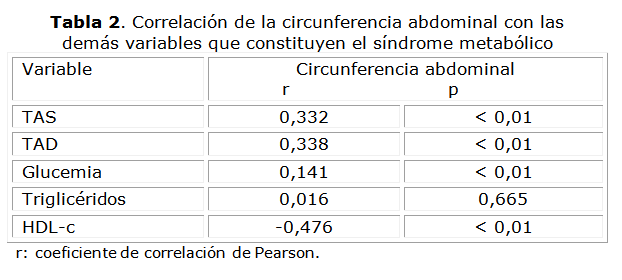
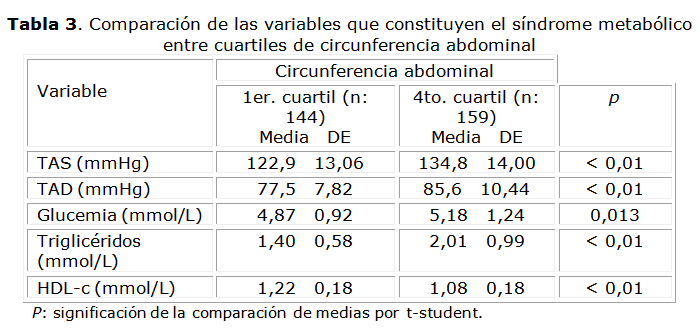
<body><![CDATA[<p><font face="Verdana, Arial, Helvetica, sans-serif" size="2">El 24,9 % de prevalencia    encontrado en este estudio es alto, si se tiene en cuenta la edad media de la    poblaci&oacute;n estudiada de apenas 38,23 a&ntilde;os. En Europa, uno de los    estudios cl&aacute;sicos es el Bostnia,<SUP>14</SUP> que arroja valores del 10 % para las    mujeres y del 15 % para los hombres. Estas cifras se elevan a 42 % en hombres    y 64 % en mujeres, cuando existe alg&uacute;n trastorno del metabolismo hidrocarbonato    (glicemia basal alterada o tolerancia a la glucosa alterada) y llega al 78 y    84 % en cada sexo en pacientes con diabetes mellitus tipo 2.</font></p>     <p><font face="Verdana, Arial, Helvetica, sans-serif" size="2">El estudio WOSCOPS,    tambi&eacute;n europeo, es uno de los m&aacute;s amplios y da 26,6 % de prevalencia    del SM.<SUP>15</SUP> El estudio DESIR de la Asociaci&oacute;n Europea para el    estudio de la diabetes<SUP>16</SUP> reporta 23 % en hombres y 12 % en mujeres.    En Grecia, en un estudio reciente, de car&aacute;cter multic&eacute;ntrico,<SUP>17</SUP>    se inform&oacute; una prevalencia de 24,2 % en hombres y 22,8 % en mujeres,    mientras que globalmente fue de 23,6 %; esta cifra se elev&oacute; a 43 % en    los adultos mayores de 70 a&ntilde;os. En Espa&ntilde;a, en una serie reciente    en las Islas Canarias, se publica 24,4 %.<SUP>18 </SUP>Sin embargo, en la poblaci&oacute;n    laboralmente activa espa&ntilde;ola<SUP>19</SUP> se registra 10,2 % (11,92 % en hombres    y 2,36 % en mujeres), cifra semejante al 9 % reportado en un estudio entre militares    franceses.<SUP>20</SUP></font></p>     <p><font face="Verdana, Arial, Helvetica, sans-serif" size="2">En ocasiones, las    variaciones entre poblaciones ofrecen cifras extremas, como las presentadas    por<i> Eckel </i>y otros: hombres de la India con 8 % de prevalencia y 24 %    en hombres norteamericanos y mujeres francesas con 7 % y mujeres iran&iacute;es    43 %.<SUP>21</SUP></font></p>     <p><font face="Verdana, Arial, Helvetica, sans-serif" size="2">M&aacute;s reciente    es un estudio realizado en siete grandes ciudades de nuestro continente,<SUP>22</SUP> que    arroj&oacute; una prevalencia del 27 % en Ciudad de M&eacute;xico; 26 % en Barquisimeto,    Venezuela; 21 % en Santiago de Chile; 20 % en Bogot&aacute;, Colombia; 18 %    en Lima, Per&uacute;; 17 % en Buenos Aires, Argentina y 14 % en Quito, Ecuador.</font></p>     <p><font face="Verdana, Arial, Helvetica, sans-serif" size="2">Tanto la<font color="#0000FF">    <a href="/img/revistas/mil/v42n1/t0205113.gif">tabla 2</a></font> como la<font color="#0000FF"> <a href="/img/revistas/mil/v42n1/t0305113.gif">tabla    3</a></font> muestran, a trav&eacute;s de an&aacute;lisis distintos, la asociaci&oacute;n    de la CA con las dem&aacute;s variables que constituyen el SM. Ya sea a trav&eacute;s    de la correlaci&oacute;n o la comparaci&oacute;n de medias entre cuartiles extremos,    se puede apreciar c&oacute;mo la CA mantiene un v&iacute;nculo con el resto    de las alteraciones cl&iacute;nicas o humorales. Incluso, la comparaci&oacute;n    de medias intercuartiles aporta el criterio de &quot;dosis-respuesta&quot; de    la asociaci&oacute;n de causalidad. Esta asociaci&oacute;n ha sido ampliamente    explicada a trav&eacute;s del concepto de la adiposopat&iacute;a.<SUP>23-25</SUP>    </font></p>     <p><font face="Verdana, Arial, Helvetica, sans-serif" size="2">La falta de significaci&oacute;n    al comparar los valores de triglic&eacute;ridos entre los sujetos portadores    del SM o no y en la correlaci&oacute;n entre la CA y los triglic&eacute;ridos    parece ser por la presencia de valores extremos, efecto que desaparece en la    comparaci&oacute;n intercuartiles. </font></p>     <p><font face="Verdana, Arial, Helvetica, sans-serif" size="2">Las &aacute;reas    bajo las curvas COR, tanto para el sexo masculino como el femenino, muestran    la utilidad de la CA para discriminar sujetos con m&uacute;ltiples factores    de riesgo asociados al SM. El punto de corte definido por la curva &#151;97    cm para los hombres y 85 cm para las mujeres&#151; es claramente inferior a    los aceptados por el ATP III. Esto es f&aacute;cil de entender por las caracter&iacute;sticas    &eacute;tnicas y raciales diferentes entre la poblaci&oacute;n en que se establecieron    los puntos de corte del ATP III y la nuestra.</font></p>     <p><font face="Verdana, Arial, Helvetica, sans-serif" size="2">La comunidad cient&iacute;fica    ha asumido esta realidad y se publican hoy m&uacute;ltiples trabajos que abordan    este asunto en diferentes pa&iacute;ses.<SUP>26-33</SUP> Los puntos de corte var&iacute;an    entre los diferentes grupos poblacionales aunque, como en este estudio, siempre    son inferiores a los adoptados por el ATP III. Por tanto, al emplear ese criterio    diagn&oacute;stico se estaba subvalorando la prevalencia del SM y del riesgo    cardiovascular.</font></p>     <p><font face="Verdana, Arial, Helvetica, sans-serif" size="2">Se concluye que    el punto de corte de la CA a ser empleado en nuestro contexto para el diagn&oacute;stico    del SM debe ser de 97 cm en el hombre y de 85 cm en la mujer, aunque estudios    poblacionales m&aacute;s extensos puedan, en el futuro, estimarlo con m&aacute;s    precisi&oacute;n. </font></p>     <p></p>     ]]></body>
<body><![CDATA[<p></p>     <p></p>     <p></p>     <p></p>     <p></p>     <p></p>     <p></p>     <p></p>     <p></p>     <p></p>     ]]></body>
<body><![CDATA[<p></p>     <p></p>     <p></p>     <p></p>     <p></p>     <p><font face="Verdana, Arial, Helvetica, sans-serif" size="2">    <br>   </font></p>     <p><font face="Verdana, Arial, Helvetica, sans-serif" size="2"><font size="3"><b>REFERENCIAS    BIBLIOGR&Aacute;FICAS</b></font></font></p>     <!-- ref --><p><font face="Verdana, Arial, Helvetica, sans-serif" size="2">1. Arpa A, Gonz&aacute;lez    O. El s&iacute;ndrome metab&oacute;lico (Editorial). Revista Cubana de Medicina    Militar. 2009;38(1). Disponible en: <a href="http://scielo.sld.cu/scielo.php?script=sci_arttext&pid=S0138-65572009000100001&lng=es" target="_blank">http://scielo.sld.cu/scielo.php?script=sci_arttext&amp;pid=S0138-65572009000100001&amp;lng=es</a></font><!-- ref --><p><font face="Verdana, Arial, Helvetica, sans-serif" size="2">2. Pischon T, Boeing    H, Hoffmann K. General and abdominal adiposity and risk of death in Europe.    N Engl J Med. 2008;359:2105-20.    </font></p>     <!-- ref --><p><font face="Verdana, Arial, Helvetica, sans-serif" size="2">3. Wang Y, Rimm    EB, Stampfer MJ. Comparison of abdominal adiposity and overall obesity in predicting    risk of type 2 diabetes among men. Am J Clin Nutr. 2005;81:555-63.    </font></p>     <!-- ref --><p><font face="Verdana, Arial, Helvetica, sans-serif" size="2">4. Leitzmann MF,    Moore SC, Koster A. Waist Circumference as Compared with Body-Mass Index in    Predicting Mortality from Specific Causes. PLoS ONE. 2011; 6(4):18582.     </font></p>     <!-- ref --><p><font face="Verdana, Arial, Helvetica, sans-serif" size="2">5. Feller S, Boeing    H, Pischon T. Body mass index, waist circumference and the risk of type 2 diabetes    mellitus implications for routine clinical practice. Dtsch Arztebl Int. 2010;107(26):470-6.    </font></p>     <!-- ref --><p><font face="Verdana, Arial, Helvetica, sans-serif" size="2">6. Berentzen TL,    Jakobsen MU, Stegger JG. Changes in waist circumference and the incidence of    acute myocardial infarction in middle-aged men and women. PLoS ONE. 2011;6(10):e26849.        doi:10.1371/journal.pone.0026849.</font></p>     <!-- ref --><p><font face="Verdana, Arial, Helvetica, sans-serif" size="2">7. Lean ME. Waist    circumference as a measure for indicating need for weight management. BMJ. 1995;311:158-61.    </font></p>     <!-- ref --><p><font face="Verdana, Arial, Helvetica, sans-serif" size="2">8. Expert panel    on the identification evaluation and treatment of overweight and obesity in    adults. Executive summary of the clinical guidelines on the identification,    evaluation and treatment of overweight and obesity in adults. Arch Intern Med    1998;158:1855-67.    </font></p>     <!-- ref --><p><font face="Verdana, Arial, Helvetica, sans-serif" size="2">9. Alberti KG,    Eckel RH, Grundy SM. Harmonizing the metabolic syndrome. A Joint Interim Statement    of the International Diabetes Federation Task Force on Epidemiology and Prevention;    National Heart, Lung, and Blood Institute; American Heart Association; World    Heart Federation; International Atherosclerosis Society and International Association    for the Study of Obesity. Circulation. 2009;120:1640-5.    </font></p>     <!-- ref --><p><font face="Verdana, Arial, Helvetica, sans-serif" size="2">10. Klein S, Allison    DB, Heymsfield SB. Waist circumference and cardiometabolic risk: a consensus    statement from shaping America's health: Association for Weight Management and    Obesity Prevention; NAASO, The Obesity Society; the American Society for Nutrition    and the American Diabetes Association. Am J Clin Nutr. 2007; 85:1197-202.    <br>       <!-- ref --><br>   11. Grundy SM, Cleeman JI, Daniels SR. Diagnosis and management of the metabolic    syndrome: an American Heart Association/National Heart, Lung and Blood Institute    Scientific Statement. Circulation. 2005;112:2735-52.    </font></p>     <!-- ref --><p><font face="Verdana, Arial, Helvetica, sans-serif" size="2">12. Perkins NJ,    Schisterman EF. The inconsistency of &quot;optimal&quot; cut points obtained    using two criteria based on the receiver operating characteristic curve. Am    J Epidemiol. 2006;163:670-5.    </font></p>     <!-- ref --><p><font face="Verdana, Arial, Helvetica, sans-serif" size="2">13. Youden WJ.    Index for rating diagnostic tests. Cancer. 1950;3:32-5.    </font></p>     <!-- ref --><p><font face="Verdana, Arial, Helvetica, sans-serif" size="2">14. Isomaa Bo,    Almgren P, Tuomi T. Cardiovascular morbidity and mortality associated with the    metabolic syndrome. Diabetes Care. 2001;24(4):683-9.    </font></p>     <!-- ref --><p><font face="Verdana, Arial, Helvetica, sans-serif" size="2">15. Rielly MP,    Rider DJ. The metabolic syndrome: more than the sum of its parts? Circulation.    2003;108:1546-51.    </font></p>     <!-- ref --><p><font face="Verdana, Arial, Helvetica, sans-serif" size="2">16. Balkau BJ,    Vernay M, Mhamdi L. The frequency and incidence of the NCEP metabolic syndrome    in the French DESIR study. The European Association for the Study of Diabetes.    Abstract Volume of 38th Annual Meeting; 2002;15:37.    </font></p>     <!-- ref --><p><font face="Verdana, Arial, Helvetica, sans-serif" size="2">17. Athyros VG,    Boulokus VI, Pehlivanidis AN. The prevalence of the metabolic syndrome in Greece:    the MetS Greece Multicentre Study. Diabetes Obes Metab. 2005;7(4):397-405.    </font></p>     <!-- ref --><p><font face="Verdana, Arial, Helvetica, sans-serif" size="2">18. &Aacute;lvarez    Le&oacute;n EE, Ribas Barba L, Serra Majem L. Prevalencia del s&iacute;ndrome    metab&oacute;lico en la poblaci&oacute;n de la comunidad Canaria. Med Clin (Barc).    2003; 120(5):172-4.    </font></p>     <!-- ref --><p><font face="Verdana, Arial, Helvetica, sans-serif" size="2">19. del R&iacute;o    A, Ferreira IJ, Casanovas JA. Temas de actualidad en Cardiolog&iacute;a preventiva:    el s&iacute;ndrome metab&oacute;lico. Rev Esp Cardiol. 2005;5:13-23.    </font></p>     <!-- ref --><p><font face="Verdana, Arial, Helvetica, sans-serif" size="2">20. Banduceau B,    Gaigts F, Bordier L. Epidemiology of the metabolic syndrome in 2 045 French    military personnel (EPIMIL study). Diabetes Metab. 2005;31:353-9.    </font></p>     <!-- ref --><p><font face="Verdana, Arial, Helvetica, sans-serif" size="2">21. Eckel RH, Grundy    SM, Zimmet PL. The metabolic syndrome. Lancet. 2005;365:1415-28.    </font></p>     <!-- ref --><p><font face="Verdana, Arial, Helvetica, sans-serif" size="2">22. Escobedo J,    Schargrodsky H, Champagne B. Prevalence of the Metabolic Syndrome in Latin America    and its association with sub-clinical carotid atherosclerosis: the CARMELA cross    sectional study. Cardiovascular Diabetology. 2009;8:52-61.    </font></p>     <!-- ref --><p><font face="Verdana, Arial, Helvetica, sans-serif" size="2">23. Bays HE, Gonz&aacute;lez-Campoy    JM, Schorr AB. What men should know about metabolic syndrome, adiposopathy and    'sick fat'. Int J Clin Pract. 2010;64(13):1735-9.    </font></p>     <!-- ref --><p><font face="Verdana, Arial, Helvetica, sans-serif" size="2">24. Bays HE, Gonz&aacute;lez-Campoy    JM, Bray GA. Pathogenic potencial of adipose tissue and metabolic consequences    of adipocyte hypertrophy and increased visceral adiposity. Expert Rev Cardiovasc    Ther. 2008;6:343-68.    </font></p>     <!-- ref --><p><font face="Verdana, Arial, Helvetica, sans-serif" size="2">25. Guilherme A,    Virbasius JV, Puri V. Adipocyte dysfunctions linking obesity to insulin resistance    and type 2 diabetes Nat Rev Mol Cell Biol. 2008;9(5):367-77.    </font></p>     <!-- ref --><p><font face="Verdana, Arial, Helvetica, sans-serif" size="2">26. Evans J, Micklesfield    L, Jennings C. Diagnostic ability of obesity measures to identify metabolic    risk factors in South African women. Metabol Syndr Relat Dis. 2011;9(5):353-60.    </font></p>     <!-- ref --><p><font face="Verdana, Arial, Helvetica, sans-serif" size="2">27. Hara K, Matsushita    Y, Horikoshi M. A proposal for the cutoff point of waist circumference for the    diagnosis of metabolic syndrome in the Japanese population. Diabetes Care. 2006;29:1123-4.    </font></p>     <!-- ref --><p><font face="Verdana, Arial, Helvetica, sans-serif" size="2">28. Delavari A,    Frouzanfar MH, Alikhani S. First nationwide study of the prevalence of the metabolic    syndrome and optimal cutoff points of waist circumference in the Middle East.    Diabetes Care. 2009;32(6):1092-7.     </font></p>     <!-- ref --><p><font face="Verdana, Arial, Helvetica, sans-serif" size="2">29. Lu Q, Xie Z,    Zhang H. Evaluation of the appropriate diagnostic threshold of waist circumference    for the cardiometabolic syndrome in Chinese uygur adults. JCMS. 2009 doi: 10.    1111/j.1559-4572.2008.00045.x.</font></p>     <!-- ref --><p><font face="Verdana, Arial, Helvetica, sans-serif" size="2">30. Kim HI, Kim    JT, Yu SH, et al. Gender differences in diagnostic values of visceral fat area    and waist circunference for predicting metabolic syndrome in Koreans. J Korean    Med Sci. 2011;26:906-13.    </font></p>     <!-- ref --><p><font face="Verdana, Arial, Helvetica, sans-serif" size="2">31. Ibrahim MM,    Elamragy AA, Girgis H. Cut off values of waist circumference &amp; associated    cardiovascular risk in Egyptians. BMC Card Dis. 2011;11:53. Available in: <a href="http://www.biomedcentral.com/1471-2261/11/53" target="_blank">    http://www.biomedcentral.com/1471-2261/11/53</a></font><!-- ref --><p><font face="Verdana, Arial, Helvetica, sans-serif" size="2">32. Tulloch-Reid    MK, Ferguson TS, Younger MOM. Appropriate waist circumference cut points for    identifying insulin resistance in black youth: a cross sectional analysis of    the 1986 Jamaica birth cohort. Diabetol Metab Syndr. 2010;2:68. Available in:    <a href="http://www.dmsjournal.com/content/2/1/68" target="_blank">http://www.dmsjournal.com/content/2/1/68</a></font><!-- ref --><p><font face="Verdana, Arial, Helvetica, sans-serif" size="2">33. Pratyush DD,    Tiwari S, Singh S. Waist circumference cut off and its importance for diagnosis    of metabolic syndrome in Asian Indians: A preliminary study. Indian J Endocrinol    Metab. 2012;16(1):112-5.    <br>       <br>   </font></p>     <p>&nbsp;</p>     <p><font face="Verdana, Arial, Helvetica, sans-serif" size="2">Recibido: 12 de    octubre de 2012.    <br>   Aprobado: 4 de diciembre de 2012.    <br>       <br>   </font></p>     <p><font face="Verdana, Arial, Helvetica, sans-serif" size="2">    <br>   </font></p>     <p></p>     ]]></body>
<body><![CDATA[<p><font face="Verdana, Arial, Helvetica, sans-serif" size="2">Dra. <i>Idelmis    Rem&oacute;n Popa</i>. Hospital Militar Central &quot;Dr. Luis D&iacute;az Soto&quot;.    Ave. Monumental y Carretera del Asilo. Habana del Este. La Habana, Cuba. Correo    electr&oacute;nico: <a href="mailto:revistamil@infomed.sld.cu">revistamil@infomed.sld.cu</a></font></p>      ]]></body><back>
<ref-list>
<ref id="B1">
<label>1</label><nlm-citation citation-type="journal">
<person-group person-group-type="author">
<name>
<surname><![CDATA[Arpa]]></surname>
<given-names><![CDATA[A]]></given-names>
</name>
<name>
<surname><![CDATA[González]]></surname>
<given-names><![CDATA[O]]></given-names>
</name>
</person-group>
<article-title xml:lang="es"><![CDATA[El síndrome metabólico]]></article-title>
<source><![CDATA[Revista Cubana de Medicina Militar]]></source>
<year>2009</year>
<volume>38</volume>
<numero>1</numero>
<issue>1</issue>
</nlm-citation>
</ref>
<ref id="B2">
<label>2</label><nlm-citation citation-type="journal">
<person-group person-group-type="author">
<name>
<surname><![CDATA[Pischon]]></surname>
<given-names><![CDATA[T]]></given-names>
</name>
<name>
<surname><![CDATA[Boeing]]></surname>
<given-names><![CDATA[H]]></given-names>
</name>
<name>
<surname><![CDATA[Hoffmann]]></surname>
<given-names><![CDATA[K]]></given-names>
</name>
</person-group>
<article-title xml:lang="en"><![CDATA[General and abdominal adiposity and risk of death in Europe]]></article-title>
<source><![CDATA[N Engl J Med.]]></source>
<year>2008</year>
<volume>359</volume>
<page-range>2105-20</page-range></nlm-citation>
</ref>
<ref id="B3">
<label>3</label><nlm-citation citation-type="journal">
<person-group person-group-type="author">
<name>
<surname><![CDATA[Wang]]></surname>
<given-names><![CDATA[Y]]></given-names>
</name>
<name>
<surname><![CDATA[Rimm]]></surname>
<given-names><![CDATA[EB]]></given-names>
</name>
<name>
<surname><![CDATA[Stampfer]]></surname>
<given-names><![CDATA[MJ]]></given-names>
</name>
</person-group>
<article-title xml:lang="en"><![CDATA[Comparison of abdominal adiposity and overall obesity in predicting risk of type 2 diabetes among men]]></article-title>
<source><![CDATA[Am J Clin Nutr.]]></source>
<year>2005</year>
<volume>81</volume>
<page-range>555-63</page-range></nlm-citation>
</ref>
<ref id="B4">
<label>4</label><nlm-citation citation-type="journal">
<person-group person-group-type="author">
<name>
<surname><![CDATA[Leitzmann]]></surname>
<given-names><![CDATA[MF]]></given-names>
</name>
<name>
<surname><![CDATA[Moore]]></surname>
<given-names><![CDATA[SC]]></given-names>
</name>
<name>
<surname><![CDATA[Koster]]></surname>
<given-names><![CDATA[A]]></given-names>
</name>
</person-group>
<article-title xml:lang="en"><![CDATA[Waist Circumference as Compared with Body-Mass Index in Predicting Mortality from Specific Causes]]></article-title>
<source><![CDATA[PLoS ONE.]]></source>
<year>2011</year>
<volume>6</volume>
<numero>4</numero>
<issue>4</issue>
<page-range>18582</page-range></nlm-citation>
</ref>
<ref id="B5">
<label>5</label><nlm-citation citation-type="journal">
<person-group person-group-type="author">
<name>
<surname><![CDATA[Feller]]></surname>
<given-names><![CDATA[S]]></given-names>
</name>
<name>
<surname><![CDATA[Boeing]]></surname>
<given-names><![CDATA[H]]></given-names>
</name>
<name>
<surname><![CDATA[Pischon]]></surname>
<given-names><![CDATA[T]]></given-names>
</name>
</person-group>
<article-title xml:lang="en"><![CDATA[Body mass index, waist circumference and the risk of type 2 diabetes mellitus implications for routine clinical practice]]></article-title>
<source><![CDATA[Dtsch Arztebl Int.]]></source>
<year>2010</year>
<volume>107</volume>
<numero>26</numero>
<issue>26</issue>
<page-range>470-6</page-range></nlm-citation>
</ref>
<ref id="B6">
<label>6</label><nlm-citation citation-type="journal">
<person-group person-group-type="author">
<name>
<surname><![CDATA[Berentzen]]></surname>
<given-names><![CDATA[TL]]></given-names>
</name>
<name>
<surname><![CDATA[Jakobsen]]></surname>
<given-names><![CDATA[MU]]></given-names>
</name>
<name>
<surname><![CDATA[Stegger]]></surname>
<given-names><![CDATA[JG]]></given-names>
</name>
</person-group>
<article-title xml:lang="en"><![CDATA[Changes in waist circumference and the incidence of acute myocardial infarction in middle-aged men and women]]></article-title>
<source><![CDATA[PLoS ONE.]]></source>
<year>2011</year>
<volume>6</volume>
<numero>10</numero>
<issue>10</issue>
<page-range>e26849</page-range></nlm-citation>
</ref>
<ref id="B7">
<label>7</label><nlm-citation citation-type="journal">
<person-group person-group-type="author">
<name>
<surname><![CDATA[Lean]]></surname>
<given-names><![CDATA[ME]]></given-names>
</name>
</person-group>
<article-title xml:lang="en"><![CDATA[Waist circumference as a measure for indicating need for weight management]]></article-title>
<source><![CDATA[BMJ.]]></source>
<year>1995</year>
<volume>311</volume>
<page-range>158-61</page-range></nlm-citation>
</ref>
<ref id="B8">
<label>8</label><nlm-citation citation-type="journal">
<collab>Expert panel on the identification evaluation and treatment of overweight and obesity in adults</collab>
<article-title xml:lang="en"><![CDATA[Executive summary of the clinical guidelines on the identification, evaluation and treatment of overweight and obesity in adults]]></article-title>
<source><![CDATA[Arch Intern Med]]></source>
<year>1998</year>
<volume>158</volume>
<page-range>1855-67</page-range></nlm-citation>
</ref>
<ref id="B9">
<label>9</label><nlm-citation citation-type="journal">
<person-group person-group-type="author">
<name>
<surname><![CDATA[Alberti]]></surname>
<given-names><![CDATA[KG]]></given-names>
</name>
<name>
<surname><![CDATA[Eckel]]></surname>
<given-names><![CDATA[RH]]></given-names>
</name>
<name>
<surname><![CDATA[Grundy]]></surname>
<given-names><![CDATA[SM]]></given-names>
</name>
</person-group>
<article-title xml:lang="en"><![CDATA[Harmonizing the metabolic syndrome: A Joint Interim Statement of the International Diabetes Federation Task Force on Epidemiology and Prevention; National Heart, Lung, and Blood Institute; American Heart Association; World Heart Federation; International Atherosclerosis Society and International Association for the Study of Obesity]]></article-title>
<source><![CDATA[Circulation.]]></source>
<year>2009</year>
<volume>120</volume>
<page-range>1640-5</page-range></nlm-citation>
</ref>
<ref id="B10">
<label>10</label><nlm-citation citation-type="journal">
<person-group person-group-type="author">
<name>
<surname><![CDATA[Klein]]></surname>
<given-names><![CDATA[S]]></given-names>
</name>
<name>
<surname><![CDATA[Allison]]></surname>
<given-names><![CDATA[DB]]></given-names>
</name>
<name>
<surname><![CDATA[Heymsfield]]></surname>
<given-names><![CDATA[SB]]></given-names>
</name>
</person-group>
<article-title xml:lang="en"><![CDATA[Waist circumference and cardiometabolic risk: a consensus statement from shaping America's health: Association for Weight Management and Obesity Prevention; NAASO, The Obesity Society; the American Society for Nutrition and the American Diabetes Association]]></article-title>
<source><![CDATA[Am J Clin Nutr]]></source>
<year>2007</year>
<volume>85</volume>
<page-range>1197-202</page-range></nlm-citation>
</ref>
<ref id="B11">
<label>11</label><nlm-citation citation-type="journal">
<person-group person-group-type="author">
<name>
<surname><![CDATA[Grundy]]></surname>
<given-names><![CDATA[SM]]></given-names>
</name>
<name>
<surname><![CDATA[Cleeman]]></surname>
<given-names><![CDATA[JI]]></given-names>
</name>
<name>
<surname><![CDATA[Daniels]]></surname>
<given-names><![CDATA[SR]]></given-names>
</name>
</person-group>
<article-title xml:lang="en"><![CDATA[Diagnosis and management of the metabolic syndrome: an American Heart Association/National Heart, Lung and Blood Institute Scientific Statement]]></article-title>
<source><![CDATA[Circulation.]]></source>
<year>2005</year>
<volume>112</volume>
<page-range>2735-52</page-range></nlm-citation>
</ref>
<ref id="B12">
<label>12</label><nlm-citation citation-type="journal">
<person-group person-group-type="author">
<name>
<surname><![CDATA[Perkins]]></surname>
<given-names><![CDATA[NJ]]></given-names>
</name>
<name>
<surname><![CDATA[Schisterman]]></surname>
<given-names><![CDATA[EF]]></given-names>
</name>
</person-group>
<article-title xml:lang="en"><![CDATA[The inconsistency of "optimal" cut points obtained using two criteria based on the receiver operating characteristic curve]]></article-title>
<source><![CDATA[Am J Epidemiol.]]></source>
<year>2006</year>
<volume>163</volume>
<page-range>670-5</page-range></nlm-citation>
</ref>
<ref id="B13">
<label>13</label><nlm-citation citation-type="journal">
<person-group person-group-type="author">
<name>
<surname><![CDATA[Youden]]></surname>
<given-names><![CDATA[WJ]]></given-names>
</name>
</person-group>
<article-title xml:lang="en"><![CDATA[Index for rating diagnostic tests]]></article-title>
<source><![CDATA[Cancer.]]></source>
<year>1950</year>
<volume>3</volume>
<page-range>32-5</page-range></nlm-citation>
</ref>
<ref id="B14">
<label>14</label><nlm-citation citation-type="journal">
<person-group person-group-type="author">
<name>
<surname><![CDATA[Isomaa]]></surname>
<given-names><![CDATA[Bo]]></given-names>
</name>
<name>
<surname><![CDATA[Almgren]]></surname>
<given-names><![CDATA[P]]></given-names>
</name>
<name>
<surname><![CDATA[Tuomi]]></surname>
<given-names><![CDATA[T]]></given-names>
</name>
</person-group>
<article-title xml:lang="en"><![CDATA[Cardiovascular morbidity and mortality associated with the metabolic syndrome]]></article-title>
<source><![CDATA[Diabetes Care.]]></source>
<year>2001</year>
<volume>24</volume>
<numero>4</numero>
<issue>4</issue>
<page-range>683-9</page-range></nlm-citation>
</ref>
<ref id="B15">
<label>15</label><nlm-citation citation-type="journal">
<person-group person-group-type="author">
<name>
<surname><![CDATA[Rielly]]></surname>
<given-names><![CDATA[MP]]></given-names>
</name>
<name>
<surname><![CDATA[Rider]]></surname>
<given-names><![CDATA[DJ]]></given-names>
</name>
</person-group>
<article-title xml:lang="en"><![CDATA[The metabolic syndrome: more than the sum of its parts?]]></article-title>
<source><![CDATA[Circulation]]></source>
<year>2003</year>
<volume>108</volume>
<page-range>1546-51</page-range></nlm-citation>
</ref>
<ref id="B16">
<label>16</label><nlm-citation citation-type="journal">
<person-group person-group-type="author">
<name>
<surname><![CDATA[Balkau]]></surname>
<given-names><![CDATA[BJ]]></given-names>
</name>
<name>
<surname><![CDATA[Vernay]]></surname>
<given-names><![CDATA[M]]></given-names>
</name>
<name>
<surname><![CDATA[Mhamdi]]></surname>
<given-names><![CDATA[L]]></given-names>
</name>
</person-group>
<article-title xml:lang="en"><![CDATA[The frequency and incidence of the NCEP metabolic syndrome in the French DESIR study: The European Association for the Study of Diabetes]]></article-title>
<source><![CDATA[Abstract Volume of 38th Annual Meeting]]></source>
<year>2002</year>
<volume>15</volume>
<page-range>37</page-range></nlm-citation>
</ref>
<ref id="B17">
<label>17</label><nlm-citation citation-type="journal">
<person-group person-group-type="author">
<name>
<surname><![CDATA[Athyros]]></surname>
<given-names><![CDATA[VG]]></given-names>
</name>
<name>
<surname><![CDATA[Boulokus]]></surname>
<given-names><![CDATA[VI]]></given-names>
</name>
<name>
<surname><![CDATA[Pehlivanidis]]></surname>
<given-names><![CDATA[AN]]></given-names>
</name>
</person-group>
<article-title xml:lang="en"><![CDATA[The prevalence of the metabolic syndrome in Greece: the MetS Greece Multicentre Study]]></article-title>
<source><![CDATA[Diabetes Obes Metab.]]></source>
<year>2005</year>
<volume>7</volume>
<numero>4</numero>
<issue>4</issue>
<page-range>397-405</page-range></nlm-citation>
</ref>
<ref id="B18">
<label>18</label><nlm-citation citation-type="journal">
<person-group person-group-type="author">
<name>
<surname><![CDATA[Álvarez León]]></surname>
<given-names><![CDATA[EE]]></given-names>
</name>
<name>
<surname><![CDATA[Ribas Barba]]></surname>
<given-names><![CDATA[L]]></given-names>
</name>
<name>
<surname><![CDATA[Serra Majem]]></surname>
<given-names><![CDATA[L]]></given-names>
</name>
</person-group>
<article-title xml:lang="es"><![CDATA[Prevalencia del síndrome metabólico en la población de la comunidad Canaria]]></article-title>
<source><![CDATA[Med Clin (Barc).]]></source>
<year>2003</year>
<volume>120</volume>
<numero>5</numero>
<issue>5</issue>
<page-range>172-4</page-range></nlm-citation>
</ref>
<ref id="B19">
<label>19</label><nlm-citation citation-type="journal">
<person-group person-group-type="author">
<name>
<surname><![CDATA[del Río]]></surname>
<given-names><![CDATA[A]]></given-names>
</name>
<name>
<surname><![CDATA[Ferreira]]></surname>
<given-names><![CDATA[IJ]]></given-names>
</name>
<name>
<surname><![CDATA[Casanovas]]></surname>
<given-names><![CDATA[JA]]></given-names>
</name>
</person-group>
<article-title xml:lang="es"><![CDATA[Temas de actualidad en Cardiología preventiva: el síndrome metabólico]]></article-title>
<source><![CDATA[Rev Esp Cardiol.]]></source>
<year>2005</year>
<volume>5</volume>
<page-range>13-23</page-range></nlm-citation>
</ref>
<ref id="B20">
<label>20</label><nlm-citation citation-type="journal">
<person-group person-group-type="author">
<name>
<surname><![CDATA[Banduceau]]></surname>
<given-names><![CDATA[B]]></given-names>
</name>
<name>
<surname><![CDATA[Gaigts]]></surname>
<given-names><![CDATA[F]]></given-names>
</name>
<name>
<surname><![CDATA[Bordier]]></surname>
<given-names><![CDATA[L]]></given-names>
</name>
</person-group>
<article-title xml:lang="en"><![CDATA[Epidemiology of the metabolic syndrome in 2 045 French military personnel (EPIMIL study)]]></article-title>
<source><![CDATA[Diabetes Metab.]]></source>
<year>2005</year>
<volume>31</volume>
<page-range>353-9</page-range></nlm-citation>
</ref>
<ref id="B21">
<label>21</label><nlm-citation citation-type="journal">
<person-group person-group-type="author">
<name>
<surname><![CDATA[Eckel]]></surname>
<given-names><![CDATA[RH]]></given-names>
</name>
<name>
<surname><![CDATA[Grundy]]></surname>
<given-names><![CDATA[SM]]></given-names>
</name>
<name>
<surname><![CDATA[Zimmet]]></surname>
<given-names><![CDATA[PL]]></given-names>
</name>
</person-group>
<article-title xml:lang="en"><![CDATA[The metabolic syndrome]]></article-title>
<source><![CDATA[Lancet.]]></source>
<year>2005</year>
<volume>365</volume>
<page-range>1415-28</page-range></nlm-citation>
</ref>
<ref id="B22">
<label>22</label><nlm-citation citation-type="journal">
<person-group person-group-type="author">
<name>
<surname><![CDATA[Escobedo]]></surname>
<given-names><![CDATA[J]]></given-names>
</name>
<name>
<surname><![CDATA[Schargrodsky]]></surname>
<given-names><![CDATA[H]]></given-names>
</name>
<name>
<surname><![CDATA[Champagne]]></surname>
<given-names><![CDATA[B]]></given-names>
</name>
</person-group>
<article-title xml:lang="en"><![CDATA[Prevalence of the Metabolic Syndrome in Latin America and its association with sub-clinical carotid atherosclerosis: the CARMELA cross sectional study]]></article-title>
<source><![CDATA[Cardiovascular Diabetology.]]></source>
<year>2009</year>
<volume>8</volume>
<page-range>52-61</page-range></nlm-citation>
</ref>
<ref id="B23">
<label>23</label><nlm-citation citation-type="journal">
<person-group person-group-type="author">
<name>
<surname><![CDATA[Bays]]></surname>
<given-names><![CDATA[HE]]></given-names>
</name>
<name>
<surname><![CDATA[González-Campoy]]></surname>
<given-names><![CDATA[JM]]></given-names>
</name>
<name>
<surname><![CDATA[Schorr]]></surname>
<given-names><![CDATA[AB]]></given-names>
</name>
</person-group>
<article-title xml:lang="en"><![CDATA[What men should know about metabolic syndrome, adiposopathy and 'sick fat']]></article-title>
<source><![CDATA[Int J Clin Pract.]]></source>
<year>2010</year>
<volume>64</volume>
<numero>13</numero>
<issue>13</issue>
<page-range>1735-9</page-range></nlm-citation>
</ref>
<ref id="B24">
<label>24</label><nlm-citation citation-type="journal">
<person-group person-group-type="author">
<name>
<surname><![CDATA[Bays]]></surname>
<given-names><![CDATA[HE]]></given-names>
</name>
<name>
<surname><![CDATA[González-Campoy]]></surname>
<given-names><![CDATA[JM]]></given-names>
</name>
<name>
<surname><![CDATA[Bray]]></surname>
<given-names><![CDATA[GA]]></given-names>
</name>
</person-group>
<article-title xml:lang="en"><![CDATA[Pathogenic potencial of adipose tissue and metabolic consequences of adipocyte hypertrophy and increased visceral adiposity]]></article-title>
<source><![CDATA[Expert Rev Cardiovasc Ther.]]></source>
<year>2008</year>
<volume>6</volume>
<page-range>343-68</page-range></nlm-citation>
</ref>
<ref id="B25">
<label>25</label><nlm-citation citation-type="journal">
<person-group person-group-type="author">
<name>
<surname><![CDATA[Guilherme]]></surname>
<given-names><![CDATA[A]]></given-names>
</name>
<name>
<surname><![CDATA[Virbasius]]></surname>
<given-names><![CDATA[JV]]></given-names>
</name>
<name>
<surname><![CDATA[Puri]]></surname>
<given-names><![CDATA[V]]></given-names>
</name>
</person-group>
<article-title xml:lang="en"><![CDATA[Adipocyte dysfunctions linking obesity to insulin resistance and type 2 diabetes]]></article-title>
<source><![CDATA[Nat Rev Mol Cell Biol.]]></source>
<year>2008</year>
<volume>9</volume>
<numero>5</numero>
<issue>5</issue>
<page-range>367-77</page-range></nlm-citation>
</ref>
<ref id="B26">
<label>26</label><nlm-citation citation-type="journal">
<person-group person-group-type="author">
<name>
<surname><![CDATA[Evans]]></surname>
<given-names><![CDATA[J]]></given-names>
</name>
<name>
<surname><![CDATA[Micklesfield]]></surname>
<given-names><![CDATA[L]]></given-names>
</name>
<name>
<surname><![CDATA[Jennings]]></surname>
<given-names><![CDATA[C]]></given-names>
</name>
</person-group>
<article-title xml:lang="en"><![CDATA[Diagnostic ability of obesity measures to identify metabolic risk factors in South African women]]></article-title>
<source><![CDATA[Metabol Syndr Relat Dis.]]></source>
<year>2011</year>
<volume>9</volume>
<numero>5</numero>
<issue>5</issue>
<page-range>353-60</page-range></nlm-citation>
</ref>
<ref id="B27">
<label>27</label><nlm-citation citation-type="journal">
<person-group person-group-type="author">
<name>
<surname><![CDATA[Hara]]></surname>
<given-names><![CDATA[K]]></given-names>
</name>
<name>
<surname><![CDATA[Matsushita]]></surname>
<given-names><![CDATA[Y]]></given-names>
</name>
<name>
<surname><![CDATA[Horikoshi]]></surname>
<given-names><![CDATA[M]]></given-names>
</name>
</person-group>
<article-title xml:lang="en"><![CDATA[A proposal for the cutoff point of waist circumference for the diagnosis of metabolic syndrome in the Japanese population]]></article-title>
<source><![CDATA[Diabetes Care.]]></source>
<year>2006</year>
<volume>29</volume>
<page-range>1123-4</page-range></nlm-citation>
</ref>
<ref id="B28">
<label>28</label><nlm-citation citation-type="journal">
<person-group person-group-type="author">
<name>
<surname><![CDATA[Delavari]]></surname>
<given-names><![CDATA[A]]></given-names>
</name>
<name>
<surname><![CDATA[Frouzanfar]]></surname>
<given-names><![CDATA[MH]]></given-names>
</name>
<name>
<surname><![CDATA[Alikhani]]></surname>
<given-names><![CDATA[S]]></given-names>
</name>
</person-group>
<article-title xml:lang="en"><![CDATA[First nationwide study of the prevalence of the metabolic syndrome and optimal cutoff points of waist circumference in the Middle East]]></article-title>
<source><![CDATA[Diabetes Care.]]></source>
<year>2009</year>
<volume>32</volume>
<numero>6</numero>
<issue>6</issue>
<page-range>1092-7</page-range></nlm-citation>
</ref>
<ref id="B29">
<label>29</label><nlm-citation citation-type="journal">
<person-group person-group-type="author">
<name>
<surname><![CDATA[Lu]]></surname>
<given-names><![CDATA[Q]]></given-names>
</name>
<name>
<surname><![CDATA[Xie]]></surname>
<given-names><![CDATA[Z]]></given-names>
</name>
<name>
<surname><![CDATA[Zhang]]></surname>
<given-names><![CDATA[H]]></given-names>
</name>
</person-group>
<article-title xml:lang="en"><![CDATA[Evaluation of the appropriate diagnostic threshold of waist circumference for the cardiometabolic syndrome in Chinese uygur adults]]></article-title>
<source><![CDATA[JCMS]]></source>
<year>2009</year>
</nlm-citation>
</ref>
<ref id="B30">
<label>30</label><nlm-citation citation-type="journal">
<person-group person-group-type="author">
<name>
<surname><![CDATA[Kim]]></surname>
<given-names><![CDATA[HI]]></given-names>
</name>
<name>
<surname><![CDATA[Kim]]></surname>
<given-names><![CDATA[JT]]></given-names>
</name>
<name>
<surname><![CDATA[Yu]]></surname>
<given-names><![CDATA[SH]]></given-names>
</name>
</person-group>
<article-title xml:lang="en"><![CDATA[Gender differences in diagnostic values of visceral fat area and waist circunference for predicting metabolic syndrome in Koreans]]></article-title>
<source><![CDATA[J Korean Med Sci.]]></source>
<year>2011</year>
<volume>26</volume>
<page-range>906-13</page-range></nlm-citation>
</ref>
<ref id="B31">
<label>31</label><nlm-citation citation-type="journal">
<person-group person-group-type="author">
<name>
<surname><![CDATA[Ibrahim]]></surname>
<given-names><![CDATA[MM]]></given-names>
</name>
<name>
<surname><![CDATA[Elamragy]]></surname>
<given-names><![CDATA[AA]]></given-names>
</name>
<name>
<surname><![CDATA[Girgis]]></surname>
<given-names><![CDATA[H]]></given-names>
</name>
</person-group>
<article-title xml:lang="en"><![CDATA[Cut off values of waist circumference & associated cardiovascular risk in Egyptians]]></article-title>
<source><![CDATA[BMC Card Dis]]></source>
<year>2011</year>
<volume>11</volume>
<page-range>53</page-range></nlm-citation>
</ref>
<ref id="B32">
<label>32</label><nlm-citation citation-type="journal">
<person-group person-group-type="author">
<name>
<surname><![CDATA[Tulloch-Reid]]></surname>
<given-names><![CDATA[MK]]></given-names>
</name>
<name>
<surname><![CDATA[Ferguson]]></surname>
<given-names><![CDATA[TS]]></given-names>
</name>
<name>
<surname><![CDATA[Younger]]></surname>
<given-names><![CDATA[MOM]]></given-names>
</name>
</person-group>
<article-title xml:lang="en"><![CDATA[Appropriate waist circumference cut points for identifying insulin resistance in black youth: a cross sectional analysis of the 1986 Jamaica birth cohort]]></article-title>
<source><![CDATA[Diabetol Metab Syndr]]></source>
<year>2010</year>
<volume>2</volume>
<page-range>68</page-range></nlm-citation>
</ref>
<ref id="B33">
<label>33</label><nlm-citation citation-type="journal">
<person-group person-group-type="author">
<name>
<surname><![CDATA[Pratyush]]></surname>
<given-names><![CDATA[DD]]></given-names>
</name>
<name>
<surname><![CDATA[Tiwari]]></surname>
<given-names><![CDATA[S]]></given-names>
</name>
<name>
<surname><![CDATA[Singh]]></surname>
<given-names><![CDATA[S]]></given-names>
</name>
</person-group>
<article-title xml:lang="en"><![CDATA[Waist circumference cut off and its importance for diagnosis of metabolic syndrome in Asian Indians: A preliminary study]]></article-title>
<source><![CDATA[Indian J Endocrinol Metab.]]></source>
<year>2012</year>
<volume>16</volume>
<numero>1</numero>
<issue>1</issue>
<page-range>112-5</page-range></nlm-citation>
</ref>
</ref-list>
</back>
</article>