<?xml version="1.0" encoding="ISO-8859-1"?><article xmlns:mml="http://www.w3.org/1998/Math/MathML" xmlns:xlink="http://www.w3.org/1999/xlink" xmlns:xsi="http://www.w3.org/2001/XMLSchema-instance">
<front>
<journal-meta>
<journal-id>0138-6557</journal-id>
<journal-title><![CDATA[Revista Cubana de Medicina Militar]]></journal-title>
<abbrev-journal-title><![CDATA[Rev Cub Med Mil]]></abbrev-journal-title>
<issn>0138-6557</issn>
<publisher>
<publisher-name><![CDATA[Centro Nacional de Información de Ciencias MédicasEditorial Ciencias Médicas]]></publisher-name>
</publisher>
</journal-meta>
<article-meta>
<article-id>S0138-65572014000300002</article-id>
<title-group>
<article-title xml:lang="en"><![CDATA[The effect of erythropoietin on creatine phosphokinase levels during ischemia reperfusion injury in rats]]></article-title>
<article-title xml:lang="es"><![CDATA[Efecto de la eritropoyetina en niveles de creatine fosfoquinasa durante daño por isquemia reperfusión en ratas]]></article-title>
</title-group>
<contrib-group>
<contrib contrib-type="author">
<name>
<surname><![CDATA[Tsompos]]></surname>
<given-names><![CDATA[Constantinos]]></given-names>
</name>
<xref ref-type="aff" rid="A01"/>
</contrib>
<contrib contrib-type="author">
<name>
<surname><![CDATA[Panoulis]]></surname>
<given-names><![CDATA[Constantinos]]></given-names>
</name>
<xref ref-type="aff" rid="A02"/>
</contrib>
<contrib contrib-type="author">
<name>
<surname><![CDATA[Toutouzas]]></surname>
<given-names><![CDATA[Konstantinos]]></given-names>
</name>
<xref ref-type="aff" rid="A03"/>
</contrib>
<contrib contrib-type="author">
<name>
<surname><![CDATA[Zografos]]></surname>
<given-names><![CDATA[George]]></given-names>
</name>
<xref ref-type="aff" rid="A03"/>
</contrib>
<contrib contrib-type="author">
<name>
<surname><![CDATA[Papalois]]></surname>
<given-names><![CDATA[Apostolos]]></given-names>
</name>
<xref ref-type="aff" rid="A04"/>
</contrib>
</contrib-group>
<aff id="A01">
<institution><![CDATA[,Mesologi County Hospital Department of Obstetrics and Gynecoogy ]]></institution>
<addr-line><![CDATA[Etoloakarnania ]]></addr-line>
<country>Greece</country>
</aff>
<aff id="A02">
<institution><![CDATA[,Athens University Aretaieion Hospital Department of Obstetrics and Gynecology]]></institution>
<addr-line><![CDATA[ ]]></addr-line>
<country>Greece</country>
</aff>
<aff id="A03">
<institution><![CDATA[,Athens University Ippokrateion General Hospital Department of Surgery]]></institution>
<addr-line><![CDATA[ ]]></addr-line>
<country>Greece</country>
</aff>
<aff id="A04">
<institution><![CDATA[,Experimental Research Center ELPEN Pharmaceutical Co. Inc. S.A. ]]></institution>
<addr-line><![CDATA[ ]]></addr-line>
</aff>
<pub-date pub-type="pub">
<day>00</day>
<month>09</month>
<year>2014</year>
</pub-date>
<pub-date pub-type="epub">
<day>00</day>
<month>09</month>
<year>2014</year>
</pub-date>
<volume>43</volume>
<numero>3</numero>
<fpage>277</fpage>
<lpage>284</lpage>
<copyright-statement/>
<copyright-year/>
<self-uri xlink:href="http://scielo.sld.cu/scielo.php?script=sci_arttext&amp;pid=S0138-65572014000300002&amp;lng=en&amp;nrm=iso"></self-uri><self-uri xlink:href="http://scielo.sld.cu/scielo.php?script=sci_abstract&amp;pid=S0138-65572014000300002&amp;lng=en&amp;nrm=iso"></self-uri><self-uri xlink:href="http://scielo.sld.cu/scielo.php?script=sci_pdf&amp;pid=S0138-65572014000300002&amp;lng=en&amp;nrm=iso"></self-uri><abstract abstract-type="short" xml:lang="en"><p><![CDATA[Objective: to examine the effect of erythropoietin testing on rat model and particularly the ischemia reperfusion protocol. Methods: experimental study of 40 rats weighing 247.7 g as average. The beneficial effect or non-effectiveness of the erythroproietin molecule on the blood creatine phosphokinase levels was biochemically studied. It was measured 60 min (groups A and C) and 120 min (groups B and D) after reperfusion with no administration of erythropoietin in groups C and D. Results: Erythropoietin administration significantly increased the creatine phosphokinase levels to 3586.05 IU/L (1873.115 IU/L-5298.985 IU/L;p= 0.0001). This finding was in accordance with the result of paired t-test (p= 0.0001). Reperfusion time significantly increased the CPK levels to 557.35 IU/L (-1513.284 IU/L-2627.984 IU/L; p= 0.5890), also in accordance with paired t-test (p= 0.4661). The interaction of erythropoietin administration and reperfusion time significantly increased the creatine phosphokinase levels to 1988.282 IU/L (918.2646 IU/L-3058.299 IU/L; p= 0.0006). Conclusions: Erythropoietin administration, reperfusion time and their interaction generally increase short-term effects on blood creatine phosphokinase after ischemia reperfusion injury.]]></p></abstract>
<abstract abstract-type="short" xml:lang="es"><p><![CDATA[Objetivo: examinar el efecto del test de eritropoyetina en un modelo de rata, particularmente el protocolo de isquemia reperfusión. Métodos: estudio experimental en el que se usaron 40 ratas con un peso medio de 247,7 g. Se estudió bioquímicamente el beneficio o el no efecto de la molécula de eritropoyetina en la creatín fosfokinasa sanguínea. Esta se midió en dos momentos: 60 min después de la reperfusión (grupos A y C) y 120 min después de esta (grupos B y D). No se administraron eritropoyetina en los grupos A y B, contrario a los grupos C y D. Resultados: la administración de eritropoyetina aumentó significativamente la creatín fosfokinasa sanguínea a 3586,05 UI/L (1873,115 IU/L-5298,985 UI/L; p= 0,0001), de acuerdo también con el test pareado t-test (p= 0,0001). El tiempo de reperfusión incrementó significativamente la creatín fosfokinasa sanguínea a 557,35 UI/L (-1513,284 UI/L-2627,984 UI/L; p= 0,5890), de acuerdo con el test aplicado t-test (p= 0,4661). La interacción de la administración de eritropoyetina y el tiempo de reperfusión elevó significativamente los niveles de creatín fosfokinasa sanguínea a 1988,282 UI/L (918,2646 IU/L-3058,299 IU/L; p= 0,0006). Conclusión: la administración de eritropoyetina, el tiempo de reperfusión y su interacción, generalmente incrementa los efectos a corto plazo en la creatín fosfokinase sanguínea después del daño por isquemia reperfusión.]]></p></abstract>
<kwd-group>
<kwd lng="en"><![CDATA[erythropoietin]]></kwd>
<kwd lng="en"><![CDATA[creatine phosphokinase levels]]></kwd>
<kwd lng="en"><![CDATA[reperfusion]]></kwd>
<kwd lng="es"><![CDATA[eritropoyetina]]></kwd>
<kwd lng="es"><![CDATA[creatín fosfoquinasa]]></kwd>
<kwd lng="es"><![CDATA[reperfusión]]></kwd>
</kwd-group>
</article-meta>
</front><body><![CDATA[ <p align="right"><font face="Verdana, Arial, Helvetica, sans-serif" size="2"><b>ART&#205;CULO  ORIGINAL</b></font></p>    <p align="left">&nbsp;</p>    <p> <font face="Verdana, Arial, Helvetica, sans-serif" size="2"><b><font size="4">The  effect of erythropoietin on creatine phosphokinase levels during ischemia reperfusion  injury in rats</font></b> </font></p>    <p>&nbsp;</p>    <p><FONT SIZE="3" FACE="Verdana"><B>Efecto  de la eritropoyetina en niveles de creatine fosfoquinasa durante da&ntilde;o por  isquemia reperfusi&#243;n en ratas</B></FONT></p>    <p>&nbsp;</p>    <p>&nbsp;</p>    <p> <font face="Verdana, Arial, Helvetica, sans-serif" size="2"><b>  Constantinos Tsompos,<sup>I</sup> Constantinos Panoulis,<sup>II</sup> Konstantinos  Toutouzas, <sup>III</sup> George Zografos,<sup>III</sup> Apostolos Papalois<sup>IV</sup>  </b> </font></p>    <p> <font face="Verdana, Arial, Helvetica, sans-serif" size="2"><sup>I</sup>  Department of Obstetrics &amp; Gynecology, Mesologi County Hospital, Etoloakarnania,  Greece. </font>    <br> <font face="Verdana, Arial, Helvetica, sans-serif" size="2"><sup>II</sup>  Department of Obstetrics &amp; Gynecology, Aretaieion Hospital, Athens University,  Greece. </font>    ]]></body>
<body><![CDATA[<br> <font face="Verdana, Arial, Helvetica, sans-serif" size="2"><sup>III</sup>  Department of Surgery, Ippokrateion General Hospital, Athens University, Greece.  </font>    <br> <font face="Verdana, Arial, Helvetica, sans-serif" size="2"><sup>IV</sup>  Experimental Research Center, ELPEN Pharmaceutical Co. Inc. S.A. </font></p>    <p>&nbsp;</p>    <p>&nbsp;  </p><hr size="1" noshade>     <P><FONT FACE="Verdana, Arial, Helvetica, sans-serif" SIZE="2"><B>ABSTRACT</B></FONT></P>    <P><FONT FACE="Verdana" SIZE="2"><B>Objective:</B>  to examine the effect of erythropoietin testing on rat model and particularly  the ischemia reperfusion protocol.     <BR><B>Methods:</B> experimental study of 40  rats weighing 247.7 g as average. The beneficial effect or non-effectiveness of  the erythroproietin molecule on the blood creatine phosphokinase levels was biochemically  studied. It was measured 60 min (groups A and C) and 120 min (groups B and D)  after reperfusion with no administration of erythropoietin in groups C and D.      <BR> <B>Results: </B>Erythropoietin administration significantly increased the  creatine phosphokinase levels to 3586.05 IU/L (1873.115 IU/L-5298.985 IU/L;p=  0.0001). This finding was in accordance with the result of paired t-test (p= 0.0001).  Reperfusion time significantly increased the CPK levels to 557.35 IU/L (-1513.284  IU/L-2627.984 IU/L; p= 0.5890), also in accordance with paired t-test (p= 0.4661).  The interaction of erythropoietin administration and reperfusion time significantly  increased the creatine phosphokinase levels to 1988.282 IU/L (918.2646 IU/L-3058.299  IU/L; p= 0.0006).     <BR> <B>Conclusions:</B> Erythropoietin administration, reperfusion  time and their interaction generally increase short-term effects on blood creatine  phosphokinase after ischemia reperfusion injury.     <BR>     ]]></body>
<body><![CDATA[<BR><B>Keywords:</B> erythropoietin,  creatine phosphokinase levels, reperfusion. </FONT></P><hr size="1" noshade>     <p><FONT FACE="Verdana, Arial, Helvetica, sans-serif" SIZE="2"><B>RESUMEN  </B> </FONT> </p>    <P> <FONT FACE="Verdana, Arial, Helvetica, sans-serif" SIZE="2"><B>Objetivo:  </B> examinar el efecto del test de eritropoyetina en un modelo de rata, particularmente  el protocolo de isquemia reperfusi&#243;n. </FONT>    <BR> <FONT FACE="Verdana, Arial, Helvetica, sans-serif" SIZE="2"><B>M&#233;todos:</B>  estudio experimental en el que se usaron 40 ratas con un peso medio de 247,7 g.  Se estudi&#243; bioqu&#237;micamente el beneficio o el no efecto de la mol&#233;cula  de eritropoyetina en la creat&#237;n fosfokinasa sangu&#237;nea. Esta se midi&#243;  en dos momentos: 60 min despu&#233;s de la reperfusi&#243;n (grupos A y C) y 120  min despu&#233;s de esta (grupos B y D). No se administraron eritropoyetina en  los grupos A y B, contrario a los grupos C y D. </FONT>    <BR> <FONT FACE="Verdana, Arial, Helvetica, sans-serif" SIZE="2"><B>Resultados:</B>  la administraci&#243;n de eritropoyetina aument&#243; significativamente la creat&#237;n  fosfokinasa sangu&#237;nea a 3586,05 UI/L (1873,115 IU/L-5298,985 UI/L; p= 0,0001),  de acuerdo tambi&#233;n con el test pareado t-test (p= 0,0001). El tiempo de reperfusi&#243;n  increment&#243; significativamente la creat&#237;n fosfokinasa sangu&#237;nea  a 557,35 UI/L (-1513,284 UI/L-2627,984 UI/L; p= 0,5890), de acuerdo con el test  aplicado t-test (p= 0,4661). La interacci&#243;n de la administraci&#243;n de  eritropoyetina y el tiempo de reperfusi&#243;n elev&#243; significativamente los  niveles de creat&#237;n fosfokinasa sangu&#237;nea a 1988,282 UI/L (918,2646 IU/L-3058,299  IU/L; p= 0,0006). </FONT>    <BR> <FONT FACE="Verdana, Arial, Helvetica, sans-serif" SIZE="2"><B>Conclusi&#243;n:</B>  la administraci&#243;n de eritropoyetina, el tiempo de reperfusi&#243;n y su interacci&#243;n,  generalmente incrementa los efectos a corto plazo en la creat&#237;n fosfokinase  sangu&#237;nea despu&#233;s del da&#241;o por isquemia reperfusi&#243;n. </FONT></P>    <P>  <FONT FACE="Verdana, Arial, Helvetica, sans-serif" SIZE="2"><B>Palabras clave:</B>  eritropoyetina, creat&#237;n fosfoquinasa, reperfusi&#243;n. </FONT></P><hr size="1" noshade>      <p>&nbsp;</p>    <p>&nbsp; </p>    <p> <font face="Verdana, Arial, Helvetica, sans-serif" size="2"><b><font size="3">INTRODUCTION</font></b>  </font></p>    ]]></body>
<body><![CDATA[<p><font face="Verdana, Arial, Helvetica, sans-serif" size="2"> Tissue  ischemia and reperfusion (IR) remain one of the main causes of permanent or transient  damage with serious implications on adjacent organs and certainly on patients'  health. The use of erythropoietin (Epo) is a well established knowledge for many  years. However, even if important progress has been made, satisfactory answers  have not been given yet to fundamental questions, such as, by what velocity this  factor acts, when should it be administered, and in which dosage. The particularly  satisfactory action of Epo in stem blood cells recovery has been noted in several  performed experiments. Since a careful literature search (PubMed-Medline) was  conducted, it was realized that this certain factor has been tried in experiments.  However, just few relative reports were found, not covering completely this particular  object of action velocity. Also, a lot of publications addressed trial of other  similar molecules of growth factors to which the studied molecule also belongs  to. </font></p>    <p><font face="Verdana, Arial, Helvetica, sans-serif" size="2">  The aim of this study was to examine the effect of Epo drug on rat model and particularly  in an IR protocol. The beneficial effect or non-effectiveness of that molecule  were studied by measuring blood creatine phosphokinase levels (CPK). This experimental  study was approved by Scientific committee of Ippokrateion General Hospital, Athens  University, and by Veterinary Address of East Attiki Prefecture under 3693/ november  12th, 2010 &amp; january 14/10th, 2012 decisions. Institutional and national guide  for the care and use of laboratory animals was followed. </font></p>    <p>&nbsp; </p>    <p>  <font face="Verdana, Arial, Helvetica, sans-serif" size="2"><b><font size="3">METHODS</font></b>  </font></p>    <p><font face="Verdana, Arial, Helvetica, sans-serif" size="2"><b>    <br>  Experimental groups</b> </font></p>    <p><font face="Verdana, Arial, Helvetica, sans-serif" size="2">  This experimental study was laid out at the Exprerimental Research Center of ELPEN  Pharmaceuticals Co. Inc. S.A. at Pikermi, Attiki. All settings needed for the  study including of consumables, equipment and substances used, were a courtesy  of that S. A. Albino female Wistar rats were used in accordance with accepted  standards of humane animal care. They spent in laboratory 7 days before the experiment  with easy access to water and food. The experiment was acute, that is, the animal  usage was completed by following experimental set of times without awakening and  preservation of the rodents. They were randomly assigned to four experimental  groups (10 animals in each group). </font></p>    <blockquote>     <p><font face="Verdana, Arial, Helvetica, sans-serif" size="2">  - Group A: ischemia for 45 min and afterwards reperfusion for 60 min. </font></p>    <p><font face="Verdana, Arial, Helvetica, sans-serif" size="2">  - Group B: ischemia for 45 min and afterwards reperfusion for 120 min. </font></p>    ]]></body>
<body><![CDATA[<p><font face="Verdana, Arial, Helvetica, sans-serif" size="2">  - Group C: ischemia for 45 min and afterwards immediate Epo intravenous (IV) administration  and reperfusion for 60 min. </font></p>    <p><font face="Verdana, Arial, Helvetica, sans-serif" size="2">  - Group D: ischemia for 45 min and afterwards immediate Epo IV administration  and reperfusion for 120 min. </font></p></blockquote>    <p><font face="Verdana, Arial, Helvetica, sans-serif" size="2">  The Epo molecule dose was 10 mg/Kg body weight of animals. </font></p>    <p><font face="Verdana, Arial, Helvetica, sans-serif" size="2">  The experiment was beginning by prenarcosis and general anesthesia administration  in animals. Their electrocardiogram and acidometry were continuously monitored.  The vessels concerning blood supply were prepared so as their flow to be excluded  by forceps. After exclusion, the protocol of IR was applied, exactly as described  in experimental groups. The molecules were administered at the time of reperfusion,  through inferior vena cava (catheterization had been preceded at experiment beginning,  after general anesthesia establishment). The CPK levels measurement was performed  at 60 min of reperfusion (groups A and C) and 120 min of reperfusion (groups B  and D). </font></p>    <p> <font face="Verdana, Arial, Helvetica, sans-serif" size="2"><b>    <br>  Protocol</b> </font></p>    <p><font face="Verdana, Arial, Helvetica, sans-serif" size="2">  Rats underwent general anesthesia by initial intramuscular (IM) administration  of 0.5 cc compound, which constituted of 0.25 cc xylazine, [20 mg/cc, 25 cc] and  0.25 cc ketamine hydrochloride [1000, 100 mg/cc, 10 cc]. Before initiation of  laparotomy, 0.03 cc butorphanol [10 mg/cc, 10 cc] anesthesia was administered  subcutaneously (SC). Continuous oxygen supply was administered during whole experiment  performance. Ischemia was caused by clapping inferior aorta over renal arteries  for 45 min after laparotomic access was achieved. Reperfusion was induced by removing  the clapping and reestablishment of inferior aorta potency. Forty (40) female  Wistar albino rats were used of mean weight 247.7 g [Std. Dev: 34.99172 g], with  min weight &#8805; 165 g and max weight <u>&lt;</u> 320 g. Rats' weight could  be potentially a confusing factor, e.g. fatter rats to have greater blood CPK  levels. This suspicion will be investigated. </font></p>    <p> <font face="Verdana, Arial, Helvetica, sans-serif" size="2"><b>    <br>  Model of ischemia-reperfusion injury</b> </font></p>    <p><font face="Verdana, Arial, Helvetica, sans-serif" size="2">  Control groups: 20 control rats of mean weight 252.5 g [Std. Dev: 39.31988 g]  were subjected to ischemia for 45 min and then reperfusion was induced. </font></p>    ]]></body>
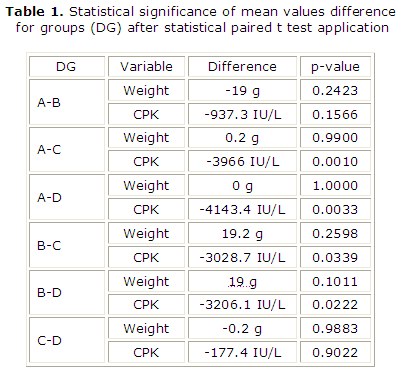
<body><![CDATA[<blockquote>      <p><font face="Verdana, Arial, Helvetica, sans-serif" size="2">- Group A: reperfusion  which lasted 60 min concerned 10 controls rats of mean weight 243 g [Std. Dev:  45.77724 g], mean CPK levels 2170.3 IU/L [Std. Dev: 817.926 IU/L]. </font></p>    <p><font face="Verdana, Arial, Helvetica, sans-serif" size="2">  - Group B: reperfusion which lasted 120 min concerned 10 controls rats of mean  weight 262 g [Std. Dev: 31.10913 g], mean CPK levels 3107.6 IU/L [Std. Dev: 2360.911  IU/L]. </font></p></blockquote>    <p><font face="Verdana, Arial, Helvetica, sans-serif" size="2">  Erythropoietin group: 20 rats of mean weight 242.9 g [Std. Dev: 30.3105 g] suffered  by ischemia for 45 min and then reperfusion in the beginning of which 10 mg Epo/kg  body weight were IV administered. </font></p>    <blockquote>     <p><font face="Verdana, Arial, Helvetica, sans-serif" size="2">  - Group C: reperfusion which lasted 60 min concerned 10 Epo rats of mean weight  242.8 g [Std. Dev: 29.33636 g], mean CPK levels 6136.3 IU/L [Std. Dev: 2973.109  IU/L]. </font></p>    <p><font face="Verdana, Arial, Helvetica, sans-serif" size="2">  - Group D: reperfusion which lasted 120 min concerned 10 Epo rats of mean weight  243 g [Std. Dev: 32.84644 g], mean CPK levels 6313.7 IU/L [Std. Dev: 3826.46 IU/L].  </font></p></blockquote>    <p>&nbsp; </p>    <p><font face="Verdana, Arial, Helvetica, sans-serif" size="2"><b><font size="3">RESULTS</font></b>  </font></p>    <p><font face="Verdana, Arial, Helvetica, sans-serif" size="2"> Every  weight rats group initially was compared with other one from 3 remained groups  applying statistical paired t-test (<A HREF="#tab1">table 1</A>). Any emerging  significant difference among CPK levels, will be investigated whether owed in  the above mentioned probable weight correlations. Every CPK rats group was also  compared with other one from 3 remainder groups applying statistical paired t-test  (<A HREF="#tab1">table 1</A>). </font></p>    ]]></body>
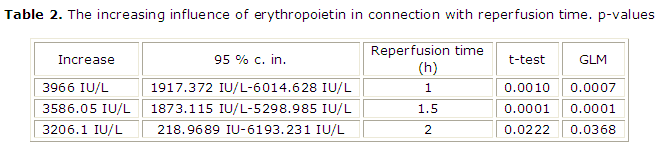
<body><![CDATA[<p ALIGN="CENTER"><IMG SRC="/img/revistas/mil/v43n3/t0102314.gif" WIDTH="400" HEIGHT="377"><A NAME="tab1"></A></p>    <p><font face="Verdana, Arial, Helvetica, sans-serif" size="2">  Applying generalised linear models (GLM) with dependant variable, the predicted  CPK values and independent variables the erythropoietin administration or no,  the reperfusion time and their interaction, results in: Epo administration significantly  increased the CPK levels by 3586.05 IU/L [1873.115 IU/L-5298.985 IU/L] (p= 0.0001).  This finding was in accordance with the result of paired t-test (p= 0.0001). Reperfusion  time non-significantly increased the CPK levels by 557.35 IU/L [-1513.284 IU/L-2627.984  IU/L] (p= 0.5890), also in accordance with paired t-test (p= 0.4661). However,  Epo administration and reperfusion time together significantly increased the CPK  levels by 1988.282 IU/L [918.2646 IU/L-3058.299 IU/L] (p= 0.0006). The <A href="/img/revistas/mil/v43n3/t0202314.gif">table  2</A> sums up concerning the alteration influence of Epo in connection with reperfusion  time. </font></p>    <p><font face="Verdana, Arial, Helvetica, sans-serif" size="2">  Inserting the rats weight as independent variable at GLM, a very significant relation  turns on CPK levels (p= 0.0144), so as to further investigation is needed. The  predicted CPK values, adjusted for rats' weight were calculated. Afterwards, the  predicted CPK values of each one from 4 rats groups were compared with other one  from 3 remainder groups applying statistical paired t-test. The <A href="/img/revistas/mil/v43n3/t0302314.gif">table  3</A> sums up concerning the increasing influence of Epo in connection with reperfusion  time. </font></p>    <p>&nbsp; </p>    <p> <font face="Verdana, Arial, Helvetica, sans-serif" size="2"><b><font size="3">DISCUSSION</font></b>  </font></p>    <p><font face="Verdana, Arial, Helvetica, sans-serif" size="2"> Many  clinical situations can prove how CPK levels are influenced by ischemic cases.  <i>Gon&#231;alves</i> et al subjected<sup>1</sup> rats to ischemia for 30 min.  There was a significant increase in plasma CPK levels of control rats than treated  ones by ornithine &#945;-ketoglutarate at the end of 30 minutes reperfusion period.  <i>Jebeli </i>et al randomized<sup>2 </sup>patients with impaired left ventricular  function [(LVEF) &lt; 35 %] undergoing on-pump coronary artery bypass graft CABG  to receive either milrinone or placebo saline (50 + 0.5 &#956;g/kg/min) respectively.  CPK serum levels, occurrence of myocardial ischemia or infarction were significantly  higher in placebo group (p&lt; 0.05). <i>Sala</i> et al compared<sup>3 </sup>patients  with ventricular tachycardia (VT) occurring within the first 4 days of an acute  phase of myocardial infarction (AMI) with control ones. The profile of patients  with AMI, hospitalized in coronary care unit, who will likely suffer from VT is,  more frequent occurrence of previous AMI, more frequent by 3.95-fold CPK-MB levels  peak &gt; 300 IU/L, more frequent by 11.23-fold ischemia previous to VT and 8.75-fold  greater mortality rate than that in control group (p&lt; 0.001 for all). </font></p>    <p>  <font face="Verdana, Arial, Helvetica, sans-serif" size="2"><i>Serruys </i> et  al assigned<sup>4 </sup>patients after successful completion of their first percutaneous  coronary intervention (PCI) randomly to receive treatment with fluvastatin 80  mg/d, or matching placebo at hospital discharge for 3 to 4 years. Major adverse  cardiac events (MACE)-free survival time was significantly longer in the fluvastatin  group (p= .01). There were no instances of CPK elevations 10 or more times the  upper limit of normal. <i>Savchuk</i> et al caused<sup>5 </sup>short-term myocardial  ischemia which increased the activity of total blood CPK by 57.3 <u>+</u> 11.7  mE/mL (p&lt; 0.001) in dogs. Coronary blood flow disturbances experiments showed  changes in enzymes activity. </font></p>    <p> <font face="Verdana, Arial, Helvetica, sans-serif" size="2"><i>Yang</i>  et al studied<sup>6</sup> the effects on the glycerol-induced rhabdomyolysis,  one of the causes of acute renal failure which significantly increased blood CPK  levels in rats. Ten minutes after rhabdomyolysis, post-treatment with rhEPO (300  U/kg) decreased blood CPK levels and the markers of kidney injury 48 h after glycerol  administration. <i>Popov</i> et al examined the single-nucleotide polymorphism  (SNP) rs1617640 in the promoter of the Epo gene in patients who underwent<sup>7</sup>  cardiac operation with cardiopulmonary bypass (CPB). However, an association between  the TT genotype and acute renal replacement therapy (p= 0.03), and serum CPK-MB  increase (p= 0.03) was observed after operation. They suggest that the risk allele  (T) 36 % homozygous genotype distribution of SNP rs1617640 in the promoter of  the Epo gene plays a role in renal dysfunction development of after CPB operation.  Patients with the TT risk allele required more frequent acute renal replacement  therapy. <i>Wu</i> et al induced<sup>8</sup> endotoxin shock by IV injection of  <i>Escherichia Coli</i> lipopolysaccharide (20 mg/kg) in conscious rats. Endotoxin  shock significantly increased blood CPK levels after sepsis. Epo (300 U/kg, IV  administration) further increased the CPK markers of organ injury after LPS. <i>Cho</i>  et al assigned<sup>9 </sup>healthy male volunteers to 1 of 2 dose (50 IU/kg or  100 IU/kg) of 3 formulations: an albumin-free rhEPO (Aropotin) and 2 existing  rhEPO formulations (Espogen, Recormon) with albumin. After a single 50 or 100  IU/kg dose for Aropotin/Espogen, and for Aropotin/Recormon, the most frequent  adverse events (AEs) were 25 % occurrences of elevated serum CPK levels in the  Recormon 100-IU/kg group over 32 hours. <i>Groopman </i> found zidovudine toxic<sup>10  </sup>to myeloid and erythroid precursors in bone marrow with proliferative capability  of these progenitor cells reduced <u>~</u> 60 %; at concentrations of zidovudine  near those associated with the optimal antiviral effect in vitro. Alleviation  of zidovudine hematologic toxicity includes the use of hematopoietic growth factors,  such as Epo. Anemia, leukopenia and myopathy, also appears to be time and dose  dependent. Patients often exhibit an associated elevation in CPK level. </font></p>    <p><font face="Verdana, Arial, Helvetica, sans-serif" size="2">  Erythropoietin administration, reperfusion time and their interaction have increasing  short- term effect on CPK levels. From clinical situations seems that Epo itself  exerts a restorating influence on CPK release on time, during IR injury. The predicted  results, adjusted for rats' weight as more reliable, show that this CPK levels  rise is not significant yet. This means that the difference of CPK levels from  baseline ones is indeed smaller that it seems. So the restorating effect of Epo  is really much more powerful than it was believed. </font></p>    <p>&nbsp; </p>    ]]></body>
<body><![CDATA[<p> <font face="Verdana, Arial, Helvetica, sans-serif" size="2"><b><font size="3">Acknowledgment</font></b>  </font></p>    <p><font face="Verdana, Arial, Helvetica, sans-serif" size="2"> This  study was funded by Scholarship by the Experimental Research Center ELPEN Pharmaceuticals  (ERCE), Athens, Greece. The research facilities for this project were provided  by the aforementioned institution.</font></p>    <p>&nbsp;</p>    <p><font face="Verdana, Arial, Helvetica, sans-serif" size="2"><b><font size="3">REFERENCES</font></b>  </font></p>    <!-- ref --><p><font face="Verdana, Arial, Helvetica, sans-serif" size="2"> 1.  Gon&ccedil;alves ES, Rabelo CM, Prado Neto AX. Effect of short-term ornithine  alpha-ketoglutarate pretreatment on intestinal ischemia-reperfusion in rats. Acta  Cir Bras. 2011;26 (Suppl 1):2-7.    </font></p>    <!-- ref --><p><font face="Verdana, Arial, Helvetica, sans-serif" size="2">2.  Jebeli M, Ghazinoor M, Mandegar MH. Effect of milrinone on short-term outcome  of patients with myocardial dysfunction undergoing coronary artery bypass graft:  A randomized controlled trial. Cardiol J. 2010;17(1):73-8.    </font></p>    <!-- ref --><p><font face="Verdana, Arial, Helvetica, sans-serif" size="2">3.  Sala MF, B&aacute;rcena JP, Rota JI. Sustained ventricular tachycardia as a marker  of inadequate myocardial perfusion during the acute phase of myocardial infarction.  Clin Cardiol. 2002 Jul;25(7):328-34.    </font></p>    ]]></body>
<body><![CDATA[<!-- ref --><p><font face="Verdana, Arial, Helvetica, sans-serif" size="2">4.  Serruys PW, de Feyter P, Macaya C. Fluvastatin for prevention of cardiac events  following successful first percutaneous coronary intervention: a randomized controlled  trial. JAMA. 2002 Jun 26;287(24):3215-22.    </font></p>    <!-- ref --><p><font face="Verdana, Arial, Helvetica, sans-serif" size="2">5.  Savchuk VI, Vinogradov AV, Pozin VM. Activity of total serum creatine phosphokinase  and its MB fraction in reversible coronary blood flow disorders in dogs in a chronic  experiment. Kardiologia. 1980 Jan;20(1):58-60.    </font></p>    <!-- ref --><p><font face="Verdana, Arial, Helvetica, sans-serif" size="2">6.  Yang FL, Subeq YM, Chiu YH. Recombinant human erythropoietin reduces rhabdomyolysis-induced  acute renal failure in rats. Injury. 2012 Mar;43(3):367-73.     </font></p>    <!-- ref --><p><font face="Verdana, Arial, Helvetica, sans-serif" size="2">7.  Popov AF, Schulz EG, Schmitto JD. Relation between renal dysfunction requiring  renal replacement therapy and promoter polymorphism of the erythropoietin gene  in cardiac surgery. Artif Organs. 2010 Nov;34(11):961-8.    </font></p>    <!-- ref --><p><font face="Verdana, Arial, Helvetica, sans-serif" size="2">8.  Wu WT, Hu TM, Lin NT. Low-dose erythropoietin aggravates endotoxin-induced organ  damage in conscious rats. Cytokine. 2010 Feb;49(2):155-62.     </font></p>    ]]></body>
<body><![CDATA[<!-- ref --><p><font face="Verdana, Arial, Helvetica, sans-serif" size="2">9.  Cho SH, Lim HS, Ghim JL. Pharmacokinetic, tolerability, and bioequivalence comparison  of three different intravenous formulations of recombinant human erythropoietin  in healthy Korean adult male volunteers: an open-label, randomized-sequence, three-treatment,  three-way crossover study. Clin Ther. 2009 May;31(5):1046-53.     </font></p>    <!-- ref --><p><font face="Verdana, Arial, Helvetica, sans-serif" size="2">10.  Groopman JE. Zidovudine intolerance. Rev Infect Dis. 1990 Jul-Aug;12(Suppl 5):S500-6.    </font></p>    <p>&nbsp;</p>    <p>&nbsp;</p>    <p><font face="Verdana, Arial, Helvetica, sans-serif" size="2">Recibido:  17 de febrero de 2014. </font>    <br> <font face="Verdana, Arial, Helvetica, sans-serif" size="2">Aprobado:  17 de abril de 2014. </font></p>    <p>&nbsp; </p>    <p>&nbsp;</p>    ]]></body>
<body><![CDATA[<p> <font face="Verdana, Arial, Helvetica, sans-serif" size="2"><i>Tsompos  Constantinos.</i> Department of Obstetrics &amp; Gynecology. Mesologi County Hospital.  Nafpaktou street. Mesologi 30200. Etoloakarnania. Greece. Tel: 00302631360237.  Fax: 2106811215. Email: <a href="mailto:constantinostsompos@yahoo.com">constantinostsompos@yahoo.com</a></font></p><font face="Verdana, Arial, Helvetica, sans-serif" size="2"><br clear="all"/>  </font>       ]]></body><back>
<ref-list>
<ref id="B1">
<label>1</label><nlm-citation citation-type="journal">
<person-group person-group-type="author">
<name>
<surname><![CDATA[Gonçalves]]></surname>
<given-names><![CDATA[ES]]></given-names>
</name>
<name>
<surname><![CDATA[Rabelo]]></surname>
<given-names><![CDATA[CM]]></given-names>
</name>
<name>
<surname><![CDATA[Prado Neto]]></surname>
<given-names><![CDATA[AX]]></given-names>
</name>
</person-group>
<article-title xml:lang="en"><![CDATA[Effect of short-term ornithine alpha-ketoglutarate pretreatment on intestinal ischemia-reperfusion in rats]]></article-title>
<source><![CDATA[Acta Cir Bras]]></source>
<year>2011</year>
<volume>26</volume>
<numero>^s1</numero>
<issue>^s1</issue>
<supplement>1</supplement>
<page-range>2-7</page-range></nlm-citation>
</ref>
<ref id="B2">
<label>2</label><nlm-citation citation-type="journal">
<person-group person-group-type="author">
<name>
<surname><![CDATA[Jebeli]]></surname>
<given-names><![CDATA[M]]></given-names>
</name>
<name>
<surname><![CDATA[Ghazinoor]]></surname>
<given-names><![CDATA[M]]></given-names>
</name>
<name>
<surname><![CDATA[Mandegar]]></surname>
<given-names><![CDATA[MH]]></given-names>
</name>
</person-group>
<article-title xml:lang="en"><![CDATA[Effect of milrinone on short-term outcome of patients with myocardial dysfunction undergoing coronary artery bypass graft: A randomized controlled trial]]></article-title>
<source><![CDATA[Cardiol J.]]></source>
<year>2010</year>
<volume>17</volume>
<numero>1</numero>
<issue>1</issue>
<page-range>73-8</page-range></nlm-citation>
</ref>
<ref id="B3">
<label>3</label><nlm-citation citation-type="journal">
<person-group person-group-type="author">
<name>
<surname><![CDATA[Sala]]></surname>
<given-names><![CDATA[MF]]></given-names>
</name>
<name>
<surname><![CDATA[Bárcena]]></surname>
<given-names><![CDATA[JP]]></given-names>
</name>
<name>
<surname><![CDATA[Rota]]></surname>
<given-names><![CDATA[JI]]></given-names>
</name>
</person-group>
<article-title xml:lang="en"><![CDATA[Sustained ventricular tachycardia as a marker of inadequate myocardial perfusion during the acute phase of myocardial infarction]]></article-title>
<source><![CDATA[Clin Cardiol.]]></source>
<year>2002</year>
<month> J</month>
<day>ul</day>
<volume>25</volume>
<numero>7</numero>
<issue>7</issue>
<page-range>328-34</page-range></nlm-citation>
</ref>
<ref id="B4">
<label>4</label><nlm-citation citation-type="journal">
<person-group person-group-type="author">
<name>
<surname><![CDATA[Serruys]]></surname>
<given-names><![CDATA[PW]]></given-names>
</name>
<name>
<surname><![CDATA[de Feyter]]></surname>
<given-names><![CDATA[P]]></given-names>
</name>
<name>
<surname><![CDATA[Macaya]]></surname>
<given-names><![CDATA[C]]></given-names>
</name>
</person-group>
<article-title xml:lang="en"><![CDATA[Fluvastatin for prevention of cardiac events following successful first percutaneous coronary intervention: a randomized controlled trial]]></article-title>
<source><![CDATA[JAMA]]></source>
<year>2002</year>
<month> J</month>
<day>un</day>
<volume>287</volume>
<numero>24</numero>
<issue>24</issue>
<page-range>3215-22</page-range></nlm-citation>
</ref>
<ref id="B5">
<label>5</label><nlm-citation citation-type="journal">
<person-group person-group-type="author">
<name>
<surname><![CDATA[Savchuk]]></surname>
<given-names><![CDATA[VI]]></given-names>
</name>
<name>
<surname><![CDATA[Vinogradov]]></surname>
<given-names><![CDATA[AV]]></given-names>
</name>
<name>
<surname><![CDATA[Pozin]]></surname>
<given-names><![CDATA[VM]]></given-names>
</name>
</person-group>
<article-title xml:lang="en"><![CDATA[Activity of total serum creatine phosphokinase and its MB fraction in reversible coronary blood flow disorders in dogs in a chronic experiment]]></article-title>
<source><![CDATA[Kardiologia]]></source>
<year>1980</year>
<month> J</month>
<day>an</day>
<volume>20</volume>
<numero>1</numero>
<issue>1</issue>
<page-range>58-60</page-range></nlm-citation>
</ref>
<ref id="B6">
<label>6</label><nlm-citation citation-type="journal">
<person-group person-group-type="author">
<name>
<surname><![CDATA[Yang]]></surname>
<given-names><![CDATA[FL]]></given-names>
</name>
<name>
<surname><![CDATA[Subeq]]></surname>
<given-names><![CDATA[YM]]></given-names>
</name>
<name>
<surname><![CDATA[Chiu]]></surname>
<given-names><![CDATA[YH]]></given-names>
</name>
</person-group>
<article-title xml:lang="en"><![CDATA[Recombinant human erythropoietin reduces rhabdomyolysis-induced acute renal failure in rats]]></article-title>
<source><![CDATA[Injury.]]></source>
<year>2012</year>
<month> M</month>
<day>ar</day>
<volume>43</volume>
<numero>3</numero>
<issue>3</issue>
<page-range>367-73</page-range></nlm-citation>
</ref>
<ref id="B7">
<label>7</label><nlm-citation citation-type="journal">
<person-group person-group-type="author">
<name>
<surname><![CDATA[Popov]]></surname>
<given-names><![CDATA[AF]]></given-names>
</name>
<name>
<surname><![CDATA[Schulz]]></surname>
<given-names><![CDATA[EG]]></given-names>
</name>
<name>
<surname><![CDATA[Schmitto]]></surname>
<given-names><![CDATA[JD]]></given-names>
</name>
</person-group>
<article-title xml:lang="en"><![CDATA[Relation between renal dysfunction requiring renal replacement therapy and promoter polymorphism of the erythropoietin gene in cardiac surgery]]></article-title>
<source><![CDATA[Artif Organs.]]></source>
<year>2010</year>
<month>No</month>
<day>v</day>
<volume>34</volume>
<numero>11</numero>
<issue>11</issue>
<page-range>961-8</page-range></nlm-citation>
</ref>
<ref id="B8">
<label>8</label><nlm-citation citation-type="journal">
<person-group person-group-type="author">
<name>
<surname><![CDATA[Wu]]></surname>
<given-names><![CDATA[WT]]></given-names>
</name>
<name>
<surname><![CDATA[Hu]]></surname>
<given-names><![CDATA[TM]]></given-names>
</name>
<name>
<surname><![CDATA[Lin]]></surname>
<given-names><![CDATA[NT]]></given-names>
</name>
</person-group>
<article-title xml:lang="en"><![CDATA[Low-dose erythropoietin aggravates endotoxin-induced organ damage in conscious rats]]></article-title>
<source><![CDATA[Cytokine.]]></source>
<year>2010</year>
<month>Fe</month>
<day>b</day>
<volume>49</volume>
<numero>2</numero>
<issue>2</issue>
<page-range>155-62</page-range></nlm-citation>
</ref>
<ref id="B9">
<label>9</label><nlm-citation citation-type="journal">
<person-group person-group-type="author">
<name>
<surname><![CDATA[Cho]]></surname>
<given-names><![CDATA[SH]]></given-names>
</name>
<name>
<surname><![CDATA[Lim]]></surname>
<given-names><![CDATA[HS]]></given-names>
</name>
<name>
<surname><![CDATA[Ghim]]></surname>
<given-names><![CDATA[JL]]></given-names>
</name>
</person-group>
<article-title xml:lang="en"><![CDATA[Pharmacokinetic, tolerability, and bioequivalence comparison of three different intravenous formulations of recombinant human erythropoietin in healthy Korean adult male volunteers: an open-label, randomized-sequence, three-treatment, three-way crossover study]]></article-title>
<source><![CDATA[Clin Ther.]]></source>
<year>2009</year>
<month>Ma</month>
<day>y</day>
<volume>31</volume>
<numero>5</numero>
<issue>5</issue>
<page-range>1046-53</page-range></nlm-citation>
</ref>
<ref id="B10">
<label>10</label><nlm-citation citation-type="journal">
<person-group person-group-type="author">
<name>
<surname><![CDATA[Groopman]]></surname>
<given-names><![CDATA[JE]]></given-names>
</name>
</person-group>
<article-title xml:lang="en"><![CDATA[Zidovudine intolerance]]></article-title>
<source><![CDATA[Rev Infect Dis]]></source>
<year>1990</year>
<month> J</month>
<day>ul</day>
<volume>12</volume>
<numero>^s5</numero>
<issue>^s5</issue>
<supplement>5</supplement>
<page-range>S500-6</page-range></nlm-citation>
</ref>
</ref-list>
</back>
</article>