<?xml version="1.0" encoding="ISO-8859-1"?><article xmlns:mml="http://www.w3.org/1998/Math/MathML" xmlns:xlink="http://www.w3.org/1999/xlink" xmlns:xsi="http://www.w3.org/2001/XMLSchema-instance">
<front>
<journal-meta>
<journal-id>0138-6557</journal-id>
<journal-title><![CDATA[Revista Cubana de Medicina Militar]]></journal-title>
<abbrev-journal-title><![CDATA[Rev Cub Med Mil]]></abbrev-journal-title>
<issn>0138-6557</issn>
<publisher>
<publisher-name><![CDATA[Centro Nacional de Información de Ciencias MédicasEditorial Ciencias Médicas]]></publisher-name>
</publisher>
</journal-meta>
<article-meta>
<article-id>S0138-65572014000300004</article-id>
<title-group>
<article-title xml:lang="es"><![CDATA[The occupational stress affects the health conditions of military police officers]]></article-title>
<article-title xml:lang="en"><![CDATA[El estrés laboral afecta las condiciones de salud de los oficiales de la policía militar]]></article-title>
</title-group>
<contrib-group>
<contrib contrib-type="author">
<name>
<surname><![CDATA[Melo Schlichting Junior]]></surname>
<given-names><![CDATA[Antônio]]></given-names>
</name>
<xref ref-type="aff" rid="A01"/>
</contrib>
<contrib contrib-type="author">
<name>
<surname><![CDATA[Cascaes da Silva]]></surname>
<given-names><![CDATA[Franciele]]></given-names>
</name>
<xref ref-type="aff" rid="A01"/>
</contrib>
<contrib contrib-type="author">
<name>
<surname><![CDATA[Valdeni Manoel]]></surname>
<given-names><![CDATA[Bernardo]]></given-names>
</name>
<xref ref-type="aff" rid="A01"/>
</contrib>
<contrib contrib-type="author">
<name>
<surname><![CDATA[Gonçalves]]></surname>
<given-names><![CDATA[Elizandra]]></given-names>
</name>
<xref ref-type="aff" rid="A01"/>
</contrib>
<contrib contrib-type="author">
<name>
<surname><![CDATA[Barbosa Gutierres Filho]]></surname>
<given-names><![CDATA[Paulo José]]></given-names>
</name>
<xref ref-type="aff" rid="A01"/>
</contrib>
<contrib contrib-type="author">
<name>
<surname><![CDATA[da Silva]]></surname>
<given-names><![CDATA[Rudney]]></given-names>
</name>
<xref ref-type="aff" rid="A01"/>
</contrib>
</contrib-group>
<aff id="A01">
<institution><![CDATA[,Univ. Estadual de Santa Catarina Center of Health Sciences and Sport ]]></institution>
<addr-line><![CDATA[Florianópolis ]]></addr-line>
<country>Brazil</country>
</aff>
<pub-date pub-type="pub">
<day>00</day>
<month>09</month>
<year>2014</year>
</pub-date>
<pub-date pub-type="epub">
<day>00</day>
<month>09</month>
<year>2014</year>
</pub-date>
<volume>43</volume>
<numero>3</numero>
<fpage>293</fpage>
<lpage>306</lpage>
<copyright-statement/>
<copyright-year/>
<self-uri xlink:href="http://scielo.sld.cu/scielo.php?script=sci_arttext&amp;pid=S0138-65572014000300004&amp;lng=en&amp;nrm=iso"></self-uri><self-uri xlink:href="http://scielo.sld.cu/scielo.php?script=sci_abstract&amp;pid=S0138-65572014000300004&amp;lng=en&amp;nrm=iso"></self-uri><self-uri xlink:href="http://scielo.sld.cu/scielo.php?script=sci_pdf&amp;pid=S0138-65572014000300004&amp;lng=en&amp;nrm=iso"></self-uri><abstract abstract-type="short" xml:lang="en"><p><![CDATA[Introduction: the agents who are responsible for the public security are exposed to working conditions that affect quality of life, sspecially the stress that these professionals daily experience. Objective: to describe the socio-demographic and occupational characteristics, the health conditions and the occupational stress indicators of the of military officers from the State of Santa Catarina. Methods: descriptive correlational study with a sample of 1069 subjects, 583 police officers in qualifying course (QMO) and 486 qualified officers. The Short Form Health Survey and Occupational Stress Indicators were applied. Results: the results showed that the scores of health conditions were below the cut off for both the physical and the mental components. The vitality variable (p= .000), social functioning (p= .017), age (p= .018) and number of hours worked per day (p= .023) showed a significant association with occupational stress score, Conclusions: it is concluded that there are significant differences between health indicators and occupational stress. The tendency to reduction of vitality caused by occupational stress and the social function increases with the age and with higher number of workhours per day.]]></p></abstract>
<abstract abstract-type="short" xml:lang="es"><p><![CDATA[Introducción: los individuos que velan por la seguridad pública están expuestos a condiciones de trabajo que afectan la calidad de vida, especialmente el nivel de estrés que experimentan a diario. La gran demanda de salud física y psicológica es provocada por la incertidumbre de enfrentarse a la muerte, y por el mantenimiento diario a la rutina. Objetivo: describir las características sociodemográficas y ocupacionales, las condiciones de salud y los indicadores de estrés laboral de los oficiales militares del Estado de Santa Catarina. Métodos: estudio descriptivo correlacional con una muestra de 1 069 sujetos, 583 policías participantes del curso de formación y 486 policías efectivos. Se aplicaron los instrumentos: Short Form Health Survey e indicadores de estrés laboral. Resultados: las condiciones de salud de la muestra están por debajo de los parámetros establecidos, ya sea para el componente físico como para el mental. El componente vitalidad (p= 0,000), funcionamiento social (p= 0,017), edad (p= 0,018) y número de horas trabajadas por día (p= 0,023) evidenciaron relaciones significativas con la puntuación de estrés ocupacional. Conclusiones: existen diferencias significativas entre el estrés laboral y los indicadores de salud. La tendencia a disminuir la vitalidad por estrés laboral y la función social aumentan con la edad y el número de horas de trabajo por día.]]></p></abstract>
<kwd-group>
<kwd lng="en"><![CDATA[police]]></kwd>
<kwd lng="en"><![CDATA[health]]></kwd>
<kwd lng="en"><![CDATA[psychological stress]]></kwd>
<kwd lng="es"><![CDATA[policía]]></kwd>
<kwd lng="es"><![CDATA[salud]]></kwd>
<kwd lng="es"><![CDATA[estrés psicológico]]></kwd>
</kwd-group>
</article-meta>
</front><body><![CDATA[ <p align="right"><font face="Verdana, Arial, Helvetica, sans-serif" size="2"><b>ART&#205;CULO  ORIGINAL</b> </font></p>    <p>&nbsp; </p>    <p><font face="Verdana, Arial, Helvetica, sans-serif" size="2"><b><font size="4">The  occupational stress affects the health conditions of military police officers</font></b>  </font></p>    <p>&nbsp; </p>    <p><font face="Verdana, Arial, Helvetica, sans-serif" size="2"><b><font size="3">El  estr&#233;s laboral afecta las condiciones de salud de los oficiales de la polic&#237;a  militar</font></b> </font></p>    <p align="center">&nbsp;</p>    <p align="center">&nbsp; </p>    <p>  <font face="Verdana, Arial, Helvetica, sans-serif" size="2"><b>MSc. Ant&#244;nio  Melo Schlichting Junior, Spec. Franciele Cascaes da Silva, Teach. Valdeni Manoel  Bernardo, Spec</b>. <b> Elizandra Gon&#231;alves, </b> <b>Phd Paulo Jos&#233;  Barbosa Gutierres Filho, Phd Rudney da Silva</b></font></p>    <p><font face="Verdana, Arial, Helvetica, sans-serif" size="2">Center  of Health Sciences and Sport. Univ. Estadual de Santa Catarina. Florian&#243;polis,  Brazil. </font></p>    <p>&nbsp; </p>    ]]></body>
<body><![CDATA[<p>&nbsp;</p><hr size="1" noshade>     <p><font face="Verdana, Arial, Helvetica, sans-serif" size="2"><b>ABSTRACT</b></font></p>    <P><FONT FACE="Verdana" SIZE="2"><B>Introduction:  </B>the agents who are responsible for the public security are exposed to working  conditions that affect quality of life, sspecially the stress that these professionals  daily experience.     <BR><B>Objective:</B> to describe the socio-demographic and  occupational characteristics, the health conditions and the occupational stress  indicators of the of military officers from the State of Santa Catarina.     <BR><B>Methods:</B>  descriptive correlational study with a sample of 1069 subjects, 583 police officers  in qualifying course (QMO) and 486 qualified officers. The Short Form Health Survey  and Occupational Stress Indicators were applied.     <BR><B>Results: </B>the results  showed that the scores of health conditions were below the cut off for both the  physical and the mental components. The vitality variable (p= .000), social functioning  (p= .017), age (p= .018) and number of hours worked per day (p= .023) showed a  significant association with occupational stress score,     <BR><B>Conclusions:</B>  it is concluded that there are significant differences between health indicators  and occupational stress. The tendency to reduction of vitality caused by occupational  stress and the social function increases with the age and with higher number of  workhours per day.</FONT></P>    <P><FONT FACE="Verdana" SIZE="2"><B>Keywords: </B>police,  health, psychological stress.</FONT></P><hr size="1" noshade>     <p><FONT FACE="Verdana, Arial, Helvetica, sans-serif" SIZE="2"><B>RESUMEN</B>  </FONT></p>    <P> <FONT FACE="Verdana, Arial, Helvetica, sans-serif" SIZE="2"><B>Introducci&#243;n:</B>  los individuos que velan por la seguridad p&#250;blica est&#225;n expuestos a  condiciones de trabajo que afectan la calidad de vida, especialmente el nivel  de estr&#233;s que experimentan a diario. La gran demanda de salud f&#237;sica  y psicol&#243;gica es provocada por la incertidumbre de enfrentarse a la muerte,  y por el mantenimiento diario a la rutina. </FONT>    ]]></body>
<body><![CDATA[<BR> <FONT FACE="Verdana, Arial, Helvetica, sans-serif" SIZE="2"><B>Objetivo:  </B> describir las caracter&#237;sticas sociodemogr&#225;ficas y ocupacionales,  las condiciones de salud y los indicadores de estr&#233;s laboral de los oficiales  militares del Estado de Santa Catarina. </FONT>    <BR> <FONT FACE="Verdana, Arial, Helvetica, sans-serif" SIZE="2"><B>M&#233;todos:  </B> estudio descriptivo correlacional con una muestra de 1 069 sujetos, 583 polic&#237;as  participantes del curso de formaci&#243;n y 486 polic&#237;as efectivos. Se aplicaron  los instrumentos: <I>Short Form Health Survey</I> e indicadores de estr&#233;s  laboral. </FONT>    <BR> <FONT FACE="Verdana, Arial, Helvetica, sans-serif" SIZE="2"><B>Resultados:</B>  las condiciones de salud de la muestra est&#225;n por debajo de los par&#225;metros  establecidos, ya sea para el componente f&#237;sico como para el mental. El componente  vitalidad (p= 0,000), funcionamiento social (p= 0,017), edad (p= 0,018) y n&#250;mero  de horas trabajadas por d&#237;a (p= 0,023) evidenciaron relaciones significativas  con la puntuaci&#243;n de estr&#233;s ocupacional. </FONT>    <BR> <FONT FACE="Verdana, Arial, Helvetica, sans-serif" SIZE="2"><B>Conclusiones:</B>  existen diferencias significativas entre el estr&#233;s laboral y los indicadores  de salud. La tendencia a disminuir la vitalidad por estr&#233;s laboral y la funci&#243;n  social aumentan con la edad y el n&#250;mero de horas de trabajo por d&#237;a.  </FONT></P>    <P><FONT FACE="Verdana, Arial, Helvetica, sans-serif" SIZE="2"><B>Palabras  clave:</B> polic&#237;a, salud, estr&#233;s psicol&#243;gico. </FONT></P><hr size="1" noshade>      <p>&nbsp;</p>    <p>&nbsp; </p>    <p> <font face="Verdana, Arial, Helvetica, sans-serif" size="2"><b><font size="3">INTRODUCTION</font></b>  </font></p>    <p><font face="Verdana, Arial, Helvetica, sans-serif" size="2"> The  agents who are responsible for the public security are exposed to working conditions  that affect quality of life, especially the states of stress experienced daily  by these professionals.<sup>1</sup> The high physical and psychological demand  of the professionals in public security is triggered by the uncertainty of impending  fatal confrontation and the routine daily servicing.<sup>2</sup> Current studies  indicate serious conditions related to physical and mental condition of police  that may affect their professional performances, especially those associated with  states of stress and occupational dissatisfaction.<sup>3-6</sup> </font></p>    <p><font face="Verdana, Arial, Helvetica, sans-serif" size="2">  Studies have also shown that police officers have low levels of life quality associated  with higher levels of stress.<sup>7,8</sup> <i>Costa, Accioly Junior Oliveira  and Maia<sup>9</sup></i> conducted a study with the Military Police Officers of  Natal-RN and they found out that 47.4 % showed indicative of stress, among the  47 %, 36 % with psychological symptoms and 11.4 % with physical symptoms. <i>Moraes,  Marques and Portes</i> <sup>10</sup> conducted a study with the Military Police  Officers of Belo Horizonte-MG and they found that the main sources of occupational  stress were related to workload, interrelationships, environment and corporate  climate. </font></p>    ]]></body>
<body><![CDATA[<p><font face="Verdana, Arial, Helvetica, sans-serif" size="2">  In a survey performed by the State of Santa Catarina about the reasons of stress  in Public Security Professionals, it was identified that Military Police Officers  show increased rates of resistance, phase in which the coping strategies used  still maintain the overall balance of the body. However, it should be highlighted  that the deleterious conditions resulting from occupational stress may, throughout  time, affect the commitment to the profession, and reduce the health and life  quality conditions in the Military Police Officers.<sup>10,11</sup> </font></p>    <p><font face="Verdana, Arial, Helvetica, sans-serif" size="2">  Considering the performance in public security by the Military Police Officers  and the deleterious consequences related to stress, this study aims to describe  and relate the socio-demographic and occupational characteristics, the health  conditions and the indicators of occupational stress of military officers of the  State of Santa Catarina. </font></p>    <p>&nbsp; </p>    <p><font face="Verdana, Arial, Helvetica, sans-serif" size="2"><b><font size="3">METHODS</font></b>  </font></p>    <p><font face="Verdana, Arial, Helvetica, sans-serif" size="2"> This  research was designed as a correlational descriptive study. It was submitted and  approved by the Ethics Committee on Research involving Human Subjects of the University  of the State of Santa Catarina, under the protocol number 132/2011 and 174/2011.  </font></p>    <p> <font face="Verdana, Arial, Helvetica, sans-serif" size="2"><b>    <br>  Sample</b> </font></p>    <p><font face="Verdana, Arial, Helvetica, sans-serif" size="2">  The population was consisted of actual military officers of the Military Police  of Santa Catarina, being 11 663 were active, 4 839 were in reserve, 2 300 from  the training courses for soldiers (CFSD) and 180 from training courses for officers  (CFO) identified between 2010 and 2012 (N= 18,982) . </font></p>    <p><font face="Verdana, Arial, Helvetica, sans-serif" size="2">  The quantitative calculation of the sample was made through <i>software SampleXS</i>  <i>for</i> <i>Windows</i>, according to the equation: <i>n= N</i>(<i>p/</i>100)(E/100),  where n= sample size, N= population size, E= tolerable sampling error (.05), and  p= estimating prevalence at 50 %. The quantitative sampling for finite populations  was set at 557 study subjects obtained by accidental sampling<sup>12</sup> for  qualified police officers (QPO) and 471 in qualification for military officers  (QMO), adopting prevalence of occurrence of occupational stress of 50 %, margin  of error less than 5 %, design effect of 1.5 points, and increase of 10 % for  sample loss, totaling 1,131 subjects (n). Sample totaling a loss of 5.5 % (QPO=  6.2 %; QMO= 4.9 %), after a preliminary analysis in 1 069 cases (583 subjects  QMO= QPO= 486) were validated. </font></p>    <p align="left"><font face="Verdana, Arial, Helvetica, sans-serif" size="2"><b>    ]]></body>
<body><![CDATA[<br>  Instruments</b> </font></p>    <p><font face="Verdana, Arial, Helvetica, sans-serif" size="2">  Two instruments were used for data collection: a) Short Form Health Survey (SF-36);  b) Occupational Stress Indicators (OSI). It was used as well a spreadsheet to  collect socio-demographic data (gender, age, possession of household goods, education)  and occupational (training area, official graduation, length of employment, number  of hours of daily work, number of days worked per week, quantity of days worked  per week, type of activity). </font></p>    <p><font face="Verdana, Arial, Helvetica, sans-serif" size="2">  The SF-36 was selected because it allows the measurement of life quality related  to health conditions living, being comprised of 36 items that are grouped into  eight different areas: functional capacity, physical aspects, pain, general state  of health, vitality, social aspect, emotional aspects, mental health.<sup>13,14</sup>  The scores of the SF-36 are calculated from the issues assessed by responses from  Likert scale, which allows the calculation of the areas investigated as criteria  and formula proposed by <i>Ware and Gandek<sup>13</sup></i> and validated in Brazil  by <i>Cicconeli, Ferraz and Santos</i><sup>14</sup> that indicate points of 0  (worst health condition) to 100 points (best health condition). </font></p>    <p><font face="Verdana, Arial, Helvetica, sans-serif" size="2">  The OSI was selected because it allows measurement of satisfaction with psychosocial  work-related aspects, consisting of 22 questions prepared by the Likert scale  of six points ranging from huge dissatisfaction to huge satisfaction for every  aspect of the job. The indicators are obtained from the sum of the measures of  satisfaction with the overall work that can range from 22 to 132 points. The OSI  was developed by <i>Robertson, Cooper and Williams</i><sup>15</sup> and was translated  into Portuguese and validated by <i>Swan, Moraes and Cooper.</i><sup>16</sup>  The rates of occupational satisfaction obtained by OSI criteria adopted by <i>Swan</i>  et al.<sup>16</sup> (22-132 points) that do not have defined point cut or split-level,  but which are categorized by <i>Martinez</i>, <i>Paraguay </i>and <i>Latorre</i><sup>17</sup>  (&lt; 44 points= satisfaction; 44-86 points= intermediate satisfaction; &gt; 86  points= dissatisfaction). </font></p>    <p> <font face="Verdana, Arial, Helvetica, sans-serif" size="2"><b>    <br>  Procedures</b> </font></p>    <p><font face="Verdana, Arial, Helvetica, sans-serif" size="2">  Initially it was requested the necessary institutional consents, in this case,  of the Board of Health and Social Promotion of the Military Police of Santa Catarina  and then the permissions of the command units of the Military Police of Santa  Catarina that were accidentally selected. After obtaining the consents and permissions,  the study was approved by the Ethics Committee in Research involving humans. </font></p>    <p><font face="Verdana, Arial, Helvetica, sans-serif" size="2">  The procedures began only after obtaining the consent of the military police officers.  However, it was offered to the subjects to sign the term of free and informed  consent, guaranteeing thereby the complete anonymity of the respondents. After  the invitation to heads of units of the Military Police of Santa Catarina, visits  were made directly in the places requesting the participation of the military  police officers. </font></p>    <p><font face="Verdana, Arial, Helvetica, sans-serif" size="2">  All units of the Military Police of Santa Catarina who were contacted enabled  the research. However, the data collection with the military police officers was  strictly between those who volunteered to participate in the study. </font></p>    <p><font face="Verdana, Arial, Helvetica, sans-serif" size="2">  The survey was conducted through questionnaires and it was answered in three basic  ways: </font></p>    ]]></body>
<body><![CDATA[<blockquote>     <p><font face="Verdana, Arial, Helvetica, sans-serif" size="2">  - Filled by the researchers from the information reported directly by the research  subjects </font></p>    <p><font face="Verdana, Arial, Helvetica, sans-serif" size="2">  - Filled by the research subjects themselves and later picked up by the researchers  </font></p>    <p><font face="Verdana, Arial, Helvetica, sans-serif" size="2"> - Filled  and sent by the subject through the email address provided by the subject. </font></p></blockquote>    <p><font face="Verdana, Arial, Helvetica, sans-serif" size="2">  The subjects who were not in the units on the days scheduled for data collection  were subsequently contacted, and those who agreed to participate were submitted  to the questionnaires. After the tabulation, analysis and systematization of the  data, it was delivered the main results, in an absolutely anonymity way to the  responsible for the Department of Health and Social Promotion of the Military  Police of Santa Catarina. </font></p>    <p align="left"><font face="Verdana, Arial, Helvetica, sans-serif" size="2"><b>    <br>  Statistical Analysis</b> </font></p>    <p><font face="Verdana, Arial, Helvetica, sans-serif" size="2">  The Data was tabulated in Microsoft Excel program version 2007 and analyzed using  the Statistical Package Social Science (SPSS) version 20.0 program. The data was  processed and shown through the minimum, maximum, medium measures and standard  deviation, and confidence interval of 95 % (IC95 %). The reliability of the results  of the instruments was assessed using Cronbach's coefficient, adopting an alpha  value equal or higher than .700 for both all the items evaluated, as for standardized  items .The Data normality was assessed using the Kolmogorov - Smirnov test. The  significance level for all analyzes was set at p&lt; .05. </font></p>    <p><font face="Verdana, Arial, Helvetica, sans-serif" size="2">  The Comparisons were made on variables considering two stratums. The first related  to the military police officers who were in the process of qualification (QMO).  The second related to qualified military officers who worked in the profession,  which was compared between those who worked in the administrative activity (QPO)  and those who worked in the operating activities (PMO). The results were obtained  by Kruskal Wallis test followed by the Mann Whitney U test with Bonferroni's correction.  </font></p>    <p><font face="Verdana, Arial, Helvetica, sans-serif" size="2"> The  relationships between the variables of occupational stress, health conditions  and demographic and occupational characteristics were calculated by simple linear  regression, and later under multiple model for the stratum and the QPO stratum  and the QMO stratum. Thus, the dependent variable considered was the level of  satisfaction with psychosocial aspects of work related to demographic, occupational,  health and stress variables considered as independent. </font></p>    ]]></body>
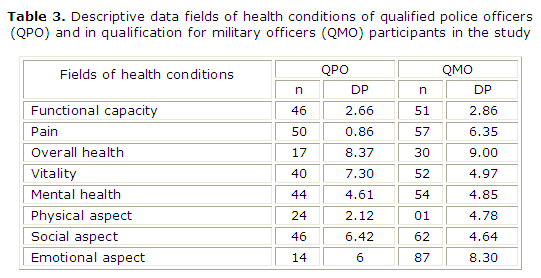
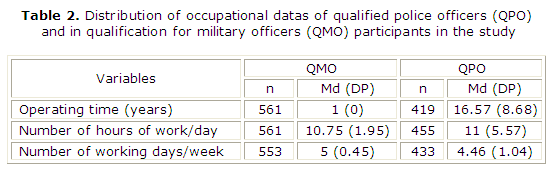
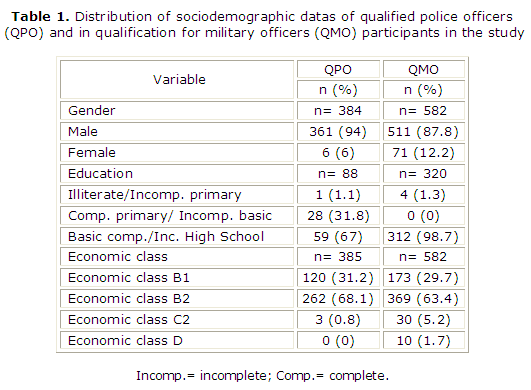
<body><![CDATA[<p><font face="Verdana, Arial, Helvetica, sans-serif" size="2">  Each independent variable was analyzed in relation to the dependent one, according  to a simple linear regression model. The cut off for entry into the multivariate  model is the value of <i>p</i> less or equal than.20 For multiple regression model,  the variables were charged as per the stepwise model, which were considered significant  when the p value was less than .05 and/or when they would modify more than 10  % the value of the angular coefficient ( &#946; ) of any variable in the model.  The multiple model can be described by the equation: <i>Y= &#946;</i><sub>0</sub>  + <i>&#946;</i><sub>1</sub> <i>X</i> + <i>&#946;</i><sub>2</sub><i>X</i> + ...  + <i>&#946;</i><sub>n</sub><i>X</i>, where Y= predicted value of the dependent  variable, &#946;0= Y axis intercept (value of variable Y when= 0), &#946;i= inclination  of the line (angular coefficient-increment value from Y to each unit of X when  all other independent variables remain constant). </font></p>    <p><font face="Verdana, Arial, Helvetica, sans-serif" size="2">  The Data are presented as the functional situation of the subjects considering  that they were characterized as per the statute of Military Police, divided in  military officers in training, in other words, not yet qualified, named Military  Police Qualifying (QMO) and military officers who are already exercising their  profession, named military Police Qualified (QPO). </font></p>    <p>&nbsp; </p>    <p><font face="Verdana, Arial, Helvetica, sans-serif" size="2"><b><font size="3">RESULTS</font></b>  </font></p>    <p><font face="Verdana, Arial, Helvetica, sans-serif" size="2"> The  analysis of internal reliability of the Short Form Outcome Medicals (SF-36) responses  determined alpha of 0.910, ranging from 0.904 (how long you feel full of vigor,  full of desire, full of strength) to 0.930 (rank of general health compared to  one year ago ) and the Occupational Stress Indicators (OSI) responses determined  alpha of 0.967, ranging from 0.965 (feeling in relation to personal current career  opportunities) to 0.968 (feeling regarding the relationship with others in the  institution that works. Thus, the reliability coefficients were considered excellent  (OSI) and great (SF-36) on adopted values. </font></p>    <p><font face="Verdana, Arial, Helvetica, sans-serif" size="2">  The socio-demographic data characterize the subjects mostly from both groups,  as males with complete or incomplete high school, and belonging to the middle  class (<A HREF="#tab1">table 1</A>). It can also be pointed that the average age  of QMO was 27.47 years (DP= 3.13), and the QPO was 37.10 years (DP= 7.5). </font></p>    <p ALIGN="CENTER"><IMG SRC="/img/revistas/mil/v43n3/t0104314.gif" WIDTH="531" HEIGHT="390"><A NAME="tab1"></A></p>    <p><font face="Verdana, Arial, Helvetica, sans-serif" size="2">  The occupational data regarding the graduation of the police officer, indicates  that between QMO presents only one subject was in the position of Cadet from the  Officer Training Course, while other students were Soldiers (f= 582, 99.82 %).  Among the QPO, it was found that the majority was in the degree of soldier (f=  297, 65.9 %). Both groups work around five days a week, 11 hours per day, and  QPO serve public security an average of 16:57 years (<A HREF="#tab2">table 2</A>).  </font></p>    <p ALIGN="CENTER"><IMG SRC="/img/revistas/mil/v43n3/t0204314.gif" WIDTH="554" HEIGHT="173"><A NAME="tab2"></A></p>    <p><font face="Verdana, Arial, Helvetica, sans-serif" size="2">  The data relating to domain scores of the health conditions of the Military Police  shows, in both groups, that the highest score refers to the field of functional  capacity and the lower scores refer to the areas of pain and vitality. The results  of the components of the health conditions of the Military Police Officers point  scores below the cut off, both physical (QMO: 50 points; QPO: 47 points) and mental  (QMO: 45 points; QPO: 41 points) (<A HREF="#tab3">table 3</A>). </font></p>    ]]></body>
<body><![CDATA[<p ALIGN="CENTER"><IMG SRC="/img/revistas/mil/v43n3/t0304314.gif" WIDTH="541" HEIGHT="278"><A NAME="tab3"></A></p>    <p><font face="Verdana, Arial, Helvetica, sans-serif" size="2">  The data associated to the overall satisfaction of work noticed from the indicators  of occupational stress of the Military Police Officers show that most of the subjects  are categorized with intermediate satisfaction (QMO: 77.1 %; QPO: 56.1%). On the  other hand, the average score of overall satisfaction noticed from the indicators  of occupational stress was 61.67 (DP= 18.95) points for QMO, and 80.10 (DP= 23.9)  points for the QPO. It is important to highlight that higher the score of the  overall satisfaction with work results to higher occupational stress. Moreover,  it was found that a higher percentage of officers already graduated are satisfied  with the work compared to students of the training courses. </font></p>    <p><font face="Verdana, Arial, Helvetica, sans-serif" size="2">  The Comparisons of the Military Police Officers in the varying conditions of health  and indicators of occupational stress shows that when the military officers who  are taking the training course are compared to the police officers in action,  as well as, among the police officers that work in operational and administrative  activity, indicate significant differences (p&lt; .05) for all variables. These  differences show that the Military Police Officers who are taking the training  course show a better situation concerning the variables such as occupational stress,  functioning capacity, pain, general health, vitality, social function, mental  health, irritability, worry and depression compared to the group of Qualified  Military Police Officers. All these differences, considering p&lt; .05 (<A HREF="#tab4">table  4</A>). </font></p>    <p ALIGN="CENTER"><IMG SRC="/img/revistas/mil/v43n3/t0404314.gif" WIDTH="573" HEIGHT="368"><A NAME="tab4"></A></p>    <p><font face="Verdana, Arial, Helvetica, sans-serif" size="2">  Considering that the ostensive action is the main function of the Institution,  it was found that most of the subjects engaged in operating activities (n= 303,  62.3 %), among those working predominantly in operating, most of them work in  the police car (n= 109, 45.2 %). When the group of the Military Police Officers  of Operational Activity (PMO), are compared to the Group of the Military Police  Officers of the Administrative Activity (QPO), it appears that QPO were on average  better than the PMO group in all variables, except the variable of occupational  stress and physical activity level (<A href="/img/revistas/mil/v43n3/t0504314.gif">table 5</A>). </font></p>    <p><font face="Verdana, Arial, Helvetica, sans-serif" size="2">  The Multiple regression of the overall occupational stress score was performed  with the variables of health-related quality of life, both QMO and QPO. After  completion of the simple regression of each of the independent variables in relation  to the dependent variable, the following variables were selected: vitality (B=  -0.403), social aspect (B= -0.120), amount of hours worked (B= 0.370) and age  (B= 0.345), all with the value of p&lt; .20, all of which remained with adopted  significance in the final model (p&lt; .05). These variables can explain 22.2  % of the occurrence of occupational stress. </font></p>    <p><font face="Verdana, Arial, Helvetica, sans-serif" size="2">  The analysis of the regression coefficients indicates that for every unit increase  in overall score of occupational stress is identified decreased vitality 0.403  points and 0.120 points in social aspect, as well as increasing age in 03.45 years  and the amount of hours worked per day in 0.370 h. Thus, it can be suggested that  the Military Police Officers with higher overall scores of occupational stress  tend to have lower scores for vitality and social function and have a greater  number of hours worked and age, independent of each final independent variables.  </font></p>    <p align="center">&nbsp; </p>    <p> <font face="Verdana, Arial, Helvetica, sans-serif" size="2"><b><font size="3">DISCUSSION</font></b>  </font></p>    <p><font face="Verdana, Arial, Helvetica, sans-serif" size="2"> The  occupational data characterize the subjects mostly as soldiers in QPO group of  predominantly operational performance, with the average time of admittance Institution  16.57 years, both groups work five days a week and 11 hours a day. These results  partially converge the study by <i>Jesus and Jesus</i><sup>4</sup> which showed  that 82.5 % of the sample was soldiers with 13.41 years of Institution, with time  of service from 11 to 20 years (48.8 %). On the other hand, <i>Ferreira, Bonfim  and Augusto</i><sup>18</sup> studied military police officers, most with more  than 18 years of institution (57 %), with an average of Institution time of 16  years, with weekly workload of 44 hours with average time of 19 hours overtime  per week. </font></p>    ]]></body>
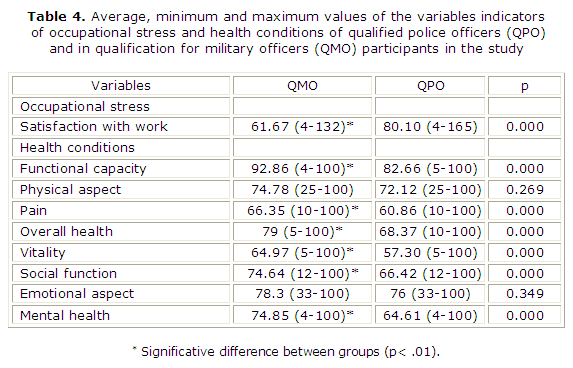
<body><![CDATA[<p> <font face="Verdana, Arial, Helvetica, sans-serif" size="2"><i>Silva,  Schlichting, Schlichting, Gutierrez Son, Adami and Silva</i><sup>19</sup> studied  military police officers in Santa Catarina and found that the subjects had an  average time of 15 years' service, with the highest concentration between 1 and  5 years (34.4 %). Thus, it can be analyzed that the military police officers investigated  in this study, have some similar occupational characteristics to Brazilian police  officers. However, it should be noted that the QMO group differs from the studies  analyzed by dealing with police officers in the beginning of their careers, still  not graduated. </font></p>    <p><font face="Verdana, Arial, Helvetica, sans-serif" size="2">  Considering that the ostensive action is the main function of the Institution,  it was possible to see that the results of this study converge with Dantas's research<sup>8</sup>  by military police officers who found that 84 % of the sample was active agents  in the operational area, which is the focus the military organization. It should  be highlighted that this distribution reflects the composition of the patents  in the Military Police of Santa Catarina, since most acts of the Institution,  according to the legal prerogative, with the patrolling assigned to the Military  Police. </font></p>    <p><font face="Verdana, Arial, Helvetica, sans-serif" size="2">  The data related to health conditions, higher for QMO compared to QPO, showed  the best scores, near the upper limit (best health status) in both groups, especially  in the field of functional capacity, partially diverging from the literature.  However, scores below the cut-off point, both for physical and for mental health  conditions, partially converge from studies in Brazil,<sup>20</sup> but differ  from the study in the United States of America,<sup>21</sup> however, all of them  point several problems to the health of the police officers. </font></p>    <p><font face="Verdana, Arial, Helvetica, sans-serif" size="2">  The problems with higher involvement in civil and military police officers of  the state of Rio de Janeiro, <i>Minayo, Assis and Oliveira,</i><sup>6</sup> were  pains in the neck, back and spine. In a study of military police of S&#227;o Paulo,  54 % of the interviewed, considered health as the most intervening factor for  life quality, as well as insufficient to perform its activities.<sup>20</sup>  In a study by <i>Rajaratnam</i> <I>et al</I>.<sup>21</sup> with North American  police officers was identified that the majority of participants considered themselves  as having good health (35.9 %), very good (42.3 %) or excellent (15.8 %). However,  it should be noted that evaluations of health conditions in this study were performed  using instruments that seek to consider perceptions, thus, most studies on this  subject is are susceptible to the context in which they are inserted, they may  vary according to the economic, social, cultural and political conditions. </font></p>    <p><font face="Verdana, Arial, Helvetica, sans-serif" size="2">  The data associated to satisfaction with psychosocial work-related shows that,  in both groups, the indicators of occupational stress of the Military Police officers  categorize most of the subjects with an "intermediate satisfaction", other than  that, a higher percentage of "satisfaction" was identified among the QPO and "dissatisfaction"  among the QMO, converging with other studies conducted in different Brazilian  contexts<sup>22</sup> and diverging from other studies.<sup>6,18 </sup><i>Ferreira</i>  <I>et al.</I><sup>18</sup> found that over half of the military police officers  considered negative the actions taken on their jobs, especially because of a repetitive  function (76 %), there is less freedom to decide (74 %), having a fast rhythm  of work (72 %) and having physical efforts in excess (58 %). Although it was identified  an intermediate job satisfaction, <i>Minayo</i> et al.<sup>6</sup> demonstrated  that the military police officers of the city of Rio de Janeiro stand out from  other professionals by the heavy workload and physical and mental suffering caused  by the functions performed on a daily categories. On the other hand, <i>Gon&#231;alo  Gomes, Barbosa and Afonso</i><sup>22</sup> found that only 7.4 % of public security  officers and 18.5 % of prison security professionals were dissatisfied with the  profession. </font></p>    <p><font face="Verdana, Arial, Helvetica, sans-serif" size="2">  Considering that occupational stress can be understood as a lack of balance between  the demands of work and the control of their activities,<sup>23</sup> care should  be taken in understanding the demands of police officer work, as this is considered  an occupation that must be prepared continuously, which causes charges to both  the police force as the officer subject of several profiles as rescue agents,  investigational agents, road agents, customs agents and others. Adds up to the  military police occupation, the inherent rigid hierarchy of command in the existing  military establishment, which causes states of anxiety that, should be properly  considered responsibilities. </font></p>    <p><font face="Verdana, Arial, Helvetica, sans-serif" size="2">  The results of associations that link the Military Police with higher scores of  occupational stress tend to have lower scores for vitality and social function  and higher amount of hours worked per day and age, as well as the results of significant  comparisons which show that the military police which are in the beginning of  their careers (formation of soldiers) have better scores in most of the variables  when compared to police officers in action, and also a better condition, for most  variables for those working in administrative activity when compared to that act  operational activity, are partially corroborated by studies conducted in Brazil<sup>24,9,20,6,25</sup>  and in many other countries.<sup>26,27</sup> </font></p>    <p> <font face="Verdana, Arial, Helvetica, sans-serif" size="2"><i>Souza  et al</i>.<sup>25</sup> found a correlation between health and physical activity,  digestive system problems, muscle, bone and skin problems among the military police  officers of the city of Rio de Janeiro. In addition to these associations, <i>Souza</i>  <I>et al.</I><sup>25</sup> also show that the increased chances of developing  psychological stress among police officers who are not satisfied with their ability  to respond to difficult situations are not satisfied with their lives as a whole,  so they have health problems, rarely develop activities beyond time and suffered  some victimization. It's important to notice that in this study the sedentary  lifestyle is not associated with psychological distress, only to health issues.  <i>Minayo</i> <I>et al</I>.<sup>6</sup> also found associations between medical  problems and symptoms of mental distress, and highlight that from the physical  point of view, the health problems of the police officers are linked to lifestyle  issues such as irregular feeding, sleep problems, inactivity and social isolation.  </font></p>    <p> <font face="Verdana, Arial, Helvetica, sans-serif" size="2"><i>Lipp</i><sup>20</sup>  found significant associations between stress and life quality in the social,  emotional, professional and health aspects. <i>Kutlu, &#199;ivi and Karaoglu</i><sup>28  </sup>found that scores of life quality in the areas of physical, psychological,  social and environmental relationships, the overall life quality and general health  were significantly lower in depressed individuals than no depressed. <i>Tharkar</i>  <I>et al.</I><sup>27</sup> verified that the lack of physical activity among Indian  police officers, although is no association with the other study variables, it  can be analyzed that among the police officers there is less time devoted to physical  exercise when compared to the control group of citizens of other assignments professionals.  </font></p>    <p> <font face="Verdana, Arial, Helvetica, sans-serif" size="2"><i>Charles</i>  et al.<sup>24</sup> identified an association between white blood cell count and  the physical activity, in a group of female North American police officers, and  the association between abdominal fat, body mass index (BMI) when adjusted for  depression. <i>Costa</i> <I>et al</I>.<sup>9</sup> in a study with military police  officers of Natal found that 76 % of the individuals had symptoms of stress and  the only association found it was between the stress and gender, women being the  most affected. <i>Nabeel et al<sup></sup></i>.<sup>26</sup> in study that aimed  to explore the correlation between physical activity, physical fitness and injuries  among police, with police officers in Minneapolis, found that agents with higher  fitness levels had less chances to suffer sprains, back pain and chronic pain.  <i>Nabeel</i> et al.<sup>26</sup> also found that officers with higher levels  of physical activity and more physically fit have lower prevalence of musculoskeletal  injuries and chronic pain. </font></p>    ]]></body>
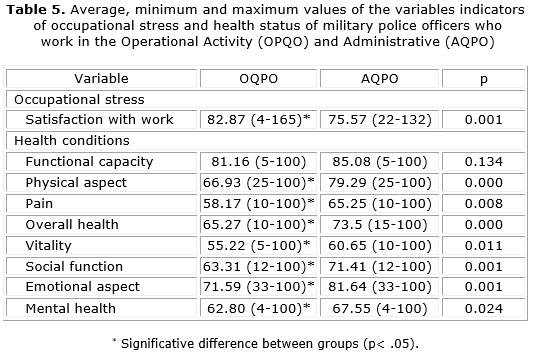
<body><![CDATA[<p><font face="Verdana, Arial, Helvetica, sans-serif" size="2">  Thus, it is understood that the results of associations and comparisons show consideration  relevant to the performance, health, occupational satisfaction, stress and physical  activity. However, it must be highlighted the need to contextualize the subject  and the Institution of the Military Police of Santa Catarina. </font></p>    <p><font face="Verdana, Arial, Helvetica, sans-serif" size="2">  It should be noted that these findings must be contextualized according to the  nature of the study and according to the limitations of the instruments adopted  mainly by the ability of subjective apprehension of variables. Regarding the characteristics  of the subjects, of which physical exercise is still a working reality, it can  be suggested that institutionalized physical activity is still in its infancy,  as there are few battalions of Military Police in the state of Santa Catarina  offering conditions similar to the students of the training courses for the realization  of physical activity. Regarding the characteristics of the instruments, it should  be noticed that all taken care of for the application and analysis of the resulting  data, including the application of reliability tests widely recommended. </font></p>    <p><font face="Verdana, Arial, Helvetica, sans-serif" size="2">  The results of this study demonstrate that the military police who are in the  situation of students from training, although they are experiencing a different  situation in their lives, which undergo aspiring to stress is part of professional  training, significantly, have a best condition in relation to occupational stress,  functioning, bodily pain, general health, vitality, social function, mental health,  irritability, worry and depression when compared to the police officers who are  already working in the Institution. Thus, it is concluded that the beginners in  the police force are in a condition of higher physical and mental health than  the police officers who are acting, and that the conditions of the officers who  work in operating activities, compared to those with health conditions who act  in administrative activities, have higher affect conditions of occupational stress,  physical appearance, pain, general health, vitality, social function, emotional  and mental health aspect. </font></p>    <p><font face="Verdana, Arial, Helvetica, sans-serif" size="2">  Considering the limitations and the findings of this study, it is suggested studies  with larger sample size and greater number of units of the Military Police of  Santa Catarina, and the use of instruments with more direct measures on the variables  screen. It is also suggested that in order to detect and prevent from situations  that can trigger some actions should be developed. </font></p>    <p>&nbsp; </p>    <p> <font face="Verdana, Arial, Helvetica, sans-serif" size="2"><b><font size="3">REFERENCES</font></b>  </font></p>    <!-- ref --><p><font face="Verdana, Arial, Helvetica, sans-serif" size="2">1. Andrade  ER, Sousa ERD, Minayo MCS. Interven&#231;&#227;o visando a auto-estima e qualidade  de vida dos policiais civis do Rio de Janeiro. Ci&#234;n Sa&#250;d Colet. 2009;14(1):275-85.      </font></p>    <!-- ref --><p><font face="Verdana, Arial, Helvetica, sans-serif" size="2"> 2.  Fraga CK. Peculiaridades do trabalho policial militar. Rev Virt Tex Contex. 2006;5(2):1-19.      </font></p>    ]]></body>
<body><![CDATA[<!-- ref --><p><font face="Verdana, Arial, Helvetica, sans-serif" size="2"> 3.  Kales SN, Tsismenakis AJ, Zhang C, Soteriades ES. Blood pressure in firefighters,  police officers, and other emergency responders. Am J Hyperten. 2009;22(1):11-20.      </font></p>    <!-- ref --><p><font face="Verdana, Arial, Helvetica, sans-serif" size="2"> 4.  Jesus GM, Jesus &#201;FA. Predisposi&#231;&#227;o para desenvolver resist&#234;ncia  insul&#237;nica em policiais militares. Pensar a Pr&#225;tica. 2010;13(2):1-15.      </font></p>    <!-- ref --><p><font face="Verdana, Arial, Helvetica, sans-serif" size="2"> 5.  Leite AJ, Silva FAB. N&#237;vel de press&#227;o arterial dos policiais militares  do 19 BPM-GO e percep&#231;&#227;o sobre sua pr&#243;pria sa&#250;de. Revisa.  2010;1(1):1-21.     </font></p>    <!-- ref --><p><font face="Verdana, Arial, Helvetica, sans-serif" size="2">  6. Minayo MCS, Assis GL, Oliveira RVC. Impacto das atividades profissionais na  sa&#250;de f&#237;sica e mental dos policiais civis e militares do Rio de Janeiro.  Ci&#234;n Sa&#250;d Colet. 2011;16(4):2199-209 </font><!-- ref --><p><font face="Verdana, Arial, Helvetica, sans-serif" size="2">  7. Oliveira KL, Santos LM. Percep&#231;&#227;o da sa&#250;de mental em policiais  militares da for&#231;a t&#225;tica e de rua. Sociologias. 2010;12(25):224-50.      </font></p>    <!-- ref --><p><font face="Verdana, Arial, Helvetica, sans-serif" size="2"> 8.  Dantas MA. Avalia&#231;&#227;o de estresse em policiais militares. Stress: Interna  J Biol Stress. 2010;12(3):66-77.     </font></p>    <!-- ref --><p>9.<font face="Verdana, Arial, Helvetica, sans-serif" size="2">  Costa M, Accioly Junior H, Oliveira J, Maia E. Estresse: diagn&#243;stico dos  policiais militares em uma cidade brasileira. Pan Am J Public Health. 2007;21(4):217-22.      </font></p>    <!-- ref --><p><font face="Verdana, Arial, Helvetica, sans-serif" size="2"> 10.  Moraes LFR, Marques AL, Portes PCP. Qualidade de vida no trabalho e estresse ocupacional  na policia militar de Minas Gerais. Rev Psico, Sa&#250;d Ment e Seguran&#231;a  P&#250;blic. 2003;1(3):1-11.     </font></p>    <!-- ref --><p><font face="Verdana, Arial, Helvetica, sans-serif" size="2">  11. Leineweber C, Westerlund H. Hagberg J, Svedberg P, Luokkala M, Alexanderson  K. Sickness presenteeism among Swedish police officers. J Occup Rehab. 2011;21(1):17-22.      </font></p>    <!-- ref --><p><font face="Verdana, Arial, Helvetica, sans-serif" size="2"> 12.  Kumar R. Research Methodology: A step-by-step guide for beginners. London: SAGE  Publications; 1996.     </font></p>    <!-- ref --><p><font face="Verdana, Arial, Helvetica, sans-serif" size="2">  13. Ware JE, Gandek B. The SF-36 Health Survey: Development and use in mental  health research and the IQOLA Project. Inter J Ment Health. 1994;23(2):49-73.      </font></p>    <!-- ref --><p><font face="Verdana, Arial, Helvetica, sans-serif" size="2"> 14.  Ciconelli RM, Ferraz MB, Santos W, Mein&#227;o I, Quaresma MR. Tradu&#231;&#227;o  para a l&#237;ngua portuguesa e valida&#231;&#227;o do question&#225;rio gen&#233;rico  de avalia&#231;&#227;o de qualidade de vida SF-36 (Brasil SF-36). Rev Bras Reuma.  1997;39(3):143-50.     </font></p>    <!-- ref --><p><font face="Verdana, Arial, Helvetica, sans-serif" size="2">  15. Robertson IT, Cooper CL, Willians J. The validity of the occupational stress  indicator. Work and Stress. 1999;4(1):29-39.     </font></p>    <!-- ref --><p><font face="Verdana, Arial, Helvetica, sans-serif" size="2">  16. Swan JA, Moraes LFR, Cooper CL. Developing the occupational stress indicator  (OSI) for use in Brazil: a report on the reliability and validity of the translated  OSI. Stress Medic. 1993;9(1):247-53.     </font></p>    <!-- ref --><p><font face="Verdana, Arial, Helvetica, sans-serif" size="2">  17. Martinez MC, Paraguay AIBB, Latorre MRDO. Rela&#231;&#227;o entre satisfa&#231;&#227;o  com aspectos psicossociais e sa&#250;de dos trabalhadores. Revista de Sa&#250;de  P&#250;blica. 2004;38(1):55-61.     </font></p>    <!-- ref --><p><font face="Verdana, Arial, Helvetica, sans-serif" size="2">  18. Ferreira SKD, Bonfim C, Augusto SGL. Fatores Associados ao Estilo de vida  de Policiais Militares. Ci&#234;n Sa&#250;d Colet. 2011;16(8):3403-12.     </font></p>    <!-- ref --><p>19.<font face="Verdana, Arial, Helvetica, sans-serif" size="2">  Silva R, Schlichting AM, Schlichting JP, Gutierres Filho PJB, Adami F, Silva A.  Aspectos relacionados &#224; qualidade de vida e atividade f&#237;sica de policiais  militares de Santa Catarina-Brasil. Motricidade. 2012;8(3):81-89.     </font></p>    <!-- ref --><p><font face="Verdana, Arial, Helvetica, sans-serif" size="2">  20. Lipp MEN. Stress and quality of life of senior Brazilian police officers.  Span J Psych. 2009;12(2):593-603.     </font></p>    <!-- ref --><p><font face="Verdana, Arial, Helvetica, sans-serif" size="2">  21. Rajaratnam SM, Barger LK, Lockley SW, Shea SA, Wang W, Landrigan CP, et al.  Sleep Disorders, Health, and Safety in Police Officers. JAMA. 2012;306(23):2567-78.      </font></p>    <!-- ref --><p><font face="Verdana, Arial, Helvetica, sans-serif" size="2"> 22.  Gon&#231;alo H, Gomes AR, Barbosa F, Afonso J. Stresse ocupacional em for&#231;as  de seguran&#231;a: Um estudo comparativo. An&#225;lise Psico. 2010;28(1):165-78.      </font></p>    <!-- ref --><p><font face="Verdana, Arial, Helvetica, sans-serif" size="2"> 23.  Rosenthal T, Alter A. Occupational stress and hypertension. J Am Soc Hyperten.  2012;6(1):2-22.     </font></p>    <!-- ref --><p><font face="Verdana, Arial, Helvetica, sans-serif" size="2">  24. Charles LE, Fekedulegn D, McCall T, Burchfiel CM, Andrew ME, Violanti JM.  Obesity, white blood cell counts, and platelet counts among police officers. Obesity.  2007;15(11):2846-54.     </font></p>    <!-- ref --><p><font face="Verdana, Arial, Helvetica, sans-serif" size="2">  25. Souza ER, Minayo MCS, Silva JG, Pires TO. Fatores associados ao sofrimento  ps&#237;quico de policiais militares da cidade do Rio de Janeiro. Cad Sa&#250;d  P&#250;blic. 2012;28(7):1297-311.     </font></p>    <!-- ref --><p><font face="Verdana, Arial, Helvetica, sans-serif" size="2">  26. Nabeel I, Baker BA, McGrail MPJr, Flottemesch TJ. Correlation between physical  activity, fitness, and musculoskeletal injuries in police officers. Minnesota  Med. 2007;90(9):40-3.     </font></p>    <!-- ref --><p><font face="Verdana, Arial, Helvetica, sans-serif" size="2">  27. Tharkar S, Kumpatla S, Muthukumaran P, Viswanathan V. High prevalence of metabolic  syndrome and cardiovascular risk among police personnel compared to general population  in India. J Assoc Phys India. 2008;56:845-9.     </font></p>    <!-- ref --><p><font face="Verdana, Arial, Helvetica, sans-serif" size="2">  28. Kutlu R, &#199;ivi S, Karaoglu O. The assessment of quality of life and depression  among police officers. Turkiye Klinikleri. 2009;29(1):8-16.     </font></p>    <p>&nbsp; </p>    <p>&nbsp;</p>    <p><font face="Verdana, Arial, Helvetica, sans-serif" size="2">Recibido:  17 de febrero de 2014. </font>    <br> <font face="Verdana, Arial, Helvetica, sans-serif" size="2">Aprobado:  17 de abril de 2014. </font></p>    <p>&nbsp; </p>    <p>&nbsp; </p>    <p> <font face="Verdana, Arial, Helvetica, sans-serif" size="2"><i>Ant&#244;nio  Melo Schlichting Junior</i> . Center of Health Sciences and Sport, UDESC, Univ.  Estadual de Santa Catarina, Adaptaded Physical Activity Lab (LABAMA). Paschoal  Simone St, 358, Coqueiros. Florian&#243;polis/SC, Brazil. Zip Code: 88080-350.  Telephone: +55 48 3321-8651. Email: <a href="mailto:sgtmelojunior@gmail.com">sgtmelojunior@gmail.com</a></font></p>        ]]></body><back>
<ref-list>
<ref id="B1">
<label>1</label><nlm-citation citation-type="journal">
<person-group person-group-type="author">
<name>
<surname><![CDATA[Andrade]]></surname>
<given-names><![CDATA[ER]]></given-names>
</name>
<name>
<surname><![CDATA[Sousa]]></surname>
<given-names><![CDATA[ERD]]></given-names>
</name>
<name>
<surname><![CDATA[Minayo]]></surname>
<given-names><![CDATA[MCS]]></given-names>
</name>
</person-group>
<article-title xml:lang="pt"><![CDATA[Intervenção visando a auto-estima e qualidade de vida dos policiais civis do Rio de Janeiro]]></article-title>
<source><![CDATA[Ciên Saúd Colet.]]></source>
<year>2009</year>
<volume>14</volume>
<numero>1</numero>
<issue>1</issue>
<page-range>275-85</page-range></nlm-citation>
</ref>
<ref id="B2">
<label>2</label><nlm-citation citation-type="journal">
<person-group person-group-type="author">
<name>
<surname><![CDATA[Fraga]]></surname>
<given-names><![CDATA[CK]]></given-names>
</name>
</person-group>
<article-title xml:lang="pt"><![CDATA[Peculiaridades do trabalho policial militar]]></article-title>
<source><![CDATA[Rev Virt Tex Contex.]]></source>
<year>2006</year>
<volume>5</volume>
<numero>2</numero>
<issue>2</issue>
<page-range>1-19</page-range></nlm-citation>
</ref>
<ref id="B3">
<label>3</label><nlm-citation citation-type="journal">
<person-group person-group-type="author">
<name>
<surname><![CDATA[Kales]]></surname>
<given-names><![CDATA[SN]]></given-names>
</name>
<name>
<surname><![CDATA[Tsismenakis]]></surname>
<given-names><![CDATA[AJ]]></given-names>
</name>
<name>
<surname><![CDATA[Zhang]]></surname>
<given-names><![CDATA[C]]></given-names>
</name>
<name>
<surname><![CDATA[Soteriades]]></surname>
<given-names><![CDATA[ES]]></given-names>
</name>
</person-group>
<article-title xml:lang="en"><![CDATA[Blood pressure in firefighters, police officers, and other emergency responders]]></article-title>
<source><![CDATA[Am J Hyperten.]]></source>
<year>2009</year>
<volume>22</volume>
<numero>1</numero>
<issue>1</issue>
<page-range>11-20</page-range></nlm-citation>
</ref>
<ref id="B4">
<label>4</label><nlm-citation citation-type="journal">
<person-group person-group-type="author">
<name>
<surname><![CDATA[Jesus]]></surname>
<given-names><![CDATA[GM]]></given-names>
</name>
<name>
<surname><![CDATA[Jesus]]></surname>
<given-names><![CDATA[ÉFA]]></given-names>
</name>
</person-group>
<article-title xml:lang="pt"><![CDATA[Predisposição para desenvolver resistência insulínica em policiais militares]]></article-title>
<source><![CDATA[Pensar a Prática.]]></source>
<year>2010</year>
<volume>13</volume>
<numero>2</numero>
<issue>2</issue>
<page-range>1-15</page-range></nlm-citation>
</ref>
<ref id="B5">
<label>5</label><nlm-citation citation-type="journal">
<person-group person-group-type="author">
<name>
<surname><![CDATA[Leite]]></surname>
<given-names><![CDATA[AJ]]></given-names>
</name>
<name>
<surname><![CDATA[Silva]]></surname>
<given-names><![CDATA[FAB]]></given-names>
</name>
</person-group>
<article-title xml:lang="pt"><![CDATA[Nível de pressão arterial dos policiais militares do 19 BPM-GO e percepção sobre sua própria saúde]]></article-title>
<source><![CDATA[Revisa.]]></source>
<year>2010</year>
<volume>1</volume>
<numero>1</numero>
<issue>1</issue>
<page-range>1-21</page-range></nlm-citation>
</ref>
<ref id="B6">
<label>6</label><nlm-citation citation-type="journal">
<person-group person-group-type="author">
<name>
<surname><![CDATA[Minayo]]></surname>
<given-names><![CDATA[MCS]]></given-names>
</name>
<name>
<surname><![CDATA[Assis]]></surname>
<given-names><![CDATA[GL]]></given-names>
</name>
<name>
<surname><![CDATA[Oliveira]]></surname>
<given-names><![CDATA[RVC]]></given-names>
</name>
</person-group>
<article-title xml:lang="pt"><![CDATA[Impacto das atividades profissionais na saúde física e mental dos policiais civis e militares do Rio de Janeiro]]></article-title>
<source><![CDATA[Ciên Saúd Colet.]]></source>
<year>2011</year>
<volume>16</volume>
<numero>4</numero>
<issue>4</issue>
<page-range>2199-209</page-range></nlm-citation>
</ref>
<ref id="B7">
<label>7</label><nlm-citation citation-type="journal">
<person-group person-group-type="author">
<name>
<surname><![CDATA[Oliveira]]></surname>
<given-names><![CDATA[KL]]></given-names>
</name>
<name>
<surname><![CDATA[Santos]]></surname>
<given-names><![CDATA[LM]]></given-names>
</name>
</person-group>
<article-title xml:lang="pt"><![CDATA[Percepção da saúde mental em policiais militares da força tática e de rua]]></article-title>
<source><![CDATA[Sociologias.]]></source>
<year>2010</year>
<volume>12</volume>
<numero>25</numero>
<issue>25</issue>
<page-range>224-50</page-range></nlm-citation>
</ref>
<ref id="B8">
<label>8</label><nlm-citation citation-type="journal">
<person-group person-group-type="author">
<name>
<surname><![CDATA[Dantas]]></surname>
<given-names><![CDATA[MA]]></given-names>
</name>
</person-group>
<article-title xml:lang="pt"><![CDATA[Avaliação de estresse em policiais militares]]></article-title>
<source><![CDATA[Stress: Interna J Biol Stress.]]></source>
<year>2010</year>
<volume>12</volume>
<numero>3</numero>
<issue>3</issue>
<page-range>66-77</page-range></nlm-citation>
</ref>
<ref id="B9">
<label>9</label><nlm-citation citation-type="journal">
<person-group person-group-type="author">
<name>
<surname><![CDATA[Costa]]></surname>
<given-names><![CDATA[M]]></given-names>
</name>
<name>
<surname><![CDATA[Accioly Junior]]></surname>
<given-names><![CDATA[H]]></given-names>
</name>
<name>
<surname><![CDATA[Oliveira]]></surname>
<given-names><![CDATA[J]]></given-names>
</name>
<name>
<surname><![CDATA[Maia]]></surname>
<given-names><![CDATA[E]]></given-names>
</name>
</person-group>
<article-title xml:lang="pt"><![CDATA[Estresse: diagnóstico dos policiais militares em uma cidade brasileira]]></article-title>
<source><![CDATA[Pan Am J Public Health.]]></source>
<year>2007</year>
<volume>21</volume>
<numero>4</numero>
<issue>4</issue>
<page-range>217-22</page-range></nlm-citation>
</ref>
<ref id="B10">
<label>10</label><nlm-citation citation-type="journal">
<person-group person-group-type="author">
<name>
<surname><![CDATA[Moraes]]></surname>
<given-names><![CDATA[LFR]]></given-names>
</name>
<name>
<surname><![CDATA[Marques]]></surname>
<given-names><![CDATA[AL]]></given-names>
</name>
<name>
<surname><![CDATA[Portes]]></surname>
<given-names><![CDATA[PCP]]></given-names>
</name>
</person-group>
<article-title xml:lang="pt"><![CDATA[Qualidade de vida no trabalho e estresse ocupacional na policia militar de Minas Gerais]]></article-title>
<source><![CDATA[Rev Psico, Saúd Ment e Segurança Públic]]></source>
<year>2003</year>
<volume>1</volume>
<numero>3</numero>
<issue>3</issue>
<page-range>1-11</page-range></nlm-citation>
</ref>
<ref id="B11">
<label>11</label><nlm-citation citation-type="journal">
<person-group person-group-type="author">
<name>
<surname><![CDATA[Leineweber]]></surname>
<given-names><![CDATA[C]]></given-names>
</name>
<name>
<surname><![CDATA[Westerlund]]></surname>
<given-names><![CDATA[H]]></given-names>
</name>
<name>
<surname><![CDATA[Hagberg]]></surname>
<given-names><![CDATA[J]]></given-names>
</name>
<name>
<surname><![CDATA[Svedberg]]></surname>
<given-names><![CDATA[P]]></given-names>
</name>
<name>
<surname><![CDATA[Luokkala]]></surname>
<given-names><![CDATA[M]]></given-names>
</name>
<name>
<surname><![CDATA[Alexanderson]]></surname>
<given-names><![CDATA[K]]></given-names>
</name>
</person-group>
<article-title xml:lang="en"><![CDATA[Sickness presenteeism among Swedish police officers]]></article-title>
<source><![CDATA[J Occup Rehab.]]></source>
<year>2011</year>
<volume>21</volume>
<numero>1</numero>
<issue>1</issue>
<page-range>17-22</page-range></nlm-citation>
</ref>
<ref id="B12">
<label>12</label><nlm-citation citation-type="book">
<person-group person-group-type="author">
<name>
<surname><![CDATA[Kumar]]></surname>
<given-names><![CDATA[R]]></given-names>
</name>
</person-group>
<source><![CDATA[Research Methodology: A step-by-step guide for beginners]]></source>
<year>1996</year>
<publisher-loc><![CDATA[London ]]></publisher-loc>
<publisher-name><![CDATA[SAGE Publications]]></publisher-name>
</nlm-citation>
</ref>
<ref id="B13">
<label>13</label><nlm-citation citation-type="journal">
<person-group person-group-type="author">
<name>
<surname><![CDATA[Ware]]></surname>
<given-names><![CDATA[JE]]></given-names>
</name>
<name>
<surname><![CDATA[Gandek]]></surname>
<given-names><![CDATA[B]]></given-names>
</name>
</person-group>
<article-title xml:lang="en"><![CDATA[The SF-36 Health Survey: Development and use in mental health research and the IQOLA Project]]></article-title>
<source><![CDATA[Inter J Ment Health.]]></source>
<year>1994</year>
<volume>23</volume>
<numero>2</numero>
<issue>2</issue>
<page-range>49-73</page-range></nlm-citation>
</ref>
<ref id="B14">
<label>14</label><nlm-citation citation-type="journal">
<person-group person-group-type="author">
<name>
<surname><![CDATA[Ciconelli]]></surname>
<given-names><![CDATA[RM]]></given-names>
</name>
<name>
<surname><![CDATA[Ferraz]]></surname>
<given-names><![CDATA[MB]]></given-names>
</name>
<name>
<surname><![CDATA[Santos]]></surname>
<given-names><![CDATA[W]]></given-names>
</name>
<name>
<surname><![CDATA[Meinão]]></surname>
<given-names><![CDATA[I]]></given-names>
</name>
<name>
<surname><![CDATA[Quaresma]]></surname>
<given-names><![CDATA[MR]]></given-names>
</name>
</person-group>
<article-title xml:lang="pt"><![CDATA[Tradução para a língua portuguesa e validação do questionário genérico de avaliação de qualidade de vida SF-36 (Brasil SF-36)]]></article-title>
<source><![CDATA[Rev Bras Reuma.]]></source>
<year>1997</year>
<volume>39</volume>
<numero>3</numero>
<issue>3</issue>
<page-range>143-50</page-range></nlm-citation>
</ref>
<ref id="B15">
<label>15</label><nlm-citation citation-type="journal">
<person-group person-group-type="author">
<name>
<surname><![CDATA[Robertson]]></surname>
<given-names><![CDATA[IT]]></given-names>
</name>
<name>
<surname><![CDATA[Cooper]]></surname>
<given-names><![CDATA[CL]]></given-names>
</name>
<name>
<surname><![CDATA[Willians]]></surname>
<given-names><![CDATA[J]]></given-names>
</name>
</person-group>
<article-title xml:lang="en"><![CDATA[The validity of the occupational stress indicator]]></article-title>
<source><![CDATA[Work and Stress.]]></source>
<year>1999</year>
<volume>4</volume>
<numero>1</numero>
<issue>1</issue>
<page-range>29-39</page-range></nlm-citation>
</ref>
<ref id="B16">
<label>16</label><nlm-citation citation-type="journal">
<person-group person-group-type="author">
<name>
<surname><![CDATA[Swan]]></surname>
<given-names><![CDATA[JA]]></given-names>
</name>
<name>
<surname><![CDATA[Moraes]]></surname>
<given-names><![CDATA[LFR]]></given-names>
</name>
<name>
<surname><![CDATA[Cooper]]></surname>
<given-names><![CDATA[CL]]></given-names>
</name>
</person-group>
<article-title xml:lang="en"><![CDATA[Developing the occupational stress indicator (OSI) for use in Brazil: a report on the reliability and validity of the translated OSI]]></article-title>
<source><![CDATA[Stress Medic.]]></source>
<year>1993</year>
<volume>9</volume>
<numero>1</numero>
<issue>1</issue>
<page-range>247-53</page-range></nlm-citation>
</ref>
<ref id="B17">
<label>17</label><nlm-citation citation-type="journal">
<person-group person-group-type="author">
<name>
<surname><![CDATA[Martinez]]></surname>
<given-names><![CDATA[MC]]></given-names>
</name>
<name>
<surname><![CDATA[Paraguay]]></surname>
<given-names><![CDATA[AIBB]]></given-names>
</name>
<name>
<surname><![CDATA[Latorre]]></surname>
<given-names><![CDATA[MRDO]]></given-names>
</name>
</person-group>
<article-title xml:lang="pt"><![CDATA[Relação entre satisfação com aspectos psicossociais e saúde dos trabalhadores]]></article-title>
<source><![CDATA[Revista de Saúde Pública.]]></source>
<year>2004</year>
<volume>38</volume>
<numero>1</numero>
<issue>1</issue>
<page-range>55-61</page-range></nlm-citation>
</ref>
<ref id="B18">
<label>18</label><nlm-citation citation-type="journal">
<person-group person-group-type="author">
<name>
<surname><![CDATA[Ferreira]]></surname>
<given-names><![CDATA[SKD]]></given-names>
</name>
<name>
<surname><![CDATA[Bonfim]]></surname>
<given-names><![CDATA[C]]></given-names>
</name>
<name>
<surname><![CDATA[Augusto]]></surname>
<given-names><![CDATA[SGL]]></given-names>
</name>
</person-group>
<article-title xml:lang="pt"><![CDATA[Fatores Associados ao Estilo de vida de Policiais Militares]]></article-title>
<source><![CDATA[Ciên Saúd Colet.]]></source>
<year>2011</year>
<volume>16</volume>
<numero>8</numero>
<issue>8</issue>
<page-range>3403-12</page-range></nlm-citation>
</ref>
<ref id="B19">
<label>19</label><nlm-citation citation-type="journal">
<person-group person-group-type="author">
<name>
<surname><![CDATA[Silva]]></surname>
<given-names><![CDATA[R]]></given-names>
</name>
<name>
<surname><![CDATA[Schlichting]]></surname>
<given-names><![CDATA[AM]]></given-names>
</name>
<name>
<surname><![CDATA[Schlichting]]></surname>
<given-names><![CDATA[JP]]></given-names>
</name>
<name>
<surname><![CDATA[Gutierres Filho]]></surname>
<given-names><![CDATA[PJB]]></given-names>
</name>
<name>
<surname><![CDATA[Adami]]></surname>
<given-names><![CDATA[F]]></given-names>
</name>
<name>
<surname><![CDATA[Silva]]></surname>
<given-names><![CDATA[A]]></given-names>
</name>
</person-group>
<article-title xml:lang="pt"><![CDATA[Aspectos relacionados à qualidade de vida e atividade física de policiais militares de Santa Catarina-Brasil]]></article-title>
<source><![CDATA[Motricidade.]]></source>
<year>2012</year>
<volume>8</volume>
<numero>3</numero>
<issue>3</issue>
<page-range>81-89</page-range></nlm-citation>
</ref>
<ref id="B20">
<label>20</label><nlm-citation citation-type="journal">
<person-group person-group-type="author">
<name>
<surname><![CDATA[Lipp]]></surname>
<given-names><![CDATA[MEN]]></given-names>
</name>
</person-group>
<article-title xml:lang="en"><![CDATA[Stress and quality of life of senior Brazilian police officers]]></article-title>
<source><![CDATA[Span J Psych.]]></source>
<year>2009</year>
<volume>12</volume>
<numero>2</numero>
<issue>2</issue>
<page-range>593-603</page-range></nlm-citation>
</ref>
<ref id="B21">
<label>21</label><nlm-citation citation-type="journal">
<person-group person-group-type="author">
<name>
<surname><![CDATA[Rajaratnam]]></surname>
<given-names><![CDATA[SM]]></given-names>
</name>
<name>
<surname><![CDATA[Barger]]></surname>
<given-names><![CDATA[LK]]></given-names>
</name>
<name>
<surname><![CDATA[Lockley]]></surname>
<given-names><![CDATA[SW]]></given-names>
</name>
<name>
<surname><![CDATA[Shea]]></surname>
<given-names><![CDATA[SA]]></given-names>
</name>
<name>
<surname><![CDATA[Wang]]></surname>
<given-names><![CDATA[W]]></given-names>
</name>
<name>
<surname><![CDATA[Landrigan]]></surname>
<given-names><![CDATA[CP]]></given-names>
</name>
</person-group>
<article-title xml:lang="en"><![CDATA[Sleep Disorders, Health, and Safety in Police Officers]]></article-title>
<source><![CDATA[JAMA.]]></source>
<year>2012</year>
<volume>306</volume>
<numero>23</numero>
<issue>23</issue>
<page-range>2567-78</page-range></nlm-citation>
</ref>
<ref id="B22">
<label>22</label><nlm-citation citation-type="journal">
<person-group person-group-type="author">
<name>
<surname><![CDATA[Gonçalo]]></surname>
<given-names><![CDATA[H]]></given-names>
</name>
<name>
<surname><![CDATA[Gomes]]></surname>
<given-names><![CDATA[AR]]></given-names>
</name>
<name>
<surname><![CDATA[Barbosa]]></surname>
<given-names><![CDATA[F]]></given-names>
</name>
<name>
<surname><![CDATA[Afonso]]></surname>
<given-names><![CDATA[J]]></given-names>
</name>
</person-group>
<article-title xml:lang="pt"><![CDATA[Stresse ocupacional em forças de segurança: Um estudo comparativo]]></article-title>
<source><![CDATA[Análise Psico.]]></source>
<year>2010</year>
<volume>28</volume>
<numero>1</numero>
<issue>1</issue>
<page-range>165-78</page-range></nlm-citation>
</ref>
<ref id="B23">
<label>23</label><nlm-citation citation-type="journal">
<person-group person-group-type="author">
<name>
<surname><![CDATA[Rosenthal]]></surname>
<given-names><![CDATA[T]]></given-names>
</name>
<name>
<surname><![CDATA[Alter]]></surname>
<given-names><![CDATA[A]]></given-names>
</name>
</person-group>
<article-title xml:lang="en"><![CDATA[Occupational stress and hypertension]]></article-title>
<source><![CDATA[J Am Soc Hyperten.]]></source>
<year>2012</year>
<volume>6</volume>
<numero>1</numero>
<issue>1</issue>
<page-range>2-22</page-range></nlm-citation>
</ref>
<ref id="B24">
<label>24</label><nlm-citation citation-type="journal">
<person-group person-group-type="author">
<name>
<surname><![CDATA[Charles]]></surname>
<given-names><![CDATA[LE]]></given-names>
</name>
<name>
<surname><![CDATA[Fekedulegn]]></surname>
<given-names><![CDATA[D]]></given-names>
</name>
<name>
<surname><![CDATA[McCall]]></surname>
<given-names><![CDATA[T]]></given-names>
</name>
<name>
<surname><![CDATA[Burchfiel]]></surname>
<given-names><![CDATA[CM]]></given-names>
</name>
<name>
<surname><![CDATA[Andrew]]></surname>
<given-names><![CDATA[ME]]></given-names>
</name>
<name>
<surname><![CDATA[Violanti]]></surname>
<given-names><![CDATA[JM]]></given-names>
</name>
</person-group>
<article-title xml:lang="en"><![CDATA[Obesity, white blood cell counts, and platelet counts among police officers]]></article-title>
<source><![CDATA[Obesity.]]></source>
<year>2007</year>
<volume>15</volume>
<numero>11</numero>
<issue>11</issue>
<page-range>2846-54</page-range></nlm-citation>
</ref>
<ref id="B25">
<label>25</label><nlm-citation citation-type="journal">
<person-group person-group-type="author">
<name>
<surname><![CDATA[Souza]]></surname>
<given-names><![CDATA[ER]]></given-names>
</name>
<name>
<surname><![CDATA[Minayo]]></surname>
<given-names><![CDATA[MCS]]></given-names>
</name>
<name>
<surname><![CDATA[Silva]]></surname>
<given-names><![CDATA[JG]]></given-names>
</name>
<name>
<surname><![CDATA[Pires]]></surname>
<given-names><![CDATA[TO]]></given-names>
</name>
</person-group>
<article-title xml:lang="pt"><![CDATA[Fatores associados ao sofrimento psíquico de policiais militares da cidade do Rio de Janeiro]]></article-title>
<source><![CDATA[Cad Saúd Públic.]]></source>
<year>2012</year>
<volume>28</volume>
<numero>7</numero>
<issue>7</issue>
<page-range>1297-311</page-range></nlm-citation>
</ref>
<ref id="B26">
<label>26</label><nlm-citation citation-type="journal">
<person-group person-group-type="author">
<name>
<surname><![CDATA[Nabeel]]></surname>
<given-names><![CDATA[I]]></given-names>
</name>
<name>
<surname><![CDATA[Baker]]></surname>
<given-names><![CDATA[BA]]></given-names>
</name>
<name>
<surname><![CDATA[McGrail]]></surname>
<given-names><![CDATA[MPJr]]></given-names>
</name>
<name>
<surname><![CDATA[Flottemesch]]></surname>
<given-names><![CDATA[TJ]]></given-names>
</name>
</person-group>
<article-title xml:lang="en"><![CDATA[Correlation between physical activity, fitness, and musculoskeletal injuries in police officers]]></article-title>
<source><![CDATA[Minnesota Med.]]></source>
<year>2007</year>
<volume>90</volume>
<numero>9</numero>
<issue>9</issue>
<page-range>40-3</page-range></nlm-citation>
</ref>
<ref id="B27">
<label>27</label><nlm-citation citation-type="journal">
<person-group person-group-type="author">
<name>
<surname><![CDATA[Tharkar]]></surname>
<given-names><![CDATA[S]]></given-names>
</name>
<name>
<surname><![CDATA[Kumpatla]]></surname>
<given-names><![CDATA[S]]></given-names>
</name>
<name>
<surname><![CDATA[Muthukumaran]]></surname>
<given-names><![CDATA[P]]></given-names>
</name>
<name>
<surname><![CDATA[Viswanathan]]></surname>
<given-names><![CDATA[V]]></given-names>
</name>
</person-group>
<article-title xml:lang="en"><![CDATA[High prevalence of metabolic syndrome and cardiovascular risk among police personnel compared to general population in India]]></article-title>
<source><![CDATA[J Assoc Phys India.]]></source>
<year>2008</year>
<volume>56</volume>
<page-range>845-9</page-range></nlm-citation>
</ref>
<ref id="B28">
<label>28</label><nlm-citation citation-type="journal">
<person-group person-group-type="author">
<name>
<surname><![CDATA[Kutlu]]></surname>
<given-names><![CDATA[R]]></given-names>
</name>
<name>
<surname><![CDATA[Çivi]]></surname>
<given-names><![CDATA[S]]></given-names>
</name>
<name>
<surname><![CDATA[Karaoglu]]></surname>
<given-names><![CDATA[O]]></given-names>
</name>
</person-group>
<article-title xml:lang="en"><![CDATA[The assessment of quality of life and depression among police officers]]></article-title>
<source><![CDATA[Turkiye Klinikleri.]]></source>
<year>2009</year>
<volume>29</volume>
<numero>1</numero>
<issue>1</issue>
<page-range>8-16</page-range></nlm-citation>
</ref>
</ref-list>
</back>
</article>