<?xml version="1.0" encoding="ISO-8859-1"?><article xmlns:mml="http://www.w3.org/1998/Math/MathML" xmlns:xlink="http://www.w3.org/1999/xlink" xmlns:xsi="http://www.w3.org/2001/XMLSchema-instance">
<front>
<journal-meta>
<journal-id>0138-6557</journal-id>
<journal-title><![CDATA[Revista Cubana de Medicina Militar]]></journal-title>
<abbrev-journal-title><![CDATA[Rev Cub Med Mil]]></abbrev-journal-title>
<issn>0138-6557</issn>
<publisher>
<publisher-name><![CDATA[Centro Nacional de Información de Ciencias MédicasEditorial Ciencias Médicas]]></publisher-name>
</publisher>
</journal-meta>
<article-meta>
<article-id>S0138-65572014000300007</article-id>
<title-group>
<article-title xml:lang="en"><![CDATA[Physical activity and health conditions of military police in attendance or health treatment]]></article-title>
<article-title xml:lang="es"><![CDATA[Actividad física y estado de salud de policías militares bajo tratamiento u hospitalizados]]></article-title>
</title-group>
<contrib-group>
<contrib contrib-type="author">
<name>
<surname><![CDATA[Mattos Benedetti]]></surname>
<given-names><![CDATA[Cristine]]></given-names>
</name>
<xref ref-type="aff" rid="A01"/>
</contrib>
<contrib contrib-type="author">
<name>
<surname><![CDATA[Cascaes da Silva]]></surname>
<given-names><![CDATA[Franciele]]></given-names>
</name>
<xref ref-type="aff" rid="A01"/>
</contrib>
<contrib contrib-type="author">
<name>
<surname><![CDATA[Domingos dos Santos]]></surname>
<given-names><![CDATA[Patrícia]]></given-names>
</name>
<xref ref-type="aff" rid="A01"/>
</contrib>
<contrib contrib-type="author">
<name>
<surname><![CDATA[Barbosa Gutierres Filho]]></surname>
<given-names><![CDATA[Paulo José]]></given-names>
</name>
<xref ref-type="aff" rid="A01"/>
</contrib>
<contrib contrib-type="author">
<name>
<surname><![CDATA[Manoel Bernardo]]></surname>
<given-names><![CDATA[Valdeni]]></given-names>
</name>
<xref ref-type="aff" rid="A01"/>
</contrib>
<contrib contrib-type="author">
<name>
<surname><![CDATA[da Silva]]></surname>
<given-names><![CDATA[Rudney]]></given-names>
</name>
<xref ref-type="aff" rid="A01"/>
</contrib>
</contrib-group>
<aff id="A01">
<institution><![CDATA[,Univ. Estadual de Santa Catarina Center of Health Sciences and Sport ]]></institution>
<addr-line><![CDATA[Florianópolis SC]]></addr-line>
<country>Brazil</country>
</aff>
<pub-date pub-type="pub">
<day>00</day>
<month>09</month>
<year>2014</year>
</pub-date>
<pub-date pub-type="epub">
<day>00</day>
<month>09</month>
<year>2014</year>
</pub-date>
<volume>43</volume>
<numero>3</numero>
<fpage>326</fpage>
<lpage>340</lpage>
<copyright-statement/>
<copyright-year/>
<self-uri xlink:href="http://scielo.sld.cu/scielo.php?script=sci_arttext&amp;pid=S0138-65572014000300007&amp;lng=en&amp;nrm=iso"></self-uri><self-uri xlink:href="http://scielo.sld.cu/scielo.php?script=sci_abstract&amp;pid=S0138-65572014000300007&amp;lng=en&amp;nrm=iso"></self-uri><self-uri xlink:href="http://scielo.sld.cu/scielo.php?script=sci_pdf&amp;pid=S0138-65572014000300007&amp;lng=en&amp;nrm=iso"></self-uri><abstract abstract-type="short" xml:lang="en"><p><![CDATA[Introduction: different studies have demonstrated that public security agents, despite their professional demands, are also affected by sedentary lifestyle. Several causes have been identified for physical inactivity in Public Security agents, mainly in Military Police officers, such as the high rates of distress, long working days, the growth of violence and economic problems related to the permanence of institutions, the lack of police officers and low salaries. Objective: to analyze the association between usual physical activity, stress, health conditions and socio demographic and occupational characteristics of the military police which is attended to or those under hospital treatment. Methods: the application of instruments Short Form Health Survey and the international questionnaire on physical activity (long version) in 526 individuals. Results: The statistical associations showed lower metabolic equivalent values in domestic physical activities and lower occurrence of depression as a symptom of stress whereas general health indexes tended to rise. Conclusions: it can be concluded that the military police officers surveyed were considered active people regarding the level of physical activity at home, in leisure and occupational activities, and in mild, moderate and severe activities. The physical and mental scores were found to be below the average estimated for the health conditions.]]></p></abstract>
<abstract abstract-type="short" xml:lang="es"><p><![CDATA[Introducción: diferentes estudios han demostrado que los policías, a pesar de sus demandas profesionales, también se ven afectados por el sedentarismo. Varias causas han sido identificadas para la inactividad física en esta población (principalmente en los oficiales), como altas tasas de estrés, largas jornadas de trabajo, aumento de la violencia y los problemas económicos relacionados con el mantenimiento de las instituciones, falta de efectivos y bajos salarios. Objetivo: analizar la asociación entre la actividad física habitual, los síntomas de estrés, las condiciones de salud y las características sociodemográficas y ocupacionales de los policías atendidos y en tratamiento hospitalario. Métodos: se aplicó el cuestionario de calidad de vida y salud, y el cuestionario Internacional de actividad física (versión larga) a 526 sujetos. Resultados: las asociaciones indican que los policías presentaron un valor bajo con relación al equivalente metabólico en actividades físicas domésticas y baja ocurrencia de depresión como síntoma de estrés; existió una tendencia a valores más altos de salud en general. Conclusiones: los policías militares investigados se consideran activos en el nivel de actividad física en tareas domésticas, en actividades de tiempo libre y ocupacional, y en actividades leves, moderadas e intensas. Las puntuaciones de los dominios físicos y mentales se encuentran por debajo de la media calculada para las condiciones de salud.]]></p></abstract>
<kwd-group>
<kwd lng="en"><![CDATA[motor activity]]></kwd>
<kwd lng="en"><![CDATA[health]]></kwd>
<kwd lng="en"><![CDATA[military police]]></kwd>
<kwd lng="es"><![CDATA[actividad motora]]></kwd>
<kwd lng="es"><![CDATA[salud]]></kwd>
<kwd lng="es"><![CDATA[policía militar]]></kwd>
</kwd-group>
</article-meta>
</front><body><![CDATA[ <p align="right"><font face="Verdana, Arial, Helvetica, sans-serif" size="2"><b>ART&#205;CULO  ORIGINAL</b> </font></p>    <p>&nbsp; </p>    <p> <font face="Verdana, Arial, Helvetica, sans-serif" size="2"><b><FONT FACE="Verdana, Arial, Helvetica, sans-serif" SIZE="2"><B><FONT SIZE="4">Physical  activity and health conditions of military police in attendance or health treatment</FONT></B>  </FONT></b></font></p>    <p>&nbsp;</p>    <p><font face="Verdana, Arial, Helvetica, sans-serif" size="2"><b><FONT SIZE="3">Actividad  f&#237;sica y estado de salud de polic&#237;as militares bajo tratamiento u hospitalizados</FONT></b>  </font></p>    <p>&nbsp;</p>    <p>&nbsp;</p>    <p><font face="Verdana, Arial, Helvetica, sans-serif" size="2"><b>  MSc. Cristine Mattos Benedetti, Spec. Franciele Cascaes da Silva, Prof. Patr&#237;cia  Domingos dos Santos, Phd Paulo Jos&#233; Barbosa Gutierres Filho, Prof. Valdeni  Manoel Bernardo, Phd Rudney da Silva </b> </font></p>    <p><font face="Verdana, Arial, Helvetica, sans-serif" size="2">  Center of Health Sciences and Sport, UDESC, Univ. Estadual de Santa Catarina,  Florian&#243;polis/SC, Brazil. </font></p>    <p>&nbsp; </p>    ]]></body>
<body><![CDATA[<p>&nbsp; </p><hr size="1" noshade>      <p><font face="Verdana, Arial, Helvetica, sans-serif" size="2"><b>ABSTRACT</b>  </font></p>    <P><FONT SIZE="2" FACE="Verdana"><B>Introduction: </B>different studies  have demonstrated that public security agents, despite their professional demands,  are also affected by sedentary lifestyle. Several causes have been identified  for physical inactivity in Public Security agents, mainly in Military Police officers,  such as the high rates of distress, long working days, the growth of violence  and economic problems related to the permanence of institutions, the lack of police  officers and low salaries.     <BR><B>Objective:</B> to analyze the association between  usual physical activity, stress, health conditions and socio demographic and occupational  characteristics of the military police which is attended to or those under hospital  treatment.     <BR><B>Methods:</B> the application of instruments Short Form Health  Survey and the international questionnaire on physical activity (long version)  in 526 individuals.     <BR><B>Results:</B> The statistical associations showed lower  metabolic equivalent values in domestic physical activities and lower occurrence  of depression as a symptom of stress whereas general health indexes tended to  rise.     <BR><B>Conclusions:</B> it can be concluded that the military police officers  surveyed were considered active people regarding the level of physical activity  at home, in leisure and occupational activities, and in mild, moderate and severe  activities. The physical and mental scores were found to be below the average  estimated for the health conditions.</FONT></P>    <P><FONT SIZE="2" FACE="Verdana"><B>Keywords:</B>  motor activity, health, military police.</FONT></P><hr size="1" noshade>     <p><FONT FACE="Verdana, Arial, Helvetica, sans-serif" SIZE="2"><B>RESUMEN  </B> </FONT></p>    <P> <FONT FACE="Verdana, Arial, Helvetica, sans-serif" SIZE="2"><B>Introducci&#243;n:</B>  diferentes estudios han demostrado que los polic&#237;as, a pesar de sus demandas  profesionales, tambi&#233;n se ven afectados por el sedentarismo. Varias causas  han sido identificadas para la inactividad f&#237;sica en esta poblaci&#243;n  (principalmente en los oficiales), como altas tasas de estr&#233;s, largas jornadas  de trabajo, aumento de la violencia y los problemas econ&#243;micos relacionados  con el mantenimiento de las instituciones, falta de efectivos y bajos salarios.  </FONT>    ]]></body>
<body><![CDATA[<BR> <FONT FACE="Verdana, Arial, Helvetica, sans-serif" SIZE="2"><B>Objetivo:  </B> analizar la asociaci&#243;n entre la actividad f&#237;sica habitual, los  s&#237;ntomas de estr&#233;s, las condiciones de salud y las caracter&#237;sticas  sociodemogr&#225;ficas y ocupacionales de los polic&#237;as atendidos y en tratamiento  hospitalario. </FONT>    <BR> <FONT FACE="Verdana, Arial, Helvetica, sans-serif" SIZE="2"><B>M&#233;todos:</B>  se aplic&#243; el cuestionario de calidad de vida y salud, y el cuestionario Internacional  de actividad f&#237;sica (versi&#243;n larga) a 526 sujetos. </FONT>    <BR> <FONT FACE="Verdana, Arial, Helvetica, sans-serif" SIZE="2"><B>Resultados:</B>  las asociaciones indican que los polic&#237;as presentaron un valor bajo con relaci&#243;n  al equivalente metab&#243;lico en actividades f&#237;sicas dom&#233;sticas y baja  ocurrencia de depresi&#243;n como s&#237;ntoma de estr&#233;s; existi&#243; una  tendencia a valores m&#225;s altos de salud en general. </FONT>    <BR> <FONT FACE="Verdana, Arial, Helvetica, sans-serif" SIZE="2"><B>Conclusiones:  </B> los polic&#237;as militares investigados se consideran activos en el nivel  de actividad f&#237;sica en tareas dom&#233;sticas, en actividades de tiempo libre  y ocupacional, y en actividades leves, moderadas e intensas. Las puntuaciones  de los dominios f&#237;sicos y mentales se encuentran por debajo de la media calculada  para las condiciones de salud. </FONT></P>    <P><FONT FACE="Verdana, Arial, Helvetica, sans-serif" SIZE="2"><B>Palabras  clave:</B> actividad motora, salud, polic&#237;a militar. </FONT></P><hr size="1" noshade>      <p>&nbsp;</p>    <p align="left">&nbsp;</p>    <p align="left"><font face="Verdana, Arial, Helvetica, sans-serif" size="2"><font size="3"><b>INTRODUCTION</b></font>  </font></p>    <p><font face="Verdana, Arial, Helvetica, sans-serif" size="2"> Nowadays  typical of urbanization and industrialization lifestyle have caused several commitments  to human health. One of the most deleterious aspects of this contemporary lifestyle  is the sedentary lifestyle, which considerably reduces the levels of physical  fitness and consequently the health and life quality.<sup>1</sup> Besides, various  social factors, mental and physical stressors affect the conditions of health  and quality of life of several professional segments, affecting more intensely  those who act in the Public Safety area.<sup>2</sup> </font></p>    <p><font face="Verdana, Arial, Helvetica, sans-serif" size="2">  Currently, more than two million deaths are attributed to physical inactivity  each year in the world and that approximately 60 % of the world population and  60 % of the Brazilian population do not practice physical activity sufficient  for health promotion.<sup>2,3</sup> Studies have demonstrated that public security  agents, despite their professional demands, are also affected by sedentary lifestyle,  both in Brazil.<sup>4-9</sup> </font></p>    ]]></body>
<body><![CDATA[<p><font face="Verdana, Arial, Helvetica, sans-serif" size="2">  Various causes have been identified for physical inactivity in Public Security  agents, mainly in Military Police officers, such as the high rates of distress,  long working days, the growth of violence and economic problems related to the  maintenance of corporations, such as the lack of effective and low salaries, among  others, in addition to the consequences of the hierarchy and discipline and institutional  pressures typical of mental activity in the fight against crime, which have relation  with the increase of diseases and occupational accidents and with the reduction  of the time for leisure, for the family and for the practice of physical activities  and sports.<sup>1,10</sup> </font></p>    <p><font face="Verdana, Arial, Helvetica, sans-serif" size="2">  Considering the presented context, this study aimed to analyze the associations  between usual physical activities, symptoms of stress, health conditions and socio  demographic and occupational characteristics of military police in attendance  or hospital treatment. </font></p>    <p>&nbsp; </p>    <p> <font face="Verdana, Arial, Helvetica, sans-serif" size="2"><b><font size="3">METHODS</font></b>  </font></p>    <p><font face="Verdana, Arial, Helvetica, sans-serif" size="2"> This  study is about a cross-sectional survey of descriptive correlational type that  was approved by the Ethics Committee for Research involving Human Beings of the  State University of Santa Catarina, under protocol no. 130/2011. </font></p>    <p><font face="Verdana, Arial, Helvetica, sans-serif" size="2">  <b>    <br> Sample </b></font></p>    <p><font face="Verdana, Arial, Helvetica, sans-serif" size="2">  The population was delineated from the population of military police of effective  Military Police of Santa Catarina, eligible to care or treatment of health at  the Hospital of the Military Police (HPM), of 11,663 active and 4,839 reserve  (N= 16,5). The sample was estimated for the type simple random with replacement,  establishing quantitative from the minimum probability of low quality of life  related to health conditions of 50 %, with a margin of error of less than 5 %,  a level of confidence of 95 % and an increase of 40 % for sample loss, cases inconsistent  or missing data, since it is application of quantitative questionnaires, totaling  a sample of 526 subjects (n). The sample size calculation was performed according  to the following equation: n= N(Z<sup>2</sup>)(p)(1-p)/Z<sup>2</sup>(p)(1-p)+E<sup>2</sup>(N-1),  in which: n= sample size, N= population size, Z= standardized normal variable  associated with the level of confidence, p= minimum probability of pathologies  occurrence and E = sampling error tolerable. </font></p>    <p><font face="Verdana, Arial, Helvetica, sans-serif" size="2">  The research was carried out on the HPM, located in Florianopolis city/SC, which  has overall responsibility for the effective care of the Military Police of Santa  Catarina, both those who are active in, as for those who are in reserve. The HPM  incorporates including the Medical Committee of the Corporation, which is responsible  for deviations from health, exams for career promotion and attendance in various  medical specialties and health areas. </font></p>    <p><font face="Verdana, Arial, Helvetica, sans-serif" size="2">  <b>    ]]></body>
<body><![CDATA[<br> Instruments </b></font></p>    <p><font face="Verdana, Arial, Helvetica, sans-serif" size="2">  There were adopted basically two instruments for data collection: Short Form Health  Survey (SF-36); Questionnaire on Physical Activity, long version (IPAQ). It is  emphasized that these instruments were selected for four reasons: </font></p>    <blockquote>      <p><font face="Verdana, Arial, Helvetica, sans-serif" size="2"> - Present sufficient  psychometric consistency. </font></p>    <p><font face="Verdana, Arial, Helvetica, sans-serif" size="2">  - Are internationally accepted and widely used. </font></p>    <p><font face="Verdana, Arial, Helvetica, sans-serif" size="2">  - Are reliable and validated for the Brazilian reality. </font></p>    <p><font face="Verdana, Arial, Helvetica, sans-serif" size="2">  - Allow quantitative evaluation of the studied variables. </font></p></blockquote>    <p><font face="Verdana, Arial, Helvetica, sans-serif" size="2">  The SF-36 was specifically selected to be used in this study by measuring the  quality of life related to health conditions. This instrument is composed of 36  items grouped into eight domains: functional capacity, physical aspects, pain,  general state of health, vitality, social aspects, emotional aspects, mental health.<sup>11,12</sup>  The SF-36 is calculated from the issues evaluated by means of answers of type  unique alternative and Lickert scale type and also allows the calculation of the  <i>raw scale </i>in the investigated areas, in accordance with the formula proposed  by <i>Ware </i>and <i>Gandek</i><sup>11</sup> and validated in Brazil by <i>Ciconelli,  Ferraz, Santos, Mein&#227;o </i>and<i> Quaresma</i><sup>.12</sup></font></p>    <p><font face="Verdana, Arial, Helvetica, sans-serif" size="2">  The IPAQ was selected for use in this study, by allow to estimate the metabolic  equivalent (MET) and the classification of the physical activity level. This instrument  consists of 25 questions that assess the physical activities in four areas: work,  domestic tasks, transportation, leisure /sports/recreation. The IPAQ still has  questions about sedentary behavior in relation to the amount of hours used to  remain sitting watching television, both during the week and on weekends, and  for working seated. <sup>13</sup>The results of this instrument are calculated  in accordance with pre-set values for each type of physical activity, according  to the guidelines of the <i>Karolinsky Institute</i>.<sup>14</sup> </font></p>    <p><font face="Verdana, Arial, Helvetica, sans-serif" size="2">  A spreadsheet was used to collect data on demographic information (gender, age,  marital status, origin place, possession of household goods and schooling), anthropometric  measurements (weight and height), occupational (training area of study, official  graduation, career time, number of daily hours of work, number of worked days  per week, type of activity and size of effective that belong), on health (coronary  risk, removed from the Coronary Risk Score of the <i>American College of Cardiology  </i>and <i>American Heart Association)</i><sup>15</sup><i> </i>and also about  signs and physical and psychological symptoms of stress withdrawn from the <i>Rotterdam  Symptom Check List </i>adapted.<sup>16</sup> </font></p>    ]]></body>
<body><![CDATA[<p><font face="Verdana, Arial, Helvetica, sans-serif" size="2">  <b>    <br> Procedures </b></font></p>    <p><font face="Verdana, Arial, Helvetica, sans-serif" size="2">  Initially, were requested permissions to the institutional responsible and subsequently  proceeded to the submission of Committee on Ethics in Research involving Human  Beings of the State University of Santa Catarina. After its approval, the research  was carried out at the premises of the HPM, however, the subjects who had been  treated and were no longer available at the time of empirical collection, were  located at a later date, with the proper application of the research instruments.  The subjects were asked to sign the informed consent, ensuring the anonymity of  respondents. </font></p>    <p><font face="Verdana, Arial, Helvetica, sans-serif" size="2">  The application of the instruments occurred in two basic ways: </font></p>    <blockquote>      <p><font face="Verdana, Arial, Helvetica, sans-serif" size="2"> - With filled  out by researchers from the information reported directly by the research subjects.  </font></p>    <p><font face="Verdana, Arial, Helvetica, sans-serif" size="2"> - With  filled out by own research subject and with posterior fold by researchers. </font></p></blockquote>    <p><font face="Verdana, Arial, Helvetica, sans-serif" size="2">  <b>    <br> Statistical Analysis </b> </font></p>    <p><font face="Verdana, Arial, Helvetica, sans-serif" size="2">  The data were analyzed with the <i>Statistical Package programs Social Science  (SPSS</i>) version 17.0 and <i>Statistical Data Analysis </i>(STATA) version 11.0.  The calculations of reliability of the data were performed by means of <i>Cronbach's  coefficient</i>, with adoption of alpha value greater than or equal to 0,700.  The descriptive analyzes were performed by means of calculations of mean and confidence  interval of 95 % (CI: 95 %). The data normality was evaluated by means of the  Kolmogorov-Smirnov test. </font></p>    ]]></body>
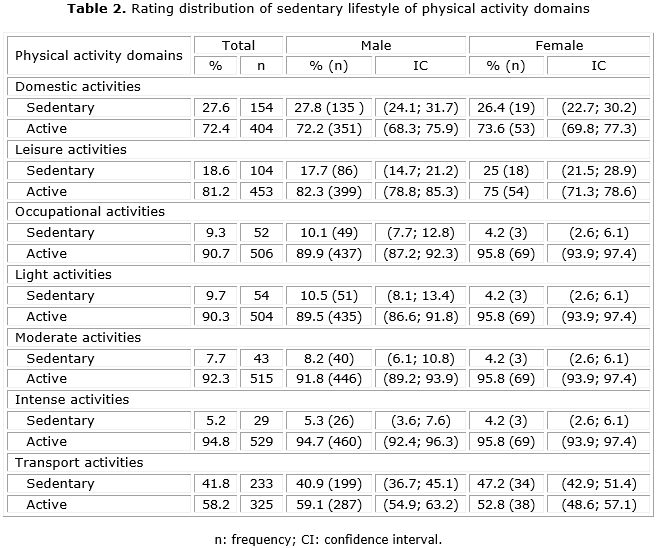
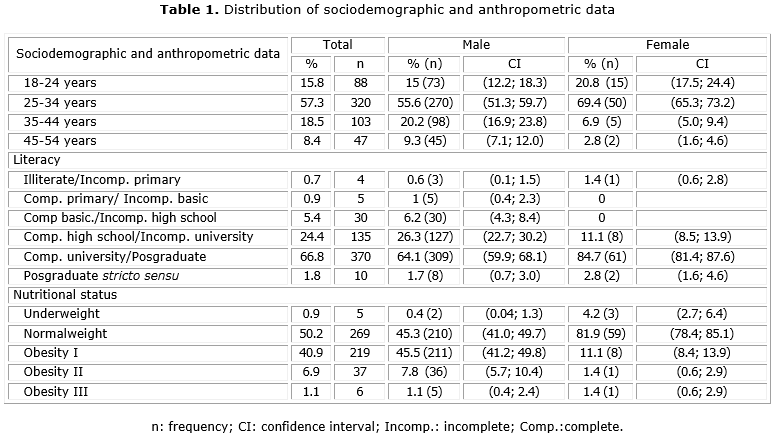
<body><![CDATA[<p><font face="Verdana, Arial, Helvetica, sans-serif" size="2">  The differences between genders for the variables age, nutritional status, level  of education, career time, number of hours of daily work, quantity of days worked  per week, type of actuation, size of effective that belongs, health conditions  and physical activity were tested by means of the analysis of 95 % confidence  interval (CI: 95 % ). </font></p>    <p><font face="Verdana, Arial, Helvetica, sans-serif" size="2">  The relationship between the values of the general health condition and the predictive  variables were analyzed by means of linear regression, in which the dependent  variable was considered as the condition of general health value obtained with  SF-36, with the demographic variables, anthropometric, occupational and physical  activity that were considered as independent. </font></p>    <p><font face="Verdana, Arial, Helvetica, sans-serif" size="2">  Each one of the independent variables were analyzed as the dependent, second simple  linear regression model, with a cutoff point for entry into multiple model and  the value of <i>p </i>less than or equal to 0.20. Already in multiple model, the  variables were analyzed according to the <i>forward model</i>. It is considered  significant, the variables of the multiple model, those that showed p&lt; .05  and/or to modify in more than 10 % the value of the angular coefficient (<i>&#946;</i>)  of any model variable. </font></p>    <p align="left">&nbsp;</p>    <p align="left"><font face="Verdana, Arial, Helvetica, sans-serif" size="2"><font size="3"><b>RESULTS  </b></font> </font></p>    <p><font face="Verdana, Arial, Helvetica, sans-serif" size="2">  The distribution by gender shows that the majority of military police is male  (f= 375). The mean values, standard deviation and confidence interval of age characteristics  demonstrate that the average age of the sample studied was 30.5 years (SD= 7.7).  The average values indicate that the military police work in 4.7 (SD= 1) days  per week and per 697.9 (SD= 302.8) minutes per day. </font></p>    <p><font face="Verdana, Arial, Helvetica, sans-serif" size="2">  The distributions of socio demographic characteristics show that the majority  of military police officers, both men and women, has academic levels; however,  the values of the confidence intervals indicate significant differences between  men and women for the strata of the medium complete/superior incomplete degree  of instruction and superior complete/post-graduate students <i>latosensu</i> (<A href="/img/revistas/mil/v43n3/t0107314.gif">table  1</A>). </font></p>    <p><font face="Verdana, Arial, Helvetica, sans-serif" size="2">  As the distributions of age groups, the majority of military police officers,  including men and women, it is at the age of 25 to 34 years. The values of the  confidence intervals indicate significant differences between men and women in  all age ranges. The distributions regarding the type of activity indicate that  the majority of military police officers, both men and women, is in soldiers formation  (<A href="/img/revistas/mil/v43n3/t0107314.gif">table 1</A>). </font></p>    <p><font face="Verdana, Arial, Helvetica, sans-serif" size="2">  The distributions of nutritional characteristics indicate that the majority of  military police men is with normal weight and obesity I. On the other hand the  military police women are within the considered normal weight. </font></p>    <p><font face="Verdana, Arial, Helvetica, sans-serif" size="2">  Even considering the socio demographic characteristics distributions, it was found  that, among the military policemen who have university degree, the sequential  frequency values of university trainings show the highest prevalence in Administration  areas (19.4 %), Physical Education (15.8 % ), Law (14.4 %) and Public Safety (11  %), among others. </font></p>    ]]></body>
<body><![CDATA[<p><font face="Verdana, Arial, Helvetica, sans-serif" size="2">  The distributions of occupational characteristics indicate that the majority of  military police officers, both men and women, have five or less career years.  The values of the confidence intervals indicate significant differences between  men and women for the strata of time of career &#8804; 5 years, 21-25 years, and  &gt; 25 years. </font></p>    <p><font face="Verdana, Arial, Helvetica, sans-serif" size="2">  In relation to distributions regarding the effective quantity, it is observed  that the majority of military police officers, both men and women, have 11 to  50 police officers in the unit in which it operates. </font></p>    <p><font face="Verdana, Arial, Helvetica, sans-serif" size="2">  The distributions of sedentary lifestyle classification on what concerns the physical  activity area indicate that the majority of military police, including men and  women, is considered active during domestic activities. Regarding the leisure  activities, the majority of military police men and women are active. The confidence  intervals values indicate significant differences between men and women on leisure  activities (<A href="/img/revistas/mil/v43n3/t0207314.gif">table 2</A>). </font></p>    <p><font face="Verdana, Arial, Helvetica, sans-serif" size="2">  In relation to the occupational activities, the study indicated that the majority  of military police men and women are active. The confidence intervals values shows  significant differences between men and women for the occupational activities  (<A href="/img/revistas/mil/v43n3/t0207314.gif">table 2</A>). </font></p>    <p><font face="Verdana, Arial, Helvetica, sans-serif" size="2">  The domain of moderate activities points out as active the majority of military  police officers, both men and women. The confidence intervals values do not indicate  significant differences between men and women for the moderate activities. </font></p>    <p><font face="Verdana, Arial, Helvetica, sans-serif" size="2">  In intensive activity field the majority of military police men and women, appears  as active. The confidence intervals values do not indicate significant differences  between men and women for the intensive activity. </font></p>    <p><font face="Verdana, Arial, Helvetica, sans-serif" size="2">  The field of transport activities indicates that the majority of military police  officers, both men and women, are considered active. The confidence intervals  do not indicate significant differences between men and women for the transportation  activities. </font></p>    <p><font face="Verdana, Arial, Helvetica, sans-serif" size="2">  The distributions of risk behaviors to health strata, concerning smoking, indicate  that the majority of military police officers, both men and women, never smoked  (<a href="/img/revistas/mil/v43n3/t0307314.gif">table 3</a>). The confidence intervals values indicate  significant differences between men and women for the smoking stratum 10 and 20  cigarettes per day (<a href="/img/revistas/mil/v43n3/t0307314.gif">table 3</a>). </font></p>    <p><font face="Verdana, Arial, Helvetica, sans-serif" size="2">  The distributions as for the systolic blood pressure (SBP) indicate that the majority  of military policemen has PAS of 120 to 130 mmHg. Already the military police  women have SBP of 110 to 119 mmHg. The confidence intervals values indicate significant  differences between men and women for the systolic blood pressure strata of 110  to 119 mmHg, 120 to 130 mmHg and 131 to 140 mmHg. </font></p>    <p><font face="Verdana, Arial, Helvetica, sans-serif" size="2">  The distributions regarding the type of physical activity they point out that  a great part of the military police, men and women, has moderate professional  activity. The confidence intervals values do not indicate significant differences  between men and women for physical activity type. </font></p>    ]]></body>
<body><![CDATA[<p><font face="Verdana, Arial, Helvetica, sans-serif" size="2">  Already the distributions regarding family history indicate that the majority  of military police, including men and women, has no cardiovascular diseases background.  The confidence intervals values do not indicate significant differences between  men and women for family history category. </font></p>    <p><font face="Verdana, Arial, Helvetica, sans-serif" size="2">  The glycemia distributions indicate that the majority of military police officers,  men and women, has fasting blood glucose below 80 mg/dl. The confidence intervals  values do not indicate significant differences between men and women for glucose  category. </font></p>    <p><font face="Verdana, Arial, Helvetica, sans-serif" size="2">  In addition, the distributions concerning cholesterol indicate that the majority  of military police officers, both men and women, has cholesterol below 180 mg/dl.  The confidence intervals values do not indicate significant differences between  men and women for category cholesterol. </font></p>    <p><font face="Verdana, Arial, Helvetica, sans-serif" size="2">  The values distribution in health condition fields indicate that the majority  of military police officers, both men and women, presents scores of physical and  mental domains below the expected average calculated, finding himself at the first  standard deviation negative scale (- 1DP: 40 to 50) of health conditions, although  there are no average gross below 50 points (<A href="/img/revistas/mil/v43n3/t0407314.gif">table 4</A>).  </font></p>    <p><font face="Verdana, Arial, Helvetica, sans-serif" size="2"> However,  confidence intervals values indicate significant difference between men and women  only in vitality related to health condition (<A href="/img/revistas/mil/v43n3/t0407314.gif">table 4)</A>.  </font></p>    <p><font face="Verdana, Arial, Helvetica, sans-serif" size="2"> The  distributions of stress signs values indicate that the majority of military police,  including men and women, shows lack of appetite, irritability, fatigue, worry  and pain and had no signs of depression (<A href="/img/revistas/mil/v43n3/t0507314.gif">table 5</A>).  However, the confidence intervals values do not indicate significant differences  between men and women for all signs of stress surveyed (<A href="/img/revistas/mil/v43n3/t0507314.gif">table  5</A>). </font></p>    <p><font face="Verdana, Arial, Helvetica, sans-serif" size="2">  The parameters of the multiple regression values of the general state of health  accordingly socio demographic variables, anthropometric, occupational, physical  activity and clinical stress signs/symptoms. After the simple regression finalization  of each of the independent variables in relation to the dependent variable, were  selected for entry into multiple model specific training, type of activity, physical  domestic activities, moderate physical activity, and symptom of stress (depression),  all with <i>p</i>&lt; .20. </font></p>    <p><font face="Verdana, Arial, Helvetica, sans-serif" size="2">  The variables domestic physical activities (<i>&#946;</i>= - .311; <i>p</i>= .013)  and the stress-depression symptom (<i>&#946; </i>= - .262; <i>p</i>= .034), remained  on the multiple linear regression model, both with statistical significance (<i>p</i>&lt;  .05). Like this, the military police with smaller metabolic equivalent (METs)  value in physical domestic activities and lower depression occurrence as a stress  symptom tend to have general health higher values, regardless of each of the independent  final variables. </font></p>    <p align="left">&nbsp;</p>    <p align="left"><font face="Verdana, Arial, Helvetica, sans-serif" size="2"><font size="3"><b>DISCUSSION  </b></font> </font></p>    ]]></body>
<body><![CDATA[<p><font face="Verdana, Arial, Helvetica, sans-serif" size="2">  The prevalent age ranges between 25 and 34 years converges with the data found  in the literature with small age variations as in <i>Prot&#225;sio</i><sup>17</sup>  study with Brazil Radiopatrulha (26 to 32 years) military police, of <i>Ferreira,  Bonfim </i>and <i>Augusto</i><sup>4</sup> with military police of Recife/PE city  (36 to 45 years) and <i>Costa, Accioly Junior, Oliveira </i>and<i> Maia</i><sup>18</sup>  with military police of Natal/RN city (&lt; 40). </font></p>    <p><font face="Verdana, Arial, Helvetica, sans-serif" size="2">  The superior University /Post-graduate <i>latosensu</i> degree subjects of this  study also partially converges with the selected literature<sup>4,18</sup> and  ratifies the legal requirements existing in Santa Catarina State. In the quoted  studies above of <i>Ferreira, Bonfim </i>and<i> Augusto</i><sup>4</sup> the majority  of the subjects had completed high school (64.9 %) or university degree (8.6 %)  and <i>Costa, Accioly Junior, Oliveira </i>and<i> Maia</i><sup>18 </sup>the majority  of the subjects had completed high school (77.3 %). However, in Brazil most of  the agents, especially the squares, still has no university degree, because until  2009 it was not necessary to take this degree to assume the position or compete  to some promotion. </font></p>    <p><font face="Verdana, Arial, Helvetica, sans-serif" size="2">  It should be highlighted that the studied population was located between the treated  agents or treated in HPM including the agents who passed by the Medical Committee  to join the Military Police of Santa Catarina, and therefore, already framed in  Complementary Law no. 454/2009 that requires university degree in any area for  the squares (soldier, corporal, sergeant and Sub-Lieutenant) and university degree  in Law for officers (lieutenant, captain, major, lieutenant colonel and colonel).  On what concerns other subjects from the HPM, you must pay attention to the Military  State of Santa Catarina Status, according to Law no. 6.218/1983, Article 11 which  provides that officers must possess a university degree education for entering  the Military Police. </font></p>    <p><font face="Verdana, Arial, Helvetica, sans-serif" size="2">  In spite of the majority present normal weight, the high percentage of subjects  with excess body weight and obesity grade I (40.9 %) are not in line with the  results presented in the questionnaires, in which 94.8 % of the agents are active.  In this sense, one can hypothesize that there is a controversy in the results  with the reality, there are recoveries, both by the Corporation and the society  itself for a posture and a life style of these professionals that is compatible  with their occupational requirements. </font></p>    <p><font face="Verdana, Arial, Helvetica, sans-serif" size="2">  The Family Budget Survey, of the Brazilian Geography and Statistics Intitute<sup>19</sup>  pointed out that the excess weight in adult men, who was of 18.5 % in 1974/1975  period, turned to 50.1 % in 2008-2009 period and, in women, which was 28.7 % in  period 1974/1975 period, turned to 48 % in 2008/2009 period. It should be highlighted  that the IBGE survey<sup>19</sup> also showed that the Southern region has the  highest percentage of obesity, because it increased from 15.9 % among men and  19.6 % among women to 56.8 % among men and 51.6 % among women, respectively, of  the 1974/75 period and 2008/2009 period , mainly in men with higher yield (61.8  %). </font></p>    <p><font face="Verdana, Arial, Helvetica, sans-serif" size="2">  The relatively short time of service of the majority of subjects converges with  <i>Costa, Accioly Junior, Oliveira </i>and<i> Maia</i><sup>18 </sup>study, because  the service time ranged between 2 and 9 years, reflecting this way, the expansion  number policy in military police of Rio Grande do Norte State. However, it must  be considered that the relatively short time of service can be analyzed from the  sample occupational characteristics, since the subjects in this study were in  treatment or care at HPM and, therefore, included those that passed by the Medical  Committee for expulsion in service, promotion or Corporation ingress. </font></p>    <p><font face="Verdana, Arial, Helvetica, sans-serif" size="2">  By analyzing the service time in relation to the type of activity, it was found  that the majority of police investigated is under preparation in soldiers training  program. In spite of this analysis, it should be highlighted that the specialized  literature points out that the Public Safety professionals with less than 10 years  of service already have health problems as a result of various consequences related  to police action, mainly between the agents that act on operational and organizational  institution service of societies that have high crime rates and local violence.<sup>1,10</sup>  </font></p>    <p><font face="Verdana, Arial, Helvetica, sans-serif" size="2"> The  prevalence of soldiers in this study can be analyzed from the sample characteristics,  the legal documents relating to Santa Catarina Military Police because effectively  Santa Catarina Military Police is composed of 10 619 squares and 674 officers,  being that between the squares, the largest number is of soldiers, which reaches  6 778 individuals<sup>19</sup> and also of the specialized literature that converges  as the obtained data.<sup>10,1</sup> </font></p>    <p><font face="Verdana, Arial, Helvetica, sans-serif" size="2">  According to the specialized literature, the soldiers are directly exposed to  the crime and, therefore, are more prone to traumatic events, mainly related to  the confrontation, as the injuries themselves of firearms or sprains and typical  fractures of persecution in different terrain and conditions.<sup>10,1</sup> </font></p>    <p><font face="Verdana, Arial, Helvetica, sans-serif" size="2">  Despite the predominance of police officers in training, it was found that more  than a quarter of the sample operates in operational function, which involves  services performed directly in the community, which requires police officers good  physical preparation to in cases intervene. It is, therefore, admissible understand  that operational actuation causes physical damage, insomniacs nights and exposes  the military police to risks, including death, because it is more vulnerable to  the suspect confrontation than the police who works in the administrative sector.<sup>20,21</sup>  </font></p>    ]]></body>
<body><![CDATA[<p><font face="Verdana, Arial, Helvetica, sans-serif" size="2"> On  the other hand, it should be pointed out also that the administrative actuation  sector of the Military Police has tightened the occupational health related mainly  to making bureaucratic overtures, organizational pressures and the psychological  pressure. Because, as <i>Spode </i>and<i> Merlo</i><sup>22</sup> discuss, military  police officers on a command function in Police Corporations have several responsibilities,  among them the achievement of crime rates reliable statistics , the studies of  sites with larger propensities to occurrences and the planning of jobs performances,  work scales, of licenses concessions and day-off management and vacation. </font></p>    <p><font face="Verdana, Arial, Helvetica, sans-serif" size="2">  The differences indicate that the military police women are more sedentary in  leisure physical activities and the associations of the general health condition,  with depression signs and with domestic physical activities, converge with the  study of <i>Costa, Accioly Junior, Oliveira </i>and<i> Maia</i><sup>18 </sup>who  points out that police officers with more than 30 years of age, without any leisure  activity and competition, have high rates of stress, and can generate several  clinical complications. Already the differences indicates that male military police  are more sedentary in occupational physical activities, converge partially with  <i>Jesus </i>and<i> Jesus</i><sup>23</sup> study who points out that the military  police women are more active in occupational activities than military police men.  </font></p>    <p><font face="Verdana, Arial, Helvetica, sans-serif" size="2"> It  may be considered, in accordance with the specialized literature, that the area  of Public Safety action is an important health risk factor, not only by direct  physical threats, but also by the consequences of disturbances caused by situations  that affect the self-esteem and dignity insults received, of unjust treatments  of civil society and of the non-completion frustrations of professional objectives  inherent to professional career. These conditions are aggravated in women police  cases, because, in addition, are still exposed to the demands of several domestic  tasks, such as to care of family, home, financial administration and children  education. So, the policewoman have less time to maintain activities that increase  their vitality, to perform physical activities, to enjoy leisure moments and even  taking care of their own health and well-being. </font></p>    <p><font face="Verdana, Arial, Helvetica, sans-serif" size="2">  With respect to the predisposing health risks factors, you can check that the  prevalence of non-smokers, especially in military policemen, partially converges  with the selected studies, both those related to the Santa Catarina Military Police<sup>24</sup>  as of Corporations in other Federation States.<sup>18,25</sup> In a study carried  out by <i>Boldori</i> and <i>Silveira</i><sup>24</sup> at Battalion of Military  Police Special Operations of Florianopolis Center, it was identified that the  majority does not smoked. In <i>Minayo, Souza </i>and<i> Constantine</i><sup>25</sup>  study, carried out with Military Police of Rio de Janeiro/RJ agents, it was observed  a significant percentage of non-smokers military police. </font></p>    <p><font face="Verdana, Arial, Helvetica, sans-serif" size="2">  On what concerns the results on the systolic blood pressure adequate to health  care, especially in military policemen, there is a convergence with the study  developed by <i>Minayo</i>, <i>Assisi </i>and <i>Oliveira</i><sup>5</sup> with  Rio de Janeiro military police who identified only 17.4 % of those surveyed had  arterial hypertension. According to the World Health Organization<sup>25</sup>  individuals without hypertension adequate control of this condition may have a  reduction in life expectancy of up to 16 years. Almost 15 % of deaths every year  in the world are attributed to uncontrolled hypertension, being that 80 % of these  deaths occur in countries of low and middle economic development and more than  half in individuals between 45 and 69 years. </font></p>    <p><font face="Verdana, Arial, Helvetica, sans-serif" size="2">  In Brazil, there is around a third of encephalic vascular accidents and myocardial  infarctions presents direct cause with systemic arterial hypertension. According  to the World Health Organization<sup>26</sup> in Brazil, 39.4 % of men with more  than 25 years and 26.6 % of women in this age group are suffering from hypertension.  </font></p>    <p><font face="Verdana, Arial, Helvetica, sans-serif" size="2"> The  low scores of the vitality domain assessed by the SF-36, mainly in military policemen,  were not analyzed comparatively, because studies were not identified on this population  theme. In this respect, this data was analyzed with studies that addressed police,  requiring relativization, because the activity in the Public Safety area can be  considered a relevant health risk factor, affecting vitality, because besides  the physical factors, psychological, organizational, and social, the police still  suffer from the typical conventionalism of an institution that presents predominance  of strong evidence of typical male attitudes.<sup>27,28</sup> </font></p>    <p><font face="Verdana, Arial, Helvetica, sans-serif" size="2">  The occurrence of clinical signs and stress symptoms and the general health condition  associations with depression signs converge partially with the selected studies.<sup>29,18</sup>  In <i>Dantas, Brito Rodrigues </i>and<i> Maciente</i><sup>29</sup> study, with  Minas Gerais military police, was identified that 76 % of those surveyed had stress,  being that 24 % had this condition physical symptoms. <i>Costa, Accioly Junior,  Oliveira </i>and <i>Maia</i><sup>,18 </sup>cited above, it was found that 47.4  % of investigated people presented stress symptoms, being that 39.8 % were in  resistance stage, 3.8 % in almost exhaustion, 3.4 % in alert and 0.4 % in exhaustion.  </font></p>    <p> <font face="Verdana, Arial, Helvetica, sans-serif" size="2"><i>Costa,  Accioly Junior, Oliveira </i> and<i> Maia</i><sup>18 </sup>also found that 76  % of police presented psychological stress symptoms, 24 % physical stress symptoms  and identified association between stress and gender, especially with the female  gender, diverging, in this way from the results found that indicate that the investigated  military police in Santa Catarina HPM are the most affected. </font></p>    <p><font face="Verdana, Arial, Helvetica, sans-serif" size="2">  It can be concluded that the military police searched, from service or treatments  in Santa Catarina HPM, are getting sick in full productive age group, especially  regarding the stress sign symptoms, which can be considered as a determining factor  in health public expenses, both individual and collective. Despite the military  police prevalence with middle and superior level within the recommended range  of weight for health and with relatively short time in police career, it was found  the occurrence of various deleterious factors, such as lack of appetite, irritability,  fatigue, worry, pain, depression and excess weight. As beneficial aspects you  can point the non-smoking, the physical activities (domestic, leisure and occupational;  light, moderate and severe) and the clinical profiles (of arterial tension, blood  glucose and cholesterol) within the normal levels. Stand out the associations  that indicate that military police officers with metabolic lower level equivalent  (MET's) in physical domestic activities and lower stress symptom depression occurrence  tend to have general health higher values. </font></p>    ]]></body>
<body><![CDATA[<p><font face="Verdana, Arial, Helvetica, sans-serif" size="2">  Two of these factors may be posted, being one negative and the other positive  health conditions. In this case, you can point respectively, the excess weight  in almost half of the sample, in particular military police and the predominance  of physical activity classifications in all types of investigated physical activity.  This way, it can be concluded that, despite the gross high scores of functional  sub domains capacity, physical aspect, of pain, general health, vitality, social  aspect, emotional and mental health, it was found that the physical and mental  scores domains were found to be below the expected average calculated . </font></p>    <p>&nbsp;  </p>    <p><font face="Verdana, Arial, Helvetica, sans-serif" size="2"><b><font size="3">REFERENCES</font></b>  </font></p>    <!-- ref --><p><font face="Verdana, Arial, Helvetica, sans-serif" size="2">1. Schlichting  Junior AM, Silva R. Revis&#227;o sistem&#225;tica da produ&#231;&#227;o cient&#237;fica  relacionada &#224; atividade f&#237;sica e qualidade de vida de militares. Rev  Educ F&#237;s-Escola de Educa&#231;&#227;o F&#237;sica do Ex&#233;rcito. 2009;145:28-36.      </font></p>    <!-- ref --><p><font face="Verdana, Arial, Helvetica, sans-serif" size="2"> 2.  Bulwer B. Sedentary lifestyles physical activity, and cardiovascular disease from  research to practice. Crit Pathw Cardiol. 2004;3(4):184-93.     </font></p>    <!-- ref --><p><font face="Verdana, Arial, Helvetica, sans-serif" size="2">  3. Benedetti TRB, Antunes PC, Rodrigues-A&#241;ez CR, Mazo GZ, Petroski EL. Reprodutibilidade  e validade do Question&#225;rio Internacional de Atividade F&#237;sica em homens  idosos. Rev Bras Med Esporte. 2007;13(1):11-6.     </font></p>    <!-- ref --><p><font face="Verdana, Arial, Helvetica, sans-serif" size="2">  4. Ferreira SKD, Bonfim C, Augusto SGL. Fatores Associados ao Estilo de vida de  Policiais Militares. Ci&#234;n Sa&#250;d Colet. 2011;16(8):3403-12.     </font></p>    <!-- ref --><p><font face="Verdana, Arial, Helvetica, sans-serif" size="2">  5. Minayo MCS, Assis GL, Oliveira RVC. Impacto das atividades profissionais na  sa&#250;de f&#237;sica e mental dos policiais civis e militares do Rio de Janeiro.  Cien Saud Colet. 2011;16(4):2199-209.     </font></p>    <!-- ref --><p><font face="Verdana, Arial, Helvetica, sans-serif" size="2">  6. S&#246;rensen L. Correlates of physical activity among middle-aged Finnish  male police officers. Occup Med. 2005;55(2):136-138.     </font></p>    <!-- ref --><p><font face="Verdana, Arial, Helvetica, sans-serif" size="2">  7. Nabeel I, Baker BA, McGrail Junior MP, Flottemesch M. Correlation between physical  activity, fitness, and musculoskeletal injuries in police officers. Minn Med.  2007;90(9):40-3.     </font></p>    <!-- ref --><p><font face="Verdana, Arial, Helvetica, sans-serif" size="2">  8. Soteriades ES, Smith DL, Tsismenakis AJ, Baur DM, Kales SN. Cardiovascular  disease in US firefighters: a systematic review. Cardiol Rev. 2011;19(4):202-15.      </font></p>    <!-- ref --><p><font face="Verdana, Arial, Helvetica, sans-serif" size="2"> 9.  Handcock P, Dempsey P. Fit to serve. A review of the New Zealand Police Physical  Competency Test. J Sci Med Sport. 2011;14(1):e56.     </font></p>    <!-- ref --><p><font face="Verdana, Arial, Helvetica, sans-serif" size="2">  10. S&#246;rensen L, Smolander J, Louhevaara V, Korthonen O, Oja P. Physical activity,  fitness and body composition of Finnish police officers: a 15-year follow-up study.  Occup Med. 2000;50(1):3-10.     </font></p>    <!-- ref --><p><font face="Verdana, Arial, Helvetica, sans-serif" size="2">  11. Ware JE, Gandek B. The SF-36 Health Survey: Development and use in mental  health research and the IQOLA Project. Int J Ment Health. 1994;23(2):49-73.     </font></p>    <!-- ref --><p><font face="Verdana, Arial, Helvetica, sans-serif" size="2">  12. Ciconelli RM, Ferraz MB, Santos W, Mein&#227;o I, Quaresma MR. Tradu&#231;&#227;o  para a l&#237;ngua portuguesa e valida&#231;&#227;o do question&#225;rio gen&#233;rico  de avalia&#231;&#227;o de qualidade de vida SF-36 (Brasil SF-36). Rev Bras Reumatol.  1997;39(3):143-50.     </font></p>    <!-- ref --><p><font face="Verdana, Arial, Helvetica, sans-serif" size="2">  13. Matsudo S, Araujo T, Matsudo V. Question&#225;rio internacional de atividade  f&#237;sica (IPAQ): estudo de validade e reprodutividade no Brasil. Rev Bras Ativ  Fis Saud. 2001;6(2):5-18.     </font></p>    <!-- ref --><p><font face="Verdana, Arial, Helvetica, sans-serif" size="2">  14. Karolinska Institute. Guidelines for data processing and analysis of the International  Physical Activity Questionnaire (IPAQ)-Short form: Scoring protocol 2005 [Internet].  [cited 2013 Dic 15]. Available from: <a href="http://www.ipaq.ki.se/scoring.pdf" TARGET="_blank">http://www.ipaq.ki.se/scoring.pdf</a></font><!-- ref --><p><font face="Verdana, Arial, Helvetica, sans-serif" size="2">  15. Mcardle W, Katch F, Katch V. Fisiologia do Exerc&#237;cio: Nutri&#231;&#227;o  e Desempenho Humano. Rio de Janeiro: Guanabara; 2001.     </font></p>    <!-- ref --><p><font face="Verdana, Arial, Helvetica, sans-serif" size="2">  16. Haes JC, Van Knippenberg FC, Neijt JP. Measuring psychological and physical  distress in cancer patients: structure and application of the Rotterdam Symptom  Checklist. Br J Cancer. 1990;62:1034-8.     </font></p>    <!-- ref --><p><font face="Verdana, Arial, Helvetica, sans-serif" size="2">  17. Prot&#225;sio IS. Sa&#250;de Mental do Trabalhador Policial Militar da Radiopatrulha.  Em: V Col&#243;quio Internacional "Educa&#231;&#227;o e Contemporaneidade". S&#227;o  Cristov&#227;o; 2011.     </font></p>    <!-- ref --><p><font face="Verdana, Arial, Helvetica, sans-serif" size="2">  18. Costa M, Accioly Junior H, Oliveira J, Maia E. Estresse: diagn&#243;stico  dos policiais militares em uma cidade brasileira. Rev Pan Am J Public Health.  2007;21(4):217-22.     </font></p>    <!-- ref --><p><font face="Verdana, Arial, Helvetica, sans-serif" size="2">  19. Instituto Brasileiro de Geografia e Estat&#237;stica. Pesquisa de Or&#231;amento  Familiar (POF) 2008-2009: Antropometria e estado nutricional de crian&#231;as,  adolescentes e adultos no Brasil. Brasil: Instituto Brasileiro de Geografia e  Estat&#237;stica; 2010.     </font></p>    ]]></body>
<body><![CDATA[<!-- ref --><p><font face="Verdana, Arial, Helvetica, sans-serif" size="2">  20. Pol&#237;cia Militar de Santa Catarina. Levantamento do Comando Geral da Pol&#237;cia  Militar do Estado de Santa Catarina sobre o efetivo da corpora&#231;&#227;o. Florian&#243;polis:  Pol&#237;cia Militar de Santa Catarina; 2012.     </font></p>    <!-- ref --><p><font face="Verdana, Arial, Helvetica, sans-serif" size="2">  21. Souza ER, Minayo MCS. Policial, risco como Profiss&#227;o: Morbimortalidade  Vinculada ao Trabalho. Ci&#234;n Sa&#250;d Colet. 2005;10(4):917-28.     </font></p>    <!-- ref --><p><font face="Verdana, Arial, Helvetica, sans-serif" size="2">  22. SpodeCB, Merlo ARC. Trabalho Policial e Sa&#250;de Mental: Uma Pesquisa Junto  aos Capit&#227;es da Pol&#237;cia Militar. Psico Refl Cr&#237;t. 2006;19(3):362-70.      </font></p>    <!-- ref --><p><font face="Verdana, Arial, Helvetica, sans-serif" size="2"> 23.  Jesus GM, Jesus &#201;FA. Predisposi&#231;&#227;o para desenvolver resist&#234;ncia  insul&#237;nica em policiais militares. Pensar a Pr&#225;tica 2010;13(2):1-15.      </font></p>    <!-- ref --><p><font face="Verdana, Arial, Helvetica, sans-serif" size="2"> 24.  Boldori R, Silveira GLF. Diagn&#243;stico do Consumo de Fumo e &#193;lcool pelos  Policiais Militares do Batalh&#227;o de Opera&#231;&#245;es Especiais da Pol&#237;cia  Militar de Santa Catarina-UFSC. Florian&#243;polis: Pol&#237;cia Militar de Santa  Catarina; 2000.     </font></p>    ]]></body>
<body><![CDATA[<!-- ref --><p><font face="Verdana, Arial, Helvetica, sans-serif" size="2">  25. Minayo SCM, Souza RE, Constantino P. Riscos percebidos e vitimiza&#231;&#227;o  de policiais civis e militares na (in) seguran&#231;a p&#250;blica. Cad Sa&#250;d  Public. 2007;23(11):2767-79.     </font></p>    <!-- ref --><p><font face="Verdana, Arial, Helvetica, sans-serif" size="2">  26. Organiza&#231;&#227;o Mundial da Sa&#250;de. Estat&#237;sticas Mundial em  Sa&#250;de. Genebra: OMS; 2008.     </font></p>    <!-- ref --><p><font face="Verdana, Arial, Helvetica, sans-serif" size="2">  27. Calazans ME. Mulheres no policiamento ostensivo e a perspectiva de uma seguran&#231;a  cidad&#227;. S&#227;o Paulo Perspect. 2004;18(1):142-50.     </font></p>    <!-- ref --><p><font face="Verdana, Arial, Helvetica, sans-serif" size="2">  28. Souza ER, Franco LG, Meireles CC, Ferreira VT, Santos NC. Sofrimento ps&#237;quico  entre policiais civis: uma an&#225;lise sob a &#243;tica de g&#234;nero. Cad Sa&#250;d  Public. 2007;23(1):105-14.     </font></p>    <!-- ref --><p><font face="Verdana, Arial, Helvetica, sans-serif" size="2">  29. Dantas MA, Brito DVC, Rodrigues PB, Maciente TS. Avalia&#231;&#227;o de estresse  em policiais militares. Psico Teo Pratic. 2010;12(3):66-77.     </font></p>    ]]></body>
<body><![CDATA[<p align="left">&nbsp;</p>    <p align="left">&nbsp;</p>    <p align="left"><font face="Verdana, Arial, Helvetica, sans-serif" size="2">Recibido:  17 de febrero de 2014. </font>    <br> <font face="Verdana, Arial, Helvetica, sans-serif" size="2">Aprobado:  17 de abril de 2014.</font></p>    <p>&nbsp;</p>    <p>&nbsp; </p>    <p> <font face="Verdana, Arial, Helvetica, sans-serif" size="2"><i>Cristine  Mattos Benedetti</i>. Center of Health Sciences and Sport, UDESC, Univ. Estadual  de Santa Catarina, Adaptaded Physical Activity Lab (LABAMA). Paschoal Simone St,  358, Coqueiros. Florian&#243;polis/SC, Brazil. Zip Code: 88080-350. Telephone:  +55 48 3321-8651. Email: <a href="mailto:cristinemb@gmail.com">cristinemb@gmail.com</a></font></p>    <p><font face="Verdana, Arial, Helvetica, sans-serif" size="2">  Patrocinado por: Funda&#231;&#227;o de Amparo &#224; Pesquisa e Inova&#231;&#227;o  do Estado de Santa Catarina-FAPESC/13.680/2011-8. </font></p><font face="Verdana, Arial, Helvetica, sans-serif" size="2"><br clear="all"/>  </font>       ]]></body><back>
<ref-list>
<ref id="B1">
<label>1</label><nlm-citation citation-type="journal">
<person-group person-group-type="author">
<name>
<surname><![CDATA[Schlichting Junior]]></surname>
<given-names><![CDATA[AM]]></given-names>
</name>
<name>
<surname><![CDATA[Silva]]></surname>
<given-names><![CDATA[R]]></given-names>
</name>
</person-group>
<article-title xml:lang="pt"><![CDATA[Revisão sistemática da produção científica relacionada à atividade física e qualidade de vida de militares]]></article-title>
<source><![CDATA[Rev Educ Fís-Escola de Educação Física do Exército]]></source>
<year>2009</year>
<volume>145</volume>
<page-range>28-36</page-range></nlm-citation>
</ref>
<ref id="B2">
<label>2</label><nlm-citation citation-type="journal">
<person-group person-group-type="author">
<name>
<surname><![CDATA[Bulwer]]></surname>
<given-names><![CDATA[B]]></given-names>
</name>
</person-group>
<article-title xml:lang="en"><![CDATA[Sedentary lifestyles physical activity, and cardiovascular disease from research to practice]]></article-title>
<source><![CDATA[Crit Pathw Cardiol.]]></source>
<year>2004</year>
<volume>3</volume>
<numero>4</numero>
<issue>4</issue>
<page-range>184-93</page-range></nlm-citation>
</ref>
<ref id="B3">
<label>3</label><nlm-citation citation-type="journal">
<person-group person-group-type="author">
<name>
<surname><![CDATA[Benedetti]]></surname>
<given-names><![CDATA[TRB]]></given-names>
</name>
<name>
<surname><![CDATA[Antunes]]></surname>
<given-names><![CDATA[PC]]></given-names>
</name>
<name>
<surname><![CDATA[Rodrigues-Añez]]></surname>
<given-names><![CDATA[CR]]></given-names>
</name>
<name>
<surname><![CDATA[Mazo]]></surname>
<given-names><![CDATA[GZ]]></given-names>
</name>
<name>
<surname><![CDATA[Petroski]]></surname>
<given-names><![CDATA[EL]]></given-names>
</name>
</person-group>
<article-title xml:lang="pt"><![CDATA[Reprodutibilidade e validade do Questionário Internacional de Atividade Física em homens idosos]]></article-title>
<source><![CDATA[Rev Bras Med Esporte.]]></source>
<year>2007</year>
<volume>13</volume>
<numero>1</numero>
<issue>1</issue>
<page-range>11-6</page-range></nlm-citation>
</ref>
<ref id="B4">
<label>4</label><nlm-citation citation-type="journal">
<person-group person-group-type="author">
<name>
<surname><![CDATA[Ferreira]]></surname>
<given-names><![CDATA[SKD]]></given-names>
</name>
<name>
<surname><![CDATA[Bonfim]]></surname>
<given-names><![CDATA[C]]></given-names>
</name>
<name>
<surname><![CDATA[Augusto]]></surname>
<given-names><![CDATA[SGL]]></given-names>
</name>
</person-group>
<article-title xml:lang="pt"><![CDATA[Fatores Associados ao Estilo de vida de Policiais Militares]]></article-title>
<source><![CDATA[Ciên Saúd Colet.]]></source>
<year>2011</year>
<volume>16</volume>
<numero>8</numero>
<issue>8</issue>
<page-range>3403-12</page-range></nlm-citation>
</ref>
<ref id="B5">
<label>5</label><nlm-citation citation-type="journal">
<person-group person-group-type="author">
<name>
<surname><![CDATA[Minayo]]></surname>
<given-names><![CDATA[MCS]]></given-names>
</name>
<name>
<surname><![CDATA[Assis]]></surname>
<given-names><![CDATA[GL]]></given-names>
</name>
<name>
<surname><![CDATA[Oliveira]]></surname>
<given-names><![CDATA[RVC]]></given-names>
</name>
</person-group>
<article-title xml:lang="pt"><![CDATA[Impacto das atividades profissionais na saúde física e mental dos policiais civis e militares do Rio de Janeiro]]></article-title>
<source><![CDATA[Cien Saud Colet.]]></source>
<year>2011</year>
<volume>16</volume>
<numero>4</numero>
<issue>4</issue>
<page-range>2199-209</page-range></nlm-citation>
</ref>
<ref id="B6">
<label>6</label><nlm-citation citation-type="journal">
<person-group person-group-type="author">
<name>
<surname><![CDATA[Sörensen]]></surname>
<given-names><![CDATA[L]]></given-names>
</name>
</person-group>
<article-title xml:lang="en"><![CDATA[Correlates of physical activity among middle-aged Finnish male police officers]]></article-title>
<source><![CDATA[Occup Med.]]></source>
<year>2005</year>
<volume>55</volume>
<numero>2</numero>
<issue>2</issue>
<page-range>136-138</page-range></nlm-citation>
</ref>
<ref id="B7">
<label>7</label><nlm-citation citation-type="journal">
<person-group person-group-type="author">
<name>
<surname><![CDATA[Nabeel]]></surname>
<given-names><![CDATA[I]]></given-names>
</name>
<name>
<surname><![CDATA[Baker]]></surname>
<given-names><![CDATA[BA]]></given-names>
</name>
<name>
<surname><![CDATA[McGrail Junior]]></surname>
<given-names><![CDATA[MP]]></given-names>
</name>
<name>
<surname><![CDATA[Flottemesch]]></surname>
<given-names><![CDATA[M]]></given-names>
</name>
</person-group>
<article-title xml:lang="en"><![CDATA[Correlation between physical activity, fitness, and musculoskeletal injuries in police officers]]></article-title>
<source><![CDATA[Minn Med.]]></source>
<year>2007</year>
<volume>90</volume>
<numero>9</numero>
<issue>9</issue>
<page-range>40-3</page-range></nlm-citation>
</ref>
<ref id="B8">
<label>8</label><nlm-citation citation-type="journal">
<person-group person-group-type="author">
<name>
<surname><![CDATA[Soteriades]]></surname>
<given-names><![CDATA[ES]]></given-names>
</name>
<name>
<surname><![CDATA[Smith]]></surname>
<given-names><![CDATA[DL]]></given-names>
</name>
<name>
<surname><![CDATA[Tsismenakis]]></surname>
<given-names><![CDATA[AJ]]></given-names>
</name>
<name>
<surname><![CDATA[Baur]]></surname>
<given-names><![CDATA[DM]]></given-names>
</name>
<name>
<surname><![CDATA[Kales]]></surname>
<given-names><![CDATA[SN]]></given-names>
</name>
</person-group>
<article-title xml:lang="en"><![CDATA[Cardiovascular disease in US firefighters: a systematic review]]></article-title>
<source><![CDATA[Cardiol Rev.]]></source>
<year>2011</year>
<volume>19</volume>
<numero>4</numero>
<issue>4</issue>
<page-range>202-15</page-range></nlm-citation>
</ref>
<ref id="B9">
<label>9</label><nlm-citation citation-type="journal">
<person-group person-group-type="author">
<name>
<surname><![CDATA[Handcock]]></surname>
<given-names><![CDATA[P]]></given-names>
</name>
<name>
<surname><![CDATA[Dempsey]]></surname>
<given-names><![CDATA[P]]></given-names>
</name>
</person-group>
<article-title xml:lang="en"><![CDATA[Fit to serve: A review of the New Zealand Police Physical Competency Test]]></article-title>
<source><![CDATA[J Sci Med Sport.]]></source>
<year>2011</year>
<volume>14</volume>
<numero>1</numero>
<issue>1</issue>
<page-range>e56</page-range></nlm-citation>
</ref>
<ref id="B10">
<label>10</label><nlm-citation citation-type="journal">
<person-group person-group-type="author">
<name>
<surname><![CDATA[Sörensen]]></surname>
<given-names><![CDATA[L]]></given-names>
</name>
<name>
<surname><![CDATA[Smolander]]></surname>
<given-names><![CDATA[J]]></given-names>
</name>
<name>
<surname><![CDATA[Louhevaara]]></surname>
<given-names><![CDATA[V]]></given-names>
</name>
<name>
<surname><![CDATA[Korthonen]]></surname>
<given-names><![CDATA[O]]></given-names>
</name>
<name>
<surname><![CDATA[Oja]]></surname>
<given-names><![CDATA[P]]></given-names>
</name>
</person-group>
<article-title xml:lang="en"><![CDATA[Physical activity, fitness and body composition of Finnish police officers: a 15-year follow-up study]]></article-title>
<source><![CDATA[Occup Med.]]></source>
<year>2000</year>
<volume>50</volume>
<numero>1</numero>
<issue>1</issue>
<page-range>3-10</page-range></nlm-citation>
</ref>
<ref id="B11">
<label>11</label><nlm-citation citation-type="journal">
<person-group person-group-type="author">
<name>
<surname><![CDATA[Ware]]></surname>
<given-names><![CDATA[JE]]></given-names>
</name>
<name>
<surname><![CDATA[Gandek]]></surname>
<given-names><![CDATA[B]]></given-names>
</name>
</person-group>
<article-title xml:lang="en"><![CDATA[The SF-36 Health Survey: Development and use in mental health research and the IQOLA Project]]></article-title>
<source><![CDATA[Int J Ment Health.]]></source>
<year>1994</year>
<volume>23</volume>
<numero>2</numero>
<issue>2</issue>
<page-range>49-73</page-range></nlm-citation>
</ref>
<ref id="B12">
<label>12</label><nlm-citation citation-type="journal">
<person-group person-group-type="author">
<name>
<surname><![CDATA[Ciconelli]]></surname>
<given-names><![CDATA[RM]]></given-names>
</name>
<name>
<surname><![CDATA[Ferraz]]></surname>
<given-names><![CDATA[MB]]></given-names>
</name>
<name>
<surname><![CDATA[Santos]]></surname>
<given-names><![CDATA[W]]></given-names>
</name>
<name>
<surname><![CDATA[Meinão]]></surname>
<given-names><![CDATA[I]]></given-names>
</name>
<name>
<surname><![CDATA[Quaresma]]></surname>
<given-names><![CDATA[MR]]></given-names>
</name>
</person-group>
<article-title xml:lang="pt"><![CDATA[Tradução para a língua portuguesa e validação do questionário genérico de avaliação de qualidade de vida SF-36 (Brasil SF-36)]]></article-title>
<source><![CDATA[Rev Bras Reumatol.]]></source>
<year>1997</year>
<volume>39</volume>
<numero>3</numero>
<issue>3</issue>
<page-range>143-50</page-range></nlm-citation>
</ref>
<ref id="B13">
<label>13</label><nlm-citation citation-type="journal">
<person-group person-group-type="author">
<name>
<surname><![CDATA[Matsudo]]></surname>
<given-names><![CDATA[S]]></given-names>
</name>
<name>
<surname><![CDATA[Araujo]]></surname>
<given-names><![CDATA[T]]></given-names>
</name>
<name>
<surname><![CDATA[Matsudo]]></surname>
<given-names><![CDATA[V]]></given-names>
</name>
</person-group>
<article-title xml:lang="pt"><![CDATA[Questionário internacional de atividade física (IPAQ): estudo de validade e reprodutividade no Brasil]]></article-title>
<source><![CDATA[Rev Bras Ativ Fis Saud.]]></source>
<year>2001</year>
<volume>6</volume>
<numero>2</numero>
<issue>2</issue>
<page-range>5-18</page-range></nlm-citation>
</ref>
<ref id="B14">
<label>14</label><nlm-citation citation-type="">
<collab>Karolinska Institute</collab>
<source><![CDATA[Guidelines for data processing and analysis of the International Physical Activity Questionnaire (IPAQ)-Short form: Scoring protocol 2005]]></source>
<year></year>
</nlm-citation>
</ref>
<ref id="B15">
<label>15</label><nlm-citation citation-type="book">
<person-group person-group-type="author">
<name>
<surname><![CDATA[Mcardle]]></surname>
<given-names><![CDATA[W]]></given-names>
</name>
<name>
<surname><![CDATA[Katch]]></surname>
<given-names><![CDATA[F]]></given-names>
</name>
<name>
<surname><![CDATA[Katch]]></surname>
<given-names><![CDATA[V]]></given-names>
</name>
</person-group>
<source><![CDATA[Fisiologia do Exercício: Nutrição e Desempenho Humano]]></source>
<year>2001</year>
<publisher-loc><![CDATA[Rio de Janeiro ]]></publisher-loc>
<publisher-name><![CDATA[Guanabara]]></publisher-name>
</nlm-citation>
</ref>
<ref id="B16">
<label>16</label><nlm-citation citation-type="journal">
<person-group person-group-type="author">
<name>
<surname><![CDATA[Haes]]></surname>
<given-names><![CDATA[JC]]></given-names>
</name>
<name>
<surname><![CDATA[Van Knippenberg]]></surname>
<given-names><![CDATA[FC]]></given-names>
</name>
<name>
<surname><![CDATA[Neijt]]></surname>
<given-names><![CDATA[JP]]></given-names>
</name>
</person-group>
<article-title xml:lang="en"><![CDATA[Measuring psychological and physical distress in cancer patients: structure and application of the Rotterdam Symptom Checklist]]></article-title>
<source><![CDATA[Br J Cancer.]]></source>
<year>1990</year>
<volume>62</volume>
<page-range>1034-8</page-range></nlm-citation>
</ref>
<ref id="B17">
<label>17</label><nlm-citation citation-type="confpro">
<person-group person-group-type="author">
<name>
<surname><![CDATA[Protásio]]></surname>
<given-names><![CDATA[IS]]></given-names>
</name>
</person-group>
<article-title xml:lang="pt"><![CDATA[Saúde Mental do Trabalhador Policial Militar da Radiopatrulha]]></article-title>
<source><![CDATA[]]></source>
<year>2011</year>
<conf-name><![CDATA[V Colóquio Internacional "Educação e Contemporaneidade"]]></conf-name>
<conf-loc>São Cristovão </conf-loc>
</nlm-citation>
</ref>
<ref id="B18">
<label>18</label><nlm-citation citation-type="journal">
<person-group person-group-type="author">
<name>
<surname><![CDATA[Costa]]></surname>
<given-names><![CDATA[M]]></given-names>
</name>
<name>
<surname><![CDATA[Accioly Junior]]></surname>
<given-names><![CDATA[H]]></given-names>
</name>
<name>
<surname><![CDATA[Oliveira]]></surname>
<given-names><![CDATA[J]]></given-names>
</name>
<name>
<surname><![CDATA[Maia]]></surname>
<given-names><![CDATA[E]]></given-names>
</name>
</person-group>
<article-title xml:lang="pt"><![CDATA[Estresse: diagnóstico dos policiais militares em uma cidade brasileira]]></article-title>
<source><![CDATA[Rev Pan Am J Public Health]]></source>
<year>2007</year>
<volume>21</volume>
<numero>4</numero>
<issue>4</issue>
<page-range>217-22</page-range></nlm-citation>
</ref>
<ref id="B19">
<label>19</label><nlm-citation citation-type="book">
<collab>Instituto Brasileiro de Geografia e Estatística</collab>
<source><![CDATA[Pesquisa de Orçamento Familiar (POF) 2008-2009: Antropometria e estado nutricional de crianças, adolescentes e adultos no Brasil]]></source>
<year>2010</year>
<publisher-name><![CDATA[Instituto Brasileiro de Geografia e Estatística]]></publisher-name>
</nlm-citation>
</ref>
<ref id="B20">
<label>20</label><nlm-citation citation-type="book">
<collab>Polícia Militar de Santa Catarina</collab>
<source><![CDATA[Levantamento do Comando Geral da Polícia Militar do Estado de Santa Catarina sobre o efetivo da corporação]]></source>
<year>2012</year>
<publisher-loc><![CDATA[Florianópolis ]]></publisher-loc>
<publisher-name><![CDATA[Polícia Militar de Santa Catarina]]></publisher-name>
</nlm-citation>
</ref>
<ref id="B21">
<label>21</label><nlm-citation citation-type="journal">
<person-group person-group-type="author">
<name>
<surname><![CDATA[Souza]]></surname>
<given-names><![CDATA[ER]]></given-names>
</name>
<name>
<surname><![CDATA[Minayo]]></surname>
<given-names><![CDATA[MCS]]></given-names>
</name>
</person-group>
<article-title xml:lang="pt"><![CDATA[Policial, risco como Profissão: Morbimortalidade Vinculada ao Trabalho]]></article-title>
<source><![CDATA[Ciên Saúd Colet.]]></source>
<year>2005</year>
<volume>10</volume>
<numero>4</numero>
<issue>4</issue>
<page-range>917-28</page-range></nlm-citation>
</ref>
<ref id="B22">
<label>22</label><nlm-citation citation-type="journal">
<person-group person-group-type="author">
<name>
<surname><![CDATA[Spode]]></surname>
<given-names><![CDATA[CB]]></given-names>
</name>
<name>
<surname><![CDATA[Merlo]]></surname>
<given-names><![CDATA[ARC]]></given-names>
</name>
</person-group>
<article-title xml:lang="pt"><![CDATA[Trabalho Policial e Saúde Mental: Uma Pesquisa Junto aos Capitães da Polícia Militar]]></article-title>
<source><![CDATA[Psico Refl Crít.]]></source>
<year>2006</year>
<volume>19</volume>
<numero>3</numero>
<issue>3</issue>
<page-range>362-70</page-range></nlm-citation>
</ref>
<ref id="B23">
<label>23</label><nlm-citation citation-type="journal">
<person-group person-group-type="author">
<name>
<surname><![CDATA[Jesus]]></surname>
<given-names><![CDATA[GM]]></given-names>
</name>
<name>
<surname><![CDATA[Jesus]]></surname>
<given-names><![CDATA[ÉFA]]></given-names>
</name>
</person-group>
<article-title xml:lang="pt"><![CDATA[Predisposição para desenvolver resistência insulínica em policiais militares]]></article-title>
<source><![CDATA[Pensar a Prática]]></source>
<year>2010</year>
<volume>13</volume>
<numero>2</numero>
<issue>2</issue>
<page-range>1-15</page-range></nlm-citation>
</ref>
<ref id="B24">
<label>24</label><nlm-citation citation-type="book">
<person-group person-group-type="author">
<name>
<surname><![CDATA[Boldori]]></surname>
<given-names><![CDATA[R]]></given-names>
</name>
<name>
<surname><![CDATA[Silveira]]></surname>
<given-names><![CDATA[GLF]]></given-names>
</name>
</person-group>
<source><![CDATA[Diagnóstico do Consumo de Fumo e Álcool pelos Policiais Militares do Batalhão de Operações Especiais da Polícia Militar de Santa Catarina-UFSC]]></source>
<year>2000</year>
<publisher-loc><![CDATA[Florianópolis ]]></publisher-loc>
<publisher-name><![CDATA[Polícia Militar de Santa Catarina]]></publisher-name>
</nlm-citation>
</ref>
<ref id="B25">
<label>25</label><nlm-citation citation-type="journal">
<person-group person-group-type="author">
<name>
<surname><![CDATA[Minayo]]></surname>
<given-names><![CDATA[SCM]]></given-names>
</name>
<name>
<surname><![CDATA[Souza]]></surname>
<given-names><![CDATA[RE]]></given-names>
</name>
<name>
<surname><![CDATA[Constantino]]></surname>
<given-names><![CDATA[P]]></given-names>
</name>
</person-group>
<article-title xml:lang="pt"><![CDATA[Riscos percebidos e vitimização de policiais civis e militares na (in) segurança pública]]></article-title>
<source><![CDATA[Cad Saúd Public.]]></source>
<year>2007</year>
<volume>23</volume>
<numero>11</numero>
<issue>11</issue>
<page-range>2767-79</page-range></nlm-citation>
</ref>
<ref id="B26">
<label>26</label><nlm-citation citation-type="book">
<collab>Organização Mundial da Saúde</collab>
<source><![CDATA[Estatísticas Mundial em Saúde]]></source>
<year>2008</year>
<publisher-loc><![CDATA[Genebra ]]></publisher-loc>
<publisher-name><![CDATA[OMS]]></publisher-name>
</nlm-citation>
</ref>
<ref id="B27">
<label>27</label><nlm-citation citation-type="journal">
<person-group person-group-type="author">
<name>
<surname><![CDATA[Calazans]]></surname>
<given-names><![CDATA[ME]]></given-names>
</name>
</person-group>
<article-title xml:lang="pt"><![CDATA[Mulheres no policiamento ostensivo e a perspectiva de uma segurança cidadã]]></article-title>
<source><![CDATA[São Paulo Perspect.]]></source>
<year>2004</year>
<volume>18</volume>
<numero>1</numero>
<issue>1</issue>
<page-range>142-50</page-range></nlm-citation>
</ref>
<ref id="B28">
<label>28</label><nlm-citation citation-type="journal">
<person-group person-group-type="author">
<name>
<surname><![CDATA[Souza]]></surname>
<given-names><![CDATA[ER]]></given-names>
</name>
<name>
<surname><![CDATA[Franco]]></surname>
<given-names><![CDATA[LG]]></given-names>
</name>
<name>
<surname><![CDATA[Meireles]]></surname>
<given-names><![CDATA[CC]]></given-names>
</name>
<name>
<surname><![CDATA[Ferreira]]></surname>
<given-names><![CDATA[VT]]></given-names>
</name>
<name>
<surname><![CDATA[Santos]]></surname>
<given-names><![CDATA[NC]]></given-names>
</name>
</person-group>
<article-title xml:lang="pt"><![CDATA[Sofrimento psíquico entre policiais civis: uma análise sob a ótica de gênero]]></article-title>
<source><![CDATA[Cad Saúd Public.]]></source>
<year>2007</year>
<volume>23</volume>
<numero>1</numero>
<issue>1</issue>
<page-range>105-14</page-range></nlm-citation>
</ref>
<ref id="B29">
<label>29</label><nlm-citation citation-type="journal">
<person-group person-group-type="author">
<name>
<surname><![CDATA[Dantas]]></surname>
<given-names><![CDATA[MA]]></given-names>
</name>
<name>
<surname><![CDATA[Brito]]></surname>
<given-names><![CDATA[DVC]]></given-names>
</name>
<name>
<surname><![CDATA[Rodrigues]]></surname>
<given-names><![CDATA[PB]]></given-names>
</name>
<name>
<surname><![CDATA[Maciente]]></surname>
<given-names><![CDATA[TS]]></given-names>
</name>
</person-group>
<article-title xml:lang="pt"><![CDATA[Avaliação de estresse em policiais militares]]></article-title>
<source><![CDATA[Psico Teo Pratic.]]></source>
<year>2010</year>
<volume>12</volume>
<numero>3</numero>
<issue>3</issue>
<page-range>66-77</page-range></nlm-citation>
</ref>
</ref-list>
</back>
</article>