<?xml version="1.0" encoding="ISO-8859-1"?><article xmlns:mml="http://www.w3.org/1998/Math/MathML" xmlns:xlink="http://www.w3.org/1999/xlink" xmlns:xsi="http://www.w3.org/2001/XMLSchema-instance">
<front>
<journal-meta>
<journal-id>0253-570X</journal-id>
<journal-title><![CDATA[Revista de Salud Animal]]></journal-title>
<abbrev-journal-title><![CDATA[Rev Salud Anim.]]></abbrev-journal-title>
<issn>0253-570X</issn>
<publisher>
<publisher-name><![CDATA[Centro Nacional de Sanidad Agropecuaria]]></publisher-name>
</publisher>
</journal-meta>
<article-meta>
<article-id>S0253-570X2007000300009</article-id>
<title-group>
<article-title xml:lang="en"><![CDATA[ANTIGENIC, BIOLOGICAL AND MOLECULAR CHARACTERIZATION OF THE CUBAN CSFV ISOLATE "MARGARITA"]]></article-title>
<article-title xml:lang="es"><![CDATA[CARACTERIZACIÓN ANTIGÉNICA, BIOLÓGICA Y MOLECULAR DEL AISLADO CUBANO "MARGARITA" DEL VIRUS DE LA PESTE PORCINA CLÁSICA]]></article-title>
</title-group>
<contrib-group>
<contrib contrib-type="author">
<name>
<surname><![CDATA[Ganges]]></surname>
<given-names><![CDATA[Llilianne]]></given-names>
</name>
<xref ref-type="aff" rid="A01"/>
</contrib>
<contrib contrib-type="author">
<name>
<surname><![CDATA[Barrera]]></surname>
<given-names><![CDATA[Maritza]]></given-names>
</name>
<xref ref-type="aff" rid="A01"/>
</contrib>
<contrib contrib-type="author">
<name>
<surname><![CDATA[Díaz de Arce¹]]></surname>
<given-names><![CDATA[Heidy]]></given-names>
</name>
<xref ref-type="aff" rid="A01"/>
</contrib>
<contrib contrib-type="author">
<name>
<surname><![CDATA[Vega¹]]></surname>
<given-names><![CDATA[A]]></given-names>
</name>
<xref ref-type="aff" rid="A01"/>
</contrib>
<contrib contrib-type="author">
<name>
<surname><![CDATA[Núñez²]]></surname>
<given-names><![CDATA[J.I]]></given-names>
</name>
<xref ref-type="aff" rid="A02"/>
</contrib>
<contrib contrib-type="author">
<name>
<surname><![CDATA[Sobrino³]]></surname>
<given-names><![CDATA[F]]></given-names>
</name>
<xref ref-type="aff" rid="A03"/>
</contrib>
<contrib contrib-type="author">
<name>
<surname><![CDATA[Frías1*]]></surname>
<given-names><![CDATA[María Teresa]]></given-names>
</name>
<xref ref-type="aff" rid="A01"/>
</contrib>
</contrib-group>
<aff id="A01">
<institution><![CDATA[,Centro Nacional de Sanidad Agropecuaria (CENSA) 1Laboratorio de Virología Animal ]]></institution>
<addr-line><![CDATA[La Habana ]]></addr-line>
<country>Cuba</country>
</aff>
<aff id="A02">
<institution><![CDATA[,Centre de Recerca en Sanitat Animal (CReSA)  ]]></institution>
<addr-line><![CDATA[Barcelona ]]></addr-line>
<country>España</country>
</aff>
<aff id="A03">
<institution><![CDATA[,Centro de Biología Molecular Severo Ochoa  ]]></institution>
<addr-line><![CDATA[Madrid ]]></addr-line>
<country>España</country>
</aff>
<pub-date pub-type="pub">
<day>00</day>
<month>12</month>
<year>2007</year>
</pub-date>
<pub-date pub-type="epub">
<day>00</day>
<month>12</month>
<year>2007</year>
</pub-date>
<volume>29</volume>
<numero>3</numero>
<fpage>182</fpage>
<lpage>192</lpage>
<copyright-statement/>
<copyright-year/>
<self-uri xlink:href="http://scielo.sld.cu/scielo.php?script=sci_arttext&amp;pid=S0253-570X2007000300009&amp;lng=en&amp;nrm=iso"></self-uri><self-uri xlink:href="http://scielo.sld.cu/scielo.php?script=sci_abstract&amp;pid=S0253-570X2007000300009&amp;lng=en&amp;nrm=iso"></self-uri><self-uri xlink:href="http://scielo.sld.cu/scielo.php?script=sci_pdf&amp;pid=S0253-570X2007000300009&amp;lng=en&amp;nrm=iso"></self-uri><abstract abstract-type="short" xml:lang="en"><p><![CDATA["Margarita" CSF virus isolate (Cuba, 1958) was characterized from the antigenic, biological and molecular point of view; adapted on PK-15 and SK-6 cell lines with an infective titer of 10(7.5) DICT50, and biologically cloned by limit dilution keeping its pathogenicity in pigs. Genotyping of this virus was made and its phylogenetic relationship with another strain deposited at the GenBank was determined keeping located in the 1.2 sub-group very close related with the field isolates from the 1993-2006 epidemic in Cuba. Its antigenic behavior was similar to the "Alfort" strain, showing no reactivity to MAbss against vaccine strains. The complete sequence of the gene for the E2 protein deposited in the EMBL with number AJ704817 is shown, also the a.a. deduced sequence showing all the residues of cysteine highly conserved in the pestivirus genome is given being part of the different types of conformational epitopes of the glycoprotein E2. From these results, an isolate of a Cuban-native CSF virus fully characterized is available, which can be used as reference material for several purposes.]]></p></abstract>
<abstract abstract-type="short" xml:lang="es"><p><![CDATA[Con el objetivo de disponer de una cepa como material de referencia de Peste Porcina Clásica (PPC) se realizó la caracterización desde el punto de vista antigénico, biológico y molecular del aislado "Margarita" (La Habana, 1958) del virus de la PPC mantenido en cerdos. Se adaptó al crecimiento en células PK-15 y SK-6 con un título infectivo de 10(7.5) DICT50, se clonó biológicamente por dilución límite manteniendo su patogenicidad para el cerdo. Se realizaron estudios filogenéticos con otras cepas informadas en el GenBank quedando ubicada en el sub-grupo 1.2 muy estrechamente relacionada con los aislados de campo de la epizootia cubana desde 1993 hasta la fecha. Se determinó que su comportamiento antigénico es similar al de la cepa "Alfort" y mostró no reactividad frente a anticuerpos monoclonales dirigidos contra cepas vacunales. La secuencia completa del gen que codifica para la proteína E2 fue depositada en el EMBL con número de acceso AJ704817 y se discute la secuencia de aminoácidos deducida, la cual mostró todos los residuos de cisteína que se encuentran altamente conservados en los genomas de los pestivirus y que forman parte de los diferentes epítopos conformacionales de la glicoproteína E2. A partir de los resultados obtenidos se dispone de un aislado autóctono cubano del virus de la PPC completamente caracterizado que sirve como material de referencia para diferentes propósitos.]]></p></abstract>
<kwd-group>
<kwd lng="en"><![CDATA[CSF]]></kwd>
<kwd lng="en"><![CDATA[CSF reference strain]]></kwd>
<kwd lng="en"><![CDATA[antigenic biological and molecular characterization]]></kwd>
<kwd lng="es"><![CDATA[PPC]]></kwd>
<kwd lng="es"><![CDATA[cepa de referencia PPC]]></kwd>
<kwd lng="es"><![CDATA[caracterización antigénica biológica y molecular]]></kwd>
</kwd-group>
</article-meta>
</front><body><![CDATA[ <div class=Section1>        <p class=MsoNormal align="right"><font face="Verdana, Arial, Helvetica, sans-serif" size="2"><b>TRABAJO      ORIGINAL</b></font></p>       <p class=MsoNormal>&nbsp;</p>       <p class=MsoNormal><font face="Verdana, Arial, Helvetica, sans-serif" size="2"><span lang=EN-GB style='mso-ansi-language:EN-GB'>    <br>     <b><font size="4">ANTIGENIC, BIOLOGICAL AND MOLECULAR CHARACTERIZATION OF      THE CUBAN CSFV ISOLATE &quot;MARGARITA&quot;</font> <o:p></o:p></b></span></font></p>       <p class=MsoNormal><font face="Verdana, Arial, Helvetica, sans-serif" size="2"><span lang=EN-GB style='mso-ansi-language:EN-GB'><b><o:p></o:p></b></span></font></p>       <p class=MsoNormal><font face="Verdana, Arial, Helvetica, sans-serif" size="2"><span lang=EN-GB style='mso-ansi-language:EN-GB'><b><o:p></o:p></b></span></font></p>       <p><font face="Verdana, Arial, Helvetica, sans-serif" size="2"><b><font size="3">CARACTERIZACI&Oacute;N      ANTIG&Eacute;NICA, BIOL&Oacute;GICA Y MOLECULAR DEL AISLADO CUBANO &quot;MARGARITA&quot;      DEL VIRUS DE <st1:PersonName ProductID="LA PESTE PORCINA" w:st="on">LA PESTE PORCINA</st1:PersonName> CL&Aacute;SICA      <o:p></o:p></font><o:p></o:p></b></font></p>       <p class=MsoNormal><font face="Verdana, Arial, Helvetica, sans-serif" size="2"><span lang=EN-GB style='mso-ansi-language:EN-GB'><b><o:p></o:p></b></span></font></p>       <p>&nbsp;</p>       ]]></body>
<body><![CDATA[<p><font face="Verdana, Arial, Helvetica, sans-serif" size="2"><span class=SpellE><b>Llilianne</b></span><b>      Ganges<sup>1<span class=GramE>,2</span></sup>, <span class=SpellE>Maritza</span>      Barrera<sup>1</sup>, <span class=SpellE>Heidy</span> D&iacute;az de Arce<sup>1</sup>,      A. Vega<sup>1</sup>, <span class=SpellE>J.I</span>. N&uacute;&ntilde;ez<sup>2</sup>,      F. Sobrino<sup>3</sup> y Mar&iacute;a Teresa Fr&iacute;as<sup>1*</sup></b>      </font></p>       <p><font face="Verdana, Arial, Helvetica, sans-serif" size="2"><i><sup>1</sup>Laboratorio      de Virolog&iacute;a Animal del Centro Nacional de Sanidad Agropecuaria (CENSA),      Apartado 10, San Jos&eacute; de las Lajas, <st1:PersonName ProductID="La Habana" w:st="on">La Habana</st1:PersonName>, Cuba. <sup>2</sup>      Centre de Recerca en <span class=SpellE>Sanitat</span> Animal (<span class=SpellE>CReSA</span>), Barcelona, Espa&ntilde;a. <sup><span lang=EN-GB style='mso-ansi-language:EN-GB'>3</span></sup><span lang=EN-GB style='mso-ansi-language:EN-GB'> Centro de <span class=SpellE>Biolog&iacute;a</span>      Molecular &quot;<span class=SpellE>Severo</span> Ochoa&quot;, <st1:place w:st="on"><st1:City  w:st="on"><span class=SpellE>Cantoblanco</span></st1:City>, <st1:State w:st="on">Madrid</st1:State></st1:place>,      <span class=SpellE>Espa&ntilde;a</span></span></i></font></p>       <p>&nbsp;</p>       <p>&nbsp;</p>   <hr size="1" noshade>       <p><font face="Verdana, Arial, Helvetica, sans-serif" size="2"><i><span lang=EN-GB style='mso-ansi-language:EN-GB'> <o:p></o:p></span></i><b><span lang=EN-GB style='mso-ansi-language:EN-GB'>ABSTRACT</span></b></font></p>       <p><font face="Verdana, Arial, Helvetica, sans-serif" size="2"><span lang=EN-GB style='mso-ansi-language:EN-GB'>&quot;Margarita&quot; CSF virus isolate&nbsp;(Cuba,      1958) was characterized from the antigenic, biological and molecular point      of view; adapted on PK-15 and SK-6 cell lines with an infective <span class=SpellE>titer</span>      of 10<sup>7.5</sup> DICT<sub>50</sub>,&nbsp; and biologically cloned by limit      dilution keeping its <span class=SpellE>pathogenicity</span> in pigs. Genotyping      of this virus was made and its <span class=SpellE>phylogenetic</span> relationship      with another strain deposited at the <span class=SpellE>GenBank</span> was      determined keeping located in the 1.2 sub-group very close related with the      field isolates&nbsp;from the 1993-2006 epidemic in Cuba. Its antigenic <span class=SpellE>behavior</span> was similar to the &quot;<span class=SpellE>Alfort</span>&quot;      strain, showing no reactivity to <span class=SpellE>MAbss</span> against&nbsp;vaccine      strains. The complete sequence of the gene for the E2 protein deposited in      the EMBL with number AJ704817 is shown, also the <span class=SpellE>a.a</span>. deduced&nbsp;sequence showing all the residues of&nbsp;      <span class=SpellE>cysteine</span> highly&nbsp;conserved in the <span class=SpellE>pestivirus</span> genome is given being part of the different types      of conformational <span class=SpellE>epitopes</span>&nbsp; of the glycoprotein      E2. From these results, an isolate of a Cuban-native CSF virus fully characterized      is available, which can be used as reference material for several purposes.      </span><b><span lang=EN-GB style='mso-ansi-language:EN-GB'><o:p></o:p></span></b></font></p>       <p><font face="Verdana, Arial, Helvetica, sans-serif" size="2"><span lang=EN-GB style='mso-ansi-language:EN-GB'><b>Key      words:</b> CSF; CSF reference strain; antigenic biological and molecular <span class=GramE>characterization</span></span></font>.</p>   <hr noshade size="1">       <p><font face="Verdana, Arial, Helvetica, sans-serif" size="2"><b>RESUMEN</b></font></p>       <p><font face="Verdana, Arial, Helvetica, sans-serif" size="2">Con el objetivo      de disponer de una cepa como material de referencia de Peste Porcina Cl&aacute;sica      (PPC) se realiz&oacute; la caracterizaci&oacute;n desde el punto de vista      antig&eacute;nico, biol&oacute;gico y molecular del aislado &quot;Margarita&quot;      (<st1:PersonName ProductID="La Habana" w:st="on">La Habana</st1:PersonName>, 1958) del virus de      <st1:PersonName ProductID="la PPC" w:st="on">la PPC</st1:PersonName> mantenido en cerdos. Se adapt&oacute;      al crecimiento en c&eacute;lulas PK-15 y SK-6 con un t&iacute;tulo infectivo      de 10<sup>7.5</sup> DICT<sub>50</sub>, se clon&oacute; biol&oacute;gicamente      por diluci&oacute;n l&iacute;mite manteniendo su <span class=SpellE>patogenicidad</span> para el cerdo. Se realizaron estudios filogen&eacute;ticos      con otras cepas informadas en el <span class=SpellE>GenBank</span> quedando      ubicada en el <span class=SpellE>sub</span>-grupo 1.2 muy estrechamente relacionada      con los aislados de campo de la epizootia cubana desde 1993 hasta la fecha.      Se determin&oacute; que su comportamiento antig&eacute;nico es similar al      de la cepa &quot;<span class=SpellE>Alfort</span>&quot; y mostr&oacute; no      reactividad frente a anticuerpos monoclonales dirigidos contra cepas <span class=SpellE>vacunales</span>.      La secuencia completa del gen que codifica para la prote&iacute;na E2 fue      depositada en el EMBL con n&uacute;mero de acceso AJ704817 y se discute la      secuencia de amino&aacute;cidos deducida, la cual mostr&oacute; todos los      residuos de <span class=SpellE>ciste&iacute;na</span> que se encuentran altamente conservados en      los genomas de los <span class=SpellE>pestivirus</span> y que forman parte      de los diferentes <span class=SpellE>ep&iacute;topos</span> <span class=SpellE>conformacionales</span>      de la <span class=SpellE>glicoprote&iacute;na</span> E2. A partir de los resultados      obtenidos se dispone de un aislado aut&oacute;ctono cubano del virus de <st1:PersonName ProductID="la PPC" w:st="on">la      PPC</st1:PersonName> completamente caracterizado que sirve como material de      referencia para diferentes prop&oacute;sitos. </font></p>       <p><font face="Verdana, Arial, Helvetica, sans-serif" size="2"><b>Palabras clave:</b><b>      </b>PPC; cepa de referencia PPC; caracterizaci&oacute;n antig&eacute;nica      biol&oacute;gica y molecular.</font></p>       ]]></body>
<body><![CDATA[<p>&nbsp;</p>       <p>&nbsp;</p>       <p><font face="Verdana, Arial, Helvetica, sans-serif" size="2"><b>(Recibido      15-8-2007; Aceptado 16-10-2007)</b></font></p>   <hr size="1" noshade>       <p><font face="Verdana, Arial, Helvetica, sans-serif" size="2"><b>    <br>     </b></font></p>       <p><font face="Verdana, Arial, Helvetica, sans-serif" size="2"><b><font size="3">INTRODUCTION</font></b>      </font></p>       <p><font face="Verdana, Arial, Helvetica, sans-serif" size="2"><span lang=EN-GB style='mso-ansi-language:EN-GB'>Classical      swine fiver (CSF) is a highly contagious viral disease affecting domestic      and wild pigs. It is considered as one of the most severe diseases     <br>     affecting the Pork World Industry, both from the economical and sanitary point      of view (25). <o:p></o:p></span></font></p>       <p><font face="Verdana, Arial, Helvetica, sans-serif" size="2"><span lang=EN-GB style='mso-ansi-language:EN-GB'>The      etiological agent is a virus, with <span class=GramE>an <span class=SpellE>icosahedric</span></span>      symmetry of 40 to 60 nm in diameter and with a lipid envelope (38). CSF virus      (CSFV), together with the bovine viral diarrhoea virus (BVDV) and the border      disease virus (BDV) <span class=GramE>conform</span> the Genus <span class=SpellE><i>Pestivirus</i></span>,      Family <span class=SpellE><i>Flaviviridae</i></span> (16). <o:p></o:p></span></font></p>       <p><font face="Verdana, Arial, Helvetica, sans-serif" size="2"><span lang=EN-GB style='mso-ansi-language:EN-GB'>The      disease affects the swine immune system, induces immune suppression associated      to important haematological changes such as leucopoenia, thrombocytopenia,      coagulation disorders, thyme and bone marrow atrophy (11). <o:p></o:p></span></font></p>       ]]></body>
<body><![CDATA[<p><font face="Verdana, Arial, Helvetica, sans-serif" size="2"><span lang=EN-GB style='mso-ansi-language:EN-GB'>Specific      viral antibodies are not detected until three weeks post infection (35) probably      due to the strong leucopoenia induced by the virus. Pigs recovered from the      infection generally develop neutralizing antibodies persisting during their      whole life. <o:p></o:p></span></font></p>       <p><font face="Verdana, Arial, Helvetica, sans-serif" size="2"><span lang=EN-GB style='mso-ansi-language:EN-GB'>The      severity of clinical signs mainly depends on the virulence of the viral strain,      also influenced by the age and the immunological state of the animal. (25).      Thus, the CSF clinical form and severity are very variable. Nevertheless,      their clinical form has been classified as: <span class=SpellE>i</span>) post      natal infections, including the hyper acute, acute and chronic forms, ii)      trans-<span class=SpellE>placentary</span> infections, which produces foetal      and neonatal affections and iii) persistent infections (8, 33). <o:p></o:p></span></font></p>       <p><font face="Verdana, Arial, Helvetica, sans-serif" size="2"><span lang=EN-GB style='mso-ansi-language:EN-GB'>Nowadays,      CSF is enzootic in Central America and the Caribbean area, South America,      Southeast Asia and <st1:place w:st="on">Eastern Europe</st1:place> (7, 8, <span class=GramE>25</span>). The      EU is considered as a re emergency high risk zone for the disease, due to      the high density of swine population, to the non vaccination policy currently      followed and the nearness to the Eastern Europe countries. <o:p></o:p></span></font></p>       <p><font face="Verdana, Arial, Helvetica, sans-serif" size="2"><span lang=EN-GB style='mso-ansi-language:EN-GB'>The      presence of wild pigs with CSF endemic infections in some of the state members      (17) is one of the problems which <span class=GramE>has</span> been associated      to the disease re-emergency, as occurred in <st1:country-region w:st="on"><st1:place w:st="on">Germany</st1:place></st1:country-region>      between 1990 and 1998. These re-emergencies have taken place in spite of the      solid control programs which include the sanitary slaughter of all affected      animals, pig movements and international trade restrictions (34<span class=GramE>,6</span>). <o:p></o:p></span></font></p>       <p><font face="Verdana, Arial, Helvetica, sans-serif" size="2"><span lang=EN-GB style='mso-ansi-language:EN-GB'>After      some years of relative calm, some outbreaks of the disease in domestic swine      farms had been notified by <st1:country-region w:st="on"><st1:place w:st="on">Germany</st1:place></st1:country-region>      from March 1<sup>st</sup>, 2006. <o:p></o:p></span></font></p>       <p><font face="Verdana, Arial, Helvetica, sans-serif" size="2"><span lang=EN-GB style='mso-ansi-language:EN-GB'>All      these elements make debatable<b> </b>the<b> </b>policy of no vaccination followed      by the EU. <o:p></o:p></span></font></p>       <p><font face="Verdana, Arial, Helvetica, sans-serif" size="2"><span lang=EN-GB style='mso-ansi-language:EN-GB'>For      disease control, different live vaccines, very efficient concerning protection      against the disease, as well as a great quantity of new generation vaccines      which have served as model for studying the immunological mechanisms related      to the induced protection against the CSFV have been developed. The characteristics      and uses of these vaccination strategies have been widely discussed (10).      <o:p></o:p></span></font></p>       <p><font face="Verdana, Arial, Helvetica, sans-serif" size="2"><span lang=EN-GB style='mso-ansi-language:EN-GB'>Concerning      <st1:country-region w:st="on"><st1:place w:st="on">Cuba</st1:place></st1:country-region>, CSF was      maintained under control until 1993 through vaccination which was applied      since 1965 using a <span class=SpellE>lapinized</span> live strain (<span class=SpellE>Labiofam</span>) obtained from the strain &quot;C&quot; (7). This      vaccine was successfully applied until 1993 when the disease re emerged and      it is still in use as part of the measures established in the National Control      Program against CSF. &quot;Margarita&quot; isolate ( Havana-Cuba,1958), is      used since almost 40 years ago, as challenge strain in the potency assays      of the CSF vaccines in Cuba and there is a strong evidence on the direct responsibility      of this strain on the outbreaks occurred in the West part of the Island during      the epizootic started in 1993.(4). Thus, the decision of the characterization      of &quot;Margarita&quot; isolate (given by the State Control Laboratory, IMV)      was taken; and also to use it as the virus to begin the studies with the aim      to obtain a virus adapted to cell cultures to be used as candidate for the      new vaccination strategies in Cuba in the control of CSF as well as reference      material for the diagnostic assays. <o:p></o:p></span></font></p>       <p>&nbsp;</p>       <p><font face="Verdana, Arial, Helvetica, sans-serif" size="2"><b><span lang=EN-GB style='mso-ansi-language:EN-GB'><font size="3">MATERIALS      AND METHODS <o:p></o:p></font><o:p></o:p></span></b></font></p>       ]]></body>
<body><![CDATA[<p><font face="Verdana, Arial, Helvetica, sans-serif" size="2"><b><span lang=EN-GB style='mso-ansi-language:EN-GB'>Production      of the virus</span></b><span lang=EN-GB style='mso-ansi-language:EN-GB'> <o:p></o:p></span></font></p>       <p><font face="Verdana, Arial, Helvetica, sans-serif" size="2"><span lang=EN-GB style='mso-ansi-language:EN-GB'>The      viral isolate &quot;Margarita&quot;, multiplied by successive passes in pig      with a <span class=SpellE>titer</span> of 10<sup>7<span class=GramE>,4</span> </sup>lethal      dose <sub>50 </sub>(DL<sub>50</sub>) /<span class=SpellE>mL</span>, was used.      <o:p></o:p></span></font></p>       <p><font face="Verdana, Arial, Helvetica, sans-serif" size="2"><span lang=EN-GB style='mso-ansi-language:EN-GB'>To      multiply the viral isolate &quot;Margarita&quot; in cell cultures, firstly      a pig blood preparation with a <span class=SpellE>titer</span> of 5x10<sup>5</sup>      DL<sub>50</sub> in pig was used. From this preparation, PK-15 recently grown      cells were inoculated at an infection multiplicity (IM) of 0<span class=GramE>,3</span>      DL<sub>50 </sub>/cell. The supernatant and cells were taken at 48 hours post      infection (HPI), and they were submitted to three freezing-thawing cycles.      The supernatant recovered after the sedimentation of cell residues was used      for other two successive passes following the previous conditions. The viral      suspension finally obtained was <span class=SpellE>titered</span> in PK-15      cells, detecting the presence of the virus by direct <span class=SpellE>immunoperoxidase</span>      assay in plate (PLA) (39). For carrying out PLA, cells were incubated for      1 hour at 37&ordm; C with a <span class=SpellE>hyperimmune</span> serum (named      a-VPPC serum) against CSFV (32). The viral <span class=SpellE>titer</span>      was calculated from the last dilutions of the virus in which specifically      stained infectious foci were observed using Reed and <span class=SpellE>Muench's</span>      method (1938) (30). The result was expressed as the viral dose which produces      infection in the 50% of the inoculated <span class=SpellE>monolayers</span>      (DICT<sub>50</sub>)/<span class=SpellE>mL</span>. <o:p></o:p></span></font></p>       <p><font face="Verdana, Arial, Helvetica, sans-serif" size="2"><span lang=EN-GB style='mso-ansi-language:EN-GB'>This      viral suspension was cloned by limit dilution, and the virus recovered from      it was amplified in PK-15 cells using an IM of 0<span class=GramE>,4</span>      which is an infective dose in tissue cultures <sub>50 </sub>(DICT<sub>50</sub>)/      cell and named c-Margarita. <o:p></o:p></span></font></p>       <p><font face="Verdana, Arial, Helvetica, sans-serif" size="2"><span lang=EN-GB style='mso-ansi-language:EN-GB'>On the other hand, using the same IM,      there were made 11 passes in PK-15 cells and other <st1:metricconverter ProductID="2 in" w:st="on">2      in</st1:metricconverter> SK6 cells. This viral suspension was <span class=SpellE>titered</span>      with the same way of the rest of viral preparations used (<span class=SpellE>nc</span>-Margarita).      <o:p></o:p></span></font></p>       <p><font face="Verdana, Arial, Helvetica, sans-serif" size="2"><span lang=EN-GB style='mso-ansi-language:EN-GB'>The      strain NADL (given by Dr. <span class=SpellE>Aynaud</span>, INRA, France)      of CSFV was grown on MDBK cells at an IM of 0,2 DICT<sub>50</sub>/ cell, while      strain <span class=SpellE>Alfort</span> (same origin of the previous one)      was grown on PK-15 cells at a IM of 0,1. <o:p></o:p></span></font></p>       <p><font face="Verdana, Arial, Helvetica, sans-serif" size="2"><b><span lang=EN-GB style='mso-ansi-language:EN-GB'>Antigenic      characterization <o:p></o:p></span></b></font></p>       <p><font face="Verdana, Arial, Helvetica, sans-serif" size="2"><b><span lang=EN-GB style='mso-ansi-language:EN-GB'>Direct      and indirect <span class=SpellE>immunofluorescence</span> (DIF-IIF) and direct and indirect <span class=SpellE>immunoperoxidase</span> (DIP-IIP) </span></b><span lang=EN-GB style='mso-ansi-language:EN-GB'><o:p></o:p></span></font></p>       <p><font face="Verdana, Arial, Helvetica, sans-serif" size="2"><span lang=EN-GB style='mso-ansi-language:EN-GB'>For      carrying out DIF and IIF, the protocols described by other authors were used      respectively (2, 37). For characterizing the antigenic reactivity of the virus      &quot;Margarita&quot;, 5 monoclonal antibodies (<span class=SpellE>mAb</span>),      which recognized glycoprotein E2 of CSFV or BVDV, as well as others against      the non-structural protein NS3 of CSFV, were used. The <span class=SpellE>hyperimmune</span>      serum a-CSFV conjugated with FITC was used. The assays IIF and DIP with these      <span class=SpellE>mAb</span> were carried out using laminar antigens prepared from      PK-15 cells infected or not with the virus &quot;c-Margarita&quot;, the <span class=SpellE>Alfort</span> strain of CSFV and MDBK cells infected or not with      NADL strain of BVDV. The <span class=SpellE>mAb</span> used were the following:      <o:p></o:p></span></font></p>       <p><font face="Verdana, Arial, Helvetica, sans-serif" size="2"><span lang=EN-GB style='mso-ansi-language:EN-GB'>-      <span class=GramE>anti</span>- protein E2 of CSFV: <b>a18</b> at a dilution      of 1:20 (36) (given by Dr. <span class=SpellE>Emilia</span> Campos, <st1:place w:st="on"><st1:City w:st="on">CISA-INIA</st1:City>,      <st1:country-region w:st="on">Spain</st1:country-region></st1:place>; <o:p></o:p></span></font></p>       ]]></body>
<body><![CDATA[<p><font face="Verdana, Arial, Helvetica, sans-serif" size="2"><span lang=EN-GB style='mso-ansi-language:EN-GB'>-      <b>HC/34/3p1</b>; anti- protein NS3 of CSFV, <b>C 16/1/1-M</b>; anti-E2 of      BVDV: <b>CA/3/2/22</b> and <b>CA 34+1+5</b> (given by Dr. <span class=SpellE>Greiser-Wilke</span>,      CSF World Reference <span class=SpellE>Center</span>, <span class=SpellE>Hannover</span>,      Germany); <o:p></o:p></span></font></p>       <p><font face="Verdana, Arial, Helvetica, sans-serif" size="2"><span lang=EN-GB style='mso-ansi-language:EN-GB'>-<b>      WH211</b> (<i>Central Veterinary Laboratory</i>, <st1:place w:st="on"><st1:City w:st="on">Weybridge</st1:City>,      <st1:country-region w:st="on">UK</st1:country-region></st1:place>). <o:p></o:p></span></font></p>       <p><font face="Verdana, Arial, Helvetica, sans-serif" size="2"><span lang=EN-GB style='mso-ansi-language:EN-GB'>The      pig <span class=SpellE>hyperimmune</span> serum a-CSFV conjugated with <span class=SpellE>fluorescein</span>      <span class=SpellE>isothiocyanate</span> (FITC) was used for DIF (<st1:place w:st="on"><st1:City  w:st="on"><span class=SpellE>Dako</span></st1:City>, <st1:country-region  w:st="on">Denmark</st1:country-region></st1:place>) (32). <o:p></o:p></span></font></p>       <p><font face="Verdana, Arial, Helvetica, sans-serif" size="2"><span lang=EN-GB style='mso-ansi-language:EN-GB'>For      carrying out the DIP, the laminar antigens and the negative controls were      incubated with the following <span class=SpellE>mAb</span> against the protein      E2 of CSFV, conjugated with <span class=SpellE>peroxidase</span>: 21.2, 44.3      and 63.19 (<span class=SpellE>Ceditest</span>, <span class=SpellE>Lelystad</span>, <span class=SpellE>Netherland</span>). In the case of the IIP, cells were incubated      with the <span class=SpellE>hyperimmune</span> serum a-CSFV. <o:p></o:p></span></font></p>       <p><font face="Verdana, Arial, Helvetica, sans-serif" size="2"><b><span lang=EN-GB style='mso-ansi-language:EN-GB'>Detection      of the protein E2 of CSFV by electrophoresis in SDS-PAGE and immune <i>Western      blot </i></span></b><span lang=EN-GB style='mso-ansi-language:EN-GB'><o:p></o:p></span></font></p>       <p><font face="Verdana, Arial, Helvetica, sans-serif" size="2"><span lang=EN-GB style='mso-ansi-language:EN-GB'>The      proceeding described by <span class=SpellE>Sambrook</span> <i>et al.</i> (31)      was used with some modifications briefly described here. Cells PK-15 infected      and not infected with the virus &quot;c-Margarita&quot; were used. Such cells      were washed twice with PBS, and 100 ml <span class=SpellE>lysis</span> tampon      (50mM <span class=SpellE>Tris-HCl</span> pH 8; 1% NP-40; <st1:metricconverter ProductID="150 mM" w:st="on">150      <span  class=SpellE>mM</span></st1:metricconverter> <span class=SpellE>NaCl</span>;      2mM EDTA) supplemented with 1mM PMSF (SIGMA) were added as protease inhibitors.      Subsequently, a volume of protein <span class=SpellE>dissociative</span> buffer      (<st1:metricconverter ProductID="0,5 M" w:st="on">0<span class=GramE>,5</span>      M</st1:metricconverter> <span class=SpellE>Tris-HCl</span> pH 6,8; 10% SDS;      10% glycerol; <st1:metricconverter ProductID="14,2 M" w:st="on">14,2 M</st1:metricconverter>      2-mercaptoetanol; 0,1% <span class=SpellE>bromophenol</span> blue) was added.      Samples were charged in a gel of 10% <span class=SpellE>polyacrylamide</span>      (SDS-PAGE), and the low molecular weight marker (28-111 <span class=SpellE>kDa</span>)      (<span class=SpellE>BioRad</span>) was included (31). <span class=SpellE>Electrotransference</span>      to nitrocellulose membrane was carried out (31). It was blocked with 5% skimmed      milk; PBS-0<span class=GramE>,05</span>% <span class=SpellE>Tween</span> 20,      after being incubated for an hour at <st1:metricconverter ProductID="37&#65466;C" w:st="on">37&ordm;C</st1:metricconverter> with the <span class=SpellE>mAb</span>      a18 (aE2). After three washes, membranes were incubated for an hour at <st1:metricconverter ProductID="37&#65466;C" w:st="on">37&ordm;C</st1:metricconverter> with anti- <span class=SpellE>mouse'IgG</span> goat serum (SIGMA). Samples were revealed using      <st1:metricconverter ProductID="0,005 g" w:st="on">0,005 g</st1:metricconverter> of diaminobenzidine/10ml      of TBS (50mM <span class=SpellE>Tris-HCl</span>; 150mM <span class=SpellE>NaCl</span> pH 7.4) and 9% hydrogen peroxide (SIGMA) as <span class=SpellE>chromogen</span>. <o:p></o:p></span></font></p>       <p><font face="Verdana, Arial, Helvetica, sans-serif" size="2"><span class=GramE><b><span lang=EN-GB style='mso-ansi-language:EN-GB'>Biological      characterization.</span></b></span><b><span lang=EN-GB style='mso-ansi-language: EN-GB'> Experimental infection in pigs </span></b><span lang=EN-GB style='mso-ansi-language:EN-GB'><o:p></o:p></span></font></p>       <p><font face="Verdana, Arial, Helvetica, sans-serif" size="2"><span lang=EN-GB style='mso-ansi-language:EN-GB'>In      order to check if &quot;<span class=SpellE>nc</span>-Margarita&quot; virus multiplied in cultures and the virus      <span class=SpellE>bilogically</span> cloned in PK-15 cells kept the <span class=SpellE>pathogenicity</span> characteristics in their natural target, 9 commercial      domestic pigs (Landrace x Large White) from 6 to 8 weeks old (free of antibodies      against CSFV) were used. They were kept in separated cages in three groups      of three pigs each ones with water and commercial feedstuff <i>ad <span class=SpellE>libitum</span></i>. All of them were inoculated by deep intramuscular      route in the neck with their respective viral suspensions. In group 1, pigs      were inoculated with 10<sup>5 </sup>DL<sub>50</sub> of &quot;Margarita&quot;      virus adapted to the pig used as positive control to infection; the pigs from      group 2 were inoculated with 10<sup>5 </sup>DICT<sub>50</sub> of &quot;c-Margarita&quot;      virus; and those from group 3 with 10<sup>4 </sup>DICT<sub>50</sub> of &quot;<span class=SpellE>nc</span>-Margarita&quot;      virus. <o:p></o:p></span></font></p>       <p><font face="Verdana, Arial, Helvetica, sans-serif" size="2"><span lang=EN-GB style='mso-ansi-language:EN-GB'>Before      inoculation and during the 14 days post-infection, the rectal temperature      was daily recorded and there was a pursuit of the disease clinical signs.      <o:p></o:p></span></font></p>       <p><font face="Verdana, Arial, Helvetica, sans-serif" size="2"><span lang=EN-GB style='mso-ansi-language:EN-GB'>Necropsy      and a deep <span class=SpellE>anatomopathological</span> analysis were carried out after the death      or euthanasia of the pigs. Samples from tonsils, spleen, <span class=SpellE>gastrohepatic</span> and mesenteric ganglia and kidney were taken      for the detection of the virus. <o:p></o:p></span></font></p>       ]]></body>
<body><![CDATA[<p><font face="Verdana, Arial, Helvetica, sans-serif" size="2"><b><span lang=EN-GB style='mso-ansi-language:EN-GB'>Molecular      characterization <o:p></o:p></span></b></font></p>       <p><font face="Verdana, Arial, Helvetica, sans-serif" size="2"><b><span lang=EN-GB style='mso-ansi-language:EN-GB'>CSFV      RNA extraction</span></b><span lang=EN-GB style='mso-ansi-language:EN-GB'> <o:p></o:p></span></font></p>       <p><font face="Verdana, Arial, Helvetica, sans-serif" size="2"><span class=SpellE><span lang=EN-GB style='mso-ansi-language:EN-GB'>Tripure</span></span><span lang=EN-GB style='mso-ansi-language:EN-GB'>&reg; was used for viral RNA extraction      following the <span class=SpellE>manufacture&acute;s</span> indications (SIGMA).      Samples of viral suspension, supernatant of infected cells, macerated from      organs, serum and mononuclear cells </span><span lang=EN-GB style='mso-ansi-language:EN-GB'>of <span class=SpellE>peripheric</span>      blood (MCPB) or 100 ml of &quot;c-Margarita&quot; virus were processed. <o:p></o:p></span></font></p>       <p><font face="Verdana, Arial, Helvetica, sans-serif" size="2"><b><span lang=EN-GB style='mso-ansi-language:EN-GB'>a)      <span class=SpellE>Oligonucleotides</span> used for amplification by RT-PCR      of the gene E2</span></b><span lang=EN-GB style='mso-ansi-language:EN-GB'> <o:p></o:p></span></font></p>       <p><font face="Verdana, Arial, Helvetica, sans-serif" size="2"><span lang=EN-GB style='mso-ansi-language:EN-GB'>The      <span class=SpellE>oligonucleotides</span> couple F190 and R190 described      by <span class=SpellE>Lowings</span> <i>et al</i>. (19) was used for amplification      and latter sequencing and <span class=SpellE>phylogenetic</span> analysis      of CSFV isolates (<a href="/img/revistas/rsa/v29n3/f0109307.gif">Table      1</a>). These <span class=SpellE>oligonucleotides</span> allow amplifying      a DNA fragment of 272 <span class=SpellE><span class=GramE>pb</span></span>      of the extreme 5&acute; of the gene E2. <o:p></o:p></span></font></p>       
<p><font face="Verdana, Arial, Helvetica, sans-serif" size="2"><span lang=EN-GB style='mso-ansi-language:EN-GB'>The      primers design for the complete amplification of the gene E2 was carried out      using the sequences corresponding to <st1:City w:st="on"><st1:place w:st="on"><span class=SpellE>Brescia</span></st1:place></st1:City>      strain of CSFV (26). This strain was selected by its strong <span class=SpellE>phylogenetic</span>      relation with &quot;Margarita&quot; isolate (4). <st1:City w:st="on"><st1:place  w:st="on"><span class=SpellE>Brescia</span></st1:place></st1:City> strain sequence      was aligned with those corresponding to <span class=SpellE>Alfort</span> (20)      and Weybridge (40) strains, to determine the flanking regions of the gene      E2 conserved among CSFV isolates of different <span class=SpellE>genogroups</span>.      Taking into account this criterion, the <span class=SpellE>oligonucleotides</span>      indicated in <a href="/img/revistas/rsa/v29n3/f0109307.gif">Table 1</a>      were selected. <o:p></o:p></span></font></p>       
<p><font face="Verdana, Arial, Helvetica, sans-serif" size="2"><span lang=EN-GB style='mso-ansi-language:EN-GB'>Three      other <span class=SpellE>oligonucleotides</span> (S3a, A4b and S5) inside <st1:City w:st="on"><st1:place  w:st="on"><span class=SpellE>Brescia</span></st1:place></st1:City> strain E2      sequence were designed. They were used in sequencing the product obtained.      All primers used were <span class=SpellE>synthetized</span> by <span class=SpellE>Isogen</span>      Bioscience. <o:p></o:p></span></font></p>       <p><font face="Verdana, Arial, Helvetica, sans-serif" size="2"><b><span lang=EN-GB style='mso-ansi-language:EN-GB'>b)      Amplification, by RT-PCR, of the regions 5' of the gene E2 and for the complete      gene E2. </span></b><span lang=EN-GB style='mso-ansi-language:EN-GB'><o:p></o:p></span></font></p>       <p><font face="Verdana, Arial, Helvetica, sans-serif" size="2"><span lang=EN-GB style='mso-ansi-language:EN-GB'>The      DNA fragment, corresponding to the positions 2467-2738 of the extreme 5&acute;of      the protein E2 gene of &quot;c-Margarita&quot; isolate, was amplified using      <span class=SpellE>oligonucleotides</span> F190 and R190. The DNA amplified was purified      and used for determining the sequence of 190 nucleotides comprised between      the position 2508 and 2697. Amplifications were carried out following the      protocol described by <span class=SpellE>D&iacute;az</span> de <span class=SpellE>Arce</span> <i>et al</i>. (4), in which 2 ml of the viral DNA obtained      from the suspension with the virus &quot;Margarita&quot; and &quot;c-Margarita&quot;      were included. Two hundred <span class=SpellE>ng</span> of the <span class=SpellE>antisense</span>      <span class=SpellE>oligonucleotide</span> (R190) and 10 U of the transcriptase      reverse enzyme of the Avian <span class=SpellE>Myeloblastosis</span> virus (<span class=SpellE>Seikagaku</span>      America, Inc) were also added in a final volume of 100 ml. After 40 min at      <st1:metricconverter ProductID="42&#65466;C" w:st="on">42&ordm;C</st1:metricconverter>, 200 <span class=SpellE>ng</span> of the sense <span class=SpellE>oligonucleotide</span>      (F190) and 2<span class=GramE>,5</span> U of the Tag polymerase enzyme were      added (<span class=SpellE>Perkin</span>-Elmer). <o:p></o:p></span></font></p>       <p><font face="Verdana, Arial, Helvetica, sans-serif" size="2"><span lang=EN-GB style='mso-ansi-language:EN-GB'>The      primers design for the amplification of the protein E2 of the virus &quot;Margarita&quot;,      of unknown sequence, was carried out using the strain <st1:City w:st="on"><st1:place  w:st="on"><span class=SpellE>Brescia</span></st1:place></st1:City>, because it      belongs to its <span class=SpellE>genogroup</span>. Sequences <span class=SpellE>CSFVs</span> belonging to other <span class=SpellE>genogroups</span>      were also taken into account for the identification of conserved regions among      <span class=SpellE>CSFVs</span>. For amplifying &quot;c-Margarita&quot; virus E2 sequence,      1,5ml of RNA extracted from the virus purified were used. Reaction, in a final      volume of 100ml included 200 <span class=SpellE>ng</span> of each specific      primer SE2 and AE2 (Table 1). DNA was amplified by 35 cycles with the following      steps: 1 min of <span class=SpellE>denaturation</span> at <st1:metricconverter ProductID="94&#65466;C" w:st="on">94&ordm;C</st1:metricconverter>, 1 min of annealing      at <st1:metricconverter ProductID="37&#65466;C" w:st="on">37&ordm;C</st1:metricconverter>      and 2 min of extension at <st1:metricconverter ProductID="72&#65466;C" w:st="on">72&ordm;C</st1:metricconverter>.      Samples were finally incubated for 10 min at <st1:metricconverter ProductID="72&#65466;C" w:st="on">72&ordm;C</st1:metricconverter>. <o:p></o:p></span></font></p>       ]]></body>
<body><![CDATA[<p><font face="Verdana, Arial, Helvetica, sans-serif" size="2"><b><span lang=EN-GB style='mso-ansi-language:EN-GB'>c)      Determination and comparison of sequences </span></b><span lang=EN-GB style='mso-ansi-language: EN-GB'><o:p></o:p></span></font></p>       <p><font face="Verdana, Arial, Helvetica, sans-serif" size="2"><span lang=EN-GB style='mso-ansi-language:EN-GB'>RT-PCR      products corresponding to the region 5' of the gene E2 were purified by the      kit<i> Wizard PCR Preps system</i> (<span class=SpellE>Promega</span>) and      sequenced using the kit <span class=SpellE><i>fmol</i></span><i> DNA Sequencing      System</i> (<span class=SpellE>Promega</span>) and the <span class=SpellE>oligonucleotides</span>      F190 and R190 according to the protocol described by <span class=SpellE>D&iacute;az</span>      de <span class=SpellE>Arce</span> <i>et al</i>. (4). In this way, the sequence      of 190 nucleotides was analyzed from the position 2508 to 2697 of the gene      E2, corresponding to one of the regions used for <span class=SpellE>phylogenetic</span>      comparison among different CSFV isolates (19). <o:p></o:p></span></font></p>       <p><font face="Verdana, Arial, Helvetica, sans-serif" size="2"><span lang=EN-GB style='mso-ansi-language:EN-GB'>Gene E2 sequence was determined using      <span class=SpellE>oligonucleotides</span> SE2, S3a, A4b, S5 and AE2, and      the sequencing equipment <i>ABI automated DNA sequencer</i> (<span class=SpellE>Perkin</span>      Elmer). The results obtained were analyzed by the program <span class=SpellE><i>Chromas</i></span><i>      (<a href="http://www.technelysium.com.au/chromas.html">http://www.technelysium.      com.au/chromas.html</a>).</i> <o:p></o:p></span></font></p>       <p><font face="Verdana, Arial, Helvetica, sans-serif" size="2"><span lang=EN-GB style='mso-ansi-language:EN-GB'>For      comparison of sequences, the ones used were those corresponding to CSFV isolates      of different <span class=SpellE>genogroups</span>, according to the classification      of Lowing <i>et al.</i> (19), available in EMBL databases and the CSF World      Reference <span class=SpellE>Center</span> in <span class=SpellE>Hannover</span>. <o:p></o:p></span></font></p>       <p>&nbsp;</p>       <p><font face="Verdana, Arial, Helvetica, sans-serif" size="2"><b><span lang=EN-GB style='mso-ansi-language:EN-GB'><font size="3">RESULTS      <o:p></o:p></font><o:p></o:p></span></b></font></p>       <p><font face="Verdana, Arial, Helvetica, sans-serif" size="2"><b><span lang=EN-GB style='mso-ansi-language:EN-GB'>Growth      on cell cultures </span></b><span lang=EN-GB style='mso-ansi-language:EN-GB'><o:p></o:p></span></font></p>       <p><font face="Verdana, Arial, Helvetica, sans-serif" size="2"><span lang=EN-GB style='mso-ansi-language:EN-GB'>&quot;Margarita&quot;      isolate is the one used for the CSF vaccine potency assay. This isolate (1957)      was obtained by successive experimental infections from organs of a natural      infected animal and never multiplied on cell cultures before (<span class=SpellE>Naranjo</span>, P. 1995, <span class=SpellE>comunicaci&oacute;n</span>      personal<sup><a href="#naranjo">1</a><a name="volao"></a></sup>). <o:p></o:p></span></font></p>       <p><font face="Verdana, Arial, Helvetica, sans-serif" size="2"><span lang=EN-GB style='mso-ansi-language:EN-GB'>To      facilitate the virus amplification and to allow its biological cloning and      characterization, the initial virus preparation was used to inoculate PK-15      cells. <o:p></o:p></span></font></p>       <p><font face="Verdana, Arial, Helvetica, sans-serif" size="2"><span lang=EN-GB style='mso-ansi-language:EN-GB'>As      it is often seen with CSFV isolates, the inoculated cells did not show <span class=SpellE>cytopatic</span>      effect. <o:p></o:p></span></font></p>       ]]></body>
<body><![CDATA[<p><font face="Verdana, Arial, Helvetica, sans-serif" size="2"><span lang=EN-GB style='mso-ansi-language:EN-GB'>However,      the monolayer stain with a polyclonal <span class=SpellE>hyperimmune</span>      serum against CSFV using the DIP technique, allowed the virus detection in      the infected cells and a <span class=SpellE>titer</span> estimation of 10<sup>5</sup>      DICT<sub>50</sub>/ml. for the initial &quot;Margarita&quot; isolate preparation;      also a biological clone was obtained by limit dilution with a <span class=SpellE>titer</span>      of 10<sup>5,6</sup> DICT<sub>50</sub>/mL. <o:p></o:p></span></font></p>       <p><font face="Verdana, Arial, Helvetica, sans-serif" size="2"><span lang=EN-GB style='mso-ansi-language:EN-GB'>A      not biological cloned viral suspension was also obtained after 11 passes on      PK-15 cells and two passes on SK6 cells; this suspension reached a <span class=SpellE>titer</span>      of 10<sup>6,9 </sup>DICT<sub>50</sub>/mL. <o:p></o:p></span></font></p>       <p><font face="Verdana, Arial, Helvetica, sans-serif" size="2"><b><span lang=EN-GB style='mso-ansi-language:EN-GB'>Antigenic      characterization and molecular weight estimation of E2 protein</span></b><span lang=EN-GB style='mso-ansi-language:EN-GB'> <o:p></o:p></span></font></p>       <p><font face="Verdana, Arial, Helvetica, sans-serif" size="2"><span lang=EN-GB style='mso-ansi-language:EN-GB'>DIF      and IIF results demonstrate that both, a-CSFV serum conjugated with FITC and      <span class=SpellE>mAb</span> C 16/1/1-M directed to anti-NS3 protein which recognize      different <span class=SpellE>pestiviruses</span>, had positive reaction against      laminar antigens of &quot;c-Margarita&quot; and &quot;<span class=SpellE>nc</span>-Margarita&quot;      viruses (<a href="#f1">Fig. 1</a>). The reactivity observed was similar to the one with strains      <span class=SpellE>Alfort</span> and NADL of BVDV.</span></font></p>       <p><font face="Verdana, Arial, Helvetica, sans-serif" size="2"><span lang=EN-GB style='mso-ansi-language:EN-GB'><a name="f1"></a><img src="file:/img/revistas/rsa/v29n3/f0209307.gif" width="424" height="523">    
<br>     </span><span lang=EN-GB style='mso-ansi-language:EN-GB'><o:p></o:p></span></font></p>       <p><font face="Verdana, Arial, Helvetica, sans-serif" size="2"><span lang=EN-GB style='mso-ansi-language:EN-GB'><o:p></o:p></span></font><font face="Verdana, Arial, Helvetica, sans-serif" size="2"><span lang=EN-GB style='mso-ansi-language:EN-GB'>The      IIF with <span class=SpellE>mAb</span> A18, HC/34/3p1 and WH211, directed against different neutralizing      <span class=SpellE>epitopes</span> of E2 from CSFV was positive when laminar      antigens infected with &quot;c-Margarita&quot;, &quot;<span class=SpellE>nc</span>-Margarita&quot; viruses and with <span class=SpellE>Alfort</span>      strain were used. The CSFV anti-E2 <span class=SpellE>mAb</span> used did      not react with NADL strain. On the contrary, the specific <span class=SpellE>mAb</span>      in front of BVDV CA/3/2/22 and CA 34+1+5, reacted with NADL strains and not      with <span class=SpellE>Alfort</span> strains or with &quot;c-Margarita&quot;      and &quot;<span class=SpellE>nc</span>-Margarita&quot; viruses. None of the      <span class=SpellE>mAb</span> used recognized the antigens prepared from non infected      PK15 and MDBK cells. <o:p></o:p></span></font></p>       <p><font face="Verdana, Arial, Helvetica, sans-serif" size="2"><span lang=EN-GB style='mso-ansi-language:EN-GB'>The      DIP technique was used to analyze the reactivity of &quot;c-Margarita&quot;      virus and <span class=SpellE>Alfort</span> and NADL strains with <span class=SpellE>mAb</span>      21.2 (which detect field and <span class=SpellE>vaccinal</span> strains of      CSFV), 44.3 (which differentiate CSFV <span class=SpellE>vaccinal</span> strains      from field strains) and 63.19 (which differentiate <span class=SpellE>vaccinal</span>      strains from field CSFV strains). <o:p></o:p></span></font></p>       <p><font face="Verdana, Arial, Helvetica, sans-serif" size="2"><span lang=EN-GB style='mso-ansi-language:EN-GB'>Both,      <span class=SpellE>Alfort</span> strain and <span class=SpellE>Maragarita</span>      virus showed positive reaction with <span class=SpellE>mAb</span> 21.2 and      44.3; NADL strain did not react with any of them. <span class=SpellE>McAb</span>      63.19 did not react with the three viruses analyzed. <o:p></o:p></span></font></p>       <p><font face="Verdana, Arial, Helvetica, sans-serif" size="2"><span lang=EN-GB style='mso-ansi-language:EN-GB'>The      SDS-PAGE and Western blot results indicated that E2 protein appeared as a      band of approximately 55 <span class=SpellE>kDa</span>, migrating parallel to the corresponding protein of <span class=SpellE>Alfort</span> strain, used as positive control (<a href="#f2">Fig. 2</a>). The specificity      of the reaction was confirmed by the absence of staining in the control lane      charged with a protein extract of non infected PK-15 cells.    <o:p></o:p></span></font></p>       ]]></body>
<body><![CDATA[<p><font face="Verdana, Arial, Helvetica, sans-serif" size="2"><span lang=EN-GB style='mso-ansi-language:EN-GB'><o:p></o:p></span></font></p>       <p><font face="Verdana, Arial, Helvetica, sans-serif" size="2"><span lang=EN-GB style='mso-ansi-language:EN-GB'><a name="f2"></a><img src="file:/img/revistas/rsa/v29n3/f0309307.gif" width="424" height="523">    
<br>         <br>         <br>     </span><span lang=EN-GB style='mso-ansi-language:EN-GB'><b>Genomic characterization </b><o:p></o:p></span></font></p>       <p><font face="Verdana, Arial, Helvetica, sans-serif" size="2"><span lang=EN-GB style='mso-ansi-language:EN-GB'>The      targeted<b> </b>nucleotide sequence<b> </b>is variable among different virus      isolates, and enough conserved to count with <span class=SpellE>phylogenetic</span>      quality which makes it broadly used for CSFV sequence comparison and analysis      (4, 5, 13, 18, <span class=GramE>19</span>). <o:p></o:p></span></font></p>       <p><font face="Verdana, Arial, Helvetica, sans-serif" size="2"><span lang=EN-GB style='mso-ansi-language:EN-GB'>Similarly,      the corresponding <span class=SpellE>sequencies</span> from the parental &quot;Margarita&quot;      isolate and the viral preparation grown from it were determined, during three      passes in PK-15 cells, and it was used for obtaining the biological clone      from which the Margarita virus came from. <o:p></o:p></span></font></p>       <p><font face="Verdana, Arial, Helvetica, sans-serif" size="2"><span lang=EN-GB style='mso-ansi-language:EN-GB'>Non      nucleotide change was found among the three determined sequences. <o:p></o:p></span></font></p>       <p><font face="Verdana, Arial, Helvetica, sans-serif" size="2"><span lang=EN-GB style='mso-ansi-language:EN-GB'>With      the aim to determine the <span class=SpellE>phylogenetic</span> relationship      among Margarita virus and other CSFV isolates, the sequence determined was      used to obtain the <span class=SpellE>phylogenetic</span> tree which is shown in <a href="/img/revistas/rsa/v29n3/f0409307.gif">Fig.      3</a> including the sequences corresponding to isolates representing different      CSFV <span class=SpellE>genogroups</span>. <o:p></o:p></span></font></p>       
<p><font face="Verdana, Arial, Helvetica, sans-serif" size="2"><span lang=EN-GB style='mso-ansi-language:EN-GB'>The      tree topology reveals, with highly significant <span class=SpellE><i>boostrap</i></span>      values, the broadly accepted <span class=SpellE>genogroup</span> classification      for CSFV. Inside the tree, the Margarita sequence was located, with an adequate      significant </span></font><font face="Verdana, Arial, Helvetica, sans-serif" size="2"><span lang=EN-GB style='mso-ansi-language:EN-GB'>level (<span class=SpellE><i>boostrap</i></span>      value 83), in the branch including the CSFV isolates belonging to the <span class=SpellE>genogroup</span>      1.2. <o:p></o:p></span></font></p>       ]]></body>
<body><![CDATA[<p><font face="Verdana, Arial, Helvetica, sans-serif" size="2"><b><span lang=EN-GB style='mso-ansi-language:EN-GB'>Study      on the culture cell multiplied Margarita virus <span class=SpellE>pathogenicity</span>      in swine </span></b><span lang=EN-GB style='mso-ansi-language:EN-GB'><o:p></o:p></span></font></p>       <p><font face="Verdana, Arial, Helvetica, sans-serif" size="2"><span lang=EN-GB style='mso-ansi-language:EN-GB'>Pigs      of control group (inoculated with &quot;Margarita&quot; virus adapted to pigs)      developed high temperature from the 4<sup>th</sup> day post inoculation. Animals      inoculated with &quot;c-Margarita&quot; virus showed high temperature similarly,      while the ones inoculated with 10<sup>4</sup> DICT<sub>50 </sub>of &quot;NC      Margarita&quot; virus started from the 5<sup>th</sup> day post inoculation      <span class=GramE>( <a href="/img/revistas/rsa/v29n3/f0509307.gif">Fig.4</a></span>).      From the 7<sup>th</sup> day all animals showed anorexia, depression and other      clinical signs described for CSF, such as dehydration, conjunctivitis, constipation      followed by diarrhoea, nervous disorders, skin cyanosis and prostration. All      animals in the control group died between the 11<sup>th</sup> and 13<sup>th</sup>      day post infection. In the other groups, one pig died in each. (<a href="/img/revistas/rsa/v29n3/f0509307.gif">Fig.4</a>).      <span class=GramE>The</span> animals which remained alive at the 14<sup>th</sup>      day were slaughtered taking into account the deterioration due to the disease.      <o:p></o:p></span></font></p>       
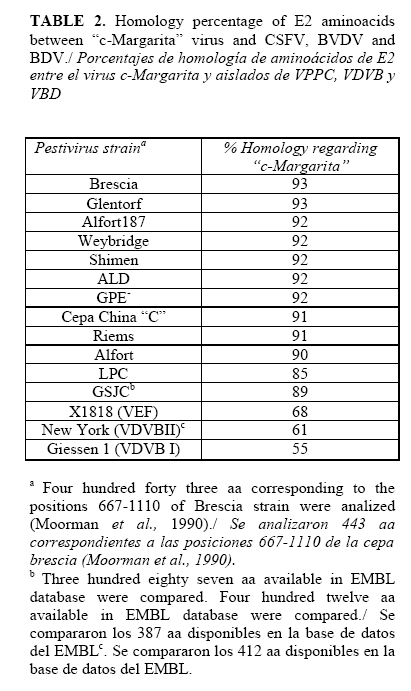
<p><font face="Verdana, Arial, Helvetica, sans-serif" size="2"><span lang=EN-GB style='mso-ansi-language:EN-GB'>In      the necropsy, typical lesions in target organs were observed in a CSF acute      case (8) as marginal infarcts in the spleen, haemorrhages in lungs, kidneys      and ganglia and enteritis. <o:p></o:p></span></font></p>       <p><font face="Verdana, Arial, Helvetica, sans-serif" size="2"><span lang=EN-GB style='mso-ansi-language:EN-GB'>The      virus was isolated in PK-15 cells from the organs obtained by necropsy in      every inoculated <span class=GramE>pigs</span>. Positive results were also obtained from all the samples      when its <span class=SpellE>RNAs</span> were extracted and amplified by RT-PCR      using CSFV1 and CSFV2 <span class=SpellE>oligonucleotides</span> (3) corresponding      with the gene codifying the non structural protein NS5B, usually used for      detecting the RNA of VPPC (data not shown). <o:p></o:p></span></font></p>       <p><font face="Verdana, Arial, Helvetica, sans-serif" size="2"><b><span lang=EN-GB style='mso-ansi-language:EN-GB'>Amplification      of E2 gene by RT-PCR</span></b><span lang=EN-GB style='mso-ansi-language:EN-GB'>      <o:p></o:p></span></font></p>       <p><font face="Verdana, Arial, Helvetica, sans-serif" size="2"><span lang=EN-GB style='mso-ansi-language:EN-GB'>The      amplification strategy involved all genes described by Moorman <i>et al.</i>      (26), including the existing RTM at the C-terminal extreme of the molecule.      The amplification of purified viral RNA by RT-PCR using SE2 and AE2 <span class=SpellE>oligonucleotides</span>,      allowed the obtainment of a DNA fragment of 1361 <span class=SpellE><span class=GramE>pb</span></span>. The fragment contained a restriction site in the      5&acute; extreme to <span class=SpellE>BamH</span> I, enzyme, the <span class=SpellE>Kozak</span> consensus sequence, an AUG <span class=SpellE>codon</span>      and the 1329 nucleotides corresponding to the <span class=SpellE>aa</span>      667-1109 from the E2 gene, carrying in its 3&acute;extreme a terminal <span class=SpellE>codon</span> of the translation followed by the sequence for the      restriction enzyme <span class=SpellE>XbaI</span>. <o:p></o:p></span></font></p>       <p><font face="Verdana, Arial, Helvetica, sans-serif" size="2"><span class=GramE><b><span lang=EN-GB style='mso-ansi-language:EN-GB'>Comparison      of the protein E2 sequence of the Margarita virus.</span></b></span><span lang=EN-GB style='mso-ansi-language:EN-GB'> <o:p></o:p></span></font></p>       <p><font face="Verdana, Arial, Helvetica, sans-serif" size="2"><span lang=EN-GB style='mso-ansi-language:EN-GB'>The      nucleotide sequence determined allowed to deduce the <span class=SpellE><span class=GramE>aa</span></span>      sequence of E2 from the &quot;c-Margarita&quot; virus, and to do an alignment      with 15 different <span class=SpellE>pestivirus</span> strains. The sequence      obtained for gene E2 from &quot;c-Margarita&quot; virus was deposited on the      EMBL database with the access number: AJ704817.    <br>     </span><span lang=EN-GB style='mso-ansi-language:EN-GB'><o:p></o:p></span></font></p>       <p><font face="Verdana, Arial, Helvetica, sans-serif" size="2"><span lang=EN-GB style='mso-ansi-language:EN-GB'>As it is shown in <a href="/img/revistas/rsa/v29n3/f0609307.gif">Table      2</a>, the E2 sequence of <span class=SpellE>Brescia</span> and <span class=SpellE>Glentorf</span>      CSFV strains were, from all analyzed, the ones showing higher homology (93      % ) with the &quot;c-Margarita&quot; virus sequence. These strains are on      the CSFV <span class=SpellE>genogroup</span> 1.2. For <span class=SpellE>Alfort</span>      strain, on the <span class=SpellE>genogroup</span> 2, the homology was 90%.      With the Asiatic strains LPS and GSJC (genotype 3), the homology percents      were 85 and 89 % respectively. The lowest homology percent was obtained with      strain Giessen1 from BVDV type I (55%). <o:p></o:p></span></font></p>       
]]></body>
<body><![CDATA[<p><font face="Verdana, Arial, Helvetica, sans-serif" size="2"><span lang=EN-GB style='mso-ansi-language:EN-GB'>On      the other hand, the <span class=SpellE>aminoacid</span> sequences deduced for the complete E2 from c-&quot;Margarita&quot;      virus presented all the <span class=SpellE>cysteine</span> residues which      are highly conserved in the <span class=SpellE>pestivirus</span> genomes being      part of the different conformational <span class=SpellE>epitopes</span> of      Glycoprotein E2. <o:p></o:p></span></font></p>       <p>&nbsp;</p>       <p><font face="Verdana, Arial, Helvetica, sans-serif" size="2"><b><span lang=EN-GB style='mso-ansi-language:EN-GB'><font size="3">DISCUSSION      AND CONCLUSIONS</font></span></b><font size="3"><span lang=EN-GB style='mso-ansi-language:EN-GB'>      <o:p></o:p></span></font><span lang=EN-GB style='mso-ansi-language:EN-GB'><o:p></o:p></span></font></p>       <p><font face="Verdana, Arial, Helvetica, sans-serif" size="2"><span lang=EN-GB style='mso-ansi-language:EN-GB'>CSF      is a serious problem for pig industry, in spite of the enormous efforts carried      out during the last decades to eradicate the disease. Many factors make difficult      the disease control, such as globalization and the increasing on trading and      pig movements, the constantly growing pig populations with increased high-density      areas and the increased wild pig populations acting as reservoir of the disease.<b>      </b>Likewise, the emergency of the diseases with clinical signs related to      porcine reproductive-respiratory syndrome (PRRS) and the syndrome of swine      dermatitis and nephropathy complicate the diagnostic of the disease (25).      <o:p></o:p></span></font></p>       <p><font face="Verdana, Arial, Helvetica, sans-serif" size="2"><span lang=EN-GB style='mso-ansi-language:EN-GB'>The      control of the CSF in endemic areas is done by vaccination with attenuated      virus strains, which not allow the differentiation between vaccinated and      infected animals. <o:p></o:p></span></font></p>       <p><font face="Verdana, Arial, Helvetica, sans-serif" size="2"><span lang=EN-GB style='mso-ansi-language:EN-GB'>As      complementary or alternative measure, depending on the severity of the outbreak      and the epidemiological situation, eradication campaigns can be carried out      through the policy of slaughtering animals around the points where the disease      appears, together with the restriction of animal movements, as in the case      of the EU countries, including <st1:country-region w:st="on"><st1:place w:st="on">Spain</st1:place></st1:country-region>      (24). <o:p></o:p></span></font></p>       <p><font face="Verdana, Arial, Helvetica, sans-serif" size="2"><span lang=EN-GB style='mso-ansi-language:EN-GB'>The      CSF epizootic occurred in Europe in 1997 (7) was a very illustrative example      of the considerable economic looses caused by the disease, mainly due to the      great quantity of non infected animals slaughtered and the restriction on      trading and animal movement. <o:p></o:p></span></font></p>       <p><font face="Verdana, Arial, Helvetica, sans-serif" size="2"><span lang=EN-GB style='mso-ansi-language:EN-GB'>The      main goal approached was the growing of the &quot;Margarita&quot; isolate      in Pk-15 cells, to facilitate its production, biological cloning and further      antigenic and molecular characterization. The virus inoculation in cell <span class=SpellE>monolayers</span>      did not produce detectable <span class=SpellE>cytopatic</span> effect. This      situation is habitual with CSFV isolates, in which the existence of the so-called      <span class=SpellE>cytopatic</span> biotype is very infrequent (21), being      obtained, mainly, after several passes in cell cultures (22). Due to the lack      of <span class=SpellE>cytopatic</span> effect, the virus multiplication became      evident by the IIP technique<b> </b>using a <span class=SpellE>hyperimmune</span>      serum against the virus (24). After the biological cloning by limit dilution,      the recovered virus from a &quot;c-Margarita&quot; virus was amplified, and      antigenic and genetically characterized. <o:p></o:p></span></font></p>       <p><font face="Verdana, Arial, Helvetica, sans-serif" size="2"><span lang=EN-GB style='mso-ansi-language:EN-GB'>The      sequence amplification of CSFV by RT-PCR strategies combined with the sequencing      of the products obtained allows an easy and accurate characterization of the      isolates (4, 5<span class=GramE>,14</span>, 15,18, 29). Thus, this sequence was determined for the      &quot;c-Margarita&quot; virus amplified in cell cultures and for the <span class=SpellE>parenteral</span> virus, the &quot;Margarita&quot; isolate, resulting      identical for both viruses.    <br>     </span><span lang=EN-GB style='mso-ansi-language:EN-GB'><o:p></o:p></span></font></p>       ]]></body>
<body><![CDATA[<p><font face="Verdana, Arial, Helvetica, sans-serif" size="2"><span lang=EN-GB style='mso-ansi-language:EN-GB'>This information allows to confirm      that the &quot;c-Margarita&quot; virus is included in the subgroup 1.2, together      with other viruses isolated in Cuba between 1993 and 1997 (4, 5). <o:p></o:p></span></font></p>       <p><font face="Verdana, Arial, Helvetica, sans-serif" size="2"><span lang=EN-GB style='mso-ansi-language:EN-GB'>Inside      the <span class=SpellE>genogroup</span> 1.2, <span class=SpellE>vaccinal</span> strains      as &quot;C&quot; and Pav-250 are <span class=GramE>included,</span> and also      recent isolates in <st1:country-region w:st="on">Ukraine</st1:country-region>,      <span class=SpellE>Malasia</span> isolates from the 80s and other CSFV strains isolated      in <st1:country-region w:st="on">USA</st1:country-region> and in the European      continent before 1987; as it is the case of <st1:City w:st="on"><st1:place  w:st="on"><span class=SpellE>Brescia</span></st1:place></st1:City> strain (28).      Inside the sequences corresponding to the <span class=SpellE>genogroup</span>      2, strain <span class=SpellE>Alfort</span> and isolates from the epizooties      occurred in <st1:place w:st="on">Europe</st1:place> during the last years      are found. (12<span class=GramE>,13</span>). <o:p></o:p></span></font></p>       <p><font face="Verdana, Arial, Helvetica, sans-serif" size="2"><span lang=EN-GB style='mso-ansi-language:EN-GB'>The      <span class=SpellE>genogroup</span> 3 constitutes an independent branch including      the viruses isolated in <st1:place w:st="on">Asia</st1:place> during the last years (27). The classification of the      CSFV in three different <span class=SpellE>genogroups</span> facilitates the      epidemiological studies for determining the origin and evolution of an outbreak      of CSF (25), in spite of the high percentage of genetic homology that all      CSFV isolates show among them (20). <o:p></o:p></span></font></p>       <p><font face="Verdana, Arial, Helvetica, sans-serif" size="2"><span lang=EN-GB style='mso-ansi-language:EN-GB'>As      it is said, glycoprotein E2 contains the antigenic sites of CSFV recognized      by neutralizing antibodies (1, 36) and it is the only protein of the virus      capable of inducing the protection against the disease when it has been used      in different vaccination strategies (9). <o:p></o:p></span></font></p>       <p><font face="Verdana, Arial, Helvetica, sans-serif" size="2"><span lang=EN-GB style='mso-ansi-language:EN-GB'>Due      to the interest in using glycoprotein E2 of &quot;c-Margarita&quot; virus      in developing a new recombinant vaccine, the antigenic characterization of      this virus was carried out. <o:p></o:p></span></font></p>       <p><font face="Verdana, Arial, Helvetica, sans-serif" size="2"><span lang=EN-GB style='mso-ansi-language:EN-GB'>The      &quot;c- Margarita&quot; virus was recognized by a <span class=SpellE>mAb</span>      that recognizes isolates of different viruses belonging to the Genus <span class=SpellE>Pestivirus</span> (23), (37) directed against the non structural      protein NS3 (more conserved among <span class=SpellE>Pestiviruses</span>).      The use of <span class=SpellE>mAb</span> specifically recognizing the E2 protein      from CSFV isolates, allows to confirm that &quot;c-Margarita&quot; virus presented      equal recognizing pattern than <span class=SpellE>Alfort</span> strain, being      only recognized by the specific <span class=SpellE>mAb</span> from field isolates,      and not by the used specific <span class=SpellE>mAb</span> from vaccine strains.      <o:p></o:p></span></font></p>       <p><font face="Verdana, Arial, Helvetica, sans-serif" size="2"><span lang=EN-GB style='mso-ansi-language:EN-GB'>The      characterization of &quot;c-Margarita&quot; virus included, also, an analysis      of the <span class=SpellE>pathogenicity</span> induced in pigs, after the cloning and/or amplification      in PK-15 cells. The results confirmed that both, &quot;c-Margarita&quot; and      &quot;<span class=SpellE>nc</span>-Margarita&quot; viruses produce acute CSF      clinical signs in 6 to 8 week pigs. The virus adapted to cultures is, therefore,      a highly virulent CSFV strain taking into account the classification of <span class=SpellE>Mittelholzer</span>      <i>et al.</i> (22), due to the fact that all the pigs presented severe clinical      signs of the disease, characterised by fever, progressive deterioration and      death before the 15<sup>th</sup> day post infection. <o:p></o:p></span></font></p>       <p><font face="Verdana, Arial, Helvetica, sans-serif" size="2"><span lang=EN-GB style='mso-ansi-language:EN-GB'>To      conclude, it is ratified the great interest of the results, and justify the      use of the &quot;c-Margarita&quot; virus for the development of new vaccination      strategies against the virus in <st1:place w:st="on"><st1:country-region w:st="on">Cuba</st1:country-region></st1:place>.      Besides, the possibility of using CSF virus adapted to grow in cell cultures      as strain for challenge in the vaccine potency test in Cuba, is open; thus      guaranteeing a higher stability and safety, simplifying the obtainment and      titration of the virus. <o:p></o:p></span></font></p>       <p><font face="Verdana, Arial, Helvetica, sans-serif" size="2"><span lang=EN-GB style='mso-ansi-language:EN-GB'>Finally,      and not less important, these results have allowed to have a complete characterized      native strain to be used as reference material for different purposes either      in the diagnostic or for obtaining non conventional vaccine candidates . <o:p></o:p></span></font></p>       <p>&nbsp;</p>       ]]></body>
<body><![CDATA[<p><font face="Verdana, Arial, Helvetica, sans-serif" size="2"><b><span lang=EN-GB style='mso-ansi-language:EN-GB'><font size="3">REFERENCES</font></span></b><font size="3"><span lang=EN-GB style='mso-ansi-language:EN-GB'> <o:p></o:p></span></font><span lang=EN-GB style='mso-ansi-language:EN-GB'><o:p></o:p></span></font></p>       <!-- ref --><p><font face="Verdana, Arial, Helvetica, sans-serif" size="2"><span lang=EN-GB style='mso-ansi-language:EN-GB'>1.      Andrew M, <span class=SpellE>Morrissy</span> CJ. <span class=SpellE>Lenguas</span> C, <span class=SpellE>Oke</span> P, Bruce M, <span class=SpellE>Brodway</span> M et <span class=GramE>al <span style='mso-spacerun:yes'>&nbsp;</span>.</span> <span style='mso-spacerun:yes'>&nbsp;</span>Porcine Interleukin-3 enhances DNA vaccination      against classical swine fever. <span class=GramE><i>Vaccine.</i></span><i>      </i></span>2006; 24:3241-3247. </font><!-- ref --><p><font face="Verdana, Arial, Helvetica, sans-serif" size="2">2. Correa, P.      <span style='mso-spacerun:yes'>&nbsp;</span>Elaboraci&oacute;n de un conjugado      para el diagn&oacute;stico de la fiebre porcina cl&aacute;sica y comprobaci&oacute;n      de su especificidad y alto rendimiento. Premio <span class=SpellE>Canifarma</span> 1991 Industria <span class=SpellE>Farmaceutica</span>      Veterinaria, <span class=SpellE>Prem</span>. <span class=SpellE>Canif</span>      Ind <span class=SpellE>Far</span> Vet. 1991;91:47-55. </font><!-- ref --><p><font face="Verdana, Arial, Helvetica, sans-serif" size="2">3. D&iacute;az      de Arce H, <span class=SpellE>Nu&ntilde;ez</span> JI, <span class=SpellE>Ganges</span> L, Barreras M, Fr&iacute;as MT, Sobrino F. <span style='mso-spacerun:yes'>&nbsp;</span><span class=SpellE>An</span> RT-PCR <span class=SpellE>assay</span> <span class=SpellE>for</span> <span class=SpellE>the</span>      <span class=SpellE>specific</span> <span class=SpellE>detection</span> <span class=SpellE>of</span> <span class=SpellE>classical</span> <span class=SpellE>swine</span>      <span class=SpellE>fever</span> virus in <span class=SpellE>clinical</span>      <span class=SpellE>samples</span>. <span class=SpellE><i>Vet</i></span><i> Res.</i>      1998;29:431-40. </font><!-- ref --><p><font face="Verdana, Arial, Helvetica, sans-serif" size="2">4. D&iacute;az      de Arce H, <span class=SpellE>Nu&ntilde;ez</span> JI, <span class=SpellE>Ganges</span> L, Barreras M, Fr&iacute;as MT, Sobrino F. Molecular      <span class=SpellE>epidemiology</span> <span class=SpellE>of</span> <span class=SpellE>classical</span> <span class=SpellE>swine</span> <span class=SpellE>fever</span> in Cuba. <i>Virus Res.</i> 1999;64:61-7. </font><!-- ref --><p><font face="Verdana, Arial, Helvetica, sans-serif" size="2">5. D&iacute;az      de Arce H, <span class=SpellE>Ganges</span> L, Barrera M, Naranjo D, Sobrino      F, Fr&iacute;as MT, N&uacute;&ntilde;ez JI. <span class=SpellE>Origin</span> <span class=SpellE>and</span> <span class=SpellE>evolution</span>      <span class=SpellE>of</span> <span class=SpellE>viruses</span> <span class=SpellE>causing</span> <span class=SpellE>classical</span> <span class=SpellE>swine</span> <span class=SpellE>fever</span> in Cuba. <i>Virus Res.      </i>2005;112:123-131. </font><!-- ref --><p><font face="Verdana, Arial, Helvetica, sans-serif" size="2"><span lang=EN-GB style='mso-ansi-language:EN-GB'>6.      Edwards S. <span style='mso-spacerun:yes'>&nbsp;</span>Survival and inactivation of classical swine      fever virus. <i>Vet <span class=SpellE>Microbiol</span>. </i>2000<span class=GramE>;73</span>:175-81. <o:p></o:p></span></font><!-- ref --><p><font face="Verdana, Arial, Helvetica, sans-serif" size="2"><span lang=EN-GB style='mso-ansi-language:EN-GB'>7.      Edwards S, <span class=SpellE>Fukusho</span> A, <span class=SpellE>Lefevre</span> PC, <span class=SpellE>Lipowski</span> A, <span class=SpellE>Pejsak</span> Z, <span class=SpellE>Roehe</span> P, <span class=SpellE>Westergaard</span> J. Classical      swine fever: the global situation. <i>Vet <span class=SpellE>Microbiol</span>.</i>      <span class=GramE>2000;73:103-19.</span>     <br>         <!-- ref --><br>     </span>8. Fr&iacute;as<span style='mso-spacerun:yes'>&nbsp; </span>MT, <span class=SpellE>Percedo</span> <span style='mso-spacerun:yes'>&nbsp;</span>MI Reconociendo      la peste porcina cl&aacute;sica. Manual Ilustrado, ISBN 2003;92-5-305000-4,      FAO. </font><!-- ref --><p><font face="Verdana, Arial, Helvetica, sans-serif" size="2">9. <span class=SpellE>Ganges</span>      L, Barrera M, N&uacute;&ntilde;ez JI, Blanco I, <span class=SpellE>Frias</span>      MT, Rodr&iacute;guez F et <span class=GramE>al .</span> <span style='mso-spacerun:yes'>&nbsp;</span>A DNA <span class=SpellE>vaccine</span> <span class=SpellE>expressing</span> <span class=SpellE>the</span> E2 <span class=SpellE>protein</span> <span class=SpellE>of</span> <span class=SpellE>CSFv</span> <span class=SpellE>elicits</span>      T <span class=SpellE>cell</span> response <span class=SpellE>that</span> can      prime <span class=SpellE>for</span> <span class=SpellE>rapid</span> <span class=SpellE>antibody</span> <span class=SpellE>production</span> <span class=SpellE>and</span> <span class=SpellE>confer</span> total <span class=SpellE>protection</span> <span class=SpellE>upon</span> viral <span class=SpellE>challenge</span>. <span class=SpellE><i>Vaccine</i></span><i>.</i>      2005<span class=GramE>;23</span>: 3741-3752. </font><!-- ref --><p><font face="Verdana, Arial, Helvetica, sans-serif" size="2">10<span class=GramE>.<span class=SpellE>Ganges</span></span>      L, N&uacute;&ntilde;ez JI, Sobrino F, Borrego B, Fern&aacute;ndez N, Fr&iacute;as      MT, Rodr&iacute;guez F. <span style='mso-spacerun:yes'>&nbsp;</span><span lang=EN-GB style='mso-ansi-language:EN-GB'>Recent advances in development of recombinant      vaccines against classical swine fever virus: cellular responses also play      a role in protection.&nbsp;<span class=GramE><i>Vet Journal </i>2007; &quot;on      line&quot;<b> </b>doi:10.1016/j.tvjl.2007.01.030<b>.</b></span><b> </b><o:p></o:p></span></font><!-- ref --><p><font face="Verdana, Arial, Helvetica, sans-serif" size="2"><span lang=EN-GB style='mso-ansi-language:EN-GB'>11.      Gomez JC, <span class=SpellE>Salguero</span> FJ, Ruiz E, Sanchez PJ, Bautista MJ, Sierra MA. Classical      Swine Fever: pathology of bone marrow. <i>Vet <span class=SpellE>Pathol</span>      </i>2003<span class=GramE>;</span>40:157-63. <o:p></o:p></span></font><!-- ref --><p><font face="Verdana, Arial, Helvetica, sans-serif" size="2"><span lang=EN-GB style='mso-ansi-language:EN-GB'>12<span class=GramE>.Greiser</span>-Wilke      I, <span class=SpellE>Moennig</span> V. <span style='mso-spacerun:yes'>&nbsp;</span>Vaccination against classical swine fever:      limitations and new strategies. <span class=SpellE><i>Anim</i></span><i> Health      <span class=SpellE>Res</span> Rev.</i> 2004<span class=GramE>;223</span>-226.      <o:p></o:p></span></font><!-- ref --><p><font face="Verdana, Arial, Helvetica, sans-serif" size="2"><span lang=EN-GB style='mso-ansi-language:EN-GB'>13<span class=GramE>.Greiser</span>-Wilke      I, <span class=SpellE>Fritzemeier</span> J, <span class=SpellE>Koenen</span>      F, <span class=SpellE>Vanderhallen</span> H, <span class=SpellE>Rutili</span>      D, De Mia GM et al. Molecular epidemiology of a large classical swine fever      epidemic in the European Union in 1997-1998. <i>Vet <span class=SpellE>Microbiol</span>.      </i><span class=GramE>2000;77:17-27.</span> <o:p></o:p></span></font><!-- ref --><p><font face="Verdana, Arial, Helvetica, sans-serif" size="2"><span lang=EN-GB style='mso-ansi-language:EN-GB'>14<span class=GramE>.Harding</span>      M, <span class=SpellE>Lutze</span>-Wallace C, <span class=SpellE>Prud'Homme</span>      I, <span class=SpellE>Zhong</span> X, <span class=SpellE>Rola</span> J. Reverse      transcriptase-PCR assay for detection of hog cholera virus. <span class=GramE><i>J      <span class=SpellE>Clin</span> <span class=SpellE>Microbiol</span>.</i></span>      <span class=GramE>1994;32:2600-2.</span> <o:p></o:p></span></font><!-- ref --><p><font face="Verdana, Arial, Helvetica, sans-serif" size="2"><span lang=EN-GB style='mso-ansi-language:EN-GB'>15<span class=GramE>.Hofmann</span>      MA, <span class=SpellE>Brechtbuhl</span> K, <span style='mso-spacerun:yes'>&nbsp;</span><span class=SpellE>Stauber</span> N. Rapid      characterization of new <span class=SpellE>pestivirus</span> strains by direct      sequencing of PCR-amplified <span class=SpellE>cDNA</span> from the 5' <span class=SpellE>noncoding</span> region. <span class=GramE><i>Arch <span class=SpellE>Virol</span>.</i></span><i> </i><span class=GramE>1994;139:217-29.</span>      <o:p></o:p></span></font><!-- ref --><p><font face="Verdana, Arial, Helvetica, sans-serif" size="2"><span lang=EN-GB style='mso-ansi-language:EN-GB'>16<span class=GramE>.Horzinek</span>      MC. <span style='mso-spacerun:yes'>&nbsp;</span><span class=SpellE><span class=GramE>Pestiviruses</span></span><span class=GramE>-taxonomic perspectives.</span>      <span class=GramE><i>Arch <span class=SpellE>Virol</span>.</i></span><i> </i><span class=SpellE>Suppl</span>      1991<span class=GramE>;3:1</span>-5. <o:p></o:p></span></font><!-- ref --><p><font face="Verdana, Arial, Helvetica, sans-serif" size="2"><span lang=EN-GB style='mso-ansi-language:EN-GB'>17<span class=GramE>.Laddomada</span>      A. <span style='mso-spacerun:yes'>&nbsp;</span><span class=GramE>Incidence      and control of CSF in wild boar in <st1:place w:st="on">Europe</st1:place>.</span>      <i>Vet <span class=SpellE>Microbiol</span> </i>2000;73:121-30. <o:p></o:p></span></font><!-- ref --><p><font face="Verdana, Arial, Helvetica, sans-serif" size="2"><span lang=EN-GB style='mso-ansi-language:EN-GB'>18<span class=GramE>.Lowings</span>      JP, <span class=SpellE>Paton</span> DJ, Sands JJ, De Mia GM, <span class=SpellE>Rutili</span> D. Classical swine fever: genetic detection and analysis      of differences between virus isolates. <span class=GramE><i>J Gen <span class=SpellE>Virol</span>.</i></span><i> </i><span class=GramE>1994;75:3461-8.</span>      <o:p></o:p></span></font><!-- ref --><p><font face="Verdana, Arial, Helvetica, sans-serif" size="2"><span lang=EN-GB style='mso-ansi-language:EN-GB'>19<span class=GramE>.Lowings</span>      P, <span class=SpellE>Ibata</span> G, Needham J, <span class=SpellE>Paton</span>      D. Classical swine fever virus diversity and evolution. <i>J Gen Virol. </i>1996;77:1311-21.      <o:p></o:p></span></font><!-- ref --><p><font face="Verdana, Arial, Helvetica, sans-serif" size="2"><span lang=EN-GB style='mso-ansi-language:EN-GB'>20<span class=GramE>.Meyers</span>      G, <span class=SpellE>Rumenapf</span> T, <span class=SpellE>Thiel</span> HJ.      Molecular cloning and nucleotide sequence of the genome of hog cholera virus.      <i>Virology. </i>1989<span style='mso-bidi-font-style:italic'>;</span>171:555-67. <o:p></o:p></span></font><!-- ref --><p><font face="Verdana, Arial, Helvetica, sans-serif" size="2"><span lang=EN-GB style='mso-ansi-language:EN-GB'>21<span class=GramE>.Meyers</span>      G,<span style='mso-spacerun:yes'>&nbsp; </span><span class=SpellE>Thiel</span>      HJ. <span class=SpellE><span class=GramE>Cytopathogenicity</span></span><span class=GramE> of classical swine fever virus caused by defective interfering particles.</span>      <span class=GramE><i>J <span class=SpellE>Virol</span>.</i></span> 1995<span class=GramE>;69</span>:3683-9.      <o:p></o:p></span></font><!-- ref --><p><font face="Verdana, Arial, Helvetica, sans-serif" size="2"><span lang=DE style='mso-ansi-language:DE'>22.Mittelholzer      C, Moser C, Tratschin JD, Hofmann MA. <span style='mso-spacerun:yes'>&nbsp;</span></span><span lang=EN-GB style='mso-ansi-language:EN-GB'>Analysis of classical swine fever virus      replication kinetics allows differentiation of highly virulent <span class=GramE>from a virulent strains</span>. <i>Vet <span class=SpellE>Microbiol</span>.</i>      2000<span class=GramE>;74</span>:293-308. <o:p></o:p></span></font><!-- ref --><p><font face="Verdana, Arial, Helvetica, sans-serif" size="2"><span lang=EN-GB style='mso-ansi-language:EN-GB'>23<span class=GramE>.Moennig</span>      V, <span class=SpellE>Plagemann</span> PG. <span class=GramE>The <span class=SpellE>pestiviruses</span>.</span> <i>Adv Virus Res.</i> 1992<span class=GramE>;41</span>:53-98. <o:p></o:p></span></font><!-- ref --><p><font face="Verdana, Arial, Helvetica, sans-serif" size="2"><span lang=EN-GB style='mso-ansi-language:EN-GB'>24<span class=GramE>.Moennig</span>      V. <span style='mso-spacerun:yes'>&nbsp;</span>Introduction to classical swine      fever: virus, disease and control policy. <i>Vet <span class=SpellE>Microbiol</span>.</i>      <span class=GramE>2000;73:93-102.</span> <o:p></o:p></span></font><!-- ref --><p><font face="Verdana, Arial, Helvetica, sans-serif" size="2"><span lang=EN-GB style='mso-ansi-language:EN-GB'>25<span class=GramE>.Moennig</span>      V. <span class=SpellE>Floegel-Niesmann</span> G, <st1:place w:st="on"><st2:Sn  w:st="on"><span class=SpellE>Greiser-Wilke</span></st2:Sn> <st2:Sn w:st="on">I.</st2:Sn></st1:place>      Clinical signs and epidemiology of classical swine fever: a review of new      knowledge. <i>Vet Journal</i> 2003<span style='mso-bidi-font-style:italic'>;</span>165:11-20.      <o:p></o:p></span></font><!-- ref --><p><font face="Verdana, Arial, Helvetica, sans-serif" size="2"><span lang=EN-GB style='mso-ansi-language:EN-GB'>26<span class=GramE>.Moormann</span>      RJ, <span class=SpellE>Warmerdam</span> PA, van <span class=SpellE>der</span>      <span class=SpellE>Meer</span> B, <span class=SpellE>Hulst</span> MM <span style='mso-spacerun:yes'>&nbsp;</span>Nucleotide sequence of hog cholera virus      RNA: properties of the <span class=SpellE>polyprotein</span> encoded by the      open reading frame spanning the viral genomic RNA. <i>Vet <span class=SpellE>Microbiol</span>.</i>      1990<span class=GramE>;23</span>:185-91. <o:p></o:p></span></font><!-- ref --><p><font face="Verdana, Arial, Helvetica, sans-serif" size="2"><span lang=EN-GB style='mso-ansi-language:EN-GB'>27<span class=GramE>.Parchariyanon</span>      S, Inui K, <span class=SpellE>Damrongwatanapokin</span> S, <span class=SpellE>Pinyochon</span>      W, <span class=SpellE>Lowings</span> P, <span class=SpellE>Paton</span> D.      Sequence analysis of E2 glycoprotein genes of classical swine fever virus:      identification of a novel <span class=SpellE>genogroup</span> in Thailand.      <span class=SpellE><span class=GramE><i>Dtsch</i></span></span><span class=GramE><i>      <span class=SpellE>Tierarztl</span> <span class=SpellE>Wochenschr</span>.</i></span>      2000<span class=GramE>;107</span>:236-8. <o:p></o:p></span></font><!-- ref --><p><font face="Verdana, Arial, Helvetica, sans-serif" size="2"><span lang=EN-GB style='mso-ansi-language:EN-GB'>28<span class=GramE>.Paton</span>      DJ, <span class=SpellE>McGoldrick</span> A, <span class=SpellE>Belak</span>      S, <span class=SpellE>Mittelholzer</span> C, <span class=SpellE>Koenen</span> F, <span class=SpellE>Vanderhallen</span> H. et al . Classical swine fever virus: a ring      test to evaluate RT-PCR detection methods. <i>Vet <span class=SpellE>Microbiol</span>.      </i>2000<span class=GramE>;73</span>:159-74.     <br>         <!-- ref --><br>     29.Paton DJ, <span class=SpellE>McGoldrick</span> A, <span class=SpellE>Greiser-Wilke</span>      I, <span class=SpellE>Parchariyanon</span> S, Song JY, <span class=SpellE>Liou</span>      PP. et al. Genetic typing of classical swine fever virus. <i>Vet <span class=SpellE>Microbiol</span>.</i> <span class=GramE>2000;73:137-57.</span> <o:p></o:p></span></font><!-- ref --><p><font face="Verdana, Arial, Helvetica, sans-serif" size="2"><span lang=EN-GB style='mso-ansi-language:EN-GB'>30<span class=GramE>.Reed</span><span style='mso-spacerun:yes'>&nbsp; </span>LJ, <span class=SpellE>Muench</span> H.      <span class=GramE>A simple method of estimating fifty percent endpoints.</span>      <i>Am J <span class=SpellE>Hyg.</span> </i>1938<span class=GramE><span style='mso-bidi-font-style:italic'>;</span>27</span>:493-7. <o:p></o:p></span></font><p><font face="Verdana, Arial, Helvetica, sans-serif" size="2"><span lang=EN-GB style='mso-ansi-language:EN-GB'>31<span class=GramE>.Sambrook</span>      J., Fritsch, EF., <span class=SpellE>Maniatis</span> T. Molecular cloning      a Laboratory Manual. <span class=GramE>Second edition.</span> <span class=GramE>Laboratory      Press.</span> <st1:place w:st="on"><st1:City w:st="on">Cold Spring <span   class=SpellE>Harbor</span></st1:City>, <st1:State w:st="on">NY</st1:State></st1:place>.      1989<o:p></o:p></span></font></p>       <!-- ref --><p><font face="Verdana, Arial, Helvetica, sans-serif" size="2">32<span class=GramE>.Tuero</span>      C, D&iacute;az de Arce H, Fr&iacute;as MT. <span style='mso-spacerun:yes'>&nbsp;</span>Elaboraci&oacute;n      de un conjugado fluorescente espec&iacute;fico contra la peste porcina cl&aacute;sica      y evaluaci&oacute;n de su utilidad diagn&oacute;stica. <i>Rev Salud <span class=SpellE>Anim</span>.</i> 1995<span class=GramE>;17</span>:91-93. </font><!-- ref --><p><font face="Verdana, Arial, Helvetica, sans-serif" size="2"><span lang=NL style='mso-ansi-language:NL'>33.van      Oirschot<span style='mso-spacerun:yes'>&nbsp; </span>JT, Terpstra C. <span style='mso-spacerun:yes'>&nbsp;</span>Hog cholera virus. </span>En Virus <span class=SpellE>infections</span> <span class=SpellE>of</span> <span class=SpellE>porcines</span>.      Editado por <span class=SpellE>M.B</span>. <span class=SpellE>Pensaert</span>.      <span lang=EN-GB style='mso-ansi-language:EN-GB'>Elsevier 1989. <o:p></o:p></span></font><!-- ref --><p><font face="Verdana, Arial, Helvetica, sans-serif" size="2"><span lang=EN-GB style='mso-ansi-language:EN-GB'>34<span class=GramE>.van</span>      <span class=SpellE>Oirschot</span> JT. Emergency vaccination against classical      swine fever. <i>Dev <span class=SpellE><span class=GramE>Biol</span></span></i><span class=GramE> <span style='mso-spacerun:yes'>&nbsp;</span>(</span><st1:place w:st="on"><st1:City w:st="on">Basel</st1:City></st1:place>) 2003;114:259-67. <o:p></o:p></span></font><p><font face="Verdana, Arial, Helvetica, sans-serif" size="2"><span lang=EN-GB style='mso-ansi-language:EN-GB'>35<span class=GramE>.van</span>      <span class=SpellE>Oirschot</span> JT. (2003): <span class=SpellE>Vaccinology</span>      of classical swine fever: from lab to field. <i>Vet <span class=SpellE>Microbiol</span>.      </i>96:367-84. <o:p></o:p></span></font></p>       <p><font face="Verdana, Arial, Helvetica, sans-serif" size="2"><span lang=EN-GB style='mso-ansi-language:EN-GB'>36.Weiland      E, Stark R, Haas B, Rumenapf T, Meyers G. y Thiel HJ. (1990): Pestivirus glycoprotein      which induces neutralizing antibodies forms part of a disulfide-linked <span class=SpellE>heterodimer</span>. <span class=GramE><i>J <span class=SpellE>Virol</span>.</i></span>      64:3563-9. <o:p></o:p></span></font></p>       <p><font face="Verdana, Arial, Helvetica, sans-serif" size="2"><span lang=EN-GB style='mso-ansi-language:EN-GB'>37<span class=GramE>.Weiland</span>,      F, <span class=SpellE>Weiland</span> E, Unger G, <span class=SpellE>Saalmuller      </span> A y <span class=SpellE>Thiel</span> HJ. (1999): Localization of <span class=SpellE>pestiviral</span> envelope proteins E(<span class=SpellE>rns</span>)      and E2 at the cell surface and on isolated particles. <span class=GramE><i>J      Gen <span class=SpellE>Virol</span>.</i></span> 80:1157-65. <o:p></o:p></span></font></p>       ]]></body>
<body><![CDATA[<p><font face="Verdana, Arial, Helvetica, sans-serif" size="2"><span lang=EN-GB style='mso-ansi-language:EN-GB'>38<span class=GramE>.Wengler</span>      G, Bradley DW, <span class=SpellE>Collet</span> MS, Heinz FX, Schlesinger      RW, Strauss JH. (1995): Sixth report of the International Committee on taxonomy      of viruses. <span class=GramE><i>Arch <span class=SpellE>Virol</span></i>      Supplement.</span> 2:223-233. <o:p></o:p></span></font></p>       <p><font face="Verdana, Arial, Helvetica, sans-serif" size="2"><span lang=EN-GB style='mso-ansi-language:EN-GB'>39<span class=GramE>.Wensvoort</span>      G,<span class=SpellE>Terpstra</span> C, <span class=SpellE>Boonstra</span>      J, <span class=SpellE>Bloemraad</span> M y Van <span class=SpellE>Zaane</span>      D. (1986): Production of monoclonal antibodies against swine fever virus and      their use in laboratory diagnosis. </span><i><span lang=IT style='mso-ansi-language: IT'>Vet Microbiol.</span></i><span lang=IT style='mso-ansi-language:IT'> 12:101-8.      <o:p></o:p></span></font></p>       <p><font face="Verdana, Arial, Helvetica, sans-serif" size="2"><span lang=IT style='mso-ansi-language:IT'>40.Yu      X, Tu C, Li H, Hu R, Chen C, Li Z. <i>et al.</i> </span><span lang=EN-GB style='mso-ansi-language: EN-GB'>(2001): DNA-mediated protection against classical swine fever virus. </span><span class=SpellE><i>Vaccine</i></span><i>. </i>19:1520-5. </font></p>       <p>&nbsp;</p>       <p>&nbsp;</p>       <p><font face="Verdana, Arial, Helvetica, sans-serif" size="2"><a href="#volao"><sup>1</sup></a><span lang=EN-GB style='mso-ansi-language:EN-GB'><a name="naranjo"></a></span> <span class=SpellE><span lang=EN-GB style='mso-ansi-language:EN-GB'>Naranjo</span></span><span lang=EN-GB style='mso-ansi-language:EN-GB'>, P. <span class=SpellE>Laboratorio</span>      de <span class=GramE>control</span> <span class=SpellE>Estatal</span> del      IMV</span></a><span lang=EN-GB style='mso-ansi-language:EN-GB'>.</span></font></p> </div>       ]]></body><back>
<ref-list>
<ref id="B1">
<label>1</label><nlm-citation citation-type="journal">
<person-group person-group-type="author">
<name>
<surname><![CDATA[Andrew]]></surname>
<given-names><![CDATA[M]]></given-names>
</name>
<name>
<surname><![CDATA[Morrissy]]></surname>
<given-names><![CDATA[CJ]]></given-names>
</name>
<name>
<surname><![CDATA[Lenguas]]></surname>
<given-names><![CDATA[C]]></given-names>
</name>
<name>
<surname><![CDATA[Oke]]></surname>
<given-names><![CDATA[P]]></given-names>
</name>
<name>
<surname><![CDATA[Bruce]]></surname>
<given-names><![CDATA[M]]></given-names>
</name>
<name>
<surname><![CDATA[Brodway]]></surname>
<given-names><![CDATA[M]]></given-names>
</name>
</person-group>
<article-title xml:lang="en"><![CDATA[Porcine Interleukin-3 enhances DNA vaccination against classical swine fever]]></article-title>
<source><![CDATA[Vaccine]]></source>
<year>2006</year>
<volume>24</volume>
<page-range>3241-3247</page-range></nlm-citation>
</ref>
<ref id="B2">
<label>2</label><nlm-citation citation-type="journal">
<person-group person-group-type="author">
<name>
<surname><![CDATA[Correa]]></surname>
<given-names><![CDATA[P]]></given-names>
</name>
</person-group>
<article-title xml:lang="es"><![CDATA[Elaboración de un conjugado para el diagnóstico de la fiebre porcina clásica y comprobación de su especificidad y alto rendimiento. Premio Canifarma 1991 Industria Farmaceutica Veterinaria]]></article-title>
<source><![CDATA[Prem Canif Ind Far Vet]]></source>
<year>1991</year>
<volume>91</volume>
<page-range>47-55</page-range></nlm-citation>
</ref>
<ref id="B3">
<label>3</label><nlm-citation citation-type="journal">
<person-group person-group-type="author">
<name>
<surname><![CDATA[Díaz de Arce]]></surname>
<given-names><![CDATA[H]]></given-names>
</name>
<name>
<surname><![CDATA[Nuñez]]></surname>
<given-names><![CDATA[JI]]></given-names>
</name>
<name>
<surname><![CDATA[Ganges]]></surname>
<given-names><![CDATA[L]]></given-names>
</name>
<name>
<surname><![CDATA[Barreras]]></surname>
<given-names><![CDATA[M]]></given-names>
</name>
<name>
<surname><![CDATA[Frías]]></surname>
<given-names><![CDATA[MT]]></given-names>
</name>
<name>
<surname><![CDATA[Sobrino]]></surname>
<given-names><![CDATA[F]]></given-names>
</name>
</person-group>
<article-title xml:lang="en"><![CDATA[An RT-PCR assay for the specific detection of classical swine fever virus in clinical samples]]></article-title>
<source><![CDATA[Vet Res]]></source>
<year>1998</year>
<volume>29</volume>
<page-range>431-40</page-range></nlm-citation>
</ref>
<ref id="B4">
<label>4</label><nlm-citation citation-type="journal">
<person-group person-group-type="author">
<name>
<surname><![CDATA[Díaz de Arce]]></surname>
<given-names><![CDATA[H]]></given-names>
</name>
<name>
<surname><![CDATA[Nuñez]]></surname>
<given-names><![CDATA[JI]]></given-names>
</name>
<name>
<surname><![CDATA[Ganges]]></surname>
<given-names><![CDATA[L]]></given-names>
</name>
<name>
<surname><![CDATA[Barreras]]></surname>
<given-names><![CDATA[M]]></given-names>
</name>
<name>
<surname><![CDATA[Frías]]></surname>
<given-names><![CDATA[MT]]></given-names>
</name>
<name>
<surname><![CDATA[Sobrino]]></surname>
<given-names><![CDATA[F]]></given-names>
</name>
</person-group>
<article-title xml:lang="en"><![CDATA[Molecular epidemiology of classical swine fever in Cuba]]></article-title>
<source><![CDATA[Virus Res]]></source>
<year>1999</year>
<volume>64</volume>
<page-range>61-7</page-range></nlm-citation>
</ref>
<ref id="B5">
<label>5</label><nlm-citation citation-type="journal">
<person-group person-group-type="author">
<name>
<surname><![CDATA[Díaz de Arce]]></surname>
<given-names><![CDATA[H]]></given-names>
</name>
<name>
<surname><![CDATA[Ganges]]></surname>
<given-names><![CDATA[L]]></given-names>
</name>
<name>
<surname><![CDATA[Barrera]]></surname>
<given-names><![CDATA[M]]></given-names>
</name>
<name>
<surname><![CDATA[Naranjo]]></surname>
<given-names><![CDATA[D]]></given-names>
</name>
<name>
<surname><![CDATA[Sobrino]]></surname>
<given-names><![CDATA[F]]></given-names>
</name>
<name>
<surname><![CDATA[Frías]]></surname>
<given-names><![CDATA[MT]]></given-names>
</name>
<name>
<surname><![CDATA[Núñez]]></surname>
<given-names><![CDATA[JI]]></given-names>
</name>
</person-group>
<article-title xml:lang="en"><![CDATA[Origin and evolution of viruses causing classical swine fever in Cuba]]></article-title>
<source><![CDATA[Virus Res]]></source>
<year>2005</year>
<volume>112</volume>
<page-range>123-131</page-range></nlm-citation>
</ref>
<ref id="B6">
<label>6</label><nlm-citation citation-type="journal">
<person-group person-group-type="author">
<name>
<surname><![CDATA[Edwards]]></surname>
<given-names><![CDATA[S]]></given-names>
</name>
</person-group>
<article-title xml:lang="en"><![CDATA[Survival and inactivation of classical swine fever virus]]></article-title>
<source><![CDATA[Vet Microbiol]]></source>
<year>2000</year>
<volume>73</volume>
<page-range>175-81</page-range></nlm-citation>
</ref>
<ref id="B7">
<label>7</label><nlm-citation citation-type="journal">
<person-group person-group-type="author">
<name>
<surname><![CDATA[Edwards]]></surname>
<given-names><![CDATA[S]]></given-names>
</name>
<name>
<surname><![CDATA[Fukusho]]></surname>
<given-names><![CDATA[A]]></given-names>
</name>
<name>
<surname><![CDATA[Lefevre]]></surname>
<given-names><![CDATA[PC]]></given-names>
</name>
<name>
<surname><![CDATA[Lipowski]]></surname>
<given-names><![CDATA[A]]></given-names>
</name>
<name>
<surname><![CDATA[Pejsak]]></surname>
<given-names><![CDATA[Z]]></given-names>
</name>
<name>
<surname><![CDATA[Roehe]]></surname>
<given-names><![CDATA[P]]></given-names>
</name>
<name>
<surname><![CDATA[Westergaard]]></surname>
<given-names><![CDATA[J]]></given-names>
</name>
</person-group>
<article-title xml:lang="en"><![CDATA[Classical swine fever: the global situation]]></article-title>
<source><![CDATA[Vet Microbiol]]></source>
<year>2000</year>
<volume>73</volume>
<page-range>103-19</page-range></nlm-citation>
</ref>
<ref id="B8">
<label>8</label><nlm-citation citation-type="book">
<person-group person-group-type="author">
<name>
<surname><![CDATA[Frías]]></surname>
<given-names><![CDATA[MT]]></given-names>
</name>
<name>
<surname><![CDATA[Percedo]]></surname>
<given-names><![CDATA[MI]]></given-names>
</name>
</person-group>
<source><![CDATA[Reconociendo la peste porcina clásica. Manual Ilustrado]]></source>
<year></year>
<publisher-name><![CDATA[FAO]]></publisher-name>
</nlm-citation>
</ref>
<ref id="B9">
<label>9</label><nlm-citation citation-type="journal">
<person-group person-group-type="author">
<name>
<surname><![CDATA[Ganges]]></surname>
<given-names><![CDATA[L]]></given-names>
</name>
<name>
<surname><![CDATA[Barrera]]></surname>
<given-names><![CDATA[M]]></given-names>
</name>
<name>
<surname><![CDATA[Núñez]]></surname>
<given-names><![CDATA[JI]]></given-names>
</name>
<name>
<surname><![CDATA[Blanco]]></surname>
<given-names><![CDATA[I]]></given-names>
</name>
<name>
<surname><![CDATA[Frias]]></surname>
<given-names><![CDATA[MT]]></given-names>
</name>
<name>
<surname><![CDATA[Rodríguez]]></surname>
<given-names><![CDATA[F]]></given-names>
</name>
</person-group>
<article-title xml:lang="en"><![CDATA[A DNA vaccine expressing the E2 protein of CSFv elicits T cell response that can prime for rapid antibody production and confer total protection upon viral challenge]]></article-title>
<source><![CDATA[Vaccine]]></source>
<year>2005</year>
<volume>23</volume>
<page-range>3741-3752</page-range></nlm-citation>
</ref>
<ref id="B10">
<label>10</label><nlm-citation citation-type="">
<person-group person-group-type="author">
<name>
<surname><![CDATA[Ganges]]></surname>
<given-names><![CDATA[L]]></given-names>
</name>
<name>
<surname><![CDATA[Núñez]]></surname>
<given-names><![CDATA[JI]]></given-names>
</name>
<name>
<surname><![CDATA[Sobrino]]></surname>
<given-names><![CDATA[F]]></given-names>
</name>
<name>
<surname><![CDATA[Borrego]]></surname>
<given-names><![CDATA[B]]></given-names>
</name>
<name>
<surname><![CDATA[Fernández]]></surname>
<given-names><![CDATA[N]]></given-names>
</name>
<name>
<surname><![CDATA[Frías]]></surname>
<given-names><![CDATA[MT]]></given-names>
</name>
<name>
<surname><![CDATA[Rodríguez]]></surname>
<given-names><![CDATA[F]]></given-names>
</name>
</person-group>
<source><![CDATA[Recent advances in development of recombinant vaccines against classical swine fever virus: cellular responses also play a role in protection]]></source>
<year>2007</year>
</nlm-citation>
</ref>
<ref id="B11">
<label>11</label><nlm-citation citation-type="journal">
<person-group person-group-type="author">
<name>
<surname><![CDATA[Gomez]]></surname>
<given-names><![CDATA[JC]]></given-names>
</name>
<name>
<surname><![CDATA[Salguero]]></surname>
<given-names><![CDATA[FJ]]></given-names>
</name>
<name>
<surname><![CDATA[Ruiz]]></surname>
<given-names><![CDATA[E]]></given-names>
</name>
<name>
<surname><![CDATA[Sanchez]]></surname>
<given-names><![CDATA[PJ]]></given-names>
</name>
<name>
<surname><![CDATA[Bautista]]></surname>
<given-names><![CDATA[MJ]]></given-names>
</name>
<name>
<surname><![CDATA[Sierra]]></surname>
<given-names><![CDATA[MA]]></given-names>
</name>
</person-group>
<article-title xml:lang="en"><![CDATA[Classical Swine Fever: pathology of bone marrow]]></article-title>
<source><![CDATA[Vet Pathol]]></source>
<year>2003</year>
<volume>40</volume>
<page-range>157-63</page-range></nlm-citation>
</ref>
<ref id="B12">
<label>12</label><nlm-citation citation-type="journal">
<person-group person-group-type="author">
<name>
<surname><![CDATA[Greiser-Wilke]]></surname>
<given-names><![CDATA[I]]></given-names>
</name>
<name>
<surname><![CDATA[Moennig]]></surname>
<given-names><![CDATA[V]]></given-names>
</name>
</person-group>
<article-title xml:lang="en"><![CDATA[Vaccination against classical swine fever: limitations and new strategies]]></article-title>
<source><![CDATA[Anim Health Res Rev]]></source>
<year>2004</year>
<page-range>223-226</page-range></nlm-citation>
</ref>
<ref id="B13">
<label>13</label><nlm-citation citation-type="journal">
<person-group person-group-type="author">
<name>
<surname><![CDATA[Greiser-Wilke]]></surname>
<given-names><![CDATA[I]]></given-names>
</name>
<name>
<surname><![CDATA[Fritzemeier]]></surname>
<given-names><![CDATA[J]]></given-names>
</name>
<name>
<surname><![CDATA[Koenen]]></surname>
<given-names><![CDATA[F]]></given-names>
</name>
<name>
<surname><![CDATA[Vanderhallen]]></surname>
<given-names><![CDATA[H]]></given-names>
</name>
<name>
<surname><![CDATA[Rutili]]></surname>
<given-names><![CDATA[D]]></given-names>
</name>
<name>
<surname><![CDATA[De Mia]]></surname>
<given-names><![CDATA[GM]]></given-names>
</name>
</person-group>
<article-title xml:lang="en"><![CDATA[Molecular epidemiology of a large classical swine fever epidemic in the European Union in 1997-1998]]></article-title>
<source><![CDATA[Vet Microbiol]]></source>
<year>2000</year>
<volume>77</volume>
<page-range>17-27</page-range></nlm-citation>
</ref>
<ref id="B14">
<label>14</label><nlm-citation citation-type="journal">
<person-group person-group-type="author">
<name>
<surname><![CDATA[Harding]]></surname>
<given-names><![CDATA[M]]></given-names>
</name>
<name>
<surname><![CDATA[Lutze-Wallace]]></surname>
<given-names><![CDATA[C]]></given-names>
</name>
<name>
<surname><![CDATA[Prud'Homme]]></surname>
<given-names><![CDATA[I]]></given-names>
</name>
<name>
<surname><![CDATA[Zhong]]></surname>
<given-names><![CDATA[X]]></given-names>
</name>
<name>
<surname><![CDATA[Rola]]></surname>
<given-names><![CDATA[J]]></given-names>
</name>
</person-group>
<article-title xml:lang="en"><![CDATA[Reverse transcriptase-PCR assay for detection of hog cholera virus]]></article-title>
<source><![CDATA[J Clin Microbiol]]></source>
<year>1994</year>
<volume>32</volume>
<page-range>2600-2</page-range></nlm-citation>
</ref>
<ref id="B15">
<label>15</label><nlm-citation citation-type="journal">
<person-group person-group-type="author">
<name>
<surname><![CDATA[Hofmann]]></surname>
<given-names><![CDATA[MA]]></given-names>
</name>
<name>
<surname><![CDATA[Brechtbuhl]]></surname>
<given-names><![CDATA[K]]></given-names>
</name>
<name>
<surname><![CDATA[Stauber]]></surname>
<given-names><![CDATA[N]]></given-names>
</name>
</person-group>
<article-title xml:lang="en"><![CDATA[Rapid characterization of new pestivirus strains by direct sequencing of PCR-amplified cDNA from the 5' noncoding region]]></article-title>
<source><![CDATA[Arch Virol]]></source>
<year>1994</year>
<volume>139</volume>
<page-range>217-29</page-range></nlm-citation>
</ref>
<ref id="B16">
<label>16</label><nlm-citation citation-type="journal">
<person-group person-group-type="author">
<name>
<surname><![CDATA[Horzinek]]></surname>
<given-names><![CDATA[MC]]></given-names>
</name>
</person-group>
<article-title xml:lang="en"><![CDATA[Pestiviruses-taxonomic perspectives]]></article-title>
<source><![CDATA[Arch Virol]]></source>
<year>1991</year>
<volume>3</volume>
<numero>^sSuppl</numero>
<issue>^sSuppl</issue>
<supplement>Suppl</supplement>
<page-range>1-5</page-range></nlm-citation>
</ref>
<ref id="B17">
<label>17</label><nlm-citation citation-type="journal">
<person-group person-group-type="author">
<name>
<surname><![CDATA[Laddomada]]></surname>
<given-names><![CDATA[A]]></given-names>
</name>
</person-group>
<article-title xml:lang="en"><![CDATA[Incidence and control of CSF in wild boar in Europe]]></article-title>
<source><![CDATA[Vet Microbiol]]></source>
<year>2000</year>
<volume>73</volume>
<page-range>121-30</page-range></nlm-citation>
</ref>
<ref id="B18">
<label>18</label><nlm-citation citation-type="journal">
<person-group person-group-type="author">
<name>
<surname><![CDATA[Lowings]]></surname>
<given-names><![CDATA[JP]]></given-names>
</name>
<name>
<surname><![CDATA[Paton]]></surname>
<given-names><![CDATA[DJ]]></given-names>
</name>
<name>
<surname><![CDATA[Sands]]></surname>
<given-names><![CDATA[JJ]]></given-names>
</name>
<name>
<surname><![CDATA[De Mia]]></surname>
<given-names><![CDATA[GM]]></given-names>
</name>
<name>
<surname><![CDATA[Rutili]]></surname>
<given-names><![CDATA[D]]></given-names>
</name>
</person-group>
<article-title xml:lang="en"><![CDATA[Classical swine fever: genetic detection and analysis of differences between virus isolates]]></article-title>
<source><![CDATA[J Gen Virol]]></source>
<year>1994</year>
<volume>75</volume>
<page-range>3461-8</page-range></nlm-citation>
</ref>
<ref id="B19">
<label>19</label><nlm-citation citation-type="journal">
<person-group person-group-type="author">
<name>
<surname><![CDATA[Lowings]]></surname>
<given-names><![CDATA[P]]></given-names>
</name>
<name>
<surname><![CDATA[Ibata]]></surname>
<given-names><![CDATA[G]]></given-names>
</name>
<name>
<surname><![CDATA[Needham]]></surname>
<given-names><![CDATA[J]]></given-names>
</name>
<name>
<surname><![CDATA[Paton]]></surname>
<given-names><![CDATA[D]]></given-names>
</name>
</person-group>
<article-title xml:lang="en"><![CDATA[Classical swine fever virus diversity and evolution]]></article-title>
<source><![CDATA[J Gen Virol]]></source>
<year>1996</year>
<volume>77</volume>
<page-range>1311-21</page-range></nlm-citation>
</ref>
<ref id="B20">
<label>20</label><nlm-citation citation-type="journal">
<person-group person-group-type="author">
<name>
<surname><![CDATA[Meyers]]></surname>
<given-names><![CDATA[G]]></given-names>
</name>
<name>
<surname><![CDATA[Rumenapf]]></surname>
<given-names><![CDATA[T]]></given-names>
</name>
<name>
<surname><![CDATA[Thiel]]></surname>
<given-names><![CDATA[HJ]]></given-names>
</name>
</person-group>
<article-title xml:lang="en"><![CDATA[Molecular cloning and nucleotide sequence of the genome of hog cholera virus]]></article-title>
<source><![CDATA[Virology]]></source>
<year>1989</year>
<volume>171</volume>
<page-range>555-67</page-range></nlm-citation>
</ref>
<ref id="B21">
<label>21</label><nlm-citation citation-type="journal">
<person-group person-group-type="author">
<name>
<surname><![CDATA[Meyers]]></surname>
<given-names><![CDATA[G]]></given-names>
</name>
<name>
<surname><![CDATA[Thiel]]></surname>
<given-names><![CDATA[HJ]]></given-names>
</name>
</person-group>
<article-title xml:lang="en"><![CDATA[Cytopathogenicity of classical swine fever virus caused by defective interfering particles]]></article-title>
<source><![CDATA[J Virol]]></source>
<year>1995</year>
<volume>69</volume>
<page-range>3683-9</page-range></nlm-citation>
</ref>
<ref id="B22">
<label>22</label><nlm-citation citation-type="journal">
<person-group person-group-type="author">
<name>
<surname><![CDATA[Mittelholzer]]></surname>
<given-names><![CDATA[C]]></given-names>
</name>
<name>
<surname><![CDATA[Moser]]></surname>
<given-names><![CDATA[C]]></given-names>
</name>
<name>
<surname><![CDATA[Tratschin]]></surname>
<given-names><![CDATA[JD]]></given-names>
</name>
<name>
<surname><![CDATA[Hofmann]]></surname>
<given-names><![CDATA[MA]]></given-names>
</name>
</person-group>
<article-title xml:lang="en"><![CDATA[Analysis of classical swine fever virus replication kinetics allows differentiation of highly virulent from a virulent strains]]></article-title>
<source><![CDATA[Vet Microbiol]]></source>
<year>2000</year>
<volume>74</volume>
<page-range>293-308</page-range></nlm-citation>
</ref>
<ref id="B23">
<label>23</label><nlm-citation citation-type="journal">
<person-group person-group-type="author">
<name>
<surname><![CDATA[Moennig]]></surname>
<given-names><![CDATA[V]]></given-names>
</name>
<name>
<surname><![CDATA[Plagemann]]></surname>
<given-names><![CDATA[PG]]></given-names>
</name>
</person-group>
<article-title xml:lang="en"><![CDATA[The pestiviruses]]></article-title>
<source><![CDATA[Adv Virus Res]]></source>
<year>1992</year>
<volume>41</volume>
<page-range>53-98</page-range></nlm-citation>
</ref>
<ref id="B24">
<label>24</label><nlm-citation citation-type="journal">
<person-group person-group-type="author">
<name>
<surname><![CDATA[Moennig]]></surname>
<given-names><![CDATA[V]]></given-names>
</name>
</person-group>
<article-title xml:lang="en"><![CDATA[Introduction to classical swine fever: virus, disease and control policy]]></article-title>
<source><![CDATA[Vet Microbiol]]></source>
<year>2000</year>
<volume>73</volume>
<page-range>93-102</page-range></nlm-citation>
</ref>
<ref id="B25">
<label>25</label><nlm-citation citation-type="journal">
<person-group person-group-type="author">
<name>
<surname><![CDATA[Moennig]]></surname>
<given-names><![CDATA[V]]></given-names>
</name>
<name>
<surname><![CDATA[Floegel-Niesmann]]></surname>
<given-names><![CDATA[G]]></given-names>
</name>
<name>
<surname><![CDATA[Greiser-Wilke]]></surname>
<given-names><![CDATA[I]]></given-names>
</name>
</person-group>
<article-title xml:lang="en"><![CDATA[Clinical signs and epidemiology of classical swine fever: a review of new knowledge]]></article-title>
<source><![CDATA[Vet Journal]]></source>
<year>2003</year>
<volume>165</volume>
<page-range>11-20</page-range></nlm-citation>
</ref>
<ref id="B26">
<label>26</label><nlm-citation citation-type="journal">
<person-group person-group-type="author">
<name>
<surname><![CDATA[Moormann]]></surname>
<given-names><![CDATA[RJ]]></given-names>
</name>
<name>
<surname><![CDATA[Warmerdam]]></surname>
<given-names><![CDATA[PA]]></given-names>
</name>
<name>
<surname><![CDATA[van der Meer]]></surname>
<given-names><![CDATA[B]]></given-names>
</name>
<name>
<surname><![CDATA[Hulst]]></surname>
<given-names><![CDATA[MM]]></given-names>
</name>
</person-group>
<article-title xml:lang="en"><![CDATA[Nucleotide sequence of hog cholera virus RNA: properties of the polyprotein encoded by the open reading frame spanning the viral genomic RNA]]></article-title>
<source><![CDATA[Vet Microbiol]]></source>
<year>1990</year>
<volume>23</volume>
<page-range>185-91</page-range></nlm-citation>
</ref>
<ref id="B27">
<label>27</label><nlm-citation citation-type="journal">
<person-group person-group-type="author">
<name>
<surname><![CDATA[Parchariyanon]]></surname>
<given-names><![CDATA[S]]></given-names>
</name>
<name>
<surname><![CDATA[Inui]]></surname>
<given-names><![CDATA[K]]></given-names>
</name>
<name>
<surname><![CDATA[Damrongwatanapokin]]></surname>
<given-names><![CDATA[S]]></given-names>
</name>
<name>
<surname><![CDATA[Pinyochon]]></surname>
<given-names><![CDATA[W]]></given-names>
</name>
<name>
<surname><![CDATA[Lowings]]></surname>
<given-names><![CDATA[P]]></given-names>
</name>
<name>
<surname><![CDATA[Paton]]></surname>
<given-names><![CDATA[D]]></given-names>
</name>
</person-group>
<article-title xml:lang="en"><![CDATA[Sequence analysis of E2 glycoprotein genes of classical swine fever virus: identification of a novel genogroup in Thailand]]></article-title>
<source><![CDATA[Dtsch Tierarztl Wochenschr]]></source>
<year>2000</year>
<volume>107</volume>
<page-range>236-8</page-range></nlm-citation>
</ref>
<ref id="B28">
<label>28</label><nlm-citation citation-type="journal">
<person-group person-group-type="author">
<name>
<surname><![CDATA[Paton]]></surname>
<given-names><![CDATA[DJ]]></given-names>
</name>
<name>
<surname><![CDATA[McGoldrick]]></surname>
<given-names><![CDATA[A]]></given-names>
</name>
<name>
<surname><![CDATA[Belak]]></surname>
<given-names><![CDATA[S]]></given-names>
</name>
<name>
<surname><![CDATA[Mittelholzer]]></surname>
<given-names><![CDATA[C]]></given-names>
</name>
<name>
<surname><![CDATA[Koenen]]></surname>
<given-names><![CDATA[F]]></given-names>
</name>
<name>
<surname><![CDATA[Vanderhallen]]></surname>
<given-names><![CDATA[H]]></given-names>
</name>
</person-group>
<article-title xml:lang="en"><![CDATA[Classical swine fever virus: a ring test to evaluate RT-PCR detection methods]]></article-title>
<source><![CDATA[Vet Microbiol]]></source>
<year>2000</year>
<volume>73</volume>
<page-range>159-74</page-range></nlm-citation>
</ref>
<ref id="B29">
<label>29</label><nlm-citation citation-type="journal">
<person-group person-group-type="author">
<name>
<surname><![CDATA[Paton]]></surname>
<given-names><![CDATA[DJ]]></given-names>
</name>
<name>
<surname><![CDATA[McGoldrick]]></surname>
<given-names><![CDATA[A]]></given-names>
</name>
<name>
<surname><![CDATA[Greiser-Wilke]]></surname>
<given-names><![CDATA[I]]></given-names>
</name>
<name>
<surname><![CDATA[Parchariyanon]]></surname>
<given-names><![CDATA[S]]></given-names>
</name>
<name>
<surname><![CDATA[Song]]></surname>
<given-names><![CDATA[JY]]></given-names>
</name>
<name>
<surname><![CDATA[Liou]]></surname>
<given-names><![CDATA[PP]]></given-names>
</name>
</person-group>
<article-title xml:lang="en"><![CDATA[Genetic typing of classical swine fever virus]]></article-title>
<source><![CDATA[Vet Microbiol]]></source>
<year>2000</year>
<volume>73</volume>
<page-range>137-57</page-range></nlm-citation>
</ref>
<ref id="B30">
<label>30</label><nlm-citation citation-type="journal">
<person-group person-group-type="author">
<name>
<surname><![CDATA[Reed]]></surname>
<given-names><![CDATA[LJ]]></given-names>
</name>
<name>
<surname><![CDATA[Muench]]></surname>
<given-names><![CDATA[H]]></given-names>
</name>
</person-group>
<article-title xml:lang="en"><![CDATA[A simple method of estimating fifty percent endpoints]]></article-title>
<source><![CDATA[Am J Hyg]]></source>
<year>1938</year>
<volume>27</volume>
<page-range>493-7</page-range></nlm-citation>
</ref>
<ref id="B31">
<label>31</label><nlm-citation citation-type="book">
<person-group person-group-type="author">
<name>
<surname><![CDATA[Sambrook]]></surname>
<given-names><![CDATA[J]]></given-names>
</name>
<name>
<surname><![CDATA[Fritsch]]></surname>
<given-names><![CDATA[EF]]></given-names>
</name>
<name>
<surname><![CDATA[Maniatis]]></surname>
<given-names><![CDATA[T]]></given-names>
</name>
</person-group>
<source><![CDATA[Molecular cloning a Laboratory Manual]]></source>
<year>1989</year>
<edition>2da</edition>
<publisher-loc><![CDATA[NY ]]></publisher-loc>
<publisher-name><![CDATA[Laboratory Press. Cold Spring Harbor]]></publisher-name>
</nlm-citation>
</ref>
<ref id="B32">
<label>32</label><nlm-citation citation-type="journal">
<person-group person-group-type="author">
<name>
<surname><![CDATA[Tuero]]></surname>
<given-names><![CDATA[C]]></given-names>
</name>
<name>
<surname><![CDATA[Díaz de Arce]]></surname>
<given-names><![CDATA[H]]></given-names>
</name>
<name>
<surname><![CDATA[Frías]]></surname>
<given-names><![CDATA[MT]]></given-names>
</name>
</person-group>
<article-title xml:lang="es"><![CDATA[Elaboración de un conjugado fluorescente específico contra la peste porcina clásica y evaluación de su utilidad diagnóstica]]></article-title>
<source><![CDATA[Rev Salud Anim]]></source>
<year>1995</year>
<volume>17</volume>
<page-range>91-93</page-range></nlm-citation>
</ref>
<ref id="B33">
<label>33</label><nlm-citation citation-type="book">
<person-group person-group-type="author">
<name>
<surname><![CDATA[van Oirschot]]></surname>
<given-names><![CDATA[JT]]></given-names>
</name>
<name>
<surname><![CDATA[Terpstra]]></surname>
<given-names><![CDATA[C]]></given-names>
</name>
</person-group>
<source><![CDATA[Hog cholera virus. En Virus infections of porcines]]></source>
<year>1989</year>
<publisher-name><![CDATA[Elsevier]]></publisher-name>
</nlm-citation>
</ref>
<ref id="B34">
<label>34</label><nlm-citation citation-type="journal">
<person-group person-group-type="author">
<name>
<surname><![CDATA[van Oirschot]]></surname>
<given-names><![CDATA[JT]]></given-names>
</name>
</person-group>
<article-title xml:lang="en"><![CDATA[Emergency vaccination against classical swine fever]]></article-title>
<source><![CDATA[Dev Biol Basel]]></source>
<year>2003</year>
<volume>114</volume>
<page-range>259-67</page-range></nlm-citation>
</ref>
<ref id="B35">
<label>35</label><nlm-citation citation-type="journal">
<person-group person-group-type="author">
<name>
<surname><![CDATA[van Oirschot]]></surname>
<given-names><![CDATA[JT]]></given-names>
</name>
</person-group>
<article-title xml:lang="en"><![CDATA[Vaccinology of classical swine fever: from lab to field]]></article-title>
<source><![CDATA[Vet Microbiol]]></source>
<year>2003</year>
<volume>96</volume>
<page-range>367-84</page-range></nlm-citation>
</ref>
<ref id="B36">
<label>36</label><nlm-citation citation-type="journal">
<person-group person-group-type="author">
<name>
<surname><![CDATA[Weiland]]></surname>
<given-names><![CDATA[E]]></given-names>
</name>
<name>
<surname><![CDATA[Stark]]></surname>
<given-names><![CDATA[R]]></given-names>
</name>
<name>
<surname><![CDATA[Haas]]></surname>
<given-names><![CDATA[B]]></given-names>
</name>
<name>
<surname><![CDATA[Rumenapf]]></surname>
<given-names><![CDATA[T]]></given-names>
</name>
<name>
<surname><![CDATA[Meyers]]></surname>
<given-names><![CDATA[G]]></given-names>
</name>
<name>
<surname><![CDATA[Thiel]]></surname>
<given-names><![CDATA[HJ]]></given-names>
</name>
</person-group>
<article-title xml:lang="en"><![CDATA[Pestivirus glycoprotein which induces neutralizing antibodies forms part of a disulfide-linked heterodimer]]></article-title>
<source><![CDATA[J Virol]]></source>
<year>1990</year>
<volume>64</volume>
<page-range>3563-9</page-range></nlm-citation>
</ref>
<ref id="B37">
<label>37</label><nlm-citation citation-type="journal">
<person-group person-group-type="author">
<name>
<surname><![CDATA[Weiland]]></surname>
<given-names><![CDATA[F]]></given-names>
</name>
<name>
<surname><![CDATA[Weiland]]></surname>
<given-names><![CDATA[E]]></given-names>
</name>
<name>
<surname><![CDATA[Unger]]></surname>
<given-names><![CDATA[G]]></given-names>
</name>
<name>
<surname><![CDATA[Saalmuller]]></surname>
<given-names><![CDATA[A]]></given-names>
</name>
<name>
<surname><![CDATA[Thiel]]></surname>
<given-names><![CDATA[HJ]]></given-names>
</name>
</person-group>
<article-title xml:lang="en"><![CDATA[Localization of pestiviral envelope proteins E(rns) and E2 at the cell surface and on isolated particles]]></article-title>
<source><![CDATA[J Gen Virol]]></source>
<year>1999</year>
<volume>80</volume>
<page-range>1157-65</page-range></nlm-citation>
</ref>
<ref id="B38">
<label>38</label><nlm-citation citation-type="journal">
<person-group person-group-type="author">
<name>
<surname><![CDATA[Wengler]]></surname>
<given-names><![CDATA[G]]></given-names>
</name>
<name>
<surname><![CDATA[Bradley]]></surname>
<given-names><![CDATA[DW]]></given-names>
</name>
<name>
<surname><![CDATA[Collet]]></surname>
<given-names><![CDATA[MS]]></given-names>
</name>
<name>
<surname><![CDATA[Heinz]]></surname>
<given-names><![CDATA[FX]]></given-names>
</name>
<name>
<surname><![CDATA[Schlesinger]]></surname>
<given-names><![CDATA[RW]]></given-names>
</name>
<name>
<surname><![CDATA[Strauss]]></surname>
<given-names><![CDATA[JH]]></given-names>
</name>
</person-group>
<article-title xml:lang="en"><![CDATA[Sixth report of the International Committee on taxonomy of viruses]]></article-title>
<source><![CDATA[Arch Virol]]></source>
<year>1995</year>
<volume>2</volume>
<numero>^sSupplement</numero>
<issue>^sSupplement</issue>
<supplement>Supplement</supplement>
<page-range>223-233</page-range></nlm-citation>
</ref>
<ref id="B39">
<label>39</label><nlm-citation citation-type="journal">
<person-group person-group-type="author">
<name>
<surname><![CDATA[Wensvoort]]></surname>
<given-names><![CDATA[G]]></given-names>
</name>
<name>
<surname><![CDATA[Terpstra]]></surname>
<given-names><![CDATA[C]]></given-names>
</name>
<name>
<surname><![CDATA[Boonstra]]></surname>
<given-names><![CDATA[J]]></given-names>
</name>
<name>
<surname><![CDATA[Bloemraad]]></surname>
<given-names><![CDATA[M]]></given-names>
</name>
<name>
<surname><![CDATA[Van Zaane]]></surname>
<given-names><![CDATA[D]]></given-names>
</name>
</person-group>
<article-title xml:lang="en"><![CDATA[Production of monoclonal antibodies against swine fever virus and their use in laboratory diagnosis]]></article-title>
<source><![CDATA[Vet Microbiol]]></source>
<year>1986</year>
<volume>12</volume>
<page-range>101-8</page-range></nlm-citation>
</ref>
<ref id="B40">
<label>40</label><nlm-citation citation-type="journal">
<person-group person-group-type="author">
<name>
<surname><![CDATA[Yu]]></surname>
<given-names><![CDATA[X]]></given-names>
</name>
<name>
<surname><![CDATA[Tu]]></surname>
<given-names><![CDATA[C]]></given-names>
</name>
<name>
<surname><![CDATA[Li]]></surname>
<given-names><![CDATA[H]]></given-names>
</name>
<name>
<surname><![CDATA[Hu]]></surname>
<given-names><![CDATA[R]]></given-names>
</name>
<name>
<surname><![CDATA[Chen]]></surname>
<given-names><![CDATA[C]]></given-names>
</name>
<name>
<surname><![CDATA[Li]]></surname>
<given-names><![CDATA[Z]]></given-names>
</name>
</person-group>
<article-title xml:lang="en"><![CDATA[DNA-mediated protection against classical swine fever virus]]></article-title>
<source><![CDATA[Vaccine]]></source>
<year>2001</year>
<volume>19</volume>
<page-range>1520-5</page-range></nlm-citation>
</ref>
</ref-list>
</back>
</article>