<?xml version="1.0" encoding="ISO-8859-1"?><article xmlns:mml="http://www.w3.org/1998/Math/MathML" xmlns:xlink="http://www.w3.org/1999/xlink" xmlns:xsi="http://www.w3.org/2001/XMLSchema-instance">
<front>
<journal-meta>
<journal-id>0253-570X</journal-id>
<journal-title><![CDATA[Revista de Salud Animal]]></journal-title>
<abbrev-journal-title><![CDATA[Rev Salud Anim.]]></abbrev-journal-title>
<issn>0253-570X</issn>
<publisher>
<publisher-name><![CDATA[Centro Nacional de Sanidad Agropecuaria]]></publisher-name>
</publisher>
</journal-meta>
<article-meta>
<article-id>S0253-570X2008000200002</article-id>
<title-group>
<article-title xml:lang="en"><![CDATA[A MULTIVATIATE ANALYSIS OF Anocentor nitens (IXODOIDEA: IXODIDAE): NON-PARASITIC PHASE/[title] [title language=es]ANÁLISIS MULTIVARIADO DE Anocentor nitens (IXODOIDEA: IXODIDAE): FASE NO PARASITARIA]]></article-title>
</title-group>
<contrib-group>
<contrib contrib-type="author">
<name>
<surname><![CDATA[de la Vega]]></surname>
<given-names><![CDATA[R]]></given-names>
</name>
<xref ref-type="aff" rid="A01"/>
</contrib>
<contrib contrib-type="author">
<name>
<surname><![CDATA[Díaz]]></surname>
<given-names><![CDATA[G]]></given-names>
</name>
<xref ref-type="aff" rid="A02"/>
</contrib>
</contrib-group>
<aff id="A01">
<institution><![CDATA[,LABIOFAM  ]]></institution>
<addr-line><![CDATA[Ciudad Habana ]]></addr-line>
<country>Cuba</country>
</aff>
<aff id="A02">
<institution><![CDATA[,Universidad de La Habana Facultad de Biología Dpto. Biología Animal y Humana]]></institution>
<addr-line><![CDATA[ ]]></addr-line>
</aff>
<pub-date pub-type="pub">
<day>00</day>
<month>08</month>
<year>2008</year>
</pub-date>
<pub-date pub-type="epub">
<day>00</day>
<month>08</month>
<year>2008</year>
</pub-date>
<volume>30</volume>
<numero>2</numero>
<fpage>78</fpage>
<lpage>84</lpage>
<copyright-statement/>
<copyright-year/>
<self-uri xlink:href="http://scielo.sld.cu/scielo.php?script=sci_arttext&amp;pid=S0253-570X2008000200002&amp;lng=en&amp;nrm=iso"></self-uri><self-uri xlink:href="http://scielo.sld.cu/scielo.php?script=sci_abstract&amp;pid=S0253-570X2008000200002&amp;lng=en&amp;nrm=iso"></self-uri><self-uri xlink:href="http://scielo.sld.cu/scielo.php?script=sci_pdf&amp;pid=S0253-570X2008000200002&amp;lng=en&amp;nrm=iso"></self-uri><abstract abstract-type="short" xml:lang="en"><p><![CDATA[Multivariate statistical methods are useful tools complementary to classic univariate methods. In biology, they are used in several scenarios where data structure, classification and grouping are necessary. Nevertheless, it seems they have not been employed in the study of non-parasitic phase of ticks or any other arthropod. In this paper, the influence of different incubation conditions was studied in groups of 12-15 individuals in each of the 24 combinations of six temperatures 24, 26, 28, 30, 32, and 34ºC and four relative humidities 100, 80, 75.5 and 70% over the cycle variables of Anocentor nitens looking for establishing the most suitable environmental conditions to increase or decrease ticks performance and to apply these knowledges to zoogeography. According to the results, it seems that the best conditions to raise these ticks in laboratory are between 26-30ºC and 100% relative humidity.]]></p></abstract>
<abstract abstract-type="short" xml:lang="es"><p><![CDATA[La estadística multivariada es una poderosa herramienta complementaria de la clásica estadística univariada. En biología ha sido empleada en diferentes situaciones cuando se hace necesario conocer la estructura de los datos, agruparlos y clasificarlos. Sin embargo, al parecer no se ha empleado con anterioridad en el estudio de la fase no parasitaria de alguna garrapata o de algún otro artrópodo. En este artículo se estudia la influencia de las condiciones de incubación en grupos de 12-15 individuos en cada una de las 24 combinaciones de seis temperaturas 24, 26, 28, 30, 32, and 34ºC y cuatro valores de humedad relativa 100, 80, 75.5 y 70%, sobre las variables del ciclo de Anocentor nitens, con el fin de establecer cuáles son las condiciones más o menos adecuadas para el desarrollo de esta garrapata y aplicar estos conocimientos a la zoogeografía. De acuerdo con los resultados experimentales, las condiciones más favorables para criar estos ácaros en el laboratorio están entre 26-30ºC y 100% de humedad relativa.]]></p></abstract>
<kwd-group>
<kwd lng="en"><![CDATA[ticks]]></kwd>
<kwd lng="en"><![CDATA[Ixodidae]]></kwd>
<kwd lng="en"><![CDATA[Multivariate Analysis]]></kwd>
<kwd lng="en"><![CDATA[non-parasitic phase]]></kwd>
<kwd lng="es"><![CDATA[garrapatas]]></kwd>
<kwd lng="es"><![CDATA[Ixodidae]]></kwd>
<kwd lng="es"><![CDATA[Análisis Multivariado]]></kwd>
<kwd lng="es"><![CDATA[fase no parasitaria]]></kwd>
</kwd-group>
</article-meta>
</front><body><![CDATA[ <p align="right"><font face="Verdana, Arial, Helvetica, sans-serif" size="2"><b>Trabajo    original </b></font></p>     <p align="left"><font face="Verdana, Arial, Helvetica, sans-serif" size="2">    <BR>   <B><font size="4">A MULTIVATIATE ANALYSIS OF<I>Anocentor nitens </I>(IXODOIDEA:    IXODIDAE): NON-PARASITIC PHASE</font> </B></font></p>     <p align="left">&nbsp;</p>     <p align="left"><font face="Verdana, Arial, Helvetica, sans-serif" size="2"><b><font size="3">AN&Aacute;LISIS    MULTIVARIADO DE <i>Anocentor nitens</i> (IXODOIDEA: IXODIDAE)<i>: </i>FASE NO    PARASITARIA</font></b></font></p>     <p align="left">&nbsp;</p>     <p align="left">&nbsp;</p>     <p align="left"><font face="Verdana, Arial, Helvetica, sans-serif" size="2"><b>R.    de la Vega* and G. D&iacute;az**</b></font> </p> <B></B>      <P> <font face="Verdana, Arial, Helvetica, sans-serif" size="2"><I>*LABIOFAM,    Apartado 34, General Peraza, CP-19210, Ciudad Habana, Cuba, FAX: (537)334857,    E-mail: delavega@infomed.sld.cu; **Dpto. Biolog&iacute;a Animal y Humana, Facultad    de Biolog&iacute;a, Universidad de La Habana, E-mail: gdacosta@fbio.uh.cu </I></font>     <P>&nbsp;     ]]></body>
<body><![CDATA[<P>&nbsp; <hr size="1">     <P><font face="Verdana, Arial, Helvetica, sans-serif" size="2"><B>ABSTRACT</B></font>     <P><font face="Verdana, Arial, Helvetica, sans-serif" size="2">Multivariate statistical    methods are useful tools complementary to classic univariate methods. In biology,    they are used in several scenarios where data structure, classification and    grouping are necessary. Nevertheless, it seems they have not been employed in    the study of non-parasitic phase of ticks or any other arthropod. In this paper,    the influence of different incubation conditions was studied in groups of 12-15    individuals in each of the 24 combinations of six temperatures 24, 26, 28, 30,    32, and 34<SUP>o</SUP>C and four relative humidities 100, 80, 75.5 and 70% over    the cycle variables of <I>Anocentor nitens</I> looking for establishing the    most suitable environmental conditions to increase or decrease ticks performance    and to apply these knowledges to zoogeography. According to the results, it    seems that the best conditions to raise these ticks in laboratory are between    26-30<SUP>o</SUP>C and 100% relative humidity. </font>      <P><font face="Verdana, Arial, Helvetica, sans-serif" size="2"><b>Key words:</b>    ticks; Ixodidae; Multivariate Analysis; non-parasitic phase</font> <hr noshade size="1">     <P><font face="Verdana, Arial, Helvetica, sans-serif" size="2"><b>RESUMEN</b></font>     <P><font face="Verdana, Arial, Helvetica, sans-serif" size="2">La estad&iacute;stica    multivariada es una poderosa herramienta complementaria de la cl&aacute;sica    estad&iacute;stica univariada. En biolog&iacute;a ha sido empleada en diferentes    situaciones cuando se hace necesario conocer la estructura de los datos, agruparlos    y clasificarlos. Sin embargo, al parecer no se ha empleado con anterioridad    en el estudio de la fase no parasitaria de alguna garrapata o de alg&uacute;n    otro artr&oacute;podo. En este art&iacute;culo se estudia la influencia de las    condiciones de incubaci&oacute;n en grupos de 12-15 individuos en cada una de    las 24 combinaciones de seis temperaturas 24, 26, 28, 30, 32, and 34<SUP>o</SUP>C    y cuatro valores de humedad relativa 100, 80, 75.5 y 70%, sobre las variables    del ciclo de <I>Anocentor nitens</I>, con el fin de establecer cu&aacute;les    son las condiciones m&aacute;s o menos adecuadas para el desarrollo de esta    garrapata y aplicar estos conocimientos a la zoogeograf&iacute;a. De acuerdo    con los resultados experimentales, las condiciones m&aacute;s favorables para    criar estos &aacute;caros en el laboratorio est&aacute;n entre 26-30<SUP>o</SUP>C    y 100% de humedad relativa.</font>  <B></B>      <P><font face="Verdana, Arial, Helvetica, sans-serif" size="2"><b>Palabras clave:</b>    garrapatas; Ixodidae; An&aacute;lisis Multivariado; fase no parasitaria</font> <hr noshade size="1">     <P>&nbsp;     <P>&nbsp;     <P><b><font face="Verdana, Arial, Helvetica, sans-serif" size="3">INTRODUCTION</font></b>      ]]></body>
<body><![CDATA[<p><font face="Verdana, Arial, Helvetica, sans-serif" size="2">Multivariate statistical    methods are useful tools complementary to classic univariate methods. In biology,    they are used in several scenarios where data structure, classification and    grouping are necessary (1, 2, 3, 4, 5, 6,7). Nevertheless, it seems they have    not been employed in the study of non-parasitic phase of ticks or any other    arthropod. In spite of some articles concerning the influence of environmental    conditions over the non-parasitic phase of <i>A. nitens </i>(8,9,10,11,12),    objective conclusions about the general effects of these factors were not been    obtained yet employing univariate statistical methods alone. In this paper,    the influence of different incubation conditions over the cycle variables of    <i>Anocentor nitens</i> were studied looking for establishing the most suitable    environmental conditions for increasing or decreasing ticks performance and    to apply these knowledges to zoogeography. </font>     <p>&nbsp;     <p><font face="Verdana, Arial, Helvetica, sans-serif" size="2"> <b><font size="3">MATERIALS    AND METHODS </font></b></font>     <p><font face="Verdana, Arial, Helvetica, sans-serif" size="2"><b>Procedure</b>    </font>     <p><font face="Verdana, Arial, Helvetica, sans-serif" size="2">Engorged <i>A.    nitens</i> female ticks raised on bovines were incubated in groups of 12-15    individuals in each of the 24 combinations of six temperatures (TEMP) 24, 26,    28, 30, 32, and 34<sup>o</sup>C and four relative humidities (RH) 100, 80, 75.5    and 70%. The variables recorded were: Female Weight (FW), Laying Weight (LW),    the onset of oviposition or Preoviposition (PREOV) and the onset of eclosion    or Minimun Time of Eclosion (MTE), the Conversion Efficiency Index or CEI (13)    and the Laying Fertility (LF), that is, number of larvae/number of eggs. Only    5 layings by group were employed to estimate LF because this procedure is cumbersome.    </font>     <p><font face="Verdana, Arial, Helvetica, sans-serif" size="2"><b>Statistical    Analysis</b> </font>     <p><font face="Verdana, Arial, Helvetica, sans-serif" size="2"> Principal Component    Analysis (PCA) was employed descriptively for data analysis and dimensional    reduction. The arcsin transformation is applied to the variable LF in order    to obtain ARSLF and fit the normality hypothesis. After that, a MANOVA was performed:    PREOV, MTE, CEI and ARSLF as dependent variables and TEMP and RH as factors.    Afterwards, a Canonical Variate Analysis (CVA) was done. This is a well-known    technique mainly used to represent group means as points in a two dimensional    space. It is traditional to draw confidence circles around these points. These    circles are only approximations. Some authors advocated those ellipses, usually    having higher inclusion rates (14, 15, 16). </font>     <p>&nbsp;     <p><font face="Verdana, Arial, Helvetica, sans-serif" size="3"><b>RESULTS </b></font>     <p><font face="Verdana, Arial, Helvetica, sans-serif" size="2"><b>1. Principal    Component Analysis. </b> </font>     ]]></body>
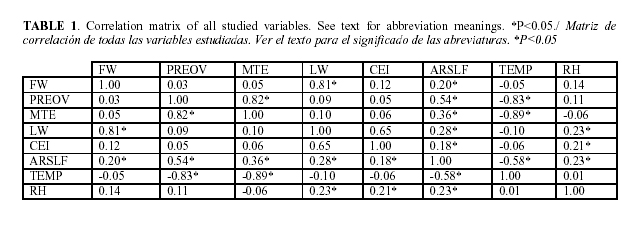
<body><![CDATA[<p><font face="Verdana, Arial, Helvetica, sans-serif" size="2"><b>- All Variables</b>    </font>     <p><font face="Verdana, Arial, Helvetica, sans-serif" size="2"><a href="/img/revistas/rsa/v30n2/f0102208.jpg">Table    1</a> shows the correlation matrix of variables. It is evident that FW and LW    are closely related, indeed there is a linear regression between them. Both    variables have some degree of correlation with ARSLF. These correlations exist    because the bigger the egg mass is, the higher protection from desiccation is    accomplished and thus a higher fertility is obtained. Also, there is not significant    correlation between these variables and CEI. Actually, the variable CEI is made    from both, FW and LW, so the covariance between them does not have to be corrected    (13). They are uncorrelated with the rest of the variables. For these reasons,    authors decided to draw out the variables FW and LW for further analysis. </font>      
<p><font face="Verdana, Arial, Helvetica, sans-serif" size="2"><b>- Analysis of    Remaining Variables </b> </font>     <p><font face="Verdana, Arial, Helvetica, sans-serif" size="2">The eigenvalues    of the first three axes are shown in <a href="/img/revistas/rsa/v30n2/f0202208.jpg">Table    2</a>. The total variance explained by the first two axes is over 70 % but does    not reach the 79.16 % required by the broken-stick test Frontier (1976), cited    by Cuadras (17) to determine the number of valid axes in PCA. So authors decided    to include the third axis in the following procedures. </font>      
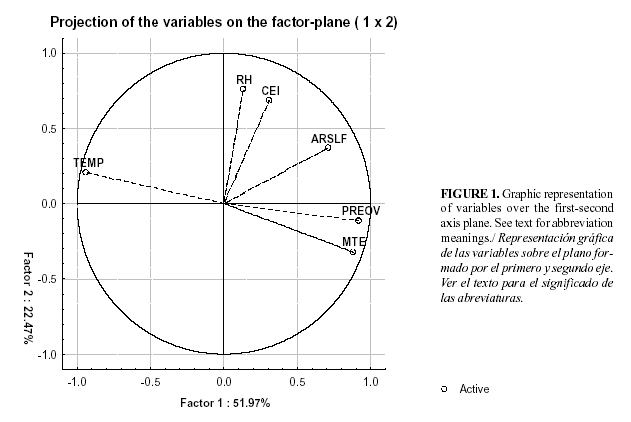
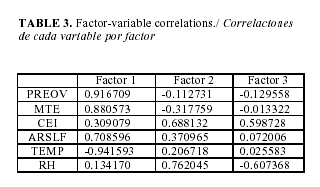
<p><font face="Verdana, Arial, Helvetica, sans-serif" size="2">The correlation    circle of first-second axis (<a href="/img/revistas/rsa/v30n2/f0302208.jpg">Fig.    1</a>) shows a high correlation between temperature and the variables related    with phase duration (PREOV and MTE). The influence of temperature over the variable    CEI is small; this last variable is better represented in the second axis and    related with relative humidity. The variable ARSLF is shared between the two    axes (for more details on factor-axes correlations, see <a href="/img/revistas/rsa/v30n2/f0302208.jpg">Figure    1</a> and <a href="/img/revistas/rsa/v30n2/f0402208.jpg">Table 3</a>).</font>      
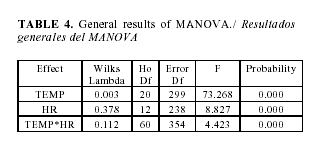
<p><font face="Verdana, Arial, Helvetica, sans-serif" size="2"><b>2. Multivariate    Analysis of Variance </b> </font>      <p><font face="Verdana, Arial, Helvetica, sans-serif" size="2">The general results    of MANOVA (<a href="/img/revistas/rsa/v30n2/f0502208.jpg">Table 4)</a>    show that the two factors and their interaction are highly significant. </font>      
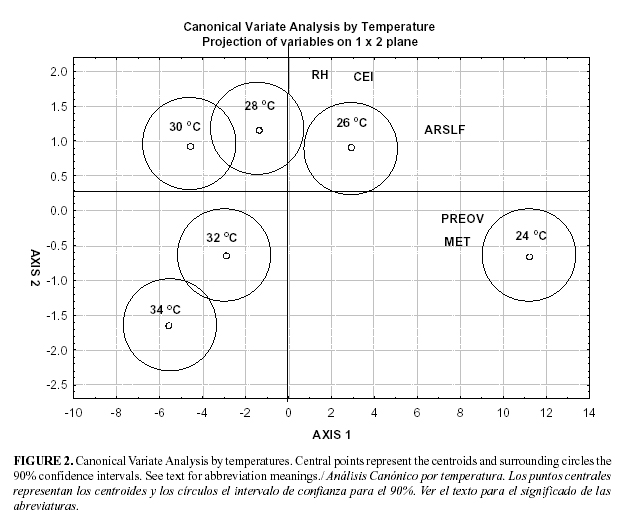
<p><font face="Verdana, Arial, Helvetica, sans-serif" size="2"><b>Canonical Variate    Analysis </b></font>      <p><font face="Verdana, Arial, Helvetica, sans-serif" size="2"><b>- By temperature:    </b> </font>     <p><font face="Verdana, Arial, Helvetica, sans-serif" size="2"><a href="/img/revistas/rsa/v30n2/f0602208.jpg">Figure    2</a> shows the relations between the six temperature groups and the variables    studied. Temperatures of 28 and 30&#176;C have an overlap of the confidence    circles. These two variates are the best if it is desired to obtain a high laying    efficiency and fertility.</font>      
]]></body>
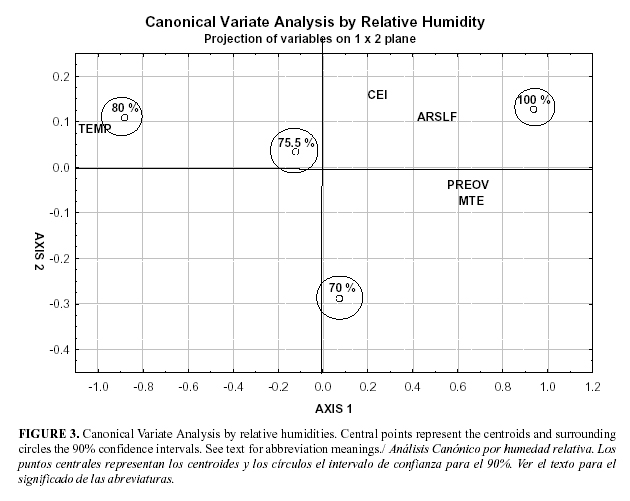
<body><![CDATA[<p><font face="Verdana, Arial, Helvetica, sans-serif" size="2">The duration of    cycle periods is not too long, as it is seen at 24&#176;C. Contrarily, temperatures    of 32 and 34&#176;C are harmful for ticks performance. </font>      <p><font face="Verdana, Arial, Helvetica, sans-serif" size="2"><b>- By Relative    Humidity: </b> </font>     <p><font face="Verdana, Arial, Helvetica, sans-serif" size="2"><a href="/img/revistas/rsa/v30n2/f0702208.jpg">Figure    3</a> expresses the relationship between groups of ticks incubated at four different    relative humidities and the variables studied. Here it is clear the fact that    the best perfomance is obtained when ticks are incubated at 100% RH and the    worst at 70% RH. </font>      
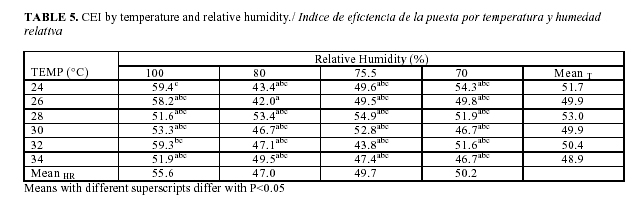
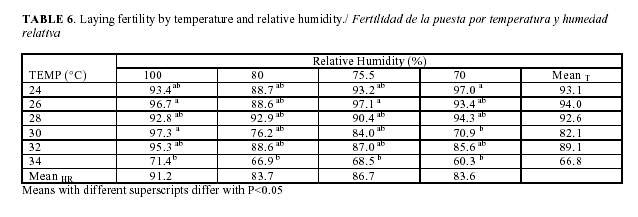
<p><font face="Verdana, Arial, Helvetica, sans-serif" size="2"><b>- By Interaction    Temperature X Relative Humidity</b> </font>     <p><font face="Verdana, Arial, Helvetica, sans-serif" size="2">As each of the    24 groups has a small number of observations (4 or 5) it was decided not to    employ data regarding ARSLF to make the procedure, and left for the future the    addition of further observations in order to add more data allowing to increase    accuracy and precision of results. </font>     <p>&nbsp;     <p><font face="Verdana, Arial, Helvetica, sans-serif" size="2"><b><font size="3">DISCUSSION</font></b>    </font>     <p><font face="Verdana, Arial, Helvetica, sans-serif" size="2">Temperature was    the most important factor acting over the <i>Anocentor nitens</i> cycle variables.    On the contrary, relative humidity between 70 and 100 % has little importance    over the same variables. The new canonical variables show in a more objective    way which are the best and the worst incubation conditions for the species.<i>    </i> </font>     <p><font face="Verdana, Arial, Helvetica, sans-serif" size="2">These results give    the suggestion that the best incubation conditions for raising <i>A. nitens    </i>are: temperatures between 26-30&#176;C and relative humidity of 100%. Higher    temperatures and lower relative humidities are harmful for it (<a href="/img/revistas/rsa/v30n2/f0602208.jpg">Fig.    2</a> and <a href="/img/revistas/rsa/v30n2/f0702208.jpg">3</a>). Results    of Despins (11) working on non-parasitic phase of <i>A. nitens </i>raised on    calves, show congruency when results shown in this paper are compared. Best    results for CEI and LF are obtained at temperatures near 30&#176;C and RH of    91%, the highest RH employed in this paper; at 30&#176;C and 61% relative humidity,    the mean percentage of egg hatch was only 43.4 % and in the case of 35&#176;C    and 40% relative humidity there was no hatch. In the present paper using 34&#176;C    and 70% relative humidity, there was the minimum value of fertility (60.3%).    Despins (11) considers that data obtained at 35&#176;C indicates that this constant    temperature is near the upper lethal temperature for <i>A. nitens.</i> The same    approximation to the results of the present article is shown in Bastos <i>et    al.</i> (8) in relation to incubation temperature. The fact that relatively    high temperatures and relative humidity as used in the present paper, are suitable    to <i>A. nitens</i> performance suggests that this tick is well adapted to tropical    conditions. In a previous work applying univariate methods (12), authors of    this paper have suspected these same conclusions, according to the obtained    data about laying fertility (<a href="/img/revistas/rsa/v30n2/f0802208.jpg">Table    5</a>) and CEI (<a href="/img/revistas/rsa/v30n2/f0902208.jpg">Table 6</a>).    Multivariate statistic methods give this information in an explicit way even    for those with little or no statistical knowledge. </font>      
<p><font face="Verdana, Arial, Helvetica, sans-serif" size="2">Furthermore, in    <i>A. nitens,</i> the minimum thermal threshold and the thermal constant for    eclosion (10) were 15.25&#176;C and 354&#176;C-day respectively, data that are    alike with values of <i>Boophilus microplus</i>, 14&#176;C and 289.9&#176;C-day,    in the laboratory (18) under natural simulated conditions (19) and validated    on conditions near to production (20). This tick is well adapted to tropical    conditions. Finally, Borges <i>et al.</i> (9) showed that <i>A. nitens</i> is    not present in the Brazilian states of Santa Catarina and R&iacute;o Grande    do Sul, whose winters are colder than in its northern states. </font>     ]]></body>
<body><![CDATA[<p>&nbsp;     <p><font face="Verdana, Arial, Helvetica, sans-serif" size="2"><b><font size="3">ACKNOWLEDGEMENTS</font></b>    </font>     <p><font face="Verdana, Arial, Helvetica, sans-serif" size="2">To Dr. Jes&uacute;s    Eladio from the Cybernetics, Mathematics and Physics Institute (ICIMAF) Cuba,    who taught us the way to manage the statistical software; to Dr. Carles M. Cuadras    from the University of Barcelona, Spain, for his valuable advices and critical    revision of mathematical language and to Dr. Wojtek J. Krzanowski from the University    of Exeter, U.K., whose advices gave light to our statistical knowledge. Finally,    to Mr. Edward Deutsch for the language revision. </font>     <p>&nbsp;     <p><font face="Verdana, Arial, Helvetica, sans-serif" size="2"><b><font size="3">REFERENCES</font></b>    </font>     <!-- ref --><p><font face="Verdana, Arial, Helvetica, sans-serif" size="2">1. Hutcheson HJ,    Oliver JHJr. Multivariate morphometrics of larvae of the blacklegged tick (<i>Ixodes    scapularis</i>) with notes on nomenclature. <i>J Parasitol.</i> 1996;82(6):    916-925 </font>    <!-- ref --><p><font face="Verdana, Arial, Helvetica, sans-serif" size="2">2. Houck MA, OConnor    BM. Morphological variation in <i>Hemisarcoptes</i> (Acari: Hemisarcoptidae):    Application of multivariate morphometric analyses. <i>Ann Entomol Soc Am</i>.    1998;91(3):335-349. </font>    <!-- ref --><p><font face="Verdana, Arial, Helvetica, sans-serif" size="2">3. Gettinger D,    Owen RD. <i>Androlaelaps rotundus</i><b> </b>Fonseca (Acari: Laelapidae) associated    with akodontine rodents in Paraguay: a morphometric examination of a pleioxenous    ectoparasite<i>. Rev Brasil</i> <i>Biol</i>. 2000;60(3): 425-434. </font>    <!-- ref --><p><font face="Verdana, Arial, Helvetica, sans-serif" size="2">4.Fern&aacute;ndez-Ruvalcaba    M, Preciado-De la Torre JF, Garc&iacute;a-V&aacute;zquez Z, Cruz V&aacute;zquez    C, Saltijeral-Oaxaca J. Seasonal assessment of <i>Boophilus microplus</i> larvae    recovery in four forage legumes in experimental infested plots. <i>T&eacute;c    Pec M&eacute;x</i>. 2004;42(1):97-104. </font>    <!-- ref --><p><font face="Verdana, Arial, Helvetica, sans-serif" size="2">5. Klimov PB, Lekveishvili    M, Dowling APG, OConnor BM. Multivariate Analysis of Morphological Variation    in Two Cryptic Species of <i>Sancassania </i>(Acari: Acaridae) from Costa Rica.    <i>Ann Entomol Soc Am</i>. 2004;97(2):322-345. </font>    <!-- ref --><p><font face="Verdana, Arial, Helvetica, sans-serif" size="2">6. Tolleson DR,    Teel PD, Stuth JW, Strey OF, Welsh THJr, Carstens GE. Fecal NIRS: Detection    of tick infestations in cattle and horses. <i>Vet Parasitol.</i> 2007;144:46-152.    </font>    <!-- ref --><p><font face="Verdana, Arial, Helvetica, sans-serif" size="2">7. Zacharda M,    Ku&egrave;era T. Diversity of Predatory Rhagidiid Mites (Acari: Rhagidiidae)    Inhabiting Montane Stony Debris in the &Ouml;tztal Alps, North Tyrol, Austria.    <i>Arctic, Antarctic, and Alpine</i><b> </b><i>Research.</i><b> </b>2006;38(2):292-300.    </font>    <!-- ref --><p><font face="Verdana, Arial, Helvetica, sans-serif" size="2">8. Bastos KMS,    Daemon E, Faccini JLH, Da Cunha DW. Efeitos de diferentes temperaturas sobre    a fase n?o parasit&aacute;ria de <i>Dermacentor (Anocentor) nitens </i>(Neumann,    1897) (Acari: Ixodidae) em condi&ograve;&otilde;es de laborat&oacute;rio. <i>Rev</i>    <i>Bras Parasitol Vet.</i> 1996;5(1):29-32. </font>    <!-- ref --><p><font face="Verdana, Arial, Helvetica, sans-serif" size="2">9. Borges LMF,    Oliveira PR, Ribeiro MFB. Seasonal dynamics of the free-living phase of <i>Anocentor    nitens</i> at Pedro Leopoldo, Minas Gerais, Brazil.<i> Vet Parasitol</i>. 1999;87:73-81.    </font>    <!-- ref --><p><font face="Verdana, Arial, Helvetica, sans-serif" size="2">10.de la Vega R,    D&iacute;az G. Thermal Constant Estimation in Tropical Horse Tick, <i>Anocentor    nitens</i> (Acari:Ixodidae). <i>Ann NY Acad Sci.</i> 2000;916:298-302. </font>    <!-- ref --><p><font face="Verdana, Arial, Helvetica, sans-serif" size="2">11.Despins JL.    Effects of Temperature and Humidity on Ovipositional Biology and Egg Development    of the Tropical Horse Tick, <i>Dermacentor (Anocentor) nitens</i>. <i>J. Med.    Entomol</i>. 1992;29(2):332-337. </font>    <!-- ref --><p><font face="Verdana, Arial, Helvetica, sans-serif" size="2">12. D&iacute;az    G, de la Vega R, Ch&aacute;vez G. Influencia de la temperatura y de la humedad    relativa en la fase no parasitaria de <i>Anocentor nitens</i> (Ixodoidea: Ixodidae).    <i>Rev Salud Anim</i>. 1991;13:124-132. </font>    <!-- ref --><p><font face="Verdana, Arial, Helvetica, sans-serif" size="2">13. Drummond RO,    Whetstone TM. Oviposition of the Gulf Coast Tick. <i>J Econ Entomol</i>. 1970;63(5):1547-1551.    </font>    <!-- ref --><p><font face="Verdana, Arial, Helvetica, sans-serif" size="2">14.Krzanowski WJ.    On confidence regions in canonical variate analysis. <i>Biometrika. </i>1989;76(1):107-116.    </font>    <!-- ref --><p><font face="Verdana, Arial, Helvetica, sans-serif" size="2">15.Krzanowski WJ,    Radley D. Nonparametric Confidence and Tolerance Regions in Canonical Variate    Analysis. <i>Biometrics.</i> 1989;45:1163-1173. </font>    <!-- ref --><p><font face="Verdana, Arial, Helvetica, sans-serif" size="2">16.Ringrose TJ,    Krzanowski WJ. Simulation study of confidence regions for canonical variate    analysis. <i>Statistics and</i> <i>Computing.</i> 1991;1: 41-46. </font>    <!-- ref --><p><font face="Verdana, Arial, Helvetica, sans-serif" size="2">17.Cuadras CM.    M&eacute;todos de An&aacute;lisis Multivariante. PPU, Barcelona. Estad&iacute;stica    y An&aacute;lisis de Datos. 1991. </font>    <!-- ref --><p><font face="Verdana, Arial, Helvetica, sans-serif" size="2">18.de la Vega R,    D&iacute;az G. Aplicaci&oacute;n de las constantes t&eacute;rmicas en el control    de la garrapata del ganado vacuno (<i>Boophilus microplus</i>). I. C&aacute;lculo    de las constantes t&eacute;rmicas. <i>Rev Salud Anim. </i>1985;7:141-148. </font>    <!-- ref --><p><font face="Verdana, Arial, Helvetica, sans-serif" size="2">19.de la Vega R,    Farrad&aacute; F, D&iacute;az G. Aplicaci&oacute;n de las constantes t&eacute;rmicas    en el control de la garrapata del ganado vacuno (<i>Boophilus microplus</i>).    VI. Cuarentena. <i>Rev Salud Anim.</i> 1988;10:71-75. </font>    <!-- ref --><p><font face="Verdana, Arial, Helvetica, sans-serif" size="2">20.de la Vega R,    D&iacute;az G. Aplicaci&oacute;n de las constantes t&eacute;rmicas en el control    de la garrapata del ganado vacuno (<i>Boophilus microplus</i>). VIII. Validaci&oacute;n    del programa de cuarentena. <i>Rev Salud Anim</i>. 1992;14:133-136.</font>    <p>&nbsp;     <p>&nbsp;     <p>      <p>      <p>      ]]></body>
<body><![CDATA[<p>      <p>      <p>      <p><font face="Verdana, Arial, Helvetica, sans-serif" size="2"><b>(Recibido 9-10-2007;    Aceptado 24-2-2008)</b> </font>     <P><font face="Verdana, Arial, Helvetica, sans-serif" size="2">    <BR>   </font>       ]]></body><back>
<ref-list>
<ref id="B1">
<label>1</label><nlm-citation citation-type="journal">
<person-group person-group-type="author">
<name>
<surname><![CDATA[Hutcheson]]></surname>
<given-names><![CDATA[HJ]]></given-names>
</name>
<name>
<surname><![CDATA[Oliver]]></surname>
<given-names><![CDATA[JHJr]]></given-names>
</name>
</person-group>
<article-title xml:lang="en"><![CDATA[Multivariate morphometrics of larvae of the blacklegged tick (Ixodes scapularis) with notes on nomenclature]]></article-title>
<source><![CDATA[J Parasitol]]></source>
<year>1996</year>
<volume>82</volume>
<numero>6</numero>
<issue>6</issue>
<page-range>916-925</page-range></nlm-citation>
</ref>
<ref id="B2">
<label>2</label><nlm-citation citation-type="journal">
<person-group person-group-type="author">
<name>
<surname><![CDATA[Houck]]></surname>
<given-names><![CDATA[MA]]></given-names>
</name>
<name>
<surname><![CDATA[OConnor]]></surname>
<given-names><![CDATA[BM]]></given-names>
</name>
</person-group>
<article-title xml:lang="en"><![CDATA[Morphological variation in Hemisarcoptes (Acari: Hemisarcoptidae): Application of multivariate morphometric analyses]]></article-title>
<source><![CDATA[Ann Entomol Soc Am]]></source>
<year>1998</year>
<volume>91</volume>
<numero>3</numero>
<issue>3</issue>
<page-range>335-349</page-range></nlm-citation>
</ref>
<ref id="B3">
<label>3</label><nlm-citation citation-type="journal">
<person-group person-group-type="author">
<name>
<surname><![CDATA[Gettinger]]></surname>
<given-names><![CDATA[D]]></given-names>
</name>
<name>
<surname><![CDATA[Owen]]></surname>
<given-names><![CDATA[RD]]></given-names>
</name>
</person-group>
<article-title xml:lang="en"><![CDATA[Androlaelaps rotundus Fonseca (Acari: Laelapidae) associated with akodontine rodents in Paraguay: a morphometric examination of a pleioxenous ectoparasite]]></article-title>
<source><![CDATA[Rev Brasil Biol]]></source>
<year>2000</year>
<volume>60</volume>
<numero>3</numero>
<issue>3</issue>
<page-range>425-434</page-range></nlm-citation>
</ref>
<ref id="B4">
<label>4</label><nlm-citation citation-type="journal">
<person-group person-group-type="author">
<name>
<surname><![CDATA[Fernández-Ruvalcaba]]></surname>
<given-names><![CDATA[M]]></given-names>
</name>
<name>
<surname><![CDATA[Preciado-De la Torre]]></surname>
<given-names><![CDATA[JF]]></given-names>
</name>
<name>
<surname><![CDATA[García-Vázquez]]></surname>
<given-names><![CDATA[Z]]></given-names>
</name>
<name>
<surname><![CDATA[Cruz Vázquez]]></surname>
<given-names><![CDATA[C]]></given-names>
</name>
<name>
<surname><![CDATA[Saltijeral-Oaxaca]]></surname>
<given-names><![CDATA[J]]></given-names>
</name>
</person-group>
<article-title xml:lang="en"><![CDATA[Seasonal assessment of Boophilus microplus larvae recovery in four forage legumes in experimental infested plots]]></article-title>
<source><![CDATA[Téc Pec Méx]]></source>
<year>2004</year>
<volume>42</volume>
<numero>1</numero>
<issue>1</issue>
<page-range>97-104</page-range></nlm-citation>
</ref>
<ref id="B5">
<label>5</label><nlm-citation citation-type="journal">
<person-group person-group-type="author">
<name>
<surname><![CDATA[Klimov]]></surname>
<given-names><![CDATA[PB]]></given-names>
</name>
<name>
<surname><![CDATA[Lekveishvili]]></surname>
<given-names><![CDATA[M]]></given-names>
</name>
<name>
<surname><![CDATA[Dowling]]></surname>
<given-names><![CDATA[APG]]></given-names>
</name>
<name>
<surname><![CDATA[OConnor]]></surname>
<given-names><![CDATA[BM]]></given-names>
</name>
</person-group>
<article-title xml:lang="en"><![CDATA[Multivariate Analysis of Morphological Variation in Two Cryptic Species of Sancassania (Acari: Acaridae) from Costa Rica]]></article-title>
<source><![CDATA[Ann Entomol Soc Am]]></source>
<year>2004</year>
<volume>97</volume>
<numero>2</numero>
<issue>2</issue>
<page-range>322-345</page-range></nlm-citation>
</ref>
<ref id="B6">
<label>6</label><nlm-citation citation-type="journal">
<person-group person-group-type="author">
<name>
<surname><![CDATA[Tolleson]]></surname>
<given-names><![CDATA[DR]]></given-names>
</name>
<name>
<surname><![CDATA[Teel]]></surname>
<given-names><![CDATA[PD]]></given-names>
</name>
<name>
<surname><![CDATA[Stuth]]></surname>
<given-names><![CDATA[JW]]></given-names>
</name>
<name>
<surname><![CDATA[Strey]]></surname>
<given-names><![CDATA[OF]]></given-names>
</name>
<name>
<surname><![CDATA[Welsh]]></surname>
<given-names><![CDATA[THJr]]></given-names>
</name>
<name>
<surname><![CDATA[Carstens]]></surname>
<given-names><![CDATA[GE]]></given-names>
</name>
</person-group>
<article-title xml:lang="en"><![CDATA[Fecal NIRS: Detection of tick infestations in cattle and horses]]></article-title>
<source><![CDATA[Vet Parasitol]]></source>
<year>2007</year>
<volume>144</volume>
<page-range>46-152</page-range></nlm-citation>
</ref>
<ref id="B7">
<label>7</label><nlm-citation citation-type="journal">
<person-group person-group-type="author">
<name>
<surname><![CDATA[Zacharda]]></surname>
<given-names><![CDATA[M]]></given-names>
</name>
<name>
<surname><![CDATA[Kuèera]]></surname>
<given-names><![CDATA[T]]></given-names>
</name>
</person-group>
<article-title xml:lang="en"><![CDATA[Diversity of Predatory Rhagidiid Mites (Acari: Rhagidiidae) Inhabiting Montane Stony Debris in the Ötztal Alps, North Tyrol, Austria]]></article-title>
<source><![CDATA[Arctic, Antarctic, and Alpine Research]]></source>
<year>2006</year>
<volume>38</volume>
<numero>2</numero>
<issue>2</issue>
<page-range>292-300</page-range></nlm-citation>
</ref>
<ref id="B8">
<label>8</label><nlm-citation citation-type="journal">
<person-group person-group-type="author">
<name>
<surname><![CDATA[Bastos]]></surname>
<given-names><![CDATA[KMS]]></given-names>
</name>
<name>
<surname><![CDATA[Daemon]]></surname>
<given-names><![CDATA[E]]></given-names>
</name>
<name>
<surname><![CDATA[Faccini]]></surname>
<given-names><![CDATA[JLH]]></given-names>
</name>
<name>
<surname><![CDATA[Da Cunha]]></surname>
<given-names><![CDATA[DW]]></given-names>
</name>
</person-group>
<article-title xml:lang="pt"><![CDATA[Efeitos de diferentes temperaturas sobre a fase n?o parasitária de Dermacentor (Anocentor) nitens (Neumann, 1897) (Acari: Ixodidae) em condiòões de laboratório]]></article-title>
<source><![CDATA[Rev Bras Parasitol Vet]]></source>
<year>1996</year>
<volume>5</volume>
<numero>1</numero>
<issue>1</issue>
<page-range>29-32</page-range></nlm-citation>
</ref>
<ref id="B9">
<label>9</label><nlm-citation citation-type="journal">
<person-group person-group-type="author">
<name>
<surname><![CDATA[Borges]]></surname>
<given-names><![CDATA[LMF]]></given-names>
</name>
<name>
<surname><![CDATA[Oliveira]]></surname>
<given-names><![CDATA[PR]]></given-names>
</name>
<name>
<surname><![CDATA[Ribeiro]]></surname>
<given-names><![CDATA[MFB]]></given-names>
</name>
</person-group>
<article-title xml:lang="en"><![CDATA[Seasonal dynamics of the free-living phase of Anocentor nitens at Pedro Leopoldo, Minas Gerais, Brazil]]></article-title>
<source><![CDATA[Vet Parasitol]]></source>
<year>1999</year>
<volume>87</volume>
<page-range>73-81</page-range></nlm-citation>
</ref>
<ref id="B10">
<label>10</label><nlm-citation citation-type="journal">
<person-group person-group-type="author">
<name>
<surname><![CDATA[de la Vega]]></surname>
<given-names><![CDATA[R]]></given-names>
</name>
<name>
<surname><![CDATA[Díaz]]></surname>
<given-names><![CDATA[G]]></given-names>
</name>
</person-group>
<article-title xml:lang="en"><![CDATA[Thermal Constant Estimation in Tropical Horse Tick, Anocentor nitens (Acari:Ixodidae)]]></article-title>
<source><![CDATA[Ann NY Acad Sci]]></source>
<year>2000</year>
<volume>916</volume>
<page-range>298-302</page-range></nlm-citation>
</ref>
<ref id="B11">
<label>11</label><nlm-citation citation-type="journal">
<person-group person-group-type="author">
<name>
<surname><![CDATA[Despins]]></surname>
<given-names><![CDATA[JL]]></given-names>
</name>
</person-group>
<article-title xml:lang="en"><![CDATA[Effects of Temperature and Humidity on Ovipositional Biology and Egg Development of the Tropical Horse Tick, Dermacentor (Anocentor) nitens]]></article-title>
<source><![CDATA[J Med Entomol]]></source>
<year>1992</year>
<volume>29</volume>
<numero>2</numero>
<issue>2</issue>
<page-range>332-337</page-range></nlm-citation>
</ref>
<ref id="B12">
<label>12</label><nlm-citation citation-type="journal">
<person-group person-group-type="author">
<name>
<surname><![CDATA[Díaz]]></surname>
<given-names><![CDATA[G]]></given-names>
</name>
<name>
<surname><![CDATA[de la Vega]]></surname>
<given-names><![CDATA[R]]></given-names>
</name>
<name>
<surname><![CDATA[Chávez]]></surname>
<given-names><![CDATA[G]]></given-names>
</name>
</person-group>
<article-title xml:lang="es"><![CDATA[Influencia de la temperatura y de la humedad relativa en la fase no parasitaria de Anocentor nitens (Ixodoidea: Ixodidae)]]></article-title>
<source><![CDATA[Rev Salud Anim]]></source>
<year>1991</year>
<volume>13</volume>
<page-range>124-132</page-range></nlm-citation>
</ref>
<ref id="B13">
<label>13</label><nlm-citation citation-type="journal">
<person-group person-group-type="author">
<name>
<surname><![CDATA[Drummond]]></surname>
<given-names><![CDATA[RO]]></given-names>
</name>
<name>
<surname><![CDATA[Whetstone]]></surname>
<given-names><![CDATA[TM]]></given-names>
</name>
</person-group>
<article-title xml:lang="en"><![CDATA[Oviposition of the Gulf Coast Tick]]></article-title>
<source><![CDATA[J Econ Entomol]]></source>
<year>1970</year>
<volume>63</volume>
<numero>5</numero>
<issue>5</issue>
<page-range>1547-1551</page-range></nlm-citation>
</ref>
<ref id="B14">
<label>14</label><nlm-citation citation-type="journal">
<person-group person-group-type="author">
<name>
<surname><![CDATA[Krzanowski]]></surname>
<given-names><![CDATA[WJ]]></given-names>
</name>
</person-group>
<article-title xml:lang="en"><![CDATA[On confidence regions in canonical variate analysis]]></article-title>
<source><![CDATA[Biometrika]]></source>
<year>1989</year>
<volume>76</volume>
<numero>1</numero>
<issue>1</issue>
<page-range>107-116</page-range></nlm-citation>
</ref>
<ref id="B15">
<label>15</label><nlm-citation citation-type="journal">
<person-group person-group-type="author">
<name>
<surname><![CDATA[Krzanowski]]></surname>
<given-names><![CDATA[WJ]]></given-names>
</name>
<name>
<surname><![CDATA[Radley]]></surname>
<given-names><![CDATA[D]]></given-names>
</name>
</person-group>
<article-title xml:lang="en"><![CDATA[Nonparametric Confidence and Tolerance Regions in Canonical Variate Analysis]]></article-title>
<source><![CDATA[Biometrics]]></source>
<year>1989</year>
<volume>45</volume>
<page-range>1163-1173</page-range></nlm-citation>
</ref>
<ref id="B16">
<label>16</label><nlm-citation citation-type="journal">
<person-group person-group-type="author">
<name>
<surname><![CDATA[Ringrose]]></surname>
<given-names><![CDATA[TJ]]></given-names>
</name>
<name>
<surname><![CDATA[Krzanowski]]></surname>
<given-names><![CDATA[WJ]]></given-names>
</name>
</person-group>
<article-title xml:lang="en"><![CDATA[Simulation study of confidence regions for canonical variate analysis]]></article-title>
<source><![CDATA[Statistics and Computing]]></source>
<year>1991</year>
<volume>1</volume>
<page-range>41-46</page-range></nlm-citation>
</ref>
<ref id="B17">
<label>17</label><nlm-citation citation-type="">
<person-group person-group-type="author">
<name>
<surname><![CDATA[Cuadras]]></surname>
<given-names><![CDATA[CM]]></given-names>
</name>
</person-group>
<source><![CDATA[Métodos de Análisis Multivariante: PPU Barcelona. Estadística y Análisis de Datos]]></source>
<year>1991</year>
</nlm-citation>
</ref>
<ref id="B18">
<label>18</label><nlm-citation citation-type="journal">
<person-group person-group-type="author">
<name>
<surname><![CDATA[de la Vega]]></surname>
<given-names><![CDATA[R]]></given-names>
</name>
<name>
<surname><![CDATA[Díaz]]></surname>
<given-names><![CDATA[G]]></given-names>
</name>
</person-group>
<article-title xml:lang="es"><![CDATA[Aplicación de las constantes térmicas en el control de la garrapata del ganado vacuno (Boophilus microplus): I. Cálculo de las constantes térmicas]]></article-title>
<source><![CDATA[Rev Salud Anim]]></source>
<year>1985</year>
<volume>7</volume>
<page-range>141-148</page-range></nlm-citation>
</ref>
<ref id="B19">
<label>19</label><nlm-citation citation-type="journal">
<person-group person-group-type="author">
<name>
<surname><![CDATA[de la Vega]]></surname>
<given-names><![CDATA[R]]></given-names>
</name>
<name>
<surname><![CDATA[Farradá]]></surname>
<given-names><![CDATA[F]]></given-names>
</name>
<name>
<surname><![CDATA[Díaz]]></surname>
<given-names><![CDATA[G]]></given-names>
</name>
</person-group>
<article-title xml:lang="es"><![CDATA[Aplicación de las constantes térmicas en el control de la garrapata del ganado vacuno (Boophilus microplus): VI. Cuarentena]]></article-title>
<source><![CDATA[Rev Salud Anim]]></source>
<year>1988</year>
<volume>10</volume>
<page-range>71-75</page-range></nlm-citation>
</ref>
<ref id="B20">
<label>20</label><nlm-citation citation-type="journal">
<person-group person-group-type="author">
<name>
<surname><![CDATA[de la Vega]]></surname>
<given-names><![CDATA[R]]></given-names>
</name>
<name>
<surname><![CDATA[Díaz]]></surname>
<given-names><![CDATA[G]]></given-names>
</name>
</person-group>
<article-title xml:lang="es"><![CDATA[Aplicación de las constantes térmicas en el control de la garrapata del ganado vacuno (Boophilus microplus): VIII. Validación del programa de cuarentena]]></article-title>
<source><![CDATA[Rev Salud Anim]]></source>
<year>1992</year>
<volume>14</volume>
<page-range>133-136</page-range></nlm-citation>
</ref>
</ref-list>
</back>
</article>