<?xml version="1.0" encoding="ISO-8859-1"?><article xmlns:mml="http://www.w3.org/1998/Math/MathML" xmlns:xlink="http://www.w3.org/1999/xlink" xmlns:xsi="http://www.w3.org/2001/XMLSchema-instance">
<front>
<journal-meta>
<journal-id>0253-570X</journal-id>
<journal-title><![CDATA[Revista de Salud Animal]]></journal-title>
<abbrev-journal-title><![CDATA[Rev Salud Anim.]]></abbrev-journal-title>
<issn>0253-570X</issn>
<publisher>
<publisher-name><![CDATA[Centro Nacional de Sanidad Agropecuaria]]></publisher-name>
</publisher>
</journal-meta>
<article-meta>
<article-id>S0253-570X2008000200011</article-id>
<title-group>
<article-title xml:lang="en"><![CDATA[RAPID DETECTION OF SWINE TRANSMISSIBLE GASTROENTERITIS VIRUS BY NESTED POLYMERASE CHAIN REACTION]]></article-title>
<article-title xml:lang="es"><![CDATA[DETECCIÓN RÁPIDA DEL VIRUS DE LA GASTROENTERITIS TRANSMISIBLE EN CERDO A TRAVÉS DE LA REACCIÓN EN CADENA DE LA POLIMERASA]]></article-title>
</title-group>
<contrib-group>
<contrib contrib-type="author">
<name>
<surname><![CDATA[Rodríguez]]></surname>
<given-names><![CDATA[Edisleidy]]></given-names>
</name>
<xref ref-type="aff" rid="A01"/>
</contrib>
<contrib contrib-type="author">
<name>
<surname><![CDATA[Betancourt]]></surname>
<given-names><![CDATA[A]]></given-names>
</name>
<xref ref-type="aff" rid="A02"/>
</contrib>
<contrib contrib-type="author">
<name>
<surname><![CDATA[Barrera]]></surname>
<given-names><![CDATA[Maritza]]></given-names>
</name>
<xref ref-type="aff" rid="A01"/>
</contrib>
<contrib contrib-type="author">
<name>
<surname><![CDATA[Lee]]></surname>
<given-names><![CDATA[Changee]]></given-names>
</name>
<xref ref-type="aff" rid="A03"/>
</contrib>
<contrib contrib-type="author">
<name>
<surname><![CDATA[Yoo]]></surname>
<given-names><![CDATA[Dongwan]]></given-names>
</name>
<xref ref-type="aff" rid="A03"/>
</contrib>
</contrib-group>
<aff id="A01">
<institution><![CDATA[,National Centre for Animal and Plant Health Animal Virology Group ]]></institution>
<addr-line><![CDATA[ ]]></addr-line>
<country>Cuba</country>
</aff>
<aff id="A02">
<institution><![CDATA[,Agrarian University of Havana Faculty of Veterinary Medicine ]]></institution>
<addr-line><![CDATA[ ]]></addr-line>
<country>Cuba</country>
</aff>
<aff id="A03">
<institution><![CDATA[,PathobiologyLab. University of Guelph  ]]></institution>
<addr-line><![CDATA[Ontario ]]></addr-line>
<country>Canada</country>
</aff>
<pub-date pub-type="pub">
<day>00</day>
<month>08</month>
<year>2008</year>
</pub-date>
<pub-date pub-type="epub">
<day>00</day>
<month>08</month>
<year>2008</year>
</pub-date>
<volume>30</volume>
<numero>2</numero>
<fpage>133</fpage>
<lpage>139</lpage>
<copyright-statement/>
<copyright-year/>
<self-uri xlink:href="http://scielo.sld.cu/scielo.php?script=sci_arttext&amp;pid=S0253-570X2008000200011&amp;lng=en&amp;nrm=iso"></self-uri><self-uri xlink:href="http://scielo.sld.cu/scielo.php?script=sci_abstract&amp;pid=S0253-570X2008000200011&amp;lng=en&amp;nrm=iso"></self-uri><self-uri xlink:href="http://scielo.sld.cu/scielo.php?script=sci_pdf&amp;pid=S0253-570X2008000200011&amp;lng=en&amp;nrm=iso"></self-uri><abstract abstract-type="short" xml:lang="en"><p><![CDATA[The aim of this study was to develop a nested PCR for the rapid detection of TGEv. The primers were designed from the highly conserved regions of several sequences of this virus included in the analysis. With the purpose of achieving a good technical specificity, sequences of porcine epidemic diarrhoea virus (PEDv) were included in the design. This virus belongs to the same viral family and it has a close genetic relationship with TGEv. Since both viruses produce the same clinical signs, it was very important to get primers which not amplify PEDv. With the external primers, the amplification of a fragment of the expected size (441 pb) in all the samples evaluated by RT-PCR was obtained, but there was a very low intensity. In the second round (nested PCR), with the internal primers, the amplification of a fragment of the expected size of 168 pb was shown, with a very good concentration. It has been considered that when using nested PCR, TGEv detection sensitivity increased in isolates with low viral concentration.]]></p></abstract>
<abstract abstract-type="short" xml:lang="es"><p><![CDATA[El objetivo de este estudio fue desarrollar una PCR anidada para la detección rápida del virus de TGE. Los cebadores fueron diseñados a partir de regiones altamente conservadas de varias secuencias de este virus incluidas en el análisis. Con el fin de lograr una buena especificidad de la técnica se incluyeron en el diseño, secuencias del virus de la diarrea epidémica porcina (PEDv), el cual pertenece a la misma familia viral y posee una estrecha relación genética con el virus de TGE. Como ambos virus producen los mismos signos clínicos fue importante obtener cebadores que no amplificaran el PEDv. Con los cebadores externos se obtuvo la amplificación de un fragmento de la talla esperada de 441 pb en todas las muestras evaluadas por RT-PCR, pero de muy baja intensidad. En la segunda amplificación (PCR anidado), con los cebadores internos, se mostró la amplificación de un fragmento de la talla esperada de 168 pb, con una buena concentración. Consideramos que con el PCR anidado se incrementó la sensibilidad de la detección del virus de TGE en aislados con baja concentración viral.]]></p></abstract>
<kwd-group>
<kwd lng="en"><![CDATA[Transmissible Gastroenteritis Virus (TGEv)]]></kwd>
<kwd lng="en"><![CDATA[RT-PCR]]></kwd>
<kwd lng="en"><![CDATA[nested PCR]]></kwd>
<kwd lng="es"><![CDATA[Virus de la Gastroenteritis Transmisible del cerdo]]></kwd>
<kwd lng="es"><![CDATA[RT-PCR]]></kwd>
<kwd lng="es"><![CDATA[PCR anidado]]></kwd>
</kwd-group>
</article-meta>
</front><body><![CDATA[ <div align="right"><font face="Verdana, Arial, Helvetica, sans-serif" size="2">    <BR>   <B>Short Communication </B></font><B> </B></div> <B>      <P>&nbsp;     <P><font face="Verdana, Arial, Helvetica, sans-serif" size="2"><font size="4">RAPID    DETECTION OF SWINE TRANSMISSIBLE GASTROENTERITIS VIRUS BY NESTED POLYMERASE    CHAIN REACTION</font></font>     <P>&nbsp;     <P> <font face="Verdana, Arial, Helvetica, sans-serif" size="2"><b><font size="3">DETECCI&Oacute;N    R&Aacute;PIDA DEL VIRUS DE LA GASTROENTERITIS TRANSMISIBLE EN CERDO A TRAV&Eacute;S    DE LA REACCI&Oacute;N EN CADENA DE LA POLIMERASA </font></b></font> </B>     <P>&nbsp;     <P>&nbsp; <B>    <P><font face="Verdana, Arial, Helvetica, sans-serif" size="2">Edisleidy Rodr&iacute;guez<SUP>*</SUP>,    A. Betancourt<SUP>**</SUP>, Maritza Barrera<SUP>*</SUP>, Changee Lee*** y Dongwan    Yoo***</font> </B>      <P>     ]]></body>
<body><![CDATA[<p><font face="Verdana, Arial, Helvetica, sans-serif" size="2"><I><SUP>*</SUP>Animal    Virology Group, National Centre for Animal and Plant Health, Cuba.E-mail: batista@censa.edu.cu;    **Faculty of Veterinary Medicine, Agrarian University of Havana, Cuba. ***Pathobiology    Lab. University of Guelph, Ontario, Canada. </I></font></p>     <p>&nbsp;</p>     <p>&nbsp;</p> <hr noshade size="1">     <p><font face="Verdana, Arial, Helvetica, sans-serif" size="2"><b>ABSTRACT</b></font></p>     <p><font face="Verdana, Arial, Helvetica, sans-serif" size="2"> The aim of this    study was to develop a nested PCR for the rapid detection of TGEv. The primers    were designed from the highly conserved regions of several sequences of this    virus included in the analysis. With the purpose of achieving a good technical    specificity, sequences of porcine epidemic diarrhoea virus (PEDv) were included    in the design. This virus belongs to the same viral family and it has a close    genetic relationship with TGEv. Since both viruses produce the same clinical    signs, it was very important to get primers which not amplify PEDv. With the    external primers, the amplification of a fragment of the expected size (441    pb) in all the samples evaluated by RT-PCR was obtained, but there was a very    low intensity. In the second round (nested PCR), with the internal primers,    the amplification of a fragment of the expected size of 168 pb was shown, with    a very good concentration. It has been considered that when using nested PCR,    TGEv detection sensitivity increased in isolates with low viral concentration.    </font></p>     <P><font face="Verdana, Arial, Helvetica, sans-serif" size="2"><b>Key words:</b>    Transmissible Gastroenteritis Virus (TGEv); RT-PCR; nested PCR</font> <hr noshade size="1">     <P><font face="Verdana, Arial, Helvetica, sans-serif" size="2"><b>RESUMEN</b></font>     <P><font face="Verdana, Arial, Helvetica, sans-serif" size="2"> El objetivo de    este estudio fue desarrollar una PCR anidada para la detecci&oacute;n r&aacute;pida    del virus de TGE. Los cebadores fueron dise&ntilde;ados a partir de regiones    altamente conservadas de varias secuencias de este virus incluidas en el an&aacute;lisis.    Con el fin de lograr una buena especificidad de la t&eacute;cnica se incluyeron    en el dise&ntilde;o, secuencias del virus de la diarrea epid&eacute;mica porcina    (PEDv), el cual pertenece a la misma familia viral y posee una estrecha relaci&oacute;n    gen&eacute;tica con el virus de TGE. Como ambos virus producen los mismos signos    cl&iacute;nicos fue importante obtener cebadores que no amplificaran el PEDv.    Con los cebadores externos se obtuvo la amplificaci&oacute;n de un fragmento    de la talla esperada de 441 pb en todas las muestras evaluadas por RT-PCR, pero    de muy baja intensidad. En la segunda amplificaci&oacute;n (PCR anidado), con    los cebadores internos, se mostr&oacute; la amplificaci&oacute;n de un fragmento    de la talla esperada de 168 pb, con una buena concentraci&oacute;n. Consideramos    que con el PCR anidado se increment&oacute; la sensibilidad de la detecci&oacute;n    del virus de TGE en aislados con baja concentraci&oacute;n viral. </font>     <P><font face="Verdana, Arial, Helvetica, sans-serif" size="2"><b>Palabras clave:</b>    Virus de la Gastroenteritis Transmisible del cerdo; RT-PCR; PCR anidado</font><b><font face="Verdana, Arial, Helvetica, sans-serif" size="2">    </font></b> <hr noshade size="1">     <P>&nbsp;     ]]></body>
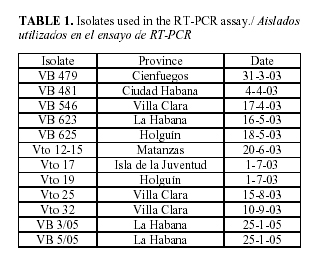
<body><![CDATA[<P><font face="Verdana, Arial, Helvetica, sans-serif" size="2">Transmissible gastroenteritis    (TGE) is a highly contagious enteric disease affecting pigs, caused by a virus    (TGEv), which belongs to <i>Coronaviridae</i> family, <i>coronavirus</i> genus    (7). This disease produces relevant economic losses due to the serious dehydration    and mortality rates close to 100% in newborn piglets (14, 11). Rapid diagnostic    methods for TGE are very important because of the highly contagious nature of    the disease (2). Various methods have been developed for the diagnosis of the    disease, including virus isolation in tissue culture (10), immunodiagnostic    methods: particularly enzyme-linked immunosorbent assay (ELISA) for detection    of virus in faeces (13) and fluorescent antibody tests (FAT) on cryostat sections    of intestine (4). Virus isolation is slow and the virus is often difficult to    adapt to growth in cell culture (12). Immunoassays required fresh clinical samples    and may fail to detect virus present at very low levels. Serological methods    such as virus neutralization test and ELISA on TGEV antibody (9) are used widely    but there is lack advantage in terms of rapid diagnosis because of the time    needed for the antibody development. Nucleic acid recognition methods including    <i>in situ </i>hybridization (8) and RT-PCR (15) have been described for the    direct detection of TGEV RNA. RT-PCR test is useful to detect small quantities    of nucleic acids (3). The purpose of this study was to develop a nested PCR    for the diagnosis of TGE virus since having a rapid result allows the application    of the quarantine measures thus it prevents the dissemination of the virus,    reducing the losses by delayed diagnosis. </font>     <p><font face="Verdana, Arial, Helvetica, sans-serif" size="2">Twelve Cuban isolates    of swine TGEv grown two times into secondary cultures of pig kidney cell monolayer    (PKC) were used. The cells were maintained under Dulbeco's modified Eagle's    medium supplemented with two percents of inactivated fetal serum. </font>     <p><font face="Verdana, Arial, Helvetica, sans-serif" size="2">The isolates were    obtained from different provinces and times during the epizootic (<a href="/img/revistas/rsa/v30n2/f0111208.jpg">Table    1</a>). Also TGEv reference strain (Purdue 115) was used as a positive control    of the reaction, gently donated by the Dr. Dongwan Yoo, University of Guelph,    Ontario, Canada. </font>      
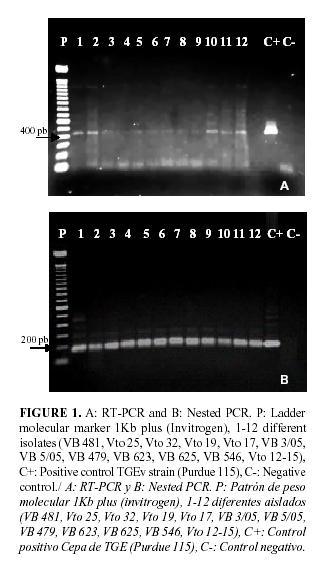
<p><font face="Verdana, Arial, Helvetica, sans-serif" size="2">The oligonucleotide    primers for the RT-PCR and nested PCR were design. There were based on a fragment    of the nucleocapsid gene (N) of TGEv. The sequences were obtained from the GenBank    database, accession numbers: AJ271965, NC002306, AY587884, AY335549, AF104420,    DQ201447, DQ443743, DQ811785, DQ811786, DQ811788 and DQ811789. The oligonucleotide    primers were design from the highly conserved regions, with a 100% identity    between all the sequences of TGEv included in the analysis. Also, with the aim    of obtainig specific primers, which not amplify the porcine epidemic diarrhoea    virus (PEDv), sequences of N gene of this virus: AF237764, AF353511, AY653206,    DQ072726, DQ355221, DQ355223, DQ355224 and NC_003436) were included in the design.    PEDv as well as TGEv belong to the group 1 of the coronavirus genus. They have    a close genetic relationship (5, 1). The sequences of primers were as follows:    forward primer for RT-PCR: (TGENF): 5' CTGGAAGAGAACTGCAGGTA 3'<b> </b>and reverse    primer for RT-PCR: (TGENR): 5' TTAGTTCGTTACCTCATC 3' (441pb), forward primer    for nested PCR: (TGENFI): 5'GGCGACCAGATAGAAGTCACG 3' y reverse primer for nested    PCR:<b> </b>(TGENRI):<b> </b>5'CTTGCTCTGACCTTTCTGCAG 3' (168pb). The softwares    used in the analysis were: Gene Runner Version 3.05<i>, </i>CLUSTAL W Multiple    Sequence Alignment Program, BLAST and Oligo Analyser version 1.2. </font>     <p><font face="Verdana, Arial, Helvetica, sans-serif" size="2">The RNA used for    the reverse transcriptase reaction (RT-PCR) was isolated by the QIAamp&#174;    Viral RNA Mini Kit (QIAGEN) from cell-culture supernatants. The reaction was    conducted as follows. In the tube, 8.5 &#181;l of RNA sample were added to 2    &#181;l of the TGENR primer [100 ng/ &#181;l]. The tube was incubated at 70&#186;C    for 10 min and then quenched on ice for 5 min. Subsequently, mixtures of 4 &#181;l    of 5x RT buffer, 2 &#181;l of 0.1M dithiothereitol, 2 &#181;l of 10mM dNTPs,    0.5 &#181;l of RNAsin, and 1 &#181;l of M-MLV RT (200 U/ &#181;L) (Invitrogen    Corporation) were added and incubated at 42&#186;C for 60 min. Finally an inactivation    step was made at 95&#186;C for 10 min. </font>     <p><font face="Verdana, Arial, Helvetica, sans-serif" size="2">Then 5 &#181;l    of the RT reaction samples were added to 45 &#181;l of the PCR mixture. The    PCR mixture consisted of 5 &#181;l of 10x buffer, 2.5 &#181;l of MgCl<sub>2    </sub>(50 mM), 1 &#181;l of 10mM dNTPs, 1 &#181;l of each primer (TGENF and    TGENR) [100 ng/ &#181;l], 34 &#181;l of water and 0.5 &#181;l of Taq DNA Polymerase    (5 U/ml) (Invitrogen Corporation). The amplification program of the PCR was    as follows: 5 min at 94&#186; C, 35 cycles (45 s at 94&#186; C, 45 s at 50&#186;    C, and 1 min at 72 &#186; C) and 10 min at 72&#186;C. </font>     <p><font face="Verdana, Arial, Helvetica, sans-serif" size="2">For the nested    PCR, 5 &#181;l of RT-PCR products were added to a tube containing 45 &#181;l    of the same PCR mixture mentioned before but with the internal primers (TGENFI    and TGENRI) 1 &#181;l of each primer [100 ng/ &#181;l]. The amplification program    was 3 min at 94&#186; C, 35 cycles of (45s at 94&#186;C, 45s at 58&#186;C, and    1 min at 72&#186;C) and 7 min at 72&#186;C. Both PCR reactions were carried    out in an Eppendorf thermal cycler. </font>     <p><font face="Verdana, Arial, Helvetica, sans-serif" size="2">PCR products were    analysed by elecrophoresis in a 2% agarose gel containing ethidium bromide.    </font>     <p><font face="Verdana, Arial, Helvetica, sans-serif" size="2">The N gene was    chosen because it is highly conserved among TGEv strains. The N protein is the    most abundant antigen in coronavirus-infected cells since its RNA template is    the smallest and it has the most abundant sgRNA (subgenomic RNA) during transcription    (6). This indicates that there is more available RNA for the N gene than for    the other TGEv protein genes. Consequently, detection of the N gene RNA might    be advantageous due to its high abundance in cells, facilitating a high sensitivity    of the diagnostic technique (16). </font>     <p><font face="Verdana, Arial, Helvetica, sans-serif" size="2"> With the external    primers designed for the detection of TGEv, the amplification of a fragment    of the expected size (441 pb) was obtained in all the samples evaluated by RT-PCR    (<a href="/img/revistas/rsa/v30n2/f0211208.jpg">Figure 1A</a>), but there    was a great difference among the amplification of the positive control (Purdue    strain) and the rest of the samples, in which the intensity of the band was    very weak, while the positive control showed to be very strong. This result    showed the necessity of developing a nested PCR to increase the sensitivity    of the assay. </font>      
]]></body>
<body><![CDATA[<p><font face="Verdana, Arial, Helvetica, sans-serif" size="2">In the second round    (nested PCR), with the internal primers, a fragment of the expected size of    168 pb was shown, and at this time the amplicons for all the samples had a very    good concentration (<a href="/img/revistas/rsa/v30n2/f0211208.jpg">Figure    1B</a>). With the nested PCR, the sensitivity of TGEv detection increased in    isolates with low passages. </font>      
<p><font face="Verdana, Arial, Helvetica, sans-serif" size="2">It has been concluded    that the nested PCR described here is a useful tool for the detection and identification    of TGEv in cell cultures with low passages. Differences in the ability to amplify    and the characteristics of PCR systems available for TGEv detection in clinical    samples should be considered before using test in future epidemiological studies.    The availability of a sensitive and specific diagnostic technique such as the    nested PCR described in this work will make possible to undertake larger epidemiological    studies of TGEv involved in the porcine diarrhoea aetiology. </font>     <p>&nbsp;     <p><font face="Verdana, Arial, Helvetica, sans-serif" size="2"><b><font size="3">REFERENCES</font></b></font>     <p><font face="Verdana, Arial, Helvetica, sans-serif" size="2">1. Calvo E, Escors    D, L&oacute;pez JA, Gonz&aacute;lez JM, &Aacute;lvarez A, Arza E, et al. (2005):    Phosphorylation and subcellular localization of transmissible gastroenteritis    virus nucleocapsid protein in infected cells. <i>J Gen Virol.</i> 2005;86:2255-2267.    </font>     <!-- ref --><p><font face="Verdana, Arial, Helvetica, sans-serif" size="2">2. Chen R, Huang    W, Lin Z, Zhou Z, Yu H, Zhu D. Development of a novel real-time RT-PCR assay    with LUX primer for the detection of swine transmissible gastroenteritis virus.    <i>J Virol Meth.</i> 2004;122:57-61. </font>    <p><font face="Verdana, Arial, Helvetica, sans-serif" size="2">3. Cho KO, Hasoksuz    M, Nielsen PR, Chang KO, Lathrop S, et al. Cross-protection studies between    respiratory and calf diarrhea and winter dysentery coronavirus strains in calves    and RT-PCR and nested PCR for their detection. <i>Arch Virol.</i> 2001;146:2401-2419.    </font>     <p><font face="Verdana, Arial, Helvetica, sans-serif" size="2">4. Enjuanes L,    Van Der Zeijst. Molecular basis of transmisible gastroenteritis virus epidemiology.    In, The <i>Coronaviridae</i>, edited by Stuart G. siddell, Plenum Press, N.Y.    1995. </font>     <!-- ref --><p><font face="Verdana, Arial, Helvetica, sans-serif" size="2">5. Gonz&aacute;lez    JM, Gomez-Puertas P, Cavanagh D, Gorbalenya AE, Enjuanes L. A comparative sequence    analysis to revise the current taxonomy of the family Coronaviridae. <i>Arch    Virol</i>. 2003;148:2207-2235. </font>    <!-- ref --><p><font face="Verdana, Arial, Helvetica, sans-serif" size="2">6. Hiscox JA, Wurm    T, Wilson L, Britton P, Cavanagh D, Brooks G. The coronavirus infectious bronchitis    virus nucleoprotein localizes to the nucleolus. <i>J Virol.</i> 2001;75:506-512.    </font>    <!-- ref --><p><font face="Verdana, Arial, Helvetica, sans-serif" size="2">7. ICTV. International    Committee on Taxonomy of Viruses. 2004. (On line). Disponible en: <a href="http://www.ncbi.nlm.nih.gov/ICTV">http://www.ncbi.nlm.nih.gov/ICTV</a>.    Consulta: 26 de julio de 2006. </font>    <!-- ref --><p><font face="Verdana, Arial, Helvetica, sans-serif" size="2">8. Kim B, Chae    C. Experimental Infection of Piglets with Transmissible Gastroenteritis Virus:    a Comparison of Three Strains (Korean, Purdue and Miller). <i>J Comp Path</i>.    2002;126:30-37. </font>    <!-- ref --><p><font face="Verdana, Arial, Helvetica, sans-serif" size="2">9. Liu C, Kokuho    T, Watanabe S, Inumaru S, Yokomizo Y, Onodera T. A serodiagnostic ELISA using    recombinant antigen of swine transmissible gastroenteritis virus nucleoprotein.    <i>J Vet Med Sci</i>. 2001;63(11):1253-1256. </font>    <!-- ref --><p><font face="Verdana, Arial, Helvetica, sans-serif" size="2">10.OIE. Manual    of Standards Diagnostic Test and Vaccines, Part 2 Section 2.6 chapter 2.6.4.    2004. (online) Updated: 23.07.2006. <a href="http://www.oie.int/eng/normes/mmanual/A_00085.htm">http://www.oie.int/eng/normes/mmanual/A_00085.htm</a>    </font>    <!-- ref --><p><font face="Verdana, Arial, Helvetica, sans-serif" size="2">11.OIE. Animal    Diseases Data. Diseases Notifiable to the OIE. 2005. (On line). Disponible en:    <a href="http://www.oie.int/eng/maladies/en_classification.htm">http://www.oie.int/eng/maladies/en_classification.htm</a>    </font>    <!-- ref --><p><font face="Verdana, Arial, Helvetica, sans-serif" size="2">12.Paton D, Lowings    P. Discrimination between transmissible gastroenteritis virus isolates. <i>Archives    of Virology</i>. 1997;142:1703-1711. </font>    <!-- ref --><p><font face="Verdana, Arial, Helvetica, sans-serif" size="2">13.Rodak L, Smid    B, Nevorankova Z, Valicek L, Smitalova R. Use of Monoclonal Antibodies in Blocking    ELISA Detection of Transmissible Gastroenteritis Virus in Faeces of Piglets.    <i>J Vet Med</i>. B 2005;52:105-111. </font>    <!-- ref --><p><font face="Verdana, Arial, Helvetica, sans-serif" size="2">14.Sestak K, Saif    LJ. Porcine coronavirus.<i> In </i>Trends in emerging viral infection of swine.    Iowa State Press, <i>Ames.</i> Page 321-330. 2002. </font>    <!-- ref --><p><font face="Verdana, Arial, Helvetica, sans-serif" size="2">15.Song DS, Kang    BK, Oh JS, Ha GW, Yang JS, Moon HJ, et al. Multiplex reverse transcription-PCR    for rapid differential detection of porcine epidemic diarrhea virus, transmissible    gastroenteritis virus, and porcine group A rotavirus. <i>J Vet Diagn Invest.</i>    2006;18(3):278-81. </font>    <!-- ref --><p><font face="Verdana, Arial, Helvetica, sans-serif" size="2">16.Takiuchi Elisabete,    Stipp D, Alfieri Alice, Alfieri A. Improved detection of bovine coronavirus    N gene in faeces of calves infected naturally by a semi-nested PCR assay and    an internal control. <i>J Virol Meth.</i> 2006;131:148-54. </font>    <p>      <p>      <p>      <p>&nbsp;     <p>&nbsp;     <p><font face="Verdana, Arial, Helvetica, sans-serif" size="2"><b>(Recibido 12-11-2006;    Aceptado 15-6-2007)</b> </font>     <P>&nbsp;       ]]></body><back>
<ref-list>
<ref id="B1">
<label>1</label><nlm-citation citation-type="journal">
<person-group person-group-type="author">
<name>
<surname><![CDATA[Calvo]]></surname>
<given-names><![CDATA[E]]></given-names>
</name>
<name>
<surname><![CDATA[Escors]]></surname>
<given-names><![CDATA[D]]></given-names>
</name>
<name>
<surname><![CDATA[López]]></surname>
<given-names><![CDATA[JA]]></given-names>
</name>
<name>
<surname><![CDATA[González]]></surname>
<given-names><![CDATA[JM]]></given-names>
</name>
<name>
<surname><![CDATA[Álvarez]]></surname>
<given-names><![CDATA[A]]></given-names>
</name>
<name>
<surname><![CDATA[Arza]]></surname>
<given-names><![CDATA[E]]></given-names>
</name>
</person-group>
<article-title xml:lang="en"><![CDATA[Phosphorylation and subcellular localization of transmissible gastroenteritis virus nucleo capsid protein in infected cells]]></article-title>
<source><![CDATA[J Gen Virol]]></source>
<year>2005</year>
<volume>86</volume>
<page-range>2255-2267</page-range></nlm-citation>
</ref>
<ref id="B2">
<label>2</label><nlm-citation citation-type="journal">
<person-group person-group-type="author">
<name>
<surname><![CDATA[Chen]]></surname>
<given-names><![CDATA[R]]></given-names>
</name>
<name>
<surname><![CDATA[Huang]]></surname>
<given-names><![CDATA[W]]></given-names>
</name>
<name>
<surname><![CDATA[Lin]]></surname>
<given-names><![CDATA[Z]]></given-names>
</name>
<name>
<surname><![CDATA[Zhou]]></surname>
<given-names><![CDATA[Z]]></given-names>
</name>
<name>
<surname><![CDATA[Yu]]></surname>
<given-names><![CDATA[H]]></given-names>
</name>
<name>
<surname><![CDATA[Zhu]]></surname>
<given-names><![CDATA[D]]></given-names>
</name>
</person-group>
<article-title xml:lang="en"><![CDATA[Development of a novel real-time RT-PCR assay with LUX primer for the detection of swine transmissible gastroenteritis virus]]></article-title>
<source><![CDATA[J Virol Meth]]></source>
<year>2004</year>
<volume>122</volume>
<page-range>57-61</page-range></nlm-citation>
</ref>
<ref id="B3">
<label>3</label><nlm-citation citation-type="journal">
<person-group person-group-type="author">
<name>
<surname><![CDATA[Cho]]></surname>
<given-names><![CDATA[KO]]></given-names>
</name>
<name>
<surname><![CDATA[Hasoksuz]]></surname>
<given-names><![CDATA[M]]></given-names>
</name>
<name>
<surname><![CDATA[Nielsen]]></surname>
<given-names><![CDATA[PR]]></given-names>
</name>
<name>
<surname><![CDATA[Chang]]></surname>
<given-names><![CDATA[KO]]></given-names>
</name>
<name>
<surname><![CDATA[Lathrop]]></surname>
<given-names><![CDATA[S]]></given-names>
</name>
<name>
<surname><![CDATA[Saif]]></surname>
<given-names><![CDATA[L]]></given-names>
</name>
</person-group>
<article-title xml:lang="en"><![CDATA[Cross-protection studies between respiratory and calf diarrhea and winter dysentery coronavirus strains in calves and RT-PCR and nested PCR for their detection]]></article-title>
<source><![CDATA[Arch Virol]]></source>
<year>2001</year>
<volume>146</volume>
<page-range>2401-2419</page-range></nlm-citation>
</ref>
<ref id="B4">
<label>4</label><nlm-citation citation-type="">
<person-group person-group-type="author">
<name>
<surname><![CDATA[Enjuanes]]></surname>
<given-names><![CDATA[L]]></given-names>
</name>
</person-group>
<article-title xml:lang="en"><![CDATA[Molecular basis of transmisible gastroenteritis virus epidemiology]]></article-title>
<person-group person-group-type="editor">
<name>
<surname><![CDATA[Stuart]]></surname>
<given-names><![CDATA[G]]></given-names>
</name>
</person-group>
<source><![CDATA[The Coronaviridae]]></source>
<year>1995</year>
<publisher-loc><![CDATA[^eN.Y N.Y]]></publisher-loc>
</nlm-citation>
</ref>
<ref id="B5">
<label>5</label><nlm-citation citation-type="journal">
<person-group person-group-type="author">
<name>
<surname><![CDATA[González]]></surname>
<given-names><![CDATA[JM]]></given-names>
</name>
<name>
<surname><![CDATA[Gomez-Puertas]]></surname>
<given-names><![CDATA[P]]></given-names>
</name>
<name>
<surname><![CDATA[Cavanagh]]></surname>
<given-names><![CDATA[D]]></given-names>
</name>
<name>
<surname><![CDATA[Gorbalenya]]></surname>
<given-names><![CDATA[AE]]></given-names>
</name>
<name>
<surname><![CDATA[Enjuanes]]></surname>
<given-names><![CDATA[L]]></given-names>
</name>
</person-group>
<article-title xml:lang="en"><![CDATA[A comparative sequence analysis to revise the current taxonomy of the family Coronaviridae]]></article-title>
<source><![CDATA[Arch Virol]]></source>
<year>2003</year>
<volume>148</volume>
<page-range>2207-2235</page-range></nlm-citation>
</ref>
<ref id="B6">
<label>6</label><nlm-citation citation-type="journal">
<person-group person-group-type="author">
<name>
<surname><![CDATA[Hiscox]]></surname>
<given-names><![CDATA[JA]]></given-names>
</name>
<name>
<surname><![CDATA[Wurm]]></surname>
<given-names><![CDATA[T]]></given-names>
</name>
<name>
<surname><![CDATA[Wilson]]></surname>
<given-names><![CDATA[L]]></given-names>
</name>
<name>
<surname><![CDATA[Britton]]></surname>
<given-names><![CDATA[P]]></given-names>
</name>
<name>
<surname><![CDATA[Cavanagh]]></surname>
<given-names><![CDATA[D]]></given-names>
</name>
<name>
<surname><![CDATA[Brooks]]></surname>
<given-names><![CDATA[G]]></given-names>
</name>
</person-group>
<article-title xml:lang="en"><![CDATA[The coronavirus infectious bronchitis virus nucleoprotein localizes to the nucleolus]]></article-title>
<source><![CDATA[J Virol]]></source>
<year>2001</year>
<volume>75</volume>
<page-range>506-512</page-range></nlm-citation>
</ref>
<ref id="B7">
<label>7</label><nlm-citation citation-type="">
<collab>ICTV. International Committee on Taxonomy of Viruses</collab>
<source><![CDATA[]]></source>
<year></year>
</nlm-citation>
</ref>
<ref id="B8">
<label>8</label><nlm-citation citation-type="journal">
<person-group person-group-type="author">
<name>
<surname><![CDATA[Kim]]></surname>
<given-names><![CDATA[B]]></given-names>
</name>
<name>
<surname><![CDATA[Chae]]></surname>
<given-names><![CDATA[C]]></given-names>
</name>
</person-group>
<article-title xml:lang="en"><![CDATA[Experimental Infection of Piglets with Transmissible Gastroenteritis Virus: a Comparison of Three Strains (Korean, Purdue and Miller)]]></article-title>
<source><![CDATA[J Comp Path]]></source>
<year>2002</year>
<volume>126</volume>
<page-range>30-37</page-range></nlm-citation>
</ref>
<ref id="B9">
<label>9</label><nlm-citation citation-type="journal">
<person-group person-group-type="author">
<name>
<surname><![CDATA[Liu]]></surname>
<given-names><![CDATA[C]]></given-names>
</name>
<name>
<surname><![CDATA[Kokuho]]></surname>
<given-names><![CDATA[T]]></given-names>
</name>
<name>
<surname><![CDATA[Watanabe]]></surname>
<given-names><![CDATA[S]]></given-names>
</name>
<name>
<surname><![CDATA[Inumaru]]></surname>
<given-names><![CDATA[S]]></given-names>
</name>
<name>
<surname><![CDATA[Yokomizo]]></surname>
<given-names><![CDATA[Y]]></given-names>
</name>
<name>
<surname><![CDATA[Onodera]]></surname>
<given-names><![CDATA[T]]></given-names>
</name>
</person-group>
<article-title xml:lang="en"><![CDATA[A serodiagnostic ELISA using recombinant antigen of swine transmissible gastroenteritis virus nucleoprotein]]></article-title>
<source><![CDATA[J Vet Med Sci]]></source>
<year>2001</year>
<volume>63</volume>
<numero>11</numero>
<issue>11</issue>
<page-range>1253-1256</page-range></nlm-citation>
</ref>
<ref id="B10">
<label>10</label><nlm-citation citation-type="book">
<source><![CDATA[Manual of Standards Diagnostic Test and Vaccines]]></source>
<year></year>
<publisher-name><![CDATA[OIE]]></publisher-name>
</nlm-citation>
</ref>
<ref id="B11">
<label>11</label><nlm-citation citation-type="book">
<source><![CDATA[Animal Diseases Data: Diseases Notifiable to the OIE]]></source>
<year>2005</year>
<publisher-name><![CDATA[OIE]]></publisher-name>
</nlm-citation>
</ref>
<ref id="B12">
<label>12</label><nlm-citation citation-type="journal">
<person-group person-group-type="author">
<name>
<surname><![CDATA[Paton]]></surname>
<given-names><![CDATA[D]]></given-names>
</name>
<name>
<surname><![CDATA[Lowings]]></surname>
<given-names><![CDATA[P]]></given-names>
</name>
</person-group>
<article-title xml:lang="en"><![CDATA[Discrimination between transmissible gastroenteritis virus isolates]]></article-title>
<source><![CDATA[Archives of Virology]]></source>
<year>1997</year>
<volume>142</volume>
<page-range>1703-1711</page-range></nlm-citation>
</ref>
<ref id="B13">
<label>13</label><nlm-citation citation-type="journal">
<person-group person-group-type="author">
<name>
<surname><![CDATA[Rodak]]></surname>
<given-names><![CDATA[L]]></given-names>
</name>
<name>
<surname><![CDATA[Smid]]></surname>
<given-names><![CDATA[B]]></given-names>
</name>
<name>
<surname><![CDATA[Nevorankova]]></surname>
<given-names><![CDATA[Z]]></given-names>
</name>
<name>
<surname><![CDATA[Valicek]]></surname>
<given-names><![CDATA[L]]></given-names>
</name>
<name>
<surname><![CDATA[Smitalova]]></surname>
<given-names><![CDATA[R]]></given-names>
</name>
</person-group>
<article-title xml:lang="en"><![CDATA[Use of Monoclonal Antibodies in Blocking ELISA Detection of Transmissible Gastroenteritis Virus in Faeces of Piglets]]></article-title>
<source><![CDATA[J Vet Med B]]></source>
<year>2005</year>
<volume>52</volume>
<page-range>105-111</page-range></nlm-citation>
</ref>
<ref id="B14">
<label>14</label><nlm-citation citation-type="book">
<person-group person-group-type="author">
<name>
<surname><![CDATA[Sestak]]></surname>
<given-names><![CDATA[K]]></given-names>
</name>
<name>
<surname><![CDATA[Saif]]></surname>
<given-names><![CDATA[LJ]]></given-names>
</name>
</person-group>
<article-title xml:lang="en"><![CDATA[Porcine coronavirus]]></article-title>
<source><![CDATA[Trends in emerging viral infection of swine]]></source>
<year>2002</year>
<page-range>321-330</page-range><publisher-name><![CDATA[Iowa State Press, Ames]]></publisher-name>
</nlm-citation>
</ref>
<ref id="B15">
<label>15</label><nlm-citation citation-type="journal">
<person-group person-group-type="author">
<name>
<surname><![CDATA[Song]]></surname>
<given-names><![CDATA[DS]]></given-names>
</name>
<name>
<surname><![CDATA[Kang]]></surname>
<given-names><![CDATA[BK]]></given-names>
</name>
<name>
<surname><![CDATA[Oh]]></surname>
<given-names><![CDATA[JS]]></given-names>
</name>
<name>
<surname><![CDATA[Ha]]></surname>
<given-names><![CDATA[GW]]></given-names>
</name>
<name>
<surname><![CDATA[Yang]]></surname>
<given-names><![CDATA[JS]]></given-names>
</name>
<name>
<surname><![CDATA[Moon]]></surname>
<given-names><![CDATA[HJ]]></given-names>
</name>
</person-group>
<article-title xml:lang="en"><![CDATA[Multiplex reverse transcription-PCR for rapid differential detection of porcine epidemic diarrhea virus, transmissible gastroenteritis virus, and porcine group A rotavirus]]></article-title>
<source><![CDATA[J Vet Diagn Invest]]></source>
<year>2006</year>
<volume>18</volume>
<numero>3</numero>
<issue>3</issue>
<page-range>278-81</page-range></nlm-citation>
</ref>
<ref id="B16">
<label>16</label><nlm-citation citation-type="journal">
<person-group person-group-type="author">
<name>
<surname><![CDATA[Takiuchi]]></surname>
<given-names><![CDATA[Elisabete]]></given-names>
</name>
<name>
<surname><![CDATA[Stipp]]></surname>
<given-names><![CDATA[D]]></given-names>
</name>
<name>
<surname><![CDATA[Alfieri]]></surname>
<given-names><![CDATA[Alice]]></given-names>
</name>
<name>
<surname><![CDATA[Alfieri]]></surname>
<given-names><![CDATA[A]]></given-names>
</name>
</person-group>
<article-title xml:lang="en"><![CDATA[Improved detection of bovine coronavirus N gene in faeces of calves infected naturally by a semi-nested PCR assay and an internal control]]></article-title>
<source><![CDATA[J Virol Meth]]></source>
<year>2006</year>
<volume>131</volume>
<page-range>148-54</page-range></nlm-citation>
</ref>
</ref-list>
</back>
</article>