<?xml version="1.0" encoding="ISO-8859-1"?><article xmlns:mml="http://www.w3.org/1998/Math/MathML" xmlns:xlink="http://www.w3.org/1999/xlink" xmlns:xsi="http://www.w3.org/2001/XMLSchema-instance">
<front>
<journal-meta>
<journal-id>0253-570X</journal-id>
<journal-title><![CDATA[Revista de Salud Animal]]></journal-title>
<abbrev-journal-title><![CDATA[Rev Salud Anim.]]></abbrev-journal-title>
<issn>0253-570X</issn>
<publisher>
<publisher-name><![CDATA[Centro Nacional de Sanidad Agropecuaria]]></publisher-name>
</publisher>
</journal-meta>
<article-meta>
<article-id>S0253-570X2009000100008</article-id>
<title-group>
<article-title xml:lang="en"><![CDATA[SAFETY OFPochonia chlamydosporia var. catenulata IN QUAILS]]></article-title>
<article-title xml:lang="es"><![CDATA[SEGURIDAD DE Pochonia chlamydosporia var. catenulata EN CODORNICES]]></article-title>
</title-group>
<contrib-group>
<contrib contrib-type="author">
<name>
<surname><![CDATA[García]]></surname>
<given-names><![CDATA[Liseth]]></given-names>
</name>
<xref ref-type="aff" rid="A01"/>
</contrib>
<contrib contrib-type="author">
<name>
<surname><![CDATA[Bulnes]]></surname>
<given-names><![CDATA[C]]></given-names>
</name>
<xref ref-type="aff" rid="A01"/>
</contrib>
<contrib contrib-type="author">
<name>
<surname><![CDATA[Melchor]]></surname>
<given-names><![CDATA[G]]></given-names>
</name>
<xref ref-type="aff" rid="A01"/>
</contrib>
<contrib contrib-type="author">
<name>
<surname><![CDATA[Hidalgo]]></surname>
<given-names><![CDATA[L]]></given-names>
</name>
<xref ref-type="aff" rid="A01"/>
</contrib>
<contrib contrib-type="author">
<name>
<surname><![CDATA[Figueredo]]></surname>
<given-names><![CDATA[J]]></given-names>
</name>
<xref ref-type="aff" rid="A01"/>
</contrib>
<contrib contrib-type="author">
<name>
<surname><![CDATA[Vega]]></surname>
<given-names><![CDATA[E]]></given-names>
</name>
<xref ref-type="aff" rid="A01"/>
</contrib>
<contrib contrib-type="author">
<name>
<surname><![CDATA[Marrero]]></surname>
<given-names><![CDATA[E]]></given-names>
</name>
<xref ref-type="aff" rid="A01"/>
</contrib>
</contrib-group>
<aff id="A01">
<institution><![CDATA[,Centro Nacional de Sanidad Agropecuaria (CENSA)  ]]></institution>
<addr-line><![CDATA[La Habana ]]></addr-line>
<country>Cuba</country>
</aff>
<pub-date pub-type="pub">
<day>00</day>
<month>04</month>
<year>2009</year>
</pub-date>
<pub-date pub-type="epub">
<day>00</day>
<month>04</month>
<year>2009</year>
</pub-date>
<volume>31</volume>
<numero>1</numero>
<fpage>40</fpage>
<lpage>45</lpage>
<copyright-statement/>
<copyright-year/>
<self-uri xlink:href="http://scielo.sld.cu/scielo.php?script=sci_arttext&amp;pid=S0253-570X2009000100008&amp;lng=en&amp;nrm=iso"></self-uri><self-uri xlink:href="http://scielo.sld.cu/scielo.php?script=sci_abstract&amp;pid=S0253-570X2009000100008&amp;lng=en&amp;nrm=iso"></self-uri><self-uri xlink:href="http://scielo.sld.cu/scielo.php?script=sci_pdf&amp;pid=S0253-570X2009000100008&amp;lng=en&amp;nrm=iso"></self-uri><abstract abstract-type="short" xml:lang="en"><p><![CDATA[To obtain safe quality criteria for biological control agents, many tests have been developed. The aim of these studies was to determine the potentiality of Pochonia chlamydosporia var. catenulata to produce toxicity, infectivity or other organ/tissue damage in quails. Acute and toxicity/pathogenicity studies were performed by oral route. A maximum dose level of 6x10(6) units of the microbial pest control agent per bird treated was used. Mortality or clinical signs were not observed and no effects on body weight, haematology, microbiology and gross or microscopic pathology were detected. Thus clinical, microbiological and pathological results provided evidence for the safety properties of this fungus in quails.]]></p></abstract>
<abstract abstract-type="short" xml:lang="es"><p><![CDATA[Para obtener los criterios de calidad y seguridad de agentes de control biológico, muchas pruebas han sido desarrolladas. El objetivo de estos estudios fue determinar el potencial de Pochonia chlamydosporia var. catenulata para producir toxicidad / infectivity u otro daño en órganos o tejidos de codornices. Se realizaron estudios agudos y de toxicidad / patogenicidad por vía oral. Se evaluaron dosis máximas de 6x10(6) unidades del agente microbiano para el control de plagas. No se observaron signos clínicos, mortalidad ni ningún efecto sobre el peso corporal, la hematología, la microbiología y la patología macroscópica o microscópica. Por lo tanto, los resultados clínicos, microbiológicos y patológicos proveen evidencias de las propiedades de seguridad de este hongo en las codornices.]]></p></abstract>
<kwd-group>
<kwd lng="en"><![CDATA[Pochonia chlamydosporia var. catenulata]]></kwd>
<kwd lng="en"><![CDATA[toxicity/pathogenicity]]></kwd>
<kwd lng="en"><![CDATA[safety]]></kwd>
<kwd lng="en"><![CDATA[quails]]></kwd>
<kwd lng="es"><![CDATA[Pochonia chlamydosporia var. catenulata]]></kwd>
<kwd lng="es"><![CDATA[toxicidad/patogenicidad]]></kwd>
<kwd lng="es"><![CDATA[seguridad]]></kwd>
<kwd lng="es"><![CDATA[codornices]]></kwd>
</kwd-group>
</article-meta>
</front><body><![CDATA[ <p align="right"><font face="Verdana, Arial, Helvetica, sans-serif" size="2"><b>Art&iacute;culo    original</b></font></p>     <p>&nbsp;</p>     <p>&nbsp;</p>     <p><font face="Verdana, Arial, Helvetica, sans-serif" size="2"><B><font size="4">SAFETY    OF<I>Pochonia chlamydosporia</I> var. <I>catenulata</I> IN QUAILS</font></B></font></p>     <p>&nbsp;</p>     <p><font face="Verdana, Arial, Helvetica, sans-serif" size="2"><b><font size="3">SEGURIDAD    DE <i> Pochonia chlamydosporia</i> var. <i>catenulata</i> EN CODORNICES</font></b></font></p>     <p>&nbsp;</p>     <p>&nbsp;</p>     <p><font face="Verdana, Arial, Helvetica, sans-serif" size="2"><b>Liseth Garc&iacute;a,    C. Bulnes, G. Melchor, L. Hidalgo, J. Figueredo, E. Vega y E. Marrero</b></font></p> <B></B>      <P>     ]]></body>
<body><![CDATA[<p><font face="Verdana, Arial, Helvetica, sans-serif" size="2"><I>Centro Nacional    de Sanidad Agropecuaria (CENSA), Apartado. 10, San Jos&eacute; de las Lajas,    La Habana, Cuba. E-mail: <a href="mailto:lgarcia@censa.edu.cu">lgarcia@censa.edu.cu</a></I></font></p>     <p>&nbsp;</p>     <p>&nbsp;</p> <hr noshade size="1">     <p><font face="Verdana, Arial, Helvetica, sans-serif" size="2"><B>ABSTRACT</B></font></p>     <p><font face="Verdana, Arial, Helvetica, sans-serif" size="2">To obtain safe    quality criteria for biological control agents, many tests have been developed.    The aim of these studies was to determine the potentiality of Pochonia chlamydosporia    var. catenulata to produce toxicity, infectivity or other organ/tissue damage    in quails. Acute and toxicity/pathogenicity studies were performed by oral route.    A maximum dose level of 6x10<SUP>6</SUP> units of the microbial pest control    agent per bird treated was used. Mortality or clinical signs were not observed    and no effects on body weight, haematology, microbiology and gross or microscopic    pathology were detected. Thus clinical, microbiological and pathological results    provided evidence for the safety properties of this fungus in quails. </font></p>     <P><font face="Verdana, Arial, Helvetica, sans-serif" size="2"><b>Key words:</b>    Pochonia chlamydosporia var. catenulata; toxicity/pathogenicity; safety; quails</font> <hr noshade size="1">     <P><font face="Verdana, Arial, Helvetica, sans-serif" size="2">RESUMEN</font>     <P><font face="Verdana, Arial, Helvetica, sans-serif" size="2">Para obtener los    criterios de calidad y seguridad de agentes de control biol&oacute;gico, muchas    pruebas han sido desarrolladas. El objetivo de estos estudios fue determinar    el potencial de <I>Pochonia chlamydosporia</I> var. <I>catenulata</I> para producir    toxicidad / infectivity u otro da&ntilde;o en &oacute;rganos o tejidos de codornices.    Se realizaron estudios agudos y de toxicidad / patogenicidad por v&iacute;a    oral. Se evaluaron dosis m&aacute;ximas de 6x10<SUP>6</SUP> unidades del agente    microbiano para el control de plagas. No se observaron signos cl&iacute;nicos,    mortalidad ni ning&uacute;n efecto sobre el peso corporal, la hematolog&iacute;a,    la microbiolog&iacute;a y la patolog&iacute;a macrosc&oacute;pica o microsc&oacute;pica.    Por lo tanto, los resultados cl&iacute;nicos, microbiol&oacute;gicos y patol&oacute;gicos    proveen evidencias de las propiedades de seguridad de este hongo en las codornices.</font> <B></B>      <P><font face="Verdana, Arial, Helvetica, sans-serif" size="2"><b>Palabras clave:</b>    Pochonia chlamydosporia var. catenulata; toxicidad/patogenicidad; seguridad;    codornices</font> <hr noshade size="1">     <P>     ]]></body>
<body><![CDATA[<P>     <P><font face="Verdana, Arial, Helvetica, sans-serif" size="2"><B><font size="3">INTRODUCTION</font></B>    </font>     <P><font face="Verdana, Arial, Helvetica, sans-serif" size="2">The nematophagous    fungus, <I>Pochonia chlamydosporia</I> var. <I>catenulata</I> (Kamyschlco ex    Barron &amp; Onions) Zare &amp; Games (1), has been researched as a potential    biocontrol agent for being used in integrated pest management strategy for <I>Meloidogyne    incognita</I> (Kofoid and White) Chitwood in vegetable crops in Cuba by means    of its application directly in the soil (2, 3). </font>     <P><font face="Verdana, Arial, Helvetica, sans-serif" size="2">To obtain safety    aspects for biological control agents regarding registration, many tests of    direct toxicity to beneficial species are required by the regulatory authorities    around the world (4). Effects on terrestrial vertebrates exposed to contaminated    food, soil, air, water or surfaces, have obvious economic and/or social consequences.    Poisoned birds and mammals probably constitute the highest social concern and    represent a high ecological hazard. </font>     <P><font face="Verdana, Arial, Helvetica, sans-serif" size="2">Many previous workers    have studied various aspects of the toxicity and ecotoxicity of this strain    including vertebrate tests with rats and rabbits (5, 6) and invertebrates using    earthworms, bees, predaceous insects and non-target beneficial plants (7). No    toxic, irritant, pathogenic and infective effects were detected; safety has    been suggested in the use of this fungus. </font>     <P><font face="Verdana, Arial, Helvetica, sans-serif" size="2">In this study,    quail was used as model; joined with the evaluations mentioned before, to provide    a battery of test for assessing the ecotoxicological impact of IMI SD 187 of    <I>Pochonia chlamydosporia</I> var. <I>catenulata</I> on non-target organisms.    </font>     <P>     <p><font face="Verdana, Arial, Helvetica, sans-serif" size="2"><B><font size="3">MATERIALS    AND METHODS</font></B></font></p>     <p><font face="Verdana, Arial, Helvetica, sans-serif" size="2"><b>Test Material</b></font></p> <B></B>      <P><font face="Verdana, Arial, Helvetica, sans-serif" size="2">In the studies,    the fungus <I>Pochonia chlamydosporia</I> var. <I>catenulata, </I>IMI SD 187    was supplied by the Research and Development Unit of Biological Control for    Agriculture, at CENSA. </font>     ]]></body>
<body><![CDATA[<P><font face="Verdana, Arial, Helvetica, sans-serif" size="2">The substrate colonized    with the fungus and powders of pure chlamydospores of the fungus were the inocula    used in the studies. To adjust chlamydospore concentration in the substrate    colonized, 9mL of sterile distilled water were added to 1g of the substrate,    the mixture became agitated vigorously and then proceeded to the count in a    hematocytometer. For the variant of pure chlamydospores (PA), they were extracted    from the substrate colonized after 21 days of incubation at 25&#176;C, using    a MycoHarvest, model Aeromatic-Fielder AG (CABI, Bioscience-Biopesticides Programme)    and their concentration was determined in an equal form that the previous inoculum.    </font>     <P><font face="Verdana, Arial, Helvetica, sans-serif" size="2"><B>Test Animals</B>    </font>     <P><font face="Verdana, Arial, Helvetica, sans-serif" size="2">Young adult male    and female Coturnix coturnix japonic quails, from 7 to 14 w-old were purchased    from the Wajay Poultry Farm &quot;26 of Julio&quot;, belonging to Poultry Genetic    Company of Havana. They were housed in isolated area (Heppa filter, 99.9%) under    standard 12 h light-dark cycles, a relative humidity of 50-70% and a temperature    of 20&#177;2&#176;C and allowed freely to drink water and feed (sterilized by    autoclaving). Previously to the experiment, a pre-acceptation study was carried    out. All the studies were conducted according to the ethical principles for    animal care and management recommended by the Good Laboratory Practice and Guidelines    (8, 9). </font>     <P><font face="Verdana, Arial, Helvetica, sans-serif" size="2"><B>Study Designs</B>    </font>     <P><font face="Verdana, Arial, Helvetica, sans-serif" size="2">In the acute oral    study (EPA, OPPTS 885.4050), animals were allotted randomly into 2 groups. Group    1 (5 animals of each sex) received 0.5ml of sterile distilled water and served    as control; and group 2 (5 animals of each sex) received 6 x 10<SUP>6</SUP>    chlamydospores /animal suspended in 0.5mL of sterile distilled water (10). During    the 2-w experimental period, animals were inspected daily for signs of toxic    effects. They were weighed the day before dosing started and on days 3, 7 and    14. At the end of the study, animals were sacrificed for gross pathology. </font>     <P><font face="Verdana, Arial, Helvetica, sans-serif" size="2">For the toxicity/    infectivity/ pathogenicity study (EPA, OPPTS 885.4050), quails were treated    during five days. Group 1: negative control (C), group 2 contact control (CC),    group 3 treated (5 animals/sex) with 0.5mL of the inactive suspension of chlamydospores    (ISC) and group 4 (25 animals/ sex) with 6x10<SUP>6 </SUP>chlamydospores / animal    of the suspension of chlamydospores (SC), were used. During the experimental    period, animals were inspected daily for signs of toxic effects. They were weighed    the day before dosing started and on days 3, 7, 14, 21 and 30. From group 4,    on study days 3, 7, 14 and 30; 3 animals per sex, were sacrificed and blood    was collected for haematology. The remaining animals from the control and dosage    group were sacrificed at the end of the study and they all were subjected to    a complete examination for any sign of gross pathology. Liver, kidneys, heart,    spleen, lungs, brain, stomach, jejunum and any grossly observed lesions, were    processed for histological examinations and for microbiological determinations.    Blood samples were taken from the heart. Heparinized tubes were used for haemoglobin    and haematocrit determinations. The fungus clearance was estimated examining    faeces samples at 1, 3, 7, 24, 48, and 72 hours after treatment. 1g of faecal    material per animal was triturated with 10 ml of physiologic saline solution    (0.9%) and tested for microbial pest control agent clearance. Recovery values    and detection of the fungi were determined by Standard Dilution Plating Technique    (11). The total count was carried out in camera of Neubauer. To detect <I>Pochonia    chlamydospores</I> in organs, liver, kidneys, heart, spleen, lungs, brain, stomach,    jejunum from six rats, sacrificed at 3, 7, 14, 21 and 30 days post-treatment,    were studied. A piece of each organ under study was put in culture medium on    petri dish (Malt Extract Agar) with chloranfenicol, 25% and blood agar with    chloranfenicol, incubated at 25&#186;C for 10 days. Samples were examined under    light microscope (Zeizz-Axiolab, Magnification 40x) to detect the presence of    the fungus. </font>     <P><font face="Verdana, Arial, Helvetica, sans-serif" size="2">In the acute study,    data were analysed by Kruskall Wallis test. Wilcoxon test was used in the infectivity    assay. A confidence limit of 95% was used as the critical significance level    for all the tests.</font>     <P>     <P>     <p><font face="Verdana, Arial, Helvetica, sans-serif" size="3"><B>RESULTS</B></font></p>     ]]></body>
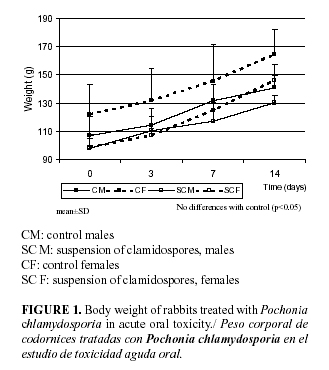
<body><![CDATA[<p><font face="Verdana, Arial, Helvetica, sans-serif" size="2"><b>Acute oral toxicity    </b> </font></p> <B></B>      <P><font face="Verdana, Arial, Helvetica, sans-serif" size="2">No death occurred    during the test and there were neither treatment- related clinical signs, which    confirms the normal behaviour in absolute body weights related with the controls    (<a href="/img/revistas/rsa/v31n1/f0108109.jpg">Fig. 1</a>). No macroscopic    alterations were observed in the organs. </font>      
<P align="center"><img src="/img/revistas/rsa/v31n1/f0108109.jpg" width="329" height="370">      
<P><font face="Verdana, Arial, Helvetica, sans-serif" size="2"><B>Oral toxicity/    infectivity/pathogenicity </B> </font>     <P><font face="Verdana, Arial, Helvetica, sans-serif" size="2">There were no treatment-related    clinical signs of toxicity. When comparing the weight of the treated group with    regard to the control, there was not any significant difference (p&lt;0.05)    in males; otherwise females showed differences (p&lt;0.05) in the weight of    the day 3 and 7. Although when analyzing the gain 0-3 and 3-7, there are no    differences related to the control gain in the same period (<a href="/img/revistas/rsa/v31n1/f0208109.jpg">Figure    2</a>).</font>      
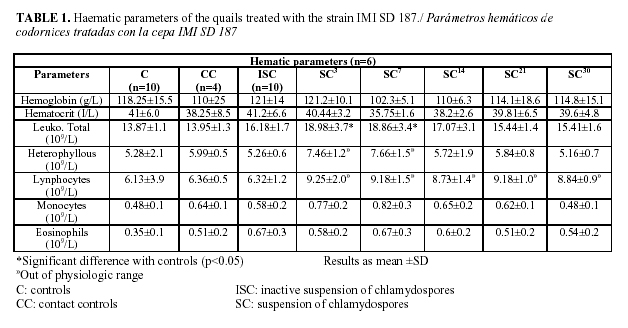
<P><font face="Verdana, Arial, Helvetica, sans-serif" size="2">In the second day,    one male of the control group appeared dead, without any apparent alteration;    this is considered normal since it is below the limit used as approach of acceptance    of the test, where more than 20% of the controls cannot die (10). Two males    treated with the fungus showed a transitory breathing difficulty, after the    administration of the product and they died for bronchoaspiration after the    second and third treatment. </font>     <P><font face="Verdana, Arial, Helvetica, sans-serif" size="2">In the haematic    analysis of quails (<a href="/img/revistas/rsa/v31n1/f0308109.jpg">Table 1</a>),    the values of the red series were inside the physiologic range for the species.    In the white series, an increment of the total leukocytes was observed, in days    three and seven with regard to the controls, there were variations inside the    physiologic range (12). This increment of the total leukocytes was related with    the increase of the heterofiles and lymphocytes, with a later recovery of the    first ones, starting from the 14 days post-treatment. Those two parameters showed    values above the physiologic range; however they were not different to the control.    The behaviour of the heterofiles on day 3 is directly associated with the process    of bronchoaspiration of the two died animals. Day 7 could be related with the    effect of the application of the inoculum, considering that the animals exposed    were able to counteract the discreet bronchoaspiration with defensive mechanisms.    The increase of lymphocytes could appear as a beneficial response of the organism    to this agent (13). </font>      
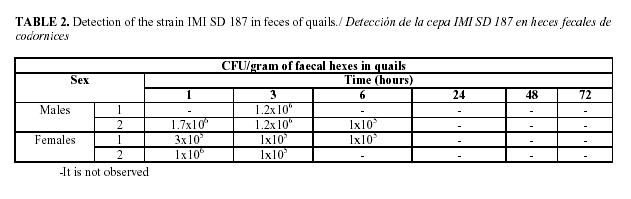
<P><font face="Verdana, Arial, Helvetica, sans-serif" size="2">In the microbiologic    analysis of the faecal hexes in the samples, the presence of any microorganism    of interest was not detected, neither the presence of chlamydospores of the    fungus; it means that after being administered during five serial days, the    fungus was eliminated during the first 48 hours post-treatment (<a href="/img/revistas/rsa/v31n1/f0408109.jpg">Table    2</a>). No growth of the microorganism evaluated in none of the organs of the    animals examined was observed. </font>      
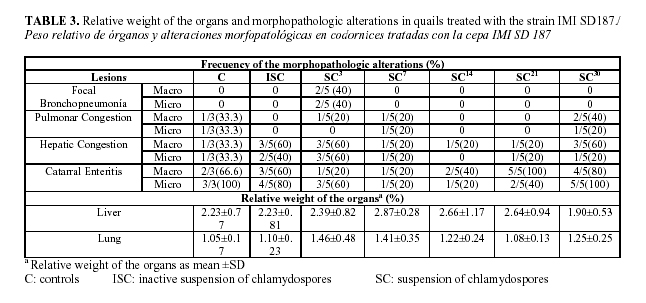
<p><font face="Verdana, Arial, Helvetica, sans-serif" size="2">From the macroscopic    point of view, the presence of a discreet congestion in several organs of all    groups including control was observed as element of interest. It was in correspondence    with the results of the histopathology analysis. No alterations in the relative    weight of the organs were observed (<a href="/img/revistas/rsa/v31n1/f0508109.jpg">Table    3</a>). </font>      
<P>     ]]></body>
<body><![CDATA[<P><font face="Verdana, Arial, Helvetica, sans-serif" size="2"><B><font size="3">DISCUSSION</font></B>    </font>     <P><font face="Verdana, Arial, Helvetica, sans-serif" size="2">A finding of acceptable    risk does not mean that under every circumstance a product will never prove    harmful. Burges (14) stated that &quot;Registration of a chemical is essentially    a statement of usage in which the risks are acceptable. The same must be applied    to biological agents&quot;. Even when products have successfully cleared these    hurdles, new questions can arise based on the changing public perception of    risk. </font>     <P><font face="Verdana, Arial, Helvetica, sans-serif" size="2">From the clinical    point of view, a toxic influence is not detected on the treatment since in animals,    there were not alterations in evolution of weight, or clinical signs of toxicity,    and the haematic values as well as the behaviour of the animals were normal    during rehearsals. </font>     <P><font face="Verdana, Arial, Helvetica, sans-serif" size="2">Likewise, there    was not any infection evidence neither multiplication indications, what is attributed    to those chlamydospores which did not germinate, that is they behaved as inert    particles, with a quick clearing where the number of recovered organisms diminishes    quickly in the time (15). </font>     <P><font face="Verdana, Arial, Helvetica, sans-serif" size="2">In general, the    pathological changes were not consistently associated in particular with any    group of treatment, what could be associated to the low capacity of being distributed    and to persist in the body of the animals treated. </font>     <P><font face="Verdana, Arial, Helvetica, sans-serif" size="2">These results are    similar to the findings of Vestergard et al., 2003 (16) when evaluating the    fungus <I>M. anisopliae</I> in birds feeding them with contaminated insects    with their conidia; and no toxic effect on the behaviour, neither on other clinical    variables analyzed during the tests were obtained. </font>     <P>     <P><font face="Verdana, Arial, Helvetica, sans-serif" size="2"><B><font size="3">CONCLUSION</font></B>    </font>     <P><font face="Verdana, Arial, Helvetica, sans-serif" size="2">The strain IMI    SD 187 of <I>Pochonia chlamydosporia</I> var. <I>catenulata </I>does not turn    out to be toxic, infective, or pathogenic for quails.</font>     <P>     ]]></body>
<body><![CDATA[<P><font face="Verdana, Arial, Helvetica, sans-serif" size="2"><B><font size="3">REFERENCES</font></B></font>     <!-- ref --><P><font face="Verdana, Arial, Helvetica, sans-serif" size="2">1. De Leij FAMM    and Kerry BR. The enmatophagus fungus <I>Verticillium chlamydosporium</I> as    a potential biological control agent for Meloidogyne arenaria. <I>Revue de Nematologia.</I>    1991;14:157-164. </font>    <!-- ref --><P><font face="Verdana, Arial, Helvetica, sans-serif" size="2">2. De Leij FAMM,    Kerry, BR and Dennehy JA: <I>Verticillium chlamydosporium</I> as a biological    control agent for <I>Meloidogyne incognita</I> and <I>M. hapla</I> in pot and    microplot test. <I>Nematologia.</I> 1993;39:115-126. </font>    <!-- ref --><P><font face="Verdana, Arial, Helvetica, sans-serif" size="2">3. Hidalgo-Diaz    L, Bourne JM Kerry BR and Rodriguez MG: Nematophagous <I>Verticillium</I> spp.    in soils infested with Meloidogyne spp. in Cuba: isolation and screening. <I>International    Journal of Pest Management.</I> 2000;46:277-284. </font>    <!-- ref --><P><font face="Verdana, Arial, Helvetica, sans-serif" size="2">4. Goettel MS,    Jaronski ST: Safety and registration of microbial agents for control of grasshoppers    and locusts. Memoirs of the Entomological Society of Canada. 1997;171:83-99.    </font>    <!-- ref --><P><font face="Verdana, Arial, Helvetica, sans-serif" size="2">5. Garc&iacute;a    L, Bulnes C, Melchor G, Vega E, Montes de Oca N, Hidalgo L y Marrero E: Safety    of <I>Pochonia chlamydosporia</I> var. <I>catenulata </I>on acute oral and thermal    toxicity/pathogenicity evaluations in rats and rabbits. <I>Vet Hum Toxicol</I>.    2004;46(5):248-250. </font>    <!-- ref --><P><font face="Verdana, Arial, Helvetica, sans-serif" size="2">6. Garc&iacute;a    L, Melchor G, Montes de Oca N, Hidalgo L: Estudio de la irritaci&oacute;n ocular    y d&eacute;rmica de <I>Pochonia chlamydosporia</I> var. <I>catenulata. Rev.    Tox</I>. 2004;21(2-3):103-107. </font>    <!-- ref --><P><font face="Verdana, Arial, Helvetica, sans-serif" size="2">7. Garc&iacute;a    L, Melchor G, Ar&eacute;valos G<SUP> </SUP>y Hidalgo L: Evaluaci&oacute;n de    la fitotoxicidad de la cepa IMI SD 187 <I>Pochonia chlamydosporia</I> var. <I>catenulata</I>    sobre <I>Zea mays </I>L. y <I>Phaseolus vulgaris</I> L<I>.</I> Rev. Sanidad    Vegetal. 2007;23:2. </font>    <!-- ref --><P><font face="Verdana, Arial, Helvetica, sans-serif" size="2">8. Landsdown AB:    Animal husbandry. In: Anderson D (Ed), Experimental Toxicology, The basic issues.    BIBRA, Surrey, UK, p. 101, 1993.</font><font face="Verdana, Arial, Helvetica, sans-serif" size="2">    <BR>       ]]></body>
<body><![CDATA[<!-- ref --><BR>   9. Ewbank R, Godfrey C, Holgate B, Inglis I, James R, et al.: Refining procedures    for the administration of substances. Lab Anim. 2001;35:1-41. </font>    <!-- ref --><P><font face="Verdana, Arial, Helvetica, sans-serif" size="2">10.Environmental    Protection Agency (EPA): Prevention, Pesticides and Toxic Substances. Microbial    Pesticides Test Guidelines. OPPTS 885.4050, Acute Oral Toxicity/Pathogenicity,    1996. </font>    <!-- ref --><P><font face="Verdana, Arial, Helvetica, sans-serif" size="2">11.Kerry BR, Kirkwood    IA, De Leij FAAM, Barba J, Leidjens MB, Brookes PC: Growth and survival of <I>Verticillium    chlamydosporium</I> Goddard, a parasite of nematodes in soil. <I>Biocontrol    Science and Technology</I>. 1993;3:355-365. </font>    <!-- ref --><P><font face="Verdana, Arial, Helvetica, sans-serif" size="2">12.Olfert DE, Brenda    M, Ann M: Guide to the care and use of experimental animals. 2nd ed. Appendix    IV; 1993;1:174. </font>    <!-- ref --><P><font face="Verdana, Arial, Helvetica, sans-serif" size="2">13.Swenson MJ:    Physiological Properties and Cellular and Chemical Constituents of Blood. Chapter    2. En: Swenson MJ. Tenth eds. Dukes&#180; Physiology of Domestic Animals. Comstock    Publishing Associates, Cornell University Press. Ithaca and London, 1984. </font>    <!-- ref --><P><font face="Verdana, Arial, Helvetica, sans-serif" size="2">14.Burges HD (ed.):    Microbial Control of Pests and Plant Diseases 1970-80. New York: Academic Press,    1981. </font>    <!-- ref --><P><font face="Verdana, Arial, Helvetica, sans-serif" size="2">15.Siegel Siegel    JP, Shadduck JA: Some observations on the safety of the entomopathogen to mammals.    Journal of Economic Entomology. 1987;80:994-997. </font>    <!-- ref --><P><font face="Verdana, Arial, Helvetica, sans-serif" size="2">16.Vestergard S,    Cherry A, Keller S, Goettel M: Safety of hyphomycete fungi as microbial control    agents. En: Hokkanen HMT, Hajek AE (eds). Environmental Impacts of Microbial    Insecticides. Kluwer Academic Publishers. Netherlands, 35-62, 2003.</font>    <P>     <P>     ]]></body>
<body><![CDATA[<P><font face="Verdana, Arial, Helvetica, sans-serif" size="2"><B>(Recibido 24-4-2008;    Aceptado 15-7-2008)</B></font>      ]]></body><back>
<ref-list>
<ref id="B1">
<label>1</label><nlm-citation citation-type="journal">
<person-group person-group-type="author">
<name>
<surname><![CDATA[De Leij]]></surname>
<given-names><![CDATA[FAMM]]></given-names>
</name>
<name>
<surname><![CDATA[Kerry]]></surname>
<given-names><![CDATA[BR]]></given-names>
</name>
</person-group>
<article-title xml:lang="en"><![CDATA[The enmatophagus fungus Verticillium chlamydosporium as a potential biological control agent for Meloidogyne arenaria]]></article-title>
<source><![CDATA[Revue de Nematologia]]></source>
<year>1991</year>
<volume>14</volume>
<page-range>157-164</page-range></nlm-citation>
</ref>
<ref id="B2">
<label>2</label><nlm-citation citation-type="journal">
<person-group person-group-type="author">
<name>
<surname><![CDATA[De Leij]]></surname>
<given-names><![CDATA[FAMM]]></given-names>
</name>
<name>
<surname><![CDATA[Kerry]]></surname>
<given-names><![CDATA[BR]]></given-names>
</name>
<name>
<surname><![CDATA[Dennehy]]></surname>
<given-names><![CDATA[JA]]></given-names>
</name>
</person-group>
<article-title xml:lang="en"><![CDATA[Verticillium chlamydosporium as a biological control agent for Meloidogyne incognita and M. hapla in pot and microplot test]]></article-title>
<source><![CDATA[Nematologia]]></source>
<year>1993</year>
<volume>39</volume>
<page-range>115-126</page-range></nlm-citation>
</ref>
<ref id="B3">
<label>3</label><nlm-citation citation-type="journal">
<person-group person-group-type="author">
<name>
<surname><![CDATA[Hidalgo-Diaz]]></surname>
<given-names><![CDATA[L]]></given-names>
</name>
<name>
<surname><![CDATA[Bourne]]></surname>
<given-names><![CDATA[JM]]></given-names>
</name>
<name>
<surname><![CDATA[Kerry]]></surname>
<given-names><![CDATA[BR]]></given-names>
</name>
<name>
<surname><![CDATA[Rodriguez]]></surname>
<given-names><![CDATA[MG]]></given-names>
</name>
</person-group>
<article-title xml:lang="en"><![CDATA[Nematophagous Verticillium spp. in soils infested with Meloidogyne spp. in Cuba: isolation and screening]]></article-title>
<source><![CDATA[International Journal of Pest Management]]></source>
<year>2000</year>
<volume>46</volume>
<page-range>277-284</page-range></nlm-citation>
</ref>
<ref id="B4">
<label>4</label><nlm-citation citation-type="journal">
<person-group person-group-type="author">
<name>
<surname><![CDATA[Goettel]]></surname>
<given-names><![CDATA[MS]]></given-names>
</name>
<name>
<surname><![CDATA[Jaronski]]></surname>
<given-names><![CDATA[ST]]></given-names>
</name>
</person-group>
<article-title xml:lang="en"><![CDATA[Safety and registration of microbial agents for control of grasshoppers and locusts]]></article-title>
<source><![CDATA[Memoirs of the Entomological Society of Canada]]></source>
<year>1997</year>
<volume>171</volume>
<page-range>83-99</page-range></nlm-citation>
</ref>
<ref id="B5">
<label>5</label><nlm-citation citation-type="journal">
<person-group person-group-type="author">
<name>
<surname><![CDATA[García]]></surname>
<given-names><![CDATA[L]]></given-names>
</name>
<name>
<surname><![CDATA[Bulnes]]></surname>
<given-names><![CDATA[C]]></given-names>
</name>
<name>
<surname><![CDATA[Melchor]]></surname>
<given-names><![CDATA[G]]></given-names>
</name>
<name>
<surname><![CDATA[Vega]]></surname>
<given-names><![CDATA[E]]></given-names>
</name>
<name>
<surname><![CDATA[Montes de Oca]]></surname>
<given-names><![CDATA[N]]></given-names>
</name>
<name>
<surname><![CDATA[Hidalgo]]></surname>
<given-names><![CDATA[L]]></given-names>
</name>
<name>
<surname><![CDATA[Marrero]]></surname>
<given-names><![CDATA[E]]></given-names>
</name>
</person-group>
<article-title xml:lang="en"><![CDATA[Safety of Pochonia chlamydosporia var. catenulata on acute oral and thermal toxicity/pathogenicity evaluations in rats and rabbits]]></article-title>
<source><![CDATA[Vet Hum Toxicol]]></source>
<year>2004</year>
<volume>46</volume>
<numero>5</numero>
<issue>5</issue>
<page-range>248-250</page-range></nlm-citation>
</ref>
<ref id="B6">
<label>6</label><nlm-citation citation-type="journal">
<person-group person-group-type="author">
<name>
<surname><![CDATA[García]]></surname>
<given-names><![CDATA[L]]></given-names>
</name>
<name>
<surname><![CDATA[Melchor]]></surname>
<given-names><![CDATA[G]]></given-names>
</name>
<name>
<surname><![CDATA[Montes de Oca]]></surname>
<given-names><![CDATA[N]]></given-names>
</name>
<name>
<surname><![CDATA[Hidalgo]]></surname>
<given-names><![CDATA[L]]></given-names>
</name>
</person-group>
<article-title xml:lang="es"><![CDATA[Estudio de la irritación ocular y dérmica de Pochonia chlamydosporia var. catenulata]]></article-title>
<source><![CDATA[Rev Tox]]></source>
<year>2004</year>
<volume>21</volume>
<numero>2-3</numero>
<issue>2-3</issue>
<page-range>103-107</page-range></nlm-citation>
</ref>
<ref id="B7">
<label>7</label><nlm-citation citation-type="journal">
<person-group person-group-type="author">
<name>
<surname><![CDATA[García]]></surname>
<given-names><![CDATA[L]]></given-names>
</name>
<name>
<surname><![CDATA[Melchor]]></surname>
<given-names><![CDATA[G]]></given-names>
</name>
<name>
<surname><![CDATA[Arévalos]]></surname>
<given-names><![CDATA[G]]></given-names>
</name>
<name>
<surname><![CDATA[Hidalgo]]></surname>
<given-names><![CDATA[L]]></given-names>
</name>
</person-group>
<article-title xml:lang="es"><![CDATA[Evaluación de la fitotoxicidad de la cepa IMI SD 187 Pochonia chlamydosporia var. catenulata sobre Zea mays L. y Phaseolus vulgaris L]]></article-title>
<source><![CDATA[Rev Sanidad Vegetal]]></source>
<year>2007</year>
<volume>23</volume>
<page-range>2</page-range></nlm-citation>
</ref>
<ref id="B8">
<label>8</label><nlm-citation citation-type="book">
<person-group person-group-type="author">
<name>
<surname><![CDATA[Landsdown]]></surname>
<given-names><![CDATA[AB]]></given-names>
</name>
</person-group>
<article-title xml:lang="en"><![CDATA[Animal husbandry]]></article-title>
<person-group person-group-type="editor">
<name>
<surname><![CDATA[Anderson]]></surname>
<given-names><![CDATA[D]]></given-names>
</name>
</person-group>
<source><![CDATA[Experimental Toxicology, The basic issues]]></source>
<year>1993</year>
<page-range>101</page-range><publisher-name><![CDATA[BIBRA]]></publisher-name>
</nlm-citation>
</ref>
<ref id="B9">
<label>9</label><nlm-citation citation-type="journal">
<person-group person-group-type="author">
<name>
<surname><![CDATA[Ewbank]]></surname>
<given-names><![CDATA[R]]></given-names>
</name>
<name>
<surname><![CDATA[Godfrey]]></surname>
<given-names><![CDATA[C]]></given-names>
</name>
<name>
<surname><![CDATA[Holgate]]></surname>
<given-names><![CDATA[B]]></given-names>
</name>
<name>
<surname><![CDATA[Inglis]]></surname>
<given-names><![CDATA[I]]></given-names>
</name>
<name>
<surname><![CDATA[James]]></surname>
<given-names><![CDATA[R]]></given-names>
</name>
</person-group>
<article-title xml:lang="en"><![CDATA[Refining procedures for the administration of substances]]></article-title>
<source><![CDATA[Lab Anim]]></source>
<year>2001</year>
<volume>35</volume>
<page-range>1-41</page-range></nlm-citation>
</ref>
<ref id="B10">
<label>10</label><nlm-citation citation-type="book">
<source><![CDATA[Prevention, Pesticides and Toxic Substances. Microbial Pesticides Test Guidelines. OPPTS 885.4050, Acute Oral Toxicity/Pathogenicity]]></source>
<year></year>
<publisher-name><![CDATA[Environmental Protection Agency (EPA)]]></publisher-name>
</nlm-citation>
</ref>
<ref id="B11">
<label>11</label><nlm-citation citation-type="journal">
<person-group person-group-type="author">
<name>
<surname><![CDATA[Kerry]]></surname>
<given-names><![CDATA[BR]]></given-names>
</name>
<name>
<surname><![CDATA[Kirkwood]]></surname>
<given-names><![CDATA[IA]]></given-names>
</name>
<name>
<surname><![CDATA[De Leij]]></surname>
<given-names><![CDATA[FAAM]]></given-names>
</name>
<name>
<surname><![CDATA[Barba]]></surname>
<given-names><![CDATA[J]]></given-names>
</name>
<name>
<surname><![CDATA[Leidjens]]></surname>
<given-names><![CDATA[MB]]></given-names>
</name>
<name>
<surname><![CDATA[Brookes]]></surname>
<given-names><![CDATA[PC]]></given-names>
</name>
</person-group>
<article-title xml:lang="en"><![CDATA[Growth and survival of Verticillium chlamydosporium Goddard, a parasite of nematodes in soil]]></article-title>
<source><![CDATA[Biocontrol Science and Technology]]></source>
<year>1993</year>
<volume>3</volume>
<page-range>355-365</page-range></nlm-citation>
</ref>
<ref id="B12">
<label>12</label><nlm-citation citation-type="journal">
<person-group person-group-type="author">
<name>
<surname><![CDATA[Olfert]]></surname>
<given-names><![CDATA[DE]]></given-names>
</name>
<name>
<surname><![CDATA[Brenda]]></surname>
<given-names><![CDATA[M]]></given-names>
</name>
<name>
<surname><![CDATA[Ann]]></surname>
<given-names><![CDATA[M]]></given-names>
</name>
</person-group>
<article-title xml:lang="en"><![CDATA[Guide to the care and use of experimental animals]]></article-title>
<source><![CDATA[Appendix IV]]></source>
<year>1993</year>
<volume>1</volume>
<page-range>174</page-range></nlm-citation>
</ref>
<ref id="B13">
<label>13</label><nlm-citation citation-type="book">
<person-group person-group-type="author">
<name>
<surname><![CDATA[Swenson]]></surname>
<given-names><![CDATA[MJ]]></given-names>
</name>
</person-group>
<article-title xml:lang="en"><![CDATA[Physiological Properties and Cellular and Chemical Constituents of Blood. Chapter 2]]></article-title>
<person-group person-group-type="editor">
<name>
<surname><![CDATA[Swenson]]></surname>
<given-names><![CDATA[MJ]]></given-names>
</name>
</person-group>
<source><![CDATA[Tenth eds. Dukes´ Physiology of Domestic Animals. Comstock Publishing Associates]]></source>
<year>1984</year>
<publisher-loc><![CDATA[^eLondon London]]></publisher-loc>
<publisher-name><![CDATA[Cornell University Press]]></publisher-name>
</nlm-citation>
</ref>
<ref id="B14">
<label>14</label><nlm-citation citation-type="book">
<person-group person-group-type="author">
<name>
<surname><![CDATA[Burges]]></surname>
<given-names><![CDATA[HD]]></given-names>
</name>
</person-group>
<source><![CDATA[Microbial Control of Pests and Plant Diseases 1970-80]]></source>
<year>1981</year>
<publisher-loc><![CDATA[New York ]]></publisher-loc>
<publisher-name><![CDATA[Academic Press]]></publisher-name>
</nlm-citation>
</ref>
<ref id="B15">
<label>15</label><nlm-citation citation-type="journal">
<person-group person-group-type="author">
<name>
<surname><![CDATA[Siegel Siegel]]></surname>
<given-names><![CDATA[JP]]></given-names>
</name>
<name>
<surname><![CDATA[Shadduck]]></surname>
<given-names><![CDATA[JA]]></given-names>
</name>
</person-group>
<article-title xml:lang="en"><![CDATA[Some observations on the safety of the entomopathogen to mammals]]></article-title>
<source><![CDATA[Journal of Economic Entomology]]></source>
<year>1987</year>
<volume>80</volume>
<page-range>994-997</page-range></nlm-citation>
</ref>
<ref id="B16">
<label>16</label><nlm-citation citation-type="book">
<person-group person-group-type="author">
<name>
<surname><![CDATA[Vestergard]]></surname>
<given-names><![CDATA[S]]></given-names>
</name>
<name>
<surname><![CDATA[Cherry]]></surname>
<given-names><![CDATA[A]]></given-names>
</name>
<name>
<surname><![CDATA[Keller]]></surname>
<given-names><![CDATA[S]]></given-names>
</name>
<name>
<surname><![CDATA[Goettel]]></surname>
<given-names><![CDATA[M]]></given-names>
</name>
</person-group>
<article-title xml:lang="en"><![CDATA[Safety of hyphomycete fungi as microbial control agents]]></article-title>
<person-group person-group-type="editor">
<name>
<surname><![CDATA[Hokkanen]]></surname>
<given-names><![CDATA[HMT]]></given-names>
</name>
<name>
<surname><![CDATA[Hajek]]></surname>
<given-names><![CDATA[AE]]></given-names>
</name>
</person-group>
<source><![CDATA[Environmental Impacts of Microbial Insecticides]]></source>
<year>2003</year>
<page-range>35-62</page-range><publisher-loc><![CDATA[^eNetherlands Netherlands]]></publisher-loc>
<publisher-name><![CDATA[Kluwer Academic Publishers]]></publisher-name>
</nlm-citation>
</ref>
</ref-list>
</back>
</article>