<?xml version="1.0" encoding="ISO-8859-1"?><article xmlns:mml="http://www.w3.org/1998/Math/MathML" xmlns:xlink="http://www.w3.org/1999/xlink" xmlns:xsi="http://www.w3.org/2001/XMLSchema-instance">
<front>
<journal-meta>
<journal-id>0253-570X</journal-id>
<journal-title><![CDATA[Revista de Salud Animal]]></journal-title>
<abbrev-journal-title><![CDATA[Rev Salud Anim.]]></abbrev-journal-title>
<issn>0253-570X</issn>
<publisher>
<publisher-name><![CDATA[Centro Nacional de Sanidad Agropecuaria]]></publisher-name>
</publisher>
</journal-meta>
<article-meta>
<article-id>S0253-570X2009000200005</article-id>
<title-group>
<article-title xml:lang="en"><![CDATA[APPLICATION OF TICK SAMPLING ON ACARICIDAL BATH FREQUENCY IN Rhipicephalus (Boophilus) microplus (ACARI: IXODIDAE)]]></article-title>
<article-title xml:lang="es"><![CDATA[APLICACION DEL MUESTREO DE GARRAPATAS EN LA FRECUENCIA DEL BAÑO ACARICIDA EN Rhipicephalus (Boophilus) microplus (ACARI: IXODIDAE)]]></article-title>
</title-group>
<contrib-group>
<contrib contrib-type="author">
<name>
<surname><![CDATA[de la Vega]]></surname>
<given-names><![CDATA[R]]></given-names>
</name>
<xref ref-type="aff" rid="A01"/>
</contrib>
<contrib contrib-type="author">
<name>
<surname><![CDATA[Díaz]]></surname>
<given-names><![CDATA[G]]></given-names>
</name>
<xref ref-type="aff" rid="A02"/>
</contrib>
<contrib contrib-type="author">
<name>
<surname><![CDATA[Camejo]]></surname>
<given-names><![CDATA[A]]></given-names>
</name>
<xref ref-type="aff" rid="A01"/>
</contrib>
<contrib contrib-type="author">
<name>
<surname><![CDATA[García]]></surname>
<given-names><![CDATA[I]]></given-names>
</name>
<xref ref-type="aff" rid="A03"/>
</contrib>
</contrib-group>
<aff id="A01">
<institution><![CDATA[,LABIOFAM  ]]></institution>
<addr-line><![CDATA[Ciudad Habana ]]></addr-line>
<country>Cuba</country>
</aff>
<aff id="A02">
<institution><![CDATA[,Universidad de La Habana Facultad de Biología ]]></institution>
<addr-line><![CDATA[ ]]></addr-line>
</aff>
<aff id="A03">
<institution><![CDATA[,Instituto Pedro Kourí (IPK)  ]]></institution>
<addr-line><![CDATA[Ciudad Habana ]]></addr-line>
<country>Cuba</country>
</aff>
<pub-date pub-type="pub">
<day>00</day>
<month>08</month>
<year>2009</year>
</pub-date>
<pub-date pub-type="epub">
<day>00</day>
<month>08</month>
<year>2009</year>
</pub-date>
<volume>31</volume>
<numero>2</numero>
<fpage>105</fpage>
<lpage>107</lpage>
<copyright-statement/>
<copyright-year/>
<self-uri xlink:href="http://scielo.sld.cu/scielo.php?script=sci_arttext&amp;pid=S0253-570X2009000200005&amp;lng=en&amp;nrm=iso"></self-uri><self-uri xlink:href="http://scielo.sld.cu/scielo.php?script=sci_abstract&amp;pid=S0253-570X2009000200005&amp;lng=en&amp;nrm=iso"></self-uri><self-uri xlink:href="http://scielo.sld.cu/scielo.php?script=sci_pdf&amp;pid=S0253-570X2009000200005&amp;lng=en&amp;nrm=iso"></self-uri><abstract abstract-type="short" xml:lang="en"><p><![CDATA[In this paper, a tick sampling method developed by authors was employed with the purpose of saving acaricides and decreasing environmental pollution by the use of acaricidal dip control bathing bovines in relation to a critical number of estimated ticks. Twenty-six Jersey cows in production were sampled. The selected sampling regions were: rear leg, udder, perinea and tail. Samplings were done from 7 to 8 am, and female tick standard size pattern was 6 mm or longer. Every two weeks approximately, samplings and acaricidal baths were done (13 samplings in total). Only cows with 10 or more ticks received acaricidal baths. Results showed that the procedure allows saving 50% of acaricides.]]></p></abstract>
<abstract abstract-type="short" xml:lang="es"><p><![CDATA[En el presente trabajo se utilizó un método de muestreo de garrapatas previamente desarrollado por los autores, con el objetivo de regular el empleo del baño acaricida en bovinos. Esto permitiría un ahorro sustancial de acaricidas y la disminución de la polución ambiental. Se trabajó con 26 vacas de raza Jersey en producción y se escogieron las regiones corporales del animal que resultaron buenos estimadores del total de garrapatas: extremidad posterior, ubre, periné y cola. Los muestreos se realizaron cada dos semanas aproximadamente, de 7:00 a 8:00 am y la garrapata patrón para el muestreo fue de 6mm o más de largo, Se realizó un total de 13 muestreos. Se escogió 10 como número límite máximo de garrapatas permitidas para que los bovinos no recibieran baño. Este trabajo permitió el ahorro del 50 % de acaricidas.]]></p></abstract>
<kwd-group>
<kwd lng="en"><![CDATA[Rhipicephalus (Boophilus) microplus]]></kwd>
<kwd lng="en"><![CDATA[tick]]></kwd>
<kwd lng="en"><![CDATA[acaricide]]></kwd>
<kwd lng="en"><![CDATA[sampling]]></kwd>
<kwd lng="es"><![CDATA[Rhipicephalus (Boophilus) microplus]]></kwd>
<kwd lng="es"><![CDATA[garrapata]]></kwd>
<kwd lng="es"><![CDATA[acaricida]]></kwd>
<kwd lng="es"><![CDATA[muestreo]]></kwd>
</kwd-group>
</article-meta>
</front><body><![CDATA[ <p align="right"><font face="Verdana, Arial, Helvetica, sans-serif" size="2"><b>Art&iacute;culo    original</b></font></p>     <p>&nbsp;</p>     <p>&nbsp;</p>     <p><font face="Verdana, Arial, Helvetica, sans-serif" size="2"><B><font size="4">APPLICATION    OF TICK SAMPLING ON ACARICIDAL BATH FREQUENCY IN <I>Rhipicephalus </I>(<I>Boophilus)    </I></font></B></font><font face="Verdana, Arial, Helvetica, sans-serif" size="4"><B><I>    microplus</I> (ACARI: IXODIDAE)</B></font></p>     <p>&nbsp;</p>     <p> <font face="Verdana, Arial, Helvetica, sans-serif" size="2"><b><font size="3">APLICACION    DEL MUESTREO DE GARRAPATAS EN LA FRECUENCIA DEL BA&Ntilde;O ACARICIDA EN <i>Rhipicephalus    (Boophilus) microplus</i> (ACARI: IXODIDAE)</font></b></font></p>     <p>&nbsp;</p>     <p>&nbsp;</p>     <p><font face="Verdana, Arial, Helvetica, sans-serif" size="2"><B>R. de la Vega*,    G. D&iacute;az**, A.Camejo* e I. Garc&iacute;a***</B> </font></p>     <P><font face="Verdana, Arial, Helvetica, sans-serif" size="2"><I>*LABIOFAM, Apartado    34, General Peraza, CP-19210, Ciudad Habana, Cuba, FAX: (537)334857, E-mail:    <a href="mailto:delavega@infomed.sld.cu">delavega@infomed.sld.cu</a>; <SUP>**</SUP>Facultad    de Biolog&iacute;a, Universidad de La Habana; <SUP>*** </SUP>Instituto Pedro    Kour&iacute; (IPK), Ciudad Habana, Cuba</I></font>      ]]></body>
<body><![CDATA[<P>&nbsp;     <P>&nbsp; <hr noshade size="1">     <P><font face="Verdana, Arial, Helvetica, sans-serif" size="2"><b>ABSTRACT</b></font>     <P><font face="Verdana, Arial, Helvetica, sans-serif" size="2">In this paper,    a tick sampling method developed by authors was employed with the purpose of    saving acaricides and decreasing environmental pollution by the use of acaricidal    dip control bathing bovines in relation to a critical number of estimated ticks.    Twenty-six Jersey cows in production were sampled. The selected sampling regions    were: rear leg, udder, perinea and tail. Samplings were done from 7 to 8 am,    and female tick standard size pattern was 6 mm or longer. Every two weeks approximately,    samplings and acaricidal baths were done (13 samplings in total). Only cows    with 10 or more ticks received acaricidal baths. Results showed that the procedure    allows saving 50% of acaricides. </font>     <P><font face="Verdana, Arial, Helvetica, sans-serif" size="2"><b>Key words:</b>    Rhipicephalus (Boophilus) microplus; tick; acaricide; sampling</font> <hr noshade size="1">     <P><font face="Verdana, Arial, Helvetica, sans-serif" size="2"><b>RESUMEN</b></font>     <P><font face="Verdana, Arial, Helvetica, sans-serif" size="2">En el presente    trabajo se utiliz&oacute; un m&eacute;todo de muestreo de garrapatas previamente    desarrollado por los autores, con el objetivo de regular el empleo del ba&ntilde;o    acaricida en bovinos. Esto permitir&iacute;a un ahorro sustancial de acaricidas    y la disminuci&oacute;n de la poluci&oacute;n ambiental. Se trabaj&oacute; con    26 vacas de raza Jersey en producci&oacute;n y se escogieron las regiones corporales    del animal que resultaron buenos estimadores del total de garrapatas: extremidad    posterior, ubre, perin&eacute; y cola. Los muestreos se realizaron cada dos    semanas aproximadamente, de 7:00 a 8:00 am y la garrapata patr&oacute;n para    el muestreo fue de 6mm o m&aacute;s de largo, Se realiz&oacute; un total de    13 muestreos. Se escogi&oacute; 10 como n&uacute;mero l&iacute;mite m&aacute;ximo    de garrapatas permitidas para que los bovinos no recibieran ba&ntilde;o. Este    trabajo permiti&oacute; el ahorro del 50 % de acaricidas.</font> <B></B>      <P><font face="Verdana, Arial, Helvetica, sans-serif" size="2"><b>Palabras clave:</b>    Rhipicephalus (Boophilus) microplus; garrapata; acaricida; muestreo</font> <hr noshade size="1">     <P>&nbsp;     <P>&nbsp;     ]]></body>
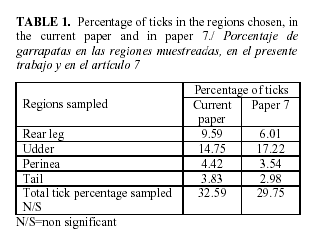
<body><![CDATA[<P><font face="Verdana, Arial, Helvetica, sans-serif" size="2"><B><font size="3">INTRODUCTION</font></B>    </font>     <P><font face="Verdana, Arial, Helvetica, sans-serif" size="2">One of the major    economic important tick of the tropical regions is <I>Rhipicephalus </I>(<I>Boophilus</I>)<I>    microplus.</I> This tick is responsible of important losses in these areas,    according with Springell (1). In 1974 in Australia the losses estimated reached    62 million dollars, $6.40 per beast per year and 11% of the total corresponded    to the cost of acaricides. Grisi <I>et al</I>. (2) in Brazil estimated the whole    loss provoked by this ectoparasite reached 2000 million dollars and the cost    per cow per year in Brazil calculated from his data was $11.83, that is 2000    million dollars/169 million cattle heads. </font>     <P><font face="Verdana, Arial, Helvetica, sans-serif" size="2">For tick control,    it is mandatory the use of a sampling method, scientifically developed and validated,    in order to monitor the different control actions undertaken and the employed    chemicals and others like vaccines. Another application of tick sampling would    be the regulation of the acaricidal bath frequency. That is, the establishment    of a logical tick number to allow bathing a bovine or not. Tick sampling could    be very important to relate milk and meat loss per tick and to know tick seasonal    dynamics and geographical distribution of a determined species. </font>     <P><font face="Verdana, Arial, Helvetica, sans-serif" size="2">In 1970, Wharton    and Utech (3) observed in groups of no more than four bovines that female ticks    (<I>Boophilus microplus</I>) from 4.5 to 8 mm in length viewed at 9 to 11 am    dropped before the next 24 hours. They established a sampling method: count    all females from 4.5 to 8.0 mm at 9 to 11 am in one-half of the cow and the    result is multiplied by two. There are some practical problems: too big area,    too small ticks and not evidence of the same number of ticks in each side of    the bovine. Other authors have developed tick sampling methods in other species    (4,5,6). In Cuba, the sampling methods on <I>B. microplus</I> have been developed    in dairy cows and young bovines (7,8,9).<I> </I>In this paper, one of these    methods was validated and employed with the purpose of saving acaricides and    decreasing environment pollution by the use of acaricidal dip control bathing    cows in relation to a critical number of estimated ticks.</font>     <P>&nbsp;     <P><font face="Verdana, Arial, Helvetica, sans-serif" size="2"><B><font size="3">MATERIALS    AND METHODS</font></B> </font>     <P><font face="Verdana, Arial, Helvetica, sans-serif" size="2">Twenty-six Jersey    cows in production were sampled with a method developed by the authors for estimation    of number of cattle ticks <I>B. microplus </I>(7). The percentage of ticks of    each 28 body regions in the bovine was calculated in order to estimate the total    number of ticks and determine if there was difference or not from the original    paper regarding distribution. From this result, the best body regions were chosen    for estimation of the number of ticks. The selected sampling regions were: rear    leg, udder, perinea and tail. Samplings were done from 7 to 8 am, and female    tick standard size pattern was 6 mm or longer. Every two weeks approximately,    samplings (13 in total) and acaricidal baths were done. Only cows with 10 or    more ticks received acaricidal baths; this number of ticks is enough to maintain    the enzootic stability of the herd (10). The acaricidal products used were Esteladon    and Tifatol. Proportions of ticks (P) in selected bovine regions were transformed    2 arsin(SQRT(P)) and compared using t-paired test.</font>     <P>&nbsp;     <P><font face="Verdana, Arial, Helvetica, sans-serif" size="2"><B><font size="3">RESULTS    AND DISCUSSION</font></B> </font>     <P><font face="Verdana, Arial, Helvetica, sans-serif" size="2">Table 1 shows the    regions chosen for total number estimation of ticks; percentages were compared    by means of a t-paired test. Results showed that there were not significant    differences between them (P&lt;0.05). The fact that the percentages taken in    the regions chosen for total tick number estimation did not differ from those    from the previous paper (7), suggests that ticks' body distribution is more    dependent from biological characteristics of the host, than from the different    prevailing environmental factors. The same fact was observed recently for the    28 sampling regions, with cows in Seropedica, Brazil (not published data).</font>     ]]></body>
<body><![CDATA[<P><img src="/img/revistas/rsa/v31n2/f0105209.gif" width="315" height="243">      
<P>      <P>      <P>      <P>      <P>      <P>      <P>      <P>      <P>      ]]></body>
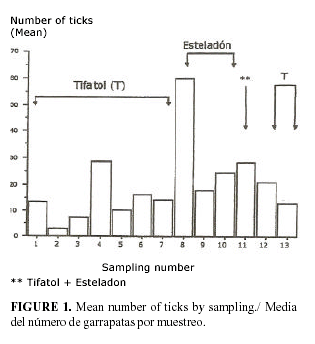
<body><![CDATA[<P>      <P>      <P>      <P><font face="Verdana, Arial, Helvetica, sans-serif" size="2">Figure 1 exhibits    the results of all samplings. Between the 7th and 8th sampling and for technical    reasons, 28 days elapsed for dipping and number of ticks grew a lot. At that    moment, Tifatol was stopped and changed to Esteladon; and in the 9th sampling,    number of ticks shut down apparently by the efficiency of the product, but in    the two next samplings, the number of ticks increased again and both products    were mixed up with goods results. During the experiment, 273 cows were sampled,    50% of them had less than 10 ticks and did not received acaricidal treatment.    This implied great savings of money and an important decrease in environmental    pollution. Results show that systematic samplings give the possibility of a    more rational treatment before ticks' infestation reaches high levels. An appropriate    and moderate use of chemicals in tick control has been recommended in order    to avoid resistance to acaricides (11). Ticks and tick-borne disease control    are affected by the widespread use of acaricides, leading to various problems    such as resistance, chemical residues, environmental pollution and high cost    (12). Also it is causing a loss of the enzootic stability to hemoparasites.    The use of the sampling method proposed for acaricidal dip control accomplishes    the recommendations cited and ensures the prevention of those problems.</font>      <P><img src="/img/revistas/rsa/v31n2/f0205209.gif" width="315" height="344">     
<P>&nbsp;     <P><font face="Verdana, Arial, Helvetica, sans-serif" size="2"><b><font size="3">REFERENCES</font></b>    </font>      <!-- ref --><p><font face="Verdana, Arial, Helvetica, sans-serif" size="2">1. Springell PH.    The cattle tick in relation to animal production in Australia. <i>Rev. Zootecnia</i>.    FAO. 1974;10:19-23. </font>    <!-- ref --><p><font face="Verdana, Arial, Helvetica, sans-serif" size="2">2. Grisi L, Massard    CI, Moya Borja GE, Pereira JB. Impacto econ&ocirc;mico das principais ectoparasitoses    em bovinos no Brasil. A Hora Veterin&aacute;ria 2002; No.125, Janeiro/fevereiro:    8-10. </font>    <!-- ref --><p><font face="Verdana, Arial, Helvetica, sans-serif" size="2">3. Wharton RH,    Utech KBW. The relation between engorgement and dropping of <i>Boophilus microplus    </i>(Canestrini) (Ixodidae) to the assessment of tick numbers on cattle. <i>J    Aust Ent Soc</i>. 1970;9:171-182. </font>    <!-- ref --><p><font face="Verdana, Arial, Helvetica, sans-serif" size="2">4. Barnard DR,    Morrison RD. Density estimators for populations of the lone star tick, <i>Amblyomma    americanum </i>(Acari: Ixodidae), on pastured beef cattle. <i>J Med Entomol.    </i>1985;22(3):244-9. </font>    <!-- ref --><p><font face="Verdana, Arial, Helvetica, sans-serif" size="2">5. Barnard DR,    Morrison RD, Terry Ervin R. Sites of Attachment and Density Assessment in </font>    <font face="Verdana, Arial, Helvetica, sans-serif" size="2"><I>Amblyomma americanum</I>    (Acari:Ixodidae) on Nursing Beef Calves. <I>Exp App Acarol. </I>1989;6:245-252.    </font>    <!-- ref --><P><font face="Verdana, Arial, Helvetica, sans-serif" size="2">6. L'Hostis M,    Diarra O, Seegers H. Sites of attachment and density assessment of female <I>Ixodes    ricinus </I>(Acari: Ixodidae) on dairy cows.<I> Exp Appl Acarol. </I>1994;18:681-689.    </font>    <!-- ref --><P><font face="Verdana, Arial, Helvetica, sans-serif" size="2">7. de la Vega R,    Moreno A, D&iacute;az G. M&eacute;todo de muestreo de la garrapata del ganado    vacuno (<I>Boophilus microplus</I>) en vacas lecheras. <I>Rev Salud Anim.</I>    1984;6:397-406. </font>    <!-- ref --><P><font face="Verdana, Arial, Helvetica, sans-serif" size="2">8. de la Vega R,    D&iacute;az G. Muestreo de garrapatas (<I>B. microplus</I>) para vacas en orde&ntilde;o    mecanizado. Comunicaci&oacute;n Corta.<I> Rev Salud Anim</I>. 1987;9:363-5.    </font>    <!-- ref --><P><font face="Verdana, Arial, Helvetica, sans-serif" size="2">9. de la Vega R,    D&iacute;az G. Tick sampling method for <I>Boophilus microplus</I> in young    bovines. In: Recombinant Vaccines for the Control of Cattle Tick. Monograph.    Elfos Scientiae. 1995; 21-6. </font>    <!-- ref --><P><font face="Verdana, Arial, Helvetica, sans-serif" size="2">10.Dalgliesh RJ.    Consideraciones actuales sobre las babesiosis y anaplasmosis del ganado bovino.    FAO. Traducci&oacute;n Dr. R. Silvestri, Facultad de Ciencias Veterinarias,    Universidad Central de Venezuela. Bolet&iacute;n de Rese&ntilde;as, Veterinaria    1979; 1-59. </font>    <!-- ref --><P><font face="Verdana, Arial, Helvetica, sans-serif" size="2">11.Furlong J, Martins    JR, Prata MCA. O carrapato dos bovines e a resist&ecirc;ncia: temos o que comemorar?    <I>A Hora Veterin&aacute;ria</I> 2007; No. 139, setembro/outubro: 1-7. </font>    <!-- ref --><P><font face="Verdana, Arial, Helvetica, sans-serif" size="2">12.Ghosh S, Azhahianambi    P, Yadav MP. Upcoming and future strategies of tick control: a review. <I>J    Vect Borne Dis.</I> 2007;44:79-89.</font>    <P>&nbsp;     ]]></body>
<body><![CDATA[<P>&nbsp;     <P><font face="Verdana, Arial, Helvetica, sans-serif" size="2"><B>(Recibido 5-1-2009;    Aceptado 20-4-2009)</B></font>      ]]></body><back>
<ref-list>
<ref id="B1">
<label>1</label><nlm-citation citation-type="journal">
<person-group person-group-type="author">
<name>
<surname><![CDATA[Springell]]></surname>
<given-names><![CDATA[PH]]></given-names>
</name>
</person-group>
<article-title xml:lang="en"><![CDATA[The cattle tick in relation to animal production in Australia]]></article-title>
<source><![CDATA[Rev Zootecnia FAO]]></source>
<year>1974</year>
<volume>10</volume>
<page-range>19-23</page-range></nlm-citation>
</ref>
<ref id="B2">
<label>2</label><nlm-citation citation-type="">
<person-group person-group-type="author">
<name>
<surname><![CDATA[Grisi]]></surname>
<given-names><![CDATA[L]]></given-names>
</name>
<name>
<surname><![CDATA[Massard]]></surname>
<given-names><![CDATA[CI]]></given-names>
</name>
<name>
<surname><![CDATA[Moya Borja]]></surname>
<given-names><![CDATA[GE]]></given-names>
</name>
<name>
<surname><![CDATA[Pereira]]></surname>
<given-names><![CDATA[JB]]></given-names>
</name>
</person-group>
<source><![CDATA[Impacto econômico das principais ectoparasitoses em bovinos no Brasil]]></source>
<year>2002</year>
<page-range>8-10</page-range></nlm-citation>
</ref>
<ref id="B3">
<label>3</label><nlm-citation citation-type="journal">
<person-group person-group-type="author">
<name>
<surname><![CDATA[Wharton]]></surname>
<given-names><![CDATA[RH]]></given-names>
</name>
<name>
<surname><![CDATA[Utech]]></surname>
<given-names><![CDATA[KBW]]></given-names>
</name>
</person-group>
<article-title xml:lang="en"><![CDATA[The relation between engorgement and dropping of Boophilus microplus (Canestrini) (Ixodidae) to the assessment of tick numbers on cattle]]></article-title>
<source><![CDATA[J Aust Ent Soc]]></source>
<year>1970</year>
<volume>9</volume>
<page-range>171-182</page-range></nlm-citation>
</ref>
<ref id="B4">
<label>4</label><nlm-citation citation-type="journal">
<person-group person-group-type="author">
<name>
<surname><![CDATA[Barnard]]></surname>
<given-names><![CDATA[DR]]></given-names>
</name>
<name>
<surname><![CDATA[Morrison]]></surname>
<given-names><![CDATA[RD]]></given-names>
</name>
</person-group>
<article-title xml:lang="en"><![CDATA[Density estimators for populations of the lone star tick, Amblyomma americanum (Acari: Ixodidae), on pastured beef cattle]]></article-title>
<source><![CDATA[J Med Entomol]]></source>
<year>1985</year>
<volume>22</volume>
<numero>3</numero>
<issue>3</issue>
<page-range>244-9</page-range></nlm-citation>
</ref>
<ref id="B5">
<label>5</label><nlm-citation citation-type="journal">
<person-group person-group-type="author">
<name>
<surname><![CDATA[Barnard]]></surname>
<given-names><![CDATA[DR]]></given-names>
</name>
<name>
<surname><![CDATA[Morrison]]></surname>
<given-names><![CDATA[RD]]></given-names>
</name>
<name>
<surname><![CDATA[Terry Ervin]]></surname>
<given-names><![CDATA[R]]></given-names>
</name>
</person-group>
<article-title xml:lang="en"><![CDATA[Sites of Attachment and Density Assessment in Amblyomma americanum (Acari:Ixodidae) on Nursing Beef Calves]]></article-title>
<source><![CDATA[Exp App Acarol]]></source>
<year>1989</year>
<volume>6</volume>
<page-range>245-252</page-range></nlm-citation>
</ref>
<ref id="B6">
<label>6</label><nlm-citation citation-type="journal">
<person-group person-group-type="author">
<name>
<surname><![CDATA[L'Hostis]]></surname>
<given-names><![CDATA[M]]></given-names>
</name>
<name>
<surname><![CDATA[Diarra]]></surname>
<given-names><![CDATA[O]]></given-names>
</name>
<name>
<surname><![CDATA[Seegers]]></surname>
<given-names><![CDATA[H]]></given-names>
</name>
</person-group>
<article-title xml:lang="en"><![CDATA[Sites of attachment and density assessment of female Ixodes ricinus (Acari: Ixodidae) on dairy cows]]></article-title>
<source><![CDATA[Exp Appl Acarol]]></source>
<year>1994</year>
<volume>18</volume>
<page-range>681-689</page-range></nlm-citation>
</ref>
<ref id="B7">
<label>7</label><nlm-citation citation-type="journal">
<person-group person-group-type="author">
<name>
<surname><![CDATA[de la Vega]]></surname>
<given-names><![CDATA[R]]></given-names>
</name>
<name>
<surname><![CDATA[Moreno]]></surname>
<given-names><![CDATA[A]]></given-names>
</name>
<name>
<surname><![CDATA[Díaz]]></surname>
<given-names><![CDATA[G]]></given-names>
</name>
</person-group>
<article-title xml:lang="es"><![CDATA[Método de muestreo de la garrapata del ganado vacuno (Boophilus microplus) en vacas lecheras]]></article-title>
<source><![CDATA[Rev Salud Anim]]></source>
<year>1984</year>
<volume>6</volume>
<page-range>397-406</page-range></nlm-citation>
</ref>
<ref id="B8">
<label>8</label><nlm-citation citation-type="journal">
<person-group person-group-type="author">
<name>
<surname><![CDATA[de la Vega]]></surname>
<given-names><![CDATA[R]]></given-names>
</name>
<name>
<surname><![CDATA[Díaz]]></surname>
<given-names><![CDATA[G]]></given-names>
</name>
</person-group>
<article-title xml:lang="es"><![CDATA[Muestreo de garrapatas (B. microplus) para vacas en ordeño mecanizado. Comunicación Corta]]></article-title>
<source><![CDATA[Rev Salud Anim]]></source>
<year>1987</year>
<volume>9</volume>
<page-range>363-5</page-range></nlm-citation>
</ref>
<ref id="B9">
<label>9</label><nlm-citation citation-type="book">
<person-group person-group-type="author">
<name>
<surname><![CDATA[de la Vega]]></surname>
<given-names><![CDATA[R]]></given-names>
</name>
<name>
<surname><![CDATA[Díaz]]></surname>
<given-names><![CDATA[G]]></given-names>
</name>
</person-group>
<article-title xml:lang="en"><![CDATA[Tick sampling method for Boophilus microplus in young bovines]]></article-title>
<source><![CDATA[Recombinant Vaccines for the Control of Cattle Tick]]></source>
<year>1995</year>
<page-range>21-6</page-range><publisher-name><![CDATA[Elfos Scientiae]]></publisher-name>
</nlm-citation>
</ref>
<ref id="B10">
<label>10</label><nlm-citation citation-type="book">
<person-group person-group-type="author">
<name>
<surname><![CDATA[Dalgliesh]]></surname>
<given-names><![CDATA[RJ]]></given-names>
</name>
</person-group>
<source><![CDATA[Consideraciones actuales sobre las babesiosis y anaplasmosis del ganado bovino]]></source>
<year>1979</year>
<page-range>1-59</page-range><publisher-name><![CDATA[Facultad de Ciencias Veterinarias, Universidad Central de Venezuela]]></publisher-name>
</nlm-citation>
</ref>
<ref id="B11">
<label>11</label><nlm-citation citation-type="">
<person-group person-group-type="author">
<name>
<surname><![CDATA[Furlong]]></surname>
<given-names><![CDATA[J]]></given-names>
</name>
<name>
<surname><![CDATA[Martins]]></surname>
<given-names><![CDATA[JR]]></given-names>
</name>
<name>
<surname><![CDATA[Prata]]></surname>
<given-names><![CDATA[MCA]]></given-names>
</name>
</person-group>
<source><![CDATA[O carrapato dos bovines e a resistência: temos o que comemorar? A Hora Veterinária]]></source>
<year>2007</year>
<page-range>1-7</page-range></nlm-citation>
</ref>
<ref id="B12">
<label>12</label><nlm-citation citation-type="journal">
<person-group person-group-type="author">
<name>
<surname><![CDATA[Ghosh]]></surname>
<given-names><![CDATA[S]]></given-names>
</name>
<name>
<surname><![CDATA[Azhahianambi]]></surname>
<given-names><![CDATA[P]]></given-names>
</name>
<name>
<surname><![CDATA[Yadav]]></surname>
<given-names><![CDATA[MP]]></given-names>
</name>
</person-group>
<article-title xml:lang="en"><![CDATA[Upcoming and future strategies of tick control: a review]]></article-title>
<source><![CDATA[J Vect Borne Dis]]></source>
<year>2007</year>
<volume>44</volume>
<page-range>79-89</page-range></nlm-citation>
</ref>
</ref-list>
</back>
</article>