<?xml version="1.0" encoding="ISO-8859-1"?><article xmlns:mml="http://www.w3.org/1998/Math/MathML" xmlns:xlink="http://www.w3.org/1999/xlink" xmlns:xsi="http://www.w3.org/2001/XMLSchema-instance">
<front>
<journal-meta>
<journal-id>0253-570X</journal-id>
<journal-title><![CDATA[Revista de Salud Animal]]></journal-title>
<abbrev-journal-title><![CDATA[Rev Salud Anim.]]></abbrev-journal-title>
<issn>0253-570X</issn>
<publisher>
<publisher-name><![CDATA[Centro Nacional de Sanidad Agropecuaria]]></publisher-name>
</publisher>
</journal-meta>
<article-meta>
<article-id>S0253-570X2009000300004</article-id>
<title-group>
<article-title xml:lang="en"><![CDATA[HUMORAL RESPONSE TO DIFFERENT VACCINATION SCHEMES AGAINST CLASSICAL SWINE FEVER (CSF) SUCCESSIVELY APPLIED DURING AN OUTBREAK OF THE DISEASE]]></article-title>
<article-title xml:lang="es"><![CDATA[RESPUESTA HUMORAL A DIFERENTES ESQUEMAS DE VACUNACIÓN CONTRA PESTE PORCINA CLÁSICA (PPC) APLICADOS SUCESIVAMENTE DURANTE UN FOCO ACTIVO DE LA ENFERMEDAD]]></article-title>
</title-group>
<contrib-group>
<contrib contrib-type="author">
<name>
<surname><![CDATA[Percedo]]></surname>
<given-names><![CDATA[María Irian]]></given-names>
</name>
<xref ref-type="aff" rid="A01"/>
</contrib>
<contrib contrib-type="author">
<name>
<surname><![CDATA[Alfonso]]></surname>
<given-names><![CDATA[P]]></given-names>
</name>
<xref ref-type="aff" rid="A01"/>
</contrib>
<contrib contrib-type="author">
<name>
<surname><![CDATA[Frías]]></surname>
<given-names><![CDATA[María Teresa]]></given-names>
</name>
<xref ref-type="aff" rid="A01"/>
</contrib>
<contrib contrib-type="author">
<name>
<surname><![CDATA[Díaz de Arce]]></surname>
<given-names><![CDATA[Heydi]]></given-names>
</name>
<xref ref-type="aff" rid="A01"/>
</contrib>
<contrib contrib-type="author">
<name>
<surname><![CDATA[Barrera]]></surname>
<given-names><![CDATA[Maritza]]></given-names>
</name>
<xref ref-type="aff" rid="A01"/>
</contrib>
<contrib contrib-type="author">
<name>
<surname><![CDATA[Fonseca]]></surname>
<given-names><![CDATA[O]]></given-names>
</name>
<xref ref-type="aff" rid="A01"/>
</contrib>
<contrib contrib-type="author">
<name>
<surname><![CDATA[Castell]]></surname>
<given-names><![CDATA[Sara]]></given-names>
</name>
<xref ref-type="aff" rid="A01"/>
</contrib>
</contrib-group>
<aff id="A01">
<institution><![CDATA[,Centro Nacional de Sanidad Agropecuaria (CENSA)  ]]></institution>
<addr-line><![CDATA[La Habana ]]></addr-line>
<country>Cuba</country>
</aff>
<pub-date pub-type="pub">
<day>00</day>
<month>12</month>
<year>2009</year>
</pub-date>
<pub-date pub-type="epub">
<day>00</day>
<month>12</month>
<year>2009</year>
</pub-date>
<volume>31</volume>
<numero>3</numero>
<fpage>158</fpage>
<lpage>163</lpage>
<copyright-statement/>
<copyright-year/>
<self-uri xlink:href="http://scielo.sld.cu/scielo.php?script=sci_arttext&amp;pid=S0253-570X2009000300004&amp;lng=en&amp;nrm=iso"></self-uri><self-uri xlink:href="http://scielo.sld.cu/scielo.php?script=sci_abstract&amp;pid=S0253-570X2009000300004&amp;lng=en&amp;nrm=iso"></self-uri><self-uri xlink:href="http://scielo.sld.cu/scielo.php?script=sci_pdf&amp;pid=S0253-570X2009000300004&amp;lng=en&amp;nrm=iso"></self-uri><abstract abstract-type="short" xml:lang="en"><p><![CDATA[Vaccination against classical swine fever (CSF) is an essential measure for its control in endemic areas, and the Chinese Strain has been used with success in already disease free countries. Nevertheless the complexity of the factors interacting on the epidemiology and control of CSF, when the expected success is not reached with the vaccination of premises, doubts always fall on the vaccine used and the vaccination scheme applied In consecuences, many changes in vaccination scheme by the breeders are frecuently observed whitout positive influence in CSF control. To clarify the CSF recurrence in a herd vaccinated by a different scheme as the one recommended in the national control program, serological samples were taken to different animal groups in three moments. Sample I, to evaluate the response to the vaccination scheme decided by producers (litters on 5 and 40 days); and samples II and III, to know its behaviour after the implementation of the scheme recommended by official veterinary service (litters at weaning, at 33 days). The presence of titres =1:50 in all litters at 3 days of age (Sample I), indicated that primo-vaccination at 5 days is not correct. The absence of protective titres on 22% of the animals (9/41), belonging to the groups with clinical cases of the disease, at only 23-30 days from the second doses, confirmed that the double vaccination scheme at 5 and 40 days was not correct. Although at 33 days of age a risk of vaccinating in the presence of high titres of passive antibodies (=1:50) in 65% of the pigs was present (Sampling II), it was verified that at 37 post-vaccination days all pigs showed high neutralizing antibodies titres (Sampling III). This result, together with the clinical behaviour and humoral response of pigs on pre- fattening demonstrated that primo-vaccination at 33 days was adequate and contributed to the control of clinical manifestation of the diseases in the herd.]]></p></abstract>
<abstract abstract-type="short" xml:lang="es"><p><![CDATA[La vacunación contra la peste porcina clásica (PPC) es una medida esencial para su control en áreas endémicas, y la cepa china ha sido empleada con éxito en países ya libres de la enfermedad. No obstante la complejidad de los factores que interactúan en la epidemiología y el control de la PPC, cuando no se obtiene el éxito esperado con la vacunación de los rebaños, las dudas siempre recaen en el producto vacunal y su esquema de aplicación. Es así como muchos criadores hacen cambios en los esquemas de vacunación sin que se observen influencias favorables en el control de la enfermedad. Para esclarecer la recurrencia de la enfermedad en un rebaño donde se estaba aplicando un esquema de vacunación diferente al recomendado en el programa de control vigente, se realizaron muestreos serológicos a diferentes grupos de animales en tres momentos: Muestreo I, para evaluar la respuesta al esquema de vacunación orientado por los productores (crías a 5 y 40 días); y Muestreo II y III, para conocer su comportamiento tras la implementación del esquema recomendado por el servicio veterinario oficial (crías al destete, a los 33 días). La presencia de títulos =1:50 en todas las crías a los tres días de nacidas (Muestreo I), indicaron que no era correcta la primovacunación a los cinco días. También la ausencia de títulos protectores en el 22 % de los cerdos (9/41), pertenecientes a los grupos con casos clínicos de la enfermedad, a solo 23-30 días de aplicada la segunda dosis, corroboró que el esquema de vacunación doble a los 5 y 40 días era incorrecto. Aunque a los 33 días de edad se tuvo el riesgo de vacunar en presencia de altos títulos de anticuerpos pasivos (=1:50) en el 65 % de los lechones (Muestreo II), se constató que a los 37 días post-vacunación (DPV) todos los cerdos tenían títulos altos de anticuerpos neutralizantes (Muestreo III). Este resultado, junto al comportamiento clínico y respuesta humoral posterior de los cerdos en preceba, demostraron que la primovacunación a los 33 días fue adecuada y que contribuyó al control de la manifestación clínica de la enfermedad en el rebaño.]]></p></abstract>
<kwd-group>
<kwd lng="en"><![CDATA[classical swine fever]]></kwd>
<kwd lng="en"><![CDATA[antibodies]]></kwd>
<kwd lng="en"><![CDATA[vaccination]]></kwd>
<kwd lng="en"><![CDATA[swine]]></kwd>
<kwd lng="en"><![CDATA[serology]]></kwd>
<kwd lng="en"><![CDATA[focus]]></kwd>
<kwd lng="es"><![CDATA[peste porcina clásica]]></kwd>
<kwd lng="es"><![CDATA[anticuerpos]]></kwd>
<kwd lng="es"><![CDATA[vacunación]]></kwd>
<kwd lng="es"><![CDATA[cerdos]]></kwd>
<kwd lng="es"><![CDATA[serología]]></kwd>
<kwd lng="es"><![CDATA[foco]]></kwd>
</kwd-group>
</article-meta>
</front><body><![CDATA[ <p align="right"><font face="Verdana, Arial, Helvetica, sans-serif" size="2"><b>Art&iacute;culo    original</b></font></p>     <p>&nbsp;</p>     <p>&nbsp;</p>     <p><font face="Verdana, Arial, Helvetica, sans-serif" size="2"><B><font size="4">HUMORAL    RESPONSE TO DIFFERENT VACCINATION SCHEMES AGAINST CLASSICAL SWINE FEVER (CSF)    SUCCESSIVELY APPLIED DURING AN OUTBREAK OF THE DISEASE</font></B></font></p>     <p>&nbsp;</p>     <p><font face="Verdana, Arial, Helvetica, sans-serif" size="2"><b><font size="3">RESPUESTA    HUMORAL A DIFERENTES ESQUEMAS DE VACUNACI&Oacute;N CONTRA PESTE PORCINA CL&Aacute;SICA    (PPC) APLICADOS SUCESIVAMENTE DURANTE UN FOCO ACTIVO DE LA ENFERMEDAD</font></b></font></p>     <P>&nbsp;     <P>&nbsp;     <P><font face="Verdana, Arial, Helvetica, sans-serif" size="2"><B>Mar&iacute;a    Irian Percedo*, P. Alfonso*, Mar&iacute;a Teresa Fr&iacute;as**, Heydi D&iacute;az    de Arce**, Maritza Barrera**, O. Fonseca*, Sara Castell**</B> </font>      <P> <font face="Verdana, Arial, Helvetica, sans-serif" size="2"><I>Grupos de Epizootiolog&iacute;a*    y Virolog&iacute;a Animal**, Centro Nacional de Sanidad Agropecuaria (CENSA),    Apartado 10, San Jos&eacute; de las Lajas, La Habana, Cuba. Correo electr&oacute;nico:    <a href="mailto:percedo@censa.edu.cu">percedo@censa.edu.cu</a><U> </U> </I></font>      ]]></body>
<body><![CDATA[<P>&nbsp;     <P>&nbsp; <hr>     <P><font face="Verdana, Arial, Helvetica, sans-serif" size="2"><B>ABSTRACT</B></font>     <P><font face="Verdana, Arial, Helvetica, sans-serif" size="2">Vaccination against    classical swine fever (CSF) is an essential measure for its control in endemic    areas, and the Chinese Strain has been used with success in already disease    free countries. Nevertheless the complexity of the factors interacting on the    epidemiology and control of CSF, when the expected success is not reached with    the vaccination of premises, doubts always fall on the vaccine used and the    vaccination scheme applied In consecuences, many changes in vaccination scheme    by the breeders are frecuently observed whitout positive influence in CSF control.    To clarify the CSF recurrence in a herd vaccinated by a different scheme as    the one recommended in the national control program, serological samples were    taken to different animal groups in three moments. Sample I, to evaluate the    response to the vaccination scheme decided by producers (litters on 5 and 40    days); and samples II and III, to know its behaviour after the implementation    of the scheme recommended by official veterinary service (litters at weaning,    at 33 days). The presence of titres =1:50 in all litters at 3 days of age (Sample    I), indicated that primo-vaccination at 5 days is not correct. The absence of    protective titres on 22% of the animals (9/41), belonging to the groups with    clinical cases of the disease, at only 23-30 days from the second doses, confirmed    that the double vaccination scheme at 5 and 40 days was not correct. Although    at 33 days of age a risk of vaccinating in the presence of high titres of passive    antibodies (=1:50) in 65% of the pigs was present (Sampling II), it was verified    that at 37 post-vaccination days all pigs showed high neutralizing antibodies    titres (Sampling III). This result, together with the clinical behaviour and    humoral response of pigs on pre- fattening demonstrated that primo-vaccination    at 33 days was adequate and contributed to the control of clinical manifestation    of the diseases in the herd. </font>      <P><font face="Verdana, Arial, Helvetica, sans-serif" size="2"><b>Key words:</b>    classical swine fever; antibodies; vaccination; swine, serology; focus</font> <hr noshade size="1">     <P><font face="Verdana, Arial, Helvetica, sans-serif" size="2"><B>RESUMEN</b></font>     <P><font face="Verdana, Arial, Helvetica, sans-serif" size="2">La vacunaci&oacute;n    contra la peste porcina cl&aacute;sica (PPC) es una medida esencial para su    control en &aacute;reas end&eacute;micas, y la cepa china ha sido empleada con    &eacute;xito en pa&iacute;ses ya libres de la enfermedad. No obstante la complejidad    de los factores que interact&uacute;an en la epidemiolog&iacute;a y el control    de la PPC, cuando no se obtiene el &eacute;xito esperado con la vacunaci&oacute;n    de los reba&ntilde;os, las dudas siempre recaen en el producto vacunal y su    esquema de aplicaci&oacute;n. Es as&iacute; como muchos criadores hacen cambios    en los esquemas de vacunaci&oacute;n sin que se observen influencias favorables    en el control de la enfermedad. Para esclarecer la recurrencia de la enfermedad    en un reba&ntilde;o donde se estaba aplicando un esquema de vacunaci&oacute;n    diferente al recomendado en el programa de control vigente, se realizaron muestreos    serol&oacute;gicos a diferentes grupos de animales en tres momentos: Muestreo    I, para evaluar la respuesta al esquema de vacunaci&oacute;n orientado por los    productores (cr&iacute;as a 5 y 40 d&iacute;as); y Muestreo II y III, para conocer    su comportamiento tras la implementaci&oacute;n del esquema recomendado por    el servicio veterinario oficial (cr&iacute;as al destete, a los 33 d&iacute;as).    La presencia de t&iacute;tulos =1:50 en todas las cr&iacute;as a los tres d&iacute;as    de nacidas (Muestreo I), indicaron que no era correcta la primovacunaci&oacute;n    a los cinco d&iacute;as. Tambi&eacute;n la ausencia de t&iacute;tulos protectores    en el 22 % de los cerdos (9/41), pertenecientes a los grupos con casos cl&iacute;nicos    de la enfermedad, a solo 23-30 d&iacute;as de aplicada la segunda dosis, corrobor&oacute;    que el esquema de vacunaci&oacute;n doble a los 5 y 40 d&iacute;as era incorrecto.    Aunque a los 33 d&iacute;as de edad se tuvo el riesgo de vacunar en presencia    de altos t&iacute;tulos de anticuerpos pasivos (=1:50) en el 65 % de los lechones    (Muestreo II), se constat&oacute; que a los 37 d&iacute;as post-vacunaci&oacute;n    (DPV) todos los cerdos ten&iacute;an t&iacute;tulos altos de anticuerpos neutralizantes    (Muestreo III). Este resultado, junto al comportamiento cl&iacute;nico y respuesta    humoral posterior de los cerdos en preceba, demostraron que la primovacunaci&oacute;n    a los 33 d&iacute;as fue adecuada y que contribuy&oacute; al control de la manifestaci&oacute;n    cl&iacute;nica de la enfermedad en el reba&ntilde;o. </font>      <P><font face="Verdana, Arial, Helvetica, sans-serif" size="2"><b>Palabras clave:</b>    peste porcina cl&aacute;sica; anticuerpos; vacunaci&oacute;n; cerdos; serolog&iacute;a;    foco</font> <hr noshade size="1">     <P>&nbsp;     <P>&nbsp;     ]]></body>
<body><![CDATA[<P><font face="Verdana, Arial, Helvetica, sans-serif" size="2"><B><font size="3">INTRODUCTION</font></B>    </font>      <P><font face="Verdana, Arial, Helvetica, sans-serif" size="2">Vaccination against    Classical Swine Fever (CSF) is an essential measure for its control in areas    where the disease is endemic (1; 2), and vaccination with the Chinese Strain    is recognized by its effectiveness and contribution to the disease eradication    in several countries (3). </font>     <P><font face="Verdana, Arial, Helvetica, sans-serif" size="2">In Cuba, CSF was    under control through vaccination program among other sanitary measures. There    was an epizootic silence for more than 25 years,<b> </b>until its re-emergency    in 1993, due to the unfavourable economical situation affecting the sanitary    stability of the national swine herd, which in parallel produced an increase    of the backyard breeders with the well-known breaches on bio- safety. </font>      <P><font face="Verdana, Arial, Helvetica, sans-serif" size="2">Until now, several    human and financial resources have been used without the corresponding success    on the control of the disease. That is why, the different situations presented    as evidence of the problems affecting the control of the disease are always    analyzed. Nevertheless, in spite of the complexity of the factors interacting    on the epidemiology of the disease and its control, when CSF is introduced or    re-emerge on systematically vaccinated herd, doubts falls always on the vaccine    or the applied vaccination scheme, in a manner that there is always breeders    trying with vaccine schemes different to that recommended by the sanitary authorities.    </font>     <P><font face="Verdana, Arial, Helvetica, sans-serif" size="2">In this work, the    humoral response to the vaccination against CSF obtained by an early immunization    scheme in an outbreak of the disease and also the behaviour after the use of    recommended by the control program in force used in the country were evaluated.    </font>     <P><font face="Verdana, Arial, Helvetica, sans-serif" size="2">Therefore, in a    CSF re- emerging case where a vaccination program not adjusted to the indications    of     <BR>   the Prevention and Control National Program for CSF (4) was applied, the humoral    response to the vaccination schema used was evaluated comparing with the response    obtained after the application of the scheme legally in force. </font>     <P>&nbsp;      <P><font face="Verdana, Arial, Helvetica, sans-serif" size="2"><B><font size="3">MATERIALS    AND METHODS </font></B></font>     <P><font face="Verdana, Arial, Helvetica, sans-serif" size="2"><b>Experimental    design </b></font>  <B></B>      ]]></body>
<body><![CDATA[<P><font face="Verdana, Arial, Helvetica, sans-serif" size="2">In a herd of 450    sows, previously recovered from a CSF outbreak, the animals were maintained    under vaccination scheme oriented by the producers (Chinese Strain; LABIOFAM,    S.A) to the litters at 5 and 40 days born, to the sows 4 times a year and every    6 months to the sires, as part of the measures for the control of the disease<B>.    </B>In order to clarify<B> </B>the recurrence of the disease, a serological    test was carried out in the different animal groups (Technological Sections,    S) (Sampling I), and the vaccination sheme recommended by official veterinary    services was implemented, among another sanitary measures. Sows and litters    at post-weaning time (33 days) were vaccinated; sires were vaccinated every    six month, as usual. </font>     <P><font face="Verdana, Arial, Helvetica, sans-serif" size="2">In Sampling, researches    regarding 18 pregnant sows between 8 and 11 pregnancy weeks at the final stage    of gestation; two groups of 20 litters each at 3 and 33 days of age; 20 and    21 swine of 4 and 5 pre-fattenings sections, were carried out. </font>     <P><font face="Verdana, Arial, Helvetica, sans-serif" size="2">After vaccination    sheme change, for monitoring the passive immunity of the litters before primovaccination,    a sampling was done (Sampling II) using two groups of 10 sows, with two piglets    each, at 15 and 33 days post partum, respectively. To evaluate the response    to the new vaccination scheme, another serological sampling (Sampling III) was    done four months later in six groups of animals (49) in different pre-fattening    and fattening technological sections (S). In all cases, blood was obtained through    vein. </font>      <P><font face="Verdana, Arial, Helvetica, sans-serif" size="2"><B>Antibody detection    </B> </font>     <P><font face="Verdana, Arial, Helvetica, sans-serif" size="2">Peripheral blood    samples without anticoagulant were taken to determine the presence of neutralizing    antibodies against classical swine fever virus (CSFV), by neutralizing peroxidase    linked assay (NPLA). Assays were done as the technical specification (5) with    PK 15 cells on 96 wells plates and 100 DICT<SUB> 50 </SUB>of Margarita Strain    (6). Sera were evaluated at titres of 1:25 and 1:50 (Sampling I and II). At    Sampling III, the humoral response of the young pigs (pre-fattening) at 30 days    post-vaccination (PVD) was evaluated at titres from 1:32 to 1:256; and screening    test was carried out to the remaining samples at 1:50 dilution as a valid criterion    of protection for vaccinated animals (7). </font>     <P>&nbsp;     <P><font face="Verdana, Arial, Helvetica, sans-serif" size="2"><B><font size="3">RESULTS    AND DISCUSSION</font></B> </font>      <P><font face="Verdana, Arial, Helvetica, sans-serif" size="2">Many questions    arise from the introduction or recurrence of CSF in herds, mainly when producers    try to fulfil the established measures to prevent and control the disease in    endemic areas. When failure on the control occurs, many doubts falls on the    quality of vaccines and the effectiveness of the application method, due to    the great importance of both aspects. </font>     <P><font face="Verdana, Arial, Helvetica, sans-serif" size="2">The national lapinized    Chinese strain vaccine, contains 100 protective infectious doses (pid) per animal,    recommended by the World Organization for Animal Health (OIE) and its quality    is verified by the State Control Laboratory. </font>     <P><font face="Verdana, Arial, Helvetica, sans-serif" size="2">Neutralizing antibody    titres higher than 32 are accepted as protective after applying the modified    life vaccines (7). As vaccinal antigens are capable to present themselves to    the immune system through exogenous and endogenous way, they efficiently activate    both humoral and cellular immunity which is traduced in a good correlation between    the antibody production and Interferon-&atilde; (8; 9). </font>     ]]></body>
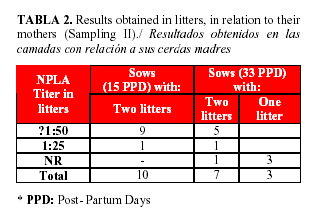
<body><![CDATA[<P><font face="Verdana, Arial, Helvetica, sans-serif" size="2">The presence of    titers =1:50 in every litter at 3 days of age, and the 80% decrease (16/20)    at only 28 days after primo-vaccination, demonstrated that the vaccinated scheme    in use was unsuitable (5 and 40 days of age) (Table1). </font>      <P><font face="Verdana, Arial, Helvetica, sans-serif" size="2">The results demonstrated    that sows were correctly vaccinated and transfered adequate antibody levels    to the litters. Thus, if the litters were vaccinated at 5 days of age, the existent    high passive antibody titers would neutralize the vaccinal antigen. </font>      <P><font face="Verdana, Arial, Helvetica, sans-serif" size="2">It is generally    accepted that passive antibody titers higher than 32 significantly affect the    induction of     <BR>   protecting immunity through vaccination with modified live strains, causing    vaccine failures (10; 11; 12). </font>     <P><font face="Verdana, Arial, Helvetica, sans-serif" size="2">At the same time,    it is recognized that in endemic areas, specially during an active focus of    the disease with a high viral circulation, sows previously vaccinated received    a constant booster (9).This situation is a problem, because contributes to the    increase of titers which are being transferred passively to the litters, probably    also conducting to vaccinal failures if this is not taken into account when    applying the primo-vaccination. </font>     <P><font face="Verdana, Arial, Helvetica, sans-serif" size="2">The Chinese Strain    vaccine is capable of inducing complete protection if it is applied at the right    moment, when it cannot be interfered with the colostrum antibodies. Thus, in    challenged vaccinated pigs an inhibition of both humoral and cellular immunity    has been observed, in the same proportion as the higher passive titers at vaccination;    and when it occurs, it is corroborated that the 50% of pigs eliminates viruses    after challenge (12). </font>     <P><font face="Verdana, Arial, Helvetica, sans-serif" size="2">Primo-vaccination    in the presence of high passive antibody titres as the cause of vaccination    failures and the existence of swine apparently healthy eliminating virus for    long periods are considered the main causes of the increasing of focuses in    areas where CSF is endemic and vaccination is systematic, as it occurred in    Mexico and Thailand during the last years (13; 9). </font>     <P><font face="Verdana, Arial, Helvetica, sans-serif" size="2">In the studied    herd, an evidence of vaccination failures has occurred due to the presence of    CSF in pigs from 9 weeks of birth (pre-fattening Section 4 and 5), where the    22% of the sampled animals (9/41) did not protect titres (=1:50), only at 23    and 30 days after finishing the two-dose vaccination scheme, respectively. </font>     <P><font face="Verdana, Arial, Helvetica, sans-serif" size="2">These results helped    to the producers to support the proposal to modify the vaccination scheme, starting    to apply primo-vaccination at 33 days, at weaning, taking advantage for vaccinating    the mothers at the same time. </font>     <P><font face="Verdana, Arial, Helvetica, sans-serif" size="2">In Sampling II    (<a href="#tab2">Table 2</a>), the two 15 day-pigs with titres of 1:25 belonged    to the same litter, indicating that the mother could not transferred a good    immunity through its colostrum. Concerning pigs with 33 days of age, the results    also indicated the effect of the mother, as one of them had her two pigs negative    and other sow had litters with titres of 1:25. These sows were destined to sanitary    slaughter after parturition, due to their former poor reproductive performance    and as part of the herd sanitation. In general, the low titres obtained in 7    of the litters could be influenced by the deficient immunological status of    the sows in which several factors such as nutritional, management or infectious    causes could be determined.</font>      ]]></body>
<body><![CDATA[<P><img src="/img/revistas/rsa/v31n3/f0204309.jpg" width="321" height="219" border="0"><a name="tab2"></a>      
<p><font face="Verdana, Arial, Helvetica, sans-serif" size="2">As it was demonstrated,    the 33% (7/20) of the litters at 33 days of age (Sampling II, <a href="/img/revistas/rsa/v31n3/f0104309.jpg">Table    1</a>), did not have protective titres, evidencing the maintaining of a high    infection pressure in the herd, even when applying the rest of the sanitary    measures. However, vaccinating at that moment was also a risk, due to the presence    of high passive antibody titres (=1:50), in 65% of the remaining pigs. </font>      
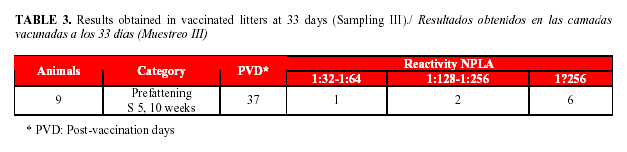
<P><font face="Verdana, Arial, Helvetica, sans-serif" size="2">The demonstration    of high titres at 37 DPV in all vaccinated 33 days of age pigs (<a href="/img/revistas/rsa/v31n3/f0304309.jpg">Table    3</a>), together with the gradual decreasing of disease cases in the herd in    successive months indicated that the decision of vaccinating at that moment    was correct to stop the outbreak.</font>      
<P><font face="Verdana, Arial, Helvetica, sans-serif" size="2">As in endemic areas,    the natural exposure to CSFV can occasionally occur; the sows systematically    vaccinated can increase the antibody titres without clinical signs of the disease,    and the transfer to their offspring produce interferences on the induction of    an active immune response at the vaccination moment. </font>     <P><font face="Verdana, Arial, Helvetica, sans-serif" size="2">These findings    and others indicating that passive antibody titres higher than 128 were necessary    for conferring protection against certain low virulence CSF isolates from Thailand,    have motivated the insistence on the necessity to monitore the immunological    status of the herds since vaccination failed in inducing protection, particularly    in endemic areas where vaccination was overused and pigs were vaccinated at    very low age (9). Thus even if many factors could influence on unsuccessful    vaccination programs, the difficulties arising from the vaccination of pigs    with maternal antibodies are considered one of the most important factor (13;    9). </font>      <P><font face="Verdana, Arial, Helvetica, sans-serif" size="2">The high titres    observed at 37 days post-vaccination (PVD) in all pigs vaccinated at 33 days    of age (<a href="/img/revistas/rsa/v31n3/f0304309.jpg">Table 3</a>), contrasted    with the ones in the animals of similar age (Section 5, Sampling I), only after    30 days from the biphasic vaccination (5 and 40 days), where the 19 % of the    animals did not have protective titres (<a href="/img/revistas/rsa/v31n3/f0104309.jpg">Table    1</a>). Similar favourable results were observed in the following sections on    pre-fattening and fattening, although in Section 7 only the 50% of the pigs    showed protective titres (Sampling III), in which other processes could influence    producing vaccination failures. </font>      
<P><font face="Verdana, Arial, Helvetica, sans-serif" size="2">It was also pointed    out that for vaccinating pigs after 5 weeks of age developed a higher quantity    of neutralizing antibodies and Interferon- &atilde; producing specific cells    against CSF than the ones vaccinated at 3 weeks (14), because it was recognized    that the swine immune system was not completely mature until 4 weeks of age    (15). Thus, under outbreak conditions the animals were vaccinated very young    with two doses, and the second dose was applied as a <I>booster</I> at 30 days,    it was recommended to interrupt this practice as soon as possible (9). </font>     <P><font face="Verdana, Arial, Helvetica, sans-serif" size="2">When CSF is introduced    in a free country or zone where vaccination is not applied, it is clear that    the early vaccination of litters can be the solution for the emergency, until    it could be guaranted an adequate protection of the litters through the vaccination    of the sows. But in endemic areas, with a systematic vaccination of the herds,    in which CSF is not usually present in litters or adult animals, but in pigs    after weaning on transition to the fattening, it is evident that the most important    problems are failures in the consolidation of post-vaccination active immunity.    </font>      <P><font face="Verdana, Arial, Helvetica, sans-serif" size="2">With the aim to    stop the known losses produced by CSF, producers make mistakes such as the early    vaccination of the litters and the indistinctly revaccination of any category.    The bad consequences of the wrong use of a vaccine can be harmful as they do    not use it on a control strategy. </font>     <P><font face="Verdana, Arial, Helvetica, sans-serif" size="2">Another aspect    causing disagreements is the frequency of vaccinating sows. In this sense, results    referred on a field assay were interesting, the majority of the vaccinated sows    were sero-positive between 2,5 and 3 years after vaccination, and less than    half of the ones vaccinated under &#168;real&#168; field conditions were sero-    positive a year later (16). </font>     ]]></body>
<body><![CDATA[<P><font face="Verdana, Arial, Helvetica, sans-serif" size="2">In practice, special    care most be taken on the vaccination of the breeders. In relation to the place    where the vaccine is applied and the type of needle used, precaution has to    be taken in applying the injection in the muscle (not in the subcutaneous fat    layer) in which the length of the needle is important. </font>     <P><font face="Verdana, Arial, Helvetica, sans-serif" size="2">On big animals,    it is recommended to apply the vaccine in the lateral-cervical region behind    the ear using needle 1-1.5 x 18, with the precaution not to remove it quickly    after applying the product to avoid the reflux of the liquid (4). </font>     <P><font face="Verdana, Arial, Helvetica, sans-serif" size="2">It is considered    that the change on the vaccination scheme, together with the rest of the sanitary    measures strictly applied, decisively contributed to the gradual herd recovering,    demonstrated by the not-appearance of new sick animals and the improvement of    the bio-productive indicators during the period evaluated. </font>     <P>&nbsp;     <P><font face="Verdana, Arial, Helvetica, sans-serif" size="2"><B><font size="3">ACNKNOWLEDGES</font></B>    </font>      <P><font face="Verdana, Arial, Helvetica, sans-serif" size="2">To Drs. Yanelis    D&iacute;az, Roberto P&eacute;rez, Roberto Gonz&aacute;lez and Mar&iacute;a    Reyes, as well as to all technicians and workers of the swine premise, for the    cooperation in the sampling and data collection in the field. </font>      <P>&nbsp;     <P><font face="Verdana, Arial, Helvetica, sans-serif" size="2"><B><font size="3">REFERENCES</font></B>    </font>      <!-- ref --><P><font face="Verdana, Arial, Helvetica, sans-serif" size="2">1. Moennig V. Introduction    to classical swine fever virus, disease and control policy. Vet Microbiol. (2000);73:93-102.    </font>    <!-- ref --><P><font face="Verdana, Arial, Helvetica, sans-serif" size="2">2. Morilla GA,    Carvajal MA. La fiebre porcina cl&aacute;sica end&eacute;mica en M&eacute;xico.    Ciencia Veterinaria. (2004); 9-2003-4, 166-190. Rev. 22/2/2008 <U><a href="http://www.rlc.fao.org/prior/segalim/animal/ppc/plan/paises/pdf/mexico.pdf">http://www.rlc.fao.org/prior/segalim/animal/ppc/plan    /paises/pdf/mexico.pdf</a></U> </font>    <!-- ref --><P><font face="Verdana, Arial, Helvetica, sans-serif" size="2">3. Espu&ntilde;a    E. Inmunizaci&oacute;n frente a la peste porcina cl&aacute;sica. Porci. Aula    Veterinaria. 1994;22:45-56. </font>    <!-- ref --><P><font face="Verdana, Arial, Helvetica, sans-serif" size="2">4. Instituto de    Medicina Veterinaria (IMV). Programa Nacional de Prevenci&oacute;n y Control    de la peste porcina cl&aacute;sica. 2005. Imprenta MINAG. </font>    <!-- ref --><P><font face="Verdana, Arial, Helvetica, sans-serif" size="2">5. World Organization    for Animal Health. OIE. Terrestrial Manual. Chapter 2.8.3. Classical swine fever    (hog cholera). 2008; 1098-1000. </font>    <!-- ref --><P><font face="Verdana, Arial, Helvetica, sans-serif" size="2">6. Ganges L, Barrera    M, D&iacute;az de Arce H, Vega A, N&uacute;&ntilde;ez JI, Sobrino F, Fr&iacute;as    MT. Antigenic, biological and molecular characterization of the Cuban CSFV isolate    &quot;Margarita&quot;. Rev Salud Anim. 2007;29(3):182-192. </font>    <!-- ref --><P><font face="Verdana, Arial, Helvetica, sans-serif" size="2">7. Terpstra C,    Wensvoort G. The protective value of vaccineinduced neutralising antibody titres    in swine fever. Vet Microbiol. 1988;16:123-128. </font>    <!-- ref --><P><font face="Verdana, Arial, Helvetica, sans-serif" size="2">8. Suradhat S,    Intrakamhaeng M, Damrongwata-napokin S. The correlation of virus-specific interferon-gamma    production and protection against classical swine fever virus infection. Vet    Immunol Immunopathol. 2001;83:177-189. </font>    <!-- ref --><P><font face="Verdana, Arial, Helvetica, sans-serif" size="2">9. Suradhat S,    Damrongwatanapokin S, Thanawong-nuwech R. Factors critical for successful vaccination    against classical swine fever in endemic areas. Vet Microbiol. 2007;119:19.    </font>    <!-- ref --><P><font face="Verdana, Arial, Helvetica, sans-serif" size="2">10.Suvintrakorn    K, Hanveeraphon A, Pariyakanok V. Efficacy of lapinized swine fever vaccine    in piglets born from immune sows. J Thai Vet Med Assoc. 1993;23:93-103. </font>    <!-- ref --><P><font face="Verdana, Arial, Helvetica, sans-serif" size="2">11.Parchariyanon    S, Tantaswasdi U, Pinyochon W, Methiyapun P. Immunity against swine fever vaccine.    II. Immunity against swine fever vaccine in piglets and protection level of    maternal immunity in piglets before vaccination. J Thai Vet Med Assoc. 1994;45:37-45.    </font>    <!-- ref --><P><font face="Verdana, Arial, Helvetica, sans-serif" size="2">12.Suradhat S,    Damrongwatanapokin S. The influence of maternal immunity on the efficacy of    a classical swine fever vaccine against classical swine fever virus, genogroup    2.2, infection. Vet Microbiol. 2003;92:187-194. </font>    <!-- ref --><P><font face="Verdana, Arial, Helvetica, sans-serif" size="2">13.Morilla GA.    A decade of learning to control CSF in endemic areas. 17 <SUP>th </SUP>Cong.    IPVS (Int. Pig Vet. Socc.), 2002. Iowa, USA. </font>    <!-- ref --><P><font face="Verdana, Arial, Helvetica, sans-serif" size="2">14.Suradhat S,    Damrongwatanapokin, S. Factors that influenced an effectiveness of classical    swine fever vaccine: a case study. Thai J Vet Med. 2002;32 (Suppl):163-172 (in    Thai). </font>    <!-- ref --><P><font face="Verdana, Arial, Helvetica, sans-serif" size="2">15.Povey RC, Carman    PS. Technical basis of vaccination. En: Pastoret, P.-P., Blancou, J., Vannier,    P., Verschueren, C. (Eds.),Veterinary Vaccinology. Elsevier Science B.V., Amsterdam.    1997. pp. 519-580. </font>    <!-- ref --><P><font face="Verdana, Arial, Helvetica, sans-serif" size="2">16.Van Bekkum JG.    Experience in the Netherlands with the lapinised so-called Chinese (C) strain    of vaccine. Eradication of classical swine fever in Hungary. In: Proceedings    of the CEC Seminar on Hog Cholera/Classical Swine Fever and African Swine Fever.    EUR 5904 EN, Hannover. 1977. pp. 379-391. </font>    <P>&nbsp;     <P>&nbsp;     <P><font face="Verdana, Arial, Helvetica, sans-serif" size="2"><B>(Recibido 15-3-2009;    Aprobado 15-5-2009)</B></font>       ]]></body><back>
<ref-list>
<ref id="B1">
<label>1</label><nlm-citation citation-type="journal">
<person-group person-group-type="author">
<name>
<surname><![CDATA[Moennig]]></surname>
<given-names><![CDATA[V]]></given-names>
</name>
</person-group>
<article-title xml:lang="en"><![CDATA[Introduction to classical swine fever virus, disease and control policy]]></article-title>
<source><![CDATA[Vet Microbiol.]]></source>
<year>2000</year>
<volume>73</volume>
<page-range>93-102</page-range></nlm-citation>
</ref>
<ref id="B2">
<label>2</label><nlm-citation citation-type="">
<person-group person-group-type="author">
<name>
<surname><![CDATA[Morilla]]></surname>
<given-names><![CDATA[GA]]></given-names>
</name>
<name>
<surname><![CDATA[Carvajal]]></surname>
<given-names><![CDATA[MA]]></given-names>
</name>
</person-group>
<source><![CDATA[La fiebre porcina clásica endémica en México: Ciencia Veterinaria]]></source>
<year>2004</year>
<page-range>166-190</page-range></nlm-citation>
</ref>
<ref id="B3">
<label>3</label><nlm-citation citation-type="journal">
<person-group person-group-type="author">
<name>
<surname><![CDATA[Espuña]]></surname>
<given-names><![CDATA[E]]></given-names>
</name>
</person-group>
<article-title xml:lang="es"><![CDATA[Inmunización frente a la peste porcina clásica: Porci]]></article-title>
<source><![CDATA[Aula Veterinaria.]]></source>
<year>1994</year>
<volume>22</volume>
<page-range>45-56</page-range></nlm-citation>
</ref>
<ref id="B4">
<label>4</label><nlm-citation citation-type="book">
<collab>Instituto de Medicina Veterinaria (IMV)</collab>
<source><![CDATA[Programa Nacional de Prevención y Control de la peste porcina clásica]]></source>
<year>2005</year>
<publisher-name><![CDATA[Imprenta MINAG]]></publisher-name>
</nlm-citation>
</ref>
<ref id="B5">
<label>5</label><nlm-citation citation-type="">
<collab>World Organization for Animal Health. OIE</collab>
<source><![CDATA[Terrestrial Manual: Classical swine fever (hog cholera)]]></source>
<year>2008</year>
<page-range>1098-1000</page-range></nlm-citation>
</ref>
<ref id="B6">
<label>6</label><nlm-citation citation-type="journal">
<person-group person-group-type="author">
<name>
<surname><![CDATA[Ganges]]></surname>
<given-names><![CDATA[L]]></given-names>
</name>
<name>
<surname><![CDATA[Barrera]]></surname>
<given-names><![CDATA[M]]></given-names>
</name>
<name>
<surname><![CDATA[Díaz de Arce]]></surname>
<given-names><![CDATA[H]]></given-names>
</name>
<name>
<surname><![CDATA[Vega]]></surname>
<given-names><![CDATA[A]]></given-names>
</name>
<name>
<surname><![CDATA[Núñez]]></surname>
<given-names><![CDATA[JI]]></given-names>
</name>
<name>
<surname><![CDATA[Sobrino]]></surname>
<given-names><![CDATA[F]]></given-names>
</name>
<name>
<surname><![CDATA[Frías]]></surname>
<given-names><![CDATA[MT]]></given-names>
</name>
</person-group>
<article-title xml:lang="en"><![CDATA[Antigenic, biological and molecular characterization of the Cuban CSFV isolate "Margarita"]]></article-title>
<source><![CDATA[Rev Salud Anim.]]></source>
<year>2007</year>
<volume>29</volume>
<numero>3</numero>
<issue>3</issue>
<page-range>182-192</page-range></nlm-citation>
</ref>
<ref id="B7">
<label>7</label><nlm-citation citation-type="journal">
<person-group person-group-type="author">
<name>
<surname><![CDATA[Terpstra]]></surname>
<given-names><![CDATA[C]]></given-names>
</name>
<name>
<surname><![CDATA[Wensvoort]]></surname>
<given-names><![CDATA[G]]></given-names>
</name>
</person-group>
<article-title xml:lang="en"><![CDATA[The protective value of vaccineinduced neutralising antibody titres in swine fever]]></article-title>
<source><![CDATA[Vet Microbiol.]]></source>
<year>1988</year>
<volume>16</volume>
<page-range>123-128</page-range></nlm-citation>
</ref>
<ref id="B8">
<label>8</label><nlm-citation citation-type="journal">
<person-group person-group-type="author">
<name>
<surname><![CDATA[Suradhat]]></surname>
<given-names><![CDATA[S]]></given-names>
</name>
<name>
<surname><![CDATA[Intrakamhaeng]]></surname>
<given-names><![CDATA[M]]></given-names>
</name>
<name>
<surname><![CDATA[Damrongwata-napokin]]></surname>
<given-names><![CDATA[S]]></given-names>
</name>
</person-group>
<article-title xml:lang="en"><![CDATA[The correlation of virus-specific interferon-gamma production and protection against classical swine fever virus infection]]></article-title>
<source><![CDATA[Vet Immunol Immunopathol.]]></source>
<year>2001</year>
<volume>83</volume>
<page-range>177-189</page-range></nlm-citation>
</ref>
<ref id="B9">
<label>9</label><nlm-citation citation-type="journal">
<person-group person-group-type="author">
<name>
<surname><![CDATA[Suradhat]]></surname>
<given-names><![CDATA[S]]></given-names>
</name>
<name>
<surname><![CDATA[Damrongwatanapokin]]></surname>
<given-names><![CDATA[S]]></given-names>
</name>
<name>
<surname><![CDATA[Thanawong-nuwech]]></surname>
<given-names><![CDATA[R]]></given-names>
</name>
</person-group>
<article-title xml:lang="en"><![CDATA[Factors critical for successful vaccination against classical swine fever in endemic areas]]></article-title>
<source><![CDATA[Vet Microbiol.]]></source>
<year>2007</year>
<volume>119</volume>
<page-range>19</page-range></nlm-citation>
</ref>
<ref id="B10">
<label>10</label><nlm-citation citation-type="journal">
<person-group person-group-type="author">
<name>
<surname><![CDATA[Suvintrakorn]]></surname>
<given-names><![CDATA[K]]></given-names>
</name>
<name>
<surname><![CDATA[Hanveeraphon]]></surname>
<given-names><![CDATA[A]]></given-names>
</name>
<name>
<surname><![CDATA[Pariyakanok]]></surname>
<given-names><![CDATA[V]]></given-names>
</name>
</person-group>
<article-title xml:lang="en"><![CDATA[Efficacy of lapinized swine fever vaccine in piglets born from immune sows]]></article-title>
<source><![CDATA[J Thai Vet Med Assoc.]]></source>
<year>1993</year>
<volume>23</volume>
<page-range>93-103</page-range></nlm-citation>
</ref>
<ref id="B11">
<label>11</label><nlm-citation citation-type="journal">
<person-group person-group-type="author">
<name>
<surname><![CDATA[Parchariyanon]]></surname>
<given-names><![CDATA[S]]></given-names>
</name>
<name>
<surname><![CDATA[Tantaswasdi]]></surname>
<given-names><![CDATA[U]]></given-names>
</name>
<name>
<surname><![CDATA[Pinyochon]]></surname>
<given-names><![CDATA[W]]></given-names>
</name>
<name>
<surname><![CDATA[Methiyapun]]></surname>
<given-names><![CDATA[P]]></given-names>
</name>
</person-group>
<article-title xml:lang="en"><![CDATA[Immunity against swine fever vaccine: II. Immunity against swine fever vaccine in piglets and protection level of maternal immunity in piglets before vaccination]]></article-title>
<source><![CDATA[J Thai Vet Med Assoc.]]></source>
<year>1994</year>
<volume>45</volume>
<page-range>37-45</page-range></nlm-citation>
</ref>
<ref id="B12">
<label>12</label><nlm-citation citation-type="journal">
<person-group person-group-type="author">
<name>
<surname><![CDATA[Suradhat]]></surname>
<given-names><![CDATA[S]]></given-names>
</name>
<name>
<surname><![CDATA[Damrongwatanapokin]]></surname>
<given-names><![CDATA[S]]></given-names>
</name>
</person-group>
<article-title xml:lang="en"><![CDATA[The influence of maternal immunity on the efficacy of a classical swine fever vaccine against classical swine fever virus, genogroup 2. 2, infection]]></article-title>
<source><![CDATA[Vet Microbiol.]]></source>
<year>2003</year>
<volume>92</volume>
<page-range>187-194</page-range></nlm-citation>
</ref>
<ref id="B13">
<label>13</label><nlm-citation citation-type="confpro">
<person-group person-group-type="author">
<name>
<surname><![CDATA[Morilla]]></surname>
<given-names><![CDATA[GA]]></given-names>
</name>
</person-group>
<source><![CDATA[A decade of learning to control CSF in endemic areas]]></source>
<year></year>
<conf-name><![CDATA[ 17 th Cong. IPVS]]></conf-name>
<conf-date>2002</conf-date>
<conf-loc>Iowa </conf-loc>
</nlm-citation>
</ref>
<ref id="B14">
<label>14</label><nlm-citation citation-type="journal">
<person-group person-group-type="author">
<name>
<surname><![CDATA[Suradhat]]></surname>
<given-names><![CDATA[S]]></given-names>
</name>
<name>
<surname><![CDATA[Damrongwatanapokin]]></surname>
<given-names><![CDATA[S]]></given-names>
</name>
</person-group>
<article-title xml:lang="en"><![CDATA[Factors that influenced an effectiveness of classical swine fever vaccine: a case study]]></article-title>
<source><![CDATA[Thai J Vet Med]]></source>
<year>2002</year>
<numero>^s32</numero>
<issue>^s32</issue>
<supplement>32</supplement>
<page-range>163-172</page-range></nlm-citation>
</ref>
<ref id="B15">
<label>15</label><nlm-citation citation-type="book">
<person-group person-group-type="author">
<name>
<surname><![CDATA[Povey]]></surname>
<given-names><![CDATA[RC]]></given-names>
</name>
<name>
<surname><![CDATA[Carman]]></surname>
<given-names><![CDATA[PS]]></given-names>
</name>
</person-group>
<article-title xml:lang="en"><![CDATA[Technical basis of vaccination]]></article-title>
<person-group person-group-type="editor">
<name>
<surname><![CDATA[Pastoret]]></surname>
<given-names><![CDATA[PP]]></given-names>
</name>
<name>
<surname><![CDATA[Blancou]]></surname>
<given-names><![CDATA[J]]></given-names>
</name>
<name>
<surname><![CDATA[Vannier]]></surname>
<given-names><![CDATA[P]]></given-names>
</name>
<name>
<surname><![CDATA[Verschueren]]></surname>
<given-names><![CDATA[C]]></given-names>
</name>
</person-group>
<source><![CDATA[Veterinary Vaccinology]]></source>
<year>1997</year>
<page-range>519-580</page-range><publisher-name><![CDATA[Elsevier Science B.V., Amsterdam]]></publisher-name>
</nlm-citation>
</ref>
<ref id="B16">
<label>16</label><nlm-citation citation-type="confpro">
<person-group person-group-type="author">
<name>
<surname><![CDATA[Van Bekkum]]></surname>
<given-names><![CDATA[JG]]></given-names>
</name>
</person-group>
<article-title xml:lang="en"><![CDATA[Experience in the Netherlands with the lapinised so-called Chinese (C) strain of vaccine: Eradication of classical swine fever in Hungary]]></article-title>
<source><![CDATA[]]></source>
<year></year>
<conf-name><![CDATA[ Proceedings of the CEC Seminar on Hog Cholera/Classical Swine Fever and African Swine Fever]]></conf-name>
<conf-date>1977</conf-date>
<conf-loc> </conf-loc>
</nlm-citation>
</ref>
</ref-list>
</back>
</article>