<?xml version="1.0" encoding="ISO-8859-1"?><article xmlns:mml="http://www.w3.org/1998/Math/MathML" xmlns:xlink="http://www.w3.org/1999/xlink" xmlns:xsi="http://www.w3.org/2001/XMLSchema-instance">
<front>
<journal-meta>
<journal-id>0253-570X</journal-id>
<journal-title><![CDATA[Revista de Salud Animal]]></journal-title>
<abbrev-journal-title><![CDATA[Rev Salud Anim.]]></abbrev-journal-title>
<issn>0253-570X</issn>
<publisher>
<publisher-name><![CDATA[Centro Nacional de Sanidad Agropecuaria]]></publisher-name>
</publisher>
</journal-meta>
<article-meta>
<article-id>S0253-570X2010000100006</article-id>
<title-group>
<article-title xml:lang="en"><![CDATA[MOLECULAR CHARACTERIZATION OF A Herpesvirus bovino 1 CUBAN STRAIN]]></article-title>
<article-title xml:lang="es"><![CDATA[CARACTERIZACIÓN MOLECULAR DE UNA CEPA CUBANA DE Herpesvirus bovino 1]]></article-title>
</title-group>
<contrib-group>
<contrib contrib-type="author">
<name>
<surname><![CDATA[Rodríguez Medina]]></surname>
<given-names><![CDATA[Majela]]></given-names>
</name>
<xref ref-type="aff" rid="A01"/>
</contrib>
<contrib contrib-type="author">
<name>
<surname><![CDATA[Barrera Valle]]></surname>
<given-names><![CDATA[Maritza]]></given-names>
</name>
<xref ref-type="aff" rid="A01"/>
</contrib>
<contrib contrib-type="author">
<name>
<surname><![CDATA[Engels]]></surname>
<given-names><![CDATA[Monika]]></given-names>
</name>
<xref ref-type="aff" rid="A02"/>
</contrib>
<contrib contrib-type="author">
<name>
<surname><![CDATA[Ackermann]]></surname>
<given-names><![CDATA[M]]></given-names>
</name>
<xref ref-type="aff" rid="A02"/>
</contrib>
</contrib-group>
<aff id="A01">
<institution><![CDATA[,Centro Nacional de Sanidad Agropecuaria (CENSA)  ]]></institution>
<addr-line><![CDATA[La Habana ]]></addr-line>
<country>Cuba</country>
</aff>
<aff id="A02">
<institution><![CDATA[,University of Zürich Institute of Virology ]]></institution>
<addr-line><![CDATA[Zürich ]]></addr-line>
<country>Switzerland</country>
</aff>
<pub-date pub-type="pub">
<day>00</day>
<month>04</month>
<year>2010</year>
</pub-date>
<pub-date pub-type="epub">
<day>00</day>
<month>04</month>
<year>2010</year>
</pub-date>
<volume>32</volume>
<numero>1</numero>
<fpage>42</fpage>
<lpage>47</lpage>
<copyright-statement/>
<copyright-year/>
<self-uri xlink:href="http://scielo.sld.cu/scielo.php?script=sci_arttext&amp;pid=S0253-570X2010000100006&amp;lng=en&amp;nrm=iso"></self-uri><self-uri xlink:href="http://scielo.sld.cu/scielo.php?script=sci_abstract&amp;pid=S0253-570X2010000100006&amp;lng=en&amp;nrm=iso"></self-uri><self-uri xlink:href="http://scielo.sld.cu/scielo.php?script=sci_pdf&amp;pid=S0253-570X2010000100006&amp;lng=en&amp;nrm=iso"></self-uri><abstract abstract-type="short" xml:lang="en"><p><![CDATA[In Cuba, infections caused by Bovine herpesvirus 1 (BoHV-1) are endemic; however clinical signs are moderate, possibly because the BoHV-1 circulating genotypes are not associated to severe infections but these are not known. In the present study a BoHV-1 strain isolated in Cuba was compared with BoHV-1 strains from other different countries. Viral DNA was analysed by adoption of a clustering system based on restriction enzyme analysis (REA) with HindIII, HpaI, PstI and SfiI, which led to identify the Cuban isolate as a BoHV-1.1.III strain. The Cuban BoHV-1 differed from all the reference strains analysed and displayed a restriction fragment pattern more similar to strains originated from the European continent. The inclusion of these results into the clustering database is a contribution for future studies in tracing back the origin of novel infectious bovine rhinotracheitis (IBR) outbreaks.]]></p></abstract>
<abstract abstract-type="short" xml:lang="es"><p><![CDATA[En Cuba, las infecciones causadas por Herpesvirus bovino 1 (BoHV-1) son endémicas; sin embargo los signos clínicos son moderados, posiblemente porque los genotipos circulantes de BoHV-1 no están asociados con infecciones severas pero estos no se conocen. En el presente estudio se comparó un aislado de BoHV-1 proveniente de Cuba con cepas de BoHV-1 de diferentes países. El ADN viral fue analizado por adopción de un sistema de agrupamiento basado en análisis de restricción (REA) con las enzimas HindIII, HpaI, PstI y SfiI, el cual permitió identificar el aislado cubano como una cepa de BoHV-1.1.III. El BoHV-1 cubano difirió de todas las cepas de referencias analizadas y mostró un patrón de restricción similar a cepas provenientes del continente europeo. La introducción de estos resultados en la base de datos de agrupamiento es una contribución para futuros estudios relacionados con el origen de nuevos brotes de rinotraqueitis infecciosa bovina (RIB).]]></p></abstract>
<kwd-group>
<kwd lng="en"><![CDATA[Bovine herpesvirus 1]]></kwd>
<kwd lng="en"><![CDATA[infectious bovine rhinotracheitis]]></kwd>
<kwd lng="en"><![CDATA[restriction enzyme analysis]]></kwd>
<kwd lng="en"><![CDATA[clustering system]]></kwd>
<kwd lng="es"><![CDATA[Herpesvirus bovino 1]]></kwd>
<kwd lng="es"><![CDATA[rinotraqueitis infecciosa bovina]]></kwd>
<kwd lng="es"><![CDATA[análisis de restricción]]></kwd>
<kwd lng="es"><![CDATA[sistema de agrupamiento]]></kwd>
</kwd-group>
</article-meta>
</front><body><![CDATA[ <p align="right"><font face="Verdana, Arial, Helvetica, sans-serif" size="2"><B>Short    communication</B></font></p>     <p>&nbsp;</p>     <p>&nbsp;</p>     <p><font face="Verdana, Arial, Helvetica, sans-serif" size="2"><B><font size="4">MOLECULAR    CHARACTERIZATION OF A <I>Herpesvirus bovino 1</I> CUBAN STRAIN</font></B></font></p>     <p>&nbsp;</p>     <p><font face="Verdana, Arial, Helvetica, sans-serif" size="2"><b><font size="3">CARACTERIZACI&Oacute;N    MOLECULAR DE UNA CEPA CUBANA DE <i>Herpesvirus bovino 1</i></font></b></font></p>     <p>&nbsp;</p>     <p>&nbsp;</p>     <p><font face="Verdana, Arial, Helvetica, sans-serif" size="2"><B>Majela Rodr&iacute;guez    Medina*, Maritza Barrera Valle*, Monika Engels**, M. Ackermann**</B> </font></p>     <P>     ]]></body>
<body><![CDATA[<p><font face="Verdana, Arial, Helvetica, sans-serif" size="2"><I>*Centro Nacional    de Sanidad Agropecuaria (CENSA). Autopista Nacional y Carretera de Jamaica,    Apartado 10, San Jos&eacute; de las Lajas, La Habana, Cuba. E-mail: <a href="mailto:majela@censa.edu.cu">majela@censa.edu.cu</a>;    **Institute of Virology, University of Z&uuml;rich. Winterthurerstrasse 266a,    Z&uuml;rich, Switzerland</I></font></p>     <p>&nbsp;</p>     <p>&nbsp;</p> <hr noshade size="1">     <p><font face="Verdana, Arial, Helvetica, sans-serif" size="2"><B>ABSTRACT</B></font></p>     <p><font face="Verdana, Arial, Helvetica, sans-serif" size="2">In Cuba, infections    caused by <I>Bovine herpesvirus 1</I> (BoHV-1) are endemic; however clinical    signs are moderate, possibly because the BoHV-1 circulating genotypes are not    associated to severe infections but these are not known. In the present study    a BoHV-1 strain isolated in Cuba was compared with BoHV-1 strains from other    different countries. Viral DNA was analysed by adoption of a clustering system    based on restriction enzyme analysis (REA) with <I>Hin</I>dIII, <I>Hpa</I>I,    <I>Pst</I>I and <I>Sfi</I>I, which led to identify the Cuban isolate as a BoHV-1.1.III    strain. The Cuban BoHV-1 differed from all the reference strains analysed and    displayed a restriction fragment pattern more similar to strains originated    from the European continent. The inclusion of these results into the clustering    database is a contribution for future studies in tracing back the origin of    novel infectious bovine rhinotracheitis (IBR) outbreaks. </font></p>     <P><font face="Verdana, Arial, Helvetica, sans-serif" size="2"><b>Key words:</b>    Bovine herpesvirus 1; infectious bovine rhinotracheitis; restriction enzyme    analysis; clustering system</font> <hr noshade size="1">     <P><B> </B>     <P><b><font face="Verdana, Arial, Helvetica, sans-serif" size="2">RESUMEN</font></b>     <P><font face="Verdana, Arial, Helvetica, sans-serif" size="2">En Cuba, las infecciones    causadas por <I>Herpesvirus bovino 1</I> (BoHV-1) son end&eacute;micas; sin    embargo los signos cl&iacute;nicos son moderados, posiblemente porque los genotipos    circulantes de BoHV-1 no est&aacute;n asociados con infecciones severas pero    estos no se conocen. En el presente estudio se compar&oacute; un aislado de    BoHV-1 proveniente de Cuba con cepas de BoHV-1 de diferentes pa&iacute;ses.    El ADN viral fue analizado por adopci&oacute;n de un sistema de agrupamiento    basado en an&aacute;lisis de restricci&oacute;n (REA) con las enzimas <I>Hin</I>dIII,    <I>Hpa</I>I, <I>Pst</I>I y <I>Sfi</I>I, el cual permiti&oacute; identificar    el aislado cubano como una cepa de BoHV-1.1.III. El BoHV-1 cubano difiri&oacute;    de todas las cepas de referencias analizadas y mostr&oacute; un patr&oacute;n    de restricci&oacute;n similar a cepas provenientes del continente europeo. La    introducci&oacute;n de estos resultados en la base de datos de agrupamiento    es una contribuci&oacute;n para futuros estudios relacionados con el origen    de nuevos brotes de rinotraqueitis infecciosa bovina (RIB). </font>      <P><font face="Verdana, Arial, Helvetica, sans-serif" size="2"><b>Palabras clave:</b>    Herpesvirus bovino 1; rinotraqueitis infecciosa bovina; an&aacute;lisis de restricci&oacute;n;    sistema de agrupamiento</font> <hr noshade size="1">     ]]></body>
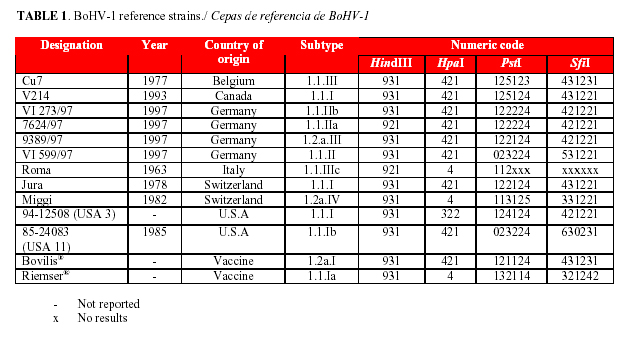
<body><![CDATA[<P>     <P>     <P><font face="Verdana, Arial, Helvetica, sans-serif" size="2"><I>Bovine herpesvirus    1</I> (BoHV-1), classified as a member of the family<I> Herpesviridae</I>, subfamily<I>    Alphaherpesvirinae</I>, genus <I>Varicellovirus</I> (1), is the causative agent    of several infections from the respiratory and genital tracts of domestic cattle    and other ruminant species. Based on Western Blot analysis of viral proteins    with a panel of monoclonal antibodies, as well as on restriction endonuclease    analysis of the viral nucleic acid and differential amplification by PCR (2,    3, 4), BoHV-1 strains are classified into two subtypes, BoHV-1.1 and BoHV-1.2,    BoHV-1.2 being additionally grouping into BoHV-1.2a and BoHV-1.2b. </font>      <P><font face="Verdana, Arial, Helvetica, sans-serif" size="2">In Cuba, studying    BoHV-1 and other cattle pathogens has been limited by economic problems. Nowadays,    the interest in cattle production is increasing, and gaining profound knowledge    on the epidemiological status of the BoHV-1 infection is getting importance.    This implies the characterization of BoHV-1 strains that are circulating in    the country. The purpose of the present study was to compare a BoHV-1 isolate    from Cuba with BoHV-1 strains from other different countries using a clustering    system based on restriction enzyme analysis. </font>     <P><font face="Verdana, Arial, Helvetica, sans-serif" size="2">Madin-Darby bovine    kidney cells (MDBK; ATCC CCL 22) were grown in Eagle's minimal essential medium    (Eagle's MEM, BioConcept's <I>AMIMED</I>, Switzerland) supplemented with 100    IU mL<SUP>-1</SUP> penicillin, 100 mg mL<SUP>-1</SUP> streptomycin and 7% foetal    calf serum (FCS, <I>Omnilab</I>, Switzerland). In the maintenance medium, FCS    was reduced to 2%. The cells were used for virus stocks production of the Cuban    BoHV-1 strain E8, isolated in 1984 during an outbreak of keratoconjunctivitis    (5) and BoHV-1 reference strains previously characterized by Wyss (6) (<a href="/img/revistas/rsa/v32n1/f0106110.jpg">Table    1</a>). </font>      
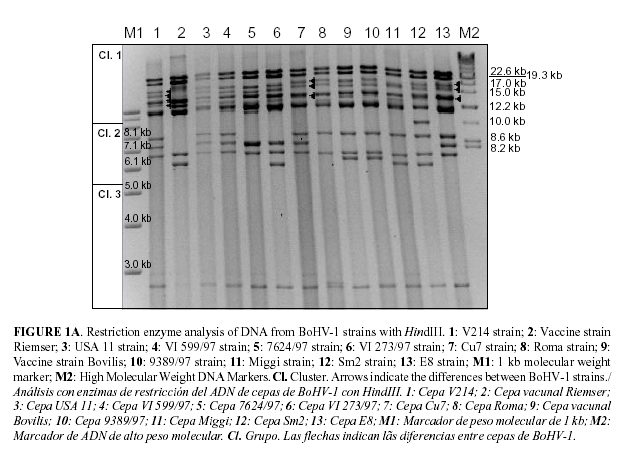
<P><font face="Verdana, Arial, Helvetica, sans-serif" size="2">Virus purification    and DNA extraction were conducted as previously described by Engels <I>et al</I>    (7). DNA concentrations were determined by reading of absorbance at 260 nm (<I>NanoDrop    Technologies, Inc., Witec</I> NanoDrop<SUP>&#174;</SUP> ND-1000 Spectrophotometer<SUP>&#174;</SUP>).    The absorbance ratio 260/280 nm was always between 1.93 and 2. </font>      <P><font face="Verdana, Arial, Helvetica, sans-serif" size="2">Aliquots containing    2 mg DNA were digested for 2 hr with<I> Hin</I>dIII,<I> Hpa</I>I, <I>Pst</I>I    (<I>Roche</I>) and <I>Sfi</I>I (<I>BioLabs</I>), respectively, under conditions    recommended by the supplier in a final volume of 20 mL. The digestion products    were separated by electrophoresis in 0.8% agarose gels containing 1 mg mL<SUP>-1    </SUP>ethidium bromide solution (<I>BioRad</I>). Gels were electrophoresed in    TAE electrophoresis buffer (4 mM Tris-acetate, 1 mM EDTA; pH 8.0) between 18    and 24 hr at 60 V. For determinating the DNA fragment sizes, 1 Kb DNA Ladder    (<I>Gibco</I>) with a size range of 500 bp to 12 kb and high molecular weight    DNA markers (<I>Invitrogen</I>) with a size range of 9 kb to 48 kb were included.    The bands were visualized and photographed using Quantity One<SUP>&#174;</SUP>    (<I>Bio-Rad Laboratories, BioRad</I>) and the molecular characterization was    based on the clustering system by Wyss (6). </font>     <P><font face="Verdana, Arial, Helvetica, sans-serif" size="2">Comparative analysis    of the resulting restriction enzyme patterns revealed that E8 <I>Hin</I>dIII    pattern was more similar to one Canadian strain (BoHV-1 V214) and two European    strains (BoHV-1 599/97 and BoHV-1 Cu7) (see <a href="/img/revistas/rsa/v32n1/f0206110.gif">Fig.    1A</a>). As all those strains belonged to the BoHV-1.1 genotype, it was concluded    that E8 belonged to the same genotype. Furthermore, isolate E8 was identified    as BoHV-1.1.III strain, based on <I>Hin</I>dIII fragments E and F which appeared    merging, </font><font face="Verdana, Arial, Helvetica, sans-serif" size="2">and    fragments C and D which showed higher molecular weight than the corresponding    fragments of the other BoHV-1 strains. </font>      
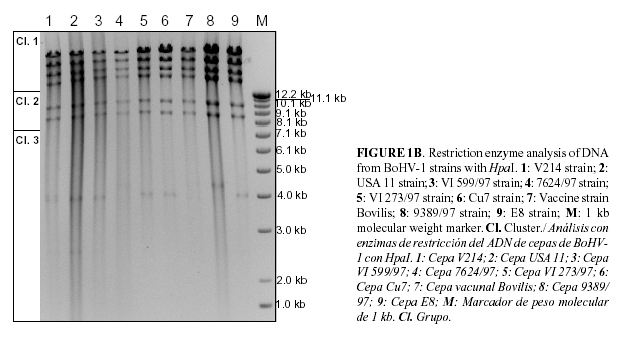
<P><font face="Verdana, Arial, Helvetica, sans-serif" size="2">Seven bands were    obtained by E8 digestion with <I>Hpa</I>I (see <a href="/img/revistas/rsa/v32n1/f0306110.gif">Fig.    1B</a>). These results corresponded to the numeric code 421 based on the number    of bands observed in clusters 1, 2 and 3, respectively. </font>      
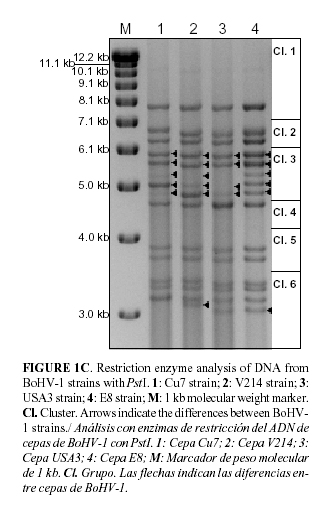
<P><font face="Verdana, Arial, Helvetica, sans-serif" size="2">E8 <I>Pst</I>I    pattern corresponded to the numeric code 125124. This code was also obtained    from BoHV-1 V214, but differences in the molecular weight of the band 4 of cluster    6 were found (see <a href="#f1c">Fig. 1C</a>). Five fragments from E8 viral DNA were observed in    cluster 3 and these were not observed from the American strain USA3 with 2 and    4 bands, respectively. Furthermore, bands 3, 4 and 5 of cluster 3 were observed    at similar intensity for E8, and differences were found in BoHV-1 strains V214    and Cu7.</font>     ]]></body>
<body><![CDATA[<P><a name="f1c"></a><img src="/img/revistas/rsa/v32n1/f0406110.gif" width="333" height="512">      
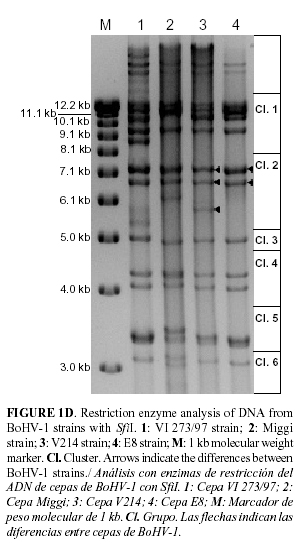
<P><font face="Verdana, Arial, Helvetica, sans-serif" size="2">As it can be seen    in <a href="#f1d">Fig. 1D</a>, the numeric code 421221 can be assigned to E8 <I>Sfi</I>I pattern.    It was more similar to the BoHV-1 strains V214 but only two bands in cluster    2 were obtained.</font>     <P><a name="f1d"></a><img src="/img/revistas/rsa/v32n1/f0506110.gif" width="303" height="556">      
<P><font face="Verdana, Arial, Helvetica, sans-serif" size="2">Restriction fragment    pattern analysis has mostly been used for classification purposes knowing that    the highest differences between BoHV-1.1 and BoHV-1.2 are restricted to distinct    genomic regions characterized by loss or gain of restriction sites (8). It has    also been used to differentiate between vaccine and field strains of BoHV-1    according to Hamelin <I>et al</I> (9). Moreover, according to systematic sequencing    of individual isolates will be difficult to perform due to the high G + C content    of BoHV-1 genomes (1), it is recommended the adoption of a clustering system    based on restriction endonuclease analysis with enzymes <I>Hin</I>dIII, <I>Hpa</I>I,    <I>Pst</I>I and <I>Sfi</I>I in order to identifying the possible origins of    BoHV-1 strains (6). This methodology was previously used to the identification    of BoHV-1 strain origin, which had been isolated from imported semen and which    had led to a new outbreak in 1983 in Switzerland (10). </font>     <P><font face="Verdana, Arial, Helvetica, sans-serif" size="2">The clustering    data base includes about 100 different BoHV-1 strains previously analyzed by    Wyss (6); in there, BoHV-1.1.III subtype corresponds with the 16% of BoHV-1.1    strains. It is important to note </font><font face="Verdana, Arial, Helvetica, sans-serif" size="2">that    all strains from Canada and U.S.A were 1.1.I subtype while 1.1.III subtype was    only found in Europe. The highest number of strains with the same restriction    fragment pattern (71%) was observed by digestion with <I>Hpa</I>I. This can    be explained by the small number of cleavage sites produced by this enzyme,    which has been used for identification of the four major genotypes of BoHV-1    (11). </font>      <P><font face="Verdana, Arial, Helvetica, sans-serif" size="2">The main differences    between E8 and the other bovine herpesviruses analyzed were found in the restriction    fragment patterns obtained by digestion with <I>Pst</I>I and <I>Sfi</I>I. This    is due to the high number of restriction sites for these enzymes that can be    found in the genome of BoHV-1. The number of bands obtained in cluster 3 of    E8 strain by digestion with <I>Pst</I>I is not common and it was only found    in strains from Canada, U.S.A, Holland and Belgium according to the table of    classification performed by Wyss (2001). Taking into account the results obtained    by Whetstone <I>et al</I> (12), it is possible to predict that the differences    in E8 <I>Pst</I>I pattern are associated with changes in the inverted repeat    regions. These changes were observed in restriction endonuclease <I>Pst</I>I    digestion patterns of BHV-1.1 and BHV-1.2 isolates after one passage in host    animal. Changes were also observed when virus was reactivated from latency or    after superinfection with another strain of BHV-1 (13). </font>     <P><font face="Verdana, Arial, Helvetica, sans-serif" size="2">It was not possible    to find a reference strain with the same four restriction fragment patterns    as the BoHV-1 E8. The largest number of similar strains was originated from    the European continent, but it has to be considered that comparison was made    with strains mainly from this region. Considering that the animals and semen    have been imported to the country only from Canada or USA, it is recommended    to increase the number of entries from de American continent into the clustering    data base. E8 DNA fragment pattern introduction in this database is a contribution    for future studies in tracing back the origin of novel IBR outbreaks and is    also a contribution to the updating of the Cuban surveillance epidemiological    program but it is recommended to continue this study with other Cuban strains.</font>     <P>     <P><B><font face="Verdana, Arial, Helvetica, sans-serif" size="3">ACKNOWLEDGEMENTS</font></B>  <B></B>      <P><font face="Verdana, Arial, Helvetica, sans-serif" size="2">The authors thank    A.E Metzler and M. Schwyzer for critical review and encouraging discussions.    This research was supported by a grant from the Federal Commission for Scholarships    for Foreign Students (FCS), Swiss Confederation. </font>     ]]></body>
<body><![CDATA[<P>     <P><font face="Verdana, Arial, Helvetica, sans-serif" size="2"><B><font size="3">REFERENCES</font></B>    </font>      <!-- ref --><P><font face="Verdana, Arial, Helvetica, sans-serif" size="2">1. Fauquet CM,    Mayo MA, Maniloff J, Desselberger U, Ball LA (eds): Virus Taxonomy, VIIIth Report    of the ICTV. 2005. Elsevier, Academic Press. </font>    <!-- ref --><P><font face="Verdana, Arial, Helvetica, sans-serif" size="2">2. Rijsewijk FA,    Kaashoek MJ, Langeveld JP, Meloen R, Judek J, Bienkowska-Szewczyk K, et al.    Epitopes on glycoprotein C of bovine herpesvirus-1 (BHV-1) that allow differentiation    between BHV-1.1 and BHV-1.2 strains. <I>J Gen Virol.</I> 1999; 80: 1477-1483.    </font>    <!-- ref --><P><font face="Verdana, Arial, Helvetica, sans-serif" size="2">3. D'Arce RCF,    Almeida RS, Silva TC, Franco AC, Spilki F, Roehe PM, et al. Restriction endonuclease    and monoclonal antibody analysis of Brazilian isolates of bovine herpesviruses    types 1 and 5. <I>Vet Microbiol.</I> 2002; 88: 315-324. </font>    <!-- ref --><P><font face="Verdana, Arial, Helvetica, sans-serif" size="2">4. Claus MP, Alfieri    AF, Folgueras-Flatschart AV, Wosiacki SR, M&eacute;dici KC, Alfieri AA. Rapid    detection and differentiation of bovine herpesvirus 1 and 5 glycoprotein C gene    in clinical specimens by multiplex-PCR. <I>J Virol Methods</I>. 2005; 128: 183-188.    </font>    <!-- ref --><P><font face="Verdana, Arial, Helvetica, sans-serif" size="2">5. Noda J, Nu&ntilde;ez    A, Garc&iacute;a J. Aislamiento del virus de la rinotraqueitis infecciosa bovina    en terneros con queratoconjutivitis. <I>Rev Salud Anim.</I> 1984; 6: 651-653.    </font>    <!-- ref --><P><font face="Verdana, Arial, Helvetica, sans-serif" size="2">6. Wyss SK. Etablierung    und Anwendung einer auf der Restriktionsenzym Analyse basierenden Cluster-Technik    und einer Datenbank des bovinen Herpesvirus Typ 1 f&uuml;r molekular-epidemiologische    Untersuchungen. Veterinary Medicine Thesis, University of Z&uuml;rich. 2001;    1-67. </font>    <!-- ref --><P><font face="Verdana, Arial, Helvetica, sans-serif" size="2">7. Engels M, Gelderblom    H, Darai G, Ludwing H. Goat Herpesviruses: Biological and physicochemical properties.    <I>J Gen Virol.</I> 1983; 64: 2237-2247. </font>    <!-- ref --><P><font face="Verdana, Arial, Helvetica, sans-serif" size="2">8. Engels M, Giuliani    C, Wild P, Beck TM, Loepfe E, Wyler R. The genome of bovine herpesvirus 1 (BHV-1)    strains exhibiting a neuropathogenic potential compared to known BHV-1 strains    by restriction site mapping and cross-hybridation. <I>Virus Res.</I> 1986/87;    6: 57-73. </font>    <!-- ref --><P><font face="Verdana, Arial, Helvetica, sans-serif" size="2">9. Hamelin C, Jacques    C, Assaf R. Differentiation of vaccine and field strains of Bovine herpesvirus    type 1 by restriction endonuclease analysis. <I>Jpn J Vet Sci.</I> 1990; 52(3):    461-467. </font>    <!-- ref --><P><font face="Verdana, Arial, Helvetica, sans-serif" size="2">10.Ackermann M,    Engels M. Pro and contra IBR-eradication. Vet Microbiol. 2006; 113: 293-302.    </font>    <!-- ref --><P><font face="Verdana, Arial, Helvetica, sans-serif" size="2">11.Edwards S, White    H, Nixon P. A study of the predominant genotypes of bovid herpesvirus 1 found    in the U.K. <I>Vet Microbiol. </I>1990; 22: 213-223. </font>    <!-- ref --><P><font face="Verdana, Arial, Helvetica, sans-serif" size="2">12.Whetstone C,    Seal BS, Miller J. Variability occurs in the inverted repeat region of genomic    DNA from bovine herpesvirus 1 respiratory, genital and bovine herpesvirus 5    encephalitic isolates. <I>Vet Microbiol.</I> 1993; 38: 181-189. </font>    <!-- ref --><P><font face="Verdana, Arial, Helvetica, sans-serif" size="2">13.Whetstone C,    Miller J, Bortner D, Van Der Maaten M. Changes in the restriction endonuclease    patterns of four modified-live infectious bovine rhinotracheitis virus (IBRV)    vaccines after one passage in host animal. <I>Vaccine. </I>1989; 7: 527-532.</font>    <P>     <P>      <P>      <P>      <P>      ]]></body>
<body><![CDATA[<P>      <P>      <P>      <P><font face="Verdana, Arial, Helvetica, sans-serif" size="2"><B>(Recibido 12-10-2009;    Aceptado 20-12-2010)</B></font>      ]]></body><back>
<ref-list>
<ref id="B1">
<label>1</label><nlm-citation citation-type="book">
<person-group person-group-type="author">
<name>
<surname><![CDATA[Fauquet]]></surname>
<given-names><![CDATA[CM]]></given-names>
</name>
<name>
<surname><![CDATA[Mayo]]></surname>
<given-names><![CDATA[MA]]></given-names>
</name>
<name>
<surname><![CDATA[Maniloff]]></surname>
<given-names><![CDATA[J]]></given-names>
</name>
<name>
<surname><![CDATA[Desselberger]]></surname>
<given-names><![CDATA[U]]></given-names>
</name>
<name>
<surname><![CDATA[Ball]]></surname>
<given-names><![CDATA[LA]]></given-names>
</name>
</person-group>
<article-title xml:lang="en"><![CDATA[Virus Taxonomy]]></article-title>
<source><![CDATA[]]></source>
<year>2005</year>
<publisher-name><![CDATA[Elsevier, Academic Press]]></publisher-name>
</nlm-citation>
</ref>
<ref id="B2">
<label>2</label><nlm-citation citation-type="journal">
<person-group person-group-type="author">
<name>
<surname><![CDATA[Rijsewijk]]></surname>
<given-names><![CDATA[FA]]></given-names>
</name>
<name>
<surname><![CDATA[Kaashoek]]></surname>
<given-names><![CDATA[MJ]]></given-names>
</name>
<name>
<surname><![CDATA[Langeveld]]></surname>
<given-names><![CDATA[JP]]></given-names>
</name>
<name>
<surname><![CDATA[Meloen]]></surname>
<given-names><![CDATA[R]]></given-names>
</name>
<name>
<surname><![CDATA[Judek]]></surname>
<given-names><![CDATA[J]]></given-names>
</name>
<name>
<surname><![CDATA[Bienkowska-Szewczyk]]></surname>
<given-names><![CDATA[K]]></given-names>
</name>
</person-group>
<article-title xml:lang="en"><![CDATA[Epitopes on glycoprotein C of bovine herpesvirus-1 (BHV-1) that allow differentiation between BHV-1.1 and BHV-1.2 strains]]></article-title>
<source><![CDATA[J Gen Virol]]></source>
<year>1999</year>
<volume>80</volume>
<page-range>1477-1483</page-range></nlm-citation>
</ref>
<ref id="B3">
<label>3</label><nlm-citation citation-type="journal">
<person-group person-group-type="author">
<name>
<surname><![CDATA[D'Arce]]></surname>
<given-names><![CDATA[RCF]]></given-names>
</name>
<name>
<surname><![CDATA[Almeida]]></surname>
<given-names><![CDATA[RS]]></given-names>
</name>
<name>
<surname><![CDATA[Silva]]></surname>
<given-names><![CDATA[TC]]></given-names>
</name>
<name>
<surname><![CDATA[Franco]]></surname>
<given-names><![CDATA[AC]]></given-names>
</name>
<name>
<surname><![CDATA[Spilki]]></surname>
<given-names><![CDATA[F]]></given-names>
</name>
<name>
<surname><![CDATA[Roehe]]></surname>
<given-names><![CDATA[PM]]></given-names>
</name>
</person-group>
<article-title xml:lang="en"><![CDATA[Restriction endonuclease and monoclonal antibody analysis of Brazilian isolates of bovine herpesviruses types 1 and 5]]></article-title>
<source><![CDATA[Vet Microbiol.]]></source>
<year>2002</year>
<volume>88</volume>
<page-range>315-324</page-range></nlm-citation>
</ref>
<ref id="B4">
<label>4</label><nlm-citation citation-type="journal">
<person-group person-group-type="author">
<name>
<surname><![CDATA[Claus]]></surname>
<given-names><![CDATA[MP]]></given-names>
</name>
<name>
<surname><![CDATA[Alfieri]]></surname>
<given-names><![CDATA[AF]]></given-names>
</name>
<name>
<surname><![CDATA[Folgueras-Flatschart]]></surname>
<given-names><![CDATA[AV]]></given-names>
</name>
<name>
<surname><![CDATA[Wosiacki]]></surname>
<given-names><![CDATA[SR]]></given-names>
</name>
<name>
<surname><![CDATA[Médici]]></surname>
<given-names><![CDATA[KC]]></given-names>
</name>
<name>
<surname><![CDATA[Alfieri]]></surname>
<given-names><![CDATA[AA]]></given-names>
</name>
</person-group>
<article-title xml:lang="en"><![CDATA[Rapid detection and differentiation of bovine herpesvirus 1 and 5 glycoprotein C gene in clinical specimens by multiplex-PCR]]></article-title>
<source><![CDATA[J Virol Methods]]></source>
<year>2005</year>
<volume>128</volume>
<page-range>183-188</page-range></nlm-citation>
</ref>
<ref id="B5">
<label>5</label><nlm-citation citation-type="journal">
<person-group person-group-type="author">
<name>
<surname><![CDATA[Noda]]></surname>
<given-names><![CDATA[J]]></given-names>
</name>
<name>
<surname><![CDATA[Nuñez]]></surname>
<given-names><![CDATA[A]]></given-names>
</name>
<name>
<surname><![CDATA[García]]></surname>
<given-names><![CDATA[J]]></given-names>
</name>
</person-group>
<article-title xml:lang="es"><![CDATA[Aislamiento del virus de la rinotraqueitis infecciosa bovina en terneros con queratoconjutivitis]]></article-title>
<source><![CDATA[Rev Salud Anim]]></source>
<year>1984</year>
<volume>6</volume>
<page-range>651-653</page-range></nlm-citation>
</ref>
<ref id="B6">
<label>6</label><nlm-citation citation-type="">
<person-group person-group-type="author">
<name>
<surname><![CDATA[Wyss]]></surname>
<given-names><![CDATA[SK]]></given-names>
</name>
</person-group>
<source><![CDATA[Etablierung und Anwendung einer auf der Restriktionsenzym Analyse basierenden Cluster-Technik und einer Datenbank des bovinen Herpesvirus Typ 1 für molekular-epidemiologische Untersuchungen]]></source>
<year></year>
</nlm-citation>
</ref>
<ref id="B7">
<label>7</label><nlm-citation citation-type="journal">
<person-group person-group-type="author">
<name>
<surname><![CDATA[Engels]]></surname>
<given-names><![CDATA[M]]></given-names>
</name>
<name>
<surname><![CDATA[Gelderblom]]></surname>
<given-names><![CDATA[H]]></given-names>
</name>
<name>
<surname><![CDATA[Darai]]></surname>
<given-names><![CDATA[G]]></given-names>
</name>
<name>
<surname><![CDATA[Ludwing]]></surname>
<given-names><![CDATA[H]]></given-names>
</name>
</person-group>
<article-title xml:lang="en"><![CDATA[Goat Herpesviruses: Biological and physicochemical properties]]></article-title>
<source><![CDATA[J Gen Virol]]></source>
<year>1983</year>
<volume>64</volume>
<page-range>2237-2247</page-range></nlm-citation>
</ref>
<ref id="B8">
<label>8</label><nlm-citation citation-type="journal">
<person-group person-group-type="author">
<name>
<surname><![CDATA[Engels]]></surname>
<given-names><![CDATA[M]]></given-names>
</name>
<name>
<surname><![CDATA[Giuliani]]></surname>
<given-names><![CDATA[C]]></given-names>
</name>
<name>
<surname><![CDATA[Wild]]></surname>
<given-names><![CDATA[P]]></given-names>
</name>
<name>
<surname><![CDATA[Beck]]></surname>
<given-names><![CDATA[TM]]></given-names>
</name>
<name>
<surname><![CDATA[Loepfe]]></surname>
<given-names><![CDATA[E]]></given-names>
</name>
<name>
<surname><![CDATA[Wyler]]></surname>
<given-names><![CDATA[R]]></given-names>
</name>
</person-group>
<article-title xml:lang="en"><![CDATA[The genome of bovine herpesvirus 1 (BHV-1) strains exhibiting a neuropathogenic potential compared to known BHV-1 strains by restriction site mapping and cross-hybridation]]></article-title>
<source><![CDATA[Virus Res]]></source>
<year>1986</year>
<volume>6</volume>
<page-range>57-73</page-range></nlm-citation>
</ref>
<ref id="B9">
<label>9</label><nlm-citation citation-type="journal">
<person-group person-group-type="author">
<name>
<surname><![CDATA[Hamelin]]></surname>
<given-names><![CDATA[C]]></given-names>
</name>
<name>
<surname><![CDATA[Jacques]]></surname>
<given-names><![CDATA[C]]></given-names>
</name>
<name>
<surname><![CDATA[Assaf]]></surname>
<given-names><![CDATA[R]]></given-names>
</name>
</person-group>
<article-title xml:lang="en"><![CDATA[Differentiation of vaccine and field strains of Bovine herpesvirus type 1 by restriction endonuclease analysis]]></article-title>
<source><![CDATA[Jpn J Vet Sci]]></source>
<year>1990</year>
<volume>52</volume>
<numero>3</numero>
<issue>3</issue>
<page-range>461-467</page-range></nlm-citation>
</ref>
<ref id="B10">
<label>10</label><nlm-citation citation-type="journal">
<person-group person-group-type="author">
<name>
<surname><![CDATA[Ackermann]]></surname>
<given-names><![CDATA[M]]></given-names>
</name>
<name>
<surname><![CDATA[Engels]]></surname>
<given-names><![CDATA[M]]></given-names>
</name>
</person-group>
<article-title xml:lang="en"><![CDATA[Pro and contra IBR-eradication]]></article-title>
<source><![CDATA[Vet Microbiol]]></source>
<year>2006</year>
<volume>113</volume>
<page-range>293-302</page-range></nlm-citation>
</ref>
<ref id="B11">
<label>11</label><nlm-citation citation-type="journal">
<person-group person-group-type="author">
<name>
<surname><![CDATA[Edwards]]></surname>
<given-names><![CDATA[S]]></given-names>
</name>
<name>
<surname><![CDATA[White]]></surname>
<given-names><![CDATA[H]]></given-names>
</name>
<name>
<surname><![CDATA[Nixon]]></surname>
<given-names><![CDATA[P]]></given-names>
</name>
</person-group>
<article-title xml:lang="en"><![CDATA[A study of the predominant genotypes of bovid herpesvirus 1 found in the UK]]></article-title>
<source><![CDATA[Vet Microbiol.]]></source>
<year>1990</year>
<volume>22</volume>
<page-range>213-223</page-range></nlm-citation>
</ref>
<ref id="B12">
<label>12</label><nlm-citation citation-type="journal">
<person-group person-group-type="author">
<name>
<surname><![CDATA[Whetstone]]></surname>
<given-names><![CDATA[C]]></given-names>
</name>
<name>
<surname><![CDATA[Seal]]></surname>
<given-names><![CDATA[BS]]></given-names>
</name>
<name>
<surname><![CDATA[Miller]]></surname>
<given-names><![CDATA[J]]></given-names>
</name>
</person-group>
<article-title xml:lang="en"><![CDATA[Variability occurs in the inverted repeat region of genomic DNA from bovine herpesvirus 1 respiratory, genital and bovine herpesvirus 5 encephalitic isolates]]></article-title>
<source><![CDATA[Vet Microbiol]]></source>
<year>1993</year>
<volume>38</volume>
<page-range>181-189</page-range></nlm-citation>
</ref>
<ref id="B13">
<label>13</label><nlm-citation citation-type="journal">
<person-group person-group-type="author">
<name>
<surname><![CDATA[Whetstone]]></surname>
<given-names><![CDATA[C]]></given-names>
</name>
<name>
<surname><![CDATA[Miller]]></surname>
<given-names><![CDATA[J]]></given-names>
</name>
<name>
<surname><![CDATA[Bortner]]></surname>
<given-names><![CDATA[D]]></given-names>
</name>
<name>
<surname><![CDATA[Van Der Maaten]]></surname>
<given-names><![CDATA[M]]></given-names>
</name>
</person-group>
<article-title xml:lang="en"><![CDATA[Changes in the restriction endonuclease patterns of four modified-live infectious bovine rhinotracheitis virus (IBRV) vaccines after one passage in host animal]]></article-title>
<source><![CDATA[Vaccine]]></source>
<year>1989</year>
<volume>7</volume>
<page-range>527-532</page-range></nlm-citation>
</ref>
</ref-list>
</back>
</article>