<?xml version="1.0" encoding="ISO-8859-1"?><article xmlns:mml="http://www.w3.org/1998/Math/MathML" xmlns:xlink="http://www.w3.org/1999/xlink" xmlns:xsi="http://www.w3.org/2001/XMLSchema-instance">
<front>
<journal-meta>
<journal-id>0253-570X</journal-id>
<journal-title><![CDATA[Revista de Salud Animal]]></journal-title>
<abbrev-journal-title><![CDATA[Rev Salud Anim.]]></abbrev-journal-title>
<issn>0253-570X</issn>
<publisher>
<publisher-name><![CDATA[Centro Nacional de Sanidad Agropecuaria]]></publisher-name>
</publisher>
</journal-meta>
<article-meta>
<article-id>S0253-570X2010000200003</article-id>
<title-group>
<article-title xml:lang="es"><![CDATA[AFLATOXINA M1 EN LECHE Y QUESO DE CABRA PRODUCIDOS EN APASEO EL GRANDE, GUANAJUATO, MÉXICO]]></article-title>
<article-title xml:lang="en"><![CDATA[AFLATOXIN M1 IN GOAT MILK AND CHEESE PRODUCED IN APASEO EL GRANDE, GUANAJUATO, MEXICO]]></article-title>
</title-group>
<contrib-group>
<contrib contrib-type="author">
<name>
<surname><![CDATA[Urbán]]></surname>
<given-names><![CDATA[Georgina]]></given-names>
</name>
<xref ref-type="aff" rid="A01"/>
</contrib>
<contrib contrib-type="author">
<name>
<surname><![CDATA[Pérez]]></surname>
<given-names><![CDATA[J]]></given-names>
</name>
<xref ref-type="aff" rid="A01"/>
</contrib>
<contrib contrib-type="author">
<name>
<surname><![CDATA[Martínez]]></surname>
<given-names><![CDATA[F]]></given-names>
</name>
<xref ref-type="aff" rid="A01"/>
</contrib>
<contrib contrib-type="author">
<name>
<surname><![CDATA[Gutiérrez]]></surname>
<given-names><![CDATA[R]]></given-names>
</name>
<xref ref-type="aff" rid="A01"/>
</contrib>
<contrib contrib-type="author">
<name>
<surname><![CDATA[Vega]]></surname>
<given-names><![CDATA[S]]></given-names>
</name>
<xref ref-type="aff" rid="A01"/>
</contrib>
<contrib contrib-type="author">
<name>
<surname><![CDATA[Coronado]]></surname>
<given-names><![CDATA[Marta]]></given-names>
</name>
<xref ref-type="aff" rid="A01"/>
</contrib>
<contrib contrib-type="author">
<name>
<surname><![CDATA[Escobar]]></surname>
<given-names><![CDATA[A]]></given-names>
</name>
<xref ref-type="aff" rid="A02"/>
</contrib>
</contrib-group>
<aff id="A01">
<institution><![CDATA[,Universidad Autónoma Metropolitana Departamento de Producción Agrícola y Animal ]]></institution>
<addr-line><![CDATA[ D.F]]></addr-line>
<country>México</country>
</aff>
<aff id="A02">
<institution><![CDATA[,Centro Nacional de Sanidad Agropecuaria (CENSA)  ]]></institution>
<addr-line><![CDATA[La Habana ]]></addr-line>
<country>Cuba</country>
</aff>
<pub-date pub-type="pub">
<day>00</day>
<month>08</month>
<year>2010</year>
</pub-date>
<pub-date pub-type="epub">
<day>00</day>
<month>08</month>
<year>2010</year>
</pub-date>
<volume>32</volume>
<numero>2</numero>
<fpage>84</fpage>
<lpage>88</lpage>
<copyright-statement/>
<copyright-year/>
<self-uri xlink:href="http://scielo.sld.cu/scielo.php?script=sci_arttext&amp;pid=S0253-570X2010000200003&amp;lng=en&amp;nrm=iso"></self-uri><self-uri xlink:href="http://scielo.sld.cu/scielo.php?script=sci_abstract&amp;pid=S0253-570X2010000200003&amp;lng=en&amp;nrm=iso"></self-uri><self-uri xlink:href="http://scielo.sld.cu/scielo.php?script=sci_pdf&amp;pid=S0253-570X2010000200003&amp;lng=en&amp;nrm=iso"></self-uri><abstract abstract-type="short" xml:lang="es"><p><![CDATA[El presente estudio se realizó con el objeto de conocer el nivel de aflatoxina M1 (AFM1) en leche y queso de cabra. Las muestras de leche (n=60) fueron tomadas durante el periodo de julio del 2008 a junio del 2009 provenientes de 5 unidades de producción caprina. Las muestras de queso (n=20) se obtuvieron en julio de 2009. Las muestras fueron analizadas mediante cromatografía de líquidos de alta resolución (HPLC) bajo los métodos propuestos por la AOAC. Los resultados señalan que el 30% de las muestras de leche presentaron algún nivel de AFM1, el 18% de las muestras estuvieron por arriba del nivel máximo permitido (0.05 µg Kg-1) por la Comunidad Europea, con un nivel máximo de 1.61 µg Kg-1. Las muestras de queso presentaron un 15% de incidencia de AFM1, con un nivel máximo de 0.23 µg Kg-1.]]></p></abstract>
<abstract abstract-type="short" xml:lang="en"><p><![CDATA[The present study was conducted to assess the level of aflatoxin M1 (AFM1) in goat milk and cheese. Milk samples (n=60) were taken during the period July 2008 to June 2009 from 5 goats production units. Cheese samples (n=20) were taken in July 2009. Samples were analyzed by high performance liquid chromatography (HPLC) using the methods proposed by the AOAC. The results show 30% of milk samples with some level of AFM1, 18% were above the maximum permissible level (0.05 µg Kg-1) by the European Community, with a peak of 1.61 µg Kg-1. Cheese samples showed a 15% incidence of AFM1, with a maximum level of 0.23 µg Kg-1.]]></p></abstract>
<kwd-group>
<kwd lng="es"><![CDATA[aflatoxina M1]]></kwd>
<kwd lng="es"><![CDATA[leche]]></kwd>
<kwd lng="es"><![CDATA[queso]]></kwd>
<kwd lng="es"><![CDATA[cabra]]></kwd>
<kwd lng="es"><![CDATA[México]]></kwd>
<kwd lng="en"><![CDATA[aflatoxin M1]]></kwd>
<kwd lng="en"><![CDATA[milk cheese]]></kwd>
<kwd lng="en"><![CDATA[goat]]></kwd>
<kwd lng="en"><![CDATA[Mexico]]></kwd>
</kwd-group>
</article-meta>
</front><body><![CDATA[ <DIV class="Sect"   >        <P   align="right" ><font face="Verdana, Arial, Helvetica, sans-serif" size="2"><b>TRABAJO ORIGINAL</b></font></P >   <FONT size="+1" color="#000000">        <P   align="left" ></P >       <P   align="left" ></P >   <B>        <P   align="left" ></P >   </B>        <P   align="left" >&nbsp;</P >       <P   align="left" >&nbsp;</P >       <P   align="left" ><font face="Verdana, Arial, Helvetica, sans-serif" size="2"><B><font size="4">AFLATOXINA      M<Sub>1</Sub> EN LECHE Y QUESO DE CABRA PRODUCIDOS EN APASEO EL GRANDE, GUANAJUATO,      M&Eacute;XICO </font></b></font></P >       <P   align="left" >&nbsp;</P >       <P   align="left" >&nbsp;</P >   <font size="+1"><font size="+1"><font size="+1"><font size="+1"><font size="+1"><font size="+1"><font size="+1"><font size="+1"><font size="+1"><font size="+1"><font size="+1"><font size="+1"><font size="+1"><font size="+1"><font size="+1"><font size="+1"><font size="+1"><font size="+1"><font size="+1"><font size="+1"><font size="+1"><font size="+1"><font face="Verdana, Arial, Helvetica, sans-serif" size="2"><b><font size="3">AFLATOXIN    M<sub>1</sub> IN GOAT MILK AND CHEESE PRODUCED IN APASEO EL GRANDE,GUANAJUATO,    MEXICO </font></b></font></font></font></font></font></font></font></font></font></font></font></font></font></font></font></font></font></font></font></font></font></font></font>        ]]></body>
<body><![CDATA[<P   align="left" >&nbsp;</P >   <B><FONT size="+1"><FONT size="+1">        <P   align="left" ></P >   </font></font></B><FONT size="+1"><FONT size="+1">        <P   align="center" >&nbsp;</P >   </font></font></font>       <P   align="left" ><font face="Verdana, Arial, Helvetica, sans-serif" size="+1" color="#000000"><B><font size="2">Georgina      Urb&aacute;n*, J. P&eacute;rez*, F. Mart&iacute;nez*, R. Guti&eacute;rrez*,      S. Vega*<Sup>1</Sup>, Marta Coronado*, </font></B></font><font face="Verdana, Arial, Helvetica, sans-serif" size="2" color="#000000"><B>A.      Escobar** </b></font></P >   <FONT size="+1" color="#000000"><FONT size="+1"><FONT size="+1"><FONT size="+1"><FONT size="+1"><B>        <P   align="left" ></P >   </B>        <P   align="center" >&nbsp;</P >       <P   align="center" >&nbsp;</P >   </font></font></font></font></font>       <P   align="left" ><font face="Verdana, Arial, Helvetica, sans-serif" size="+1" color="#000000"><I><font size="2">*Departamento      de Producci&oacute;n Agr&iacute;cola y Animal. Universidad Aut&oacute;noma      Metropolitana. Unidad Xochimilco, M&eacute;xico, D.F. </font></I><font size="2"><Sup><I>1</I></Sup><I>Correo      electr&oacute;nico: <a href="mailto:svega@correo.xoc.uam.mx">svega@correo.xoc.uam.mx</a>;      **Centro Nacional de Sanidad Agropecuaria (CENSA), Apartado 10, San Jos&eacute;      de las Lajas, La Habana, Cuba </I></font></font></P >       <P   align="left" >&nbsp;</P >       <P   align="left" >&nbsp;</P >   <hr size="1" noshade>       ]]></body>
<body><![CDATA[<P   align="left" ><font face="Verdana, Arial, Helvetica, sans-serif" size="2"><B>RESUMEN</B></font></P >       <P   align="left" ><font face="Verdana, Arial, Helvetica, sans-serif" size="2">El presente estudio      se realiz&oacute; con el objeto de conocer el nivel de aflatoxina M<Sub>1</Sub>      (AFM<Sub>1</Sub>) en leche y queso de cabra. Las muestras de leche (n=60)      fueron tomadas durante el periodo de julio del 2008 a junio del 2009 provenientes      de 5 unidades de producci&oacute;n caprina. Las muestras de queso (n=20) se      obtuvieron en julio de 2009. Las muestras fueron analizadas mediante cromatograf&iacute;a      de l&iacute;quidos de alta resoluci&oacute;n (HPLC) bajo los m&eacute;todos      propuestos por la AOAC. Los resultados se&ntilde;alan que el 30% de las muestras      de leche presentaron alg&uacute;n nivel de AFM<Sub>1</Sub>, el 18% de las      muestras estuvieron por arriba del nivel m&aacute;ximo permitido (0.05 &micro;g      Kg<Sup>-1</Sup>) por la Comunidad Europea, con un nivel m&aacute;ximo de 1.61      &micro;g Kg<Sup>-1</Sup>. Las muestras de queso presentaron un 15% de incidencia      de AFM<Sub>1</Sub>, con un nivel m&aacute;ximo de 0.23 &micro;g Kg<Sup>-1</Sup>.      </font></P >   <FONT size="+1" color="#000000"><FONT size="+1"><FONT size="+1"><FONT size="+1"><FONT size="+1"><FONT size="+1"><FONT size="+1"><FONT size="+1"><FONT size="+1"><FONT size="+1"><FONT size="+1"><FONT size="+1"><FONT size="+1"><FONT size="+1"><FONT size="+1"><FONT size="+1"><FONT size="+1"><FONT size="+1"><FONT size="+1"><FONT size="+1"><FONT size="+1">        <P   align="justify" ><font face="Verdana, Arial, Helvetica, sans-serif" size="2"><b>Palabras clave:</b>      aflatoxina M<Sub>1</Sub>; leche; queso; cabra; M&eacute;xico</font></P >   </font></font></font></font></font></font></font></font></font></font></font></font></font></font></font></font></font></font></font></font></font>   <hr noshade size="1">   <FONT size="+1" color="#000000"><FONT size="+1"><FONT size="+1"><FONT size="+1"><FONT size="+1"><FONT size="+1"><FONT size="+1"><FONT size="+1"><FONT size="+1"><FONT size="+1"><FONT size="+1"><FONT size="+1"><FONT size="+1"><FONT size="+1"><FONT size="+1"><FONT size="+1"><FONT size="+1"><FONT size="+1"><FONT size="+1"><FONT size="+1"><FONT size="+1"><FONT size="+1"><FONT size="+1">        <P   align="justify" ><font face="Verdana, Arial, Helvetica, sans-serif" size="2"><B>ABSTRACT</b></font></P >       <P   align="justify" ><font face="Verdana, Arial, Helvetica, sans-serif" size="2">The present study      was conducted to assess the level of aflatoxin M1 (AFM1) in goat milk and      cheese. Milk samples (n=60) were taken during the period July 2008 to June      2009 from 5 goats production units. Cheese samples (n=20) were taken in July      2009. Samples were analyzed by high performance liquid chromatography (HPLC)      using the methods proposed by the AOAC. The results show 30% of milk samples      with some level of AFM1, 18% were above the maximum permissible level (0.05      &micro;g Kg<Sup>-1</Sup>) by the European Community, with a peak of 1.61 &micro;g      Kg<Sup>-1</Sup>. Cheese samples showed a 15% incidence of AFM1, with a maximum      level of 0.23 &micro;g Kg<Sup>-1</Sup>. </font></P >   <FONT size="+1"><FONT size="+1"><B><FONT size="+1"><FONT size="+1"><FONT size="+1"><FONT size="+1"><FONT size="+1"><FONT size="+1">        <P   align="left" ></P >   </font></font></font></font></font></font></B><FONT size="+1"><FONT size="+1"><FONT size="+1"><FONT size="+1"><FONT size="+1"><FONT size="+1">        <P   align="justify" ><font face="Verdana, Arial, Helvetica, sans-serif" size="2"><b>Key words:</b>      aflatoxin M1; milk cheese; goat, Mexico</font></P >   </font></font></font></font></font></font></font></font></font></font></font></font></font></font></font></font></font></font></font></font></font></font></font></font></font></font></font></font></font></font></font>   <hr noshade size="1">       <p>&nbsp;</p>       <p><FONT size="+1" color="#000000"><FONT size="+1"><FONT size="+1"><FONT size="+1"><FONT size="+1"><FONT size="+1"><FONT size="+1"><FONT size="+1"><FONT size="+1"><FONT size="+1"><FONT size="+1"><FONT size="+1"><FONT size="+1"><FONT size="+1"><FONT size="+1"><FONT size="+1"><FONT size="+1"><FONT size="+1"><FONT size="+1"><FONT size="+1"><FONT size="+1"><FONT size="+1"><FONT size="+1"><FONT size="+1"><FONT size="+1"><FONT size="+1"><FONT size="+1"><FONT size="+1"><FONT size="+1"><FONT size="+1"><FONT size="+1">      </font></font></font></font></font></font></font></font></font></font></font></font></font></font></font></font></font></font></font></font></font></font></font></font></font></font></font></font></font></font></font></p>   <FONT size="+1" color="#000000"><FONT size="+1"><FONT size="+1"><FONT size="+1"><FONT size="+1"><FONT size="+1"><FONT size="+1"><FONT size="+1"><FONT size="+1"><FONT size="+1"><FONT size="+1"><FONT size="+1"><FONT size="+1"><FONT size="+1"><FONT size="+1"><FONT size="+1"><FONT size="+1"><FONT size="+1"><FONT size="+1"><FONT size="+1"><FONT size="+1"><FONT size="+1"><FONT size="+1"><FONT size="+1"><FONT size="+1"><FONT size="+1"><FONT size="+1"><FONT size="+1"><FONT size="+1"><FONT size="+1"><FONT size="+1">        <P   align="left" ></P >       ]]></body>
<body><![CDATA[<P   align="left" ></P >       <P   align="left" ></P >       <P   align="left" ></P >       <P   align="left" ></P >       <P   align="left" ></P >       <P   align="left" ></P >       <P   align="left" ></P >       <P   align="left" ></P >       <P   align="left" ></P >       <P   align="left" ></P >       ]]></body>
<body><![CDATA[<P   align="left" > </P >       <P   align="left" > </P >       <P   align="center" > </P >   <B>        <P   align="left" ><font face="Verdana, Arial, Helvetica, sans-serif" size="3">INTRODUCCI&Oacute;N      </font></P >       <P   align="left" >&nbsp;</P >       <P   align="left" ></P >   </B>        <P   align="justify" ><font face="Verdana, Arial, Helvetica, sans-serif" size="2">La aflatoxina M1      (AFM1) es un metabolito hidrolizado de la aflatoxina B1 (AFB1) que se excreta      en la leche de animales lactando en una relaci&oacute;n entre el 0.18-3% de      la concentraci&oacute;n inicial de AFB1 presente en el alimento consumido,      variando de animal a animal, de d&iacute;a a d&iacute;a o de orde&ntilde;o      a orde&ntilde;o (1, 2, 3). La Agencia Internacional para la Investigaci&oacute;n      del C&aacute;ncer (IARC) en su clasificaci&oacute;n en 2002 coloc&oacute;      a la AFM<Sub>1</Sub> en el grupo 1 como un probable carcin&oacute;geno (4),      considerando que presenta s&oacute;lo el 10% de potencial carcinog&eacute;nico      y genot&oacute;xico de su precursor la AFB<Sub>1. </Sub></font></P >   <FONT size="+1"><FONT size="+1"><FONT size="+1">        <P   align="left" > </P >   <FONT size="+1">        <P   align="justify" ><font face="Verdana, Arial, Helvetica, sans-serif" size="2">La excreci&oacute;n      de la AFM1 en leche de cabra alimentadas con una dosis &uacute;nica (0.8 mg/cabeza)      fue detectada 1 h despu&eacute;s de la ingesti&oacute;n, alcanzando su m&aacute;xima      concentraci&oacute;n entre 3 a 6 horas despu&eacute;s de la administraci&oacute;n      del alimento contaminado (5). La aflatoxina M<Sub>1</Sub> al igual que otras      aflatoxinas son compuestos muy estables y durante los procesos tecnol&oacute;gicos      de la leche no presentan reducci&oacute;n significativa de su concentraci&oacute;n,      incluso, en quesos se ha vis-to un incremento significativo en la concentraci&oacute;n      de la AFM<Sub>1</Sub> (6). </font></P >   <FONT size="+1"><FONT size="+1"><FONT size="+1"><FONT size="+1">        <P   align="justify" > </P >       ]]></body>
<body><![CDATA[<P   align="justify" ><font face="Verdana, Arial, Helvetica, sans-serif" size="2">El paso de la AFM<Sub>1</Sub>      de la leche al queso es complejo debido a la gran diversidad de procesos de      elaboraci&oacute;n y conservaci&oacute;n, pero existe la tendencia a dividirse      en una proporci&oacute;n 40:60 entre el cuajo y el suero en leche (7). </font></P >   <FONT size="+1"><FONT size="+1">        <P   align="justify" > </P >       <P   align="justify" ><font face="Verdana, Arial, Helvetica, sans-serif" size="2">En M&eacute;xico      se han realizado algunos estudios para conocer la incidencia de la AFM<Sub>1</Sub>      en leche fluida de vaca (8,9,10,11), en leche en polvo (9) no existiendo informaci&oacute;n      en productos l&aacute;cteos como queso y yogurt. En caso similar de ausencia      de informaci&oacute;n se encuentra la leche y el queso de cabra, por lo que      el objetivo de este estudio fue conocer el nivel de aflatoxina M<Sub>1</Sub>      en leche y queso de cabra que se producen en Apaseo El Grande, Guanajuato,      M&eacute;xico. </font></P >   <FONT size="+1"><FONT size="+1"><FONT size="+1"><FONT size="+1"> </font></font></font></font></font></font></font></font></font></font></font></font></font></font></font></font></font></font></font></font></font></font></font></font></font></font></font></font></font></font></font></font></font></font></font></font></font></font></font></font></font></font></font></font></font>       <P   align="left" > </P >       <P   align="left" > </P >       <P   align="left" >&nbsp;</P >       <P   align="left" ><font face="Verdana, Arial, Helvetica, sans-serif" size="+1" color="#000000"><B><font size="3">MATERIALES      Y M&Eacute;TODOS </font></b></font></P >       <P   align="center" ><font face="Verdana, Arial, Helvetica, sans-serif" size="+1" color="#000000"><B>      </b></font></P >   <FONT size="+1" color="#000000"><FONT size="+1"><FONT size="+1"><FONT size="+1"><FONT size="+1"><FONT size="+1"><FONT size="+1"><FONT size="+1"><FONT size="+1"><FONT size="+1"><FONT size="+1"><FONT size="+1"><FONT size="+1"><FONT size="+1"><FONT size="+1"><FONT size="+1"><FONT size="+1"><FONT size="+1"><FONT size="+1"><FONT size="+1"><FONT size="+1"><FONT size="+1"><FONT size="+1"><FONT size="+1"><FONT size="+1"><FONT size="+1"><FONT size="+1"><FONT size="+1"><FONT size="+1"><FONT size="+1"><FONT size="+1"><FONT size="+1"><FONT size="+1"><FONT size="+1"><FONT size="+1"><FONT size="+1"><FONT size="+1"><FONT size="+1"><FONT size="+1"><FONT size="+1"><FONT size="+1"><FONT size="+1"><FONT size="+1"><FONT size="+1"><FONT size="+1"><B>        <P   align="left" ></P >   </B>        <P   align="justify" ><font face="Verdana, Arial, Helvetica, sans-serif" size="2"><B>Muestreo </B>      </font></P >       ]]></body>
<body><![CDATA[<P   align="justify" ><font face="Verdana, Arial, Helvetica, sans-serif" size="2">Se colectaron muestras      de 1 litro de leche de cabra, procedentes de cinco unidades de producci&oacute;n      caprina (Mat, Pio, Col, Pas y Top) ubicadas en la regi&oacute;n de Apaseo      El Grande, Guanajuato, M&eacute;xico, durante el periodo comprendido de julio      de 2008 a junio de 2009, con una frecuencia mensual resultando 12 muestras      por unidad productiva, haciendo un total de 60 muestras, para determinar el      contenido de aflatoxina M<Sub>1</Sub>. La leche se transport&oacute; refrigerada      al laboratorio en frascos de pl&aacute;stico y se almacen&oacute; a 4&deg;C      hasta su an&aacute;lisis. Todas las muestras fueron tomadas de los tanques      de colecta bajo las pautas establecidas en la gu&iacute;a para el muestreo      de leche y productos l&aacute;cteos (12). </font></P >   <FONT size="+1"><FONT size="+1">        <P   align="left" > </P >       <P   align="justify" ><font face="Verdana, Arial, Helvetica, sans-serif" size="2">El muestreo de quesos      se realiz&oacute; siguiendo un dise&ntilde;o de muestreo de aceptaci&oacute;n      para la inspecci&oacute;n por atributos (13), considerando un tama&ntilde;o      de lote de 3000 unidades, con un plan de muestreo simple y nivel de inspecci&oacute;n      especial S 4 (pruebas destructivas), con lo que se estim&oacute; el tama&ntilde;o      de la muestra (n=20). El nivel de calidad aceptable se estableci&oacute; en      0.1% determin&aacute;ndose un Ac=0, Re=1. Las muestras de 250 g de queso se      tomaron de una de las unidades de producci&oacute;n caprina. </font></P >       <P   align="left" > </P >       <P   align="justify" ><font face="Verdana, Arial, Helvetica, sans-serif" size="2"><B>Extracci&oacute;n      y purificaci&oacute;n de la AFM<Sub>1 </Sub></b></font></P >       <P   align="justify" ><font size="2" face="Verdana, Arial, Helvetica, sans-serif"><B>Leche. </b>Se      realiz&oacute; de acuerdo a lo establecido en el m&eacute;todo oficial propuesto      por la AOAC(14). Las muestras de leche fueron descremadas mediante centrifugado      refrigerado a 3000 rpm por 5 minutos. La Aflatoxina M<Sub>1 </Sub>se extrajo      de la leche mediante una columna de fase s&oacute;lida C18 acondicionada con      metanol y agua, lavada con &eacute;ter diet&iacute;lico sobre otra columna      de s&iacute;lica gel y eluida con diclorometano metanol (95:5 v/v). </font></P >   <FONT size="+1"><FONT size="+1"><FONT size="+1"><FONT size="+1">        <P   align="left" > </P >       <P   align="justify" ><font face="Verdana, Arial, Helvetica, sans-serif" size="2"><B>Queso. </B>La      extracci&oacute;n se realiz&oacute; seg&uacute;n lo establecido por la AOAC      (15). La AFM<Sub>1</Sub> fue extra&iacute;da del que-so mediante cloroformo      por agitaci&oacute;n mec&aacute;nica. Previamente filtrada se purific&oacute;      en una columna empacada con s&iacute;lica gel activada al 1% y sulfato de      sodio anhidro, mediante un lavado con tolueno-acido ac&eacute;tico (9:1) seguido      de un lavado con hexano y otro de hexano-&eacute;ter-acetonitrilo (50:30:20),      la muestra se eluy&oacute; con cloroformo-acetona (8:2). </font></P >   <FONT size="+1"><FONT size="+1">        <P   align="left" > </P >       <P   align="justify" ><font face="Verdana, Arial, Helvetica, sans-serif" size="2">El eluato clorof&oacute;rmico-acetona      se rotoevapor&oacute; casi a sequedad bajo presi&oacute;n reducida a una temperatura      de 30&ordm;C, el residuo se termina de secar bajo una corriente de nitr&oacute;geno      (99.999%). </font></P >       ]]></body>
<body><![CDATA[<P   align="justify" > </P >       <P   align="justify" ><font face="Verdana, Arial, Helvetica, sans-serif" size="2"><B>Derivatizaci&oacute;n.      </B>La aflatoxina M<Sub>1</Sub> se derivatiz&oacute; con &aacute;cido trifluoroac&eacute;tico.      M&eacute;todo AOAC 986-16 (14) Al residuo seco se le adicionaron 100 &micro;L      de hexano, posteriormente se agregaron 50 &micro;L de &aacute;cido trifluoroac&eacute;tico      (TFA) y se colocaron en ba&ntilde;o de agua a 40&ordm;C durante 30 minutos.      Una vez transcurrido este lapso de tiempo se evapor&oacute; bajo nitr&oacute;geno      (99.999%). El residuo se resuspendi&oacute; en 500 &micro;L de la fase m&oacute;vil      antes de someterlo a la cromatograf&iacute;a de l&iacute;quidos. </font></P >   <FONT size="+1"><FONT size="+1">        <P   align="left" > </P >       <P   align="justify" ><font face="Verdana, Arial, Helvetica, sans-serif" size="2"><B>An&aacute;lisis      cromatogr&aacute;fico. </B>Se utiliz&oacute; un detector de fluorescencia      (LaCrhom-7480) con longitud de onda de excitaci&oacute;n y emisi&oacute;n      de 365 y 425 nm respectivamente; acoplado a un cromat&oacute;grafo de l&iacute;qui-dos      de alta resoluci&oacute;n Merck-Hitachi, empleando una columna fase reversa      C 18 (Lichrocart 100). </font></P >       <P   align="justify" ><font face="Verdana, Arial, Helvetica, sans-serif" size="2"> La fase m&oacute;vil      empleada fue metanolacetonitrilo-agua (20:20:60) a flujo continuo de 1 mL/min.      El volumen de inyecci&oacute;n de la muestra y el patr&oacute;n fue de 50      &micro;L. </font></P >       <P   align="justify" ><font face="Verdana, Arial, Helvetica, sans-serif" size="2">Los cromatogramas      fueron registrados usando una interfase Perkin Elmer NCI 900 y procesados      con el software Totalchrom versi&oacute;n 6.2.1. </font></P >       <P   align="left" > </P >       <P   align="justify" ><font face="Verdana, Arial, Helvetica, sans-serif" size="2"><B>Identificaci&oacute;n      y cuantificaci&oacute;n. </B>La preparaci&oacute;n de la soluci&oacute;n patr&oacute;n      de AFM<Sub>1</Sub> (Sigma-Aldrich) se realiz&oacute; bajo los preceptos recomendados      por la AOAC en el m&eacute;todo oficial 971.22 (16). </font></P >   <FONT size="+1"><FONT size="+1">        <P   align="justify" ><font face="Verdana, Arial, Helvetica, sans-serif" size="2"> La concentraci&oacute;n      de la aflatoxina M<Sub>1 </Sub>en la soluci&oacute;n de trabajo se corrigi&oacute;      emple&aacute;ndose un espectrofot&oacute;metro Beckman Coulter Dv 650 ajustado      a una densidad &oacute;ptica a 350 nm, empleando como blanco la mezcla de      benceno &ndash; acetonitrilo. La evaluaci&oacute;n de desempe&ntilde;o del      m&eacute;todo se realiz&oacute; a trav&eacute;s del recobrado, limite de detecci&oacute;n      y linealidad seg&uacute;n P&eacute;rez y colaboradores durante la determinaci&oacute;n      de AFM1 en leche (8). </font></P >   <FONT size="+1"><FONT size="+1">        <P   align="left" > </P >       ]]></body>
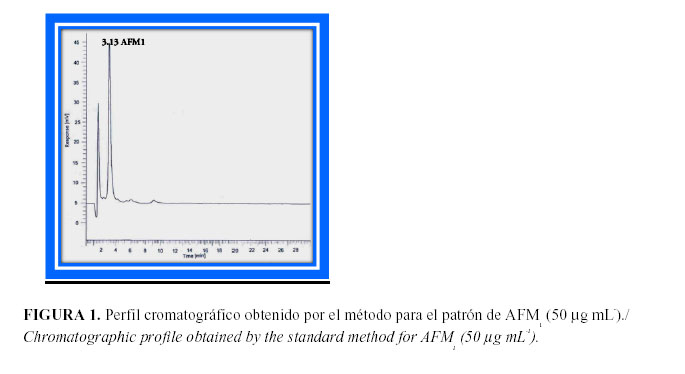
<body><![CDATA[<P   align="left" ><font face="Verdana, Arial, Helvetica, sans-serif" size="2"><B>An&aacute;lisis      estad&iacute;stico. </B>Estad&iacute;stica descriptiva. Estad&iacute;sticos      de resumen univariados (media aritm&eacute;tica, desviaci&oacute;n est&aacute;ndar,      m&iacute;nimo y m&aacute;ximo) para las variables utilizadas (aflatoxina M1).      </font></P >       <P   align="left" >&nbsp;</P >   </font></font></font></font></font></font></font></font></font></font></font></font></font></font></font></font></font></font></font></font></font></font></font></font></font></font></font></font></font></font></font></font></font></font></font></font></font></font></font></font></font></font></font></font></font></font></font></font></font></font></font></font></font></font></font></font></font></font></font>       <P   align="left" ></P >       <P   align="left" ></P >       <P   align="left" > </P >       <P   align="left" > </P >       <P   align="left" ><font size="3"><b><font face="Verdana, Arial, Helvetica, sans-serif" color="#000000">RESULTADOS      Y DISCUSI&Oacute;N </font></b></font></P >       <P   align="center" ><b><font face="Verdana, Arial, Helvetica, sans-serif" size="+1" color="#000000">      </font></b></P >   <b><FONT size="+1" color="#000000"><FONT size="+1"><FONT size="+1"><FONT size="+1"><FONT size="+1"><FONT size="+1"><FONT size="+1"><FONT size="+1"><FONT size="+1"><FONT size="+1"><FONT size="+1"><FONT size="+1"><FONT size="+1"><FONT size="+1"><FONT size="+1"><FONT size="+1"><FONT size="+1"><FONT size="+1"><FONT size="+1"><FONT size="+1"><FONT size="+1"><FONT size="+1"><FONT size="+1"><FONT size="+1"><FONT size="+1"><FONT size="+1"><FONT size="+1"><FONT size="+1"><FONT size="+1"><FONT size="+1"><FONT size="+1"><FONT size="+1"><FONT size="+1"><FONT size="+1"><FONT size="+1"><FONT size="+1"><FONT size="+1"><FONT size="+1"><FONT size="+1"><FONT size="+1"><FONT size="+1"><FONT size="+1"><FONT size="+1"><FONT size="+1"><FONT size="+1"><FONT size="+1"><FONT size="+1"><FONT size="+1"><FONT size="+1"><FONT size="+1"><FONT size="+1"><FONT size="+1"><FONT size="+1"><FONT size="+1"><FONT size="+1"><FONT size="+1"><FONT size="+1"><FONT size="+1"><FONT size="+1"></font></font></font></font></font></font></font></font></font></font></font></font></font></font></font></font></font></font></font></font></font></font></font></font></font></font></font></font></font></font></font></font></font></font></font></font></font></font></font></font></font></font></font></font></font></font></font></font></font></font></font></font></font></font></font></font></font></font></font></b><FONT size="+1" color="#000000"><FONT size="+1"><FONT size="+1"><FONT size="+1"><FONT size="+1"><FONT size="+1"><FONT size="+1"><FONT size="+1"><FONT size="+1"><FONT size="+1"><FONT size="+1"><FONT size="+1"><FONT size="+1"><FONT size="+1"><FONT size="+1"><FONT size="+1"><FONT size="+1"><FONT size="+1"><FONT size="+1"><FONT size="+1"><FONT size="+1"><FONT size="+1"><FONT size="+1"><FONT size="+1"><FONT size="+1"><FONT size="+1"><FONT size="+1"><FONT size="+1"><FONT size="+1"><FONT size="+1"><FONT size="+1"><FONT size="+1"><FONT size="+1"><FONT size="+1"><FONT size="+1"><FONT size="+1"><FONT size="+1"><FONT size="+1"><FONT size="+1"><FONT size="+1"><FONT size="+1"><FONT size="+1"><FONT size="+1"><FONT size="+1"><FONT size="+1"><FONT size="+1"><FONT size="+1"><FONT size="+1"><FONT size="+1"><FONT size="+1"><FONT size="+1"><FONT size="+1"><FONT size="+1"><FONT size="+1"><FONT size="+1"><FONT size="+1"><FONT size="+1"><FONT size="+1"><FONT size="+1"><B>       <P   align="center" > </P >   </B>        <P   align="justify" ><font face="Verdana, Arial, Helvetica, sans-serif" size="2">Las condiciones cromatogr&aacute;ficas      permitieron obtener un pico definido para la aflatoxina M<Sub>1</Sub>, tanto      para el patr&oacute;n como para las muestras, lo que permiti&oacute; evaluar      las caracter&iacute;sticas de desempe&ntilde;o del m&eacute;todo. El tiempo      de retenci&oacute;n para la Aflatoxina M<Sub>1</Sub> fue de 3.13 &plusmn;      0.10 minutos (<a href="/img/revistas/rsa/v32n2/f0103210.jpg">Figura 1</a>).La      curva de calibraci&oacute;n (Y=103281x &ndash; 5948.7) mostr&oacute; una linealidad      significativa (p&lt;0.05) y un coeficiente de determinaci&oacute;n de 0.9982.      Los l&iacute;mites de detecci&oacute;n y cuantificaci&oacute;n fueron 26.5      y 30.1 ng &micro;L,<Sup>1</Sup> respectivamente. El recobrado de la AFM<Sub>1</Sub>      en leche fue de 91% para un nivel de 40 &micro;g Kg<Sup>-1</Sup>, con una      precisi&oacute;n de 5%. </font></P >   <FONT size="+1"><FONT size="+1"><FONT size="+1"><FONT size="+1"><FONT size="+1"><FONT size="+1"><FONT size="+1"><FONT size="+1"><FONT size="+1"><FONT size="+1">        
]]></body>
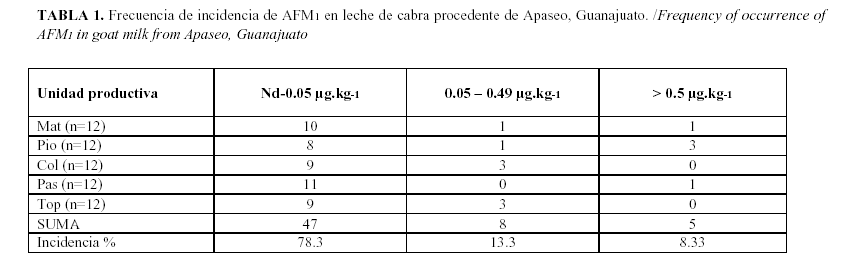
<body><![CDATA[<P   align="justify" > </P >   <FONT size="+1"><FONT size="+1"><FONT size="+1"><FONT size="+1"><FONT size="+1"><FONT size="+1"><FONT size="+1"><FONT size="+1"><FONT size="+1"><FONT size="+1">        <P   align="justify" > </P >       <P   align="justify" ><font face="Verdana, Arial, Helvetica, sans-serif" size="2">La aflatoxina M<Sub>1</Sub>      se encontr&oacute; presente en 18 (30%) de las 60 muestras de leche de cabra      examinadas. Los niveles de contaminaci&oacute;n variaron en los diferentes      meses, no detect&aacute;ndose en los meses de julio, agosto, noviembre y diciembre      del 2008, ni en junio de 2009. Los meses con mayor frecuencia (4 muestras      de 5), fueron marzo y octubre con intervalos de 0.29 a 1.54 y 0.02 a 0.81      &micro;g Kg<Sup>-1</Sup>. El valor de la mediana mayor fue encontrada en el      mes de marzo (0.87 &micro;g Kg<Sup>-1</Sup>). Estos resultados indican una      ingesta de alimento con contenidos elevados de AFB<Sub>1</Sub>. </font></P >   <FONT size="+1"><FONT size="+1"><FONT size="+1"><FONT size="+1"><FONT size="+1"><FONT size="+1"><FONT size="+1"><FONT size="+1">        <P   align="left" > </P >       <P   align="justify" ><font face="Verdana, Arial, Helvetica, sans-serif" size="2">El 8.3% de las muestras      analizadas presentaron niveles por arriba del LMR establecido de 0.5 &micro;g      Kg<Sup>-1 </Sup>por el Codex Alimentarius (3), FDA de los Estados Unidos (17)      y la Norma Oficial Mexicana (13) (<a href="/img/revistas/rsa/v32n2/f0203210.gif">Tabla      1</a>). Las muestras que presentaron contenidos superiores a los permitidos      por la normatividad mexicana pertenecen a tres de las unidades productivas,      siendo la denominada Pio, la que present&oacute; un 58% de muestras con presencia      de aflatoxina M<Sub>1</Sub>, de las cuales el 30% se encuentra en niveles      superiores al l&iacute;mite m&aacute;ximo establecido por la comunidad Europea      (0.05 &micro;g Kg<Sup>-1</Sup>). </font></P >   <FONT size="+1"><FONT size="+1"><FONT size="+1"><FONT size="+1"><FONT size="+1"><FONT size="+1">        
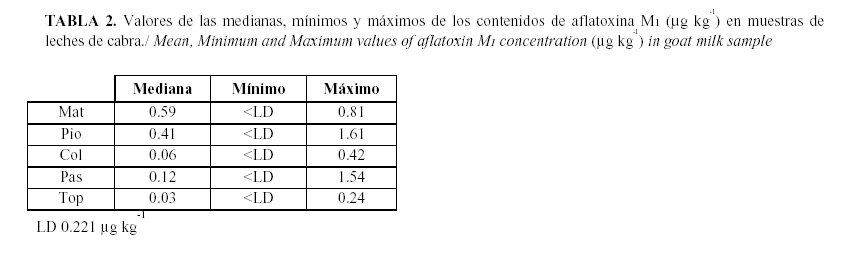
<P   align="left" > </P >   </font></font></font></font></font></font></font></font></font></font></font></font></font></font></font></font></font></font></font></font></font></font></font></font></font></font></font></font></font></font></font></font></font></font></font></font></font></font></font></font></font></font></font></font></font></font></font></font></font></font></font></font></font></font></font></font></font></font></font></font></font></font></font></font></font></font></font></font></font></font></font></font></font></font></font></font></font></font></font></font></font></font></font></font></font></font></font></font></font></font></font></font></font></DIV > <FONT size="+1" color="#000000"><FONT size="+1"><FONT size="+1"><FONT size="+1"><FONT size="+1"><FONT size="+1"><FONT size="+1"><FONT size="+1"><FONT size="+1"><FONT size="+1"><FONT size="+1"><FONT size="+1"><FONT size="+1"><FONT size="+1"><FONT size="+1"><FONT size="+1"><FONT size="+1"><FONT size="+1"><FONT size="+1"><FONT size="+1"><FONT size="+1"><FONT size="+1"><FONT size="+1"><FONT size="+1"><FONT size="+1"><FONT size="+1"><FONT size="+1"><FONT size="+1"><FONT size="+1"><FONT size="+1"><FONT size="+1"><FONT size="+1"><FONT size="+1"><FONT size="+1"><FONT size="+1"><FONT size="+1"><FONT size="+1"><FONT size="+1"><FONT size="+1"><FONT size="+1"><FONT size="+1"><FONT size="+1"><FONT size="+1"><FONT size="+1"><FONT size="+1"><FONT size="+1"><FONT size="+1"><FONT size="+1"><FONT size="+1"><FONT size="+1"><FONT size="+1"><FONT size="+1"><FONT size="+1"><FONT size="+1"><FONT size="+1"><FONT size="+1"><FONT size="+1"><FONT size="+1"><FONT size="+1"><FONT size="+1"><FONT size="+1"><FONT size="+1"><FONT size="+1"><FONT size="+1"><FONT size="+1"><FONT size="+1"><FONT size="+1"><FONT size="+1"><FONT size="+1"><FONT size="+1"><FONT size="+1"><FONT size="+1"><FONT size="+1"><FONT size="+1"><FONT size="+1"><FONT size="+1"><FONT size="+1"><FONT size="+1"><FONT size="+1"><FONT size="+1"><FONT size="+1"><FONT size="+1"><FONT size="+1"><FONT size="+1"><FONT size="+1"><FONT size="+1"><FONT size="+1"><FONT size="+1"><FONT size="+1"><FONT size="+1"><FONT size="+1"><FONT size="+1"><FONT size="+1"><FONT size="+1"><FONT size="+1"><FONT size="+1"><FONT size="+1"><FONT size="+1">     <DIV class="Sect"   >       <P   align="left" ><font face="Verdana, Arial, Helvetica, sans-serif" size="2">Los valores de las      medianas, m&iacute;nimos y m&aacute;ximos de los contenidos de aflatoxina      M<Sub>1</Sub> (&micro;g kg<Sup>-1</Sup>) en muestras de leches de cabra, por      unidad productiva se muestran en la <a href="/img/revistas/rsa/v32n2/f0303210.gif">Tabla      2</a>. Las concentraciones de AFM<Sub>1 </Sub>variaron de 0.01 a 1.61 &micro;g      Kg<Sup>-1</Sup> los valores de las medianas fluctuaron de 0.12 a 0.59 &micro;g      Kg<Sup>-1</Sup>, el valor m&aacute;ximo lo present&oacute;, la unidad productiva      denominada Pio (1.61 &micro;g Kg<Sup>-1</Sup>), seguida de denominada Pas      (1.54 &micro;g Kg<Sup>-1</Sup>). </font></P >   <FONT size="+1"><FONT size="+1"><FONT size="+1"><FONT size="+1"><FONT size="+1"><FONT size="+1"><FONT size="+1"><FONT size="+1"><FONT size="+1"><FONT size="+1"><FONT size="+1"><FONT size="+1"><FONT size="+1"><FONT size="+1"><FONT size="+1">    <FONT size="+1"><FONT size="+1"><FONT size="+1"><FONT size="+1"><FONT size="+1"><FONT size="+1"><FONT size="+1"><FONT size="+1"><FONT size="+1"><FONT size="+1">        
<P   align="left" > </P >   <FONT size="+1">        <P   align="justify" ><font face="Verdana, Arial, Helvetica, sans-serif" size="2">La incidencia de      AFM<Sub>1 </Sub>en leche de cabra observada en el presente estudio (30%),      est&aacute; por debajo de los descritos en otros trabajos (18-21); sin embargo      los niveles encontrados son muy superiores a los emcontrados por estos mismo      autores, que reportan valores de AFM1 en leche inferiores a 0.05 Kg<Sup>-1</Sup>      en todas las muestras estudiadas en Italia (22-23), 0.011 y 0.161 &micro;g      L<Sup>-1 </Sup>en Brasil (20). Los estudios anteriormente mencionados hacen      referencia que los niveles encontrados de AFM1 en leche de cabra no tienen      significado como factor de riesgo para los humanos, en tanto que en este trabajo      el 21.6% de las muestras presentaron niveles superiores a 0.05 &micro;g Kg<Sup>-1</Sup>,      con 8.3% de valores por arriba de 0.5 &micro;g kg<Sup>-1</Sup>, lo que corrobora      que los animales est&aacute;n expuesto a concentraciones elevadas de alfatoxina      B1 en el concentrado. </font></P >   <FONT size="+1"><FONT size="+1"><FONT size="+1"><FONT size="+1"><FONT size="+1"><FONT size="+1"><FONT size="+1"><FONT size="+1"><FONT size="+1"><FONT size="+1">        ]]></body>
<body><![CDATA[<P   align="left" > </P >       <P   align="justify" ><font face="Verdana, Arial, Helvetica, sans-serif" size="2">Los resultados encontrados      en las muestras de queso de cabra permiten observar que 3 de ellas pre-sentaron      alg&uacute;n nivel de AFM1, con un valor m&aacute;ximo de 0.23 &micro;g Kg<Sup>-1      </Sup>y un m&iacute;nimo de 0.1 &micro;g Kg<Sup>-1</Sup> (<a href="/img/revistas/rsa/v32n2/f0403210.gif">Tabla      3</a>), lo que representa un 15% de incidencia con valores no significativos      en cuestiones de salud p&uacute;blica. La incidencia en esta investigaci&oacute;n      es similar a la informada para quesos de cabra en Italia (24-25); sin embargo      los valores encontrados en quesos de cabra italianos oscilaron entre 19 a      200 ng/kg (25), es decir hasta 10 veces el valor m&aacute;ximo encontrado      en el presente trabajo. En otros estudios realizados en quesos producidos      en Turqu&iacute;a, se obtuvieron valores mayores a los de este estudio; el      valor m&aacute;ximo fue 860 ng Kg<Sup>-1</Sup>, (26). </font></P >   <FONT size="+1"><FONT size="+1"><FONT size="+1"><FONT size="+1"><FONT size="+1"><FONT size="+1">        
<P   align="left" > </P >   </font></font></font></font></font></font></font></font></font></font></font></font></font></font></font></font></font></font></font></font></font></font></font></font></font></font></font></font></font></font></font></font></font></font></font></font></font></font></font></font></font></font></DIV > <FONT size="+1"><FONT size="+1"><FONT size="+1"><FONT size="+1"><FONT size="+1"><FONT size="+1"><FONT size="+1"><FONT size="+1"><FONT size="+1"><FONT size="+1"><FONT size="+1"><FONT size="+1"><FONT size="+1"><FONT size="+1"><FONT size="+1"><FONT size="+1"><FONT size="+1"><FONT size="+1"><FONT size="+1"><FONT size="+1"><FONT size="+1"><FONT size="+1"><FONT size="+1"><FONT size="+1"><FONT size="+1"><FONT size="+1"><FONT size="+1"><FONT size="+1"><FONT size="+1"><FONT size="+1"><FONT size="+1"><FONT size="+1"><FONT size="+1"><FONT size="+1"><FONT size="+1"><FONT size="+1"><FONT size="+1"><FONT size="+1"><FONT size="+1"><FONT size="+1"><FONT size="+1"><FONT size="+1"><FONT size="+1"><FONT size="+1"><FONT size="+1"><FONT size="+1"><FONT size="+1">     <DIV class="Sect"   >     <P   align="left" ></P >   <FONT size="+1">        <P   align="left" > </P >       <P   align="justify" ><font face="Verdana, Arial, Helvetica, sans-serif" size="2">La Norma Mexicana      sobre quesos frescos, madurados y procesados no tiene nivel m&aacute;ximo      permitido para la AFM<Sub>1</Sub> expl&iacute;cito; sin embargo establece      en el inciso 6.1 que la leche con que se elaboran estos productos debe cumplir      con las especificaciones sanitarias marcadas en la norma de leche pasteurizada      (27). Sin embargo, al considerar el nivel de tolerancia de AFM<Sub>1 </Sub>en      queso (0.25 &micro;g Kg<Sup>-1</Sup>), establecido por algunos pa&iacute;ses      como Australia, Honduras, Suiza y Turqu&iacute;a (28), los resultados de este      trabajo indican que todas las muestras est&aacute;n por debajo de este l&iacute;mite.      </font></P >   <FONT size="+1"><FONT size="+1"><FONT size="+1"><FONT size="+1"><FONT size="+1"><FONT size="+1">        <P   align="left" > </P >       <P   align="justify" ><font face="Verdana, Arial, Helvetica, sans-serif" size="2">Finalmente, de acuerdo      al criterio de nivel de calidad aceptable propuesto en el dise&ntilde;o experimental,      el lote de quesos de cabra cumple con la especificaci&oacute;n para ser aceptado,      al no implicar ning&uacute;n riesgo para la salud. </font></P >       <P   align="left" > </P >       ]]></body>
<body><![CDATA[<P   align="justify" ><font face="Verdana, Arial, Helvetica, sans-serif" size="2">Los resultados de      este estudio indican la necesidad de elevar los niveles de conocimiento sobre      la inocuidad de los productos l&aacute;cteos respecto a la contaminaci&oacute;n      con AFM<Sub>1</Sub>, implicando un mayor &eacute;nfasis en la aplicaci&oacute;n      de las buenas pr&aacute;cticas en el almacenamiento de alimentos de animales      en M&eacute;xico. </font></P >       <P   align="justify" >&nbsp;</P >   <FONT size="+1"><FONT size="+1">        <P   align="left" ><font face="Verdana, Arial, Helvetica, sans-serif" size="3"><B>REFERENCIAS </b></font>   </font></font></font></font></font></font></font></font></font>       <!-- ref --><p><FONT size="+1"><FONT size="+1"><FONT size="+1"><FONT size="+1"><FONT size="+1"><FONT size="+1"><FONT size="+1"><FONT size="+1"><FONT size="+1"><B>      </B><font face="Verdana, Arial, Helvetica, sans-serif" size="2">1. Van Egmond      HP. Current situation on regulations for mycotoxins. Overview of tolerances      and status of standard methods of sampling and analysis. Food Additives &amp;      Contaminants. 1989;6(2):139-88.</font></font></font></font></font></font></font></font></font></font><!-- ref --><p><FONT size="+1"><FONT size="+1"><FONT size="+1"><FONT size="+1"><FONT size="+1"><FONT size="+1"><FONT size="+1"><FONT size="+1"><FONT size="+1"><font face="Verdana, Arial, Helvetica, sans-serif" size="2">2.      Martins ML, Martins HM. Aflatoxin M1 in raw and ultra high temperature-treated      milk commercialized in Portugal. Food Additives &amp; Contaminants. 2000;17(10):871-4.      </font> </font></font></font></font></font></font></font></font></font><!-- ref --><p><font face="Verdana, Arial, Helvetica, sans-serif" size="2">3. IPCS. Aflatoxin      M1. En:Safety evaluation of certain mycotoxins in food. FAO Food and Nutrition      PAPER 74, WHO Food Additives SERIES 47. 2001:1-102. </font><p><font face="Verdana, Arial, Helvetica, sans-serif" size="2">4. IARC. Some      Traditional Herbal Medicines, Some Myacotoxins, Naphthalene and Styrene En:      IARC Monographs on the evaluations of carcinogenic risks to humans. 2002;Vol      82. </font></p>       <!-- ref --><p><font face="Verdana, Arial, Helvetica, sans-serif" size="2">5. Mazzette A,      Decandia M, Acciaro M, Fenu A, D&iacute;az Francesconi A, Battacone G. Excretion      of aflatoxin M1 in milk of goats fed diet contaminated by aflatoxin B1. Ital      J Anim Sci. 2009;8(2):631-3. </font><!-- ref --><p><font face="Verdana, Arial, Helvetica, sans-serif" size="2">6. Galvano F,      Galofaro V, Galvano G. Occurrence and stability of aflatoxin M1 in milk and      milk products: A worldwide review. J Food Prot. 1996;59:1079-90. </font><!-- ref --><p><font face="Verdana, Arial, Helvetica, sans-serif" size="2">7. Oruc HH, Cibik      R, Yilmaz E, Gunes E. Fate of aflatoxin M1 in kashar cheese. J Food Safety.      2007;27(1):82-90. </font><!-- ref --><p><font face="Verdana, Arial, Helvetica, sans-serif" size="2">8. P&eacute;rez      J, Guti&eacute;rrez R, Vega S, D&iacute;az G, Urb&aacute;n G, Coronado M,      et al. Ocurrencia de Aflatoxina M1 en leches crudas, ultrapasteurizada y org&aacute;nica      producidas y comercializadas en el altiplano Mexicano. Rev Salud Anim. 2008;30(2):103-9.      </font><!-- ref --><p><font face="Verdana, Arial, Helvetica, sans-serif" size="2">9. Esqueda M,      Higuera-Ciapara I, Nieblas J. Aflatoxina M1 en leche comercializada en Hermosillo,      Sonora, M&eacute;xico. Rev Mex Mic 1995;11:179-83. </font><!-- ref --><p><font face="Verdana, Arial, Helvetica, sans-serif" size="2">10. Carvajal      M, Bola&ntilde;os A, Rojo F, M&eacute;ndez I. Aflatoxin M1 in pasteurized      and ultrapasteurized milk with different fat content in Mexico. J Food Protection.      2003;66(10):1885-92. </font><!-- ref --><p><font face="Verdana, Arial, Helvetica, sans-serif" size="2">11. Cordova A,      Oaxaca J, Lang G, Su&aacute;rez S, Campos V, Betancourt S, et al. Identification      of M1 aflatoxin in milk of the collector tank. J Ani Vet Advances. 2007;6(2):194-7.      </font><!-- ref --><p><font face="Verdana, Arial, Helvetica, sans-serif" size="2">12. COFOCALEC.      Sistema producto leche-Producto leche-Alimentos-L&aacute;cteos. Gu&iacute;a      para el muestreo de leche y productos l&aacute;cteos. M&eacute;xico. Norma      Mexicana NMX-F-718-COFOCALEC-2006 2006:P. 31. </font><!-- ref --><p><font face="Verdana, Arial, Helvetica, sans-serif" size="2">13. NOM. Productos      y servicios. Leche, f&oacute;rmula l&aacute;ctea y producto l&aacute;cteo      combinado. Especificaciones sanitarias. Secretar&iacute;a de Salud. Publicada      en el Diario Oficial de la Federaci&oacute;n el 23 de octubre de 2002. Norma      Oficial Mexicana. 2002;NOM- 184 SSA1-2002. </font><!-- ref --><p><font face="Verdana, Arial, Helvetica, sans-serif" size="2">14. AOAC. Aflatoxins      M1 y M2 in fluid milk. Liquid Chromatographic Method 986.16. In: Official      Method of Analysis of AOAC International 17th Edition Volume II Ed Patricia      Cinnif Cap 49(49306 E) Natural Toxins Peter M Scott P 40-41, <I>2000. </I>      </font><!-- ref --><p><font face="Verdana, Arial, Helvetica, sans-serif" size="2">15. AOAC. Aflatoxin      M1 in milk and Cheese. Method 980.21. In: Official Method of Analysis of AOAC      International 16th Edition Volume II Food composition; additives; natural      contaminants Cap 49(49302 C y D) Natural Toxins P 37-38. 2000. </font><!-- ref --><p><font face="Verdana, Arial, Helvetica, sans-serif" size="2">16. AOAC. Standards      for Aflatoxins. Method 971.22. In: Official Method of Analysis of AOAC International      17th Edition Volume II Food composition; additives; natural contaminants Cap      49(49203 B y C) Natural Toxins P 4-5. 2000. </font><!-- ref --><p><font face="Verdana, Arial, Helvetica, sans-serif" size="2">17. FDA. Compliance      Policy Guides Section. (7106.210, Section 527.400 Whole Milk,Low Fat Skim      Milk-Aflatoxin M1). Office of Regulatory Affairs, Washington D.C. 1996:p.219.      </font><!-- ref --><p><font face="Verdana, Arial, Helvetica, sans-serif" size="2">18. Ghanem I,      Orfi M. Aflatoxin M1 in raw, pasteurized and powdered milk available in the      Syriam market. Food Control. 2009;20(6):603-5. </font><p><font face="Verdana, Arial, Helvetica, sans-serif" size="2">19. Motawee M,      Bauer J, McMahon D. Survey of aflatoxina M1 in cow, goat, buffalo and camel      milks in Ismailia &ndash; Egypt. Bull Environ Contam Toxicol 2009;83:766-9.      </font></p>       <!-- ref --><p><font face="Verdana, Arial, Helvetica, sans-serif" size="2">20. Oliveira      C, Ferraz O. Occurrence of aflatoxin M1 in pasteurised, UHT milk and milk      powder from goat origin Food Control. 2007;18(4):375-8. </font><!-- ref --><p><font face="Verdana, Arial, Helvetica, sans-serif" size="2">21. &Ouml;zdemir      M. Determination of aflatoxina M1 level in goat milk consumed in Kilis province.      Ankara &Uuml;niversitesi Veteriner Fak&uuml;ltesi Dergisi 2007;54(2):99-103.      </font><!-- ref --><p><font face="Verdana, Arial, Helvetica, sans-serif" size="2">22. Sacc&agrave;      E, Boscolo D, Vallati A, Ventura W, Bigaran F, Piasentier E. Aflatoxin occurrence      in milk and supplied concentrates of goat farms of north-eastern Italy. J      Sci Food Agricult. 2009;89(3):487-93. </font><!-- ref --><p><font face="Verdana, Arial, Helvetica, sans-serif" size="2">23. Virdis S,      Corgiolu G, Scarano C, Pilo A, De Santi E. Occurrence of aflatoxin M1 in tank      bulk goat milk and ripened goat cheese. Food Control. 2008;19(1):44-9. </font><p><font face="Verdana, Arial, Helvetica, sans-serif" size="2">24. Montagna      M, Napoli C, De Giglio O, Iatta R, Barbuti G. Occurrence of aflatoxin M1 in      dairy products in Southern Italy. Int J Mol Sci. 9. 2008;9:2614-21. </font></p>       <!-- ref --><p><font face="Verdana, Arial, Helvetica, sans-serif" size="2">25. Finoli C,      Vecchio A. Aflatoxin M1 in goat dairy products. Microbiologie Aliments Nutrition.      1997;15(1):47-52. </font><!-- ref --><p><font face="Verdana, Arial, Helvetica, sans-serif" size="2">26. Ardic M,      Karakaya Y, Atasever M, Adiguzel G. Aflatoxin M1 levels of Turkish white brined      cheese. Food Control 2009;20(3):196-9. </font><!-- ref --><p><font face="Verdana, Arial, Helvetica, sans-serif" size="2">27. NOM. Norma      Oficial Mexicana Bienes y servicios. Quesos: frescos, madurados y procesados.      Especificaciones sanitarias. Secretar&iacute;a de Salud. Publicada en el Diario      Oficial de la Federaci&oacute;n el 23 de febrero de 1996. NOM-121 SSA1-1994      1994. </font><!-- ref --><p><font face="Verdana, Arial, Helvetica, sans-serif" size="2">28. Colak H,      Hampikyan H, Ulusoy B. Comparison of a competitive ELISA with an HPLC method      for the determination of aflatoxin M1 in turkish white, kasar and tulum cheeses.      Eur Food Res Technol. 2006;223(6):719-23.</font><p>&nbsp;</p>       <p>&nbsp;</p>   <FONT size="+1"><FONT size="+1"><FONT size="+1"><FONT size="+1"><FONT size="+1"><FONT size="+1"><FONT size="+1"><FONT size="+1"><FONT size="+1">       <P   align="left" ></P >       <P   align="left" ></P >       <P   align="left" ></P >       <P   align="left" > </P >       <P   align="left" ><font face="Verdana, Arial, Helvetica, sans-serif" size="2"><B>(Recibido 20-11-2009;      Aceptado 22-1-2010) </B> </font></P >   </font></font></font></font></font></font></font></font></font></DIV > </font></font></font></font></font></font></font></font></font></font></font></font></font></font></font></font></font></font></font></font></font></font></font></font></font></font></font></font></font></font></font></font></font></font></font></font></font></font></font></font></font></font></font></font></font></font></font></font></font></font></font></font></font></font></font></font></font></font></font></font></font></font></font></font></font></font></font></font></font></font></font></font></font></font></font></font></font></font></font></font></font></font></font></font></font></font></font></font></font></font></font></font></font></font></font></font></font></font></font></font></font></font></font></font></font></font></font></font></font></font></font></font></font></font></font></font></font></font></font></font></font></font></font></font></font></font></font></font></font></font></font></font></font></font></font></font></font></font></font></font></font></font></font></font></font>       ]]></body><back>
<ref-list>
<ref id="B1">
<label>1</label><nlm-citation citation-type="journal">
<person-group person-group-type="author">
<name>
<surname><![CDATA[Van Egmond]]></surname>
<given-names><![CDATA[HP]]></given-names>
</name>
</person-group>
<article-title xml:lang="en"><![CDATA[Current situation on regulations for mycotoxins. Overview of tolerances and status of standard methods of sampling and analysis]]></article-title>
<source><![CDATA[Food Additives & Contaminants]]></source>
<year>1989</year>
<volume>6</volume>
<numero>2</numero>
<issue>2</issue>
<page-range>139-88</page-range></nlm-citation>
</ref>
<ref id="B2">
<label>2</label><nlm-citation citation-type="journal">
<person-group person-group-type="author">
<name>
<surname><![CDATA[Martins]]></surname>
<given-names><![CDATA[ML]]></given-names>
</name>
<name>
<surname><![CDATA[Martins]]></surname>
<given-names><![CDATA[HM]]></given-names>
</name>
</person-group>
<article-title xml:lang="en"><![CDATA[Aflatoxin M1 in raw and ultra high temperature-treated milk commercialized in Portugal]]></article-title>
<source><![CDATA[Food Additives & Contaminants]]></source>
<year>2000</year>
<volume>17</volume>
<numero>10</numero>
<issue>10</issue>
<page-range>871-4</page-range></nlm-citation>
</ref>
<ref id="B3">
<label>3</label><nlm-citation citation-type="journal">
<collab>IPCS</collab>
<article-title xml:lang="en"><![CDATA[Aflatoxin M1. En:Safety evaluation of certain mycotoxins in food]]></article-title>
<source><![CDATA[FAO Food and Nutrition PAPER 74, WHO Food Additives SERIES 47]]></source>
<year>2001</year>
<page-range>1-102</page-range></nlm-citation>
</ref>
<ref id="B4">
<label>4</label><nlm-citation citation-type="journal">
<collab>IARC</collab>
<article-title xml:lang="en"><![CDATA[Some Traditional Herbal Medicines, Some Myacotoxins, Naphthalene and Styrene]]></article-title>
<source><![CDATA[IARC Monographs on the evaluations of carcinogenic risks to humans]]></source>
<year>2002</year>
<volume>82</volume>
</nlm-citation>
</ref>
<ref id="B5">
<label>5</label><nlm-citation citation-type="journal">
<person-group person-group-type="author">
<name>
<surname><![CDATA[Mazzette]]></surname>
<given-names><![CDATA[A]]></given-names>
</name>
<name>
<surname><![CDATA[Decandia]]></surname>
<given-names><![CDATA[M]]></given-names>
</name>
<name>
<surname><![CDATA[Acciaro]]></surname>
<given-names><![CDATA[M]]></given-names>
</name>
<name>
<surname><![CDATA[Fenu]]></surname>
<given-names><![CDATA[A]]></given-names>
</name>
<name>
<surname><![CDATA[Díaz Francesconi]]></surname>
<given-names><![CDATA[A]]></given-names>
</name>
<name>
<surname><![CDATA[Battacone]]></surname>
<given-names><![CDATA[G]]></given-names>
</name>
</person-group>
<article-title xml:lang="en"><![CDATA[Excretion of aflatoxin M1 in milk of goats fed diet contaminated by aflatoxin B1]]></article-title>
<source><![CDATA[Ital J Anim Sci]]></source>
<year>2009</year>
<volume>8</volume>
<numero>2</numero>
<issue>2</issue>
<page-range>631-3</page-range></nlm-citation>
</ref>
<ref id="B6">
<label>6</label><nlm-citation citation-type="journal">
<person-group person-group-type="author">
<name>
<surname><![CDATA[Galvano]]></surname>
<given-names><![CDATA[F]]></given-names>
</name>
<name>
<surname><![CDATA[Galofaro]]></surname>
<given-names><![CDATA[V]]></given-names>
</name>
<name>
<surname><![CDATA[Galvano]]></surname>
<given-names><![CDATA[G]]></given-names>
</name>
</person-group>
<article-title xml:lang="en"><![CDATA[Occurrence and stability of aflatoxin M1 in milk and milk products: A worldwide review]]></article-title>
<source><![CDATA[J Food Prot]]></source>
<year>1996</year>
<volume>59</volume>
<page-range>1079-90</page-range></nlm-citation>
</ref>
<ref id="B7">
<label>7</label><nlm-citation citation-type="journal">
<person-group person-group-type="author">
<name>
<surname><![CDATA[Oruc]]></surname>
<given-names><![CDATA[HH]]></given-names>
</name>
<name>
<surname><![CDATA[Cibik]]></surname>
<given-names><![CDATA[R]]></given-names>
</name>
<name>
<surname><![CDATA[Yilmaz]]></surname>
<given-names><![CDATA[E]]></given-names>
</name>
<name>
<surname><![CDATA[Gunes]]></surname>
<given-names><![CDATA[E]]></given-names>
</name>
</person-group>
<article-title xml:lang="en"><![CDATA[Fate of aflatoxin M1 in kashar cheese]]></article-title>
<source><![CDATA[J Food Safety]]></source>
<year>2007</year>
<volume>27</volume>
<numero>1</numero>
<issue>1</issue>
<page-range>82-90</page-range></nlm-citation>
</ref>
<ref id="B8">
<label>8</label><nlm-citation citation-type="journal">
<person-group person-group-type="author">
<name>
<surname><![CDATA[Pérez]]></surname>
<given-names><![CDATA[J]]></given-names>
</name>
<name>
<surname><![CDATA[Gutiérrez]]></surname>
<given-names><![CDATA[R]]></given-names>
</name>
<name>
<surname><![CDATA[Vega]]></surname>
<given-names><![CDATA[S]]></given-names>
</name>
<name>
<surname><![CDATA[Díaz]]></surname>
<given-names><![CDATA[G]]></given-names>
</name>
<name>
<surname><![CDATA[Urbán]]></surname>
<given-names><![CDATA[G]]></given-names>
</name>
<name>
<surname><![CDATA[Coronado]]></surname>
<given-names><![CDATA[M]]></given-names>
</name>
</person-group>
<article-title xml:lang="es"><![CDATA[Ocurrencia de Aflatoxina M1 en leches crudas, ultrapasteurizada y orgánica producidas y comercializadas en el altiplano Mexicano]]></article-title>
<source><![CDATA[Rev Salud Anim]]></source>
<year>2008</year>
<volume>30</volume>
<numero>2</numero>
<issue>2</issue>
<page-range>103-9</page-range></nlm-citation>
</ref>
<ref id="B9">
<label>9</label><nlm-citation citation-type="journal">
<person-group person-group-type="author">
<name>
<surname><![CDATA[Esqueda]]></surname>
<given-names><![CDATA[M]]></given-names>
</name>
<name>
<surname><![CDATA[Higuera-Ciapara]]></surname>
<given-names><![CDATA[I]]></given-names>
</name>
<name>
<surname><![CDATA[Nieblas]]></surname>
<given-names><![CDATA[J]]></given-names>
</name>
</person-group>
<article-title xml:lang="es"><![CDATA[Aflatoxina M1 en leche comercializada en Hermosillo, Sonora, México]]></article-title>
<source><![CDATA[Rev Mex Mic]]></source>
<year>1995</year>
<volume>11</volume>
<page-range>179-83</page-range></nlm-citation>
</ref>
<ref id="B10">
<label>10</label><nlm-citation citation-type="journal">
<person-group person-group-type="author">
<name>
<surname><![CDATA[Carvajal]]></surname>
<given-names><![CDATA[M]]></given-names>
</name>
<name>
<surname><![CDATA[Bolaños]]></surname>
<given-names><![CDATA[A]]></given-names>
</name>
<name>
<surname><![CDATA[Rojo]]></surname>
<given-names><![CDATA[F]]></given-names>
</name>
<name>
<surname><![CDATA[Méndez]]></surname>
<given-names><![CDATA[I]]></given-names>
</name>
</person-group>
<article-title xml:lang="en"><![CDATA[Aflatoxin M1 in pasteurized and ultrapasteurized milk with different fat content in Mexico]]></article-title>
<source><![CDATA[J Food Protection]]></source>
<year>2003</year>
<volume>66</volume>
<numero>10</numero>
<issue>10</issue>
<page-range>1885-92</page-range></nlm-citation>
</ref>
<ref id="B11">
<label>11</label><nlm-citation citation-type="journal">
<person-group person-group-type="author">
<name>
<surname><![CDATA[Cordova]]></surname>
<given-names><![CDATA[A]]></given-names>
</name>
<name>
<surname><![CDATA[Oaxaca]]></surname>
<given-names><![CDATA[J]]></given-names>
</name>
<name>
<surname><![CDATA[Lang]]></surname>
<given-names><![CDATA[G]]></given-names>
</name>
<name>
<surname><![CDATA[Suárez]]></surname>
<given-names><![CDATA[S]]></given-names>
</name>
<name>
<surname><![CDATA[Campos]]></surname>
<given-names><![CDATA[V]]></given-names>
</name>
<name>
<surname><![CDATA[Betancourt]]></surname>
<given-names><![CDATA[S]]></given-names>
</name>
</person-group>
<article-title xml:lang="en"><![CDATA[Identification of M1 aflatoxin in milk of the collector tank]]></article-title>
<source><![CDATA[J Ani Vet Advances]]></source>
<year>2007</year>
<volume>6</volume>
<numero>2</numero>
<issue>2</issue>
<page-range>194-7</page-range></nlm-citation>
</ref>
<ref id="B12">
<label>12</label><nlm-citation citation-type="">
<source><![CDATA[COFOCALEC. Sistema producto leche-Producto leche-Alimentos-Lácteos. Guía para el muestreo de leche y productos lácteos]]></source>
<year>2006</year>
<page-range>31</page-range><publisher-loc><![CDATA[México ]]></publisher-loc>
</nlm-citation>
</ref>
<ref id="B13">
<label>13</label><nlm-citation citation-type="book">
<source><![CDATA[Productos y servicios. Leche, fórmula láctea y producto lácteo combinado. Especificaciones sanitarias. Secretaría de Salud. Publicada en el Diario Oficial de la Federación el 23 de octubre de 2002]]></source>
<year>2002</year>
<publisher-name><![CDATA[NOM]]></publisher-name>
</nlm-citation>
</ref>
<ref id="B14">
<label>14</label><nlm-citation citation-type="">
<collab>AOAC</collab>
<article-title xml:lang="en"><![CDATA[Aflatoxins M1 y M2 in fluid milk. Liquid Chromatographic Method 986.16]]></article-title>
<source><![CDATA[Official Method of Analysis of AOAC International]]></source>
<year>2000</year>
<edition>17th</edition>
<page-range>40-41</page-range></nlm-citation>
</ref>
<ref id="B15">
<label>15</label><nlm-citation citation-type="">
<collab>AOAC</collab>
<article-title xml:lang="en"><![CDATA[Aflatoxin M1 in milk and Cheese. Method 980.21]]></article-title>
<source><![CDATA[Official Method of Analysis of AOAC International]]></source>
<year>2000</year>
<edition>16th</edition>
<page-range>37-38</page-range></nlm-citation>
</ref>
<ref id="B16">
<label>16</label><nlm-citation citation-type="">
<collab>AOAC</collab>
<article-title xml:lang="en"><![CDATA[Standards for Aflatoxins. Method 971.22]]></article-title>
<source><![CDATA[Official Method of Analysis of AOAC International 17th Edition Volume II Food composition; additives; natural contaminants]]></source>
<year>2000</year>
<page-range>4-5</page-range></nlm-citation>
</ref>
<ref id="B17">
<label>17</label><nlm-citation citation-type="book">
<source><![CDATA[Compliance Policy Guides Section. (7106.210, Section 527.400 Whole Milk,Low Fat Skim Milk-Aflatoxin M1)]]></source>
<year>1996</year>
<page-range>219</page-range><publisher-loc><![CDATA[Washington D.C ]]></publisher-loc>
<publisher-name><![CDATA[FDA]]></publisher-name>
</nlm-citation>
</ref>
<ref id="B18">
<label>18</label><nlm-citation citation-type="journal">
<person-group person-group-type="author">
<name>
<surname><![CDATA[Ghanem]]></surname>
<given-names><![CDATA[I]]></given-names>
</name>
<name>
<surname><![CDATA[Orfi]]></surname>
<given-names><![CDATA[M]]></given-names>
</name>
</person-group>
<article-title xml:lang="en"><![CDATA[Aflatoxin M1 in raw, pasteurized and powdered milk available in the Syriam market]]></article-title>
<source><![CDATA[Food Control]]></source>
<year>2009</year>
<volume>20</volume>
<numero>6</numero>
<issue>6</issue>
<page-range>603-5</page-range></nlm-citation>
</ref>
<ref id="B19">
<label>19</label><nlm-citation citation-type="journal">
<person-group person-group-type="author">
<name>
<surname><![CDATA[Motawee]]></surname>
<given-names><![CDATA[M]]></given-names>
</name>
<name>
<surname><![CDATA[Bauer]]></surname>
<given-names><![CDATA[J]]></given-names>
</name>
<name>
<surname><![CDATA[McMahon]]></surname>
<given-names><![CDATA[D]]></given-names>
</name>
</person-group>
<article-title xml:lang="en"><![CDATA[Survey of aflatoxina M1 in cow, goat, buffalo and camel milks in Ismailia - Egypt]]></article-title>
<source><![CDATA[Bull Environ Contam Toxicol]]></source>
<year>2009</year>
<volume>83</volume>
<page-range>766-9</page-range></nlm-citation>
</ref>
<ref id="B20">
<label>20</label><nlm-citation citation-type="journal">
<person-group person-group-type="author">
<name>
<surname><![CDATA[Oliveira]]></surname>
<given-names><![CDATA[C]]></given-names>
</name>
<name>
<surname><![CDATA[Ferraz]]></surname>
<given-names><![CDATA[O]]></given-names>
</name>
</person-group>
<article-title xml:lang="en"><![CDATA[Occurrence of aflatoxin M1 in pasteurised, UHT milk and milk powder from goat origin]]></article-title>
<source><![CDATA[Food Control]]></source>
<year>2007</year>
<volume>18</volume>
<numero>4</numero>
<issue>4</issue>
<page-range>375-8</page-range></nlm-citation>
</ref>
<ref id="B21">
<label>21</label><nlm-citation citation-type="journal">
<person-group person-group-type="author">
<name>
<surname><![CDATA[Özdemir]]></surname>
<given-names><![CDATA[M]]></given-names>
</name>
</person-group>
<article-title xml:lang="en"><![CDATA[Determination of aflatoxina M1 level in goat milk consumed in Kilis province]]></article-title>
<source><![CDATA[Ankara Üniversitesi Veteriner Fakültesi Dergisi]]></source>
<year>2007</year>
<volume>54</volume>
<numero>2</numero>
<issue>2</issue>
<page-range>99-103</page-range></nlm-citation>
</ref>
<ref id="B22">
<label>22</label><nlm-citation citation-type="journal">
<person-group person-group-type="author">
<name>
<surname><![CDATA[Saccà]]></surname>
<given-names><![CDATA[E]]></given-names>
</name>
<name>
<surname><![CDATA[Boscolo]]></surname>
<given-names><![CDATA[D]]></given-names>
</name>
<name>
<surname><![CDATA[Vallati]]></surname>
<given-names><![CDATA[A]]></given-names>
</name>
<name>
<surname><![CDATA[Ventura]]></surname>
<given-names><![CDATA[W]]></given-names>
</name>
<name>
<surname><![CDATA[Bigaran]]></surname>
<given-names><![CDATA[F]]></given-names>
</name>
<name>
<surname><![CDATA[Piasentier]]></surname>
<given-names><![CDATA[E]]></given-names>
</name>
</person-group>
<article-title xml:lang="en"><![CDATA[Aflatoxin occurrence in milk and supplied concentrates of goat farms of north-eastern Italy]]></article-title>
<source><![CDATA[J Sci Food Agricult]]></source>
<year>2009</year>
<volume>89</volume>
<numero>3</numero>
<issue>3</issue>
<page-range>487-93</page-range></nlm-citation>
</ref>
<ref id="B23">
<label>23</label><nlm-citation citation-type="journal">
<person-group person-group-type="author">
<name>
<surname><![CDATA[Virdis]]></surname>
<given-names><![CDATA[S]]></given-names>
</name>
<name>
<surname><![CDATA[Corgiolu]]></surname>
<given-names><![CDATA[G]]></given-names>
</name>
<name>
<surname><![CDATA[Scarano]]></surname>
<given-names><![CDATA[C]]></given-names>
</name>
<name>
<surname><![CDATA[Pilo]]></surname>
<given-names><![CDATA[A]]></given-names>
</name>
<name>
<surname><![CDATA[De Santi]]></surname>
<given-names><![CDATA[E]]></given-names>
</name>
</person-group>
<article-title xml:lang="en"><![CDATA[Occurrence of aflatoxin M1 in tank bulk goat milk and ripened goat cheese]]></article-title>
<source><![CDATA[Food Control]]></source>
<year>2008</year>
<volume>19</volume>
<numero>1</numero>
<issue>1</issue>
<page-range>44-9</page-range></nlm-citation>
</ref>
<ref id="B24">
<label>24</label><nlm-citation citation-type="journal">
<person-group person-group-type="author">
<name>
<surname><![CDATA[Montagna]]></surname>
<given-names><![CDATA[M]]></given-names>
</name>
<name>
<surname><![CDATA[Napoli]]></surname>
<given-names><![CDATA[C]]></given-names>
</name>
<name>
<surname><![CDATA[De Giglio]]></surname>
<given-names><![CDATA[O]]></given-names>
</name>
<name>
<surname><![CDATA[Iatta]]></surname>
<given-names><![CDATA[R]]></given-names>
</name>
<name>
<surname><![CDATA[Barbuti]]></surname>
<given-names><![CDATA[G]]></given-names>
</name>
</person-group>
<article-title xml:lang="en"><![CDATA[Occurrence of aflatoxin M1 in dairy products in Southern Italy]]></article-title>
<source><![CDATA[Int J Mol Sci]]></source>
<year>2008</year>
<volume>9</volume>
<page-range>2614-21</page-range></nlm-citation>
</ref>
<ref id="B25">
<label>25</label><nlm-citation citation-type="journal">
<person-group person-group-type="author">
<name>
<surname><![CDATA[Finoli]]></surname>
<given-names><![CDATA[C]]></given-names>
</name>
<name>
<surname><![CDATA[Vecchio]]></surname>
<given-names><![CDATA[A]]></given-names>
</name>
</person-group>
<article-title xml:lang="en"><![CDATA[Aflatoxin M1 in goat dairy products]]></article-title>
<source><![CDATA[Microbiologie Aliments Nutrition]]></source>
<year>1997</year>
<volume>15</volume>
<numero>1</numero>
<issue>1</issue>
<page-range>47-52</page-range></nlm-citation>
</ref>
<ref id="B26">
<label>26</label><nlm-citation citation-type="journal">
<person-group person-group-type="author">
<name>
<surname><![CDATA[Ardic]]></surname>
<given-names><![CDATA[M]]></given-names>
</name>
<name>
<surname><![CDATA[Karakaya]]></surname>
<given-names><![CDATA[Y]]></given-names>
</name>
<name>
<surname><![CDATA[Atasever]]></surname>
<given-names><![CDATA[M]]></given-names>
</name>
<name>
<surname><![CDATA[Adiguzel]]></surname>
<given-names><![CDATA[G]]></given-names>
</name>
</person-group>
<article-title xml:lang="en"><![CDATA[Aflatoxin M1 levels of Turkish white brined cheese]]></article-title>
<source><![CDATA[Food Control]]></source>
<year>2009</year>
<volume>20</volume>
<numero>3</numero>
<issue>3</issue>
<page-range>196-9</page-range></nlm-citation>
</ref>
<ref id="B27">
<label>27</label><nlm-citation citation-type="book">
<source><![CDATA[Norma Oficial Mexicana Bienes y servicios. Quesos: frescos, madurados y procesados. Especificaciones sanitarias. Secretaría de Salud. Publicada en el Diario Oficial de la Federación el 23 de febrero de 1996]]></source>
<year>1994</year>
<publisher-name><![CDATA[NOM]]></publisher-name>
</nlm-citation>
</ref>
<ref id="B28">
<label>28</label><nlm-citation citation-type="journal">
<person-group person-group-type="author">
<name>
<surname><![CDATA[Colak]]></surname>
<given-names><![CDATA[H]]></given-names>
</name>
<name>
<surname><![CDATA[Hampikyan]]></surname>
<given-names><![CDATA[H]]></given-names>
</name>
<name>
<surname><![CDATA[Ulusoy]]></surname>
<given-names><![CDATA[B]]></given-names>
</name>
</person-group>
<article-title xml:lang="en"><![CDATA[Comparison of a competitive ELISA with an HPLC method for the determination of aflatoxin M1 in turkish white, kasar and tulum cheeses]]></article-title>
<source><![CDATA[Eur Food Res Technol]]></source>
<year>2006</year>
<volume>223</volume>
<numero>6</numero>
<issue>6</issue>
<page-range>719-23</page-range></nlm-citation>
</ref>
</ref-list>
</back>
</article>