<?xml version="1.0" encoding="ISO-8859-1"?><article xmlns:mml="http://www.w3.org/1998/Math/MathML" xmlns:xlink="http://www.w3.org/1999/xlink" xmlns:xsi="http://www.w3.org/2001/XMLSchema-instance">
<front>
<journal-meta>
<journal-id>0253-570X</journal-id>
<journal-title><![CDATA[Revista de Salud Animal]]></journal-title>
<abbrev-journal-title><![CDATA[Rev Salud Anim.]]></abbrev-journal-title>
<issn>0253-570X</issn>
<publisher>
<publisher-name><![CDATA[Centro Nacional de Sanidad Agropecuaria]]></publisher-name>
</publisher>
</journal-meta>
<article-meta>
<article-id>S0253-570X2010000200004</article-id>
<title-group>
<article-title xml:lang="en"><![CDATA[A MULTIVARIATE ANALYSIS OF Boophilus microplus (ACARI: IXODIDAE): NON-PARASITIC PHASE]]></article-title>
<article-title xml:lang="es"><![CDATA[ANALISIS MULTIVARIADO DE Boophilus microplus (ACARI: IXODIDAE):FASE NO PARASÍTICA]]></article-title>
</title-group>
<contrib-group>
<contrib contrib-type="author">
<name>
<surname><![CDATA[de la Vega]]></surname>
<given-names><![CDATA[R]]></given-names>
</name>
<xref ref-type="aff" rid="A01"/>
</contrib>
<contrib contrib-type="author">
<name>
<surname><![CDATA[Díaz]]></surname>
<given-names><![CDATA[G]]></given-names>
</name>
<xref ref-type="aff" rid="A02"/>
</contrib>
<contrib contrib-type="author">
<name>
<surname><![CDATA[da Fonseca]]></surname>
<given-names><![CDATA[A.H]]></given-names>
</name>
<xref ref-type="aff" rid="A03"/>
</contrib>
</contrib-group>
<aff id="A01">
<institution><![CDATA[,LABIOFAM  ]]></institution>
<addr-line><![CDATA[Ciudad Habana ]]></addr-line>
</aff>
<aff id="A02">
<institution><![CDATA[,Universidad de La Habana Facultad de Biología Dpto. Biología Animal y Humana]]></institution>
<addr-line><![CDATA[ ]]></addr-line>
<country>Cuba</country>
</aff>
<aff id="A03">
<institution><![CDATA[,Universidad Federal Rural do Rio de Janeiro (UFRRJ)  ]]></institution>
<addr-line><![CDATA[Antiga Rodovía Rio-São Paulo ]]></addr-line>
<country>Brasil</country>
</aff>
<pub-date pub-type="pub">
<day>00</day>
<month>08</month>
<year>2010</year>
</pub-date>
<pub-date pub-type="epub">
<day>00</day>
<month>08</month>
<year>2010</year>
</pub-date>
<volume>32</volume>
<numero>2</numero>
<fpage>89</fpage>
<lpage>96</lpage>
<copyright-statement/>
<copyright-year/>
<self-uri xlink:href="http://scielo.sld.cu/scielo.php?script=sci_arttext&amp;pid=S0253-570X2010000200004&amp;lng=en&amp;nrm=iso"></self-uri><self-uri xlink:href="http://scielo.sld.cu/scielo.php?script=sci_abstract&amp;pid=S0253-570X2010000200004&amp;lng=en&amp;nrm=iso"></self-uri><self-uri xlink:href="http://scielo.sld.cu/scielo.php?script=sci_pdf&amp;pid=S0253-570X2010000200004&amp;lng=en&amp;nrm=iso"></self-uri><abstract abstract-type="short" xml:lang="en"><p><![CDATA[Multivariate statistical methods are relatively new tools for data analysis. They have a lot of applications in biological researches: nevertheless, for several reasons, they have not been widely employed in this subject yet. Recently, present authors published a paper applying multivariate statistics on non-parasitic phase of Anocentor nitens. In the present article Boophilus microplus has received a very similar statistic treatment. In this paper, the influence of different incubation conditions was studied in groups of 12-15 individuals in each of the 24 combinations of six temperatures 24, 27, 30, 32, 34 and 36ºC and four relative humidity values, 100, 80, 75.5 and 70% over the cycle variables of B. microplus. According to the results, the best conditions are 30ºC and 100% relative humidity and the worse ones were higher temperatures together with lower relative humidity. It was remarked that this ixodid is better adapted to warm humid conditions in tropic than A. nitens is. Some other issues have been discussed in this new approach, like the possibility of its applications in prognosing geographical distribution of ixodids.]]></p></abstract>
<abstract abstract-type="short" xml:lang="es"><p><![CDATA[Los métodos de estadística multivariada constituyen herramientas relativamente nuevas para el análisis de datos. Ellos tienen una gran aplicación en las investigaciones biológicas, sin embargo, por diversas razones, aún no han sido ampliamente empleados. Recientemente los autores publicaron un artículo aplicando estadística multivariada a la fase no parasitaria de Anocentor nitens. En el presente trabajo la fase no parasitaria de Boophilus microplus recibió un tratamiento estadístico similar. En este artículo se estudia la influencia de las condiciones de incubación en grupos de 12-15 individuos en cada una de las 24 combinaciones de seis temperaturas 24, 27, 30, 32, 34 y 36ºC y cuatro valores de humedad relativa 100, 80, 75.5 y 70%, sobre las variables del ciclo de B. microplus. De acuerdo con los resultados obtenidos, las condiciones más favorables fueron 30ºC y 100% de humedad relativa y las condiciones más desfavorables resultaron las temperaturas más elevadas unidas a las humedades relativas bajas. Esto indica que este ixódido está mejor adaptado que A. nitens a las condiciones cálido-húmedas del trópico. Se discuten otros aspectos como la posible aplicación de estos métodos al pronóstico de la distribución geográfica de los ixódidos.]]></p></abstract>
<kwd-group>
<kwd lng="en"><![CDATA[ticks]]></kwd>
<kwd lng="en"><![CDATA[Ixodidae]]></kwd>
<kwd lng="en"><![CDATA[Boophilus microplus]]></kwd>
<kwd lng="en"><![CDATA[Multivariate Analysis]]></kwd>
<kwd lng="en"><![CDATA[non-parasitic phase]]></kwd>
<kwd lng="es"><![CDATA[garrapatas]]></kwd>
<kwd lng="es"><![CDATA[Ixodidae]]></kwd>
<kwd lng="es"><![CDATA[Boophilus microplus]]></kwd>
<kwd lng="es"><![CDATA[Análisis Multivariado]]></kwd>
<kwd lng="es"><![CDATA[fase no parasitaria]]></kwd>
</kwd-group>
</article-meta>
</front><body><![CDATA[ <DIV class="Sect"   >        <P   align="right" ><font size="2" color="#000000" face="Verdana, Arial, Helvetica, sans-serif"><b>TRABAJO      ORIGINAL</b></font></P >   <FONT size="+1" color="#000000">        <P   align="left" ></P >   <B>        <P   align="left" ></P >   </B>        <P   align="center" >&nbsp;</P >       <P   align="center" >&nbsp;</P >       <P   align="left" ><font size="2" face="Verdana, Arial, Helvetica, sans-serif"><B><font size="4">A      MULTIVARIATE ANALYSIS OF <I>Boophilus microplus</I> (ACARI: IXODIDAE): NON-PARASITIC      PHASE </font></b></font></P >       <P   align="left" >&nbsp;</P >       <P   align="left" >&nbsp;</P >   </font>       <p   align="left" ><font size="+1" color="#000000"><b><font face="Verdana, Arial, Helvetica, sans-serif" size="3">ANALISIS      MULTIVARIADO DE <i>Boophilus microplus</i> (ACARI: IXODIDAE):FASE NO PARAS&Iacute;TICA</font></b></font></p >       ]]></body>
<body><![CDATA[<P   align="left" >&nbsp;</P >   <FONT size="+1" color="#000000"><B>        <P   align="left" ></P >   </B>        <P   align="center" >&nbsp;</P >       <P   align="left" ><font size="2" face="Verdana, Arial, Helvetica, sans-serif"><B>R. de la Vega*,      G. D&iacute;az** and A.H. da Fonseca*** </B> </font></P >       <P   align="center" >&nbsp;</P >       <P   align="center" >&nbsp;</P >       <P   align="left" ><font size="2" face="Verdana, Arial, Helvetica, sans-serif"><I>*LABIOFAM, Apartado      34, General Peraza, CP-19210, Ciudad Habana, Cuba, FAX: (537)334857, E-mail:      <a href="mailto:delavega@infomed.sld.cu">delavega@infomed.sld.cu</a>; ** Dpto.      Biolog&iacute;a Animal y Humana, Facultad de Biolog&iacute;a, Universidad      de La Habana, Cuba. *** Universidad Federal Rural do Rio de Janeiro (UFRRJ),      Serop&eacute;dica, RJ, Brasil, Km 47, Antiga Rodov&iacute;a Rio-S&atilde;o      Paulo,E-mail: </I><A href="mailto:adivaldo@ufrrj.br"> <U><FONT color="#0000FF"><I>adivaldo@ufrrj.br</I></font></U></A></font></P >       <P   align="left" >&nbsp;</P >       <P   align="left" >&nbsp;</P >   </font>   <hr noshade size="1">   <FONT size="+1" color="#000000">       <P   align="left" ><font size="2" face="Verdana, Arial, Helvetica, sans-serif"><B>ABSTRACT</b></font></P >       ]]></body>
<body><![CDATA[<P   align="left" ><font size="2" face="Verdana, Arial, Helvetica, sans-serif">Multivariate statistical      methods are relatively new tools for data analysis. They have a lot of applications      in biological researches: nevertheless, for several reasons, they have not      been widely employed in this subject yet. Recently, present authors published      a paper applying multivariate statistics on non-parasitic phase of <I>Anocentor      nitens</I>. In the present article <I>Boophilus microplus</I> has received      a very similar statistic treatment. In this paper, the influence of different      incubation conditions was studied in groups of 12-15 individuals in each of      the 24 combinations of six temperatures 24, 27, 30, 32, 34 and 36<Sup>o</Sup>C      and four relative humidity values, 100, 80, 75.5 and 70% over the cycle variables      of <I>B. microplus</I>. According to the results, the best conditions are      30&ordm;C and 100% relative humidity and the worse ones were higher temperatures      together with lower relative humidity. It was remarked that this ixodid is      better adapted to warm humid conditions in tropic than <I>A. nitens </I>is.      Some other issues have been discussed in this new approach, like the possibility      of its applications in prognosing geographical distribution of ixodids.<B>      </b></font></P >   <FONT size="+1"><FONT color="#0000FF"><FONT color="#000000"></font></font></font></font><FONT size="+1" color="#000000"><FONT size="+1"><FONT color="#0000FF"><FONT color="#000000"><FONT size="+1"><FONT size="+1">        <P   align="justify" ><font size="2" face="Verdana, Arial, Helvetica, sans-serif"><b>Key words: </b>ticks;      Ixodidae; Boophilus microplus; Multivariate Analysis; non-parasitic phase      </font></P >   </font></font></font></font></font></font>   <hr noshade size="1">   <FONT size="+1" color="#000000"><FONT size="+1"><FONT color="#0000FF"><FONT color="#000000"><FONT size="+1"><FONT size="+1">    </font></font></font></font></font></font>       <P   align="left" ><font size="2" face="Verdana, Arial, Helvetica, sans-serif" color="#000000">      </font></P >       <P   align="left" ><font size="2" color="#000000"><b><font face="Verdana, Arial, Helvetica, sans-serif">RESUMEN</font></b></font></P >   <FONT size="+1" color="#000000"><FONT size="+1"><FONT color="#0000FF"><FONT color="#000000"><FONT size="+1"><FONT size="+1"><FONT size="+1">        <P   align="justify" ><font size="2" face="Verdana, Arial, Helvetica, sans-serif">Los m&eacute;todos      de estad&iacute;stica multivariada constituyen herramientas relativamente      nuevas para el an&aacute;lisis de datos. Ellos tienen una gran aplicaci&oacute;n      en las investigaciones biol&oacute;gicas, sin embargo, por diversas razones,      a&uacute;n no han sido ampliamente empleados. Recientemente los autores publicaron      un art&iacute;culo aplicando estad&iacute;stica multivariada a la fase no      parasitaria de <I>Anocentor nitens</I>. En el presente trabajo la fase no      parasitaria de <I>Boophilus microplus</I> recibi&oacute; un tratamiento estad&iacute;stico      similar. En este art&iacute;culo se estudia la influencia de las condiciones      de incubaci&oacute;n en grupos de 12-15 individuos en cada una de las 24 combinaciones      de seis temperaturas 24, 27, 30, 32, 34 y 36&ordm;C y cuatro valores de humedad      relativa 100, 80, 75.5 y 70%, sobre las variables del ciclo de B. microplus.      De acuerdo con los resultados obtenidos, las condiciones m&aacute;s favorables      fueron 30&ordm;C y 100% de humedad relativa y las condiciones m&aacute;s desfavorables      resultaron las temperaturas m&aacute;s elevadas unidas a las humedades relativas      bajas. Esto indica que este ix&oacute;dido est&aacute; mejor adaptado que      <I>A. nitens</I> a las condiciones c&aacute;lido-h&uacute;medas del tr&oacute;pico.      Se discuten otros aspectos como la posible aplicaci&oacute;n de estos m&eacute;todos      al pron&oacute;stico de la distribuci&oacute;n geogr&aacute;fica de los ix&oacute;didos.      </font></P >   <FONT size="+1">        <P   align="justify" ><font size="2" face="Verdana, Arial, Helvetica, sans-serif"><b>Palabras clave:</b>      garrapatas, Ixodidae; Boophilus microplus; An&aacute;lisis Multivariado; fase      no parasitaria </font></P >   </font></font></font></font></font></font></font></font>   <hr noshade size="1">   <FONT size="+1" color="#000000"><FONT size="+1"><FONT color="#0000FF"><FONT color="#000000"><FONT size="+1"><FONT size="+1"><FONT size="+1"><FONT size="+1"><FONT size="+1">        <P   align="center" >&nbsp;</P >       <P   align="center" >&nbsp;</P >       <P   align="left" ><font size="2" face="Verdana, Arial, Helvetica, sans-serif"><B><font size="3">INTRODUCTION      </font></B> </font></P >   <FONT size="+1">        <P   align="justify" ><font size="2" face="Verdana, Arial, Helvetica, sans-serif">Statistical multivariate      methods are relatively new tools for data analysis. The authors consider their      generalization as a current statistical procedures depending upon multiple      reasons: few appropriate programs on the issue that join a solid scientific      support with an easy manipulation, and on the writing, by statistical mathematicians,      of books at the level of comprehension for current users. It means an easy      understanding for scientific researches, who, otherwise, need to expend some      of their time on the study of general ideas about the subject that makes possible      a common language to allow a mutual comprehension between them and statisticians,      and could profited the advantages that offer these quite powerful, exact and      precise procedures in conjunction with current univariate statistics. Besides,      time should show the prospective advantages they have, and researchers would      be more interested in applying these techniques. </font></P >       ]]></body>
<body><![CDATA[<P   align="left" > </P >       <P   align="justify" ><font size="2" face="Verdana, Arial, Helvetica, sans-serif">Recently (1), authors      employed multivariate methods to study non-parasitic phase of <I>Anocentor      nitens</I>, and took out conclusions about the best and worst incubation conditions      to raise this ixodid in laboratory and about the adaptation of this tick to      prevailing tropical conditions. <I>Boophilus microplus</I> is a tick species      extended in tropical and subtropical areas in Africa, Latin American and northern      and eastern Australia (2, 3, 4, 5, 6). It seams interesting to know the adaptation      degree of <I>B. microplus</I> to this climatic environment. For this reason,      an experiment was carried out, under almost the same conditions as the previous      one (1) for <I>B. microplus</I> in order to know if results of multivariate      statistical analysis and other scientific methods, like thermal constant,      agree with results obtained under natural and controlled conditions for this      tick. In the future, the same procedures could be applied to other species      being studied, maybe, as a useful forecast guide in the study of geographical      distribution of ticks. </font></P >       <P   align="left" > </P >       <P   align="justify" ><font size="2" face="Verdana, Arial, Helvetica, sans-serif">Some authors have      proposed taxonomic changes in the genus <I>Boophilus</I>, considering it as      a subgenus of genus Rhipicephalus (7,8,9,10). As this is still under analysis      for international acceptance, it was decided to use the ancient denomination.      </font></P >       <P   align="center" > </P >   <B>        <P   align="left" >&nbsp;</P >       <P   align="left" ><font size="3" face="Verdana, Arial, Helvetica, sans-serif">MATERIALS AND METHODS      </font></P >   </B>        <P   align="justify" ><font size="2" face="Verdana, Arial, Helvetica, sans-serif"><B>Procedure </B>      </font></P >       <P   align="justify" ><font size="2" face="Verdana, Arial, Helvetica, sans-serif">Engorged <I>B. microplus</I>      female ticks raised on bovines were incubated in groups of 12-15 individuals      in each of the 24 combinations of six temperatures (TEMP) 24, 27, 30, 32,      34 and 36<Sup>o</Sup>C and four relative humidity values (RH) 100, 80, 75.5      and 70 %. The variables recorded were: Female Weight (FW), Laying Weight (LW),      the onset of oviposition or Preoviposition (PREOV), the onset of eclosion      or Minimum Time of Eclosion (MTE), and the Conversion Efficiency Index or      CEI (11). It is evident that FW and LW are strong correlated in ticks; indeed      there is a linear regression between them (12,13,14,15,16); otherwise, the      relation LW/FW is expressed in the CEI, and in this way it is better to use      CEI in further data analysis because this eliminate the covariance between      FW and LW. Also the Laying Fertility (LF) and number of larvae/number of eggs      was recorded. Only five layings by group were employed to estimate LF because      this procedure is cumbersome. </font></P >   <FONT size="+1"><FONT size="+1">        <P   align="left" > </P >       ]]></body>
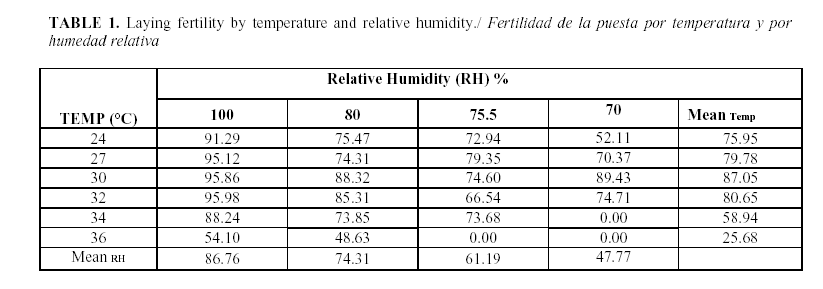
<body><![CDATA[<P   align="justify" ><font size="2" face="Verdana, Arial, Helvetica, sans-serif"><B>Statistical Analysis      </B> </font></P >       <P   align="justify" ><font size="2" face="Verdana, Arial, Helvetica, sans-serif">Principal Component      Analysis (PCA) was descriptively employed for data analysis and dimensional      reduction. The arcsin transformation was applied to the variable LF in order      to obtain ARSLF and fit the normality hypothesis. After that, a MANOVA was      performed: PREOV, MTE, CEI and ARSLF as dependent variables and TEMP and RH      as factors. Afterwards, a Canonical Variate Analysis (CVA) was done. This      is a technique mainly used to represent multivariate means projected as points      in a two dimensional space (centroids). It is traditional to draw confidences      circles around these points (17, 18, 19). A more complete description about      the issue can be found in the article of Arenas and Cuadras (20). </font></P >       <P   align="left" > </P >       <P   align="left" >&nbsp;</P >       <P   align="left" ><font size="2" face="Verdana, Arial, Helvetica, sans-serif"><B><font size="3">RESULTS      </font></B> </font></P >       <P   align="justify" ><font size="2" face="Verdana, Arial, Helvetica, sans-serif">The total absence      of fertility (LF) at 70% RH and 34 and 36&deg;C and at 75.5% RH and 36&deg;C      (<a href="/img/revistas/rsa/v32n2/f0104210.gif">Table 1</a>) was the      first notable result. For this reason all data at these incubation conditions      were not considered in further analysis. </font></P >       
<P   align="left" > </P >       <P   align="justify" ><FONT size="+1"></font></P >   <FONT size="+1">        <P   align="left" > </P >       <P   align="justify" > <font size="2" face="Verdana, Arial, Helvetica, sans-serif"><B>Principal Component      Analysis </B> </font></P >       ]]></body>
<body><![CDATA[<P   align="justify" ><font size="2" face="Verdana, Arial, Helvetica, sans-serif">Table 2 shows the      correlation matrix of variables. Temperature is negatively correlated to cycle      variables (PREOV and MTE) and also to the ARSLF. The relative humidity only      is directly correlated to ARSLF. Another interesting result is the direct      correlation between CEI and ARSLF. </font></P >   <FONT size="+1">        <P   align="justify" > </P >   <FONT size="+1">        <P   align="justify" ><font size="2" face="Verdana, Arial, Helvetica, sans-serif">The eigenvalues of      the first three axes are shown in Table 3. The total variance explained by      the first two axes is over 70% but does not reach the 79.16% required by the      broken-stick test Frontier (1976), cited by Cuadras (18) to determine the      number of valid axes in PCA. Due to this, it was decided to include the third      axis in the following procedures. </font></P >   <FONT size="+1">        <P   align="left" > </P >   <FONT size="+1">        <P   align="justify" > </P >       <P   align="justify" ><font size="2" face="Verdana, Arial, Helvetica, sans-serif">The correlation circle      of first-second axis (Fig.1) shows a high inverse correlation between temperature      and the variables related to phase duration (PREOV and MTE). The variable      ARSLF is shared between the two axes and very influenced by RH (for more details      on factor-axes correlations see Table 4). </font></P >       <P   align="left" > </P >       <P   align="left" >&nbsp;</P >   <FONT size="+1">        <P   align="left" > </P >   <FONT size="+1">        <P   align="left" > </P >       ]]></body>
<body><![CDATA[<P   align="left" ><font size="2" face="Verdana, Arial, Helvetica, sans-serif"><B>Multivariate Analysis      of Variance Canonical Variate Analysis </B> </font></P >       <P   align="left" ><font size="2" face="Verdana, Arial, Helvetica, sans-serif">The general results      of MANOVA (Table 5) show that the two factors are highly significant, but      their interaction is not. </font></P >       <P   align="left" > </P >       <P   align="left" ><FONT size="+1"><FONT size="+1"><FONT size="+1"><FONT size="+1"><FONT size="+1"><FONT size="+1"></font></font></font></font></font></font></P >   <FONT size="+1"><FONT size="+1"><FONT size="+1"><FONT size="+1"><FONT size="+1"><FONT size="+1">        <P   align="left" > </P >   <FONT size="+1">        <P   align="left" > </P >       <P   align="left" ><font size="2" face="Verdana, Arial, Helvetica, sans-serif"><B>- By temperature:</B>      </font></P >       <P   align="justify" ><font size="2" face="Verdana, Arial, Helvetica, sans-serif">Figure 2 shows the      relations between the five temperature groups and the studied variables. Temperature      of 30&deg;C has the best performance among the temperatures employed in the      experiment, the efficiency and the fertility of laying are the best and cycle      duration is not too long. Contrarily, temperatures of 32 and 34&deg;C seem      to be less favorable for ticks&rsquo; performance. Temperature of 27&deg;C      has less productivity of larvae than 30&deg;C, and 24&deg;C is somehow worse      in performance than 27&deg;C. Variables of the cycle, that is, PREOV, and      MTE are clearly negatively correlated to temperature, the higher the temperature,      the shorter the period and vice versa, see also Fig 1. </font></P >       <P   align="left" > </P >       <P   align="justify" ><font size="2" face="Verdana, Arial, Helvetica, sans-serif"><B>-By Relative Humidity:      </B> </font></P >       ]]></body>
<body><![CDATA[<P   align="justify" ><font size="2" face="Verdana, Arial, Helvetica, sans-serif">Figure 3 shows the      relationship between groups of ticks incubated at three different relative      humidity values and the studied variables. Here it is clear the fact that      the best performance (higher CEI and ARSLF) is obtained when ticks are incubated      at 100% RH and the worse at 75%. </font></P >       <P   align="left" > </P >       <P   align="left" >&nbsp;</P >       <P   align="justify" ><font size="2" face="Verdana, Arial, Helvetica, sans-serif"><B><font size="3">DISCUSSION      </font></B> </font></P >       <P   align="justify" ><font size="2" face="Verdana, Arial, Helvetica, sans-serif">Temperature is the      most important factor acting over the <I>B. microplus</I> cycle variables      (Figures 1 and 2, Table 4), this fact is already described by other authors      (21, 22,<B> </B>23, 24, 25). The new canonical variables show, in a more objective      and easy way, which are the best and the worst incubation conditions for the      species, as it was happened in the case of A. nitens (1). These results give      the suggestions that the best incubation conditions for <I>B. microplus</I>      are 30&deg;C and 100% RH; higher temperatures and lower relative humidity      are harmful for this ixodid (Figures 2 and 3; Table 1). It looks that <I>B.      microplus</I> is better adapted for tropical conditions (warm temperatures      and high relative humidity) than <I>A. nitens</I> (1). In MANOVA the interaction      between TEMPxRH is not significant possibly because at lower RHs (70 and 75%)      and higher temperatures combinations (34&deg;C and 36&deg;C) data were withdrawn      from analysis and number of cases for interactions was too small. </font></P >       <P   align="left" > </P >       <P   align="justify" ><font size="2" face="Verdana, Arial, Helvetica, sans-serif">Estrada-Pe&ntilde;a      <I>et al.</I> (26) studied how the climate factors influence geographical      distribution of <I>B. microplus</I> in Mexico. They concluded that this tick      is most commonly found under warm and humid conditions, and it is absent in      the central mountainous regions and Mexican plateau, where low temperatures      are prevalent. These authors found that in municipalities where yearly mean      temperature is 19.97<Sup>&ordm;</Sup>C and SD is 4.22<Sup>&ordm;</Sup>C, the      species was absent. In this case the confidence interval in their inferior      limit is &micro;-2s=19.97-8.44=11.53<Sup>&ordm;</Sup>C, in 47.5% of years.      This temperature (11.53&deg;C) is below 14<Sup>&ordm;</Sup>C corresponding      to the Minimum Thermal Threshold (MTT) in B. microplus (27,28,29). MTT is      the lowest temperature at which development of determined stage could be completed      in poikilothermic organisms, first authors working on this subject (30) name      this temperature &ldquo;critical point&rdquo;. Otherwise, this tick is present      in municipalities in Mexico (26) where yearly mean temperature is 23.82&ordm;C,      and SD is 2.4&ordm;C. The same calculation shows &micro;-2s=23.82-4.8=19.02<Sup>&ordm;</Sup>C,      this temperature value is over 14<Sup>&ordm;</Sup>C (MTT of <I>B. microplus</I>),      and development of the species is always possible. In this direction Alvarez      <I>et al.</I> (31) in Costa Rica affirm that B. microplus is present in zones      were temperatures values are greater than 13&deg;C. All these mentioned papers      are congruent with present data and with a series of articles published by      authors about thermals constant applied in <I>B. microplus </I>(27,28,29,32,33,34,35,36).      </font></P >   <FONT size="+1"><FONT size="+1"><FONT size="+1"><FONT size="+1"><FONT size="+1"><FONT size="+1"><FONT size="+1"><FONT size="+1"><FONT size="+1"><FONT size="+1"><FONT size="+1"><FONT size="+1">        <P   align="left" > </P >       <P   align="justify" ><font size="2" face="Verdana, Arial, Helvetica, sans-serif">The data obtained      by those authors (26) could be forecast and/or explained applying thermal      constant method (37,38). </font></P >       <P   align="left" > </P >       ]]></body>
<body><![CDATA[<P   align="justify" ><font size="2" face="Verdana, Arial, Helvetica, sans-serif">Estrada Pe&ntilde;a      <I>et al</I>. (4) said that the collections of Latin American <I>B. microplus</I>      are very homogeneous according to climate preferences and well separated from      the African counterpart. Their graphics show that mean minimum monthly temperature      recorded for collection points of Latin American B. microplus are approximately      between 12.5&deg;C and 18&deg;C, and the mean maximum temperatures are between      24&deg;C and 30&deg;C. These data are in good correspondence with present      results. Mentioned authors (4) proposed the existence of populations (demes)      with ecologically requirements within each tick species. It seems interesting      to investigate in laboratory about thermal constant parameters in African      <I>B. microplus</I> because it could be possible that thermal constant would      be a conspicuous data in species determination and/or speciation in ticks.      </font></P >       <P   align="justify" >&nbsp;</P >       <P   align="center" > </P >   <B>        <P   align="left" ><font size="3" face="Verdana, Arial, Helvetica, sans-serif">REFERENCES </font></P >   </B></font></font></font></font></font></font></font></font></font></font></font></font></font></font></font></font></font></font></font></font></font></font></font></font></font></font></font></font></font></font></font></font></font></font></font></font></font></font><FONT size="+1" color="#000000"><FONT size="+1"><FONT color="#0000FF"><FONT color="#000000"><FONT size="+1"><FONT size="+1"><FONT size="+1"><FONT size="+1"><FONT size="+1"><FONT size="+1"><FONT size="+1"><FONT size="+1"><FONT size="+1"><FONT size="+1"><FONT size="+1"><FONT size="+1"><FONT size="+1"><FONT size="+1"><FONT size="+1"><FONT size="+1"><FONT size="+1"><FONT size="+1"><FONT size="+1"><FONT size="+1"><FONT size="+1"><FONT size="+1"><FONT size="+1"><FONT size="+1"><FONT size="+1"><FONT size="+1"><FONT size="+1"><FONT size="+1"><FONT size="+1"><FONT size="+1"><FONT size="+1"><FONT size="+1"><FONT size="+1"><FONT size="+1">       <!-- ref --><P   align="left" ><font face="Verdana, Arial, Helvetica, sans-serif" size="2">1. de la Vega R,      D&iacute;az G. A Multivariate Analysis of Anocentor nitens (Ixodoidea: Ixodidae):      nonparasitic phase. Rev Salud Anim. 2008;30 (2): 78-84. </font></P >       <!-- ref --><P   align="left" ><font size="2" face="Verdana, Arial, Helvetica, sans-serif">2. Berkvens DL, Geysen      DM, Chaka G, Madder M, Brandt JRA. A survey of the ixodid ticks parasitising      cattle in the Eastern Province of Zambia. Med Vet Entomol. 1998;12: 234-240.      </font></P >       <P   align="left" ><font size="2" face="Verdana, Arial, Helvetica, sans-serif">3. Evans DE, Martins      JR. Guglielmone AA. A Review of the Ticks (Acari, Ixodida) of Brazil, Their      Hosts and Geographic Distribution &ndash;1.The State of Rio Grande do Sul,      Southern Brazil. Mem. Inst. Oswaldo Cruz, Rio de Janeiro 95 2000;(4):453-470.      </font></P >       <!-- ref --><P   align="left" ><font size="2" face="Verdana, Arial, Helvetica, sans-serif">4. Estrada-Pe&ntilde;a      A, Bouattour A, Camicas JL, Guglielmone A, Horak I, Jongejan F et al The known      distribution and ecological preferences of the tick subgenus Boophilus (Acari:      Ixodidae) in Africa and Latin America. Exp App Acarol. 2006;38: 219-235. </font></P >       <!-- ref --><P   align="left" ><font size="2" face="Verdana, Arial, Helvetica, sans-serif">5. Barros-Battesti      DM, Arzua M, Bechara GH. Carrapatos de Import&acirc;ncia M&eacute;dico-Veterin&aacute;ria      da Regi&atilde;o Neotropical: Um guia ilustrado para identifica&ccedil;&atilde;o      de esp&eacute;cies. S&atilde;o Paulo, Vox/ICTTD-3/Butantan, 2006;223 pp.Ilust.      </font></P >       <!-- ref --><P   align="left" ><font size="2" face="Verdana, Arial, Helvetica, sans-serif">6. Kolonin GV. FAUNA      OF IXODID TICKS OF THE WORLD (Acari, Ixodidae) Moscow. 2009 </font></P >       <!-- ref --><P   align="left" ><font size="2" face="Verdana, Arial, Helvetica, sans-serif">7. Murrell A, Campbell      NJJ, Barker SC. Phylogenetic Analyses of the Rhipicephaline Ticks Indicate      That the Genus Rhipicephalus Is Paraphyletic. Mol Phylogenet Evol. 2000;16(1):1-7.      </font></P >       <!-- ref --><P   align="left" ><font size="2" face="Verdana, Arial, Helvetica, sans-serif">8. Beati L, Keirans      JR. Analysis of the Systematic Relationships among Ticks of the Genera Rhipicephalus      and Boophilus (Acari: Ixodidae) Based on Mitochondrial 12S Ribosomal DNA Gene      Sequences and Morphological Characters. J Parasitol. 2001;87(1):32-48. </font></P >       <!-- ref --><P   align="left" ><font size="2" face="Verdana, Arial, Helvetica, sans-serif">9. Horak IG, Camicas      JL, Keirans JE. The Argasidae, Ixodidae and Nuttalliellidae (Acari: Ixodida).      A World List of Valid Tick Names. Exp Appl Acarol. 2002;28 (1-4): 27-54. </font></P >       <!-- ref --><P   align="left" ><font size="2" face="Verdana, Arial, Helvetica, sans-serif">10. Murrell A, Barker      SC. Synonymy of Boophilus Curtice,1891 with Rhipicephalus Koch, 1844 (Acari:      Ixodidae). Systematic Parasitology 2003;56: 169-172. </font></P >       <!-- ref --><P   align="left" ><font size="2" face="Verdana, Arial, Helvetica, sans-serif">11. Drummond RO,      Whetstone TM. Oviposition of the Gulf Coast Tick. J Econ Entomol. 1970;63(5):1547-1551.      </font></P >       <!-- ref --><P   align="left" ><font size="2" face="Verdana, Arial, Helvetica, sans-serif">12. Drummond RO,      Whetstone TM, Ernst SE, Gladney WJ. Oviposition of the American Dog Tick (Acarina:      Ixodidae). Ann Entomol Soc. Amer1971; 64 (6): 1305-1309. </font></P >       <!-- ref --><P   align="left" ><font size="2" face="Verdana, Arial, Helvetica, sans-serif">13. de la Vega R.      Contribuci&oacute;n al estudio de la biolog&iacute;a de Boophilus microplus      (Canestrini, 1887) en Cuba. Serie Biol&oacute;gica No. 64. Academia de Ciencias      de Cuba 1976;8pp. </font></P >       <!-- ref --><P   align="left" ><font size="2" face="Verdana, Arial, Helvetica, sans-serif">14. Davey RB, Garza      JJr, Thompson GD, Drummond RO. Ovipositional Biology of the cattle tick, Boophilus      annulatus (Acari: Ixodidae), in the laboratory. J Med Entomol. 1980;176 (83):287-289.      </font></P >       <!-- ref --><P   align="left" ><font size="2" face="Verdana, Arial, Helvetica, sans-serif">15. Rodr&iacute;guez      J, Villalba G. Fase preparas&iacute;tica de Amblyomma cajennense en condiciones      naturales. Protoquia y cotoquia. Rev Salud Anim. 1984;6 (4):517-523. </font></P >       <!-- ref --><P   align="left" ><font size="2" face="Verdana, Arial, Helvetica, sans-serif">16. D&iacute;az G,      de la Vega R. Fase no parasitaria de Anocentor nitens (Ixodoidea. Ixodidae)      en condiciones controladas. Rev Salud Anim. 1987;9: 29-35. </font></P >       <!-- ref --><P   align="left" ><font size="2" face="Verdana, Arial, Helvetica, sans-serif">17. Krzanowski WJ.      On confidence regions in canonical variate analysis. Biometrika 1989;76(1):107-116.      </font></P >       <!-- ref --><P   align="left" ><font size="2" face="Verdana, Arial, Helvetica, sans-serif">18. Cuadras CM. M&eacute;todos      de An&aacute;lisis Multivariante. PPU. Barcelona. Estad&iacute;stica y An&aacute;lisis      de Datos. 1991 </font></P >       <!-- ref --><P   align="left" ><font size="2" face="Verdana, Arial, Helvetica, sans-serif">19. Ringrose TJ,      Krzanowski WJ. Simulation study of confidence regions for canonical variate      analysis. Statistics and Computing. 1991;1: 41-46. </font></P >       <!-- ref --><P   align="left" ><font size="2" face="Verdana, Arial, Helvetica, sans-serif">20. Arenas C, Cuadras      CM. Comparing Two Methods for Joint Representation of Multivariate Data. Communications      in Statistics - Simulation and Computation, 2004;33(2):415-430. </font></P >       <!-- ref --><P   align="left" ><font size="2" face="Verdana, Arial, Helvetica, sans-serif">21. Hitchcock LF.      Studies on the non-parasitic stages on the cattle tick, Boophilus microplus      (Canestrini) (Acarina: Ixodidae) Aust J Zool. 1955;3:295-311. </font></P >       <!-- ref --><P   align="left" ><font size="2" face="Verdana, Arial, Helvetica, sans-serif">22. Bennet GG. Oviposition      of Boophilus microplus (Canestrini) (Acarina: Ixodidae) II-Influence of temperature,      humidity and light. Acarologia 1974;16 (82):250- 257. </font></P >       <!-- ref --><P   align="left" ><font size="2" face="Verdana, Arial, Helvetica, sans-serif">23. de la Vega R.      Estudio de la Biolog&iacute;a de Boophilus microplus. Informe T&eacute;cnico.      Vicerrector&iacute;a de Investigaciones Agropecuarias,Universidad de La Habana.      Imp.Universitaria, 1975;28pp. </font></P >       <!-- ref --><P   align="left" ><font size="2" face="Verdana, Arial, Helvetica, sans-serif">24. N&uacute;&ntilde;ez      JL, Mu&ntilde;oz Cobe&ntilde;as ME, Moltedo HL. Boophilus microplus. La garrapata      com&uacute;n del ganado vacuno. Ed. Hemisferio Sur S.A., Buenos Aires, Argentina.      1987;184 pp. </font></P >       <!-- ref --><P   align="left" ><font size="2" face="Verdana, Arial, Helvetica, sans-serif">25. Gloria MA, Daemon      E, Faccini JLH, Grisi L. Influ&ecirc;ncia de diferentes temperaturas sobre      a biologia a fase n&atilde;o parasit&aacute;ria de Boophilus microplus (Can.,1887)(Acari:      Ixodidae). Rev Bras Parasitol Vet. 1993;2(2):85-91. </font></P >       <!-- ref --><P   align="left" ><font size="2" face="Verdana, Arial, Helvetica, sans-serif">26. Estrada-Pe&ntilde;a      A, Garc&iacute;a Z, Fragoso S&aacute;nchez H. The distribution and ecological      preferences of Boophilus microplus (Acari: Ixodidae) in Mexico. Exp Appl Acarol.      2006;38: 307-316. </font></P >       <!-- ref --><P   align="left" ><font size="2" face="Verdana, Arial, Helvetica, sans-serif">27. de la Vega R,      D&iacute;az G. Aplicaci&oacute;n de las constantes t&eacute;rmicas en el control      de la garrapata del ganado vacuno (Boophilus microplus) I: C&aacute;lculode      las constantes t&eacute;rmicas. Rev Salud Anim. 1985;7: 141-148. </font></P >       <!-- ref --><P   align="left" ><font size="2" face="Verdana, Arial, Helvetica, sans-serif">28. de la Vega R,      D&iacute;az G. Aplicaci&oacute;n de las constantes t&eacute;rmicas en el control      de la garrapata del ganado vacuno (Boophilus microplus). II. Estimaci&oacute;n      del inicio de la eclosi&oacute;n en condiciones naturales simuladas. Rev Salud      Anim. 1985;7:307-316. </font></P >       <!-- ref --><P   align="left" ><font size="2" face="Verdana, Arial, Helvetica, sans-serif">29. de la Vega R,      D&iacute;az G. Aplicaci&oacute;n de las constantes t&eacute;rmicas en el control      de la garrapata del ganado vacuno (Boophilus microplus). III. Simplificaciones      del m&eacute;todo de estimaci&oacute;n de los per&iacute;odos de la fase no      parasitaria. Rev Salud Anim. 1985;7:441-446. </font></P >       <!-- ref --><P   align="left" ><font size="2" face="Verdana, Arial, Helvetica, sans-serif">30. Sanderson ED,      Peairs LM. The relation of temperature to insect life. New Hampshire College      Agricultural Experiment Station Tech Bull. 1913;7:125pp. </font></P >       <!-- ref --><P   align="left" ><font size="2" face="Verdana, Arial, Helvetica, sans-serif">31. Alvarez V, Bonilla      R, Chac&oacute;n I. Frecuencia relativa de Boophilus microplus (Acari:Ixodidae)      en bo<I>vinos (</I>Bos taurus<I> y </I>B. indicus) en ocho zonas ecol&oacute;gicas      de Costa Rica. Rev Biol Trop. 2003;51 (2):427-434. </font></P >       <!-- ref --><P   align="left" ><font size="2" face="Verdana, Arial, Helvetica, sans-serif">32. de la Vega R,      D&iacute;az G. Aplicaci&oacute;n de las constantes t&eacute;rmicas en el control      de la garrapata del ganado vacuno (Boophilus microplus). IV. Pron&oacute;stico      del inicio de la eclosi&oacute;n en condiciones de intemperie. Rev Salud Anim.      1986;8:337-345. </font></P >       <!-- ref --><P   align="left" ><font size="2" face="Verdana, Arial, Helvetica, sans-serif">33. de la Vega R,      D&iacute;az G. Aplicaci&oacute;n de las constantes t&eacute;rmicas en el control      de la garrapata del ganado vacuno (Boophilus microplus). V. Supervivencia      larvaria en el laboratorio. Rev Salud Anim. 1987;9: 259-265. </font></P >       <!-- ref --><P   align="left" ><font size="2" face="Verdana, Arial, Helvetica, sans-serif">34. de la Vega R,      D&iacute;az G. Aplicaci&oacute;n de las constantes t&eacute;rmicas en el control      de la garrapata del ganado vacuno (Boophilus microplus). VI. Cuarentena. Rev      Salud Anim. 1988;10:71-75. </font></P >       <!-- ref --><P   align="left" ><font size="2" face="Verdana, Arial, Helvetica, sans-serif">35. de la Vega R,      Farrad&aacute; F, D&iacute;az G. Aplicaci&oacute;n de las constantes t&eacute;rmicas      en el control de la garrapata del ganado vacuno (Boophilus microplus). VII.      Despoblamiento Rev Salud Anim. 1993;15:163-171. </font></P >       <!-- ref --><P   align="left" ><font size="2" face="Verdana, Arial, Helvetica, sans-serif">36. de la Vega R,      D&iacute;az G. Aplicaci&oacute;n de las constantes t&eacute;rmicas en el control      de la garrapata del ganado vacuno (Boophilus microplus). VIII. Validaci&oacute;n      del programa de cuarentena Rev Salud Anim. 1992;14:133-136. </font></P >       <!-- ref --><P   align="left" ><font size="2" face="Verdana, Arial, Helvetica, sans-serif">37. Allee WC, Park      O, Park T, Emerson AE, Smith KP. Principles of Animal Ecology, Ed. WB Saunders      Co., Philadelphia, London. 1963;833 pp. </font></P >       <!-- ref --><P   align="left" ><font size="2" face="Verdana, Arial, Helvetica, sans-serif">38. Messenger PS.      Bioclimatology and prediction of population trends. Proc. FAO Conference on      Ecology in relation to plant pest control: 1974;21-45. </font></P >   </font></font></font></font></font></font></font></font></font></font></font></font></font></font></font></font></font></font></font></font></font></font></font></font></font></font></font></font></font></font></font></font></font></font></font></font></font></font><FONT size="+1" color="#000000"><FONT size="+1"><FONT color="#0000FF"><FONT color="#000000"><FONT size="+1"><FONT size="+1"><FONT size="+1"><FONT size="+1"><FONT size="+1"><FONT size="+1"><FONT size="+1"><FONT size="+1"><FONT size="+1"><FONT size="+1"><FONT size="+1"><FONT size="+1"><FONT size="+1"><FONT size="+1"><FONT size="+1"><FONT size="+1"><FONT size="+1"><FONT size="+1"><FONT size="+1"><FONT size="+1"><FONT size="+1"><FONT size="+1"><FONT size="+1"><FONT size="+1"><FONT size="+1"><FONT size="+1"><FONT size="+1"><FONT size="+1"><FONT size="+1"><FONT size="+1"><FONT size="+1"><FONT size="+1"><FONT size="+1"><FONT size="+1"><FONT size="+1"><FONT size="+1"><FONT size="+1"><FONT size="+1"><FONT size="+1"><FONT size="+1"><FONT size="+1"><FONT size="+1"><FONT size="+1"><FONT size="+1"><FONT size="+1"><FONT size="+1">        <P   align="justify" > </P >       <P   align="justify" > </P >       <P   align="justify" > </P >       <P   align="left" >&nbsp;</P >       <P   align="left" >&nbsp;</P >       <P   align="left" ><font size="2" face="Verdana, Arial, Helvetica, sans-serif"><B>(Recibido 3-6-2010;      Aceptado 30-7-2010)</B> </font></P >   </font></font></font></font></font></font></font></font></font></font></font></font></font></font></font></font></font></font></font></font></font></font></font></font></font></font></font></font></font></font></font></font></font></font></font></font></font></font></font></font></font></font></font></font></font></font></font></font></font></font></DIV >      ]]></body><back>
<ref-list>
<ref id="B1">
<label>1</label><nlm-citation citation-type="journal">
<person-group person-group-type="author">
<name>
<surname><![CDATA[de la Vega]]></surname>
<given-names><![CDATA[R]]></given-names>
</name>
<name>
<surname><![CDATA[Díaz]]></surname>
<given-names><![CDATA[G]]></given-names>
</name>
</person-group>
<article-title xml:lang="en"><![CDATA[A Multivariate Analysis of Anocentor nitens (Ixodoidea: Ixodidae): nonparasitic phase]]></article-title>
<source><![CDATA[Rev Salud Anim]]></source>
<year>2008</year>
<volume>30</volume>
<numero>2</numero>
<issue>2</issue>
<page-range>78-84</page-range></nlm-citation>
</ref>
<ref id="B2">
<label>2</label><nlm-citation citation-type="journal">
<person-group person-group-type="author">
<name>
<surname><![CDATA[Berkvens]]></surname>
<given-names><![CDATA[DL]]></given-names>
</name>
<name>
<surname><![CDATA[Geysen]]></surname>
<given-names><![CDATA[DM]]></given-names>
</name>
<name>
<surname><![CDATA[Chaka]]></surname>
<given-names><![CDATA[G]]></given-names>
</name>
<name>
<surname><![CDATA[Madder]]></surname>
<given-names><![CDATA[M]]></given-names>
</name>
<name>
<surname><![CDATA[Brandt]]></surname>
<given-names><![CDATA[JRA]]></given-names>
</name>
</person-group>
<article-title xml:lang="en"><![CDATA[A survey of the ixodid ticks parasitising cattle in the Eastern Province of Zambia]]></article-title>
<source><![CDATA[Med Vet Entomol]]></source>
<year>1998</year>
<volume>12</volume>
<page-range>234-240</page-range></nlm-citation>
</ref>
<ref id="B3">
<label>3</label><nlm-citation citation-type="journal">
<person-group person-group-type="author">
<name>
<surname><![CDATA[Evans]]></surname>
<given-names><![CDATA[DE]]></given-names>
</name>
<name>
<surname><![CDATA[Martins]]></surname>
<given-names><![CDATA[JR]]></given-names>
</name>
<name>
<surname><![CDATA[Guglielmone]]></surname>
<given-names><![CDATA[AA]]></given-names>
</name>
</person-group>
<article-title xml:lang="en"><![CDATA[A Review of the Ticks (Acari, Ixodida) of Brazil, Their Hosts and Geographic Distribution -1.The State of Rio Grande do Sul, Southern Brazil]]></article-title>
<source><![CDATA[Mem Inst. Oswaldo Cruz, Rio de Janeiro]]></source>
<year>2000</year>
<numero>4</numero>
<issue>4</issue>
<page-range>453-470</page-range></nlm-citation>
</ref>
<ref id="B4">
<label>4</label><nlm-citation citation-type="journal">
<person-group person-group-type="author">
<name>
<surname><![CDATA[Estrada-Peña]]></surname>
<given-names><![CDATA[A]]></given-names>
</name>
<name>
<surname><![CDATA[Bouattour]]></surname>
<given-names><![CDATA[A]]></given-names>
</name>
<name>
<surname><![CDATA[Camicas]]></surname>
<given-names><![CDATA[JL]]></given-names>
</name>
<name>
<surname><![CDATA[Guglielmone]]></surname>
<given-names><![CDATA[A]]></given-names>
</name>
<name>
<surname><![CDATA[Horak]]></surname>
<given-names><![CDATA[I]]></given-names>
</name>
<name>
<surname><![CDATA[Jongejan]]></surname>
<given-names><![CDATA[F]]></given-names>
</name>
</person-group>
<article-title xml:lang="en"><![CDATA[The known distribution and ecological preferences of the tick subgenus Boophilus (Acari: Ixodidae) in Africa and Latin America]]></article-title>
<source><![CDATA[Exp App Acarol]]></source>
<year>2006</year>
<volume>38</volume>
<page-range>219-235</page-range></nlm-citation>
</ref>
<ref id="B5">
<label>5</label><nlm-citation citation-type="">
<person-group person-group-type="author">
<name>
<surname><![CDATA[Barros-Battesti]]></surname>
<given-names><![CDATA[DM]]></given-names>
</name>
<name>
<surname><![CDATA[Arzua]]></surname>
<given-names><![CDATA[M]]></given-names>
</name>
<name>
<surname><![CDATA[Bechara]]></surname>
<given-names><![CDATA[GH]]></given-names>
</name>
</person-group>
<source><![CDATA[Carrapatos de Importância Médico-Veterinária da Região Neotropical: Um guia ilustrado para identificação de espécies]]></source>
<year>2006</year>
<page-range>223</page-range><publisher-loc><![CDATA[São Paulo ]]></publisher-loc>
</nlm-citation>
</ref>
<ref id="B6">
<label>6</label><nlm-citation citation-type="">
<person-group person-group-type="author">
<name>
<surname><![CDATA[Kolonin]]></surname>
<given-names><![CDATA[GV]]></given-names>
</name>
</person-group>
<source><![CDATA[FAUNA OF IXODID TICKS OF THE WORLD (Acari, Ixodidae) Moscow]]></source>
<year>2009</year>
</nlm-citation>
</ref>
<ref id="B7">
<label>7</label><nlm-citation citation-type="journal">
<person-group person-group-type="author">
<name>
<surname><![CDATA[Murrell]]></surname>
<given-names><![CDATA[A]]></given-names>
</name>
<name>
<surname><![CDATA[Campbell]]></surname>
<given-names><![CDATA[NJJ]]></given-names>
</name>
<name>
<surname><![CDATA[Barker]]></surname>
<given-names><![CDATA[SC]]></given-names>
</name>
</person-group>
<article-title xml:lang="en"><![CDATA[Phylogenetic Analyses of the Rhipicephaline Ticks Indicate That the Genus Rhipicephalus Is Paraphyletic]]></article-title>
<source><![CDATA[Mol Phylogenet Evol]]></source>
<year>2000</year>
<volume>16</volume>
<numero>1</numero>
<issue>1</issue>
<page-range>1-7</page-range></nlm-citation>
</ref>
<ref id="B8">
<label>8</label><nlm-citation citation-type="journal">
<person-group person-group-type="author">
<name>
<surname><![CDATA[Beati]]></surname>
<given-names><![CDATA[L]]></given-names>
</name>
<name>
<surname><![CDATA[Keirans]]></surname>
<given-names><![CDATA[JR]]></given-names>
</name>
</person-group>
<article-title xml:lang="en"><![CDATA[Analysis of the Systematic Relationships among Ticks of the Genera Rhipicephalus and Boophilus (Acari: Ixodidae) Based on Mitochondrial 12S Ribosomal DNA Gene Sequences and Morphological Characters]]></article-title>
<source><![CDATA[J Parasitol]]></source>
<year>2001</year>
<volume>87</volume>
<numero>1</numero>
<issue>1</issue>
<page-range>32-48</page-range></nlm-citation>
</ref>
<ref id="B9">
<label>9</label><nlm-citation citation-type="journal">
<person-group person-group-type="author">
<name>
<surname><![CDATA[Horak]]></surname>
<given-names><![CDATA[IG]]></given-names>
</name>
<name>
<surname><![CDATA[Camicas]]></surname>
<given-names><![CDATA[JL]]></given-names>
</name>
<name>
<surname><![CDATA[Keirans]]></surname>
<given-names><![CDATA[JE]]></given-names>
</name>
</person-group>
<article-title xml:lang="en"><![CDATA[The Argasidae, Ixodidae and Nuttalliellidae (Acari: Ixodida). A World List of Valid Tick Names]]></article-title>
<source><![CDATA[Exp Appl Acarol]]></source>
<year>2002</year>
<volume>28</volume>
<numero>1-4</numero>
<issue>1-4</issue>
<page-range>27-54</page-range></nlm-citation>
</ref>
<ref id="B10">
<label>10</label><nlm-citation citation-type="journal">
<person-group person-group-type="author">
<name>
<surname><![CDATA[Murrell]]></surname>
<given-names><![CDATA[A]]></given-names>
</name>
<name>
<surname><![CDATA[Barker]]></surname>
<given-names><![CDATA[SC]]></given-names>
</name>
</person-group>
<article-title xml:lang="en"><![CDATA[Synonymy of Boophilus Curtice,1891 with Rhipicephalus Koch, 1844 (Acari: Ixodidae)]]></article-title>
<source><![CDATA[Systematic Parasitology]]></source>
<year>2003</year>
<volume>56</volume>
<page-range>169-172</page-range></nlm-citation>
</ref>
<ref id="B11">
<label>11</label><nlm-citation citation-type="journal">
<person-group person-group-type="author">
<name>
<surname><![CDATA[Drummond]]></surname>
<given-names><![CDATA[RO]]></given-names>
</name>
<name>
<surname><![CDATA[Whetstone]]></surname>
<given-names><![CDATA[TM]]></given-names>
</name>
</person-group>
<article-title xml:lang="en"><![CDATA[Oviposition of the Gulf Coast Tick]]></article-title>
<source><![CDATA[J Econ Entomol]]></source>
<year>1970</year>
<volume>63</volume>
<numero>5</numero>
<issue>5</issue>
<page-range>1547-1551</page-range></nlm-citation>
</ref>
<ref id="B12">
<label>12</label><nlm-citation citation-type="journal">
<person-group person-group-type="author">
<name>
<surname><![CDATA[Drummond]]></surname>
<given-names><![CDATA[RO]]></given-names>
</name>
<name>
<surname><![CDATA[Whetstone]]></surname>
<given-names><![CDATA[TM]]></given-names>
</name>
<name>
<surname><![CDATA[Ernst]]></surname>
<given-names><![CDATA[SE]]></given-names>
</name>
<name>
<surname><![CDATA[Gladney]]></surname>
<given-names><![CDATA[WJ]]></given-names>
</name>
</person-group>
<article-title xml:lang="en"><![CDATA[Oviposition of the American Dog Tick (Acarina: Ixodidae)]]></article-title>
<source><![CDATA[Ann Entomol Soc Amer]]></source>
<year>1971</year>
<volume>64</volume>
<numero>6</numero>
<issue>6</issue>
<page-range>1305-1309</page-range></nlm-citation>
</ref>
<ref id="B13">
<label>13</label><nlm-citation citation-type="book">
<person-group person-group-type="author">
<name>
<surname><![CDATA[de la Vega]]></surname>
<given-names><![CDATA[R]]></given-names>
</name>
</person-group>
<source><![CDATA[Contribución al estudio de la biología de Boophilus microplus (Canestrini, 1887) en Cuba. Serie Biológica No. 64]]></source>
<year>1976</year>
<page-range>8</page-range><publisher-name><![CDATA[Academia de Ciencias de Cuba]]></publisher-name>
</nlm-citation>
</ref>
<ref id="B14">
<label>14</label><nlm-citation citation-type="journal">
<person-group person-group-type="author">
<name>
<surname><![CDATA[Davey]]></surname>
<given-names><![CDATA[RB]]></given-names>
</name>
<name>
<surname><![CDATA[Garza]]></surname>
<given-names><![CDATA[JJr]]></given-names>
</name>
<name>
<surname><![CDATA[Thompson]]></surname>
<given-names><![CDATA[GD]]></given-names>
</name>
<name>
<surname><![CDATA[Drummond]]></surname>
<given-names><![CDATA[RO]]></given-names>
</name>
</person-group>
<article-title xml:lang="en"><![CDATA[Ovipositional Biology of the cattle tick, Boophilus annulatus (Acari: Ixodidae), in the laboratory]]></article-title>
<source><![CDATA[J Med Entomol]]></source>
<year>1980</year>
<volume>176</volume>
<numero>83</numero>
<issue>83</issue>
<page-range>287-289</page-range></nlm-citation>
</ref>
<ref id="B15">
<label>15</label><nlm-citation citation-type="journal">
<person-group person-group-type="author">
<name>
<surname><![CDATA[Rodríguez]]></surname>
<given-names><![CDATA[J]]></given-names>
</name>
<name>
<surname><![CDATA[Villalba]]></surname>
<given-names><![CDATA[G]]></given-names>
</name>
</person-group>
<article-title xml:lang="es"><![CDATA[Fase preparasítica de Amblyomma cajennense en condiciones naturales. Protoquia y cotoquia]]></article-title>
<source><![CDATA[Rev Salud Anim]]></source>
<year>1984</year>
<volume>6</volume>
<numero>4</numero>
<issue>4</issue>
<page-range>517-523</page-range></nlm-citation>
</ref>
<ref id="B16">
<label>16</label><nlm-citation citation-type="journal">
<person-group person-group-type="author">
<name>
<surname><![CDATA[Díaz]]></surname>
<given-names><![CDATA[G]]></given-names>
</name>
<name>
<surname><![CDATA[de la Vega]]></surname>
<given-names><![CDATA[R]]></given-names>
</name>
</person-group>
<article-title xml:lang="es"><![CDATA[Fase no parasitaria de Anocentor nitens (Ixodoidea. Ixodidae) en condiciones controladas]]></article-title>
<source><![CDATA[Rev Salud Anim]]></source>
<year>1987</year>
<volume>9</volume>
<page-range>29-35</page-range></nlm-citation>
</ref>
<ref id="B17">
<label>17</label><nlm-citation citation-type="journal">
<person-group person-group-type="author">
<name>
<surname><![CDATA[Krzanowski]]></surname>
<given-names><![CDATA[WJ]]></given-names>
</name>
</person-group>
<article-title xml:lang="en"><![CDATA[On confidence regions in canonical variate analysis]]></article-title>
<source><![CDATA[Biometrika]]></source>
<year>1989</year>
<volume>76</volume>
<numero>1</numero>
<issue>1</issue>
<page-range>107-116</page-range></nlm-citation>
</ref>
<ref id="B18">
<label>18</label><nlm-citation citation-type="">
<person-group person-group-type="author">
<name>
<surname><![CDATA[Cuadras]]></surname>
<given-names><![CDATA[CM]]></given-names>
</name>
</person-group>
<source><![CDATA[Métodos de Análisis Multivariante. PPU. Barcelona. Estadística y Análisis de Datos]]></source>
<year>1991</year>
</nlm-citation>
</ref>
<ref id="B19">
<label>19</label><nlm-citation citation-type="journal">
<person-group person-group-type="author">
<name>
<surname><![CDATA[Ringrose]]></surname>
<given-names><![CDATA[TJ]]></given-names>
</name>
<name>
<surname><![CDATA[Krzanowski]]></surname>
<given-names><![CDATA[WJ]]></given-names>
</name>
</person-group>
<article-title xml:lang="en"><![CDATA[Simulation study of confidence regions for canonical variate analysis]]></article-title>
<source><![CDATA[Statistics and Computing]]></source>
<year>1991</year>
<volume>1</volume>
<page-range>41-46</page-range></nlm-citation>
</ref>
<ref id="B20">
<label>20</label><nlm-citation citation-type="journal">
<person-group person-group-type="author">
<name>
<surname><![CDATA[Arenas]]></surname>
<given-names><![CDATA[C]]></given-names>
</name>
<name>
<surname><![CDATA[Cuadras]]></surname>
<given-names><![CDATA[CM]]></given-names>
</name>
</person-group>
<article-title xml:lang="en"><![CDATA[Comparing Two Methods for Joint Representation of Multivariate Data]]></article-title>
<source><![CDATA[Communications in Statistics - Simulation and Computation]]></source>
<year>2004</year>
<volume>33</volume>
<numero>2</numero>
<issue>2</issue>
<page-range>415-430</page-range></nlm-citation>
</ref>
<ref id="B21">
<label>21</label><nlm-citation citation-type="journal">
<person-group person-group-type="author">
<name>
<surname><![CDATA[Hitchcock]]></surname>
<given-names><![CDATA[LF]]></given-names>
</name>
</person-group>
<article-title xml:lang="en"><![CDATA[Studies on the non-parasitic stages on the cattle tick, Boophilus microplus (Canestrini) (Acarina: Ixodidae)]]></article-title>
<source><![CDATA[Aust J Zool]]></source>
<year>1955</year>
<volume>3</volume>
<page-range>295-311</page-range></nlm-citation>
</ref>
<ref id="B22">
<label>22</label><nlm-citation citation-type="journal">
<person-group person-group-type="author">
<name>
<surname><![CDATA[Bennet]]></surname>
<given-names><![CDATA[GG]]></given-names>
</name>
</person-group>
<article-title xml:lang="en"><![CDATA[Oviposition of Boophilus microplus (Canestrini) (Acarina: Ixodidae) II-Influence of temperature, humidity and light]]></article-title>
<source><![CDATA[Acarologia]]></source>
<year>1974</year>
<volume>16</volume>
<numero>82</numero>
<issue>82</issue>
<page-range>250- 257</page-range></nlm-citation>
</ref>
<ref id="B23">
<label>23</label><nlm-citation citation-type="book">
<person-group person-group-type="author">
<name>
<surname><![CDATA[de la Vega]]></surname>
<given-names><![CDATA[R]]></given-names>
</name>
</person-group>
<source><![CDATA[Estudio de la Biología de Boophilus microplus. Informe Técnico]]></source>
<year>1975</year>
<page-range>28</page-range><publisher-name><![CDATA[Vicerrectoría de Investigaciones Agropecuarias,Universidad de La Habana]]></publisher-name>
</nlm-citation>
</ref>
<ref id="B24">
<label>24</label><nlm-citation citation-type="">
<person-group person-group-type="author">
<name>
<surname><![CDATA[Núñez]]></surname>
<given-names><![CDATA[JL]]></given-names>
</name>
<name>
<surname><![CDATA[Muñoz Cobeñas]]></surname>
<given-names><![CDATA[ME]]></given-names>
</name>
<name>
<surname><![CDATA[Moltedo]]></surname>
<given-names><![CDATA[HL]]></given-names>
</name>
</person-group>
<source><![CDATA[Boophilus microplus. La garrapata común del ganado vacuno]]></source>
<year>1987</year>
<page-range>184</page-range><publisher-loc><![CDATA[Buenos Aires^eArgentina Argentina]]></publisher-loc>
</nlm-citation>
</ref>
<ref id="B25">
<label>25</label><nlm-citation citation-type="journal">
<person-group person-group-type="author">
<name>
<surname><![CDATA[Gloria]]></surname>
<given-names><![CDATA[MA]]></given-names>
</name>
<name>
<surname><![CDATA[Daemon]]></surname>
<given-names><![CDATA[E]]></given-names>
</name>
<name>
<surname><![CDATA[Faccini]]></surname>
<given-names><![CDATA[JLH]]></given-names>
</name>
<name>
<surname><![CDATA[Grisi]]></surname>
<given-names><![CDATA[L]]></given-names>
</name>
</person-group>
<article-title xml:lang="pt"><![CDATA[Influência de diferentes temperaturas sobre a biologia a fase não parasitária de Boophilus microplus (Can.,1887)(Acari: Ixodidae)]]></article-title>
<source><![CDATA[Rev Bras Parasitol Vet]]></source>
<year>1993</year>
<volume>2</volume>
<numero>2</numero>
<issue>2</issue>
<page-range>85-91</page-range></nlm-citation>
</ref>
<ref id="B26">
<label>26</label><nlm-citation citation-type="journal">
<person-group person-group-type="author">
<name>
<surname><![CDATA[Estrada-Peña]]></surname>
<given-names><![CDATA[A]]></given-names>
</name>
<name>
<surname><![CDATA[García]]></surname>
<given-names><![CDATA[Z]]></given-names>
</name>
<name>
<surname><![CDATA[Fragoso Sánchez]]></surname>
<given-names><![CDATA[H]]></given-names>
</name>
</person-group>
<article-title xml:lang="en"><![CDATA[The distribution and ecological preferences of Boophilus microplus (Acari: Ixodidae) in Mexico]]></article-title>
<source><![CDATA[Exp Appl Acarol]]></source>
<year>2006</year>
<volume>38</volume>
<page-range>307-316</page-range></nlm-citation>
</ref>
<ref id="B27">
<label>27</label><nlm-citation citation-type="journal">
<person-group person-group-type="author">
<name>
<surname><![CDATA[de la Vega]]></surname>
<given-names><![CDATA[R]]></given-names>
</name>
<name>
<surname><![CDATA[Díaz]]></surname>
<given-names><![CDATA[G]]></given-names>
</name>
</person-group>
<article-title xml:lang="es"><![CDATA[Aplicación de las constantes térmicas en el control de la garrapata del ganado vacuno (Boophilus microplus) I: Cálculode las constantes térmicas]]></article-title>
<source><![CDATA[Rev Salud Anim]]></source>
<year>1985</year>
<volume>7</volume>
<page-range>141-148</page-range></nlm-citation>
</ref>
<ref id="B28">
<label>28</label><nlm-citation citation-type="journal">
<person-group person-group-type="author">
<name>
<surname><![CDATA[de la Vega]]></surname>
<given-names><![CDATA[R]]></given-names>
</name>
<name>
<surname><![CDATA[Díaz]]></surname>
<given-names><![CDATA[G]]></given-names>
</name>
</person-group>
<article-title xml:lang="es"><![CDATA[Aplicación de las constantes térmicas en el control de la garrapata del ganado vacuno (Boophilus microplus). II. Estimación del inicio de la eclosión en condiciones naturales simuladas]]></article-title>
<source><![CDATA[Rev Salud Anim]]></source>
<year>1985</year>
<volume>7</volume>
<page-range>307-316</page-range></nlm-citation>
</ref>
<ref id="B29">
<label>29</label><nlm-citation citation-type="journal">
<person-group person-group-type="author">
<name>
<surname><![CDATA[de la Vega]]></surname>
<given-names><![CDATA[R]]></given-names>
</name>
<name>
<surname><![CDATA[Díaz]]></surname>
<given-names><![CDATA[G]]></given-names>
</name>
</person-group>
<article-title xml:lang="es"><![CDATA[Aplicación de las constantes térmicas en el control de la garrapata del ganado vacuno (Boophilus microplus). III. Simplificaciones del método de estimación de los períodos de la fase no parasitaria]]></article-title>
<source><![CDATA[Rev Salud Anim]]></source>
<year>1985</year>
<volume>7</volume>
<page-range>441-446</page-range></nlm-citation>
</ref>
<ref id="B30">
<label>30</label><nlm-citation citation-type="journal">
<person-group person-group-type="author">
<name>
<surname><![CDATA[Sanderson]]></surname>
<given-names><![CDATA[ED]]></given-names>
</name>
<name>
<surname><![CDATA[Peairs]]></surname>
<given-names><![CDATA[LM]]></given-names>
</name>
</person-group>
<article-title xml:lang="en"><![CDATA[The relation of temperature to insect life]]></article-title>
<source><![CDATA[New Hampshire College Agricultural Experiment Station Tech Bull]]></source>
<year>1913</year>
<volume>7</volume>
<page-range>125</page-range></nlm-citation>
</ref>
<ref id="B31">
<label>31</label><nlm-citation citation-type="journal">
<person-group person-group-type="author">
<name>
<surname><![CDATA[Alvarez]]></surname>
<given-names><![CDATA[V]]></given-names>
</name>
<name>
<surname><![CDATA[Bonilla]]></surname>
<given-names><![CDATA[R]]></given-names>
</name>
<name>
<surname><![CDATA[Chacón]]></surname>
<given-names><![CDATA[I]]></given-names>
</name>
</person-group>
<article-title xml:lang="es"><![CDATA[Frecuencia relativa de Boophilus microplus (Acari:Ixodidae) en bovinos (Bos taurus y B. indicus) en ocho zonas ecológicas de Costa Rica]]></article-title>
<source><![CDATA[Rev Biol Trop]]></source>
<year>2003</year>
<volume>51</volume>
<numero>2</numero>
<issue>2</issue>
<page-range>427-434</page-range></nlm-citation>
</ref>
<ref id="B32">
<label>32</label><nlm-citation citation-type="journal">
<person-group person-group-type="author">
<name>
<surname><![CDATA[de la Vega]]></surname>
<given-names><![CDATA[R]]></given-names>
</name>
<name>
<surname><![CDATA[Díaz]]></surname>
<given-names><![CDATA[G]]></given-names>
</name>
</person-group>
<article-title xml:lang="es"><![CDATA[Aplicación de las constantes térmicas en el control de la garrapata del ganado vacuno (Boophilus microplus). IV. Pronóstico del inicio de la eclosión en condiciones de intemperie]]></article-title>
<source><![CDATA[Rev Salud Anim]]></source>
<year>1986</year>
<volume>8</volume>
<page-range>337-345</page-range></nlm-citation>
</ref>
<ref id="B33">
<label>33</label><nlm-citation citation-type="journal">
<person-group person-group-type="author">
<name>
<surname><![CDATA[de la Vega]]></surname>
<given-names><![CDATA[R]]></given-names>
</name>
<name>
<surname><![CDATA[Díaz]]></surname>
<given-names><![CDATA[G]]></given-names>
</name>
</person-group>
<article-title xml:lang="es"><![CDATA[Aplicación de las constantes térmicas en el control de la garrapata del ganado vacuno (Boophilus microplus). V. Supervivencia larvaria en el laboratorio]]></article-title>
<source><![CDATA[Rev Salud Anim]]></source>
<year>1987</year>
<volume>9</volume>
<page-range>259-265</page-range></nlm-citation>
</ref>
<ref id="B34">
<label>34</label><nlm-citation citation-type="journal">
<person-group person-group-type="author">
<name>
<surname><![CDATA[de la Vega]]></surname>
<given-names><![CDATA[R]]></given-names>
</name>
<name>
<surname><![CDATA[Díaz]]></surname>
<given-names><![CDATA[G]]></given-names>
</name>
</person-group>
<article-title xml:lang="es"><![CDATA[Aplicación de las constantes térmicas en el control de la garrapata del ganado vacuno (Boophilus microplus). VI. Cuarentena]]></article-title>
<source><![CDATA[Rev Salud Anim]]></source>
<year>1988</year>
<volume>10</volume>
<page-range>71-75</page-range></nlm-citation>
</ref>
<ref id="B35">
<label>35</label><nlm-citation citation-type="journal">
<person-group person-group-type="author">
<name>
<surname><![CDATA[de la Vega]]></surname>
<given-names><![CDATA[R]]></given-names>
</name>
<name>
<surname><![CDATA[Farradá]]></surname>
<given-names><![CDATA[F]]></given-names>
</name>
<name>
<surname><![CDATA[Díaz]]></surname>
<given-names><![CDATA[G]]></given-names>
</name>
</person-group>
<article-title xml:lang="es"><![CDATA[Aplicación de las constantes térmicas en el control de la garrapata del ganado vacuno (Boophilus microplus). VII. Despoblamiento]]></article-title>
<source><![CDATA[Rev Salud Anim]]></source>
<year>1993</year>
<volume>15</volume>
<page-range>163-171</page-range></nlm-citation>
</ref>
<ref id="B36">
<label>36</label><nlm-citation citation-type="journal">
<person-group person-group-type="author">
<name>
<surname><![CDATA[de la Vega]]></surname>
<given-names><![CDATA[R]]></given-names>
</name>
<name>
<surname><![CDATA[Díaz]]></surname>
<given-names><![CDATA[G]]></given-names>
</name>
</person-group>
<article-title xml:lang="es"><![CDATA[Aplicación de las constantes térmicas en el control de la garrapata del ganado vacuno (Boophilus microplus). VIII. Validación del programa de cuarentena]]></article-title>
<source><![CDATA[Rev Salud Anim]]></source>
<year>1992</year>
<volume>14</volume>
<page-range>133-136</page-range></nlm-citation>
</ref>
<ref id="B37">
<label>37</label><nlm-citation citation-type="">
<person-group person-group-type="author">
<name>
<surname><![CDATA[Allee]]></surname>
<given-names><![CDATA[WC]]></given-names>
</name>
<name>
<surname><![CDATA[Park]]></surname>
<given-names><![CDATA[O]]></given-names>
</name>
<name>
<surname><![CDATA[Park]]></surname>
<given-names><![CDATA[T]]></given-names>
</name>
<name>
<surname><![CDATA[Emerson]]></surname>
<given-names><![CDATA[AE]]></given-names>
</name>
<name>
<surname><![CDATA[Smith]]></surname>
<given-names><![CDATA[KP]]></given-names>
</name>
</person-group>
<source><![CDATA[Principles of Animal Ecology]]></source>
<year>1963</year>
<page-range>833</page-range><publisher-loc><![CDATA[Philadelphia^eLondon London]]></publisher-loc>
</nlm-citation>
</ref>
<ref id="B38">
<label>38</label><nlm-citation citation-type="">
<person-group person-group-type="author">
<name>
<surname><![CDATA[Messenger]]></surname>
<given-names><![CDATA[PS]]></given-names>
</name>
</person-group>
<source><![CDATA[Bioclimatology and prediction of population trends. Proc. FAO Conference on Ecology in relation to plant pest control]]></source>
<year>1974</year>
<page-range>21-45</page-range></nlm-citation>
</ref>
</ref-list>
</back>
</article>