<?xml version="1.0" encoding="ISO-8859-1"?><article xmlns:mml="http://www.w3.org/1998/Math/MathML" xmlns:xlink="http://www.w3.org/1999/xlink" xmlns:xsi="http://www.w3.org/2001/XMLSchema-instance">
<front>
<journal-meta>
<journal-id>0253-570X</journal-id>
<journal-title><![CDATA[Revista de Salud Animal]]></journal-title>
<abbrev-journal-title><![CDATA[Rev Salud Anim.]]></abbrev-journal-title>
<issn>0253-570X</issn>
<publisher>
<publisher-name><![CDATA[Centro Nacional de Sanidad Agropecuaria]]></publisher-name>
</publisher>
</journal-meta>
<article-meta>
<article-id>S0253-570X2011000100006</article-id>
<title-group>
<article-title xml:lang="en"><![CDATA[ISOLATION AND IDENTIFICATION OF Ornithobacteriun rhinotracheale FROM LAYING HENS IN FARMS OF LA HABANA PROVINCE]]></article-title>
<article-title xml:lang="es"><![CDATA[AISLAMIENTO E IDENTIFICACIÓN DE Ornithobacterium rhinotracheale EN GALLINAS PONEDORAS DE GRANJAS DE LA PROVINCIA LA HABANA]]></article-title>
</title-group>
<contrib-group>
<contrib contrib-type="author">
<name>
<surname><![CDATA[Espinosa]]></surname>
<given-names><![CDATA[Ivette]]></given-names>
</name>
<xref ref-type="aff" rid="A01"/>
</contrib>
<contrib contrib-type="author">
<name>
<surname><![CDATA[Colas]]></surname>
<given-names><![CDATA[M]]></given-names>
</name>
<xref ref-type="aff" rid="A02"/>
</contrib>
<contrib contrib-type="author">
<name>
<surname><![CDATA[Vichi]]></surname>
<given-names><![CDATA[Joivier]]></given-names>
</name>
<xref ref-type="aff" rid="A01"/>
</contrib>
<contrib contrib-type="author">
<name>
<surname><![CDATA[Báez]]></surname>
<given-names><![CDATA[M]]></given-names>
</name>
<xref ref-type="aff" rid="A01"/>
</contrib>
<contrib contrib-type="author">
<name>
<surname><![CDATA[Martínez]]></surname>
<given-names><![CDATA[Siomara]]></given-names>
</name>
<xref ref-type="aff" rid="A01"/>
</contrib>
</contrib-group>
<aff id="A01">
<institution><![CDATA[,National Center for animal and plant health (CENSA) Division of Biology Molecular ]]></institution>
<addr-line><![CDATA[La Habana ]]></addr-line>
<country>Cuba</country>
</aff>
<aff id="A02">
<institution><![CDATA[,Laboratorio de Investigaciones y Diagnóstico Aviar  ]]></institution>
<addr-line><![CDATA[ ]]></addr-line>
</aff>
<pub-date pub-type="pub">
<day>00</day>
<month>04</month>
<year>2011</year>
</pub-date>
<pub-date pub-type="epub">
<day>00</day>
<month>04</month>
<year>2011</year>
</pub-date>
<volume>33</volume>
<numero>1</numero>
<fpage>38</fpage>
<lpage>43</lpage>
<copyright-statement/>
<copyright-year/>
<self-uri xlink:href="http://scielo.sld.cu/scielo.php?script=sci_arttext&amp;pid=S0253-570X2011000100006&amp;lng=en&amp;nrm=iso"></self-uri><self-uri xlink:href="http://scielo.sld.cu/scielo.php?script=sci_abstract&amp;pid=S0253-570X2011000100006&amp;lng=en&amp;nrm=iso"></self-uri><self-uri xlink:href="http://scielo.sld.cu/scielo.php?script=sci_pdf&amp;pid=S0253-570X2011000100006&amp;lng=en&amp;nrm=iso"></self-uri><abstract abstract-type="short" xml:lang="en"><p><![CDATA[Respiratory infection is the most serious disease affecting poultry and causing great economic losses to the poultry industry worldwide. In avian host, several microorganisms of the genus Pasteurella (P. multocida, P. gallinarum and P. anatipestifer), Bordetella (B. avium) and Avibacterium paragallinarum) were involved in respiratory diseases complex. Ornithobacterium rhinotracheale is a recently discovered bacterium, of worldwide distribution in commercial poultry, in which it is associated to respiratory diseases and it is also found in wild birds. Airsacculitis and pneumonia are the most common symptoms of infection with O. rhinotracheale. Isolation and identification of pathogenic bacteria associated to respiratory diseases were carried out from a total of 80 samples of animals collected in four different periods from 4 farms in the western region in Cuba. In total 16(20%), 15(18%), 9(11%) and 4(5%), isolates were identified as P. multocida, E.coli, M.haemolytic and O. rhinotracheale. The O. rhinotracheale strains were isolated from infraorbital sinus exudates of animal with clinical symptoms and these strains were identified by biochemical test and by amplification of a fragment of 16S rRNA which was analysed by enzymatic restriction, the fragments with the expected size were obtained. This work is the first report of the presence of O.rhinotrachelae by culture and molecular method in layer hens in farms from the Western region in Cuba.]]></p></abstract>
<abstract abstract-type="short" xml:lang="es"><p><![CDATA[Las enfermedades respiratorias en las aves son de gran importancia por su impacto económico en la conversión alimenticia, disminución en la producción de huevos, incremento en el costo de medicamentos. En hospederos aviares varios microorganismos de los géneros Pasteurella (P. multocida, P. gallinarum and P. anatipestifer), Bordetella (B. avium) and Avibacterium paragallinarum) están asociados al complejo respiratorio. Ornithobacterium rhinotracheale es una bacteria de reciente descubrimiento, de amplia distribución mundial, asociada con enfermedades respiratorias, también está presente en aves salvajes. La aerosaculitis y neumonía son los síntomas más comunes de la infección por O.rhinotracheale. El objetivo de este trabajo es la identificación de bacterias asociadas a procesos respiratorios en aves ponedoras específicamente en 80 muestras de animales procedentes de 4 granjas de la región occidental. Del total de muestras 16(20%), 15(18%), 9(11%) y 4(5%) correspondieron a P. multocida, E.coli, M.haemolytic and O. rhinotracheale. Las cepas de O. rhinotracheale se identificaron por pruebas bioquímicas, se confirmaron, análisis de restricción por amplificación de un fragmento del RNAr16s. Se obtuvieron los tamaños esperados. Este trabajo constituye el primer reporte de la identificación y presencia de O.rhinotracheale por cultivo y métodos moleculares en gallinas ponedoras en granjas de la región occidental.]]></p></abstract>
<kwd-group>
<kwd lng="en"><![CDATA[Pasteurella multocida]]></kwd>
<kwd lng="en"><![CDATA[Escherichia coli]]></kwd>
<kwd lng="en"><![CDATA[Ornithobacterium rhinotracheale]]></kwd>
<kwd lng="en"><![CDATA[layer hens]]></kwd>
<kwd lng="es"><![CDATA[Pasteurella multocida]]></kwd>
<kwd lng="es"><![CDATA[Escherichia coli]]></kwd>
<kwd lng="es"><![CDATA[Ornithobacterium rhinotracheale]]></kwd>
<kwd lng="es"><![CDATA[gallinas ponedoras]]></kwd>
</kwd-group>
</article-meta>
</front><body><![CDATA[ <p align="right"><font face="Verdana, Arial, Helvetica, sans-serif" size="2">    <b>Art&iacute;culo original</b></font></p>     <p>&nbsp;</p>     <p>&nbsp;</p>     <p><font face="Verdana, Arial, Helvetica, sans-serif" size="2"><B><font size="4">ISOLATION    AND IDENTIFICATION OF <I>Ornithobacteriun rhinotracheale</I> FROM LAYING HENS    IN FARMS OF LA HABANA PROVINCE</font></B></font></p>     <p>&nbsp;</p>     <p> <font face="Verdana, Arial, Helvetica, sans-serif" size="2"><b><font size="3">AISLAMIENTO    E IDENTIFICACI&Oacute;N DE <i>Ornithobacterium rhinotracheale</i> EN GALLINAS    PONEDORAS DE GRANJAS DE LA PROVINCIA LA HABANA</font></b></font></p>     <p>&nbsp;</p>     <p>&nbsp; </p>     <P><font face="Verdana, Arial, Helvetica, sans-serif" size="2"><B>Ivette Espinosa*,    M. Colas**, Joivier Vichi*, M. B&aacute;ez*, Siomara Mart&iacute;nez*</B> </font>     <P>     ]]></body>
<body><![CDATA[<p><font face="Verdana, Arial, Helvetica, sans-serif" size="2"><I>*Division of    Biology Molecular National Center for animal and plant health (CENSA) Apdo.10,    San Jos&eacute; de las Lajas, La Habana, Cuba. E-mail: <a href="mailto:espinosa@censa.edu.cu">espinosa@censa.edu.cu</a>;    **Laboratorio de Investigaciones y Diagn&oacute;stico Aviar</I></font></p>     <p>&nbsp;</p>     <p>&nbsp;</p> <hr noshade size="1">     <p><font face="Verdana, Arial, Helvetica, sans-serif" size="2"><B>ABSTRACT</B></font></p>     <p><font face="Verdana, Arial, Helvetica, sans-serif" size="2">Respiratory infection    is the most serious disease affecting poultry and causing great economic losses    to the poultry industry worldwide. In avian host, several microorganisms of    the genus Pasteurella (<I>P. multocida</I>, <I>P. gallinarum</I> and <I>P. anatipestifer</I>),    <I>Bordetella</I> (<I>B. avium</I>) and <I>Avibacterium paragallinarum</I>)    were involved in respiratory diseases complex. <I>Ornithobacterium rhinotracheale</I>    is a recently discovered bacterium, of worldwide distribution in commercial    poultry, in which it is associated to respiratory diseases and it is also found    in wild birds. Airsacculitis and pneumonia are the most common symptoms of infection    with <I>O. rhinotracheale</I>. Isolation and identification of pathogenic bacteria    associated to respiratory diseases were carried out from a total of 80 samples    of animals collected in four different periods from 4 farms in the western region    in Cuba. In total 16(20%), 15(18%), 9(11%) and 4(5%), isolates were identified    as <I>P. multocida, E.coli</I>, <I>M.haemolytic </I>and<I> O. rhinotracheale</I>.    The <I>O. rhinotracheale </I>strains were isolated from infraorbital sinus exudates    of animal with clinical symptoms and these strains were identified by biochemical    test and by amplification of a fragment of 16S rRNA which was analysed by enzymatic    restriction, the fragments with the expected size were obtained. This work is    the first report of the presence of <I>O.rhinotrachelae</I> by culture and molecular    method in layer hens in farms from the Western region in Cuba. </font> </p>     <P><font face="Verdana, Arial, Helvetica, sans-serif" size="2"><b>Key words:</b>    Pasteurella multocida; Escherichia coli; Ornithobacterium rhinotracheale; layer    hens.</font> <hr noshade size="1">     <P><font face="Verdana, Arial, Helvetica, sans-serif" size="2"><b>RESUMEN</b></font>     <P><font face="Verdana, Arial, Helvetica, sans-serif" size="2">Las enfermedades    respiratorias en las aves son de gran importancia por su impacto econ&oacute;mico    en la conversi&oacute;n alimenticia, disminuci&oacute;n en la producci&oacute;n    de huevos, incremento en el costo de medicamentos. En hospederos aviares varios    microorganismos de los g&eacute;neros Pasteurella (<I>P. multocida</I>, <I>P.    gallinarum</I> and <I>P. anatipestifer</I>), <I>Bordetella</I> (<I>B. avium</I>)    and <I>Avibacterium paragallinarum</I>) est&aacute;n asociados al complejo respiratorio.    <I>Ornithobacterium rhinotracheale</I> es una bacteria de reciente descubrimiento,    de amplia distribuci&oacute;n mundial, asociada con enfermedades respiratorias,    tambi&eacute;n est&aacute; presente en aves salvajes. La aerosaculitis y neumon&iacute;a    son los s&iacute;ntomas m&aacute;s comunes de la infecci&oacute;n por <I>O.rhinotracheale</I>.    El objetivo de este trabajo es la identificaci&oacute;n de bacterias asociadas    a procesos respiratorios en aves ponedoras espec&iacute;ficamente en 80 muestras    de animales procedentes de 4 granjas de la regi&oacute;n occidental. Del total    de muestras 16(20%), 15(18%), 9(11%) y 4(5%) correspondieron a <I>P. multocida,    E.coli</I>, <I>M.haemolytic </I>and<I> O. rhinotracheale</I>. Las cepas de <I>O.    rhinotracheale</I> se identificaron por pruebas bioqu&iacute;micas, se confirmaron,    an&aacute;lisis de restricci&oacute;n por amplificaci&oacute;n de un fragmento    del RNAr16s. Se obtuvieron los tama&ntilde;os esperados. Este trabajo constituye    el primer reporte de la identificaci&oacute;n y presencia de <I>O.rhinotracheale</I>    por cultivo y m&eacute;todos moleculares en gallinas ponedoras en granjas de    la regi&oacute;n occidental.</font>  <B></B>      <P><font face="Verdana, Arial, Helvetica, sans-serif" size="2"><b>Palabras clave:</b>    Pasteurella multocida; Escherichia coli; Ornithobacterium rhinotracheale; gallinas    ponedoras</font>. <hr noshade size="1">     <P>     ]]></body>
<body><![CDATA[<P>     <P><font face="Verdana, Arial, Helvetica, sans-serif" size="2"><B><font size="3">INTRODUCTION</font></B>    </font>      <P><font face="Verdana, Arial, Helvetica, sans-serif" size="2">Respiratory infection    is the most serious disease affecting poultry causing great economic losses    to in the poultry industry worldwide. In avian host, several microorganisms    of the genus <I>Mycoplasma</I> sp., <I>Pasteurella multocida,</I> <I>Bordetella    avium</I> and <I>Avibacterium paragallinarum</I> are involved in respiratory    diseases complex (1, 2). <I>Escherichia coli </I>associated to respiratory infection    in chickens has also been reported (3). </font>     <P><font face="Verdana, Arial, Helvetica, sans-serif" size="2">The etiological    agent of ORT is a Gram-negative rod shaped bacterium named <I>Ornithobacterium    rhinotracheale </I>in 1994 after a detailed phenotypic and genotypic analysis    done by Vandamme (4). This disease may affect chickens and turkeys at any age,    the birds manifest dyspnoea, sneezing, increased mortality rate and decreased    egg production. Currently, 18 serotypes of ORT have been differentiated (from    A to R) (5, 6). The infection can be transmitted horizontally by aerosol, as    well as vertically through eggs, which probably accounts for its rapid and worldwide    spread (6). </font>     <P><font face="Verdana, Arial, Helvetica, sans-serif" size="2">In Cuba, serological    evidence of the ORT infection has been observed (date no yet published) through    antibodies against the bacteria which have been detected using commercial ELISA    test. This study was aimed at isolation and identification of bacteria associated    to sinusitis and pneumonia with special reference to <I>O. rhinotracheale</I>    in four layer hens' farms in the province La Habana. </font>     <P>     <P><font face="Verdana, Arial, Helvetica, sans-serif" size="2"><B><font size="3">MATERIALS    AND METHODS </font></B> </font>      <P><font face="Verdana, Arial, Helvetica, sans-serif" size="2">Samples such as    exudates from infraorbital sinus, tracheas and lungs fragments were collected    from 80 layer hens from <I>White leghorn </I>line<I> </I>L33 belonging to four    different farms in the Occidental region and in four different months: July    and October 2008; February and December 2009. The animals showed respiratory    disease symptoms. The collected samples were streaked onto 5 % sheep blood agar    media(Columbia Blood Agar base; Oxoid) and Chocolate agar. The culture plates    were incubated for at least 48 hour at 37<SUP>o</SUP>C in anaerobic or aerobic    conditions with or without CO<SUB>2</SUB> (Anaerobic Oxoid). </font>     <P><font face="Verdana, Arial, Helvetica, sans-serif" size="2">Cultures with pure    growth were analyzed for identification by subculture in Columbia blood agar,    Chocolate agar and Mac Conkey agar. Pure culture were stained by Gram's Method,    identified biochemically by oxidase and catalase test and api systems api, Biomerieux,    France to confirm the main phenotypic traits. Suspected <I>P.multocida</I> and    <I>O. rhinotracheale</I> were confirmed genetically by PCR with specific primers    to region of 16S rRNA. </font>      <P><font face="Verdana, Arial, Helvetica, sans-serif" size="2">DNA extraction:    A few colonies from suspicious ORT cultures were transferred into tubes containing    3 ml of Brain Heart Broth. The tubes were incubated at 37&#176;C for 18 hours.    The cultures were then centrifuged at 13000 g for 5 min and the cell pellet    was resuspended with 0.5 ml of TE buffer and the supernatant was removes and    resuspended in 375 &#181;l of fresch cell wall disruption buffer (10mg/ml lysozyme)    and incubated al 37<SUP>o</SUP>C for 30 minutes. The cells were lysed by addition    of 20 &#181;l Lysis buffer (SDS 20%) and 3 &#181;l of proteinase K and this    mix was incubated at 37<SUP>o</SUP>C for 1 hour and 200 &#181;l saturated NaCl    (approx. 6,0M) was added. Genomic DNA was precipitated with absolute ethanol    and 0.3 M sodium acetate at 20&#176;C overnight. The mixture was then centrifuged    at 120000 g for 10 min and the pellet was washed with 300 &#181;l of 70% ethanol.    The pellet was dried and resuspended in 50 &#181;l of TE buffer containing RNAase    A and used as a target DNA in PCR (7). Bacterial DNA of <I>P.multocida</I> and    ORT to be amplified were also released from whole organisms by boiling from    single colony (8). </font>     ]]></body>
<body><![CDATA[<P><font face="Verdana, Arial, Helvetica, sans-serif" size="2">PCR was carried    out in a total volume of 25 &#181;l containing 5 &#181;l of template DNA, 20    pmol of each primer, 200 &#181;M of dNTPs, 1x PCR buffer, 3 mM MgCl<SUB>2 </SUB>and    1.5 U of amplicen. The amplified DNA was visualized in 0.8% agarose gels stained    with ethidium bromide. The 1Kb ladder (Promega) was used as standard. The oligonucleotide    primers were custom synthesized (CIGB, Cuba). </font>     <P><font face="Verdana, Arial, Helvetica, sans-serif" size="2">Amplification of    <I>P.multocida</I> was obtained with initial denaturation step at 95&#176;C    for 4 min followed by 45 cycles at 95&#176;C for 60s, 55&#176;C for 60s and    at 72&#176;C for 60s, with a final extension at 72&#176;C for 9 min. The pair    of primers has the fallowed sequence: KMT1SP6 5'GCTGTAAACGAACTCGCCAC-3' and    KMT1T75'-ATCCGCTATTTACCCAGTGG-3' were used for amplification of a fragment of    DNA <I>P.multocida</I> (8). </font>     <P><font face="Verdana, Arial, Helvetica, sans-serif" size="2">Amplifications    for ORT were carried out using conditions modified from Van Empel and Hafez    (9). The sequence of primers to the ribosomal 16S rRNA gene of ORT: OR16S-F1    (5'-GAGAATTAATTTACGGATTAAG) and OR16S-R1 (5'-TTCGCTTGGTCTCCGAAGAT). Amplification    was obtained with initial denaturation step at 94&#176;C for 5 min, followed    by 35 cycles of denaturation at 94&#176;C for 30 s, annealing at 58&#176;C for    60s and extension at 72&#176;C for 90s, with a final extension at 72&#176;C    for 7 min. The amplified products were visualized by ethidium bromide (0.5&#181;g/mL)    staining after electrophoresis at 70 volts for 1 hour in 0.8% agarose gels.    Chromosomal and amplified DNA of ORT was digested for 3 h with the restriction    endonucleases <I>Cla</I>I according to the recommendations of the manufacturer    (Promega). The 20 &#181;l digestion mixture consisted of DNA, buffer (10X),    enzyme (10U) and water. Following restriction digestion, reactions were stopped    by heating solutions for 10 min at 65<SUP>o</SUP>C, then cooling for 5 min on    ice. The digested DNA was separated in a horizontal gel containing 1% (w/v)    agarose. Electrophoresis was done at room temperature (RT) at 100 V for 30 minute.    </font>      <P>     <P><font face="Verdana, Arial, Helvetica, sans-serif" size="2"><B><font size="3">RESULTS    AND DISCUSSION </font></B> </font>      <P><font face="Verdana, Arial, Helvetica, sans-serif" size="2">According to growth    characteristics, colony morphology, biochemical reactions and carbohydrate fermentation,    the bacterial isolates were identified as <I>P. multocida </I>16(20%), <I>E.coli    </I>15(18%), <I>Mainhelia haemolytic </I>9(11%)<I> </I>and<I> </I>4(5%) <I>O.    rhinotracheale</I>. </font>     <P><font face="Verdana, Arial, Helvetica, sans-serif" size="2">Bright pink colonies    observed as a result of lactose fermentation on MacConkey's agar were identified    as <I>E. coli </I>and confirmed by negative oxidase test and Api 20 E test.    Colibacillosis caused by <I>E.coli</I> infections account for significant morbidity    and mortality in poultry industry (3, 10). Yet, despite the importance of colibacillosis,    much about the virulence mechanisms employed by avian <I>E.coli</I> remains    unknown (11, 12). </font>     <P><font face="Verdana, Arial, Helvetica, sans-serif" size="2">Smooth, circular,    convex colonies were observed on the Columbia blood agar, staining by Gram method    revealed gram negative, coccobacillary organisms and no growth on MacConkey's    agar was identified as possible <I>P.multocida. P.multocida</I> isolates were    confirmed using api 20NE and PCR assay, a band of 460 pb was amplified from    all isolates identified. In poultry, infection with <I>P. multocida</I> may    result in fowl cholera, a disease of economic importance in commercial production    that may occur in different forms, such as per acute, acute and chronic infections    (13). It is probably that <I>P.multocida</I> recovered in this study is associated    with chronic respiratory process. </font>     <P><font face="Verdana, Arial, Helvetica, sans-serif" size="2">Ewers <I>et al.    </I>in 2003 (14), Songserm <I>et al.</I> in 2003 (15) and Nasrin <I>et al.</I>    2007<B> </B>(16)<B> </B>isolated <I>E. coli </I>and <I>Pasteurella </I>spp.    from layers. The presence of these bacteria could be alarming for industry poultry    since the bacteria may produce disease especially when birds are immunologically    suppressed due to severe stress conditions (16). </font>     <P><font face="Verdana, Arial, Helvetica, sans-serif" size="2">Circular and small    colonies (13 mm in diameter), opaque to greyish and non-haemolytic, negative    in Mac Conkey, positive oxidase and negative for catalase were then selected    as possibly to belonging to ORT using the criteria of Vandamme <I>et al</I>.,    1994 (4). Gram-negative pleomorphic bacteria were visualised as described by    Van Empel and Hafez en 1999 (9) and Chin and Droual en 1997 (17). </font>      ]]></body>
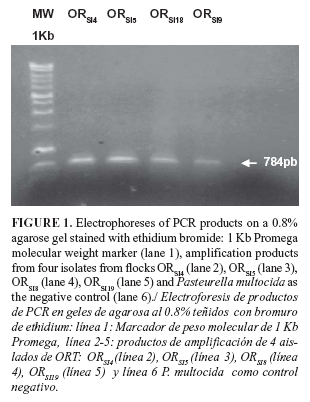
<body><![CDATA[<P><font face="Verdana, Arial, Helvetica, sans-serif" size="2">Two isolates were    obtained from one flock and the remaining two isolates were from another flock.    The four isolates possibly belonging to ORT identified in this study showed    the fallowing code: 0-0-2-0-0-0-4 when the api 20 NE was used, similar to 30.55%    from the strains tested by Van Empel and Hafez en 1999 (9). The isolates were    b galactosidasa positive similar to the ORT isolation detected by Ozbey <I>et    al</I>. en 2004 (18). API-20NE identification strip (Bio Merieux, France) has    prove to be useful, although ORT is not included in the API data files;in studies    where a total of approximately 1150 strains were tested, the strains showed    different code by API-20NE. However to Canal <I>et al</I>. in 2005 (19) the    identification of ORT through the API 20NE system was not possible since the    reactions were negative. </font>     <P><font face="Verdana, Arial, Helvetica, sans-serif" size="2">The results of    biochemical test were confirmed by PCR. All ORT suspicious isolates were positive    in PCR. A 784 bp amplification product was obtained, corresponding to the expected    size (<a href="#f1">Figure 1</a>) when the DNA was extracted    using chemical lyses from broth cultures. No amplified products were obtained    from the negative control. </font>      <P><font face="Verdana, Arial, Helvetica, sans-serif" size="2"><a name="f1"></a></font><img src="/img/revistas/rsa/v33n1/f0106111.gif" width="310" height="402">      
<P> <font face="Verdana, Arial, Helvetica, sans-serif" size="2"><B> </B></font><font face="Verdana, Arial, Helvetica, sans-serif" size="2">The    ORT fragment of 784 bp was also amplified when the ORT PCR was also performed    directly from a single colony grown on agar plates using DNA extraction by boiling,    similar to <I>P.</I> <I>multocida</I>, this technique is useful for the rapid    identification of <I>ORT </I>directly from bacterial cultures without culture,    extraction and purification of genomic DNA even in mixed culture. </font>      <P><font face="Verdana, Arial, Helvetica, sans-serif" size="2">To confirm that    the amplified PCR fragment corresponding to 16S rRNA it was cleaved with the    restriction endonucleases and the products were resolved by agarose gel electrophoresis    showed the fragments with the expected size 671 and 124 pb when the <I>Cla</I>I    restriction enzyme was used (date not shown). The primers described by Van Empel    and Hafez en 1999 (9) are highly specific only for a 784bp fragment on the 16S    rRNA gene of ORT<I> </I>and at the same time are not consistent with any other    closely related bacteria occurring in a genome. </font>     <P><font face="Verdana, Arial, Helvetica, sans-serif" size="2">In the present    study <I>O.rhinotracheale</I> was isolated only from the infraorbital sinus    exudates from four layer hens but not from other tissues. ORT can usually be    isolated from the lungs, trachea and air sacs in broilers (1, 20, 21), although    there are some reports about the isolation of ORT from infraorbital sinus from    layer hens (21, 22, 23). In the experimental infection with ORT aerosol in broiler    chickens, the histological lesion in sinuses were predominant but the culture    and PCR was negative, however ORT was detected by culture and PCR in trachea,    lungs and air sacs only (24). </font>     <P><font face="Verdana, Arial, Helvetica, sans-serif" size="2">Because of the    difficulties of ORT isolation, it can be incorrectly diagnosed as viral infection    or bacterial infection due to the overgrowing of different genus of bacterial,    particularly <I>E.</I> <I>coli, Proteus </I>sp.<I>, Pseudomonas </I>sp.<I> </I>thereby    making it difficult to identify by the routine methods used in most diagnostic    laboratories. This can be avoiding by isolation at early infections stage or    by the use of antibiotic in the culture media. Since it has been shown that    the most of ORT isolates are resistant to gentamicin and recommended the use    of 10 ug of gentamicin per ml of blood agar medium (25). </font>     <P><font face="Verdana, Arial, Helvetica, sans-serif" size="2">ORT was isolated    only in two months corresponding to winter November and January however in July    and October there not was any isolation of ORT in the studied samples. It is    well known that respiratory infections are significantly affected by environmental    factors, and that disease severity is increased during the winter months. Temperature,    ventilation, humidity, atmospheric ammonia, and dust have important interactions    with infectious agents in producing respiratory disease (1). </font>     <P><font face="Verdana, Arial, Helvetica, sans-serif" size="2">The study revealed    that the percentage of isolation of <I>P.multocida </I>and <I>E.coli</I> was    higher (20% and 18% respectively) than the ones of <I>O.rhinotracheale </I>(5%).<I>    </I>These results<I> </I>were consistent with the ones reported by Ozbey <I>et    al.</I> 2004 (18) where ORT was isolated from trachea only (1.5%) from chickens    while the presence of antibodies against ORT was detected by ELISA in 33 (10.2%)    of the samples. </font>     <P><font face="Verdana, Arial, Helvetica, sans-serif" size="2"><I>Ornithobacterium    rhinotracheale </I>has been isolated from chickens, turkeys, quails, ducks,    geese, ostriches, guinea fowls, pheasants, rooks and pigeons (4, 26). ORT was    also reported producing infections in the United States, Germany, South Africa,    The Netherlands, France, Israel, Belgium, Hungary, Japan, the United Kingdom,    Turkey, Canada, Jordan and Brazil (18, 26, 27, 28, 29, 30). The isolates obtained    in our study were compatible with ORT and for the first time it is recognized    in Cuba by the culture and genetic identification from infrorbital sinus of    layer hens with respiratory disorders. The results will allow the development    of future study with the aim at generating information about the serotyping    of ORT,<I> </I>characterization of antimicrobial susceptibility and pathogenicity    specifically in layer chickens. </font>     ]]></body>
<body><![CDATA[<P>     <P><font face="Verdana, Arial, Helvetica, sans-serif" size="2"><B><font size="3">REFERENCES</font></B>    </font>      <!-- ref --><P><font face="Verdana, Arial, Helvetica, sans-serif" size="2">1. Kleven S. Mycoplasmas    in the Etiology of Multifactorial Respiratory Disease. Poultry Science. 1998;77:1146-1149.        </font>     <!-- ref --><P><font face="Verdana, Arial, Helvetica, sans-serif" size="2">2. Hafez MH. Diagnosis    of <I>Ornithobacterium rhinotracheale</I>. Int J Poultry Sci. 2002;1:114-118.        </font>      <!-- ref --><P><font face="Verdana, Arial, Helvetica, sans-serif" size="2">3. EL-Sukonhs NS,    Musa A, AL-Attar M. Studies on the bacterial etiology of airsacculitis of broilers    in northern and middle Jordan with special reference to <I>Escherichia coli,    Ornithobacterium rhinotracheale</I> and <I>Bordetella avium</I>. Avian Dis.    2002;46:605-612.     </font>      <!-- ref --><P><font face="Verdana, Arial, Helvetica, sans-serif" size="2">4. Vandamme P,    Segers P, Vancanneyt M, Van Hofe K, Mutters R, Hommez J, et al. <I>Ornithobacterium    rhinotracheale</I> gen.nov., isolated from the avian respiratory tract. Int    J Syst Bacteriol<I>.</I> 1994;44:24-37.     </font>     ]]></body>
<body><![CDATA[<!-- ref --><P><font face="Verdana, Arial, Helvetica, sans-serif" size="2">5. Chin RP, Van    Empel PCM, Hafez HM. <I>Ornithobacterium rhinotracheale</I> infection. In: Disease    of Poultry, 11th ed Iowa state University Press, Ames, Iowa. 2003: 683-690.    (YM Saif, HJ Barnes, JR Glisson, AM Fadly, LR McDougald, DE Swayne, Eds.    ) </font>      <!-- ref --><P><font face="Verdana, Arial, Helvetica, sans-serif" size="2">6. Van Empel P,    Bosch H, Loeffen P, Storm P. Identification and serotyping of <I>Ornithobacterium    rhinotracheale</I>. J Clin Microbiol<I>.</I> 1997;35:418-421.     </font>      <!-- ref --><P><font face="Verdana, Arial, Helvetica, sans-serif" size="2">7. Douglas A, Ra&uacute;l    A, Stephen P. Elucidation of the DNA sequence of <I>Streptococcus uberis </I>adhesion    molecule gene (<I>sua</I>) and detection of <I>sua </I>in strains of <I>Streptococcus    uberis </I>isolated from geographically diverse locations. Vet Microbiol. 2008;128(3):304-312.        </font>      <!-- ref --><P><font face="Verdana, Arial, Helvetica, sans-serif" size="2">8. Townsend Kirsty    M, Frost Alan J, Lee Chiang W, Papadimitriou John M, Dawkins Hugh JS. Development    of PCR Assays for Species- and Type-Specific Identification of <I>Pasteurella    multocida</I> Isolates. J Clin Microbiol. 1998;36(4):1096-1100.     </font>      <!-- ref --><P><font face="Verdana, Arial, Helvetica, sans-serif" size="2">9. Van Empel PCM,    Hafez HM. <I>Ornithobacterium rhinotracheale</I> a review. Avian Pathology.    1999;28:217-227.     </font>      ]]></body>
<body><![CDATA[<P><font face="Verdana, Arial, Helvetica, sans-serif" size="2">10.Jerod AS, Shelley    MH, Giddings Catherine W, Wooley Richard E, Gibbs Penelope S, et al. Characterizing    Avian Escherichia coli Isolates with Multiplex Polymerase Chain Reaction. Avian    Dis. 2003;47(4):1441-1447. </font>      <!-- ref --><P><font face="Verdana, Arial, Helvetica, sans-serif" size="2">11.Johnson TJ,    Siek KE, Johnson SJ, Nolan LK. DNA Sequence of a ColV plasmid and prevalence    of selected plasmid-encoded virulence genes among avian <I>Escherichia coli    </I>strains. J Bacteriol.<I> </I>2006;188:745-758.     </font>      <!-- ref --><P><font face="Verdana, Arial, Helvetica, sans-serif" size="2">12.Kariyawasam    S, Johnson TJ, Nolan LK. <I>Pap </I>operon of avian pathogenic <I>Escherichia    coli </I>strain O1 is located on a novel pathogenicity island. Infect Immun.    2006;74:744-749.     </font>      <!-- ref --><P><font face="Verdana, Arial, Helvetica, sans-serif" size="2">13.Christensen    JP, Bisgaard M. Fowl cholera. Rev Sci Tech Off Int Epiz. 2000;19:626-637.     </font>      <!-- ref --><P><font face="Verdana, Arial, Helvetica, sans-serif" size="2">14.Ewers C, Janssen    T, Wieler LH. Avian pathogenic <I>Escherichia coli </I>(APEC). Berl Munch Tierarztl    Wochenschr. 2003;116(9-10):381-395.     </font>      <!-- ref --><P><font face="Verdana, Arial, Helvetica, sans-serif" size="2">15.Songserm T,    Viriyarampa AS, Sae-Heng N, Chamsingh W, Bootdee O, Pathanasophon P. <I>Pasteurella    multocida</I>-associated sinusitis in khaki Campbell ducks (<I>Anas platyrhynchos</I>).    Avian Dis. 2003;47(3):649-655.     </font>      <!-- ref --><P><font face="Verdana, Arial, Helvetica, sans-serif" size="2">16.Nasrin MS, Islam    MJ, Nazir KHAN, Choudhury KA, Rahman MT. Identification of bacteria and determination    of their load in adult layer and its environment.<I> </I>J Bangladesh Soc Agric    Sci Technol<I>. </I>2004;(1-2):69-72<I>.     </I> </font>      <!-- ref --><P><font face="Verdana, Arial, Helvetica, sans-serif" size="2">17.Chin R, Droual    R. Ornithobacterium rhinotracheale infection. In Calnek BW (Ed.), Diseases of    Poultry (10th edn, pp. 1012-1015). Ames: Iowa State University Press.    </font>      <!-- ref --><P><font face="Verdana, Arial, Helvetica, sans-serif" size="2">18.Osbey G, Baulk    DT, Celik V, Kilic A, Muz A. Investigations on <I>Ornithobacterium rhinotracheale</I>    in broiler flocks in Elazig province located in the East of Turkey.<I> </I>Vet    Med-Czech. 2004;49(8):305-311<I>.    </I> </font>     <!-- ref --><P><font face="Verdana, Arial, Helvetica, sans-serif" size="2">19.Canal CW, Leao    JA, Rocha SLS, Maganan M, Lima-Rosa CAV, Oliveira SD, et al. Isolation and characterization    of <I>Ornithobacterium</I> <I>rhinotracheale </I>from chickens in Brazil. Res    Vet Sci. 2005;78:225-230.     </font>     <!-- ref --><P><font face="Verdana, Arial, Helvetica, sans-serif" size="2">20. Asadpour Y,    Bozorgmehrifard MH, Pourbakhsh SA, Banani M, Charkhkar S. Isolation and identification    of Ornithobacterium rhinotracheale in broiler breeder flocks of Guilan province,    north of Iran. Pak J Biol Sci. 2008;11(11):1487-1491.     </font>      <!-- ref --><P><font face="Verdana, Arial, Helvetica, sans-serif" size="2">21.Murthy TRGK,    Dorairajan N, Balasubramaniam GA, Dinakaran AM, Saravanabava K. Pathogenic bacteria    related to respiratory diseases in<B> </B>poultry with reference to <I>Ornithobacterium    rhinotracheale </I>isolated in India.<I> </I>Veterinarski Arhiv. 2008;78(2):131-140.        </font>      <!-- ref --><P><font face="Verdana, Arial, Helvetica, sans-serif" size="2">22.Murthy TRGK,    Dorairajan N, Balasubramaniam GA, Dinakaran AM, Saravanabava K. <I>In vitro    </I>antibiotic sensitivity of <I>Ornithobacterium rhinotracheale</I> strains    isolated from laying hens in Indi.<I> </I>Veterinarski Arhiv. 2008;78(1):49-56.        </font>      <!-- ref --><P><font face="Verdana, Arial, Helvetica, sans-serif" size="2">23.Sprenger SJ,    Halvorson DA, Nagaraja KV, Spasojevic R, Dutton RS, Shaw DP. Ornithobacterium    rhinotracheale infection in commercial laying-type chickens. Avian Dis. 2000;44(3):725-729.    </font><font face="Verdana, Arial, Helvetica, sans-serif" size="2">    <BR>       <!-- ref --><BR>   24.Kilic A, Timurkaan H, Ertas B, Yilmaz F. Pathological examination and bacterial    reisolation by culture and PCR of experimental <I>Ornithobacterium rhinotracheale    </I>infection in broiler chickens.<I> </I>Revue M&eacute;d V&eacute;t<I>. </I>2009;160(3):140-144.        </font>      ]]></body>
<body><![CDATA[<!-- ref --><P><font face="Verdana, Arial, Helvetica, sans-serif" size="2">25.Hafez Mohamed.    Diagnosis of Ornithobacterium rhinotracheale. International journal of Poultry    Science. 2002;1(5):114-118.     </font>     <!-- ref --><P><font face="Verdana, Arial, Helvetica, sans-serif" size="2">26.Leroy-Setrin    S, Flaujac G, Thenaisy K, Chaslus-Dancla E. Genetic diversity of Ornithobacterium    rhinotracheale strains isolated from poultry in France. Letters in Applied Microbiology.    1998;26:189-193.     </font>     <!-- ref --><P><font face="Verdana, Arial, Helvetica, sans-serif" size="2">27.Joubert P, Higgins    R, Laperle A, Mikaelian I, Venne D, Silim A. Isolation of <I>Ornithobacterium    rhinotracheale</I> from turkeys in Quebec, Canada. Avian Dis. 1999;43:622-626.        </font>      <!-- ref --><P><font face="Verdana, Arial, Helvetica, sans-serif" size="2">28.Halvorson DA.    Seroprevalence of <I>Ornithobacterium rhinotracheale</I> infection in commercial    laying hens in the north central region of the United States. Avian Dis. 2001;45:1064-1067.        </font>      <!-- ref --><P><font face="Verdana, Arial, Helvetica, sans-serif" size="2">29.Nagaraja K,    Back A, Sorenger S, Rajashekara G, Halvorson D. Tissue distribution post-infection    and antimicrobal sensitivity of <I>Ornithobacterium rhinotracheale</I>. In Proceedings    of the 47th Western Poultry Disease Conference, Sacramento, (1998):57-60.     </font>      ]]></body>
<body><![CDATA[<!-- ref --><P><font face="Verdana, Arial, Helvetica, sans-serif" size="2">30.Rahimi M, Banani    M.<B> </B>Isolation of <I>Ornithobacterium rhinotracheale </I>from the chickens    of a broiler farm in Kermanshah province, west of Iran Iranian Journal of Veterinary    Research, University of Shiraz. 2007;8(4).    </font>     <P>     <P>     <P><font face="Verdana, Arial, Helvetica, sans-serif" size="2"><B>(Recibido 11-11-2009;    Aceptado 7-7-2010)</B></font>       ]]></body><back>
<ref-list>
<ref id="B1">
<label>1</label><nlm-citation citation-type="journal">
<person-group person-group-type="author">
<name>
<surname><![CDATA[Kleven]]></surname>
<given-names><![CDATA[S]]></given-names>
</name>
</person-group>
<article-title xml:lang="en"><![CDATA[Mycoplasmas in the Etiology of Multifactorial Respiratory Disease]]></article-title>
<source><![CDATA[Poultry Science]]></source>
<year>1998</year>
<volume>77</volume>
<page-range>1146-1149</page-range></nlm-citation>
</ref>
<ref id="B2">
<label>2</label><nlm-citation citation-type="journal">
<person-group person-group-type="author">
<name>
<surname><![CDATA[Hafez]]></surname>
<given-names><![CDATA[MH]]></given-names>
</name>
</person-group>
<article-title xml:lang="en"><![CDATA[Diagnosis of Ornithobacterium rhinotracheale]]></article-title>
<source><![CDATA[Int J Poultry Sci]]></source>
<year>2002</year>
<volume>1</volume>
<page-range>114-118</page-range></nlm-citation>
</ref>
<ref id="B3">
<label>3</label><nlm-citation citation-type="journal">
<person-group person-group-type="author">
<name>
<surname><![CDATA[EL-Sukonhs]]></surname>
<given-names><![CDATA[NS]]></given-names>
</name>
<name>
<surname><![CDATA[Musa]]></surname>
<given-names><![CDATA[A]]></given-names>
</name>
<name>
<surname><![CDATA[AL-Attar]]></surname>
<given-names><![CDATA[M]]></given-names>
</name>
</person-group>
<article-title xml:lang="en"><![CDATA[Studies on the bacterial etiology of airsacculitis of broilers in northern and middle Jordan with special reference to Escherichia coli, Ornithobacterium rhinotracheale and Bordetella avium]]></article-title>
<source><![CDATA[Avian Dis]]></source>
<year>2002</year>
<volume>46</volume>
<page-range>605-612</page-range></nlm-citation>
</ref>
<ref id="B4">
<label>4</label><nlm-citation citation-type="journal">
<person-group person-group-type="author">
<name>
<surname><![CDATA[Vandamme]]></surname>
<given-names><![CDATA[P]]></given-names>
</name>
<name>
<surname><![CDATA[Segers]]></surname>
<given-names><![CDATA[P]]></given-names>
</name>
<name>
<surname><![CDATA[Vancanneyt]]></surname>
<given-names><![CDATA[M]]></given-names>
</name>
<name>
<surname><![CDATA[Van Hofe]]></surname>
<given-names><![CDATA[K]]></given-names>
</name>
<name>
<surname><![CDATA[Mutters]]></surname>
<given-names><![CDATA[R]]></given-names>
</name>
<name>
<surname><![CDATA[Hommez]]></surname>
<given-names><![CDATA[J]]></given-names>
</name>
</person-group>
<article-title xml:lang="en"><![CDATA[Ornithobacterium rhinotracheale gen.nov., isolated from the avian respiratory tract]]></article-title>
<source><![CDATA[Int J Syst Bacteriol]]></source>
<year>1994</year>
<volume>44</volume>
<page-range>24-37</page-range></nlm-citation>
</ref>
<ref id="B5">
<label>5</label><nlm-citation citation-type="">
<person-group person-group-type="author">
<name>
<surname><![CDATA[Chin]]></surname>
<given-names><![CDATA[RP]]></given-names>
</name>
<name>
<surname><![CDATA[Van Empel]]></surname>
<given-names><![CDATA[PCM]]></given-names>
</name>
<name>
<surname><![CDATA[Hafez]]></surname>
<given-names><![CDATA[HM]]></given-names>
</name>
</person-group>
<article-title xml:lang="en"><![CDATA[Ornithobacterium rhinotracheale infection]]></article-title>
<person-group person-group-type="editor">
<name>
<surname><![CDATA[Saif]]></surname>
<given-names><![CDATA[YM]]></given-names>
</name>
<name>
<surname><![CDATA[Barnes]]></surname>
<given-names><![CDATA[HJ]]></given-names>
</name>
<name>
<surname><![CDATA[Glisson]]></surname>
<given-names><![CDATA[JR]]></given-names>
</name>
<name>
<surname><![CDATA[Fadly]]></surname>
<given-names><![CDATA[AM]]></given-names>
</name>
<name>
<surname><![CDATA[McDougald]]></surname>
<given-names><![CDATA[LR]]></given-names>
</name>
<name>
<surname><![CDATA[Swayne]]></surname>
<given-names><![CDATA[DE]]></given-names>
</name>
</person-group>
<source><![CDATA[Disease of Poultry]]></source>
<year>2003</year>
<edition>11th</edition>
<page-range>683-690</page-range></nlm-citation>
</ref>
<ref id="B6">
<label>6</label><nlm-citation citation-type="journal">
<person-group person-group-type="author">
<name>
<surname><![CDATA[Van Empel]]></surname>
<given-names><![CDATA[P]]></given-names>
</name>
<name>
<surname><![CDATA[Bosch]]></surname>
<given-names><![CDATA[H]]></given-names>
</name>
<name>
<surname><![CDATA[Loeffen]]></surname>
<given-names><![CDATA[P]]></given-names>
</name>
<name>
<surname><![CDATA[Storm]]></surname>
<given-names><![CDATA[P]]></given-names>
</name>
</person-group>
<article-title xml:lang="en"><![CDATA[Identification and serotyping of Ornithobacterium rhinotracheale]]></article-title>
<source><![CDATA[J Clin Microbiol]]></source>
<year>1997</year>
<volume>35</volume>
<page-range>418-421</page-range></nlm-citation>
</ref>
<ref id="B7">
<label>7</label><nlm-citation citation-type="journal">
<person-group person-group-type="author">
<name>
<surname><![CDATA[Douglas]]></surname>
<given-names><![CDATA[A]]></given-names>
</name>
<name>
<surname><![CDATA[Raúl]]></surname>
<given-names><![CDATA[A]]></given-names>
</name>
<name>
<surname><![CDATA[Stephen]]></surname>
<given-names><![CDATA[P]]></given-names>
</name>
</person-group>
<article-title xml:lang="en"><![CDATA[Elucidation of the DNA sequence of Streptococcus uberis adhesion molecule gene (sua) and detection of sua in strains of Streptococcus uberis isolated from geographically diverse locations]]></article-title>
<source><![CDATA[Vet Microbiol]]></source>
<year>2008</year>
<volume>128</volume>
<numero>3</numero>
<issue>3</issue>
<page-range>304-312</page-range></nlm-citation>
</ref>
<ref id="B8">
<label>8</label><nlm-citation citation-type="journal">
<person-group person-group-type="author">
<name>
<surname><![CDATA[Townsend]]></surname>
<given-names><![CDATA[Kirsty M]]></given-names>
</name>
<name>
<surname><![CDATA[Frost]]></surname>
<given-names><![CDATA[Alan J]]></given-names>
</name>
<name>
<surname><![CDATA[Lee]]></surname>
<given-names><![CDATA[Chiang W]]></given-names>
</name>
<name>
<surname><![CDATA[Papadimitriou]]></surname>
<given-names><![CDATA[John M]]></given-names>
</name>
<name>
<surname><![CDATA[Dawkins]]></surname>
<given-names><![CDATA[Hugh JS]]></given-names>
</name>
</person-group>
<article-title xml:lang="en"><![CDATA[Development of PCR Assays for Species- and Type-Specific Identification of Pasteurella multocida Isolates]]></article-title>
<source><![CDATA[J Clin Microbiol]]></source>
<year>1998</year>
<volume>36</volume>
<numero>4</numero>
<issue>4</issue>
<page-range>1096-1100</page-range></nlm-citation>
</ref>
<ref id="B9">
<label>9</label><nlm-citation citation-type="journal">
<person-group person-group-type="author">
<name>
<surname><![CDATA[Van Empel]]></surname>
<given-names><![CDATA[PCM]]></given-names>
</name>
<name>
<surname><![CDATA[Hafez]]></surname>
<given-names><![CDATA[HM]]></given-names>
</name>
</person-group>
<article-title xml:lang="en"><![CDATA[Ornithobacterium rhinotracheale a review]]></article-title>
<source><![CDATA[Avian Pathology]]></source>
<year>1999</year>
<volume>28</volume>
<page-range>217-227</page-range></nlm-citation>
</ref>
<ref id="B10">
<label>10</label><nlm-citation citation-type="journal">
<person-group person-group-type="author">
<name>
<surname><![CDATA[Jerod]]></surname>
<given-names><![CDATA[AS]]></given-names>
</name>
<name>
<surname><![CDATA[Shelley]]></surname>
<given-names><![CDATA[MH]]></given-names>
</name>
<name>
<surname><![CDATA[Catherine W]]></surname>
<given-names><![CDATA[Giddings]]></given-names>
</name>
<name>
<surname><![CDATA[Wooley]]></surname>
<given-names><![CDATA[Richard E]]></given-names>
</name>
<name>
<surname><![CDATA[Gibbs]]></surname>
<given-names><![CDATA[Penelope S]]></given-names>
</name>
</person-group>
<article-title xml:lang="en"><![CDATA[Characterizing Avian Escherichia coli Isolates with Multiplex Polymerase Chain Reaction]]></article-title>
<source><![CDATA[Avian Dis]]></source>
<year>2003</year>
<volume>47</volume>
<numero>4</numero>
<issue>4</issue>
<page-range>1441-1447</page-range></nlm-citation>
</ref>
<ref id="B11">
<label>11</label><nlm-citation citation-type="journal">
<person-group person-group-type="author">
<name>
<surname><![CDATA[Johnson]]></surname>
<given-names><![CDATA[TJ]]></given-names>
</name>
<name>
<surname><![CDATA[Siek]]></surname>
<given-names><![CDATA[KE]]></given-names>
</name>
<name>
<surname><![CDATA[Johnson]]></surname>
<given-names><![CDATA[SJ]]></given-names>
</name>
<name>
<surname><![CDATA[Nolan]]></surname>
<given-names><![CDATA[LK]]></given-names>
</name>
</person-group>
<article-title xml:lang="en"><![CDATA[DNA Sequence of a ColV plasmid and prevalence of selected plasmid-encoded virulence genes among avian Escherichia coli strains]]></article-title>
<source><![CDATA[J Bacteriol]]></source>
<year>2006</year>
<volume>188</volume>
<page-range>745-758</page-range></nlm-citation>
</ref>
<ref id="B12">
<label>12</label><nlm-citation citation-type="journal">
<person-group person-group-type="author">
<name>
<surname><![CDATA[Kariyawasam]]></surname>
<given-names><![CDATA[S]]></given-names>
</name>
<name>
<surname><![CDATA[Johnson]]></surname>
<given-names><![CDATA[TJ]]></given-names>
</name>
<name>
<surname><![CDATA[Nolan]]></surname>
<given-names><![CDATA[LK]]></given-names>
</name>
</person-group>
<article-title xml:lang="en"><![CDATA[Pap operon of avian pathogenic Escherichia coli strain O1 is located on a novel pathogenicity island]]></article-title>
<source><![CDATA[Infect Immun]]></source>
<year>2006</year>
<volume>74</volume>
<page-range>744-749</page-range></nlm-citation>
</ref>
<ref id="B13">
<label>13</label><nlm-citation citation-type="journal">
<person-group person-group-type="author">
<name>
<surname><![CDATA[Christensen]]></surname>
<given-names><![CDATA[JP]]></given-names>
</name>
<name>
<surname><![CDATA[Bisgaard]]></surname>
<given-names><![CDATA[M]]></given-names>
</name>
</person-group>
<article-title xml:lang="en"><![CDATA[Fowl cholera]]></article-title>
<source><![CDATA[Rev Sci Tech Off Int Epiz]]></source>
<year>2000</year>
<volume>19</volume>
<page-range>626-637</page-range></nlm-citation>
</ref>
<ref id="B14">
<label>14</label><nlm-citation citation-type="journal">
<person-group person-group-type="author">
<name>
<surname><![CDATA[Ewers]]></surname>
<given-names><![CDATA[C]]></given-names>
</name>
<name>
<surname><![CDATA[Janssen]]></surname>
<given-names><![CDATA[T]]></given-names>
</name>
<name>
<surname><![CDATA[Wieler]]></surname>
<given-names><![CDATA[LH]]></given-names>
</name>
</person-group>
<article-title xml:lang="en"><![CDATA[Avian pathogenic Escherichia coli (APEC)]]></article-title>
<source><![CDATA[Berl Munch Tierarztl Wochenschr]]></source>
<year>2003</year>
<volume>116</volume>
<numero>9-10</numero>
<issue>9-10</issue>
<page-range>381-395</page-range></nlm-citation>
</ref>
<ref id="B15">
<label>15</label><nlm-citation citation-type="journal">
<person-group person-group-type="author">
<name>
<surname><![CDATA[Songserm]]></surname>
<given-names><![CDATA[T]]></given-names>
</name>
<name>
<surname><![CDATA[Viriyarampa]]></surname>
<given-names><![CDATA[AS]]></given-names>
</name>
<name>
<surname><![CDATA[Sae-Heng]]></surname>
<given-names><![CDATA[N]]></given-names>
</name>
<name>
<surname><![CDATA[Chamsingh]]></surname>
<given-names><![CDATA[W]]></given-names>
</name>
<name>
<surname><![CDATA[Bootdee]]></surname>
<given-names><![CDATA[O]]></given-names>
</name>
<name>
<surname><![CDATA[Pathanasophon]]></surname>
<given-names><![CDATA[P]]></given-names>
</name>
</person-group>
<article-title xml:lang="en"><![CDATA[Pasteurella multocida-associated sinusitis in khaki Campbell ducks (Anas platyrhynchos)]]></article-title>
<source><![CDATA[Avian Dis]]></source>
<year>2003</year>
<volume>47</volume>
<numero>3</numero>
<issue>3</issue>
<page-range>649-655</page-range></nlm-citation>
</ref>
<ref id="B16">
<label>16</label><nlm-citation citation-type="journal">
<person-group person-group-type="author">
<name>
<surname><![CDATA[Nasrin]]></surname>
<given-names><![CDATA[MS]]></given-names>
</name>
<name>
<surname><![CDATA[Islam]]></surname>
<given-names><![CDATA[MJ]]></given-names>
</name>
<name>
<surname><![CDATA[Nazir]]></surname>
<given-names><![CDATA[KHAN]]></given-names>
</name>
<name>
<surname><![CDATA[Choudhury]]></surname>
<given-names><![CDATA[KA]]></given-names>
</name>
<name>
<surname><![CDATA[Rahman]]></surname>
<given-names><![CDATA[MT]]></given-names>
</name>
</person-group>
<article-title xml:lang="en"><![CDATA[Identification of bacteria and determination of their load in adult layer and its environment]]></article-title>
<source><![CDATA[J Bangladesh Soc Agric Sci Technol]]></source>
<year>2004</year>
<numero>1-2</numero>
<issue>1-2</issue>
<page-range>69-72</page-range></nlm-citation>
</ref>
<ref id="B17">
<label>17</label><nlm-citation citation-type="">
<person-group person-group-type="author">
<name>
<surname><![CDATA[Chin]]></surname>
<given-names><![CDATA[R]]></given-names>
</name>
<name>
<surname><![CDATA[Droual]]></surname>
<given-names><![CDATA[R]]></given-names>
</name>
</person-group>
<article-title xml:lang="en"><![CDATA[Ornithobacterium rhinotracheale infection]]></article-title>
<person-group person-group-type="editor">
<name>
<surname><![CDATA[Calnek]]></surname>
<given-names><![CDATA[BW]]></given-names>
</name>
</person-group>
<source><![CDATA[Diseases of Poultry]]></source>
<year></year>
<edition>10th</edition>
<page-range>1012-1015</page-range></nlm-citation>
</ref>
<ref id="B18">
<label>18</label><nlm-citation citation-type="journal">
<person-group person-group-type="author">
<name>
<surname><![CDATA[Osbey]]></surname>
<given-names><![CDATA[G]]></given-names>
</name>
<name>
<surname><![CDATA[Baulk]]></surname>
<given-names><![CDATA[DT]]></given-names>
</name>
<name>
<surname><![CDATA[Celik]]></surname>
<given-names><![CDATA[V]]></given-names>
</name>
<name>
<surname><![CDATA[Kilic]]></surname>
<given-names><![CDATA[A]]></given-names>
</name>
<name>
<surname><![CDATA[Muz]]></surname>
<given-names><![CDATA[A]]></given-names>
</name>
</person-group>
<article-title xml:lang="en"><![CDATA[Investigations on Ornithobacterium rhinotracheale in broiler flocks in Elazig province located in the East of Turkey]]></article-title>
<source><![CDATA[Vet Med-Czech]]></source>
<year>2004</year>
<volume>49</volume>
<numero>8</numero>
<issue>8</issue>
<page-range>305-311</page-range></nlm-citation>
</ref>
<ref id="B19">
<label>19</label><nlm-citation citation-type="journal">
<person-group person-group-type="author">
<name>
<surname><![CDATA[Canal]]></surname>
<given-names><![CDATA[CW]]></given-names>
</name>
<name>
<surname><![CDATA[Leao]]></surname>
<given-names><![CDATA[JA]]></given-names>
</name>
<name>
<surname><![CDATA[Rocha]]></surname>
<given-names><![CDATA[SLS]]></given-names>
</name>
<name>
<surname><![CDATA[Maganan]]></surname>
<given-names><![CDATA[M]]></given-names>
</name>
<name>
<surname><![CDATA[Lima-Rosa]]></surname>
<given-names><![CDATA[CAV]]></given-names>
</name>
<name>
<surname><![CDATA[Oliveira]]></surname>
<given-names><![CDATA[SD]]></given-names>
</name>
</person-group>
<article-title xml:lang="en"><![CDATA[Isolation and characterization of Ornithobacterium rhinotracheale from chickens in Brazil]]></article-title>
<source><![CDATA[Res Vet Sci]]></source>
<year>2005</year>
<volume>78</volume>
<page-range>225-230</page-range></nlm-citation>
</ref>
<ref id="B20">
<label>20</label><nlm-citation citation-type="journal">
<person-group person-group-type="author">
<name>
<surname><![CDATA[Asadpour]]></surname>
<given-names><![CDATA[Y]]></given-names>
</name>
<name>
<surname><![CDATA[Bozorgmehrifard]]></surname>
<given-names><![CDATA[MH]]></given-names>
</name>
<name>
<surname><![CDATA[Pourbakhsh]]></surname>
<given-names><![CDATA[SA]]></given-names>
</name>
<name>
<surname><![CDATA[Banani]]></surname>
<given-names><![CDATA[M]]></given-names>
</name>
<name>
<surname><![CDATA[Charkhkar]]></surname>
<given-names><![CDATA[S]]></given-names>
</name>
</person-group>
<article-title xml:lang="en"><![CDATA[Isolation and identification of Ornithobacterium rhinotracheale in broiler breeder flocks of Guilan province, north of Iran]]></article-title>
<source><![CDATA[Pak J Biol Sci]]></source>
<year>2008</year>
<volume>11</volume>
<numero>11</numero>
<issue>11</issue>
<page-range>1487-1491</page-range></nlm-citation>
</ref>
<ref id="B21">
<label>21</label><nlm-citation citation-type="journal">
<person-group person-group-type="author">
<name>
<surname><![CDATA[Murthy]]></surname>
<given-names><![CDATA[TRGK]]></given-names>
</name>
<name>
<surname><![CDATA[Dorairajan]]></surname>
<given-names><![CDATA[N]]></given-names>
</name>
<name>
<surname><![CDATA[Balasubramaniam]]></surname>
<given-names><![CDATA[GA]]></given-names>
</name>
<name>
<surname><![CDATA[Dinakaran]]></surname>
<given-names><![CDATA[AM]]></given-names>
</name>
<name>
<surname><![CDATA[Saravanabava]]></surname>
<given-names><![CDATA[K]]></given-names>
</name>
</person-group>
<article-title xml:lang="en"><![CDATA[Pathogenic bacteria related to respiratory diseases in poultry with reference to Ornithobacterium rhinotracheale isolated in India]]></article-title>
<source><![CDATA[Veterinarski Arhiv]]></source>
<year>2008</year>
<volume>78</volume>
<numero>2</numero>
<issue>2</issue>
<page-range>131-140</page-range></nlm-citation>
</ref>
<ref id="B22">
<label>22</label><nlm-citation citation-type="journal">
<person-group person-group-type="author">
<name>
<surname><![CDATA[Murthy]]></surname>
<given-names><![CDATA[TRGK]]></given-names>
</name>
<name>
<surname><![CDATA[Dorairajan]]></surname>
<given-names><![CDATA[N]]></given-names>
</name>
<name>
<surname><![CDATA[Balasubramaniam]]></surname>
<given-names><![CDATA[GA]]></given-names>
</name>
<name>
<surname><![CDATA[Dinakaran]]></surname>
<given-names><![CDATA[AM]]></given-names>
</name>
<name>
<surname><![CDATA[Saravanabava]]></surname>
<given-names><![CDATA[K]]></given-names>
</name>
</person-group>
<article-title xml:lang="en"><![CDATA[In vitro antibiotic sensitivity of Ornithobacterium rhinotracheale strains isolated from laying hens in Indi]]></article-title>
<source><![CDATA[Veterinarski Arhiv]]></source>
<year>2008</year>
<volume>78</volume>
<numero>1</numero>
<issue>1</issue>
<page-range>49-56</page-range></nlm-citation>
</ref>
<ref id="B23">
<label>23</label><nlm-citation citation-type="journal">
<person-group person-group-type="author">
<name>
<surname><![CDATA[Sprenger]]></surname>
<given-names><![CDATA[SJ]]></given-names>
</name>
<name>
<surname><![CDATA[Halvorson]]></surname>
<given-names><![CDATA[DA]]></given-names>
</name>
<name>
<surname><![CDATA[Nagaraja]]></surname>
<given-names><![CDATA[KV]]></given-names>
</name>
<name>
<surname><![CDATA[Spasojevic]]></surname>
<given-names><![CDATA[R]]></given-names>
</name>
<name>
<surname><![CDATA[Dutton]]></surname>
<given-names><![CDATA[RS]]></given-names>
</name>
<name>
<surname><![CDATA[Shaw]]></surname>
<given-names><![CDATA[DP]]></given-names>
</name>
</person-group>
<article-title xml:lang="en"><![CDATA[Ornithobacterium rhinotracheale infection in commercial laying-type chickens]]></article-title>
<source><![CDATA[Avian Dis]]></source>
<year>2000</year>
<volume>44</volume>
<numero>3</numero>
<issue>3</issue>
<page-range>725-729</page-range></nlm-citation>
</ref>
<ref id="B24">
<label>24</label><nlm-citation citation-type="journal">
<person-group person-group-type="author">
<name>
<surname><![CDATA[Kilic]]></surname>
<given-names><![CDATA[A]]></given-names>
</name>
<name>
<surname><![CDATA[Timurkaan]]></surname>
<given-names><![CDATA[H]]></given-names>
</name>
<name>
<surname><![CDATA[Ertas]]></surname>
<given-names><![CDATA[B]]></given-names>
</name>
<name>
<surname><![CDATA[Yilmaz]]></surname>
<given-names><![CDATA[F]]></given-names>
</name>
</person-group>
<article-title xml:lang="en"><![CDATA[Pathological examination and bacterial reisolation by culture and PCR of experimental Ornithobacterium rhinotracheale infection in broiler chickens]]></article-title>
<source><![CDATA[Revue Méd Vét]]></source>
<year>2009</year>
<volume>160</volume>
<numero>3</numero>
<issue>3</issue>
<page-range>140-144</page-range></nlm-citation>
</ref>
<ref id="B25">
<label>25</label><nlm-citation citation-type="journal">
<person-group person-group-type="author">
<name>
<surname><![CDATA[Hafez]]></surname>
<given-names><![CDATA[Mohamed]]></given-names>
</name>
</person-group>
<article-title xml:lang="en"><![CDATA[Diagnosis of Ornithobacterium rhinotracheale]]></article-title>
<source><![CDATA[International journal of Poultry Science]]></source>
<year>2002</year>
<volume>1</volume>
<numero>5</numero>
<issue>5</issue>
<page-range>114-118</page-range></nlm-citation>
</ref>
<ref id="B26">
<label>26</label><nlm-citation citation-type="journal">
<person-group person-group-type="author">
<name>
<surname><![CDATA[Leroy-Setrin]]></surname>
<given-names><![CDATA[S]]></given-names>
</name>
<name>
<surname><![CDATA[Flaujac]]></surname>
<given-names><![CDATA[G]]></given-names>
</name>
<name>
<surname><![CDATA[Thenaisy]]></surname>
<given-names><![CDATA[K]]></given-names>
</name>
<name>
<surname><![CDATA[Chaslus-Dancla]]></surname>
<given-names><![CDATA[E]]></given-names>
</name>
</person-group>
<article-title xml:lang="en"><![CDATA[Genetic diversity of Ornithobacterium rhinotracheale strains isolated from poultry in France]]></article-title>
<source><![CDATA[Letters in Applied Microbiology]]></source>
<year>1998</year>
<volume>26</volume>
<page-range>189-193</page-range></nlm-citation>
</ref>
<ref id="B27">
<label>27</label><nlm-citation citation-type="journal">
<person-group person-group-type="author">
<name>
<surname><![CDATA[Joubert]]></surname>
<given-names><![CDATA[P]]></given-names>
</name>
<name>
<surname><![CDATA[Higgins]]></surname>
<given-names><![CDATA[R]]></given-names>
</name>
<name>
<surname><![CDATA[Laperle]]></surname>
<given-names><![CDATA[A]]></given-names>
</name>
<name>
<surname><![CDATA[Mikaelian]]></surname>
<given-names><![CDATA[I]]></given-names>
</name>
<name>
<surname><![CDATA[Venne]]></surname>
<given-names><![CDATA[D]]></given-names>
</name>
<name>
<surname><![CDATA[Silim]]></surname>
<given-names><![CDATA[A]]></given-names>
</name>
</person-group>
<article-title xml:lang="en"><![CDATA[Isolation of Ornithobacterium rhinotracheale from turkeys in Quebec, Canada]]></article-title>
<source><![CDATA[Avian Dis]]></source>
<year>1999</year>
<volume>43</volume>
<page-range>622-626</page-range></nlm-citation>
</ref>
<ref id="B28">
<label>28</label><nlm-citation citation-type="journal">
<person-group person-group-type="author">
<name>
<surname><![CDATA[Halvorson]]></surname>
<given-names><![CDATA[DA]]></given-names>
</name>
</person-group>
<article-title xml:lang="en"><![CDATA[Seroprevalence of Ornithobacterium rhinotracheale infection in commercial laying hens in the north central region of the United States]]></article-title>
<source><![CDATA[Avian Dis]]></source>
<year>2001</year>
<volume>45</volume>
<page-range>1064-1067</page-range></nlm-citation>
</ref>
<ref id="B29">
<label>29</label><nlm-citation citation-type="confpro">
<person-group person-group-type="author">
<name>
<surname><![CDATA[Nagaraja]]></surname>
<given-names><![CDATA[K]]></given-names>
</name>
<name>
<surname><![CDATA[Back]]></surname>
<given-names><![CDATA[A]]></given-names>
</name>
<name>
<surname><![CDATA[Sorenger]]></surname>
<given-names><![CDATA[S]]></given-names>
</name>
<name>
<surname><![CDATA[Rajashekara]]></surname>
<given-names><![CDATA[G]]></given-names>
</name>
<name>
<surname><![CDATA[Halvorson]]></surname>
<given-names><![CDATA[D]]></given-names>
</name>
</person-group>
<article-title xml:lang="en"><![CDATA[Tissue distribution post-infection and antimicrobal sensitivity of Ornithobacterium rhinotracheale]]></article-title>
<source><![CDATA[]]></source>
<year></year>
<conf-name><![CDATA[ Proceedings of the 47th Western Poultry Disease Conference]]></conf-name>
<conf-date>1998</conf-date>
<conf-loc>Sacramento </conf-loc>
</nlm-citation>
</ref>
<ref id="B30">
<label>30</label><nlm-citation citation-type="journal">
<person-group person-group-type="author">
<name>
<surname><![CDATA[Rahimi]]></surname>
<given-names><![CDATA[M]]></given-names>
</name>
<name>
<surname><![CDATA[Banani]]></surname>
<given-names><![CDATA[M]]></given-names>
</name>
</person-group>
<article-title xml:lang="en"><![CDATA[Isolation of Ornithobacterium rhinotracheale from the chickens of a broiler farm in Kermanshah province, west of Iran]]></article-title>
<source><![CDATA[Iranian Journal of Veterinary Research]]></source>
<year>2007</year>
<volume>8</volume>
<numero>4</numero>
<issue>4</issue>
</nlm-citation>
</ref>
</ref-list>
</back>
</article>
