<?xml version="1.0" encoding="ISO-8859-1"?><article xmlns:mml="http://www.w3.org/1998/Math/MathML" xmlns:xlink="http://www.w3.org/1999/xlink" xmlns:xsi="http://www.w3.org/2001/XMLSchema-instance">
<front>
<journal-meta>
<journal-id>0253-570X</journal-id>
<journal-title><![CDATA[Revista de Salud Animal]]></journal-title>
<abbrev-journal-title><![CDATA[Rev Salud Anim.]]></abbrev-journal-title>
<issn>0253-570X</issn>
<publisher>
<publisher-name><![CDATA[Centro Nacional de Sanidad Agropecuaria]]></publisher-name>
</publisher>
</journal-meta>
<article-meta>
<article-id>S0253-570X2012000100005</article-id>
<title-group>
<article-title xml:lang="en"><![CDATA[EFFECTS OF TWO PHYTOTHERAPIC FORMULATIONS CONTAINING Glycine max (L.) MERR ON MALE RAT FERTILITY]]></article-title>
<article-title xml:lang="es"><![CDATA[EFECTOS DE DOS FORMULACIONES FITOTERAPÉUTICAS QUE CONTINEN Glycine max (L.) MERR SOBRE LA FERTILIDAD DE RATAS MACHOS]]></article-title>
</title-group>
<contrib-group>
<contrib contrib-type="author">
<name>
<surname><![CDATA[Boemler Hollenbach]]></surname>
<given-names><![CDATA[Clarissa]]></given-names>
</name>
<xref ref-type="aff" rid="A01"/>
</contrib>
<contrib contrib-type="author">
<name>
<surname><![CDATA[Bortolini]]></surname>
<given-names><![CDATA[Carlos Eduardo]]></given-names>
</name>
<xref ref-type="aff" rid="A01"/>
</contrib>
<contrib contrib-type="author">
<name>
<surname><![CDATA[Mattos Rodrigues]]></surname>
<given-names><![CDATA[Juliano]]></given-names>
</name>
<xref ref-type="aff" rid="A01"/>
</contrib>
<contrib contrib-type="author">
<name>
<surname><![CDATA[Hirtz]]></surname>
<given-names><![CDATA[Lucas]]></given-names>
</name>
<xref ref-type="aff" rid="A01"/>
</contrib>
<contrib contrib-type="author">
<name>
<surname><![CDATA[Bastos de Mello]]></surname>
<given-names><![CDATA[Fernanda]]></given-names>
</name>
<xref ref-type="aff" rid="A02"/>
</contrib>
<contrib contrib-type="author">
<name>
<surname><![CDATA[Braga de Mello]]></surname>
<given-names><![CDATA[João Roberto]]></given-names>
</name>
<xref ref-type="aff" rid="A01"/>
</contrib>
</contrib-group>
<aff id="A01">
<institution><![CDATA[,Universidade Federal do Rio Grande do Sul (UFRGS) Instituto de Ciências Básicas da Saúde (ICBS) Departamento de Farmacologia]]></institution>
<addr-line><![CDATA[Porto Alegre ]]></addr-line>
<country>Brazil</country>
</aff>
<aff id="A02">
<institution><![CDATA[,UFCSPA - Universidade Federal de Ciências da Saúde de Porto Alegre  ]]></institution>
<addr-line><![CDATA[Porto Alegre ]]></addr-line>
<country>Brazil</country>
</aff>
<pub-date pub-type="pub">
<day>00</day>
<month>04</month>
<year>2012</year>
</pub-date>
<pub-date pub-type="epub">
<day>00</day>
<month>04</month>
<year>2012</year>
</pub-date>
<volume>34</volume>
<numero>1</numero>
<fpage>31</fpage>
<lpage>39</lpage>
<copyright-statement/>
<copyright-year/>
<self-uri xlink:href="http://scielo.sld.cu/scielo.php?script=sci_arttext&amp;pid=S0253-570X2012000100005&amp;lng=en&amp;nrm=iso"></self-uri><self-uri xlink:href="http://scielo.sld.cu/scielo.php?script=sci_abstract&amp;pid=S0253-570X2012000100005&amp;lng=en&amp;nrm=iso"></self-uri><self-uri xlink:href="http://scielo.sld.cu/scielo.php?script=sci_pdf&amp;pid=S0253-570X2012000100005&amp;lng=en&amp;nrm=iso"></self-uri><abstract abstract-type="short" xml:lang="en"><p><![CDATA[The present study evaluates the effects of two commercial phytotherapic formulations containing Glycine max (L.) Merr. (Soy) (Phytotherapic A and Phytotherapic B) on Wistar rat fertility. Doses were based on the manufacturer's recommendation and increased in a logarithmic scale. The animals were divided into six experimental groups and a control group, which received distillated water. Three groups were treated with Phytotherapic A and three groups were treated with Phytotherapic B. The doses were: 4.3mg.kg-1.day-1, 21.5 mg.kg-1.day-1 and 43 mg.kg-1.day-1, respectively, for GPA1, GPA2, GPA3, and GPB1, GPB2, GPB3. The males were treated during ninety-one days, before and during the mating. Female Wistar rats were treated before and during the mating, pregnancy and lactation. The total number of spermatozoa, their daily production sperm morphology, histopathology and weight of sexual organs were evaluated. The results showed the interference of the phytotherapic formulations A and B in the total number of spermatozoa and in the sperm morphology in a dose-dependent manner.]]></p></abstract>
<abstract abstract-type="short" xml:lang="es"><p><![CDATA[El presente estudio evalúa los efectos de dos formulaciones comerciales que contienen fitoterapéuticos Glycine max (L.) Merr. (Soja) (fitoterapéutico A y fitoterapéutico B) sobre la fertilidad de ratas Wistar. Las dosis se basaron en las recomendaciones del fabricante y el aumento en una escala logarítmica. Los animales se dividieron en seis grupos experimentales y un grupo control, que recibió agua destilada. Tres grupos fueron tratados con un fitoterapéutico y tres grupos fueron tratados con fitoterapéutico B. Las dosis fueron: 4.3mg.kg-1.day-1, 21,5 mg.kg-1.day-1 y 43 mg.kg-1.day-1, respectivamente, para GPA1, GPA2, GPA3 y GPB1, GPB2, GPB3. Los machos fueron tratados durante noventa y un días, antes y durante el apareamiento. Las Hembras Wistar fueron tratadas antes y durante el apareamiento, el embarazo y la lactancia. Número total de espermatozoides, la producción diaria de espermatozoides, la morfología del esperma, la histopatología y el peso de los órganos sexuales fueron evaluados. Los resultados mostraron la interferencia de las formulaciones fitoterapéuticos A y B en el número total de espermatozoides y en la morfología de los espermatozoides de una manera dosis-dependiente.]]></p></abstract>
<kwd-group>
<kwd lng="en"><![CDATA[soy]]></kwd>
<kwd lng="en"><![CDATA[Glycine max]]></kwd>
<kwd lng="en"><![CDATA[phytotherapic]]></kwd>
<kwd lng="en"><![CDATA[male rats]]></kwd>
<kwd lng="en"><![CDATA[fertility]]></kwd>
<kwd lng="en"><![CDATA[toxicity]]></kwd>
<kwd lng="es"><![CDATA[soja]]></kwd>
<kwd lng="es"><![CDATA[Glycine max]]></kwd>
<kwd lng="es"><![CDATA[fitoterapéuticos]]></kwd>
<kwd lng="es"><![CDATA[ratas machos]]></kwd>
<kwd lng="es"><![CDATA[fertilidad]]></kwd>
<kwd lng="es"><![CDATA[toxicidad]]></kwd>
</kwd-group>
</article-meta>
</front><body><![CDATA[ <p align="right"><font face="Verdana, Arial, Helvetica, sans-serif" size="2">    <b>Art&iacute;culo original</b></font></p>     <p>&nbsp;</p>     <p>&nbsp;</p>     <p><font face="Verdana, Arial, Helvetica, sans-serif" size="2"><b><font size="4">EFFECTS    OF TWO PHYTOTHERAPIC FORMULATIONS CONTAINING <i>Glycine max </i>(L.) MERR ON    MALE RAT FERTILITY</font></b></font></p>     <p>&nbsp;</p>     <p><b><font face="Verdana, Arial, Helvetica, sans-serif" size="3">EFECTOS DE DOS    FORMULACIONES FITOTERAP&Eacute;UTICAS QUE CONTINEN <b><i>Glycine max</i> (L.)    </b>MERR SOBRE LA FERTILIDAD DE RATAS MACHOS</font></b></p>     <p>&nbsp; </p>     <p>&nbsp;</p> <h3><font face="Verdana, Arial, Helvetica, sans-serif" size="2"><B>Clarissa Boemler    Hollenbach*<SUP><a href="#volao">1</a><a name="pie"></a></SUP>, Carlos Eduardo    Bortolini*, Juliano Mattos Rodrigues*, Lucas Hirtz*, Fernanda Bastos de Mello**,    Jo&atilde;o Roberto Braga de Mello*</B> </font></h3>     <P> <font face="Verdana, Arial, Helvetica, sans-serif" size="2"><I>*Departamento    de Farmacologia, Instituto de Ci&ecirc;ncias B&aacute;sicas da Sa&uacute;de    (ICBS). Universidade Federal do Rio Grande do Sul (UFRGS), Av. Sarmento Leite    n&#176; 500, sala 204, 90046-900, Porto Alegre, RS, Brazil. E-mail: <U><a href="mailto:clarissa.hollenbach@gmail.com">clarissa.hollenbach@gmail.com</a></U>;    **UFCSPA - Universidade Federal de Ci&ecirc;ncias da Sa&uacute;de de Porto Alegre    Av. Sarmento Leite n. 245 Cep. 90050-170, Porto Alegre, RS, Brazil. E-mail:    <U><a href="mailto:fernanda.mello@ufrgs.br">fernanda.mello@ufrgs.br</a></U>    </I></font>      <P>&nbsp;     ]]></body>
<body><![CDATA[<P>&nbsp; <hr noshade size="1">     <P><font face="Verdana, Arial, Helvetica, sans-serif" size="2"><B>ABSTRACT</B></font>     <P><font face="Verdana, Arial, Helvetica, sans-serif" size="2">The present study    evaluates the effects of two commercial phytotherapic formulations containing    <I>Glycine max</I> (L.) Merr. (Soy) (Phytotherapic A and Phytotherapic B) on    Wistar rat fertility. Doses were based on the manufacturer's recommendation    and increased in a logarithmic scale. The animals were divided into six experimental    groups and a control group, which received distillated water. Three groups were    treated with Phytotherapic A and three groups were treated with Phytotherapic    B. The doses were: 4.3mg.kg<SUP>-1</SUP>.day<SUP>-1</SUP>, 21.5 mg.kg<SUP>-1</SUP>.day<SUP>-1    </SUP>and 43 mg.kg<SUP>-1</SUP>.day<SUP>-1</SUP>, respectively, for GPA1, GPA2,    GPA3, and GPB1, GPB2, GPB3. The males were treated during ninety-one days, before    and during the mating. Female Wistar rats were treated before and during the    mating, pregnancy and lactation<I>.</I> The total number of spermatozoa, their    daily production sperm morphology, histopathology and weight of sexual organs    were evaluated. The results showed the interference of the phytotherapic formulations    A and B in the total number of spermatozoa and in the sperm morphology in a    dose-dependent manner. </font>      <P><font face="Verdana, Arial, Helvetica, sans-serif" size="2"><b>Key words:</b>    soy; Glycine max; phytotherapic; male rats; fertility; toxicity.</font>  <hr noshade size="1">     <P><font face="Verdana, Arial, Helvetica, sans-serif" size="2"><b>RESUMEN</b></font>     <P><font face="Verdana, Arial, Helvetica, sans-serif" size="2">El presente estudio    eval&uacute;a los efectos de dos formulaciones comerciales que contienen fitoterap&eacute;uticos    <i>Glycine max</i> (L.) Merr. (Soja) (fitoterap&eacute;utico A y fitoterap&eacute;utico    B) sobre la fertilidad de ratas Wistar. Las dosis se basaron en las recomendaciones    del fabricante y el aumento en una escala logar&iacute;tmica. Los animales se    dividieron en seis grupos experimentales y un grupo control, que recibi&oacute;    agua destilada. Tres grupos fueron tratados con un fitoterap&eacute;utico y    tres grupos fueron tratados con fitoterap&eacute;utico B. Las dosis fueron:    4.3mg.kg<SUP>-1</SUP>.day<SUP>-1</SUP>, 21,5 mg.kg<SUP>-1</SUP>.day<SUP>-1</SUP>    y 43 mg.kg<SUP>-1</SUP>.day<SUP>-1</SUP>, respectivamente, para GPA1, GPA2,    GPA3 y GPB1, GPB2, GPB3. Los machos fueron tratados durante noventa y un d&iacute;as,    antes y durante el apareamiento. Las Hembras Wistar fueron tratadas antes y    durante el apareamiento, el embarazo y la lactancia. N&uacute;mero total de    espermatozoides, la producci&oacute;n diaria de espermatozoides, la morfolog&iacute;a    del esperma, la histopatolog&iacute;a y el peso de los &oacute;rganos sexuales    fueron evaluados. Los resultados mostraron la interferencia de las formulaciones    fitoterap&eacute;uticos A y B en el n&uacute;mero total de espermatozoides y    en la morfolog&iacute;a de los espermatozoides de una manera dosis-dependiente.    </font>      <P><font face="Verdana, Arial, Helvetica, sans-serif" size="2"><b>Palabras clave:</b>    soja; Glycine max; fitoterap&eacute;uticos; ratas machos; fertilidad; toxicidad.    </font>  <hr noshade size="1">     <P>&nbsp;     <P>&nbsp;     <P><font face="Verdana, Arial, Helvetica, sans-serif" size="2"><B><font size="3">INTRODUCTION</font></B>    </font>      ]]></body>
<body><![CDATA[<P><font face="Verdana, Arial, Helvetica, sans-serif" size="2">Soybean is a leguminous    species of the Fabaceae family, rich in phytochemical compounds, especially    isoflavones. Products derived from the soybean (such as flour, milk, or tofu)    contain significant concentrations of isoflavones. </font>     <P><font face="Verdana, Arial, Helvetica, sans-serif" size="2">Isoflavones are    members of the polyphenol group and their chemical structure is closely related    to human estrogen. They are capable of inducing marked hormonal effects and    are designated phytoestrogens (1). </font>     <P><font face="Verdana, Arial, Helvetica, sans-serif" size="2">There is extensive    literature covering the use of soybean for prevention and treatment of several    diseases. The therapeutic indications include: milk substitution for allergic    children, management of pre- and post-menopausal symptoms, prevention of osteoporosis,    prevention and treatment of cancer, prevention of cardiovascular diseases, and    as an adjuvant to the handling of diabetes. However, many contradictory studies    report toxic effects of isoflavones on fertility. </font>     <P><font face="Verdana, Arial, Helvetica, sans-serif" size="2">Moreover, there    is substantial bibliography regarding potential adverse outcomes from the ingestion    of soybean and its isoflavones. Among others, interference in the immunological    system, changes in thyroid function, reduction of vitamins and minerals absorption,    impairment of the myelinization process, triggering of cancer and damage to    DNA chain have been recorded (2, 3, 4, 5). </font>     <P><font face="Verdana, Arial, Helvetica, sans-serif" size="2">The best documented    effects are related to the activity on reproduction. With this regard, soybean    and its isoflavones are classified as endocrinal disrupters (6, 7, 8). <I>In    vitro </I>studies have shown that genistein induces apoptosis of testicular    cell lines, and inhibits their<I> </I>growth and proliferation. Also, it may    interfere with percentage of sperm motility and modulate sperm capacitation,    acrossome reactions, and fertilizing ability. Histopathologic findings in males    included ductal alveolar hyperplasia and hypertrophy in the mammary glands;    aberrant or delayed spermatozoa and decreased sperm in the epididymis (9, 10,    11, 12). </font>     <P><font face="Verdana, Arial, Helvetica, sans-serif" size="2">The consumption    of pharmaceutical products based on soybean and claimed as natural substances    has grown exponentially, representing a real danger for public health since    many of the active principles of soybean have not been well evaluated. Therefore,    studies about the toxicity of such phytotherapics, besides assessment of their    safety and efficacy on rat fertility have become a matter of highest necessity.    </font>     <P><font face="Verdana, Arial, Helvetica, sans-serif" size="2">The present study    has evaluated the effects of two phytotherapic preparations on the fertility    and reproductive performance of male Wistar rats (13). It is part of a larger    appraisal about the reproductive toxicity of soybean-based phytotherapic substances    that was recommended by the Federal Drug Administration (FDA) and the Organization    for Economic Cooperation and Development (OECD). </font>      <P>&nbsp;      <P><font face="Verdana, Arial, Helvetica, sans-serif" size="2"><B><font size="3">METHODS</font></B></font>     <P><font face="Verdana, Arial, Helvetica, sans-serif" size="2"><b>Phytotherapic    formulations</b></font>  <B></B>      ]]></body>
<body><![CDATA[<P><font face="Verdana, Arial, Helvetica, sans-serif" size="2">The phytotherapic    formulations used in the experiments were acquired in local pharmaceutical establishments,    containing the same batch number and date of manufacture and were within the    validity period in all cases. The corporate name for Phytotherapic A was Ache    Laborat&oacute;rios Farmac&ecirc;uticos S/A, and for Phytotherapic B was Herbarium    Laborat&oacute;rio Bot&acirc;nico Ltda. The declared composition in the package    leaflet of Phytotherapic A was dry extract of <I>Glycine max</I> (L.) Merr.    40% in 150mg capsule and of Phytotherapic B was dry extract of <I>Glycine max    </I>(L.) Merr 40% in the 75mg capsule. The experimental doses were obtained    based on the manufacturer's recommendations as follows: G1 the therapeutic dose    (4.3mg.kg<SUP>-1</SUP>), G2 five times therapeutic dose (21.5 mg.kg<SUP>-1</SUP>),    G3 ten times therapeutic dose (43mg.kg<SUP>-1</SUP>). The phytotherapic formulations    were prepared through the dilution of the contents of the capsules, using distilled    water as a vehicle, stored in amber vial and kept under refrigeration. </font>     <P><font face="Verdana, Arial, Helvetica, sans-serif" size="2"><B>Quantification    of isoflavones</B> </font>     <P><font face="Verdana, Arial, Helvetica, sans-serif" size="2">Confirmation of    the isoflavones levels per capsule of the Phythoterapic was performed by high    performance liquid chromatography (HPLC). </font>     <P><font face="Verdana, Arial, Helvetica, sans-serif" size="2">HP1100 liquid chromatograph    (Agilent, CA, USA) consisting in quaternary pump, degasser, autosampler, diode    array detector (DAD) were used under chromatographic conditions described by    C&eacute;sar et al. (14). Conjugates malonyl-glucosides and total isoflavones    as aglycones were calculated based on their molecular weight. The content of    isoflavones found in the sample was: daidzin: 8.93%, genistin: 3.89%, Daidzein:    25.75%, Genistein: 16.61% (GPA) and, daidzin: 8.04%, genistin: 3.05%, Daidzein:    25.6%, Genistein: 15.65% (GPB). The results ensured the isoflavones levels produced    by the laboratories. </font>     <P><font face="Verdana, Arial, Helvetica, sans-serif" size="2"><B>Animals</B>    </font>     <P><font face="Verdana, Arial, Helvetica, sans-serif" size="2">The 24 males and    72 females albino Wistar rats from the Center of the Reproduction and Experimentation    of Laboratory Animals of the Universidade Federal do Rio Grande do Sul (UFRGS)    were kept under a day/night cycle (lights on 9:00 am to 9:00 pm), room temperature    21&#186;C &#177; 1, and 50% &#177; 5 relative humidity. The animals received    a standard pellet diet (Nuvital CR 1&#174;, Paran&aacute;, Brazil) and tap water    <I>ad libitum </I>throughout the experiment. The rats were adapted to these    conditions in their own animal quarters for 2 weeks before starting the experiment.    Breeding, housing, and experimental procedures followed guidelines published    in the NIH Guide for Care and Use of Laboratory Animals and were in accordance    with current Brazilian regulations including approval by the Research Ethics    Committee of UFRGS. </font>      <P><font face="Verdana, Arial, Helvetica, sans-serif" size="2"><B>Mating procedure</B>    </font>     <P><font face="Verdana, Arial, Helvetica, sans-serif" size="2">Males were housed    individually in a cage with wood shavings as bedding. Three virgin females were    placed into a male cage for 2 hours each (7:00 am to 9:00 am) and vaginal smears    were collected (9:00 am) and examined for the presence of sperm. The mating    procedure was repeated from Monday to Friday for 3 weeks. </font>     <P><font face="Verdana, Arial, Helvetica, sans-serif" size="2"><B>Treatment schedule</B>    </font>     <P><font face="Verdana, Arial, Helvetica, sans-serif" size="2">The animals were    divided into 7 groups composed of 8 males and 24 females each. A control group    received only distillated water vehicle (CG). The other six groups received    the therapeutic doses of Phytotherapic A and Phytotherapic B, five times the    therapeutic dose, and ten times the therapeutic dose (4.3mg.kg<SUP>-1</SUP>.day<SUP>-1</SUP>,    21.5 mg.kg<SUP>-1</SUP>.day<SUP>-1 </SUP>and 43 mg.kg<SUP>-1</SUP>.day), respectively    GPA1, GPA2, GPA3, GPB1, GPB2 and GPB3. All animals in the experimental groups    were dosed once daily by gavage, the volume of administration was equivalent    to 10ml.kg<SUP>-1</SUP>. Male rats were dosed for 91 days (70 days before mating    and 21 during mating). Females were dosed before mating (14 days) and during    mating (21 days), pregnancy (21 days), and lactation periods (21 days). </font>     ]]></body>
<body><![CDATA[<P><font face="Verdana, Arial, Helvetica, sans-serif" size="2"><B>Animal evaluation</B>    </font>     <P><font face="Verdana, Arial, Helvetica, sans-serif" size="2">All males and females    were assessed daily for weight development, mortality, and toxicity signs. Pregnant    females were monitored for weight gain, signs of abortion, dystocia, and prolonged    duration of pregnancy. </font>     <P><font face="Verdana, Arial, Helvetica, sans-serif" size="2"><B>Fertility evaluation    </B> </font>     <P><font face="Verdana, Arial, Helvetica, sans-serif" size="2">On the 21<SUP>st</SUP>    day of pregnancy, half of the females was anaesthetized with tiletamin/ zolazepan    50% and euthanatized by decapitation. After the collection of uterus and ovaries,    resorptions as well as living and dead fetuses were counted and the number of    implantation sites was determined (data not shown). </font>     <P><font face="Verdana, Arial, Helvetica, sans-serif" size="2"><B>Male examination    procedure</B> </font>     <P><font face="Verdana, Arial, Helvetica, sans-serif" size="2">All male rats were    euthanized by decapitation after tiletamin/zolazepan 50% anesthesia at the end    of the mating period and necropsied. Organs were inspected macroscopically,    weighed and fixed in 10% neutral buffered formalin for routine processing and    light-microscopic evaluation of sections stained with hematoxylin-eosin. One    animal/group had its testis removed immediately after being euthanized. The    testis was fixed in Bouin's solution, embedded in paraffin and stained with    hematoxylin-eosin for histological examination. </font>      <P><font face="Verdana, Arial, Helvetica, sans-serif" size="2"><B>Spermatid and    sperm numbers</B> </font>     <P><font face="Verdana, Arial, Helvetica, sans-serif" size="2">Testes and epididymis    were removed after the animals were euthanazed. The testis was rinsed and homogenized    in 10 ml 0.9 % NaCl containing 0.5 % triton X-100 at medium speed in a Fisaton    720&#174; tissuemizer for 1 min, after removal of the albuginea tunic. The number    of homogenization-resistant spermatids was counted in a hematocytomer (Neubauer).    The cauda epididymis was also rinsed, homogenized, and spermatozoa counted in    the hematocytomer. </font>     <P><font face="Verdana, Arial, Helvetica, sans-serif" size="2">The number of sperm    and daily sperm production was determined as follows: Number of sperm (S) =    C<SUB>s</SUB> x FC x V; and daily sperm production C<SUB>d</SUB> x FC x V: 6,    1; S = total number per animal. FC = chamber factor (1.250). V = dilution (10<SUP>6</SUP>).    C<SUB>s</SUB> = number of sperms counted. C<SUB>d</SUB> = number of homogenization-resistant    spermatids counted. </font>     <P><font face="Verdana, Arial, Helvetica, sans-serif" size="2"><B>Sperm morphology    assessment</B> </font>     ]]></body>
<body><![CDATA[<P><font face="Verdana, Arial, Helvetica, sans-serif" size="2">To assess the percentage    of morphologically abnormal sperm (defects in head, body or tail piece), the    ductus deferens was rinsed with 1M 0.9 % NaCl and a sperm suspension was subsequently    obtained. An aliquot of sperm suspension was stained with 2 % eosin to assess    the percentage of morphologically abnormal sperm. Two hundred sperm/animal were    analyzed microscopically at a magnification of 400 times and were recorded as    being either morphologically normal or abnormal. The abnormal sperm was classified    according to defects in head or in cauda. The head alteration categories were    outstanding, malformation and missing. The cauda alteration categories were    outstanding, broken and cauda with intense folding. </font>     <P><font face="Verdana, Arial, Helvetica, sans-serif" size="2"><B>Statistical    analysis</B> </font>     <P><font face="Verdana, Arial, Helvetica, sans-serif" size="2">Data were analyzed    by one-way analysis of variance. Bonferroni test was used to identify differences    between groups in the control group. Proportions were analyzed by the Chi-square    test. Statistical evaluation was performed using Excel and SPSS for Windows    programs, and P&lt; 0.05 was considered significant. </font>     <P>&nbsp;     <P> <font face="Verdana, Arial, Helvetica, sans-serif" size="2"><B><font size="3">RESULTS    </font></B></font>     <P><font face="Verdana, Arial, Helvetica, sans-serif" size="2"><b>Body weight    gain and toxicity</b></font>  <B></B>      <P><font face="Verdana, Arial, Helvetica, sans-serif" size="2">The administration    of phytotherapics for 91 days prior to mating and during the mating period did    not induce death or toxicity. There were no statistically significant differences    in body weight gain among the groups at the three doses of Phytotherapics A    and B (data not shown). </font>     <P><font face="Verdana, Arial, Helvetica, sans-serif" size="2"><B>Organ weights</B>    </font>     <P><font face="Verdana, Arial, Helvetica, sans-serif" size="2">Treatment with    Phytotherapic A resulted in statistically significant differences in absolute    and/or relative weights of livers, epididymides, and seminal vesicle. Testis,    prostate, kidneys, livers, spleens and hearts of the animals examined did not    show statistically significant differences. The treatment with Phytotherapic    B showed statistically significant differences in absolute weights of epididymides.    Testes, accessory glands (prostate and seminal vesicle), kidneys, livers, spleens    and hearts of the animals examined did not show statistically significant differences.    </font>      <P><font face="Verdana, Arial, Helvetica, sans-serif" size="2"><B>Histology</B>    </font>     ]]></body>
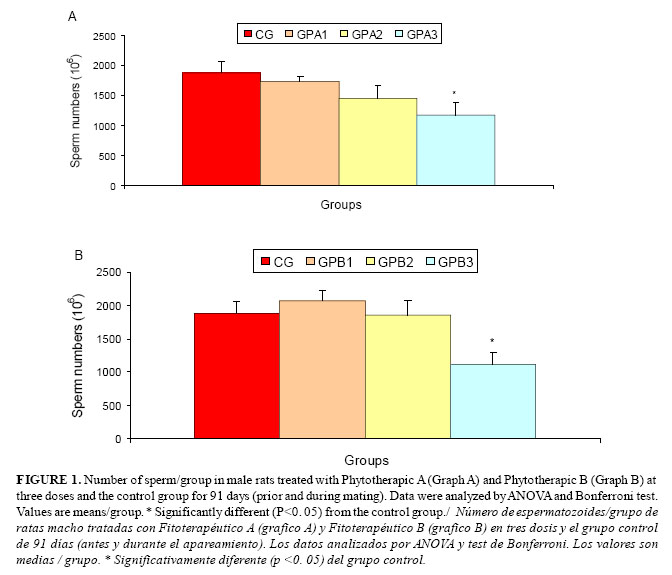
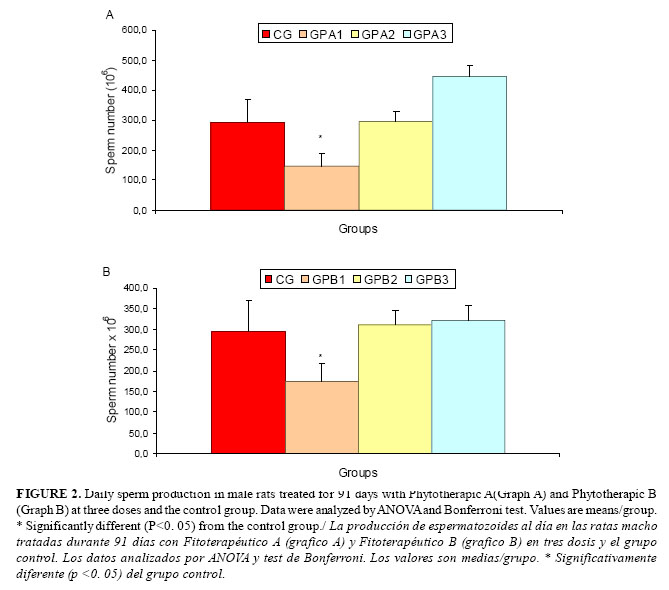
<body><![CDATA[<P><font face="Verdana, Arial, Helvetica, sans-serif" size="2">Light microscopic    evaluation did not reveal morphological alterations in the examined organs of    male rats treated with Phytotherapic A and B at the three doses. </font>     <P><font face="Verdana, Arial, Helvetica, sans-serif" size="2"><B>Sperm number    and daily sperm production</B> </font>     <P><font face="Verdana, Arial, Helvetica, sans-serif" size="2">The number of sperm    in the caudal epididymides in male rats treated with Phytotherapic A and B resulted    in statistically significant differences at a higher dose (43 mg.kg<SUP>-1</SUP>.day<SUP>-1</SUP>)    (<a href="/img/revistas/rsa/v34n1/f0105112.jpg">Fig 1</a>). Daily sperm    productions also resulted in statistically significant differences, but at a    lower dose (4.3 mg.kg<SUP>-1</SUP>.day<SUP>-1</SUP>) (<a href="/img/revistas/rsa/v34n1/f0205112.jpg">Fig    2</a>).    
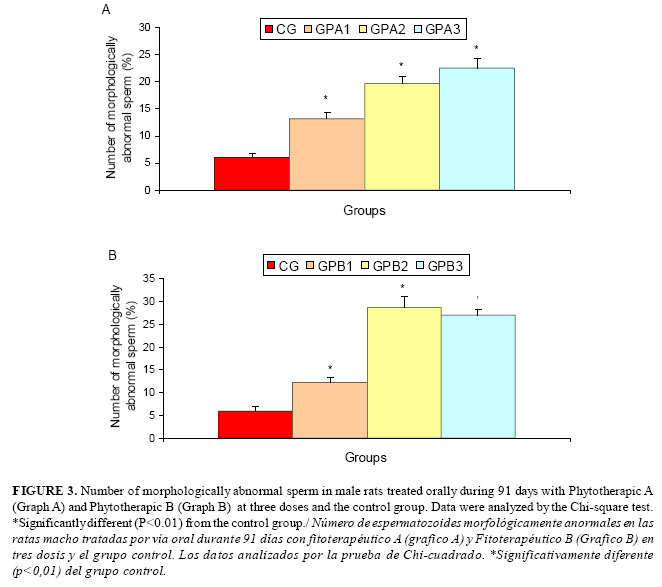
<BR>   </font><font face="Verdana, Arial, Helvetica, sans-serif" size="2">    <BR>   <B>Sperm Morphology</B> </font>      <P><font face="Verdana, Arial, Helvetica, sans-serif" size="2">The number and    percentage of morphologically abnormal sperm in males treated with Phytotherapic    A and B resulted in statistically significant differences from the control group    at the three doses (<a href="/img/revistas/rsa/v34n1/f0305112.jpg">Fig    3</a>). </font>      
<P>&nbsp;     <P><font face="Verdana, Arial, Helvetica, sans-serif" size="2"><B><font size="3">DISCUSSION</font></B>    </font>      <P><font face="Verdana, Arial, Helvetica, sans-serif" size="2">The phytoestrogens    of the soy are molecules of plant origin with numerous biological properties,    but the best known is that they behave like weak estrogens. Evidence from animal    studies suggests that the ingestion of very high amounts of phytoestrogens may    affect fertility. Sheep exposed to great amounts of clover forage presents infertility,    ewes fed with estrogenic forage may suffer impaired ovarian function, often    accompanied by reduced conception rates and increased embryonic loss. In cattle,    phytoestrogens cause irregular estrus, nymphomania, anestrus, and ovarian cysts    (15). </font>      <P><font face="Verdana, Arial, Helvetica, sans-serif" size="2">In males, estrogenic    compounds can be toxic to testicular tissue in rodents and humans (16). Fertility    of the human male is particularly susceptible to agents that reduce the number    or quality of sperm produced. Compared to many other species, human males produce    fewer sperm in relation to the number of sperm required for fertility (17, 18).    As a result, many men are subfertile or infertile (18). If the number of normal    sperm per ejaculation is sufficiently low, fertilization is unlikely and an    infertile condition exists (19). However, isoflavones are able to exert non-genomic    actions potentially injurious to male fertility (20). Rodents can also be sensitive    to the effects of isoflavones, as genistein can inhibit the growth and proliferation    of testicular cells. In mice, it was shown that genistein can deregulate the    spermatogenesis and reduce the number of sperm in the epididymis (9). </font>      ]]></body>
<body><![CDATA[<P><font face="Verdana, Arial, Helvetica, sans-serif" size="2">Various studies    show that treatment of male rats with estrogenic chemicals reduces testicular    and epididymal sperm concentration and Sertoli cell number, alters testicular    gene expression, and causes rete tubule distension and reduced epithelial height    in the efferent ducts (21, 22, 23, 24). </font>     <P><font face="Verdana, Arial, Helvetica, sans-serif" size="2">Global declines    in semen quality were suggested to be associated with enhanced exposure to environmental    chemicals that act as endocrine disrupters as a result of our increased use    of pesticides, plastics, phytoestrogens and other anthropogenic materials (25).    Considerable toxicology data based upon laboratory and wildlife animal studies    suggest that exposure to certain endocrine disrupters is associated with reproductive    toxicity, including abnormalities of the male reproductive tract (cryptorchidism,    hypospadias), reduced semen quality, and impaired fertility in the adult (26,    27, 28, 29, 30). </font>      <P><font face="Verdana, Arial, Helvetica, sans-serif" size="2">In humans, a study    assessed 99 male partners of subfertile couples as the intake of isoflavones    in the diet. As a result it was observed that there was an inverse association    between soy food intake and that sperm concentration significant remained after    accounting for age, abstinence time, body mass index, caffeine and alcohol intake    and smoking. In conclusions, these data suggest that a higher intake of soy    foods and soy isoflavones is associated with a lower sperm concentration (31).    </font>     <P><font face="Verdana, Arial, Helvetica, sans-serif" size="2">Data from this    study suggest that male rats exposed to the daily oral administration of the    two phytotherapic preparations (Phytotherapic A and Phytotherapic B) for 91    days prior to and during the mating period did not have any systemic toxicity.    However, both were able to reduce the epididymis weight, without promoting histological    alterations. Both phytotherapic formulations decreased the total number of sperm    stored in the epididymis at the highest dose and increased the sperm morphology    changes in a dose-dependent manner. </font>      <P><font face="Verdana, Arial, Helvetica, sans-serif" size="2">The epididymis,    a steroid-dependent organ, is responsible for the post-testicular maturation    and storage of sperm. Because of the composition of the sperm plasma membrane    and its lack of cytoplasm, sperm in the epididymis is susceptible to damage    from reactive oxygen species (32). </font>     <P><font face="Verdana, Arial, Helvetica, sans-serif" size="2">An increase in    abnormal sperm morphology has been considered as evidence that the agent has    gained access to germ cells (33, 34). Sperm morphology profiles are relatively    stable and characteristic in a normal individual (and a strain within a species)    over time. </font>     <P><font face="Verdana, Arial, Helvetica, sans-serif" size="2">The litters of    males exposed to Phytotherapic A and Phytotherapic B and the controls negative    and positive were also evaluated for overall and sexual development, and behavior    on the open field. No change related to the administration of isoflavones was    found (35). </font>     <P><font face="Verdana, Arial, Helvetica, sans-serif" size="2">To identify possible    effects of isoflavones on male fertility, reproductive parameters were evaluated    in Wistar-Unilever rats receiving dietary exposure to PTI G-2535, a characterized    mixture of soy-derived isoflavones containing 45% genistein, 23% daidzein, and    4% glycitein. Rats received chronic dietary exposure to the soy isoflavone mixture    (200 or 2000 mg/kg diet) for a minimum of 12 months. Dietary exposure to isoflavones    induced no gross toxicity or alterations in body weight gain. Histopathologic    evaluations demonstrated that testicular morphology was similar in all study    groups (36). </font>     <P><font face="Verdana, Arial, Helvetica, sans-serif" size="2">In conclusion,    this study suggests that both Phytotherapic formulations have acted on the epididymis    of the animals, causing decrease dose-dependent in the weight of the organ without    causing a decrease in animal weight, reducing the number of sperm at the highest    dose used and increasing the percentage of spermatozoa with morphological alterations    however, the results reinforce the data observed in related literature, concerning    the effects of soy isoflavones on male fertility. </font>     <P>&nbsp;     ]]></body>
<body><![CDATA[<P><font face="Verdana, Arial, Helvetica, sans-serif" size="2"><B><font size="3">CONFLICT    OF INTEREST</font></B> </font>      <P><font face="Verdana, Arial, Helvetica, sans-serif" size="2">None. </font>     <P>&nbsp;     <P><font face="Verdana, Arial, Helvetica, sans-serif" size="2"><B><font size="3">ACKNOWLEDGMENTS</font></B>    </font>      <P><font face="Verdana, Arial, Helvetica, sans-serif" size="2">The authors are    grateful to Coordena&ccedil;&atilde;o de Aperfei&ccedil;oamento de Pessoal de    N&iacute;vel Superior (CAPES) and Conselho Nacional de Desenvolvimento Cient&iacute;fico    e Tecnol&oacute;gico (CNPq) for the financial support. We also wish to thank    the excellent technical assistance of Department of Pathology, Favet/UFRGS.    </font>     <P>&nbsp;     <P><font face="Verdana, Arial, Helvetica, sans-serif" size="2"><B><font size="3">REFERENCES</font></B>    </font>      <!-- ref --><P><font face="Verdana, Arial, Helvetica, sans-serif" size="2">1. Tempfer CB,    Bentz E-K, Leodolter S, Tscherne<B> </B>G, Reuss F, Cross HS, et al. Phytoestrogens    in clinical practice: a review of the literature. Fertil Steril. 2007;87(8):1243-1249.        </font>      <!-- ref --><P><font face="Verdana, Arial, Helvetica, sans-serif" size="2">2. Markovitz J,    Linassier C, Foss&eacute; P, Couprie J, Pierre J, Jacquemin-Sablon A, et al.    Inhibitory effects of the tyrosine kinase inhibitor genistein on mammalian DNA    topoisomerase II. Cancer Res. 1989;48:5111-5117.     </font>      <!-- ref --><P><font face="Verdana, Arial, Helvetica, sans-serif" size="2">3. Ju YH, Allred    CD, Allred KF, Karko KL, Doerge DR, Helferich WG. Physiological concentrations    of dietary genistein dose-dependently stimulate growth of estrogen-dependent    human breast cancer (MCF-7) tumors implanted in athymic nude mice. J Nutr. 2001;131:2957-2962.        </font>      <!-- ref --><P><font face="Verdana, Arial, Helvetica, sans-serif" size="2">4. Allred CD, Allred    KF, Ju YH, Virant SM, Helferich WG. Soy diets containing varying amounts of    genistein stimulate growth of estrogen-dependent (MCF-7) tumors in a dose-dependent    manner. Cancer Res. 2001;61:5045-5050.     </font>      <!-- ref --><P><font face="Verdana, Arial, Helvetica, sans-serif" size="2">5. Cassidy A, Albertazzi    P, Nielsen IL, Hall W, Williamson G, Tetens I, et al. Critical review of health    effects of soyabean phyto-oestrogens in post-menopausal women. Proc Nutr Soc.    2006;65:76-92.     </font>      <!-- ref --><P><font face="Verdana, Arial, Helvetica, sans-serif" size="2">6. Wuttke W, Jarry    H, Wuttke DS. Isoflavones-Safe food additives or dangerous drugs?<B> </B>Ageing    Res Rev. 2007;6:150-188.     </font>      <!-- ref --><P><font face="Verdana, Arial, Helvetica, sans-serif" size="2">7. McClain RM,    Wolz E, Davidovich A, Pfannkuch F, Edwards JA, Bausch J. Acute, subchronic and    chronic safety studies with genistein in rats. Food Chem Toxicol. 2006;44:56-80.        </font>      <!-- ref --><P><font face="Verdana, Arial, Helvetica, sans-serif" size="2">8. Zhang W-Z, Cui    W-M, Zhang X, Wang W, Jia X-D, Zhang X-P, et al. Subchronic Toxicity Study on    Soy Isoflavones in Rats. Biomed Environ Sci. 2009;22(3):259-264.     </font>      <!-- ref --><P><font face="Verdana, Arial, Helvetica, sans-serif" size="2">9. Kumi-Diaka J,    Rodrigues R, Goudaze G. Influence of genistein (4,5,7 trihydroxyisoflavone)    on growth and proliferation of testicular cell lines. Biol Cell. 1998;90:349-354.        </font>      <!-- ref --><P><font face="Verdana, Arial, Helvetica, sans-serif" size="2">10.Adeoya-Osiguwa    SA,<B> </B>Markoulaki S, Pocock V, Milligan SR, Fraser LR. 17 beta- Estradiol    and environmental estrogens significantly affect mammalian sperm function. Hum    Reprod. 2003;18:100-107.     </font>      <!-- ref --><P><font face="Verdana, Arial, Helvetica, sans-serif" size="2">11.McClain RM,    Wolz E, Davidovich A, Edwards J, Bausch J. Reproductive safety studies with    genistein in rats. Food Chem Toxicol. 2007;45:1319-1332.     </font>      <!-- ref --><P><font face="Verdana, Arial, Helvetica, sans-serif" size="2">12.Klein CB, King    AA. Genistein genotoxicity: Critical considerations of in vitro exposure dose.    Toxicol Appl Pharmacol. 2007;224:1-11.     </font>      <!-- ref --><P><font face="Verdana, Arial, Helvetica, sans-serif" size="2">13.Hollenbach CB,    Bortolini CE, Batista JM, Hollenbach EB, Hirtz L, Mello FB, et al. Effects of    two phytotherapics formulations containing <I>Glycine max </I>(L.) Merr on general    reproductive performance in Wistar rats. Rev Port Cien Vet. 2008;103:567-568.        </font>      <!-- ref --><P><font face="Verdana, Arial, Helvetica, sans-serif" size="2">14.C&eacute;sar    IC, Braga FC, Vianna-Soares CD,<B><I> </I></B>Nunan EA, Barbosa TAF, Moreira-Campos    LM. Determina&ccedil;&atilde;o de daidze&iacute;na, geniste&iacute;na e glicite&iacute;na    em c&aacute;psulas de isoflavonas por cromatografia em camada delgada (CCD)    e cromatografia l&iacute;quida de alta efici&ecirc;ncia (CLAE). Braz J Pharmacogn.    2007;17(4):616-625.     </font>      <!-- ref --><P><font face="Verdana, Arial, Helvetica, sans-serif" size="2">15.Adams NR. Detection    of effects of phytoestrogens on sheep and cattle.<I> </I>J Anim Sci. 1995;73:1509-1515.        </font>      <!-- ref --><P><font face="Verdana, Arial, Helvetica, sans-serif" size="2">16.Toppari J, Larsen    JC, Christiansen P, Giwercman A, Grandjean P, Guillette LJ, Jegou B. Male Reproductive    Health and Environmental Chemicals with estrogenic effects. Miljoprojekt nr.    290, Danish Environmental Protection Agency. 1995.     </font>      <!-- ref --><P><font face="Verdana, Arial, Helvetica, sans-serif" size="2">17.Guan L, Huang    Y, Chen Z. Developmental and reproductive toxicity of soybean isoflavones to    immature SD rats. Biomed Environ Sci.<I> </I>2008;21:197-204.     </font>      <!-- ref --><P><font face="Verdana, Arial, Helvetica, sans-serif" size="2">18.Amann RP. A    critical review of methods for evaluation of spermatogenesis from seminal characteristics.    J Androl. 1981;2:37-58.     </font>      <!-- ref --><P><font face="Verdana, Arial, Helvetica, sans-serif" size="2">19.Working PK.    Male reproductive toxicity: comparison of the human to animal models. Environ    Health. 1988;77:37-44.     </font>      <!-- ref --><P><font face="Verdana, Arial, Helvetica, sans-serif" size="2">20.Fraser LR, Beyret    E, Milligan SR, Adeoya-Osiguwa SA. Effects of estrogenic xenobiotics on human    and mouse spermatozoa. Hum Reprod. 2006;21:1184-1193.     </font>      <!-- ref --><P><font face="Verdana, Arial, Helvetica, sans-serif" size="2">21.Aceitero J,    Llanero M, Parrado R, Pena E, Lopez-Beltran A. Neonatal exposure of male rats    to estradiol benzoate causes rete testis dilation and backflow impairment of    spermatogenesis<I>. </I>Anat Rec. 1998;252:17-33.     </font>      <!-- ref --><P><font face="Verdana, Arial, Helvetica, sans-serif" size="2">22.Goyal HO, Robateau    A, Braden TD, Williams CS, Srivastava KK, Ali K. Neonatal estrogen exposure    of male rats alters reproductive functions at adulthood. Biol Reprod. 2003;68:2081-2091.        </font>      <!-- ref --><P><font face="Verdana, Arial, Helvetica, sans-serif" size="2">23.Adachi T,<B>    </B>Ono Y, Koh K-B, Takashima K, Tainaka H, Matsuno Y,<B> </B>et al. Long-term    alteration of gene expression without morphological change in testis after neonatal    exposure to genistein in mice: toxicogenomic analysis using cDNA microarray.    Food Chem Toxicol. 2004;42:445-452.     </font>      <!-- ref --><P><font face="Verdana, Arial, Helvetica, sans-serif" size="2">24.Atanassova NN,    Walker M, McKinnell C, Fisher JS, Sharpe RM. Evidence that androgens and oestrogens,    as well as follicle-stimulating hormone, can alter Sertoli cell number in the    neonatal rat. J Endocrinol. 2005;184:107-117.     </font>      <!-- ref --><P><font face="Verdana, Arial, Helvetica, sans-serif" size="2">25.Phillips KP,    Tanphaichitr N. Human exposures to endocrine disrupters and semen quality. J    Toxicol Environ Health B. 2008;11:188-220.     </font>      <!-- ref --><P><font face="Verdana, Arial, Helvetica, sans-serif" size="2">26.Casini ML, Gerli    S, Unfer V. An infertile couple suffering from oligospermia by partial sperm    maturation arrest: can phytoestrogens play a therapeutic role? A case report    study. Gynecol Endocrinol. 2006;22:399-401.     </font>      <!-- ref --><P><font face="Verdana, Arial, Helvetica, sans-serif" size="2">27.Ge RS, Chen    GR, Tanriku C, Hardy MP. Phthalate ester toxicity in Leydig cells: Developmental    timing and dosage considerations. Reprod Toxicol. 2007;23:366-373.     </font>      <!-- ref --><P><font face="Verdana, Arial, Helvetica, sans-serif" size="2">28.Mauduit C, Florin    A, Amara S, Bozec A, Siddeek B, Cunha S, et al. Long-term effects of environmental    endocrine disruptors on male fertility. Gynecol Obstet F&eacute;rtil. 2006;34:978-984.        </font>      <!-- ref --><P><font face="Verdana, Arial, Helvetica, sans-serif" size="2">29.Ryu JY, Whang    J, Park H, Im JY, Kim J, Ahn MY, et al. Di(2-ethylhexyl) phthalate induces apoptosis    through peroxisome proliferators-activated receptorgamma and ERK 1/2 activation    in testis of Sprague-Dawley rats. J Toxicol Environ Health A.<I> </I>2007;70:1296-1303.    <I>    </I> </font>      <!-- ref --><P><font face="Verdana, Arial, Helvetica, sans-serif" size="2">30.Sharpe RM. Pathways    of endocrine disruption during male sexual differentiation and masculinisation.    Best Pract Res Clin Endocrinol Metab.<I> </I>2006;20:91-110.     </font>      <!-- ref --><P><font face="Verdana, Arial, Helvetica, sans-serif" size="2">31.Chavarro JE,    Toth TL, Sadio SM, Hauser R. Soy food and isoflavone intake in relation to semen    quality parameters among men from an infertility clinic. Hum Reprod. 2008;23(11):2584-2590.        </font>      <!-- ref --><P><font face="Verdana, Arial, Helvetica, sans-serif" size="2">32.Aitken RJ, Vernet    P. Maturation of redox regulatory mechanisms in the epididymis. J Reprod Fert.    1998;53:109-118.     </font>      <!-- ref --><P><font face="Verdana, Arial, Helvetica, sans-serif" size="2">33.U.S. Environmental    Protection Agency. Guidelines for Reproductive Toxicity Risk Assessment. Federal    Register. 1996;61(212):56274-56322.    </font>      <!-- ref --><P><font face="Verdana, Arial, Helvetica, sans-serif" size="2">34.Delb&egrave;s    G, Levacher C, Habert R. Estrogen effects on fetal and neonatal testicular development.    Reproduction. 2006;132:1741-7899.     </font>      <!-- ref --><P><font face="Verdana, Arial, Helvetica, sans-serif" size="2">35.Hollenbach CB,    Bortolini CE, Batista JM, Hollenbach EB, Scuch TL, Pacheco MH, et al.<B> </B>Desenvolvimento    p&oacute;s-natal e potencial teratog&ecirc;nico da prole de ratos Wistar no    estudo da toxicidade reprodutiva de duas prepara&ccedil;&otilde;es fitoter&aacute;picas    contendo soja <I>Glycine max </I>(L.) Merr. Arq Bras Med Vet Zootec. 2010;62(4):845-852.        </font>      <!-- ref --><P><font face="Verdana, Arial, Helvetica, sans-serif" size="2">36.Faqi AS, Johnson    WD, Morrissey RL, Mc Corrmick DL. Reproductive toxicity assessment of chronic    dietary exposure to soy isofalvones in male rats. Reprod Toxicol. 2004;18:605-611.    </font>     <P>&nbsp;     ]]></body>
<body><![CDATA[<P>&nbsp;     <P><font face="Verdana, Arial, Helvetica, sans-serif" size="2"><B>(Recibido 5-11-2011;    Aceptado 8-2-2012)</B> </font>     <P>&nbsp; <h6> <font face="Verdana, Arial, Helvetica, sans-serif" size="2"><sup><a href="#pie">1</a><a name="volao "></a></sup>Corresponding    author.</font> </h6>      ]]></body><back>
<ref-list>
<ref id="B1">
<label>1</label><nlm-citation citation-type="journal">
<person-group person-group-type="author">
<name>
<surname><![CDATA[Tempfer]]></surname>
<given-names><![CDATA[CB]]></given-names>
</name>
<name>
<surname><![CDATA[Bentz]]></surname>
<given-names><![CDATA[E-K]]></given-names>
</name>
<name>
<surname><![CDATA[Leodolter]]></surname>
<given-names><![CDATA[S]]></given-names>
</name>
<name>
<surname><![CDATA[Tscherne]]></surname>
<given-names><![CDATA[G]]></given-names>
</name>
<name>
<surname><![CDATA[Reuss]]></surname>
<given-names><![CDATA[F]]></given-names>
</name>
<name>
<surname><![CDATA[Cross]]></surname>
<given-names><![CDATA[HS]]></given-names>
</name>
</person-group>
<article-title xml:lang="en"><![CDATA[Phytoestrogens in clinical practice: a review of the literature]]></article-title>
<source><![CDATA[Fertil Steril]]></source>
<year>2007</year>
<volume>87</volume>
<numero>8</numero>
<issue>8</issue>
<page-range>1243-1249</page-range></nlm-citation>
</ref>
<ref id="B2">
<label>2</label><nlm-citation citation-type="journal">
<person-group person-group-type="author">
<name>
<surname><![CDATA[Markovitz]]></surname>
<given-names><![CDATA[J]]></given-names>
</name>
<name>
<surname><![CDATA[Linassier]]></surname>
<given-names><![CDATA[C]]></given-names>
</name>
<name>
<surname><![CDATA[Fossé]]></surname>
<given-names><![CDATA[P]]></given-names>
</name>
<name>
<surname><![CDATA[Couprie]]></surname>
<given-names><![CDATA[J]]></given-names>
</name>
<name>
<surname><![CDATA[Pierre]]></surname>
<given-names><![CDATA[J]]></given-names>
</name>
<name>
<surname><![CDATA[Jacquemin-Sablon]]></surname>
<given-names><![CDATA[A]]></given-names>
</name>
</person-group>
<article-title xml:lang="en"><![CDATA[Inhibitory effects of the tyrosine kinase inhibitor genistein on mammalian DNA topoisomerase II]]></article-title>
<source><![CDATA[Cancer Res]]></source>
<year>1989</year>
<volume>48</volume>
<page-range>5111-5117</page-range></nlm-citation>
</ref>
<ref id="B3">
<label>3</label><nlm-citation citation-type="journal">
<person-group person-group-type="author">
<name>
<surname><![CDATA[Ju]]></surname>
<given-names><![CDATA[YH]]></given-names>
</name>
<name>
<surname><![CDATA[Allred]]></surname>
<given-names><![CDATA[CD]]></given-names>
</name>
<name>
<surname><![CDATA[Allred]]></surname>
<given-names><![CDATA[KF]]></given-names>
</name>
<name>
<surname><![CDATA[Karko]]></surname>
<given-names><![CDATA[KL]]></given-names>
</name>
<name>
<surname><![CDATA[Doerge]]></surname>
<given-names><![CDATA[DR]]></given-names>
</name>
<name>
<surname><![CDATA[Helferich]]></surname>
<given-names><![CDATA[WG]]></given-names>
</name>
</person-group>
<article-title xml:lang="en"><![CDATA[Physiological concentrations of dietary genistein dose-dependently stimulate growth of estrogen-dependent human breast cancer (MCF-7) tumors implanted in athymic nude mice]]></article-title>
<source><![CDATA[J Nutr]]></source>
<year>2001</year>
<volume>131</volume>
<page-range>2957-2962</page-range></nlm-citation>
</ref>
<ref id="B4">
<label>4</label><nlm-citation citation-type="journal">
<person-group person-group-type="author">
<name>
<surname><![CDATA[Allred]]></surname>
<given-names><![CDATA[CD]]></given-names>
</name>
<name>
<surname><![CDATA[Allred]]></surname>
<given-names><![CDATA[KF]]></given-names>
</name>
<name>
<surname><![CDATA[Ju]]></surname>
<given-names><![CDATA[YH]]></given-names>
</name>
<name>
<surname><![CDATA[Virant]]></surname>
<given-names><![CDATA[SM]]></given-names>
</name>
<name>
<surname><![CDATA[Helferich]]></surname>
<given-names><![CDATA[WG]]></given-names>
</name>
</person-group>
<article-title xml:lang="en"><![CDATA[Soy diets containing varying amounts of genistein stimulate growth of estrogen-dependent (MCF-7) tumors in a dose-dependent manner]]></article-title>
<source><![CDATA[Cancer Res]]></source>
<year>2001</year>
<volume>61</volume>
<page-range>5045-5050</page-range></nlm-citation>
</ref>
<ref id="B5">
<label>5</label><nlm-citation citation-type="journal">
<person-group person-group-type="author">
<name>
<surname><![CDATA[Cassidy]]></surname>
<given-names><![CDATA[A]]></given-names>
</name>
<name>
<surname><![CDATA[Albertazzi]]></surname>
<given-names><![CDATA[P]]></given-names>
</name>
<name>
<surname><![CDATA[Nielsen]]></surname>
<given-names><![CDATA[IL]]></given-names>
</name>
<name>
<surname><![CDATA[Hall]]></surname>
<given-names><![CDATA[W]]></given-names>
</name>
<name>
<surname><![CDATA[Williamson]]></surname>
<given-names><![CDATA[G]]></given-names>
</name>
<name>
<surname><![CDATA[Tetens]]></surname>
<given-names><![CDATA[I]]></given-names>
</name>
</person-group>
<article-title xml:lang="en"><![CDATA[ritical review of health effects of soyabean phyto-oestrogens in post-menopausal women]]></article-title>
<source><![CDATA[Proc Nutr Soc]]></source>
<year>2006</year>
<volume>65</volume>
<page-range>76-92</page-range></nlm-citation>
</ref>
<ref id="B6">
<label>6</label><nlm-citation citation-type="journal">
<person-group person-group-type="author">
<name>
<surname><![CDATA[Wuttke]]></surname>
<given-names><![CDATA[W]]></given-names>
</name>
<name>
<surname><![CDATA[Jarry]]></surname>
<given-names><![CDATA[H]]></given-names>
</name>
<name>
<surname><![CDATA[Wuttke]]></surname>
<given-names><![CDATA[DS]]></given-names>
</name>
</person-group>
<article-title xml:lang="en"><![CDATA[Isoflavones-Safe food additives or dangerous drugs?]]></article-title>
<source><![CDATA[Ageing Res Rev]]></source>
<year>2007</year>
<volume>6</volume>
<page-range>150-188</page-range></nlm-citation>
</ref>
<ref id="B7">
<label>7</label><nlm-citation citation-type="journal">
<person-group person-group-type="author">
<name>
<surname><![CDATA[McClain]]></surname>
<given-names><![CDATA[RM]]></given-names>
</name>
<name>
<surname><![CDATA[Wolz]]></surname>
<given-names><![CDATA[E]]></given-names>
</name>
<name>
<surname><![CDATA[Davidovich]]></surname>
<given-names><![CDATA[A]]></given-names>
</name>
<name>
<surname><![CDATA[Pfannkuch]]></surname>
<given-names><![CDATA[F]]></given-names>
</name>
<name>
<surname><![CDATA[Edwards]]></surname>
<given-names><![CDATA[JA]]></given-names>
</name>
<name>
<surname><![CDATA[Bausch]]></surname>
<given-names><![CDATA[J]]></given-names>
</name>
</person-group>
<article-title xml:lang="en"><![CDATA[Acute, subchronic and chronic safety studies with genistein in rats]]></article-title>
<source><![CDATA[Food Chem Toxicol]]></source>
<year>2006</year>
<volume>44</volume>
<page-range>56-80</page-range></nlm-citation>
</ref>
<ref id="B8">
<label>8</label><nlm-citation citation-type="journal">
<person-group person-group-type="author">
<name>
<surname><![CDATA[Zhang]]></surname>
<given-names><![CDATA[W-Z]]></given-names>
</name>
<name>
<surname><![CDATA[Cui]]></surname>
<given-names><![CDATA[W-M]]></given-names>
</name>
<name>
<surname><![CDATA[Zhang]]></surname>
<given-names><![CDATA[X]]></given-names>
</name>
<name>
<surname><![CDATA[Wang]]></surname>
<given-names><![CDATA[W]]></given-names>
</name>
<name>
<surname><![CDATA[Jia]]></surname>
<given-names><![CDATA[X-D]]></given-names>
</name>
<name>
<surname><![CDATA[Zhang]]></surname>
<given-names><![CDATA[X-P]]></given-names>
</name>
</person-group>
<article-title xml:lang="en"><![CDATA[Subchronic Toxicity Study on Soy Isoflavones in Rats]]></article-title>
<source><![CDATA[Biomed Environ Sci]]></source>
<year>2009</year>
<volume>22</volume>
<numero>3</numero>
<issue>3</issue>
<page-range>259-264</page-range></nlm-citation>
</ref>
<ref id="B9">
<label>9</label><nlm-citation citation-type="journal">
<person-group person-group-type="author">
<name>
<surname><![CDATA[Kumi-Diaka]]></surname>
<given-names><![CDATA[J]]></given-names>
</name>
<name>
<surname><![CDATA[Rodrigues]]></surname>
<given-names><![CDATA[R]]></given-names>
</name>
<name>
<surname><![CDATA[Goudaze]]></surname>
<given-names><![CDATA[G]]></given-names>
</name>
</person-group>
<article-title xml:lang="en"><![CDATA[Influence of genistein (4,5,7 trihydroxyisoflavone) on growth and proliferation of testicular cell lines]]></article-title>
<source><![CDATA[Biol Cell]]></source>
<year>1998</year>
<volume>90</volume>
<page-range>349-354</page-range></nlm-citation>
</ref>
<ref id="B10">
<label>10</label><nlm-citation citation-type="journal">
<person-group person-group-type="author">
<name>
<surname><![CDATA[Adeoya-Osiguwa]]></surname>
<given-names><![CDATA[SA]]></given-names>
</name>
<name>
<surname><![CDATA[Markoulaki]]></surname>
<given-names><![CDATA[S]]></given-names>
</name>
<name>
<surname><![CDATA[Pocock]]></surname>
<given-names><![CDATA[V]]></given-names>
</name>
<name>
<surname><![CDATA[Milligan]]></surname>
<given-names><![CDATA[SR]]></given-names>
</name>
<name>
<surname><![CDATA[Fraser]]></surname>
<given-names><![CDATA[LR]]></given-names>
</name>
</person-group>
<article-title xml:lang="en"><![CDATA[17 beta- Estradiol and environmental estrogens significantly affect mammalian sperm function]]></article-title>
<source><![CDATA[Hum Reprod]]></source>
<year>2003</year>
<volume>18</volume>
<page-range>100-107</page-range></nlm-citation>
</ref>
<ref id="B11">
<label>11</label><nlm-citation citation-type="journal">
<person-group person-group-type="author">
<name>
<surname><![CDATA[McClain]]></surname>
<given-names><![CDATA[RM]]></given-names>
</name>
<name>
<surname><![CDATA[Wolz]]></surname>
<given-names><![CDATA[E]]></given-names>
</name>
<name>
<surname><![CDATA[Davidovich]]></surname>
<given-names><![CDATA[A]]></given-names>
</name>
<name>
<surname><![CDATA[Edwards]]></surname>
<given-names><![CDATA[J]]></given-names>
</name>
<name>
<surname><![CDATA[Bausch]]></surname>
<given-names><![CDATA[J]]></given-names>
</name>
</person-group>
<article-title xml:lang="en"><![CDATA[Reproductive safety studies with genistein in rats]]></article-title>
<source><![CDATA[Food Chem Toxicol]]></source>
<year>2007</year>
<volume>45</volume>
<page-range>1319-1332</page-range></nlm-citation>
</ref>
<ref id="B12">
<label>12</label><nlm-citation citation-type="journal">
<person-group person-group-type="author">
<name>
<surname><![CDATA[Klein]]></surname>
<given-names><![CDATA[CB]]></given-names>
</name>
<name>
<surname><![CDATA[King]]></surname>
<given-names><![CDATA[AA]]></given-names>
</name>
</person-group>
<article-title xml:lang="en"><![CDATA[Genistein genotoxicity: Critical considerations of in vitro exposure dose]]></article-title>
<source><![CDATA[Toxicol Appl Pharmacol]]></source>
<year>2007</year>
<volume>224</volume>
<page-range>1-11</page-range></nlm-citation>
</ref>
<ref id="B13">
<label>13</label><nlm-citation citation-type="journal">
<person-group person-group-type="author">
<name>
<surname><![CDATA[Hollenbach]]></surname>
<given-names><![CDATA[CB]]></given-names>
</name>
<name>
<surname><![CDATA[Bortolini]]></surname>
<given-names><![CDATA[CE]]></given-names>
</name>
<name>
<surname><![CDATA[Batista]]></surname>
<given-names><![CDATA[JM]]></given-names>
</name>
<name>
<surname><![CDATA[Hollenbach]]></surname>
<given-names><![CDATA[EB]]></given-names>
</name>
<name>
<surname><![CDATA[Hirtz]]></surname>
<given-names><![CDATA[L]]></given-names>
</name>
<name>
<surname><![CDATA[Mello]]></surname>
<given-names><![CDATA[FB]]></given-names>
</name>
</person-group>
<article-title xml:lang="en"><![CDATA[Effects of two phytotherapics formulations containing Glycine max (L.) Merr on general reproductive performance in Wistar rats]]></article-title>
<source><![CDATA[Rev Port Cien Vet]]></source>
<year>2008</year>
<volume>103</volume>
<page-range>567-568</page-range></nlm-citation>
</ref>
<ref id="B14">
<label>14</label><nlm-citation citation-type="journal">
<person-group person-group-type="author">
<name>
<surname><![CDATA[César]]></surname>
<given-names><![CDATA[IC]]></given-names>
</name>
<name>
<surname><![CDATA[Braga]]></surname>
<given-names><![CDATA[FC]]></given-names>
</name>
<name>
<surname><![CDATA[Vianna-Soares]]></surname>
<given-names><![CDATA[CD]]></given-names>
</name>
<name>
<surname><![CDATA[Nunan]]></surname>
<given-names><![CDATA[EA]]></given-names>
</name>
<name>
<surname><![CDATA[Barbosa]]></surname>
<given-names><![CDATA[TAF]]></given-names>
</name>
<name>
<surname><![CDATA[Moreira-Campos]]></surname>
<given-names><![CDATA[LM]]></given-names>
</name>
</person-group>
<article-title xml:lang="pt"><![CDATA[Determinação de daidzeína, genisteína e gliciteína em cápsulas de isoflavonas por cromatografia em camada delgada (CCD) e cromatografia líquida de alta eficiência (CLAE)]]></article-title>
<source><![CDATA[Braz J Pharmacogn]]></source>
<year>2007</year>
<volume>17</volume>
<numero>4</numero>
<issue>4</issue>
<page-range>616-625</page-range></nlm-citation>
</ref>
<ref id="B15">
<label>15</label><nlm-citation citation-type="journal">
<person-group person-group-type="author">
<name>
<surname><![CDATA[Adams]]></surname>
<given-names><![CDATA[NR]]></given-names>
</name>
</person-group>
<article-title xml:lang="en"><![CDATA[Detection of effects of phytoestrogens on sheep and cattle]]></article-title>
<source><![CDATA[J Anim Sci]]></source>
<year>1995</year>
<volume>73</volume>
<page-range>1509-1515</page-range></nlm-citation>
</ref>
<ref id="B16">
<label>16</label><nlm-citation citation-type="">
<person-group person-group-type="author">
<name>
<surname><![CDATA[Toppari]]></surname>
<given-names><![CDATA[J]]></given-names>
</name>
<name>
<surname><![CDATA[Larsen]]></surname>
<given-names><![CDATA[JC]]></given-names>
</name>
<name>
<surname><![CDATA[Christiansen]]></surname>
<given-names><![CDATA[P]]></given-names>
</name>
<name>
<surname><![CDATA[Giwercman]]></surname>
<given-names><![CDATA[A]]></given-names>
</name>
<name>
<surname><![CDATA[Grandjean]]></surname>
<given-names><![CDATA[P]]></given-names>
</name>
<name>
<surname><![CDATA[Guillette]]></surname>
<given-names><![CDATA[LJ]]></given-names>
</name>
<name>
<surname><![CDATA[Jegou]]></surname>
<given-names><![CDATA[B]]></given-names>
</name>
</person-group>
<source><![CDATA[Male Reproductive Health and Environmental Chemicals with estrogenic effects]]></source>
<year>1995</year>
</nlm-citation>
</ref>
<ref id="B17">
<label>17</label><nlm-citation citation-type="journal">
<person-group person-group-type="author">
<name>
<surname><![CDATA[Guan]]></surname>
<given-names><![CDATA[L]]></given-names>
</name>
<name>
<surname><![CDATA[Huang]]></surname>
<given-names><![CDATA[Y]]></given-names>
</name>
<name>
<surname><![CDATA[Chen]]></surname>
<given-names><![CDATA[Z]]></given-names>
</name>
</person-group>
<article-title xml:lang="en"><![CDATA[Developmental and reproductive toxicity of soybean isoflavones to immature SD rats]]></article-title>
<source><![CDATA[Biomed Environ Sci]]></source>
<year>2008</year>
<volume>21</volume>
<page-range>197-204</page-range></nlm-citation>
</ref>
<ref id="B18">
<label>18</label><nlm-citation citation-type="journal">
<person-group person-group-type="author">
<name>
<surname><![CDATA[Amann]]></surname>
<given-names><![CDATA[RP]]></given-names>
</name>
</person-group>
<article-title xml:lang="en"><![CDATA[A critical review of methods for evaluation of spermatogenesis from seminal characteristics]]></article-title>
<source><![CDATA[J Androl]]></source>
<year>1981</year>
<volume>2</volume>
<page-range>37-58</page-range></nlm-citation>
</ref>
<ref id="B19">
<label>19</label><nlm-citation citation-type="journal">
<person-group person-group-type="author">
<name>
<surname><![CDATA[Working]]></surname>
<given-names><![CDATA[PK]]></given-names>
</name>
</person-group>
<article-title xml:lang="en"><![CDATA[Male reproductive toxicity: comparison of the human to animal models]]></article-title>
<source><![CDATA[Environ Health]]></source>
<year>1988</year>
<volume>77</volume>
<page-range>37-44</page-range></nlm-citation>
</ref>
<ref id="B20">
<label>20</label><nlm-citation citation-type="journal">
<person-group person-group-type="author">
<name>
<surname><![CDATA[Fraser]]></surname>
<given-names><![CDATA[LR]]></given-names>
</name>
<name>
<surname><![CDATA[Beyret]]></surname>
<given-names><![CDATA[E]]></given-names>
</name>
<name>
<surname><![CDATA[Milligan]]></surname>
<given-names><![CDATA[SR]]></given-names>
</name>
<name>
<surname><![CDATA[Adeoya-Osiguwa]]></surname>
<given-names><![CDATA[SA]]></given-names>
</name>
</person-group>
<article-title xml:lang="en"><![CDATA[Effects of estrogenic xenobiotics on human and mouse spermatozoa]]></article-title>
<source><![CDATA[Hum Reprod]]></source>
<year>2006</year>
<volume>21</volume>
<page-range>1184-1193</page-range></nlm-citation>
</ref>
<ref id="B21">
<label>21</label><nlm-citation citation-type="journal">
<person-group person-group-type="author">
<name>
<surname><![CDATA[Aceitero]]></surname>
<given-names><![CDATA[J]]></given-names>
</name>
<name>
<surname><![CDATA[Llanero]]></surname>
<given-names><![CDATA[M]]></given-names>
</name>
<name>
<surname><![CDATA[Parrado]]></surname>
<given-names><![CDATA[R]]></given-names>
</name>
<name>
<surname><![CDATA[Pena]]></surname>
<given-names><![CDATA[E]]></given-names>
</name>
<name>
<surname><![CDATA[Lopez-Beltran]]></surname>
<given-names><![CDATA[A]]></given-names>
</name>
</person-group>
<article-title xml:lang="en"><![CDATA[Neonatal exposure of male rats to estradiol benzoate causes rete testis dilation and backflow impairment of spermatogenesis]]></article-title>
<source><![CDATA[Anat Rec]]></source>
<year>1998</year>
<volume>252</volume>
<page-range>17-33</page-range></nlm-citation>
</ref>
<ref id="B22">
<label>22</label><nlm-citation citation-type="journal">
<person-group person-group-type="author">
<name>
<surname><![CDATA[Goyal]]></surname>
<given-names><![CDATA[HO]]></given-names>
</name>
<name>
<surname><![CDATA[Robateau]]></surname>
<given-names><![CDATA[A]]></given-names>
</name>
<name>
<surname><![CDATA[Braden]]></surname>
<given-names><![CDATA[TD]]></given-names>
</name>
<name>
<surname><![CDATA[Williams]]></surname>
<given-names><![CDATA[CS]]></given-names>
</name>
<name>
<surname><![CDATA[Srivastava]]></surname>
<given-names><![CDATA[KK]]></given-names>
</name>
<name>
<surname><![CDATA[Ali]]></surname>
<given-names><![CDATA[K]]></given-names>
</name>
</person-group>
<article-title xml:lang="en"><![CDATA[Neonatal estrogen exposure of male rats alters reproductive functions at adulthood]]></article-title>
<source><![CDATA[Biol Reprod]]></source>
<year>2003</year>
<volume>68</volume>
<page-range>2081-2091</page-range></nlm-citation>
</ref>
<ref id="B23">
<label>23</label><nlm-citation citation-type="journal">
<person-group person-group-type="author">
<name>
<surname><![CDATA[Adachi]]></surname>
<given-names><![CDATA[T]]></given-names>
</name>
<name>
<surname><![CDATA[Ono]]></surname>
<given-names><![CDATA[Y]]></given-names>
</name>
<name>
<surname><![CDATA[Koh]]></surname>
<given-names><![CDATA[K-B]]></given-names>
</name>
<name>
<surname><![CDATA[Takashima]]></surname>
<given-names><![CDATA[K]]></given-names>
</name>
<name>
<surname><![CDATA[Tainaka]]></surname>
<given-names><![CDATA[H]]></given-names>
</name>
<name>
<surname><![CDATA[Matsuno]]></surname>
<given-names><![CDATA[Y]]></given-names>
</name>
</person-group>
<article-title xml:lang="en"><![CDATA[Long-term alteration of gene expression without morphological change in testis after neonatal exposure to genistein in mice: toxicogenomic analysis using cDNA microarray]]></article-title>
<source><![CDATA[Food Chem Toxicol]]></source>
<year>2004</year>
<volume>42</volume>
<page-range>445-452</page-range></nlm-citation>
</ref>
<ref id="B24">
<label>24</label><nlm-citation citation-type="journal">
<person-group person-group-type="author">
<name>
<surname><![CDATA[Atanassova]]></surname>
<given-names><![CDATA[NN]]></given-names>
</name>
<name>
<surname><![CDATA[Walker]]></surname>
<given-names><![CDATA[M]]></given-names>
</name>
<name>
<surname><![CDATA[McKinnell]]></surname>
<given-names><![CDATA[C]]></given-names>
</name>
<name>
<surname><![CDATA[Fisher]]></surname>
<given-names><![CDATA[JS]]></given-names>
</name>
<name>
<surname><![CDATA[Sharpe]]></surname>
<given-names><![CDATA[RM]]></given-names>
</name>
</person-group>
<article-title xml:lang="en"><![CDATA[Evidence that androgens and oestrogens, as well as follicle-stimulating hormone, can alter Sertoli cell number in the neonatal rat]]></article-title>
<source><![CDATA[J Endocrinol]]></source>
<year>2005</year>
<volume>184</volume>
<page-range>107-117</page-range></nlm-citation>
</ref>
<ref id="B25">
<label>25</label><nlm-citation citation-type="journal">
<person-group person-group-type="author">
<name>
<surname><![CDATA[Phillips]]></surname>
<given-names><![CDATA[KP]]></given-names>
</name>
<name>
<surname><![CDATA[Tanphaichitr]]></surname>
<given-names><![CDATA[N]]></given-names>
</name>
</person-group>
<article-title xml:lang="en"><![CDATA[Human exposures to endocrine disrupters and semen quality]]></article-title>
<source><![CDATA[J Toxicol Environ Health B]]></source>
<year>2008</year>
<volume>11</volume>
<page-range>188-220</page-range></nlm-citation>
</ref>
<ref id="B26">
<label>26</label><nlm-citation citation-type="journal">
<person-group person-group-type="author">
<name>
<surname><![CDATA[Casini]]></surname>
<given-names><![CDATA[ML]]></given-names>
</name>
<name>
<surname><![CDATA[Gerli]]></surname>
<given-names><![CDATA[S]]></given-names>
</name>
<name>
<surname><![CDATA[Unfer]]></surname>
<given-names><![CDATA[V]]></given-names>
</name>
</person-group>
<article-title xml:lang="en"><![CDATA[An infertile couple suffering from oligospermia by partial sperm maturation arrest: can phytoestrogens play a therapeutic role? A case report study]]></article-title>
<source><![CDATA[Gynecol Endocrinol]]></source>
<year>2006</year>
<volume>22</volume>
<page-range>399-401</page-range></nlm-citation>
</ref>
<ref id="B27">
<label>27</label><nlm-citation citation-type="journal">
<person-group person-group-type="author">
<name>
<surname><![CDATA[Ge]]></surname>
<given-names><![CDATA[RS]]></given-names>
</name>
<name>
<surname><![CDATA[Chen]]></surname>
<given-names><![CDATA[GR]]></given-names>
</name>
<name>
<surname><![CDATA[Tanriku]]></surname>
<given-names><![CDATA[C]]></given-names>
</name>
<name>
<surname><![CDATA[Hardy]]></surname>
<given-names><![CDATA[MP]]></given-names>
</name>
</person-group>
<article-title xml:lang="en"><![CDATA[Phthalate ester toxicity in Leydig cells: Developmental timing and dosage considerations]]></article-title>
<source><![CDATA[Reprod Toxicol]]></source>
<year>2007</year>
<volume>23</volume>
<page-range>366-373</page-range></nlm-citation>
</ref>
<ref id="B28">
<label>28</label><nlm-citation citation-type="journal">
<person-group person-group-type="author">
<name>
<surname><![CDATA[Mauduit]]></surname>
<given-names><![CDATA[C]]></given-names>
</name>
<name>
<surname><![CDATA[Florin]]></surname>
<given-names><![CDATA[A]]></given-names>
</name>
<name>
<surname><![CDATA[Amara]]></surname>
<given-names><![CDATA[S]]></given-names>
</name>
<name>
<surname><![CDATA[Bozec]]></surname>
<given-names><![CDATA[A]]></given-names>
</name>
<name>
<surname><![CDATA[Siddeek]]></surname>
<given-names><![CDATA[B]]></given-names>
</name>
<name>
<surname><![CDATA[Cunha]]></surname>
<given-names><![CDATA[S]]></given-names>
</name>
</person-group>
<article-title xml:lang="en"><![CDATA[Long-term effects of environmental endocrine disruptors on male fertility]]></article-title>
<source><![CDATA[Gynecol Obstet Fértil]]></source>
<year>2006</year>
<volume>34</volume>
<page-range>978-984</page-range></nlm-citation>
</ref>
<ref id="B29">
<label>29</label><nlm-citation citation-type="journal">
<person-group person-group-type="author">
<name>
<surname><![CDATA[Ryu]]></surname>
<given-names><![CDATA[JY]]></given-names>
</name>
<name>
<surname><![CDATA[Whang]]></surname>
<given-names><![CDATA[J]]></given-names>
</name>
<name>
<surname><![CDATA[Park]]></surname>
<given-names><![CDATA[H]]></given-names>
</name>
<name>
<surname><![CDATA[Im]]></surname>
<given-names><![CDATA[JY]]></given-names>
</name>
<name>
<surname><![CDATA[Kim]]></surname>
<given-names><![CDATA[J]]></given-names>
</name>
<name>
<surname><![CDATA[Ahn]]></surname>
<given-names><![CDATA[MY]]></given-names>
</name>
</person-group>
<article-title xml:lang="en"><![CDATA[Di(2-ethylhexyl) phthalate induces apoptosis through peroxisome proliferators-activated receptorgamma and ERK 1/2 activation in testis of Sprague-Dawley rats]]></article-title>
<source><![CDATA[J Toxicol Environ Health A]]></source>
<year>2007</year>
<volume>70</volume>
<page-range>1296-1303</page-range></nlm-citation>
</ref>
<ref id="B30">
<label>30</label><nlm-citation citation-type="journal">
<person-group person-group-type="author">
<name>
<surname><![CDATA[Sharpe]]></surname>
<given-names><![CDATA[RM]]></given-names>
</name>
</person-group>
<article-title xml:lang="en"><![CDATA[Pathways of endocrine disruption during male sexual differentiation and masculinisation]]></article-title>
<source><![CDATA[Best Pract Res Clin Endocrinol Metab]]></source>
<year>2006</year>
<volume>20</volume>
<page-range>91-110</page-range></nlm-citation>
</ref>
<ref id="B31">
<label>31</label><nlm-citation citation-type="journal">
<person-group person-group-type="author">
<name>
<surname><![CDATA[Chavarro]]></surname>
<given-names><![CDATA[JE]]></given-names>
</name>
<name>
<surname><![CDATA[Toth]]></surname>
<given-names><![CDATA[TL]]></given-names>
</name>
<name>
<surname><![CDATA[Sadio]]></surname>
<given-names><![CDATA[SM]]></given-names>
</name>
<name>
<surname><![CDATA[Hauser]]></surname>
<given-names><![CDATA[R]]></given-names>
</name>
</person-group>
<article-title xml:lang="en"><![CDATA[Soy food and isoflavone intake in relation to semen quality parameters among men from an infertility clinic]]></article-title>
<source><![CDATA[Hum Reprod]]></source>
<year>2008</year>
<volume>23</volume>
<numero>11</numero>
<issue>11</issue>
<page-range>2584-2590</page-range></nlm-citation>
</ref>
<ref id="B32">
<label>32</label><nlm-citation citation-type="journal">
<person-group person-group-type="author">
<name>
<surname><![CDATA[Aitken]]></surname>
<given-names><![CDATA[RJ]]></given-names>
</name>
<name>
<surname><![CDATA[Vernet]]></surname>
<given-names><![CDATA[P]]></given-names>
</name>
</person-group>
<article-title xml:lang="en"><![CDATA[Maturation of redox regulatory mechanisms in the epididymis]]></article-title>
<source><![CDATA[J Reprod Fert]]></source>
<year>1998</year>
<volume>53</volume>
<page-range>109-118</page-range></nlm-citation>
</ref>
<ref id="B33">
<label>33</label><nlm-citation citation-type="journal">
<collab>U.S</collab>
<article-title xml:lang="en"><![CDATA[Environmental Protection Agency: Guidelines for Reproductive Toxicity Risk Assessment]]></article-title>
<source><![CDATA[Federal Register]]></source>
<year>1996</year>
<volume>61</volume>
<numero>212</numero>
<issue>212</issue>
<page-range>56274-56322</page-range></nlm-citation>
</ref>
<ref id="B34">
<label>34</label><nlm-citation citation-type="journal">
<person-group person-group-type="author">
<name>
<surname><![CDATA[Delbès]]></surname>
<given-names><![CDATA[G]]></given-names>
</name>
<name>
<surname><![CDATA[Levacher]]></surname>
<given-names><![CDATA[C]]></given-names>
</name>
<name>
<surname><![CDATA[Habert]]></surname>
<given-names><![CDATA[R]]></given-names>
</name>
</person-group>
<article-title xml:lang="en"><![CDATA[Estrogen effects on fetal and neonatal testicular development]]></article-title>
<source><![CDATA[Reproduction]]></source>
<year>2006</year>
<volume>132</volume>
<page-range>1741-7899</page-range></nlm-citation>
</ref>
<ref id="B35">
<label>35</label><nlm-citation citation-type="journal">
<person-group person-group-type="author">
<name>
<surname><![CDATA[Hollenbach]]></surname>
<given-names><![CDATA[CB]]></given-names>
</name>
<name>
<surname><![CDATA[Bortolini]]></surname>
<given-names><![CDATA[CE]]></given-names>
</name>
<name>
<surname><![CDATA[Batista]]></surname>
<given-names><![CDATA[JM]]></given-names>
</name>
<name>
<surname><![CDATA[Hollenbach]]></surname>
<given-names><![CDATA[EB]]></given-names>
</name>
<name>
<surname><![CDATA[Scuch]]></surname>
<given-names><![CDATA[TL]]></given-names>
</name>
<name>
<surname><![CDATA[Pacheco]]></surname>
<given-names><![CDATA[MH]]></given-names>
</name>
</person-group>
<article-title xml:lang="pt"><![CDATA[Desenvolvimento pós-natal e potencial teratogênico da prole de ratos Wistar no estudo da toxicidade reprodutiva de duas preparações fitoterápicas contendo soja Glycine max (L.) Merr]]></article-title>
<source><![CDATA[Arq Bras Med Vet Zootec]]></source>
<year>2010</year>
<volume>62</volume>
<numero>4</numero>
<issue>4</issue>
<page-range>845-852</page-range></nlm-citation>
</ref>
<ref id="B36">
<label>36</label><nlm-citation citation-type="journal">
<person-group person-group-type="author">
<name>
<surname><![CDATA[Faqi]]></surname>
<given-names><![CDATA[AS]]></given-names>
</name>
<name>
<surname><![CDATA[Johnson]]></surname>
<given-names><![CDATA[WD]]></given-names>
</name>
<name>
<surname><![CDATA[Morrissey]]></surname>
<given-names><![CDATA[RL]]></given-names>
</name>
<name>
<surname><![CDATA[Mc Corrmick]]></surname>
<given-names><![CDATA[DL]]></given-names>
</name>
</person-group>
<article-title xml:lang="en"><![CDATA[Reproductive toxicity assessment of chronic dietary exposure to soy isofalvones in male rats]]></article-title>
<source><![CDATA[Reprod Toxicol]]></source>
<year>2004</year>
<volume>18</volume>
<page-range>605-611</page-range></nlm-citation>
</ref>
</ref-list>
</back>
</article>