<?xml version="1.0" encoding="ISO-8859-1"?><article xmlns:mml="http://www.w3.org/1998/Math/MathML" xmlns:xlink="http://www.w3.org/1999/xlink" xmlns:xsi="http://www.w3.org/2001/XMLSchema-instance">
<front>
<journal-meta>
<journal-id>0253-570X</journal-id>
<journal-title><![CDATA[Revista de Salud Animal]]></journal-title>
<abbrev-journal-title><![CDATA[Rev Salud Anim.]]></abbrev-journal-title>
<issn>0253-570X</issn>
<publisher>
<publisher-name><![CDATA[Centro Nacional de Sanidad Agropecuaria]]></publisher-name>
</publisher>
</journal-meta>
<article-meta>
<article-id>S0253-570X2012000200004</article-id>
<title-group>
<article-title xml:lang="en"><![CDATA[Post-thaw acrosomal viability and reaction in sperm obtained from equine epididymis tail]]></article-title>
<article-title xml:lang="es"><![CDATA[Viabilidad y reacción acrosomal postcongelación en espermatozoides obtenidos de cola de epidídimo de equino]]></article-title>
</title-group>
<contrib-group>
<contrib contrib-type="author">
<name>
<surname><![CDATA[Hernández]]></surname>
<given-names><![CDATA[P.J.E]]></given-names>
</name>
<xref ref-type="aff" rid="A01"/>
</contrib>
<contrib contrib-type="author">
<name>
<surname><![CDATA[Fernández]]></surname>
<given-names><![CDATA[R.F]]></given-names>
</name>
<xref ref-type="aff" rid="A01"/>
</contrib>
<contrib contrib-type="author">
<name>
<surname><![CDATA[Rodríguez]]></surname>
<given-names><![CDATA[S.J.L]]></given-names>
</name>
<xref ref-type="aff" rid="A01"/>
</contrib>
<contrib contrib-type="author">
<name>
<surname><![CDATA[Soto]]></surname>
<given-names><![CDATA[M.Y.G]]></given-names>
</name>
<xref ref-type="aff" rid="A02"/>
</contrib>
<contrib contrib-type="author">
<name>
<surname><![CDATA[Verona]]></surname>
<given-names><![CDATA[J.E.H]]></given-names>
</name>
<xref ref-type="aff" rid="A02"/>
</contrib>
<contrib contrib-type="author">
<name>
<surname><![CDATA[García]]></surname>
<given-names><![CDATA[R.A.D]]></given-names>
</name>
<xref ref-type="aff" rid="A02"/>
</contrib>
</contrib-group>
<aff id="A01">
<institution><![CDATA[,Universidad Autónoma Metropolitana-Xochimilco Laboratorio Manejo de la Reproducción ]]></institution>
<addr-line><![CDATA[Coyoacán ]]></addr-line>
<country>México</country>
</aff>
<aff id="A02">
<institution><![CDATA[,Clínica privada. México  ]]></institution>
<addr-line><![CDATA[ ]]></addr-line>
</aff>
<pub-date pub-type="pub">
<day>00</day>
<month>08</month>
<year>2012</year>
</pub-date>
<pub-date pub-type="epub">
<day>00</day>
<month>08</month>
<year>2012</year>
</pub-date>
<volume>34</volume>
<numero>2</numero>
<fpage>84</fpage>
<lpage>88</lpage>
<copyright-statement/>
<copyright-year/>
<self-uri xlink:href="http://scielo.sld.cu/scielo.php?script=sci_arttext&amp;pid=S0253-570X2012000200004&amp;lng=en&amp;nrm=iso"></self-uri><self-uri xlink:href="http://scielo.sld.cu/scielo.php?script=sci_abstract&amp;pid=S0253-570X2012000200004&amp;lng=en&amp;nrm=iso"></self-uri><self-uri xlink:href="http://scielo.sld.cu/scielo.php?script=sci_pdf&amp;pid=S0253-570X2012000200004&amp;lng=en&amp;nrm=iso"></self-uri><abstract abstract-type="short" xml:lang="en"><p><![CDATA[In order to evaluate the post-thaw effect on acrosomal viability and reaction of sperm collected from equine epididymis tail, 62 testes were collected and transported at 4°C. Epididymis was dissected to perform the retrograde flushing of the epididymis tail , using 10 mL of a diluent based on skim milk (INRA 82). The diluent obtained with the spermatic content was recovered in graduated collecting tubes and 1mL of each sample was taken to be evaluated. For evaluations, the samples having a minimum of 30% of progressive motility were selected. The evaluations were on: percentage of live sperm, normal morphology, sperm concentration, percentage of live sperm without acrosomal reaction (VsRA) and live with acrosomal reaction (VcRA), evaluating this indicator with FITC-PNA staining and propidium iodide (PI). Averages of 53.2%, 72.7%, 82.9%, 507.3X10⁶, 65.3% and 6.0% were respectively obtained. Subsequently, samples were packed into 0.5 ml straws at a 100x106 concentration, frozen in liquid nitrogen and stored for 8 days. Thawing was performed at 38°C for 37 seconds, resulting for sperm motility, percentage of live sperm, normal morphology and VcRA VsRA the following values: 26.3%, 60.9%, 73.8%, 43.4% and 14.2%, respectively. Although all studied sperm quality values were affected by cryopreservation (P <0.05), a 43.4% of cells was recovered with characteristics making them suitable for use in biotechnological applications of assisted reproduction.]]></p></abstract>
<abstract abstract-type="short" xml:lang="es"><p><![CDATA[Con el objetivo de evaluar el efecto de la congelación sobre la viabilidad y reacción acrosomal de espermatozoides obtenidos de cola de epidídimo de equinos se recolectaron 62 testículos los que fueron transportados a 4°C., se diseccionó el epidídimo, para realizar el lavado retrógrado de la cola de epidídimo, utilizando 10 ml de un diluyente a base de leche descremada (INRA 82). El diluyente obtenido con el contenido espermático fue recuperado en tubos colectores graduados, se tomó 1 ml de cada muestra para ser evaluadas. Para las evaluaciones se seleccionaron las que presentaran como mínimo 30.0% de motilidad progresiva, a éstas se les evaluó: porcentaje de espermatozoides vivos, morfología normal, concentración espermática y porcentaje de espermatozoides vivos sin reacción acrosomal (VsRA) y vivos con reacción acrosomal (VcRA) evaluando este indicador con la tinción FITC-PNA y Ioduro de propidio (IP); obteniendo promedios de 53.2%, 72.7%, 82.9%, 507.3X10⁶, 65.3% y 6.0%, respectivamente. Posteriormente las muestras se envasaron en pajillas de 0.5 ml en concentración de 100X106 y se congelaron en nitrógeno líquido, almacenándose durante 8 días. La descongelación se realizó a 38°C., por 37 segundos, obteniendo como resultado para motilidad espermática, porcentaje de espermatozoides vivos, morfología normal, VsRA y VcRA los siguientes valores: 26.3%, 60.9%, 73.8%, 43.4% y 14.2%, respectivamente. Aunque todos los valores de calidad espermática estudiados fueron afectados por la criopreservación (P<0,05), se recuperaron un 43.4% de células con características que las hacen aptas para su empleo en aplicaciones biotecnológicas de reproducción asistida.]]></p></abstract>
<kwd-group>
<kwd lng="en"><![CDATA[cryopreservation]]></kwd>
<kwd lng="en"><![CDATA[viability]]></kwd>
<kwd lng="en"><![CDATA[acrosomal reaction]]></kwd>
<kwd lng="en"><![CDATA[FITC-PNA/IP]]></kwd>
<kwd lng="en"><![CDATA[sperm]]></kwd>
<kwd lng="en"><![CDATA[epididymis]]></kwd>
<kwd lng="en"><![CDATA[equine]]></kwd>
<kwd lng="es"><![CDATA[criopreservación]]></kwd>
<kwd lng="es"><![CDATA[viabilidad]]></kwd>
<kwd lng="es"><![CDATA[reacción acrosomal]]></kwd>
<kwd lng="es"><![CDATA[FITC-PNA/IP]]></kwd>
<kwd lng="es"><![CDATA[espermatozoides]]></kwd>
<kwd lng="es"><![CDATA[epidídimo]]></kwd>
<kwd lng="es"><![CDATA[equino]]></kwd>
</kwd-group>
</article-meta>
</front><body><![CDATA[ <p align="right"><font face="Verdana, Arial, Helvetica, sans-serif" size="2"><B>ART&Iacute;CULO    ORIGINAL</B> </font></p>     <p>&nbsp;</p>     <p><font face="Verdana, Arial, Helvetica, sans-serif" size="2"><B><font size="4">Post-thaw    acrosomal viability and reaction in sperm obtained from equine epididymis tail    </font></B></font></p>     <p>&nbsp;</p>     <p> <font face="Verdana, Arial, Helvetica, sans-serif" size="2"><b><font size="3">Viabilidad    y reacci&oacute;n acrosomal postcongelaci&oacute;n en espermatozoides obtenidos    de cola de epid&iacute;dimo de equino </font></b></font></p>     <p>&nbsp;</p>     <p>&nbsp;</p>     <p><font face="Verdana, Arial, Helvetica, sans-serif" size="2"><B>P.J.E. Hern&aacute;ndez<SUP>I</SUP>,    R.F. Fern&aacute;ndez<SUP>I</SUP>, S.J.L. Rodr&iacute;guez<SUP>I</SUP>, M.Y.G.    Soto<SUP>II</SUP>, J.E.H. Verona<SUP>II</SUP>, R.A.D. Garc&iacute;a<SUP>II </SUP></B></font>  </p>     <P><font face="Verdana, Arial, Helvetica, sans-serif" size="2"><B><SUP>I</sup></b>Laboratorio    Manejo de la Reproducci&oacute;n. Universidad Aut&oacute;noma Metropolitana-Xochimilco.    Calzada del Hueso 1100, Colonia Villa Quietud, Coyoac&aacute;n 04960. M&eacute;xico,    D.F. E-mail: <U><a href="mailto:ehernan@correo.xoc.uam.mx">ehernan@correo.xoc.uam.mx</a></U>;    </font><font face="Verdana, Arial, Helvetica, sans-serif" size="2"><B><SUP>    <br>   II</SUP></B>Cl&iacute;nica privada. M&eacute;xico, D.F. </font>      ]]></body>
<body><![CDATA[<P>&nbsp;     <P>&nbsp; <hr noshade size="1">     <P><font face="Verdana, Arial, Helvetica, sans-serif" size="2"><B>ABSTRACT</B></font>     <P><font face="Verdana, Arial, Helvetica, sans-serif" size="2">In order to evaluate    the post-thaw effect on acrosomal viability and reaction of sperm collected    from equine epididymis tail, 62 testes were collected and transported at 4&#176;C.    Epididymis was dissected to perform the retrograde flushing of the epididymis    tail , using 10 mL of a diluent based on skim milk (INRA 82). The diluent obtained    with the spermatic content was recovered in graduated collecting tubes and 1mL    of each sample was taken to be evaluated. For evaluations, the samples having    a minimum of 30% of progressive motility were selected. The evaluations were    on: percentage of live sperm, normal morphology, sperm concentration, percentage    of live sperm without acrosomal reaction (VsRA) and live with acrosomal reaction    (VcRA), evaluating this indicator with FITC-PNA staining and propidium iodide    (PI). Averages of 53.2%, 72.7%, 82.9%, 507.3X10<SUP>6</SUP>, 65.3% and 6.0%    were respectively obtained. Subsequently, samples were packed into 0.5 ml straws    at a 100x10<SUP>6</SUP> concentration, frozen in liquid nitrogen and stored    for 8 days. Thawing was performed at 38&#176;C for 37 seconds, resulting for    sperm motility, percentage of live sperm, normal morphology and VcRA VsRA the    following values: 26.3%, 60.9%, 73.8%, 43.4% and 14.2%, respectively. Although    all studied sperm quality values were affected by cryopreservation (P &lt;0.05),    a 43.4% of cells was recovered with characteristics making them suitable for    use in biotechnological applications of assisted reproduction. </font>     <P><font face="Verdana, Arial, Helvetica, sans-serif" size="2"><B>Key words</B>:    cryopreservation, viability, acrosomal reaction, FITC-PNA/IP, sperm, epididymis,    equine. </font> <hr noshade size="1">     <P>      <P><font face="Verdana, Arial, Helvetica, sans-serif" size="2"><B>RESUMEN</b></font>     <P><font face="Verdana, Arial, Helvetica, sans-serif" size="2">Con el objetivo    de evaluar el efecto de la congelaci&oacute;n sobre la viabilidad y reacci&oacute;n    acrosomal de espermatozoides obtenidos de cola de epid&iacute;dimo de equinos<B>    </B>se recolectaron 62 test&iacute;culos los que fueron transportados a 4&#176;C.,    se diseccion&oacute; el epid&iacute;dimo, para realizar el lavado retr&oacute;grado    de la cola de epid&iacute;dimo, utilizando 10 ml de un diluyente a base de leche    descremada (INRA 82). El diluyente obtenido con el contenido esperm&aacute;tico    fue recuperado en tubos colectores graduados, se tom&oacute; 1 ml de cada muestra    para ser evaluadas. Para las evaluaciones se seleccionaron las que presentaran    como m&iacute;nimo 30.0% de motilidad progresiva, a &eacute;stas se les evalu&oacute;:    porcentaje de espermatozoides vivos, morfolog&iacute;a normal, concentraci&oacute;n    esperm&aacute;tica y porcentaje de espermatozoides vivos sin reacci&oacute;n    acrosomal (VsRA) y vivos con reacci&oacute;n acrosomal (VcRA) evaluando este    indicador con la tinci&oacute;n FITC-PNA y Ioduro de propidio (IP); obteniendo    promedios de 53.2%, 72.7%, 82.9%, 507.3X10<SUP>6</SUP>, 65.3% y 6.0%, respectivamente.    Posteriormente las muestras se envasaron en pajillas de 0.5 ml en concentraci&oacute;n    de 100X10<SUP>6</SUP> y se congelaron en nitr&oacute;geno l&iacute;quido, almacen&aacute;ndose    durante 8 d&iacute;as. La descongelaci&oacute;n se realiz&oacute; a 38&#176;C.,    por 37 segundos, obteniendo como resultado para motilidad esperm&aacute;tica,    porcentaje de espermatozoides vivos, morfolog&iacute;a normal, VsRA y VcRA los    siguientes valores: 26.3%, 60.9%, 73.8%, 43.4% y 14.2%, respectivamente. Aunque    todos los valores de calidad esperm&aacute;tica estudiados fueron afectados    por la criopreservaci&oacute;n (P&lt;0,05), se recuperaron un 43.4% de c&eacute;lulas    con caracter&iacute;sticas que las hacen aptas para su empleo en aplicaciones    biotecnol&oacute;gicas de reproducci&oacute;n asistida. </font>     <P><font face="Verdana, Arial, Helvetica, sans-serif" size="2"><B>Palabras clave:    </B>criopreservaci&oacute;n, viabilidad, reacci&oacute;n acrosomal, FITC-PNA/IP,    espermatozoides, epid&iacute;dimo, equino. </font> <hr noshade size="1">     <P>&nbsp;     ]]></body>
<body><![CDATA[<P>&nbsp;     <P><font face="Verdana, Arial, Helvetica, sans-serif" size="2"><B><font size="3">INTRODUCTION</font></B>    </font>     <P><font face="Verdana, Arial, Helvetica, sans-serif" size="2">The ability of    sperm collection and preservation of a stallion epididymis after castration    either by choice, a traumatic injury, serious illness or unexpected death on    several occasions has allowed the genetics preservation, thanks to continuing    advances in assisted reproductive techniques (1,2). Studies have shown that    sperm retrieved from epididymis is highly efficient, and even when it is kept    at room temperature, it remains viable up to 24 hours after performing orchiectomy,    and could be subsequently used for artificial insemination (AI) (3). However,    it has been seen that when testes are stored at 4-5&#176;C., the sperm has a    higher viability percentage (2). </font>     <P><font face="Verdana, Arial, Helvetica, sans-serif" size="2">Retrograde flushing    is considered a fast and efficient procedure for the recovery of epididymis    tail sperm in the equine species. With this procedure, a recovery of sperm similar    to that obtained in ejaculates collected through artificial vagina is reported    (4,3). </font>     <P><font face="Verdana, Arial, Helvetica, sans-serif" size="2">The success of    epididymal sperm collections with resulting pregnancies has been reported in    different animal species, including man. In the case of equines, frozen epididymal    sperm has proven to be fertile (5), since results obtained by Monteiro <I>et    al</I>. (4), show that sperm collected from epididymis tail, immediately or    after 24 hours performing orchiectomy, remains fertility similar to that of    ejaculated sperm. Morris <I>et al</I>. (6) reported pregnancies in mares by    AI by hysteroscopy with thawed sperm collected from epididymis. </font>     <P><font face="Verdana, Arial, Helvetica, sans-serif" size="2">Sperm cryopreservation    contributes to the expansion of diverse reproductive techniques such as AI,    <I>in vitro</I> fertilization (IVF) and intracytoplasmic injection (ICSI). It    has been seen that AI with frozen semen is an essential part in the breeding    and selection programs, thereby contributing to increase the production of domestic    species (7). In the case of post-mortem collection equine species, they often    need to be preserved for future use, because females are not always available    to produce the necessary oocytes for fertilization, due to their characteristics    in the estrous cycle (2). </font>     <P><font face="Verdana, Arial, Helvetica, sans-serif" size="2">Sperm plasma membrane    is of fundamental importance in the fertilization process (training, acrosomal    reaction and sperm fusion with oocyte). During semen cryopreservation, alterations    of the membrane are produced causing a decrease in sperm viability (8). There    are reports indicating that equine sperm is severely damaged during freezing    and no more than the 50.0% will survive to cryopreservation. Besides, that sperm    that still alive but having an acrosomal reaction (AR) is not functional to    penetrate the oocyte and loses its fertilizing capacity (9). </font>     <P><font face="Verdana, Arial, Helvetica, sans-serif" size="2">There are evidences    reporting at epididymis level the presence of substances causing modifications    in the sperm membrane. One of these substances is inmovilina, which is a high    molecular weight glycoprotein that increases epididymal fluid viscosity and    thus reduces sperm cell motility. It also raises an inhibition of the phosphodiesterase    activity and changes in cAMP levels, which together help to provide greater    resistance to cold shock, compared with ejaculated sperm, thus proving more    resistant to cooling and freezing procedures that epididymal sperm (4, 3). </font>     <P><font face="Verdana, Arial, Helvetica, sans-serif" size="2">A generally accepted    criterion for using post-thaw ejaculated semen of horses is that this must present    a motility between 30.0-35.0% to be considered as acceptable (10). While Shulman    <I>et al</I>. (11) claim that it is permitted the use of epididymis post-thawed    sperm with a progressive motility within a range of 29.0-40.0%, for being used    in AI programs, reporting that using a dose of 400X10<SUP>6</SUP> sperm, a pregnancy    rate of 69.2% can be registered (12). Considering the above, and due to there    are not reports in Mexico in which parameters of potential viability in equine    epididymal sperm are registered, the objective of this study was to evaluate    the characteristics of equine sperm taken from the epididymis tail, fresh and    cryopreserved for possible use in assisted reproduction procedures. </font>     <P>&nbsp;     ]]></body>
<body><![CDATA[<P><font face="Verdana, Arial, Helvetica, sans-serif" size="2"><B><font size="3">MATERIALS    AND METHODS</font></B> </font>     <P><font face="Verdana, Arial, Helvetica, sans-serif" size="2">Sixty two pairs    of testes of adult horses were obtained in an abbatoir of the State of Mexico.They    were </font><font face="Verdana, Arial, Helvetica, sans-serif" size="2">collected    immediately after slaughter and were linked to the pampiniform plexus level    and placed in polyethylene bags containing 10 mL of physiological saline solution    at 0.9% with antibiotic (100 IU/mL penicillin and 100 mg/ml streptomycin). The    samples were transported to the Reproduction Laboratory of Handling UAM-Xochimilco    at a temperature of 4&#176;C. (2). </font>     <P><font face="Verdana, Arial, Helvetica, sans-serif" size="2">Once in the laboratory,    the samples were handled in a cold room at a temperature of 4&#176;C. To obtain    sperm, epididymis tail was carefully dissected, including deferens vessel; and    later a retrograde flushing was made from the deferens duct by introducing 18-gauge    needle inserted at the entrance of the deferens duct. Gently washing was performed    (5,13) with 10 ml of diluent INRA 82 previously prepared with: Glucose 200 g,    Lactose 300 g, Raffinose 500 g, Trisodium citrate 60 g, Potassium citrate 82    mg, Penicillin 10 IU/ml, Gentamicin 10 IU/ml, 50 ml distilled water and 30 ml    skim milk (14).Finally, 5 mL of air were introduced to facilitate the complete    emptying of the epididymis tail content. The sperm sample was deposited into    sterile collectior tubes of 15 mL. </font>     <P><font face="Verdana, Arial, Helvetica, sans-serif" size="2">Once the sample    is retrieved, it proceeded to take an aliquot of 1 mL and placed in a water    bath at 37&#176;C., during 5 minutes for microscopic evaluation. Progressive    motility was directly assessed by placing a drop of the sample on a slide covered    with a slide tempered under a 10X objective of a microscope (SMZ645, Nikon)    equipped with a platen (Tokai Hit, Nikon) at 37&#176;C. Only those samples showing    a progressive motility <U>&gt;</U> 30.0% were processed. </font>     <P><font face="Verdana, Arial, Helvetica, sans-serif" size="2">Viability and morphology    estimate was carried out by staining with eosin-nigrosin and the evaluation    with of 40X and 100X objectives, respectively. Either in fresh semen or post-thaw    semen for each sample, 100 spermatozoa were counted (13,15,16). The concentration    of the samples was evaluated by counting in a Neubauer chamber (2). </font>     <P><font face="Verdana, Arial, Helvetica, sans-serif" size="2">The viability and    acrosomal status of sperm obtained from equine epididymis tail were determined    in fresh and post-thaw stage by using the double staining technique of fluorescein    isothiocyanate with Arachis hypogea (FITC-PNA) and propidium iodide (PI), according    to the procedure of Garcia-Rosello <I>et al</I>. (17), to which 100 &#181;l    were taken from each sample, adding 5 &#181;l of FITC-PNA and 5 &#181;l of IP,    incubated at 38.5&#176;C., for 5 minutes. From this latter suspension, 10 &#181;l    were taken and 10 &#181;l of paraformaldehyde were added for smear, observed    with a fluorescence microscope (Eclipse E600, Nikon) at 400 magnification. The    functional status of 100 spermatozoa per sample was evaluated and classified    according to the following staining patterns: live sperm without RA (sperm without    staining of FITC-PNA and PI) live sperm with RA (sperm with acrosomal staining),    dead sperm without RA (sperm with nuclear and acrosome staining) (18). In order    to determine the acrosomal stage, the filter-grade B-2A with excitation degree    of 450-490 nm was used; and to evaluate sperm viability, the G-2A filter with    excitation degree of 510-560 nm was used. </font>     <P><font face="Verdana, Arial, Helvetica, sans-serif" size="2">The samples considered    acceptable for cryopreservation were left in the cold room for 2 hours, to later    add the second diluent of freezing INRA 82. This was supplemented with 5% glycerol,    and with it, the concentration was adjusted to 200X10<SUP>6</SUP> sperm/ml.    Then an equilibration period of 2 hours was given. Finally semen was packaged    in 0.5 ml straws and sealed with polyvinyl alcohol, placed in liquid nitrogen    vapor at 4 cm of nitrogen level for 10 minutes After the time, straws were immersed    in nitrogen for preservation until analysis (4). </font>     <P><font face="Verdana, Arial, Helvetica, sans-serif" size="2">For post-thaw analysis,    straws were immersed for 30 seconds at 37&#176;C., (5,19) and it proceeded to    carry out the evaluation of progressive motility, viability, normal morphology    and acrosomal reaction, in the same way that those evaluated in fresh sperm.    </font>     <P><font face="Verdana, Arial, Helvetica, sans-serif" size="2">Statistical analysis.    Data were analyzed with SPSS 13.0 statistical package for the comparison of    the sperm characteristics evaluated, as well as ANOVA and &#171;t&#187; of Student    statistical tests, assessing the significance degree of p &lt;0.05 (20). </font>     <P>&nbsp;     ]]></body>
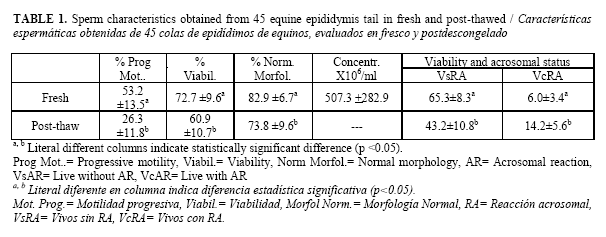
<body><![CDATA[<P><font face="Verdana, Arial, Helvetica, sans-serif" size="2"><B><font size="3">RESULTS    AND DISCUSSION</font></B> </font>      <P><font face="Verdana, Arial, Helvetica, sans-serif" size="2">As a result of    the freezing process, there is an affectation of the indicators measured suggested    by Neild <I>et al</I>. (9) and Zhang <I>et al</I>. (8) (<a href="/img/revistas/rsa/v34n2/t0104212.gif">Table    1</a>). </font>      
<P><font face="Verdana, Arial, Helvetica, sans-serif" size="2">The progressive    motility of equine epididymis sperm in fresh samples obtained in this study    was of 53.2%, a percentage similar to that obtained working the same type of    samples by James (2), who found 57.0% progressive motility, and a value found    within the range given by Heise <I>et al</I>. (13) who found a motility between    10.0-75.0% when evaluating 4 purebred stallions. At thaw, a motility of 26.3%    was found, which was higher than that found by Heise <I>et al</I>. (13) who    reported a progressive motility of 5.0-10.0% and Papa <I>et al</I>. (3), 19.2%,    but lesser than that obtained by James (2) and Monteiro <I>et al</I>. (4) who    observed 46.0 and 36.2% motility, respectively. This value in the progressive    motility may result from the freezing protocol used in the assay since the diluent    with glycerol was added in one step at 2 hours of cooling, unlike James (2)    who added glycerol in fractions of 0.125% of the total volume in 30 minutes,    up to the appropriate volume in 2 hours. </font>     <P><font face="Verdana, Arial, Helvetica, sans-serif" size="2">On the other hand,    Monteiro <I>et al</I>. (4) used Botu-Crio&#174;, which is a commercial diluent    added to the sample and can be packaged immediately. This diluent only requires    20 minutes to be cooled at 5&#176;C., to subsequently place samples at 6 cm    of nitrogen for 20 minutes, and be completely submerged totally in nitrogen,    a different technique to that employed in this study. </font>     <P><font face="Verdana, Arial, Helvetica, sans-serif" size="2">The most widely    used parameter as fertility predictor for AI in horses is the individual motility    of post-thaw spermatozoa, existing reports in which there is an acceptable motility    of at least 30.0% in ejaculated sperm (21). In this research, an average motility    of 26.3% was obtained, an acceptable value and found near the range provided    by Schulman <I>et al</I>. (11): 29.0-40.0%, for use in AI programs. </font>     <P><font face="Verdana, Arial, Helvetica, sans-serif" size="2">The viability percentage    assessed by eosin-nigrosin staining 72.7% of live sperm was found in fresh semen,    a low percentage, considering that reported by Heise <I>et al</I>. (13) who    found 91.0% of viability after regaining epididymal sample by washing. This    difference may be due to two causes: 1) recovery time elapsed between animal    death and epididymal washing process, since the samples worked in this study    were transported from abbatoir to the laboratory within a period of 2 to 3 hours,    and 2) the age and breed of animals, since samples were obtained from horses    aged in most cases over 15 years, while Heise <I>et al</I>. (13 ) in their study    used young stallions 4-5 years old, purebred, and samples were immediately recovered    after castration. Nevertheless, this author reports having observed thawing    of viable sperm 60.0%, a value similar to that found in this study (60.9%).    </font>     <P><font face="Verdana, Arial, Helvetica, sans-serif" size="2">The percentage    of normal morphology found in the samples before and after freezing was 82.9    and 73.8% respectively, which is higher than that reported by Heise <I>et al</I>.    (13), who observed a 35.4 and 29.9% of normal sperm in fresh and post-thaw in    samples tested with the same technique eosin-nigrosin, respectively. However,    in this study, it was only taken into account that sperm presented primary and    secondary abnormalities, while Heise <I>et al</I>. (13) took into account features    in more detail: sperm with nuclear, acrosomal and flagellum defects, reporting    significantly lower percentages. </font>     <P><font face="Verdana, Arial, Helvetica, sans-serif" size="2">In any assisted    reproductive procedure, the main objective is the use of viable sperm having    a high potential for fertilization, and in the case of choosing spermatozoa,    the best option is to select those that are alive and without RA. This study    found a 65.3% in recovered fresh sperm, a smaller percentage than that reported    by Heise <I>et al</I>. (13), Monteiro <I>et al</I>. (4) and James (2), who obtained    a 97.7, 88.6 and 76.7% of sperm without RA, respectively. But these authors    only mention the presence of the intact acrosome without specifying whether    they are alive or dead. Regarding thawed samples, there is a 43.2% of live sperm    and without RA, a value similar to that reported by Monteiro <I>et al</I>. (4)    who found 41.4% of intact acrosome but lesser than that assessed by Heise <I>et    al</I>. (13) and Papa <I>et al</I>. (3), who reported 94.2 and 79.0% of sperm    without RA, regardless cell viability and using CASA program for evaluation.    Likewise Papa <I>et al</I>. (3) used Botu-Cryo&#174; for the cryopreservation    process, which is a commercial diluent that has shown to increase the sperm    quality after thawing, because of the content of several amino acids responsible    for the activation, protection and membrane integrity of post-thawed sperm.    On the other hand, this value is also comparable to data from ejaculated sperm,    since Graham (22) reported a range of 28.0-67.0% of live sperm without RA, values    like those obtained in this research with 43.2%. </font>     <P><font face="Verdana, Arial, Helvetica, sans-serif" size="2">Based on the results    obtained in this study, the potentiality of sperm obtained from equine post    freezing epididymis can be considered to be used in biotechnological applications    of assisted reproduction. </font>     <P>&nbsp;     ]]></body>
<body><![CDATA[<P><font face="Verdana, Arial, Helvetica, sans-serif" size="2"><B><font size="3">REFERENCES</font></B>    </font>     <!-- ref --><P><font face="Verdana, Arial, Helvetica, sans-serif" size="2">1. Bruemmer JE.    Collection and freezing of epididymal stallion sperm. Vet Clin North Am Equine    Pract. 2006;22(3):677-682.     </font>     <!-- ref --><P><font face="Verdana, Arial, Helvetica, sans-serif" size="2">2. James AN. Preservation    of sperm harvested from the rat, caprine, equine and bovine epididymis. PhD    Thesis. Faculty of the Louisiana State University and Agricultural and Mechanical    College, Baton Rouge; 2004.     </font>     <!-- ref --><P><font face="Verdana, Arial, Helvetica, sans-serif" size="2">3. Papa FO, Melo    CM, Fioratti EG, Dell'Aqua Jr JA, Zahn FS, et al. Freezing of stallion epidymal    sperm. Anim Reprod Sci. 2008;107:293-301.     </font>     <!-- ref --><P><font face="Verdana, Arial, Helvetica, sans-serif" size="2">4. Monteiro GA,    Papa FO, Zahn FS, Dell'Aqua Jr JA, Melo CM, et al. Cryopreservation and fertility    of ejaculated and epididymal stallion sperm. Anim Reprod Sci. 2011;127:197-201.        </font>     <!-- ref --><P><font face="Verdana, Arial, Helvetica, sans-serif" size="2">5. Cary JA, Madill    S, Farnsworth K, Hayna JT, Duoos L, Fahning L. A comparison of electroejaculated    and epididymal sperm collection techniques in stallions. Can Vet J. 2004;45(1):35-41.        </font>     <!-- ref --><P><font face="Verdana, Arial, Helvetica, sans-serif" size="2">6. Morris LHA,    Tiplady C, Allen WR. Hysteroscopic insemination of mares with frozen-thawed    epididymal spermatozoa. In: Proc. Havemeyer Foundation Workshop From Epididymis    to Embryo. New Orleans, 2001.     </font>      <!-- ref --><P><font face="Verdana, Arial, Helvetica, sans-serif" size="2">7. Barbas JP, Mascarenhas    RD. Cryopreservation of domestic animal sperm cells. Cell Tissue Bank. 2009;10:49-62.        </font>     <!-- ref --><P><font face="Verdana, Arial, Helvetica, sans-serif" size="2">8. Zhang J, Boyle    MS, Smith CA, Moore HD. Acrosome reaction of stallion spermatozoa evaluated    with monoclonal antibody and zona-free hamster eggs. Mol Reprod Dev. 1990;27(2):152-158.        </font>     <!-- ref --><P><font face="Verdana, Arial, Helvetica, sans-serif" size="2">9. Neild MD, Gadella    MB, Chaves GM, Miragaya HM, Colenbrander B, Ag&uuml;ero A. Membrane changes    during different stages of a freeze-thawed for equine semen cryopreservation.    Theriogenology. 2003;59:1693-1705.     </font>     <P><font face="Verdana, Arial, Helvetica, sans-serif" size="2">10.Boyle MS. Assessing    the potential fertility of frozen stallion semen. In: W.R. Allen and J.F. Wade    (eds.). Havemeyer Foundation monograph. Newmarket, UK: R &amp;W Publications    Ltd; 1999. </font>      ]]></body>
<body><![CDATA[<!-- ref --><P><font face="Verdana, Arial, Helvetica, sans-serif" size="2">11.Schulman ML,    Gerber D, Rauterberg H, Walter K, Aurich C, Petzold R, et al. Effects of halothane    anaesthesia on the cryopreservation of epididymal spermatozoa in pony stallions.    Equine Vet J. 2003;35(1):93-95.     </font>     <!-- ref --><P><font face="Verdana, Arial, Helvetica, sans-serif" size="2">12.Melo CM, Papa    FO, Fioratti EG, Villaverde AISB, Avanzi BR, Monteiro G, et al. Comparison of    three different extenders for epididymal stallion sperm. Anim Reprod Sci. 2008;107(3):331.        </font>     <!-- ref --><P><font face="Verdana, Arial, Helvetica, sans-serif" size="2">13.Heise A, Thompson    PN, Gerber D. Influence of seminal plasma on fresh and post-thaw parameters    of stallion epididymal spermatozoa. Anim Reprod Sci. 2011;123:192-201.     </font>     <!-- ref --><P><font face="Verdana, Arial, Helvetica, sans-serif" size="2">14.Palma GA. Biotecnolog&iacute;a    de la Reproducci&oacute;n. Ediciones Instituto Nacional de Tecnolog&iacute;a    Agropecuaria. Argentina; 2001.     </font>     <!-- ref --><P><font face="Verdana, Arial, Helvetica, sans-serif" size="2">15.Sieme H, Martinsson    G, Rauterberg H, Walter K, Aurich C, Petzoldt R, et al. Application of techniques    for sperm selection in fresh and frozen-thawed stallion semen. Reprod Domest    Anim. 2003;38:134-140.     </font>     ]]></body>
<body><![CDATA[<!-- ref --><P><font face="Verdana, Arial, Helvetica, sans-serif" size="2">16.Vidament M,    Daire C, Yvon JM, Doligez P, Bruneau B, Magistrini M, et al. Motility and feritily    of stallion semen frozen with glycerol and/or dimethyl formide. Theriogenology.    2002;58:249-251.     </font>     <!-- ref --><P><font face="Verdana, Arial, Helvetica, sans-serif" size="2">17.Garc&iacute;a-Rosell&oacute;    E, Mat&aacute;s C, C&aacute;novas S, Moreira PN, Gadea J, Coy P. Influence of    sperm pretreatment on the efficiency of intracytoplasmic sperm injection in    pigs. J Androl. 2006;27(2):268-275.     </font>     <!-- ref --><P><font face="Verdana, Arial, Helvetica, sans-serif" size="2">18.Garc&iacute;a    MR. Efecto de los inhibidores de H+-ATPasas durante la maduraci&oacute;n, capacitaci&oacute;n    y reacci&oacute;n acrosomal del espermatozoide de conejo. Tesis para obtener    el grado de Doctor en Ciencias Biol&oacute;gicas. Universidad Aut&oacute;noma    Metropolitana, Unidad Xochimilco, M&eacute;xico; 2000.     </font>     <!-- ref --><P><font face="Verdana, Arial, Helvetica, sans-serif" size="2">19.Salazar JrJL,    Teague SR, Love CC, Brinsko SP, Blanchard TL, Varner DD. Effect of cryopreservation    protocol on post-thaw characteristics of stallion sperm. Theriogenology. 2011;76:409-418.        </font>     <!-- ref --><P><font face="Verdana, Arial, Helvetica, sans-serif" size="2">20.&Aacute;lvarez    R. Estad&iacute;stica aplicada a las ciencias de la salud. D&iacute;az de Santos,    Espa&ntilde;a; 2007.     </font>     ]]></body>
<body><![CDATA[<!-- ref --><P><font face="Verdana, Arial, Helvetica, sans-serif" size="2">21.Samper JC, Morris    CA. Current methods for stallion semen cryopreservation: a survey. Theriogenology.    1998;49:895-903.     </font>     <!-- ref --><P><font face="Verdana, Arial, Helvetica, sans-serif" size="2">22.Graham JK. Assessment    of sperm quality: a flow cytometric approach. Anim Reprod Sci. 2001;68:239-247.        </font>     <P>      <P>      <P>      <P>      <P>      <P>      ]]></body>
<body><![CDATA[<P>      <P>      <P>&nbsp;      <P>&nbsp;     <P><font face="Verdana, Arial, Helvetica, sans-serif" size="2">Recibido: 17-12-2011.</font>        <br>   <font face="Verdana, Arial, Helvetica, sans-serif" size="2">Aceptado: 21-5-2012.</font>      <P>&nbsp;     <P>&nbsp;     <P>&nbsp;       ]]></body><back>
<ref-list>
<ref id="B1">
<label>1</label><nlm-citation citation-type="journal">
<person-group person-group-type="author">
<name>
<surname><![CDATA[Bruemmer]]></surname>
<given-names><![CDATA[JE]]></given-names>
</name>
</person-group>
<article-title xml:lang="en"><![CDATA[Collection and freezing of epididymal stallion sperm]]></article-title>
<source><![CDATA[Vet Clin North Am Equine Pract]]></source>
<year>2006</year>
<volume>22</volume>
<numero>3</numero>
<issue>3</issue>
<page-range>677-682</page-range></nlm-citation>
</ref>
<ref id="B2">
<label>2</label><nlm-citation citation-type="">
<person-group person-group-type="author">
<name>
<surname><![CDATA[James]]></surname>
<given-names><![CDATA[AN]]></given-names>
</name>
</person-group>
<article-title xml:lang="en"><![CDATA[Preservation of sperm harvested from the rat, caprine, equine and bovine epididymis]]></article-title>
<source><![CDATA[]]></source>
<year></year>
</nlm-citation>
</ref>
<ref id="B3">
<label>3</label><nlm-citation citation-type="journal">
<person-group person-group-type="author">
<name>
<surname><![CDATA[Papa]]></surname>
<given-names><![CDATA[FO]]></given-names>
</name>
<name>
<surname><![CDATA[Melo]]></surname>
<given-names><![CDATA[CM]]></given-names>
</name>
<name>
<surname><![CDATA[Fioratti]]></surname>
<given-names><![CDATA[EG]]></given-names>
</name>
<name>
<surname><![CDATA[Dell'Aqua Jr]]></surname>
<given-names><![CDATA[JA]]></given-names>
</name>
<name>
<surname><![CDATA[Zahn]]></surname>
<given-names><![CDATA[FS]]></given-names>
</name>
</person-group>
<article-title xml:lang="en"><![CDATA[Freezing of stallion epidymal sperm]]></article-title>
<source><![CDATA[Anim Reprod Sci]]></source>
<year>2008</year>
<volume>107</volume>
<page-range>293-301</page-range></nlm-citation>
</ref>
<ref id="B4">
<label>4</label><nlm-citation citation-type="journal">
<person-group person-group-type="author">
<name>
<surname><![CDATA[Monteiro]]></surname>
<given-names><![CDATA[GA]]></given-names>
</name>
<name>
<surname><![CDATA[Papa]]></surname>
<given-names><![CDATA[FO]]></given-names>
</name>
<name>
<surname><![CDATA[Zahn]]></surname>
<given-names><![CDATA[FS]]></given-names>
</name>
<name>
<surname><![CDATA[Dell'Aqua Jr]]></surname>
<given-names><![CDATA[JA]]></given-names>
</name>
<name>
<surname><![CDATA[Melo]]></surname>
<given-names><![CDATA[CM]]></given-names>
</name>
</person-group>
<article-title xml:lang="en"><![CDATA[Cryopreservation and fertility of ejaculated and epididymal stallion sperm]]></article-title>
<source><![CDATA[Anim Reprod Sci]]></source>
<year>2011</year>
<volume>127</volume>
<page-range>197-201</page-range></nlm-citation>
</ref>
<ref id="B5">
<label>5</label><nlm-citation citation-type="journal">
<person-group person-group-type="author">
<name>
<surname><![CDATA[Cary]]></surname>
<given-names><![CDATA[JA]]></given-names>
</name>
<name>
<surname><![CDATA[Madill]]></surname>
<given-names><![CDATA[S]]></given-names>
</name>
<name>
<surname><![CDATA[Farnsworth]]></surname>
<given-names><![CDATA[K]]></given-names>
</name>
<name>
<surname><![CDATA[Hayna]]></surname>
<given-names><![CDATA[JT]]></given-names>
</name>
<name>
<surname><![CDATA[Duoos]]></surname>
<given-names><![CDATA[L]]></given-names>
</name>
<name>
<surname><![CDATA[Fahning]]></surname>
<given-names><![CDATA[L]]></given-names>
</name>
</person-group>
<article-title xml:lang="en"><![CDATA[A comparison of electroejaculated and epididymal sperm collection techniques in stallions]]></article-title>
<source><![CDATA[Can Vet J]]></source>
<year>2004</year>
<volume>45</volume>
<numero>1</numero>
<issue>1</issue>
<page-range>35-41</page-range></nlm-citation>
</ref>
<ref id="B6">
<label>6</label><nlm-citation citation-type="">
<person-group person-group-type="author">
<name>
<surname><![CDATA[Morris]]></surname>
<given-names><![CDATA[LHA]]></given-names>
</name>
<name>
<surname><![CDATA[Tiplady]]></surname>
<given-names><![CDATA[C]]></given-names>
</name>
<name>
<surname><![CDATA[Allen]]></surname>
<given-names><![CDATA[WR]]></given-names>
</name>
</person-group>
<article-title xml:lang="en"><![CDATA[Hysteroscopic insemination of mares with frozen-thawed epididymal spermatozoa]]></article-title>
<source><![CDATA[Proc. Havemeyer Foundation Workshop From Epididymis to Embryo]]></source>
<year>2001</year>
<publisher-loc><![CDATA[New Orleans ]]></publisher-loc>
</nlm-citation>
</ref>
<ref id="B7">
<label>7</label><nlm-citation citation-type="journal">
<person-group person-group-type="author">
<name>
<surname><![CDATA[Barbas]]></surname>
<given-names><![CDATA[JP]]></given-names>
</name>
<name>
<surname><![CDATA[Mascarenhas]]></surname>
<given-names><![CDATA[RD]]></given-names>
</name>
</person-group>
<article-title xml:lang="en"><![CDATA[Cryopreservation of domestic animal sperm cells]]></article-title>
<source><![CDATA[Cell Tissue Bank]]></source>
<year>2009</year>
<volume>10</volume>
<page-range>49-62</page-range></nlm-citation>
</ref>
<ref id="B8">
<label>8</label><nlm-citation citation-type="journal">
<person-group person-group-type="author">
<name>
<surname><![CDATA[Zhang]]></surname>
<given-names><![CDATA[J]]></given-names>
</name>
<name>
<surname><![CDATA[Boyle]]></surname>
<given-names><![CDATA[MS]]></given-names>
</name>
<name>
<surname><![CDATA[Smith]]></surname>
<given-names><![CDATA[CA]]></given-names>
</name>
<name>
<surname><![CDATA[Moore]]></surname>
<given-names><![CDATA[HD]]></given-names>
</name>
</person-group>
<article-title xml:lang="en"><![CDATA[Acrosome reaction of stallion spermatozoa evaluated with monoclonal antibody and zona-free hamster eggs]]></article-title>
<source><![CDATA[Mol Reprod Dev]]></source>
<year>1990</year>
<volume>27</volume>
<numero>2</numero>
<issue>2</issue>
<page-range>152-158</page-range></nlm-citation>
</ref>
<ref id="B9">
<label>9</label><nlm-citation citation-type="journal">
<person-group person-group-type="author">
<name>
<surname><![CDATA[Neild]]></surname>
<given-names><![CDATA[MD]]></given-names>
</name>
<name>
<surname><![CDATA[Gadella]]></surname>
<given-names><![CDATA[MB]]></given-names>
</name>
<name>
<surname><![CDATA[Chaves]]></surname>
<given-names><![CDATA[GM]]></given-names>
</name>
<name>
<surname><![CDATA[Miragaya]]></surname>
<given-names><![CDATA[HM]]></given-names>
</name>
<name>
<surname><![CDATA[Colenbrander]]></surname>
<given-names><![CDATA[B]]></given-names>
</name>
<name>
<surname><![CDATA[Agüero]]></surname>
<given-names><![CDATA[A]]></given-names>
</name>
</person-group>
<article-title xml:lang="es"><![CDATA[Membrane changes during different stages of a freeze-thawed for equine semen cryopreservation]]></article-title>
<source><![CDATA[Theriogenology]]></source>
<year>2003</year>
<volume>59</volume>
<page-range>1693-1705</page-range></nlm-citation>
</ref>
<ref id="B10">
<label>10</label><nlm-citation citation-type="">
<person-group person-group-type="author">
<name>
<surname><![CDATA[Boyle]]></surname>
<given-names><![CDATA[MS]]></given-names>
</name>
</person-group>
<article-title xml:lang="es"><![CDATA[Assessing the potential fertility of frozen stallion semen]]></article-title>
<person-group person-group-type="editor">
<name>
<surname><![CDATA[Allen]]></surname>
<given-names><![CDATA[W.R]]></given-names>
</name>
<name>
<surname><![CDATA[Wade]]></surname>
<given-names><![CDATA[J.F]]></given-names>
</name>
</person-group>
<source><![CDATA[Havemeyer Foundation monograph]]></source>
<year>1999</year>
</nlm-citation>
</ref>
<ref id="B11">
<label>11</label><nlm-citation citation-type="journal">
<person-group person-group-type="author">
<name>
<surname><![CDATA[Schulman]]></surname>
<given-names><![CDATA[ML]]></given-names>
</name>
<name>
<surname><![CDATA[Gerber]]></surname>
<given-names><![CDATA[D]]></given-names>
</name>
<name>
<surname><![CDATA[Rauterberg]]></surname>
<given-names><![CDATA[H]]></given-names>
</name>
<name>
<surname><![CDATA[Walter]]></surname>
<given-names><![CDATA[K]]></given-names>
</name>
<name>
<surname><![CDATA[Aurich]]></surname>
<given-names><![CDATA[C]]></given-names>
</name>
<name>
<surname><![CDATA[Petzold]]></surname>
<given-names><![CDATA[R]]></given-names>
</name>
</person-group>
<article-title xml:lang="en"><![CDATA[Effects of halothane anaesthesia on the cryopreservation of epididymal spermatozoa in pony stallions]]></article-title>
<source><![CDATA[Equine Vet J]]></source>
<year>2003</year>
<volume>35</volume>
<numero>1</numero>
<issue>1</issue>
<page-range>93-95</page-range></nlm-citation>
</ref>
<ref id="B12">
<label>12</label><nlm-citation citation-type="journal">
<person-group person-group-type="author">
<name>
<surname><![CDATA[Melo]]></surname>
<given-names><![CDATA[CM]]></given-names>
</name>
<name>
<surname><![CDATA[Papa]]></surname>
<given-names><![CDATA[FO]]></given-names>
</name>
<name>
<surname><![CDATA[Fioratti]]></surname>
<given-names><![CDATA[EG]]></given-names>
</name>
<name>
<surname><![CDATA[Villaverde]]></surname>
<given-names><![CDATA[AISB]]></given-names>
</name>
<name>
<surname><![CDATA[Avanzi]]></surname>
<given-names><![CDATA[BR]]></given-names>
</name>
<name>
<surname><![CDATA[Monteiro]]></surname>
<given-names><![CDATA[G]]></given-names>
</name>
</person-group>
<article-title xml:lang="en"><![CDATA[Comparison of three different extenders for epididymal stallion sperm]]></article-title>
<source><![CDATA[Anim Reprod Sci]]></source>
<year>2008</year>
<volume>107</volume>
<numero>3</numero>
<issue>3</issue>
<page-range>331</page-range></nlm-citation>
</ref>
<ref id="B13">
<label>13</label><nlm-citation citation-type="journal">
<person-group person-group-type="author">
<name>
<surname><![CDATA[Heise]]></surname>
<given-names><![CDATA[A]]></given-names>
</name>
<name>
<surname><![CDATA[Thompson]]></surname>
<given-names><![CDATA[PN]]></given-names>
</name>
<name>
<surname><![CDATA[Gerber]]></surname>
<given-names><![CDATA[D]]></given-names>
</name>
</person-group>
<article-title xml:lang="en"><![CDATA[Influence of seminal plasma on fresh and post-thaw parameters of stallion epididymal spermatozoa]]></article-title>
<source><![CDATA[Anim Reprod Sci]]></source>
<year>2011</year>
<volume>123</volume>
<page-range>192-201</page-range></nlm-citation>
</ref>
<ref id="B14">
<label>14</label><nlm-citation citation-type="book">
<person-group person-group-type="author">
<name>
<surname><![CDATA[Palma]]></surname>
<given-names><![CDATA[GA]]></given-names>
</name>
</person-group>
<source><![CDATA[Biotecnología de la Reproducción]]></source>
<year></year>
<page-range>2001</page-range><publisher-loc><![CDATA[Argentina ]]></publisher-loc>
<publisher-name><![CDATA[Ediciones Instituto Nacional de Tecnología Agropecuaria]]></publisher-name>
</nlm-citation>
</ref>
<ref id="B15">
<label>15</label><nlm-citation citation-type="journal">
<person-group person-group-type="author">
<name>
<surname><![CDATA[Sieme]]></surname>
<given-names><![CDATA[H]]></given-names>
</name>
<name>
<surname><![CDATA[Martinsson]]></surname>
<given-names><![CDATA[G]]></given-names>
</name>
<name>
<surname><![CDATA[Rauterberg]]></surname>
<given-names><![CDATA[H]]></given-names>
</name>
<name>
<surname><![CDATA[Walter]]></surname>
<given-names><![CDATA[K]]></given-names>
</name>
<name>
<surname><![CDATA[Aurich]]></surname>
<given-names><![CDATA[C]]></given-names>
</name>
<name>
<surname><![CDATA[Petzoldt]]></surname>
<given-names><![CDATA[R]]></given-names>
</name>
</person-group>
<article-title xml:lang="en"><![CDATA[Application of techniques for sperm selection in fresh and frozen-thawed stallion semen]]></article-title>
<source><![CDATA[Reprod Domest Anim]]></source>
<year>2003</year>
<volume>38</volume>
<page-range>134-140</page-range></nlm-citation>
</ref>
<ref id="B16">
<label>16</label><nlm-citation citation-type="journal">
<person-group person-group-type="author">
<name>
<surname><![CDATA[Vidament]]></surname>
<given-names><![CDATA[M]]></given-names>
</name>
<name>
<surname><![CDATA[Daire]]></surname>
<given-names><![CDATA[C]]></given-names>
</name>
<name>
<surname><![CDATA[Yvon]]></surname>
<given-names><![CDATA[JM]]></given-names>
</name>
<name>
<surname><![CDATA[Doligez]]></surname>
<given-names><![CDATA[P]]></given-names>
</name>
<name>
<surname><![CDATA[Bruneau]]></surname>
<given-names><![CDATA[B]]></given-names>
</name>
<name>
<surname><![CDATA[Magistrini]]></surname>
<given-names><![CDATA[M]]></given-names>
</name>
</person-group>
<article-title xml:lang="en"><![CDATA[Motility and feritily of stallion semen frozen with glycerol and/or dimethyl formide]]></article-title>
<source><![CDATA[Theriogenology]]></source>
<year>2002</year>
<volume>58</volume>
<page-range>249-251</page-range></nlm-citation>
</ref>
<ref id="B17">
<label>17</label><nlm-citation citation-type="journal">
<person-group person-group-type="author">
<name>
<surname><![CDATA[García-Roselló]]></surname>
<given-names><![CDATA[E]]></given-names>
</name>
<name>
<surname><![CDATA[Matás]]></surname>
<given-names><![CDATA[C]]></given-names>
</name>
<name>
<surname><![CDATA[Cánovas]]></surname>
<given-names><![CDATA[S]]></given-names>
</name>
<name>
<surname><![CDATA[Moreira]]></surname>
<given-names><![CDATA[PN]]></given-names>
</name>
<name>
<surname><![CDATA[Gadea]]></surname>
<given-names><![CDATA[J]]></given-names>
</name>
<name>
<surname><![CDATA[Coy]]></surname>
<given-names><![CDATA[P]]></given-names>
</name>
</person-group>
<article-title xml:lang="en"><![CDATA[Influence of sperm pretreatment on the efficiency of intracytoplasmic sperm injection in pigs]]></article-title>
<source><![CDATA[J Androl]]></source>
<year>2006</year>
<volume>27</volume>
<numero>2</numero>
<issue>2</issue>
<page-range>268-275</page-range></nlm-citation>
</ref>
<ref id="B18">
<label>18</label><nlm-citation citation-type="">
<person-group person-group-type="author">
<name>
<surname><![CDATA[García]]></surname>
<given-names><![CDATA[MR]]></given-names>
</name>
</person-group>
<article-title xml:lang="es"><![CDATA[Efecto de los inhibidores de H+ATPasas durante la maduración, capacitación y reacción acrosomal del espermatozoide de conejo]]></article-title>
<source><![CDATA[]]></source>
<year></year>
</nlm-citation>
</ref>
<ref id="B19">
<label>19</label><nlm-citation citation-type="journal">
<person-group person-group-type="author">
<name>
<surname><![CDATA[Salazar]]></surname>
<given-names><![CDATA[JrJL]]></given-names>
</name>
<name>
<surname><![CDATA[Teague]]></surname>
<given-names><![CDATA[SR]]></given-names>
</name>
<name>
<surname><![CDATA[Love]]></surname>
<given-names><![CDATA[CC]]></given-names>
</name>
<name>
<surname><![CDATA[Brinsko]]></surname>
<given-names><![CDATA[SP]]></given-names>
</name>
<name>
<surname><![CDATA[Blanchard]]></surname>
<given-names><![CDATA[TL]]></given-names>
</name>
<name>
<surname><![CDATA[Varner]]></surname>
<given-names><![CDATA[DD]]></given-names>
</name>
</person-group>
<article-title xml:lang="en"><![CDATA[Effect of cryopreservation protocol on post-thaw characteristics of stallion sperm]]></article-title>
<source><![CDATA[Theriogenology]]></source>
<year>2011</year>
<volume>76</volume>
<page-range>409-418</page-range></nlm-citation>
</ref>
<ref id="B20">
<label>20</label><nlm-citation citation-type="">
<person-group person-group-type="author">
<name>
<surname><![CDATA[Álvarez]]></surname>
<given-names><![CDATA[R]]></given-names>
</name>
</person-group>
<source><![CDATA[Estadística aplicada a las ciencias de la salud]]></source>
<year>2007</year>
<publisher-loc><![CDATA[España ]]></publisher-loc>
</nlm-citation>
</ref>
<ref id="B21">
<label>21</label><nlm-citation citation-type="journal">
<person-group person-group-type="author">
<name>
<surname><![CDATA[Samper]]></surname>
<given-names><![CDATA[JC]]></given-names>
</name>
<name>
<surname><![CDATA[Morris]]></surname>
<given-names><![CDATA[CA]]></given-names>
</name>
</person-group>
<article-title xml:lang="es"><![CDATA[Current methods for stallion semen cryopreservation: a survey]]></article-title>
<source><![CDATA[Theriogenology]]></source>
<year>1998</year>
<volume>49</volume>
<page-range>895-903</page-range></nlm-citation>
</ref>
<ref id="B22">
<label>22</label><nlm-citation citation-type="journal">
<person-group person-group-type="author">
<name>
<surname><![CDATA[Graham]]></surname>
<given-names><![CDATA[JK]]></given-names>
</name>
</person-group>
<article-title xml:lang="en"><![CDATA[Assessment of sperm quality: a flow cytometric approach]]></article-title>
<source><![CDATA[Anim Reprod Sci]]></source>
<year>2001</year>
<volume>68</volume>
<page-range>239-247</page-range></nlm-citation>
</ref>
</ref-list>
</back>
</article>