<?xml version="1.0" encoding="ISO-8859-1"?><article xmlns:mml="http://www.w3.org/1998/Math/MathML" xmlns:xlink="http://www.w3.org/1999/xlink" xmlns:xsi="http://www.w3.org/2001/XMLSchema-instance">
<front>
<journal-meta>
<journal-id>0253-570X</journal-id>
<journal-title><![CDATA[Revista de Salud Animal]]></journal-title>
<abbrev-journal-title><![CDATA[Rev Salud Anim.]]></abbrev-journal-title>
<issn>0253-570X</issn>
<publisher>
<publisher-name><![CDATA[Centro Nacional de Sanidad Agropecuaria]]></publisher-name>
</publisher>
</journal-meta>
<article-meta>
<article-id>S0253-570X2012000200009</article-id>
<title-group>
<article-title xml:lang="en"><![CDATA[Thiocyanate content in raw milk under the american tropic conditions in relation to the activation of the lactoperoxidase system]]></article-title>
<article-title xml:lang="es"><![CDATA[Contenido de tiocianato en leche cruda en las condiciones del trópico americano y su relación con la activación del sistema lactoperoxidasa]]></article-title>
</title-group>
<contrib-group>
<contrib contrib-type="author">
<name>
<surname><![CDATA[Ponce]]></surname>
<given-names><![CDATA[P]]></given-names>
</name>
<xref ref-type="aff" rid="A01"/>
</contrib>
</contrib-group>
<aff id="A01">
<institution><![CDATA[,Centro Nacional de Sanidad Agropecuaria (CENSA) Centro de Ensayos para el Control de la Calidad de la Leche y Derivados Lácteos (CENLAC) ]]></institution>
<addr-line><![CDATA[Mayabeque ]]></addr-line>
<country>Cuba</country>
</aff>
<pub-date pub-type="pub">
<day>00</day>
<month>08</month>
<year>2012</year>
</pub-date>
<pub-date pub-type="epub">
<day>00</day>
<month>08</month>
<year>2012</year>
</pub-date>
<volume>34</volume>
<numero>2</numero>
<fpage>115</fpage>
<lpage>119</lpage>
<copyright-statement/>
<copyright-year/>
<self-uri xlink:href="http://scielo.sld.cu/scielo.php?script=sci_arttext&amp;pid=S0253-570X2012000200009&amp;lng=en&amp;nrm=iso"></self-uri><self-uri xlink:href="http://scielo.sld.cu/scielo.php?script=sci_abstract&amp;pid=S0253-570X2012000200009&amp;lng=en&amp;nrm=iso"></self-uri><self-uri xlink:href="http://scielo.sld.cu/scielo.php?script=sci_pdf&amp;pid=S0253-570X2012000200009&amp;lng=en&amp;nrm=iso"></self-uri><abstract abstract-type="short" xml:lang="en"><p><![CDATA[The potential risks in the use of thiocyanate salt for the activation of the Lactoperoxidase System (LPs) have been strongly discussed at international level. This study approaches different factors associated to variations of the thiocyanate ion concentrations in milk under the tropic conditions. Mean thiocyanate concentrations in bulk milk are between 0,10-0,15 mmol/liter, with a general mean of 0,140 mmols/L, which indicates that the exogenous activation of the LPs can be done with a lesser salt quantity and that the maximal natural concentration is 2,4 times higher than that established by the guidelines about its use. A criterion regarding of overdose, for the control of use of the LPs is established. Under these conditions, activation is safe and does not involve toxicological risks for consumers.]]></p></abstract>
<abstract abstract-type="short" xml:lang="es"><p><![CDATA[Los riesgos potenciales en el uso de una sal de tiocianato para activar el sistema lactoperoxidasa (LP), es un tema de discusión a nivel internacional. El estudio aborda los diferentes factores asociados a la variación de las concentraciones del ion tiocianato en la leche en condiciones del trópico. La concentración media de tiocianato en mezclas se encuentran entre 0,10-0,15 mmoles/litro, con una media general de 0,140 mmoles/L, lo que indica que la activación exógena del sistema LP se puede realizar con una cantidad menor de la sal y que la máxima concentración natural es 2,4 veces superior al establecido por las directrices de uso. Se establece un criterio de sobredosificación para el control de uso del sistema LP. Bajo estas condiciones la activación es segura y no entraña riesgo toxicológico para los consumidores.]]></p></abstract>
<kwd-group>
<kwd lng="en"><![CDATA[milk]]></kwd>
<kwd lng="en"><![CDATA[thiocyanate content]]></kwd>
<kwd lng="en"><![CDATA[Lactoperoxidase System]]></kwd>
<kwd lng="es"><![CDATA[leche]]></kwd>
<kwd lng="es"><![CDATA[tiocianato]]></kwd>
<kwd lng="en"><![CDATA[Sistema Lactoperoxidase]]></kwd>
</kwd-group>
</article-meta>
</front><body><![CDATA[ <p align="right"><font face="Verdana, Arial, Helvetica, sans-serif" size="2"><B>ORIGINAL    ARTICLE</B> </font></p>     <p>&nbsp;</p> <H1><font face="Verdana, Arial, Helvetica, sans-serif" size="2"><B><font size="4">Thiocyanate    content in raw milk under the american tropic conditions in relation to the    activation of the lactoperoxidase system</font></B></font></H1>     <P>&nbsp;     <P> <font face="Verdana, Arial, Helvetica, sans-serif" size="2"><b><font size="3">Contenido    de tiocianato en leche cruda en las condiciones del tr&oacute;pico americano    y su relaci&oacute;n con la activaci&oacute;n del sistema lactoperoxidasa</font></b></font>      <P>&nbsp;     <P>&nbsp;     <P><font face="Verdana, Arial, Helvetica, sans-serif" size="2"><B>P. Ponce</B>    </font>     <P><font face="Verdana, Arial, Helvetica, sans-serif" size="2">Centro de Ensayos    para el Control de la Calidad de la Leche y Derivados L&aacute;cteos (CENLAC),    Centro Nacional de Sanidad Agropecuaria (CENSA). San Jos&eacute; de las Lajas,    Mayabeque, Cuba. Correo electr&oacute;nico: <U><a href="mailto:pastor@censa.edu.cu">pastor@censa.edu.cu</a></U>    y <U><a href="mailto:pponce@infomed.sld.cu">pponce@infomed.sld.cu</a></U> </font>      <P>&nbsp;     <P>&nbsp; <hr noshade size="1">     ]]></body>
<body><![CDATA[<P><font face="Verdana, Arial, Helvetica, sans-serif" size="2"><B>ABSTRACT</B></font>     <P><font face="Verdana, Arial, Helvetica, sans-serif" size="2">The potential risks    in the use of thiocyanate salt for the activation of the Lactoperoxidase System    (LPs) have been strongly discussed at international level. This study approaches    different factors associated to variations of the thiocyanate ion concentrations    in milk under the tropic conditions. Mean thiocyanate concentrations in bulk    milk are between 0,10-0,15 mmol/liter, with a general mean of 0,140 mmols/L,    which indicates that the exogenous activation of the LPs can be done with a    lesser salt quantity and that the maximal natural concentration is 2,4 times    higher than that established by the guidelines about its use. A criterion regarding    of overdose, for the control of use of the LPs is established. Under these conditions,    activation is safe and does not involve toxicological risks for consumers. </font>     <P><font face="Verdana, Arial, Helvetica, sans-serif" size="2"><B>Keys word:</B>    milk, thiocyanate content, Lactoperoxidase System. </font> <hr noshade size="1">     <P>      <P><font face="Verdana, Arial, Helvetica, sans-serif" size="2"><B>RESUMEN</b></font>     <P><font face="Verdana, Arial, Helvetica, sans-serif" size="2">Los riesgos potenciales    en el uso de una sal de tiocianato para activar el sistema lactoperoxidasa (LP),    es un tema de discusi&oacute;n a nivel internacional. El estudio aborda los    diferentes factores asociados a la variaci&oacute;n de las concentraciones del    ion tiocianato en la leche en condiciones del tr&oacute;pico. La concentraci&oacute;n    media de tiocianato en mezclas se encuentran entre 0,10-0,15 mmoles/litro, con    una media general de 0,140 mmoles/L, lo que indica que la activaci&oacute;n    ex&oacute;gena del sistema LP se puede realizar con una cantidad menor de la    sal y que la m&aacute;xima concentraci&oacute;n natural es 2,4 veces superior    al establecido por las directrices de uso. Se establece un criterio de sobredosificaci&oacute;n    para el control de uso del sistema LP. Bajo estas condiciones la activaci&oacute;n    es segura y no entra&ntilde;a riesgo toxicol&oacute;gico para los consumidores.    </font>     <P><font face="Verdana, Arial, Helvetica, sans-serif" size="2"><B>Palabras clave:</B>    leche, tiocianato, Sistema Lactoperoxidase. </font> <hr noshade size="1">     <P>&nbsp;     <P>&nbsp;     <P><font face="Verdana, Arial, Helvetica, sans-serif" size="2"><B><font size="3">INTRODUCTION</font></B>    </font>     ]]></body>
<body><![CDATA[<P><font face="Verdana, Arial, Helvetica, sans-serif" size="2">The <I>Codex Alimentarius</I>    has established a guideline about the use of the LPs. It recommends the addition    of 14 mg/L sodium thiocyanate to raw milk (1), besides its natural content,    in order to obtain a final concentration between 0,20-0,25 mmol/L, which is    the maximal value for the enzyme activity. However, the calculation of the activation    dose was established at the end of the 80s. This was based on the existent scientific    reports mainly coming from the European countries (2). Some recent reports have    pointed out the possible potential risk of this practice since the ingestion    of high concentrations of the ion could have toxic effects in humans, due to    interference with iodine mechanisms in the thyroid gland (3, 4). </font>     <P><font face="Verdana, Arial, Helvetica, sans-serif" size="2">Feeding of ruminants    in the tropic (cows, goats, and buffaloes), based on tropical pastures and forages,    is a factor to be taken into account since it differs from those used in warm    climate countries (5). Other management aspects and lactation characteristics    including a lesser dairy production can have an important influence in thiocyanate    concentrations. The exogenous activation of the LPs regarding preservation the    of raw milk without refrigeration is addressed to bulks of diverse animals,    more than to the volume of an individual cow, but individual variations can    offer a comparison point for indicating if activation surpasses or not the maximal    natural thresholds. This study integrates results of diverse assays and analyzes    different effects in order to establish criteria about the potential toxicity    of the LPs activation under the tropic conditions, which is a limited knowledge    area but of great interest in the practical use. </font>     <P>&nbsp;     <P><font face="Verdana, Arial, Helvetica, sans-serif" size="2"><B><font size="3">MATERIALS    AND METHODS</font></B> </font>     <P><font face="Verdana, Arial, Helvetica, sans-serif" size="2">The thiocyanate    analysis procedure, recommended by the <I>Codex Alimentarius</I> guidelines,    was used (1). The study includes three aspects: thiocyanate ion variation in    individual samples and in bulk milk from cows under different feeding conditions    (extensive and rotational systems) and types of pastures (natural and artificial    sugar cane, forages), including star pasture (<I>Cynodon nlenfuensis</I>) for    being a source of cyanogenic glucosides frequently used in the tropic; the effect    of biological factors and herd management such as number, lactation time, breed    of animal, colostral phase, mastitis; and a third aspect including the results    obtained in large bulk milks in three countries (Cuba, Venezuela and Mexico).    A total of 2 091 samples of milk from 444 cows and bulk milk, was analyzed.    Bulk milks represented an approximate volume of 4,2 million liters. Fresh samples    were preserved in refrigeration (freezer) at a temperature of 4-6&#176;C until    their analysis, which was carried out within the first 12 hours of being obtained.    The results are expressed in mmol/liter of milk (mmol/) thiocyanate ion (SCN<SUP>-</SUP>),    except in the cases referred to the sodium thiocyanate salt which is expressed    in mg/L and it is indicated between parentheses. </font>     <P>&nbsp;     <P><font face="Verdana, Arial, Helvetica, sans-serif" size="2"><B><font size="3">RESULTS</font></B>    </font>     <P><font face="Verdana, Arial, Helvetica, sans-serif" size="2">The highest thiocyanate    concentrations were observed in the milk of cows consuming star pasture fertilized    with nitrogen, while in the rest of the groups were very similar, averaging    from 0,116 to 0,14 mmol/L, including bulk milk from cows consuming star pasture    with the lack or absence of nitrogen fertilization (<a href="/img/revistas/rsa/v34n2/t0109212.gif">Table    1</a>). In all cases, means were lower than 0,25 mmol/L, which is the optimal    concentration for the activation of the LPs. There were a wide variation between    the minimal and maximal value in the case of individual samples, reaching a    maximal value of 2,4 times higher than that required for such activation, but    being reduced considerably in the bulks. Year season did not have a significant    effect on thiocyanate concentrations in milk from cistern cars and jar bulks,    having values oscillating between 0.12 and 0.14 mmol/L, which were similar to    that previously observed. </font>      
<P><font face="Verdana, Arial, Helvetica, sans-serif" size="2">There was a high    thiocyanate ion concentration in the first 24 hours post birth, until the fourth    day of the colostral period; but at the end of the first week, values were normalized    between 0,15 and 0,12 mmol/L (<a href="#f1">Figure 1</a>). Mastitis produced    an increment in the thiocyanate concentration and was normalized in milk from    healthy cows (<a href="#f2">Figure 2</a>). </font>      <P align="center"><img src="file:/img/revistas/rsa/v34n2/f0109212.jpg" width="299" height="214">    <a name="f1"></a>      
]]></body>
<body><![CDATA[<P align="center"><img src="file:/img/revistas/rsa/v34n2/f0209212.jpg" width="304" height="236">    <a name="f2"></a>     
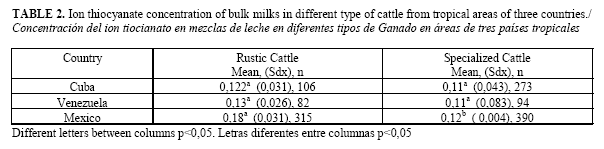
<P><font face="Verdana, Arial, Helvetica, sans-serif" size="2">Thiocyanate concentrations    in bulk milk in cows consuming pastures and forages as basic diet (rustic breeds)    and concentrated foods (specialized breeds), coming from tropical areas of Cuba,    Venezuela and Mexico, were as it is shown in <a href="/img/revistas/rsa/v34n2/t0209212.gif">Table    2</a>. In all the cases, the absolute thiocyanate values were higher in milk    from more rustic breeds (zebu-like breeds or its crossbreeds with European breeds),    though difference was only significant in the case of Mexico. Means were also    within the values previously observed, also the minor concentration in specialized    breed would be related with a higher production of milk volume. </font>      
<P><font face="Verdana, Arial, Helvetica, sans-serif" size="2">A summary or guide    table was elaborated from these results, in order to establish criteria for    the LPs management under the tropic conditions. These should be based on assuring    the maximal activity of the system and a lesser toxicological risk associated    to thiocyanate ion (<a href="/img/revistas/rsa/v34n2/t0309212.gif">Table    3</a>). </font>      
<P><font face="Verdana, Arial, Helvetica, sans-serif" size="2">The general mean    concentration obtained was of 0,14 mmol/L. From such value, the amount of thiocyanate    necessary for the activation of the LPs is calculated in 0,11 mmol/L to reach    the optimal concentration required by the lactoperoxidase enzyme which is 0,25    mmol/L. An expected range regarding overdose was established in 0,251-0,35mmoles/L,    when concentration surpasses the value 0,35 mmol/L. This criterion is obtained    when considering the sum of the maximal natural concentration in a bulk milk    (0,20 mmol/L in cows consuming star pasture), plus a standard deviation of the    mean value (0,03 mmol/L) and the exogenous concentration which should be added    (0,11mmol/L) to reach a total sum of 0,25 mmol/L of the SCN ion concentration.    </font>     <P>&nbsp;     <P><font face="Verdana, Arial, Helvetica, sans-serif" size="2"><B><font size="3">DISCUSSION</font></B>    </font>     <P><font face="Verdana, Arial, Helvetica, sans-serif" size="2">The highest thiocyanate    concentrations in the milk of cows consuming star pasture fertilized with nitrogen    as a basic diet, coincide with the highest cyanogenic potential reported for    this tropical grass (6), similar to that observed in the milk of cows consuming    mandioc (7). The tendency to concentrations slightly superior in rustic breed    cows or their crossbreeds with specialized breeds seems to be associated to:    first, the use of feeding based on tropical pastures and forages and second,    the concentration effect of solids in milk and in the components of the LPs    in the animals due to low milk productions (5,8). The increment of thiocyanate    in cows having subclinical and/or clinical mastitis, and in their colostral    period, is adjusted to the defensive role attributed to the LPs at mammary gland    level, and also to the physiological stage which increases mammary tissue permeability    (8). In both cases, such concentration is reduced when reaching a normal udder    health condition. The slight ion increase starting from the 5<SUP>th</SUP> or    more lactation could also be associated to conditions in the oldest cows&#180;    udder. </font>     <P><font face="Verdana, Arial, Helvetica, sans-serif" size="2">The general mean    concentration obtained in all studies was higher than that established in the    international preceding reports (1,9), which indicates that the activation of    the LPs under the American tropic conditions could be carried out with lesser    amounts of thiocyanate salt than that recommended by the guidelines. Similitude    in concentrations obtained in bulk milk in the three countries under study,    indicates that such values could be taken as reference Stability of such concentrations    during a year is also a favorable element for assuming a unique concentration    for the activation of the LPs, which is established in 0,11 mmol/L thiocyanate    ion, equivalent to 9 mg/100 liters of salt. It should be considered that the    activation of the LPs is addressed to the preservation of bulk milk without    refrigeration and not to its use in individual animals (1,9). Thus, keeping    a thiocyanate mean value in bulk milk within very narrow limits is also a safety    aspect. In this sense, the maximal natural concentration found in raw milk from    individual cows (0,62 mmol/L) was 2,4 times higher than the concentration threshold    recommended for the enzyme activity, including the exogenous activation with    sodium thiocyanate salt (0,25mmol/L). Regarding sodium thiocyanate salt weight,    bulk milk concentration varies between 8-12 mg/100 ml of milk, while in individual    cows is of 4-49 mg/100 ml. </font>     <P><font face="Verdana, Arial, Helvetica, sans-serif" size="2">A suspicion of    overdose range (0,251-0,35 mmol]/ L) and a value above which could be considering    that the is there is a thyocianate ion overdose (+ of 0,35 mmol) in the exogenous    activation of the LP system, has not been established before and constitutes    an important element related to the security of the use and the practical control    of the method. </font>     <P><font face="Verdana, Arial, Helvetica, sans-serif" size="2">Some reports, which    have pointed out the potential thiocyanate risk due to the possible interference    in the thyroid metabolism (3,4,10), have used much higher concentrations than    those recommended by the <I>Codex Alimentarius</I> guidelines, or the conclusions    referred to milk are speculative. The inocuity of the activation method has    been demonstrated since the 80s up to now (2,5,9,11,12). The criterion about    the toxicological damage referred to the guidelines, is a misinterpretation    due to the following reasons: A simple calculation of the annual thiocyanate    ingestion indicates that those countries which do not apply the LPs but consume    an equivalent of 200 kg/year or more (developed countries), drink a greater    quantity of thiocyanate from natural origin than those countries with an equivalent    of 120 kg/year or less (developing countries), though activating the LPs in    all milk. Another misinterpretation is the fact that the natural ion content    in milk from individual cows can be 2,4 times higher than the total concentration    obtained in bulk milk, once activating the LPs. A third aspect is that people    drink more thiocyanate in the consumption of some vegetables and mandioc (9,13)    than during the consumption of milk previously activated with the LPs. Regarding    the term risk-benefit, it could be more dangerous to limit the consumption of    milk than the potential risk which implies the activation of the system using    small quantities of thiocyanate; and also iodine deficiencies in the areas affected    by endemic goitern (14) could be covered by the supply of iodized salt. </font>     ]]></body>
<body><![CDATA[<P><font face="Verdana, Arial, Helvetica, sans-serif" size="2">The characterization    carried out in this study indicates the need of adjusting (reducing to a half)    the amount of thiocyanate salt established for the activation of the LPs under    the tropic conditions and also the need of using suspicion and overdose indicators    as a way of incrementing the control of use of such method. The previous results    assure a greater safety in the activation of the system than that established    in the <I>Codex Alimentarius</I> guidelines; and also do contribute to its improvement.    </font>     <P>&nbsp;     <P><font face="Verdana, Arial, Helvetica, sans-serif" size="2"><B><font size="3">CONCLUSIONS</font></B>    </font>     <P><font face="Verdana, Arial, Helvetica, sans-serif" size="2">The mean concentration    of thiocyanate in raw bulk milk under tropic conditions is between 0,10-0,15    mmoles/L, with a high variability on individual animals between 0,05-0,6 mmoles/L.    The exogenous activation of the LPs only needs between 8-9 mg of sodium thiocyanate    per liter, half less than that indicated in the <I>Codex Alimentarius</I> guideline.    </font>     <P><font face="Verdana, Arial, Helvetica, sans-serif" size="2">The activation    of the LPs in bulk milk with the thiocyanate quantity indicated is 2,4 times    lesser than the maximum values found in milk of individual cows. The criterion    to identify the over dosage was established from 24 mg/L or higher than 0,40    mmoles /L, and between values for the suspicion of over dosage (0,26-0,40 mmoles/L).    The previous results assure a higher security margin in the system activation    than that established by the <I>Codex Alimentarius</I> guideline and contribute    to its improvement. </font>     <P>&nbsp;     <P><font face="Verdana, Arial, Helvetica, sans-serif" size="2"><B><font size="3">REFERENCES</font></B>    </font>     <!-- ref --><P><font face="Verdana, Arial, Helvetica, sans-serif" size="2">1. CAC/GL 13-1991.    Guidelines for the preservation of raw milk by use of the lactoperoxidase system.<I>    </I>Codex alimentarius, 5 pp, 1991.     </font>     <!-- ref --><P><font face="Verdana, Arial, Helvetica, sans-serif" size="2">2. JECFA. 35 Reuni&oacute;n    FAO/OMS del Comit&eacute; de Expertos en Aditivos Alimentarios. Informe Nro    789, 1990.     </font>     <!-- ref --><P><font face="Verdana, Arial, Helvetica, sans-serif" size="2">3. Kishore B, Banerjee    K, Marimuthu P, Bhattacharyya P, Chatterjee M. Effect of thiocyanate through    milk on thyroid hormone homeostasis in women. Brit J Nutrit. 1997;78:679-681.        </font>     <!-- ref --><P><font face="Verdana, Arial, Helvetica, sans-serif" size="2">4. Sousa de Benedicto    A, Maoirka PC, Goncalves ID, Marques de Sa LR, Gorniak SL. Evaluation of effects    of prenatal exposure to the cyanide and thiocyanate in wistar rats. Reprod Toxicol.    2007;568-577.     </font>     <!-- ref --><P><font face="Verdana, Arial, Helvetica, sans-serif" size="2">5. Ponce P, Capdevila    J, Armenteros M. Aspectos pr&aacute;cticos y consideraciones sobre peligros    microbiol&oacute;gicos y qu&iacute;micos en el uso sistema lactoperoxidasa en    el tr&oacute;pico americano. Rev Salud Anim. 2004;25:163-172.     </font>     <!-- ref --><P><font face="Verdana, Arial, Helvetica, sans-serif" size="2">6. Aguilera JM.    Contribuci&oacute;n al estudio del efecto de la fertilizaci&oacute;n nitrogenada,    &eacute;poca y edad de rebrote en el potencial cianog&eacute;nico del pasto    estrella. Tesis para opci&oacute;n del grado de Doctor en Ciencias Veterinarias,    CENSA. La Habana, Cuba, 1983.     </font>     <!-- ref --><P><font face="Verdana, Arial, Helvetica, sans-serif" size="2">7. Hansen R. Sistema    lactoperoxidase: Avaliacao de m&eacute;todos para ativacao e de efeitos na preservacao    do leite em nivel de fazenda e postos de resfriamento. Tese para obtencao do    titulo de Magister Scientiae. UFV, Vicosa, MG, Brasil, Outubre, 1996.     </font>     <!-- ref --><P><font face="Verdana, Arial, Helvetica, sans-serif" size="2">8. Ponce P. Activaci&oacute;n    del sistema lactoperoxidasa: Un nuevo enfoque para la conservaci&oacute;n de    la leche en el tr&oacute;pico americano. Tesis de doctor en Ciencias Generales    (Doctor II). CENSA, 151pp, Dic/2007.     </font>     <!-- ref --><P><font face="Verdana, Arial, Helvetica, sans-serif" size="2">9. FAO/OMS. Benefits    and potencial risks of the LPs of raw milk preservation. Inform of the technical    meeting FAO/OMS. 56 pages, 2006. Available on line at <U><a href="http://www.fao.org/ag/dairy.html" target="_blank">http://www.fao.org/ag/dairy.html</a></U>.        </font>      <!-- ref --><P><font face="Verdana, Arial, Helvetica, sans-serif" size="2">10.Dahlberg P,    Bergmark A, Eltom M, Bj&ouml;rck L, Bruce &Aring;, Hambraeus L, et al. Intake    of thiocyanate by way of milk and its possible effect on thyroid function. American    J Clin Nutr. 1984;39:416-420.     </font>     <!-- ref --><P><font face="Verdana, Arial, Helvetica, sans-serif" size="2">11. Dalberg P,    Bergmark A, Bjork L, Elton M, Claesson O. Effect of thiocyanate levels in milk    on thyroid function in iodine deficient subjects. American J Clin Nutr. 1985;39:416-420.        </font>     <!-- ref --><P><font face="Verdana, Arial, Helvetica, sans-serif" size="2">12.Fern&aacute;ndez    O, Marrero E, Capdevila JZ. Safety considerations on lactoperoxidase system    use for milk preservation. Rev Salud Anim. 2005;27:205-209.     </font>      <!-- ref --><P><font face="Verdana, Arial, Helvetica, sans-serif" size="2">13.Weuffen W. Medizinische    und biologische bedeutung der thiocyanate (Rodanide). Ed Weuffen W. In Veb Verlag    Volk. 1982.     </font>      <!-- ref --><P><font face="Verdana, Arial, Helvetica, sans-serif" size="2">14.Mathur BN, Chopra    R. Current issues concerning safety of Lp-system for preservation of raw milk.    Ind Dairyman. 1995;47:4-11.     </font>      <P>      <P>      <P>      <P>      <P>      ]]></body>
<body><![CDATA[<P>      <P>      <P>      <P>      <P>     <p>&nbsp;</p>     <p>&nbsp;</p>     <p><font face="Verdana, Arial, Helvetica, sans-serif" size="2">Recibido: 20-4-2012.    <br>   Aceptado: 28-6-2012. </font></p>     <p>&nbsp;</p>     ]]></body>
<body><![CDATA[<p>&nbsp;</p>     <p>&nbsp; </p> <B></B>       ]]></body><back>
<ref-list>
<ref id="B1">
<label>1</label><nlm-citation citation-type="">
<source><![CDATA[Guidelines for the preservation of raw milk by use of the lactoperoxidase system: Codex alimentarius]]></source>
<year>1991</year>
<page-range>5</page-range></nlm-citation>
</ref>
<ref id="B2">
<label>2</label><nlm-citation citation-type="">
<collab>JECFA</collab>
<source><![CDATA[35 Reunión FAO/OMS del Comité de Expertos en Aditivos Alimentarios: Informe Nro 789]]></source>
<year>1990</year>
</nlm-citation>
</ref>
<ref id="B3">
<label>3</label><nlm-citation citation-type="journal">
<person-group person-group-type="author">
<name>
<surname><![CDATA[Kishore]]></surname>
<given-names><![CDATA[B]]></given-names>
</name>
<name>
<surname><![CDATA[Banerjee]]></surname>
<given-names><![CDATA[K]]></given-names>
</name>
<name>
<surname><![CDATA[Marimuthu]]></surname>
<given-names><![CDATA[P]]></given-names>
</name>
<name>
<surname><![CDATA[Bhattacharyya]]></surname>
<given-names><![CDATA[P]]></given-names>
</name>
<name>
<surname><![CDATA[Chatterjee]]></surname>
<given-names><![CDATA[M]]></given-names>
</name>
</person-group>
<article-title xml:lang="en"><![CDATA[Effect of thiocyanate through milk on thyroid hormone homeostasis in women]]></article-title>
<source><![CDATA[Brit J Nutrit]]></source>
<year>1997</year>
<volume>78</volume>
<page-range>679-681</page-range></nlm-citation>
</ref>
<ref id="B4">
<label>4</label><nlm-citation citation-type="journal">
<person-group person-group-type="author">
<name>
<surname><![CDATA[Sousa de]]></surname>
<given-names><![CDATA[Benedicto A]]></given-names>
</name>
<name>
<surname><![CDATA[Maoirka]]></surname>
<given-names><![CDATA[PC]]></given-names>
</name>
<name>
<surname><![CDATA[Goncalves]]></surname>
<given-names><![CDATA[ID]]></given-names>
</name>
<name>
<surname><![CDATA[Marques de Sa]]></surname>
<given-names><![CDATA[LR]]></given-names>
</name>
<name>
<surname><![CDATA[Gorniak]]></surname>
<given-names><![CDATA[SL]]></given-names>
</name>
</person-group>
<article-title xml:lang="en"><![CDATA[Evaluation of effects of prenatal exposure to the cyanide and thiocyanate in wistar rats]]></article-title>
<source><![CDATA[Reprod Toxicol]]></source>
<year>2007</year>
<page-range>568-577</page-range></nlm-citation>
</ref>
<ref id="B5">
<label>5</label><nlm-citation citation-type="journal">
<person-group person-group-type="author">
<name>
<surname><![CDATA[Ponce]]></surname>
<given-names><![CDATA[P]]></given-names>
</name>
<name>
<surname><![CDATA[Capdevila]]></surname>
<given-names><![CDATA[J]]></given-names>
</name>
<name>
<surname><![CDATA[Armenteros]]></surname>
<given-names><![CDATA[M]]></given-names>
</name>
</person-group>
<article-title xml:lang="es"><![CDATA[Aspectos prácticos y consideraciones sobre peligros microbiológicos y químicos en el uso sistema lactoperoxidasa en el trópico americano]]></article-title>
<source><![CDATA[Rev Salud Anim]]></source>
<year>2004</year>
<volume>25</volume>
<page-range>163-172</page-range></nlm-citation>
</ref>
<ref id="B6">
<label>6</label><nlm-citation citation-type="">
<person-group person-group-type="author">
<name>
<surname><![CDATA[Aguilera]]></surname>
<given-names><![CDATA[JM]]></given-names>
</name>
</person-group>
<article-title xml:lang="es"><![CDATA[Contribución al estudio del efecto de la fertilización nitrogenada, época y edad de rebrote en el potencial cianogénico del pasto estrella]]></article-title>
<source><![CDATA[]]></source>
<year></year>
</nlm-citation>
</ref>
<ref id="B7">
<label>7</label><nlm-citation citation-type="">
<person-group person-group-type="author">
<name>
<surname><![CDATA[Hansen]]></surname>
<given-names><![CDATA[R]]></given-names>
</name>
</person-group>
<article-title xml:lang="pt"><![CDATA[Sistema lactoperoxidase: Avaliacao de métodos para ativacao e de efeitos na preservacao do leite em nivel de fazenda e postos de resfriamento]]></article-title>
<source><![CDATA[]]></source>
<year></year>
</nlm-citation>
</ref>
<ref id="B8">
<label>8</label><nlm-citation citation-type="">
<person-group person-group-type="author">
<name>
<surname><![CDATA[Ponce]]></surname>
<given-names><![CDATA[P]]></given-names>
</name>
</person-group>
<article-title xml:lang="es"><![CDATA[Activación del sistema lactoperoxidasa: Un nuevo enfoque para la conservación de la leche en el trópico americano]]></article-title>
<source><![CDATA[]]></source>
<year></year>
</nlm-citation>
</ref>
<ref id="B9">
<label>9</label><nlm-citation citation-type="">
<collab>FAO/OMS</collab>
<article-title xml:lang="en"><![CDATA[Benefits and potencial risks of the LPs of raw milk preservation]]></article-title>
<source><![CDATA[Inform of the technical meeting FAO/OMS]]></source>
<year>2006</year>
<page-range>56</page-range></nlm-citation>
</ref>
<ref id="B10">
<label>10</label><nlm-citation citation-type="journal">
<person-group person-group-type="author">
<name>
<surname><![CDATA[Dahlberg]]></surname>
<given-names><![CDATA[P]]></given-names>
</name>
<name>
<surname><![CDATA[Bergmark]]></surname>
<given-names><![CDATA[A]]></given-names>
</name>
<name>
<surname><![CDATA[Eltom]]></surname>
<given-names><![CDATA[M]]></given-names>
</name>
<name>
<surname><![CDATA[Björck]]></surname>
<given-names><![CDATA[L]]></given-names>
</name>
<name>
<surname><![CDATA[Bruce]]></surname>
<given-names><![CDATA[Å]]></given-names>
</name>
<name>
<surname><![CDATA[Hambraeus]]></surname>
<given-names><![CDATA[L]]></given-names>
</name>
</person-group>
<article-title xml:lang="en"><![CDATA[Intake of thiocyanate by way of milk and its possible effect on thyroid function]]></article-title>
<source><![CDATA[American J Clin Nutr]]></source>
<year>1984</year>
<volume>39</volume>
<page-range>416-420</page-range></nlm-citation>
</ref>
<ref id="B11">
<label>11</label><nlm-citation citation-type="journal">
<person-group person-group-type="author">
<name>
<surname><![CDATA[Dalberg]]></surname>
<given-names><![CDATA[P]]></given-names>
</name>
<name>
<surname><![CDATA[Bergmark]]></surname>
<given-names><![CDATA[A]]></given-names>
</name>
<name>
<surname><![CDATA[Bjork]]></surname>
<given-names><![CDATA[L]]></given-names>
</name>
<name>
<surname><![CDATA[Elton]]></surname>
<given-names><![CDATA[M]]></given-names>
</name>
<name>
<surname><![CDATA[Claesson]]></surname>
<given-names><![CDATA[O]]></given-names>
</name>
</person-group>
<article-title xml:lang="en"><![CDATA[Effect of thiocyanate levels in milk on thyroid function in iodine deficient subjects]]></article-title>
<source><![CDATA[American J Clin Nutr]]></source>
<year>1985</year>
<volume>39</volume>
<page-range>416-420</page-range></nlm-citation>
</ref>
<ref id="B12">
<label>12</label><nlm-citation citation-type="journal">
<person-group person-group-type="author">
<name>
<surname><![CDATA[Fernández]]></surname>
<given-names><![CDATA[O]]></given-names>
</name>
<name>
<surname><![CDATA[Marrero]]></surname>
<given-names><![CDATA[E]]></given-names>
</name>
<name>
<surname><![CDATA[Capdevila]]></surname>
<given-names><![CDATA[JZ]]></given-names>
</name>
</person-group>
<article-title xml:lang="en"><![CDATA[Safety considerations on lactoperoxidase system use for milk preservation]]></article-title>
<source><![CDATA[Rev Salud Anim]]></source>
<year>2005</year>
<volume>27</volume>
<page-range>205-209</page-range></nlm-citation>
</ref>
<ref id="B13">
<label>13</label><nlm-citation citation-type="">
<person-group person-group-type="author">
<name>
<surname><![CDATA[Weuffen]]></surname>
<given-names><![CDATA[W]]></given-names>
</name>
</person-group>
<article-title xml:lang="de"><![CDATA[Medizinische und biologische bedeutung der thiocyanate (Rodanide)]]></article-title>
<person-group person-group-type="editor">
<name>
<surname><![CDATA[Weuffen]]></surname>
<given-names><![CDATA[W]]></given-names>
</name>
</person-group>
<source><![CDATA[In Veb Verlag Volk]]></source>
<year>1982</year>
</nlm-citation>
</ref>
<ref id="B14">
<label>14</label><nlm-citation citation-type="journal">
<person-group person-group-type="author">
<name>
<surname><![CDATA[Mathur]]></surname>
<given-names><![CDATA[BN]]></given-names>
</name>
<name>
<surname><![CDATA[Chopra]]></surname>
<given-names><![CDATA[R]]></given-names>
</name>
</person-group>
<article-title xml:lang="en"><![CDATA[Current issues concerning safety of Lp-system for preservation of raw milk]]></article-title>
<source><![CDATA[Ind Dairyman]]></source>
<year>1995</year>
<volume>47</volume>
<page-range>4-11</page-range></nlm-citation>
</ref>
</ref-list>
</back>
</article>