<?xml version="1.0" encoding="ISO-8859-1"?><article xmlns:mml="http://www.w3.org/1998/Math/MathML" xmlns:xlink="http://www.w3.org/1999/xlink" xmlns:xsi="http://www.w3.org/2001/XMLSchema-instance">
<front>
<journal-meta>
<journal-id>0253-570X</journal-id>
<journal-title><![CDATA[Revista de Salud Animal]]></journal-title>
<abbrev-journal-title><![CDATA[Rev Salud Anim.]]></abbrev-journal-title>
<issn>0253-570X</issn>
<publisher>
<publisher-name><![CDATA[Centro Nacional de Sanidad Agropecuaria]]></publisher-name>
</publisher>
</journal-meta>
<article-meta>
<article-id>S0253-570X2012000300003</article-id>
<title-group>
<article-title xml:lang="en"><![CDATA[Antimicrobial Resistance and genes associated to the host-microbe interaction of Pasteurella multocida isolates from swine in Western Cuba]]></article-title>
<article-title xml:lang="es"><![CDATA[Resistencia antimicrobiana y genes asociados a la interacción hospedero-microorganismo en aislados de Pasteurella multocida de origen porcino de la región occidental de Cuba]]></article-title>
</title-group>
<contrib-group>
<contrib contrib-type="author">
<name>
<surname><![CDATA[Espinosa]]></surname>
<given-names><![CDATA[Ivette]]></given-names>
</name>
<xref ref-type="aff" rid="A01"/>
</contrib>
<contrib contrib-type="author">
<name>
<surname><![CDATA[Báez]]></surname>
<given-names><![CDATA[M]]></given-names>
</name>
<xref ref-type="aff" rid="A01"/>
</contrib>
<contrib contrib-type="author">
<name>
<surname><![CDATA[Vichi]]></surname>
<given-names><![CDATA[J]]></given-names>
</name>
<xref ref-type="aff" rid="A01"/>
</contrib>
<contrib contrib-type="author">
<name>
<surname><![CDATA[Martínez]]></surname>
<given-names><![CDATA[Siomara]]></given-names>
</name>
<xref ref-type="aff" rid="A01"/>
</contrib>
</contrib-group>
<aff id="A01">
<institution><![CDATA[,Division of Molecular Biology National Center for Animal and Plant Health (CENSA) ]]></institution>
<addr-line><![CDATA[Mayabeque ]]></addr-line>
<country>Cuba</country>
</aff>
<pub-date pub-type="pub">
<day>00</day>
<month>12</month>
<year>2012</year>
</pub-date>
<pub-date pub-type="epub">
<day>00</day>
<month>12</month>
<year>2012</year>
</pub-date>
<volume>34</volume>
<numero>3</numero>
<fpage>151</fpage>
<lpage>158</lpage>
<copyright-statement/>
<copyright-year/>
<self-uri xlink:href="http://scielo.sld.cu/scielo.php?script=sci_arttext&amp;pid=S0253-570X2012000300003&amp;lng=en&amp;nrm=iso"></self-uri><self-uri xlink:href="http://scielo.sld.cu/scielo.php?script=sci_abstract&amp;pid=S0253-570X2012000300003&amp;lng=en&amp;nrm=iso"></self-uri><self-uri xlink:href="http://scielo.sld.cu/scielo.php?script=sci_pdf&amp;pid=S0253-570X2012000300003&amp;lng=en&amp;nrm=iso"></self-uri><abstract abstract-type="short" xml:lang="en"><p><![CDATA[Pasteurella multocida is an important veterinary pathogen that causes a range of animal diseases, including fowl cholera, hemorrhagic septicemia in cattle and atrophic rhinitis in swine. P. multocida is generally recognized as a secondary invader contributing substantially to respiratory diseases in pigs by aggravation of lung lesions. Five capsule serogroups are routinely identified in P. multocida (A, B, D, E, and F) and each is generally associated with, but not completely restricted, to a specific host. A total of 16 isolates of Pasteurella multocida capsular genotype A and two isolates capsular genotype D were characterized for their susceptibilities to 10 antibiotics and the presence of four genes for virulence factors associated to adherence. The use of PCR showed that colonization factors (ptfA), sialidases (nanH) and outer membrane proteins (ompH) occurred in 100% porcine strains, while nanB as a further colonization-related gene was detected in 22% of isolates. The 94% of the isolates showed multiple-drug resistance. It was observed that 100% were resistant to amoxicillin and spectinomicin. The resistance profiles suggested that cephalosporins and sulphametozaxole were the drugs most likely to be active against P. multocida in vitro.]]></p></abstract>
<abstract abstract-type="short" xml:lang="es"><p><![CDATA[Pasteurella multocida es un patógeno de amplia distribución mundial, responsable de diversos procesos clínicos en varias especies de animales, produce el cólera aviar en aves, septicemia hemorrágica en bovinos y la rinitis atrófica en cerdos. En esta especie animal P.multocida se considera, además como un patógeno secundario que contribuye sustancialmente a los procesos clínicos respiratorios, agravando las lesiones pulmonares. Existen 5 serogrupos capsulares en P. multocida (A, B, D, E, and F) y cada uno es generalmente asociado, pero no completamente restringido a un hospedero específico. En este estudio se realizó la caracterización de la resistencia antimicrobiana frente a 10 antibióticos y la detección de cuatro genes asociados a la virulencia en 16 aislados de P. multocida tipo capsular A y 2 del tipo capsular D, todos procedentes de cerdos. Los ensayos de PCR evidenciaron la presencia de factores de colonización (ptfA), sialidasa (nanH) y la proteína de membrana externa ompH en 100% de los aislados, mientras el gen nanB asociado a la colonización solamente se detectó en 22% de los aislados. El 94% de los aislados mostraron multirresistencia a los antimicrobianos evaluados, el 100% fueron resistentes a amoxicillin y spectinomicin. Los perfiles de resistencia detectados señalan que las cephalosporina y sulphametozaxole fueron las drogas más activas contra P. multocida in vitro.]]></p></abstract>
<kwd-group>
<kwd lng="en"><![CDATA[P. multocida]]></kwd>
<kwd lng="en"><![CDATA[virulence factor]]></kwd>
<kwd lng="en"><![CDATA[PCR]]></kwd>
<kwd lng="en"><![CDATA[antimicrobial susceptibility]]></kwd>
<kwd lng="es"><![CDATA[P.multocida]]></kwd>
<kwd lng="es"><![CDATA[factor virulencia]]></kwd>
<kwd lng="es"><![CDATA[PCR]]></kwd>
<kwd lng="es"><![CDATA[susceptibilidad antimicrobial]]></kwd>
</kwd-group>
</article-meta>
</front><body><![CDATA[ <P align="right"><font face="Verdana, Arial, Helvetica, sans-serif" size="2"><B>ORIGINAL  ARTICLE</B></font>     <P align="right">&nbsp;     <P align="left"><font face="Verdana, Arial, Helvetica, sans-serif" size="2"><B><font size="4">Antimicrobial  Resistance and genes associated to the host-microbe interaction of <I>Pasteurella  multocida </I>isolates<I> </I>from swine in Western Cuba </font></B></font>     <P align="left">&nbsp;      <P align="left"><font face="Verdana, Arial, Helvetica, sans-serif" size="2"><b><font size="3">Resistencia  antimicrobiana y genes asociados a la interacci&oacute;n hospedero-microorganismo  en aislados de <i>Pasteurella multocida</i> de origen porcino de la regi&oacute;n  occidental de Cuba</font></b></font>     <P align="left">&nbsp;     <P align="left">&nbsp;     <P align="left"><font face="Verdana, Arial, Helvetica, sans-serif" size="2"><b>Ivette  Espinosa, M. B&aacute;ez, J. Vichi, Siomara Mart&iacute;nez</b></font> <B></B>      <P><font face="Verdana, Arial, Helvetica, sans-serif" size="2">Division of Molecular  Biology. National Center for Animal and Plant Health (CENSA), Apdo.10, San Jos&eacute;  de las Lajas, Mayabeque, Cuba. E-mail: <a href="mailto:espinosa@censa.edu.cu">espinosa@censa.edu.cu</a>.  </font>     <P>&nbsp;     ]]></body>
<body><![CDATA[<P>&nbsp; <hr noshade size="1">     <P><font face="Verdana, Arial, Helvetica, sans-serif" size="2"><B>ABSTRACT</B></font>      <P><font face="Verdana, Arial, Helvetica, sans-serif" size="2"><I>Pasteurella  multocida </I>is an important veterinary pathogen that causes a range of animal  diseases, including fowl cholera, hemorrhagic septicemia in cattle and atrophic  rhinitis in swine. <I>P. multocida </I>is generally recognized as a secondary  invader contributing substantially to respiratory diseases in pigs by aggravation  of lung lesions. Five capsule serogroups are routinely identified in <I>P. multocida</I>  (A, B, D, E, and F) and each is generally associated with, but not completely  restricted, to a specific host. A total of 16 isolates of <I>Pasteurella multocida<B>  </B></I>capsular genotype A and two isolates capsular genotype D were characterized  for their susceptibilities to 10 antibiotics and the presence of four genes for  virulence factors associated to adherence. The use of PCR showed that colonization  factors (<I>ptfA</I>), sialidases (<I>nanH</I>) and outer membrane proteins (<I>ompH</I>)  occurred in 100% porcine strains, while <I>nanB</I> as a further colonization-related  gene was detected in 22% of isolates. The 94% of the isolates showed multiple-drug  resistance. It was observed that 100% were resistant to amoxicillin and spectinomicin.  The resistance profiles suggested that cephalosporins and sulphametozaxole were  the drugs most likely to be active against <I>P. multocida in vitro</I>. </font>      <P><font face="Verdana, Arial, Helvetica, sans-serif" size="2"><B>Key words:</B>  <I>P. multocida</I>, virulence factor, PCR, antimicrobial susceptibility. </font>  <hr noshade size="1">     <P><font face="Verdana, Arial, Helvetica, sans-serif" size="2"><B>RESUMEN</b></font>      <P><font face="Verdana, Arial, Helvetica, sans-serif" size="2"><I>Pasteurella  multocida</I> es un pat&oacute;geno de amplia distribuci&oacute;n mundial, responsable  de diversos procesos cl&iacute;nicos en varias especies de animales, produce el  c&oacute;lera aviar en aves, septicemia hemorr&aacute;gica en bovinos y la rinitis  atr&oacute;fica en cerdos. En esta especie animal <I>P.multocida</I> se considera,  adem&aacute;s como un pat&oacute;geno secundario que contribuye sustancialmente  a los procesos cl&iacute;nicos respiratorios, agravando las lesiones pulmonares.  Existen 5 serogrupos capsulares en <I>P. multocida</I> (A, B, D, E, and F) y cada  uno es generalmente asociado, pero no completamente restringido a un hospedero  espec&iacute;fico. En este estudio se realiz&oacute; la caracterizaci&oacute;n  de la resistencia antimicrobiana frente a 10 antibi&oacute;ticos y la detecci&oacute;n  de cuatro genes asociados a la virulencia en 16 aislados de <I>P. multocida</I>  tipo capsular A y 2 del tipo capsular D, todos procedentes de cerdos. Los ensayos  de PCR evidenciaron la presencia de factores de colonizaci&oacute;n (<I>ptfA</I>),  sialidasa (<I>nanH</I>) y la prote&iacute;na de membrana externa <I>ompH</I> en  100% de los aislados, mientras el gen <I>nanB</I> asociado a la colonizaci&oacute;n  solamente se detect&oacute; en 22% de los aislados. El 94% de los aislados mostraron  multirresistencia a los antimicrobianos evaluados, el 100% fueron resistentes  a amoxicillin y spectinomicin. Los perfiles de resistencia detectados se&ntilde;alan  que las cephalosporina y sulphametozaxole fueron las drogas m&aacute;s activas  contra <I>P. multocida in vitro</I>. </font>     <P><font face="Verdana, Arial, Helvetica, sans-serif" size="2"><B>Palabras  clave:</B><I> P.multocida</I>, factor virulencia, PCR, susceptibilidad antimicrobial.</font>  <hr noshade size="1">     <P>&nbsp;     <P>&nbsp;     <P><font face="Verdana, Arial, Helvetica, sans-serif" size="2"><B><font size="3">INTRODUCTION</font></B>  </font>     ]]></body>
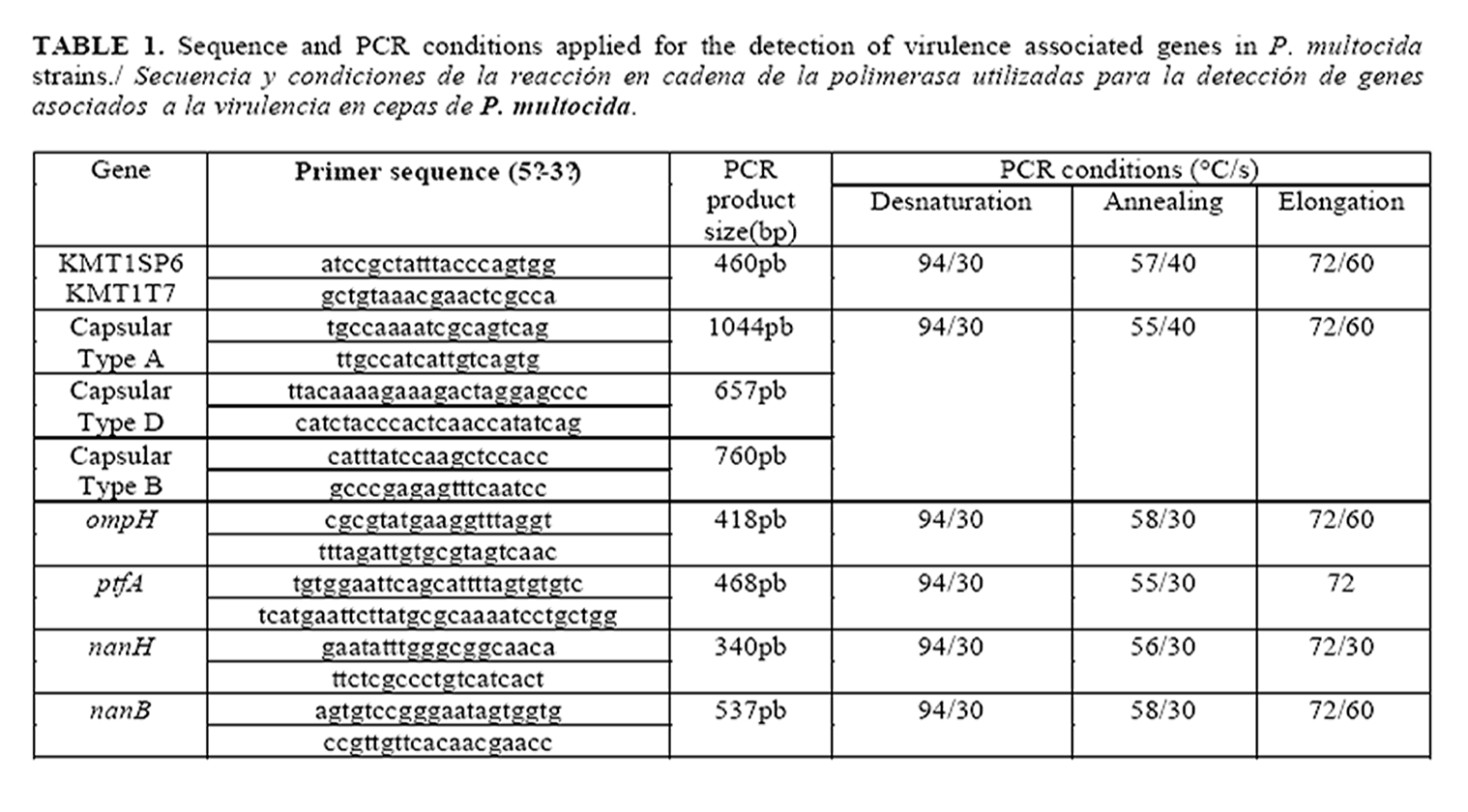
<body><![CDATA[<P><font face="Verdana, Arial, Helvetica, sans-serif" size="2"><I>Pasteurella  multocida </I>is a worldwide-distributed pathogen responsible for a broad range  of diseases in livestock (hemorrhagic septicemia, shipping fever), poultry (fowl  cholera), wildlife (avian cholera) and laboratory rabbits (snuffles) (1). <I>P.  multocida</I> is the type species of the genus including the three subspecies;  <I>P. multocida</I> subsp. multocida, <I>P. multocida</I> subsp. gallicida and  <I>P. m</I>ultocida subsp. Septic (2,3).<I> </I>This bacterium<I> </I>is a major  pathogen of pigs, being involved in a number of different disease conditions.  The main diseases associated with this organism are progressive atrophic rhinitis  and pneumonic pasteurellosis, one of the most common and widespread diseases of  intensively housed pigs and also playing a role to increasing the severity of  primary lung lesions in pigs (4, 5). </font>     <P><font face="Verdana, Arial, Helvetica, sans-serif" size="2"><I>P.  multocida</I> shows a high antigenic variability and a wide host spectrum, as  well as different courses of infection which also imply enormous difficulties  in producing vaccines (6). Strains of <I>P. multocida </I>are grouped into five  capsular serogroups (serogroups<I> </I>A, B, D, E, and F) and are further classified  into 16<I> </I>somatic serotypes (serotypes 1 to 16), which are primarily<I> </I>based  on lipopolysaccharide antigens (7). The recognized virulence factors of this organism  that have been identified to date are the capsule and lipopolysaccharide (1,7).  Other key factors also include diverse adhesins, toxins, siderophores, sialidases  and outer membrane proteins (6,8,9). </font>     <P><font face="Verdana, Arial, Helvetica, sans-serif" size="2">Although  antimicrobial therapy is a widely available tool for the prevention and control  of clinical infections (10,11), the antibiotic resistance in pathogenic bacteria  from food-producing animals and environmental sources is recognized as a global  problem for public health (10, 12). Numerous previous studies have reported that  the imprudent use of antimicrobials bears a high risk for the selection of resistant  bacteria and promotes the spread of resistance genes located on plasmids, integrons  and transposons thought the process of horizontal transfer gene (13). </font>      <P><font face="Verdana, Arial, Helvetica, sans-serif" size="2">The prevalence  of serotypes and pathotypes of <I>P. multocida</I> can vary considerably according  to the geographical distribution and over time in a given region. The use of control  methods such as antimicrobial or autogenous vaccines requires studies in each  geographical area (13). These studies are useful for identifying the presence  of pathogenic strains, which are predominant , and establishing the persistence  of these strains over time. A successful approach for the identification of virulent  strains is the differentiation of capsular serotypes using specific antisera or  the corresponding <I>cps</I> types by genotypic assessment, with the subsequent  detection of virulence associated factors. To date, in Cuba there are no studies  concerning the presence of virulence associated genes known so far in porcine  <I>P. multocida</I> strains. The aim of this study was thus to research the presence  of so far known virulence associated genes in <I>P. multocida</I> isolates and  to evaluate the antibiotic susceptibility.</font>     <P>&nbsp;     <P><font face="Verdana, Arial, Helvetica, sans-serif" size="3"><b>MATERIALS  AND METHODS</b></font>     <P><font face="Verdana, Arial, Helvetica, sans-serif" size="2">The  selected isolates of <I>P. multocida</I> (nP=18) were recovered from 2004 (n=10),  2010 (n=3) and 2011 (n=5) in the course of routine diagnostic procedures from  diseased pigs lung. Pigs included in the study were classified into two production  stages: post-weaning (4-10 weeks) and transition (10-18 weeks) belonging to five  farrow-to-finish farms in<I> </I>several geographic areas within the western region.  Bacteria were cultured on Columbia<I> </I>agar plus 5% sheep blood plates. All  the isolates were identified by standard methods as api NE (biomeriuex), not grown  in Mac Conkey agar. After identification, bacteria were lyophilized and stored  at 4<SUP>o</SUP>C until they were used. </font>     <P><font face="Verdana, Arial, Helvetica, sans-serif" size="2">Identification  of <I>P. multocida </I>isolates was confirmed using species-specific PCR with  primers KMT1T7 and KMT1SP6, as previously described (14). The capsular types of  the isolates were determined by capsule PCR typing with the capsule-specific primer  pairs (primers specific for <I>capA</I>, <I>capD </I>and<I> capB</I>) described  by Townsend et al. (15). The primer sequences used in the capsule PCR typing assay  for <I>P. multocida </I>are listed in <A HREF="/img/revistas/rsa/v34n3/t0103312.gif">Table  1</A>.<B> </B>Four pairs of oligonucleotide primers were used for the detection  of virulence genes (VG) <I>ompH</I>,<I> ptfA</I>, <I>nanH</I> and <I>nanB</I>  (6). Details of all oligonucleotide primers used and PCR conditions applied for  the detection are listed in <a href="/img/revistas/rsa/v34n3/t0103312.gif">Table<i>  </i>1</a>. Each isolate was tested under the same conditions twice. All oligonucleotides  were custom synthesized (CIGB, Cuba). </font>     
<P><font face="Verdana, Arial, Helvetica, sans-serif" size="2">The  bacterial lysates used as templates for PCR were prepared as follows. A loopful  of a bacteria colony from a fresh overnight culture on a Columbia agar plate was  resuspended homogeneously in 50 &#181;L of sterile water and the mixture was boiled  at 100&#176;C for 5 min and frozen at 20<SUP>o</SUP>C for 10 min to release the  DNA and centrifuged to 3000g (14). A 5 &#181;L volume of the supernatant was used  as a template for each 25 &#181;L PCR mixture containing 20 pmol of each primer,  0,4 mM of dNTPs, 1x PCR buffer, 3 mM MgCl<SUB>2</SUB> and 1 U Taq DNA polymerase  (Invitrogen). </font>     <P><font face="Verdana, Arial, Helvetica, sans-serif" size="2">The  amplified DNA was visualized in 2% agarose gels in TBE buffer (90<SUP> </SUP>mM  Tris, 90 mM borate, 2.5 mM EDTA [pH 8]) for 1h at a constant<SUP> </SUP>voltage  of 125V. Amplified products were stained with ethidium<SUP> </SUP>bromide (0.5&#181;g/&#181;L)  and detected by UV transillumination. The 50pb ladder (Promega) was used as standard.  </font>     ]]></body>
<body><![CDATA[<P><font face="Verdana, Arial, Helvetica, sans-serif" size="2">Antimicrobial  susceptibility was determined by disk diffusion methods by following CLSI guidelines  (16). The antimicrobial agents used<B> </B>and their respective concentration  were as follows: amoxicillin (30&#181;g); neomycin (30&#181;g); erythromycin (15&#181;g);  tetracycline (30&#181;g); trimethoprim/sulphamethoxazole (25&#181;g), spectinomycin  (25&#181;g); amikacin (30&#181;g), chloramphenicol (30&#181;g), nalidixic acid  (30&#181;g) and cepholetin (30&#181;g). They were supplied by the Oxoid. The inoculums  were prepared from a 24 hour Columbia blood agar plate by suspending several colonies  in 5 mL of saline solution and were adjusted to 0.5 McFarland standards. One hundred  microliters of the adjusted inoculums were deposited on the surface agar Muller  Hinton plate and further incubated at 37<SUP>o</SUP>C for 24 h. For the antimicrobials,  the breakpoint values were taken from the CLSI guidelines (16).</font>     <P>&nbsp;     <P><font face="Verdana, Arial, Helvetica, sans-serif" size="2"><B><font size="3">RESULTS  AND DISCUSSION</font></B> </font>     <P><font face="Verdana, Arial, Helvetica, sans-serif" size="2">The  <I>P. multocida</I> isolates were researched for <I>kmt</I>, the presence of three  capsule biosynthesis genes and four virulence associated genes by PCR analyses.  <I>Pasteurellosis</I> is one of the most common diseases of pigs worldwide (17,18).  It is remarkable that <I>P. multocida</I>, one of the first agents specifically  identified in pneumonic swine lung, continued throughout the past over 100 years  as a major agent in porcine pneumonia, often mixed with viral agents and continues  today without any evidence of being diminished (19). In this study the isolates  of <I>P. multocida</I> were from post-weaning pigs and transition with lesions  in the lungs and clinical signs of pneumonia. Xibiao et al 2009 detected strains  of <I>P. multocida </I>throughout the year without seasonal variation from growing  pigs 60 to 110 days old (20). A study in tonsils using high throughput bar-coded  454-FLX pyrosequencing defined the core microbiome dominated by <I>Pasteurellaceae</I>,  in theses structures of pig that are constantly exposed to both ingested and inhaled  microorganisms including both bacteria and viruses (21). </font>     <P><font face="Verdana, Arial, Helvetica, sans-serif" size="2">The  whole 18 isolates were confirmed as <I>P. multocida</I> based on the <I>kmt</I>  species specific gene PCR amplification product. The identification of <I>P. multocida</I>  depends on standard culture methods and serotyping. These methods are labor intensive  and results can be inconclusive. In recent years, genotypic methods of bacterial  identification have proved beneficial in overcoming some limitations of traditional  phenotypic procedures. For ease and rapidity, PCR was performed directly from  single colonies, grown on agar plates in primary cultures from contaminated sites  on the animal, such as tonsil and lung (14). A pipette tip was lightly touched  onto a colony, and this sample was then resuspended in PCR amplification mixture.  The primer pair KMT1SP6-KMT1T7 amplified a product of approximately 460 bp from  all isolates of <I>P. multocida</I>. </font>     <P><font face="Verdana, Arial, Helvetica, sans-serif" size="2"><I>P.  multocida</I> in pigs can cause two different clinical presentations: the atrophic  rhinitis and pneumonia as a secondary invader. <I>P. multocida</I> plays a secondary  in combination with other viral or bacterial infections contributing substantially  to respiratory diseases in pigs by aggravation of lung lesions. These two clinical  presentations have been predominantly linked to the capsule antigen D and capsule  antigen A respectively (18). In this study, sixteenth isolates belong to A capsular  serogroup and two isolates correspond to D capsular serogroup. The capsular PCR  assay also provides a rapid and highly specific alternative to conventional capsular  serotyping, there are currently only two laboratories worldwide that make and  maintain the antisera required for capsular typing (15). </font>     <P><font face="Verdana, Arial, Helvetica, sans-serif" size="2">The  atrophic rhinitis is less frequent as reported data from different countries,  in the United States (17), England and Wales (18), thus the prevalence of strains  of capsular serogroup D is lower than that of serogroup A. However, in Australian  (22) and Asia (20,23), the prevalence of strains of capsular serogroup D is higher  than that of serogroup A although atrophic rhinitis is seldom reported in these  countries (20). There was a high numerous of isolates capsular type A, the two  isolates capsular type D corresponding to 2011. Our findings suggest that the  capsule type A and D isolates were to the same extent associated with pneumonic  lesions in swine, that have been predominantly linked to the capsule antigen A  in the past (6). None of the isolates amplified the fragment with <I>capB</I>-specific  primers<I> </I>corresponding to the capsule biosynthetic loci of B serogroup.  The strains of serogroup B have occasionally been implicated as a cause of a pneumonic  disease in swine in China (20) or a septicemic disease in India, Sri Lanka and  Vietnam (15,19). <I>P. multocida </I>is rarely considered the primary agent, but  rather constitutes a part of the porcine respiratory disease complex (PRDC). However  the findings of pericarditis and positive cultivation of <I>P. multocida </I>from  the pericardial sac indicate that bronchopneumonia associated with <I>P. multocida  </I>is a part of a more complex disease pattern affecting other organ systems  in addition to the respiratory tract (24). </font>     <P><font face="Verdana, Arial, Helvetica, sans-serif" size="2">The  ability to cause pathogenesis in such a wide range of host species suggests that  <I>P. multocida </I>must have an armamentarium of adhesins to allow tissue colonization.  However, the ways in which these molecules interact with the host have not been  elucidated (25). All the isolates amplified the fragments of 418pb and 468pb corresponding  to <I>ompH</I> and <I>ptfA</I> genes respectively (<a href="#f01">Figure 1</a>).  Escribe texto o la direcci&oacute;n de un sitio web, o bien, traduce un documento.Cancelatraducci&oacute;n  del espa&ntilde;ol al ingl&eacute;sThe outer membrane proteins (OMPs, Outer Membrane  Proteins) are present in many Gram-negative bacteria, developing a role in pathogen-host  interactions involved in nonspecific adhesion, immunomodulation, cytokine secretion,  cytoskeletal changes and chemotaxis neutr&oacute;filos (26). The DNA sequence  analyses of <I>ptfA</I> genes from various <I>P. multocida</I> strains showed  a high degree of variation that could limit the potency of a vaccine based on  this fimbrial antigen to cause a heterologous, capsule- and serotype independent  protection considerably (6). </font>     <P ALIGN="CENTER"><img src="/img/revistas/rsa/v34n3/f0103312.gif" width="363" height="402">  <a name="f01"></a>     
<P><font face="Verdana, Arial, Helvetica, sans-serif" size="2">Sialidase  is the only extracellular glycolytic enzyme produced by <I>P. multocida</I>, suggesting  that this enzyme probably plays a major role in the ability of <I>P. multocida  </I>to colonize animals. Many <I>P. multocida </I>isolates possess two sialidase  genes (<I>nanH</I> and <I>nanB</I>) that encode enzymes with different substrate  specificities (27). Of the sialidase-encoding genes studied, <I>nanH </I>(100%)  was more frequent than <I>nanB </I>(22%), this last one only was present in A  type isolate (n=4) while <I>nanH</I> in A and D types isolates. Tang et al (20)  also found that of the sialidase-encoding genes studied, <I>nanH </I>(97.0%) was  more prevalent than <I>nanB </I>(81.5%), in contrast Ewers <I>et al. </I>(6) found  that of the sialidase-encoding genes, <I>nanB</I> was present in 100% of the <I>P.  multocida</I> strains tested while<I> nanH </I>in 98.1%. These genes are part  of the operon encoding two sialidases whose function is to release sialic acid  from different host compounds, for example, to glycoproteins and glycolipids,  thus, used as carbon source, also involved in virulence as they discover receptor  cells of the mucous membranes of the host and / or reduce their defenses (27).  </font>     ]]></body>
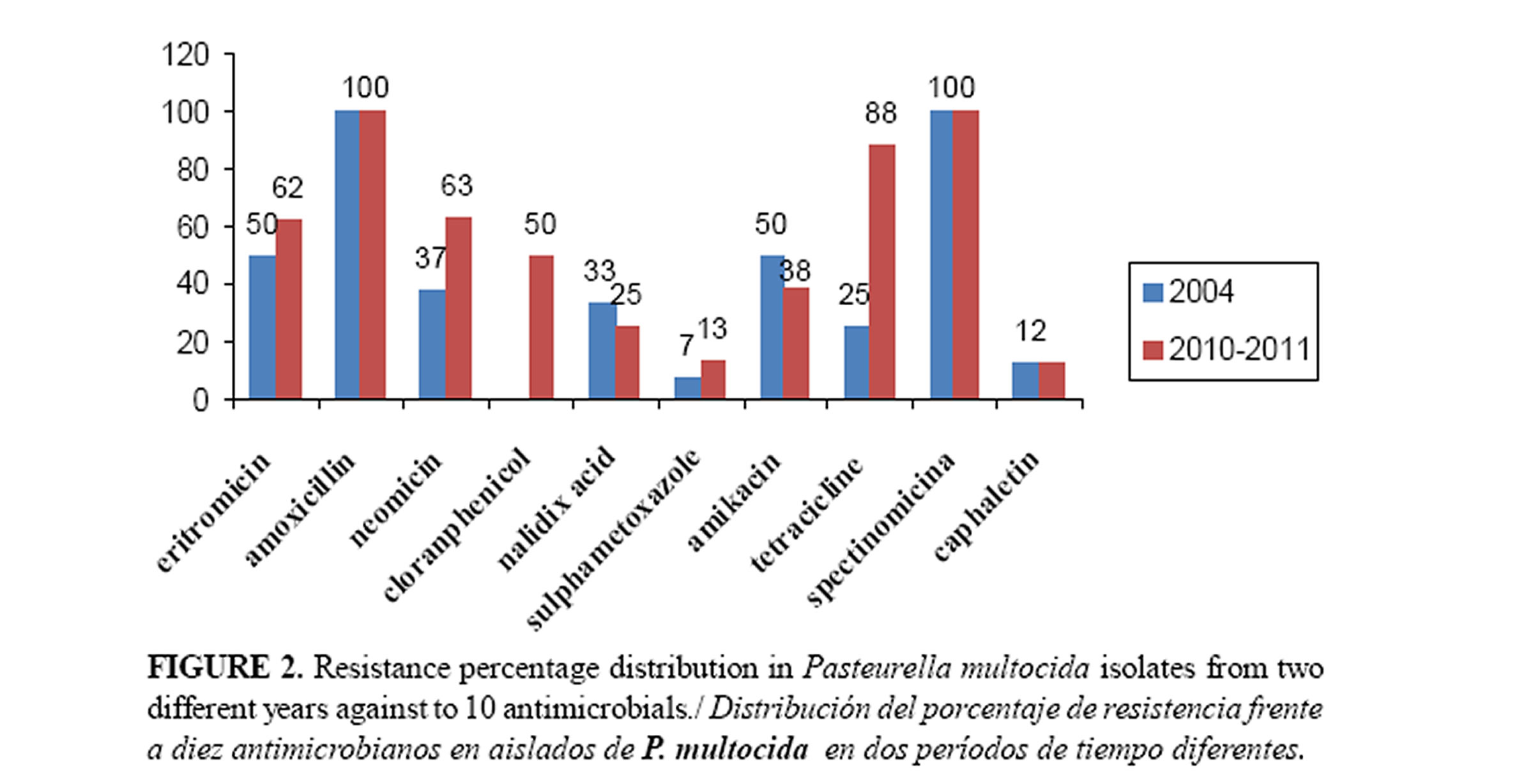
<body><![CDATA[<P><font face="Verdana, Arial, Helvetica, sans-serif" size="2">About the  metabolism of the sialic acids, a structurally diverse group of nine-carbon keto  sugars, has hypothesized that the interplay between its metabolism and the host-microbe  interaction is a unifying theme for understanding diseases caused by a wide range  of invasive pathogens or commensals. Other pathogens, such as <I>Neisseria gonorrhoeae  </I>and <I>Haemophilus </I>spp, do not synthesize sialic acid but scavenge host-derived  (environmental) sialic acids for cell surface decoration (modification) involving  endogenous sialyltransferases. In addition to de novo synthesis or scavenging  of sialic acid, some pathogens may also catabolize environmental sialic acid for  nutrition (carbon, nitrogen and energy) or as a source of amino sugars for cell  wall biosynthesis (28,29). In <I>P. multocida</I> , <I>nanH</I> or <I>nanB</I>  genes could confer the bacterium not only growth benefit but also the property  to adhere and invade host cells by unmasking host receptors (30). The <I>nanH</I>  sialidase-deficient mutants of <I>P. multocida </I>have a reduced ability to replicate  with host glycoconjugants as carbon sources (31). </font>     <P><font face="Verdana, Arial, Helvetica, sans-serif" size="2">Productive  infection by bacterial pathogens relies on the expression of virulence factors  that have wide ranging functions like competence, adherence, capsule synthesis  and export, evading host immune responses. One of the difficulties associated  with the development of a heterologous vaccine for <I>P. multocida</I> is that  strains of this organism exhibit extensive genetic heterogeneity within and between  serotypes (32). Thus, identification of an antigenic factor or DNA region conserved  across capsular types or pathogenic strains irrespective of geographic origin  may help to obviate this problem. The presence of the VF genes examined, which  encode colonization factors (<I>ptfA)</I>, sialidases (<I>nanH</I>), and outer  membrane proteins (<I>ompH)</I>, was equally in both (A and D) capsular type.  These distribution patterns would support some lines of evidence suggesting the  factors involved in adhesion may potentially serve as vaccine candidates that  can elicit homologous protective immunity against all serogroup of <I>P. multocida  </I>(32). </font>     <P><font face="Verdana, Arial, Helvetica, sans-serif" size="2">Eigteen  isolates of <I>P. multocida </I>recovered from diseased swine were tested for  resistance to 10 antibiotics. The prevalence of resistance to conventional antibiotics,  including amoxicillin, spectinomicin and tetracycline among the <I>P. multocida  </I>isolates was found to be in excess of 100-88% for each antibiotic (<a href="/img/revistas/rsa/v34n3/f0203312.jpg">Figure  2</a>). The 25% of isolates from 2004 and 88% of isolates from 2010-2011 showed  a progressive increase of resistance to tetracycline. Therefore, preventive and  therapeutic effects on porcine <I>P. multocida</I> strains should no longer be  expected from these antibiotics. </font>     
<P><font face="Verdana, Arial, Helvetica, sans-serif" size="2">Susceptibility  of <I>P. multocida </I>isolates to eritromicin, neomicin, nalidixic acid and amikacin  was variable. Of the <I>P. multocida </I>isolates tested corresponding to 2004,  all of them were inhibited effectively by cloranphenicol; however the isolates  corresponding to 2010-2011 showed a slight increase in resistance. In the present  study, nalidixic acid, neomicine and amikacin exhibited moderate activity against  all strains tested. Therefore, these antimicrobials could be still considered  as primary therapeutic agents for the empiric treatment of <I>P. multocida</I>  infections. </font>     <P><font face="Verdana, Arial, Helvetica, sans-serif" size="2">It  was observed that 94% of isolates were multiresistant (resistant to from 3 to  10 antibiotics). Most of the resistance genes to date encountered among <I>P.  multocida </I>isolates are associated with either small plasmids or with conjugative  and nonconjugative transposons (33,34). Alvaro et al (35) found coexistence of  multiple antimicrobial resistance plasmids in <I>P. multocida</I> strains from  Spain and explained the resistant to tetracyclines and/or streptomycin as well  as to sulfonamides. </font>     <P><font face="Verdana, Arial, Helvetica, sans-serif" size="2">Our  results about antibiotic susceptibility, like the findings of Kehrenberg <I>et  al.</I> (13) in France, Salmon et al. (36) in North America and Yoshimura et al.  (37) in Japan, indicated that cephalosporin (cephaletin) was one of the most active  drug, however in our study trimethoprim/sulphametoxazole were also an active drug.  The high proportion of strains susceptible to sulphonamides (sulphathiazole) indicates  that <I>P. multocida</I> is mainly susceptible to this antimicrobial agent. Bacteria  respond to antibiotic stress with a transcriptional reflex to counteract the assault  on essential processes such as cell wall synthesis, translation, transcription  and replication. The transcriptional responses of <I>P. multocida </I>to different  antibiotics with known mode of actions were collected to create a compendium of  transcriptional profiles; the trimethoprim caused a marked reduction in the transcription  of capsule genes, which correlated with a concomitant reduction of the capsular  layer on the surface of <I>P. multocida </I>(38). </font>     <P><font face="Verdana, Arial, Helvetica, sans-serif" size="2">To  the authors' knowledge, this is the first extended study of genetic diversity  within a collection of <I>P. multocida </I>isolates from pigs using molecular  methods including the amplification of virulence genes in Cuba. This is the first  report indicating the occurrence of at least two capsular types A and D and the  presence of gene fragments associated to the host-microbe interaction among the  <I>P.multocida </I>isolates<I> </I>tested. A larger scale sampling of several  pig farms from different geographical regions of the country could enable us to  design a strategy to minimize the risk of exposure to<I> P. multocida</I>. </font>      <P><font face="Verdana, Arial, Helvetica, sans-serif" size="2">Studies on antibiotic  susceptibility and resistance are very few and hence this study on <I>in vitro  </I>susceptibility test on <I>P. multocida </I>isolates would be helpful in formulating  control measures for <I>P. multocida </I>infection in swine. Therefore it is important  to evaluate the efficacy of various antimicrobial drugs currently used in swine  and to determine patterns of antibiotic sensitivity. The high prevalence of multiresistant  strains of <I>P. multocida </I>in pigs and the association of such strains with  serious disease strongly suggest that more attention should be paid to the prudent  use of antimicrobials. The resistance development in isolates is a continuous  process in which novel resistance genes may be acquired or developed under the  selective pressure imposed by the use of new drugs (19). </font>     <P>&nbsp;     <P>&nbsp;  <font face="Verdana, Arial, Helvetica, sans-serif" size="2"><B><font size="3">REFERENCES</font></B></font>      ]]></body>
<body><![CDATA[<!-- ref --><P><font face="Verdana, Arial, Helvetica, sans-serif" size="2">1. Harper M, Boyce  JD, Adler B. <I>Pasteurella multocida </I>pathogenesis: 125 years after Pasteur.  FEMS Microbiol Lett. 2006;265:1-10.     </font>     <!-- ref --><P><font face="Verdana, Arial, Helvetica, sans-serif" size="2">2.  Christensen H, Bisgaard M, Angen O, Frederiksen W, Olsen JE. Characterization  of sucrose negative variants of <I>Pasteurella multocida</I> including isolates  from large cat bitewounds. J Clin Microbiol. 2005;43:259-270.     </font>     <!-- ref --><P><font face="Verdana, Arial, Helvetica, sans-serif" size="2">3.  Pijoan C. Pneumonic pasteurellosis. Progressive Atrophic Rhinitis. In: Leman AD,  Straw BE, Mengeling WL, D'AIliare S, De Jong MF (Eds.), Diseases of Swine. Iowa  State University Press, Ames 1992:414-435.     </font>     <!-- ref --><P><font face="Verdana, Arial, Helvetica, sans-serif" size="2">4.  Pijoan C. Pneumonic pasteurellosis. In: Straw BE, D'Allaire S, Mengeling WL, Taylor,  DJ. (Eds.), Diseases of Swine. Iowa State University Press, Ames, Iowa. 1999;511-520.      </font>     <!-- ref --><P><font face="Verdana, Arial, Helvetica, sans-serif" size="2">5. De Jong  MF. Progressive and nonprogressive atrophic rhinitis. In Diseases of Swine 9 th  edition. Straw B, Zimmerman JJ, D&aacute;llaire S and Taylor DJ (eds.). Blackwell  Publishing, Ames, Iowa, USA. 2006;577-602.     </font>     ]]></body>
<body><![CDATA[<!-- ref --><P><font face="Verdana, Arial, Helvetica, sans-serif" size="2">6.  Ewers CA, Becker L, Bethe A, Kie&szlig;ling S, Filter M, Wieler LH. Virulence  genotype of <I>Pasteurella multocida </I>strains isolated from different hosts  with various disease status. Vet Microbiol. 2006;114(3-4):304-317 </font>     <!-- ref --><P><font face="Verdana, Arial, Helvetica, sans-serif" size="2">7.  Harper M, Cox A, Michael FS, Parnas H, Wilkie I, Blackall PJ, et al. Decoration  of <I>Pasteurella multocida </I>lipopolysaccharide with phosphocholine is important  for virulence. J Bacteriol. 2007;189:7384-7391.     </font>     <!-- ref --><P><font face="Verdana, Arial, Helvetica, sans-serif" size="2">8.  Adler B, Bulach D, Chung J, Doughty S, Hunt M, Rajakumar K, et al. Candidate vaccine  antigens and genes in <I>Pasteurella multocida</I>. J Biotechnol. 1999;73:83-90.      </font>     <!-- ref --><P><font face="Verdana, Arial, Helvetica, sans-serif" size="2">9. Fuller  TE, Kennedy MJ, Lowery DE. Identification of <I>Pasteurella multocida </I>virulence  genes in a septicemic mouse model using signature-tagged mutagenesis. Microb Pathog.  2000;29:25-38.     </font>     <!-- ref --><P><font face="Verdana, Arial, Helvetica, sans-serif" size="2">10.Lion  C, Conroy MC, Carpentier AM, Lozniewski A. Antimicrobial susceptibilities of <I>Pasteurella  </I>strains isolated from humans. Int J Antimicrob Agents. 2006;27:290-293.     </font>      <!-- ref --><P><font face="Verdana, Arial, Helvetica, sans-serif" size="2">11.Brogden KA,  Nordholm G, Ackermann M.<B> </B>Antimicrobial activity of cathelicidins BMAP28,  SMAP28, SMAP29 and PMAP23 against <I>Pasteurella multocida </I>is more broad-spectrum  than host species specific. Vet Microbiol. 2007;119:76-81.     </font>     <!-- ref --><P><font face="Verdana, Arial, Helvetica, sans-serif" size="2">12.White  DG, Zhao S, Simjee S, Wagner DD, McDermott PF. Antimicrobial resistance of foodborne  pathogens. Microbes Infect. 2002;4:405-412.     </font>     <!-- ref --><P><font face="Verdana, Arial, Helvetica, sans-serif" size="2">13.Kehrenberg  C, Schulze-Tanzil G, Martel JL, Chaslus-Dancla E, Schwarz S. Antimicrobial resistance  in <I>Pasteurella </I>and <I>Mannheimia</I>:<B> </B>epidemiology and genetic basis.  Vet Res. 2001;32:323-339.     </font>     <!-- ref --><P><font face="Verdana, Arial, Helvetica, sans-serif" size="2">14.Townsend  KM, Frost AJ, Lee CW, Papadimitriou JM, Dawkins HJ. Development of PCR assays  for species- and type-specific identification of <I>Pasteurella multocida </I>isolates.  J Clin Microbiol. 1998;36:1096-1100.     </font>     <!-- ref --><P><font face="Verdana, Arial, Helvetica, sans-serif" size="2">15.Townsend  K, Boyce M, Chung JD, Chung AJ, Adler B. Genetic organization of <I>Pasteurella  multocida </I>cap Loci and development of a multiplex capsular PCR typing system.  J Clin Microbiol. 2001;39:924-929.     </font>     <P><font face="Verdana, Arial, Helvetica, sans-serif" size="2">16.National  Committee for Clinical Laboratory Standards. Performance Standards for antimicrobial  disk and dilution susceptibility test for bacteria isolated from animals: approved  standard, second ed., NCCLS document 2002.M31-A2, Wayne, USA. </font>     ]]></body>
<body><![CDATA[<!-- ref --><P><font face="Verdana, Arial, Helvetica, sans-serif" size="2">17.Pijoan  C. Pneumonic Pasteurellosis. In Diseases of Swine, 9 th edition. Straw B, Zimmerman  JJ, D&aacute;llaire S,Taylor DJ (eds.). Blackwell Publishing. Ames, Iowa, USA.2006;719-726.      </font>     <!-- ref --><P><font face="Verdana, Arial, Helvetica, sans-serif" size="2">18.Davies  RL, Mac Corquodale R, Baillie S, Caffrey B. Characterization and comparison of  <I>Pasteurella multocida </I>strains associated with porcine pneumonia and atrophic  rhinitis. J Med Microbiol. 2003;52:59-67.     </font>     <!-- ref --><P><font face="Verdana, Arial, Helvetica, sans-serif" size="2">19.Ross  RF. <I>Pasteurella multocida</I> and its role in porcine pneumonia Anim Health  Res Rev. 2007;7(1/2):13-29.     </font>     <!-- ref --><P><font face="Verdana, Arial, Helvetica, sans-serif" size="2">20.Tang  X, Zhanqin Z, Junyong H, Bin W, Xuwang C, Qigai H, Huanchun C. Isolation, Antimicrobial  Resistance, and Virulence Genes of <I>Pasteurella multocida </I>Strains from Swine  in China. J Clin Microbiol. 2009;47(4):951-958.     </font>     <!-- ref --><P><font face="Verdana, Arial, Helvetica, sans-serif" size="2">21.O'Sullivan  T, Friendship R, Blackwell T, Pearl D, McEwen B, Carman S, et al. Microbiological  identification and analysis of swine tonsils collected from carcasses at slaughter.  Can J Vet Res.2011;75:106-111.     </font>     ]]></body>
<body><![CDATA[<!-- ref --><P><font face="Verdana, Arial, Helvetica, sans-serif" size="2">22.Djordjevic  SP, Eamens GJ, Ha H, Walker MJ, Chin JC. Demonstration that Australian <I>Pasteurella  multocida </I>isolates from sporadic outbreaks of porcine pneumonia are non-toxigenic  (<I>toxA</I>-) and display heterogeneous DNA restriction endonuclease profiles  compared with toxigenic isolates from herds with progressive atrophic rhinitis.  J Med Microbiol. 1998;47:679-688.     </font>     <!-- ref --><P><font face="Verdana, Arial, Helvetica, sans-serif" size="2">23.Choi  C, Kim B, Cho WS, Kim J, Kwon D, Cheon DS, et al. Capsular serotype, <I>toxA </I>gene  and antimicrobial susceptibility profiles of <I>Pasteurella multocida </I>isolated  from pigs with pneumonia in Korea. Vet Rec. 2001;149:210-212.     </font>     <!-- ref --><P><font face="Verdana, Arial, Helvetica, sans-serif" size="2">24.Pors  SE, Hansen MS, Bisgaard M, Jensen HE. Occurrence and associated lesions of <I>Pasteurella  multocida </I>in porcine bronchopneumonia, Vet Microbiol. 2011;150(1-2):160-166  </font>     <!-- ref --><P><font face="Verdana, Arial, Helvetica, sans-serif" size="2">25.Mullen  LM, Nair SP, Ward JM, Rycroft AN, Williams RJ. Novel Adhesin from <I>Pasteurella  multocida </I>That Binds to the Integrin-Binding Fibronectin FnIII9-10 Repeats_  Infect Immun.. 2008;76(3):1093-1104.     </font>     <!-- ref --><P><font face="Verdana, Arial, Helvetica, sans-serif" size="2">26.Giles  R, Nicky J, Mordan L Henderson B, Lin J, Huang S, Zhang, Q. Outer membrane proteins:  key players for bacterial adaptation in host niches. Microb Infect. 2002;4:325-331.      </font>     <!-- ref --><P><font face="Verdana, Arial, Helvetica, sans-serif" size="2">27.Mizan  S, Henk A, Stallings A, Maier M, Lee MD. Cloning and characterization of sialidases  with 2-6' and 2-3' sialyl lactose specificity from <I>Pasteurella multocida</I>.  J Bacteriol. 2000;182:6874-6883.     </font>     <!-- ref --><P><font face="Verdana, Arial, Helvetica, sans-serif" size="2">28.Vimr  E R, Kalivoda K A, Deszo EL, Steenbergen S M. Diversity of Microbial Sialic Acid  Metabolism. Microbiol Mol Biol Reviews. 2004;68(1):132153.     </font>     <!-- ref --><P><font face="Verdana, Arial, Helvetica, sans-serif" size="2">29.Chen  X and<B> </B>Varki A.<B> </B>Advances in the Biology and Chemistry of Sialic Acids.<I>  </I>ACS Chem Biol. 2010;5(2):163-176.    <B> </B> </font>     <!-- ref --><P><font face="Verdana, Arial, Helvetica, sans-serif" size="2">30.Mizan  S, Henk A, Stallings A, Maier M, Lee MD. Cloning and characterization of sialidases  with 2-62 and 2-32 sialyl lactose specificity from <I>Pasteurella multocida</I>.  J Bacteriol.<I> </I>2000;182:6874-6883 </font>     <!-- ref --><P><font face="Verdana, Arial, Helvetica, sans-serif" size="2">31.Steenbergen  SM, Lichtensteiger CA, Caughlan R, Garfinkle J, Fuller TE, Vimr ER. Sialic Acid  Metabolism and Systemic Pasteurellosis. Infect Immun. 2005;73(3): 1284-1294.     </font>      <!-- ref --><P><font face="Verdana, Arial, Helvetica, sans-serif" size="2">32.Al-Hasan K,  Boyce1 J, McCarl VP, Bottomley S,<B> </B>Identification of novel immunogens in  <I>Pasteurella multocida </I>Microbial Cell Fact.<I> </I>2007;6(3):1-5.     </font>      ]]></body>
<body><![CDATA[<!-- ref --><P><font face="Verdana, Arial, Helvetica, sans-serif" size="2">33.Wilkie I, Adler  B, Naas T, Benaoudia F, Lebrun L, Nordmann P. Molecular identification of TEM-1  beta-lactamase in a <I>Pasteurella multocida </I>isolate of human origin. Eur  J Clin Microbiol Infect Dis. 2001;20<B>:</B>210-213.     </font>     <!-- ref --><P><font face="Verdana, Arial, Helvetica, sans-serif" size="2">34.Wu  JR, Shieh HK, Shien JH, Gong SR, Chang PC.<B> </B>Molecular characterization of  plasmids with antimicrobial resistant genes in avian isolates of <I>Pasteurella  multocida</I>. Avian Dis. 2003;47<B>:</B>1384-1392.     </font>     <!-- ref --><P><font face="Verdana, Arial, Helvetica, sans-serif" size="2">35.Alvaro  SM, Escudero JA, Gutierrez B, Hidalgo L, Garcia N, Llagostera M, et al. Multiresistance  in <I>Pasteurella multocida </I>Is Mediated by Coexistence of Small Plasmids.  Antimicrob agents Chemother. 2009; 3399-3404.     </font>     <!-- ref --><P><font face="Verdana, Arial, Helvetica, sans-serif" size="2">36.Salmon  SA, Watts JL, Case CA, Hoffman LJ, Wegener HC, Yancey RJ. Comparison of MICs of  ceftiofur and other antimicrobial agents against bacterial pathogens of swine  from the United States, Canada and Denmark. J Clin Microbiol. 1995;33:2435-2444.      </font>     <!-- ref --><P><font face="Verdana, Arial, Helvetica, sans-serif" size="2">37.Yoshimura  H, Ishimaru M, Endoh YS, Kojima A. Antimicrobial susceptibility of <I>Pasteurella  multocida </I>isolated from cattle and pigs. J Vet. Med B. 2001;48<B>:</B>555-560.      </font>     ]]></body>
<body><![CDATA[<!-- ref --><P><font face="Verdana, Arial, Helvetica, sans-serif" size="2">38.Lin  JT, Connelly MB, Amolo C, Otani S, Yaver DS. Global transcriptional response of  <I>Bacillus subtilis </I>to treatment with subinhibitory concentrations of antibiotics  that inhibit protein synthesis. Antimicrob Agents Chemother.2005; 49:1915-26.      </font>     <P>&nbsp;     <P>&nbsp;     <P><font face="Verdana, Arial, Helvetica, sans-serif" size="2">Recibido:  28-10-2011.    <br> </font><font face="Verdana, Arial, Helvetica, sans-serif" size="2">Aceptado:  30-7-2012. </font>     <P>&nbsp;       ]]></body><back>
<ref-list>
<ref id="B1">
<label>1</label><nlm-citation citation-type="journal">
<person-group person-group-type="author">
<name>
<surname><![CDATA[Harper]]></surname>
<given-names><![CDATA[M]]></given-names>
</name>
<name>
<surname><![CDATA[Boyce]]></surname>
<given-names><![CDATA[JD]]></given-names>
</name>
<name>
<surname><![CDATA[Adler]]></surname>
<given-names><![CDATA[B]]></given-names>
</name>
</person-group>
<article-title xml:lang="en"><![CDATA[Pasteurella multocida pathogenesis: 125 years after Pasteur]]></article-title>
<source><![CDATA[FEMS Microbiol Lett]]></source>
<year>2006</year>
<volume>265</volume>
<page-range>1-10</page-range></nlm-citation>
</ref>
<ref id="B2">
<label>2</label><nlm-citation citation-type="journal">
<person-group person-group-type="author">
<name>
<surname><![CDATA[Christensen]]></surname>
<given-names><![CDATA[H]]></given-names>
</name>
<name>
<surname><![CDATA[Bisgaard]]></surname>
<given-names><![CDATA[M]]></given-names>
</name>
<name>
<surname><![CDATA[Angen]]></surname>
<given-names><![CDATA[O]]></given-names>
</name>
<name>
<surname><![CDATA[Frederiksen]]></surname>
<given-names><![CDATA[W]]></given-names>
</name>
<name>
<surname><![CDATA[Olsen]]></surname>
<given-names><![CDATA[JE]]></given-names>
</name>
</person-group>
<article-title xml:lang="en"><![CDATA[Characterization of sucrose negative variants of Pasteurella multocida including isolates from large cat bitewounds]]></article-title>
<source><![CDATA[J Clin Microbiol]]></source>
<year>2005</year>
<volume>43</volume>
<page-range>259-270</page-range></nlm-citation>
</ref>
<ref id="B3">
<label>3</label><nlm-citation citation-type="book">
<person-group person-group-type="author">
<name>
<surname><![CDATA[Pijoan]]></surname>
<given-names><![CDATA[C]]></given-names>
</name>
</person-group>
<article-title xml:lang="en"><![CDATA[Pneumonic pasteurellosis. Progressive Atrophic Rhinitis]]></article-title>
<source><![CDATA[Diseases of Swine]]></source>
<year>1992</year>
<page-range>414-435</page-range><publisher-name><![CDATA[Iowa State University Press]]></publisher-name>
</nlm-citation>
</ref>
<ref id="B4">
<label>4</label><nlm-citation citation-type="book">
<person-group person-group-type="author">
<name>
<surname><![CDATA[Pijoan]]></surname>
<given-names><![CDATA[C]]></given-names>
</name>
</person-group>
<article-title xml:lang="en"><![CDATA[Pneumonic pasteurellosis]]></article-title>
<source><![CDATA[Diseases of Swine]]></source>
<year>1999</year>
<page-range>511-520</page-range><publisher-loc><![CDATA[Iowa ]]></publisher-loc>
<publisher-name><![CDATA[Iowa State University Press]]></publisher-name>
</nlm-citation>
</ref>
<ref id="B5">
<label>5</label><nlm-citation citation-type="book">
<person-group person-group-type="author">
<name>
<surname><![CDATA[De Jong]]></surname>
<given-names><![CDATA[MF]]></given-names>
</name>
</person-group>
<article-title xml:lang="en"><![CDATA[Progressive and nonprogressive atrophic rhinitis]]></article-title>
<source><![CDATA[Diseases of Swine]]></source>
<year>2006</year>
<edition>9</edition>
<page-range>577-602</page-range><publisher-loc><![CDATA[Iowa^eUSA USA]]></publisher-loc>
<publisher-name><![CDATA[Blackwell Publishing]]></publisher-name>
</nlm-citation>
</ref>
<ref id="B6">
<label>6</label><nlm-citation citation-type="journal">
<person-group person-group-type="author">
<name>
<surname><![CDATA[Ewers]]></surname>
<given-names><![CDATA[CA]]></given-names>
</name>
<name>
<surname><![CDATA[Becker]]></surname>
<given-names><![CDATA[L]]></given-names>
</name>
<name>
<surname><![CDATA[Bethe]]></surname>
<given-names><![CDATA[A]]></given-names>
</name>
<name>
<surname><![CDATA[Kießling]]></surname>
<given-names><![CDATA[S]]></given-names>
</name>
<name>
<surname><![CDATA[Filter]]></surname>
<given-names><![CDATA[M]]></given-names>
</name>
<name>
<surname><![CDATA[Wieler]]></surname>
<given-names><![CDATA[LH]]></given-names>
</name>
</person-group>
<article-title xml:lang="en"><![CDATA[Virulence genotype of Pasteurella multocida strains isolated from different hosts with various disease status]]></article-title>
<source><![CDATA[Vet Microbiol]]></source>
<year>2006</year>
<volume>114</volume>
<numero>3-4</numero>
<issue>3-4</issue>
<page-range>304-317</page-range></nlm-citation>
</ref>
<ref id="B7">
<label>7</label><nlm-citation citation-type="journal">
<person-group person-group-type="author">
<name>
<surname><![CDATA[Harper]]></surname>
<given-names><![CDATA[M]]></given-names>
</name>
<name>
<surname><![CDATA[Cox]]></surname>
<given-names><![CDATA[A]]></given-names>
</name>
<name>
<surname><![CDATA[Michael]]></surname>
<given-names><![CDATA[FS]]></given-names>
</name>
<name>
<surname><![CDATA[Parnas]]></surname>
<given-names><![CDATA[H]]></given-names>
</name>
<name>
<surname><![CDATA[Wilkie]]></surname>
<given-names><![CDATA[I]]></given-names>
</name>
<name>
<surname><![CDATA[Blackall]]></surname>
<given-names><![CDATA[PJ]]></given-names>
</name>
</person-group>
<article-title xml:lang="en"><![CDATA[Decoration of Pasteurella multocida lipopolysaccharide with phosphocholine is important for virulence]]></article-title>
<source><![CDATA[J Bacteriol]]></source>
<year>2007</year>
<volume>189</volume>
<page-range>7384-7391</page-range></nlm-citation>
</ref>
<ref id="B8">
<label>8</label><nlm-citation citation-type="journal">
<person-group person-group-type="author">
<name>
<surname><![CDATA[Adler]]></surname>
<given-names><![CDATA[B]]></given-names>
</name>
<name>
<surname><![CDATA[Bulach]]></surname>
<given-names><![CDATA[D]]></given-names>
</name>
<name>
<surname><![CDATA[Chung]]></surname>
<given-names><![CDATA[J]]></given-names>
</name>
<name>
<surname><![CDATA[Doughty]]></surname>
<given-names><![CDATA[S]]></given-names>
</name>
<name>
<surname><![CDATA[Hunt]]></surname>
<given-names><![CDATA[M]]></given-names>
</name>
<name>
<surname><![CDATA[Rajakumar]]></surname>
<given-names><![CDATA[K]]></given-names>
</name>
</person-group>
<article-title xml:lang="en"><![CDATA[Candidate vaccine antigens and genes in Pasteurella multocida]]></article-title>
<source><![CDATA[J Biotechnol]]></source>
<year>1999</year>
<volume>73</volume>
<page-range>83-90</page-range></nlm-citation>
</ref>
<ref id="B9">
<label>9</label><nlm-citation citation-type="journal">
<person-group person-group-type="author">
<name>
<surname><![CDATA[Fuller]]></surname>
<given-names><![CDATA[TE]]></given-names>
</name>
<name>
<surname><![CDATA[Kennedy]]></surname>
<given-names><![CDATA[MJ]]></given-names>
</name>
<name>
<surname><![CDATA[Lowery]]></surname>
<given-names><![CDATA[DE]]></given-names>
</name>
</person-group>
<article-title xml:lang="en"><![CDATA[Identification of Pasteurella multocida virulence genes in a septicemic mouse model using signature-tagged mutagenesis]]></article-title>
<source><![CDATA[Microb Pathog]]></source>
<year>2000</year>
<volume>29</volume>
<page-range>25-38</page-range></nlm-citation>
</ref>
<ref id="B10">
<label>10</label><nlm-citation citation-type="journal">
<person-group person-group-type="author">
<name>
<surname><![CDATA[Lion]]></surname>
<given-names><![CDATA[C]]></given-names>
</name>
<name>
<surname><![CDATA[Conroy]]></surname>
<given-names><![CDATA[MC]]></given-names>
</name>
<name>
<surname><![CDATA[Carpentier]]></surname>
<given-names><![CDATA[AM]]></given-names>
</name>
<name>
<surname><![CDATA[Lozniewski]]></surname>
<given-names><![CDATA[A]]></given-names>
</name>
</person-group>
<article-title xml:lang="en"><![CDATA[Antimicrobial susceptibilities of Pasteurella strains isolated from humans]]></article-title>
<source><![CDATA[Int J Antimicrob Agents]]></source>
<year>2006</year>
<volume>27</volume>
<page-range>290-293</page-range></nlm-citation>
</ref>
<ref id="B11">
<label>11</label><nlm-citation citation-type="journal">
<person-group person-group-type="author">
<name>
<surname><![CDATA[Brogden]]></surname>
<given-names><![CDATA[KA]]></given-names>
</name>
<name>
<surname><![CDATA[Nordholm]]></surname>
<given-names><![CDATA[G]]></given-names>
</name>
<name>
<surname><![CDATA[Ackermann]]></surname>
<given-names><![CDATA[M]]></given-names>
</name>
</person-group>
<article-title xml:lang="en"><![CDATA[Antimicrobial activity of cathelicidins BMAP28, SMAP28, SMAP29 and PMAP23 against Pasteurella multocida is more broad-spectrum than host species specific]]></article-title>
<source><![CDATA[Vet Microbiol]]></source>
<year>2007</year>
<volume>119</volume>
<page-range>76-81</page-range></nlm-citation>
</ref>
<ref id="B12">
<label>12</label><nlm-citation citation-type="journal">
<person-group person-group-type="author">
<name>
<surname><![CDATA[White]]></surname>
<given-names><![CDATA[DG]]></given-names>
</name>
<name>
<surname><![CDATA[Zhao]]></surname>
<given-names><![CDATA[S]]></given-names>
</name>
<name>
<surname><![CDATA[Simjee]]></surname>
<given-names><![CDATA[S]]></given-names>
</name>
<name>
<surname><![CDATA[Wagner]]></surname>
<given-names><![CDATA[DD]]></given-names>
</name>
<name>
<surname><![CDATA[McDermott]]></surname>
<given-names><![CDATA[PF]]></given-names>
</name>
</person-group>
<article-title xml:lang="en"><![CDATA[Antimicrobial resistance of foodborne pathogens]]></article-title>
<source><![CDATA[Microbes Infect]]></source>
<year>2002</year>
<volume>4</volume>
<page-range>405-412</page-range></nlm-citation>
</ref>
<ref id="B13">
<label>13</label><nlm-citation citation-type="journal">
<person-group person-group-type="author">
<name>
<surname><![CDATA[Kehrenberg]]></surname>
<given-names><![CDATA[C]]></given-names>
</name>
<name>
<surname><![CDATA[Schulze-Tanzil]]></surname>
<given-names><![CDATA[G]]></given-names>
</name>
<name>
<surname><![CDATA[Martel]]></surname>
<given-names><![CDATA[JL]]></given-names>
</name>
<name>
<surname><![CDATA[Chaslus-Dancla]]></surname>
<given-names><![CDATA[E]]></given-names>
</name>
<name>
<surname><![CDATA[Schwarz]]></surname>
<given-names><![CDATA[S]]></given-names>
</name>
</person-group>
<article-title xml:lang="en"><![CDATA[Antimicrobial resistance in Pasteurella and Mannheimia: epidemiology and genetic basis]]></article-title>
<source><![CDATA[Vet Res]]></source>
<year>2001</year>
<volume>32</volume>
<page-range>323-339</page-range></nlm-citation>
</ref>
<ref id="B14">
<label>14</label><nlm-citation citation-type="journal">
<person-group person-group-type="author">
<name>
<surname><![CDATA[Townsend]]></surname>
<given-names><![CDATA[KM]]></given-names>
</name>
<name>
<surname><![CDATA[Frost]]></surname>
<given-names><![CDATA[AJ]]></given-names>
</name>
<name>
<surname><![CDATA[Lee]]></surname>
<given-names><![CDATA[CW]]></given-names>
</name>
<name>
<surname><![CDATA[Papadimitriou]]></surname>
<given-names><![CDATA[JM]]></given-names>
</name>
<name>
<surname><![CDATA[Dawkins]]></surname>
<given-names><![CDATA[HJ]]></given-names>
</name>
</person-group>
<article-title xml:lang="en"><![CDATA[Development of PCR assays for species- and type-specific identification of Pasteurella multocida isolates]]></article-title>
<source><![CDATA[J Clin Microbiol]]></source>
<year>1998</year>
<volume>36</volume>
<page-range>1096-1100</page-range></nlm-citation>
</ref>
<ref id="B15">
<label>15</label><nlm-citation citation-type="journal">
<person-group person-group-type="author">
<name>
<surname><![CDATA[Townsend]]></surname>
<given-names><![CDATA[K]]></given-names>
</name>
<name>
<surname><![CDATA[Boyce]]></surname>
<given-names><![CDATA[M]]></given-names>
</name>
<name>
<surname><![CDATA[Chung]]></surname>
<given-names><![CDATA[JD]]></given-names>
</name>
<name>
<surname><![CDATA[Chung]]></surname>
<given-names><![CDATA[AJ]]></given-names>
</name>
<name>
<surname><![CDATA[Adler]]></surname>
<given-names><![CDATA[B]]></given-names>
</name>
</person-group>
<article-title xml:lang="en"><![CDATA[Genetic organization of Pasteurella multocida cap Loci and development of a multiplex capsular PCR typing system]]></article-title>
<source><![CDATA[J Clin Microbiol]]></source>
<year>2001</year>
<volume>39</volume>
<page-range>924-929</page-range></nlm-citation>
</ref>
<ref id="B16">
<label>16</label><nlm-citation citation-type="book">
<source><![CDATA[Performance Standards for antimicrobial disk and dilution susceptibility test for bacteria isolated from animals: approved standard]]></source>
<year>2002</year>
<edition>2</edition>
<publisher-loc><![CDATA[^eUSA USA]]></publisher-loc>
<publisher-name><![CDATA[National Committee for Clinical Laboratory Standards]]></publisher-name>
</nlm-citation>
</ref>
<ref id="B17">
<label>17</label><nlm-citation citation-type="book">
<person-group person-group-type="author">
<name>
<surname><![CDATA[Pijoan]]></surname>
<given-names><![CDATA[C]]></given-names>
</name>
</person-group>
<source><![CDATA[Pneumonic Pasteurellosis. In Diseases of Swine]]></source>
<year>2006</year>
<edition>9 th</edition>
<page-range>719-726</page-range><publisher-loc><![CDATA[Iowa^eUSA USA]]></publisher-loc>
<publisher-name><![CDATA[Blackwell Publishing]]></publisher-name>
</nlm-citation>
</ref>
<ref id="B18">
<label>18</label><nlm-citation citation-type="journal">
<person-group person-group-type="author">
<name>
<surname><![CDATA[Davies]]></surname>
<given-names><![CDATA[RL]]></given-names>
</name>
<name>
<surname><![CDATA[Mac Corquodale]]></surname>
<given-names><![CDATA[R]]></given-names>
</name>
<name>
<surname><![CDATA[Baillie]]></surname>
<given-names><![CDATA[S]]></given-names>
</name>
<name>
<surname><![CDATA[Caffrey]]></surname>
<given-names><![CDATA[B]]></given-names>
</name>
</person-group>
<article-title xml:lang="en"><![CDATA[Characterization and comparison of Pasteurella multocida strains associated with porcine pneumonia and atrophic rhinitis]]></article-title>
<source><![CDATA[J Med Microbiol]]></source>
<year>2003</year>
<volume>52</volume>
<page-range>59-67</page-range></nlm-citation>
</ref>
<ref id="B19">
<label>19</label><nlm-citation citation-type="journal">
<person-group person-group-type="author">
<name>
<surname><![CDATA[Ross]]></surname>
<given-names><![CDATA[RF]]></given-names>
</name>
</person-group>
<article-title xml:lang="en"><![CDATA[Pasteurella multocida and its role in porcine pneumonia]]></article-title>
<source><![CDATA[Anim Health Res Rev]]></source>
<year>2007</year>
<volume>7</volume>
<numero>1/2</numero>
<issue>1/2</issue>
<page-range>13-29</page-range></nlm-citation>
</ref>
<ref id="B20">
<label>20</label><nlm-citation citation-type="journal">
<person-group person-group-type="author">
<name>
<surname><![CDATA[Tang]]></surname>
<given-names><![CDATA[X]]></given-names>
</name>
<name>
<surname><![CDATA[Zhanqin]]></surname>
<given-names><![CDATA[Z]]></given-names>
</name>
<name>
<surname><![CDATA[Junyong]]></surname>
<given-names><![CDATA[H]]></given-names>
</name>
<name>
<surname><![CDATA[Bin]]></surname>
<given-names><![CDATA[W]]></given-names>
</name>
<name>
<surname><![CDATA[Xuwang]]></surname>
<given-names><![CDATA[C]]></given-names>
</name>
<name>
<surname><![CDATA[Qigai]]></surname>
<given-names><![CDATA[H]]></given-names>
</name>
<name>
<surname><![CDATA[Huanchun]]></surname>
<given-names><![CDATA[C]]></given-names>
</name>
</person-group>
<article-title xml:lang="en"><![CDATA[Isolation, Antimicrobial Resistance, and Virulence Genes of Pasteurella multocida Strains from Swine in China]]></article-title>
<source><![CDATA[J Clin Microbiol]]></source>
<year>2009</year>
<volume>47</volume>
<numero>4</numero>
<issue>4</issue>
<page-range>951-958</page-range></nlm-citation>
</ref>
<ref id="B21">
<label>21</label><nlm-citation citation-type="journal">
<person-group person-group-type="author">
<name>
<surname><![CDATA[O'Sullivan]]></surname>
<given-names><![CDATA[T]]></given-names>
</name>
<name>
<surname><![CDATA[Friendship]]></surname>
<given-names><![CDATA[R]]></given-names>
</name>
<name>
<surname><![CDATA[Blackwell]]></surname>
<given-names><![CDATA[T]]></given-names>
</name>
<name>
<surname><![CDATA[Pearl]]></surname>
<given-names><![CDATA[D]]></given-names>
</name>
<name>
<surname><![CDATA[McEwen]]></surname>
<given-names><![CDATA[B]]></given-names>
</name>
<name>
<surname><![CDATA[Carman]]></surname>
<given-names><![CDATA[S]]></given-names>
</name>
</person-group>
<article-title xml:lang="en"><![CDATA[Microbiological identification and analysis of swine tonsils collected from carcasses at slaughter]]></article-title>
<source><![CDATA[Can J Vet Res]]></source>
<year>2011</year>
<volume>75</volume>
<page-range>106-111</page-range></nlm-citation>
</ref>
<ref id="B22">
<label>22</label><nlm-citation citation-type="journal">
<person-group person-group-type="author">
<name>
<surname><![CDATA[Djordjevic]]></surname>
<given-names><![CDATA[SP]]></given-names>
</name>
<name>
<surname><![CDATA[Eamens]]></surname>
<given-names><![CDATA[GJ]]></given-names>
</name>
<name>
<surname><![CDATA[Ha]]></surname>
<given-names><![CDATA[H]]></given-names>
</name>
<name>
<surname><![CDATA[Walker]]></surname>
<given-names><![CDATA[MJ]]></given-names>
</name>
<name>
<surname><![CDATA[Chin]]></surname>
<given-names><![CDATA[JC]]></given-names>
</name>
</person-group>
<article-title xml:lang="en"><![CDATA[Demonstration that Australian Pasteurella multocida isolates from sporadic outbreaks of porcine pneumonia are non-toxigenic (toxA-) and display heterogeneous DNA restriction endonuclease profiles compared with toxigenic isolates from herds with progressive atrophic rhinitis]]></article-title>
<source><![CDATA[J Med Microbiol]]></source>
<year>1998</year>
<volume>47</volume>
<numero>679-688</numero>
<issue>679-688</issue>
</nlm-citation>
</ref>
<ref id="B23">
<label>23</label><nlm-citation citation-type="journal">
<person-group person-group-type="author">
<name>
<surname><![CDATA[Choi]]></surname>
<given-names><![CDATA[C]]></given-names>
</name>
<name>
<surname><![CDATA[Kim]]></surname>
<given-names><![CDATA[B]]></given-names>
</name>
<name>
<surname><![CDATA[Cho]]></surname>
<given-names><![CDATA[WS]]></given-names>
</name>
<name>
<surname><![CDATA[Kim]]></surname>
<given-names><![CDATA[J]]></given-names>
</name>
<name>
<surname><![CDATA[Kwon]]></surname>
<given-names><![CDATA[D]]></given-names>
</name>
<name>
<surname><![CDATA[Cheon]]></surname>
<given-names><![CDATA[DS]]></given-names>
</name>
</person-group>
<article-title xml:lang="en"><![CDATA[Capsular serotype, toxA gene and antimicrobial susceptibility profiles of Pasteurella multocida isolated from pigs with pneumonia in Korea]]></article-title>
<source><![CDATA[Vet Rec]]></source>
<year>2001</year>
<volume>149</volume>
<page-range>210-212</page-range></nlm-citation>
</ref>
<ref id="B24">
<label>24</label><nlm-citation citation-type="journal">
<person-group person-group-type="author">
<name>
<surname><![CDATA[Pors]]></surname>
<given-names><![CDATA[SE]]></given-names>
</name>
<name>
<surname><![CDATA[Hansen]]></surname>
<given-names><![CDATA[MS]]></given-names>
</name>
<name>
<surname><![CDATA[Bisgaard]]></surname>
<given-names><![CDATA[M]]></given-names>
</name>
<name>
<surname><![CDATA[Jensen]]></surname>
<given-names><![CDATA[HE]]></given-names>
</name>
</person-group>
<article-title xml:lang="en"><![CDATA[Occurrence and associated lesions of Pasteurella multocida in porcine bronchopneumonia]]></article-title>
<source><![CDATA[Vet Microbiol]]></source>
<year>2011</year>
<volume>150</volume>
<page-range>1-2</page-range><page-range>160-166</page-range></nlm-citation>
</ref>
<ref id="B25">
<label>25</label><nlm-citation citation-type="journal">
<person-group person-group-type="author">
<name>
<surname><![CDATA[Mullen]]></surname>
<given-names><![CDATA[LM]]></given-names>
</name>
<name>
<surname><![CDATA[Nair]]></surname>
<given-names><![CDATA[SP]]></given-names>
</name>
<name>
<surname><![CDATA[Ward]]></surname>
<given-names><![CDATA[JM]]></given-names>
</name>
<name>
<surname><![CDATA[Rycroft]]></surname>
<given-names><![CDATA[AN]]></given-names>
</name>
<name>
<surname><![CDATA[Williams]]></surname>
<given-names><![CDATA[RJ]]></given-names>
</name>
</person-group>
<article-title xml:lang="en"><![CDATA[Novel Adhesin from Pasteurella multocida That Binds to the Integrin-Binding Fibronectin FnIII9-10]]></article-title>
<source><![CDATA[Repeats_ Infect Immun]]></source>
<year>2008</year>
<volume>76</volume>
<numero>3</numero>
<issue>3</issue>
<page-range>1093-1104</page-range></nlm-citation>
</ref>
<ref id="B26">
<label>26</label><nlm-citation citation-type="journal">
<person-group person-group-type="author">
<name>
<surname><![CDATA[Giles]]></surname>
<given-names><![CDATA[R]]></given-names>
</name>
<name>
<surname><![CDATA[Nicky]]></surname>
<given-names><![CDATA[J]]></given-names>
</name>
<name>
<surname><![CDATA[Mordan]]></surname>
<given-names><![CDATA[L]]></given-names>
</name>
<name>
<surname><![CDATA[Henderson]]></surname>
<given-names><![CDATA[B]]></given-names>
</name>
<name>
<surname><![CDATA[Lin]]></surname>
<given-names><![CDATA[J]]></given-names>
</name>
<name>
<surname><![CDATA[Huang]]></surname>
<given-names><![CDATA[S]]></given-names>
</name>
<name>
<surname><![CDATA[Zhang]]></surname>
<given-names><![CDATA[Q]]></given-names>
</name>
</person-group>
<article-title xml:lang="en"><![CDATA[Outer membrane proteins: key players for bacterial adaptation in host niches]]></article-title>
<source><![CDATA[Microb Infect]]></source>
<year>2002</year>
<volume>4</volume>
<page-range>325-331</page-range></nlm-citation>
</ref>
<ref id="B27">
<label>27</label><nlm-citation citation-type="journal">
<person-group person-group-type="author">
<name>
<surname><![CDATA[Mizan]]></surname>
<given-names><![CDATA[S]]></given-names>
</name>
<name>
<surname><![CDATA[Henk]]></surname>
<given-names><![CDATA[A]]></given-names>
</name>
<name>
<surname><![CDATA[Stallings]]></surname>
<given-names><![CDATA[A]]></given-names>
</name>
<name>
<surname><![CDATA[Maier]]></surname>
<given-names><![CDATA[M]]></given-names>
</name>
<name>
<surname><![CDATA[Lee]]></surname>
<given-names><![CDATA[MD]]></given-names>
</name>
</person-group>
<article-title xml:lang="en"><![CDATA[Cloning and characterization of sialidases with 2-6' and 2-3' sialyl lactose specificity from Pasteurella multocida]]></article-title>
<source><![CDATA[J Bacteriol]]></source>
<year>2000</year>
<volume>182</volume>
<page-range>6874-6883</page-range></nlm-citation>
</ref>
<ref id="B28">
<label>28</label><nlm-citation citation-type="journal">
<person-group person-group-type="author">
<name>
<surname><![CDATA[Vimr]]></surname>
<given-names><![CDATA[E R]]></given-names>
</name>
<name>
<surname><![CDATA[Kalivoda]]></surname>
<given-names><![CDATA[K A]]></given-names>
</name>
<name>
<surname><![CDATA[Deszo]]></surname>
<given-names><![CDATA[EL]]></given-names>
</name>
<name>
<surname><![CDATA[Steenbergen]]></surname>
<given-names><![CDATA[S M]]></given-names>
</name>
</person-group>
<article-title xml:lang="en"><![CDATA[Diversity of Microbial Sialic Acid Metabolism]]></article-title>
<source><![CDATA[Microbiol Mol Biol Reviews]]></source>
<year>2004</year>
<volume>68</volume>
<numero>1</numero>
<issue>1</issue>
<page-range>132153</page-range></nlm-citation>
</ref>
<ref id="B29">
<label>29</label><nlm-citation citation-type="journal">
<person-group person-group-type="author">
<name>
<surname><![CDATA[Chen]]></surname>
<given-names><![CDATA[X]]></given-names>
</name>
<name>
<surname><![CDATA[Varki]]></surname>
<given-names><![CDATA[A]]></given-names>
</name>
</person-group>
<article-title xml:lang="en"><![CDATA[Advances in the Biology and Chemistry of Sialic Acids]]></article-title>
<source><![CDATA[ACS Chem Biol]]></source>
<year>2010</year>
<volume>5</volume>
<numero>2</numero>
<issue>2</issue>
<page-range>163-176</page-range></nlm-citation>
</ref>
<ref id="B30">
<label>30</label><nlm-citation citation-type="journal">
<person-group person-group-type="author">
<name>
<surname><![CDATA[Mizan]]></surname>
<given-names><![CDATA[S]]></given-names>
</name>
<name>
<surname><![CDATA[Henk]]></surname>
<given-names><![CDATA[A]]></given-names>
</name>
<name>
<surname><![CDATA[Stallings]]></surname>
<given-names><![CDATA[A]]></given-names>
</name>
<name>
<surname><![CDATA[Maier]]></surname>
<given-names><![CDATA[M]]></given-names>
</name>
<name>
<surname><![CDATA[Lee]]></surname>
<given-names><![CDATA[MD]]></given-names>
</name>
</person-group>
<article-title xml:lang="en"><![CDATA[Cloning and characterization of sialidases with 2-62 and 2-32 sialyl lactose specificity from Pasteurella multocida]]></article-title>
<source><![CDATA[J Bacteriol]]></source>
<year>2000</year>
<volume>182</volume>
<page-range>6874-6883</page-range></nlm-citation>
</ref>
<ref id="B31">
<label>31</label><nlm-citation citation-type="journal">
<person-group person-group-type="author">
<name>
<surname><![CDATA[Steenbergen]]></surname>
<given-names><![CDATA[SM]]></given-names>
</name>
<name>
<surname><![CDATA[Lichtensteiger]]></surname>
<given-names><![CDATA[CA]]></given-names>
</name>
<name>
<surname><![CDATA[Caughlan]]></surname>
<given-names><![CDATA[R]]></given-names>
</name>
<name>
<surname><![CDATA[Garfinkle]]></surname>
<given-names><![CDATA[J]]></given-names>
</name>
<name>
<surname><![CDATA[Fuller]]></surname>
<given-names><![CDATA[TE]]></given-names>
</name>
<name>
<surname><![CDATA[Vimr]]></surname>
<given-names><![CDATA[ER]]></given-names>
</name>
</person-group>
<article-title xml:lang="en"><![CDATA[Sialic Acid Metabolism and Systemic Pasteurellosis]]></article-title>
<source><![CDATA[Infect Immun]]></source>
<year>2005</year>
<volume>73</volume>
<numero>3</numero>
<issue>3</issue>
<page-range>1284-1294</page-range></nlm-citation>
</ref>
<ref id="B32">
<label>32</label><nlm-citation citation-type="journal">
<person-group person-group-type="author">
<name>
<surname><![CDATA[Al-Hasan]]></surname>
<given-names><![CDATA[K]]></given-names>
</name>
<name>
<surname><![CDATA[Boyce]]></surname>
<given-names><![CDATA[J]]></given-names>
</name>
<name>
<surname><![CDATA[McCarl]]></surname>
<given-names><![CDATA[VP]]></given-names>
</name>
<name>
<surname><![CDATA[Bottomley]]></surname>
<given-names><![CDATA[S]]></given-names>
</name>
</person-group>
<article-title xml:lang="en"><![CDATA[Identification of novel immunogens in Pasteurella multocida]]></article-title>
<source><![CDATA[Microbial Cell Fact]]></source>
<year>2007</year>
<volume>6</volume>
<numero>3</numero>
<issue>3</issue>
<page-range>1-5</page-range></nlm-citation>
</ref>
<ref id="B33">
<label>33</label><nlm-citation citation-type="journal">
<person-group person-group-type="author">
<name>
<surname><![CDATA[Wilkie]]></surname>
<given-names><![CDATA[I]]></given-names>
</name>
<name>
<surname><![CDATA[Adler]]></surname>
<given-names><![CDATA[B]]></given-names>
</name>
<name>
<surname><![CDATA[Naas]]></surname>
<given-names><![CDATA[T]]></given-names>
</name>
<name>
<surname><![CDATA[Benaoudia]]></surname>
<given-names><![CDATA[F]]></given-names>
</name>
<name>
<surname><![CDATA[Lebrun]]></surname>
<given-names><![CDATA[L]]></given-names>
</name>
<name>
<surname><![CDATA[Nordmann]]></surname>
<given-names><![CDATA[P]]></given-names>
</name>
</person-group>
<article-title xml:lang="en"><![CDATA[Molecular identification of TEM-1 beta-lactamase in a Pasteurella multocida isolate of human origin]]></article-title>
<source><![CDATA[Eur J Clin Microbiol Infect Dis]]></source>
<year>2001</year>
<volume>20</volume>
<page-range>210-213</page-range></nlm-citation>
</ref>
<ref id="B34">
<label>34</label><nlm-citation citation-type="journal">
<person-group person-group-type="author">
<name>
<surname><![CDATA[Wu]]></surname>
<given-names><![CDATA[JR]]></given-names>
</name>
<name>
<surname><![CDATA[Shieh]]></surname>
<given-names><![CDATA[HK]]></given-names>
</name>
<name>
<surname><![CDATA[Shien]]></surname>
<given-names><![CDATA[JH]]></given-names>
</name>
<name>
<surname><![CDATA[Gong]]></surname>
<given-names><![CDATA[SR]]></given-names>
</name>
<name>
<surname><![CDATA[Chang]]></surname>
<given-names><![CDATA[PC]]></given-names>
</name>
</person-group>
<article-title xml:lang="en"><![CDATA[Molecular characterization of plasmids with antimicrobial resistant genes in avian isolates of Pasteurella multocida]]></article-title>
<source><![CDATA[Avian Dis]]></source>
<year>2003</year>
<volume>47</volume>
<page-range>1384-1392</page-range></nlm-citation>
</ref>
<ref id="B35">
<label>35</label><nlm-citation citation-type="journal">
<person-group person-group-type="author">
<name>
<surname><![CDATA[Alvaro]]></surname>
<given-names><![CDATA[SM]]></given-names>
</name>
<name>
<surname><![CDATA[Escudero]]></surname>
<given-names><![CDATA[JA]]></given-names>
</name>
<name>
<surname><![CDATA[Gutierrez]]></surname>
<given-names><![CDATA[B]]></given-names>
</name>
<name>
<surname><![CDATA[Hidalgo]]></surname>
<given-names><![CDATA[L]]></given-names>
</name>
<name>
<surname><![CDATA[Garcia]]></surname>
<given-names><![CDATA[N]]></given-names>
</name>
<name>
<surname><![CDATA[Llagostera]]></surname>
<given-names><![CDATA[M]]></given-names>
</name>
</person-group>
<article-title xml:lang="en"><![CDATA[Multiresistance in Pasteurella multocida Is Mediated by Coexistence of Small Plasmids]]></article-title>
<source><![CDATA[Antimicrob agents Chemother]]></source>
<year>2009</year>
<page-range>3399-3404</page-range></nlm-citation>
</ref>
<ref id="B36">
<label>36</label><nlm-citation citation-type="journal">
<person-group person-group-type="author">
<name>
<surname><![CDATA[Salmon]]></surname>
<given-names><![CDATA[SA]]></given-names>
</name>
<name>
<surname><![CDATA[Watts]]></surname>
<given-names><![CDATA[JL]]></given-names>
</name>
<name>
<surname><![CDATA[Case]]></surname>
<given-names><![CDATA[CA]]></given-names>
</name>
<name>
<surname><![CDATA[Hoffman]]></surname>
<given-names><![CDATA[LJ]]></given-names>
</name>
<name>
<surname><![CDATA[Wegener]]></surname>
<given-names><![CDATA[HC]]></given-names>
</name>
<name>
<surname><![CDATA[Yancey]]></surname>
<given-names><![CDATA[RJ]]></given-names>
</name>
</person-group>
<article-title xml:lang="en"><![CDATA[Comparison of MICs of ceftiofur and other antimicrobial agents against bacterial pathogens of swine from the United States, Canada and Denmark]]></article-title>
<source><![CDATA[J Clin Microbiol]]></source>
<year>1995</year>
<volume>33</volume>
<page-range>2435-2444</page-range></nlm-citation>
</ref>
<ref id="B37">
<label>37</label><nlm-citation citation-type="journal">
<person-group person-group-type="author">
<name>
<surname><![CDATA[Yoshimura]]></surname>
<given-names><![CDATA[H]]></given-names>
</name>
<name>
<surname><![CDATA[Ishimaru]]></surname>
<given-names><![CDATA[M]]></given-names>
</name>
<name>
<surname><![CDATA[Endoh]]></surname>
<given-names><![CDATA[YS]]></given-names>
</name>
<name>
<surname><![CDATA[Kojima]]></surname>
<given-names><![CDATA[A]]></given-names>
</name>
</person-group>
<article-title xml:lang="en"><![CDATA[Antimicrobial susceptibility of Pasteurella multocida isolated from cattle and pigs]]></article-title>
<source><![CDATA[J Vet. Med B]]></source>
<year>2001</year>
<volume>48</volume>
<page-range>555-560</page-range></nlm-citation>
</ref>
<ref id="B38">
<label>38</label><nlm-citation citation-type="journal">
<person-group person-group-type="author">
<name>
<surname><![CDATA[Lin]]></surname>
<given-names><![CDATA[JT]]></given-names>
</name>
<name>
<surname><![CDATA[Connelly]]></surname>
<given-names><![CDATA[MB]]></given-names>
</name>
<name>
<surname><![CDATA[Amolo]]></surname>
<given-names><![CDATA[C]]></given-names>
</name>
<name>
<surname><![CDATA[Otani]]></surname>
<given-names><![CDATA[S]]></given-names>
</name>
<name>
<surname><![CDATA[Yaver]]></surname>
<given-names><![CDATA[DS]]></given-names>
</name>
</person-group>
<article-title xml:lang="en"><![CDATA[Global transcriptional response of Bacillus subtilis to treatment with subinhibitory concentrations of antibiotics that inhibit protein synthesis]]></article-title>
<source><![CDATA[Antimicrob Agents Chemother]]></source>
<year>2005</year>
<volume>49</volume>
<page-range>1915-26</page-range></nlm-citation>
</ref>
</ref-list>
</back>
</article>