<?xml version="1.0" encoding="ISO-8859-1"?><article xmlns:mml="http://www.w3.org/1998/Math/MathML" xmlns:xlink="http://www.w3.org/1999/xlink" xmlns:xsi="http://www.w3.org/2001/XMLSchema-instance">
<front>
<journal-meta>
<journal-id>0253-570X</journal-id>
<journal-title><![CDATA[Revista de Salud Animal]]></journal-title>
<abbrev-journal-title><![CDATA[Rev Salud Anim.]]></abbrev-journal-title>
<issn>0253-570X</issn>
<publisher>
<publisher-name><![CDATA[Centro Nacional de Sanidad Agropecuaria]]></publisher-name>
</publisher>
</journal-meta>
<article-meta>
<article-id>S0253-570X2013000100009</article-id>
<title-group>
<article-title xml:lang="en"><![CDATA[Evaluation of simplified DNA extraction methods for Streptococcus suis typing]]></article-title>
<article-title xml:lang="es"><![CDATA[Evaluación de métodos simples de extracción de ADN para la tipificación de S. suis]]></article-title>
</title-group>
<contrib-group>
<contrib contrib-type="author">
<name>
<surname><![CDATA[Espinosa]]></surname>
<given-names><![CDATA[Ivette]]></given-names>
</name>
<xref ref-type="aff" rid="A01"/>
</contrib>
<contrib contrib-type="author">
<name>
<surname><![CDATA[Báez]]></surname>
<given-names><![CDATA[M]]></given-names>
</name>
<xref ref-type="aff" rid="A01"/>
</contrib>
<contrib contrib-type="author">
<name>
<surname><![CDATA[Percedo]]></surname>
<given-names><![CDATA[María Irian]]></given-names>
</name>
<xref ref-type="aff" rid="A01"/>
</contrib>
<contrib contrib-type="author">
<name>
<surname><![CDATA[Martínez]]></surname>
<given-names><![CDATA[Siomara]]></given-names>
</name>
<xref ref-type="aff" rid="A01"/>
</contrib>
</contrib-group>
<aff id="A01">
<institution><![CDATA[,National Centre for Animal and Plant Health (CENSA) Division of Molecular Biology ]]></institution>
<addr-line><![CDATA[Mayabeque ]]></addr-line>
<country>Cuba</country>
</aff>
<pub-date pub-type="pub">
<day>00</day>
<month>04</month>
<year>2013</year>
</pub-date>
<pub-date pub-type="epub">
<day>00</day>
<month>04</month>
<year>2013</year>
</pub-date>
<volume>35</volume>
<numero>1</numero>
<fpage>59</fpage>
<lpage>63</lpage>
<copyright-statement/>
<copyright-year/>
<self-uri xlink:href="http://scielo.sld.cu/scielo.php?script=sci_arttext&amp;pid=S0253-570X2013000100009&amp;lng=en&amp;nrm=iso"></self-uri><self-uri xlink:href="http://scielo.sld.cu/scielo.php?script=sci_abstract&amp;pid=S0253-570X2013000100009&amp;lng=en&amp;nrm=iso"></self-uri><self-uri xlink:href="http://scielo.sld.cu/scielo.php?script=sci_pdf&amp;pid=S0253-570X2013000100009&amp;lng=en&amp;nrm=iso"></self-uri><abstract abstract-type="short" xml:lang="en"><p><![CDATA[Streptococcus suis is a gram-positive bacterium that causes serious diseases in pigs and in humans with occupational risk. The DNA extraction methods for amplification of gene fragments by PCR for typing S.suis may be complex, and expensive chemical reagents and time consuming. The aim of this study was to evaluate a method for the rapid release of the genomic DNA from S.suis colonies by using a physical method based on heating and freezing; in this case, temperatures of 100ºC and 95ºC were tested. The results showed that DNA extraction directly from colonies by heating at 100ºC could be useful for an easy genotyping of S.suis strains in a short time, while 95ºC was not sufficient for DNA release. The detection limit of the PCR assay using DNA obtained by chemical purification was 0.5ng; considering the size of S.suis genome, it is possible to estimate that an adequate amount of cells are in a single S.suis colony to ensure the sensitivity of the PCR assay.]]></p></abstract>
<abstract abstract-type="short" xml:lang="es"><p><![CDATA[Streptococcus suis es una bacteria grampositiva que causa serias enfermedades en cerdos y humanos con riesgo profesional. Los métodos de extracción de ADN para la amplificación de fragmentos de genes por PCR para la tipificación de S.suis pueden resultar complejos, consumir reactivos costosos y tiempo. El objetivo de este trabajo es la evaluación de un método físico para la extracción rápida del ADN, a partir de colonias mediante el calentamiento y la congelación, para lo cual se evaluaron dos temperaturas 100ºC y 95ºC. Los resultados mostraron que la extracción de ADN a partir de colonias a 100ºC es válida para la genotipificación rápida de S.suis fácilmente en corto tiempo, mientras la temperatura de 95ºC no fue suficiente para la liberación del ADN. El límite de detección del ensayo a partir de ADN genómico extraído por purificación química fue 0.5 ng; teniendo en cuenta el tamaño del genoma de S. suis. Es posible considerar que en una simple colonia de S.suis existe la suficiente cantidad de células para garantizar la sensibilidad del ensayo de PCR.]]></p></abstract>
<kwd-group>
<kwd lng="en"><![CDATA[Streptococcus suis]]></kwd>
<kwd lng="en"><![CDATA[direct colony PCR]]></kwd>
<kwd lng="es"><![CDATA[Streptococcus suis]]></kwd>
<kwd lng="es"><![CDATA[PCR directo de colonia]]></kwd>
</kwd-group>
</article-meta>
</front><body><![CDATA[ <P align="right"><font face="Verdana, Arial, Helvetica, sans-serif" size="2"><B>SHORT    COMMUNICATION</B></font>     <P>&nbsp;     <P><font face="Verdana, Arial, Helvetica, sans-serif" size="2"><B><font size="4">Evaluation    of simplified DNA extraction methods for <I>Streptococcus suis </I>typing</font></B></font>      <P>&nbsp;     <P><font face="Verdana, Arial, Helvetica, sans-serif" size="2"><b><font size="3">Evaluaci&oacute;n    de m&eacute;todos simples de extracci&oacute;n de ADN para la tipificaci&oacute;n    de <i>S. suis</i></font></b></font>     <P>&nbsp;     <P>&nbsp;     <P><font face="Verdana, Arial, Helvetica, sans-serif" size="2"><b>Ivette Espinosa,    M. B&aacute;ez, Mar&iacute;a Irian Percedo, Siomara Mart&iacute;nez </b></font>     <P><font face="Verdana, Arial, Helvetica, sans-serif" size="2">Division of Molecular    Biology, National Centre for Animal and Plant Health (CENSA), Apdo.10, San Jos&eacute;    de las Lajas, Mayabeque, Cuba. E-mail: <a href="mailto:espinosa@censa.edu.cu">espinosa@censa.edu.cu</a>.    </font>      <P>&nbsp;     ]]></body>
<body><![CDATA[<P>&nbsp; <hr noshade size="1">     <P><font face="Verdana, Arial, Helvetica, sans-serif" size="2"><B>ABSTRACT</B></font>     <P><font face="Verdana, Arial, Helvetica, sans-serif" size="2"> <I>Streptococcus    suis</I> is a gram-positive bacterium that causes serious diseases in pigs and    in humans with occupational risk. The DNA extraction methods for amplification    of gene fragments by PCR for typing <I>S.suis</I> may be complex, and expensive    chemical reagents and time consuming. The aim of this study was to evaluate    a method for the rapid release of the genomic DNA from <I>S.suis</I> colonies    by using a physical method based on heating and freezing; in this case, temperatures    of 100<SUP>o</SUP>C and 95<SUP>o</SUP>C were tested. The results showed that    DNA extraction directly from colonies by heating at 100<SUP>o</SUP>C could be    useful for an easy genotyping of <I>S.suis </I>strains<I> </I>in a short time,    while 95<SUP>o</SUP>C was not sufficient for DNA release. The detection limit    of the PCR assay using DNA obtained by chemical purification was 0.5ng; considering    the size of <I>S.suis </I>genome, it is possible to estimate that an adequate    amount of cells are in a single <I>S.suis</I> colony to ensure the sensitivity    of the PCR assay. </font>     <P><font face="Verdana, Arial, Helvetica, sans-serif" size="2"><B>Key words:</B>    <I>Streptococcus suis</I>, direct colony PCR. </font> <hr noshade size="1">     <P><font face="Verdana, Arial, Helvetica, sans-serif" size="2"><b>RESUMEN</b></font>          <P><font face="Verdana, Arial, Helvetica, sans-serif" size="2"><I>Streptococcus    suis </I>es una bacteria grampositiva<I> </I>que causa serias enfermedades en    cerdos y humanos con riesgo profesional. Los m&eacute;todos de extracci&oacute;n    de ADN para la amplificaci&oacute;n de fragmentos de genes por PCR para la tipificaci&oacute;n    de <I>S.suis</I> pueden resultar complejos, consumir reactivos costosos y tiempo.    El objetivo de este trabajo es la evaluaci&oacute;n de un m&eacute;todo f&iacute;sico    para la extracci&oacute;n r&aacute;pida del ADN, a partir de colonias mediante    el calentamiento y la congelaci&oacute;n, para lo cual se evaluaron dos temperaturas    100<SUP>o</SUP>C y 95<SUP>o</SUP>C. Los resultados mostraron que la extracci&oacute;n    de ADN a partir de colonias a 100<SUP>o</SUP>C es v&aacute;lida para la genotipificaci&oacute;n    r&aacute;pida de <I>S.suis</I> f&aacute;cilmente en corto tiempo, mientras la    temperatura de 95<SUP>o</SUP>C no fue suficiente para la liberaci&oacute;n del    ADN. El l&iacute;mite de detecci&oacute;n del ensayo a partir de ADN gen&oacute;mico    extra&iacute;do por purificaci&oacute;n qu&iacute;mica fue 0.5 ng; teniendo    en cuenta el tama&ntilde;o del genoma de <I>S. suis</I>. Es posible considerar    que en una simple colonia de <I>S.suis</I> existe la suficiente cantidad de    c&eacute;lulas para garantizar la sensibilidad del ensayo de PCR. </font>      <P><font face="Verdana, Arial, Helvetica, sans-serif" size="2"><B>Palabras clave:</B>    <I>Streptococcus suis, </I>PCR directo de colonia. </font>  <hr noshade size="1">     <P>&nbsp;      <P>&nbsp;     <P><font face="Verdana, Arial, Helvetica, sans-serif" size="2"><I>Streptococcus    suis </I>is an important pathogen for pigs worldwide. This microorganism is    associated with meningitis, arthritis, endocarditis, septicemia, pneumonia and    sudden death in pigs during post-weaning and growing (1,2,3). <I>S. suis </I>is    also associated with human infections, and is considered an occupational hazard    for abattoir workers, meat workers and veterinarians (4,5,6,7 ). <I>S.suis</I>    is a diverse species, approximately 33 serotypes of this entity have been described    with differences in pathogenicity and geographic distribution, which can be    detected by agglutination with the specific antiserum (8,9,10,11,12,13) and    also by amplification of fragments of genes related to the capsule polysaccharide    biogenesis (14,15). Serotype 2 strains are considered to be highly virulent    based on European and Asian epidemiological studies or experimental infections    (15,16). </font>      ]]></body>
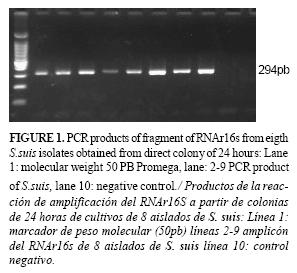
<body><![CDATA[<P><font face="Verdana, Arial, Helvetica, sans-serif" size="2">Several molecular    tests have been developed to detect <I>S. suis</I> species by means of regions    conserved in all the capsular types<I>. </I>Okwumabua<I> et al. </I>(18)<I>    </I>developed a PCR<SUP> </SUP>assay<B> </B>based on the <I>gdh</I> gene, which    encodes the glutamate deshydrogenase,<SUP> </SUP>and Marois et al (19) developed    a PCR system for <I>S. suis</I> detection by amplifying a fragment of RNAr16s<I>.    </I> </font>     <P><font face="Verdana, Arial, Helvetica, sans-serif" size="2">Nucleic acid based    tests are increasingly used in the bacteriological diagnosis for the speed,    sensitivity and specificity, which exceed the benefits of the identification    by biochemical tests (18). The isolation and purification of DNA is a key step    for most protocols in molecular biological studies including PCR. The various    methods proposed to extract and purify DNA from bacterial and yeast can be classified    according to the system chosen to break the cells, including beadbeating, enzymatic    cell wall lysis or cell permeabilization with chaotrophic agents; generally    all the systems either are very time-consuming or they show poor release of    DNA (20). The application of a direct PCR from colonies was first performed    in rapid characterization studies of <I>Escherichia coli</I> strains transformed    with plasmids (21). The DNA amplified directly from the colony has been sequenced    with as satisfactory results as those obtained from DNA extracted by the conventional    phenol-chloroform procedure (22, 23, 24). The aim of this study was to evaluate    a method for the rapid release of the genomic DNA from <I>S.suis</I> colony    by using a physical method based on heating and freezing; in this case, two    heating temperatures, 100<SUP>o</SUP>C and 95<SUP>o</SUP>C, were tested for    analyzing by polymerase chain reaction. </font>     <P><font face="Verdana, Arial, Helvetica, sans-serif" size="2">A total of 10 isolates    of <I>S.suis</I> from lungs of pigs with respiratory disorders were cultured    on Columbia agar base (Oxoid) supplemented with 5% sheep blood and they were    identified with the following criteria: presence of pinpoint colonies with alpha-hemolysis,    Gram-positive cocci, negative catalase test and biochemical tests API 20 STREP    kit (Biome&Acirc;rieux, Marcy-l'Etoile, France). The conventional phenol-chloroform    DNA extraction, followed by ethanol precipitation according to the protocol    reported by Douglas et al (25), from overnight broth cultures was used as the    control. </font>     <P><font face="Verdana, Arial, Helvetica, sans-serif" size="2">For the rapid direct    colony PCR, two protocols were followed. The first one consisted of lightly    touching a colony of a culture on blood agar with a sterile pipette tip and    placing of the collected material into a tube containing 50 &#181;L nuclease-free    water, then subjected to boiling at 100<SUP>o</SUP>C for five minutes and subsequently    frozen at -20<SUP>o</SUP>C for 10 minutes, the mixture was centrifuged at 3000    g for 10 minutes. In the second procedure the colony was preheated at 95<SUP>o</SUP>C    for 10 minutes in the thermal cycler and cooled. In both cases, 5 &#181;L was    used for PCR amplification. A colony from both 24 and 48 hour cultures were    used. Finally, the mix was added into the two sets of samples separately. </font>     <P><font face="Verdana, Arial, Helvetica, sans-serif" size="2">The PCR with extracted    genomic DNA as template of strains of <I>S. suis</I> was made as reported by    Marois <I>et al. </I>(19). The primers amplify a fragment of 294 bp of 16S rRNA    gene. For genoserotyping, specifically the gene fragment related to the biogenesis    of the two capsular type (cps2), the conditions described by Smith et al (26)    were followed. </font>     <P><font face="Verdana, Arial, Helvetica, sans-serif" size="2">Amplification was    performed in a final volume of 25 &#181;L containing 10 mM Tris-HCl, pH 8.3,    50 mM KCl, 3 mM MgCl<SUB>2</SUB>; 0.1mg/mL BSA; 10 mM of each dNTP; 20 pmol    of each primer and 1 &#181;L of Amplicen (2&#181;/&#181;L), CENSA, Cuba, and    2&#181;l of template DNA, purified by the method of chemical analysis, was added.    Different concentrations of the genomic DNA from one isolate were made to establish    the detection limit of the assay, and 5 &#181;L was used for PCR amplification    for the DNA extracted from the colony. </font>     <P><font face="Verdana, Arial, Helvetica, sans-serif" size="2">All the isolates    of <I>S.suis</I>, identified by morphological and biochemical criteria, amplified    a fragment of 294 bp from the genomic DNA extracted by the method of chemical    lyses. The amplification limit of the PCR corresponded to 0.5 ng of chromosomal    DNA. </font>     <P><font face="Verdana, Arial, Helvetica, sans-serif" size="2">In both cases,    colony from 24 and 48 hour cultures, the application of direct colony PCR was    successful only when the samples were subjected to boiling at 100<SUP>o</SUP>C    (<a href="#f01">Figure 1</a>) but not when heating at 95<SUP>o</SUP>C, this    latter condition was not sufficient for DNA release . Taking into account the    detection limit detected from the genomic DNA (0.5 ng), considering the size    reported for <I>S.</I> <I>suis</I> genomic DNA (2.14Mpb), assuming that the    genome is of GC%=50, then it is possible to estimate a detection limit corresponding    to about 2.1x10<SUP>4</SUP>cells (27). A single 24 hour colony grown on an agar    plate contains the number of cells required for PCR amplification of fragment    RNAr16s gene and locus fragment linked to biogenesis specific two capsular polysaccharide    type. </font>      <P align="center"><img src="/img/revistas/rsa/v35n1/f0109113.gif" width="297" height="273">    <a name="f01"></a>      
<P><font face="Verdana, Arial, Helvetica, sans-serif" size="2">DNA extraction    from Gram-positive bacteria may be more complex than from Gram-negative bacteria    and involves multiple steps such as cell wall treatment with enzymes or ionic    detergents and cell lysis using mutanolysin and hyaluronidase. These methods    are costly, time consuming and often lead to errors when processing a large    number of samples (25, 26). For <I>S. suis</I> genotyping, methods based on    chemical purification which include the use of proteinase K, detergents such    as Triton X-100, Nonidet P-40 and washing with phenol and chloroform are described    (28). Trudy et al (29) reported the detection of genes in <I>S. pneumoniae</I>    from a colony which was subjected to a chemical lysis solution and heated at    60<SUP>o</SUP>C for one hour or at 95<SUP>o</SUP>C for 5 minutes. </font>     ]]></body>
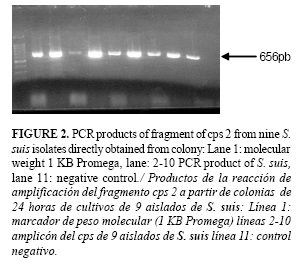
<body><![CDATA[<P><font face="Verdana, Arial, Helvetica, sans-serif" size="2">However, in recent    years, several have been the reports on the use of PCR after the rapid extraction    of DNA from the colony of Gram-positive bacterial entities. Boiling of the samples    has been shown to be a simpler and more economical method for releasing DNA    from bacteria (29). The rapid detection of <I>Staphylococcus aureus</I> resistant    to methicillin was made from the colony DNA without the use of chemical reagents,    but, despite the larger size of the single colony of <I>S. aureus</I>, 4 to    5 colonies were used,(29). Okwumabua <I>et al.</I> (18) used lysis by a boiling    method for the PCR assay using <I>gdh</I> gene of <I>S. suis</I>. Briefly, a    single colony of a bacterial isolate grown on sheep blood agar plate was suspended    in 100 &#181;l of water and heated at 100<SUP>o</SUP>C for 20 min, followed    by centrifugation for 2 min at 13 000g. However, in our study, the use of a    singe colony of 24 hours heated at 100<SUP>o</SUP>C for 5 min is enough for    the application of the PCR test for genotyping <I>S.suis</I> using different    genetic markers. This colony is touched with a simple sterile pipette tip; previously,    and using the same pipette tip, this colony is placed on a sheep blood agar    plate to be sub-cultured for other assays like antibiotic susceptibility and    for ensuring the identity of this colony and its conservation. </font>     <P><font face="Verdana, Arial, Helvetica, sans-serif" size="2">Jose and Brahmadathan    (28) developed a methodology for the typing of the group A of <I>Streptococcus</I>    spp by PCR from colony where preheating at 95<SUP>o</SUP>C for 2 minutes and    then cooling was sufficient for DNA release. It should be noted that several    colonies and not a single one were used in their work. However, our results    showed that a colony of <I>S. suis</I> from a culture of 24 hours was enough    for typing <I>S.suis</I>. </font>     <P><font face="Verdana, Arial, Helvetica, sans-serif" size="2">Although <I>S.suis</I>    is a bacterium phenotypically well characterized, its identification in the    laboratory may be complicated by the morphological and biochemical similarities    with other members of this genus that may be present in the respiratory tract    of pigs. Baele <I>et al.</I> (31) studied Gram-positive tonsillar and nasal    microbiota in pigs of 2 and 6 weeks of age and identified the following species    of <I>Streptococcus </I>spp: <I>S.suis</I>, <I>S. dysgalactiae</I>, <I>S. gallolyticus</I>,    <I>S. bovis</I>, <I>S. agalactiae</I>, <I>S. cricetus</I>, <I>S. hyointestinalis</I>,    <I>S. hyovaginalis</I>, <I>S. sanguinis</I>, <I>S. porcinus</I>, <I>S. pluranimalium</I>.    <I>S.suis</I> was present in all the animals and at concentrations 10<SUP>2</SUP>    to 10<SUP>7 </SUP>ufc; however, none of the isolates corresponded to serotype    2. These data demonstrated the need for a rapid protocol for DNA genoserotyping    <I>S. suis</I> from mixed primary cultures where other species may be present.    The <a href="/img/revistas/rsa/v35n1/f0209113.gif">figure 2</a> shows the    amplification products of a fragment of 656 bp of locus cps2j in isolates of    <I>S.suis</I> directly from colony. </font>      
<P><font face="Verdana, Arial, Helvetica, sans-serif" size="2">It was demonstrated    that <I>S.suis</I> cells from cultures could be used directly for PCR amplification    of target DNA by heating at 100&#176;C for 5 minutes and freezing for 10 minutes    at -20&#176;C for cell wall disruption and membrane denaturation; the DNA released    was enough for amplification. Thus, these methods can not only replace more    cumbersome and time-consuming cell lysate methods, but they also avoids the    successive passes needed to obtain pure cultures for the application of biochemical    tests and can be used for typing large number of strains in much less time.    </font>      <P>&nbsp;     <P><font face="Verdana, Arial, Helvetica, sans-serif" size="2"><B><font size="3">REFERENCES</font></B></font>      <!-- ref --><P><font face="Verdana, Arial, Helvetica, sans-serif" size="2">1. Chanter N,      Jones PW, Alexander TJ. Meningitis in pigs caused by <I>Streptococcus suis</I>-a      speculative review. Vet Microbiol<I>. </I>1999;36:39-55.     </font>        <!-- ref --><P><font face="Verdana, Arial, Helvetica, sans-serif" size="2">2. Fittipaldi      N, Troy EF, Janet FT, Thomas LW. Serotype distribution and production of muramidase-released      protein,extracellular factor and suilysin by field strains of Streptococcus      suis isolated in the United States. Vet Microbiol. 2009;139:310-317.     </font>        ]]></body>
<body><![CDATA[<!-- ref --><P><font face="Verdana, Arial, Helvetica, sans-serif" size="2">3. Gottschalk      M, Segura M, Xu J. <I>Streptococcus suis<IMG SRC="../../../RE9A88~1/VOL35N~1/PAGEMA~1/ND0.JPG" WIDTH="6" HEIGHT="10"  ALIGN="BOTTOM"></I> infections in humans: the Chinese experience and the situation      in North America. Anim Health Res Rev<I>.</I> 2007;8:29-45.     </font>        <!-- ref --><P><font face="Verdana, Arial, Helvetica, sans-serif" size="2">4. Thaddeus JW,      et al. Slaughterhouse Pigs Are a Major Reservoir of <I>Streptococcus suis</I>      Serotype 2 Capable of Causing Human Infection in Southern Vietnam PLoS One.      2011;6(3).     </font>        <!-- ref --><P><font face="Verdana, Arial, Helvetica, sans-serif" size="2">5. Youjun F,      Huimin Z, Ying M. George FG. Uncovering newly emerging variants of <I>Streptococcus      suis</I>, an important zoonotic agent. Trends Microbiol. 2010;18:3.     </font>        <!-- ref --><P><font face="Verdana, Arial, Helvetica, sans-serif" size="2">6. Yu H, Jing      H, Chen Z, Zheng H, Zhu X, Wang Hl. Human <I>Streptococcus suis </I>outbreak,      Sichuan,China. Emerg Infect Dis. 2006;12:914-920.     </font>        <!-- ref --><P><font face="Verdana, Arial, Helvetica, sans-serif" size="2">7. Kaicheng W,      Weixing F, Wisselink H, Chengping L. The cps locus of Streptococcus suis serotype      16: Development of a serotype-specific PCR assay Vet Microbiol. 2011;153:      403-406.     </font>        ]]></body>
<body><![CDATA[<!-- ref --><P><font face="Verdana, Arial, Helvetica, sans-serif" size="2">8. Baums CG.      Valentin-Weigand P. Surface-associated and secreted factors of <I>Streptococcus      suis</I> in epidemiology, pathogenesis and vaccine development. Anim Health      Res Rev. 2009;10(1):65-83.     </font>        <!-- ref --><P><font face="Verdana, Arial, Helvetica, sans-serif" size="2">9. Gottschalk      M, Higgins R, Boudreau M. Use of polyvalent coagglutination reagents for serotyping      of <I>Streptococcus suis</I>. J Clin Microbiol.1993;31(8):2192-2194.     </font>        <!-- ref --><P><font face="Verdana, Arial, Helvetica, sans-serif" size="2">10.Hill J E,      Gottschalk M, Brousseau R, Harel J, Hemmingsen SM, Goh SH. Biochemical analysis,      cpn60 and 16S rDNA sequence data indicate that <I>Streptococcus suis</I> serotypes      32 and 34, isolated from pigs, are <I>Streptococcus orisratti</I>. Vet Microbiol<I>.      </I>2005;107:63-69.     </font>        <!-- ref --><P><font face="Verdana, Arial, Helvetica, sans-serif" size="2">11.Anding Z,      Ming Y, Pan H, Jiayan W, Bo C, Yafeng H, et al. Comparative genomic analysis      of <I>Streptococcus suis</I> reveals significant genomic diversity among different      serotypes. BMC Genomics. 2011;12:523.     </font>        <!-- ref --><P><font face="Verdana, Arial, Helvetica, sans-serif" size="2">12.Andreas B,      Katharina B, Christina N, Charlotte S, Karl-Heinz W, Wolfgang B, et al. Comparative      evaluation of virulence and pathology of <I>Streptococcus suis</I> serotypes      2 and 9 in experimentally infected growers. Vet Microbiol<I>.</I> 2008;128(3-4):423-430.          </font>        ]]></body>
<body><![CDATA[<!-- ref --><P><font face="Verdana, Arial, Helvetica, sans-serif" size="2">13.Lecours Marie-Pier,      et al. Sialylation of Streptococcus suis serotype 2 is essential for capsule      expression but is not responsible for the main capsular epitope. Microb Infect.      2012;14:941-950.     </font>        <!-- ref --><P><font face="Verdana, Arial, Helvetica, sans-serif" size="2">14.Smith HE,      Damamn M, Van der Velde J, Veenbergen V, Wagenaar F, Stockhofe-ZN, et al.      Identification and characterization of the complete <I>cps</I> locus of <I>Streptococcus      suis</I> serotype 2: the capsule protects against phagocytosis and is an important      virulence factor. Infect Immun. 1999;67:1750-1756.    <B> </B> </font>        <!-- ref --><P><font face="Verdana, Arial, Helvetica, sans-serif" size="2">15.Silva LMG,      Baums CG, Rehm T, Wisselink HJ, Goethe R, Valentin-Weigand P. Virulence-associated      gene profiling of <I>Streptococcus suis</I><B> </B>isolates by PCR. Vet Microbiol.      2006;155:117-127.     </font>        <!-- ref --><P><font face="Verdana, Arial, Helvetica, sans-serif" size="2">16.Inmaculada      L, Verena B, Vera Ana I, Perea JA, M&aacute;rquez JM, Fern&aacute;ndez J,      et al . Genetic analysis of <I>Streptococcus suis</I> isolates recovered from      diseased and healthy carrier pigs at different stages of production on a pig      farm. The Vet Journal. 2010;186:396-398.     </font>        <!-- ref --><P><font face="Verdana, Arial, Helvetica, sans-serif" size="2">17.Zigong W.      Characterization of <I>Streptococcus suis</I> isolates from the diseased pigs      in China between 2003 and 2007.Vet Microbiol. 2009;137:196-201.     </font>        ]]></body>
<body><![CDATA[<!-- ref --><P><font face="Verdana, Arial, Helvetica, sans-serif" size="2">18.Okwumabua      O, O'Connor M, Shull E. A polymerase chain reaction (PCR) assay specific for      <I>Streptococcus suis</I> based on the gene encoding the glutamate dehydrogenase.      FEMS Microbiol Lett. 2003;218:79-84.     </font>        <!-- ref --><P><font face="Verdana, Arial, Helvetica, sans-serif" size="2">19.Marois C,      Le Devendec L, Gottschalk M, Kobisch M. Detection and molecular typing of      <I>Streptococcus suis</I> in tonsils from live pigs in France. Can J Vet Res.      2007;71(1):14-22.     </font>        <!-- ref --><P><font face="Verdana, Arial, Helvetica, sans-serif" size="2">20.Mirhendi H,      Diba K, Rezaei A, Jalalizand N, Hosseinpur L, Khodadadi H.<I> </I>Colony-PCR      Is a Rapid and Sensitive Method for DNA Amplification in Yeasts. Iranian J      Publ Health. 2007;36(1):40-44.     </font>        <!-- ref --><P><font face="Verdana, Arial, Helvetica, sans-serif" size="2">21.Sambrook J,      Russell DW. Molecular Cloning: A Laboratory Manual, 3rd edn. Cold Spring Harbor      Laboratory Press, Cold Spring Harbor, NY.2001.     </font>        <!-- ref --><P><font face="Verdana, Arial, Helvetica, sans-serif" size="2">22.Brian R, Berridge      J D, Fuller JA, Donald EL, Herve B, Frelier PF. Development of specific oligonucleotide      PCR primers for the <I>Streptococcus iniae</I> 16S-23S ribosomal DNA intergenic      spacer. J Clin Microbiol. 1998;36(9):2778-2781.     </font>        ]]></body>
<body><![CDATA[<!-- ref --><P><font face="Verdana, Arial, Helvetica, sans-serif" size="2">23.Hynes WL,      Ferretti JJ, Gilmore MS, Segarra RA. PCR amplification of Streptoccal DNA      using crude cell lysates. FEMS Microbiol Lett. 1992;94:139-42.     </font>        <!-- ref --><P><font face="Verdana, Arial, Helvetica, sans-serif" size="2">24.Hofmann MA,      Brian DA. Sequencing PCR DNA amplified directly from a bacterial colony. Biotechniques.      1991;11:30-31.     </font>        <!-- ref --><P><font face="Verdana, Arial, Helvetica, sans-serif" size="2">25.Douglas A,      Ra&uacute;l A, Stephen P. Elucidation of the DNA sequence of <I>Streptococcus      uberis </I>adhesion molecule gene (<I>sua</I>) and detection of <I>sua </I>in      strains of <I>Streptococcus uberis </I>isolated from geographically diverse      locations. Vet Microbiol. 2008; 128(3):304-312.     </font>        <!-- ref --><P><font face="Verdana, Arial, Helvetica, sans-serif" size="2">26.Smith, HE.,      Veenbergen V, van der Velde J, Damman M, Wisselink HJ, Smits MA. The <I>cps</I>      genes of <I>Streptococcus suis</I> serotypes 1, 2, and 9: development of rapid      serotype-specific PCR<B> </B>assays. J Clin Microbiol. 1999;37:3146-3152.          </font>        <!-- ref --><P><font face="Verdana, Arial, Helvetica, sans-serif" size="2">27.Takasugu G,      Hideake N, Ayko M, Yoshiaki K, Oki O, Kanako A. Rapid identification of <I>Streptococus      intermedius</I> by PCR with the ily gene as a specie marker gene. J Med Microbiol.      2002;51;178-186.     </font>        ]]></body>
<body><![CDATA[<!-- ref --><P><font face="Verdana, Arial, Helvetica, sans-serif" size="2">28.Jose JJM,      Brahmadathan K. Evaluation of simplified DNA extraction methods for <I>EMM</I>      typing of group a streptococci<I> </I>Indian. J Med Microbiol. 2006<I>;</I>224(2):127-130.          </font>        <!-- ref --><P><font face="Verdana, Arial, Helvetica, sans-serif" size="2">29.Trudy O, Messmer      C, Whitney G, Barry S. Fields Use of polymerase chain reaction to identify      pneumococcal infection associated with hemorrhage and shock in two previously      healthy young children. Clin Chemistry. 1997;43:930-935.     </font>        <!-- ref --><P><font face="Verdana, Arial, Helvetica, sans-serif" size="2">30.Sandhu GS,      Precup JW, Kline BC. Rapid one step characterization of recombinant vectors      by direct analysis of transformed <I>Escherichia coli</I> colonies. Biotechniques.1989;7:689-690.          </font>         <!-- ref --><P><font face="Verdana, Arial, Helvetica, sans-serif" size="2">31.Baele M, Chiers    K, Devriese LA, Smith HE, Wisselink HJ, Vaneechoutte MF, et al. The Gram-positive    tonsillar and nasal flora of piglets before and after weaning. J Applied Microbiol.    2001;91:997-1003.     </font>      <P>      <P>      ]]></body>
<body><![CDATA[<P>      <P>      <P>      <P>      <P>      <P>      <P>&nbsp;     <P>&nbsp;     <P><font face="Verdana, Arial, Helvetica, sans-serif" size="2">Recibido: 6-12-2012.    <br>   </font><font face="Verdana, Arial, Helvetica, sans-serif" size="2">Aceptado:    25-1-2013. </font>     ]]></body>
<body><![CDATA[<P>&nbsp;     <P>&nbsp;      <P>&nbsp;       ]]></body><back>
<ref-list>
<ref id="B1">
<label>1</label><nlm-citation citation-type="journal">
<person-group person-group-type="author">
<name>
<surname><![CDATA[Chanter]]></surname>
<given-names><![CDATA[N]]></given-names>
</name>
<name>
<surname><![CDATA[Jones]]></surname>
<given-names><![CDATA[PW]]></given-names>
</name>
<name>
<surname><![CDATA[Alexander]]></surname>
<given-names><![CDATA[TJ]]></given-names>
</name>
</person-group>
<article-title xml:lang="en"><![CDATA[Meningitis in pigs caused by Streptococcus suis-a speculative review]]></article-title>
<source><![CDATA[Vet Microbiol]]></source>
<year>1999</year>
<volume>36</volume>
<page-range>39-55</page-range></nlm-citation>
</ref>
<ref id="B2">
<label>2</label><nlm-citation citation-type="journal">
<person-group person-group-type="author">
<name>
<surname><![CDATA[Fittipaldi]]></surname>
<given-names><![CDATA[N]]></given-names>
</name>
<name>
<surname><![CDATA[Troy]]></surname>
<given-names><![CDATA[EF]]></given-names>
</name>
<name>
<surname><![CDATA[Janet]]></surname>
<given-names><![CDATA[FT]]></given-names>
</name>
<name>
<surname><![CDATA[Thomas]]></surname>
<given-names><![CDATA[LW]]></given-names>
</name>
</person-group>
<article-title xml:lang="en"><![CDATA[Serotype distribution and production of muramidase-released protein,extracellular factor and suilysin by field strains of Streptococcus suis isolated in the United States]]></article-title>
<source><![CDATA[Vet Microbiol]]></source>
<year>2009</year>
<volume>139</volume>
<page-range>310-317</page-range></nlm-citation>
</ref>
<ref id="B3">
<label>3</label><nlm-citation citation-type="journal">
<person-group person-group-type="author">
<name>
<surname><![CDATA[Gottschalk]]></surname>
<given-names><![CDATA[M]]></given-names>
</name>
<name>
<surname><![CDATA[Segura]]></surname>
<given-names><![CDATA[M]]></given-names>
</name>
<name>
<surname><![CDATA[Xu]]></surname>
<given-names><![CDATA[J]]></given-names>
</name>
</person-group>
<article-title xml:lang="en"><![CDATA[Streptococcus suis<img width=6 height=10 src="../../../RE9A88~1/VOL35N~1/PAGEMA~1/ND0.JPG" align=BOTTOM> infections in humans: the Chinese experience and the situation in North America]]></article-title>
<source><![CDATA[Anim Health Res Rev]]></source>
<year>2007</year>
<volume>8</volume>
<page-range>29-45</page-range></nlm-citation>
</ref>
<ref id="B4">
<label>4</label><nlm-citation citation-type="journal">
<person-group person-group-type="author">
<name>
<surname><![CDATA[Thaddeus]]></surname>
<given-names><![CDATA[JW]]></given-names>
</name>
</person-group>
<article-title xml:lang="en"><![CDATA[Slaughterhouse Pigs Are a Major Reservoir of Streptococcus suis Serotype 2 Capable of Causing Human Infection in Southern Vietnam]]></article-title>
<source><![CDATA[PLoS One]]></source>
<year>2011</year>
<volume>6</volume>
<numero>3</numero>
<issue>3</issue>
</nlm-citation>
</ref>
<ref id="B5">
<label>5</label><nlm-citation citation-type="journal">
<person-group person-group-type="author">
<name>
<surname><![CDATA[Youjun]]></surname>
<given-names><![CDATA[F]]></given-names>
</name>
<name>
<surname><![CDATA[Huimin]]></surname>
<given-names><![CDATA[Z]]></given-names>
</name>
<name>
<surname><![CDATA[Ying]]></surname>
<given-names><![CDATA[M]]></given-names>
</name>
<name>
<surname><![CDATA[George]]></surname>
<given-names><![CDATA[FG]]></given-names>
</name>
</person-group>
<article-title xml:lang="en"><![CDATA[Uncovering newly emerging variants of Streptococcus suis, an important zoonotic agent]]></article-title>
<source><![CDATA[Trends Microbiol]]></source>
<year>2010</year>
<volume>18</volume>
<page-range>3</page-range></nlm-citation>
</ref>
<ref id="B6">
<label>6</label><nlm-citation citation-type="journal">
<person-group person-group-type="author">
<name>
<surname><![CDATA[Yu]]></surname>
<given-names><![CDATA[H]]></given-names>
</name>
<name>
<surname><![CDATA[Jing]]></surname>
<given-names><![CDATA[H]]></given-names>
</name>
<name>
<surname><![CDATA[Chen]]></surname>
<given-names><![CDATA[Z]]></given-names>
</name>
<name>
<surname><![CDATA[Zheng]]></surname>
<given-names><![CDATA[H]]></given-names>
</name>
<name>
<surname><![CDATA[Zhu]]></surname>
<given-names><![CDATA[X]]></given-names>
</name>
<name>
<surname><![CDATA[Wang]]></surname>
<given-names><![CDATA[Hl]]></given-names>
</name>
</person-group>
<article-title xml:lang="en"><![CDATA[Human Streptococcus suis outbreak, Sichuan,China]]></article-title>
<source><![CDATA[Emerg Infect Dis]]></source>
<year>2006</year>
<volume>12</volume>
<page-range>914-920</page-range></nlm-citation>
</ref>
<ref id="B7">
<label>7</label><nlm-citation citation-type="journal">
<person-group person-group-type="author">
<name>
<surname><![CDATA[Kaicheng]]></surname>
<given-names><![CDATA[W]]></given-names>
</name>
<name>
<surname><![CDATA[Weixing]]></surname>
<given-names><![CDATA[F]]></given-names>
</name>
<name>
<surname><![CDATA[Wisselink]]></surname>
<given-names><![CDATA[H]]></given-names>
</name>
<name>
<surname><![CDATA[Chengping]]></surname>
<given-names><![CDATA[L]]></given-names>
</name>
</person-group>
<article-title xml:lang="en"><![CDATA[The cps locus of Streptococcus suis serotype 16: Development of a serotype-specific PCR assay]]></article-title>
<source><![CDATA[Vet Microbiol]]></source>
<year>2011</year>
<volume>153</volume>
<page-range>403-406</page-range></nlm-citation>
</ref>
<ref id="B8">
<label>8</label><nlm-citation citation-type="journal">
<person-group person-group-type="author">
<name>
<surname><![CDATA[Baums]]></surname>
<given-names><![CDATA[CG]]></given-names>
</name>
</person-group>
<article-title xml:lang="en"><![CDATA[Valentin-Weigand P. Surface-associated and secreted factors of Streptococcus suis in epidemiology, pathogenesis and vaccine development]]></article-title>
<source><![CDATA[Anim Health Res Rev]]></source>
<year>2009</year>
<volume>10</volume>
<numero>1</numero>
<issue>1</issue>
<page-range>65-83</page-range></nlm-citation>
</ref>
<ref id="B9">
<label>9</label><nlm-citation citation-type="journal">
<person-group person-group-type="author">
<name>
<surname><![CDATA[Gottschalk]]></surname>
<given-names><![CDATA[M]]></given-names>
</name>
<name>
<surname><![CDATA[Higgins]]></surname>
<given-names><![CDATA[R]]></given-names>
</name>
<name>
<surname><![CDATA[Boudreau]]></surname>
<given-names><![CDATA[M]]></given-names>
</name>
</person-group>
<article-title xml:lang="en"><![CDATA[Use of polyvalent coagglutination reagents for serotyping of Streptococcus suis]]></article-title>
<source><![CDATA[J Clin Microbiol]]></source>
<year>1993</year>
<volume>31</volume>
<numero>8</numero>
<issue>8</issue>
<page-range>2192-2194</page-range></nlm-citation>
</ref>
<ref id="B10">
<label>10</label><nlm-citation citation-type="journal">
<person-group person-group-type="author">
<name>
<surname><![CDATA[Hill]]></surname>
<given-names><![CDATA[J E]]></given-names>
</name>
<name>
<surname><![CDATA[Gottschalk]]></surname>
<given-names><![CDATA[M]]></given-names>
</name>
<name>
<surname><![CDATA[Brousseau]]></surname>
<given-names><![CDATA[R]]></given-names>
</name>
<name>
<surname><![CDATA[Harel]]></surname>
<given-names><![CDATA[J]]></given-names>
</name>
<name>
<surname><![CDATA[Hemmingsen]]></surname>
<given-names><![CDATA[SM]]></given-names>
</name>
<name>
<surname><![CDATA[Goh]]></surname>
<given-names><![CDATA[SH]]></given-names>
</name>
</person-group>
<article-title xml:lang="en"><![CDATA[Biochemical analysis, cpn60 and 16S rDNA sequence data indicate that Streptococcus suis serotypes 32 and 34, isolated from pigs, are Streptococcus orisratti]]></article-title>
<source><![CDATA[Vet Microbiol]]></source>
<year>2005</year>
<volume>107</volume>
<page-range>63-69</page-range></nlm-citation>
</ref>
<ref id="B11">
<label>11</label><nlm-citation citation-type="journal">
<person-group person-group-type="author">
<name>
<surname><![CDATA[Anding]]></surname>
<given-names><![CDATA[Z]]></given-names>
</name>
<name>
<surname><![CDATA[Ming]]></surname>
<given-names><![CDATA[Y]]></given-names>
</name>
<name>
<surname><![CDATA[Pan]]></surname>
<given-names><![CDATA[H]]></given-names>
</name>
<name>
<surname><![CDATA[Jiayan]]></surname>
<given-names><![CDATA[W]]></given-names>
</name>
<name>
<surname><![CDATA[Bo]]></surname>
<given-names><![CDATA[C]]></given-names>
</name>
<name>
<surname><![CDATA[Yafeng]]></surname>
<given-names><![CDATA[H]]></given-names>
</name>
</person-group>
<article-title xml:lang="en"><![CDATA[Comparative genomic analysis of Streptococcus suis reveals significant genomic diversity among different serotypes]]></article-title>
<source><![CDATA[BMC Genomics]]></source>
<year>2011</year>
<volume>12</volume>
<page-range>523</page-range></nlm-citation>
</ref>
<ref id="B12">
<label>12</label><nlm-citation citation-type="journal">
<person-group person-group-type="author">
<name>
<surname><![CDATA[Andreas]]></surname>
<given-names><![CDATA[B]]></given-names>
</name>
<name>
<surname><![CDATA[Katharina]]></surname>
<given-names><![CDATA[B]]></given-names>
</name>
<name>
<surname><![CDATA[Christina]]></surname>
<given-names><![CDATA[N]]></given-names>
</name>
<name>
<surname><![CDATA[Charlotte]]></surname>
<given-names><![CDATA[S]]></given-names>
</name>
<name>
<surname><![CDATA[Karl-Heinz]]></surname>
<given-names><![CDATA[W]]></given-names>
</name>
<name>
<surname><![CDATA[Wolfgang]]></surname>
<given-names><![CDATA[B]]></given-names>
</name>
</person-group>
<article-title xml:lang="en"><![CDATA[Comparative evaluation of virulence and pathology of Streptococcus suis serotypes 2 and 9 in experimentally infected growers]]></article-title>
<source><![CDATA[Vet Microbiol]]></source>
<year>2008</year>
<volume>128</volume>
<numero>3-4</numero>
<issue>3-4</issue>
<page-range>423-430</page-range></nlm-citation>
</ref>
<ref id="B13">
<label>13</label><nlm-citation citation-type="journal">
<person-group person-group-type="author">
<name>
<surname><![CDATA[Lecours]]></surname>
<given-names><![CDATA[Marie-Pier]]></given-names>
</name>
</person-group>
<article-title xml:lang="en"><![CDATA[Sialylation of Streptococcus suis serotype 2 is essential for capsule expression but is not responsible for the main capsular epitope]]></article-title>
<source><![CDATA[Microb Infect]]></source>
<year>2012</year>
<volume>14</volume>
<page-range>941-950</page-range></nlm-citation>
</ref>
<ref id="B14">
<label>14</label><nlm-citation citation-type="journal">
<person-group person-group-type="author">
<name>
<surname><![CDATA[Smith]]></surname>
<given-names><![CDATA[HE]]></given-names>
</name>
<name>
<surname><![CDATA[Damamn]]></surname>
<given-names><![CDATA[M]]></given-names>
</name>
<name>
<surname><![CDATA[Van der Velde]]></surname>
<given-names><![CDATA[J]]></given-names>
</name>
<name>
<surname><![CDATA[Veenbergen]]></surname>
<given-names><![CDATA[V]]></given-names>
</name>
<name>
<surname><![CDATA[Wagenaar]]></surname>
<given-names><![CDATA[F]]></given-names>
</name>
<name>
<surname><![CDATA[Stockhofe]]></surname>
<given-names><![CDATA[ZN]]></given-names>
</name>
</person-group>
<article-title xml:lang="en"><![CDATA[Identification and characterization of the complete cps locus of Streptococcus suis serotype 2: the capsule protects against phagocytosis and is an important virulence factor]]></article-title>
<source><![CDATA[Infect Immun]]></source>
<year>1999</year>
<volume>67</volume>
<page-range>1750-1756</page-range></nlm-citation>
</ref>
<ref id="B15">
<label>15</label><nlm-citation citation-type="journal">
<person-group person-group-type="author">
<name>
<surname><![CDATA[Silva]]></surname>
<given-names><![CDATA[LMG]]></given-names>
</name>
<name>
<surname><![CDATA[Baums]]></surname>
<given-names><![CDATA[CG]]></given-names>
</name>
<name>
<surname><![CDATA[Rehm]]></surname>
<given-names><![CDATA[T]]></given-names>
</name>
<name>
<surname><![CDATA[Wisselink]]></surname>
<given-names><![CDATA[HJ]]></given-names>
</name>
<name>
<surname><![CDATA[Goethe]]></surname>
<given-names><![CDATA[R]]></given-names>
</name>
<name>
<surname><![CDATA[Valentin-Weigand]]></surname>
<given-names><![CDATA[P]]></given-names>
</name>
</person-group>
<article-title xml:lang="en"><![CDATA[Virulence-associated gene profiling of Streptococcus suis isolates by PCR]]></article-title>
<source><![CDATA[Vet Microbiol]]></source>
<year>2006</year>
<volume>155</volume>
<page-range>117-127</page-range></nlm-citation>
</ref>
<ref id="B16">
<label>16</label><nlm-citation citation-type="journal">
<person-group person-group-type="author">
<name>
<surname><![CDATA[nmaculada]]></surname>
<given-names><![CDATA[L]]></given-names>
</name>
<name>
<surname><![CDATA[Verena]]></surname>
<given-names><![CDATA[B]]></given-names>
</name>
<name>
<surname><![CDATA[Vera Ana]]></surname>
<given-names><![CDATA[I]]></given-names>
</name>
<name>
<surname><![CDATA[Perea]]></surname>
<given-names><![CDATA[JA]]></given-names>
</name>
<name>
<surname><![CDATA[Márquez]]></surname>
<given-names><![CDATA[JM]]></given-names>
</name>
<name>
<surname><![CDATA[Fernández]]></surname>
<given-names><![CDATA[J]]></given-names>
</name>
</person-group>
<article-title xml:lang="en"><![CDATA[Genetic analysis of Streptococcus suis isolates recovered from diseased and healthy carrier pigs at different stages of production on a pig farm]]></article-title>
<source><![CDATA[The Vet Journal]]></source>
<year>2010</year>
<volume>186</volume>
<page-range>396-398</page-range></nlm-citation>
</ref>
<ref id="B17">
<label>17</label><nlm-citation citation-type="journal">
<person-group person-group-type="author">
<name>
<surname><![CDATA[Zigong]]></surname>
<given-names><![CDATA[W]]></given-names>
</name>
</person-group>
<article-title xml:lang="en"><![CDATA[Characterization of Streptococcus suis isolates from the diseased pigs in China between 2003 and 2007]]></article-title>
<source><![CDATA[Vet Microbiol]]></source>
<year>2009</year>
<volume>137</volume>
<page-range>196-201</page-range></nlm-citation>
</ref>
<ref id="B18">
<label>18</label><nlm-citation citation-type="journal">
<person-group person-group-type="author">
<name>
<surname><![CDATA[Okwumabua]]></surname>
<given-names><![CDATA[O]]></given-names>
</name>
<name>
<surname><![CDATA[O'Connor]]></surname>
<given-names><![CDATA[M]]></given-names>
</name>
<name>
<surname><![CDATA[Shull]]></surname>
<given-names><![CDATA[E]]></given-names>
</name>
</person-group>
<article-title xml:lang="en"><![CDATA[A polymerase chain reaction (PCR) assay specific for Streptococcus suis based on the gene encoding the glutamate dehydrogenase]]></article-title>
<source><![CDATA[FEMS Microbiol Lett]]></source>
<year>2003</year>
<volume>218</volume>
<page-range>79-84</page-range></nlm-citation>
</ref>
<ref id="B19">
<label>19</label><nlm-citation citation-type="journal">
<person-group person-group-type="author">
<name>
<surname><![CDATA[Marois]]></surname>
<given-names><![CDATA[C]]></given-names>
</name>
<name>
<surname><![CDATA[Le Devendec]]></surname>
<given-names><![CDATA[L]]></given-names>
</name>
<name>
<surname><![CDATA[Gottschalk]]></surname>
<given-names><![CDATA[M]]></given-names>
</name>
<name>
<surname><![CDATA[Kobisch]]></surname>
<given-names><![CDATA[M]]></given-names>
</name>
</person-group>
<article-title xml:lang="en"><![CDATA[Detection and molecular typing of Streptococcus suis in tonsils from live pigs in France]]></article-title>
<source><![CDATA[Can J Vet Res]]></source>
<year>2007</year>
<volume>71</volume>
<numero>1</numero>
<issue>1</issue>
<page-range>14-22</page-range></nlm-citation>
</ref>
<ref id="B20">
<label>20</label><nlm-citation citation-type="journal">
<person-group person-group-type="author">
<name>
<surname><![CDATA[Mirhendi]]></surname>
<given-names><![CDATA[H]]></given-names>
</name>
<name>
<surname><![CDATA[Diba]]></surname>
<given-names><![CDATA[K]]></given-names>
</name>
<name>
<surname><![CDATA[Rezaei]]></surname>
<given-names><![CDATA[A]]></given-names>
</name>
<name>
<surname><![CDATA[Jalalizand]]></surname>
<given-names><![CDATA[N]]></given-names>
</name>
<name>
<surname><![CDATA[Hosseinpur]]></surname>
<given-names><![CDATA[L]]></given-names>
</name>
<name>
<surname><![CDATA[Khodadadi]]></surname>
<given-names><![CDATA[H]]></given-names>
</name>
</person-group>
<article-title xml:lang="en"><![CDATA[Colony-PCR Is a Rapid and Sensitive Method for DNA Amplification in Yeasts]]></article-title>
<source><![CDATA[Iranian J Publ Health]]></source>
<year>2007</year>
<volume>36</volume>
<numero>1</numero>
<issue>1</issue>
<page-range>40-44</page-range></nlm-citation>
</ref>
<ref id="B21">
<label>21</label><nlm-citation citation-type="book">
<person-group person-group-type="author">
<name>
<surname><![CDATA[Sambrook]]></surname>
<given-names><![CDATA[J]]></given-names>
</name>
<name>
<surname><![CDATA[Russell]]></surname>
<given-names><![CDATA[DW]]></given-names>
</name>
</person-group>
<source><![CDATA[Molecular Cloning: A Laboratory Manual]]></source>
<year>2001</year>
<edition>3rd</edition>
<publisher-loc><![CDATA[NY ]]></publisher-loc>
<publisher-name><![CDATA[Cold Spring Harbor Laboratory Press, Cold Spring Harbor]]></publisher-name>
</nlm-citation>
</ref>
<ref id="B22">
<label>22</label><nlm-citation citation-type="journal">
<person-group person-group-type="author">
<name>
<surname><![CDATA[Brian]]></surname>
<given-names><![CDATA[R]]></given-names>
</name>
<name>
<surname><![CDATA[Berridge]]></surname>
<given-names><![CDATA[J D]]></given-names>
</name>
<name>
<surname><![CDATA[Fuller]]></surname>
<given-names><![CDATA[JA]]></given-names>
</name>
<name>
<surname><![CDATA[Donald]]></surname>
<given-names><![CDATA[EL]]></given-names>
</name>
<name>
<surname><![CDATA[Herve]]></surname>
<given-names><![CDATA[B]]></given-names>
</name>
<name>
<surname><![CDATA[Frelier]]></surname>
<given-names><![CDATA[PF]]></given-names>
</name>
</person-group>
<article-title xml:lang="en"><![CDATA[Development of specific oligonucleotide PCR primers for the Streptococcus iniae 16S-23S ribosomal DNA intergenic spacer]]></article-title>
<source><![CDATA[J Clin Microbiol]]></source>
<year>1998</year>
<volume>36</volume>
<numero>9</numero>
<issue>9</issue>
<page-range>2778-2781</page-range></nlm-citation>
</ref>
<ref id="B23">
<label>23</label><nlm-citation citation-type="journal">
<person-group person-group-type="author">
<name>
<surname><![CDATA[Hynes]]></surname>
<given-names><![CDATA[WL]]></given-names>
</name>
<name>
<surname><![CDATA[Ferretti]]></surname>
<given-names><![CDATA[JJ]]></given-names>
</name>
<name>
<surname><![CDATA[Gilmore]]></surname>
<given-names><![CDATA[MS]]></given-names>
</name>
<name>
<surname><![CDATA[Segarra]]></surname>
<given-names><![CDATA[RA]]></given-names>
</name>
</person-group>
<article-title xml:lang="en"><![CDATA[PCR amplification of Streptoccal DNA using crude cell lysates]]></article-title>
<source><![CDATA[FEMS Microbiol Lett]]></source>
<year>1992</year>
<volume>94</volume>
<page-range>139-42</page-range></nlm-citation>
</ref>
<ref id="B24">
<label>24</label><nlm-citation citation-type="journal">
<person-group person-group-type="author">
<name>
<surname><![CDATA[Hofmann]]></surname>
<given-names><![CDATA[MA]]></given-names>
</name>
<name>
<surname><![CDATA[Brian]]></surname>
<given-names><![CDATA[DA]]></given-names>
</name>
</person-group>
<article-title xml:lang="en"><![CDATA[Sequencing PCR DNA amplified directly from a bacterial colony]]></article-title>
<source><![CDATA[Biotechniques]]></source>
<year>1991</year>
<volume>11</volume>
<page-range>30-31</page-range></nlm-citation>
</ref>
<ref id="B25">
<label>25</label><nlm-citation citation-type="journal">
<person-group person-group-type="author">
<name>
<surname><![CDATA[Douglas]]></surname>
<given-names><![CDATA[A]]></given-names>
</name>
<name>
<surname><![CDATA[Raúl]]></surname>
<given-names><![CDATA[A]]></given-names>
</name>
<name>
<surname><![CDATA[Stephen]]></surname>
<given-names><![CDATA[P]]></given-names>
</name>
</person-group>
<article-title xml:lang="en"><![CDATA[Elucidation of the DNA sequence of Streptococcus uberis adhesion molecule gene (sua) and detection of sua in strains of Streptococcus uberis isolated from geographically diverse locations]]></article-title>
<source><![CDATA[Vet Microbiol]]></source>
<year>2008</year>
<volume>128</volume>
<numero>3</numero>
<issue>3</issue>
<page-range>304-312</page-range></nlm-citation>
</ref>
<ref id="B26">
<label>26</label><nlm-citation citation-type="journal">
<person-group person-group-type="author">
<name>
<surname><![CDATA[Smith]]></surname>
<given-names><![CDATA[HE]]></given-names>
</name>
<name>
<surname><![CDATA[Veenbergen]]></surname>
<given-names><![CDATA[V]]></given-names>
</name>
<name>
<surname><![CDATA[van der Velde]]></surname>
<given-names><![CDATA[J]]></given-names>
</name>
<name>
<surname><![CDATA[Damman]]></surname>
<given-names><![CDATA[M]]></given-names>
</name>
<name>
<surname><![CDATA[Wisselink]]></surname>
<given-names><![CDATA[HJ]]></given-names>
</name>
<name>
<surname><![CDATA[Smits]]></surname>
<given-names><![CDATA[MA]]></given-names>
</name>
</person-group>
<article-title xml:lang="en"><![CDATA[The cps genes of Streptococcus suis serotypes 1, 2, and 9: development of rapid serotype-specific PCR assays]]></article-title>
<source><![CDATA[J Clin Microbiol]]></source>
<year>1999</year>
<volume>37</volume>
<page-range>3146-3152</page-range></nlm-citation>
</ref>
<ref id="B27">
<label>27</label><nlm-citation citation-type="journal">
<person-group person-group-type="author">
<name>
<surname><![CDATA[Takasugu]]></surname>
<given-names><![CDATA[G]]></given-names>
</name>
<name>
<surname><![CDATA[Hideake]]></surname>
<given-names><![CDATA[N]]></given-names>
</name>
<name>
<surname><![CDATA[Ayko]]></surname>
<given-names><![CDATA[M]]></given-names>
</name>
<name>
<surname><![CDATA[Yoshiaki]]></surname>
<given-names><![CDATA[K]]></given-names>
</name>
<name>
<surname><![CDATA[Oki]]></surname>
<given-names><![CDATA[O]]></given-names>
</name>
<name>
<surname><![CDATA[Kanako]]></surname>
<given-names><![CDATA[A]]></given-names>
</name>
</person-group>
<article-title xml:lang="en"><![CDATA[Rapid identification of Streptococus intermedius by PCR with the ily gene as a specie marker gene]]></article-title>
<source><![CDATA[J Med Microbiol]]></source>
<year>2002</year>
<volume>51</volume>
<page-range>178-186</page-range></nlm-citation>
</ref>
<ref id="B28">
<label>28</label><nlm-citation citation-type="journal">
<person-group person-group-type="author">
<name>
<surname><![CDATA[Jose]]></surname>
<given-names><![CDATA[JJM]]></given-names>
</name>
<name>
<surname><![CDATA[Brahmadathan]]></surname>
<given-names><![CDATA[K]]></given-names>
</name>
</person-group>
<article-title xml:lang="en"><![CDATA[Evaluation of simplified DNA extraction methods for EMM typing of group a streptococci Indian]]></article-title>
<source><![CDATA[J Med Microbiol]]></source>
<year>2006</year>
<volume>224</volume>
<numero>2</numero>
<issue>2</issue>
<page-range>127-130</page-range></nlm-citation>
</ref>
<ref id="B29">
<label>29</label><nlm-citation citation-type="journal">
<person-group person-group-type="author">
<name>
<surname><![CDATA[Trudy]]></surname>
<given-names><![CDATA[O]]></given-names>
</name>
<name>
<surname><![CDATA[Messmer]]></surname>
<given-names><![CDATA[C]]></given-names>
</name>
<name>
<surname><![CDATA[Whitney]]></surname>
<given-names><![CDATA[G]]></given-names>
</name>
<name>
<surname><![CDATA[Barry]]></surname>
<given-names><![CDATA[S]]></given-names>
</name>
</person-group>
<article-title xml:lang="en"><![CDATA[Fields Use of polymerase chain reaction to identify pneumococcal infection associated with hemorrhage and shock in two previously healthy young children]]></article-title>
<source><![CDATA[Clin Chemistry]]></source>
<year>1997</year>
<volume>43</volume>
<page-range>930-935</page-range></nlm-citation>
</ref>
<ref id="B30">
<label>30</label><nlm-citation citation-type="journal">
<person-group person-group-type="author">
<name>
<surname><![CDATA[Sandhu]]></surname>
<given-names><![CDATA[GS]]></given-names>
</name>
<name>
<surname><![CDATA[Precup]]></surname>
<given-names><![CDATA[JW]]></given-names>
</name>
<name>
<surname><![CDATA[Kline]]></surname>
<given-names><![CDATA[BC]]></given-names>
</name>
</person-group>
<article-title xml:lang="en"><![CDATA[Rapid one step characterization of recombinant vectors by direct analysis of transformed Escherichia coli colonies]]></article-title>
<source><![CDATA[Biotechniques]]></source>
<year>1989</year>
<volume>7</volume>
<page-range>689-690</page-range></nlm-citation>
</ref>
<ref id="B31">
<label>31</label><nlm-citation citation-type="journal">
<person-group person-group-type="author">
<name>
<surname><![CDATA[Baele]]></surname>
<given-names><![CDATA[M]]></given-names>
</name>
<name>
<surname><![CDATA[Chiers]]></surname>
<given-names><![CDATA[K]]></given-names>
</name>
<name>
<surname><![CDATA[Devriese]]></surname>
<given-names><![CDATA[LA]]></given-names>
</name>
<name>
<surname><![CDATA[Smith]]></surname>
<given-names><![CDATA[HE]]></given-names>
</name>
<name>
<surname><![CDATA[Wisselink]]></surname>
<given-names><![CDATA[HJ]]></given-names>
</name>
<name>
<surname><![CDATA[Vaneechoutte]]></surname>
<given-names><![CDATA[MF]]></given-names>
</name>
</person-group>
<article-title xml:lang="en"><![CDATA[The Gram-positive tonsillar and nasal flora of piglets before and after weaning]]></article-title>
<source><![CDATA[J Applied Microbiol]]></source>
<year>2001</year>
<volume>91</volume>
<page-range>997-1003</page-range></nlm-citation>
</ref>
</ref-list>
</back>
</article>