<?xml version="1.0" encoding="ISO-8859-1"?><article xmlns:mml="http://www.w3.org/1998/Math/MathML" xmlns:xlink="http://www.w3.org/1999/xlink" xmlns:xsi="http://www.w3.org/2001/XMLSchema-instance">
<front>
<journal-meta>
<journal-id>0253-570X</journal-id>
<journal-title><![CDATA[Revista de Salud Animal]]></journal-title>
<abbrev-journal-title><![CDATA[Rev Salud Anim.]]></abbrev-journal-title>
<issn>0253-570X</issn>
<publisher>
<publisher-name><![CDATA[Centro Nacional de Sanidad Agropecuaria]]></publisher-name>
</publisher>
</journal-meta>
<article-meta>
<article-id>S0253-570X2013000200007</article-id>
<title-group>
<article-title xml:lang="en"><![CDATA[Territorial risks analysis by transboundary animal diseases in Cuba]]></article-title>
<article-title xml:lang="es"><![CDATA[El análisis territorial de riesgo para las enfermedades transfronterizas de los animales en Cuba]]></article-title>
</title-group>
<contrib-group>
<contrib contrib-type="author">
<name>
<surname><![CDATA[Percedo]]></surname>
<given-names><![CDATA[María Irian]]></given-names>
</name>
<xref ref-type="aff" rid="A01"/>
</contrib>
<contrib contrib-type="author">
<name>
<surname><![CDATA[González]]></surname>
<given-names><![CDATA[Isel]]></given-names>
</name>
<xref ref-type="aff" rid="A01"/>
</contrib>
<contrib contrib-type="author">
<name>
<surname><![CDATA[Chávez]]></surname>
<given-names><![CDATA[Pablo R]]></given-names>
</name>
<xref ref-type="aff" rid="A02"/>
</contrib>
<contrib contrib-type="author">
<name>
<surname><![CDATA[Delgado]]></surname>
<given-names><![CDATA[Carlos]]></given-names>
</name>
<xref ref-type="aff" rid="A03"/>
</contrib>
<contrib contrib-type="author">
<name>
<surname><![CDATA[Abeledo]]></surname>
<given-names><![CDATA[María Antonia]]></given-names>
</name>
<xref ref-type="aff" rid="A01"/>
</contrib>
</contrib-group>
<aff id="A01">
<institution><![CDATA[,National Center for Animal and Plant Health (CENSA) Center of Preparedness for Disasters Reduction in Animals and Plants (CEDESAP) ]]></institution>
<addr-line><![CDATA[Mayabeque ]]></addr-line>
<country>Cuba</country>
</aff>
<aff id="A02">
<institution><![CDATA[,Civil Defense  ]]></institution>
<addr-line><![CDATA[ ]]></addr-line>
<country>Cuba</country>
</aff>
<aff id="A03">
<institution><![CDATA[,Veterinary Medicine Institute (IMV)  ]]></institution>
<addr-line><![CDATA[ ]]></addr-line>
<country>Cuba</country>
</aff>
<pub-date pub-type="pub">
<day>00</day>
<month>08</month>
<year>2013</year>
</pub-date>
<pub-date pub-type="epub">
<day>00</day>
<month>08</month>
<year>2013</year>
</pub-date>
<volume>35</volume>
<numero>2</numero>
<fpage>116</fpage>
<lpage>125</lpage>
<copyright-statement/>
<copyright-year/>
<self-uri xlink:href="http://scielo.sld.cu/scielo.php?script=sci_arttext&amp;pid=S0253-570X2013000200007&amp;lng=en&amp;nrm=iso"></self-uri><self-uri xlink:href="http://scielo.sld.cu/scielo.php?script=sci_abstract&amp;pid=S0253-570X2013000200007&amp;lng=en&amp;nrm=iso"></self-uri><self-uri xlink:href="http://scielo.sld.cu/scielo.php?script=sci_pdf&amp;pid=S0253-570X2013000200007&amp;lng=en&amp;nrm=iso"></self-uri><abstract abstract-type="short" xml:lang="en"><p><![CDATA[A methodology for the territorial risk analysis of biological disasters due to transboundary animal diseases (TADs) was developed and conducted in all municipalities in the country. The methodology identifies the relevant places for the potential entry and the following spreading of TADs (objectives with biological risk-OBR), and characterizes the level of their vulnerability (sanitary gaps) as well as that of the local animal populations. The vulnerability of animal populations considers many topics divided into four aspects: structure of animal production, sanitary control, urbanization of animal rearing, and general characteristics of the municipality. In 161 municipalities, 1597 OBRs were identified. Few municipalities were classified at the highest level of risk but sanitary breaches were identified in many of them. The identification of sanitary breaches and the General Index of Biological Risk in each municipality and OBR was usefull for the improvement of the disaster risk reduction plan. The communication of the biological risk is better understood and accepted by the stakeholders through this process. The use of the methodology for developing plans for prevention diseases at local level is discussed.]]></p></abstract>
<abstract abstract-type="short" xml:lang="es"><p><![CDATA[Se desarrolló y aplicó en todos los municipios del país una metodología para el análisis territorial de riesgo de desastres biológicos por enfermedades transfronterizas de los animales (ETrans). La metodología identifica los lugares relevantes para la entrada y consiguiente diseminación potencial de las ETrans (objetivos con riesgo biológico-ORB) y caracteriza el nivel de su vulnerabilidad (brechas sanitarias), así como de la población animal local. La vulnerabilidad de la población animal considera varios tópicos divididos en cuatro aspectos: estructura de la producción animal, el control sanitario, la urbanización en la crianza de animales y las características generales del territorio. En 161 municipios evaluados se identificaron 1597 ORB. Pocos municipios fueron clasificados con el mayor nivel de riesgo, pero se identificaron brechas sanitarias en muchos de ellos. La identificación de brechas sanitarias y del Índice General de Riesgo Biológico en cada municipio y ORB fue útil para el perfeccionamiento de los planes de reducción de riesgo respectivos. Este proceso de análisis de riesgo facilita su comunicación, así como su entendimiento y aceptación, por parte de los decisores. Se discute el uso de esta metodología para el desarrollo de los planes de prevención a nivel local.]]></p></abstract>
<kwd-group>
<kwd lng="en"><![CDATA[risk analysis]]></kwd>
<kwd lng="en"><![CDATA[transboundary diseases]]></kwd>
<kwd lng="en"><![CDATA[animal protection]]></kwd>
<kwd lng="en"><![CDATA[biological disasters]]></kwd>
<kwd lng="en"><![CDATA[prevention]]></kwd>
<kwd lng="en"><![CDATA[risk reduction]]></kwd>
<kwd lng="es"><![CDATA[análisis de riesgo]]></kwd>
<kwd lng="es"><![CDATA[enfermedades transfronterizas]]></kwd>
<kwd lng="es"><![CDATA[protección animal]]></kwd>
<kwd lng="es"><![CDATA[desastres biológicos]]></kwd>
<kwd lng="es"><![CDATA[prevención]]></kwd>
<kwd lng="es"><![CDATA[reducción de riesgos]]></kwd>
</kwd-group>
</article-meta>
</front><body><![CDATA[ <p align="right"><font face="Verdana, Arial, Helvetica, sans-serif" size="2"><B>ART&Iacute;CULO    ORIGINAL</B></font></p>     <p>&nbsp;</p>     <p><font face="Verdana, Arial, Helvetica, sans-serif" size="2"><B><font size="4">Territorial    risks analysis by transboundary animal diseases in Cuba</font></B></font></p>     <p>&nbsp;</p>     <p><font face="Verdana, Arial, Helvetica, sans-serif" size="2"><b><font size="3">El    an&aacute;lisis territorial de riesgo para las enfermedades transfronterizas    de los animales en Cuba </font></b></font> </p>     <p>&nbsp;</p>     <p>&nbsp;</p> <H1><font face="Verdana, Arial, Helvetica, sans-serif" size="2">Mar&iacute;a Irian    Percedo<SUP>I</SUP>, Isel Gonz&aacute;lez<SUP>I</SUP>, Pablo R. Ch&aacute;vez<SUP>II,<a href="#autor">*</a><a name="pie"></a></SUP>,    Carlos Delgado<SUP>III</SUP>, Mar&iacute;a Antonia Abeledo<SUP>I</SUP></font><B></B>  </H1>     <P><font face="Verdana, Arial, Helvetica, sans-serif" size="2"><SUP>I</SUP>Center    of Preparedness for Disasters Reduction in Animals and Plants (CEDESAP), National    Center for Animal and Plant Health (CENSA), Collaboration Center for Reduction    of the Risk of Disasters in Animal Health. Apdo. 10, San Jos&eacute; de las    Lajas, Mayabeque, Cuba. E-mail: <U><a href="mailto:percedo@censa.edu.cu">percedo@censa.edu.cu</a></U>.    <SUP>    <br>   II</SUP>Animal Protection, Civil Defense, Cuba. <SUP>    <br>   III</SUP>Veterinary Medicine Institute (IMV), Cuba.</font>      ]]></body>
<body><![CDATA[<P>&nbsp;     <P>&nbsp; <hr noshade size="1">     <P><font face="Verdana, Arial, Helvetica, sans-serif" size="2"><B>ABSTRACT</B></font>     <P><font face="Verdana, Arial, Helvetica, sans-serif" size="2">A methodology for    the territorial risk analysis of biological disasters due to transboundary animal    diseases (TADs) was developed and conducted in all municipalities in the country.    The methodology identifies the relevant places for the potential entry and the    following spreading of TADs (objectives with biological risk-OBR), and characterizes    the level of their vulnerability (sanitary gaps) as well as that of the local    animal populations. The vulnerability of animal populations considers many topics    divided into four aspects: structure of animal production, sanitary control,    urbanization of animal rearing, and general characteristics of the municipality.    In 161 municipalities, 1597 OBRs were identified. Few municipalities were classified    at the highest level of risk but sanitary breaches were identified in many of    them. The identification of sanitary breaches and the General Index of Biological    Risk in each municipality and OBR was usefull for the improvement of the disaster    risk reduction plan. The communication of the biological risk is better understood    and accepted by the stakeholders through this process. The use of the methodology    for developing plans for prevention diseases at local level is discussed. </font>     <P><font face="Verdana, Arial, Helvetica, sans-serif" size="2"><B>Key words: </B>risk    analysis, transboundary diseases, animal protection, biological disasters, prevention,    risk reduction.</font> <hr noshade size="1">     <p><font face="Verdana, Arial, Helvetica, sans-serif" size="2"><B>RESUMEN</b></font></p>     <p><font face="Verdana, Arial, Helvetica, sans-serif" size="2">Se desarroll&oacute;    y aplic&oacute; en todos los municipios del pa&iacute;s una metodolog&iacute;a    para el an&aacute;lisis territorial de riesgo de desastres biol&oacute;gicos    por enfermedades transfronterizas de los animales (ETrans). La metodolog&iacute;a    identifica los lugares relevantes para la entrada y consiguiente diseminaci&oacute;n    potencial de las ETrans (objetivos con riesgo biol&oacute;gico-ORB) y caracteriza    el nivel de su vulnerabilidad (brechas sanitarias), as&iacute; como de la poblaci&oacute;n    animal local. La vulnerabilidad de la poblaci&oacute;n animal considera varios    t&oacute;picos divididos en cuatro aspectos: estructura de la producci&oacute;n    animal, el control sanitario, la urbanizaci&oacute;n en la crianza de animales    y las caracter&iacute;sticas generales del territorio. En 161 municipios evaluados    se identificaron 1597 ORB. Pocos municipios fueron clasificados con el mayor    nivel de riesgo, pero se identificaron brechas sanitarias en muchos de ellos.    La identificaci&oacute;n de brechas sanitarias y del &Iacute;ndice General de    Riesgo Biol&oacute;gico en cada municipio y ORB fue &uacute;til para el perfeccionamiento    de los planes de reducci&oacute;n de riesgo respectivos. Este proceso de an&aacute;lisis    de riesgo facilita su comunicaci&oacute;n, as&iacute; como su entendimiento    y aceptaci&oacute;n, por parte de los decisores. Se discute el uso de esta metodolog&iacute;a    para el desarrollo de los planes de prevenci&oacute;n a nivel local. </font>  </p>     <P><font face="Verdana, Arial, Helvetica, sans-serif" size="2"><B>Palabras clave:</B>    an&aacute;lisis de riesgo, enfermedades transfronterizas, protecci&oacute;n    animal, desastres biol&oacute;gicos, prevenci&oacute;n, reducci&oacute;n de    riesgos.</font> <hr noshade size="1">     <P>&nbsp;     <P>&nbsp;     ]]></body>
<body><![CDATA[<P><font face="Verdana, Arial, Helvetica, sans-serif" size="2"><B><font size="3">INTRODUCTION</font></B>    </font>     <P><font face="Verdana, Arial, Helvetica, sans-serif" size="2">There is a growing    international concern about the situation of disasters affecting the sustainable    development of countries, especially poor and developing countries, where the    resources available to solve unforeseen problems are more limited. </font>     <P><font face="Verdana, Arial, Helvetica, sans-serif" size="2">Animal disease    outbreaks pose significant threats to livestock sectors throughout the world,    both from the standpoint of the economic impacts of the disease itself and the    measures taken to mitigate the risk of disease introduction, and in the developing    world, livestock diseases have broader, more nuanced effects on markets, poverty,    and livelihoods, given the diversity of uses of livestock and complexity of    livestock value chains [1]. </font>     <P><font face="Verdana, Arial, Helvetica, sans-serif" size="2">The sudden appearance    and subsequent spread of exotic animal diseases in a region or country are considered    as disaster because they threaten entire animal populations including those    in neighboring regions or countries, producing significant environmental changes    with serious economic, social, productive, commercial and sanitary repercussions    [2]. The transboundary animal diseases (TADs) posed these characteristics and    it is required the effort of the regional or global cooperation for its prevention    or control [3]. </font>     <P><font face="Verdana, Arial, Helvetica, sans-serif" size="2">The emerge and    spread diseases are threats associated to smuggling and other actions that circumvent    orderly trade and these have grown as a consequence of the interdependence between    globalization and trade. The potential costs of animal disease transmission    through infected products are escalating as industries become more concentrated    [4], as occur in developed countries [5]. On the hand, in the most of developing    countries, there are not the resources and policies for a good governance and    the appropriate implementation of sanitary standards [6, 7], while chances for    diseases eradication are related to its quickly recognizing before its dissemination;    this task may be extremely difficult and costly, or even impossible [8]. The    previous studies have shown that the close relationship between Gross Domestic    Product (GDP) with the total public expenditures for prevention activities at    national level may lead to its significant under funding, most notably in low-income    countries [9]. </font>     <P><font face="Verdana, Arial, Helvetica, sans-serif" size="2">Thus, the research    results confirm that emerging infectious disease origins are significantly correlated    to the socio-economic, environmental and ecological factors, while the global    resources for counter disease emergence are poorly allocated, with the majority    of the scientific and surveillance effort focused on countries in the lowest    risky areas of the world [10]. </font>     <P><font face="Verdana, Arial, Helvetica, sans-serif" size="2">However, today    more than ever, with the increasing globalization, the world `developed' and    `developing/transition' countries are so interconnected that both, TADs effects    and the measures to prevent them cannot be viewed in isolation [7]. </font>     <P><font face="Verdana, Arial, Helvetica, sans-serif" size="2">Nowadays, the transboundary    diseases, many of them emerging, re-emerging or zoonotic diseases, are considered    as perils of disaster situations due to their impacts; and the international    organizations claim to pay attention to them by the governments and the sanitary    institutions [11]. As a consequence, the increase of heavy losses due infectious    diseases in developed, as well as in resource-poor developing countries, is    an important reason for the investment in preventing and preparing for biological    emergencies and disasters [3, 4, 7, 12]. </font>     <P><font face="Verdana, Arial, Helvetica, sans-serif" size="2">To coping TADs,    as the same as other perils of disasters, the prospective disaster risk management    should be integrated into sustainable development planning, thus the development    programs and projects need to be seen in the context of reduction or aggravation    of vulnerability and hazard [13]. Also, the planning for effective community    risk reduction of biological threats and management emergencies should be risk-based,    because the counter measures to prevent the introduction and spread of TADs    should be proportionate to the risk assessed [14]. </font>     <P><font face="Verdana, Arial, Helvetica, sans-serif" size="2">The principles    of the methodology developed in Cuba for this purpose and the results of its    national implementation are the objectives of this paper.</font>     ]]></body>
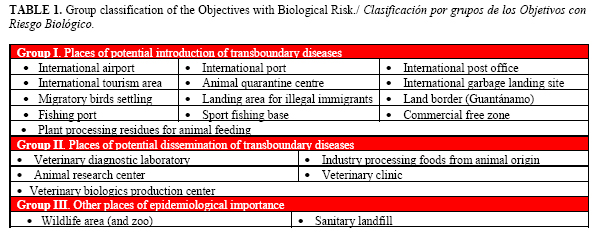
<body><![CDATA[<P>&nbsp; <H1> <font face="Verdana, Arial, Helvetica, sans-serif" size="2"><B><font size="3">MATERIALS    AND METHODS</font></B> </font></H1>     <P><font face="Verdana, Arial, Helvetica, sans-serif" size="2">A methodology was    developed and applied nationally in order to evaluate the risk of introduction    and dissemination of TADs in municipalities and country-wide. This allowed to    obtain a General Index of Biological Risk (GIBR) for each animal species (bovine,    porcine and poultry) at the municipality level. GIBR was calculated by accumulating    points based on the evaluation of the following components: </font>     <P><font face="Verdana, Arial, Helvetica, sans-serif" size="2"><B>&#149; Threats</B>:    given by the presence of objectives (places) with biological (sanitary) risk    (OBR) that can promote the introduction as well as dissemination of transboundary    diseases. </font>     <P><font face="Verdana, Arial, Helvetica, sans-serif" size="2">&#149; <B>Vulnerability    of OBR (V<SUB>OBR</SUB>)</B>: given by the deficiencies in the sanitary protection    (against epidemics) of the objectives with biological risks (OBR), those identified    as sanitary gaps (SG). </font>     <P><font face="Verdana, Arial, Helvetica, sans-serif" size="2">&#149; <B>Vulnerability    of the animal population (V<SUB>AP</SUB>)</B>: given by different factors that    make an animal population of a particular territory to be more exposed to the    introduction and dissemination of transboundary diseases. The methodology has    been developed for cattle, pigs and poultry, although it can be adapted to other    species. </font>     <P><font face="Verdana, Arial, Helvetica, sans-serif" size="2">In each territory,    a risk analysis is conducted for each animal species in a way that each one    has a particular GIBR determined by the peculiarity of its risk factors and    the vulnerability of its animal population. </font>     <P><font face="Verdana, Arial, Helvetica, sans-serif" size="2">The partial validation    of the methodology was made in 1997 (15), and after its integral validation    in four municipalities in 1998 (16), it was approved for its introduction in    the whole country in 2002 by the Veterinary Medicine Institute, official veterinary    services in Cuba. In 2003, the technical staff was trained to apply it in provinces    and municipalities. The necessary data for the analysis by veterinarians from    IMV at the municipalities is updating annually. </font>     <P><font face="Verdana, Arial, Helvetica, sans-serif" size="2">A brief explanation    about the criteria used for the evaluation of risks in every municipality is    given below. </font>     <P><font face="Verdana, Arial, Helvetica, sans-serif" size="2"><B>Evaluation of    threat (perils) from the presence of OBR (T).</B> </font>     <P><font face="Verdana, Arial, Helvetica, sans-serif" size="2">In every municipality,    all types of OBR were identified and grouped (I, II and III) according to whether    they were a place of potential introduction and/or dissemination of diseases,    or a general epidemiological interest (<a href="/img/revistas/rsa/v35n2/t0107213.jpg">Table    1</a>). Biological Risk Objectives of group I, except for fishing ports and    sport fishing bases, are places where activities of the first barrier of sanitary    protection are carried out, in particular the application of external quarantine    measures for avoiding exotic disease introduction. The inclusion of fishing    ports and sport fishing bases in OBR group I was justified by the possible contact    and illegal exchange of animal by-products between fishing boats and international    ships. International landing areas are coast zones where potentially dangerous    wastes coming from international ships are accumulated. Waste processing plants    were included in OBRs of group I because they receive sweepings from ports,    and residues from restaurants and hospitals among other wastes, and treat them    thermally at high pressure for the production of animal feed. </font>      
]]></body>
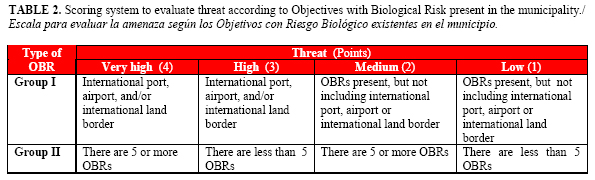
<body><![CDATA[<P><font face="Verdana, Arial, Helvetica, sans-serif" size="2">The industry processing    foods from animal origin (group II) include milk pasteurization plants, cheese    and ice-cream factories, rustic and industrial slaughterhouses and animal by-product    production centers, among others. </font>     <P><font face="Verdana, Arial, Helvetica, sans-serif" size="2"> The Threat (T)    existing in every municipality was classified by the kinds of Group I OBRs and    number of Group II OBRs present; and a threat-level value ranging from 1 (low)    to 4 (very high) was assigned (<a href="/img/revistas/rsa/v35n2/t0207213.jpg">Table    2</a>). International ports and airports and the international land border were    considered to pose great risk in a municipality (very high or high). Two to    four is the most common number of Group II OBRs in municipalities; therefore    five as a cut-off were used, assuming that municipalities with higher than this    number would be at greater risk for disease spread. </font>      
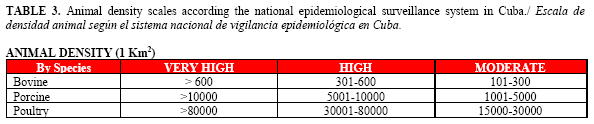
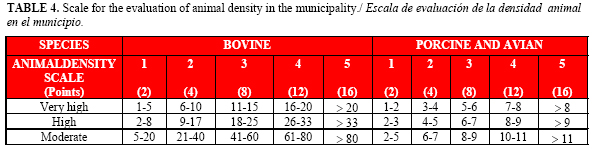
<P><font face="Verdana, Arial, Helvetica, sans-serif" size="2"><B>Evaluation of    OBRs municipal vulnerability (V<SUB>OBR</SUB>).</B> </font>     <P><font face="Verdana, Arial, Helvetica, sans-serif" size="2">The sanitary gaps    existing in OBRs identified in every territory were characterized according    to the protection criteria previously established for each kind of OBR (14).    From the perspective of vulnerability, Group I, II and III OBRs were assigned    5, 3 and 1 points, respectively, for each sanitary gap detected. The total points    accumulated from all existent gaps was considered as the measure of an individual    OBR's vulnerability. The sum of the total &#171;vulnerability&#187; points of    all OBRs existent in each municipality was calculated (V<SUB>OBR</SUB>), expressing    the overall vulnerability of that municipality. From threat perspective, each    Group I, II or III OBR was assigned 10, 5 or 3 points, respectively. The sum    of the total &#171;threat&#187; points of all OBRs existent in each municipality    was calculated (OBR<SUB>T</SUB>), expressing the overall threat in that region.    The V<SUB>OBR</SUB> was divided by OBR<SUB>T</SUB> and categorized. Points were    subjectively assigned (1 low, 2 medium, 3 high and 4 very high), to each V<SUB>OBR</SUB>/OBR<SUB>T</SUB>    category in order to estimate the average vulnerability of OBR in the municipality    (14). </font>     <P><font face="Verdana, Arial, Helvetica, sans-serif" size="2"><B>Evaluation of    vulnerability of animal population (V<SUB>AP</SUB>).</B> </font>     <P><font face="Verdana, Arial, Helvetica, sans-serif" size="2">Several aspects,    listed below, were considered in order to analyze the vulnerability of animal    populations (<I>V<SUB>AP</SUB></I>) by individual species (bovine, porcine,    poultry). The <I>V<SUB>AP</SUB></I> was ultimately determined by summing the    points assigned to each aspect. The points assigned to each category of each    aspect appear in parentheses. </font>     <P><font face="Verdana, Arial, Helvetica, sans-serif" size="2">I. Structure of    animal production in the municipality. </font>     <P><font face="Verdana, Arial, Helvetica, sans-serif" size="2">a) Density of animal    population. Points were accumulated from the number of geographical sub-quadrants    (1 Km<SUP>2</SUP>) categorized by SIVE (System of Information and Epidemiological    Surveillance, in Spanish), as very high, high and medium animal density in each    municipality (<a href="/img/revistas/rsa/v35n2/t0307213.jpg">Table 3</a>)    [16]. The points accumulated according to the animal density scale are shown    in <a href="/img/revistas/rsa/v35n2/t0407213.jpg">Table 4</a>. </font>      
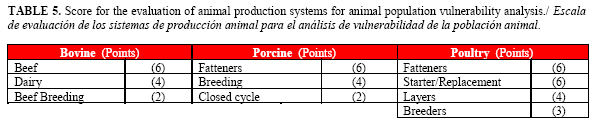
<P><font face="Verdana, Arial, Helvetica, sans-serif" size="2">b) The predominant    economical productive sector. Four types were considered: I) Backyard breeding    (15 points); II) Not specialized (10 points); III) Owner cooperatives (8 points);    IV) Specialized (6 points). The assignment of points was subjectively based    on several aspects, including biosecurity, level of diagnostic activities and    access to veterinary services and control of animal movement, all of which increased    in the same order as the different production types are cited above. The points    assigned are lower while the level of the biosecurity increases. </font>     <P><font face="Verdana, Arial, Helvetica, sans-serif" size="2">c) Main purpose    of animal production. This was evaluated only when the intensive production    sector with large scale production and a defined purpose predominate in the    municipalities. Those systems with greater systematic entry of animals in the    production flow (as fatteners and open production systems) were considered more    vulnerable, as they provide greater probabilities of entry of diseases into    herds as well as less sanitary stability of population with respect to endemic    diseases in the territory (<a href="/img/revistas/rsa/v35n2/t0507213.jpg">Table    5</a>). </font>      
]]></body>
<body><![CDATA[<P><font face="Verdana, Arial, Helvetica, sans-serif" size="2">d) Main movement    flow of animals in animal production. This refers to the movement (transit)    of animals to meet the production objectives of their husbandry in the territory.    This can be: movement out of the territory (0 points); movement within the territory    (3 points); movement into the territory (5 points). There is a greater probability    of the introduction of a new disease and epidemiological instability of animal    population when animals are introduced into the territory. </font>     <P><font face="Verdana, Arial, Helvetica, sans-serif" size="2">II.Sanitary control    of animal population. For each aspect, control is defined as satisfactory (S),    deficient (D) or regular (R). In case of &#171;Satisfactory&#187; it does not    sum any point (0). </font>     <P><font face="Verdana, Arial, Helvetica, sans-serif" size="2">a) The level of    veterinary diagnostic. This includes necropsies, sample submissions to labs    and the completion and reporting of the diagnostic work done in the labs. R    (6), D (8) </font>     <P><font face="Verdana, Arial, Helvetica, sans-serif" size="2">b) Quality of biosecurity.    Taking into account the external and internal barriers and environmental sanitation    evaluation in production facilities. R (8), D (10) </font>     <P><font face="Verdana, Arial, Helvetica, sans-serif" size="2">c) Animal movement    control. It considers the evaluation of the fulfillment of sanitary certification    for animal movement within and between municipalities and the violations detected.    R (3), D (5) </font>     <P><font face="Verdana, Arial, Helvetica, sans-serif" size="2">d) Delivery of    relevant and updated information on sanitary control to Municipal Office of    IMV. R (2), D (3) </font>     <P><font face="Verdana, Arial, Helvetica, sans-serif" size="2">e) Speed of notification    to the municipal IMV of high morbidity and/or mortality cases. R (3) <U>&lt;</U>    48 hours, D (5) &gt; 48 hours </font>     <P><font face="Verdana, Arial, Helvetica, sans-serif" size="2"> f) Veterinary    coverage provided by local veterinary services. R (2) D (4) </font>     <P><font face="Verdana, Arial, Helvetica, sans-serif" size="2"> g) Staffing completeness    of the official veterinary structure in the municipality (% of the stipulated    personnel employed). R (2) From 80-89 %, D (4) Less than 80% </font>     <P><font face="Verdana, Arial, Helvetica, sans-serif" size="2">III.Aspects related    to ownership of animals in urban areas </font>     ]]></body>
<body><![CDATA[<P><font face="Verdana, Arial, Helvetica, sans-serif" size="2">a) Approximate    estimate of animal population in urban areas. This is a relative evaluation    of the livestock existence (cattle, pigs, chicken) in the cities and surrounding    areas for backyard production. Low (2), Medium (3), High (5). </font>     <P><font face="Verdana, Arial, Helvetica, sans-serif" size="2">b) Vector and pest    control in urban communities. R (3), D (5). </font>     <P><font face="Verdana, Arial, Helvetica, sans-serif" size="2">c) Systematic collection    of garbage and wastes in the community. R (3), D (5) </font>     <P><font face="Verdana, Arial, Helvetica, sans-serif" size="2">IV. General characteristics    of the municipality. </font>     <P><font face="Verdana, Arial, Helvetica, sans-serif" size="2">a) Ratio of rural    to urban areas. Regions with a predominance of rural areas are considered more    vulnerable. Rural/urban: <U>&lt;</U> 0.6 (1), 0.7 - 0.9 (2),<U>&gt;</U>1 (4)    </font>     <P><font face="Verdana, Arial, Helvetica, sans-serif" size="2">b) Accessibility    into the territory. Municipalities with good transportation infrastructure (highway,    freeway, trains etc.) are considered more vulnerable because they facilitate    disease dissemination through the movement of people and vehicles linked to    animal production. For example, the intensive production of dairy cattle or    fatteners will require a viable infrastructure facilitating the link between    primary production and industry.Good (4), Average (2), Poor (1) </font>     <P><font face="Verdana, Arial, Helvetica, sans-serif" size="2">c) Predominant    landscape. Mountainous rural regions are considered more vulnerable due to the    difficulty of surveillance and routine control measures, above all when the    animals are scattered within small and isolated production sectors. Flat terrain    (1), Mixed (2),Mountainous (4) </font>     <P><font face="Verdana, Arial, Helvetica, sans-serif" size="2">The points assigned    for each aspect listed above (from I to IV) were summed within each species    (bovine, porcine, poultry), in order to determine their population vulnerability    (V<SUB>AP</SUB>) in each municipality. The following categories were then assigned    1, 2, 3 or 4 points respectively: Low (<U>&lt;</U>41 points), Medium (42-53),    High (54-64) or Very high (&gt;64). </font>     <P><font face="Verdana, Arial, Helvetica, sans-serif" size="2"><B>Evaluation of    the General Index of Biological Risk (GIBR)</B> </font>     <P><font face="Verdana, Arial, Helvetica, sans-serif" size="2">The points from    the final evaluation (Very high, High, Medium or Low) of each GIBR component    (T, V<SUB>OBR</SUB> and V<SUB>AP</SUB>) were summed. The points summed from    all components were categorized as: Low (3 - 4 points), Medium (5 - 7), High    (8 - 10) or Very high (11 - 12). </font>     ]]></body>
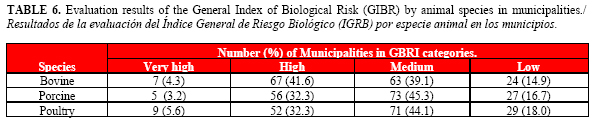
<body><![CDATA[<P><font face="Verdana, Arial, Helvetica, sans-serif" size="2">Since each animal    species (bovine, porcine and poultry) had its unique V<SUB>AP</SUB>, they were    also assigned a corresponding IGBR. In the same sense, the values of the Threat    (T) and V<SUB>OBR </SUB>can be different in IGBR evaluation for each animal    species.The ORB&#180;s considered cannot be the same for each one. For example,    if the slaughterhouse is only used for poultry, ORB is not to be considering    for the evaluation of the Threat and V<SUB>ORB </SUB>for bovine or swine population    in the municipality. </font>     <P><font face="Verdana, Arial, Helvetica, sans-serif" size="2">The methodology    is supported by a computerized system (ACCESS) with its user manual [18].</font>     <P>&nbsp; <H1> <font face="Verdana, Arial, Helvetica, sans-serif" size="2"><B><font size="3">RESULTS    AND DISCUSSION</font></B> </font></H1>     <P><font face="Verdana, Arial, Helvetica, sans-serif" size="2">Results of the    biological risk territorial analysis were obtained from 161 municipalities (95.3    % of the total). One-thousand five-hundred ninety-seven ORB were identified;    737 (46.2%) were places of potential introduction of transboundary diseases,    622 (38.9%) were places that can contribute to disease dissemination, and 238    (14.9%) were places of epidemiological importance in cases of disease emergencies    (i.e., wildlife areas, such as zoos, and dumping places or sanitary landfill).    </font>     <P><font face="Verdana, Arial, Helvetica, sans-serif" size="2">Dumping places    are very important due to the increase in food animal rearing in urban areas.    Therefore, in addition to the potential presence of exotic pathogens in animal-origin    food residues, domestic wastes may contain feces and other solid residues from    backyard animal rearing, which can also be sources of endemic pathogens. </font>     <P><font face="Verdana, Arial, Helvetica, sans-serif" size="2"><a href="/img/revistas/rsa/v35n2/t0607213.jpg">Table    6</a> summarizes the evaluation of the General Index of Biological Risk in municipalities    for bovine, swine and poultry. It is important to note that the labels for these    categories contribute to establish the relative risk of municipalities within    their province in order to prioritize planning activities. For instance, the    designation Very High means that the municipality needs more attention because    it has higher conditions for the disease introduction and spread than those    designed as Medium or Low. For each species, the majority of municipalities    presented a GIBR between High and Medium; though porcine and poultry have relatively    more municipalities classified as Medium (as opposed to High) than bovine. This    is a result of the intensive production practices of porcine and poultry industries,    which favors the most rigorous application of biosecurity measures and other    kinds of controls. Also, the control or preventive program for classical swine    fever (CSF) and avian influenza (H5N1), respectively, have an impact in these    better evaluations than in bovine. On other hand, bovine operations tend to    be semi-intensive or extensive with minor biosecurity practices. </font>      
<P><font face="Verdana, Arial, Helvetica, sans-serif" size="2">For all species,    very few municipalities obtained Very High values of GIBR. This indicates that    there are very few municipalities having both conditions, the OBRs of greater    danger (airports, ports and land borders) and Very High or High vulnerability    values, in either OBRs or animal populations. </font>     <P><font face="Verdana, Arial, Helvetica, sans-serif" size="2">It is important    to note that in those municipalities with Very High GIBR, sanitary gaps in the    protection of international ports and airports were not detected. Adequate measures    for counteracting risks are guaranteed in all of these kinds of OBRs in Cuba,    as they are subjected to systematic inspection by the national and local sanitary    authorities. </font>     <P><font face="Verdana, Arial, Helvetica, sans-serif" size="2">The risk analysis    is a decision support tool for the control and prevention of animal diseases    [19]. So, in order to provide the basis for designing and implementing appropriately    resourced prevention strategies, the risk analysis should provide an estimate    of introduction risk degree of the target disease(s), the more likely mechanisms    and entry portals of them in the country and the potential seriousness of its    consequences [14]. The territorial risk analysis follows these objectives for    the improvement of reduction risk program at local level as a task of the official    veterinary services. </font>     <P><font face="Verdana, Arial, Helvetica, sans-serif" size="2">This methodology    enables making a detailed analysis of the different factors that significantly    influence in the origin, course and development of an epidemic in any territory.    More than having a qualitative or quantitative evaluation of risk, it allows    the identification of problems leading to greater vulnerability in front of    a transboundary disease spreading and its disastrous consequences. Thus, the    assessment of the TADs risk impact does not rest alone on the GIBR qualification.    </font>     ]]></body>
<body><![CDATA[<P><font face="Verdana, Arial, Helvetica, sans-serif" size="2">The disaster reduction    plan for animal production to cope all perils (biological, natural and technological)    should be made by the veterinary services for each farm and ORB. Therefore,    the methodology is useful for the identification of TADs risks introduction/dissemination    and respective counter measures for its inclusion in the plan of each ORB and    a broader level as a municipality/province. </font>     <P><font face="Verdana, Arial, Helvetica, sans-serif" size="2">As have been recommended,    risk evaluations should include all components that allow the planners to identify    sensitive determinants and feasible measures to apply, in order to reduce perils    or vulnerability, i.e. to develop a plan for risk reduction [20]. </font>     <P><font face="Verdana, Arial, Helvetica, sans-serif" size="2">Many specialists    of different disciplines at munici-pality and province level intervened in the    risk analysis process and approved the final report for each territory. As recommended,    this process uses science-based evidence through multidisciplinary approach    to assist in making decisions for animal health policy [4, 14]. </font>     <P><font face="Verdana, Arial, Helvetica, sans-serif" size="2">In Cuba, the plans    for dealing with natural, technolo-gical and sanitary (biological) disasters    in all sectors are guided by the Civil Defense [21, 22, 23, 24], and the Agricultural    Ministry within the sector [25, 26]. </font>     <P><font face="Verdana, Arial, Helvetica, sans-serif" size="2">On the other hand,    Cuba has a surveillance system with a comprehensive and current data base [17],    which includes accurate data for the risk analyses from essentially every single    animal production unit in each municipality. The methodology for biological    risk analysis is geared towards veterinary service at the municipal level, which    is the primary technical-administrative level of IMV. It provides a tool for    the basic evaluation of diverse risk factors that facilitate the introduction    and dissemination of TADs. </font>     <P><font face="Verdana, Arial, Helvetica, sans-serif" size="2">The methodology    has greatly improved the planning of measures to prevent disease emergencies    in Cuba, and it is particularly useful because it pays attention to the threats    and vulnerability conditions in every municipality. Throughout many years ago,    the progressive application of this methodology has been incorporated in the    surveillance system and its results are considering also disaster reduction    program elaborated at the local level. </font>     <P><font face="Verdana, Arial, Helvetica, sans-serif" size="2">The territorial    risk analysis is only possible to be made by the veterinary services at the    same level, never by the province or national specialists whom do not know the    particular characteristics of each municipality. The strengthening of veterinary    services at the municipal level has aided these activities in a more effective    manner which includes the participation from key people in all sectors involved    with animal production. </font>     <P><font face="Verdana, Arial, Helvetica, sans-serif" size="2">FAO was committed    to develop a system approach to assist countries to attain compliance with international    animal health standards and improve trade opportunities [7]. In this sense,    the territorial analysis of biological risk could offer performance indicators    related to the principal compliance sanitary barriers to avoid the introduction    and dissemination of diseases into any territory, and it facilitates the improvement    of the prevention measures against these threats and trade opportunities. </font>     <P><font face="Verdana, Arial, Helvetica, sans-serif" size="2">To coping disasters    situations, communication among the different actors in the community is a strategic    aspect, because they should know and have an adequate perception about the risks    they are facing. Their support is a key for success the mitigation programs    [13, 20]. </font>     <P><font face="Verdana, Arial, Helvetica, sans-serif" size="2">Ways to facilitate    communication and to sensitize all stakeholders to the importance of planning    measures for mitigating future events that can affect animal protection should    include education about biological risk evaluation activities geared directly    or indirectly to animal health in various places or about indicators of the    danger of introduction and dissemination of severe diseases, including zoonosis.    </font>     ]]></body>
<body><![CDATA[<P><font face="Verdana, Arial, Helvetica, sans-serif" size="2">In this context,    the results of the municipal risk analysis are also useful to sensitize the    community sectors involved in the disaster reduction activities. </font>     <P><font face="Verdana, Arial, Helvetica, sans-serif" size="2">The methodology    applied in Cuba has many contact points with the recently guide proposed for    the prevention and control of diseases which considers the concepts as risk-based    and people-centered control of disease risks in livestock value chain [14].    </font>     <P><font face="Verdana, Arial, Helvetica, sans-serif" size="2">Nowadays it is    accepted the planning of strategies to reduce risks (risk management) as a result    of knowledge of the usual patterns of movement of animals, products, materials,    people and vehicles (productive fluxes) combined with risk analysis to better    understand how disease could spread if introduced into the system at different    places [14]. So, the strategy to coping avian influenza in Asia was strengthened    with these guidelines to use science-based evidence by a multidisciplinary approach    which contributed to a better understanding of the disease transmission risks,    drivers and impacts (27). </font>     <P><font face="Verdana, Arial, Helvetica, sans-serif" size="2">The territorial    based-methodology bases are similar of those and its application was useful    to improve and support diseases prevention program at local level. So, the Veterinary    Services need to define the major issues to coping TADS for requesting a higher    priority in the national budget allocation, and/or sustained external support.Thus,    the risk analysis results can help the Veterinary Services to identify the priorities    and can be able to effectively address these challenges. In Cuba there is investment    in the development of capabilities for disaster preparation from threat, vulnerability    and risk planning and identification process (28). </font>     <P><font face="Verdana, Arial, Helvetica, sans-serif" size="2">Taking into account    many similarities in the animal production systems in the Caribbean countries,    the Cuban experience with this methodology was shared with the Epidemiology    Working Group (EWG) of CaribVET, the network of animal health in the region.    For its use in other countries the methodological manual, with the software    for database management and the user&#180;s manual, were translated into English    for the training of the EWG members (29). </font>     <P><font face="Verdana, Arial, Helvetica, sans-serif" size="2">Recently, the necessity    of increasing the participation of the veterinary authority in the national    platform for disaster reduction was analyzed since the prevention stage, particularly    in the perils, vulnerability and risk analysis (30). Also, it is better to work    on risk reduction rather than on risk management because of the significant    benefits from the improved prevention and control measures outweigh the cost    of investment (7, 11). </font>     <P><font face="Verdana, Arial, Helvetica, sans-serif" size="2">The risk analysis    territorial-based methodology considers the introduction and spreading disease    prevention in a broad sense. It takes into account the TADs general characteristics    in order to have a better target and improve the sanitary defenses at national    levels as an effective way to cope these threats of biological disasters. </font>     <P><font face="Verdana, Arial, Helvetica, sans-serif" size="2">So, the methodology    has been updating since 2012 with some changes in the territorial analysis of    perils. Additionally, the major exotic and endemic diseases for our country    were considered, specifically those with potential emergence due to climate    changes.</font>     <P>&nbsp;     <P><font face="Verdana, Arial, Helvetica, sans-serif" size="2"><B><font size="3">REFERENCES</font></B>    </font>      ]]></body>
<body><![CDATA[<!-- ref --><P><font face="Verdana, Arial, Helvetica, sans-serif" size="2">1. Rich KM, Perry      BD. The economic and poverty impacts of animal diseases in developing countries:      New roles, new demands for economics and epidemiology. Prev Vet Med. 2010;101(3-4):133-147.          </font>        <!-- ref --><P><font face="Verdana, Arial, Helvetica, sans-serif" size="2">2. Astudillo VM,    Casas RO, Rosenberg F. Situaciones de desastres que afectan la salud animal    de pa&iacute;ses latinoamericanos. Monograf&iacute;a. Consejo Cient&iacute;fico    Veterinario de Cuba. 1990.     </font>      <!-- ref --><P><font face="Verdana, Arial, Helvetica, sans-serif" size="2">3. Domenech J.    The global framework for the progressive control of transboundary animal diseases    (TADs). Capacity building for surveillance and control of zoonotic diseases.    FAO/WHO/OIE Expert and Technical Consultation. 2005, Rome, 14-16 June. Available    in: <U><a href="ftp://ftp.fao.org/docrep/fao/009/a0083e/" target="_blank">ftp://ftp.fao.org/docrep/fao/009/a0083e/</a></U>.    Revised: 31 de enero de 2013.     </font>      <!-- ref --><P><font face="Verdana, Arial, Helvetica, sans-serif" size="2">4. Morzaria S.    Investments for resilience against vulnerability: transboundary animal disease    control. In: Food for All. Investment Forum for Food Security in Asia and the    Pacific. 2010, 7-9 July. Manila, Philippines. Available in: <U><a href="http://www.foodsecurity-asiapacific.com/wp-content/uploads/2010/10/pdf%20/Session4/3%20S.%20Morzaria_Innovations%20in%20Transboundary%20Animal%20Disease%20Mgt%20(Document).pdf" target="_blank">http://www.foodsecurity-asiapacific.com/wp-content/uploads/2010/10/pdf    /Session4/3 S. Morzaria_Innovations in Transboundary Animal Disease Mgt (Document).pdf</a></U>.    Revised: 22 de junio de 2011.     </font>      <!-- ref --><P><font face="Verdana, Arial, Helvetica, sans-serif" size="2">5. S&oslash;rensen      JT, Edwards S, Noordhuizen J, Gunnarsson S. Animal production systems in the      industrialized world. Rev sci tech Off int Epiz. 2006;25(2):493-503.     </font>       ]]></body>
<body><![CDATA[<!-- ref --><P><font face="Verdana, Arial, Helvetica, sans-serif" size="2">6. Vallat B,      Pinto J, Schudel A. International organizations and their role in helping      to protect the worldwide community against natural and intentional biological      disasters. Rev Sci Tech Off int Epiz. 2006;25(1):163-172.     </font>        <!-- ref --><P><font face="Verdana, Arial, Helvetica, sans-serif" size="2">7. World Organisation    for Animal Health (OIE). Prevention and control of animal diseases worldwide.    Part I Economic analysis - prevention versus outbreak costs. Final Report. Part    I. Submitted by: Civic Consulting - Agra CEAS Consulting. 2007. Available in:    <U><a href="http://www.oie.int/fileadmin/Home/eng/Support_to_OIE_Members/docs/pdf/OIE_-_Cost-Benefit_Analysis_Part_I_.pdf" target="_blank">http://www.oie.int/fileadmin/Home/eng/Support_to_OIE_Members/docs/pdf/OIE_-_Cost-Benefit_Analysis_Part_I_.pdf</a></U>.    Revised: 20 de febrero de 2013.     </font>      <!-- ref --><P><font face="Verdana, Arial, Helvetica, sans-serif" size="2">8. Food and Agricultural    Organization (FAO). Good Emergency Management Practices: The Essentials. Nick    Honhold N, Douglas I, Geering W, Shimshoni A, Lubroth J, editors. FAO Animal    Production and Health 2011, Manual No. 11.     </font>      <!-- ref --><P><font face="Verdana, Arial, Helvetica, sans-serif" size="2">9. Civic Consulting      (World Organization for Animal Health, World Bank, European Union). Cost of      National Prevention Systems for Animal Diseases and Zoonoses in Developing      and Transition Countries. 2009. p. 381.     </font>        <!-- ref --><P><font face="Verdana, Arial, Helvetica, sans-serif" size="2">10.Jones KE, Patel    N, Levy MA, Storeygard A, Balk D, Gittleman JL, et al. Global trends in emerging    infectious diseases. Nature. 2008;451:990-993.     </font>      ]]></body>
<body><![CDATA[<!-- ref --><P><font face="Verdana, Arial, Helvetica, sans-serif" size="2">11.Lubroth J.      International cooperation and preparedness in responding to accidental or      deliberate biological disasters: lessons and future directions. Rev Sci Tech      Off int Epiz. 2006;25(1):361-374.     </font>       <!-- ref --><P><font face="Verdana, Arial, Helvetica, sans-serif" size="2">12.Rushton J,      Upton M. Investment in preventing and prepararing for biological emergencies      and disasters: social and economic cost of disasters versus costs of surveillance      and response preparedness. Rev Sci Tech Off int Epiz. 2006;25(1):375-388.          </font>        <!-- ref --><P><font face="Verdana, Arial, Helvetica, sans-serif" size="2">13.Programa de    Naciones Unidas para el Desarrollo (PNUD). Un informe mundial. LA REDUCCI&Oacute;N    DE RIESGOS DE DESASTRES - Un desaf&iacute;o para el desarrollo. 2004, Available    in: <U><a href="http://www.undp.org/bcpr" target="_blank">http://www.undp.org/bcpr</a></U>.    Revised: 20 de junio de 2011.     </font>      <!-- ref --><P><font face="Verdana, Arial, Helvetica, sans-serif" size="2">14.Food and Agricultural    Organization (FAO). A value chain approach to animal diseases risk management    Technical foundations and practical framework for field application. Animal    Production and Health Guidelines. 2011, No. 4. Available in: <U><a href="http://www.fao.org/docrep/014/al861e/al861e00.pdf" target="_blank">http://www.fao.org/docrep/014/al861e/al861e00.pdf</a></U>.    Revised: 20 de junio de 2011.     </font>      <!-- ref --><P><font face="Verdana, Arial, Helvetica, sans-serif" size="2">15.Percedo MI,      P&eacute;rez S, Gonz&aacute;lez I, M&eacute;rida R, Alfonso O, Ch&aacute;vez      P. An&aacute;lisis de riesgo de desastres biol&oacute;gicos para la poblaci&oacute;n      animal. Rev Salud Anim. 1998;20(1):5-8.     </font>       ]]></body>
<body><![CDATA[<!-- ref --><P><font face="Verdana, Arial, Helvetica, sans-serif" size="2">16.Percedo MI.      An&aacute;lisis de riesgo biol&oacute;gico por enfermedades emergentes en      la poblaci&oacute;n animal (Tesis). Centro Nacional de Sanidad Agropecuaria,      Cuba; 1998.     </font>       <!-- ref --><P><font face="Verdana, Arial, Helvetica, sans-serif" size="2">17.Toledo M,      Seoane G, Fregel N, Encinosa A, Serrano E. Sistema de informaci&oacute;n y      vigilancia epizootiol&oacute;gica en la Rep&uacute;blica de Cuba. Rev Cub      Cienc Vet. 2000;26(1):7-11.     </font>        <!-- ref --><P><font face="Verdana, Arial, Helvetica, sans-serif" size="2">18.Gonz&aacute;lez    I, Percedo MI. Sistema automatizado para el An&aacute;lisis Territorial de Riesgo    Biol&oacute;gico para la poblaci&oacute;n animal. Rev Salud Anim. 2005;27(1):15-20.        </font>      <!-- ref --><P><font face="Verdana, Arial, Helvetica, sans-serif" size="2">19.Zepeda C. Risk    analysis a decision support tool for the control and prevention of animal diseases.    70<SUP>ava. </SUP>Asamblea General de la OIE. 2001, Paris, Francia. Available    in: <U><a href="ftp://ftp.oie.int/70SG_2002/A_70_SG_10.pdf" target="_blank">ftp://ftp.oie.int/70SG_2002/A_70_SG_10.pdf</a></U>.    Revised: 20 de junio de 2011.     </font>      <!-- ref --><P><font face="Verdana, Arial, Helvetica, sans-serif" size="2">20.United Nations    International Strategy for Disaster Reduction (UNISDR). Terminology on Disaster    Risk Reduction. 2009. p. 35. Available in: <U><a href="http://www.unisdr.org/we/inform/terminology" target="_blank">http://www.unisdr.org/we/inform/terminology</a></U>.    Revised: 29 de enero de 2013.     </font>      ]]></body>
<body><![CDATA[<!-- ref --><P><font face="Verdana, Arial, Helvetica, sans-serif" size="2">21.Ch&aacute;vez      PR, Percedo MI, Peraza A, Toledo M. La planificaci&oacute;n y organizaci&oacute;n      del aseguramiento veterinario para casos de desastres. Rvta Cub Cienc Vet.      1992;24(1):41-43.     </font>        <!-- ref --><P><font face="Verdana, Arial, Helvetica, sans-serif" size="2">22.Defensa Civil    de Cuba. Metodolog&iacute;a para la elaboraci&oacute;n del Anexo al Plan de    medidas para casos de cat&aacute;strofes correspondientes a enfermedades epizo&oacute;ticas    graves para los animales. 1995.     </font>      <!-- ref --><P><font face="Verdana, Arial, Helvetica, sans-serif" size="2">23.Consejo de Defensa    Nacional-CDN. Directiva No. 1 del Vicepresidente del Consejo de Defensa Nacional    para la Planificaci&oacute;n, Organizaci&oacute;n y Preparaci&oacute;n del Pa&iacute;s    para Situaciones de Desastres. Directiva No. 1. Consejo de Defensa Nacional,    Cuba. (Junio 1, 2005). Available in: <U><a href="http://www.sld.cu/galerias/pdf/sitios/desastres/directiva_vp_cdn_sobre_desastres.ultima_version.pdf" target="_blank">http://www.sld.cu/galerias/pdf/sitios/desastres/directiva_vp_cdn_sobre_desastres.ultima_version.pdf</a></U>    Revised: 20 de junio de 2011.     </font>      <!-- ref --><P><font face="Verdana, Arial, Helvetica, sans-serif" size="2">24.Consejo de      Defensa Nacional-CDN. Directiva No. 1 del Presidente del Consejo de Defensa      Nacional para la Reducci&oacute;n de Desastres. 2010, 8 de abril, La Habana,      Cuba.     </font>       <P><font face="Verdana, Arial, Helvetica, sans-serif" size="2">25.Anexo al Plan      de Medidas para casos de cat&aacute;strofes correspondiente a enfermedades      epizo&oacute;ticas graves para los animales. Indicaci&oacute;n No. 2. Ministerio      de la Agricultura. Cuba. 1995. </font>        <!-- ref --><P><font face="Verdana, Arial, Helvetica, sans-serif" size="2">26.Percedo MI,    Betancourt JE, Alfonso P, Tablada L. Estrategia para la reducci&oacute;n de    desastres sanitarios en la poblaci&oacute;n animal en Cuba. El caso de la influenza    aviar. Rev Salud Anim. 2006;28(3):174-181.     </font>      <!-- ref --><P><font face="Verdana, Arial, Helvetica, sans-serif" size="2">27.Morzaria S.    Taking a holistic approach transboundary animal disease control. In: Food for    All. Investing in Food Security in Asia and the Pacific-Issues, Innovations    and Practices. Ed.: Philippines Asian Development Bank, 2011. p. 198-208.     </font>      <!-- ref --><P><font face="Verdana, Arial, Helvetica, sans-serif" size="2">28.Izquierdo Carballo    MJ. La reducci&oacute;n de riesgos de desastres: enfoque integral de actuaci&oacute;n    para impulsar procesos de desarrollo m&aacute;s seguros y sostenibles. En: Experiencias    Compartidas N&#186; 3 Gesti&oacute;n de riesgos de desastres. Ayuda en Acci&oacute;&iexcl;n.    2008. p. 1-7. Available in: <U><a href="http://www.ayudaenaccion.org" target="_blank">http://www.ayudaenaccion.org</a></U>.    Revised: 29 de noviembre de 2012.     </font>      <P><font face="Verdana, Arial, Helvetica, sans-serif" size="2">29.Percedo MI,    G&oacute;ngora V, Sanford B, Myers J, De Paz M, Fr&iacute;as MT, et al. Capacidades    fortalecidas por CaribVET. An&aacute;lisis territorial de riesgo para la prevenci&oacute;n    de enfermedades (Caso Belize). Acta del I Congreso Internacional de la Sociedad    Iberoamericana de Epidemiolog&iacute;a Veterinaria y Medicina Preventiva; 2011;    21-23 Nov., Comunicaci&oacute;n Oral 5.1, M&eacute;rida, M&eacute;xico. p. 1-92.    </font>      <!-- ref --><P><font face="Verdana, Arial, Helvetica, sans-serif" size="2">30.Mendoza E, Percedo    MI. Manejo de situaciones de desastres y el rol y la preparaci&oacute;n de los    Servicios Veterinarios. Acta de la 21&#170; Conf. Comisi&oacute;n Regional OIE    para las Am&eacute;ricas, 2012 26-29 Nov.; Bridgetown, Barbados. p. 6-21.    </font>     <P>&nbsp;     <P>&nbsp;     ]]></body>
<body><![CDATA[<P><font face="Verdana, Arial, Helvetica, sans-serif" size="2">Recibido: 20-2-2013.    <br>   </font><font face="Verdana, Arial, Helvetica, sans-serif" size="2">Aceptado:    8-5-2013.</font>     <P>&nbsp;     <P>&nbsp;     <P><font face="Verdana, Arial, Helvetica, sans-serif" size="2"><B><a href="#pie">*</a><a name="autor"></a></B><i>Ch&aacute;vez,    Pablo:</i> He worked in the National Civil Defence when this methodology was    developed. Our post-morten recognition. </font>       ]]></body><back>
<ref-list>
<ref id="B1">
<label>1</label><nlm-citation citation-type="journal">
<person-group person-group-type="author">
<name>
<surname><![CDATA[Rich]]></surname>
<given-names><![CDATA[KM]]></given-names>
</name>
<name>
<surname><![CDATA[Perry]]></surname>
<given-names><![CDATA[BD]]></given-names>
</name>
</person-group>
<article-title xml:lang="en"><![CDATA[The economic and poverty impacts of animal diseases in developing countries: New roles, new demands for economics and epidemiology]]></article-title>
<source><![CDATA[Prev Vet Med]]></source>
<year>2010</year>
<volume>101</volume>
<numero>3-4</numero>
<issue>3-4</issue>
<page-range>133-147</page-range></nlm-citation>
</ref>
<ref id="B2">
<label>2</label><nlm-citation citation-type="book">
<person-group person-group-type="author">
<name>
<surname><![CDATA[Astudillo]]></surname>
<given-names><![CDATA[VM]]></given-names>
</name>
<name>
<surname><![CDATA[Casas]]></surname>
<given-names><![CDATA[RO]]></given-names>
</name>
<name>
<surname><![CDATA[Rosenberg]]></surname>
<given-names><![CDATA[F]]></given-names>
</name>
</person-group>
<source><![CDATA[Situaciones de desastres que afectan la salud animal de países latinoamericanos]]></source>
<year>1990</year>
<publisher-name><![CDATA[Consejo Científico Veterinario de Cuba]]></publisher-name>
</nlm-citation>
</ref>
<ref id="B3">
<label>3</label><nlm-citation citation-type="book">
<person-group person-group-type="author">
<name>
<surname><![CDATA[Domenech]]></surname>
<given-names><![CDATA[J]]></given-names>
</name>
</person-group>
<source><![CDATA[The global framework for the progressive control of transboundary animal diseases (TADs): Capacity building for surveillance and control of zoonotic diseases]]></source>
<year>2005</year>
<publisher-loc><![CDATA[Rome ]]></publisher-loc>
<publisher-name><![CDATA[FAO/WHO/OIE Expert and Technical Consultation]]></publisher-name>
</nlm-citation>
</ref>
<ref id="B4">
<label>4</label><nlm-citation citation-type="">
<person-group person-group-type="author">
<name>
<surname><![CDATA[Morzaria]]></surname>
<given-names><![CDATA[S]]></given-names>
</name>
</person-group>
<article-title xml:lang="en"><![CDATA[Investments for resilience against vulnerability: transboundary animal disease control]]></article-title>
<source><![CDATA[Food for All: Investment Forum for Food Security in Asia and the Pacific]]></source>
<year>2010</year>
<publisher-loc><![CDATA[Manila^ePhilippines Philippines]]></publisher-loc>
</nlm-citation>
</ref>
<ref id="B5">
<label>5</label><nlm-citation citation-type="journal">
<person-group person-group-type="author">
<name>
<surname><![CDATA[Sørensen]]></surname>
<given-names><![CDATA[JT]]></given-names>
</name>
<name>
<surname><![CDATA[Edwards]]></surname>
<given-names><![CDATA[S]]></given-names>
</name>
<name>
<surname><![CDATA[Noordhuizen]]></surname>
<given-names><![CDATA[J]]></given-names>
</name>
<name>
<surname><![CDATA[Gunnarsson]]></surname>
<given-names><![CDATA[S]]></given-names>
</name>
</person-group>
<article-title xml:lang="en"><![CDATA[Animal production systems in the industrialized world]]></article-title>
<source><![CDATA[Rev sci tech Off int Epiz]]></source>
<year>2006</year>
<volume>25</volume>
<numero>2</numero>
<issue>2</issue>
<page-range>493-503</page-range></nlm-citation>
</ref>
<ref id="B6">
<label>6</label><nlm-citation citation-type="journal">
<person-group person-group-type="author">
<name>
<surname><![CDATA[Vallat]]></surname>
<given-names><![CDATA[B]]></given-names>
</name>
<name>
<surname><![CDATA[Pinto]]></surname>
<given-names><![CDATA[J]]></given-names>
</name>
<name>
<surname><![CDATA[Schudel]]></surname>
<given-names><![CDATA[A]]></given-names>
</name>
</person-group>
<article-title xml:lang="en"><![CDATA[International organizations and their role in helping to protect the worldwide community against natural and intentional biological disasters]]></article-title>
<source><![CDATA[Rev Sci Tech Off int Epiz]]></source>
<year>2006</year>
<volume>25</volume>
<numero>1</numero>
<issue>1</issue>
<page-range>163-172</page-range></nlm-citation>
</ref>
<ref id="B7">
<label>7</label><nlm-citation citation-type="">
<collab>World Organisation for Animal Health (OIE)</collab>
<source><![CDATA[Prevention and control of animal diseases worldwide: Part I Economic analysis - prevention versus outbreak costs]]></source>
<year>2007</year>
</nlm-citation>
</ref>
<ref id="B8">
<label>8</label><nlm-citation citation-type="">
<collab>Food and Agricultural Organization (FAO)</collab>
<article-title xml:lang="en"><![CDATA[Good Emergency Management Practices: The Essentials]]></article-title>
<person-group person-group-type="author">
<name>
<surname><![CDATA[Nick Honhold]]></surname>
<given-names><![CDATA[N]]></given-names>
</name>
<name>
<surname><![CDATA[Douglas]]></surname>
<given-names><![CDATA[I]]></given-names>
</name>
<name>
<surname><![CDATA[Geering]]></surname>
<given-names><![CDATA[W]]></given-names>
</name>
<name>
<surname><![CDATA[Shimshoni]]></surname>
<given-names><![CDATA[A]]></given-names>
</name>
<name>
<surname><![CDATA[Lubroth]]></surname>
<given-names><![CDATA[J]]></given-names>
</name>
</person-group>
<source><![CDATA[Animal Production and Health]]></source>
<year>2011</year>
</nlm-citation>
</ref>
<ref id="B9">
<label>9</label><nlm-citation citation-type="">
<collab>World Organization for Animal Health, World Bank, European Union</collab>
<source><![CDATA[Cost of National Prevention Systems for Animal Diseases and Zoonoses in Developing and Transition Countries]]></source>
<year>2009</year>
<page-range>381</page-range></nlm-citation>
</ref>
<ref id="B10">
<label>10</label><nlm-citation citation-type="journal">
<person-group person-group-type="author">
<name>
<surname><![CDATA[Jones]]></surname>
<given-names><![CDATA[KE]]></given-names>
</name>
<name>
<surname><![CDATA[Patel]]></surname>
<given-names><![CDATA[N]]></given-names>
</name>
<name>
<surname><![CDATA[Levy]]></surname>
<given-names><![CDATA[MA]]></given-names>
</name>
<name>
<surname><![CDATA[Storeygard]]></surname>
<given-names><![CDATA[A]]></given-names>
</name>
<name>
<surname><![CDATA[Balk]]></surname>
<given-names><![CDATA[D]]></given-names>
</name>
<name>
<surname><![CDATA[Gittleman]]></surname>
<given-names><![CDATA[JL]]></given-names>
</name>
</person-group>
<article-title xml:lang="en"><![CDATA[Global trends in emerging infectious diseases]]></article-title>
<source><![CDATA[Nature]]></source>
<year>2008</year>
<volume>451</volume>
<page-range>990-993</page-range></nlm-citation>
</ref>
<ref id="B11">
<label>11</label><nlm-citation citation-type="journal">
<person-group person-group-type="author">
<name>
<surname><![CDATA[Lubroth]]></surname>
<given-names><![CDATA[J]]></given-names>
</name>
</person-group>
<article-title xml:lang="en"><![CDATA[International cooperation and preparedness in responding to accidental or deliberate biological disasters: lessons and future directions]]></article-title>
<source><![CDATA[Rev Sci Tech Off int Epiz]]></source>
<year>2006</year>
<volume>25</volume>
<numero>1</numero>
<issue>1</issue>
<page-range>361-374</page-range></nlm-citation>
</ref>
<ref id="B12">
<label>12</label><nlm-citation citation-type="journal">
<person-group person-group-type="author">
<name>
<surname><![CDATA[Rushton]]></surname>
<given-names><![CDATA[J]]></given-names>
</name>
<name>
<surname><![CDATA[Upton]]></surname>
<given-names><![CDATA[M]]></given-names>
</name>
</person-group>
<article-title xml:lang="en"><![CDATA[Investment in preventing and prepararing for biological emergencies and disasters: social and economic cost of disasters versus costs of surveillance and response preparedness]]></article-title>
<source><![CDATA[Rev Sci Tech Off int Epiz]]></source>
<year>2006</year>
<volume>25</volume>
<numero>1</numero>
<issue>1</issue>
<page-range>375-388</page-range></nlm-citation>
</ref>
<ref id="B13">
<label>13</label><nlm-citation citation-type="">
<collab>PNUD</collab>
<source><![CDATA[Un informe mundial: LA REDUCCIÓN DE RIESGOS DE DESASTRES - Un desafío para el desarrollo]]></source>
<year>2004</year>
</nlm-citation>
</ref>
<ref id="B14">
<label>14</label><nlm-citation citation-type="">
<collab>FAO</collab>
<source><![CDATA[A value chain approach to animal diseases risk management Technical foundations and practical framework for field application: Animal Production and Health Guidelines]]></source>
<year>2011</year>
</nlm-citation>
</ref>
<ref id="B15">
<label>15</label><nlm-citation citation-type="journal">
<person-group person-group-type="author">
<name>
<surname><![CDATA[Percedo]]></surname>
<given-names><![CDATA[MI]]></given-names>
</name>
<name>
<surname><![CDATA[Pérez]]></surname>
<given-names><![CDATA[S]]></given-names>
</name>
<name>
<surname><![CDATA[González]]></surname>
<given-names><![CDATA[I]]></given-names>
</name>
<name>
<surname><![CDATA[Mérida]]></surname>
<given-names><![CDATA[R]]></given-names>
</name>
<name>
<surname><![CDATA[Alfonso]]></surname>
<given-names><![CDATA[O]]></given-names>
</name>
<name>
<surname><![CDATA[Chávez]]></surname>
<given-names><![CDATA[P]]></given-names>
</name>
</person-group>
<article-title xml:lang="es"><![CDATA[Análisis de riesgo de desastres biológicos para la población animal]]></article-title>
<source><![CDATA[Rev Salud Anim]]></source>
<year>1998</year>
<volume>20</volume>
<numero>1</numero>
<issue>1</issue>
<page-range>5-8</page-range></nlm-citation>
</ref>
<ref id="B16">
<label>16</label><nlm-citation citation-type="">
<person-group person-group-type="author">
<name>
<surname><![CDATA[Percedo]]></surname>
<given-names><![CDATA[MI]]></given-names>
</name>
</person-group>
<source><![CDATA[Análisis de riesgo biológico por enfermedades emergentes en la población animal]]></source>
<year></year>
</nlm-citation>
</ref>
<ref id="B17">
<label>17</label><nlm-citation citation-type="journal">
<person-group person-group-type="author">
<name>
<surname><![CDATA[Toledo]]></surname>
<given-names><![CDATA[M]]></given-names>
</name>
<name>
<surname><![CDATA[Seoane]]></surname>
<given-names><![CDATA[G]]></given-names>
</name>
<name>
<surname><![CDATA[Fregel]]></surname>
<given-names><![CDATA[N]]></given-names>
</name>
<name>
<surname><![CDATA[Encinosa]]></surname>
<given-names><![CDATA[A]]></given-names>
</name>
<name>
<surname><![CDATA[Serrano]]></surname>
<given-names><![CDATA[E]]></given-names>
</name>
</person-group>
<article-title xml:lang="es"><![CDATA[Sistema de información y vigilancia epizootiológica en la República de Cuba]]></article-title>
<source><![CDATA[Rev Cub Cienc Vet]]></source>
<year>2000</year>
<volume>26</volume>
<numero>1</numero>
<issue>1</issue>
<page-range>7-11</page-range></nlm-citation>
</ref>
<ref id="B18">
<label>18</label><nlm-citation citation-type="journal">
<person-group person-group-type="author">
<name>
<surname><![CDATA[González]]></surname>
<given-names><![CDATA[I]]></given-names>
</name>
<name>
<surname><![CDATA[Percedo]]></surname>
<given-names><![CDATA[MI]]></given-names>
</name>
</person-group>
<article-title xml:lang="es"><![CDATA[Sistema automatizado para el Análisis Territorial de Riesgo Biológico para la población animal]]></article-title>
<source><![CDATA[Rev Salud Anim]]></source>
<year>2005</year>
<volume>27</volume>
<numero>1</numero>
<issue>1</issue>
<page-range>15-20</page-range></nlm-citation>
</ref>
<ref id="B19">
<label>19</label><nlm-citation citation-type="">
<person-group person-group-type="author">
<name>
<surname><![CDATA[Zepeda]]></surname>
<given-names><![CDATA[C]]></given-names>
</name>
</person-group>
<article-title xml:lang="en"><![CDATA[Risk analysis a decision support tool for the control and prevention of animal diseases]]></article-title>
<source><![CDATA[]]></source>
<year>2001</year>
<publisher-loc><![CDATA[Paris^eFrancia Francia]]></publisher-loc>
</nlm-citation>
</ref>
<ref id="B20">
<label>20</label><nlm-citation citation-type="">
<collab>UNISDR</collab>
<source><![CDATA[Terminology on Disaster Risk Reduction]]></source>
<year>2009</year>
<page-range>35</page-range></nlm-citation>
</ref>
<ref id="B21">
<label>21</label><nlm-citation citation-type="journal">
<person-group person-group-type="author">
<name>
<surname><![CDATA[Chávez]]></surname>
<given-names><![CDATA[PR]]></given-names>
</name>
<name>
<surname><![CDATA[Percedo]]></surname>
<given-names><![CDATA[MI]]></given-names>
</name>
<name>
<surname><![CDATA[Peraza]]></surname>
<given-names><![CDATA[A]]></given-names>
</name>
<name>
<surname><![CDATA[Toledo]]></surname>
<given-names><![CDATA[M]]></given-names>
</name>
</person-group>
<article-title xml:lang="es"><![CDATA[La planificación y organización del aseguramiento veterinario para casos de desastres]]></article-title>
<source><![CDATA[Rvta Cub Cienc Vet]]></source>
<year>1992</year>
<volume>24</volume>
<numero>1</numero>
<issue>1</issue>
<page-range>41-43</page-range></nlm-citation>
</ref>
<ref id="B22">
<label>22</label><nlm-citation citation-type="">
<collab>Defensa Civil de Cuba</collab>
<source><![CDATA[Metodología para la elaboración del Anexo al Plan de medidas para casos de catástrofes correspondientes a enfermedades epizoóticas graves para los animales]]></source>
<year>1995</year>
</nlm-citation>
</ref>
<ref id="B23">
<label>23</label><nlm-citation citation-type="">
<collab>CDN</collab>
<source><![CDATA[Directiva No. 1 del Vicepresidente del Consejo de Defensa Nacional para la Planificación, Organización y Preparación del País para Situaciones de Desastres]]></source>
<year>Juni</year>
<month>o </month>
<day>1,</day>
<publisher-loc><![CDATA[^eCuba Cuba]]></publisher-loc>
</nlm-citation>
</ref>
<ref id="B24">
<label>24</label><nlm-citation citation-type="">
<collab>CDN</collab>
<source><![CDATA[Directiva No. 1 del Presidente del Consejo de Defensa Nacional para la Reducción de Desastres]]></source>
<year>2010</year>
<month>, </month>
<day>8 </day>
<publisher-loc><![CDATA[La Habana^eCuba Cuba]]></publisher-loc>
</nlm-citation>
</ref>
<ref id="B25">
<label>25</label><nlm-citation citation-type="">
<collab>Ministerio de la Agricultura</collab>
<source><![CDATA[Anexo al Plan de Medidas para casos de catástrofes correspondiente a enfermedades epizoóticas graves para los animales: Indicación No. 2]]></source>
<year>1995</year>
<publisher-loc><![CDATA[^eCuba Cuba]]></publisher-loc>
</nlm-citation>
</ref>
<ref id="B26">
<label>26</label><nlm-citation citation-type="journal">
<person-group person-group-type="author">
<name>
<surname><![CDATA[Percedo]]></surname>
<given-names><![CDATA[MI]]></given-names>
</name>
<name>
<surname><![CDATA[Betancourt]]></surname>
<given-names><![CDATA[JE]]></given-names>
</name>
<name>
<surname><![CDATA[Alfonso]]></surname>
<given-names><![CDATA[P]]></given-names>
</name>
<name>
<surname><![CDATA[Tablada]]></surname>
<given-names><![CDATA[L]]></given-names>
</name>
</person-group>
<article-title xml:lang="es"><![CDATA[Estrategia para la reducción de desastres sanitarios en la población animal en Cuba: El caso de la influenza aviar]]></article-title>
<source><![CDATA[Rev Salud Anim]]></source>
<year>2006</year>
<volume>28</volume>
<numero>3</numero>
<issue>3</issue>
<page-range>174-181</page-range></nlm-citation>
</ref>
<ref id="B27">
<label>27</label><nlm-citation citation-type="book">
<person-group person-group-type="author">
<name>
<surname><![CDATA[Morzaria]]></surname>
<given-names><![CDATA[S]]></given-names>
</name>
</person-group>
<article-title xml:lang="en"><![CDATA[Taking a holistic approach transboundary animal disease control]]></article-title>
<source><![CDATA[Food for All: Investing in Food Security in Asia and the Pacific-Issues, Innovations and Practices]]></source>
<year>2011</year>
<page-range>198-208</page-range><publisher-name><![CDATA[Philippines Asian Development Bank]]></publisher-name>
</nlm-citation>
</ref>
<ref id="B28">
<label>28</label><nlm-citation citation-type="">
<person-group person-group-type="author">
<name>
<surname><![CDATA[Izquierdo Carballo]]></surname>
<given-names><![CDATA[MJ]]></given-names>
</name>
</person-group>
<article-title xml:lang="es"><![CDATA[La reducción de riesgos de desastres: enfoque integral de actuación para impulsar procesos de desarrollo más seguros y sostenibles]]></article-title>
<source><![CDATA[Experiencias Compartidas Nº 3 Gestión de riesgos de desastres: Ayuda en Acción]]></source>
<year>2008</year>
<page-range>1-7</page-range></nlm-citation>
</ref>
<ref id="B29">
<label>29</label><nlm-citation citation-type="">
<person-group person-group-type="author">
<name>
<surname><![CDATA[Percedo]]></surname>
<given-names><![CDATA[MI]]></given-names>
</name>
<name>
<surname><![CDATA[Góngora]]></surname>
<given-names><![CDATA[V]]></given-names>
</name>
<name>
<surname><![CDATA[Sanford]]></surname>
<given-names><![CDATA[B]]></given-names>
</name>
<name>
<surname><![CDATA[Myers]]></surname>
<given-names><![CDATA[J]]></given-names>
</name>
<name>
<surname><![CDATA[De Paz]]></surname>
<given-names><![CDATA[M]]></given-names>
</name>
<name>
<surname><![CDATA[Frías]]></surname>
<given-names><![CDATA[MT]]></given-names>
</name>
</person-group>
<article-title xml:lang="es"><![CDATA[Capacidades fortalecidas por CaribVET: Análisis territorial de riesgo para la prevención de enfermedades (Caso Belice)]]></article-title>
<source><![CDATA[Acta del I Congreso Internacional de la Sociedad Iberoamericana de Epidemiología Veterinaria y Medicina Preventiva]]></source>
<year>2011</year>
<page-range>1-92</page-range><publisher-loc><![CDATA[Mérida^eMéxico México]]></publisher-loc>
</nlm-citation>
</ref>
<ref id="B30">
<label>30</label><nlm-citation citation-type="confpro">
<person-group person-group-type="author">
<name>
<surname><![CDATA[Mendoza]]></surname>
<given-names><![CDATA[E]]></given-names>
</name>
<name>
<surname><![CDATA[Percedo]]></surname>
<given-names><![CDATA[MI]]></given-names>
</name>
</person-group>
<article-title xml:lang="es"><![CDATA[Manejo de situaciones de desastres y el rol y la preparación de los Servicios Veterinarios]]></article-title>
<source><![CDATA[]]></source>
<year></year>
<conf-name><![CDATA[ Acta de la 21ª Conf. Comisión Regional OIE para las Américas]]></conf-name>
<conf-date>2012</conf-date>
<conf-loc>Bridgetown </conf-loc>
<page-range>6-21</page-range></nlm-citation>
</ref>
</ref-list>
</back>
</article>