<?xml version="1.0" encoding="ISO-8859-1"?><article xmlns:mml="http://www.w3.org/1998/Math/MathML" xmlns:xlink="http://www.w3.org/1999/xlink" xmlns:xsi="http://www.w3.org/2001/XMLSchema-instance">
<front>
<journal-meta>
<journal-id>0253-570X</journal-id>
<journal-title><![CDATA[Revista de Salud Animal]]></journal-title>
<abbrev-journal-title><![CDATA[Rev Salud Anim.]]></abbrev-journal-title>
<issn>0253-570X</issn>
<publisher>
<publisher-name><![CDATA[Centro Nacional de Sanidad Agropecuaria]]></publisher-name>
</publisher>
</journal-meta>
<article-meta>
<article-id>S0253-570X2013000300009</article-id>
<title-group>
<article-title xml:lang="en"><![CDATA[Adaptation of a real-time RT-PCR assay for the detection of Schmallenberg virus]]></article-title>
<article-title xml:lang="es"><![CDATA[Adaptación de un ensayo de RT-PCR en tiempo real para la detección del virus de Schmallenberg]]></article-title>
</title-group>
<contrib-group>
<contrib contrib-type="author">
<name>
<surname><![CDATA[Perera]]></surname>
<given-names><![CDATA[Carmen L]]></given-names>
</name>
<xref ref-type="aff" rid="A01"/>
</contrib>
<contrib contrib-type="author">
<name>
<surname><![CDATA[Rios]]></surname>
<given-names><![CDATA[Liliam]]></given-names>
</name>
<xref ref-type="aff" rid="A01"/>
</contrib>
<contrib contrib-type="author">
<name>
<surname><![CDATA[Frías]]></surname>
<given-names><![CDATA[María T]]></given-names>
</name>
<xref ref-type="aff" rid="A01"/>
</contrib>
<contrib contrib-type="author">
<name>
<surname><![CDATA[Pérez]]></surname>
<given-names><![CDATA[Lester J]]></given-names>
</name>
<xref ref-type="aff" rid="A01"/>
</contrib>
</contrib-group>
<aff id="A01">
<institution><![CDATA[,National Center for Animal and Plant Health (CENSA) Animal Virology Group ]]></institution>
<addr-line><![CDATA[Mayabeque ]]></addr-line>
<country>Cuba</country>
</aff>
<pub-date pub-type="pub">
<day>00</day>
<month>12</month>
<year>2013</year>
</pub-date>
<pub-date pub-type="epub">
<day>00</day>
<month>12</month>
<year>2013</year>
</pub-date>
<volume>35</volume>
<numero>3</numero>
<fpage>201</fpage>
<lpage>205</lpage>
<copyright-statement/>
<copyright-year/>
<self-uri xlink:href="http://scielo.sld.cu/scielo.php?script=sci_arttext&amp;pid=S0253-570X2013000300009&amp;lng=en&amp;nrm=iso"></self-uri><self-uri xlink:href="http://scielo.sld.cu/scielo.php?script=sci_abstract&amp;pid=S0253-570X2013000300009&amp;lng=en&amp;nrm=iso"></self-uri><self-uri xlink:href="http://scielo.sld.cu/scielo.php?script=sci_pdf&amp;pid=S0253-570X2013000300009&amp;lng=en&amp;nrm=iso"></self-uri><abstract abstract-type="short" xml:lang="en"><p><![CDATA[Schmallenberg virus was first detected in Germany in October 2011, associated with congenital malformations in cattle, sheep and goats. This novel emergent agent causes mild disease in cattle with decreased milk production, fever and diarrhea. In March 2012, the German Institute of Diagnostic Virology, Friedrich-Loeffler-Institut, reported the development and validation of a real-time RT-PCR for the diagnosis of this new virus. The Animal Virology Laboratory at the National Center for Animal and Plant Health in Cuba has adapted the protocol previously reported on the LightCycler platforms using two different mix conditions. In all cases, amplification curves obtained were specific and all the dilutions tested showed an increase in the Ct-values. Nevertheless, the sensitivity of the test was not affected. Thus, the test for Schmallenberg virus detection is enabled for the possible emergency of this agent in Cuba.]]></p></abstract>
<abstract abstract-type="short" xml:lang="es"><p><![CDATA[El virus de Schmallenberg fue diagnosticado por primera vez en octubre de 2011 en Alemania, asociado a malformaciones congénitas en bovinos, ovinos y cabras. Este nuevo agente emergente causa enfermedad ligera en bovinos, con disminución de la producción de leche, fiebre y diarreas. En marzo de 2012 se reportó el desarrollo y validación de un RT-PCR en tiempo real para el diagnóstico de este nuevo virus por el grupo alemán del Institute of Diagnostic Virology, Friedrich-Loeffler-Institut. El Laboratorio de Virología Animal del Centro Nacional de Sanidad Agropecuaria, en Cuba, adaptó el protocolo previamente reportado a la plataforma de LighCycler usando dos condiciones de mezcla diferentes. En todos los casos las curvas de amplificación obtenidas fueron específicas y todas las diluciones evaluadas mostraron un incremento en los valores de Ct. A pesar de esto, la sensibilidad de la técnica no se afectó. Por lo tanto, la técnica para la detección del virus de Schmallenberg está disponible ante la posible emergencia de este agente en Cuba.]]></p></abstract>
<kwd-group>
<kwd lng="en"><![CDATA[Schmallenberg virus]]></kwd>
<kwd lng="en"><![CDATA[real-time RT-PCR]]></kwd>
<kwd lng="en"><![CDATA[emergent]]></kwd>
<kwd lng="es"><![CDATA[Virus de Schmallenberg]]></kwd>
<kwd lng="es"><![CDATA[RT-PCR en tiempo real]]></kwd>
<kwd lng="es"><![CDATA[emergente]]></kwd>
</kwd-group>
</article-meta>
</front><body><![CDATA[ <p align="right"><font face="Verdana, Arial, Helvetica, sans-serif" size="2"><B>SHORT    COMMUNICATION</B></font></p>     <p>&nbsp;</p>     <p><font face="Verdana, Arial, Helvetica, sans-serif" size="2"><B><font size="4">Adaptation    of a real-time RT-PCR assay for the detection of Schmallenberg virus </font></B></font></p>     <p>&nbsp;</p>     <p><font face="Verdana, Arial, Helvetica, sans-serif" size="2"><b><font size="3">Adaptaci&oacute;n    de un ensayo de RT-PCR en tiempo real para la detecci&oacute;n del virus de    Schmallenberg </font></b></font> </p>     <p>&nbsp;</p>     <p>&nbsp;</p> <H1><font face="Verdana, Arial, Helvetica, sans-serif" size="2">Carmen L. Perera<SUP><a href="#pie">*</a><a name="autor"></a></SUP>,    Liliam Rios, Mar&iacute;a T. Fr&iacute;as, Lester J. P&eacute;rez</font><B></B>  </H1>     <P><font face="Verdana, Arial, Helvetica, sans-serif" size="2">Animal Virology    Group, National Center for Animal and Plant Health (CENSA), Apartado 10, San    Jos&eacute; de las Lajas, CP 32 700, Mayabeque, Cuba. E-mail: <U><a href="mailto:claura@censa.edu.cu">claura@censa.edu.cu</a></U>.</font>      <p>&nbsp;</p>     <p>&nbsp;</p> <hr noshade size="1">     ]]></body>
<body><![CDATA[<p><font face="Verdana, Arial, Helvetica, sans-serif" size="2"><B>ABSTRACT</B></font></p>     <p><font face="Verdana, Arial, Helvetica, sans-serif" size="2">Schmallenberg virus    was first detected in Germany in October 2011, associated with congenital malformations    in cattle, sheep and goats. This novel emergent agent causes mild disease in    cattle with decreased milk production, fever and diarrhea. In March 2012, the    German Institute of Diagnostic Virology, Friedrich-Loeffler-Institut, reported    the development and validation of a real-time RT-PCR for the diagnosis of this    new virus. The Animal Virology Laboratory at the National Center for Animal    and Plant Health in Cuba has adapted the protocol previously reported on the    LightCycler platforms using two different mix conditions. In all cases, amplification    curves obtained were specific and all the dilutions tested showed an increase    in the Ct-values. Nevertheless, the sensitivity of the test was not affected.    Thus, the test for Schmallenberg virus detection is enabled for the possible    emergency of this agent in Cuba. </font></p>     <P><font face="Verdana, Arial, Helvetica, sans-serif" size="2"><B>Key words:</B>    Schmallenberg virus, real-time RT-PCR, emergent.</font> <hr noshade size="1">     <p><font face="Verdana, Arial, Helvetica, sans-serif" size="2"><B>RESUMEN</b></font></p>     <p><font face="Verdana, Arial, Helvetica, sans-serif" size="2">El virus de Schmallenberg    fue diagnosticado por primera vez en octubre de 2011 en Alemania, asociado a    malformaciones cong&eacute;nitas en bovinos, ovinos y cabras. Este nuevo agente    emergente causa enfermedad ligera en bovinos, con disminuci&oacute;n de la producci&oacute;n    de leche, fiebre y diarreas. En marzo de 2012 se report&oacute; el desarrollo    y validaci&oacute;n de un RT-PCR en tiempo real para el diagn&oacute;stico de    este nuevo virus por el grupo alem&aacute;n del Institute of Diagnostic Virology,    Friedrich-Loeffler-Institut. El Laboratorio de Virolog&iacute;a Animal del Centro    Nacional de Sanidad Agropecuaria, en Cuba, adapt&oacute; el protocolo previamente    reportado a la plataforma de LighCycler usando dos condiciones de mezcla diferentes.    En todos los casos las curvas de amplificaci&oacute;n obtenidas fueron espec&iacute;ficas    y todas las diluciones evaluadas mostraron un incremento en los valores de Ct.    A pesar de esto, la sensibilidad de la t&eacute;cnica no se afect&oacute;. Por    lo tanto, la t&eacute;cnica para la detecci&oacute;n del virus de Schmallenberg    est&aacute; disponible ante la posible emergencia de este agente en Cuba. </font>  </p>     <P><font face="Verdana, Arial, Helvetica, sans-serif" size="2"><B>Palabras clave:</B>    Virus de Schmallenberg, RT-PCR en tiempo real, emergente.</font> <hr noshade size="1">     <P>&nbsp;     <P>&nbsp;     <P><font face="Verdana, Arial, Helvetica, sans-serif" size="2">In August 2011,    an unidentified disease syndrome was first reported in dairy cattle in Germany.    Fever and decreased milk yielding were the main clinical signs observed (1).    The duration of the clinical signs was between 2-3 weeks even though some individual    affected animals recovered over a few days (2,3). This disease syndrome was    associated with a new virus which was provisionally named Schmallenberg virus    (SBV). This agent has been phylogenetically related to Shamonda, Aino and Akabane    viruses, all they members of Simbuserogroup included into the genus <I>Orthobunyavirus</I>    of the family <I>Bunyaviridae</I>. This relationship was found based on similarities    between the small (S), medium (M) and large (L) genes (4). Nevertheless, a final    classification for this agent has not yet been established by the International    Committee on Taxonomy of Viruses. </font>     <P><font face="Verdana, Arial, Helvetica, sans-serif" size="2">From results obtained    in experimental reproductions, SBV has also been associated with fetal deformities    in sheep, goats, and cattle. In naturally infected pregnant small ruminants,    SBV has been found causing stillbirths and births of newborns with one or more    defects (3). An important aspect to take into account is the fact that viruses    of the genus <I>Orthobunyavirus</I> are arthropod-borne viruses, transmitted    by mosquitoes and/or Culicoides biting midges. Therefore, it is possible to    assume that SBV could also be transmitted by similar-type vectors (3). This    transmission route increases the potential risk of SBV's spread worldwide. To    date, this emergent viral agent has been reported in eight Member States of    the European Union, the Netherlands, Germany, Belgium, France, the UK, Italy,    Luxembourg and Spain (5). </font>      ]]></body>
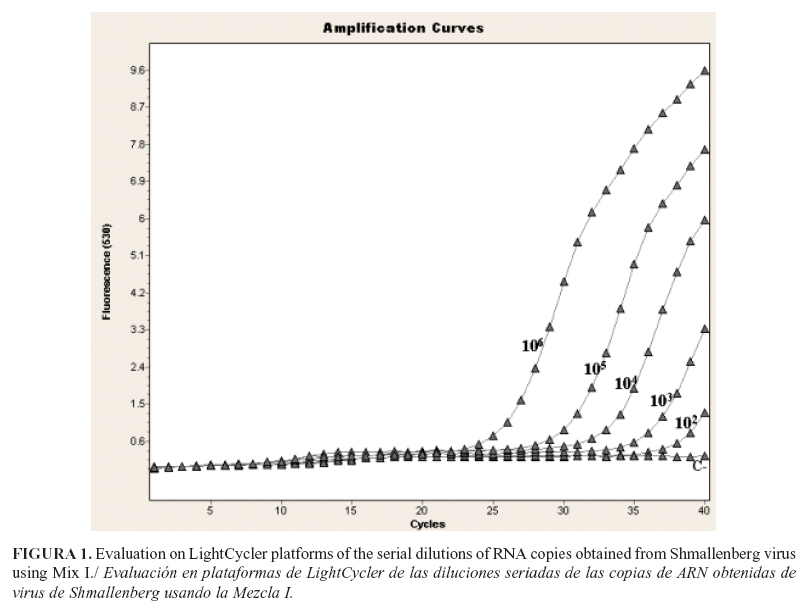
<body><![CDATA[<P><font face="Verdana, Arial, Helvetica, sans-serif" size="2">The development    of new diagnostic techniques to establish early detection of the SBV is an important    task for the diagnosis laboratories. However, to our knowledge, only one assay    has been reported for this purpose (6). </font>      <P><font face="Verdana, Arial, Helvetica, sans-serif" size="2">The most important    task for the Animal Virology Laboratory at the National Centre for Animal and    Plant Health in Cuba is the diagnosis of emerging and re-emerging transboundary    animal diseases. Within the area of assay design, relevant issues include chemistry,    target selection, cycling conditions and thermocycling platform selection (8).    Chemistry and platform are the most variable aspects between the different laboratories    (8). Regarding platform, each instrument has inherent characteristics that must    be addressed as an essential step in the process of assay validation (8). Hence,    the adaptation of the different diagnosis protocols to each condition into each    laboratory is a very relevant aspect. The current work was aimed to accomplish    the adaptation of the real-time RT-PCR (rRT-PCR) developed by Bilk <I>et al.    </I>(6) on the LightCycler platforms. </font>      <P><font face="Verdana, Arial, Helvetica, sans-serif" size="2">The rRT-PCR assay    developed by Bilk <I>et al.</I> (6) was optimized on ABIPrism7500 platforms    (AP7500) (Applied Biosystems, CA, USA). For the adaptation of the assay, the    primer pair (SBV-S-382F: 5'-TCAGATTGTCATGCCCCTTGC-3', SBV-S-469R: 5'-TTCGGCCCCAGGTGCAAATC-3'),    probe (SBV-S-408FAM: 5'-FAM-TTA AGG GAT GCA CCT GGG CCG ATG GT-BHQ1-3') and    serial dilutions of positive control RNA SBV (10<SUP>2</SUP>-10<SUP>6</SUP>    copies/&#181;l) were used. The reagents above mentioned were kindly provided    by Dr. Bernd Hoffman, Institute of Diagnostic Virology, Friedrich-Loeffler-Institut,    Riems Island, Germany. </font>      <P><font face="Verdana, Arial, Helvetica, sans-serif" size="2">On the LightCycler    1.5 and 2.0 platforms (Roche Applied Science, Mannheim, Germany), the detection    of SBV genome was performed using two different mixes. In all cases, a water    control was included. The final conditions for each mix were the following:    </font>     <P><font face="Verdana, Arial, Helvetica, sans-serif" size="2">Mix I: The synthesis    of cDNA was performed by random priming and using M-MLV reverse transcriptase,    as described previously by D&iacute;az de Arce <I>et al.</I> (9). The reagent/primer    final concentration was 1xQuantitect-SYBR-Green PCR kit/0.4 &#181;M, with each    sample in a 20 &#181;L total reaction volume that included 5 &#181;L of cDNA    template. The thermal profile used was the following: 15 min at 95&#176;C (inactivation    reverse transcriptase/activation <I>Taq</I> polymerase), followed by 52 cycles    of 10 s at 95&#176;C (denaturation), 5 s at 56&#176;C (annealing) and 20 s at    72&#176;C (elongation). After the PCR cycles, a melting curve was generated    (15 s at 95&#176;C, 1 min at 65&#176;C, 15 s at 95&#176;C) to discriminate between    specific amplicons and non-specific amplification products (in all cases the    ramp time was 1&#176;C per second). </font>      <P><font face="Verdana, Arial, Helvetica, sans-serif" size="2">Mix II: The mixture    contained 3.2 &#181;L RNase-free water, 4 &#181;L 5x QIAGEN OneSetp RT-PCR buffer,    4 &#181;L 5x Q-Solutions, 1 &#181;L dNTP Mix (containing 10 mM of each dNTP),    1 &#181;L QIAGEN OneSetp RT-PCR Enzyme Mix, 0.25 &#181;L RNase inhibitor, 2    &#181;L SBV specific primer/probe-mix (10 mM SBV-specific primers + 1.875 mM    SBV-specific probes) for one reaction and 5 &#181;L RNA template was added.    For reverse transcription and amplification, the following temperature profile    was used: 30 min at 50&#176;C (reverse transcription), 15 min at 95&#176;C (inactivation    reverse transcriptase/activation Taq polymerase), followed by 52 cycles of 10    s at 95&#176;C (denaturation), 20 s at 55&#176;C (annealing) and 30 s at 72&#176;C    (elongation). </font>     <P><font face="Verdana, Arial, Helvetica, sans-serif" size="2">On LightCycler    1.5 and 2.0 platforms, specific amplification curves for SBV detection were    obtained. In addition, a linear-range was observed when serial dilutions of    the SBV were assessed (<a href="/img/revistas/rsa/v35n3/f0109313.jpg">Fig.    1</a> and <a href="/img/revistas/rsa/v35n3/f0209313.jpg">Fig. 2</a>). On    the other hand, amplification curves were not observed when negative controls    were evaluated. The Cycle threshold values (Ct-values) were not different for    the serial dilutions assessed when Mix I or Mix II were used. Therefore the    same degree of sensitivity was obtained for both mixes of reaction. </font>      
<P><font face="Verdana, Arial, Helvetica, sans-serif" size="2">Nevertheless, it    is important to highlight the fact that the curves obtained on LightCycler 1.5    and 2.0 platforms showed an increase in the Ct-values compared with the results    obtained by Bilk <I>et al.</I> (6). However, the adapted assay was able to detect    the same RNA viral copies that the previously reported by Bilk <I>et al.</I>    (6) between 10<SUP>2 </SUP>- 10<SUP>6</SUP> copies/&#181;l. Thus, even though    a displacement in the Ct-values on LightCycler 1.5 and 2.0 platforms was observed,    the sensitivity of the test was kept. </font>      <P><font face="Verdana, Arial, Helvetica, sans-serif" size="2">In the current    work, an rRT-PCR assay for the detection of the new emergent virus named SBV    was adapted on LightCycler 1.5 and 2.0 platforms.Viral diseases emergence is    the major concern in public and animal health (10). The recent incidences of    emerging and re-emerging transboundary animal diseases have led to very heavy    losses all over the world. Several examples in the last years have been the    outbreaks caused by foot-and-mouth disease on three continents (Africa, Asia    and South America), classical swine fever (Africa, Asia and Europe), rinderpest    (Africa and Asia), or highly pathogenic avian influenza (Africa, Asia and Europe)    (11). </font>      <P><font face="Verdana, Arial, Helvetica, sans-serif" size="2">The most recent    episode regarding a viral diseases emergence was caused by SBV in the European    Union during the last half of 2011 (1). The SBV has been associated with congenital    malformations in cattle, sheep and goats, with a high impact on production leading    to economic losses (12). On the other hand, the transmission route of SBV enhances    the potential risk of worldwide dissemination (2). </font>      ]]></body>
<body><![CDATA[<P><font face="Verdana, Arial, Helvetica, sans-serif" size="2">The early warning    systems and the rapid and highly specific detection of the agents are major    tasks, considering that the timely recognition of such viral infections would    prevent the spread of the diseases to large animal populations. Therefore, the    development of novel and powerful diagnostic assays is today a basic issue in    veterinary research and animal healthcare. Molecular virology offers a range    of new methods, which are able to accelerate and improve the diagnosis of infectious    diseases in animals (11). </font>      <P><font face="Verdana, Arial, Helvetica, sans-serif" size="2">The results obtained    in this study showed the flexibility of the rRT-PCR developed by Bilk <I>et    al.</I> (6). This assay was adapted to other platforms and two different mix    conditions. The adapted assay maintained the specificity and sensitivity of    the original protocol despite the increase of the Ct-values. </font>      <P><font face="Verdana, Arial, Helvetica, sans-serif" size="2">The displacement    in the Ct-values showed by the LightCycler 1.5 and 2.0 platforms compared with    AP7500 platforms could be related to two different aspects. The first one could    be explained by the effect of the ramps between different platforms of real    time which was previously reported by Perez <I>et al.</I> (13). This issue is    due to the fact that the temperature transition rate recommended for the LightCycler    1.5 instrument is 20&#186;C per second, while the rate suggested for the AP7500    platform is 1&#186;C per second; the time it takes to get from one temperature    to the next one in the heating/cooling cycle is longer in the AP7500 than in    the LightCycler 1.5 and 2.0 instruments. Consequently, the Ct-values could be    displaced (13). The second one could be due to the possible degrading of RNA    during the transport of the positive controls from the Institute of Diagnostic    Virology, Friedrich-Loeffler-Institut, Riems Island, Germany to the Animal Virology    Laboratory, CENSA. This final aspect is nowadays one of the most important concerns    for the sample sending between different laboratories of diagnosis. </font>      <P><font face="Verdana, Arial, Helvetica, sans-serif" size="2">In conclusion,    an rRT-PCR for new emergent SBV was adapted on LightCycler 1.5 and 2.0 platforms.    Additionally, two different mixes of reaction were assessed to determine the    flexibility of the test. Finally, this assay for SBV detection can be used for    a possible emergence of this agent in Cuba.</font>     <P>&nbsp;     <P><font face="Verdana, Arial, Helvetica, sans-serif" size="2"><B><font size="3">ACKNOWLEDGMENTS</font></B>    </font>     <P><font face="Verdana, Arial, Helvetica, sans-serif" size="2">The authors thank    Dr. Bernd Hoffman, Institute of Diagnostic Virology, Friedrich-Loeffler-Institut,    Germany, who submitted protocol, positive control, primer pairs and probe of    SBV virus for this work.</font>     <P>&nbsp;     <P><font face="Verdana, Arial, Helvetica, sans-serif" size="2"><B><font size="3">REFERENCES</font></B>    </font>      <!-- ref --><P><font face="Verdana, Arial, Helvetica, sans-serif" size="2">1. FLI. Update    from the Friedrich Loeffler Institute on Schmallenberg virus 4. (2012). Disponible    en: <U><a href="http://www.fli.bund.de/nocache/de/startseite/aktuelles/tierseuchengeschehen/schmallenbergvirus.html" target="_blank">http://www.fli.bund.de/nocache/de/startseite/aktuelles/tierseuchengeschehen/schmallenbergvirus.html</a></U>    (15.02.12).     </font>      <!-- ref --><P><font face="Verdana, Arial, Helvetica, sans-serif" size="2">2. Hoffmann B,      Scheuch M, H&ouml;per D, Jungblut R, Holsteg M, Schirrmeier H, et al. Novel      orthobunya virus in Cattle. Emerg Infect Dis. 2011;18:469-472.     </font>       <!-- ref --><P><font face="Verdana, Arial, Helvetica, sans-serif" size="2">3. Muskens J,      Smolenaars AJ, van der Poel WH, Mars MH, van Wuijckhuise L. Nederlandse melkbedrijven      door het Schmallenberg virus. Tijdschr. Diergeneeskd. 2012;137:112-115.     </font>       <!-- ref --><P><font face="Verdana, Arial, Helvetica, sans-serif" size="2">4. Lievaart-Peterson      K, Luttikholt SJM, Van den Brom R, Vellema P. Schmallenberg virus infection      in small ruminants - First review of the situation and prospects in Northern      Europe. Small Ruminant Research. 2012;106(2):71-76.     </font>        <!-- ref --><P><font face="Verdana, Arial, Helvetica, sans-serif" size="2">5. Sanidad Animal.    INFO. Actualizaci&oacute;n epidemiol&oacute;gica de la enfermedad de Schmallenberg.    2012. Disponible en: <U><a href="http://www.sanidadanimal.info/sanidadanimal/es/actividades/emergentes-online%20/virus-schmallenberg-vsb/137-actualizacion-epidemiologica-schmallenberg.html." target="_blank">http://www.sanidadanimal.info/sanidadanimal/es/actividades/emergentes-online/virus-schmallenberg-vsb/137-actualizacion-epidemiologica-schmallenberg.html</a></U><a href="http://www.    sanidadanimal.info/sanidadanimal/es/actividades/emergentes-online%20/virus-schmallenberg-vsb/137-actualizacion-epidemiologica-schmallenberg.html.">.</a>    </font>      <!-- ref --><P><font face="Verdana, Arial, Helvetica, sans-serif" size="2">6. Bilk S, Schulze    C, Fischer M, Beer M, Hlinak A, Hoffmann B. Organ distribution of Schmallenberg    virus RNA in malformed newborns. Vet Microbiol. 2012;159(1-2):236-238.     </font>      <!-- ref --><P><font face="Verdana, Arial, Helvetica, sans-serif" size="2">7. Hayden RT, Hokason    KM, Punods SB, Bankowski MJ, Belzer SW, Carr J, et al. Multicenter comparison    of different real-time PCR assays for quantitative detection of Epstein-Barr    virus. J Clin Microbiol. 2008;46(1):157-163.     </font>      <!-- ref --><P><font face="Verdana, Arial, Helvetica, sans-serif" size="2">8. Bentley HA,    Belloni DR, Tsongalis GJ. Parameters involved in the conversion of real-time    PCR assays from the ABI prism 7700 to the Cepheid SmartCycler II. Clin Biochem.    2005;38:183-186.     </font>      <!-- ref --><P><font face="Verdana, Arial, Helvetica, sans-serif" size="2">9. D&iacute;az    de Arce H, Nu&ntilde;ez JI, Ganges L, Barreras M, Frias MT, Sobrino F. An RT-PCR    assay for the specific detection of classical swine fever virus in clinical    samples. Vet Res. 1998;29:431-44.     </font>      <!-- ref --><P><font face="Verdana, Arial, Helvetica, sans-serif" size="2">10.Domingo E. Mechanisms    of viral emergence. Vet Res. 2010;41:38.     </font>      <!-- ref --><P><font face="Verdana, Arial, Helvetica, sans-serif" size="2">11.Bel&aacute;k    S. Molecular diagnosis of viral diseases, present trends and future aspects.    A view from the OIE Collaborating Centre for the Application of Polymerase Chain    Reaction Methods for Diagnosis of Viral Diseases in Veterinary Medicine. Vaccine.    2007;25:5444-5452.     </font>      <!-- ref --><P><font face="Verdana, Arial, Helvetica, sans-serif" size="2">12.Garigliany M-M,    Bayrou C, Kleijnen D, Cassart D, Jolly S, Linden A, et al. Schmallenberg virus:    A new Shamonda/Sathuperi-like virus on the rise in Europe. Antiviral Res. 2012.    Disponible en: <U><a href="http://dx.doi.org/10.1016/j.antiviral.2012.05.014" target="_blank">http://dx.doi.org/10.1016/j.antiviral.2012.05.014</a></U>.        </font>      <!-- ref --><P><font face="Verdana, Arial, Helvetica, sans-serif" size="2">13.P&eacute;rez    LJ, D&iacute;az de Arce H, Tarradas J, Rosell R, Perera CL, Mu&ntilde;oz M,    et al. Development and validation of a novel SYBR Green real-time RT-PCR assay    for the detection of classical swine fever virus evaluated on different real-time    PCR platforms. J of Virological Methods. 2012;174:53-59.    </font>      <P>&nbsp;     <P>&nbsp;     <P><font face="Verdana, Arial, Helvetica, sans-serif" size="2">Recibido: 19-4-2013.    <br>   </font><font face="Verdana, Arial, Helvetica, sans-serif" size="2">Aceptado:    8-7-2013.</font>     <P>&nbsp;     ]]></body>
<body><![CDATA[<P>&nbsp;     <P><font face="Verdana, Arial, Helvetica, sans-serif" size="2"><B><a href="#autor">*</a></B><a name="pie"></a>Corresponding    autor: <i>Carmen L. Perera</i>. Animal Virology Group, National Center for Animal    and Plant Health (CENSA), Apartado 10, San Jos&eacute; de las Lajas, CP 32 700,    Mayabeque, Cuba. Tel.:+5347863206; Fax:+5347861104. E-mail addresses: <U><a href="mailto:claura@censa.edu.cu">claura@censa.edu.cu</a></U>.</font>       ]]></body><back>
<ref-list>
<ref id="B1">
<label>1</label><nlm-citation citation-type="">
<collab>FLI</collab>
<source><![CDATA[Update from the Friedrich Loeffler Institute on Schmallenberg virus 4]]></source>
<year>2012</year>
</nlm-citation>
</ref>
<ref id="B2">
<label>2</label><nlm-citation citation-type="journal">
<person-group person-group-type="author">
<name>
<surname><![CDATA[Hoffmann]]></surname>
<given-names><![CDATA[B]]></given-names>
</name>
<name>
<surname><![CDATA[Scheuch]]></surname>
<given-names><![CDATA[M]]></given-names>
</name>
<name>
<surname><![CDATA[Höper]]></surname>
<given-names><![CDATA[D]]></given-names>
</name>
<name>
<surname><![CDATA[Jungblut]]></surname>
<given-names><![CDATA[R]]></given-names>
</name>
<name>
<surname><![CDATA[Holsteg]]></surname>
<given-names><![CDATA[M]]></given-names>
</name>
<name>
<surname><![CDATA[Schirrmeier]]></surname>
<given-names><![CDATA[H]]></given-names>
</name>
</person-group>
<article-title xml:lang="es"><![CDATA[Novel orthobunya virus in Cattle]]></article-title>
<source><![CDATA[Emerg Infect Dis]]></source>
<year>2011</year>
<volume>18</volume>
<page-range>469-472</page-range></nlm-citation>
</ref>
<ref id="B3">
<label>3</label><nlm-citation citation-type="journal">
<person-group person-group-type="author">
<name>
<surname><![CDATA[Muskens]]></surname>
<given-names><![CDATA[J]]></given-names>
</name>
<name>
<surname><![CDATA[Smolenaars]]></surname>
<given-names><![CDATA[AJ]]></given-names>
</name>
<name>
<surname><![CDATA[van der Poel]]></surname>
<given-names><![CDATA[WH]]></given-names>
</name>
<name>
<surname><![CDATA[Mars]]></surname>
<given-names><![CDATA[MH]]></given-names>
</name>
<name>
<surname><![CDATA[van Wuijckhuise]]></surname>
<given-names><![CDATA[L]]></given-names>
</name>
</person-group>
<article-title xml:lang="en"><![CDATA[Nederlandse melkbedrijven door het Schmallenberg virus]]></article-title>
<source><![CDATA[Tijdschr. Diergeneeskd]]></source>
<year>2012</year>
<volume>137</volume>
<page-range>112-115</page-range></nlm-citation>
</ref>
<ref id="B4">
<label>4</label><nlm-citation citation-type="journal">
<person-group person-group-type="author">
<name>
<surname><![CDATA[Lievaart-Peterson]]></surname>
<given-names><![CDATA[K]]></given-names>
</name>
<name>
<surname><![CDATA[Luttikholt]]></surname>
<given-names><![CDATA[SJM]]></given-names>
</name>
<name>
<surname><![CDATA[Van den Brom]]></surname>
<given-names><![CDATA[R]]></given-names>
</name>
<name>
<surname><![CDATA[Vellema]]></surname>
<given-names><![CDATA[P]]></given-names>
</name>
</person-group>
<article-title xml:lang="en"><![CDATA[Schmallenberg virus infection in small ruminants - First review of the situation and prospects in Northern Europe]]></article-title>
<source><![CDATA[Small Ruminant Research]]></source>
<year>2012</year>
<volume>106</volume>
<numero>2</numero>
<issue>2</issue>
<page-range>71-76</page-range></nlm-citation>
</ref>
<ref id="B5">
<label>5</label><nlm-citation citation-type="">
<source><![CDATA[Actualización epidemiológica de la enfermedad de Schmallenberg]]></source>
<year>2012</year>
</nlm-citation>
</ref>
<ref id="B6">
<label>6</label><nlm-citation citation-type="journal">
<person-group person-group-type="author">
<name>
<surname><![CDATA[Bilk]]></surname>
<given-names><![CDATA[S]]></given-names>
</name>
<name>
<surname><![CDATA[Schulze]]></surname>
<given-names><![CDATA[C]]></given-names>
</name>
<name>
<surname><![CDATA[Fischer]]></surname>
<given-names><![CDATA[M]]></given-names>
</name>
<name>
<surname><![CDATA[Beer]]></surname>
<given-names><![CDATA[M]]></given-names>
</name>
<name>
<surname><![CDATA[Hlinak]]></surname>
<given-names><![CDATA[A]]></given-names>
</name>
<name>
<surname><![CDATA[Hoffmann]]></surname>
<given-names><![CDATA[B]]></given-names>
</name>
</person-group>
<article-title xml:lang="en"><![CDATA[Organ distribution of Schmallenberg virus RNA in malformed newborns]]></article-title>
<source><![CDATA[Vet Microbiol]]></source>
<year>2012</year>
<volume>159</volume>
<numero>1-2</numero>
<issue>1-2</issue>
<page-range>236-238</page-range></nlm-citation>
</ref>
<ref id="B7">
<label>7</label><nlm-citation citation-type="journal">
<person-group person-group-type="author">
<name>
<surname><![CDATA[Hayden]]></surname>
<given-names><![CDATA[RT]]></given-names>
</name>
<name>
<surname><![CDATA[Hokason]]></surname>
<given-names><![CDATA[KM]]></given-names>
</name>
<name>
<surname><![CDATA[Punods]]></surname>
<given-names><![CDATA[SB]]></given-names>
</name>
<name>
<surname><![CDATA[Bankowski]]></surname>
<given-names><![CDATA[MJ]]></given-names>
</name>
<name>
<surname><![CDATA[Belzer]]></surname>
<given-names><![CDATA[SW]]></given-names>
</name>
<name>
<surname><![CDATA[Carr]]></surname>
<given-names><![CDATA[J]]></given-names>
</name>
</person-group>
<article-title xml:lang="en"><![CDATA[Multicenter comparison of different real-time PCR assays for quantitative detection of Epstein-Barr virus]]></article-title>
<source><![CDATA[J Clin Microbiol]]></source>
<year>2008</year>
<volume>46</volume>
<numero>1</numero>
<issue>1</issue>
<page-range>157-163</page-range></nlm-citation>
</ref>
<ref id="B8">
<label>8</label><nlm-citation citation-type="journal">
<person-group person-group-type="author">
<name>
<surname><![CDATA[Bentley]]></surname>
<given-names><![CDATA[HA]]></given-names>
</name>
<name>
<surname><![CDATA[Belloni]]></surname>
<given-names><![CDATA[DR]]></given-names>
</name>
<name>
<surname><![CDATA[Tsongalis]]></surname>
<given-names><![CDATA[GJ]]></given-names>
</name>
</person-group>
<article-title xml:lang="en"><![CDATA[Parameters involved in the conversion of real-time PCR assays from the ABI prism 7700 to the Cepheid SmartCycler II]]></article-title>
<source><![CDATA[Clin Biochem]]></source>
<year>2005</year>
<volume>38</volume>
<page-range>183-186</page-range></nlm-citation>
</ref>
<ref id="B9">
<label>9</label><nlm-citation citation-type="journal">
<person-group person-group-type="author">
<name>
<surname><![CDATA[Díaz de Arce]]></surname>
<given-names><![CDATA[H]]></given-names>
</name>
<name>
<surname><![CDATA[Nuñez]]></surname>
<given-names><![CDATA[JI]]></given-names>
</name>
<name>
<surname><![CDATA[Ganges]]></surname>
<given-names><![CDATA[L]]></given-names>
</name>
<name>
<surname><![CDATA[Barreras]]></surname>
<given-names><![CDATA[M]]></given-names>
</name>
<name>
<surname><![CDATA[Frias]]></surname>
<given-names><![CDATA[MT]]></given-names>
</name>
<name>
<surname><![CDATA[Sobrino]]></surname>
<given-names><![CDATA[F]]></given-names>
</name>
</person-group>
<article-title xml:lang="en"><![CDATA[An RT-PCR assay for the specific detection of classical swine fever virus in clinical samples]]></article-title>
<source><![CDATA[Vet Res]]></source>
<year>1998</year>
<volume>29</volume>
<page-range>431-44</page-range></nlm-citation>
</ref>
<ref id="B10">
<label>10</label><nlm-citation citation-type="journal">
<person-group person-group-type="author">
<name>
<surname><![CDATA[Domingo]]></surname>
<given-names><![CDATA[E]]></given-names>
</name>
</person-group>
<article-title xml:lang="en"><![CDATA[Mechanisms of viral emergence]]></article-title>
<source><![CDATA[Vet Res]]></source>
<year>2010</year>
<volume>41</volume>
<page-range>38</page-range></nlm-citation>
</ref>
<ref id="B11">
<label>11</label><nlm-citation citation-type="journal">
<person-group person-group-type="author">
<name>
<surname><![CDATA[Belák]]></surname>
<given-names><![CDATA[S]]></given-names>
</name>
</person-group>
<article-title xml:lang="en"><![CDATA[Molecular diagnosis of viral diseases, present trends and future aspects: A view from the OIE Collaborating Centre for the Application of Polymerase Chain Reaction Methods for Diagnosis of Viral Diseases in Veterinary Medicine]]></article-title>
<source><![CDATA[Vaccine]]></source>
<year>2007</year>
<volume>25</volume>
<page-range>5444-5452</page-range></nlm-citation>
</ref>
<ref id="B12">
<label>12</label><nlm-citation citation-type="journal">
<person-group person-group-type="author">
<name>
<surname><![CDATA[Garigliany]]></surname>
<given-names><![CDATA[M-M]]></given-names>
</name>
<name>
<surname><![CDATA[Bayrou]]></surname>
<given-names><![CDATA[C]]></given-names>
</name>
<name>
<surname><![CDATA[Kleijnen]]></surname>
<given-names><![CDATA[D]]></given-names>
</name>
<name>
<surname><![CDATA[Cassart]]></surname>
<given-names><![CDATA[D]]></given-names>
</name>
<name>
<surname><![CDATA[Jolly]]></surname>
<given-names><![CDATA[S]]></given-names>
</name>
<name>
<surname><![CDATA[Linden]]></surname>
<given-names><![CDATA[A]]></given-names>
</name>
</person-group>
<article-title xml:lang="en"><![CDATA[Schmallenberg virus: A new Shamonda/Sathuperi-like virus on the rise in Europe]]></article-title>
<source><![CDATA[Antiviral Res]]></source>
<year>2012</year>
</nlm-citation>
</ref>
<ref id="B13">
<label>13</label><nlm-citation citation-type="journal">
<person-group person-group-type="author">
<name>
<surname><![CDATA[Pérez]]></surname>
<given-names><![CDATA[LJ]]></given-names>
</name>
<name>
<surname><![CDATA[Díaz de Arce]]></surname>
<given-names><![CDATA[H]]></given-names>
</name>
<name>
<surname><![CDATA[Tarradas]]></surname>
<given-names><![CDATA[J]]></given-names>
</name>
<name>
<surname><![CDATA[Rosell]]></surname>
<given-names><![CDATA[R]]></given-names>
</name>
<name>
<surname><![CDATA[Perera]]></surname>
<given-names><![CDATA[CL]]></given-names>
</name>
<name>
<surname><![CDATA[Muñoz]]></surname>
<given-names><![CDATA[M]]></given-names>
</name>
</person-group>
<article-title xml:lang="en"><![CDATA[Development and validation of a novel SYBR Green real-time RT-PCR assay for the detection of classical swine fever virus evaluated on different real-time PCR platforms]]></article-title>
<source><![CDATA[J of Virological Methods]]></source>
<year>2012</year>
<volume>174</volume>
<page-range>53-59</page-range></nlm-citation>
</ref>
</ref-list>
</back>
</article>