<?xml version="1.0" encoding="ISO-8859-1"?><article xmlns:mml="http://www.w3.org/1998/Math/MathML" xmlns:xlink="http://www.w3.org/1999/xlink" xmlns:xsi="http://www.w3.org/2001/XMLSchema-instance">
<front>
<journal-meta>
<journal-id>0253-570X</journal-id>
<journal-title><![CDATA[Revista de Salud Animal]]></journal-title>
<abbrev-journal-title><![CDATA[Rev Salud Anim.]]></abbrev-journal-title>
<issn>0253-570X</issn>
<publisher>
<publisher-name><![CDATA[Centro Nacional de Sanidad Agropecuaria]]></publisher-name>
</publisher>
</journal-meta>
<article-meta>
<article-id>S0253-570X2015000300007</article-id>
<title-group>
<article-title xml:lang="en"><![CDATA[Cell surface characteristics and adherence of typeable and non-typeable strains of Streptococcus suis from pig farms in Cuba]]></article-title>
<article-title xml:lang="es"><![CDATA[Características de la superficie celular y adherencia de cepas tipificables y no tipificables de Streptococcus suis de granjas porcinas en Cuba]]></article-title>
</title-group>
<contrib-group>
<contrib contrib-type="author">
<name>
<surname><![CDATA[Espinosa Castaño]]></surname>
<given-names><![CDATA[Ivette]]></given-names>
</name>
<xref ref-type="aff" rid="A01"/>
</contrib>
<contrib contrib-type="author">
<name>
<surname><![CDATA[Arias Baéz]]></surname>
<given-names><![CDATA[Michel]]></given-names>
</name>
<xref ref-type="aff" rid="A01"/>
</contrib>
<contrib contrib-type="author">
<name>
<surname><![CDATA[Lobo Rivero]]></surname>
<given-names><![CDATA[Evelyn]]></given-names>
</name>
<xref ref-type="aff" rid="A01"/>
</contrib>
<contrib contrib-type="author">
<name>
<surname><![CDATA[Martínez Marrero]]></surname>
<given-names><![CDATA[Siomara]]></given-names>
</name>
<xref ref-type="aff" rid="A01"/>
</contrib>
</contrib-group>
<aff id="A01">
<institution><![CDATA[,National Center for Animal and Plant Health Department of Microbiology ]]></institution>
<addr-line><![CDATA[San José de las Lajas Mayabeque]]></addr-line>
<country>Cuba</country>
</aff>
<pub-date pub-type="pub">
<day>00</day>
<month>12</month>
<year>2015</year>
</pub-date>
<pub-date pub-type="epub">
<day>00</day>
<month>12</month>
<year>2015</year>
</pub-date>
<volume>37</volume>
<numero>3</numero>
<fpage>191</fpage>
<lpage>197</lpage>
<copyright-statement/>
<copyright-year/>
<self-uri xlink:href="http://scielo.sld.cu/scielo.php?script=sci_arttext&amp;pid=S0253-570X2015000300007&amp;lng=en&amp;nrm=iso"></self-uri><self-uri xlink:href="http://scielo.sld.cu/scielo.php?script=sci_abstract&amp;pid=S0253-570X2015000300007&amp;lng=en&amp;nrm=iso"></self-uri><self-uri xlink:href="http://scielo.sld.cu/scielo.php?script=sci_pdf&amp;pid=S0253-570X2015000300007&amp;lng=en&amp;nrm=iso"></self-uri><abstract abstract-type="short" xml:lang="en"><p><![CDATA[Streptococcus suis infection is considered a major problem in the swine industry. There are 35 known serotypes of S. suis based on the capsular polysaccharides (CPS) on the cell surface. Serotype 2 is the most virulent in pigs and humans. Some S. suis strains do not agglutinate with any of the typing antisera and are identified as non-typable strains, which have generally been viewed as organisms that do not cause important clinical infections. Previous studies have shown differences in the composition and properties of the cell surface among these strains. The aim of this study included the characterization of cell hydrophobicity, ability to adhere to plates, and autolysis over time of typeable and non-typeable strains of S. suis from farms of the Cuban western region. The non-typeable strains showed a hydrophobic surface and ability of adhesion to plates. In this work, a fragment of atl gene encoding for the most important autolysine in S. suis was detected in serotypes 2, 9 and non-typeable strains. Correlation between cell adherence, hydrophobicity, and autolysis was only detected in two non-typeable strains, indicating that the non-encapsulated strain was more hydrophobic than the encapsulated strain and suggesting a potential ability to form biofilms. The ability to form biofilms is not required for virulence, but it does contribute towards long-term colonization, transmission and difficulties to eradicate these infections. These results indicated that non-typable strains should be considered when implementing measures to control the pathogenesis of the infection with S. suis in Cuban farms.]]></p></abstract>
<abstract abstract-type="short" xml:lang="es"><p><![CDATA[La infección por Streptococcus suis constituye uno de los problemas de mayor importancia en la industria porcina. Existen 35 serotipos de S. suis basados en la presencia de polisacáridos capsulares (cps) sobre la superficie celular. El serotipo 2 es el más virulento para cerdos y humanos. Existen cepas que no aglutinan con algunos de los antisueros; estas se denominan cepas no tipificables y se consideran sin importancia clínica. Los estudios previos han mostrado diferencia en la composición y en las propiedades de la superficie celular de las cepas tipificables y no tipificables. El objetivo de este estudio incluyó la caracterización de la hidrofobicidad celular, la habilidad de adherirse a placa y la autolisis celular en el tiempo de cepas tipifacables y no tipificables procedentes de granjas de Cuba. Las cepas no tipificadas mostraron una superficie hidrfóbica y una capacidad de adherencia. Se detectó un fragmento del gene atl, que codifica para la más importante autolisina de S. suis, en cepas de los serotipos 2 y 9, así como en cepas no tipificables. La correlación entre hidrofobicidad, adherencia y autolisis celular fue detectada en dos cepas no tipificables, que indicaron que las mismas presentan una superficie hidrofóbica que puede contribuir a la formación de biopelículas y, de este modo, perpetuar la infección en las granjas. Aunque la producción de biopelículas no es una expresión necesaria para la virulencia, sí contribuye a la colonización a largo plazo, a la transmisión de la infección y a las dificultades para su erradicación. Estos resultados indican que los aislados no tipificables detectados en los laboratorios deben ser considerados cuando se implementan medidas para el control de la patogénesis de la infección por S. suis en granjas de Cuba, como podría ser el uso de antibiótios.]]></p></abstract>
<kwd-group>
<kwd lng="en"><![CDATA[Streptococcus suis]]></kwd>
<kwd lng="en"><![CDATA[hydrophobicity]]></kwd>
<kwd lng="en"><![CDATA[adherence]]></kwd>
<kwd lng="en"><![CDATA[autolysine]]></kwd>
<kwd lng="es"><![CDATA[Streptococcus suis]]></kwd>
<kwd lng="es"><![CDATA[hidrofobicidad]]></kwd>
<kwd lng="es"><![CDATA[adherencia]]></kwd>
<kwd lng="es"><![CDATA[autolisina]]></kwd>
</kwd-group>
</article-meta>
</front><body><![CDATA[ <p align="right"><font size="2" face="Verdana, Arial, Helvetica, sans-serif"><B>ORIGINAL    ARTICLE</B> </font></p>     <p>&nbsp;</p> <h1> <font size="2" face="Verdana, Arial, Helvetica, sans-serif"><b><font size="4">Cell    surface&#160;characteristics and&#160;adherence&#160;of typeable and non-typeable    strains of <i>Streptococcus suis </i>from pig farms in Cuba</font> </b></font></h1>     <p>&nbsp;</p>     <p><font size="2" face="Verdana, Arial, Helvetica, sans-serif"><b><font size="3">Caracter&iacute;sticas    de la superficie celular y adherencia de cepas tipificables y no tipificables    de <i>Streptococcus suis</i> de granjas porcinas en Cuba</font> </b></font>  </p>     <p>&nbsp;</p>     <p>&nbsp; </p> <H1><B>        <P><font size="2" face="Verdana, Arial, Helvetica, sans-serif">Ivette Espinosa      Casta&ntilde;o, Michel Arias Ba&eacute;z, Evelyn Lobo Rivero, Siomara Mart&iacute;nez      Marrero</font>   </B> </H1>     <P><font size="2" face="Verdana, Arial, Helvetica, sans-serif">Department of Microbiology,    National Center for Animal and Plant Health, CENSA. Apdo. 10, San Jos&eacute;    de las Lajas, Mayabeque, Cuba. E-mail: <u><a href="mailto:espinosa@censa.edu.cu">espinosa@censa.edu.cu</a></u>.    </font>     <P>&nbsp;     <P>&nbsp; <hr noshade size="1">     ]]></body>
<body><![CDATA[<P><font size="2" face="Verdana, Arial, Helvetica, sans-serif"><B>ABSTRACT</B></font>     <P><font size="2" face="Verdana, Arial, Helvetica, sans-serif"><I>Streptococcus    suis </I>infection is considered a major problem in the swine industry. There    are 35 known serotypes of <I>S. suis</I> based on the capsular polysaccharides    (CPS) on the cell surface. Serotype 2 is the most virulent in pigs and humans.    Some <I>S. suis</I> strains do not agglutinate with any of the typing antisera    and are identified as non-typable strains, which have generally been viewed    as organisms that do not cause important clinical infections. Previous studies    have shown differences in the composition and properties of the cell surface    among these strains. The aim of this study included the characterization of    cell hydrophobicity, ability to adhere to plates, and autolysis over time of    typeable and non-typeable strains of <I>S. suis</I> from farms of the Cuban    western region. The non-typeable strains showed a hydrophobic surface and ability    of adhesion to plates. In this work, a fragment of <I>atl</I> gene encoding    for the most important autolysine in <I>S. suis</I> was detected in serotypes    2, 9 and non-typeable strains. Correlation between&#160;cell adherence, hydrophobicity,    and autolysis was only detected in two non-typeable strains, indicating that    the non-encapsulated strain was more hydrophobic than the encapsulated strain    and suggesting a potential ability to form biofilms. The ability to form biofilms    is not required for virulence, but it does contribute towards long-term colonization,    transmission and difficulties to eradicate these infections. These results indicated    that non-typable strains should be considered when implementing measures to    control the pathogenesis of the infection with <I>S. suis</I> in Cuban farms.    </font>     <P><font size="2" face="Verdana, Arial, Helvetica, sans-serif"><B>Key words</B>:    <I>Streptococcus suis</I>, hydrophobicity, adherence, autolysine. </font> <hr noshade size="1">         <P><font size="2" face="Verdana, Arial, Helvetica, sans-serif"><B>RESUMEN</b></font>        <P><font size="2" face="Verdana, Arial, Helvetica, sans-serif">La infecci&oacute;n    por <I>Streptococcus suis</I> constituye uno de los problemas de mayor importancia    en la industria porcina. Existen 35 serotipos de <I>S. suis</I> basados en la    presencia de polisac&aacute;ridos capsulares (cps) sobre la superficie celular.    El serotipo 2 es el m&aacute;s virulento para cerdos y humanos. Existen cepas    que no aglutinan con algunos de los antisueros; estas se denominan cepas no    tipificables y se consideran sin importancia cl&iacute;nica. Los estudios previos    han mostrado diferencia en la composici&oacute;n y en las propiedades de la    superficie celular de las cepas tipificables y no tipificables. El objetivo    de este estudio incluy&oacute; la caracterizaci&oacute;n de la hidrofobicidad    celular, la habilidad de adherirse a placa y la autolisis celular en el tiempo    de cepas tipifacables y no tipificables procedentes de granjas de Cuba. Las    cepas no tipificadas mostraron una superficie hidrf&oacute;bica y una capacidad    de adherencia. Se detect&oacute; un fragmento del gene <I>atl</I>, que codifica    para la m&aacute;s importante autolisina de <I>S. suis</I>, en cepas de los    serotipos 2 y 9, as&iacute; como en cepas no tipificables. La correlaci&oacute;n    entre hidrofobicidad, adherencia y autolisis celular fue detectada en dos cepas    no tipificables, que indicaron que las mismas presentan una superficie hidrof&oacute;bica    que puede contribuir a la formaci&oacute;n de biopel&iacute;culas y, de este    modo, perpetuar la infecci&oacute;n en las granjas. Aunque la producci&oacute;n    de biopel&iacute;culas no es una expresi&oacute;n necesaria para la virulencia,    s&iacute; contribuye a la colonizaci&oacute;n a largo plazo, a la transmisi&oacute;n    de la infecci&oacute;n y a las dificultades para su erradicaci&oacute;n. Estos    resultados indican que los aislados no tipificables detectados en los laboratorios    deben ser considerados cuando se implementan medidas para el control de la patog&eacute;nesis    de la infecci&oacute;n por <I>S. suis</I> en granjas de Cuba, como podr&iacute;a    ser el uso de antibi&oacute;tios. </font>      <P><font size="2" face="Verdana, Arial, Helvetica, sans-serif"><B>Palabras clave:</B>    <I>Streptococcus suis</I>, hidrofobicidad, adherencia, autolisina.</font> <hr noshade size="1">     <P>&nbsp;     <P>&nbsp;     <P><font size="2" face="Verdana, Arial, Helvetica, sans-serif"><B><font size="3">INTRODUCTION</font></B>    </font>     <P><font size="2" face="Verdana, Arial, Helvetica, sans-serif"><I>Streptococcus    suis</I> is an important pathogen of pigs that causes high mortality and is    responsible for considerable economic losses in the porcine industry<I>. S.    suis</I> is also considered an important zoonotic pathogen causing a variety    of life-threatening infections that include meningitis, arthritis and septicaemia    (1, 2, 3). There are 35 known serotypes of <I>S. suis</I>: 1-34 and 1/2. Serotype    2 is the most virulent, and is commonly associated with disease in pigs and    humans (4, 5). Although other serotypes are reported, globally, the predominant    <I>S. suis</I> serotypes isolated from clinical cases in pigs are, in decreasing    order, serotypes 2, 9, 3, 1/2 and 7. However, 15.5% of non-typeable strains    by serotyping, not considered important in <I>S. suis</I> pathology due to the    large number of non-typebeable strains, are also isolated, especially from healthy    pigs (6). </font>     ]]></body>
<body><![CDATA[<P><font size="2" face="Verdana, Arial, Helvetica, sans-serif">Different strategies    based on vaccines and antimicrobials have been used for controlling <I>S. suis</I>    infection; however, more persistent <I>S. suis</I> infections are achieved <I>in    vivo</I> (7), and hence <I>S. suis</I> infections may be difficult to treat    (8). Non-typeable <I>S. suis </I>strains<I> </I>have generally been considered    as organisms that do not cause important clinical infections; however, previous    studies have shown the unencapsulated serotype 2 and non-typeable strains to    be more adhesive than the encapsulated strains (9). </font>     <P><font size="2" face="Verdana, Arial, Helvetica, sans-serif">Attachment of microbial    cells to biotic or abiotic surfaces depends on several factors such as Brownian    movement, van der Waals attraction, gravitational forces and surface electrostatic    charges. Another important factor is the cell hydrophobicity. Hydrophobic cells    play a key role in the formation of biofilms on tissues; the biofilms are an    important problem because of the strong resistance of these microbial structures    to drugs (10). </font>     <P><font size="2" face="Verdana, Arial, Helvetica, sans-serif">The non-typeable    strains of <I>S. sui</I>s are being taken into account more each time in the    last years (6): a similar fact happens with nontypeable strains of other species    of the genus <I>Streptococcus</I> recognized important for human health like    <I>S. pneumonaie </I>(11). </font>     <P><font size="2" face="Verdana, Arial, Helvetica, sans-serif">The aim of this    study was to characterize typeable and nontypeable isolates of <I>Streptococcus    suis </I>from pig farms in the Cuban western region, in relation to those characters    contributing to persistence such as cell hydrophobicity, adherence ability,    and autolysin activity. </font>     <P>&nbsp;     <P><font size="2" face="Verdana, Arial, Helvetica, sans-serif"><B><font size="3">MATERIALS    AND METHODS</font></B> </font>     <P><font size="2" face="Verdana, Arial, Helvetica, sans-serif"><B>Bacterial strains    and culture conditions: </B>The<I> S. suis </I>strains used in the present study    are shown in <a href="#t1">Table 1</a>. All strains were clinical isolates from    lung samples of pneumonia diseased pigs previously characterized at the Bacteriology    Laboratory of the National Centre for Animal and Plant Health over the period    2002-2014. The samples were cultured on Columbia Blood Agar (Oxoid) containing    5% (v/v) sheep blood and incubated aerobically at 37<SUP>o</SUP>C for 48 h.    All the isolates were biochemically typed using the API 20 STREP test kit (Bio    M&eacute;rieux, France). Serotyping was carried out by the coagglutination test    using rabbit hyperimmune sera against reference strains of all serotypes of    <I>S. suis</I>, as previously described by Higgins and Gottschalk 1990 (12).    </font>      <P align="center"><img src="/img/revistas/rsa/v37n3/t0107315.jpg" width="393" height="356">    <a name="t1"></a>      
<P><font size="2" face="Verdana, Arial, Helvetica, sans-serif">All <I>S. suis</I>-like    strains were confirmed by PCR with the amplification of a 294bp fragment of    16S rDNA gene using <I>S. suis </I>species-specific primers (13). The colony    of each isolate from blood agar plates was transferred to 50 &#181;l of nuclease-free    water and boiled in a heating block at 100<SUP>o</SUP>C for 5 min. After centrifugation    at 5000 g for 5 min, the supernatant was collected and stored at -20<SUP>o</SUP>C    until use. The PCR assays were carried out on a final reaction volume of 25    <FONT  COLOR="#231f20">&#181;</FONT>l and using PCR Master Mix (Invitrogen) according    to the manufacturer`s instructions; 5 <FONT  COLOR="#231f20">&#181;</FONT>l of DNA sample was used in each reaction. The primers    were synthesized by the Center of Genetic Engineer and Biotechnology (CIGB).    They were used at a concentration of 0.2 <FONT  COLOR="#231f20">&#181;</FONT>M .Amplification was done in the PCR system (Mastercycler);    each isolate was tested twice under the same conditions. PCR amplicons were    electrophoresed on 2% agarose gels and visualized by UV transillumination after    ethidium bromide staining (0.5 <FONT  COLOR="#231f20">&#181;</FONT>g/ml). The strains were maintained as stock cultures    in Todd-Hewitt broth (THB, Oxoid) containing 20% glycerol at 20<SUP>o</SUP>C.    </font>     <P><font size="2" face="Verdana, Arial, Helvetica, sans-serif"><B>Detecting<I>    </I>gene<I> atl</I> fragment </B> </font>     ]]></body>
<body><![CDATA[<P><font size="2" face="Verdana, Arial, Helvetica, sans-serif">The gene <I>atl    </I>encoding for the autolysine protein was identified by PCR as previously    described by Cun-Xiang <I>et al.</I> (14). </font>     <P><font size="2" face="Verdana, Arial, Helvetica, sans-serif"><B>Autolysis assay    </B> </font>     <P><font size="2" face="Verdana, Arial, Helvetica, sans-serif">The autolysis assay    was carried out as previously described (14). Cells were grown to stationary    phase (1&#215;10<SUP>8</SUP> CFUml<SUP>-1</SUP>) in THB at 37&#176;C and pelleted    by centrifugation. The cells were washed once and resuspended in 50 mM Tris-HCl    (pH 7.0) containing 0.05% Triton X-100 to an absorbance <SUB>600</SUB> of 0.6.    The cell suspensions were incubated at 37&#176;C with gentle shaking. The decrease    in absorbance was monitored </font>     <P><font size="2" face="Verdana, Arial, Helvetica, sans-serif"><B>Surface hydrophobicity    assay</B> </font>     <P><font size="2" face="Verdana, Arial, Helvetica, sans-serif">Surface hydrophobicity    was assessed using the modified salting aggregation test (SAT) assay (15). <I>S.    suis</I> cultures in THB incubated at 37&#176;C to late-log phase (1&#215;10<SUP>8</SUP>    CFUml<SUP>-1</SUP>) were harvested, washed twice with PBS, resuspended in PBS    (pH 7,2), and `salted out' (aggregated) by combining 25 <FONT  COLOR="#231f20">&#181;</FONT>l volumes with 25 <FONT  COLOR="#231f20">&#181;</FONT>l volumes of ammonium sulphate (NH<SUB>4</SUB>)<SUB>2</SUB>SO<SUB>4</SUB>    solutions at different concentrations (0,2, 0,5, 1, 1,5, 2, 2,5, 3 and 4 mol    l-<SUP>1</SUP>) on microscope slides followed by agitation for 4 min at room    temperature. The lowest final concentration of (NH4)<SUB>2</SUB>SO4 causing    aggregation was recorded as the SAT value and classified as follows: &lt;0.1    mol l<SUP>-1</SUP>= highly hydrophobic; 0.1-1.0 mol l<SUP>-1</SUP>=hydrophobic    and &gt;1.0 mol l<SUP>-1</SUP>= hydrophilic. The assays were performed in duplicate    at two separate occasions. </font>     <P><font size="2" face="Verdana, Arial, Helvetica, sans-serif"><B>Microtitre plate    adherence assay </B> </font>     <P><font size="2" face="Verdana, Arial, Helvetica, sans-serif">The cultures of    each strain in THB containing 2.10<SUP>8</SUP> bacteria was diluted into wells    of polystyrene plates containing the minimal medium (MM) described by Grenier    <I>et al.</I>(2009) (15). After 24&#160;hours, the plates were washed three    times with sterile double-distilled water. They were allowed to air-dry for    1 hour at 42&#176;C and then stained with 1% crystal violet (Sigma). They were    quantified by adding 30% acetic acid (Sigma) and measuring the absorbance at    492 nm using a microtiter plate reader (SUMA, PR-621, Cuba). Wells with sterile    broth medium served as controls. The isolates were classified as described by    Christensen <I>et al.</I> 1985 (16). </font>     <P><font size="2" face="Verdana, Arial, Helvetica, sans-serif"><B>Statistics and    Reproducibility of results </B> </font>     <P><font size="2" face="Verdana, Arial, Helvetica, sans-serif">The microtiter    plate assays were performed in duplicate wells. All experiments were repeated    independently three times. One-way ANOVA was used to compare groups followed    by Bonferroni's multiple comparison post-test by using Info Stat Ver. 1.1 (2002).    The significance level was p&lt; 0.05. </font>     <P>&nbsp;     ]]></body>
<body><![CDATA[<P><font size="2" face="Verdana, Arial, Helvetica, sans-serif"><B><font size="3">RESULTS    AND DISCUSSION</font></B> </font>     <P><font size="2" face="Verdana, Arial, Helvetica, sans-serif">Serotyping, a procedure    that relies on the composition of capsular material, is an important step in    the identification of <I>S. suis</I> (6, 12). Serotype 2 is most frequently    associated with pathology, although other serotypes are also the source of many    infections (12). The non-typeable isolates are increasingly more reported associated    with pneumonia cases in pigs. More specifically, Wei <I>et al.</I> (17) characterized    407 strains of <I>S. suis</I> isolated from diseased pigs in China and recovered    5.4% of nontypeable isolates. In Canada, between 12% and 20% of strains recovered    from diseased pigs were untypeable (18). In a previous study in Cuba, non-typeable    isolates were also recovered from pneumonic pigs (19). To gain clarity on the    characteristics of Cuban isolates recovered from non-invasive disease sources    and presumptively identified as typeable and non-typeable, one genotypic and    two phenotypic assays were performed. </font>     <P><font size="2" face="Verdana, Arial, Helvetica, sans-serif">There are various    methods of recognition of hydrophobic properties of microorganisms. In this    study, the SAT values were expressed as the minimal molar concentration of (NH4)<SUB>2</SUB>SO<SUB>4</SUB>    necessary to cause agglutination of the bacterial cells (<a href="#t1">Table    1</a>). SAT indices ranged from 0.2 to 4 M (<a href="/img/revistas/rsa/v37n3/t0207315.jpg">Table    2</a>). The non-typeable isolates (SsNTF, SsNTQ and SsNTY) agglutinated in the    presence of the most low concentration of (NH4)<SUB>2</SUB>SO<SUB>4, </SUB>indicating    their hydrophobic surface, while the typeable isolates corresponding to serotypes1,    &#189;, 2, 3, 8, and 16 only agglutinated showing a hydrophilic surface in the    presence of (NH4)<SUB>2</SUB>SO<SUB>4 </SUB>concentrations higher than 2 M.    Bonifait <I>et al.</I> (20) described the lack of a capsule in the non-typeable    isolates to correlate with a greater cell-surface hydrophobicity when compared    with that of capsulated serotype 2 isolates, thereby favoring the cell adherence    and biofilm formation. </font>      
<P><font size="2" face="Verdana, Arial, Helvetica, sans-serif">The average absorbance    at 492nm obtained for isolates of <I>S. suis </I>in the assay for adherence    to plates are shown in <a href="/img/revistas/rsa/v37n3/f0107315.jpg">Figure    1</a>. Significant differences (p &lt; 0.05) were observed. Only the non-typeable    isolates showed some ability to adhere to plates. One isolate (SsNTF) was classified    as strongly adherent (SsNTF), two isolates (SsNTQ and SsNTV) as moderately adherent,    while the rest were weakly or non-adherent. </font>      
<P><font size="2" face="Verdana, Arial, Helvetica, sans-serif">According to our    results, only few adherence-producing isolates could be detected, which was    in agreement with the observations of other researchers who found non-typeable    isolates producing adherence. The polystyrene microtitre plate assay measures    the amount of biological material sticking to the surface of a container after    the bacteria have been cultured in it. It is not clear if this assay is an estimator    of an increase in biofilm biomass or if it detects an increased ability of the    biofilm material to attach to the sides of the plastic wells (21). By the other    way, Bonifait <I>et al</I>. (22) showed that supplementing the culture medium    with fibrinogen induced biofilm formation by different serotypes of <I>S. suis    </I>in a dose-dependent manner. </font>     <P><font size="2" face="Verdana, Arial, Helvetica, sans-serif">Nowadays, it is    well accepted that, in most environments, microorganisms can switch from a free-living    state to a sessile mode of life to form biofilms displaying specific properties.    Among these specific properties is an enhanced tolerance to all sort of adverse    conditions including desiccation and high concentrations of antimicrobial agents    such as biocides, antibiotics, and antifungal compounds. The ability to form    biofilms is not required for virulence, but it does contribute towards long-term    colonization, transmission and difficulties to eradicate these infections (23,    24, 25). </font>     <P><font size="2" face="Verdana, Arial, Helvetica, sans-serif">The results of    this study confirmed the presence of a fragment <I>atl </I>corresponding to    start codon of the autolysine in serotype 2 strains and in one isolate of serotype    9, but they also revealed the presence of this fragment in non-typeable isolates    (<a href="/img/revistas/rsa/v37n3/f0207315.gif">Figure 2</a>). Autolysins    are bacterial cell wall hydrolytic enzymes that mediate an important role in    cell wall metabolism during the antibiotic-induced lysis and may function as    important virulence factors for bacterial pathogens (11). </font>      
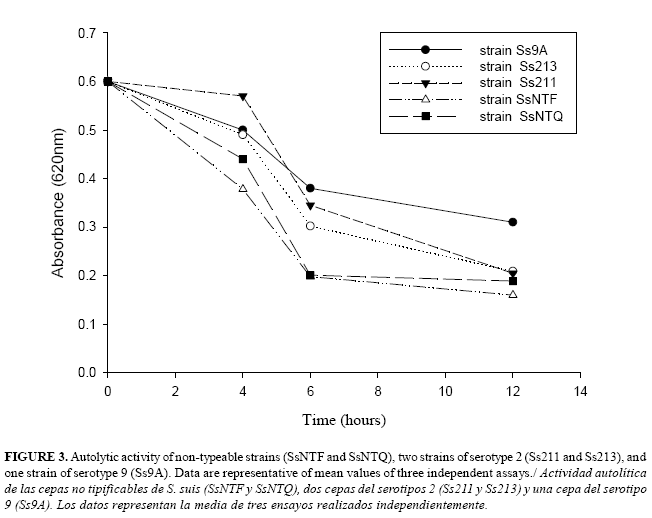
<P><font size="2" face="Verdana, Arial, Helvetica, sans-serif">The autolytic activity    of strains of <I>S. suis</I> was determined, and the absorbance of strains where    it was possible to detect <I>atl</I> gene is shown in the <a href="/img/revistas/rsa/v37n3/f0307315.gif">Figure    3</a>. Results of the autolysis assay showed an absorbance decrease over time    for the whole-cell suspensions in buffer in all the strains evaluated. However,    the non-typeable <I>S. suis </I>strains reached the lowest values of absorbance    over time, while <I>S. suis</I> serotype 9 showed the highest value. The non-typeable    strains were also the most adherent in the plate assay. Probably, the autolysine    also contributes to the biofilm formation because the developmental process    requires the release of extracellular polymeric substances (EPS) by the biofilm    forming community (8). </font>      
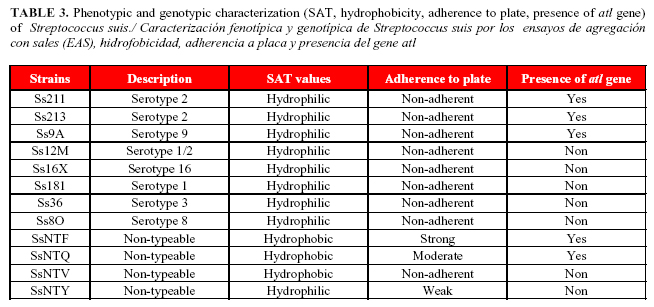
<P><font size="2" face="Verdana, Arial, Helvetica, sans-serif">It was interesting    that the correlation between hydrophobicity, adherence and presence of <I>atl</I>    gene was only detected in the non-typeable strains (<a href="/img/revistas/rsa/v37n3/t0307315.jpg">Table    3</a>). There was no correlation between adherence and hydrophobicity in typeable    strains. </font>      
<P><font size="2" face="Verdana, Arial, Helvetica, sans-serif"> The non-typeable    isolates showed a hydrophobic surface in the SAT test, ability to adhere to    the plate, presence of <I>atl</I> and autolysis activity; all these properties    favor the cell persistence through the biofilm formation by these strains. </font>     ]]></body>
<body><![CDATA[<P><font size="2" face="Verdana, Arial, Helvetica, sans-serif">For years, the    attempts for controlling infections by <I>S. suis</I> have been focused only    on typeable strains because non-typeable strains have generally been regarded    as organisms which do not cause important clinical infections. It is also difficult    to be certain that these strains were already non-encapsulated when causing    disease, or if they had lost their CPS during isolation and culture. It has    been reported that 34% of isolates belonging to serotype 1/2 or 2 recovered    from cases of endocarditis in Japan were non-encapsulated due to deletions and    insertions in the genes of the CPS locus (6). These aspects suggest to consider    the non-typeable isolates when implementing measures to control infections by    <I>S. suis</I> in Cuban farms. </font>      <P>&nbsp;     <P><font size="2" face="Verdana, Arial, Helvetica, sans-serif"><B><font size="3">REFERENCES</font></B>    </font>      <!-- ref --><P><font size="2" face="Verdana, Arial, Helvetica, sans-serif">1. Baums CG,      Verku&#168;hlen GJ, Rehm T, Beyerbach M, Pohlmeyer K, Weigand PV. Prevalence      of <I>Streptococcus suis </I>Genotypes in Wild Boars of Northwestern Germany.      Appl Environ Microbiol. 2007;73:711-717.     </font>        <!-- ref --><P><font size="2" face="Verdana, Arial, Helvetica, sans-serif">2. Chanter N,      Jones PW, Alexander TJ. Meningitis in pigs caused by <I>Streptococcus suis</I>-a      speculative review. Vet Microbiol. 1999;36:39-55.     </font>        <!-- ref --><P><font size="2" face="Verdana, Arial, Helvetica, sans-serif">3. Christensen      G, Sorensen V, Mousing J. Diseases of swine. In: Straw BE, D'Allaire S, Mengeling      WL, Taylor DJ, eds. Diseases in Swine, 8<SUP>th</SUP> Edn. Oxford: Blackwell      Science 1999; pp. 913-940.     </font>        <!-- ref --><P><font size="2" face="Verdana, Arial, Helvetica, sans-serif">4. Gottschalk      M, Higgins R, Boudreau M. Use of polyvalent coagglutination reagents for serotyping      of <I>Streptococcus suis</I>. J Clin Microbiol. 1993;31:2192-2194.     </font>        <!-- ref --><P><font size="2" face="Verdana, Arial, Helvetica, sans-serif">5. Gottschalk      M, Segura M, Xu J. <I>Streptococcus suis</I> infections in humans: the Chinese      experience and the situation in North America. Anim Health Res Rev. 2007;8:29-45.          </font>         <!-- ref --><P><font size="2" face="Verdana, Arial, Helvetica, sans-serif">6. Guillaume GD,    Jean-Philippe A, Jianguo X, Segura M, Gottschalk M. <I>Streptococcus suis</I>,    an important pig pathogen and emerging zoonotic agent-an update on the worldwide    distribution based on serotyping and sequence typing. Emerging Microbes and    Infections 3, e45; doi:10.1038/emi. 2014.     </font>      <!-- ref --><P><font size="2" face="Verdana, Arial, Helvetica, sans-serif">7. Brown MR,      Allison DG, Gilbert P. Resistance of bacterial biofilms to antibiotics: a      growth-rate related effect? J Antimicrob Chemother. 1988;22:777-780.     </font>        <!-- ref --><P><font size="2" face="Verdana, Arial, Helvetica, sans-serif">8. Brady RA,      Leid JG, Calhoun JH, Costerton JW, Shirtliff ME. Osteomyelitis and the role      of biofilms in chronic infection. FEMS Immunol Med Microbiol. 2008;52:13-22.          </font>         <!-- ref --><P><font size="2" face="Verdana, Arial, Helvetica, sans-serif">9. Benga L, Goethe    R, Rohde M, Valentin-Weigand P. Non-encapsulated strains reveal novel insights    in invasion and survival of <I>Streptococcus suis </I>in epithelial cells. Cell    Microbiol<I>. </I>2004;6:867-881.     </font>      <!-- ref --><P><font size="2" face="Verdana, Arial, Helvetica, sans-serif">10.Krasowska A,    Sigler K. How microorganisms use hydrophobicity and what does this mean for    human needs? Frontiers in Cellular and Infection Microbiology. 2014. <U><a href="http://www.frontiersin.org">http://www.frontiersin.org</a></U>.    </font>      <!-- ref --><P><font size="2" face="Verdana, Arial, Helvetica, sans-serif">11.Sa&#180;-Lea~o      R, Simo~es AS, Nunes S, Sousa NG, Fraza~o N, et al. Identification, prevalence      and population structure of non-typable Streptococcus pneumoniae in carriage      samples isolated from preschoolers attending day-care centres. Microbiol.      2006;152:367-376.     </font>         <!-- ref --><P><font size="2" face="Verdana, Arial, Helvetica, sans-serif">12.Higgins R, Gottschalk    M. An update on <I>Streptococcus suis </I>identification. J Vet Diagn Invest.    1990;2:249-252.     </font>      <!-- ref --><P><font size="2" face="Verdana, Arial, Helvetica, sans-serif">13.Marois C,      Le Devendec L, Gottschalk M, Kobisch M. Detection and molecular typing of      <I>Streptococcus suis</I> in tonsils from live pigs in France. Can J Vet Res.      2007;71:14-22.     </font>        <!-- ref --><P><font size="2" face="Verdana, Arial, Helvetica, sans-serif">14.Cun-Xiang      J, Hong-Wei G, Cheng-Ping L. Characterization and Functional Analysis of <I>atl</I>,      a Novel Gene Encoding Autolysin in <I>Streptococcus suis. </I>J Bacteriol.      2011;1464-1473.     </font>        <!-- ref --><P><font size="2" face="Verdana, Arial, Helvetica, sans-serif">15.Basson A,      Flemming LA, Chenia HY. Evaluation of adherence, hydrophobicity, aggregation      characteristics and biofilm development of <I>Flavobacterium johnsoniae</I>-like      isolates from South African aquaculture systems. Microb Ecol. 2008;55:1-14.          </font>        <!-- ref --><P><font size="2" face="Verdana, Arial, Helvetica, sans-serif">16.Grenier D,      Grignon L, Gottschalk M. Characterization of biofilm formation by a <I>Streptococcus      suis </I>meningitis isolate. Vet J. 2009;179:292-295.     </font>         <!-- ref --><P><font size="2" face="Verdana, Arial, Helvetica, sans-serif">17.Wei Z, Li R,    Zhang A, Hongkui He, Yafeng Hua, et al. Characterization of <I>Streptococcus    suis</I> isolates from the diseased pigs in China between 2003 and 2007. Vet    Microbiol. 2009;137:196-201.     </font>      <!-- ref --><P><font size="2" face="Verdana, Arial, Helvetica, sans-serif">18.Gottschalk      M, Lacouture S, Bonifait L, David R, Nahuel F, Daniel G. Characterization      of Streptococcus suis isolates recovered between 2008 and 2011 from diseased      pigs in Qu&#180;ebec, Canada. Vet Microbiol. 2013;162(2-4):819-825.     </font>         <!-- ref --><P><font size="2" face="Verdana, Arial, Helvetica, sans-serif">19.Espinosa I,    B&aacute;ez M, Corona B, Chong D, Lobo E, Mart&iacute;nez S. Molecular typing    of <I>Streptococcus suis </I>from pigs in Cuba. Biotecnol Aplic. 2013;30(1):39-34<I>.    </I>    </font>      <!-- ref --><P><font size="2" face="Verdana, Arial, Helvetica, sans-serif">20.Bonifait L,    Gottschalk M, Grenier D. Cell surface characteristics of nontypeable isolates    of <I>Streptococcus suis. </I>FEMS Microbiol Lett. 2010;311(2):160-166.     </font>      <!-- ref --><P><font size="2" face="Verdana, Arial, Helvetica, sans-serif">21.Siva W, Xiaojin    L, Gunawardana M, Maguire K, Guerrero-Given D, Schaudinn C, <I>et al.</I> Beta-    Lactam Antibiotics Stimulate Biofilm Formation in Non-Typeable <I>Haemophilus    influenzae </I>by Up-Regulating Carbohydrate Metabolism. PLOS ONE. 2014;9(7).    <U><a href="http://www.plosone.org">http://www.plosone.org</a></U>.     </font>      <!-- ref --><P><font size="2" face="Verdana, Arial, Helvetica, sans-serif">22.Bonifait L,      Louis G, Daniel G. Fibrinogen Induces Biofilm Formation by <I>Streptococcus      suis </I>and Enhances Its Antibiotic Resistance. Applied Environ Microb. 2008;4969-4972.          </font>         <!-- ref --><P><font size="2" face="Verdana, Arial, Helvetica, sans-serif">23.Parsek MR, Singh    PK. Bacterial biofilms: an emerging link to disease pathogenesis. Annu Rev Microbiol.    2003;57:677-701.     </font>      <!-- ref --><P><font size="2" face="Verdana, Arial, Helvetica, sans-serif">24.Yifan X, Kreth    J. Role of LytF and AtlS in eDNA Release by <I>Streptococcus</I> <I>gordonii</I>.    PLOS ONE. 2013. <u><a href="http://www.plosone.org">http://www.plosone.org</a></u>.    8(4).     </font>      <!-- ref --><P><font size="2" face="Verdana, Arial, Helvetica, sans-serif">25. Lebeaux D,    Ashwini C, Olaya R, Christophe B. From <I>in vitro </I>to <I>in vivo </I>Models    of Bacterial Biofilm-Related Infection. Pathogens<I>. </I>2013;2:288-356.    </font>     <P>&nbsp;     <P>&nbsp;     <P><font size="2" face="Verdana, Arial, Helvetica, sans-serif">Recibido: 20-6-2015.    <br>   </font><font size="2" face="Verdana, Arial, Helvetica, sans-serif">Aceptado:    25-10-2015.</font><font size="2" face="Verdana, Arial, Helvetica, sans-serif">    </font>       ]]></body><back>
<ref-list>
<ref id="B1">
<label>1</label><nlm-citation citation-type="journal">
<person-group person-group-type="author">
<name>
<surname><![CDATA[Baums]]></surname>
<given-names><![CDATA[CG]]></given-names>
</name>
<name>
<surname><![CDATA[Verku¨hlen]]></surname>
<given-names><![CDATA[GJ]]></given-names>
</name>
<name>
<surname><![CDATA[Rehm]]></surname>
<given-names><![CDATA[T]]></given-names>
</name>
<name>
<surname><![CDATA[Beyerbach]]></surname>
<given-names><![CDATA[M]]></given-names>
</name>
<name>
<surname><![CDATA[Pohlmeyer]]></surname>
<given-names><![CDATA[K]]></given-names>
</name>
<name>
<surname><![CDATA[Weigand]]></surname>
<given-names><![CDATA[PV]]></given-names>
</name>
</person-group>
<article-title xml:lang="en"><![CDATA[Prevalence of Streptococcus suis Genotypes in Wild Boars of Northwestern Germany]]></article-title>
<source><![CDATA[Appl Environ Microbiol]]></source>
<year>2007</year>
<volume>73</volume>
<page-range>711-717</page-range></nlm-citation>
</ref>
<ref id="B2">
<label>2</label><nlm-citation citation-type="journal">
<person-group person-group-type="author">
<name>
<surname><![CDATA[Chanter]]></surname>
<given-names><![CDATA[N]]></given-names>
</name>
<name>
<surname><![CDATA[Jones]]></surname>
<given-names><![CDATA[PW]]></given-names>
</name>
<name>
<surname><![CDATA[Alexander]]></surname>
<given-names><![CDATA[TJ]]></given-names>
</name>
</person-group>
<article-title xml:lang="en"><![CDATA[Meningitis in pigs caused by Streptococcus suis-a speculative review]]></article-title>
<source><![CDATA[Vet Microbiol]]></source>
<year>1999</year>
<volume>36</volume>
<page-range>39-55</page-range></nlm-citation>
</ref>
<ref id="B3">
<label>3</label><nlm-citation citation-type="book">
<person-group person-group-type="author">
<name>
<surname><![CDATA[Christensen]]></surname>
<given-names><![CDATA[G]]></given-names>
</name>
<name>
<surname><![CDATA[Sorensen]]></surname>
<given-names><![CDATA[V]]></given-names>
</name>
<name>
<surname><![CDATA[Mousing]]></surname>
<given-names><![CDATA[J]]></given-names>
</name>
</person-group>
<person-group person-group-type="editor">
<name>
<surname><![CDATA[Straw]]></surname>
<given-names><![CDATA[BE]]></given-names>
</name>
<name>
<surname><![CDATA[D'Allaire]]></surname>
<given-names><![CDATA[S]]></given-names>
</name>
<name>
<surname><![CDATA[Mengeling]]></surname>
<given-names><![CDATA[WL]]></given-names>
</name>
<name>
<surname><![CDATA[Taylor]]></surname>
<given-names><![CDATA[DJ]]></given-names>
</name>
</person-group>
<source><![CDATA[Diseases in Swine]]></source>
<year>1999</year>
<edition>8th</edition>
<page-range>913-940</page-range><publisher-name><![CDATA[Oxford: Blackwell Science]]></publisher-name>
</nlm-citation>
</ref>
<ref id="B4">
<label>4</label><nlm-citation citation-type="journal">
<person-group person-group-type="author">
<name>
<surname><![CDATA[Gottschalk]]></surname>
<given-names><![CDATA[M]]></given-names>
</name>
<name>
<surname><![CDATA[Higgins]]></surname>
<given-names><![CDATA[R]]></given-names>
</name>
<name>
<surname><![CDATA[Boudreau]]></surname>
<given-names><![CDATA[M]]></given-names>
</name>
</person-group>
<article-title xml:lang="en"><![CDATA[Use of polyvalent coagglutination reagents for serotyping of Streptococcus suis]]></article-title>
<source><![CDATA[J Clin Microbiol]]></source>
<year>1993</year>
<volume>31</volume>
<page-range>2192-2194</page-range></nlm-citation>
</ref>
<ref id="B5">
<label>5</label><nlm-citation citation-type="journal">
<person-group person-group-type="author">
<name>
<surname><![CDATA[Gottschalk]]></surname>
<given-names><![CDATA[M]]></given-names>
</name>
<name>
<surname><![CDATA[Segura]]></surname>
<given-names><![CDATA[M]]></given-names>
</name>
<name>
<surname><![CDATA[Xu]]></surname>
<given-names><![CDATA[J]]></given-names>
</name>
</person-group>
<article-title xml:lang="en"><![CDATA[Streptococcus suis infections in humans: the Chinese experience and the situation in North America]]></article-title>
<source><![CDATA[Anim Health Res Rev]]></source>
<year>2007</year>
<volume>8</volume>
<page-range>29-45</page-range></nlm-citation>
</ref>
<ref id="B6">
<label>6</label><nlm-citation citation-type="journal">
<person-group person-group-type="author">
<name>
<surname><![CDATA[Guillaume]]></surname>
<given-names><![CDATA[GD]]></given-names>
</name>
<name>
<surname><![CDATA[Jean-Philippe]]></surname>
<given-names><![CDATA[A]]></given-names>
</name>
<name>
<surname><![CDATA[Jianguo]]></surname>
<given-names><![CDATA[X]]></given-names>
</name>
<name>
<surname><![CDATA[Segura]]></surname>
<given-names><![CDATA[M]]></given-names>
</name>
<name>
<surname><![CDATA[Gottschalk]]></surname>
<given-names><![CDATA[M]]></given-names>
</name>
</person-group>
<article-title xml:lang="en"><![CDATA[Streptococcus suis, an important pig pathogen and emerging zoonotic agent-an update on the worldwide distribution based on serotyping and sequence typing]]></article-title>
<source><![CDATA[Emerging Microbes and Infections]]></source>
<year>2014</year>
<volume>3</volume>
<numero>e45</numero>
<issue>e45</issue>
</nlm-citation>
</ref>
<ref id="B7">
<label>7</label><nlm-citation citation-type="journal">
<person-group person-group-type="author">
<name>
<surname><![CDATA[Brown]]></surname>
<given-names><![CDATA[MR]]></given-names>
</name>
<name>
<surname><![CDATA[Allison]]></surname>
<given-names><![CDATA[DG]]></given-names>
</name>
<name>
<surname><![CDATA[Gilbert]]></surname>
<given-names><![CDATA[P]]></given-names>
</name>
</person-group>
<article-title xml:lang="en"><![CDATA[Resistance of bacterial biofilms to antibiotics: a growth-rate related effect?]]></article-title>
<source><![CDATA[J Antimicrob Chemother]]></source>
<year>1988</year>
<volume>22</volume>
<page-range>777-780</page-range></nlm-citation>
</ref>
<ref id="B8">
<label>8</label><nlm-citation citation-type="journal">
<person-group person-group-type="author">
<name>
<surname><![CDATA[Brady]]></surname>
<given-names><![CDATA[RA]]></given-names>
</name>
<name>
<surname><![CDATA[Leid]]></surname>
<given-names><![CDATA[JG]]></given-names>
</name>
<name>
<surname><![CDATA[Calhoun]]></surname>
<given-names><![CDATA[JH]]></given-names>
</name>
<name>
<surname><![CDATA[Costerton]]></surname>
<given-names><![CDATA[JW]]></given-names>
</name>
<name>
<surname><![CDATA[Shirtliff]]></surname>
<given-names><![CDATA[ME]]></given-names>
</name>
</person-group>
<article-title xml:lang="en"><![CDATA[Osteomyelitis and the role of biofilms in chronic infection]]></article-title>
<source><![CDATA[FEMS Immunol Med Microbiol]]></source>
<year>2008</year>
<volume>52</volume>
<page-range>13-22</page-range></nlm-citation>
</ref>
<ref id="B9">
<label>9</label><nlm-citation citation-type="journal">
<person-group person-group-type="author">
<name>
<surname><![CDATA[Benga]]></surname>
<given-names><![CDATA[L]]></given-names>
</name>
<name>
<surname><![CDATA[Goethe]]></surname>
<given-names><![CDATA[R]]></given-names>
</name>
<name>
<surname><![CDATA[Rohde]]></surname>
<given-names><![CDATA[M]]></given-names>
</name>
<name>
<surname><![CDATA[Valentin-Weigand]]></surname>
<given-names><![CDATA[P]]></given-names>
</name>
</person-group>
<article-title xml:lang="en"><![CDATA[Non-encapsulated strains reveal novel insights in invasion and survival of Streptococcus suis in epithelial cells]]></article-title>
<source><![CDATA[Cell Microbiol]]></source>
<year>2004</year>
<volume>6</volume>
<page-range>867-881</page-range></nlm-citation>
</ref>
<ref id="B10">
<label>10</label><nlm-citation citation-type="">
<person-group person-group-type="author">
<name>
<surname><![CDATA[Krasowska]]></surname>
<given-names><![CDATA[A]]></given-names>
</name>
<name>
<surname><![CDATA[Sigler]]></surname>
<given-names><![CDATA[K]]></given-names>
</name>
</person-group>
<source><![CDATA[How microorganisms use hydrophobicity and what does this mean for human needs: Frontiers in Cellular and Infection Microbiology]]></source>
<year>2014</year>
</nlm-citation>
</ref>
<ref id="B11">
<label>11</label><nlm-citation citation-type="journal">
<person-group person-group-type="author">
<name>
<surname><![CDATA[Sa´-Lea~o]]></surname>
<given-names><![CDATA[R]]></given-names>
</name>
<name>
<surname><![CDATA[Simo~es]]></surname>
<given-names><![CDATA[AS]]></given-names>
</name>
<name>
<surname><![CDATA[Nunes]]></surname>
<given-names><![CDATA[S]]></given-names>
</name>
<name>
<surname><![CDATA[Sousa]]></surname>
<given-names><![CDATA[NG]]></given-names>
</name>
<name>
<surname><![CDATA[Fraza~o]]></surname>
<given-names><![CDATA[N]]></given-names>
</name>
</person-group>
<article-title xml:lang="en"><![CDATA[Identification, prevalence and population structure of non-typable Streptococcus pneumoniae in carriage samples isolated from preschoolers attending day-care centres]]></article-title>
<source><![CDATA[Microbiol]]></source>
<year>2006</year>
<volume>152</volume>
<page-range>367-376</page-range></nlm-citation>
</ref>
<ref id="B12">
<label>12</label><nlm-citation citation-type="journal">
<person-group person-group-type="author">
<name>
<surname><![CDATA[Higgins]]></surname>
<given-names><![CDATA[R]]></given-names>
</name>
<name>
<surname><![CDATA[Gottschalk]]></surname>
<given-names><![CDATA[M]]></given-names>
</name>
</person-group>
<article-title xml:lang="en"><![CDATA[An update on Streptococcus suis identification]]></article-title>
<source><![CDATA[J Vet Diagn Invest]]></source>
<year>1990</year>
<volume>2</volume>
<page-range>249-252</page-range></nlm-citation>
</ref>
<ref id="B13">
<label>13</label><nlm-citation citation-type="journal">
<person-group person-group-type="author">
<name>
<surname><![CDATA[Marois]]></surname>
<given-names><![CDATA[C]]></given-names>
</name>
<name>
<surname><![CDATA[Le Devendec]]></surname>
<given-names><![CDATA[L]]></given-names>
</name>
<name>
<surname><![CDATA[Gottschalk]]></surname>
<given-names><![CDATA[M]]></given-names>
</name>
<name>
<surname><![CDATA[Kobisch]]></surname>
<given-names><![CDATA[M]]></given-names>
</name>
</person-group>
<article-title xml:lang="en"><![CDATA[Detection and molecular typing of Streptococcus suis in tonsils from live pigs in France]]></article-title>
<source><![CDATA[Can J Vet Res]]></source>
<year>2007</year>
<volume>71</volume>
<page-range>14-22</page-range></nlm-citation>
</ref>
<ref id="B14">
<label>14</label><nlm-citation citation-type="journal">
<person-group person-group-type="author">
<name>
<surname><![CDATA[Cun-Xiang]]></surname>
<given-names><![CDATA[J]]></given-names>
</name>
<name>
<surname><![CDATA[Hong-Wei]]></surname>
<given-names><![CDATA[G]]></given-names>
</name>
<name>
<surname><![CDATA[Cheng-Ping]]></surname>
<given-names><![CDATA[L]]></given-names>
</name>
</person-group>
<article-title xml:lang="en"><![CDATA[Characterization and Functional Analysis of atl, a Novel Gene Encoding Autolysin in Streptococcus suis]]></article-title>
<source><![CDATA[J Bacteriol]]></source>
<year>2011</year>
<page-range>1464-1473</page-range></nlm-citation>
</ref>
<ref id="B15">
<label>15</label><nlm-citation citation-type="journal">
<person-group person-group-type="author">
<name>
<surname><![CDATA[Basson]]></surname>
<given-names><![CDATA[A]]></given-names>
</name>
<name>
<surname><![CDATA[Flemming]]></surname>
<given-names><![CDATA[LA]]></given-names>
</name>
<name>
<surname><![CDATA[Chenia]]></surname>
<given-names><![CDATA[HY]]></given-names>
</name>
</person-group>
<article-title xml:lang="en"><![CDATA[Evaluation of adherence, hydrophobicity, aggregation characteristics and biofilm development of Flavobacterium johnsoniae-like isolates from South African aquaculture systems]]></article-title>
<source><![CDATA[Microb Ecol]]></source>
<year>2008</year>
<volume>55</volume>
<page-range>1-14</page-range></nlm-citation>
</ref>
<ref id="B16">
<label>16</label><nlm-citation citation-type="journal">
<person-group person-group-type="author">
<name>
<surname><![CDATA[Grenier]]></surname>
<given-names><![CDATA[D]]></given-names>
</name>
<name>
<surname><![CDATA[Grignon]]></surname>
<given-names><![CDATA[L]]></given-names>
</name>
<name>
<surname><![CDATA[Gottschalk]]></surname>
<given-names><![CDATA[M]]></given-names>
</name>
</person-group>
<article-title xml:lang="en"><![CDATA[Characterization of biofilm formation by a Streptococcus suis meningitis isolate]]></article-title>
<source><![CDATA[Vet J]]></source>
<year>2009</year>
<volume>179</volume>
<page-range>292-295</page-range></nlm-citation>
</ref>
<ref id="B17">
<label>17</label><nlm-citation citation-type="journal">
<person-group person-group-type="author">
<name>
<surname><![CDATA[Wei]]></surname>
<given-names><![CDATA[Z]]></given-names>
</name>
<name>
<surname><![CDATA[Li]]></surname>
<given-names><![CDATA[R]]></given-names>
</name>
<name>
<surname><![CDATA[Zhang]]></surname>
<given-names><![CDATA[A]]></given-names>
</name>
<name>
<surname><![CDATA[Hongkui]]></surname>
<given-names><![CDATA[He]]></given-names>
</name>
<name>
<surname><![CDATA[Yafeng]]></surname>
<given-names><![CDATA[Hua]]></given-names>
</name>
</person-group>
<article-title xml:lang="en"><![CDATA[Characterization of Streptococcus suis isolates from the diseased pigs in China between 2003 and 2007]]></article-title>
<source><![CDATA[Vet Microbiol]]></source>
<year>2009</year>
<volume>137</volume>
<page-range>196-201</page-range></nlm-citation>
</ref>
<ref id="B18">
<label>18</label><nlm-citation citation-type="journal">
<person-group person-group-type="author">
<name>
<surname><![CDATA[Gottschalk]]></surname>
<given-names><![CDATA[M]]></given-names>
</name>
<name>
<surname><![CDATA[Lacouture]]></surname>
<given-names><![CDATA[S]]></given-names>
</name>
<name>
<surname><![CDATA[Bonifait]]></surname>
<given-names><![CDATA[L]]></given-names>
</name>
<name>
<surname><![CDATA[David]]></surname>
<given-names><![CDATA[R]]></given-names>
</name>
<name>
<surname><![CDATA[Nahuel]]></surname>
<given-names><![CDATA[F]]></given-names>
</name>
<name>
<surname><![CDATA[Daniel]]></surname>
<given-names><![CDATA[G]]></given-names>
</name>
</person-group>
<article-title xml:lang="en"><![CDATA[Characterization of Streptococcus suis isolates recovered between 2008 and 2011 from diseased pigs in Qu´ebec, Canada]]></article-title>
<source><![CDATA[Vet Microbiol]]></source>
<year>2013</year>
<volume>162</volume>
<numero>2-4</numero>
<issue>2-4</issue>
<page-range>819-825</page-range></nlm-citation>
</ref>
<ref id="B19">
<label>19</label><nlm-citation citation-type="journal">
<person-group person-group-type="author">
<name>
<surname><![CDATA[Espinosa]]></surname>
<given-names><![CDATA[I]]></given-names>
</name>
<name>
<surname><![CDATA[Báez]]></surname>
<given-names><![CDATA[M]]></given-names>
</name>
<name>
<surname><![CDATA[Corona]]></surname>
<given-names><![CDATA[B]]></given-names>
</name>
<name>
<surname><![CDATA[Chong]]></surname>
<given-names><![CDATA[D]]></given-names>
</name>
<name>
<surname><![CDATA[Lobo]]></surname>
<given-names><![CDATA[E]]></given-names>
</name>
<name>
<surname><![CDATA[Martínez]]></surname>
<given-names><![CDATA[S]]></given-names>
</name>
</person-group>
<article-title xml:lang="en"><![CDATA[Molecular typing of Streptococcus suis from pigs in Cuba]]></article-title>
<source><![CDATA[Biotecnol Aplic]]></source>
<year>2013</year>
<volume>30</volume>
<numero>1</numero>
<issue>1</issue>
<page-range>39-34</page-range></nlm-citation>
</ref>
<ref id="B20">
<label>20</label><nlm-citation citation-type="journal">
<person-group person-group-type="author">
<name>
<surname><![CDATA[Bonifait]]></surname>
<given-names><![CDATA[L]]></given-names>
</name>
<name>
<surname><![CDATA[Gottschalk]]></surname>
<given-names><![CDATA[M]]></given-names>
</name>
<name>
<surname><![CDATA[Grenier]]></surname>
<given-names><![CDATA[D]]></given-names>
</name>
</person-group>
<article-title xml:lang="en"><![CDATA[Cell surface characteristics of nontypeable isolates of Streptococcus suis]]></article-title>
<source><![CDATA[FEMS Microbiol Lett]]></source>
<year>2010</year>
<volume>311</volume>
<numero>2</numero>
<issue>2</issue>
<page-range>160-166</page-range></nlm-citation>
</ref>
<ref id="B21">
<label>21</label><nlm-citation citation-type="journal">
<person-group person-group-type="author">
<name>
<surname><![CDATA[Siva]]></surname>
<given-names><![CDATA[W]]></given-names>
</name>
<name>
<surname><![CDATA[Xiaojin]]></surname>
<given-names><![CDATA[L]]></given-names>
</name>
<name>
<surname><![CDATA[Gunawardana]]></surname>
<given-names><![CDATA[M]]></given-names>
</name>
<name>
<surname><![CDATA[Maguire]]></surname>
<given-names><![CDATA[K]]></given-names>
</name>
<name>
<surname><![CDATA[Guerrero-Given]]></surname>
<given-names><![CDATA[D]]></given-names>
</name>
<name>
<surname><![CDATA[Schaudinn]]></surname>
<given-names><![CDATA[C]]></given-names>
</name>
</person-group>
<article-title xml:lang="en"><![CDATA[Beta- Lactam Antibiotics Stimulate Biofilm Formation in Non-Typeable Haemophilus influenzae by Up-Regulating Carbohydrate Metabolism]]></article-title>
<source><![CDATA[PLOS ONE]]></source>
<year>2014</year>
<volume>9</volume>
<numero>7</numero>
<issue>7</issue>
</nlm-citation>
</ref>
<ref id="B22">
<label>22</label><nlm-citation citation-type="journal">
<person-group person-group-type="author">
<name>
<surname><![CDATA[Bonifait]]></surname>
<given-names><![CDATA[L]]></given-names>
</name>
<name>
<surname><![CDATA[Louis]]></surname>
<given-names><![CDATA[G]]></given-names>
</name>
<name>
<surname><![CDATA[Daniel]]></surname>
<given-names><![CDATA[G]]></given-names>
</name>
</person-group>
<article-title xml:lang="en"><![CDATA[Fibrinogen Induces Biofilm Formation by Streptococcus suis and Enhances Its Antibiotic Resistance]]></article-title>
<source><![CDATA[Applied Environ Microb]]></source>
<year>2008</year>
<page-range>4969-4972</page-range></nlm-citation>
</ref>
<ref id="B23">
<label>23</label><nlm-citation citation-type="journal">
<person-group person-group-type="author">
<name>
<surname><![CDATA[Parsek]]></surname>
<given-names><![CDATA[MR]]></given-names>
</name>
<name>
<surname><![CDATA[Singh]]></surname>
<given-names><![CDATA[PK]]></given-names>
</name>
</person-group>
<article-title xml:lang="en"><![CDATA[Bacterial biofilms: an emerging link to disease pathogenesis]]></article-title>
<source><![CDATA[Annu Rev Microbiol]]></source>
<year>2003</year>
<volume>57</volume>
<page-range>677-701</page-range></nlm-citation>
</ref>
<ref id="B24">
<label>24</label><nlm-citation citation-type="journal">
<person-group person-group-type="author">
<name>
<surname><![CDATA[Yifan]]></surname>
<given-names><![CDATA[X]]></given-names>
</name>
<name>
<surname><![CDATA[Kreth]]></surname>
<given-names><![CDATA[J]]></given-names>
</name>
</person-group>
<article-title xml:lang="en"><![CDATA[Role of LytF and AtlS in eDNA Release by Streptococcus gordonii]]></article-title>
<source><![CDATA[PLOS ONE]]></source>
<year>2013</year>
<volume>8</volume>
<numero>4</numero>
<issue>4</issue>
</nlm-citation>
</ref>
<ref id="B25">
<label>25</label><nlm-citation citation-type="journal">
<person-group person-group-type="author">
<name>
<surname><![CDATA[Lebeaux]]></surname>
<given-names><![CDATA[D]]></given-names>
</name>
<name>
<surname><![CDATA[Ashwini]]></surname>
<given-names><![CDATA[C]]></given-names>
</name>
<name>
<surname><![CDATA[Olaya]]></surname>
<given-names><![CDATA[R]]></given-names>
</name>
<name>
<surname><![CDATA[Christophe]]></surname>
<given-names><![CDATA[B]]></given-names>
</name>
</person-group>
<article-title xml:lang="en"><![CDATA[From in vitro to in vivo Models of Bacterial Biofilm-Related Infection]]></article-title>
<source><![CDATA[Pathogens]]></source>
<year>2013</year>
<volume>2</volume>
<page-range>288-356</page-range></nlm-citation>
</ref>
</ref-list>
</back>
</article>