<?xml version="1.0" encoding="ISO-8859-1"?><article xmlns:mml="http://www.w3.org/1998/Math/MathML" xmlns:xlink="http://www.w3.org/1999/xlink" xmlns:xsi="http://www.w3.org/2001/XMLSchema-instance">
<front>
<journal-meta>
<journal-id>0253-570X</journal-id>
<journal-title><![CDATA[Revista de Salud Animal]]></journal-title>
<abbrev-journal-title><![CDATA[Rev Salud Anim.]]></abbrev-journal-title>
<issn>0253-570X</issn>
<publisher>
<publisher-name><![CDATA[Centro Nacional de Sanidad Agropecuaria]]></publisher-name>
</publisher>
</journal-meta>
<article-meta>
<article-id>S0253-570X2016000300003</article-id>
<title-group>
<article-title xml:lang="en"><![CDATA[Vagal indigestion in Zebu cattle in Brazil]]></article-title>
<article-title xml:lang="es"><![CDATA[Indigestión vagal en el ganado Cebú en Brasil]]></article-title>
</title-group>
<contrib-group>
<contrib contrib-type="author">
<name>
<surname><![CDATA[dos Santos Belo Reis]]></surname>
<given-names><![CDATA[Alessandra]]></given-names>
</name>
<xref ref-type="aff" rid="A01"/>
</contrib>
<contrib contrib-type="author">
<name>
<surname><![CDATA[dos Anjos Bomjardim]]></surname>
<given-names><![CDATA[Henrique]]></given-names>
</name>
<xref ref-type="aff" rid="A01"/>
</contrib>
<contrib contrib-type="author">
<name>
<surname><![CDATA[Chaves Oliveira]]></surname>
<given-names><![CDATA[Carlos Magno]]></given-names>
</name>
<xref ref-type="aff" rid="A01"/>
</contrib>
<contrib contrib-type="author">
<name>
<surname><![CDATA[Sousade Oliveira]]></surname>
<given-names><![CDATA[Cairo Henrique]]></given-names>
</name>
<xref ref-type="aff" rid="A02"/>
</contrib>
<contrib contrib-type="author">
<name>
<surname><![CDATA[Sarmento da Silveira]]></surname>
<given-names><![CDATA[José Alcides]]></given-names>
</name>
<xref ref-type="aff" rid="A01"/>
</contrib>
<contrib contrib-type="author">
<name>
<surname><![CDATA[da Silva e Silva]]></surname>
<given-names><![CDATA[Natália]]></given-names>
</name>
<xref ref-type="aff" rid="A03"/>
</contrib>
<contrib contrib-type="author">
<name>
<surname><![CDATA[Masiero Salvarani]]></surname>
<given-names><![CDATA[Felipe]]></given-names>
</name>
<xref ref-type="aff" rid="A01"/>
</contrib>
<contrib contrib-type="author">
<name>
<surname><![CDATA[Barbosa da Silva]]></surname>
<given-names><![CDATA[Jenevaldo]]></given-names>
</name>
<xref ref-type="aff" rid="A04"/>
</contrib>
<contrib contrib-type="author">
<name>
<surname><![CDATA[Diomedes Barbosa]]></surname>
<given-names><![CDATA[José]]></given-names>
</name>
<xref ref-type="aff" rid="A01"/>
</contrib>
</contrib-group>
<aff id="A01">
<institution><![CDATA[,Universidade Federal do Pará Instituto de Medicina Veterinária ]]></institution>
<addr-line><![CDATA[Castanhal PA]]></addr-line>
<country>Brazil</country>
</aff>
<aff id="A02">
<institution><![CDATA[,Universidade Federal de Goiás - UFG Escola de Veterinária e Zootecnia Setor de Medicina Veterinária Preventiva]]></institution>
<addr-line><![CDATA[Goiânia GO]]></addr-line>
<country>Brazil</country>
</aff>
<aff id="A03">
<institution><![CDATA[,Universidade Federal Rural da Amazônia Campus Paragominas ]]></institution>
<addr-line><![CDATA[Paragominas PA]]></addr-line>
<country>Brazil</country>
</aff>
<aff id="A04">
<institution><![CDATA[,Universidade Federal dos Vales do Jequitinhonha e Mucuri - ICA/UFVJM  ]]></institution>
<addr-line><![CDATA[Unaí Minas Gerais]]></addr-line>
<country>Brazil</country>
</aff>
<pub-date pub-type="pub">
<day>00</day>
<month>12</month>
<year>2016</year>
</pub-date>
<pub-date pub-type="epub">
<day>00</day>
<month>12</month>
<year>2016</year>
</pub-date>
<volume>38</volume>
<numero>3</numero>
<fpage>149</fpage>
<lpage>153</lpage>
<copyright-statement/>
<copyright-year/>
<self-uri xlink:href="http://scielo.sld.cu/scielo.php?script=sci_arttext&amp;pid=S0253-570X2016000300003&amp;lng=en&amp;nrm=iso"></self-uri><self-uri xlink:href="http://scielo.sld.cu/scielo.php?script=sci_abstract&amp;pid=S0253-570X2016000300003&amp;lng=en&amp;nrm=iso"></self-uri><self-uri xlink:href="http://scielo.sld.cu/scielo.php?script=sci_pdf&amp;pid=S0253-570X2016000300003&amp;lng=en&amp;nrm=iso"></self-uri><abstract abstract-type="short" xml:lang="en"><p><![CDATA[Vagal indigestion or “Hoflund Syndrome” is a disease characterized by the dysfunction of the tenth pair of cranial nerves that causes changes in stomach motility. In the present study, the clinic-pathological tests were performed on three pasture-raised Zebu cattle suspected of vagal indigestion. The epidemiological data were obtained on three properties; two of them located in the northeastern part of Pará state, and the other located in Açailândia municipality in Maranhão state. The predominant clinical symptoms were apathy, dehydration, dry feces or diarrhea, changes in rumen motility, and bilateral distension (both the dorsal and ventral region were distended on the left side, but only the ventral region was distended on the right side). A positive atropine test confirmed the clinical suspicion of vagal indigestion in the three cases. Necropsies on two of the animals confirmed that an adhesion of the reticulum to the diaphragm was the cause of the vagal nerve damage observed]]></p></abstract>
<abstract abstract-type="short" xml:lang="es"><p><![CDATA[La indigestión vagal, o "Síndrome Hoflund", es una enfermedad que se caracteriza por la disfunción del décimo par de nervios craneales que causa cambios en la motilidad del estómago. En el presente estudio se realizaron exámenes clínico-patológicos en tres bovinos Cebú criados con pasto y que eran sospechosos de padecer indigestión vagal. Se obtuvieron los datos epidemiológicos de tres propiedades: dos de ellos estaban ubicadas en la parte noreste del estado de Pará y la otra se encuentra en el municipio Açailândia, en el estado de Maranhão. Los síntomas clínicos predominantes fueron apatía, deshidratación, heces secas o diarrea, cambios en la motilidad del rumen y distensión bilateral (la región dorsal y la región ventral se distendieron en el lado izquierdo, pero solo la región ventral estaba distendida en el lado derecho). Una prueba positiva de atropina confirmó la sospecha clínica de la indigestión vagal en los tres casos. Las necropsias de dos de los animales confirmaron que la causa del daño al nervio vagal observado fue una adhesión del retículo al diafragma]]></p></abstract>
<kwd-group>
<kwd lng="en"><![CDATA[Vagal lesion]]></kwd>
<kwd lng="en"><![CDATA[Hoflund syndrome]]></kwd>
<kwd lng="en"><![CDATA[Pará]]></kwd>
<kwd lng="en"><![CDATA[Maranhão]]></kwd>
<kwd lng="es"><![CDATA[Lesión vagal]]></kwd>
<kwd lng="es"><![CDATA[síndrome Hoflund]]></kwd>
<kwd lng="es"><![CDATA[Pará]]></kwd>
<kwd lng="es"><![CDATA[Maranhão]]></kwd>
</kwd-group>
</article-meta>
</front><body><![CDATA[  <span style="font-family:'Verdana','sans-serif'; font-size:10.0pt"></span>     <p align="right"><font size="2" face="Verdana, Arial, Helvetica, sans-serif"><b>ORIGINAL ARTICLE</b></font></p> <span style="font-family:'Verdana','sans-serif'; font-size:10.0pt">     <p>&nbsp;</p>     <p><font size="4" face="Verdana, Arial, Helvetica, sans-serif"><b>Vagal indigestion in Zebu cattle in Brazil</b></font></p>     <p>&nbsp;</p>     <p><font size="3" face="Verdana, Arial, Helvetica, sans-serif"><b>Indigestión vagal en el ganado Cebú en Brasil</b></font></p>     <p>&nbsp;</p>     <p>&nbsp;</p> </span>     <p align="justify"><span style="font-family:'Verdana','sans-serif'; font-size:10.0pt"><font size="2" face="Verdana, Arial, Helvetica, sans-serif"><b>Alessandra dos Santos Belo Reis,</b><sup><b>I</b></sup> <b>Henrique dos Anjos Bomjardim,</b><sup><b>I</b></sup> <b> Carlos Magno Chaves Oliveira,</b><sup><b>I</b></sup> <b> Cairo Henrique Sousade Oliveira,</b><sup><b>II</b></sup> <b> José Alcides Sarmento da Silveira,</b><sup><b>I</b></sup><b> Natália da Silva e Silva,</b><sup><b>III</b></sup><b> Felipe Masiero Salvarani,</b><sup><b>I</b></sup></font></span><font size="2" face="Verdana, Arial, Helvetica, sans-serif"><sup><b> </b></sup></font><span style="font-family:'Verdana','sans-serif'; font-size:10.0pt"><font size="2" face="Verdana, Arial, Helvetica, sans-serif"><b>Jenevaldo Barbosa da Silva,</b><sup><b>IV</b></sup><b> José Diomedes Barbosa,</b><sup><b>I</b></sup></font></span></p>      <p align="justify">    <span style="font-family:'Verdana','sans-serif'; font-size:10.0pt"><font size="2" face="Verdana, Arial, Helvetica, sans-serif"><sup>I</sup>Instituto de Medicina  Veterin&aacute;ria, Universidade Federal do Par&aacute;, Rodovia BR 316 Km 61,&nbsp; Bairro Saudade, 68740-970, Castanhal, PA,  Brazil.    ]]></body>
<body><![CDATA[<br>   <sup>II</sup>Setor de Medicina  Veterin&aacute;ria Preventiva, Escola de Veterin&aacute;ria e Zootecnia, Universidade Federal  de Goi&aacute;s - UFG, Avenida Esperan&ccedil;a s/n, Campus Samambaia, 74690-900,&nbsp; Goi&acirc;nia, GO, Brazil.    <br>   <sup>III</sup></font></span><span style="font-family:'Verdana','sans-serif'; font-size:10.0pt"><font size="2" face="Verdana, Arial, Helvetica, sans-serif"><span style="line-height:107%; font-family:'Verdana','sans-serif'; font-size:10.0pt; ">Universidade Federal Rural da  Amaz&ocirc;nia, Campus Paragominas, Rodovia PA-256, Bairro Nova Conquista,  68627-451, Paragominas, PA, Brazil. </span>    <br>   <sup>IV</sup><span style="font-family:'Verdana','sans-serif'; font-size:10.0pt; ">Universidade Federal dos  Vales do Jequitinhonha e Mucuri &ndash; ICA/UFVJM, Av. Jo&atilde;o Narciso, 1380 -  Cachoeira, 38610-000 Una&iacute;, Minas Gerais, Brazil</span>. </font></span></p><span style="font-family:'Verdana','sans-serif'; font-size:10.0pt">     <p>&nbsp;</p>     <p>&nbsp;</p> <hr>     <p align="justify"><font size="2" face="Verdana, Arial, Helvetica, sans-serif"><b>ABSTRACT</b></font></p>     <p align="justify"><font size="2" face="Verdana, Arial, Helvetica, sans-serif">Vagal  indigestion or &ldquo;Hoflund Syndrome&rdquo; is a disease characterized by the dysfunction  of the tenth pair of cranial nerves that causes changes in stomach motility. In  the present study, the clinic-pathological tests were performed on three  pasture-raised Zebu cattle suspected of vagal indigestion. The epidemiological  data were obtained on three properties; two of them&nbsp; located in the northeastern part of Par&aacute;  state, and the other located in A&ccedil;ail&acirc;ndia municipality in Maranh&atilde;o state. The  predominant clinical symptoms were apathy, dehydration, dry feces or diarrhea, changes  in rumen motility, and bilateral distension (both the dorsal and ventral region  were distended on the left side, but only the ventral region was distended on  the right side). A positive atropine test confirmed the clinical suspicion of  vagal indigestion in the three cases. Necropsies on two of the animals  confirmed that an adhesion of the reticulum to the diaphragm was the cause of  the vagal nerve damage observed.</font></p>     <p><font size="2" face="Verdana, Arial, Helvetica, sans-serif"><b>Key words: </b><span style="line-height:107%; font-family:'Verdana','sans-serif'; font-size:10.0pt; ">Vagal  lesion, Hoflund syndrome, Par&aacute;, Maranh&atilde;o</span>.</font></p> <hr> </span>       <p><b><font size="2" face="Verdana, Arial, Helvetica, sans-serif">RESUMEN</font></b></p>       <p align="justify"><font size="2" face="Verdana, Arial, Helvetica, sans-serif">La  indigesti&oacute;n vagal, o &quot;S&iacute;ndrome Hoflund&quot;, es una enfermedad que se  caracteriza por la disfunci&oacute;n del d&eacute;cimo par de nervios craneales que causa  cambios en la motilidad del est&oacute;mago. En el presente estudio se realizaron  ex&aacute;menes cl&iacute;nico-patol&oacute;gicos en tres bovinos Ceb&uacute; criados con pasto y que eran  sospechosos de padecer indigesti&oacute;n vagal. Se obtuvieron los datos  epidemiol&oacute;gicos de tres propiedades: dos de ellos estaban ubicadas en la parte  noreste del estado de Par&aacute; y la otra se encuentra en el municipio A&ccedil;ail&acirc;ndia,  en el estado de Maranh&atilde;o. Los s&iacute;ntomas cl&iacute;nicos predominantes fueron apat&iacute;a,  deshidrataci&oacute;n, heces secas o diarrea, cambios en la motilidad del rumen y  distensi&oacute;n bilateral (la regi&oacute;n dorsal y la regi&oacute;n ventral se distendieron en  el lado izquierdo, pero solo la regi&oacute;n ventral estaba distendida en el lado  derecho). Una prueba positiva de atropina confirm&oacute; la sospecha cl&iacute;nica de la  indigesti&oacute;n vagal en los tres casos. Las necropsias de dos de los animales  confirmaron que la causa del da&ntilde;o al nervio vagal observado fue una adhesi&oacute;n  del ret&iacute;culo al diafragma.</font></p>       ]]></body>
<body><![CDATA[<p><b><font size="2" face="Verdana, Arial, Helvetica, sans-serif">Palabras clave</font></b><span style="font-family:'Verdana','sans-serif'; font-size:10.0pt"><font size="2" face="Verdana, Arial, Helvetica, sans-serif"><b>: </b><span style="line-height:107%; font-family:'Verdana','sans-serif'; font-size:10.0pt; ">Lesi&oacute;n  vagal, s&iacute;ndrome Hoflund, Par&aacute;, Maranh&atilde;o</span>.</font></span></p> <span style="font-family:'Verdana','sans-serif'; font-size:10.0pt"> <hr>     <p>&nbsp;</p>     <p>&nbsp;</p>     <p align="justify"><font size="2" face="Verdana, Arial, Helvetica, sans-serif">     <p align="justify"><font size="3" face="Verdana, Arial, Helvetica, sans-serif"><b>INTRODUCTION </b></font></p> <font size="2" face="Verdana, Arial, Helvetica, sans-serif">    <p align="justify" style="margin-top:12.0pt;text-indent:0cm;">Vagal indigestion in  cattle was first described in 1940 by Hoflund. It is characterized by a  dysfunction in the tenth pair of cranial nerves that leads to changes in  forestomach motility (1, 2). The vagal nerve is not only found in the head and  neck; it also extends to the thoracic and abdominal cavities, where it branches  and forms a visceral plexus. There are two main types of vagal indigestion: a  proximal functional stenosis between the reticulum and the omasum, and a distal  functional stenosis between the abomasum and the duodenum (3).</p>     <p align="justify" style="margin-top:12.0pt;text-indent:0cm;">The vagal indigestion  pathogenesis in cattle is not well defined, and the causes of vagal indigestion  can be broad and varied. Numerous different pathologies can damage the vagal  nerve, including traumatic reticulum peritonitis, reticular adhesions,  leucosis, tuberculosis, hemangioma, hepatic lymphosarcoma abscesses resulting  from the proximity between the liver and the reticulum (4), and displacement of  the abomasum to the right (5). In addition, Gordon (6) has described the  occurrence of vagal dysfunction due to a fibropapilloma. </p>     <p align="justify" style="margin-top:12.0pt;text-indent:0cm;">Vagal indigestion is  primarily attributed to cattle grazing under semi-intensive and intensive  systems, and it is rare in small ruminants (7). The clinical manifestations of  vagal indigestion in cattle include diminished appetite associated to gradual  weight loss and a distended abdomen assuming a typical apple/pear shape. The  rumen motility can be normal, decreased or increased; and the recurring  tympanitis is common. Fecal excretion can be decreased or increased, and the  feces can contain undigested material. Other common findings include  bradycardia and a rectal temperature that is either normal or slightly above  normal. The conventional treatments generally do not resolve the problem, and  it is important to consider differential diagnoses such as traumatic reticle  pericarditis, abomasal impaction, pyloric obstruction by a phytobezoar, and  abomasal ulcers (8).</p>     <p align="justify" style="margin-top:12.0pt;text-indent:0cm;">In Brazil, reports of  vagal indigestion cases in cattle are scarce. This disease has only been  described in two Brazilian dairy cows (one was four years old and the other one  fifteen years old). Both of these cattle were raised in an intensive system (9,  10). Vagal indigestion has also been reported in miniature cattle, which have a  predisposition to develop this disease (11, 12). The objective of this study  was thus to describe the clinic-pathological findings from three cases of vagal  indigestion observed in Zebu cattle in northern Brazil.</p>     <p align="left" style="margin-top:12.0pt;margin-right:0cm;margin-bottom:5.65pt;margin-left:0cm;text-align:left;">&nbsp;</p>     ]]></body>
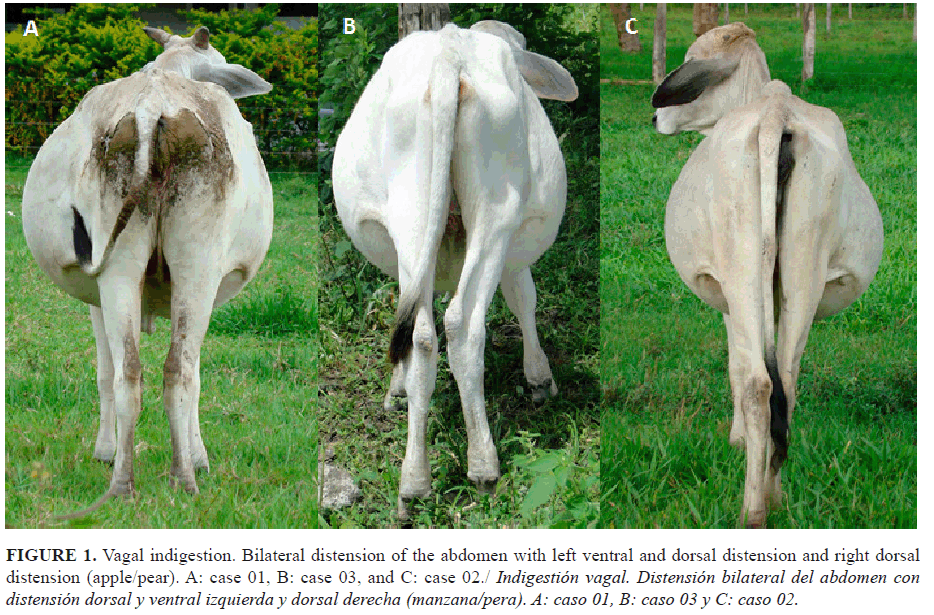
<body><![CDATA[<p align="justify"><font size="3" face="Verdana, Arial, Helvetica, sans-serif"><b>MATERIALS AND  METHODS</b></font></p>     <p align="justify" style="margin-top:12.0pt;text-indent:0cm;">Three animals were  examined in the period between 2008 - 2011 during visits to three different  properties, two located in the northeastern region of Par&aacute; state , Brazil,  [animals 01 and 02], and the third in A&ccedil;ail&acirc;ndia municipality in Maranh&atilde;o  state, Brazil, [animal 03]. This epidemiological study was conducted by the  visits carried out to obtain information regarding breeding, grazing, water  sources, and health management on the properties. The three animals were  clinically examined according to Dirksen <em>et al.</em> (1), their blood was  collected by jugular venipuncture to obtain a complete blood count (CBC), and  an atropine test. This atropine test was performed according the techniques  described by Dirksen<em> et al. </em>(1).</p>     <p align="justify" style="margin-top:12.0pt;text-indent:0cm;">Animals 02 and 03 were  examined during 30 days before being euthanized due to their poor prognoses.  Necropsy was performed in both animals according to the animal welfare  guidelines established by the National Council for Animal Experiments Control  (CONCEA) (16). However, the owner of animal 01 did not authorize euthanasia,  even though it was made clear that the animal&rsquo;s prognosis was poor.</p>     <p style="margin-top:12.0pt;margin-right:0cm;margin-bottom:5.65pt;margin-left:0cm;">&nbsp;</p>     <p align="justify"><font size="3" face="Verdana, Arial, Helvetica, sans-serif"><b>RESULTS</b></font></p>     <p align="justify" style="margin-top:12.0pt;text-indent:0cm;">The  animals were farmed extensively in Brachiaria brizantha pastures: one  four-year-old Nellore cow (case 01) and two one-year-old crossbred Nellore x  Zebu cattle [one female (case 02) and one male (case 03).</p>     <p align="justify" style="margin-top:12.0pt;text-indent:0cm;">The clinical  examinations revealed lack of appetite, mild dehydration, rough coat, and a  normal nutritional status in the three animals. Upon inspections of the  digestive system, an evidence of undulating movements in the left paralumbar  fossa was observed. These movements coincided with the ruminal movements and the  contractions of the left ventral abdominal wall corresponding to the ventral  sac of the rumen, which moved towards the dorsal region. The three animals had  bilateral distension of the abdomen, with the ventral and dorsal regions being  distended on the left side, and only the ventral region being distended on the  right side (i.e., in the shape of an apple/pear) (<a href="/img/revistas/rsa/v38n3/f0103316.gif">Fig.1 A</a>, <a href="/img/revistas/rsa/v38n3/f0103316.gif">B</a> and <a href="/img/revistas/rsa/v38n3/f0103316.gif">C</a>). Palpation  revealed no stratification of the rumen content. During the auscultation of the  forestomachs, incomplete rumen contractions were observed with a normal  frequency in animal 01 and with an increased frequency in animals 02 and 03.  Animal 01 had diarrhea present on the surfaces of the ischialtuberosities, but  animals 02 and 03 had scant feces with a firm consistency.</p>     
<p align="justify" style="margin-top:12.0pt;text-indent:0cm;">CBC did not reveal  abnormalities in any of the three cases. The atropine test was positive in the  three cases, and the cardiac frequency increased by at least 16% after the  application of atropine sulfate. </p>     <p align="justify" style="margin-top:12.0pt;text-indent:0cm;">The necropsies of  animals 02 and 03 revealed that the rumen and reticulum were distended, the  size of the omasum and abomasum was reduced, and they had very little content  (<a href="#f2">Fig. 2</a>). In addition, the adhesion of the reticulum to the diaphragm was  observed (<a href="#f3">Fig. 3</a>), and the rumen content was shown to be homogenous with a  foamy appearance, a viscous consistency and an olive green color (<a href="/img/revistas/rsa/v38n3/f0403316.gif">Fig. 4</a>).</p>     
<p align="center" ><a name="f2"></a></p>     ]]></body>
<body><![CDATA[<p align="center" ><img src="../img/revistas/rsa/v38n3/f0203316.gif" width="400" height="420"></p>     <p align="center" ><a name="f3"></a></p>     <p align="center" ><img src="../img/revistas/rsa/v38n3/f0303316.gif" width="400" height="378"><span style="font-family:'Verdana','sans-serif'; font-size:10.0pt; ">&nbsp;</span></p>     <p align="justify">&nbsp;</p>     <p align="justify"><font size="3" face="Verdana, Arial, Helvetica, sans-serif"><b>DISCUSSION</b></font></p>     <p align="justify" style="margin-top:12.0pt;text-indent:0cm;">Diagnoses of vagal  indigestion have been reported in European animal species, their crossbred  offspring, and in miniature cattle raised under semi-intensive or intensive  systems (4, 5, 9,17). The cases reported in this study were unique because the  animals belonged to Zebu cattle raised under an extensive system, meaning that  this is the first Brazilian study to report the occurrence of vagal indigestion  in Zebu cattle raised under this production system.&nbsp; </p>     <p align="justify" style="margin-top:12.0pt;text-indent:0cm;">In the cases reported  in the current study, the clinical symptoms observed were apathy, anorexia,  weight loss, dehydration, dull and rough coats, diarrhea in case 01, and scant  feces with a firm consistency in cases 02 and 03. These general clinical  findings corroborated the data described in the literature regarding the  clinical symptomatology of vagal indigestion (2, 4, 13, 15). Animals with vagal  indigestion commonly develop bradycardia, which is defined as a heartbeat less  than or equal to 60 beats per minute. However, not all animals with vagal indigestion  present these symptoms, as it was observed in this study. Consequently, the  possibility of vagal nerve damage cannot be discarded due to the absence of  bradycardia (4). </p>     <p align="justify" style="margin-top:12.0pt;text-indent:0cm;">The abdominal  distension observed in the upper and lower left quadrants and in the lower  right quadrant (the &ldquo;apple and pear&rdquo; shape) is a characteristic finding for  vagal indigestion (8, 9). The abdominal distension developed due to a  progressive increase in rumen volume resulted when the flow of the  ruminoreticulated contents into the omasum and abomasum is stopped, as it was  observed in the three cases reported. In some cases of vagal damage, the  animals have been reported to exhibit an increased frequency of rumen  contractions. However, these contractions are ineffective and the intake  accumulates in the rumen and the reticulum (3, 5, 8). These contractions can be  observed as prominent undulations in the left paralumbar fossa (8), which is  consistent with the observations of the cases studied here. </p>     <p align="justify" style="margin-top:12.0pt;text-indent:0cm;">In this study, the  results of the hematological exams of the animals were normal. CBC are useful  tools to indicate inflammatory processes that can cause damage to the vagal  nerve (8). However, CBC values can be normal if the inflammatory process has  already been relieved or it is due to a chronic process. The necropsies of the  animals researched here confirmed that the inflammatory process had already  been mitigated, but several remaining sequelae were manifested as adhesions.</p>     <p align="justify" style="margin-top:12.0pt;text-indent:0cm;">The diagnoses of vagal  indigestion were based on the history, clinical symptoms and a positive  atropine test. However, the cause of the nerve damage was generally difficult  to establish because the origin of such damage cannot be determined only with a  clinical exam in many cases. Therefore, the cause of this damage is only  determined after necropsy in many cases (8). The prognosis for this disease was  poor, and the symptoms were progressive, making it frequently necessary to  euthanize the animal (15). Indeed, euthanasia was performed in cases 02 and 03,  both of which presented progressive clinical symptoms with compromised the  general health. Both of these animals had also positive results on the atropine  test, which for some authors, constituted a proof of the vagal nerve damage  (1).</p>     ]]></body>
<body><![CDATA[<p align="justify" style="margin-top:12.0pt;text-indent:0cm;">The findings of  necropsies from cases of vagal indigestion primarily showed changes in the size  and content of the forestomach and stomach, with the nerve damage being a  possible cause (3, 5). In cases of anterior stenosis, the rumen and reticulum  were dilated with an abundant homogeneous rumen content that had a foamy  viscous consistency and an olive green color. In addition, the omasum and  abomasum were reduced in size, and their content was compacted and reduced, as  it was observed in cases 02 and 03. These findings were similar to those of  Dirksen <em>et al.</em> (1), Sattler <em>et al.</em> (5) and Curtis and Groot (13). </p>     <p align="justify" style="margin-top:12.0pt;text-indent:0cm;">In the cases described  here, necropsies helped to establish the cause of the vagal nerve damage. A  reticular adhesion to the diaphragm has been shown to cause damage to the  ventral abdominal vagus nerve and has been classified according to Nadalian  (15) as an anterior stenosis with hypermotility of the reticulo-rumen. </p>     <p style="margin-top:12.0pt;margin-right:0cm;margin-bottom:5.65pt;margin-left:0cm;">&nbsp;</p>     <p align="justify"><font size="3" face="Verdana, Arial, Helvetica, sans-serif"><b>CONCLUSIONS</b></font></p>     <p align="justify" style="margin-top:12.0pt;text-indent:0cm;">Given the findings of  this study, we conclude that vagal indigestion is a disease that can affect  animals at any age, breed, and grazing system. The present study provides the  first case report of vagal indigestion in extensively reared Zebu cattle in  Brazil.</p>     <p align="left" style="margin-top:12.0pt;margin-right:0cm;margin-bottom:5.65pt;margin-left:0cm;text-align:left;">&nbsp;</p>     <p align="justify"><font size="3" face="Verdana, Arial, Helvetica, sans-serif"><b>CONFLICT OF INTEREST STATEMENT</b></font></p>     <p align="justify" style="margin-top:12.0pt;text-indent:0cm;">None of the authors of  this paper have a financial or personal relationship with other people or  organizations that would inappropriately influence or bias the content of this  paper.</p>     <p style="margin-top:12.0pt;text-indent:0cm;">&nbsp;</p>     <p align="justify"><font size="3" face="Verdana, Arial, Helvetica, sans-serif"><b>REFERENCES</b></font></p> </font>     ]]></body>
<body><![CDATA[<!-- ref --><p align="justify" style="margin-top:12.0pt;margin-right:0cm;margin-bottom:5.65pt;margin-left:0cm;text-align:justify;text-indent:0cm;"><font size="2" face="Verdana, Arial, Helvetica, sans-serif">1.  Dirksen G, Gr&uuml;nder HD, St&ouml;ber M. Medicina    interna y cirug&iacute;a del bovino. 4&ordf; ed. Buenos Aires: Inter-M&eacute;dica. 2005.    </font></p>     <!-- ref --><p align="justify" style="margin-top:12.0pt;margin-right:0cm;margin-bottom:5.65pt;margin-left:0cm;text-align:justify;text-indent:0cm;"><font size="2" face="Verdana, Arial, Helvetica, sans-serif">2. Lacasta D, Climent M, Ferrer LM, Ramos  JJ,    Figueras L, Borobia M. Vagus indigestion resulting from a Cysticercus  tenuicollis cyst in anadultewe. Small Ruminant Res. 2013;110(1):62-64.    </font></p>     <!-- ref --><p align="justify" style="margin-top:12.0pt;margin-right:0cm;margin-bottom:5.65pt;margin-left:0cm;text-align:justify;text-indent:0cm;"><font size="2" face="Verdana, Arial, Helvetica, sans-serif">3. Braun U, Rauch S, H&auml;ssig M.  Ultrasonographic evaluation of reticular motility in 144 cattle with vagal  indigestion. Vet Rec. 2009;164(1):11-13.    </font></p>     <!-- ref --><p align="justify" style="margin-top:12.0pt;margin-right:0cm;margin-bottom:5.65pt;margin-left:0cm;text-align:justify;text-indent:0cm;"><font size="2" face="Verdana, Arial, Helvetica, sans-serif">4. Braun U, Hausammann K, Oertle C. Hoflund  syndrome due to anterior functional stenosis in 20 cows. Berl Munch Tierarztl  Wochenschr. 1990;103(6):192-197.    </font></p>     <!-- ref --><p align="justify" style="margin-top:12.0pt;margin-right:0cm;margin-bottom:5.65pt;margin-left:0cm;text-indent:0cm;"><font size="2" face="Verdana, Arial, Helvetica, sans-serif">5. Sattler N, Fecteau G, H&eacute;lie P, Lapointe  JM, Chouinard L, Babkine M, <em>et al.</em> Etiology, forms, and prognosis of  gastrointestinal dysfunction resembling vagal indigestion occurring after  surgical correction of right abomasal displacement. Can Vet J.  2000;41(10):777-785.    </font></p>     ]]></body>
<body><![CDATA[<!-- ref --><p align="justify" style="margin-top:12.0pt;margin-right:0cm;margin-bottom:5.65pt;margin-left:0cm;text-align:justify;text-indent:0cm;"><font size="2" face="Verdana, Arial, Helvetica, sans-serif">6. Gordon PJ. Surgical removal of a  fibropapilloma from the reticulum causing apparent vagal indigestion. Vet Rec.  1997;140(3):69-70.    </font></p>     <!-- ref --><p align="justify" style="margin-top:12.0pt;margin-right:0cm;margin-bottom:5.65pt;margin-left:0cm;text-align:justify;text-indent:0cm;"><font size="2" face="Verdana, Arial, Helvetica, sans-serif">7. Borges JRJ, Moscardine ARC. Indigest&atilde;o  vagal. In: Riet-Correa F,Schild AL, Lemos AA, Borges JRJ. Doen&ccedil;as de ruminantes  e equ&iacute;deos. 3&ordf; ed. Vol 2. Santa Maria: Pallotti. 2007; 349-352.    </font></p>     <!-- ref --><p align="justify" style="margin-top:12.0pt;margin-right:0cm;margin-bottom:5.65pt;margin-left:0cm;text-align:justify;text-indent:0cm;"><font size="2" face="Verdana, Arial, Helvetica, sans-serif">8. Radostits OM, Clive CG, Blood DC,  Hinchcliff KW.Cl&iacute;nica veterin&aacute;ria. Um tratado de doen&ccedil;as dos bovinos, ovinos,  su&iacute;nos, caprinos e equinos. 9&ordf; ed. Rio de janeiro: Guanabara Koogan. 2002.    </font></p>     <!-- ref --><p align="justify" style="margin-top:12.0pt;margin-right:0cm;margin-bottom:5.65pt;margin-left:0cm;text-align:justify;text-indent:0cm;"><font size="2" face="Verdana, Arial, Helvetica, sans-serif">9. Fernandes GO, Filappi AR, Cecim M, Leal  MLR. Indigest&atilde;o vagal causada por linfossarcoma em bovino.  2008. <a href="http://www.sovergs.com.br/conbravet2008/anais/cd/resumos/R0715-1.pdf" target="_blank">http://www.sovergs.com.br/conbravet2008/anais/cd/resumos/R0715-1.pdf</a>.    </font></p>     <!-- ref --><p align="justify" style="margin-top:12.0pt;margin-right:0cm;margin-bottom:5.65pt;margin-left:0cm;text-align:justify;text-indent:0cm;"><font size="2" face="Verdana, Arial, Helvetica, sans-serif">10. Rom&atilde;o FTNMA, Barberini DJ, Gomes RG.  Estenose funcional pil&oacute;rica em vaca leiteira: relato de caso. Rev Acad Cienc  Agrar Ambient. 2012;10(1):99-103.    </font></p>     ]]></body>
<body><![CDATA[<!-- ref --><p align="justify" style="margin-top:12.0pt;margin-right:0cm;margin-bottom:5.65pt;margin-left:0cm;text-align:justify;text-indent:0cm;"><font size="2" face="Verdana, Arial, Helvetica, sans-serif">11. Santos GGF, Stuchi RS, Deschk M, Rodrigues  M, Cadioli FA, Rodrigues CA, <em>et al.</em> Indigest&atilde;o vagal em uma minivaca:  relato de caso. Vet Zootec. 2010;17(Supl1):40.    </font></p>     <!-- ref --><p align="justify" style="margin-top:12.0pt;margin-right:0cm;margin-bottom:5.65pt;margin-left:0cm;text-align:justify;text-indent:0cm;"><font size="2" face="Verdana, Arial, Helvetica, sans-serif">12. Amorim RM, Santarosa BP, Dantas GN,  Ferreira DOL, Rodrigues CA, Hussni CA, <em>et al.</em> Indigest&atilde;o vagal em seis  mini-bovinos atendidos na Cl&iacute;nica de Grandes Animais FMVZ-UNESP/Botucatu.2011. <a href="http://www.sovergs.com.br/site/38conbravet/resumos/963.pdf" target="_blank">http://www.sovergs.com.br/site/38conbravet/resumos/963.pdf</a>.    </font></p>     <!-- ref --><p align="justify" style="margin-top:12.0pt;margin-right:0cm;margin-bottom:5.65pt;margin-left:0cm;text-align:justify;text-indent:0cm;"><font size="2" face="Verdana, Arial, Helvetica, sans-serif">13. Curtis RA, Groot JJ. Vagus indigestion  related to a liver hemangioma. Can Vet J. 1967;8(3):75-76.    </font></p>     <!-- ref --><p align="justify" style="margin-top:12.0pt;margin-right:0cm;margin-bottom:5.65pt;margin-left:0cm;text-align:justify;text-indent:0cm;"><font size="2" face="Verdana, Arial, Helvetica, sans-serif">14. Fubini SL, Ducharme NG, Murphy JP, Smith  DF. Vagus indigestion syndrome resulting from a liver abscess in dairy cows. J  Am Vet Med Assoc. 1985;186(12):1297-1300.    </font></p>     <!-- ref --><p align="justify" style="margin-top:12.0pt;margin-right:0cm;margin-bottom:5.65pt;margin-left:0cm;text-align:justify;text-indent:0cm;"><font size="2" face="Verdana, Arial, Helvetica, sans-serif">15. Nadalian MG. Vagus indigestion syndrome in  cattle. J Vet Fac Univ Tehran.1990;45(1):23-35.    </font></p>     ]]></body>
<body><![CDATA[<!-- ref --><p align="justify" style="margin-top:12.0pt;margin-right:0cm;margin-bottom:5.65pt;margin-left:0cm;text-align:justify;text-indent:0cm;"><font size="2" face="Verdana, Arial, Helvetica, sans-serif">16. National Council for Animal Experiments  Control - CONCEA, V do art. 5o da Lei No. 11.794, of the 8 de October of the  2008.    </font></p>     <!-- ref --><p align="justify" style="margin-top:12.0pt;margin-right:0cm;margin-bottom:5.65pt;margin-left:0cm;text-align:justify;text-indent:0cm;"><font size="2" face="Verdana, Arial, Helvetica, sans-serif"><span style="font-family:'Verdana','sans-serif'; font-size:10.0pt; ">17. Rehage J, Kaske M, Stockhofe-Zurwieden N, Yalcin E. Evaluation  of the pathogenesis of vagus indigestion in cows with traumatic  reticuloperitonitis. J Am Vet Med Assoc. 1995;207(12):1607-1611</span>.    </font></p>     <p align="justify">&nbsp;</p>     <p align="justify">&nbsp;</p>     <p align="justify"><font size="2" face="Verdana, Arial, Helvetica, sans-serif"><span style="font-family:'Verdana','sans-serif'; font-size:10.0pt">Recibido:</span> 7/09/<span style="font-family:'Verdana','sans-serif'; font-size:10.0pt">2015    <br> </span>Aceptado<span style="font-family:'Verdana','sans-serif'; font-size:10.0pt">: 15/06/2016</span></font></p>     <p align="justify">&nbsp;</p>     <p align="justify">&nbsp;</p> <font size="2" face="Verdana, Arial, Helvetica, sans-serif">     ]]></body>
<body><![CDATA[<p align="justify"><i>Jenevaldo Barbosa da Silva,</i> <span style="line-height:107%; font-family:'Verdana','sans-serif'; font-size:10.0pt; ">Universidade  Federal dos Vales do Jequitinhonha e Mucuri &ndash; ICA/UFVJM</span>.    Email: <a href="mailto:jenevaldo@hotmail.com">jenevaldo@hotmail.com</a>.</p> </font>      ]]></body><back>
<ref-list>
<ref id="B1">
<label>1</label><nlm-citation citation-type="book">
<person-group person-group-type="author">
<name>
<surname><![CDATA[Dirksen]]></surname>
<given-names><![CDATA[G]]></given-names>
</name>
<name>
<surname><![CDATA[Gründer]]></surname>
<given-names><![CDATA[HD]]></given-names>
</name>
<name>
<surname><![CDATA[Stöber]]></surname>
<given-names><![CDATA[M]]></given-names>
</name>
</person-group>
<source><![CDATA[Medicina interna y cirugía del bovino]]></source>
<year>2005</year>
<edition>4</edition>
<publisher-loc><![CDATA[^eBuenos Aires Buenos Aires]]></publisher-loc>
<publisher-name><![CDATA[Inter-Médica]]></publisher-name>
</nlm-citation>
</ref>
<ref id="B2">
<label>2</label><nlm-citation citation-type="journal">
<person-group person-group-type="author">
<name>
<surname><![CDATA[Lacasta]]></surname>
<given-names><![CDATA[D]]></given-names>
</name>
<name>
<surname><![CDATA[Climent]]></surname>
<given-names><![CDATA[M]]></given-names>
</name>
<name>
<surname><![CDATA[Ferrer]]></surname>
<given-names><![CDATA[LM]]></given-names>
</name>
<name>
<surname><![CDATA[Ramos]]></surname>
<given-names><![CDATA[JJ]]></given-names>
</name>
<name>
<surname><![CDATA[Figueras]]></surname>
<given-names><![CDATA[L]]></given-names>
</name>
<name>
<surname><![CDATA[Borobia]]></surname>
<given-names><![CDATA[M]]></given-names>
</name>
</person-group>
<article-title xml:lang="en"><![CDATA[Vagus indigestion resulting from a Cysticercus tenuicollis cyst in anadultewe]]></article-title>
<source><![CDATA[Small Ruminant Res]]></source>
<year>2013</year>
<volume>110</volume>
<numero>1</numero>
<issue>1</issue>
<page-range>62-64</page-range></nlm-citation>
</ref>
<ref id="B3">
<label>3</label><nlm-citation citation-type="journal">
<person-group person-group-type="author">
<name>
<surname><![CDATA[Braun]]></surname>
<given-names><![CDATA[U]]></given-names>
</name>
<name>
<surname><![CDATA[Rauch]]></surname>
<given-names><![CDATA[S]]></given-names>
</name>
<name>
<surname><![CDATA[Hässig]]></surname>
<given-names><![CDATA[M]]></given-names>
</name>
</person-group>
<article-title xml:lang="en"><![CDATA[Ultrasonographic evaluation of reticular motility in 144 cattle with vagal indigestion]]></article-title>
<source><![CDATA[Vet Rec]]></source>
<year>2009</year>
<volume>164</volume>
<numero>1</numero>
<issue>1</issue>
<page-range>11-13</page-range></nlm-citation>
</ref>
<ref id="B4">
<label>4</label><nlm-citation citation-type="journal">
<person-group person-group-type="author">
<name>
<surname><![CDATA[Braun]]></surname>
<given-names><![CDATA[U]]></given-names>
</name>
<name>
<surname><![CDATA[Hausammann]]></surname>
<given-names><![CDATA[K]]></given-names>
</name>
<name>
<surname><![CDATA[Oertle]]></surname>
<given-names><![CDATA[C]]></given-names>
</name>
</person-group>
<article-title xml:lang="en"><![CDATA[Hoflund syndrome due to anterior functional stenosis in 20 cows]]></article-title>
<source><![CDATA[Berl Munch Tierarztl Wochenschr]]></source>
<year>1990</year>
<volume>103</volume>
<numero>6</numero>
<issue>6</issue>
<page-range>192-197</page-range></nlm-citation>
</ref>
<ref id="B5">
<label>5</label><nlm-citation citation-type="journal">
<person-group person-group-type="author">
<name>
<surname><![CDATA[Sattler]]></surname>
<given-names><![CDATA[N]]></given-names>
</name>
<name>
<surname><![CDATA[Fecteau]]></surname>
<given-names><![CDATA[G]]></given-names>
</name>
<name>
<surname><![CDATA[Hélie]]></surname>
<given-names><![CDATA[P]]></given-names>
</name>
<name>
<surname><![CDATA[Lapointe]]></surname>
<given-names><![CDATA[JM]]></given-names>
</name>
<name>
<surname><![CDATA[Chouinard]]></surname>
<given-names><![CDATA[L]]></given-names>
</name>
<name>
<surname><![CDATA[Babkine]]></surname>
<given-names><![CDATA[M]]></given-names>
</name>
</person-group>
<article-title xml:lang="en"><![CDATA[Etiology, forms, and prognosis of gastrointestinal dysfunction resembling vagal indigestion occurring after surgical correction of right abomasal displacement]]></article-title>
<source><![CDATA[Can Vet J]]></source>
<year>2000</year>
<volume>41</volume>
<numero>10</numero>
<issue>10</issue>
<page-range>777-785</page-range></nlm-citation>
</ref>
<ref id="B6">
<label>6</label><nlm-citation citation-type="journal">
<person-group person-group-type="author">
<name>
<surname><![CDATA[Gordon]]></surname>
<given-names><![CDATA[PJ]]></given-names>
</name>
</person-group>
<article-title xml:lang="en"><![CDATA[Surgical removal of a fibropapilloma from the reticulum causing apparent vagal indigestion]]></article-title>
<source><![CDATA[Vet Rec]]></source>
<year>1997</year>
<volume>140</volume>
<numero>3</numero>
<issue>3</issue>
<page-range>69-70</page-range></nlm-citation>
</ref>
<ref id="B7">
<label>7</label><nlm-citation citation-type="book">
<person-group person-group-type="author">
<name>
<surname><![CDATA[Borges]]></surname>
<given-names><![CDATA[JRJ]]></given-names>
</name>
<name>
<surname><![CDATA[Moscardine]]></surname>
<given-names><![CDATA[ARC]]></given-names>
</name>
</person-group>
<article-title xml:lang="pt"><![CDATA[Indigestão vagal]]></article-title>
<person-group person-group-type="editor">
<name>
<surname><![CDATA[Riet-Correa]]></surname>
<given-names><![CDATA[F]]></given-names>
</name>
<name>
<surname><![CDATA[Schild]]></surname>
<given-names><![CDATA[AL]]></given-names>
</name>
<name>
<surname><![CDATA[Lemos]]></surname>
<given-names><![CDATA[AA]]></given-names>
</name>
<name>
<surname><![CDATA[Borges]]></surname>
<given-names><![CDATA[JRJ]]></given-names>
</name>
</person-group>
<source><![CDATA[Doenças de ruminantes e equídeos]]></source>
<year>2007</year>
<volume>2</volume>
<edition>3</edition>
<page-range>349-352</page-range><publisher-loc><![CDATA[Santa Maria ]]></publisher-loc>
<publisher-name><![CDATA[Pallotti]]></publisher-name>
</nlm-citation>
</ref>
<ref id="B8">
<label>8</label><nlm-citation citation-type="book">
<person-group person-group-type="author">
<name>
<surname><![CDATA[Radostits]]></surname>
<given-names><![CDATA[OM]]></given-names>
</name>
<name>
<surname><![CDATA[Clive]]></surname>
<given-names><![CDATA[CG]]></given-names>
</name>
<name>
<surname><![CDATA[Blood]]></surname>
<given-names><![CDATA[DC]]></given-names>
</name>
<name>
<surname><![CDATA[Hinchcliff]]></surname>
<given-names><![CDATA[KW]]></given-names>
</name>
</person-group>
<source><![CDATA[Clínica veterinária. Um tratado de doenças dos bovinos, ovinos, suínos, caprinos e equinos]]></source>
<year>2002</year>
<edition>9</edition>
<publisher-loc><![CDATA[^eRio de janeiro Rio de janeiro]]></publisher-loc>
<publisher-name><![CDATA[Guanabara Koogan]]></publisher-name>
</nlm-citation>
</ref>
<ref id="B9">
<label>9</label><nlm-citation citation-type="">
<person-group person-group-type="author">
<name>
<surname><![CDATA[Fernandes]]></surname>
<given-names><![CDATA[GO]]></given-names>
</name>
<name>
<surname><![CDATA[Filappi]]></surname>
<given-names><![CDATA[AR]]></given-names>
</name>
<name>
<surname><![CDATA[Cecim]]></surname>
<given-names><![CDATA[M]]></given-names>
</name>
<name>
<surname><![CDATA[Leal]]></surname>
<given-names><![CDATA[MLR]]></given-names>
</name>
</person-group>
<source><![CDATA[Indigestão vagal causada por linfossarcoma em bovino]]></source>
<year>2008</year>
</nlm-citation>
</ref>
<ref id="B10">
<label>10</label><nlm-citation citation-type="journal">
<person-group person-group-type="author">
<name>
<surname><![CDATA[Romão]]></surname>
<given-names><![CDATA[FTNMA]]></given-names>
</name>
<name>
<surname><![CDATA[Barberini]]></surname>
<given-names><![CDATA[DJ]]></given-names>
</name>
<name>
<surname><![CDATA[Gomes]]></surname>
<given-names><![CDATA[RG]]></given-names>
</name>
</person-group>
<article-title xml:lang="pt"><![CDATA[Estenose funcional pilórica em vaca leiteira: relato de caso]]></article-title>
<source><![CDATA[Rev Acad Cienc Agrar Ambient]]></source>
<year>2012</year>
<volume>10</volume>
<numero>1</numero>
<issue>1</issue>
<page-range>99-103</page-range></nlm-citation>
</ref>
<ref id="B11">
<label>11</label><nlm-citation citation-type="journal">
<person-group person-group-type="author">
<name>
<surname><![CDATA[Santos]]></surname>
<given-names><![CDATA[GGF]]></given-names>
</name>
<name>
<surname><![CDATA[Stuchi]]></surname>
<given-names><![CDATA[RS]]></given-names>
</name>
<name>
<surname><![CDATA[Deschk]]></surname>
<given-names><![CDATA[M]]></given-names>
</name>
<name>
<surname><![CDATA[Rodrigues]]></surname>
<given-names><![CDATA[M]]></given-names>
</name>
<name>
<surname><![CDATA[Cadioli]]></surname>
<given-names><![CDATA[FA]]></given-names>
</name>
<name>
<surname><![CDATA[Rodrigues]]></surname>
<given-names><![CDATA[CA]]></given-names>
</name>
</person-group>
<article-title xml:lang="pt"><![CDATA[Indigestão vagal em uma minivaca: relato de caso]]></article-title>
<source><![CDATA[Vet Zootec]]></source>
<year>2010</year>
<volume>17</volume>
<numero>Supl1</numero>
<issue>Supl1</issue>
<page-range>40</page-range></nlm-citation>
</ref>
<ref id="B12">
<label>12</label><nlm-citation citation-type="book">
<person-group person-group-type="author">
<name>
<surname><![CDATA[Amorim]]></surname>
<given-names><![CDATA[RM]]></given-names>
</name>
<name>
<surname><![CDATA[Santarosa]]></surname>
<given-names><![CDATA[BP]]></given-names>
</name>
<name>
<surname><![CDATA[Dantas]]></surname>
<given-names><![CDATA[GN]]></given-names>
</name>
<name>
<surname><![CDATA[Ferreira]]></surname>
<given-names><![CDATA[DOL]]></given-names>
</name>
<name>
<surname><![CDATA[Rodrigues]]></surname>
<given-names><![CDATA[CA]]></given-names>
</name>
<name>
<surname><![CDATA[Hussni]]></surname>
<given-names><![CDATA[CA]]></given-names>
</name>
</person-group>
<source><![CDATA[Indigestão vagal em seis mini-bovinos atendidos na Clínica de Grandes Animais]]></source>
<year>2011</year>
<publisher-loc><![CDATA[^eBotucatu Botucatu]]></publisher-loc>
<publisher-name><![CDATA[FMVZ-UNESP]]></publisher-name>
</nlm-citation>
</ref>
<ref id="B13">
<label>13</label><nlm-citation citation-type="journal">
<person-group person-group-type="author">
<name>
<surname><![CDATA[Curtis]]></surname>
<given-names><![CDATA[RA]]></given-names>
</name>
<name>
<surname><![CDATA[Groot]]></surname>
<given-names><![CDATA[JJ]]></given-names>
</name>
</person-group>
<article-title xml:lang="en"><![CDATA[Vagus indigestion related to a liver hemangioma]]></article-title>
<source><![CDATA[Can Vet J]]></source>
<year>1967</year>
<volume>8</volume>
<numero>3</numero>
<issue>3</issue>
<page-range>75-76</page-range></nlm-citation>
</ref>
<ref id="B14">
<label>14</label><nlm-citation citation-type="journal">
<person-group person-group-type="author">
<name>
<surname><![CDATA[Fubini]]></surname>
<given-names><![CDATA[SL]]></given-names>
</name>
<name>
<surname><![CDATA[Ducharme]]></surname>
<given-names><![CDATA[NG]]></given-names>
</name>
<name>
<surname><![CDATA[Murphy]]></surname>
<given-names><![CDATA[JP]]></given-names>
</name>
<name>
<surname><![CDATA[Smith]]></surname>
<given-names><![CDATA[DF]]></given-names>
</name>
</person-group>
<article-title xml:lang="en"><![CDATA[Vagus indigestion syndrome resulting from a liver abscess in dairy cows]]></article-title>
<source><![CDATA[J Am Vet Med Assoc]]></source>
<year>1985</year>
<volume>186</volume>
<numero>12</numero>
<issue>12</issue>
<page-range>1297-1300</page-range></nlm-citation>
</ref>
<ref id="B15">
<label>15</label><nlm-citation citation-type="journal">
<person-group person-group-type="author">
<name>
<surname><![CDATA[Nadalian]]></surname>
<given-names><![CDATA[MG]]></given-names>
</name>
</person-group>
<article-title xml:lang="en"><![CDATA[Vagus indigestion syndrome in cattle]]></article-title>
<source><![CDATA[J Vet Fac Univ Tehran]]></source>
<year>1990</year>
<volume>45</volume>
<numero>1</numero>
<issue>1</issue>
<page-range>23-35</page-range></nlm-citation>
</ref>
<ref id="B16">
<label>16</label><nlm-citation citation-type="">
<collab>National Council for Animal Experiments Control - CONCEA</collab>
<source><![CDATA[V do art. 5o da Lei No. 11.794]]></source>
<year>8 de</year>
<month> O</month>
<day>ct</day>
</nlm-citation>
</ref>
<ref id="B17">
<label>17</label><nlm-citation citation-type="journal">
<person-group person-group-type="author">
<name>
<surname><![CDATA[Rehage]]></surname>
<given-names><![CDATA[J]]></given-names>
</name>
<name>
<surname><![CDATA[Kaske]]></surname>
<given-names><![CDATA[M]]></given-names>
</name>
<name>
<surname><![CDATA[Stockhofe-Zurwieden]]></surname>
<given-names><![CDATA[N]]></given-names>
</name>
<name>
<surname><![CDATA[Yalcin]]></surname>
<given-names><![CDATA[E]]></given-names>
</name>
</person-group>
<article-title xml:lang="en"><![CDATA[Evaluation of the pathogenesis of vagus indigestion in cows with traumatic reticuloperitonitis]]></article-title>
<source><![CDATA[J Am Vet Med Assoc]]></source>
<year>1995</year>
<volume>207</volume>
<numero>12</numero>
<issue>12</issue>
<page-range>1607-1611</page-range></nlm-citation>
</ref>
</ref-list>
</back>
</article>