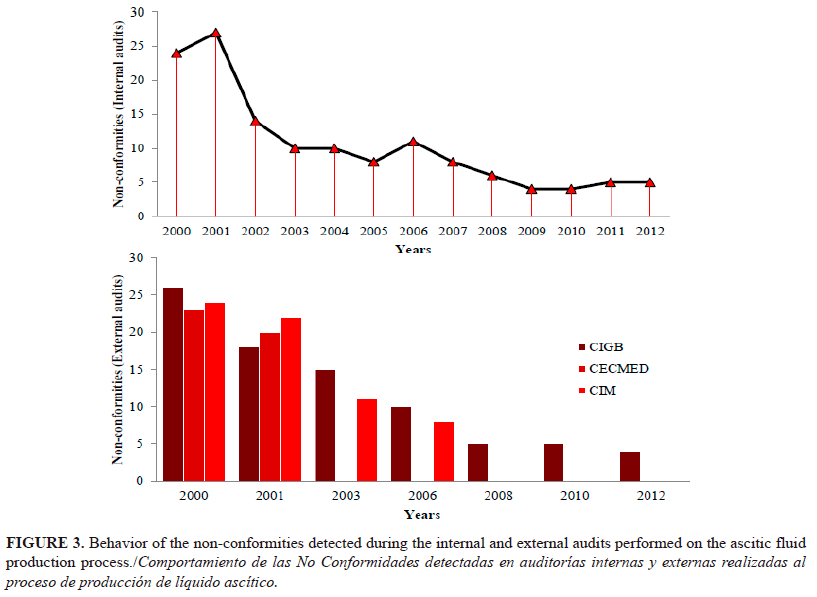
<?xml version="1.0" encoding="ISO-8859-1"?><article xmlns:mml="http://www.w3.org/1998/Math/MathML" xmlns:xlink="http://www.w3.org/1999/xlink" xmlns:xsi="http://www.w3.org/2001/XMLSchema-instance">
<front>
<journal-meta>
<journal-id>0253-570X</journal-id>
<journal-title><![CDATA[Revista de Salud Animal]]></journal-title>
<abbrev-journal-title><![CDATA[Rev Salud Anim.]]></abbrev-journal-title>
<issn>0253-570X</issn>
<publisher>
<publisher-name><![CDATA[Centro Nacional de Sanidad Agropecuaria]]></publisher-name>
</publisher>
</journal-meta>
<article-meta>
<article-id>S0253-570X2016000300006</article-id>
<title-group>
<article-title xml:lang="en"><![CDATA[Microbiological control in the large-scale production of ascitic fluid rich in monoclonal antibodies in Cuba]]></article-title>
<article-title xml:lang="es"><![CDATA[Control microbiológico en la producción a gran escala de líquido ascítico rico en anticuerpos monoclonales en Cuba]]></article-title>
</title-group>
<contrib-group>
<contrib contrib-type="author">
<name>
<surname><![CDATA[Vargas Caballero]]></surname>
<given-names><![CDATA[Yordanka]]></given-names>
</name>
<xref ref-type="aff" rid="A01"/>
</contrib>
<contrib contrib-type="author">
<name>
<surname><![CDATA[Grandía Guzmán]]></surname>
<given-names><![CDATA[Raiden]]></given-names>
</name>
<xref ref-type="aff" rid="A02"/>
</contrib>
<contrib contrib-type="author">
<name>
<surname><![CDATA[Riera Ojeda]]></surname>
<given-names><![CDATA[Layna]]></given-names>
</name>
<xref ref-type="aff" rid="A03"/>
</contrib>
<contrib contrib-type="author">
<name>
<surname><![CDATA[Zuaznábar Macías]]></surname>
<given-names><![CDATA[Leticia]]></given-names>
</name>
<xref ref-type="aff" rid="A01"/>
</contrib>
<contrib contrib-type="author">
<name>
<surname><![CDATA[Hernández Vasallo]]></surname>
<given-names><![CDATA[Odys]]></given-names>
</name>
<xref ref-type="aff" rid="A01"/>
</contrib>
<contrib contrib-type="author">
<name>
<surname><![CDATA[Sánchez Sterling]]></surname>
<given-names><![CDATA[Sahilis]]></given-names>
</name>
<xref ref-type="aff" rid="A03"/>
</contrib>
<contrib contrib-type="author">
<name>
<surname><![CDATA[León León]]></surname>
<given-names><![CDATA[Isnay]]></given-names>
</name>
<xref ref-type="aff" rid="A01"/>
</contrib>
<contrib contrib-type="author">
<name>
<surname><![CDATA[Reyes Drake]]></surname>
<given-names><![CDATA[Dairy Julia]]></given-names>
</name>
<xref ref-type="aff" rid="A01"/>
</contrib>
<contrib contrib-type="author">
<name>
<surname><![CDATA[Álvarez León]]></surname>
<given-names><![CDATA[Evaristo]]></given-names>
</name>
<xref ref-type="aff" rid="A01"/>
</contrib>
<contrib contrib-type="author">
<name>
<surname><![CDATA[Vera Sarmiento]]></surname>
<given-names><![CDATA[Elisabet]]></given-names>
</name>
<xref ref-type="aff" rid="A01"/>
</contrib>
<contrib contrib-type="author">
<name>
<surname><![CDATA[Entrena García]]></surname>
<given-names><![CDATA[Ángel]]></given-names>
</name>
<xref ref-type="aff" rid="A04"/>
</contrib>
<contrib contrib-type="author">
<name>
<surname><![CDATA[Lugo Marante]]></surname>
<given-names><![CDATA[Sonia]]></given-names>
</name>
<xref ref-type="aff" rid="A03"/>
</contrib>
<contrib contrib-type="author">
<name>
<surname><![CDATA[Muñoz]]></surname>
<given-names><![CDATA[Elaine]]></given-names>
</name>
<xref ref-type="aff" rid="A03"/>
</contrib>
</contrib-group>
<aff id="A01">
<institution><![CDATA[,National Centre for the Breeding of Laboratory Animals Gnotobiotic Animals Division ]]></institution>
<addr-line><![CDATA[ ]]></addr-line>
</aff>
<aff id="A02">
<institution><![CDATA[,National Centre for the Breeding of Laboratory Animals Biotechnology Division ]]></institution>
<addr-line><![CDATA[ Havana]]></addr-line>
<country>Cuba</country>
</aff>
<aff id="A03">
<institution><![CDATA[,National Centre for the Breeding of Laboratory Animals Quality Division ]]></institution>
<addr-line><![CDATA[ Havana]]></addr-line>
<country>Cuba</country>
</aff>
<aff id="A04">
<institution><![CDATA[,National Centre for the Breeding of Laboratory Animals Project Division ]]></institution>
<addr-line><![CDATA[Boyeros Havana]]></addr-line>
<country>Cuba</country>
</aff>
<pub-date pub-type="pub">
<day>00</day>
<month>12</month>
<year>2016</year>
</pub-date>
<pub-date pub-type="epub">
<day>00</day>
<month>12</month>
<year>2016</year>
</pub-date>
<volume>38</volume>
<numero>3</numero>
<fpage>173</fpage>
<lpage>186</lpage>
<copyright-statement/>
<copyright-year/>
<self-uri xlink:href="http://scielo.sld.cu/scielo.php?script=sci_arttext&amp;pid=S0253-570X2016000300006&amp;lng=en&amp;nrm=iso"></self-uri><self-uri xlink:href="http://scielo.sld.cu/scielo.php?script=sci_abstract&amp;pid=S0253-570X2016000300006&amp;lng=en&amp;nrm=iso"></self-uri><self-uri xlink:href="http://scielo.sld.cu/scielo.php?script=sci_pdf&amp;pid=S0253-570X2016000300006&amp;lng=en&amp;nrm=iso"></self-uri><abstract abstract-type="short" xml:lang="en"><p><![CDATA[The obtaining of the monoclonal antibodies (MAb) in ascitic fluid (hybridoma technique) in Cuba is targeted to guarantee the production of recombinant anti-Hepatitis B vaccine. Given its necessary production free of contaminating microorganisms, its objective was to evaluate the effectiveness of the Microbiological Control Program implemented in production of ascitic fluid rich in MAb in Cuba. For the program evaluation, microbiological (Chi-square, p<0.05), productive and quality indicators in the ascitic fluid production between Stage I (design and implementation) and Stage II (evaluation) were analyzed. A lower incidence of microorganisms isolated from ozonized drinking water (1-28%) and bedding material (3-12%) in Stage II was evidenced, compared to Stage I (8-41% from water and 8-38% on bedding material). Likewise, higher values in the productive indicators (MAb (mg/ml) 3.41 (Stage I)/6.73 (Stage II) and crude volume/engrafted animal (ml/animal) with 5.26 (Stage I)/7.05 (Stage II)) were obtained. Similarly, less quantity of Non-conformities and more Customer Satisfaction were obtained in the quality indicators analyzed (Stage II). The Microbiological Control Program implemented in the large-scale production of ascitic fluid rich in MAb in Cuba is effective, ensuring the consistency in the specified characteristics of the final product for its regulatory approval.]]></p></abstract>
<abstract abstract-type="short" xml:lang="es"><p><![CDATA[En Cuba, la obtención de anticuerpos monoclonales (AcM) en líquido ascítico (técnica de hibridomas) está dirigida a garantizar la producción de la vacuna anti-Hepatitis B recombinante. Debido a su necesaria producción libre de microorganismos contaminantes, se propuso como objetivo evaluar la efectividad del Programa de Control Microbiológico implementado en la producción de líquido ascítico rico en AcM. Para la evaluación del programa se analizaron indicadores microbiológicos, productivos y de calidad en la producción de líquido ascítico entre la Etapa I (diseño e implementación) y la Etapa II (evaluación). Se evidenció menor incidencia de los microorganismos aislados en agua potable ozonizada (1-28%) y material de cama (3-12%) en la Etapa II, comparado con la Etapa I (8-41% en agua y 8-38% en material de cama). Asimismo, se obtuvieron valores superiores en los indicadores productivos (AcM (mg/ml) 3,41 (Etapa I) / 6,73 (Etapa II) y Volumen crudo/animal prendido (ml/animal) con 5,26 (Etapa I) / 7,05 (Etapa II)). Igualmente, disminuyeron las No Conformidades y se incrementó la Satisfacción del Cliente en los indicadores de calidad analizados (Etapa II). El Programa de Control Microbiológico implementado en el proceso productivo de líquido ascítico rico en AcM en Cuba es efectivo y permite asegurar la consistencia en las características especificadas del producto final para su aprobación regulatoria]]></p></abstract>
<kwd-group>
<kwd lng="en"><![CDATA[Microbiological Control Program]]></kwd>
<kwd lng="en"><![CDATA[ascitic fluid]]></kwd>
<kwd lng="en"><![CDATA[MAb]]></kwd>
<kwd lng="en"><![CDATA[Cuba]]></kwd>
<kwd lng="es"><![CDATA[Programa de Control Microbiológico]]></kwd>
<kwd lng="es"><![CDATA[líquido ascítico]]></kwd>
<kwd lng="es"><![CDATA[AcM]]></kwd>
<kwd lng="es"><![CDATA[Cuba]]></kwd>
</kwd-group>
</article-meta>
</front><body><![CDATA[  <span style="font-family:'Verdana','sans-serif'; font-size:10.0pt"></span>     <p align="right"><font size="2" face="Verdana, Arial, Helvetica, sans-serif"><b>ORIGINAL ARTICLE</b></font></p> <span style="font-family:'Verdana','sans-serif'; font-size:10.0pt">     <p>&nbsp;</p>     <p align="justify"><font size="4" face="Verdana, Arial, Helvetica, sans-serif"><b>Microbiological control in the large-scale production of ascitic fluid rich in monoclonal antibodies in Cuba</b></font></p>     <p>&nbsp;</p>     <p align="justify"><font size="3" face="Verdana, Arial, Helvetica, sans-serif"><b>Control microbiológico en la producción a gran escala de líquido ascítico rico en anticuerpos monoclonales en Cuba</b></font></p>     <p>&nbsp;</p>     <p>&nbsp;</p> </span>     <p align="justify"><span style="font-family:'Verdana','sans-serif'; font-size:10.0pt"><font size="2" face="Verdana, Arial, Helvetica, sans-serif"><b>Yordanka Vargas Caballero,</b><sup><b>I</b> </sup><b> Raiden Grandía Guzmán,</b><sup><b>II</b></sup><b> Layna Riera Ojeda,</b><sup><b>III</b></sup><b> Leticia Zuaznábar Macías,</b><sup><b>I</b></sup><b> Odys Hernández Vasallo,</b><sup><b>I</b></sup></font></span><font size="2" face="Verdana, Arial, Helvetica, sans-serif"><sup><b> </b></sup></font><span style="font-family:'Verdana','sans-serif'; font-size:10.0pt"><font size="2" face="Verdana, Arial, Helvetica, sans-serif"><b> Sahilis Sánchez Sterling,</b><sup><b>III</b></sup><b> Isnay León León,</b><sup><b>I</b></sup><b> Dairy Julia Reyes Drake,</b><sup><b>I</b></sup><b> Evaristo Álvarez León,</b><sup><b>I</b></sup><b> Elisabet Vera Sarmiento,</b><sup><b>I</b></sup><b> Ángel Entrena García,</b><sup><b>IV</b></sup><b> Sonia Lugo Marante,</b><sup><b>III</b> </sup><b>Elaine Muñoz </b><b>Dones</b><b>,</b><sup><b>III</b></sup></font></span></p>     <p align="justify">    <span style="font-family:'Verdana','sans-serif'; font-size:10.0pt"><font size="2" face="Verdana, Arial, Helvetica, sans-serif"><sup>I</sup>Gnotobiotic Animals  Division, National Centre for the Breeding of Laboratory Animals.     ]]></body>
<body><![CDATA[<br>   <sup>II</sup>Biotechnology  Division, National Centre for the Breeding of Laboratory Animals. Havana, Cuba.     <br>   <sup>III</sup>Quality  Division, National Centre for the Breeding of Laboratory Animals</font></span><font size="2" face="Verdana, Arial, Helvetica, sans-serif">,<span style="font-family:'Verdana','sans-serif'; font-size:10.0pt"> Havana, Cuba.</span>    <br>   </font><span style="font-family:'Verdana','sans-serif'; font-size:10.0pt"><font size="2" face="Verdana, Arial, Helvetica, sans-serif"><sup>IV</sup></font>Project Division, National Centre  for the Breeding of Laboratory Animals, Third Street, number 40759, between 6<sup>th</sup> and Tirabeque Road, La Union, Boyeros, Havana, Cuba.</span></p>     <p align="justify">&nbsp;</p> <span style="font-family:'Verdana','sans-serif'; font-size:10.0pt">     <p>&nbsp;</p>     <p>&nbsp;</p> <hr>     <p><font size="2" face="Verdana, Arial, Helvetica, sans-serif"><b>ABSTRACT</b></font></p>     <p align="justify"><font size="2" face="Verdana, Arial, Helvetica, sans-serif"><span class="longtext"><span style="line-height:107%; font-family:'Verdana','sans-serif'; font-size:10.0pt; color:black; "><span style="color:black; ">The obtaining of the monoclonal  antibodies (MAb) in ascitic fluid (hybridoma technique) in Cuba is targeted to  guarantee the production of recombinant anti-Hepatitis B vaccine. Given its  necessary</span></span></span><span class="shorttext"><span style="font-family:'Verdana','sans-serif'; font-size:10.0pt; color:black; "><span style="color:black; "> </span></span></span><span class="longtext"><span style="font-family:'Verdana','sans-serif'; font-size:10.0pt; color:black; "><span style="color:black; ">production free of contaminating  microorganisms, its objective was to evaluate the effectiveness of the  Microbiological Control Program implemented in production of  ascitic fluid rich in MAb in Cuba.&nbsp; For  the program evaluation, microbiological (Chi-square, p&lt;0.05), productive and  quality indicators in the ascitic fluid production between Stage I (design and  implementation) and Stage II (evaluation) were analyzed. A lower  incidence of microorganisms isolated from ozonized drinking water (1-28%) and  bedding material (3-12%) in Stage II was evidenced, compared to Stage I (8-41%  from water and 8-38% on bedding material). Likewise, higher values </span></span></span><span class="longtext"><span style="line-height:107%; font-family:'Arial','sans-serif'; font-size:10.0pt; color:black; "><span style="color:black; ">&#8203;&#8203;</span></span></span><span class="longtext"><span style="font-family:'Verdana','sans-serif'; font-size:10.0pt; color:black; "><span style="color:black; ">in the productive indicators [MAb  (mg/ml) 3.41 (Stage I)/6.73 (Stage II) and crude volume/engrafted animal  (ml/animal) with 5.26 (Stage I)/7.05 (Stage II)] were obtained. Similarly, less  quantity of Non-conformities and more Customer Satisfaction were obtained in the quality indicators analyzed (Stage II). The  Microbiological Control Program implemented in the large-scale production of  ascitic fluid rich in MAb in Cuba is effective, </span></span></span><span style="line-height:107%; font-family:'Verdana','sans-serif'; font-size:10.0pt; ">ensuring the consistency in  the specified characteristics of the final product for its regulatory approval</span>.</font></p>     <p><font size="2" face="Verdana, Arial, Helvetica, sans-serif"><b>Key words: </b><span style="line-height:107%; font-family:'Verdana','sans-serif'; font-size:10.0pt; ">Microbiological  Control Program, ascitic fluid, MAb, Cuba</span>.</font></p> <hr> </span>     <p><font size="2" face="Verdana, Arial, Helvetica, sans-serif"><b>RESUMEN</b></font></p> <span style="font-family:'Verdana','sans-serif'; font-size:10.0pt">     ]]></body>
<body><![CDATA[<p align="justify"><font size="2" face="Verdana, Arial, Helvetica, sans-serif"><span style="line-height:107%; font-family:'Verdana','sans-serif'; font-size:10.0pt; ">En  Cuba, la obtenci&oacute;n de anticuerpos monoclonales (AcM) en l&iacute;quido asc&iacute;tico  (t&eacute;cnica de hibridomas) est&aacute; dirigida a garantizar la producci&oacute;n de la vacuna  anti-Hepatitis B recombinante. Debido a su necesaria producci&oacute;n libre de  microorganismos contaminantes, se propuso como objetivo evaluar la efectividad  del Programa de Control Microbiol&oacute;gico implementado en la producci&oacute;n de l&iacute;quido  asc&iacute;tico rico en AcM. Para la evaluaci&oacute;n del programa se analizaron indicadores  microbiol&oacute;gicos, productivos y de calidad en la producci&oacute;n de l&iacute;quido asc&iacute;tico  entre la Etapa I (dise&ntilde;o e implementaci&oacute;n) y la Etapa II (evaluaci&oacute;n). Se  evidenci&oacute; menor incidencia de los microorganismos aislados en agua potable  ozonizada (1-28%) y material de cama (3-12%) en la Etapa II, comparado con la  Etapa I (8-41% en agua y 8-38% en material de cama). Asimismo, se obtuvieron  valores superiores en los indicadores productivos [AcM (mg/ml) 3,41 (Etapa I) /  6,73 (Etapa II) y Volumen crudo/animal prendido (ml/animal) con 5,26 (Etapa I)  / 7,05 (Etapa II)]. Igualmente, disminuyeron las No Conformidades y se  increment&oacute; la Satisfacci&oacute;n del Cliente en los indicadores de calidad analizados  (Etapa II). El Programa de Control Microbiol&oacute;gico implementado en el proceso  productivo de l&iacute;quido asc&iacute;tico rico en AcM en Cuba es efectivo y permite  asegurar la consistencia en las caracter&iacute;sticas especificadas del producto  final para su aprobaci&oacute;n regulatoria</span>.</font></p> </span>     <p><font size="2" face="Verdana, Arial, Helvetica, sans-serif"><b>Palabras clave</b></font><span style="font-family:'Verdana','sans-serif'; font-size:10.0pt"><font size="2" face="Verdana, Arial, Helvetica, sans-serif"><b>:</b><span style="line-height:107%; font-family:'Verdana','sans-serif'; font-size:10.0pt; "> Programa  de Control Microbiol&oacute;gico, l&iacute;quido asc&iacute;tico, AcM, Cuba</span>.</font></span></p> <hr>     <p>&nbsp;</p>     <p>&nbsp;</p>     <p align="justify"><font size="2" face="Verdana, Arial, Helvetica, sans-serif"> </font>     <p align="justify"><font size="3" face="Verdana, Arial, Helvetica, sans-serif"><b>INTRODUCTION</b></font></p>     <p align="justify" style="margin-top:12.0pt;text-indent:0cm;"><font size="2" face="Verdana, Arial, Helvetica, sans-serif">The hybridoma  technique, used for obtaining monoclonal antibodies (MAb) with a predetermined  specificity in ascitic fluid, was introduced in 1975 for the first time by  K&ouml;hler and Milstein. The widespread use of these compounds in research, diagnosis and disease  therapy has created the need for appropriate methods for their production and  purification (1). In Cuba, the large-scale production of ascitic fluid is  developed by the <em>in vivo </em>method at the National Centre for the Breeding  of Laboratory Animals (CENPALAB), with the objective of providing the MAb  required for the production of the anti-recombinant hepatitis B vaccine.</font></p>     <p align="justify" style="margin-top:12.0pt;text-indent:0cm;"><font size="2" face="Verdana, Arial, Helvetica, sans-serif">Regulatory  institutional bodies such as the World Health Organization (WHO), the  Federation of Food and Drug (FDA) and others establish that this type of  product should be free of infectious agents, inherent wastes to the process of  obtaining the hybridoma and other impurities proper of the production process  (2,3). Therefore, the establishment of an efficient quality management system  with the inclusion of the principles of Good Manufacturing Practices (GMP)  constitutes an aspect of high relevance in this type of production process,  given that the obtaining of biologics is characterized by a great variability  for being derived from living organisms (4).</font></p>     <p align="justify" style="margin-top:12.0pt;text-indent:0cm;"><font size="2" face="Verdana, Arial, Helvetica, sans-serif">Any change in the  manufacturing process leads to changes in the product that may have some impact  on its quality, safety and efficacy (4). On the other hand, the possible  existence of a cross-contamination phenomenon will threaten with the quality of  the final product; hence, it is necessary to employ validated processes,  standard operating procedures and control of process stages, from the  identification of critical points (5). In this sense, animals are among the  contamination potential sources of ascitic fluid (variety of clinical or  subclinical infections) (6), as well as the environment quality, the materials  used in the ascitic fluid obtaining, the equipment, and the personnel (7). </font></p>     <p align="justify" style="margin-top:12.0pt;text-indent:0cm;"><font size="2" face="Verdana, Arial, Helvetica, sans-serif">Keeping this in mind,  the adoption of control strategies is a priority as part of a Microbiological  Control Program to prevent, minimize or eradicate the dangers of contamination  during the production process, optimizing the ascitic fluid quality as finished  product (8). In order to ensure the consistency in the specified  characteristics of the final product for the regulatory approval, it <span style="color:black; ">was proposed as objective to  evaluate the effectiveness of the Microbiological Control Program implemented  in the large-scale production of ascitic fluid rich in MAb in Cuba.</span> </font></p>     ]]></body>
<body><![CDATA[<p align="justify" style="margin-top:12.0pt;text-indent:0cm;">&nbsp;</p>     <p align="justify"><font size="3" face="Verdana, Arial, Helvetica, sans-serif"><b>MATERIALS AND METHODS</b></font></p>     <p align="justify" style="margin-top:12.0pt;text-indent:0cm;"><font size="2" face="Verdana, Arial, Helvetica, sans-serif"><span style="font-family:'Verdana','sans-serif'; color:black; "><span style="color:black; ">For the initial design  and implementation of the Microbiological Control Program, the regulations  established for the production of biologicals by different national and  international organizations such as WHO </span></span><span style="font-family:'Verdana','sans-serif'; ">(3, 9, 10)<span style="color:black; ">, Regulation 16 </span>(4)<span style="color:black; ">, FDA </span>(2),<span style="color:black; "> as well as the Directive 75/318/EEC </span>(11)<span style="color:black; ">, EU Guide to Good Manufacturing Practice  for Medicinal Products for Human and Veterinary Use </span>(12)<span style="color:black; ">, ISO 9000 </span>(5)<span style="color:black; ">, </span>10002 (13) <span style="color:black; ">and </span>19011 (14)<span style="color:black; ">, and Regulations on Biosafety  (Decree Law 190&nbsp; and Biosecurity Manual  of the </span>National Centre of Biological Security (15, 16<span style="color:black; ">)), were consulted.</span> </span></font></p>     <p align="justify" style="margin-top:12.0pt;text-indent:0cm;"><font size="2" face="Verdana, Arial, Helvetica, sans-serif"><span style="font-family:'Verdana','sans-serif'; color:black; "><span style="color:black; ">Besides this, a qualitative assessment of  microbiological contamination risk in the production process was developed, a  flow chart was designed and 9 Critical Control Points (</span></span><span style="font-family:'Verdana','sans-serif'; ">animal reception,  hybridoma reception, animal irritation, hybridoma inoculation, extraction,  clarification, mixture prefiltration, filtration and <span style="color:black; ">ascitic fluid</span> expedition<span style="color:black; ">)  were defined. </span> </span></font></p>     <p align="justify" style="margin-top:12.0pt;text-indent:0cm;"><font size="2" face="Verdana, Arial, Helvetica, sans-serif"><span style="font-family:'Verdana','sans-serif'; color:black; "><span style="color:black; ">The rules and regulations for monitoring  the macro and micro environmental factors such as: Standard methods for the examination of water and waste water of the </span></span><span style="font-family:'Verdana','sans-serif'; ">American Public Health  Association <span style="color:black; ">(APHA) </span>(17), <span style="color:black; ">&nbsp;the Federal Standard 209 E </span>(18)<span style="color:black; "> about Clean Room and Work Station  Requirements, and Controlled Environment, were also consulted. </span> </span></font></p>     <p align="justify" style="margin-top:12.0pt;text-indent:0cm;"><font size="2" face="Verdana, Arial, Helvetica, sans-serif"><span style="font-family:'Verdana','sans-serif'; color:black; "><span style="color:black; ">For the evaluation of the Microbiological Control Program implemented in the large-scale  production of ascitic fluid rich in MAb in Cuba, the analysis of  microbiological, production and quality indicators were taken into  consideration as follows:</span></span> </font></p>     <p align="justify"><font size="2" face="Verdana, Arial, Helvetica, sans-serif"><b>Evaluation for microbiological indicators</b></font></p>     <p align="justify" style="margin-top:12.0pt;text-indent:0cm;"><font size="2" face="Verdana, Arial, Helvetica, sans-serif"><span style="font-family:'Verdana','sans-serif'; color:black; "><span style="color:black; ">The microbiological analysis included a  period of 13 years, divided into 2 stages; Stage I from 2000-2005 (design and  implementation) and Stage II from 2006-2012 (assessment) of the Microbiological  Control Program established. The Microbiological  Control Program was designed with a planned monitoring system (type and sample  quality, sampling frequency and method type) for evaluating the air and surface  quality, and the efficacy of disinfectants (effectiveness of the cleaning and  disinfection of facilities).</span></span><span style="font-family:'Verdana','sans-serif'; "> <span style="color:black; ">Likewise, the ozonized drinking water,  feed, bedding material, operator&acute;s clothing and sterilizable materials, as well  as the personnel monitoring, the efficacy of the sterilization equipments, the  non-finished product, and final product, were  analyzed. In order to verify the real effectiveness of the program implemented,  an assessment of its microbiological indicators</span> <span style="color:black; ">was carried out. This program was  supported by others such as the Cleaning and Disinfection Program, Training and  Requalification Program for the Staff, Equipment and  Facility Maintenance Program, and Biosafety Program. </span> </span></font></p>     <p align="justify" style="margin-top:12.0pt;text-indent:0cm;"><font size="2" face="Verdana, Arial, Helvetica, sans-serif"><span style="font-family:'Verdana','sans-serif'; color:black; "><span style="color:black; ">The results of the microbiological  monitoring and quality controls to the following elements were analyzed:</span></span> </font></p>     <p align="justify" style="margin-top:12.0pt;text-indent:0cm;"><font size="2" face="Verdana, Arial, Helvetica, sans-serif"><span style="font-family:'Verdana','sans-serif'; color:black; "><span style="color:black; ">&bull; </span></span><em><span style="font-family:'Verdana','sans-serif'; color:black; "><span style="color:black; ">Macroenvironmental factors (facilities,  barrier systems and auxiliaries):</span></span></em><span style="font-family:'Verdana','sans-serif'; color:black; "><span style="color:black; "> The environmental quality (air) was  monitored by the passive method of the air particle sedimentation by gravity  (plates exposed) weekly, and the opened plates (Plate Count Agar) were exposed  during 1 h in different places (immobile stations).&nbsp; Once the time is up, the plates at </span></span><span style="font-family:'Verdana','sans-serif'; ">30-35&deg;C for 48 h<span style="color:black; "> (bacteria) and later at </span>22-25&deg;C  for 72 h<span style="color:black; "> (fungi) were incubated. In </span>some cases, <span style="color:black; ">the </span>Tryptone  Soy Agar was used when <span style="color:black; ">necessary</span>, where <span style="color:black; ">samples</span> at 35-37&deg;C  for 24 h were incubated. <span style="color:black; ">The colony forming units (CFU) per plate were  counted and identification was carried out by Gram</span>.  The action limits (&ge;1 CFU/m<sup>3</sup>) in the critical areas (critical  points) and the alert (&ge;1 CFU/m<sup>3</sup>) and action limits (&ge;3 CFU/m<sup>3</sup>)  in the support critical areas <span style="color:black; ">were </span>established. <span style="color:black; ">This procedure was implemented before the  start up and every time these facilities were used (17, 19, 20). </span> </span></font></p>     ]]></body>
<body><![CDATA[<p align="justify" style="margin-top:12.0pt;text-indent:0cm;"><font size="2" face="Verdana, Arial, Helvetica, sans-serif"><span style="font-family:'Verdana','sans-serif'; color:black; "><span style="color:black; ">To control surfaces, the swab method was  used weekly, monthly and before using the barrier and auxiliary systems.  Matrixes of aluminum paper with 100 cm</span></span><sup><span style="font-family:'Verdana','sans-serif'; color:black; "><span style="color:black; ">2</span></span></sup><span style="font-family:'Verdana','sans-serif'; color:black; "><span style="color:black; "> of area (with an internal cut area of 25  cm</span></span><sup><span style="font-family:'Verdana','sans-serif'; color:black; "><span style="color:black; ">2</span></span></sup><span style="font-family:'Verdana','sans-serif'; color:black; "><span style="color:black; ">) were put on the monitoring surfaces.  Later, samples with the swab imbibed in saline solution were collected and  transferred to a tube with saline solution. Afterwards, 2 ml of the homogenized  sample were deposited in 2 plates (1 ml per plate)  with 15 ml of the molten medium (Plate Count Agar or </span></span><span style="letter-spacing:-.1pt; font-family:'Verdana','sans-serif'; ">Tryptone  Soy Agar</span><span style="font-family:'Verdana','sans-serif'; color:black; "><span style="color:black; ">) and later mixing was hardened. Plates  at the same conditions of temperature and time (bacteria and fungi) as the  plates exposed method were incubated. Likewise, the CFU counting  and identification were realized</span></span><span style="font-family:'Verdana','sans-serif'; ">. Finally, the </span><span style="font-family:'Verdana','sans-serif'; color:black; "><span style="color:black; ">CFU </span></span><span style="font-family:'Verdana','sans-serif'; ">number</span><span style="font-family:'Verdana','sans-serif'; color:black; "><span style="color:black; "> was multiplied per 10 to </span></span><span style="font-family:'Verdana','sans-serif'; ">result  in the real quantity in </span><span style="font-family:'Verdana','sans-serif'; color:black; "><span style="color:black; ">25 cm</span></span><sup><span style="font-family:'Verdana','sans-serif'; color:black; "><span style="color:black; ">2</span></span></sup><span style="font-family:'Verdana','sans-serif'; color:black; "><span style="color:black; ">. The </span></span><span style="font-family:'Verdana','sans-serif'; ">acceptation  limits in the </span><span style="font-family:'Verdana','sans-serif'; color:black; "><span style="color:black; ">Biological Safety Cabinet type II</span></span><span style="font-family:'Verdana','sans-serif'; "> (1 CFU/25 cm<sup>2</sup>)</span><span style="font-family:'Verdana','sans-serif'; color:black; "><span style="color:black; ">,  wall, roof, transfer, isolators </span></span><span style="font-family:'Verdana','sans-serif'; ">(5  CFU/25 cm<sup>2</sup>),</span><span style="font-family:'Verdana','sans-serif'; color:black; "><span style="color:black; "> and  floor </span></span><span style="font-family:'Verdana','sans-serif'; ">(10 CFU/25 cm<sup>2</sup>) were established. </span><span style="font-family:'Verdana','sans-serif'; color:black; "><span style="color:black; ">These controls (both methods) were  applied to protected areas, clean rooms, Biological Safety Cabinet type II,  transfer, processing equipment, isolators, filters and filtration macroisolators of ascitic fluid (17, 19, 20). The factors were controlled under  automation conditions and supervised by the trained personnel. </span></span> </font></p>     <p align="justify" style="margin-top:12.0pt;text-indent:0cm;"><font size="2" face="Verdana, Arial, Helvetica, sans-serif"><span style="font-family:'Verdana','sans-serif'; color:black; "><span style="color:black; ">&bull; </span></span><em><span style="font-family:'Verdana','sans-serif'; color:black; "><span style="color:black; ">Microenvironmental factors (ozonized  drinking water, feed, bedding material, operator&acute;s clothing and sterilizable  material):</span></span></em><span style="font-family:'Verdana','sans-serif'; color:black; "><span style="color:black; "> The  microbiological controls (mixed testing method) of the bedding material, feed  and operator&acute;s clothing were applied monthly and weekly and each time they  (ozonized drinking water) were used. Drinking water (10 ml), feed, bedding  material and operator&acute;s clothing</span></span> <span style="font-family:'Verdana','sans-serif'; color:black; "><span style="color:black; ">(small pack involved in three paper  films) were sampled. These samples in </span></span><span style="line-height:120%; font-family:'Verdana','sans-serif'; color:black; "><span style="color:black; ">Thioglycollate</span></span><span style="font-family:'Verdana','sans-serif'; "> Broth and Tryptone Soy Broth</span><span style="font-family:'Verdana','sans-serif'; color:black; "><span style="color:black; "> were  inoculated and later</span></span><span style="font-family:'Verdana','sans-serif'; "> incubated at 30-35&deg;C (</span><span style="font-family:'Verdana','sans-serif'; color:black; "><span style="color:black; ">Thioglycollate Broth</span></span><span style="font-family:'Verdana','sans-serif'; ">) and 20-25&deg;C  (Tryptone Soy Broth) for 14 days. Turbid tube samples to Blood Agar and Mac  Conkey Agar were transferred and later incubated at 37&deg;C for 24-48 h. </span><span style="font-family:'Verdana','sans-serif'; color:black; "><span style="color:black; ">Likewise, the CFU counting and  identification were carried out (17, 20, 21).&nbsp; </span></span> </font></p>     <p align="justify" style="margin-top:12.0pt;text-indent:0cm;"><font size="2" face="Verdana, Arial, Helvetica, sans-serif"><span style="font-family:'Verdana','sans-serif'; color:black; "><span style="color:black; ">The sterility control (direct  transference method) to the sterilizable material</span></span> <span style="font-family:'Verdana','sans-serif'; color:black; "><span style="color:black; ">(before its use) was used. For  determining the bacteria and fungi presence, samples in </span></span><span style="font-family:'Verdana','sans-serif'; ">Fluid</span><span style="font-family:'Verdana','sans-serif'; color:black; "><span style="color:black; "> Thioglycollate</span></span><span style="font-family:'Verdana','sans-serif'; "> Medium and  Tryptone Soy Broth</span><span style="font-family:'Verdana','sans-serif'; color:black; "><span style="color:black; "> directly and after floming covers were inoculated; later they were </span></span><span style="font-family:'Verdana','sans-serif'; ">incubated  at 30-35&deg;C (Fluid</span><span style="font-family:'Verdana','sans-serif'; color:black; "><span style="color:black; "> Thioglycollate</span></span><span style="font-family:'Verdana','sans-serif'; "> Medium) and 20-25&deg;C (Tryptone Soy Broth) for 14 days. Turbid tube samples were  considered positive. For mycoplasma determining, a </span><span style="font-family:'Verdana','sans-serif'; color:black; "><span style="color:black; ">direct  transference to Mycoplasma </span></span><span style="font-family:'Verdana','sans-serif'; ">Broth</span> <span style="font-family:'Verdana','sans-serif'; ">was performed; </span><span style="font-family:'Verdana','sans-serif'; color:black; "><span style="color:black; ">and later incubated</span></span><span style="font-family:'Verdana','sans-serif'; "> at 35-37&deg;C</span><span style="font-family:'Verdana','sans-serif'; color:black; "><span style="color:black; "> for 7-14 days. Reactive tube  samples to Mycoplasma Agar (supplemented) plates  were transferred and later incubated</span></span><span style="font-family:'Verdana','sans-serif'; "> at 37&deg;C</span><span style="font-family:'Verdana','sans-serif'; color:black; "><span style="color:black; "> for 7 days with 10% of CO</span></span><sub><span style="font-family:'Verdana','sans-serif'; color:black; "><span style="color:black; ">2</span></span></sub><span style="font-family:'Verdana','sans-serif'; color:black; "><span style="color:black; ">. After 7 days, the reversed plates in  Optic Microscopy (10X) were observed, and the presence of typical Mycoplasma  colonies were considered positive (17, 20, 22). </span></span> </font></p>     <p align="justify" style="margin-top:12.0pt;text-indent:0cm;"><font size="2" face="Verdana, Arial, Helvetica, sans-serif"><span style="font-family:'Verdana','sans-serif'; color:black; "><span style="color:black; ">&bull; </span></span><em><span style="font-family:'Verdana','sans-serif'; color:black; "><span style="color:black; ">Autoclaves:</span></span></em><span style="font-family:'Verdana','sans-serif'; color:black; "><span style="color:black; "> The sterilization process efficacy was  assessed weekly by the microbiological control method with the use of  bioindicator bulbs (</span></span><em><span style="font-family:'Verdana','sans-serif'; ">Bacillus  stearothermophilus</span></em><span style="font-family:'Verdana','sans-serif'; "> suspension</span><span style="font-family:'Verdana','sans-serif'; color:black; "><span style="color:black; ">) by </span></span><span style="font-family:'Verdana','sans-serif'; ">QUIMEFA  EPB &ldquo;Carlos J. Finlay&rdquo;</span> <span style="font-family:'Verdana','sans-serif'; color:black; "><span style="color:black; ">under  different times and temperatures. Between 3 or 6 bioindicator bulbs were  introduced into the autoclaves during the sterilization process. Later, they  were incubated at </span></span><span style="font-family:'Verdana','sans-serif'; ">55&deg;C</span><span style="font-family:'Verdana','sans-serif'; color:black; "><span style="color:black; "> for  24-48 hours. Once  the time is up, the  yellow color presence (pH change) in bulbs indicated that the sterilization  process was not effective (violet as original color) (20, 23). </span></span> </font></p>     <p align="justify" style="margin-top:12.0pt;text-align:justify;text-justify:distribute-all-lines;text-indent:0cm;"><font size="2" face="Verdana, Arial, Helvetica, sans-serif"><span style="font-family:'Verdana','sans-serif'; color:black; "><span style="color:black; ">&bull; </span></span><em><span style="font-family:'Verdana','sans-serif'; color:black; "><span style="color:black; ">Personnel (operator):</span></span></em><span style="font-family:'Verdana','sans-serif'; color:black; "><span style="color:black; "> The pharyngeal</span></span> <span style="font-family:'Verdana','sans-serif'; color:black; "><span style="color:black; ">exudates, feces analysis, clean hands (impression  method), gloved hands and forearms (swab method) were  analyzed. The assessment frequency was quarterly for pharyngeal</span></span> <span style="font-family:'Verdana','sans-serif'; color:black; "><span style="color:black; ">exudates and feces analysis, while the other  controls were conducted biannually. Pharyngeal</span></span> <span style="font-family:'Verdana','sans-serif'; color:black; "><span style="color:black; ">exudate  samples </span></span><span style="font-family:'Verdana','sans-serif'; ">to Blood Agar and Mac Conkey Agar were transferred and  later incubated at 37 &deg;C for 24-48 h. </span> </font></p>     <p align="justify" style="margin-top:12.0pt;text-indent:0cm;"><font size="2" face="Verdana, Arial, Helvetica, sans-serif"><span style="font-family:'Verdana','sans-serif'; color:black; "><span style="color:black; ">Feces samples </span></span><span style="font-family:'Verdana','sans-serif'; ">to  Peptonized Water Regulator Solution (37&deg;C for 18-24 h) and Nutrient Broth (37&deg;C  for 24-72 h) </span><span style="font-family:'Verdana','sans-serif'; color:black; "><span style="color:black; ">were </span></span><span style="font-family:'Verdana','sans-serif'; ">transferred  and later incubated. Turbid tube samples to 2 tubes of Selenite Cystine Broth  (one at 42&deg;C for 18-24 h and other at 37&deg;C for 24-48 h) were transferred and  later incubated. Afterwards, the turbid tube samples to different agar medium  plates (Brilliant Green Agar Modified, Salmonella-Shigella Agar Modified,  Selenite Cystine Agar, Mac Conkey Agar and Endo Agar</span><span style="font-family:'Verdana','sans-serif'; color:black; "><span style="color:black; ">) were extended and later incubated at </span></span><span style="font-family:'Verdana','sans-serif'; ">37&deg;C  for 24 h</span><span style="font-family:'Verdana','sans-serif'; color:black; "><span style="color:black; ">. Likewise, the CFU counting and  identification were carried out by different methods (Gram, Oxidase, Coagulase,  Catalase and Api tests) (20, 24).</span></span> </font></p>     <p align="justify" style="margin-top:12.0pt;text-indent:0cm;"><font size="2" face="Verdana, Arial, Helvetica, sans-serif"><span style="font-family:'Verdana','sans-serif'; color:black; "><span style="color:black; ">In the operator control, the clean hands (impression method) was performed following the same procedure of the  plate exposed method from the initial impression in the Plate Count Agar to the  CFU counting and final identification. However, for sampling the gloved hands  and forearms (swab method), the procedure of the control  surfaces, was followed but starting from the sample collection in saline  solution, later its transference to the Plate Count Agar and finalizing with  the CFU counting and the final identification (20, 25).</span></span> </font></p>     <p align="justify" style="margin-top:12.0pt;text-indent:0cm;"><font size="2" face="Verdana, Arial, Helvetica, sans-serif"><span style="font-family:'Verdana','sans-serif'; color:black; "><span style="color:black; ">&bull; </span></span><em><span style="font-family:'Verdana','sans-serif'; color:black; "><span style="color:black; ">Disinfectants:</span></span></em><span style="font-family:'Verdana','sans-serif'; color:black; "><span style="color:black; "> The evaluation of disinfectant  solutions used in the production process was conducted to verify their  effectiveness. The evaluation frequency was biannually by the antimicrobial  action method. For this method, it was necessary to use the sample (Disinfectant  solution) and control (Phosphate Buffering Solution) preparation (20,  26).</span></span> </font></p>     <p align="justify" style="margin-top:12.0pt;text-indent:0cm;"><font size="2" face="Verdana, Arial, Helvetica, sans-serif"><span style="font-family:'Verdana','sans-serif'; color:black; "><span style="color:black; ">The disinfectant sample (9.9 ml) was  added to 2 sterile tubes (duplicate), later they were agitated, and 100 &micro;l of  microorganism suspension of reference were added in concentration of </span></span><span style="font-family:'Verdana','sans-serif'; ">10&times;10<sup>9</sup> CFU/ml</span><span style="font-family:'Verdana','sans-serif'; color:black; "><span style="color:black; ">. The microorganism suspension was  constituted by </span></span><em><span style="font-family:'Verdana','sans-serif'; ">Staphylococcus aureus </span></em><span style="font-family:'Verdana','sans-serif'; ">(ATCC  25923),<em> Escherichia coli </em>(ATCC 25922)<em>, Pseudomonas aeruginosa </em>(ATCC  27853), <em>Candida albicans </em>(ATCC 10231),</span><span style="font-family:'Verdana','sans-serif'; color:black; "><span style="color:black; "> and </span></span><em><span style="font-family:'Verdana','sans-serif'; ">Aspergillus  niger </span></em><span style="font-family:'Verdana','sans-serif'; ">(ATCC 9642)</span><span style="font-family:'Verdana','sans-serif'; color:black; "><span style="color:black; ">.  Afterwards, the mixture was agitated during 30 seconds,  and immediately 1 ml of culture was added in 9 ml of Neutralizing Solution.  Later, 1 ml of culture was added in 9 ml of Phosphate Buffering Solution,  homogenized again and diluted until a dilution of 10</span></span><sup><span style="font-family:'Verdana','sans-serif'; color:black; "><span style="color:black; ">4</span></span></sup><span style="font-family:'Verdana','sans-serif'; color:black; "><span style="color:black; ">. Finally, 1 ml of  this mixture was spilled in a sterile petri plate, and later 15 ml of fluid  Nutrient Agar were added, mixed, cooled, and incubated at </span></span><span style="font-family:'Verdana','sans-serif'; ">35-37&deg;C</span><span style="font-family:'Verdana','sans-serif'; color:black; "><span style="color:black; "> for 48 h. Once the time is up,&nbsp; the  CFU/ml were counted. The control preparation followed the same procedure of the disinfectant sample, but only diluting the microorganism suspension  of reference in Phosphate Buffering Solution until a dilution of 10</span></span><sup><span style="font-family:'Verdana','sans-serif'; color:black; "><span style="color:black; ">5</span></span></sup><span style="font-family:'Verdana','sans-serif'; color:black; "><span style="color:black; "> (20, 26).&nbsp; </span></span> </font></p>     <p align="justify" style="margin-top:12.0pt;text-indent:0cm;"><font size="2" face="Verdana, Arial, Helvetica, sans-serif"><span style="font-family:'Verdana','sans-serif'; color:black; "><span style="color:black; ">The reduction percent (efficacy) of the  disinfectant samples was calculated as follows (26): </span></span> </font></p>     ]]></body>
<body><![CDATA[<p align="justify" style="margin-top:12.0pt;text-indent:0cm;"><font size="2" face="Verdana, Arial, Helvetica, sans-serif"><span style="font-family:'Verdana','sans-serif'; ">%  of reduction = 100 - ((CFU/ml of sample &times; 100) / CFU/ml of control))</span><span style="font-family:'Verdana','sans-serif'; color:black; "><span style="color:black; ">.</span></span> </font></p>     <p align="justify" style="margin-top:12.0pt;text-indent:0cm;"><font size="2" face="Verdana, Arial, Helvetica, sans-serif"><span style="font-family:'Verdana','sans-serif'; color:black; "><span style="color:black; ">A value of </span></span><span style="font-family:'Verdana','sans-serif'; ">75-125&times;10<sup>6</sup></span> <span style="font-family:'Verdana','sans-serif'; color:black; "><span style="color:black; ">CFU/ml in the control preparation was  evaluated as valid, as well as the disinfectant sample with 99.999% of CFU  reduction in the first 30 seconds was considered as effective (20, 26). </span></span> </font></p>     <p align="justify" style="margin-top:12.0pt;text-indent:0cm;"><font size="2" face="Verdana, Arial, Helvetica, sans-serif"><span style="font-family:'Verdana','sans-serif'; color:black; "><span style="color:black; ">These controls were performed in the  Quality Division according to the procedures established in the Manual of  Quality Control for the culture and identification of contaminating  microorganisms in the production process of ascitic fluid at CENPALAB. Besides  these</span></span> <span style="font-family:'Verdana','sans-serif'; color:black; "><span style="color:black; ">components, the final product was included.</span></span> </font></p>      <p align="justify"><font size="2" face="Verdana, Arial, Helvetica, sans-serif"><b><i>Statistical  analysis</i></b></font></p>     <p align="justify" style="margin-top:12.0pt;text-indent:0cm;"><font size="2" face="Verdana, Arial, Helvetica, sans-serif"><span style="font-family:'Verdana','sans-serif'; color:black; "><span style="color:black; ">The frequency analysis was carried out by  using the independence Chi-square test to compare the incidence of biological  agents isolated in ozonized drinking water and the  bedding material (crumbled bagasse) during the stages of the study, in which  one association to p&lt;0.05 was considered as statistically significant. The  InfoStat v2.0 statistical software was used.</span></span> </font></p>     <p align="justify" style="margin-top:12.0pt;text-indent:0cm;"><font size="2" face="Verdana, Arial, Helvetica, sans-serif"><span style="font-family:'Verdana','sans-serif'; color:black; "><span style="color:black; ">The odds ratio (OR) was calculated to  determine the risk magnitude of the absence of preventive  measures for the presence of contaminating microorganisms in ozonized drinking  water and the bedding material, where a value of OR&ge;1 indicated the presence of  a risk factor; however, an OR&lt;1 indicated to be a protective factor </span></span><span style="font-family:'Verdana','sans-serif'; ">(27)<span style="color:black; ">.</span> </span></font></p>     <p align="justify"><font size="2" face="Verdana, Arial, Helvetica, sans-serif"><b>Evaluation for productive indicators</b></font></p>     <p align="justify" style="margin-top:12.0pt;text-indent:0cm;"><font size="2" face="Verdana, Arial, Helvetica, sans-serif"><span style="font-family:'Verdana','sans-serif'; color:black; "><span style="color:black; ">The control charts for some productive  indicators were established according to ISO 7870 </span></span><span style="font-family:'Verdana','sans-serif'; ">(28)<span style="color:black; ">, as a statistical tool that  ensures a continuous monitoring of the process and a compliance with product  specifications, allowing its continuous improvement. Warning limits with &plusmn;  2 Standard Deviations (SD) and action with &plusmn; 3SD were established. For this,  the Minitab v. 16 program was used.&nbsp; </span> </span></font></p>     <p align="justify" style="margin-top:12.0pt;text-indent:0cm;"><font size="2" face="Verdana, Arial, Helvetica, sans-serif"><span style="font-family:'Verdana','sans-serif'; color:black; "><span style="color:black; ">The productive indicator behavior  according to the </span></span><span style="font-family:'Verdana','sans-serif'; ">Standard </span><em><span style="font-family:'Verdana','sans-serif'; color:black; font-style:normal; "><span style="color:black; ">Operation Procedure</span></span></em><span style="font-family:'Verdana','sans-serif'; "> Manual <span style="color:black; ">of the ascitic fluid production was  analyzed </span>(29)<span style="color:black; ">, based on the Annual Review of Product as it enabled the analysis of  trends in the process data. To determine performance, the following indicators  were calculated: performance by engrafted animal (ml/animal) and  batch performance of the final product (mg/ml).</span> </span></font></p>     <p align="justify" style="margin-top:12.0pt;text-indent:0cm;"><font size="2" face="Verdana, Arial, Helvetica, sans-serif"><span style="font-family:'Verdana','sans-serif'; color:black; "><span style="color:black; ">&nbsp;The formulas for calculating these indicators  are (30): </span></span> </font></p>     ]]></body>
<body><![CDATA[<p align="justify" style="margin-top:12.0pt;text-indent:0cm;"><font size="2" face="Verdana, Arial, Helvetica, sans-serif"><span style="font-family:'Verdana','sans-serif'; color:black; "><span style="color:black; ">&bull; Performance by engrafted animal  (ml/animal) = crude volume/engrafted animals </span></span> </font></p>     <p align="justify" style="margin-top:12.0pt;text-align:left;text-indent:0cm;"><font size="2" face="Verdana, Arial, Helvetica, sans-serif"><span style="font-family:'Verdana','sans-serif'; color:black; "><span style="color:black; ">&bull; Performance batch of the final  product (mg/ml) = concentration of MAb/ml </span></span><span style="font-family:'Verdana','sans-serif'; ">    <br>     <span style="color:black; ">ml:  milliliter, mg: milligrams. </span> </span></font></p>     <p align="justify"><font size="2" face="Verdana, Arial, Helvetica, sans-serif"><b>Evaluation for quality indicators</b></font></p>     <p align="justify" style="margin-top:12.0pt;text-indent:0cm;"><font size="2" face="Verdana, Arial, Helvetica, sans-serif"><span style="font-family:'Verdana','sans-serif'; color:black; "><span style="color:black; ">The behavior of some quality indicators  related to the Microbiological Control Program implemented in the ascitic fluid  production was analyzed. Among them are:</span></span> </font></p>     <p align="justify" style="margin-top:12.0pt;text-indent:0cm;"><font size="2" face="Verdana, Arial, Helvetica, sans-serif"><span style="font-family:'Verdana','sans-serif'; color:black; "><span style="color:black; ">&bull; </span></span><em><span style="font-family:'Verdana','sans-serif'; color:black; "><span style="color:black; ">Non-conformities identified in internal  and external</span></span></em> <em><span style="font-family:'Verdana','sans-serif'; color:black; "><span style="color:black; ">audits: </span></span></em><span style="font-family:'Verdana','sans-serif'; color:black; "><span style="color:black; ">In order to evaluate the quality of this  bioproduct, 8 internal inspections, 10 internal audits by ISO 19011</span></span><span style="font-family:'Verdana','sans-serif'; ">(14) <span style="color:black; ">and 8 external audits were  performed, analyzing the non-conformities identified during the evaluation  process of the ascitic fluid production.</span> </span></font></p>     <p align="justify" style="margin-top:12.0pt;text-indent:0cm;"><font size="2" face="Verdana, Arial, Helvetica, sans-serif"><span style="font-family:'Verdana','sans-serif'; color:black; "><span style="color:black; ">&bull; </span></span><em><span style="font-family:'Verdana','sans-serif'; color:black; "><span style="color:black; ">Claims:</span></span></em><span style="font-family:'Verdana','sans-serif'; color:black; "><span style="color:black; "> Customer&acute;s claims were valued according  to ISO 10002 </span></span><span style="font-family:'Verdana','sans-serif'; ">(13)<span style="color:black; ">. A research and a cause analysis  for taking corrective actions were performed.</span> </span></font></p>     <p align="justify" style="margin-top:12.0pt;text-indent:0cm;"><font size="2" face="Verdana, Arial, Helvetica, sans-serif"><span style="font-family:'Verdana','sans-serif'; color:black; "><span style="color:black; ">&nbsp;&bull; </span></span><em><span style="font-family:'Verdana','sans-serif'; color:black; "><span style="color:black; ">Customer satisfaction: </span></span></em><span style="font-family:'Verdana','sans-serif'; color:black; "><span style="color:black; ">Customer  perception about the quality of this product (Customer satisfaction) was  determined by the method of Perceived Quality Index.</span></span><span style="font-family:'Verdana','sans-serif'; "> <span style="color:black; ">Survey results sent to the client for 5  years in Stage II were taken into consideration; as far back as 2008 this  analysis was inserted for its importance in the  production process. The interpretation criterion of this indicator was: PQI&ge;1:  Satisfied/PQI&lt;1: Not satisfied. The following formula</span></span> <span style="font-family:'Verdana','sans-serif'; color:black; "><span style="color:black; ">was  used for</span></span> <span style="font-family:'Verdana','sans-serif'; color:black; "><span style="color:black; ">calculation (31):</span></span> </font></p>     <p align="justify" style="margin-top:12.0pt;text-indent:0cm;"><font size="2" face="Verdana, Arial, Helvetica, sans-serif"><span style="font-family:'Verdana','sans-serif'; color:black; "><span style="color:black; ">PQI = (5E + 1G + (-1) F + (-5) B) / Total </span></span> </font></p>     <p align="justify" style="margin-top:12.0pt;text-indent:0cm;"><font size="2" face="Verdana, Arial, Helvetica, sans-serif"><span style="font-family:'Verdana','sans-serif'; color:black; "><span style="color:black; ">E: Excellent, G:  Good, F: Fair, B: Bad.</span></span> </font></p>     ]]></body>
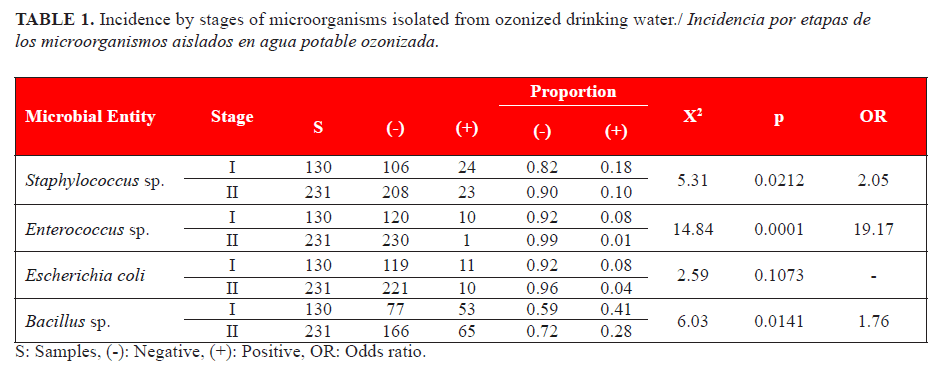
<body><![CDATA[<p align="justify"><font size="2" face="Verdana, Arial, Helvetica, sans-serif"><b><i>Economic  evaluation</i></b></font></p>     <p align="justify" style="margin-top:12.0pt;text-indent:0cm;"><font size="2" face="Verdana, Arial, Helvetica, sans-serif"><span style="font-family:'Verdana','sans-serif'; color:black; "><span style="color:black; ">In order to value the economic impact of  this productive process for the institution and country, the total income  (resulted of the perceived volume to concept of sales of the final product in  the evaluated period), income per man (obtained from  relation between the total incomes and total of workers included in process),  as well as the income per day, and the percent of</span></span> <span style="font-family:'Verdana','sans-serif'; color:black; "><span style="color:black; ">income</span></span> <span style="font-family:'Verdana','sans-serif'; color:black; "><span style="color:black; ">in  the institution were determined as efficiency indicators. This monetary value was expressed in Cuban pesos (CUP).</span></span> </font></p>     <p align="justify" style="margin-top:12.0pt;margin-right:0cm;margin-bottom:5.65pt;margin-left:0cm;">&nbsp;</p>     <p align="justify"><font size="3" face="Verdana, Arial, Helvetica, sans-serif"><b>RESULTS AND DISCUSSION</b></font></p>     <p align="justify" style="margin-top:12.0pt;text-indent:0cm;"><font size="2" face="Verdana, Arial, Helvetica, sans-serif"><span style="font-family:'Verdana','sans-serif'; color:black; "><span style="color:black; ">The  results analysis of the microbiological, </span></span><span style="font-family:'Verdana','sans-serif'; ">productive and <span style="color:black; ">quality</span> <span style="color:black; ">indicators</span> will be shown as follows<span style="color:black; ">.</span> </span></font></p>     <p align="justify"><font size="2" face="Verdana, Arial, Helvetica, sans-serif"><b>Evaluation for microbiological indicators</b></font></p>     <p align="justify" style="margin-top:12.0pt;text-indent:0cm;"><font size="2" face="Verdana, Arial, Helvetica, sans-serif"><span style="font-family:'Verdana','sans-serif'; color:black; "><span style="color:black; ">Among the microenvironmental elements  monitored in both stages (water, bedding material, food, clothing and other  sterilizable materials), only the non-compliant results in water and the  bedding material were obtained (21). The rest of the macroenvironmental factors controlled (facilities, barrier and auxiliary systems)  behaved in correspondence with the acceptance limits defined (19).</span></span> </font></p>     <p align="justify" style="margin-top:12.0pt;text-indent:0cm;"><font size="2" face="Verdana, Arial, Helvetica, sans-serif"><span style="font-family:'Verdana','sans-serif'; color:black; "><span style="color:black; ">The incidence of microorganisms isolated  from ozonized drinking water during Stages I and II is shown in <a href="/img/revistas/rsa/v38n3/t0106316.gif">Table 1</a>. </span></span> </font></p>     
<p align="justify" style="margin-top:12.0pt;text-indent:0cm;"><font size="2" face="Verdana, Arial, Helvetica, sans-serif"><span style="font-family:'Verdana','sans-serif'; color:black; "><span style="color:black; ">Among the  agents identified, </span></span><em><span style="font-family:'Verdana','sans-serif'; color:black; "><span style="color:black; ">Bacillus</span></span></em><span style="font-family:'Verdana','sans-serif'; color:black; "><span style="color:black; "> sp. (</span></span><span style="font-family:'Verdana','sans-serif'; ">environment microbiota<span style="color:black; ">) and </span><em><span style="color:black; ">Staphylococcus</span></em><span style="color:black; "> sp. (</span>skin  microbiota<span style="color:black; ">)  were considered environmental contaminants, while </span><em><span style="color:black; ">Enterococcus</span></em><span style="color:black; "> sp. and </span><em><span style="color:black; ">Escherichia coli</span></em><span style="color:black; "> were classified as opportunistic  pathogens (skin or mucosal microbiota) (9, </span>32, 33<span style="color:black; ">). These findings coincided with  others obtained in previous studies by Riera</span> (34)<span style="color:black; ">, who also obtained isolates of  these bacterial entities from ozonized drinking water, being </span><em><span style="color:black; ">Bacillus</span></em><span style="color:black; "> sp. and </span><em><span style="color:black; ">Staphylococcus</span></em><span style="color:black; "> sp. the ones with the&nbsp; highest incidence (37.5 and 15.6%,  respectively). </span> </span></font></p>     <p align="justify" style="margin-top:12.0pt;text-indent:0cm;"><font size="2" face="Verdana, Arial, Helvetica, sans-serif">Likewise, Caorsi <em>et  al.</em> (32) evidenced that <em>Staphylococcus </em>sp. was the most frequently  environmental contaminant in the sterile preparation units from the Chilean  Clinical Hospital studied, followed by <em>Micrococcus </em>sp. and <em>Bacillus </em>sp.  In this sense, Donati&eacute;n (35) demonstrated an incidence of 48% of <em><span style="color:black; ">Staphylococcus</span></em><span style="color:black; "> sp. as environmental contaminant  in Cuba, while </span>Hern&aacute;ndez and Mar&iacute;n (36) reported the presence  of this microbial entity in<span style="color:black; "> environmental controls in human </span>meeting places  (library) in Colombia. </font></p>     ]]></body>
<body><![CDATA[<p align="justify" style="margin-top:12.0pt;text-indent:0cm;"><font size="2" face="Verdana, Arial, Helvetica, sans-serif"><span style="font-family:'Verdana','sans-serif'; color:black; "><span style="color:black; ">The opportunistic pathogens were  naturally present in the environment. Not&nbsp;  considering them as defined pathogens may eventually cause human  diseases whose mechanisms of local or systemic  defenses were deficient. If drinking or bath water contains a significant  number of microorganisms, it can be a source of skin and mucosal infection.  This can be confirmed in reports or studies carried out by WHO </span></span><span style="font-family:'Verdana','sans-serif'; ">(9) <span style="color:black; ">and Llop </span><em><span style="color:black; ">et al.</span></em> (37), <span style="color:black; ">where they referred to </span><em><span style="color:black; ">Pseudomonas aeruginosa</span></em><span style="color:black; ">, </span><em><span style="color:black; ">Escherichia coli</span></em><span style="color:black; "> and to a lesser degree species of </span><em><span style="color:black; ">Flavobacterium</span></em><span style="color:black; ">, </span><em><span style="color:black; ">Acinetobacter</span></em><span style="color:black; ">, </span><em><span style="color:black; ">Klebsiella</span></em><span style="color:black; ">, </span><em><span style="color:black; ">Serratia</span></em><span style="color:black; "> and </span><em><span style="color:black; ">Aeromonas</span></em><span style="color:black; ">, as well as some slow-growing  mycobacteria, as major opportunistic pathogens in water. </span> </span></font></p>     <p align="justify" style="margin-top:12.0pt;text-indent:0cm;"><font size="2" face="Verdana, Arial, Helvetica, sans-serif"><span style="font-family:'Verdana','sans-serif'; color:black; "><span style="color:black; ">Taken into consideration that the  treatment of drinking water with ozone is considered an effective mechanism for  sterilizing bacteria and viruses according to the statements made by Bataller </span></span><em><span style="font-family:'Verdana','sans-serif'; color:black; "><span style="color:black; ">et al.</span></span></em><span style="font-family:'Verdana','sans-serif'; "> (38),<span style="color:black; "> the presence of the isolated  bacteria could be the result of contamination of the passageways colonized  within the water distribution network. This coincided with Allen </span>(39)<span style="color:black; ">, who noted that </span><em><span style="color:black; ">Enterobacter</span></em><span style="color:black; ">, </span><em><span style="color:black; ">Staphylococcus</span></em><span style="color:black; ">, </span><em><span style="color:black; ">Pseudomonas</span></em><span style="color:black; "> and </span><em><span style="color:black; ">Klebsiella</span></em><span style="color:black; "> species frequently colonized the  inner surfaces of water pipes and storage tanks  (often called &ldquo;flare&rdquo;) and grew into biofilms when conditions were favorable,  such as the presence of nutrients, warm temperatures, low concentrations of  disinfectants and long storage, among others.</span> </span></font></p>     <p align="justify" style="margin-top:12.0pt;text-indent:0cm;"><font size="2" face="Verdana, Arial, Helvetica, sans-serif"><span style="font-family:'Verdana','sans-serif'; color:black; "><span style="color:black; ">The isolated agents may have been transmitted to the water as a result of the condition of  the ducts and pipes of the treatment system and their distribution according to  what was stated by WHO </span></span><span style="font-family:'Verdana','sans-serif'; ">(10)<span style="color:black; ">, possibly having a negative influence on  the quality and production process stability. Likewise, Goya and Wilde </span>(40) <span style="color:black; ">reported  that the construction defect or structures of deposits, as well as the absence  or irregularities in the maintenance of facilities, constituted causes for the  presence and growth of microorganisms from different  sources.</span> </span></font></p>     <p align="justify" style="margin-top:12.0pt;text-indent:0cm;"><font size="2" face="Verdana, Arial, Helvetica, sans-serif"><span style="font-family:'Verdana','sans-serif'; color:black; "><span style="color:black; ">These isolates in ozonized drinking water  used in the productive process entailed the establishment of a maintenance plan  as part of the Technology Management System implemented in Gnotobiotic Rodent  Management. It consisted on circulating water with high concentrations of  ozone in the pipes for 1 hour; besides including the checking and cleaning of  deposits and ozone generating equipment with monthly frequency.</span></span> </font></p>     <p align="justify" style="margin-top:12.0pt;text-indent:0cm;"><font size="2" face="Verdana, Arial, Helvetica, sans-serif"><span style="font-family:'Verdana','sans-serif'; color:black; "><span style="color:black; ">The incidence of isolated contaminant  microorganisms in ozonized drinking water is shown  in <a href="/img/revistas/rsa/v38n3/t0106316.gif">Table 1</a>. </span></span><em><span style="font-family:'Verdana','sans-serif'; color:black; "><span style="color:black; ">Bacillus</span></span></em><span style="font-family:'Verdana','sans-serif'; color:black; "><span style="color:black; "> sp. had the major incidence in both  stages due to its high resistance in environment, as dust and soil microbiota,  followed by </span></span><em><span style="font-family:'Verdana','sans-serif'; color:black; "><span style="color:black; ">Staphylococcus</span></span></em><span style="font-family:'Verdana','sans-serif'; color:black; "><span style="color:black; "> sp. as another common environment  contaminant but from the human and animal skin microbiota  (32). However, the results achieved in Stage II showed an improvement in the  quality of ozonized drinking water in relation to the previous stage, since </span></span><em><span style="font-family:'Verdana','sans-serif'; color:black; "><span style="color:black; ">Enterococcus</span></span></em><span style="font-family:'Verdana','sans-serif'; color:black; "><span style="color:black; "> sp. was scarcely reported and nor the  incidence of the rest of the isolated agents or  other contaminants. These findings demonstrated that the implementation of the  Microbiological Control Program improved the microbiological quality of this  contaminant source through a considerable reduction.</span></span></font></p>     
<p align="justify" style="margin-top:12.0pt;text-indent:0cm;"><font size="2" face="Verdana, Arial, Helvetica, sans-serif"><span style="font-family:'Verdana','sans-serif'; "><span style="color:black; ">Analyzing  the statistical processing (Chi-square) of the results obtained in both  stages, statistically significant differences (p&lt;0.05) were observed in the  percentage values </span></span><span style="color:black; ">&#8203;&#8203;</span><span style="font-family:'Verdana','sans-serif'; color:black; "><span style="color:black; ">of </span></span><em><span style="font-family:'Verdana','sans-serif'; color:black; "><span style="color:black; ">Staphylococcus</span></span></em><span style="font-family:'Verdana','sans-serif'; color:black; "><span style="color:black; "> sp., </span></span><em><span style="font-family:'Verdana','sans-serif'; color:black; "><span style="color:black; ">Bacillus</span></span></em><span style="font-family:'Verdana','sans-serif'; color:black; "><span style="color:black; "> sp. and </span></span><em><span style="font-family:'Verdana','sans-serif'; color:black; "><span style="color:black; ">Enterococcus</span></span></em><span style="font-family:'Verdana','sans-serif'; color:black; "><span style="color:black; "> sp. incidence in ozonized drinking water  with a significant decrease in Stage II. Unlike the percentage  values </span></span><span style="color:black; ">&#8203;&#8203;</span><span style="font-family:'Verdana','sans-serif'; color:black; "><span style="color:black; ">of </span></span><em><span style="font-family:'Verdana','sans-serif'; color:black; "><span style="color:black; ">Escherichia coli</span></span></em><span style="font-family:'Verdana','sans-serif'; color:black; "><span style="color:black; "> showed no significant differences  although its incidence was lower (<a href="/img/revistas/rsa/v38n3/t0106316.gif">Table 1</a>). </span></span> </font></p>     
<p align="justify" style="margin-top:12.0pt;text-indent:0cm;"><font size="2" face="Verdana, Arial, Helvetica, sans-serif"><span style="font-family:'Verdana','sans-serif'; color:black; "><span style="color:black; ">Water contamination and changes in its  chemical composition can affect the health of animals and the results of the final product quality, since it is used in all the activities of the  productive process, cleaning and preparation of solutions, as well as in the  staff bath to enter the protected area, and in the maintenance of rodents as  they constitute important factors to control </span></span><span style="font-family:'Verdana','sans-serif'; ">(29)<span style="color:black; ">.</span> </span></font></p>     <p align="justify" style="margin-top:12.0pt;text-indent:0cm;"><font size="2" face="Verdana, Arial, Helvetica, sans-serif"><span style="font-family:'Verdana','sans-serif'; color:black; "><span style="color:black; ">The statistical analysis confirmed the  effectiveness of the measures taken to achieve improvements in the quality of  the water used in the process, since a significant reduction of microorganisms  was identified. Likewise, it was necessary to implement other actions to  eradicate the bacterial agents isolated in the water which could potentially  affect the quality of the finished product.</span></span> </font></p>     <p align="justify" style="margin-top:12.0pt;text-indent:0cm;"><font size="2" face="Verdana, Arial, Helvetica, sans-serif"><span style="font-family:'Verdana','sans-serif'; color:black; "><span style="color:black; ">The odds ratio values </span></span><span style="color:black; ">&#8203;&#8203;</span><span style="font-family:'Verdana','sans-serif'; color:black; "><span style="color:black; ">obtained in both stages (<a href="/img/revistas/rsa/v38n3/t0106316.gif">Table 1</a>) showed  (in Stage II) a decrease in the risk magnitude of water contamination by  such agents, since lower values </span></span><span style="color:black; ">&#8203;&#8203;</span><span style="font-family:'Verdana','sans-serif'; color:black; "><span style="color:black; ">of this indicator were obtained compared  with Stage I. This defined the absence of preventive measures as a risk factor  for the contamination of </span></span><em><span style="font-family:'Verdana','sans-serif'; color:black; "><span style="color:black; ">Enterococcus</span></span></em><span style="font-family:'Verdana','sans-serif'; color:black; "><span style="color:black; "> sp., </span></span><em><span style="font-family:'Verdana','sans-serif'; color:black; "><span style="color:black; ">Staphylococcus</span></span></em><span style="font-family:'Verdana','sans-serif'; color:black; "><span style="color:black; "> sp. and </span></span><em><span style="font-family:'Verdana','sans-serif'; color:black; "><span style="color:black; ">Bacillus</span></span></em><span style="font-family:'Verdana','sans-serif'; color:black; "><span style="color:black; "> sp. in 19.17; 2.05 and 1.76 times higher  for this type of sample respectively; compared with the presence of the  measures to prevent water contamination by these microbial entities (27). </span></span> </font></p>     
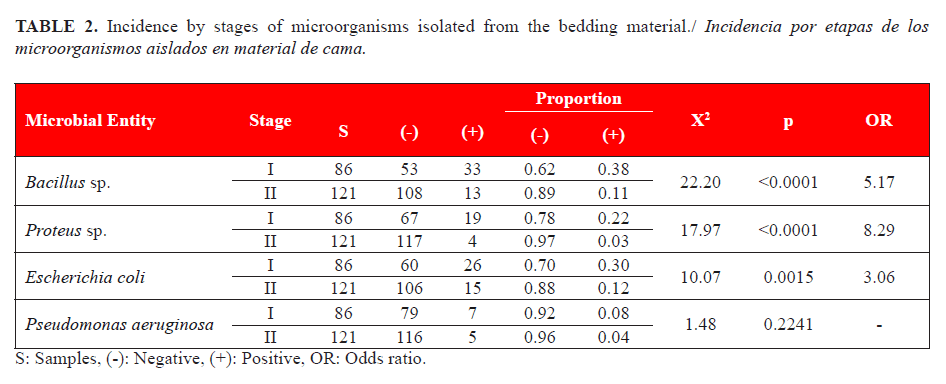
<p align="justify" style="margin-top:12.0pt;text-indent:0cm;"><font size="2" face="Verdana, Arial, Helvetica, sans-serif"><span style="font-family:'Verdana','sans-serif'; color:black; "><span style="color:black; ">The incidence of isolated agents in  crumbled bagasse (alternative source of bedding material)  during the stages studied is shown in <a href="/img/revistas/rsa/v38n3/t0206316.gif">Table 2</a>. It can be seen that in Stage I </span></span><em><span style="font-family:'Verdana','sans-serif'; color:black; "><span style="color:black; ">Bacillus</span></span></em><span style="font-family:'Verdana','sans-serif'; color:black; "><span style="color:black; "> sp. and </span></span><em><span style="font-family:'Verdana','sans-serif'; color:black; "><span style="color:black; ">Escherichia coli</span></span></em><span style="font-family:'Verdana','sans-serif'; color:black; "><span style="color:black; "> were the most isolated microbial  entities; followed by </span></span><em><span style="font-family:'Verdana','sans-serif'; color:black; "><span style="color:black; ">Proteus</span></span></em><span style="font-family:'Verdana','sans-serif'; color:black; "><span style="color:black; "> sp. and in a lower percentage of  isolation </span></span><em><span style="font-family:'Verdana','sans-serif'; color:black; "><span style="color:black; ">Pseudomonas  aeruginosa</span></span></em><span style="font-family:'Verdana','sans-serif'; color:black; "><span style="color:black; ">. The  presence of these agents in the bedding material could have been obtained from  the origin source or storage conditions, which can favor contamination when  they are not adequately controlled. According to the statements made by Francis </span></span><em><span style="font-family:'Verdana','sans-serif'; color:black; "><span style="color:black; ">et  al. </span></span></em><span style="font-family:'Verdana','sans-serif'; ">(41)<span style="color:black; ">, cellulose and sucrose content in  its composition, and its residual moisture (about 8%) favored the  multiplication of these microorganisms when the sterilizing process was not  effective.</span> </span></font></p>     
]]></body>
<body><![CDATA[<p align="justify" style="margin-top:12.0pt;text-indent:0cm;"><font size="2" face="Verdana, Arial, Helvetica, sans-serif"><span style="font-family:'Verdana','sans-serif'; color:black; "><span style="color:black; ">In the analysis of the results with the  statistical processing (Chi-square) of the  sterility control in the&nbsp; bedding  material in the two stages of the study, significant statistical differences  (p&lt;0.05) were observed in Stage II, with a marked decrease in the incidence  of bacteria that had been identified in Stage I (<a href="/img/revistas/rsa/v38n3/t0206316.gif">Table 2</a>). However, </span></span><em><span style="font-family:'Verdana','sans-serif'; color:black; "><span style="color:black; ">Pseudomonas aeruginosa</span></span></em><span style="font-family:'Verdana','sans-serif'; color:black; "><span style="color:black; "> had a lower incidence in the second  stage, although a statistically significant difference was not evidenced as  compared to Stage I.</span></span> </font></p>     
<p align="justify" style="margin-top:12.0pt;text-indent:0cm;"><font size="2" face="Verdana, Arial, Helvetica, sans-serif"><span style="font-family:'Verdana','sans-serif'; color:black; "><span style="color:black; ">These isolations coincided with the  approach made by Riera</span></span><span style="font-family:'Verdana','sans-serif'; "> (34) <span style="color:black; ">in studies carried out about the  microbiological behavior in dehydrated crumbled bagasse as bedding material for  rodents free of specific pathogens, and subsequent works related to the health  monitoring and maintenance of microbiological hygienic condition in experimental rodents.</span> </span></font></p>     <p align="justify" style="margin-top:12.0pt;text-indent:0cm;"><font size="2" face="Verdana, Arial, Helvetica, sans-serif"><span style="font-family:'Verdana','sans-serif'; color:black; "><span style="color:black; ">The presence of these bacteria entities  in the bedding material showed the need to make adjustments to the  sterilization process which was made from the microbiological results obtained  in Stage I (<a href="/img/revistas/rsa/v38n3/t0206316.gif">Table 2</a>), on adjustments in sterilizing  time for this material. The drying stage and a maximum storage time for a week  was made longer, which allowed to obtain better results in Stage II; therefore  a significant decrease was observed as mentioned above. </span></span> </font></p>     
<p align="justify" style="margin-top:12.0pt;text-indent:0cm;"><font size="2" face="Verdana, Arial, Helvetica, sans-serif"><span style="font-family:'Verdana','sans-serif'; color:black; "><span style="color:black; ">Analyzing the odds ratio values </span></span><span style="color:black; ">&#8203;&#8203;</span><span style="font-family:'Verdana','sans-serif'; color:black; "><span style="color:black; ">obtained (<a href="/img/revistas/rsa/v38n3/t0206316.gif">Table 2</a>), it was found that  the corrective measures implemented enabled to reduce the magnitude of the  contamination risk by these entities in Stage II, since the absence of  preventive measures increased the contamination risk by </span></span><em><span style="font-family:'Verdana','sans-serif'; color:black; "><span style="color:black; ">Proteus</span></span></em><span style="font-family:'Verdana','sans-serif'; color:black; "><span style="color:black; "> sp., </span></span><em><span style="font-family:'Verdana','sans-serif'; color:black; "><span style="color:black; ">Bacillus</span></span></em><span style="font-family:'Verdana','sans-serif'; color:black; "><span style="color:black; "> sp. and </span></span><em><span style="font-family:'Verdana','sans-serif'; color:black; "><span style="color:black; ">Escherichia coli</span></span></em><span style="font-family:'Verdana','sans-serif'; color:black; "><span style="color:black; "> in 8.29; 5.17 and 3.06 times  respectively; compared with the presence of measures to prevent the  contamination of the bedding material for these microbial entities (27). Based  on these arguments, this indicator confirmed the effectiveness  of the measures applied, directing the use of corrective actions to other  alternatives that allowed obtaining a completely free of contaminant bedding  material. </span></span> </font></p>     
<p align="justify" style="margin-top:12.0pt;text-indent:0cm;"><font size="2" face="Verdana, Arial, Helvetica, sans-serif"><span style="font-family:'Verdana','sans-serif'; color:black; "><span style="color:black; ">In the bedding material,</span></span> <em><span style="font-family:'Verdana','sans-serif'; color:black; "><span style="color:black; ">Bacillus</span></span></em><span style="font-family:'Verdana','sans-serif'; color:black; "><span style="color:black; "> sp. had the major incidence in Stage I,  again due to its high resistance in environment  such as dust and soil microbiota (32), as it was previously mentioned. However,  once more it is demonstrated that the implementation of the Microbiological  Control Program improved the microbiological quality of this another contaminant source through a significant reduction. </span></span> </font></p>     <p align="justify" style="margin-top:12.0pt;text-indent:0cm;"><font size="2" face="Verdana, Arial, Helvetica, sans-serif"><span style="font-family:'Verdana','sans-serif'; color:black; "><span style="color:black; ">Another control carried out as a part of  the Microbiological Control Program was the health monitoring of the staff. In  this case, the highest prevalence of microorganisms identified was in the pharyngeal exudates (<a href="/img/revistas/rsa/v38n3/f0106316.gif">Fig. 1</a>), being the results of the stool analysis  and vaginal exudates insignificant in the laboratory analysis (24). The  positive staff was separated from the productive activity and </span></span><span style="font-family:'Verdana','sans-serif'; ">subjected to <span style="color:black; ">treatments with subsequent  rechecking. </span> </span></font></p>     
<p align="justify" style="margin-top:12.0pt;text-indent:0cm;"><font size="2" face="Verdana, Arial, Helvetica, sans-serif"><span style="font-family:'Verdana','sans-serif'; color:black; "><span style="color:black; ">During the two stages, high </span></span><em><span style="font-family:'Verdana','sans-serif'; color:black; "><span style="color:black; ">Staphylococcus aureus</span></span></em><span style="font-family:'Verdana','sans-serif'; color:black; "><span style="color:black; "> prevalence values were evidenced and  identified through all the years studied (<a href="/img/revistas/rsa/v38n3/f0106316.gif">Fig. 1</a>). This result coincided with  the findings made by Riera </span></span><span style="font-family:'Verdana','sans-serif'; ">(34)<span style="color:black; ">, who reported this bacterium as the most  prevalent in the staff pharyngeal exudates, reaching  percentages of isolation up to 50%. This microorganism is referred to in the  literature as normal microbiota of the pharynx, although it is also considered  an opportunistic pathogen that could eventually cause inflammatory processes, not only in humans, but also in animals. Therefore it is  controlled and measures are taken </span>(9, 42)<span style="color:black; ">, deriving to the positive cases of </span><em><span style="color:black; ">Staphylococcus aureus</span></em> <em><span style="color:black; ">&beta;</span></em><span style="color:black; "> hemolytic which could be  considered by a physician to value the needs of a specific antibiotic treatment. </span> </span></font></p>     
<p align="justify" style="margin-top:12.0pt;text-indent:0cm;"><font size="2" face="Verdana, Arial, Helvetica, sans-serif"><em><span style="font-family:'Verdana','sans-serif'; color:black; "><span style="color:black; ">Pseudomonas aeruginosa</span></span></em><span style="font-family:'Verdana','sans-serif'; color:black; "><span style="color:black; "> and </span></span><em><span style="font-family:'Verdana','sans-serif'; color:#181818; ">Escherichia  coli </span></em><span style="font-family:'Verdana','sans-serif'; color:#181818; ">had the major annual persistence after </span><em><span style="font-family:'Verdana','sans-serif'; color:black; "><span style="color:black; ">Staphylococcus aureus</span></span></em><span style="font-family:'Verdana','sans-serif'; color:#181818; "> in the </span><span style="font-family:'Verdana','sans-serif'; color:black; "><span style="color:black; ">pharyngeal</span></span> <span style="font-family:'Verdana','sans-serif'; color:black; "><span style="color:black; ">exudate samples (<a href="/img/revistas/rsa/v38n3/f0106316.gif">Fig. 1</a>). The results obtained  showed that these microorganisms have been considered as major opportunistic pathogens in the environment, particularly in drinking  water (9, 37). In this sense, the strict application of corrective measures in  the drinking water treatment is one of the most important actions to reduce the  future contaminations of facilities and personnel (17).&nbsp; </span></span> </font></p>     
<p align="justify" style="margin-top:12.0pt;text-indent:0cm;"><font size="2" face="Verdana, Arial, Helvetica, sans-serif"><span style="font-family:'Verdana','sans-serif'; color:black; "><span style="color:black; ">In another sense, the analysis of the  operator control was acceptable in the majority of the samplings (25). The  sterilization process efficacy (autoclaves) (23), sterility control of the  sterilizable materials</span></span> <span style="font-family:'Verdana','sans-serif'; color:black; "><span style="color:black; ">(22) and the evaluation  of disinfectant solutions (26) were considered satisfactory. These findings  demonstrated that the measures taken after the implementation of the  Microbiological Control Program improved the microbiological quality of these  contaminant sources in Stage II.</span></span> </font></p>     <p align="justify" style="margin-top:12.0pt;text-indent:0cm;"><font size="2" face="Verdana, Arial, Helvetica, sans-serif"><span style="font-family:'Verdana','sans-serif'; color:black; "><span style="color:black; ">Regarding the quality of the finished  product with the implementation of the Microbiological Control Program, a  product free of contaminating microorganisms was obtained, which ensured the  quality specifications fulfillment, allowing the release of all the batches produced. </span></span> </font></p>     ]]></body>
<body><![CDATA[<p align="justify"><font size="2" face="Verdana, Arial, Helvetica, sans-serif"><b>Evaluation for productive indicators</b></font></p>     <p align="justify" style="margin-top:12.0pt;text-indent:0cm;"><font size="2" face="Verdana, Arial, Helvetica, sans-serif"><span style="font-family:'Verdana','sans-serif'; color:black; "><span style="color:black; ">&nbsp;Monitoring the productive performance of each  operator starting by the analysis of these indicators was of great importance  since it has been highly demonstrated that the way productivity increased when ensuring an adequate health maintenance and handling of  animals </span></span><span style="font-family:'Verdana','sans-serif'; ">(8)<span style="color:black; ">.</span> </span></font></p>     <p align="justify" style="margin-top:12.0pt;text-indent:0cm;"><font size="2" face="Verdana, Arial, Helvetica, sans-serif"><span style="font-family:'Verdana','sans-serif'; color:black; "><span style="color:black; ">As can be seen in <a href="/img/revistas/rsa/v38n3/f0206316.gif">Fig. 2</a>, the performance  of the&nbsp; ascitic fluid, both in crude  volume/animal engrafted and MAb, increased considerably in Stage II (2006-2012)  after the implementation of the Microbiological Control  Program, demonstrating its effectiveness. </span></span> </font></p>     
<p align="justify" style="margin-top:12.0pt;text-indent:0cm;"><font size="2" face="Verdana, Arial, Helvetica, sans-serif"><span style="font-family:'Verdana','sans-serif'; color:black; "><span style="color:black; ">This is made clear by taking into  consideration the comment of the previous paragraph, plus the fact that once  the contamination of the final product is demonstrated, it should be  reprocessed so that part of the volume and concentration of MAb produced is lost. That is why the strict application of controls and preventive  measures ensured their entire microbiological quality of the process. </span></span> </font></p>     <p align="justify" style="margin-top:12.0pt;text-indent:0cm;"><font size="2" face="Verdana, Arial, Helvetica, sans-serif"><span style="font-family:'Verdana','sans-serif'; color:black; "><span style="color:black; ">The lowest performances described as  alert (-2SL) and action limits (-3SL) may be indicatives of the presence of a  subclinical infection affecting the productive potential of these  animals. This is quite common in laboratory rodents according to the statements  made by Shek </span></span><span style="font-family:'Verdana','sans-serif'; ">(6)<span style="color:black; ">, who referred that there was a wide variety of microorganisms  affecting experimental rodents, where most of the infections had no  clinical symptomatology. Therefore, there was a risk of not being detected to  interfere in the research results and processes in which these biomodels were  used.</span> </span></font></p>     <p align="justify" style="margin-top:12.0pt;text-indent:0cm;"><font size="2" face="Verdana, Arial, Helvetica, sans-serif"><span style="font-family:'Verdana','sans-serif'; color:black; "><span style="color:black; ">&nbsp;In  contrast with these mentioned criteria, the superior performances  defined as alert (+2SL) and action limits (+3SL) indicated a surplus of these  productive indicators for the efficacy of the Microbiological Control Program  implemented, as the tendency to increase in Stage II (2006-2012), shown in <a href="/img/revistas/rsa/v38n3/f0206316.gif">Fig.  2</a>. Thus, in fulfilling the objectives, plans and  predicted goals, delivery of MAb in the quantity and quality required for its  regulatory approval were ensured. </span></span> </font></p>     
<p align="justify"><font size="2" face="Verdana, Arial, Helvetica, sans-serif"><b>Evaluation for quality indicators</b></font></p>     <p align="justify" style="margin-top:12.0pt;text-indent:0cm;"><font size="2" face="Verdana, Arial, Helvetica, sans-serif"><span style="font-family:'Verdana','sans-serif'; color:black; "><span style="color:black; ">The non-conformities results detected in  inspections, internal and external audits, as well as claims  and evaluations of customers&acute; satisfaction, and the quality indicators  promoting the continuous improvement of processes </span></span><span style="font-family:'Verdana','sans-serif'; ">will be shown <span style="color:black; ">as follows.</span> </span></font></p>     <p align="justify"><font size="2" face="Verdana, Arial, Helvetica, sans-serif"><b><i>Non-conformities  detected in internal and external audits</i></b></font></p>     <p align="justify" style="margin-top:12.0pt;text-indent:0cm;"><font size="2" face="Verdana, Arial, Helvetica, sans-serif"><span style="font-family:'Verdana','sans-serif'; color:black; "><span style="color:black; ">In this productive  process, the Quality Management established annually the Internal Audit  Program, whose objective was to assess the compliance of the Good Production  Practice (GPP) and verify the aspects of the Quality Management System. For  these audits, there was a competent group of independent experts  who were not related to the process that constituted the audit team.</span></span> </font></p>     ]]></body>
<body><![CDATA[<p align="justify" style="margin-top:12.0pt;text-indent:0cm;"><font size="2" face="Verdana, Arial, Helvetica, sans-serif"><span style="font-family:'Verdana','sans-serif'; color:black; "><span style="color:black; ">The non-conformities detected during  inspections and internal audits conducted by the Quality Management to the  ascitic fluid production rich in MAb from 2000 to 2012 are shown in <a href="/img/revistas/rsa/v38n3/f0306316.gif">Fig. 3</a>,  showing a decreasing tendency, which evidence the improvements in the process,  as well as the proper performance of the GPP.</span></span> </font></p>     
<p align="justify" style="margin-top:12.0pt;text-indent:0cm;"><font size="2" face="Verdana, Arial, Helvetica, sans-serif"><span style="font-family:'Verdana','sans-serif'; color:black; "><span style="color:black; ">The detection of non-conformities allowed  to design an Improvement Program made up of corrective  measures directed to optimize the documentary system, the constructive  condition of the facilities, the calibration and verification of the equipment,  and the purchase of the necessary equipment for the control of harmful elements  like ammonia and ozone.</span></span> </font></p>     <p align="justify" style="margin-top:12.0pt;text-indent:0cm;"><font size="2" face="Verdana, Arial, Helvetica, sans-serif"><span style="font-family:'Verdana','sans-serif'; color:black; "><span style="color:black; ">This allowed advancing in the productive  process integrity since many of these non-conformities could negatively  influence on the effectiveness of the Microbiological Control Program, as they  directly affected the micro and macroenvironmental factors already mentioned above. At the same time, this allowed the establishment  of action priorities to eliminate those causes that threatened the product  quality in each stage of the process.</span></span> </font></p>     <p align="justify" style="margin-top:12.0pt;text-indent:0cm;"><font size="2" face="Verdana, Arial, Helvetica, sans-serif"><span style="font-family:'Verdana','sans-serif'; color:black; "><span style="color:black; ">Other institutions have also conducted  numerous audits to this productive process, among them are those made  by the Centre  for the Quality State Control of Drugs, Equipments and Medical Devices</span></span><span style="font-family:'Verdana','sans-serif'; "> <span style="color:black; ">(CECMED) to grant the Production License,  as well as the Supplier audits conducted by the Center for Genetic Engineering  and Biotechnology (CIGB), and the Center of Molecular  Immunology (CIM). The major non-conformities detected in these audits are  referred to aspects in which large investments (equipment to control harmful  elements, automation, etc.) are required. These identified deficiencies have been resolved gradually, which are evidenced by the  significant reduction of the non-conformities through the years, mainly in  Stage II as shown in <a href="/img/revistas/rsa/v38n3/f0306316.gif">Fig. 3</a>.</span> </span></font></p>     
<p align="justify" style="margin-top:12.0pt;text-indent:0cm;"><font size="2" face="Verdana, Arial, Helvetica, sans-serif"><span style="font-family:'Verdana','sans-serif'; color:black; "><span style="color:black; ">In general, the importance to eliminate  the non-conformity is in guaranteeing the improvement  of the ascitic fluid production, as the automated equipment optimizes the  control on the process, at the same time favoring the effectiveness of the  Microbiological Control Program established, conditioned by the strict control  over the quality of the environment for animals and the  treatment of drinking water and food.</span></span> </font></p>     <p align="justify" style="margin-top:12.0pt;text-indent:0cm;"><font size="2" face="Verdana, Arial, Helvetica, sans-serif"><span style="font-family:'Verdana','sans-serif'; color:black; "><span style="color:black; ">The stated aspects do not invalidate the  GPP, as the Production License was granted by the CECMED in 1999, and the  acceptability by WHO of the production of anti-Hepatitis B vaccine in 2001, 2002, 2004, 2006, 2008, 2010 and 2012, making possible that our  country commercializes vaccines and other drugs through institutions of the  United Nations (UN) to other regions and countries of the world.</span></span> </font></p>     <p align="justify"><font size="2" face="Verdana, Arial, Helvetica, sans-serif"><b><i>Claims</i></b></font></p>     <p align="justify" style="margin-top:12.0pt;text-indent:0cm;"><font size="2" face="Verdana, Arial, Helvetica, sans-serif"><span style="font-family:'Verdana','sans-serif'; color:black; "><span style="color:black; ">This indicator also starts to be evaluated as part of the continuous improvement process, agreeing with the  points made by Sosa </span></span><span style="font-family:'Verdana','sans-serif'; ">(8)<span style="color:black; ">, who stated that the organization should  continually improve the effectiveness of its system or process with the use of  some tools such as results of inspections, audits, corrective and  preventive actions, surveys of customer satisfaction and data analysis. The  behavior of claims&acute; number is shown in <a href="#f4">Fig. 4</a>.</span> </span></font></p>     <p align="center" ><font size="2" face="Verdana, Arial, Helvetica, sans-serif"><a name="f4"></a></font></p>     <p align="center" ><font size="2" face="Verdana, Arial, Helvetica, sans-serif"><img src="../img/revistas/rsa/v38n3/f0406316.gif" width="400" height="311"></font></p>     ]]></body>
<body><![CDATA[<p align="justify" style="margin-top:12.0pt;text-indent:0cm;"><font size="2" face="Verdana, Arial, Helvetica, sans-serif"><span style="font-family:'Verdana','sans-serif'; color:black; "><span style="color:black; ">During all the years of the study, this  indicator was below the acceptable value determined by the institution (1%), highlighting that during recent years the claims have been  from 0.15 to 0.10% of the total batch issued. The causes of these claims are  related to transportation (delivery time), lack of communication between the  parties, but not to the quality specifications of the product (8).</span></span> </font></p>     <p align="justify"><font size="2" face="Verdana, Arial, Helvetica, sans-serif"><b><i>Customer  satisfaction</i></b></font></p>     <p align="justify" style="margin-top:12.0pt;text-indent:0cm;"><font size="2" face="Verdana, Arial, Helvetica, sans-serif"><span style="font-family:'Verdana','sans-serif'; color:black; "><span style="color:black; ">Surveys were conducted in order to know  the perception of the customers about the ascitic fluid production rich in MAb  issued for the production of recombinant anti-Hepatitis B vaccine, since annual  surveys were conducted in 2008. Their results provided the necessary  information to take actions to improve the process.</span></span> </font></p>     <p align="justify" style="margin-top:12.0pt;text-indent:0cm;"><font size="2" face="Verdana, Arial, Helvetica, sans-serif"><span style="font-family:'Verdana','sans-serif'; color:black; "><span style="color:black; ">The values of the Perceived Quality Index  (PQI) calculated from the survey results made to the customers evidenced a PQI  of 1.6 (2008), 2.6 (2009), 3.3 (2010), 2.2 (2011), and  1.7 (2012) for the centers evaluated.</span></span> </font></p>     <p align="justify" style="margin-top:12.0pt;text-indent:0cm;"><font size="2" face="Verdana, Arial, Helvetica, sans-serif"><span style="font-family:'Verdana','sans-serif'; color:black; "><span style="color:black; ">The answers given by the clients were  fully compliant, allowing to have the perception estimation of these customers  satisfied (PQI &ge; 1) with the quality of MAb obtained at CENPALAB for its use in the production of the vaccine. As it can be  appreciated, the overall satisfaction degree remained as a satisfactory  performance, even though the regulations and requirements for this type of  product increase every year </span></span><span style="font-family:'Verdana','sans-serif'; ">(13,<span style="color:black; "> 31</span>)<span style="color:black; ">.</span> </span></font></p>     <p align="justify"><font size="2" face="Verdana, Arial, Helvetica, sans-serif"><b><i>Economic  evaluation</i></b></font></p>     <p align="justify" style="margin-top:12.0pt;text-indent:0cm;"><font size="2" face="Verdana, Arial, Helvetica, sans-serif"><span style="font-family:'Verdana','sans-serif'; color:black; "><span style="color:black; "><a href="/img/revistas/rsa/v38n3/t0306316.gif">Table 3</a> shows the behavior of some  efficiency indicators in the productive process, as a result of the  Microbiological Control Program effectiveness implemented with the support of  other established programs, mentioned above.</span></span> </font></p>     
<p align="justify" style="margin-top:12.0pt;text-indent:0cm;"><font size="2" face="Verdana, Arial, Helvetica, sans-serif"><span style="font-family:'Verdana','sans-serif'; color:black; "><span style="color:black; ">The results  achieved, in relation to the total volume obtained (<a href="/img/revistas/rsa/v38n3/t0306316.gif">Table 3</a>), made the country  save about $ 21 million annually, according to the current prices in the world  market for this type of product. In addition, the productivity achieved was  outstanding, since the group of technicians and specialists  involved in the process was reduced in a half since 2004, maintaining and  improving the productive results with a high level of expertise and a  significant reduction of salary costs.</span></span> </font></p>     
<p align="justify" style="margin-top:12.0pt;text-indent:0cm;"><font size="2" face="Verdana, Arial, Helvetica, sans-serif"><span style="font-family:'Verdana','sans-serif'; color:black; "><span style="color:black; ">On the other hand, it was not necessary either to import any animals needed for obtaining this  biological product, whereof prices in the world would have been uneconomical,  since large volumes of MAb for the production process of the anti-Hepatitis B  vaccine are required, therefore the need to import a large number of  animals to produce the volume required. </span></span> </font></p>     <p align="justify" style="margin-top:12.0pt;text-indent:0cm;"><font size="2" face="Verdana, Arial, Helvetica, sans-serif"><span style="font-family:'Verdana','sans-serif'; color:black; "><span style="color:black; ">In relation to the incomes obtained for  marketing this biological product, it should be noted that this productive  process has contributed since its establishment until today with 36.24% of the total income of the institution; generating an income/peso  spent of $3.48; in addition to the added value of the medicines generated and  evaluated from this bioproduct. It contributes to the development of biotech  drugs produced by other institutions (CIGB and CIM), whose exports  provide substantial contributions to the Cuban economy.</span></span> </font></p>     ]]></body>
<body><![CDATA[<p align="justify" style="margin-top:12.0pt;text-indent:0cm;"><font size="2" face="Verdana, Arial, Helvetica, sans-serif">The adoption of control  strategies as part of the Microbiological Control Program constituted a  priority to prevent, minimize or eradicate the contamination dangers during the  production process, optimizing the ascitic fluid quality as a finished product. </font></p>     <p align="justify" style="margin-top:12.0pt;text-indent:0cm;"><font size="2" face="Verdana, Arial, Helvetica, sans-serif">Ensuring that this  program contributes to the safety, efficacy and stability of the final product  was the major impact in the productive process of ascitic fluid, guaranteeing  the consistency in its specified characteristics for the regulatory approval.  In this sense, the obtaining of major productive performances stimulated the  diversification of the MAb production, generating superior economical profits  for our institution. Likewise, in this production diversity, major uses in the  Cuban Biotechnology Industry were obtained, not only in the preventive and  therapeutic vaccine productions for the infectious diseases, but also in the  diagnosis, following and the treatment of cancer, as well as the T lymphocytes  quantification in the peripheral blood, <span style="color:black; ">among others (29).</span> </font></p>     <p align="justify" style="margin-top:12.0pt;margin-right:0cm;margin-bottom:5.65pt;margin-left:0cm;">&nbsp;</p>     <p align="justify"><font size="3" face="Verdana, Arial, Helvetica, sans-serif"><b>CONCLUSIONS</b></font></p>     <p align="justify" style="margin-top:12.0pt;text-indent:0cm;"><font size="2" face="Verdana, Arial, Helvetica, sans-serif"><span style="font-family:'Verdana','sans-serif'; color:black; "><span style="color:black; ">Based on the results obtained, it is  concluded that the Microbiological Control Program implemented in the  productive process of the ascitic fluid rich in MAb in Cuba is  effective, allowing to ensure consistency in the specified characteristics of  the final product for the regulatory approval. </span></span> </font></p>     <p align="justify" style="margin-top:12.0pt;margin-right:0cm;margin-bottom:5.65pt;margin-left:0cm;">&nbsp;</p>     <p align="justify"><font size="3" face="Verdana, Arial, Helvetica, sans-serif"><b>REFERENCES</b></font></p>     <!-- ref --><p align="justify" style="margin-top:12.0pt;margin-right:0cm;margin-bottom:5.65pt;margin-left:0cm;text-align:justify;text-indent:0cm;"><font size="2" face="Verdana, Arial, Helvetica, sans-serif">1.  Kaur J, Badyal K, Khosia P. Los Anticuerpos Monoclonales han revolucionado la  terapia de muchas enfermedades. Indian J Pharmacol. 2007;39:5-14.    </font></p>     <!-- ref --><p align="justify" style="margin-top:12.0pt;margin-right:0cm;margin-bottom:5.65pt;margin-left:0cm;text-align:justify;text-indent:0cm;"><font size="2" face="Verdana, Arial, Helvetica, sans-serif">2.  U.S. Food and Drug Administration (FDA), 2014. Guidance for Industry:  Monoclonal Antibodies Used as Reagents in Drug Manufacturing. Available at: <u style="text-underline:thick;"><a href="http://www.fda.gov/BiologicsBloodVaccines/GuidanceComplianceRegulatoryInformation/Guidances/Blood/ucm076753.htm" target="_blank">http://www.fda.gov/BiologicsBloodVaccines/GuidanceComplianceRegulatoryInformation/Guidances/Blood/ucm076753.htm</a></u>.  Access 19 January 2015.    </font></p>     <!-- ref --><p align="justify" style="margin-top:12.0pt;margin-right:0cm;margin-bottom:5.65pt;margin-left:0cm;text-align:justify;text-indent:0cm;"><font size="2" face="Verdana, Arial, Helvetica, sans-serif">3.WHO. <em><span style="font-family:'Verdana','sans-serif'; color:black; font-style:normal; "><span style="color:black; ">Good Manufacturing Practices</span></span></em><span style="font-family:'Verdana','sans-serif'; color:black; "><span style="color:black; "> for </span></span><em><span style="font-family:'Verdana','sans-serif'; color:black; font-style:normal; "><span style="color:black; ">Pharmaceutical Products</span></span></em><span style="font-family:'Verdana','sans-serif'; color:black; "><span style="color:black; ">: </span></span><em><span style="font-family:'Verdana','sans-serif'; color:black; font-style:normal; "><span style="color:black; ">Main Principles</span></span></em>. Ref  Type: Report. 2014.    </font></p>     <!-- ref --><p align="justify" style="margin-top:12.0pt;margin-right:0cm;margin-bottom:5.65pt;margin-left:0cm;text-align:justify;text-indent:0cm;"><font size="2" face="Verdana, Arial, Helvetica, sans-serif"><span style="font-family:'Verdana','sans-serif'; font-size:10.0pt; ">4.  Regulaci&oacute;n 16. Centro para el Control Estatal de Medicamentos, </span><span style="line-height:120%; font-family:'Verdana','sans-serif'; font-size:10.0pt; color:black; "><span style="color:black; ">Equipos  y Dispositivos M&eacute;dicos</span></span><span style="font-family:'Verdana','sans-serif'; font-size:10.0pt; "> (CECMED).  Directrices sobre Buenas Pr&aacute;cticas para la Fabricaci&oacute;n de productos  farmac&eacute;uticos. Ref Type: Report. 2012.    </span></font></p>     <!-- ref --><p align="justify" style="margin-top:12.0pt;margin-right:0cm;margin-bottom:5.65pt;margin-left:0cm;text-align:justify;text-indent:0cm;"><font size="2" face="Verdana, Arial, Helvetica, sans-serif">5.  ISO 9000. Quality Management System. Fundamentals and vocabulary. Ref Type:  Report. 2005.     </font></p>     <!-- ref --><p align="justify" style="margin-top:12.0pt;margin-right:0cm;margin-bottom:5.65pt;margin-left:0cm;text-align:justify;text-indent:0cm;"><font size="2" face="Verdana, Arial, Helvetica, sans-serif">6.  Shek S. Role of housing modalities of management and surveillance strategies  for adventitious agents of rodents. ILAR Journal. 2008;49:316-325.    </font></p>     <!-- ref --><p align="justify" style="margin-top:12.0pt;margin-right:0cm;margin-bottom:5.65pt;margin-left:0cm;text-align:justify;text-indent:0cm;"><font size="2" face="Verdana, Arial, Helvetica, sans-serif">7.  Ayala M, Milocco S, Maschi F, <span style="font-family:'Verdana','sans-serif'; color:black; "><span style="color:black; ">Galosi  CM, Cagliada MP, Carbone C. </span></span>Utilizaci&oacute;n de la t&eacute;cnica de  histerectom&iacute;a para la eliminaci&oacute;n de pat&oacute;genos en una colonia de ratones CF-1  destinados a la investigaci&oacute;n biom&eacute;dica. C&aacute;tedra de animales de laboratorio y  beaterio. Analecta Vet.<span style="font-family:'Verdana','sans-serif'; color:black; "><span style="color:black; ">2005;</span></span>25(2).    </font></p>     <!-- ref --><p align="justify" style="margin-top:12.0pt;margin-right:0cm;margin-bottom:5.65pt;margin-left:0cm;text-align:justify;text-indent:0cm;"><font size="2" face="Verdana, Arial, Helvetica, sans-serif">8.  Sosa IT, Lugo SM, Llanes HM, Gonz&aacute;lez SP, Acevedo MC, Riera LO. Gesti&oacute;n de la  calidad aplicada en el CENPALAB. Congreso Internacional de Veterinaria. Ref  Type: Report. 2007.    </font></p>     <!-- ref --><p align="justify" style="margin-top:12.0pt;margin-right:0cm;margin-bottom:5.65pt;margin-left:0cm;text-align:justify;text-indent:0cm;"><font size="2" face="Verdana, Arial, Helvetica, sans-serif">9.  WHO. Guidelines for Drinking-water Quality. Geneva. Ref Type: Report. 1995.    </font></p>     <!-- ref --><p align="justify" style="margin-top:12.0pt;margin-right:0cm;margin-bottom:5.65pt;margin-left:0cm;text-align:justify;text-indent:0cm;"><font size="2" face="Verdana, Arial, Helvetica, sans-serif">10. WHO.  Good Manufacturing Practices: Water for Pharmaceutical Use. Ref Type: Report.  2005.    </font></p>     <!-- ref --><p align="justify" style="margin-top:12.0pt;margin-right:0cm;margin-bottom:5.65pt;margin-left:0cm;text-align:justify;text-indent:0cm;"><font size="2" face="Verdana, Arial, Helvetica, sans-serif"><span style="font-family:'Verdana','sans-serif'; font-size:10.0pt; color:black; "><span style="color:black; ">11. Directive  75/318/EEC. Production and Quality Control of Monoclonal Antibodies. </span></span><span style="font-family:'Verdana','sans-serif'; font-size:10.0pt; ">Ref  Type: Report. <span style="color:black; ">1995.    </span> </span></font></p>     <!-- ref --><p align="justify" style="margin-top:12.0pt;margin-right:0cm;margin-bottom:5.65pt;margin-left:0cm;text-indent:0cm;"><font size="2" face="Verdana, Arial, Helvetica, sans-serif">12. Auterhoff  G, Throm S. EU Guide to Good Manufacturing Practice for Medicinal Products for  Human and Veterinary Use.&nbsp; 7th Edition.  Germany:&nbsp; Editio Cantor Verlag Aulendorf.  2012.    </font></p>     <!-- ref --><p align="justify" style="margin-top:12.0pt;margin-right:0cm;margin-bottom:5.65pt;margin-left:0cm;text-align:justify;text-indent:0cm;"><font size="2" face="Verdana, Arial, Helvetica, sans-serif">13. ISO  10002. <em><span style="font-family:'Verdana','sans-serif'; color:black; font-style:normal; "><span style="color:black; ">Quality management</span></span></em><span style="font-family:'Verdana','sans-serif'; color:black; "><span style="color:black; ">.  Customer satisfaction. Guidelines for complaints handling in organizations</span></span>.  Ref Type: Report. 2004.    </font></p>     <!-- ref --><p align="justify" style="margin-top:12.0pt;margin-right:0cm;margin-bottom:5.65pt;margin-left:0cm;text-align:justify;text-indent:0cm;"><font size="2" face="Verdana, Arial, Helvetica, sans-serif">14. ISO  19011. Guidelines <span style="font-family:'Verdana','sans-serif'; color:black; "><span style="color:black; ">for quality and/or environmental  management systems auditing</span></span>. Ref Type: Report. 2004.    </font></p>     <p align="justify" style="margin-top:12.0pt;margin-right:0cm;margin-bottom:5.65pt;margin-left:0cm;text-align:justify;text-indent:0cm;"><font size="2" face="Verdana, Arial, Helvetica, sans-serif">15. Decreto  - Ley 190. De la Seguridad Biol&oacute;gica. G.O.R. Edici&oacute;n Ordinaria. N<sup>o</sup> 7. Ref Type: Report. 1999.</font></p>     <!-- ref --><p align="justify" style="margin-top:12.0pt;margin-right:0cm;margin-bottom:5.65pt;margin-left:0cm;text-align:justify;text-indent:0cm;"><font size="2" face="Verdana, Arial, Helvetica, sans-serif">16. Arce  LH, Gueche FG, Men&eacute;ndez JCL, Rod&iacute;guez JD, La Rosa JP, Lorenzo MH, <em>et al</em>.  Compendio de legislaci&oacute;n de Seguridad Biol&oacute;gica. Manual de Bioseguridad. Centro  Nacional de Seguridad Biol&oacute;gica. Ref Type: Report. 2006.    </font></p>     <!-- ref --><p align="justify" style="margin-top:12.0pt;margin-right:0cm;margin-bottom:5.65pt;margin-left:0cm;text-align:justify;text-indent:0cm;"><font size="2" face="Verdana, Arial, Helvetica, sans-serif">17. American  Public Health Association (APHA), editor. Standard Methods for examination of  water and wastewater. 22<sup>nd</sup> ed. Washington, USA: American Public  Health Association. 1360 p; 2012.    </font></p>     ]]></body>
<body><![CDATA[<!-- ref --><p align="justify" style="margin-top:12.0pt;margin-right:0cm;margin-bottom:5.65pt;margin-left:0cm;text-align:justify;text-indent:0cm;"><font size="2" face="Verdana, Arial, Helvetica, sans-serif">18. U.  S. <span style="color:black; ">Federal  Standard 209 E. Clean Room and Work Station Requirements, Controlled  Environment</span>. Institute of Environment Sciences and Technology.  Ref Type: Report. <span style="color:black; ">1992.    </span></font></p>     <!-- ref --><p align="justify" style="margin-top:12.0pt;margin-right:0cm;margin-bottom:5.65pt;margin-left:0cm;text-align:justify;text-indent:0cm;"><font size="2" face="Verdana, Arial, Helvetica, sans-serif"><span style="font-family:'Verdana','sans-serif'; font-size:10.0pt; color:black; "><span style="color:black; ">19. POT  00.14.022. Control Microbiol&oacute;gico del Ambiente. </span></span><span style="font-family:'Verdana','sans-serif'; font-size:10.0pt; ">CENPALAB,  p 1-6.<span style="color:black; "> Edici&oacute;n 01</span>. 2014.    </span></font></p>     <!-- ref --><p align="justify" style="margin-top:12.0pt;margin-right:0cm;margin-bottom:5.65pt;margin-left:0cm;text-align:justify;text-indent:0cm;"><font size="2" face="Verdana, Arial, Helvetica, sans-serif"><span style="font-family:'Verdana','sans-serif'; font-size:10.0pt; color:black; "><span style="color:black; ">20. USP  35 NF 30. United States Farmacopeia. National Formulary. </span></span><span style="font-family:'Verdana','sans-serif'; font-size:10.0pt; ">Ref  Type: Report. 2012.    </span></font></p>     <!-- ref --><p align="justify" style="margin-top:12.0pt;margin-right:0cm;margin-bottom:5.65pt;margin-left:0cm;text-align:justify;text-indent:0cm;"><font size="2" face="Verdana, Arial, Helvetica, sans-serif"><span style="font-family:'Verdana','sans-serif'; font-size:10.0pt; color:black; "><span style="color:black; ">21. POT  00.14.006. </span></span><span style="line-height:120%; letter-spacing:-.15pt; font-family:'Verdana','sans-serif'; font-size:10.0pt; ">Control  Microbiol&oacute;gico de Pruebas Mixtas. </span><span style="font-family:'Verdana','sans-serif'; font-size:10.0pt; ">CENPALAB, p 1-4.<span style="color:black; "> Edici&oacute;n 01</span>.  2014.     </span></font></p>     <!-- ref --><p align="justify" style="margin-top:12.0pt;margin-right:0cm;margin-bottom:5.65pt;margin-left:0cm;text-align:justify;text-indent:0cm;"><font size="2" face="Verdana, Arial, Helvetica, sans-serif"><span style="font-family:'Verdana','sans-serif'; font-size:10.0pt; color:black; "><span style="color:black; ">22. POT  00.14.004. </span></span><span style="font-family:'Verdana','sans-serif'; font-size:10.0pt; ">Control  de Esterilidad Bacteriana, F&uacute;ngica y Mycoplasma. CENPALAB,  p 1-6.<span style="color:black; "> Edici&oacute;n 01</span>. 2014.    </span></font></p>     ]]></body>
<body><![CDATA[<!-- ref --><p align="justify" style="margin-top:12.0pt;margin-right:0cm;margin-bottom:5.65pt;margin-left:0cm;text-align:justify;text-indent:0cm;"><font size="2" face="Verdana, Arial, Helvetica, sans-serif"><span style="font-family:'Verdana','sans-serif'; font-size:10.0pt; color:black; "><span style="color:black; ">23. POT  00.14.007. </span></span><span style="font-family:'Verdana','sans-serif'; font-size:10.0pt; ">Control  de Autoclaves. Bioindicadores. CENPALAB, p 1-2.<span style="color:black; "> Edici&oacute;n 01</span>.  2014.     </span></font></p>     <!-- ref --><p align="justify" style="margin-top:12.0pt;margin-right:0cm;margin-bottom:5.65pt;margin-left:0cm;text-align:justify;text-indent:0cm;"><font size="2" face="Verdana, Arial, Helvetica, sans-serif"><span style="font-family:'Verdana','sans-serif'; font-size:10.0pt; color:black; "><span style="color:black; ">24. POT  00.14.008. </span></span><span style="font-family:'Verdana','sans-serif'; font-size:10.0pt; ">Procesamiento de Muestras de Exudados, Secreciones,  Heces Fecales, Orina, Lesiones y Otras Muestras Espec&iacute;ficas. CENPALAB,  p 1-11.<span style="color:black; "> Edici&oacute;n 01</span>. 2014.     </span></font></p>     <!-- ref --><p align="justify" style="margin-top:12.0pt;margin-right:0cm;margin-bottom:5.65pt;margin-left:0cm;text-align:justify;text-indent:0cm;"><font size="2" face="Verdana, Arial, Helvetica, sans-serif"><span style="font-family:'Verdana','sans-serif'; font-size:10.0pt; color:black; "><span style="color:black; ">25. POT  00.14.016. Control Microbiol&oacute;gico de las Manos (lavadas y desinfectadas) y  Vestuario de los Operarios en las &Aacute;reas Clasificadas y  Controladas. </span></span><span style="font-family:'Verdana','sans-serif'; font-size:10.0pt; ">CENPALAB, p 1-6.<span style="color:black; "> Edici&oacute;n 01</span>.  2014.     </span></font></p>     <!-- ref --><p align="justify" style="margin-top:12.0pt;margin-right:0cm;margin-bottom:5.65pt;margin-left:0cm;text-align:justify;text-indent:0cm;"><font size="2" face="Verdana, Arial, Helvetica, sans-serif"><span style="font-family:'Verdana','sans-serif'; font-size:10.0pt; color:black; "><span style="color:black; ">26. POT  00.14.018. Determinaci&oacute;n de la Eficacia de los Desinfectantes o Sustancias  Antis&eacute;pticas.</span></span><span style="font-family:'Verdana','sans-serif'; font-size:10.0pt; "> CENPALAB, p 1-6.<span style="color:black; "> Edici&oacute;n 01</span>.  2014.    </span></font></p>     <!-- ref --><p align="justify" style="margin-top:12.0pt;margin-right:0cm;margin-bottom:5.65pt;margin-left:0cm;text-align:justify;text-indent:0cm;"><font size="2" face="Verdana, Arial, Helvetica, sans-serif">27. Pfeiffer  DV. Veterinary epidemiology. An introduction. Royal Veterinary College, United  Kingdom. p 102; 2002.    </font></p>     ]]></body>
<body><![CDATA[<!-- ref --><p align="justify" style="margin-top:12.0pt;margin-right:0cm;margin-bottom:5.65pt;margin-left:0cm;text-align:justify;text-indent:0cm;"><font size="2" face="Verdana, Arial, Helvetica, sans-serif">28. ISO  7870. Control Charts. General Guide and Introduction. 1<sup>st</sup> Edition.  Ref Type: Report. 2000.    </font></p>     <!-- ref --><p align="justify" style="margin-top:12.0pt;margin-right:0cm;margin-bottom:5.65pt;margin-left:0cm;text-align:justify;text-indent:0cm;"><font size="2" face="Verdana, Arial, Helvetica, sans-serif">29. Zuazn&aacute;bar  LM. Manual de Procedimientos Operacionales de Trabajo para la producci&oacute;n de  L&iacute;quido Asc&iacute;tico rico en AcM. 2<sup>da</sup> Edici&oacute;n. CENPALAB. Ref Type:  Report. 2013.    </font></p>     <!-- ref --><p align="justify" style="margin-top:12.0pt;margin-right:0cm;margin-bottom:5.65pt;margin-left:0cm;text-align:justify;text-indent:0cm;"><font size="2" face="Verdana, Arial, Helvetica, sans-serif"><span style="font-family:'Verdana','sans-serif'; font-size:10.0pt; color:black; "><span style="color:black; ">30. POT  01.03.059. Irritaci&oacute;n e inoculaci&oacute;n intraperitoneal y extracci&oacute;n de l&iacute;quido  asc&iacute;tico en animales. </span></span><span style="font-family:'Verdana','sans-serif'; font-size:10.0pt; ">CENPALAB,  p 1-6.<span style="color:black; "> Edici&oacute;n 01</span>. 2013.    </span></font></p>     <!-- ref --><p align="justify" style="margin-top:12.0pt;margin-right:0cm;margin-bottom:5.65pt;margin-left:0cm;text-align:justify;text-indent:0cm;"><font size="2" face="Verdana, Arial, Helvetica, sans-serif"><span style="font-family:'Verdana','sans-serif'; font-size:10.0pt; color:black; "><span style="color:black; ">31. POT  00.02.03.009. Evaluaci&oacute;n de la Satisfacci&oacute;n de los Clientes. </span></span><span style="font-family:'Verdana','sans-serif'; font-size:10.0pt; ">CENPALAB,  p 1-3.<span style="color:black; "> Edici&oacute;n 01</span>. 2012.    </span></font></p>     <!-- ref --><p align="justify" style="margin-top:12.0pt;margin-right:0cm;margin-bottom:5.65pt;margin-left:0cm;text-align:justify;text-indent:0cm;"><font size="2" face="Verdana, Arial, Helvetica, sans-serif">32. Caorsi  B, Sakurada A, Ulloa T, Pezzani M, Latorre P. Calidad Microbiol&oacute;gica del aire  de una unidad de preparados farmac&eacute;uticos est&eacute;riles. Rev Chil Infectol. 2011;28  (1):14-18.    </font></p>     ]]></body>
<body><![CDATA[<!-- ref --><p align="justify" style="margin-top:12.0pt;margin-right:0cm;margin-bottom:5.65pt;margin-left:0cm;text-align:justify;text-indent:0cm;"><font size="2" face="Verdana, Arial, Helvetica, sans-serif">33. Le&oacute;n  J, Aponte J, Rojas R, Cuadra D, Ayala N, Tom&aacute;s G, Guerrero M. Estudio de  actinomicetos marinos con capacidad antimicrobiana frente a cepas <em>Staphylococcus  aureus </em>meticilino resistentes (MRSA) y <em>Enterococcus </em>vancomicina  resistentes (VRE). Rev Peru Med Exp Salud P&uacute;blica. 2011;28:237-46.    </font></p>     <!-- ref --><p align="justify" style="margin-top:12.0pt;margin-right:0cm;margin-bottom:5.65pt;margin-left:0cm;text-align:justify;text-indent:0cm;"><font size="2" face="Verdana, Arial, Helvetica, sans-serif"><span style="font-family:'Verdana','sans-serif'; font-size:10.0pt; ">34. Riera  LO. Est&aacute;ndar microbiol&oacute;gico para ratones y ratas empleados como animales de  experimentaci&oacute;n. Tesis de doctorado. La Habana, Cuba: Universidad Agraria de La  Habana. 53 p; 2010.    </span> </font></p>     <!-- ref --><p align="justify" style="margin-top:12.0pt;margin-right:0cm;margin-bottom:5.65pt;margin-left:0cm;text-align:justify;text-indent:0cm;"><font size="2" face="Verdana, Arial, Helvetica, sans-serif">35. Donatien  M. Armonizaci&oacute;n del Sistema de Gesti&oacute;n de la Calidad y Buenas Pr&aacute;cticas de  Producci&oacute;n en la planta de llenado de Productos Biol&oacute;gicos de la Direcci&oacute;n de  Biotecnolog&iacute;a del CENPALAB. Tesis de grado. La Habana, Cuba: Universidad de La  Habana. 54 p; 2010.    </font></p>     <!-- ref --><p align="justify" style="margin-top:12.0pt;margin-right:0cm;margin-bottom:5.65pt;margin-left:0cm;text-align:justify;text-indent:0cm;"><font size="2" face="Verdana, Arial, Helvetica, sans-serif">36. Hern&aacute;ndez  AML, Mar&iacute;n AFR. Elaboraci&oacute;n de un protocolo de muestreo que permita evaluar la  calidad microbiol&oacute;gica del aire para el laboratorio de an&aacute;lisis de aguas y  alimentos de la Universidad Tecnol&oacute;gica de Pereira. Tesis de grado. Pereira,  Colombia: Universidad Tecnol&oacute;gica de Pereira. 98 p; 2013.    </font></p>     <!-- ref --><p align="justify" style="margin-top:12.0pt;margin-right:0cm;margin-bottom:5.65pt;margin-left:0cm;text-align:justify;text-indent:0cm;"><font size="2" face="Verdana, Arial, Helvetica, sans-serif">37. Llop  AH, Vald&eacute;s-Dapena MV, Zuazo JLS. Microbiolog&iacute;a y Parasitolog&iacute;a M&eacute;dicas. Tomo I.  ECIMED, La Habana. p 153-385; 2001.    </font></p>     ]]></body>
<body><![CDATA[<!-- ref --><p align="justify" style="margin-top:12.0pt;margin-right:0cm;margin-bottom:5.65pt;margin-left:0cm;text-align:justify;text-indent:0cm;"><font size="2" face="Verdana, Arial, Helvetica, sans-serif">38. Bataller  M, V&eacute;liz E, Fern&aacute;ndez LA, &Aacute;lvarez C. Factores que influyen en el proceso de  ozonizaci&oacute;n de agua en columnas de burbujeo, Rev cenic cienc qu&iacute;m.  2001;32(3):165-170.    </font></p>     <!-- ref --><p align="justify" style="margin-top:12.0pt;margin-right:0cm;margin-bottom:5.65pt;margin-left:0cm;text-align:justify;text-indent:0cm;"><font size="2" face="Verdana, Arial, Helvetica, sans-serif">39. Allen M. La importancia para la Salud P&uacute;blica de  los indicadores bacterianos que se encuentran en el agua potable. Reuni&oacute;n sobre  la calidad del Agua Potable. OPS. OMS. Lima, Per&uacute;: CEPIS. 1996.    </font></p>     <!-- ref --><p align="justify" style="margin-top:12.0pt;margin-right:0cm;margin-bottom:5.65pt;margin-left:0cm;text-align:justify;text-indent:0cm;"><font size="2" face="Verdana, Arial, Helvetica, sans-serif"><span style="font-family:'Verdana','sans-serif'; font-size:10.0pt; ">40. Goya A, Wilde O. Calidad bacteriol&oacute;gica de las  aguas utilizadas en plantas faenadoras de la Provincia de Tucum&aacute;n. Memorias de  la 2<sup>da</sup> Jornada Bonaerenses de Microbiolog&iacute;a Cl&iacute;nica, Ambiental,  Industrial y de Alimentos. Mar del Plata (junio), 1998;1:32.    </span> </font></p>     <!-- ref --><p align="justify" style="margin-top:12.0pt;margin-right:0cm;margin-bottom:5.65pt;margin-left:0cm;text-align:justify;text-indent:0cm;"><font size="2" face="Verdana, Arial, Helvetica, sans-serif">41. Francis  TL, <span style="font-family:'Verdana','sans-serif'; color:black; "><span style="color:black; ">Remigio A, Artega ME. </span></span>Ventajas del Bagazo  desmeollado como material de cama para la cr&iacute;a y mantenimiento de los roedores  de laboratorio. Anim exp, rev hispanoam cienc anim lab. 2001;6:1-5.    </font></p>     <!-- ref --><p align="justify" style="margin-top:12.0pt;margin-right:0cm;margin-bottom:5.65pt;margin-left:0cm;text-align:justify;text-indent:0cm;"><font size="2" face="Verdana, Arial, Helvetica, sans-serif"><span style="line-height:107%; font-family:'Verdana','sans-serif'; font-size:10.0pt; ">42. Clifford CB, </span><span style="line-height:107%; font-family:'Verdana','sans-serif'; font-size:10.0pt; color:black; "><span style="color:black; ">Watson</span></span><span style="font-family:'Verdana','sans-serif'; font-size:10.0pt; "> J. Old Enemies, Still with Us after All These  Years. ILAR Journal. 2008; 49(3):291-302</span>.    </font></p>     ]]></body>
<body><![CDATA[<p align="justify">&nbsp;</p>     <p align="justify">&nbsp;</p>     <p align="justify"><font size="2" face="Verdana, Arial, Helvetica, sans-serif"><span style="font-family:'Verdana','sans-serif'; font-size:10.0pt">Recibido: </span>3/05/2016<span style="font-family:'Verdana','sans-serif'; font-size:10.0pt">    <br>   A</span>ceptado<span style="font-family:'Verdana','sans-serif'; font-size:10.0pt">: 4/10/2016</span></font></p>     <p align="justify">&nbsp;</p>     <p align="justify">&nbsp;</p>     <p align="justify"><font size="2" face="Verdana, Arial, Helvetica, sans-serif"><i>Raiden Grandía Guzmán,</i> Biotechnology  Division, National Centre for the Breeding of Laboratory Animals.    Email: <a href="mailto:raiden.grandia@cenpalab.cu">raiden.grandia@cenpalab.cu</a></font></p> </font></p>      ]]></body><back>
<ref-list>
<ref id="B1">
<label>1</label><nlm-citation citation-type="journal">
<person-group person-group-type="author">
<name>
<surname><![CDATA[Kaur]]></surname>
<given-names><![CDATA[J]]></given-names>
</name>
<name>
<surname><![CDATA[Badyal]]></surname>
<given-names><![CDATA[K]]></given-names>
</name>
<name>
<surname><![CDATA[Khosia]]></surname>
<given-names><![CDATA[P]]></given-names>
</name>
</person-group>
<article-title xml:lang="es"><![CDATA[Los Anticuerpos Monoclonales han revolucionado la terapia de muchas enfermedades]]></article-title>
<source><![CDATA[Indian J Pharmacol]]></source>
<year>2007</year>
<volume>39</volume>
<page-range>5-14</page-range></nlm-citation>
</ref>
<ref id="B2">
<label>2</label><nlm-citation citation-type="">
<collab>U.S. Food and Drug Administration (FDA)</collab>
<source><![CDATA[Guidance for Industry: Monoclonal Antibodies Used as Reagents in Drug Manufacturing]]></source>
<year>2014</year>
</nlm-citation>
</ref>
<ref id="B3">
<label>3</label><nlm-citation citation-type="">
<collab>WHO</collab>
<source><![CDATA[Good Manufacturing Practices for Pharmaceutical Products: Main Principles]]></source>
<year>2014</year>
</nlm-citation>
</ref>
<ref id="B4">
<label>4</label><nlm-citation citation-type="">
<collab>Centro para el Control Estatal de Medicamentos, Equipos y Dispositivos Médicos (CECMED)</collab>
<source><![CDATA[Directrices sobre Buenas Prácticas para la Fabricación de productos farmacéuticos]]></source>
<year>2012</year>
</nlm-citation>
</ref>
<ref id="B5">
<label>5</label><nlm-citation citation-type="">
<collab>ISO</collab>
<source><![CDATA[Quality Management System. Fundamentals and vocabulary]]></source>
<year>2005</year>
</nlm-citation>
</ref>
<ref id="B6">
<label>6</label><nlm-citation citation-type="journal">
<person-group person-group-type="author">
<name>
<surname><![CDATA[Shek]]></surname>
<given-names><![CDATA[S]]></given-names>
</name>
</person-group>
<article-title xml:lang="en"><![CDATA[Role of housing modalities of management and surveillance strategies for adventitious agents of rodents]]></article-title>
<source><![CDATA[ILAR Journal]]></source>
<year>2008</year>
<volume>49</volume>
<page-range>316-325</page-range></nlm-citation>
</ref>
<ref id="B7">
<label>7</label><nlm-citation citation-type="journal">
<person-group person-group-type="author">
<name>
<surname><![CDATA[Ayala]]></surname>
<given-names><![CDATA[M]]></given-names>
</name>
<name>
<surname><![CDATA[Milocco]]></surname>
<given-names><![CDATA[S]]></given-names>
</name>
<name>
<surname><![CDATA[Maschi]]></surname>
<given-names><![CDATA[F]]></given-names>
</name>
<name>
<surname><![CDATA[Galosi]]></surname>
<given-names><![CDATA[CM]]></given-names>
</name>
<name>
<surname><![CDATA[Cagliada]]></surname>
<given-names><![CDATA[MP]]></given-names>
</name>
<name>
<surname><![CDATA[Carbone]]></surname>
<given-names><![CDATA[C]]></given-names>
</name>
</person-group>
<article-title xml:lang="es"><![CDATA[Utilización de la técnica de histerectomía para la eliminación de patógenos en una colonia de ratones CF-1 destinados a la investigación biomédica. Cátedra de animales de laboratorio y beaterio]]></article-title>
<source><![CDATA[Analecta Vet]]></source>
<year>2005</year>
<volume>25</volume>
<numero>2</numero>
<issue>2</issue>
</nlm-citation>
</ref>
<ref id="B8">
<label>8</label><nlm-citation citation-type="">
<person-group person-group-type="author">
<name>
<surname><![CDATA[Sosa]]></surname>
<given-names><![CDATA[IT]]></given-names>
</name>
<name>
<surname><![CDATA[Lugo]]></surname>
<given-names><![CDATA[SM]]></given-names>
</name>
<name>
<surname><![CDATA[Llanes]]></surname>
<given-names><![CDATA[HM]]></given-names>
</name>
<name>
<surname><![CDATA[González]]></surname>
<given-names><![CDATA[SP]]></given-names>
</name>
<name>
<surname><![CDATA[Acevedo]]></surname>
<given-names><![CDATA[MC]]></given-names>
</name>
<name>
<surname><![CDATA[Riera]]></surname>
<given-names><![CDATA[LO]]></given-names>
</name>
</person-group>
<source><![CDATA[Gestión de la calidad aplicada en el CENPALAB. Congreso Internacional de Veterinaria]]></source>
<year>2007</year>
</nlm-citation>
</ref>
<ref id="B9">
<label>9</label><nlm-citation citation-type="">
<collab>WHO</collab>
<source><![CDATA[Guidelines for Drinking-water Quality]]></source>
<year>1995</year>
<publisher-loc><![CDATA[^eGeneva Geneva]]></publisher-loc>
</nlm-citation>
</ref>
<ref id="B10">
<label>10</label><nlm-citation citation-type="">
<collab>WHO</collab>
<source><![CDATA[Good Manufacturing Practices: Water for Pharmaceutical Use]]></source>
<year>2005</year>
</nlm-citation>
</ref>
<ref id="B11">
<label>11</label><nlm-citation citation-type="">
<collab>EEC</collab>
<source><![CDATA[Production and Quality Control of Monoclonal Antibodies]]></source>
<year>1995</year>
</nlm-citation>
</ref>
<ref id="B12">
<label>12</label><nlm-citation citation-type="book">
<person-group person-group-type="author">
<name>
<surname><![CDATA[Auterhoff]]></surname>
<given-names><![CDATA[G]]></given-names>
</name>
<name>
<surname><![CDATA[Throm]]></surname>
<given-names><![CDATA[S]]></given-names>
</name>
</person-group>
<source><![CDATA[EU Guide to Good Manufacturing Practice for Medicinal Products for Human and Veterinary Use]]></source>
<year>2012</year>
<edition>7</edition>
<publisher-name><![CDATA[Cantor Verlag Aulendorf]]></publisher-name>
</nlm-citation>
</ref>
<ref id="B13">
<label>13</label><nlm-citation citation-type="">
<collab>ISO</collab>
<source><![CDATA[Quality management. Customer satisfaction. Guidelines for complaints handling in organizations]]></source>
<year>2004</year>
</nlm-citation>
</ref>
<ref id="B14">
<label>14</label><nlm-citation citation-type="">
<collab>ISO</collab>
<source><![CDATA[Guidelines for quality and/or environmental management systems auditing]]></source>
<year>2004</year>
</nlm-citation>
</ref>
<ref id="B15">
<label>15</label><nlm-citation citation-type="">
<collab>G.O.R.</collab>
<source><![CDATA[Decreto - Ley 190. De la Seguridad Biológica]]></source>
<year>1999</year>
<edition>7</edition>
</nlm-citation>
</ref>
<ref id="B16">
<label>16</label><nlm-citation citation-type="">
<person-group person-group-type="author">
<name>
<surname><![CDATA[Arce]]></surname>
<given-names><![CDATA[LH]]></given-names>
</name>
<name>
<surname><![CDATA[Gueche]]></surname>
<given-names><![CDATA[FG]]></given-names>
</name>
<name>
<surname><![CDATA[Menéndez]]></surname>
<given-names><![CDATA[JCL]]></given-names>
</name>
<name>
<surname><![CDATA[Rodíguez]]></surname>
<given-names><![CDATA[JD]]></given-names>
</name>
<name>
<surname><![CDATA[La Rosa]]></surname>
<given-names><![CDATA[JP]]></given-names>
</name>
<name>
<surname><![CDATA[Lorenzo]]></surname>
<given-names><![CDATA[MH]]></given-names>
</name>
</person-group>
<source><![CDATA[Compendio de legislación de Seguridad Biológica. Manual de Bioseguridad. Centro Nacional de Seguridad Biológica]]></source>
<year>2006</year>
</nlm-citation>
</ref>
<ref id="B17">
<label>17</label><nlm-citation citation-type="book">
<collab>American Public Health Association (APHA)</collab>
<source><![CDATA[Standard Methods for examination of water and wastewater]]></source>
<year>2012</year>
<edition>22</edition>
<page-range>1360</page-range><publisher-loc><![CDATA[^eWashington Washington]]></publisher-loc>
<publisher-name><![CDATA[American Public Health Association]]></publisher-name>
</nlm-citation>
</ref>
<ref id="B18">
<label>18</label><nlm-citation citation-type="book">
<collab>U. S. Federal Standard</collab>
<source><![CDATA[Clean Room and Work Station Requirements, Controlled Environment]]></source>
<year>1992</year>
<publisher-name><![CDATA[Institute of Environment Sciences and Technology]]></publisher-name>
</nlm-citation>
</ref>
<ref id="B19">
<label>19</label><nlm-citation citation-type="book">
<collab>POT</collab>
<source><![CDATA[Control Microbiológico del Ambiente]]></source>
<year>2014</year>
<page-range>1-6</page-range><publisher-name><![CDATA[CENPALAB]]></publisher-name>
</nlm-citation>
</ref>
<ref id="B20">
<label>20</label><nlm-citation citation-type="">
<collab>USP</collab>
<source><![CDATA[United States Farmacopeia. National Formulary]]></source>
<year>2012</year>
</nlm-citation>
</ref>
<ref id="B21">
<label>21</label><nlm-citation citation-type="book">
<collab>POT</collab>
<source><![CDATA[Control Microbiológico de Pruebas Mixtas]]></source>
<year>2014</year>
<page-range>1-4</page-range><publisher-name><![CDATA[CENPALAB]]></publisher-name>
</nlm-citation>
</ref>
<ref id="B22">
<label>22</label><nlm-citation citation-type="book">
<collab>POT</collab>
<source><![CDATA[Control de Esterilidad Bacteriana, Fúngica y Mycoplasma]]></source>
<year>2014</year>
<page-range>1-6</page-range><publisher-name><![CDATA[CENPALAB]]></publisher-name>
</nlm-citation>
</ref>
<ref id="B23">
<label>23</label><nlm-citation citation-type="book">
<collab>POT</collab>
<source><![CDATA[Control de Autoclaves. Bioindicadores]]></source>
<year>2014</year>
<page-range>1-2</page-range><publisher-name><![CDATA[CENPALAB]]></publisher-name>
</nlm-citation>
</ref>
<ref id="B24">
<label>24</label><nlm-citation citation-type="book">
<collab>POT</collab>
<source><![CDATA[Procesamiento de Muestras de Exudados, Secreciones, Heces Fecales, Orina, Lesiones y Otras Muestras Específicas]]></source>
<year>2014</year>
<page-range>1-11</page-range><publisher-name><![CDATA[CENPALAB]]></publisher-name>
</nlm-citation>
</ref>
<ref id="B25">
<label>25</label><nlm-citation citation-type="book">
<collab>POT</collab>
<source><![CDATA[Control Microbiológico de las Manos (lavadas y desinfectadas) y Vestuario de los Operarios en las Áreas Clasificadas y Controladas]]></source>
<year>2014</year>
<page-range>1-6</page-range><publisher-name><![CDATA[CENPALAB]]></publisher-name>
</nlm-citation>
</ref>
<ref id="B26">
<label>26</label><nlm-citation citation-type="book">
<collab>POT</collab>
<source><![CDATA[Determinación de la Eficacia de los Desinfectantes o Sustancias Antisépticas]]></source>
<year>2014</year>
<page-range>1-6</page-range><publisher-name><![CDATA[CENPALAB]]></publisher-name>
</nlm-citation>
</ref>
<ref id="B27">
<label>27</label><nlm-citation citation-type="book">
<person-group person-group-type="author">
<name>
<surname><![CDATA[Pfeiffer]]></surname>
<given-names><![CDATA[DV]]></given-names>
</name>
</person-group>
<source><![CDATA[Veterinary epidemiology. An introduction]]></source>
<year>2002</year>
<page-range>102</page-range><publisher-name><![CDATA[Royal Veterinary College]]></publisher-name>
</nlm-citation>
</ref>
<ref id="B28">
<label>28</label><nlm-citation citation-type="">
<collab>ISO</collab>
<source><![CDATA[Control Charts. General Guide and Introduction]]></source>
<year>2000</year>
<edition>1</edition>
</nlm-citation>
</ref>
<ref id="B29">
<label>29</label><nlm-citation citation-type="book">
<person-group person-group-type="author">
<name>
<surname><![CDATA[Zuaznábar]]></surname>
<given-names><![CDATA[LM]]></given-names>
</name>
</person-group>
<source><![CDATA[Manual de Procedimientos Operacionales de Trabajo para la producción de Líquido Ascítico rico en AcM]]></source>
<year>2013</year>
<edition>2</edition>
<publisher-name><![CDATA[CENPALAB]]></publisher-name>
</nlm-citation>
</ref>
<ref id="B30">
<label>30</label><nlm-citation citation-type="book">
<collab>POT</collab>
<source><![CDATA[Irritación e inoculación intraperitoneal y extracción de líquido ascítico en animales]]></source>
<year>2013</year>
<page-range>1-6</page-range><publisher-name><![CDATA[CENPALAB]]></publisher-name>
</nlm-citation>
</ref>
<ref id="B31">
<label>31</label><nlm-citation citation-type="book">
<collab>POT</collab>
<source><![CDATA[Evaluación de la Satisfacción de los Clientes]]></source>
<year>2012</year>
<page-range>1-3</page-range><publisher-name><![CDATA[CENPALAB]]></publisher-name>
</nlm-citation>
</ref>
<ref id="B32">
<label>32</label><nlm-citation citation-type="journal">
<person-group person-group-type="author">
<name>
<surname><![CDATA[Caorsi]]></surname>
<given-names><![CDATA[B]]></given-names>
</name>
<name>
<surname><![CDATA[Sakurada]]></surname>
<given-names><![CDATA[A]]></given-names>
</name>
<name>
<surname><![CDATA[Ulloa]]></surname>
<given-names><![CDATA[T]]></given-names>
</name>
<name>
<surname><![CDATA[Pezzani]]></surname>
<given-names><![CDATA[M]]></given-names>
</name>
<name>
<surname><![CDATA[Latorre]]></surname>
<given-names><![CDATA[P]]></given-names>
</name>
</person-group>
<article-title xml:lang="es"><![CDATA[Calidad Microbiológica del aire de una unidad de preparados farmacéuticos estériles]]></article-title>
<source><![CDATA[Rev Chil Infectol]]></source>
<year>2011</year>
<volume>28</volume>
<numero>1</numero>
<issue>1</issue>
<page-range>14-18</page-range></nlm-citation>
</ref>
<ref id="B33">
<label>33</label><nlm-citation citation-type="journal">
<person-group person-group-type="author">
<name>
<surname><![CDATA[León]]></surname>
<given-names><![CDATA[J]]></given-names>
</name>
<name>
<surname><![CDATA[Aponte]]></surname>
<given-names><![CDATA[J]]></given-names>
</name>
<name>
<surname><![CDATA[Rojas]]></surname>
<given-names><![CDATA[R]]></given-names>
</name>
<name>
<surname><![CDATA[Cuadra]]></surname>
<given-names><![CDATA[D]]></given-names>
</name>
<name>
<surname><![CDATA[Ayala]]></surname>
<given-names><![CDATA[N]]></given-names>
</name>
<name>
<surname><![CDATA[Tomás]]></surname>
<given-names><![CDATA[G]]></given-names>
</name>
<name>
<surname><![CDATA[Guerrero]]></surname>
<given-names><![CDATA[M]]></given-names>
</name>
</person-group>
<article-title xml:lang="es"><![CDATA[Estudio de actinomicetos marinos con capacidad antimicrobiana frente a cepas Staphylococcus aureus meticilino resistentes (MRSA) y Enterococcus vancomicina resistentes (VRE)]]></article-title>
<source><![CDATA[Rev Peru Med Exp Salud Pública]]></source>
<year>2011</year>
<volume>28</volume>
<page-range>237-46</page-range></nlm-citation>
</ref>
<ref id="B34">
<label>34</label><nlm-citation citation-type="">
<person-group person-group-type="author">
<name>
<surname><![CDATA[Riera]]></surname>
<given-names><![CDATA[LO]]></given-names>
</name>
</person-group>
<article-title xml:lang="es"><![CDATA[Estándar microbiológico para ratones y ratas empleados como animales de experimentación]]></article-title>
<source><![CDATA[]]></source>
<year>2010</year>
<page-range>53</page-range></nlm-citation>
</ref>
<ref id="B35">
<label>35</label><nlm-citation citation-type="">
<person-group person-group-type="author">
<name>
<surname><![CDATA[Donatien]]></surname>
<given-names><![CDATA[M]]></given-names>
</name>
</person-group>
<article-title xml:lang="es"><![CDATA[Armonización del Sistema de Gestión de la Calidad y Buenas Prácticas de Producción en la planta de llenado de Productos Biológicos de la Dirección de Biotecnología del CENPALAB]]></article-title>
<source><![CDATA[]]></source>
<year>2010</year>
<page-range>54</page-range></nlm-citation>
</ref>
<ref id="B36">
<label>36</label><nlm-citation citation-type="">
<person-group person-group-type="author">
<name>
<surname><![CDATA[Hernández]]></surname>
<given-names><![CDATA[AML]]></given-names>
</name>
<name>
<surname><![CDATA[Marín]]></surname>
<given-names><![CDATA[AFR]]></given-names>
</name>
</person-group>
<article-title xml:lang="es"><![CDATA[Elaboración de un protocolo de muestreo que permita evaluar la calidad microbiológica del aire para el laboratorio de análisis de aguas y alimentos de la Universidad Tecnológica de Pereira]]></article-title>
<source><![CDATA[]]></source>
<year>2013</year>
<page-range>98</page-range></nlm-citation>
</ref>
<ref id="B37">
<label>37</label><nlm-citation citation-type="book">
<person-group person-group-type="author">
<name>
<surname><![CDATA[Llop]]></surname>
<given-names><![CDATA[AH]]></given-names>
</name>
<name>
<surname><![CDATA[Valdés-Dapena]]></surname>
<given-names><![CDATA[MV]]></given-names>
</name>
<name>
<surname><![CDATA[Zuazo]]></surname>
<given-names><![CDATA[JLS]]></given-names>
</name>
</person-group>
<source><![CDATA[Microbiología y Parasitología Médicas]]></source>
<year>2001</year>
<page-range>153-385</page-range><publisher-loc><![CDATA[^eLa Habana La Habana]]></publisher-loc>
<publisher-name><![CDATA[ECIMED]]></publisher-name>
</nlm-citation>
</ref>
<ref id="B38">
<label>38</label><nlm-citation citation-type="journal">
<person-group person-group-type="author">
<name>
<surname><![CDATA[Bataller]]></surname>
<given-names><![CDATA[M]]></given-names>
</name>
<name>
<surname><![CDATA[Véliz]]></surname>
<given-names><![CDATA[E]]></given-names>
</name>
<name>
<surname><![CDATA[Fernández]]></surname>
<given-names><![CDATA[LA]]></given-names>
</name>
<name>
<surname><![CDATA[Álvarez]]></surname>
<given-names><![CDATA[C]]></given-names>
</name>
</person-group>
<article-title xml:lang="es"><![CDATA[Factores que influyen en el proceso de ozonización de agua en columnas de burbujeo]]></article-title>
<source><![CDATA[Rev cenic cienc quím]]></source>
<year>2001</year>
<volume>32</volume>
<numero>3</numero>
<issue>3</issue>
<page-range>165-170</page-range></nlm-citation>
</ref>
<ref id="B39">
<label>39</label><nlm-citation citation-type="book">
<person-group person-group-type="author">
<name>
<surname><![CDATA[Allen]]></surname>
<given-names><![CDATA[M]]></given-names>
</name>
</person-group>
<source><![CDATA[La importancia para la Salud Pública de los indicadores bacterianos que se encuentran en el agua potable]]></source>
<year>1996</year>
<publisher-loc><![CDATA[^eLima Lima]]></publisher-loc>
<publisher-name><![CDATA[OPSOMSCEPIS]]></publisher-name>
</nlm-citation>
</ref>
<ref id="B40">
<label>40</label><nlm-citation citation-type="confpro">
<person-group person-group-type="author">
<name>
<surname><![CDATA[Goya]]></surname>
<given-names><![CDATA[A]]></given-names>
</name>
<name>
<surname><![CDATA[Wilde]]></surname>
<given-names><![CDATA[O]]></given-names>
</name>
</person-group>
<article-title xml:lang="es"><![CDATA[Calidad bacteriológica de las aguas utilizadas en plantas faenadoras de la Provincia de Tucumán]]></article-title>
<source><![CDATA[]]></source>
<year></year>
<conf-name><![CDATA[2 Jornada Bonaerenses de Microbiología Clínica, Ambiental, Industrial y de Alimentos]]></conf-name>
<conf-date>1998</conf-date>
<conf-loc>Mar del Plata Mar del Plata</conf-loc>
</nlm-citation>
</ref>
<ref id="B41">
<label>41</label><nlm-citation citation-type="journal">
<person-group person-group-type="author">
<name>
<surname><![CDATA[Francis]]></surname>
<given-names><![CDATA[TL]]></given-names>
</name>
<name>
<surname><![CDATA[Remigio]]></surname>
<given-names><![CDATA[A]]></given-names>
</name>
<name>
<surname><![CDATA[Artega]]></surname>
<given-names><![CDATA[ME]]></given-names>
</name>
</person-group>
<source><![CDATA[Anim exp, rev hispanoam cienc anim lab]]></source>
<year>2001</year>
<volume>6</volume>
<page-range>1-5</page-range></nlm-citation>
</ref>
<ref id="B42">
<label>42</label><nlm-citation citation-type="journal">
<person-group person-group-type="author">
<name>
<surname><![CDATA[Clifford]]></surname>
<given-names><![CDATA[CB]]></given-names>
</name>
<name>
<surname><![CDATA[Watson]]></surname>
<given-names><![CDATA[J]]></given-names>
</name>
</person-group>
<article-title xml:lang="en"><![CDATA[Old Enemies, Still with Us after All These Years]]></article-title>
<source><![CDATA[ILAR Journal]]></source>
<year>2008</year>
<volume>49</volume>
<numero>3</numero>
<issue>3</issue>
<page-range>291-302</page-range></nlm-citation>
</ref>
</ref-list>
</back>
</article>
