<?xml version="1.0" encoding="ISO-8859-1"?><article xmlns:mml="http://www.w3.org/1998/Math/MathML" xmlns:xlink="http://www.w3.org/1999/xlink" xmlns:xsi="http://www.w3.org/2001/XMLSchema-instance">
<front>
<journal-meta>
<journal-id>0253-570X</journal-id>
<journal-title><![CDATA[Revista de Salud Animal]]></journal-title>
<abbrev-journal-title><![CDATA[Rev Salud Anim.]]></abbrev-journal-title>
<issn>0253-570X</issn>
<publisher>
<publisher-name><![CDATA[Centro Nacional de Sanidad Agropecuaria]]></publisher-name>
</publisher>
</journal-meta>
<article-meta>
<article-id>S0253-570X2017000200004</article-id>
<title-group>
<article-title xml:lang="en"><![CDATA[Occurrence of bovine dermatophilosis in Huambo province, Angola]]></article-title>
<article-title xml:lang="es"><![CDATA[Ocurrencia de dermatofilosis bovina en la provincia Huambo, Angola]]></article-title>
</title-group>
<contrib-group>
<contrib contrib-type="author">
<name>
<surname><![CDATA[Walter]]></surname>
<given-names><![CDATA[Aires]]></given-names>
</name>
<xref ref-type="aff" rid="A01"/>
</contrib>
<contrib contrib-type="author">
<name>
<surname><![CDATA[Paixão]]></surname>
<given-names><![CDATA[Armindo]]></given-names>
</name>
<xref ref-type="aff" rid="A01"/>
</contrib>
<contrib contrib-type="author">
<name>
<surname><![CDATA[Martínez]]></surname>
<given-names><![CDATA[Siomara]]></given-names>
</name>
<xref ref-type="aff" rid="A02"/>
</contrib>
<contrib contrib-type="author">
<name>
<surname><![CDATA[Espinosa]]></surname>
<given-names><![CDATA[Ivette]]></given-names>
</name>
<xref ref-type="aff" rid="A02"/>
</contrib>
</contrib-group>
<aff id="A01">
<institution><![CDATA[,Jose Eduardo Dos Santos University Faculty of Veterinary Medicine ]]></institution>
<addr-line><![CDATA[ ]]></addr-line>
<country>Angola</country>
</aff>
<aff id="A02">
<institution><![CDATA[,National Center for Animal and Plant Health Departament of Microbiology-Epidemiology ]]></institution>
<addr-line><![CDATA[San José de las Lajas Mayabeque]]></addr-line>
<country>Cuba</country>
</aff>
<pub-date pub-type="pub">
<day>00</day>
<month>08</month>
<year>2017</year>
</pub-date>
<pub-date pub-type="epub">
<day>00</day>
<month>08</month>
<year>2017</year>
</pub-date>
<volume>39</volume>
<numero>2</numero>
<fpage>00</fpage>
<lpage>00</lpage>
<copyright-statement/>
<copyright-year/>
<self-uri xlink:href="http://scielo.sld.cu/scielo.php?script=sci_arttext&amp;pid=S0253-570X2017000200004&amp;lng=en&amp;nrm=iso"></self-uri><self-uri xlink:href="http://scielo.sld.cu/scielo.php?script=sci_abstract&amp;pid=S0253-570X2017000200004&amp;lng=en&amp;nrm=iso"></self-uri><self-uri xlink:href="http://scielo.sld.cu/scielo.php?script=sci_pdf&amp;pid=S0253-570X2017000200004&amp;lng=en&amp;nrm=iso"></self-uri><abstract abstract-type="short" xml:lang="es"><p><![CDATA[Dermatophilosis is an exudative pustular dermatitis that affects cattle, sheep, horses, goats, dogs, cats, reptiles, and occasionally humans. This disease is caused by Dermatophilus congolensis, a pleomorphic Gram-positive actinomycete. According to the Veterinary Services, the highest incidence of the disease in Angola was identified in the provinces Huambo, Kwanza Sul and Malang during May 2013 and April 2015, but only supported on clinical sings. In the present work ninety crust samples were taken from animals with lesions on the skin in Huambo province, in the period May 2013-April 2015. The bacteria were isolated following Haalstra´s method. Presumptive colonies of the Dermathophilus genus were subjected to Gram stain, biochemical identification, and molecular detection by PCR. Eight Dermathophilus congolensis isolates were tested for their sensitivity to eleven different antibiotics. A total of 30 samples showed typical colonies of the Dermatophilus genus. The amplicon of 817 bp corresponding to the 16S rRNA region was obtained in the 30 isolates suspecting of being D. congolensis. Drug sensitivity test revealed that Amoxicillin/clavulanate, Clindamycin, Erythromycin, Lincomycin, Azithromycin, Rifampicin, and Enrofloxacin were highly effective against the eight D. congolensis isolates. Observation of lesions and microbiologic diagnosis using biochemical and molecular techniques allowed confirming bovine dermatophilosis in the region of Huambo, Angola]]></p></abstract>
<abstract abstract-type="short" xml:lang="en"><p><![CDATA[Dermatofilosis es una dermatitis pustular exudativa que afecta al ganado bovino, ovejas, caballos, cabras, perros, gatos, reptiles y, ocasionalmente, a humanos. Esta enfermedad es causada por Dermatophilus congolensis, un actinomiceto pleomórfico Gram-positivo. Según los Servicios Veterinarios, la mayor incidencia de la enfermedad en Angola se identificó en las provincias Huambo, Huila, Kwanza Sul y Malang durante mayo de 2013 y abril de 2015, pero solo se basó en lesiones clínicas. En el presente trabajo se obtuvieron 90 muestras de costra de animales con lesiones en la piel en Huambo, Angola, en mayo de 2013 y abril de 2015. Las bacterias se aislaron siguiendo el método de Haalstra. A las colonias presuntivas del género Dermathophilus se les realizó tinción de Gram, identificación bioquímica y detección molecular por PCR. Se seleccionaron ocho aislamientos de Dermathophilus congolensis para su sensibilidad a 11 antibióticos diferentes. Un total de 30 muestras mostraron colonias típicas del género Dermatophilus. El amplicón de 817 pb correspondiente a la región ARNr 16S se obtuvo en treinta cepas sospechosas de D. congolensis. La prueba de sensibilidad a las drogas reveló que Amoxicilina/clavulanato, Clindamicina, Eritromicina, Lincomicina, Azitromicina, Rifampicina y Enrofloxacina fueron altamente eficaces contra los ocho aislados de D. congolensis. La observación de lesiones y la identificación por técnicas bioquímicas y moleculares confirmaron la dermatophilosis bovina en la región de Huambo, Angola]]></p></abstract>
<kwd-group>
<kwd lng="es"><![CDATA[Dermatophilus congolensis]]></kwd>
<kwd lng="es"><![CDATA[bovine]]></kwd>
<kwd lng="es"><![CDATA[diagnosis]]></kwd>
<kwd lng="es"><![CDATA[antimicrobial resistance]]></kwd>
<kwd lng="en"><![CDATA[Dermathophilus congolensis]]></kwd>
<kwd lng="en"><![CDATA[bovino]]></kwd>
<kwd lng="en"><![CDATA[diagnóstico]]></kwd>
<kwd lng="en"><![CDATA[resistencia antimicrobiana]]></kwd>
</kwd-group>
</article-meta>
</front><body><![CDATA[ <p align="right" style="text-align:right;"><strong><span style="font-family:'Verdana','sans-serif'; font-size:10.0pt; ">ORIGINAL ARTICLE</span></strong></p>     <p align="right" style="text-align:right;">&nbsp;</p>     <p style="text-align:justify;"><strong><span style="font-family:'Verdana','sans-serif'; font-size:16.0pt; ">Occurrence of bovine dermatophilosis in Huambo province, Angola</span></strong></p>     <p style="text-align:justify;">&nbsp;</p>     <p style="text-align:justify;"><strong><span style="font-family:'Verdana','sans-serif'; font-size:14.0pt; ">Ocurrencia  de dermatofilosis bovina en la provincia Huambo, Angola</span></strong></p>     <p style="text-align:justify;">&nbsp;</p>     <p style="text-align:justify;">&nbsp;</p>     <p style="text-align:justify;"><strong><span style="font-family:'Verdana','sans-serif'; font-size:10.0pt; ">Aires Walter<sup>1</sup>,  Armindo Paix&atilde;o<sup>1</sup>, Siomara Mart&iacute;nez<sup>2</sup>, Ivette Espinosa<sup>2</sup></span></strong><a href="#_ftn1" name="_ftnref1" title="" id="_ftnref1"><span class="MsoFootnoteReference"><strong><span style="font-family:Wingdings; font-size:10.0pt; ">*</span></strong></span></a><strong><span style="font-family:'Verdana','sans-serif'; font-size:10.0pt; "> </span></strong></p>     <p style="text-align:justify;"><sup><span style="font-family:'Verdana','sans-serif'; font-size:10.0pt; ">1 </span></sup><em><span style="font-family:'Verdana','sans-serif'; font-size:10.0pt; ">Faculty  of Veterinary Medicine, Jose Eduardo Dos Santos University, Angola</span></em><span style="font-family:'Verdana','sans-serif'; font-size:10.0pt; ">. </span></p>     <p style="text-align:justify;"><sup><span style="font-family:'Verdana','sans-serif'; font-size:10.0pt; ">2 </span></sup><em><span style="font-family:'Verdana','sans-serif'; font-size:10.0pt; ">Departament  of Microbiology-Epidemiology, National Center for Animal and Plant Health  (CENSA), Apartado 10, San Jos&eacute; de las Lajas, Mayabeque, Cuba</span></em><span style="font-family:'Verdana','sans-serif'; font-size:10.0pt; ">.</span></p>     ]]></body>
<body><![CDATA[<p style="text-align:justify;">&nbsp;</p>     <p style="text-align:justify;">&nbsp;</p> <hr />     <p style="text-align:justify;"><strong><span style="font-family:'Verdana','sans-serif'; font-size:10.0pt; ">ABSTRACT</span></strong></p>     <p style="text-align:justify;"><span style="font-family:'Verdana','sans-serif'; font-size:10.0pt; ">Dermatophilosis is an exudative pustular dermatitis that affects cattle,  sheep, horses, goats, dogs, cats, reptiles, and occasionally humans. This  disease is caused by <em>Dermatophilus congolensis,</em> a pleomorphic Gram-positive actinomycete. According to the Veterinary Services,  the highest incidence of the disease in Angola was identified in the provinces  Huambo, Kwanza Sul and Malang during May 2013 and  April 2015, but only supported on clinical sings. &nbsp;In the present work ninety crust samples were  taken from animals with lesions on the skin in Huambo province, in the period May  2013-April 2015. The bacteria  were isolated following Haalstra&acute;s method.  Presumptive colonies of the <em>Dermathophilus</em> genus were subjected to Gram stain, biochemical identification, and molecular  detection by PCR. Eight <em>Dermathophilus congolensis</em> isolates were tested for their sensitivity to eleven different antibiotics. A total of 30 samples showed typical  colonies of the <em>Dermatophilus</em> genus. The amplicon of 817 bp corresponding to the 16S rRNA region was obtained  in the 30 isolates suspecting of being <em>D.  congolensis</em>. Drug sensitivity test revealed that Amoxicillin/clavulanate,  Clindamycin, Erythromycin, Lincomycin, Azithromycin, Rifampicin, and  Enrofloxacin were highly effective against the eight <em>D. congolensis </em>isolates. Observation of lesions and microbiologic  diagnosis using biochemical and molecular techniques allowed confirming bovine  dermatophilosis in the region of Huambo, Angola.</span></p>     <p style="text-align:justify;"><strong><span style="font-family:'Verdana','sans-serif'; font-size:10.0pt; ">Key words: </span></strong><em><span style="font-family:'Verdana','sans-serif'; font-size:10.0pt; ">Dermatophilus congolensis</span></em><span style="font-family:'Verdana','sans-serif'; font-size:10.0pt; ">, bovine, diagnosis, antimicrobial resistance.</span></p> <hr />     <p style="text-align:justify;"><strong><span style="font-family:'Verdana','sans-serif'; font-size:10.0pt; ">RESUMEN</span></strong></p>     <p style="text-align:justify;"><span style="font-family:'Verdana','sans-serif'; font-size:10.0pt; ">Dermatofilosis es  una dermatitis pustular exudativa que afecta al ganado bovino, ovejas,  caballos, cabras, perros, gatos, reptiles y, ocasionalmente, a humanos. Esta  enfermedad es causada por <em>Dermatophilus congolensis</em>,  un actinomiceto pleom&oacute;rfico Gram-positivo. Seg&uacute;n los Servicios Veterinarios, la  mayor incidencia de la enfermedad en Angola se identific&oacute; en las provincias  Huambo, Huila, Kwanza Sul y Malang durante mayo de 2013 y abril de 2015, pero  solo se bas&oacute; en lesiones cl&iacute;nicas. En el presente trabajo se obtuvieron 90  muestras de costra de animales con lesiones en la piel en Huambo, Angola, en  mayo de 2013 y abril de 2015. Las bacterias se aislaron siguiendo el m&eacute;todo de  Haalstra. A las colonias presuntivas del g&eacute;nero <em>Dermathophilus</em> se les realiz&oacute; tinci&oacute;n de Gram, identificaci&oacute;n  bioqu&iacute;mica y detecci&oacute;n molecular por PCR. Se seleccionaron ocho aislamientos de <em>Dermathophilus congolensis</em> para su  sensibilidad a 11 antibi&oacute;ticos diferentes. Un total de 30 muestras mostraron  colonias t&iacute;picas del g&eacute;nero <em>Dermatophilus</em>.  El amplic&oacute;n de 817 pb correspondiente a la regi&oacute;n ARNr 16S se obtuvo en treinta  cepas sospechosas de <em>D. congolensis</em>.  La prueba de sensibilidad a las drogas revel&oacute; que Amoxicilina/clavulanato,  Clindamicina, Eritromicina, Lincomicina, Azitromicina, Rifampicina y Enrofloxacina  fueron altamente eficaces contra los ocho aislados de <em>D. congolensis</em>. La observaci&oacute;n de lesiones y la identificaci&oacute;n por  t&eacute;cnicas bioqu&iacute;micas y moleculares confirmaron la dermatophilosis bovina en la  regi&oacute;n de Huambo, Angola.</span></p>     <p style="text-align:justify;"><strong><span style="font-family:'Verdana','sans-serif'; font-size:10.0pt; ">Palabras clave: </span></strong><em><span style="font-family:'Verdana','sans-serif'; font-size:10.0pt; ">Dermathophilus congolensis</span></em><span style="font-family:'Verdana','sans-serif'; font-size:10.0pt; ">, bovino,  diagn&oacute;stico, resistencia antimicrobiana.</span></p> <hr />     <p align="justify" style="text-align:center;">&nbsp;</p>     <p align="justify" style="text-align:center;">&nbsp;</p>     ]]></body>
<body><![CDATA[<p align="justify" ><strong><span style="font-family:'Verdana','sans-serif'; font-size:14.0pt; ">INTRODUCTION</span></strong></p>     <p style="text-align:justify;"><span style="font-family:'Verdana','sans-serif'; font-size:10.0pt; ">Dermatophilosis is a contagious skin disease caused by <em>Dermatophilus congolensis</em>.  Such disease is characterized by exudative, proliferative or hyper keratotic  dermatitis, accompanied by the production of crusts and foliculitis (</span><span style="font-family:'Verdana','sans-serif'; font-size:10.0pt; "><a href="#r">1,2,3</a></span><span style="font-family:'Verdana','sans-serif'; font-size:10.0pt; ">). The causative organism is an aerobic Gram-positive  bacterium that produces motile zoospores. This bacterium invades the skin and  causes an acute, subacute or chronic skin disease. This disease affects cattle,  sheep, horses, goats, wild animals, and man, being considered a zoonosis (</span><span style="font-family:'Verdana','sans-serif'; font-size:10.0pt; "><a href="#r">4,5,6</a></span><span style="font-family:'Verdana','sans-serif'; font-size:10.0pt; ">).</span></p>     <p style="text-align:justify;"><span style="font-family:'Verdana','sans-serif'; font-size:10.0pt; ">This disease, which has a worldwide distribution, prevails in tropical  areas and it is associated to humid environments and other factors. The first  case was reported in Belgian Congo, the current Democratic Congo, by <em>Van  Saceghem </em>in 1915, and since then, the bacterium has been isolated from  animal infections chiefly in Africa (Kenya, Ethiopia, Tanzania, Nigeria, and  South Africa), Asia (Turkey, India and China), and Central and South America  (Argentina, Uruguay and Brazil).&nbsp; The  disease has also been isolated in Australia, the United States (New York,  Kentucky, Florida, and Texas), Canada, and Europe (France, Spain, and Germany),  but as a chronic endemic disease or, more rarely, as an acute and epidemic  infection (</span><span style="font-family:'Verdana','sans-serif'; font-size:10.0pt; "><a href="#r">7,8,9</a></span><span style="font-family:'Verdana','sans-serif'; font-size:10.0pt; ">). </span></p>     <p style="text-align:justify;"><span style="font-family:'Verdana','sans-serif'; font-size:10.0pt; ">In Angola, the dermatophilosis is considered as a re-emerging disease.  The costs are calculated in terms of productivity losses, reproduction problems  in cows with severe vulva infection, and also chemotherapy and chemoprophylaxis  costs, as well as losses due to culling and death of the infected animals. The  disease has occurred in Angola with the highest incidence in the provinces of  Huambo, Kwanza Sul and Malang, as it was reported by the General Directory of  the Veterinary Services of Angola, (</span><span style="font-family:'Verdana','sans-serif'; font-size:10.0pt; "><a href="#r">10</a></span><span style="font-family:'Verdana','sans-serif'; font-size:10.0pt; ">). However, this information has been supported only on clinical  examination, but there are also other diseases  affecting cattle and producing similar injuries to the bovine skin. For these  reasons, the application of a polyphasic diagnosis combining phenotypic and  molecular assays has been necessary. </span></p>     <p style="text-align:justify;"><span style="font-family:'Verdana','sans-serif'; font-size:10.0pt; ">This work was aimed at confirming the presence of <em>D. congolensis </em>in animals with clinical lesions, similar to the  dermatophilosis in the bovine farms in Huambo province, Angola, by using  microbiological, phenotypic and molecular methods.</span></p>     <p style="text-align:justify;">&nbsp;</p>     <p align="justify"><strong><span style="font-family:'Verdana','sans-serif'; font-size:14.0pt; ">MATERIALS AND  METHODS</span></strong></p>     <p style="text-align:justify;"><span style="font-family:'Verdana','sans-serif'; font-size:10.0pt; ">A randomized, cross-sectional and prospective study was conducted on  farms and communities with traditional systems and extensive breeding located  in five municipalities in Huambo province, Angola. The total cattle population  consisted of 752 animals, which included the Nelore  race and indigenous cattle. The samples were taken  in two stages in the period May 2013&ndash;April 2015. Animals with skin lesions were  selected specifically for the production of crust, purulent discharge and  alopecia, similar to those described by Topa and Iseensee (</span><span style="font-family:'Verdana','sans-serif'; font-size:10.0pt; "><a href="#r">11</a></span><span style="font-family:'Verdana','sans-serif'; font-size:10.0pt; ">) and Tavanaeimanesh <em>et al. </em>(</span><span style="font-family:'Verdana','sans-serif'; font-size:10.0pt; "><a href="#r">12</a></span><span style="font-family:'Verdana','sans-serif'; font-size:10.0pt; ">).</span></p>     <p style="text-align:justify;"><span style="font-family:'Verdana','sans-serif'; font-size:10.0pt; ">A prevalence of 30 % based on previous studies was considered (</span><span style="font-family:'Verdana','sans-serif'; font-size:10.0pt; "><a href="#r">13</a></span><span style="font-family:'Verdana','sans-serif'; font-size:10.0pt; ">), and the minimum sample size was calculated with 95 %  confidence and 5 % estimated error. The following equation was used: n</span><span style="font-family:'Verdana','sans-serif'; font-size:10.0pt; ">=</span><span style="font-family:'Verdana','sans-serif'; font-size:10.0pt; ">Nz<sup>2</sup>pq/dz(N-1)+z<sup>2</sup>pq (</span><span style="font-family:'Verdana','sans-serif'; font-size:10.0pt; "><a href="#r">14</a></span><span style="font-family:'Verdana','sans-serif'; font-size:10.0pt; ">). Based on this equation, the minimum sample size was  73 bovines for obtaining the ratio of animals positive for <em>D. congolensis. </em></span></p>     <p style="text-align:justify;"><strong><span style="font-family:'Verdana','sans-serif'; font-size:10.0pt; ">Isolation of <em>Dermatophilus  congolensis </em>from the infected scabs</span></strong><strong><span style="font-family:'Verdana','sans-serif'; font-size:10.0pt; "> </span></strong></p>     ]]></body>
<body><![CDATA[<p style="text-align:justify;"><span style="font-family:'Verdana','sans-serif'; font-size:10.0pt; ">The samples were collected in sterile plastic tubes by scraping the  lesions located on different parts of the animal body and conserved in  refrigeration, maintaining the <em><span style="font-family:'Verdana','sans-serif'; ">biosecurity</span></em> in the whole process of specimen collection. Then they were  transported to the Veterinary Medical Microbiology Laboratory, Faculty  of Agriculture and Veterinary Medicine of the University of Brasilia, Brazil.  The containers with specimen were properly closed and decontaminated in each  farm. </span></p>     <p style="text-align:justify;"><em><span style="font-family:'Verdana','sans-serif'; font-size:10.0pt; ">Dermatophilus </span></em><span style="font-family:'Verdana','sans-serif'; font-size:10.0pt; ">species isolation  was carried out by the <em>Haalstra&rsquo;s </em>method with  minor modifications (</span><span style="font-family:'Verdana','sans-serif'; font-size:10.0pt; "><a href="#r">15</a></span><span style="font-family:'Verdana','sans-serif'; font-size:10.0pt; ">). The samples were fragmented  with a scalpel, moistened with sterile saline solution, and stained by the Gram  stain. Small pieces of scab were placed in a vial with 1 ml of sterile  distilled water and stored at room temperature for 3-4 hours. The opened vial  was placed for 15 minutes in a candle jar. The samples of the liquid surface  were extracted with a bacteriological loop and cultured on Blood Agar Base  (Oxoid) supplemented with 5 % sheep blood and incubated at 37&deg;C under 5 % CO<sub>2 </sub>tension in an incubator for 72 hours.</span></p>     <p style="text-align:justify;"><span style="font-family:'Verdana','sans-serif'; font-size:10.0pt; ">The colonies with the presumptive characteristics of the <em>Dermatophilus</em> genus (tiny, smooth,  creamy white-colored, beta-hemolytic and adherent) were sub-cultured to obtain  pure cultures. Subsequently, identification was done by using Gram stain and  two biochemical tests, catalase with 3 % hydrogen peroxide and the oxidase test  (1 % dihydrochloridetetramethyl-p-phenylenediamine) (Probac, Brasil). Ten  strains were selected for their identification by the biochemical tests. The  fallowing test were used: indole production, nitrate reduction, gelatin  hydrolysis, urea production, and the use of glucose, fructose, maltose,  sucrose, salicin, sorbitol, xylose, mannitol, and lactose. The strain cultures  were incubated at 37&deg;C and observed for five days for any activity by the  organisms.</span></p>     <p style="text-align:justify;"><strong><span style="font-family:'Verdana','sans-serif'; font-size:10.0pt; ">Antibiotic susceptibility test</span></strong></p>     <p style="text-align:justify;"><span style="font-family:'Verdana','sans-serif'; font-size:10.0pt; ">The cultures of the eight strains were performed on Muller Hinton Agar  medium (Oxoid) supplemented with 5 % blood. The antibiotics used were  Amoxicillin + clavulanate (10 ug, Oxoid), Clindamycin (2 ug, Oxoid),  Streptomycin (10 ug, Oxoid), Sulfazotrim (30 ug, Oxoid) Erythromycin (15 ug,  Oxoid), Lincomycin (2 ug, Oxoid), Azithromycin (15 ug, Oxoid), Rifampicin (5  ug, Oxoid), Enrofloxacin (10 ug, Oxoid), and Sulfonamides (250 ug). The  inhibition zone diameter was measured after 48 h incubation at 37&deg;C. The  results were analyzed according to the </span><span style="font-family:'Verdana','sans-serif'; font-size:10.0pt; ">Clinical and Laboratory Standards Institute (</span><span style="font-family:'Verdana','sans-serif'; font-size:10.0pt; "><a href="#r">16</a></span><span style="font-family:'Verdana','sans-serif'; font-size:10.0pt; ">), specifically for Gram positive microorganisms.</span></p>     <p style="text-align:justify;"><strong><em><span style="font-family:'Verdana','sans-serif'; font-size:10.0pt; ">D. congolensis </span></em></strong><strong><span style="font-family:'Verdana','sans-serif'; font-size:10.0pt; ">detection by PCR </span></strong></p>     <p style="text-align:justify;"><span style="font-family:'Verdana','sans-serif'; font-size:10.0pt; ">Bacterial DNA was extracted from colonies which had been resuspended in  200 &micro;l of nuclease-free water. Proteinase K (20 mg/ml) was added and incubated  at 37<sup>o</sup>C for 90 min. Then, phenol-chloroform extractions and ethanol  precipitation were made. The concentration and purity of the DNA from all  samples were determined by Colibri Microvolume Spectrophotometer  (Titertek-Berthold, Pforzheim, Germany). DNA was stored at -20&deg;C until use. The  molecular confirmation of <em>D. congolensis </em>was  performed by PCR according to the conditions designed by Amor (</span><span style="font-family:'Verdana','sans-serif'; font-size:10.0pt; "><a href="#r">17</a></span><span style="font-family:'Verdana','sans-serif'; font-size:10.0pt; ">) for the amplification of an 817 bp fragment of the  16S rRNA gene, using the primers 5&acute;CGTGCAGTGGGTACGGGCAG3&acute; and 5&acute;TGTTACTTGATCCCCAATCGCCAGT3&acute;.  Amplification was performed in a final volume of 25 &micro;l containing 1.5 &micro;l of  each primer (25 pmol), 1&micro;l of the DNA sample, 12.5 &micro;l of Green Master Mix 2X  (Promega, Madison, WI), and 8.5 &micro;l of water. The reaction mixture was subjected  to a program: 10 min at 94&deg;C, 40 cycles of 30 s at 94&deg;C, 30 s at 60&deg;C, and 1  min and 15 s at 72&deg;C, and a final extension for 1 min at 72&deg;C. </span></p>     <p style="text-align:justify;"><span style="font-family:'Verdana','sans-serif'; font-size:10.0pt; ">A second PCR assay was carried out to detect the presence of the <em>nasp</em> gene (530 pb) fragment encoding for  the <em>D. congolensis </em>serine protease  protein, which constituted a factor for <em>D.  congolensis </em>virulence , and the protocol described by Garcia-Sanchez <em>et al.</em> (</span><span style="font-family:'Verdana','sans-serif'; font-size:10.0pt; "><a href="#r">18</a></span><span style="font-family:'Verdana','sans-serif'; font-size:10.0pt; ">) was followed. &nbsp;Primer sequences  were 5&acute;GATGGAAAATGCAAGGAGCAG3&acute; and 5&acute;GTCTTCGGGGTCCATGAACAT3&acute;. The PCR program  carried out consisted of one denaturation step at 94<sup>0</sup>C for 5 min,  and then 35 cycles of 1 min at 94&deg;C, 1 min at 55&deg;C, and 1, 5 min at 72&deg;C.</span></p>     <p style="text-align:justify;"><span style="font-family:'Verdana','sans-serif'; font-size:10.0pt; ">The amplification reactions were performed in a Thermocycler Eppendorf Mastercycler  Personal. The products of all amplification reactions were analyzed by gel  electrophoresis on 0.8 % agarose and 0.5X TBE buffer staining with ethidium  bromide 0.5 ug/ml. The run was performed in 0.5X TBE buffer at a constant  voltage of 100 V for 40 min and using a 1kb molecular weight marker (Promega).  The bands were visualized in a UV transilluminator.</span><span style="font-family:'Verdana','sans-serif'; font-size:10.0pt; "> </span></p>     <p style="text-align:justify;"><strong><span style="font-family:'Verdana','sans-serif'; font-size:10.0pt; ">DNA sequencing </span></strong></p>     ]]></body>
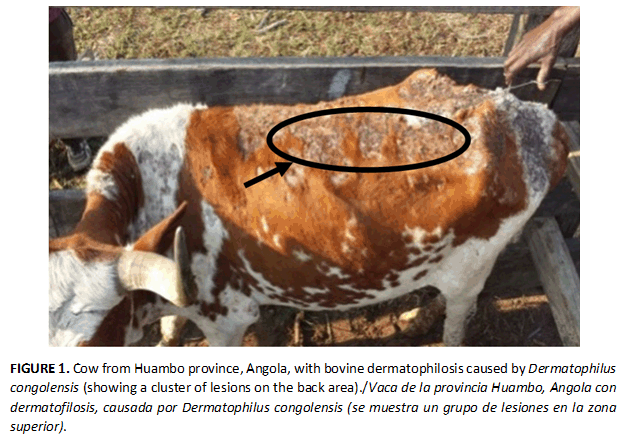
<body><![CDATA[<p style="text-align:justify;"><span style="font-family:'Verdana','sans-serif'; font-size:10.0pt; ">The genomic DNA corresponding to </span><span style="font-family:'Verdana','sans-serif'; font-size:10.0pt; ">2015 Angola </span><span style="font-family:'Verdana','sans-serif'; font-size:10.0pt; ">strain was sequenced at Macrogene Advancing through Genomics. The 16S  rRNA gene of </span><span style="font-family:'Verdana','sans-serif'; font-size:10.0pt; ">2015 Angola </span><span style="font-family:'Verdana','sans-serif'; font-size:10.0pt; ">strain was amplified with an expected size of 1465 bp  by using the oligonucleotide primers 5&acute;AGAGTTTGATCATGGCTCAG3&acute;&nbsp; and 5&acute;GTGTGACGGGCGGTGTGTAC3&acute; (Korea, </span><span style="font-family:'Verdana','sans-serif'; font-size:10.0pt; "><a href="http://dna.macrogen.com/kor/" target="_blank">http://dna.macrogen.com/kor/</a></span><span style="font-family:'Verdana','sans-serif'; font-size:10.0pt; ">), which corresponded to bases 8 to 27 and to bases 1391 to 1410 of the  16S rRNA. Sequences were aligned and assembled using the Vector NTI&reg; software  (Invitrogen, USA) to obtain a sequence of 1380 bp, which was deposited in  GenBank under accession numbers KX884879.1. They were aligned using MEGA 7  software (</span><span style="font-family:'Verdana','sans-serif'; font-size:10.0pt; "><a href="#r">19</a></span><span style="font-family:'Verdana','sans-serif'; font-size:10.0pt; ">) for phylogenetic inference using </span><span style="font-family:'Verdana','sans-serif'; font-size:10.0pt; ">the Neighbor-Joined  method (</span><span style="font-family:'Verdana','sans-serif'; font-size:10.0pt; "><a href="#r">20</a></span><span style="font-family:'Verdana','sans-serif'; font-size:10.0pt; ">). </span></p>     <p style="text-align:justify;"><strong><span style="font-family:'Verdana','sans-serif'; font-size:10.0pt; ">Ethical considerations</span></strong></p>     <p style="text-align:justify;"><span style="font-family:'Verdana','sans-serif'; font-size:10.0pt; ">Samples were collected by clinical veterinarians as part of the usual  screening scheme on farms, and the ethical guidelines and animal welfare  regulations (OIE, 2010) were  strictly respected. All herd owners had given an informed consent prior to the  study.</span></p>     <p align="center" style="text-align:center;">&nbsp;</p>     <p align="justify" ><strong><span style="font-family:'Verdana','sans-serif'; font-size:14.0pt; ">RESULTS</span></strong></p>     <p style="text-align:justify;"><span style="font-family:'Verdana','sans-serif'; font-size:10.0pt; ">Ninety animals </span><span style="font-family:'Verdana','sans-serif'; font-size:10.0pt; ">were found </span><span style="font-family:'Verdana','sans-serif'; font-size:10.0pt; ">to have  typical lesions of bovine dermatophilosis. Scabs with exudates were observed on  those parts of the body with alopecia or matted hairs (</span><span style="font-family:'Verdana','sans-serif'; font-size:10.0pt; "><a href="/img/revistas/rsa/v39n2/f0104217.gif">Figure 1</a></span><span style="font-family:'Verdana','sans-serif'; font-size:10.0pt; ">). Dermatophylosis diagnosis is often confused with others  cutaneous infections (dermatophitosis) due to the close resemblance of its  clinical presentations; therefore, it is necessary to have a microbiological  confirmation.</span></p>     
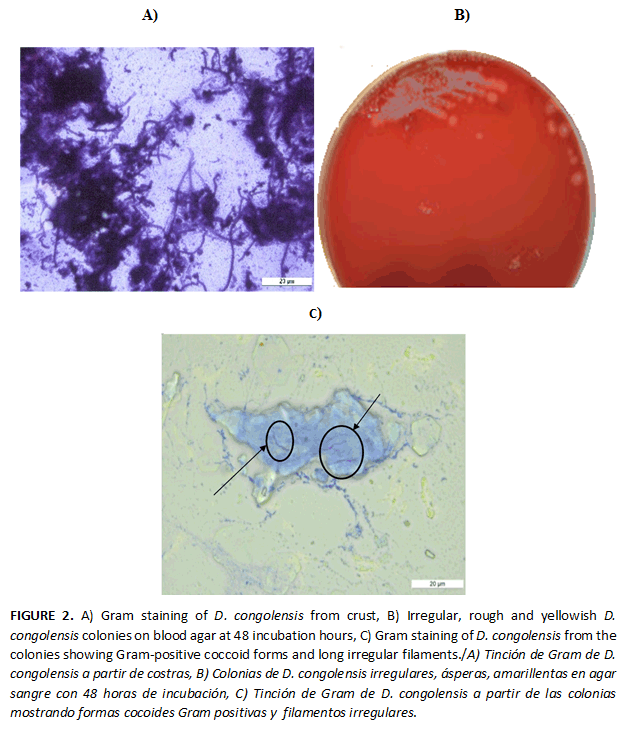
<p style="text-align:justify;"><span style="font-family:'Verdana','sans-serif'; font-size:10.0pt; ">Thirty suspected isolates of <em>D.  congolensis</em> were obtained from the 90 clinical samples</span><span style="font-family:'Verdana','sans-serif'; font-size:10.0pt; "> with an  overall prevalence of 33% (30/90). </span><span style="font-family:'Verdana','sans-serif'; font-size:10.0pt; ">The  frequency of <em>D. congolensis</em> isolates  and their origin of isolation are listed in </span><span style="font-family:'Verdana','sans-serif'; font-size:10.0pt; "><a href="/img/revistas/rsa/v39n2/t0104217.gif">Table 1</a></span><span style="font-family:'Verdana','sans-serif'; font-size:10.0pt; ">. Based on the morphological characterization and biochemical  performance, the isolates were identified as possible <em>D. congolensis</em>; the colonies 0.5 to 1 mm had a rough surface, a  yellow-golden pigmentation, and produced &beta;-hemolysis. The Gram stained smears  from both scabs and colonies revealed Gram positive branching rods which were  thick and filamentous, suggesting the presence of this bacterium in the lesions  (</span><span style="font-family:'Verdana','sans-serif'; font-size:10.0pt; "><a href="/img/revistas/rsa/v39n2/f0204217.gif">Figure 2</a></span><span style="font-family:'Verdana','sans-serif'; font-size:10.0pt; ">). </span></p>     
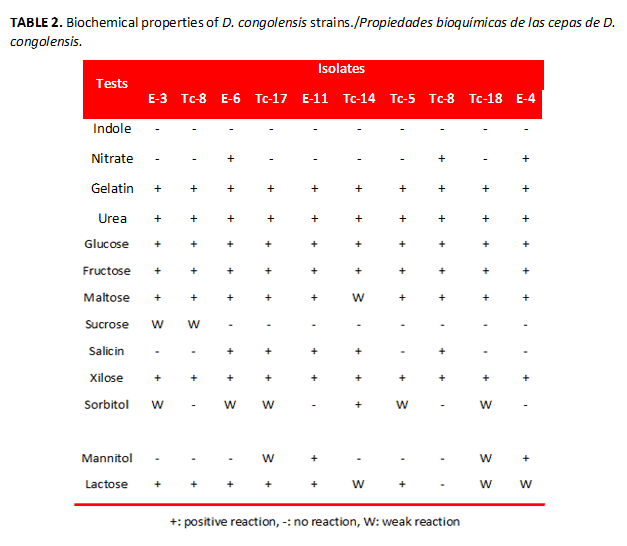
<p style="text-align:justify;"><span style="font-family:'Verdana','sans-serif'; font-size:10.0pt; ">The phenotypic characterization showed the isolates producing catalase,  while the oxidase test was negative. All isolates produced urease and digested  gelatin. Only three isolates were able to reduce nitrate to nitrite, the rest  (n=10) were unable. The indole test was negative. In the sugar fermentation  test, all <em>D. congolensis </em>isolates fermented glucose, fructose, maltose,  and xilose, while only two isolates fermented manitol (</span><span style="font-family:'Verdana','sans-serif'; font-size:10.0pt; "><a href="/img/revistas/rsa/v39n2/t0204217.gif">Table 2</a></span><span style="font-family:'Verdana','sans-serif'; font-size:10.0pt; ">). </span></p>     
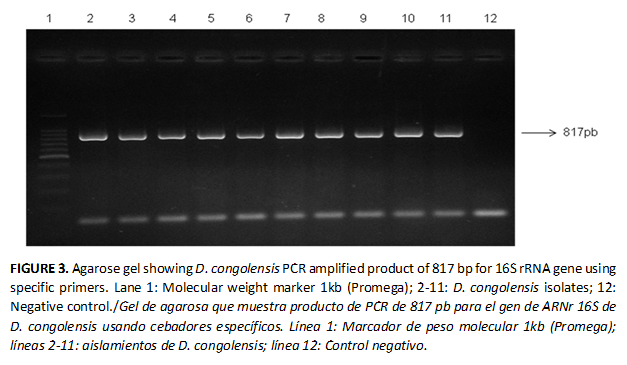
<p style="text-align:justify;"><span style="font-family:'Verdana','sans-serif'; font-size:10.0pt; ">From the cultures (n=30) with presumptive characteristics of the genus <em>Dermatophilus, </em>a fragment of approximately  817 bp was amplified (</span><span style="font-family:'Verdana','sans-serif'; font-size:10.0pt; "><a href="/img/revistas/rsa/v39n2/f0304217.gif">Figure 3</a></span><span style="font-family:'Verdana','sans-serif'; font-size:10.0pt; ">). PCR detection limit with purified genomic DNA as  the template was &gt; 0,014 ng DNA/PCR.</span></p>     
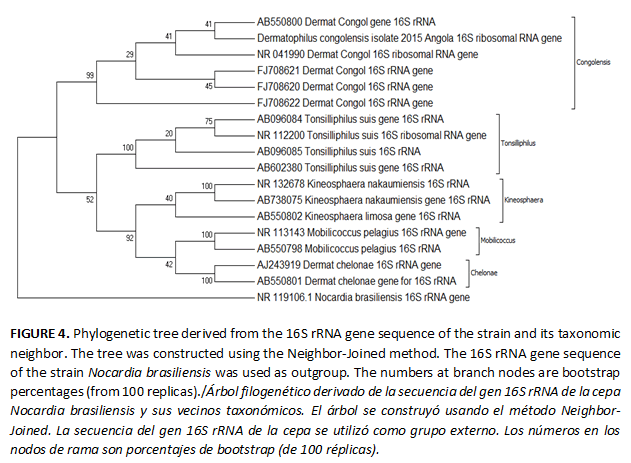
<p style="text-align:justify;"><span style="font-family:'Verdana','sans-serif'; font-size:10.0pt; ">The phylogenetic analysis based on the </span><span style="font-family:'Verdana','sans-serif'; font-size:10.0pt; ">16S rRNA gene sequence revealed that  the 2015 Angola strain was related to the type strain of <em>D. congolensis</em> (</span><span style="font-family:'Verdana','sans-serif'; font-size:10.0pt; "><a href="/img/revistas/rsa/v39n2/f0404217.gif">Figure 4</a></span><span style="font-family:'Verdana','sans-serif'; font-size:10.0pt; ">). The 2015  Angola strain joined the phylogenetic lineage of <em>D. congolensis</em> species with a bootstrap resampling value of 99 %.  This result supported the affiliation of 2015 Angola strain to <em>D. congolensis</em> species. The highest  sequence identity value of the 2015 Angola strain was observed in <em>D. congolensis</em> strain: NBRC 105199.</span></p>     
]]></body>
<body><![CDATA[<p style="text-align:justify;"><span style="font-family:'Verdana','sans-serif'; font-size:10.0pt; ">An expected product of 530 bp in  size, using the specific primers for </span><em><span style="font-family:'Verdana','sans-serif'; font-size:10.0pt; ">nasp </span></em><span style="font-family:'Verdana','sans-serif'; font-size:10.0pt; ">gene, </span><span style="font-family:'Verdana','sans-serif'; font-size:10.0pt; ">was  amplified </span><span style="font-family:'Verdana','sans-serif'; font-size:10.0pt; ">from</span><span style="font-family:'Verdana','sans-serif'; font-size:10.0pt; "> all  isolates subjected to a second PCR assay (</span><span style="font-family:'Verdana','sans-serif'; font-size:10.0pt; "><a href="/img/revistas/rsa/v39n2/f0504217.gif">Figure  5</a></span><span style="font-family:'Verdana','sans-serif'; font-size:10.0pt; ">). </span></p>     
<p style="text-align:justify;"><em><span style="font-family:'Verdana','sans-serif'; font-size:10.0pt; ">D</span></em><span style="font-family:'Verdana','sans-serif'; font-size:10.0pt; ">. <em>congolensis </em>isolates were sensitive <em>in  vitro</em> to Amoxicillin/clavulanate, Clindamycin, Streptomycin, Erythromycin,  Lincomycin, Azithromycin, Rifampicin, and Enrofloxacin. They were resistant  only to Sulfonamides and Sulfazotrim.</span></p>     <p style="text-align:justify;">&nbsp;</p>     <p align="justify" ><strong><span style="font-family:'Verdana','sans-serif'; font-size:14.0pt; ">DISCUSSION</span></strong></p>     <p style="text-align:justify;"><span style="font-family:'Verdana','sans-serif'; font-size:10.0pt; ">Dermatophilosis infection has been reported in cattle and other mammal species in different countries  of the African continent. The </span><span style="font-family:'Verdana','sans-serif'; font-size:10.0pt; ">Veterinary Services have demonstrated the presence of  the disease </span><span style="font-family:'Verdana','sans-serif'; font-size:10.0pt; ">based only  on clinical sings </span><span style="font-family:'Verdana','sans-serif'; font-size:10.0pt; ">in the northern, central and southern provinces of  Angola</span><span style="font-family:'Verdana','sans-serif'; font-size:10.0pt; "> (</span><span style="font-family:'Verdana','sans-serif'; font-size:10.0pt; "><a href="#r">21</a></span><span style="font-family:'Verdana','sans-serif'; font-size:10.0pt; ">). </span><span style="font-family:'Verdana','sans-serif'; font-size:10.0pt; ">The  confirmation of <em>D. congolensis </em>was established based on bovine clinical  signs and lesions, as well as through its isolation and identification in the  laboratory using phenotypic and genotypic assays.</span><span style="font-family:'Verdana','sans-serif'; font-size:10.0pt; "> </span></p>     <p style="text-align:justify;"><span style="font-family:'Verdana','sans-serif'; font-size:10.0pt; ">The dark brown scabs observed on the shoulders were very similar to  those described by </span><span style="font-family:'Verdana','sans-serif'; font-size:10.0pt; ">Prasad <em>et al</em>., (</span><span style="font-family:'Verdana','sans-serif'; font-size:10.0pt; "><a href="#r">22</a></span><span style="font-family:'Verdana','sans-serif'; font-size:10.0pt; ">) and Reddy <em>et al.</em> (</span><span style="font-family:'Verdana','sans-serif'; font-size:10.0pt; "><a href="#r">23</a></span><span style="font-family:'Verdana','sans-serif'; font-size:10.0pt; ">). </span><span style="font-family:'Verdana','sans-serif'; font-size:10.0pt; ">Comparable to previous findings, </span><span style="font-family:'Verdana','sans-serif'; font-size:10.0pt; ">the colonies were 0.5 to 1 mm and produced  &szlig;-haemolysis (</span><span style="font-family:'Verdana','sans-serif'; font-size:10.0pt; "><a href="#r">24,25,26</a></span><span style="font-family:'Verdana','sans-serif'; font-size:10.0pt; ">).</span></p>     <p style="text-align:justify;"><span style="font-family:'Verdana','sans-serif'; font-size:10.0pt; ">Glucose and maltose fermentation agreed with previous results (</span><span style="font-family:'Verdana','sans-serif'; font-size:10.0pt; "><a href="#r">13</a></span><span style="font-family:'Verdana','sans-serif'; font-size:10.0pt; ">). Only two isolates fermented sucrose, differing from  the results of most authors, who have reported a negative response to this  sugar (</span><span style="font-family:'Verdana','sans-serif'; font-size:10.0pt; "><a href="#r">27</a></span><span style="font-family:'Verdana','sans-serif'; font-size:10.0pt; ">). Six isolates were lactose positive;  however many of the published works have shown a  negative response to this sugar, except&nbsp;  the study made&nbsp; by Shaibu <em>et  al.</em> (</span><span style="font-family:'Verdana','sans-serif'; font-size:10.0pt; "><a href="#r">28</a></span><span style="font-family:'Verdana','sans-serif'; font-size:10.0pt; ">)</span><span style="font-family:'Verdana','sans-serif'; font-size:10.0pt; ">, in which only two isolates from goat and castle were  reported to be lactose positive. Otherwise, the reaction to sorbitol and  salicin was similar to that found in other studies which declared a pattern in  a negative to positive range (</span><span style="font-family:'Verdana','sans-serif'; font-size:10.0pt; "><a href="#r">9,27</a></span><span style="font-family:'Verdana','sans-serif'; font-size:10.0pt; ">). Differences in  the biochemical profile of strains with the results of other authors can be  attributed to intra-species diversity for <em>D.  congolensis</em>, an aspect that has been little discussed in the literature,  which is probably because different biotypes exist. Many of the results based  on biochemical tests have been carried out from the <em>D. congolensis</em> strains that had different origins such as goats,  cattle and horses.</span></p>     <p style="text-align:justify;"><span style="font-family:'Verdana','sans-serif'; font-size:10.0pt; ">The isolation of <em>D. congolensis</em> was not possible from all the animals showing typical lesions. Some samples  produced mixed cultures in which the bacterial growth, typical of other genera  like <em>Staphylococcus</em> and <em>Bacillus, </em>was observed. Culturing this  bacterium from lesions is difficult; it may be masked by the overgrowth of  other opportunistic microorganisms that are part of the skin microbiota (</span><span style="font-family:'Verdana','sans-serif'; font-size:10.0pt; "><a href="#r">15</a></span><span style="font-family:'Verdana','sans-serif'; font-size:10.0pt; ">). Difficulties to isolate and identify <em>D.  congolensis </em>have consequently been the reasons for the lack of reports of  more dermatophilosis cases (</span><span style="font-family:'Verdana','sans-serif'; font-size:10.0pt; "><a href="#r">18</a></span><span style="font-family:'Verdana','sans-serif'; font-size:10.0pt; ">). The use of special  techniques like filtration and chemotaxis, including culture media with  antibiotics, are sometimes recommended for the bacteriological isolation (</span><span style="font-family:'Verdana','sans-serif'; font-size:10.0pt; "><a href="#r">3,15</a></span><span style="font-family:'Verdana','sans-serif'; font-size:10.0pt; ">).</span></p>     <p style="text-align:justify;"><span style="font-family:'Verdana','sans-serif'; font-size:10.0pt; ">The isolates were identified as</span><em><span style="font-family:'Verdana','sans-serif'; font-size:10.0pt; "> D. congolensis</span></em><span style="font-family:'Verdana','sans-serif'; font-size:10.0pt; "> by species-specific PCR assay. For the detection of <em>D. congolensis</em> by PCR, different targets  have been referred: the alkaline ceramidase gene (</span><span style="font-family:'Verdana','sans-serif'; font-size:10.0pt; "><a href="#r">18</a></span><span style="font-family:'Verdana','sans-serif'; font-size:10.0pt; ">) and 16S rRNA (</span><span style="font-family:'Verdana','sans-serif'; font-size:10.0pt; "><a href="#r">9,17,28</a></span><span style="font-family:'Verdana','sans-serif'; font-size:10.0pt; ">). The latter has been more frequently used  in different formats such as a real-time assay (</span><span style="font-family:'Verdana','sans-serif'; font-size:10.0pt; "><a href="#r">4</a></span><span style="font-family:'Verdana','sans-serif'; font-size:10.0pt; ">). Besides, the use of this molecule has  allowed identifying <em>D. congolensis</em> isolates of different species of animals like goats and sheep (</span><span style="font-family:'Verdana','sans-serif'; font-size:10.0pt; "><a href="#r">28</a></span><span style="font-family:'Verdana','sans-serif'; font-size:10.0pt; ">).</span><span style="font-family:'Verdana','sans-serif'; font-size:10.0pt; "> </span></p>     <p style="text-align:justify;"><span style="font-family:'Verdana','sans-serif'; font-size:10.0pt; ">The <em>nasp</em> gene virulence gene  was detected in all the isolates previously identified as<em> D. congolensis.</em> According to Garcia-Sanchez <em>et al.</em> (</span><span style="font-family:'Verdana','sans-serif'; font-size:10.0pt; "><a href="#r">18</a></span><span style="font-family:'Verdana','sans-serif'; font-size:10.0pt; ">), the <em>nasp</em> gene encodes for the serine protease protein which constitutes an important virulence  factor for the development of <em>D.  congolensis</em> infection. The product of this gene (serine protease) contributes to break the main protective barriers like  keratin and cutaneous lipids, allowing the bacterial penetration and survival  in deeper epidermal layers and the completion of its life cycle. This protein  can be considered as a candidate antigen for vaccines and a diagnostic tool for  dermatophilosis (</span><span style="font-family:'Verdana','sans-serif'; font-size:10.0pt; "><a href="#r">18</a></span><span style="font-family:'Verdana','sans-serif'; font-size:10.0pt; ">).</span><span style="font-family:'Verdana','sans-serif'; font-size:10.0pt; "> </span></p>     ]]></body>
<body><![CDATA[<p style="text-align:justify;"><span style="font-family:'Verdana','sans-serif'; font-size:10.0pt; ">The susceptibility of most of the antibiotics  tested was in agreement with the results of others authors </span><span style="font-family:'Verdana','sans-serif'; font-size:10.0pt; ">(</span><span style="font-family:'Verdana','sans-serif'; font-size:10.0pt; "><a href="#r">9,29</a></span><span style="font-family:'Verdana','sans-serif'; font-size:10.0pt; ">). The  dermatophilosis treatment in animals has been attempted with a wide variety of  topical and parenteral antibiotics, but it has been largely ineffective,  probably because of the inability of the topical antibiotics to reach organisms  in the deep epidermis of parenteral antibiotics to obtain the avascular upper  epidermal layers (</span><span style="font-family:'Verdana','sans-serif'; font-size:10.0pt; "><a href="#r">9</a></span><span style="font-family:'Verdana','sans-serif'; font-size:10.0pt; ">). All antibiotics used in this study are of  parenteral application. </span></p>     <p style="text-align:justify;"><span style="font-family:'Verdana','sans-serif'; font-size:10.0pt; ">In the farms visited, the most frequently antibiotics used have been  compounds derived from penicillin (<span class="MsoBookTitle">Penfort&reg; PPU</span>,  Pen &amp; Strep, and Oxitetraciclin), but they have not been effective for the  control and eradication of this infection. Therefore, it would be convenient to  evaluate other strategies such as the use of medicinal plants or the  combination of drugs (</span><span style="font-family:'Verdana','sans-serif'; font-size:10.0pt; "><a href="#r">30</a></span><span style="font-family:'Verdana','sans-serif'; font-size:10.0pt; ">). The crust </span><span style="font-family:'Verdana','sans-serif'; font-size:10.0pt; ">detachment was </span><span style="font-family:'Verdana','sans-serif'; font-size:10.0pt; ">observed from the skin and growth of new hair </span><span style="font-family:'Verdana','sans-serif'; font-size:10.0pt; ">after the application of a cream ointment prepared from <em>Tephrosia vogelii </em>leaves<em>.</em></span><span style="font-family:'Verdana','sans-serif'; font-size:10.0pt; "> </span></p>     <p style="text-align:justify;"><span style="font-family:'Verdana','sans-serif'; font-size:10.0pt; ">Data on antimicrobial susceptibility in <em>D. congolensis</em> strains are scarce. And similar to what occurs for  many pathogens of veterinary interest for this species, regional or global  standardized data do not exist yet. This aspect constitutes  a difficulty in the antimicrobial susceptibility studies and the  comparison of reports among laboratories. The results obtained in this work can  contribute to the <em>D. congolensis</em> databases and its susceptibility patterns for the African continent.</span></p>     <p style="text-align:justify;"><span style="font-family:'Verdana','sans-serif'; font-size:10.0pt; ">The detection of the animals affected by dermatophilosis is often difficult  and the disease can be confused with clinically similar diseases. For this  reason, specific methodologies allowing the confirmation of the microorganism  are required. Prior to this work, phenotypic and genotypic assays had not been  used to confirm the presence of <em>D.  congolensis </em>in Huambo, Angola. The present study is the first confirmation  about the presence of this disease in bovine farms with clinical signs in  Huambo.</span></p> <span style="font-family:'Verdana','sans-serif'; font-size:10.0pt; ">     <p style="text-align:justify;">&nbsp;</p>     <p align="justify" ><a name="r" id="r"><strong><span style="font-family:'Verdana','sans-serif'; font-size:14.0pt; ">REFERENCES</span></strong></a><strong><span style="font-family:'Verdana','sans-serif'; font-size:14.0pt; "> </span></strong></p> <ol>       <li><span style="line-height:115%; font-family:'Verdana','sans-serif'; font-size:10.0pt; ">Yeruham I, Elad D, Perl S.  Dermatophilosis in goats in the Judean foothills. Revue Medicine Veterinary.  2003;154(12):785-786.</span></li>       <li><span style="font-family:'Verdana','sans-serif'; font-size:10.0pt; ">Dalis  SJ, Kazzem HM, Makinde AA, Fatihu MY. Bacteria associated with bovine  dermatophilosis in Zaria, Nigeria<em>. </em>Afr J Microbiol Res.  2010;4:1475-1476.</span></li>       <li><span style="font-family:'Verdana','sans-serif'; font-size:10.0pt; ">Garc&iacute;a A,  Mart&iacute;nez R, Medina JM. </span><span style="font-family:'Verdana','sans-serif'; font-size:10.0pt; ">Development of a real-time SYBR Green PCR assay for  the rapid detection of <em>Dermatophilus congolensis.</em> J Vet Sci. 2013;14(4):491-494.</span><span style="font-family:'Verdana','sans-serif'; font-size:10.0pt; "> </span></li>       <li><span style="font-family:'Verdana','sans-serif'; font-size:10.0pt; ">Shoorijeh SJ, Badiee K,  Behzadi MA, Tamadon A. First report of <em>Dermatophilus  congolensis</em> dermatitis in dairy cows in Shiraz, southern Iran. Iranian J  Vet Res. 2008;9(3):281-283.</span></li>       ]]></body>
<body><![CDATA[<li><span class="Cuerpodeltexto7"><span style="font-family:'Verdana','sans-serif'; font-size:10.0pt; ">Ag&uuml;ero  P, Briosso M. Descripci&oacute;n de un Caso de Dermatofilosis en Tambo.</span></span><span style="font-family:'Verdana','sans-serif'; font-size:10.0pt; "> Bolet&iacute;n electr&oacute;nico Agosto 2010. Laboratorio de Diagn&oacute;stico de Centro  Diagn&oacute;stico Veterinario (CDV). [en l&iacute;nea]&nbsp;  2010 Agosto (Consultado: 12 de Julio de 2016). Disponible en: <a href="http://www.cdvsa.com.ar/pdf/boletin-electronico1.pdf" target="_blank">http://www.cdvsa.com.ar/pdf/boletin-electronico1.pdf</a><u>.</u></span></li>       <li><span style="font-family:'Verdana','sans-serif'; font-size:10.0pt; ">Dickson  C, DeEl&iacute;as-Costa MRI.&nbsp; Dermatofilosis  humana y animal. Presentaci&oacute;n de un caso at&iacute;pico y revisi&oacute;n de la literatura.  [en l&iacute;nea] </span><span style="font-family:'Verdana','sans-serif'; font-size:10.0pt; ">2010;</span><span style="font-family:'Verdana','sans-serif'; font-size:10.0pt; ">(Consultado  2 de&nbsp; Julio&nbsp; de 2016)</span><span class="A2"><span style="line-height:115%; font-size:10.0pt; ">;</span></span><span style="font-family:'Verdana','sans-serif'; font-size:10.0pt; ">16(5):349-353</span><span style="font-family:'Verdana','sans-serif'; font-size:10.0pt; ">.Disponible  en: <a href="http://www.dermatolarg.org.ar/index.php/dermatnolarg/article/viewFile/526/309" target="_blank">http://www.dermatolarg.org.ar/index.php/dermatnolarg/article/viewFile/526/309</a><u>.</u></span><span class="A2"><span style="font-size:10.0pt; "> </span></span></li>       <li><span style="font-family:'Verdana','sans-serif'; font-size:10.0pt; ">Sharma DR, Kwatra MS, Saini SS, Dhillon SS, Gill BS.  Epidemiological studies on dermatophilosis outbreaks in Punjab, Indian. J Comp  MicrobiolImmunol and Infect Dis. 1992;(13):5-9. </span></li>       <li><span style="font-family:'Verdana','sans-serif'; font-size:10.0pt; ">CIE.  Dermatofiliasis. CIE-10 A48.8. Otras enfermedades bacterianas especificadas. [en  l&iacute;nea] 2006. (C<span style="color:black; ">onsultado 2 de julio de 2016)  Disponible</span> en: <a href="http://bvs1.panaftosa.org.br/local/file/textoc/Achav1dermatofiliasis.pdf" target="_blank">http://bvs1.panaftosa.org.br/local/file/textoc/Achav1dermatofiliasis.pdf</a>.</span><span class="A2"><span style="line-height:115%; font-size:10.0pt; color:red; "> </span></span></li>       <li><span class="A2"><span style="font-size:10.0pt; ">Burd EM, Juzych LA, Rudrik JT, Habib F. Pustular dermatitis caused by <em>Dermatophilus congolensis.</em> J Clin Microbiol.  2007;45(5):1655-1658. </span></span><span style="font-family:'Verdana','sans-serif'; font-size:10.0pt; "> </span></li>       <li><span class="A2"><span style="font-size:10.0pt; ">Institute of  Veterinary Services. (ISV). General Direction. Report on Activities Developed  during the year Ministry of Agriculture, Rural Development, and Fisheries. </span></span><span class="A2"><span style="font-size:10.0pt; ">Luanda Angola. 2010.</span></span><span style="font-family:'Verdana','sans-serif'; font-size:10.0pt; "> </span></li>       <li><span class="A2"><span style="font-size:10.0pt; ">Topa MC, Iseensee K,  Thompson G. Um caso de dermatofilose em bovino. Rev Port Cienc Vet.  2001;96(583):89-93.</span></span></li>       <li><span class="A2"><span style="font-size:10.0pt; ">Tavanaeimanesh  H, Sasani F, Atyabi N, Rasekh M, Eftekhari Z, Hashemian M .An outbreak of  atypical dermatophilosis mixed by Pseudomonas aeruginosa in a sheep herd after dipping.  Iranian J Vet Med. 2015;9(4):303-306. </span></span><span style="font-family:'Verdana','sans-serif'; font-size:10.0pt; "> </span></li>       <li><span style="font-family:'Verdana','sans-serif'; font-size:10.0pt; ">Zacarias T, Eliseu  A. </span><span style="font-family:'Verdana','sans-serif'; font-size:10.0pt; ">P</span><span style="font-family:'Verdana','sans-serif'; font-size:10.0pt; ">revalence and control  of bovine dermatophilosis in </span><span style="font-family:'Verdana','sans-serif'; font-size:10.0pt; ">A</span><span style="font-family:'Verdana','sans-serif'; font-size:10.0pt; ">ngola. </span><span style="font-family:'Verdana','sans-serif'; font-size:10.0pt; ">AO/IAEA International Symposium on Sustainable Improvement  of Animal Production and Health, SYNOPSES Vienna, Austria:8&ndash;11 June, </span><span style="font-family:'Verdana','sans-serif'; font-size:10.0pt; ">CN- 2008</span><span style="font-family:'Verdana','sans-serif'; font-size:10.0pt; ">;</span><span style="font-family:'Verdana','sans-serif'; font-size:10.0pt; ">174-62.</span><span class="A2"><span style="font-size:10.0pt; "> </span></span></li>       <li><span style="font-family:'Verdana','sans-serif'; font-size:10.0pt; ">Aguilar B. F&oacute;rmulas para el c&aacute;lculo de la  muestra en investigaciones de salud. Salud en Tabasco. 2005;11(1-2):333-338.</span></li>       ]]></body>
<body><![CDATA[<li><span class="A2"><span style="font-size:10.0pt; ">World Organisation for Animal Health (OIE). Dermatophilosis: A Manual of  Diagnostic tests for Terrestrial Animals, 5th ed., Office of International des  Epizootics. 2008;725-727.</span></span></li>       <li><span style="font-family:'Verdana','sans-serif'; font-size:10.0pt; ">Clinical and Laboratory Standards  Institute (CLSI)</span><span class="A2"><span style="font-size:10.0pt; ">. Performance Standards for  Antimicrobial Susceptibility Testing 26th ed, M100S, </span></span><span style="font-family:'Verdana','sans-serif'; font-size:10.0pt; ">Wayne, PA.</span><span class="A2"><span style="font-size:10.0pt; "> 2016.</span></span><span style="font-family:'Verdana','sans-serif'; font-size:10.0pt; "> </span></li>       <li><span style="font-family:'Verdana','sans-serif'; font-size:10.0pt; ">Amor A, Enriquenz A,  Corcuera MT, Toro C, Herroro D, Baquero M. Is infection by <em>Dermatophilus congolensis</em> under diagnosed? J Clin Microbiol. 2011;49(1):449-451.</span></li>       <li><span class="A2"><span style="font-size:10.0pt; ">Garc&iacute;a SA, Cerrato C,  Larrasa AJ. </span></span><span class="A2"><span style="font-size:10.0pt; ">Identification of analkaline ceramidase  gene from <em>Dermatophilus congolensis</em>.  Vet Microbiol. 2004;99:67-74.</span></span></li>       <li><span class="A2"><span style="font-size:10.0pt; ">Tamura K, Stecher G, Kumar S. 2016. Mega7: Molecular Evolutionary  Genetics Analysis Version 7.0 for Bigger Datasets. Mol Biol Evol:33:1870-1874.</span></span></li>       <li><span class="A2"><span style="font-size:10.0pt; ">Saitou N, Nei M. The Neighhbor-Joining method: a new method for  reconstructing </span></span><span style="font-family:'Verdana','sans-serif'; font-size:10.0pt; ">phylogenetic  trees. Mol Biol Evol. 1987;4(4):406-25.</span><span class="A2"><span style="font-size:10.0pt; "> </span></span></li>       <li><span class="A2"><span style="font-size:10.0pt; ">Institute of Veterinary Services (ISV). General Direction. Report on  Activities Developed during the year Ministry of Agriculture, Rural  Development, and Fisheries. Luanda Angola. 2012.</span></span><span style="font-family:'Verdana','sans-serif'; font-size:10.0pt; "> </span></li>       <li><span class="A2"><span style="font-size:10.0pt; ">Prasad BS, Prameela DR, Sreenivasulu D, Vijayalaxmi S. Prevalence of  bovine dermatophilosis in Andhra Pradesh. Inter J VetSci. 2016;5(1):41-43.</span></span><span style="font-family:'Verdana','sans-serif'; font-size:10.0pt; "> </span></li>       <li><span class="A2"><span style="font-size:10.0pt; ">Reddy BS, Rani PD, Sivajothi S, Venkatasivakumar R, Solmon KGR.  Dermatohilus in Cross-Bred Cattle in Y.S.R. District of Andhara Pradesh.  International J Sci Env Technol. 2014;3(4):1371-1374. </span></span></li>       <li><span class="A2"><span style="font-size:10.0pt; ">Ellis TM, Masters AM, Sutherland SS, Carson JM, Gregory AR. Variation in  cultural, morphological, biochemical properties and infectivity of Australian  isolates of <em>Dermatophilus congolensis</em>.  Vet Microbiol. 1993;38(1-2):81-102.</span></span></li>       ]]></body>
<body><![CDATA[<li><span class="A2"><span style="font-size:10.0pt; ">Masters AM, Ellis MT, Grein SB. <em>Dermatophilus  congolensis</em>. Strain difference in expression of phospholiphase activities,  Elsevier Veterinary Microbiology. 1997;57:199-213.</span></span></li>       <li><span style="font-family:'Verdana','sans-serif'; font-size:10.0pt; ">Tarazi YH, Al-Ani FK. </span><span style="font-family:'Verdana','sans-serif'; font-size:10.0pt; ">An Outbreak of dermatophilosis and case ous lymphadenistis&nbsp; mixed infection in camels&nbsp; in Jordan. J Inf Dev Ctries.  2016;10(5):506-511.</span></li>       <li><span class="A2"><span style="font-size:10.0pt; ">Shaibu SJ, Kazeem HM, Abdullahi US, Fatihu MY. Phenotypic and Genotypic  characterization of isolates of <em>Dermatophilus  congolensis</em> from cattle, sheep and goats in Jos, Nigeria., African J  Microbiol Res. 2011;5(5):467-474. </span></span></li>       <li><span class="A2"><span style="font-size:10.0pt; ">Shaibu SJ, Kazeem HM, Abdullahi US, Fatihu MY. The use of polymerase  chain reaction in the diagnosis of dermatophilosis from cattle, sheep and goats  in Nigeria. J Anim Vet Advan. 2010;9(6):1034-1036.</span></span></li>       <li><span class="A2"><span style="font-size:10.0pt; ">Towersey LE, Takiya CM, Londero AT. <em>Dermatophilus  congolensis</em> human infection. J Am Acad Dermatol. 1993;29:351-354.</span></span></li>       <li><span class="A2"><span style="font-size:10.0pt; ">Makoshi MS,  Arowolo ROA. Therapeutic effects of <em>Tephrosia  vogelii</em> ointment in the treatment of bovine dermatophilosis. J Vet&nbsp; Med Anim Health. 2011;3(4):51-55. </span></span></li>     </ol>     <p>&nbsp;</p>     <p>&nbsp;</p>     <p style="text-align:justify;"><span style="font-family:'Verdana','sans-serif'; font-size:10.0pt; ">Recibido:  6/2/2017</span></p>     ]]></body>
<body><![CDATA[<p class="MsoFootnoteText"><span style="font-family:'Verdana','sans-serif'; ">Aceptado: 9/6/2017</span></p>     <p class="MsoFootnoteText">&nbsp;</p>     <p class="MsoFootnoteText">&nbsp;</p>     <p class="MsoFootnoteText"><a href="#_ftnref1" name="_ftn1" title="" id="_ftn1"><span class="MsoFootnoteReference"><span style="font-family:Wingdings; ">*</span></span></a><span style="font-family:'Verdana','sans-serif'; color:#221E1F; ">Autor para  correspondencia: </span><em><span style="font-family:'Verdana','sans-serif'; ">Ivette  Espinosa</span></em><span style="font-family:'Verdana','sans-serif'; ">. E-mail: <a href="mailto:espinosa@censa.edu.cu">espinosa@censa.edu.cu</a></span></p></span>      ]]></body><back>
<ref-list>
<ref id="B1">
<label>1</label><nlm-citation citation-type="journal">
<person-group person-group-type="author">
<name>
<surname><![CDATA[Yeruham]]></surname>
<given-names><![CDATA[I]]></given-names>
</name>
<name>
<surname><![CDATA[Elad]]></surname>
<given-names><![CDATA[D]]></given-names>
</name>
<name>
<surname><![CDATA[Perl]]></surname>
<given-names><![CDATA[S]]></given-names>
</name>
</person-group>
<article-title xml:lang="en"><![CDATA[Dermatophilosis in goats in the Judean foothills]]></article-title>
<source><![CDATA[Revue Medicine Veterinary]]></source>
<year>2003</year>
<volume>154</volume>
<numero>12</numero>
<issue>12</issue>
<page-range>785-786</page-range></nlm-citation>
</ref>
<ref id="B2">
<label>2</label><nlm-citation citation-type="journal">
<person-group person-group-type="author">
<name>
<surname><![CDATA[Dalis]]></surname>
<given-names><![CDATA[SJ]]></given-names>
</name>
<name>
<surname><![CDATA[Kazzem]]></surname>
<given-names><![CDATA[HM]]></given-names>
</name>
<name>
<surname><![CDATA[Makinde]]></surname>
<given-names><![CDATA[AA]]></given-names>
</name>
<name>
<surname><![CDATA[Fatihu]]></surname>
<given-names><![CDATA[MY]]></given-names>
</name>
</person-group>
<article-title xml:lang="en"><![CDATA[Bacteria associated with bovine dermatophilosis in Zaria, Nigeria]]></article-title>
<source><![CDATA[Afr J Microbiol Res]]></source>
<year>2010</year>
<volume>4</volume>
<page-range>1475-1476</page-range></nlm-citation>
</ref>
<ref id="B3">
<label>3</label><nlm-citation citation-type="journal">
<person-group person-group-type="author">
<name>
<surname><![CDATA[García]]></surname>
<given-names><![CDATA[A]]></given-names>
</name>
<name>
<surname><![CDATA[Martínez]]></surname>
<given-names><![CDATA[R]]></given-names>
</name>
<name>
<surname><![CDATA[Medina]]></surname>
<given-names><![CDATA[JM]]></given-names>
</name>
</person-group>
<article-title xml:lang="en"><![CDATA[Development of a real-time SYBR Green PCR assay for the rapid detection of Dermatophilus congolensis]]></article-title>
<source><![CDATA[J Vet Sci]]></source>
<year>2013</year>
<volume>14</volume>
<numero>4</numero>
<issue>4</issue>
<page-range>491-494</page-range></nlm-citation>
</ref>
<ref id="B4">
<label>4</label><nlm-citation citation-type="journal">
<person-group person-group-type="author">
<name>
<surname><![CDATA[Shoorijeh]]></surname>
<given-names><![CDATA[SJ]]></given-names>
</name>
<name>
<surname><![CDATA[Badiee]]></surname>
<given-names><![CDATA[K]]></given-names>
</name>
<name>
<surname><![CDATA[Behzadi]]></surname>
<given-names><![CDATA[MA]]></given-names>
</name>
<name>
<surname><![CDATA[Tamadon]]></surname>
<given-names><![CDATA[A]]></given-names>
</name>
</person-group>
<article-title xml:lang="en"><![CDATA[First report of Dermatophilus congolensis dermatitis in dairy cows in Shiraz, southern Iran]]></article-title>
<source><![CDATA[Iranian J Vet Res]]></source>
<year>2008</year>
<volume>9</volume>
<numero>3</numero>
<issue>3</issue>
<page-range>281-283</page-range></nlm-citation>
</ref>
<ref id="B5">
<label>5</label><nlm-citation citation-type="book">
<person-group person-group-type="author">
<name>
<surname><![CDATA[Agüero]]></surname>
<given-names><![CDATA[P]]></given-names>
</name>
<name>
<surname><![CDATA[Briosso]]></surname>
<given-names><![CDATA[M]]></given-names>
</name>
</person-group>
<article-title xml:lang="es"><![CDATA[Descripción de un Caso de Dermatofilosis en Tambo]]></article-title>
<source><![CDATA[Boletín electrónico Agosto 2010]]></source>
<year>2010</year>
<publisher-name><![CDATA[Laboratorio de Diagnóstico de Centro Diagnóstico Veterinario (CDV)]]></publisher-name>
</nlm-citation>
</ref>
<ref id="B6">
<label>6</label><nlm-citation citation-type="journal">
<person-group person-group-type="author">
<name>
<surname><![CDATA[Dickson]]></surname>
<given-names><![CDATA[C]]></given-names>
</name>
<name>
<surname><![CDATA[DeElías-Costa]]></surname>
<given-names><![CDATA[MRI]]></given-names>
</name>
</person-group>
<article-title xml:lang="es"><![CDATA[Dermatofilosis humana y animal. Presentación de un caso atípico y revisión de la literatura]]></article-title>
<source><![CDATA[Dermatolarg]]></source>
<year>2010</year>
<volume>16</volume>
<numero>5</numero>
<issue>5</issue>
<page-range>349-353</page-range></nlm-citation>
</ref>
<ref id="B7">
<label>7</label><nlm-citation citation-type="journal">
<person-group person-group-type="author">
<name>
<surname><![CDATA[Sharma]]></surname>
<given-names><![CDATA[DR]]></given-names>
</name>
<name>
<surname><![CDATA[Kwatra]]></surname>
<given-names><![CDATA[MS]]></given-names>
</name>
<name>
<surname><![CDATA[Saini]]></surname>
<given-names><![CDATA[SS]]></given-names>
</name>
<name>
<surname><![CDATA[Dhillon]]></surname>
<given-names><![CDATA[SS]]></given-names>
</name>
<name>
<surname><![CDATA[Gill]]></surname>
<given-names><![CDATA[BS]]></given-names>
</name>
</person-group>
<article-title xml:lang="en"><![CDATA[Epidemiological studies on dermatophilosis outbreaks in Punjab, Indian]]></article-title>
<source><![CDATA[J Comp MicrobiolImmunol and Infect Dis]]></source>
<year>1992</year>
<numero>13</numero>
<issue>13</issue>
<page-range>5-9</page-range></nlm-citation>
</ref>
<ref id="B8">
<label>8</label><nlm-citation citation-type="">
<collab>CIE</collab>
<source><![CDATA[Dermatofiliasis. CIE-10 A48.8. Otras enfermedades bacterianas especificadas]]></source>
<year>2006</year>
</nlm-citation>
</ref>
<ref id="B9">
<label>9</label><nlm-citation citation-type="journal">
<person-group person-group-type="author">
<name>
<surname><![CDATA[Burd]]></surname>
<given-names><![CDATA[EM]]></given-names>
</name>
<name>
<surname><![CDATA[Juzych]]></surname>
<given-names><![CDATA[LA]]></given-names>
</name>
<name>
<surname><![CDATA[Rudrik]]></surname>
<given-names><![CDATA[JT]]></given-names>
</name>
<name>
<surname><![CDATA[Habib]]></surname>
<given-names><![CDATA[F]]></given-names>
</name>
</person-group>
<article-title xml:lang="en"><![CDATA[Pustular dermatitis caused by Dermatophilus congolensis]]></article-title>
<source><![CDATA[J Clin Microbiol]]></source>
<year>2007</year>
<volume>45</volume>
<numero>5</numero>
<issue>5</issue>
<page-range>1655-1658</page-range></nlm-citation>
</ref>
<ref id="B10">
<label>10</label><nlm-citation citation-type="book">
<collab>Institute of Veterinary Services</collab>
<source><![CDATA[Report on Activities Developed during the year]]></source>
<year>2010</year>
<publisher-loc><![CDATA[^eLuanda Luanda]]></publisher-loc>
<publisher-name><![CDATA[Ministry of Agriculture, Rural Development, and Fisheries]]></publisher-name>
</nlm-citation>
</ref>
<ref id="B11">
<label>11</label><nlm-citation citation-type="journal">
<person-group person-group-type="author">
<name>
<surname><![CDATA[Topa]]></surname>
<given-names><![CDATA[MC]]></given-names>
</name>
<name>
<surname><![CDATA[Iseensee]]></surname>
<given-names><![CDATA[K]]></given-names>
</name>
<name>
<surname><![CDATA[Thompson]]></surname>
<given-names><![CDATA[G]]></given-names>
</name>
</person-group>
<article-title xml:lang="pt"><![CDATA[Um caso de dermatofilose em bovino]]></article-title>
<source><![CDATA[Rev Port Cienc Vet]]></source>
<year>2001</year>
<volume>96</volume>
<numero>583</numero>
<issue>583</issue>
<page-range>89-93</page-range></nlm-citation>
</ref>
<ref id="B12">
<label>12</label><nlm-citation citation-type="journal">
<person-group person-group-type="author">
<name>
<surname><![CDATA[Tavanaeimanesh]]></surname>
<given-names><![CDATA[H]]></given-names>
</name>
<name>
<surname><![CDATA[Sasani]]></surname>
<given-names><![CDATA[F]]></given-names>
</name>
<name>
<surname><![CDATA[Atyabi]]></surname>
<given-names><![CDATA[N]]></given-names>
</name>
<name>
<surname><![CDATA[Rasekh]]></surname>
<given-names><![CDATA[M]]></given-names>
</name>
<name>
<surname><![CDATA[Eftekhari]]></surname>
<given-names><![CDATA[Z]]></given-names>
</name>
<name>
<surname><![CDATA[Hashemian]]></surname>
<given-names><![CDATA[M]]></given-names>
</name>
</person-group>
<article-title xml:lang="en"><![CDATA[An outbreak of atypical dermatophilosis mixed by Pseudomonas aeruginosa in a sheep herd after dipping]]></article-title>
<source><![CDATA[Iranian J Vet Med]]></source>
<year>2015</year>
<volume>9</volume>
<numero>4</numero>
<issue>4</issue>
<page-range>303-306</page-range></nlm-citation>
</ref>
<ref id="B13">
<label>13</label><nlm-citation citation-type="confpro">
<person-group person-group-type="author">
<name>
<surname><![CDATA[Zacarias]]></surname>
<given-names><![CDATA[T]]></given-names>
</name>
<name>
<surname><![CDATA[Eliseu]]></surname>
<given-names><![CDATA[A]]></given-names>
</name>
</person-group>
<article-title xml:lang="en"><![CDATA[Prevalence and control of bovine dermatophilosis in Angola]]></article-title>
<source><![CDATA[]]></source>
<year>2008</year>
<conf-name><![CDATA[ International Symposium on Sustainable Improvement of Animal Production and Health]]></conf-name>
<conf-date>8-11 June</conf-date>
<conf-loc>Vienna Vienna</conf-loc>
<page-range>174-62</page-range></nlm-citation>
</ref>
<ref id="B14">
<label>14</label><nlm-citation citation-type="journal">
<person-group person-group-type="author">
<name>
<surname><![CDATA[Aguilar]]></surname>
<given-names><![CDATA[B]]></given-names>
</name>
</person-group>
<article-title xml:lang="pt"><![CDATA[Fórmulas para el cálculo de la muestra en investigaciones de salud]]></article-title>
<source><![CDATA[Salud en Tabasco]]></source>
<year>2005</year>
<volume>11</volume>
<numero>1-2</numero>
<issue>1-2</issue>
<page-range>333-338</page-range></nlm-citation>
</ref>
<ref id="B15">
<label>15</label><nlm-citation citation-type="book">
<collab>World Organisation for Animal Health</collab>
<source><![CDATA[Dermatophilosis: A Manual of Diagnostic tests for Terrestrial Animals]]></source>
<year>2008</year>
<edition>5</edition>
<page-range>725-727</page-range><publisher-name><![CDATA[Office of International des Epizootics]]></publisher-name>
</nlm-citation>
</ref>
<ref id="B16">
<label>16</label><nlm-citation citation-type="">
<collab>Clinical and Laboratory Standards Institute</collab>
<source><![CDATA[Performance Standards for Antimicrobial Susceptibility Testing]]></source>
<year>2016</year>
<edition>26</edition>
<publisher-loc><![CDATA[Wayne^ePA PA]]></publisher-loc>
</nlm-citation>
</ref>
<ref id="B17">
<label>17</label><nlm-citation citation-type="journal">
<person-group person-group-type="author">
<name>
<surname><![CDATA[Amor]]></surname>
<given-names><![CDATA[A]]></given-names>
</name>
<name>
<surname><![CDATA[Enriquenz]]></surname>
<given-names><![CDATA[A]]></given-names>
</name>
<name>
<surname><![CDATA[Corcuera]]></surname>
<given-names><![CDATA[MT]]></given-names>
</name>
<name>
<surname><![CDATA[Toro]]></surname>
<given-names><![CDATA[C]]></given-names>
</name>
<name>
<surname><![CDATA[Herroro]]></surname>
<given-names><![CDATA[D]]></given-names>
</name>
<name>
<surname><![CDATA[Baquero]]></surname>
<given-names><![CDATA[M]]></given-names>
</name>
</person-group>
<article-title xml:lang="en"><![CDATA[Is infection by Dermatophilus congolensis under diagnosed]]></article-title>
<source><![CDATA[J Clin Microbiol]]></source>
<year>2011</year>
<volume>49</volume>
<numero>1</numero>
<issue>1</issue>
<page-range>449-451</page-range></nlm-citation>
</ref>
<ref id="B18">
<label>18</label><nlm-citation citation-type="journal">
<person-group person-group-type="author">
<name>
<surname><![CDATA[García]]></surname>
<given-names><![CDATA[SA]]></given-names>
</name>
<name>
<surname><![CDATA[Cerrato]]></surname>
<given-names><![CDATA[C]]></given-names>
</name>
<name>
<surname><![CDATA[Larrasa]]></surname>
<given-names><![CDATA[AJ]]></given-names>
</name>
</person-group>
<article-title xml:lang="en"><![CDATA[Identification of analkaline ceramidase gene from Dermatophilus congolensis]]></article-title>
<source><![CDATA[Vet Microbiol]]></source>
<year>2004</year>
<volume>99</volume>
<page-range>67-74</page-range></nlm-citation>
</ref>
<ref id="B19">
<label>19</label><nlm-citation citation-type="journal">
<person-group person-group-type="author">
<name>
<surname><![CDATA[Tamura]]></surname>
<given-names><![CDATA[K]]></given-names>
</name>
<name>
<surname><![CDATA[Stecher]]></surname>
<given-names><![CDATA[G]]></given-names>
</name>
<name>
<surname><![CDATA[Kumar]]></surname>
<given-names><![CDATA[S]]></given-names>
</name>
</person-group>
<article-title xml:lang="en"><![CDATA[Mega7: Molecular Evolutionary Genetics Analysis Version 7.0 for Bigger Datasets]]></article-title>
<source><![CDATA[Mol Biol Evol]]></source>
<year>2016</year>
<volume>33</volume>
<page-range>1870-1874</page-range></nlm-citation>
</ref>
<ref id="B20">
<label>20</label><nlm-citation citation-type="journal">
<person-group person-group-type="author">
<name>
<surname><![CDATA[Saitou]]></surname>
<given-names><![CDATA[N]]></given-names>
</name>
<name>
<surname><![CDATA[Nei]]></surname>
<given-names><![CDATA[M]]></given-names>
</name>
</person-group>
<article-title xml:lang="en"><![CDATA[The Neighhbor-Joining method: a new method for reconstructing phylogenetic trees]]></article-title>
<source><![CDATA[Mol Biol Evol]]></source>
<year>1987</year>
<volume>4</volume>
<numero>4</numero>
<issue>4</issue>
<page-range>406-25</page-range></nlm-citation>
</ref>
<ref id="B21">
<label>21</label><nlm-citation citation-type="book">
<collab>Institute of Veterinary Services</collab>
<source><![CDATA[Report on Activities Developed during the year]]></source>
<year>2012</year>
<publisher-loc><![CDATA[^eLuanda Luanda]]></publisher-loc>
<publisher-name><![CDATA[Ministry of Agriculture, Rural Development, and Fisheries]]></publisher-name>
</nlm-citation>
</ref>
<ref id="B22">
<label>22</label><nlm-citation citation-type="journal">
<person-group person-group-type="author">
<name>
<surname><![CDATA[Prasad]]></surname>
<given-names><![CDATA[BS]]></given-names>
</name>
<name>
<surname><![CDATA[Prameela]]></surname>
<given-names><![CDATA[DR]]></given-names>
</name>
<name>
<surname><![CDATA[Sreenivasulu]]></surname>
<given-names><![CDATA[D]]></given-names>
</name>
<name>
<surname><![CDATA[Vijayalaxmi]]></surname>
<given-names><![CDATA[S]]></given-names>
</name>
</person-group>
<article-title xml:lang="en"><![CDATA[Prevalence of bovine dermatophilosis in Andhra Pradesh]]></article-title>
<source><![CDATA[Inter J VetSci]]></source>
<year>2016</year>
<volume>5</volume>
<numero>1</numero>
<issue>1</issue>
<page-range>41-43</page-range></nlm-citation>
</ref>
<ref id="B23">
<label>23</label><nlm-citation citation-type="journal">
<person-group person-group-type="author">
<name>
<surname><![CDATA[Reddy]]></surname>
<given-names><![CDATA[BS]]></given-names>
</name>
<name>
<surname><![CDATA[Rani]]></surname>
<given-names><![CDATA[PD]]></given-names>
</name>
<name>
<surname><![CDATA[Sivajothi]]></surname>
<given-names><![CDATA[S]]></given-names>
</name>
<name>
<surname><![CDATA[Venkatasivakumar]]></surname>
<given-names><![CDATA[R]]></given-names>
</name>
<name>
<surname><![CDATA[Solmon]]></surname>
<given-names><![CDATA[KGR]]></given-names>
</name>
</person-group>
<article-title xml:lang="en"><![CDATA[Dermatohilus in Cross-Bred Cattle in Y: S.R. District of Andhara Pradesh]]></article-title>
<source><![CDATA[International J Sci Env Technol]]></source>
<year>2014</year>
<volume>3</volume>
<numero>4</numero>
<issue>4</issue>
<page-range>1371-1374</page-range></nlm-citation>
</ref>
<ref id="B24">
<label>24</label><nlm-citation citation-type="journal">
<person-group person-group-type="author">
<name>
<surname><![CDATA[Ellis]]></surname>
<given-names><![CDATA[TM]]></given-names>
</name>
<name>
<surname><![CDATA[Masters]]></surname>
<given-names><![CDATA[AM]]></given-names>
</name>
<name>
<surname><![CDATA[Sutherland]]></surname>
<given-names><![CDATA[SS]]></given-names>
</name>
<name>
<surname><![CDATA[Carson]]></surname>
<given-names><![CDATA[JM]]></given-names>
</name>
<name>
<surname><![CDATA[Gregory]]></surname>
<given-names><![CDATA[AR]]></given-names>
</name>
</person-group>
<article-title xml:lang="en"><![CDATA[Variation in cultural, morphological, biochemical properties and infectivity of Australian isolates of Dermatophilus congolensis]]></article-title>
<source><![CDATA[Vet Microbiol]]></source>
<year>1993</year>
<volume>38</volume>
<numero>1-2</numero>
<issue>1-2</issue>
<page-range>81-102</page-range></nlm-citation>
</ref>
<ref id="B25">
<label>25</label><nlm-citation citation-type="journal">
<person-group person-group-type="author">
<name>
<surname><![CDATA[Masters]]></surname>
<given-names><![CDATA[AM]]></given-names>
</name>
<name>
<surname><![CDATA[Ellis]]></surname>
<given-names><![CDATA[MT]]></given-names>
</name>
<name>
<surname><![CDATA[Grein]]></surname>
<given-names><![CDATA[SB]]></given-names>
</name>
</person-group>
<article-title xml:lang="unknown"><![CDATA[Dermatophilus congolensis]]></article-title>
<source><![CDATA[Strain difference in expression of phospholiphase activities, Elsevier Veterinary Microbiology]]></source>
<year>1997</year>
<volume>57</volume>
<page-range>199-213</page-range></nlm-citation>
</ref>
<ref id="B26">
<label>26</label><nlm-citation citation-type="journal">
<person-group person-group-type="author">
<name>
<surname><![CDATA[Tarazi]]></surname>
<given-names><![CDATA[YH]]></given-names>
</name>
<name>
<surname><![CDATA[Al-Ani]]></surname>
<given-names><![CDATA[FK]]></given-names>
</name>
</person-group>
<article-title xml:lang="en"><![CDATA[An Outbreak of dermatophilosis and case ous lymphadenistis mixed infection in camels in Jordan]]></article-title>
<source><![CDATA[J Inf Dev Ctries]]></source>
<year>2016</year>
<volume>10</volume>
<numero>5</numero>
<issue>5</issue>
<page-range>506-511</page-range></nlm-citation>
</ref>
<ref id="B27">
<label>27</label><nlm-citation citation-type="journal">
<person-group person-group-type="author">
<name>
<surname><![CDATA[Shaibu]]></surname>
<given-names><![CDATA[SJ]]></given-names>
</name>
<name>
<surname><![CDATA[Kazeem]]></surname>
<given-names><![CDATA[HM]]></given-names>
</name>
<name>
<surname><![CDATA[Abdullahi]]></surname>
<given-names><![CDATA[US]]></given-names>
</name>
<name>
<surname><![CDATA[Fatihu]]></surname>
<given-names><![CDATA[MY]]></given-names>
</name>
</person-group>
<article-title xml:lang="en"><![CDATA[Phenotypic and Genotypic characterization of isolates of Dermatophilus congolensis from cattle, sheep and goats in Jos, Nigeria: , African J Microbiol]]></article-title>
<source><![CDATA[Res]]></source>
<year>2011</year>
<volume>5</volume>
<numero>5</numero>
<issue>5</issue>
<page-range>467-474</page-range></nlm-citation>
</ref>
<ref id="B28">
<label>28</label><nlm-citation citation-type="journal">
<person-group person-group-type="author">
<name>
<surname><![CDATA[Shaibu]]></surname>
<given-names><![CDATA[SJ]]></given-names>
</name>
<name>
<surname><![CDATA[Kazeem]]></surname>
<given-names><![CDATA[HM]]></given-names>
</name>
<name>
<surname><![CDATA[Abdullahi]]></surname>
<given-names><![CDATA[US]]></given-names>
</name>
<name>
<surname><![CDATA[Fatihu]]></surname>
<given-names><![CDATA[MY]]></given-names>
</name>
</person-group>
<article-title xml:lang="en"><![CDATA[The use of polymerase chain reaction in the diagnosis of dermatophilosis from cattle, sheep and goats in Nigeria]]></article-title>
<source><![CDATA[J Anim Vet Advan]]></source>
<year>2010</year>
<volume>9</volume>
<numero>6</numero>
<issue>6</issue>
<page-range>1034-1036</page-range></nlm-citation>
</ref>
<ref id="B29">
<label>29</label><nlm-citation citation-type="journal">
<person-group person-group-type="author">
<name>
<surname><![CDATA[Towersey]]></surname>
<given-names><![CDATA[LE]]></given-names>
</name>
<name>
<surname><![CDATA[Takiya]]></surname>
<given-names><![CDATA[CM]]></given-names>
</name>
<name>
<surname><![CDATA[Londero]]></surname>
<given-names><![CDATA[AT]]></given-names>
</name>
</person-group>
<article-title xml:lang="en"><![CDATA[Dermatophilus congolensis human infection]]></article-title>
<source><![CDATA[J Am Acad Dermatol]]></source>
<year>1993</year>
<volume>29</volume>
<page-range>351-354</page-range></nlm-citation>
</ref>
<ref id="B30">
<label>30</label><nlm-citation citation-type="journal">
<person-group person-group-type="author">
<name>
<surname><![CDATA[Makoshi]]></surname>
<given-names><![CDATA[MS]]></given-names>
</name>
<name>
<surname><![CDATA[Arowolo]]></surname>
<given-names><![CDATA[ROA]]></given-names>
</name>
</person-group>
<article-title xml:lang="en"><![CDATA[Therapeutic effects of Tephrosia vogelii ointment in the treatment of bovine dermatophilosis]]></article-title>
<source><![CDATA[J Vet Med Anim Health]]></source>
<year>2011</year>
<volume>3</volume>
<numero>4</numero>
<issue>4</issue>
<page-range>51-55</page-range></nlm-citation>
</ref>
</ref-list>
</back>
</article>