<?xml version="1.0" encoding="ISO-8859-1"?><article xmlns:mml="http://www.w3.org/1998/Math/MathML" xmlns:xlink="http://www.w3.org/1999/xlink" xmlns:xsi="http://www.w3.org/2001/XMLSchema-instance">
<front>
<journal-meta>
<journal-id>0258-5936</journal-id>
<journal-title><![CDATA[Cultivos Tropicales]]></journal-title>
<abbrev-journal-title><![CDATA[cultrop]]></abbrev-journal-title>
<issn>0258-5936</issn>
<publisher>
<publisher-name><![CDATA[Ediciones INCA]]></publisher-name>
</publisher>
</journal-meta>
<article-meta>
<article-id>S0258-59362014000100009</article-id>
<title-group>
<article-title xml:lang="en"><![CDATA[Ultrastructural alterations into chloroplasts and root nodules of cowpea plants grown under saline stress conditions]]></article-title>
<article-title xml:lang="es"><![CDATA[Alteraciones ultraestructurales en los cloroplastos y nódulos de las raíces de plantas de frijol Caupí desarrolladas bajo condiciones de estrés salino]]></article-title>
</title-group>
<contrib-group>
<contrib contrib-type="author">
<name>
<surname><![CDATA[Gómez Padilla]]></surname>
<given-names><![CDATA[Ernesto]]></given-names>
</name>
<xref ref-type="aff" rid="A01"/>
</contrib>
<contrib contrib-type="author">
<name>
<surname><![CDATA[López Sánchez]]></surname>
<given-names><![CDATA[Raúl]]></given-names>
</name>
<xref ref-type="aff" rid="A01"/>
</contrib>
<contrib contrib-type="author">
<name>
<surname><![CDATA[Ruiz-Diez]]></surname>
<given-names><![CDATA[Beatriz]]></given-names>
</name>
<xref ref-type="aff" rid="A02"/>
</contrib>
<contrib contrib-type="author">
<name>
<surname><![CDATA[Fernández-Pascual]]></surname>
<given-names><![CDATA[Mercedes]]></given-names>
</name>
<xref ref-type="aff" rid="A02"/>
</contrib>
<contrib contrib-type="author">
<name>
<surname><![CDATA[Fajardo]]></surname>
<given-names><![CDATA[Susana]]></given-names>
</name>
<xref ref-type="aff" rid="A02"/>
</contrib>
<contrib contrib-type="author">
<name>
<surname><![CDATA[Eichler-Loebermann]]></surname>
<given-names><![CDATA[Bettina]]></given-names>
</name>
<xref ref-type="aff" rid="A03"/>
</contrib>
</contrib-group>
<aff id="A01">
<institution><![CDATA[,Universidad de Granma Centro de Estudios de Biotecnología Vegetal Facultad de Ciencias Agrícolas]]></institution>
<addr-line><![CDATA[ ]]></addr-line>
<country>Cuba</country>
</aff>
<aff id="A02">
<institution><![CDATA[,Instituto de Ciencias Agrarias (CSIC)  ]]></institution>
<addr-line><![CDATA[Madrid ]]></addr-line>
<country>España</country>
</aff>
<aff id="A03">
<institution><![CDATA[,Universidad de Rostock Facultad de Ciencias Agrícolas y Ambientales ]]></institution>
<addr-line><![CDATA[Rostock ]]></addr-line>
<country>Alemania</country>
</aff>
<pub-date pub-type="pub">
<day>00</day>
<month>03</month>
<year>2014</year>
</pub-date>
<pub-date pub-type="epub">
<day>00</day>
<month>03</month>
<year>2014</year>
</pub-date>
<volume>35</volume>
<numero>1</numero>
<fpage>62</fpage>
<lpage>66</lpage>
<copyright-statement/>
<copyright-year/>
<self-uri xlink:href="http://scielo.sld.cu/scielo.php?script=sci_arttext&amp;pid=S0258-59362014000100009&amp;lng=en&amp;nrm=iso"></self-uri><self-uri xlink:href="http://scielo.sld.cu/scielo.php?script=sci_abstract&amp;pid=S0258-59362014000100009&amp;lng=en&amp;nrm=iso"></self-uri><self-uri xlink:href="http://scielo.sld.cu/scielo.php?script=sci_pdf&amp;pid=S0258-59362014000100009&amp;lng=en&amp;nrm=iso"></self-uri><abstract abstract-type="short" xml:lang="en"><p><![CDATA[The ultrastructure of leaves chloroplast and root nodules from cowpea plants (Vigna unguiculata (L.) Walp.), var. IT 86 D-715, subjected to saline stress was evaluated by Transmission Electron Microscopy (TEM). Plants were exposed at 150 and 0,02 mM of NaCl treatments, considering 0,02 mM salt level as control. Native strain VIBA-1 (Bradyrhizobium liaoningense) isolated from saline soils of Cauto Valley (Cuba) was inoculated at sowing. Forty days after germination, samples of the same age and position from leaves and root nodules were taken for microscopy observations. Some ultrastructural modifications were detected by the salt effect in chloroplasts, mainly triggered by the great increase in the size of the starch granules. These modifications produced altered grana distribution. In nodule structure, when saline stress was applied, a weakness of peribacteroid membrane and high number of vesicles into infected cells were noted. Symbiosomes started deteriorating with some broken peribacteroidal membranes. A high vesiculation and degradation of some cellular organelle into uninfected cells were observed.]]></p></abstract>
<abstract abstract-type="short" xml:lang="es"><p><![CDATA[Se ha evaluado el efecto del estrés salino sobre la ultraestructura de los cloroplastos y los nódulos radicales de plantas de frijol Caupí (Vigna unguiculata (L.) Walp.), var. IT 86 D-715, mediante Microscopía Electrónica de Transmisión TEM. Las plantas se sometieron a 150 y 0,02 mM de NaCl, siendo considerado este último como control. La cepa VIBA-1 (Bradyrhizobium liaoningense), aislada de suelos salinos del Valle del Cauto (Cuba), fue inoculada en el momento de la siembra. Cuarenta días después de la germinación se tomaron muestras de hojas y nódulos de la misma posición y edad para realizar observaciones microscópicas. Se han puesto en evidencia modificaciones ultraestructurales en los cloroplastos, provocadas principalmente por el incremento de tamaño de los gránulos de almidón. Estas modificaciones produjeron alteraciones en la distribución normal de los granos. En la ultraestructura del nódulo se produjo un debilitamiento de la membrana peribacteroidal y se incrementó el número de vesículas de las células infectadas, al ser aplicado el tratamiento salino. Los simbiosomas comenzaron a degradarse al romperse la membrana peribacteroidal. Dentro de las células no infectadas se observó una alta vesiculación y la degradación de algunos orgánulos celulares.]]></p></abstract>
<kwd-group>
<kwd lng="en"><![CDATA[saline stress]]></kwd>
<kwd lng="en"><![CDATA[ultrastructure]]></kwd>
<kwd lng="en"><![CDATA[starch]]></kwd>
<kwd lng="en"><![CDATA[cowpea]]></kwd>
<kwd lng="es"><![CDATA[estrés salino]]></kwd>
<kwd lng="es"><![CDATA[ultraestructura]]></kwd>
<kwd lng="es"><![CDATA[almidón]]></kwd>
<kwd lng="es"><![CDATA[caupí]]></kwd>
</kwd-group>
</article-meta>
</front><body><![CDATA[ <p><font size="4" face="Verdana, Arial, Helvetica, sans-serif"><strong>Ultrastructural    alterations into chloroplasts and root nodules of cowpea plants grown under    saline stress conditions</strong></font></p>     <p>&nbsp;</p>     <p><font size="3" face="Verdana, Arial, Helvetica, sans-serif"><strong>Alteraciones    ultraestructurales en los cloroplastos y n&oacute;dulos de las ra&iacute;ces    de plantas de frijol Caup&iacute; desarrolladas bajo condiciones de estr&eacute;s    salino</strong></font></p>     <p>&nbsp;</p>     <p>&nbsp;</p>     <p><font size="2" face="Verdana, Arial, Helvetica, sans-serif"><strong>M.Sc. Ernesto    G&oacute;mez Padilla,<sup>I</sup> Dr.C. Ra&uacute;l L&oacute;pez S&aacute;nchez,<sup>II</sup>    Dra.C. Beatriz Ruiz-Diez,<sup>III</sup> Dra.C. Mercedes Fern&aacute;ndez-Pascual,<sup>IV</sup>    Lic. Susana Fajardo,<sup>V</sup> Dra.C. Bettina Eichler-Loebermann<sup>VI</sup></strong></font></p>     <p><font size="2" face="Verdana, Arial, Helvetica, sans-serif"><sup>I</sup>Aspirante    Investigador, Profesor Asistente, Centro de Estudios de Biotecnolog&iacute;a    Vegetal, Facultad de Ciencias Agr&iacute;colas, Universidad de Granma, Cuba.    <br>   <sup>II</sup>Investigador Agregado, Profesor Titular, Centro de Estudios de    Biotecnolog&iacute;a Vegetal, Facultad de Ciencias Agr&iacute;colas, Universidad    de Granma, Cuba.    <br>   <sup>III</sup>Investigadora Contratada, Instituto de Ciencias Agrarias (CSIC),    Madrid, Espa&ntilde;a.    <br>   <sup>IV</sup>Investigadora Cient&iacute;fica, Instituto de Ciencias Agrarias    (CSIC), Madrid, Espa&ntilde;a.     ]]></body>
<body><![CDATA[<br>   <sup>V</sup>Especialista, Instituto de Ciencias Agrarias (CSIC), Madrid, Espa&ntilde;a.    <br>   <sup>VI</sup>Dr. Hab. Investigadora, Universidad de Rostock, Facultad de Ciencias    Agr&iacute;colas y Ambientales, Rostock, Alemania.</font></p>     <p>&nbsp;</p>     <p>&nbsp;</p> <hr>     <p><font size="2" face="Verdana, Arial, Helvetica, sans-serif"><strong>ABSTRACT</strong></font></p>     <p><font size="2" face="Verdana, Arial, Helvetica, sans-serif"> The ultrastructure    of leaves chloroplast and root nodules from cowpea plants (Vigna unguiculata    (L.) Walp.), var. IT 86 D-715, subjected to saline stress was evaluated by Transmission    Electron Microscopy (TEM). Plants were exposed at 150 and 0,02 mM of NaCl treatments,    considering 0,02 mM salt level as control. Native strain VIBA-1 (Bradyrhizobium    liaoningense) isolated from saline soils of Cauto Valley (Cuba) was inoculated    at sowing. Forty days after germination, samples of the same age and position    from leaves and root nodules were taken for microscopy observations. Some ultrastructural    modifications were detected by the salt effect in chloroplasts, mainly triggered    by the great increase in the size of the starch granules. These modifications    produced altered grana distribution. In nodule structure, when saline stress    was applied, a weakness of peribacteroid membrane and high number of vesicles    into infected cells were noted. Symbiosomes started deteriorating with some    broken peribacteroidal membranes. A high vesiculation and degradation of some    cellular organelle into uninfected cells were observed.</font></p>     <p><font size="2" face="Verdana, Arial, Helvetica, sans-serif"><strong>Key words:</strong>    saline stress, ultrastructure, starch, cowpea.</font></p> <hr>     <p><font size="2" face="Verdana, Arial, Helvetica, sans-serif"><strong>RESUMEN</strong></font></p>     <p><font size="2" face="Verdana, Arial, Helvetica, sans-serif"> Se ha evaluado    el efecto del estr&eacute;s salino sobre la ultraestructura de los cloroplastos    y los n&oacute;dulos radicales de plantas de frijol Caup&iacute; (Vigna unguiculata    (L.) Walp.), var. IT 86 D-715, mediante Microscop&iacute;a Electr&oacute;nica    de Transmisi&oacute;n (TEM). Las plantas se sometieron a 150 y 0,02 mM de NaCl,    siendo considerado este &uacute;ltimo como control. La cepa VIBA-1 (Bradyrhizobium    liaoningense), aislada de suelos salinos del Valle del Cauto (Cuba), fue inoculada    en el momento de la siembra. Cuarenta d&iacute;as despu&eacute;s de la germinaci&oacute;n    se tomaron muestras de hojas y n&oacute;dulos de la misma posici&oacute;n y    edad para realizar observaciones microsc&oacute;picas. Se han puesto en evidencia    modificaciones ultraestructurales en los cloroplastos, provocadas principalmente    por el incremento de tama&ntilde;o de los gr&aacute;nulos de almid&oacute;n.    Estas modificaciones produjeron alteraciones en la distribuci&oacute;n normal    de los granas. En la ultraestructura del n&oacute;dulo se produjo un debilitamiento    de la membrana peribacteroidal y se increment&oacute; el n&uacute;mero de ves&iacute;culas    de las c&eacute;lulas infectadas, al ser aplicado el tratamiento salino. Los    simbiosomas comenzaron a degradarse al romperse la membrana peribacteroidal.    Dentro de las c&eacute;lulas no infectadas se observ&oacute; una alta vesiculaci&oacute;n    y la degradaci&oacute;n de algunos org&aacute;nulos celulares.</font></p>     <p><font size="2" face="Verdana, Arial, Helvetica, sans-serif"><strong>Palabras    clave:</strong> estr&eacute;s salino, ultraestructura, almid&oacute;n, caup&iacute;.</font></p> <hr>     ]]></body>
<body><![CDATA[<p>&nbsp;</p>     <p>&nbsp;</p>     <p><font size="2" face="Verdana, Arial, Helvetica, sans-serif"><strong><font size="3">INTRODUCTION</font></strong></font></p>     <p><font size="2" face="Verdana, Arial, Helvetica, sans-serif"> Legumes with wildness    and adaptive characteristics to environmental stresses like cowpea (Vigna unguiculata    (L.) Walp.) developed different mechanisms to reach the ionic and osmotic homeostasis    into the cell (1, 2). Some of them, like increase of abscisic acid (ABA) synthesis    (3), the rise of K<sup>+</sup>, Ca2<sup>+</sup> concentration, amino acid and    other ions and compatible solutes (4), the intracellular compartmentalization    of Cl<sup>-</sup> and Na<sup>+</sup> (5), the movement of them from the leaves    to the roots system among others, can be mentioned (1, 6).    <br>       <br>   However, in parallel to physiological, biochemical and molecular changes, ultrastructural    alterations may occur. Into the chloroplasts, the plastids and tilakoids membranes    disappeared and grana are disorganized (7, 8, 9).    <br>       <br>   At the same time, into the nodule the cytoplasm disintegration, the loss of    cell wall stiffness, the decrease in the packaging of inner cortex cells and    the appearance of lobulated nuclei, took place. Other damages like the variations    in chromatin condensation, a decrease in the volume of intercellular spaces,    the increase of vesicles number and the weakening of peribacteroid membrane    have been reported too (10, 11).    <br>       <br>   The analysis of cellular ultrastructure has been used as a tool to explain some    response mechanisms to abiotic stress conditions in nodules and leaves of several    crops like Lupin, Medicago truncatula Gaertn., Pisum sativum L. (11, 12, 13).    Nevertheless, reports of ultrastructural changes that reflect damages or adaptive    responses of cowpea subjected to salt stress are still unknown.    ]]></body>
<body><![CDATA[<br>       <br>   In this context, the aim of the present study was to determine the ultrastructural    modifications that take place into the leave chloroplasts and root nodules of    cowpea plants grown under saline stress conditions.</font></p>     <p>&nbsp;</p>     <p> <font size="3" face="Verdana, Arial, Helvetica, sans-serif"><strong>MATERIALS    AND METHODS</strong></font></p>     <p><font size="2" face="Verdana, Arial, Helvetica, sans-serif"> Cowpea seeds (Vigna    unguiculata (L.) Walp.), var. IT 86 D-715), were inoculated with a native Bradyrhizobium    liaoningense strain VIBA-1 (GeneBank accession number FJ941843), isolated from    nodules of cowpea grown in saline soils of Jiguan&iacute; Municipality, Granma    Province, Cuba (14).    <br>       <br>   The bacteria were grown in YEM medium (15). The seeds were surface-sterilized    (16), then sown in pots with vermiculite Asfaltex S.A, previously washed with    distilled water and sterilized in Autoclave SC-500 Matachana for 20 min, at    120&deg;C and 2 180 hPa. The Hoagland nutrient solution nitrogen-free was used    to irrigate the plants (17). Seedlings were grown in a growth chamber at 26/19&deg;C    (day/night) temperature, 60-70 % relative humidity, 16/8 h light/dark photoperiod,    a quantum irradiance of 190 &micro;E m<sup>-2</sup>, s<sup>-2</sup>. Forty days    after germination, plants were collected and samples of the same age and position    from the leaves and nodules were taken for ultrastructural analyses by means    of Transmission Electron Microscopy.    <br>       <br>   Sections of 1 or 2 mm<sup>2</sup> were cut near the central nerve of the leaves    with a blade of stainless steel; likewise, the nodules were cut in four little    sections around 1 mm<sup>2</sup> wide, then the samples were embedded in LR-White    resin (Sigma) (18).    <br>       ]]></body>
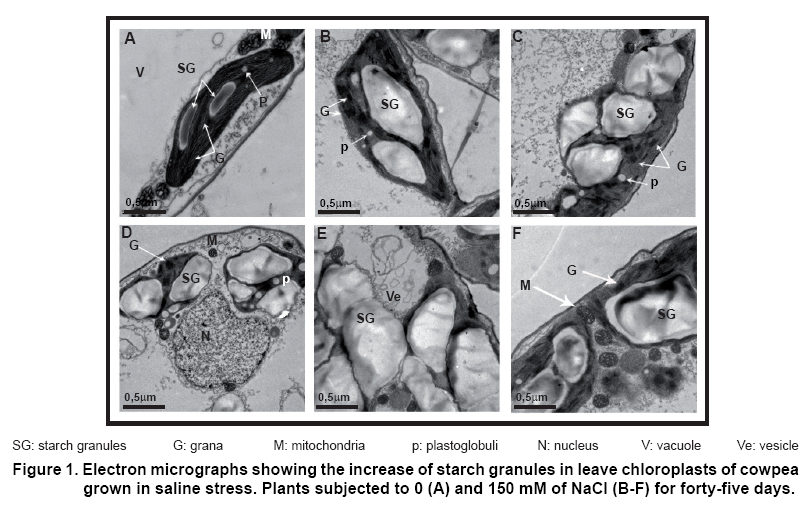
<body><![CDATA[<br>   Nodules and leaves samples were cut with ultramicrotome Reichter Ultracut S.    (Leica, Vienna, Austria) equipped with Diatome diamond blades 45&deg;.    <br>       <br>   Ultrathin sections (70 nm) were collected on copper grills of 120-200 windows    and post-stained with lead citrate and examined with a STEM LEO 910 electron    microscope with an integrated digital camera Gatan Bioscan (model 792) at an    accelerating voltage of 80 kv.</font></p>     <p>&nbsp;</p>     <p> <font size="3" face="Verdana, Arial, Helvetica, sans-serif"><strong>RESULTS</strong></font></p>     <p> <font size="2" face="Verdana, Arial, Helvetica, sans-serif"><strong>Analysis    of leave chloroplasts ultrastructure    <br>   </strong>    <br>   The chloroplasts of mesophyll cells from controls plants presented an organized    structure with numerous grana and intergrana aligned in parallel with the chloroplast    axis.    <br>       <br>   One or two elongated starch granules (amiloplasts) with normal size, some plastoglobuli    (droplets of lipids) in the stroma and big mitochondria at the chloroplast ends    were also observed (<a href="/img/revistas/ctr/v35n1/f0109114.gif">Figure    1 A</a>). The size and number of starch granules increased considerably in leave    chloroplasts from plants subjected to saline stress (<a href="/img/revistas/ctr/v35n1/f0109114.gif">Figure    1B-1F</a>).    
]]></body>
<body><![CDATA[<br>       <br>   The starch granules augmented in such way that changed their original elongated    form (<a href="/img/revistas/ctr/v35n1/f0109114.gif">Figure 1A</a>), to    take circular or oval shape (<a href="/img/revistas/ctr/v35n1/f0109114.gif">Figure    1B and C</a>) with irregular borders (<a href="/img/revistas/ctr/v35n1/f0109114.gif">Figure    1C and F</a>).    
<br>       <br>   This phenomenon caused modification of normal grana distribution (<a href="/img/revistas/ctr/v35n1/f0109114.gif">Figure    1E and F</a>), which were moved to the chloroplast edges. The grana&#8217;s    appearance changed, being observed like amorphous mass very dense to the electrons,    caused as a consequence of tilacoid membranes rupture, which is a senescence    signal (<a href="/img/revistas/ctr/v35n1/f0109114.gif">Figure 1B and D</a>).    The major damages produced by the starch granules increased, occurred when chloroplast    membranes were broken (<a href="/img/revistas/ctr/v35n1/f0109114.gif">Figure    1E</a>).    
<br>       <br>   Cellular organelle, as nucleus and mitochondrias, did not have structural modifications    under saline stress (<a href="/img/revistas/ctr/v35n1/f0109114.gif">Figure    1 D and F</a>). The appearance of vesicles were also noted, which is sign of    early senescence (<a href="/img/revistas/ctr/v35n1/f0109114.gif">Figure    1H</a>).    
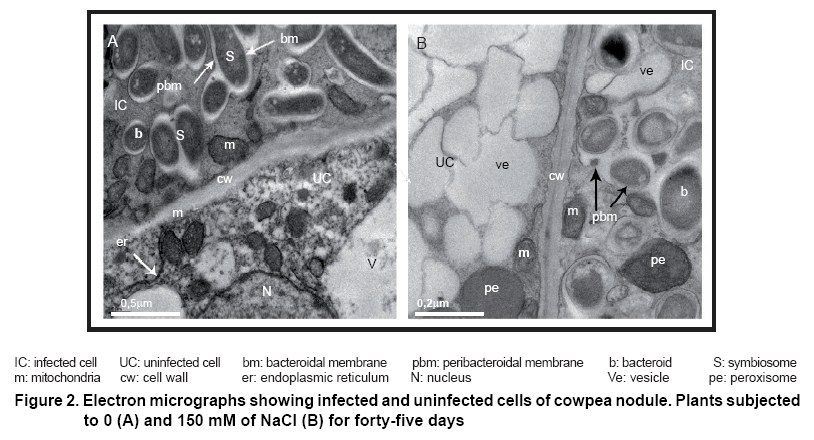
<br>       <br>   <strong>Analysis of nodular ultrastructure</strong>    <br>       <br>   Two types of cells were found in the infection zone of cowpea nodules, infected    and uninfected cells. Infected cells were plenty of bacteroids which carries    out the biological nitrogen fixation. Uninfected or interstitial cells, without    bacteroids, were responsible for the exchange of nitrogen products to the rest    of the plant (<a href="/img/revistas/ctr/v35n1/f0209114.gif">Figure 2 A-B</a>).    
]]></body>
<body><![CDATA[<br>       <br>   Into infected cells of nodules from plants grown in control treatment, many    bacteroids surrounded by peribacteroidal membrane, and symbiosomes formed by    two or three bacteroids were highlighted, (<a href="/img/revistas/ctr/v35n1/f0209114.gif">Figure    2 A</a>).    
<br>       <br>   Into uninfected cells, several mitochondria&#8217;s, endoplasmic reticulum,    the nucleus and big vacuole with normal characteristics were noted. However,    some variations in cell of nodules from plants subjected to saline stress were    evidenced (<a href="/img/revistas/ctr/v35n1/f0209114.gif">Figure 2B</a>).    
<br>       <br>   In this sense, symbiosomes look affected by a weakness of peribacteroidal membrane,    some of them become broken, being this characteristic the most important damage    observed into infected cell (<a href="/img/revistas/ctr/v35n1/f0209114.gif">Figure    2B</a> arrowheads). The uninfected cell emphasized unaltered peroxisomes, however    the high number of vesicles and some signs of mitochondria deterioration pointed    out senescence symptoms.</font></p>     
<p>&nbsp;</p>     <p><font size="3" face="Verdana, Arial, Helvetica, sans-serif"><strong>DISCUSSION</strong></font></p>     <p><font size="2" face="Verdana, Arial, Helvetica, sans-serif"> It is a well-known    the fact that the starch granules of leaves, synthesized through the day and    degraded at the night, need the activity of hydrolytic enzymes, which may be    inhibited by adverse conditions (19, 20). A theory related with the mechanism    through the plants increase in starch accumulation was explained using Arabidopsis    thaliana L. and Nicotiana tabacum L. species. In these plants, the increase    of starch granules in leaves correlated with a block in starch degradation,    induced mainly by a loss of amylases within the plastids (chloroplasts, amiloplasts)    (21).    <br>       ]]></body>
<body><![CDATA[<br>   In this experiment, the micrographs at cellular level highlighted a big accumulation    of starch granules in the chloroplasts when the plants were subjected to saline    stress, by resulting in some disorders in their structures. For this reason,    the starch accumulation in chloroplasts seemed to be more closely related with    the initial damage provoked by saline stress at cellular level, than the beneficial    effect of the starch as reserve carbohydrate, as have been suggested by several    authors (19, 22). This hypothesis could be attributable to the inability of    cowpea plants to degrade the accumulated starch by hydrolysis during the night,    exhibiting in some problems related with starch metabolism, specifically in    the loss or blocked of hydrolytic amylases. Taking into consideration that synthesis    and degradation of starch within the plants cells are quick processes (day-night,    respectively) then, the starch accumulation could be a mechanism used by plants    to mitigate the saline stress. However, this behavior maintain until the saline    stress affects the enzymatic hydrolysis, by resulting in a disproportionate    starch accumulation, which alter chloroplasts ultrastructure in the same way.    <br>       <br>   In our results, that phenomenon possibly took place some days before the harvest    (45 days) because damages were observed at this moment, and others evidenced    of harmful effect at tissue or plant level were not highlight.    <br>       <br>   Our data agreed with those obtained by several researchers who reported an increase    (three-fold) of the leaf starch content in M. truncatula and Lotus japonicus    L. grown under salinity stress in comparison with the control without salt (20).        <br>       <br>   On the other hand, the little variation in nodule structure (as the vesicles    appearance) and the weakening of peribacteroidal membrane could be caused due    to the nodule senescence, and the beginning of the harmful effect provoked by    saline stress. Anyway, other morphological and ultrastructural disorders were    not observed in the cells of the nodules, which indicate deep damages caused    by salinity. Several authors have reported other deep lesions as cytoplasm disintegration,    the stiffness loss of the cell wall, the diminishing of intercellular space    and the increase of epidermis membrane and the cortex, due to the increase of    vesicles number (22, 23).    <br>       <br>   The fact that in our result the infected zone of the nodule from plants subjected    to salinity, was not affected in a marked way, is very beneficial to symbiotic    nitrogen fixation. In the same way, this may indicate also that the nodule as    a new structure formed, has developed some mechanisms to protect the symbiosome,    and at the same time, to avoid the inactivation of nitrogenase enzyme.    <br>       ]]></body>
<body><![CDATA[<br>   Some mechanisms can be mentioned, such as compatible solutes accumulation as    proline, sucrose, and also some structural adaptations as the swollen cell cortex    which is used as a barrier to avoid the entry of Na<sup>+</sup> ions to the    infected zone (23, 24, 25). Others as the presence of a vacuolar antiporter    Na<sup>+</sup>/H<sup>+</sup>, which play a relevant role in the saline tolerance,    and ionic homeostasis, probably due to the induction of the accumulation of    Na<sup>+</sup> into the vacuole (26, 27) have been reported too.</font></p>     <p>&nbsp;</p>     <p> <font size="3" face="Verdana, Arial, Helvetica, sans-serif"><strong>ACKNOWLEDGEMENTS</strong></font></p>     <p><font size="2" face="Verdana, Arial, Helvetica, sans-serif"> This work was    carried out as part of the AECID project, reference A/8500/07 and A/019119/08,    developed between CSIC (Madrid, Spain) and the University of Granma, Cuba. BRD    was supported by contracts of Junta de Comunidades de Castilla-La Mancha (POII09-0182-3834    and POII10-0211-5015).</font></p>     <p>&nbsp;</p>     <p> <font size="3" face="Verdana, Arial, Helvetica, sans-serif"><strong>REFERENCES</strong></font></p>     <!-- ref --><p><font size="2" face="Verdana, Arial, Helvetica, sans-serif"> 1. Praxedes, S.    C.; de Lacerda, C. F.; DaMatta, F. M.; Prisco, J. T. and Gomes-Felho, E. Salt    tolerance is associated with differences in ion accumulation, biomass allocation    and photosynthesis in cowpea cultivars. J. Agron. Crop. Sci., 2010, vol. 196,    p. 193-204.    <br>       <!-- ref --><br>   2. Sprent, J. I.; Odee, W. D. and Dakora, D. F. African legumes: a vital but    under-utilized resource. J. Exp. Bot., 2010, vol. 61, no. 5, p. 1257-1265.    <br>       ]]></body>
<body><![CDATA[<!-- ref --><br>   3. Raghavendra, A. S.; Gonugunta, V. K.; Christmann, A. and Grill, E. ABA perception    and signaling. Trends Plant Sci., 2010, vol. 15, no. 7, p. 395-401.    <br>       <!-- ref --><br>   4. Maathuis, F. J. M. The role of monovalent cation transporters in plant responses    to salinity. J. Exp. Bot., 2006, vol. 57, no. 5, p. 1137-1147.    <br>       <!-- ref --><br>   5. Turkan, I. and Demiral, T. Recent developments in understanding salinity    tolerance. J. Envir. Exp. Bot., 2009, vol. 67, p. 2-9.    <br>       <!-- ref --><br>   6. Manchanda, G. and Garg, N. Salinity and its effects on the functional biology    of legumes. Act. Physiol. Plant., 2008, vol. 30, p. 595-618.    <br>       <!-- ref --><br>   7. Hashemi, A.; Abdolzadeh, A. and Sadeghipour, H. R. Beneficial effects of    silicon nutrition in alleviating salinity stress in hydroponically grown canola,    Brassica napus L. plants. Soil Sci. Plant. Nut., 2010, vol. 56, no. 2, p. 244-253.    <br>       ]]></body>
<body><![CDATA[<!-- ref --><br>   8. Abdalla, M. M. Impact of diatomite nutrition on two Trifolium alexandrinum    cultivars differing in salinity tolerance. Int. J. Plant Physiol. Bioch., 2011,    vol. 3, no. 13, p. 233-246.    <br>       <!-- ref --><br>   9. Amina, A. A.; Ahmed, F. K. and Gadalla, N. O. Improvement the adverse effect    of salt stress in Egyptian clover (Trifolium alexandrinum L.) by AsA aplication    through some biochemical and RT-PCR markers. J. Appl. Phyto. Envir. Sanit.,    2012, vol. 1, no. 2, p. 91-102.    <br>       <!-- ref --><br>   10. Perez-Guerra, J. C.; Coussens, G.; De Keyser, A.; De Rycke, R.; De Bodt,    S.; Van De Velde, W.; Goormachtig, S. and Holsters, M. Comparison of developmental    and stress-induced nodule senescence in Medicago truncatula. Plant Physiol.,    2010, vol. 152, no. 3, p. 1574-1584.    <br>       <!-- ref --><br>   11. Borucki, W. and Sujkowska, M. The effects of sodium chloride salinity upon    growth, nodulation, and root nodule structure of pea (Pisum sativum L.) plants.    Acta Physiol. Plant., 2008, vol. 30, p. 293-301.    <br>       <!-- ref --><br>   12. Fern&aacute;ndez-Pascual, M.; De Lorenzo, C.; de Felipe, M. R.; Rajalakshmi,    S.; Gordon, A. J.; Thomas, B. J. and Minchin, F. R. Possible reasons for relative    salt stress tolerance in nodules of White lupin cv. Multolupa. J. Exp. Bot.,    1996, vol. 47, no. 304, p. 1709-1716.    <br>       ]]></body>
<body><![CDATA[<!-- ref --><br>   13. Perez-Guerra, J. C.; Coussens, G.; De Keyser, A.; De Rycke, R.; De Bodt,    S.; Van De Velde, W.; Goormachtig, S. and Holsters, M. Comparison of developmental    and stress-induced nodule senescence in Medicago truncatula. Plant Physiol.,    2010. vol. 152, no. 3, p. 1574-1584.    <br>       <!-- ref --><br>   14. G&oacute;mez-Padilla, E.; Ruiz-D&iacute;ez, B.; Fajardo, S.; G&oacute;mez-Buz&oacute;n,    E.; L&oacute;pez-S&aacute;nchez, R. and Fern&aacute;ndez-Pascual, Mercedes.    Experimentos de campo en suelos salinos cubanos con plantas de Vigna unguiculata    inoculadas con cepas de Bradyrhizobium nativas de la zona. In: Editores: Bonilla,    I.; Zornoza, P.; G&aacute;rate, A.; Marco, E.; Rivilla, R. y Lucena, J. J. La    Nutrici&oacute;n Mineral de las Plantas, como base de una agricultura sostenible.    Espa&ntilde;a. Edici&oacute;n libro digital 2012, p. 284-289. ISBN: 84-695-5571-5;    ISBN-13: 978-84-695-5571-2.    <br>       <!-- ref --><br>   15. Vincent, J. M. A manual for the practical study of root-nodule bacteria    /J.M Vincent. In: International Programme Handbook. No. 15. Blackwele scientific    publications, Oxford, England. 1970, p. 164.    <br>       <!-- ref --><br>   16. Somasegaran, P. and Hoben, H. J. Methods in legume-Rhizobium technology.    University of Hawaii NifTAL Project and MIRCEN, Department of Agronomy and Soil    Science, Hawaii. Institute of Tropical Agriculture and Human Resources. 1985.    296 p.    <br>       <!-- ref --><br>   17. Hoagland, D. R. and Arnon, D. I. The water-culture method for growing plants    without soil. Calif. Agric. Exp. Sta. Circ. 1950. vol. 347, p. 1-32.    <br>       ]]></body>
<body><![CDATA[<!-- ref --><br>   18. de Mar&iacute;a, N.; de Felipe, M. R. and Fern&aacute;ndez-Pascual, M. Alterations    induced by glyphosate on lupin photosynthetic apparatus and nodule ultrastructure    and some oxygen diffusion related proteins. Plant Physiol. Bioch., 2005, vol.    43, no. 985-996.    <br>       <!-- ref --><br>   19. Geigenberger, P. Regulation of starch biosynthesis in response to a fluctuating    environment. Plant Physiol., 2011, vol. 155, p. 1566-1577.    <br>       <!-- ref --><br>   20. L&oacute;pez, G. M. Metabolismo carbonado nodular en Medicago truncatula-Sinorhizobium    meliloti, Lotus japonicus-Mesorhizobium loti en estr&eacute;s salino: implicaci&oacute;n    de la trehalosa. Tesis de Doctarado. Universidad de Granada. Facultad de Ciencias.    2007, 315 p. ISBN: 978-84-338-4466-8.    <br>       <!-- ref --><br>   21. Humme, E.; Osterrieder, A.; Robinson, D. G. and Hawes, C. Inhibition of    Golgi function causes plastid starch accumulation. J. Exp. Bot., 2010, vol.    61, no. 10, p. 2603-2614.    <br>       <!-- ref --><br>   22. Redondo, F. J.; de la Pena, T. C.; Morcillo, C. N.; Lucas, M. M. and Pueyo,    J. J. Overexpression of flavodoxin in bacteroids induces changes in antioxidant    metabolism leading to delayed senescence and starch accumulation in alfalfa    root nodules. Plant Physiol., 2009, vol. 149, no. 2, p. 1166-1178.    <br>       ]]></body>
<body><![CDATA[<!-- ref --><br>   23. Mudgal, V.; Madaan, N.; Mudgal, A.; Singh, A. and Kumar, P. Comparative    Study of the Effects of Salinity on Plant Growth, Nodulation, and Legheamoglobin    Content in Kabuli and Desi Cultivars of Cicer arietinum (L.). KBM J. Biol.,    2010, vol. 1, p. 1-4.    <br>       <!-- ref --><br>   24. Larrainzar, E.; Wienkoop, S.; Scherling, C.; Kempa, S.; Ladrera, R.; ArreseIgor,    C.; Weckwerth, W. and Gonz&aacute;lez, E. M. Carbon metabolism and bacteroid    functioning are involved in the regulation of nitrogen fixation in Medicago    truncatula under drought and recovery. Mol. Plant Micro. Interac., 2009, vol.    22, p. 1565-1576.    <br>       <!-- ref --><br>   25. Hussain, K.; Farrukh, M.; Majeed, A.; Nawaz, K.; Hayat, K.; Afghan, S. and    Shahazad Zia-ul-Hussnian, S. What molecular mechanism is adapted by plants during    salt stress tolerance? Afr. J. Biot., 2010, vol. 9, no.4, p. 416-422.    <br>       <!-- ref --><br>   26. Coba de la Pe&ntilde;a, T. and Pueyo, J. J. Legumes in the reclamation of    marginal soils, from cultivar and inoculant selection to transgenic approaches.    Agro. Sust. Develop., 2012, vol. 35, no. 1, p. 65-91.    <br>       <!-- ref --><br>   27. Tang, R.; Li, C.; Xu, K.; Du, Y. H., and Xia, T. Isolation, functional characterization,    and expression pattern of a vacuolar Na<sup>+</sup>/H<sup>+</sup> antiporter    gene TrNHX1 from Trifolium repens L. Plant Mol. Biol., 2010, vol. 28, p. 102-111.    </font></p>     ]]></body>
<body><![CDATA[<p>&nbsp;</p>     <p>&nbsp;</p>     <p><font size="2" face="Verdana, Arial, Helvetica, sans-serif"> Recibido: 27 de    marzo de 2013    <br>   Aceptado: 12 de julio de 2013</font></p>     <p>&nbsp;</p>     <p>&nbsp;</p>     <p><font size="2" face="Verdana, Arial, Helvetica, sans-serif"><em>M.Sc. Ernesto    G&oacute;mez Padilla,</em><strong> </strong>Aspirante Investigador, Profesor    Asistente, Centro de Estudios de Biotecnolog&iacute;a Vegetal, Facultad de Ciencias    Agr&iacute;colas, Universidad de Granma, Cuba. Email: <a href="mailto:egomezp@udg.co.cu">egomezp@udg.co.cu</a></font></p>      ]]></body><back>
<ref-list>
<ref id="B1">
<label>1</label><nlm-citation citation-type="journal">
<person-group person-group-type="author">
<name>
<surname><![CDATA[Praxedes]]></surname>
<given-names><![CDATA[S. C]]></given-names>
</name>
<name>
<surname><![CDATA[de Lacerda]]></surname>
<given-names><![CDATA[C. F]]></given-names>
</name>
<name>
<surname><![CDATA[DaMatta]]></surname>
<given-names><![CDATA[F. M]]></given-names>
</name>
<name>
<surname><![CDATA[Prisco]]></surname>
<given-names><![CDATA[J. T]]></given-names>
</name>
<name>
<surname><![CDATA[Gomes-Felho]]></surname>
<given-names><![CDATA[E]]></given-names>
</name>
</person-group>
<article-title xml:lang="en"><![CDATA[Salt tolerance is associated with differences in ion accumulation, biomass allocation and photosynthesis in cowpea cultivars]]></article-title>
<source><![CDATA[J. Agron. Crop. Sci]]></source>
<year>2010</year>
<volume>196</volume>
<page-range>193-204</page-range></nlm-citation>
</ref>
<ref id="B2">
<label>2</label><nlm-citation citation-type="journal">
<person-group person-group-type="author">
<name>
<surname><![CDATA[Sprent]]></surname>
<given-names><![CDATA[J. I]]></given-names>
</name>
<name>
<surname><![CDATA[Odee]]></surname>
<given-names><![CDATA[W. D]]></given-names>
</name>
<name>
<surname><![CDATA[Dakora]]></surname>
<given-names><![CDATA[D. F]]></given-names>
</name>
</person-group>
<article-title xml:lang="en"><![CDATA[African legumes: a vital but under-utilized resource]]></article-title>
<source><![CDATA[J. Exp. Bot]]></source>
<year>2010</year>
<volume>61</volume>
<numero>5</numero>
<issue>5</issue>
<page-range>1257-1265</page-range></nlm-citation>
</ref>
<ref id="B3">
<label>3</label><nlm-citation citation-type="journal">
<person-group person-group-type="author">
<name>
<surname><![CDATA[Raghavendra]]></surname>
<given-names><![CDATA[A. S]]></given-names>
</name>
<name>
<surname><![CDATA[Gonugunta]]></surname>
<given-names><![CDATA[V. K]]></given-names>
</name>
<name>
<surname><![CDATA[Christmann]]></surname>
<given-names><![CDATA[A]]></given-names>
</name>
<name>
<surname><![CDATA[Grill]]></surname>
<given-names><![CDATA[E]]></given-names>
</name>
</person-group>
<article-title xml:lang="en"><![CDATA[ABA perception and signaling]]></article-title>
<source><![CDATA[Trends Plant Sci]]></source>
<year>2010</year>
<volume>15</volume>
<numero>7</numero>
<issue>7</issue>
<page-range>395-401</page-range></nlm-citation>
</ref>
<ref id="B4">
<label>4</label><nlm-citation citation-type="journal">
<person-group person-group-type="author">
<name>
<surname><![CDATA[Maathuis]]></surname>
<given-names><![CDATA[F. J. M]]></given-names>
</name>
</person-group>
<article-title xml:lang="en"><![CDATA[The role of monovalent cation transporters in plant responses to salinity]]></article-title>
<source><![CDATA[J. Exp. Bot]]></source>
<year>2006</year>
<volume>57</volume>
<numero>5</numero>
<issue>5</issue>
<page-range>1137-1147</page-range></nlm-citation>
</ref>
<ref id="B5">
<label>5</label><nlm-citation citation-type="journal">
<person-group person-group-type="author">
<name>
<surname><![CDATA[Turkan]]></surname>
<given-names><![CDATA[I]]></given-names>
</name>
<name>
<surname><![CDATA[Demiral]]></surname>
<given-names><![CDATA[T]]></given-names>
</name>
</person-group>
<article-title xml:lang="en"><![CDATA[Recent developments in understanding salinity tolerance]]></article-title>
<source><![CDATA[J. Envir. Exp. Bot]]></source>
<year>2009</year>
<volume>67</volume>
<page-range>2-9</page-range></nlm-citation>
</ref>
<ref id="B6">
<label>6</label><nlm-citation citation-type="journal">
<person-group person-group-type="author">
<name>
<surname><![CDATA[Manchanda]]></surname>
<given-names><![CDATA[G]]></given-names>
</name>
<name>
<surname><![CDATA[Garg]]></surname>
<given-names><![CDATA[N]]></given-names>
</name>
</person-group>
<article-title xml:lang="en"><![CDATA[Salinity and its effects on the functional biology of legumes]]></article-title>
<source><![CDATA[Act. Physiol. Plant]]></source>
<year>2008</year>
<volume>30</volume>
<page-range>595-618</page-range></nlm-citation>
</ref>
<ref id="B7">
<label>7</label><nlm-citation citation-type="journal">
<person-group person-group-type="author">
<name>
<surname><![CDATA[Hashemi]]></surname>
<given-names><![CDATA[A]]></given-names>
</name>
<name>
<surname><![CDATA[Abdolzadeh]]></surname>
<given-names><![CDATA[A]]></given-names>
</name>
<name>
<surname><![CDATA[Sadeghipour]]></surname>
<given-names><![CDATA[H. R]]></given-names>
</name>
</person-group>
<article-title xml:lang="en"><![CDATA[Beneficial effects of silicon nutrition in alleviating salinity stress in hydroponically grown canola, Brassica napus L. plants]]></article-title>
<source><![CDATA[Soil Sci. Plant. Nut]]></source>
<year>2010</year>
<volume>56</volume>
<numero>2</numero>
<issue>2</issue>
<page-range>244-253</page-range></nlm-citation>
</ref>
<ref id="B8">
<label>8</label><nlm-citation citation-type="journal">
<person-group person-group-type="author">
<name>
<surname><![CDATA[Abdalla]]></surname>
<given-names><![CDATA[M. M]]></given-names>
</name>
</person-group>
<article-title xml:lang="en"><![CDATA[Impact of diatomite nutrition on two Trifolium alexandrinum cultivars differing in salinity tolerance]]></article-title>
<source><![CDATA[Int. J. Plant Physiol. Bioch]]></source>
<year>2011</year>
<volume>3</volume>
<numero>13</numero>
<issue>13</issue>
<page-range>233-246</page-range></nlm-citation>
</ref>
<ref id="B9">
<label>9</label><nlm-citation citation-type="journal">
<person-group person-group-type="author">
<name>
<surname><![CDATA[Amina]]></surname>
<given-names><![CDATA[A. A]]></given-names>
</name>
<name>
<surname><![CDATA[Ahmed]]></surname>
<given-names><![CDATA[F. K]]></given-names>
</name>
<name>
<surname><![CDATA[Gadalla]]></surname>
<given-names><![CDATA[N. O]]></given-names>
</name>
</person-group>
<article-title xml:lang="en"><![CDATA[Improvement the adverse effect of salt stress in Egyptian clover (Trifolium alexandrinum L.) by AsA aplication through some biochemical and RT-PCR markers]]></article-title>
<source><![CDATA[J. Appl. Phyto. Envir. Sanit]]></source>
<year>2012</year>
<volume>1</volume>
<numero>2</numero>
<issue>2</issue>
<page-range>91-102</page-range></nlm-citation>
</ref>
<ref id="B10">
<label>10</label><nlm-citation citation-type="journal">
<person-group person-group-type="author">
<name>
<surname><![CDATA[Perez-Guerra]]></surname>
<given-names><![CDATA[J. C]]></given-names>
</name>
<name>
<surname><![CDATA[Coussens]]></surname>
<given-names><![CDATA[G]]></given-names>
</name>
<name>
<surname><![CDATA[De Keyser]]></surname>
<given-names><![CDATA[A]]></given-names>
</name>
<name>
<surname><![CDATA[De Rycke]]></surname>
<given-names><![CDATA[R]]></given-names>
</name>
<name>
<surname><![CDATA[De Bodt]]></surname>
<given-names><![CDATA[S]]></given-names>
</name>
<name>
<surname><![CDATA[Van De Velde]]></surname>
<given-names><![CDATA[W]]></given-names>
</name>
<name>
<surname><![CDATA[Goormachtig]]></surname>
<given-names><![CDATA[S]]></given-names>
</name>
<name>
<surname><![CDATA[Holsters]]></surname>
<given-names><![CDATA[M]]></given-names>
</name>
</person-group>
<article-title xml:lang="en"><![CDATA[Comparison of developmental and stress-induced nodule senescence in Medicago truncatula]]></article-title>
<source><![CDATA[Plant Physiol]]></source>
<year>2010</year>
<volume>152</volume>
<numero>3</numero>
<issue>3</issue>
<page-range>1574-1584</page-range></nlm-citation>
</ref>
<ref id="B11">
<label>11</label><nlm-citation citation-type="journal">
<person-group person-group-type="author">
<name>
<surname><![CDATA[Borucki]]></surname>
<given-names><![CDATA[W]]></given-names>
</name>
<name>
<surname><![CDATA[Sujkowska]]></surname>
<given-names><![CDATA[M]]></given-names>
</name>
</person-group>
<article-title xml:lang="en"><![CDATA[The effects of sodium chloride salinity upon growth, nodulation, and root nodule structure of pea (Pisum sativum L.) plants]]></article-title>
<source><![CDATA[Acta Physiol. Plant]]></source>
<year>2008</year>
<volume>30</volume>
<page-range>293-301</page-range></nlm-citation>
</ref>
<ref id="B12">
<label>12</label><nlm-citation citation-type="journal">
<person-group person-group-type="author">
<name>
<surname><![CDATA[Fernández-Pascual]]></surname>
<given-names><![CDATA[M]]></given-names>
</name>
<name>
<surname><![CDATA[De Lorenzo]]></surname>
<given-names><![CDATA[C]]></given-names>
</name>
<name>
<surname><![CDATA[de Felipe]]></surname>
<given-names><![CDATA[M. R]]></given-names>
</name>
<name>
<surname><![CDATA[Rajalakshmi]]></surname>
<given-names><![CDATA[S]]></given-names>
</name>
<name>
<surname><![CDATA[Gordon]]></surname>
<given-names><![CDATA[A. J]]></given-names>
</name>
<name>
<surname><![CDATA[Thomas]]></surname>
<given-names><![CDATA[B. J]]></given-names>
</name>
<name>
<surname><![CDATA[Minchin]]></surname>
<given-names><![CDATA[F. R]]></given-names>
</name>
</person-group>
<article-title xml:lang="en"><![CDATA[Possible reasons for relative salt stress tolerance in nodules of White lupin cv. Multolupa]]></article-title>
<source><![CDATA[J. Exp. Bot]]></source>
<year>1996</year>
<volume>47</volume>
<numero>304</numero>
<issue>304</issue>
<page-range>1709-1716</page-range></nlm-citation>
</ref>
<ref id="B13">
<label>13</label><nlm-citation citation-type="journal">
<person-group person-group-type="author">
<name>
<surname><![CDATA[Perez-Guerra]]></surname>
<given-names><![CDATA[J. C]]></given-names>
</name>
<name>
<surname><![CDATA[Coussens]]></surname>
<given-names><![CDATA[G]]></given-names>
</name>
<name>
<surname><![CDATA[De Keyser]]></surname>
<given-names><![CDATA[A]]></given-names>
</name>
<name>
<surname><![CDATA[De Rycke]]></surname>
<given-names><![CDATA[R]]></given-names>
</name>
<name>
<surname><![CDATA[De Bodt]]></surname>
<given-names><![CDATA[S]]></given-names>
</name>
<name>
<surname><![CDATA[Van De Velde]]></surname>
<given-names><![CDATA[W]]></given-names>
</name>
<name>
<surname><![CDATA[Goormachtig]]></surname>
<given-names><![CDATA[S]]></given-names>
</name>
<name>
<surname><![CDATA[Holsters]]></surname>
<given-names><![CDATA[M]]></given-names>
</name>
</person-group>
<article-title xml:lang="en"><![CDATA[Comparison of developmental and stress-induced nodule senescence in Medicago truncatula]]></article-title>
<source><![CDATA[Plant Physiol]]></source>
<year>2010</year>
<volume>152</volume>
<numero>3</numero>
<issue>3</issue>
<page-range>1574-1584</page-range></nlm-citation>
</ref>
<ref id="B14">
<label>14</label><nlm-citation citation-type="book">
<person-group person-group-type="author">
<name>
<surname><![CDATA[Gómez-Padilla]]></surname>
<given-names><![CDATA[E]]></given-names>
</name>
<name>
<surname><![CDATA[Ruiz-Díez]]></surname>
<given-names><![CDATA[B]]></given-names>
</name>
<name>
<surname><![CDATA[Fajardo]]></surname>
<given-names><![CDATA[S]]></given-names>
</name>
<name>
<surname><![CDATA[Gómez-Buzón]]></surname>
<given-names><![CDATA[E]]></given-names>
</name>
<name>
<surname><![CDATA[López-Sánchez]]></surname>
<given-names><![CDATA[R]]></given-names>
</name>
<name>
<surname><![CDATA[Fernández-Pascual]]></surname>
<given-names><![CDATA[Mercedes]]></given-names>
</name>
</person-group>
<article-title xml:lang="es"><![CDATA[Experimentos de campo en suelos salinos cubanos con plantas de Vigna unguiculata inoculadas con cepas de Bradyrhizobium nativas de la zona]]></article-title>
<person-group person-group-type="editor">
<name>
<surname><![CDATA[Bonilla]]></surname>
<given-names><![CDATA[I]]></given-names>
</name>
<name>
<surname><![CDATA[Zornoza]]></surname>
<given-names><![CDATA[P]]></given-names>
</name>
<name>
<surname><![CDATA[Gárate]]></surname>
<given-names><![CDATA[A]]></given-names>
</name>
<name>
<surname><![CDATA[Marco]]></surname>
<given-names><![CDATA[E]]></given-names>
</name>
<name>
<surname><![CDATA[Rivilla]]></surname>
<given-names><![CDATA[R]]></given-names>
</name>
<name>
<surname><![CDATA[Lucena]]></surname>
<given-names><![CDATA[J. J]]></given-names>
</name>
</person-group>
<source><![CDATA[La Nutrición Mineral de las Plantas, como base de una agricultura sostenible]]></source>
<year></year>
<page-range>284-289</page-range><publisher-loc><![CDATA[España ]]></publisher-loc>
<publisher-name><![CDATA[Edición libro digital 2012]]></publisher-name>
</nlm-citation>
</ref>
<ref id="B15">
<label>15</label><nlm-citation citation-type="book">
<person-group person-group-type="author">
<name>
<surname><![CDATA[Vincent]]></surname>
<given-names><![CDATA[J. M]]></given-names>
</name>
</person-group>
<article-title xml:lang="en"><![CDATA[A manual for the practical study of root-nodule bacteria /J.M Vincent]]></article-title>
<source><![CDATA[International Programme Handbook]]></source>
<year>1970</year>
<page-range>164</page-range><publisher-loc><![CDATA[England ]]></publisher-loc>
<publisher-name><![CDATA[Blackwele scientific publications]]></publisher-name>
</nlm-citation>
</ref>
<ref id="B16">
<label>16</label><nlm-citation citation-type="book">
<person-group person-group-type="author">
<name>
<surname><![CDATA[Somasegaran]]></surname>
<given-names><![CDATA[P]]></given-names>
</name>
<name>
<surname><![CDATA[Hoben]]></surname>
<given-names><![CDATA[H. J]]></given-names>
</name>
</person-group>
<source><![CDATA[Methods in legume-Rhizobium technology. University of Hawaii NifTAL Project and MIRCEN, Department of Agronomy and Soil Science, Hawaii]]></source>
<year>1985</year>
<page-range>296</page-range><publisher-name><![CDATA[Institute of Tropical Agriculture and Human Resources]]></publisher-name>
</nlm-citation>
</ref>
<ref id="B17">
<label>17</label><nlm-citation citation-type="journal">
<person-group person-group-type="author">
<name>
<surname><![CDATA[Hoagland]]></surname>
<given-names><![CDATA[D. R]]></given-names>
</name>
<name>
<surname><![CDATA[Arnon]]></surname>
<given-names><![CDATA[D. I]]></given-names>
</name>
</person-group>
<article-title xml:lang="en"><![CDATA[The water-culture method for growing plants without soil]]></article-title>
<source><![CDATA[Calif. Agric. Exp. Sta. Circ]]></source>
<year>1950</year>
<volume>347</volume>
<page-range>1-32</page-range></nlm-citation>
</ref>
<ref id="B18">
<label>18</label><nlm-citation citation-type="journal">
<person-group person-group-type="author">
<name>
<surname><![CDATA[de María]]></surname>
<given-names><![CDATA[N]]></given-names>
</name>
<name>
<surname><![CDATA[de Felipe]]></surname>
<given-names><![CDATA[M. R]]></given-names>
</name>
<name>
<surname><![CDATA[Fernández-Pascual]]></surname>
<given-names><![CDATA[M]]></given-names>
</name>
</person-group>
<article-title xml:lang="en"><![CDATA[Alterations induced by glyphosate on lupin photosynthetic apparatus and nodule ultrastructure and some oxygen diffusion related proteins]]></article-title>
<source><![CDATA[Plant Physiol. Bioch]]></source>
<year>2005</year>
<volume>43</volume>
<page-range>985-996</page-range></nlm-citation>
</ref>
<ref id="B19">
<label>19</label><nlm-citation citation-type="journal">
<person-group person-group-type="author">
<name>
<surname><![CDATA[Geigenberger]]></surname>
<given-names><![CDATA[P]]></given-names>
</name>
</person-group>
<article-title xml:lang="en"><![CDATA[Regulation of starch biosynthesis in response to a fluctuating environment]]></article-title>
<source><![CDATA[Plant Physiol]]></source>
<year>2011</year>
<volume>155</volume>
<page-range>1566-1577</page-range></nlm-citation>
</ref>
<ref id="B20">
<label>20</label><nlm-citation citation-type="">
<person-group person-group-type="author">
<name>
<surname><![CDATA[López]]></surname>
<given-names><![CDATA[G. M]]></given-names>
</name>
</person-group>
<source><![CDATA[Metabolismo carbonado nodular en Medicago truncatula-Sinorhizobium meliloti, Lotus japonicus-Mesorhizobium loti en estrés salino: implicación de la trehalosa]]></source>
<year>2007</year>
<page-range>315</page-range></nlm-citation>
</ref>
<ref id="B21">
<label>21</label><nlm-citation citation-type="journal">
<person-group person-group-type="author">
<name>
<surname><![CDATA[Humme]]></surname>
<given-names><![CDATA[E]]></given-names>
</name>
<name>
<surname><![CDATA[Osterrieder]]></surname>
<given-names><![CDATA[A]]></given-names>
</name>
<name>
<surname><![CDATA[Robinson]]></surname>
<given-names><![CDATA[D. G]]></given-names>
</name>
<name>
<surname><![CDATA[Hawes]]></surname>
<given-names><![CDATA[C]]></given-names>
</name>
</person-group>
<article-title xml:lang="en"><![CDATA[Inhibition of Golgi function causes plastid starch accumulation]]></article-title>
<source><![CDATA[J. Exp. Bot]]></source>
<year>2010</year>
<volume>61</volume>
<numero>10</numero>
<issue>10</issue>
<page-range>2603-2614</page-range></nlm-citation>
</ref>
<ref id="B22">
<label>22</label><nlm-citation citation-type="journal">
<person-group person-group-type="author">
<name>
<surname><![CDATA[Redondo]]></surname>
<given-names><![CDATA[F. J]]></given-names>
</name>
<name>
<surname><![CDATA[de la Pena]]></surname>
<given-names><![CDATA[T. C]]></given-names>
</name>
<name>
<surname><![CDATA[Morcillo]]></surname>
<given-names><![CDATA[C. N]]></given-names>
</name>
<name>
<surname><![CDATA[Lucas]]></surname>
<given-names><![CDATA[M. M]]></given-names>
</name>
<name>
<surname><![CDATA[Pueyo]]></surname>
<given-names><![CDATA[J. J]]></given-names>
</name>
</person-group>
<article-title xml:lang="en"><![CDATA[Overexpression of flavodoxin in bacteroids induces changes in antioxidant metabolism leading to delayed senescence and starch accumulation in alfalfa root nodules]]></article-title>
<source><![CDATA[Plant Physiol]]></source>
<year>2009</year>
<volume>149</volume>
<numero>2</numero>
<issue>2</issue>
<page-range>1166-1178</page-range></nlm-citation>
</ref>
<ref id="B23">
<label>23</label><nlm-citation citation-type="journal">
<person-group person-group-type="author">
<name>
<surname><![CDATA[Mudgal]]></surname>
<given-names><![CDATA[V]]></given-names>
</name>
<name>
<surname><![CDATA[Madaan]]></surname>
<given-names><![CDATA[N]]></given-names>
</name>
<name>
<surname><![CDATA[Mudgal]]></surname>
<given-names><![CDATA[A]]></given-names>
</name>
<name>
<surname><![CDATA[Singh]]></surname>
<given-names><![CDATA[A]]></given-names>
</name>
<name>
<surname><![CDATA[Kumar]]></surname>
<given-names><![CDATA[P]]></given-names>
</name>
</person-group>
<article-title xml:lang="en"><![CDATA[Comparative Study of the Effects of Salinity on Plant Growth, Nodulation, and Legheamoglobin Content in Kabuli and Desi Cultivars of Cicer arietinum (L.)]]></article-title>
<source><![CDATA[KBM J. Biol]]></source>
<year>2010</year>
<volume>1</volume>
<page-range>1-4</page-range></nlm-citation>
</ref>
<ref id="B24">
<label>24</label><nlm-citation citation-type="journal">
<person-group person-group-type="author">
<name>
<surname><![CDATA[Larrainzar]]></surname>
<given-names><![CDATA[E]]></given-names>
</name>
<name>
<surname><![CDATA[Wienkoop]]></surname>
<given-names><![CDATA[S]]></given-names>
</name>
<name>
<surname><![CDATA[Scherling]]></surname>
<given-names><![CDATA[C]]></given-names>
</name>
<name>
<surname><![CDATA[Kempa]]></surname>
<given-names><![CDATA[S]]></given-names>
</name>
<name>
<surname><![CDATA[Ladrera]]></surname>
<given-names><![CDATA[R]]></given-names>
</name>
<name>
<surname><![CDATA[ArreseIgor]]></surname>
<given-names><![CDATA[C]]></given-names>
</name>
<name>
<surname><![CDATA[Weckwerth]]></surname>
<given-names><![CDATA[W]]></given-names>
</name>
<name>
<surname><![CDATA[González]]></surname>
<given-names><![CDATA[E. M]]></given-names>
</name>
</person-group>
<article-title xml:lang="en"><![CDATA[Carbon metabolism and bacteroid functioning are involved in the regulation of nitrogen fixation in Medicago truncatula under drought and recovery]]></article-title>
<source><![CDATA[Mol. Plant Micro. Interac]]></source>
<year>2009</year>
<volume>22</volume>
<page-range>1565-1576</page-range></nlm-citation>
</ref>
<ref id="B25">
<label>25</label><nlm-citation citation-type="journal">
<person-group person-group-type="author">
<name>
<surname><![CDATA[Hussain]]></surname>
<given-names><![CDATA[K]]></given-names>
</name>
<name>
<surname><![CDATA[Farrukh]]></surname>
<given-names><![CDATA[M]]></given-names>
</name>
<name>
<surname><![CDATA[Majeed]]></surname>
<given-names><![CDATA[A]]></given-names>
</name>
<name>
<surname><![CDATA[Nawaz]]></surname>
<given-names><![CDATA[K]]></given-names>
</name>
<name>
<surname><![CDATA[Hayat]]></surname>
<given-names><![CDATA[K]]></given-names>
</name>
<name>
<surname><![CDATA[Afghan]]></surname>
<given-names><![CDATA[S]]></given-names>
</name>
<name>
<surname><![CDATA[Shahazad Zia-ul-Hussnian]]></surname>
<given-names><![CDATA[S]]></given-names>
</name>
</person-group>
<article-title xml:lang="en"><![CDATA[What molecular mechanism is adapted by plants during salt stress tolerance]]></article-title>
<source><![CDATA[Afr. J. Biot]]></source>
<year>2010</year>
<volume>9</volume>
<numero>4</numero>
<issue>4</issue>
<page-range>416-422</page-range></nlm-citation>
</ref>
<ref id="B26">
<label>26</label><nlm-citation citation-type="journal">
<person-group person-group-type="author">
<name>
<surname><![CDATA[Coba de la Peña]]></surname>
<given-names><![CDATA[T]]></given-names>
</name>
<name>
<surname><![CDATA[Pueyo]]></surname>
<given-names><![CDATA[J. J]]></given-names>
</name>
</person-group>
<article-title xml:lang="en"><![CDATA[Legumes in the reclamation of marginal soils, from cultivar and inoculant selection to transgenic approaches]]></article-title>
<source><![CDATA[Agro. Sust. Develop]]></source>
<year>2012</year>
<volume>35</volume>
<numero>1</numero>
<issue>1</issue>
<page-range>65-91</page-range></nlm-citation>
</ref>
<ref id="B27">
<label>27</label><nlm-citation citation-type="journal">
<person-group person-group-type="author">
<name>
<surname><![CDATA[Tang]]></surname>
<given-names><![CDATA[R]]></given-names>
</name>
<name>
<surname><![CDATA[Li]]></surname>
<given-names><![CDATA[C]]></given-names>
</name>
<name>
<surname><![CDATA[Xu]]></surname>
<given-names><![CDATA[K]]></given-names>
</name>
<name>
<surname><![CDATA[Du]]></surname>
<given-names><![CDATA[Y. H]]></given-names>
</name>
<name>
<surname><![CDATA[Xia]]></surname>
<given-names><![CDATA[T]]></given-names>
</name>
</person-group>
<article-title xml:lang="en"><![CDATA[Isolation, functional characterization, and expression pattern of a vacuolar Na+/H+ antiporter gene TrNHX1 from Trifolium repens L]]></article-title>
<source><![CDATA[Plant Mol. Biol]]></source>
<year>2010</year>
<volume>28</volume>
<page-range>102-111</page-range></nlm-citation>
</ref>
</ref-list>
</back>
</article>