<?xml version="1.0" encoding="ISO-8859-1"?><article xmlns:mml="http://www.w3.org/1998/Math/MathML" xmlns:xlink="http://www.w3.org/1999/xlink" xmlns:xsi="http://www.w3.org/2001/XMLSchema-instance">
<front>
<journal-meta>
<journal-id>0258-5936</journal-id>
<journal-title><![CDATA[Cultivos Tropicales]]></journal-title>
<abbrev-journal-title><![CDATA[cultrop]]></abbrev-journal-title>
<issn>0258-5936</issn>
<publisher>
<publisher-name><![CDATA[Ediciones INCA]]></publisher-name>
</publisher>
</journal-meta>
<article-meta>
<article-id>S0258-59362014000300001</article-id>
<title-group>
<article-title xml:lang="en"><![CDATA[Medicinal herbs, great potential and endangered problems in Asia (Kazakhstan), Africa ( Egypt) and America (Cuba)]]></article-title>
<article-title xml:lang="es"><![CDATA[Plantas medicinales, gran potencial y problemas de extinción en Asia (Kazajstán), África (Egipto) y América (Cuba)]]></article-title>
</title-group>
<contrib-group>
<contrib contrib-type="author">
<name>
<surname><![CDATA[Pérez Álvarez]]></surname>
<given-names><![CDATA[Sandra]]></given-names>
</name>
<xref ref-type="aff" rid="A01"/>
</contrib>
<contrib contrib-type="author">
<name>
<surname><![CDATA[Cossio Vargas]]></surname>
<given-names><![CDATA[Luis E]]></given-names>
</name>
<xref ref-type="aff" rid="A01"/>
</contrib>
<contrib contrib-type="author">
<name>
<surname><![CDATA[Cabezas Montero]]></surname>
<given-names><![CDATA[Daniel]]></given-names>
</name>
<xref ref-type="aff" rid="A02"/>
</contrib>
<contrib contrib-type="author">
<name>
<surname><![CDATA[Tamara Nikolayevna]]></surname>
<given-names><![CDATA[Stikhareva]]></given-names>
</name>
<xref ref-type="aff" rid="A03"/>
</contrib>
<contrib contrib-type="author">
<name>
<surname><![CDATA[Vitaliy Yurevich]]></surname>
<given-names><![CDATA[Kirillov]]></given-names>
</name>
<xref ref-type="aff" rid="A03"/>
</contrib>
<contrib contrib-type="author">
<name>
<surname><![CDATA[Nurgul Burkitbayevna]]></surname>
<given-names><![CDATA[Kazangapova]]></given-names>
</name>
<xref ref-type="aff" rid="A03"/>
</contrib>
<contrib contrib-type="author">
<name>
<surname><![CDATA[Nadezhda Konstantinovna]]></surname>
<given-names><![CDATA[Chebotko]]></given-names>
</name>
<xref ref-type="aff" rid="A03"/>
</contrib>
<contrib contrib-type="author">
<name>
<surname><![CDATA[Osman]]></surname>
<given-names><![CDATA[Yasser A. H]]></given-names>
</name>
<xref ref-type="aff" rid="A04"/>
</contrib>
<contrib contrib-type="author">
<name>
<surname><![CDATA[Ahmed]]></surname>
<given-names><![CDATA[Ahmed I. S]]></given-names>
</name>
<xref ref-type="aff" rid="A04"/>
</contrib>
</contrib-group>
<aff id="A01">
<institution><![CDATA[,National Research Institute of Foresty, Agriculture and livestock (INIFAP)  ]]></institution>
<addr-line><![CDATA[Uruapan Michoacán]]></addr-line>
<country>México</country>
</aff>
<aff id="A02">
<institution><![CDATA[,Agrarian University of Havana  ]]></institution>
<addr-line><![CDATA[Mayebeque ]]></addr-line>
<country>Cuba</country>
</aff>
<aff id="A03">
<institution><![CDATA[,Kazakh Scientific Research Institute of Forestry  ]]></institution>
<addr-line><![CDATA[Akmola Region ]]></addr-line>
<country>Kazakhstan</country>
</aff>
<aff id="A04">
<institution><![CDATA[,Desert Research Center Ahmed, Medicinal and Aromatic plants production Unit, Medicinal and Aromatic plants Dept. ]]></institution>
<addr-line><![CDATA[Cairo ]]></addr-line>
<country>Egypt</country>
</aff>
<pub-date pub-type="pub">
<day>00</day>
<month>09</month>
<year>2014</year>
</pub-date>
<pub-date pub-type="epub">
<day>00</day>
<month>09</month>
<year>2014</year>
</pub-date>
<volume>35</volume>
<numero>3</numero>
<fpage>5</fpage>
<lpage>16</lpage>
<copyright-statement/>
<copyright-year/>
<self-uri xlink:href="http://scielo.sld.cu/scielo.php?script=sci_arttext&amp;pid=S0258-59362014000300001&amp;lng=en&amp;nrm=iso"></self-uri><self-uri xlink:href="http://scielo.sld.cu/scielo.php?script=sci_abstract&amp;pid=S0258-59362014000300001&amp;lng=en&amp;nrm=iso"></self-uri><self-uri xlink:href="http://scielo.sld.cu/scielo.php?script=sci_pdf&amp;pid=S0258-59362014000300001&amp;lng=en&amp;nrm=iso"></self-uri><abstract abstract-type="short" xml:lang="en"><p><![CDATA[The damage that world biodiversity is facing this days and their negative impact in the obtainment of new molecule of therapeutic interest is a sad reality, because there are species that have been disappear from this planet. The aim of this review is to analyze the great potential and endangered problems of some medicinal plants in three countries as a representation of three continents of our planet. Analysis of flora of some herbaceous plants in Kazakhstan has shown that about 40 % of sorts presented in its composition have economic importance. In Egypt up to 95 % of its lands are deserts. One of the most valuable treasures that can be found in those deserts are Medicinal and Aromatic plants where is possible to find 30 economically cultivated species. In Cuba medicinal plant species amount to 1 241 (97 are endemic ones), which belong to 725 genera from 172 families. Among them, 17 species, which have the same quantity of genera and families, are in the endangered categories and from them 4 are critically endangered. Medicinal herbs are taking their place alongside the likes of bioenergy crops, sources of renewable industrial feed stocks and bioremedials as potential beneficiaries of technological solutions. For this reasons scientific community most pay attention to this important source of plants especially to those that are endangered]]></p></abstract>
<abstract abstract-type="short" xml:lang="es"><p><![CDATA[Los daños que la biodiversidad mundial sufre actualmente y su impacto negativo en la obtención de nuevas moléculas de interés terapéutico es una triste realidad, porque hay especies que han desaparecido del planeta. El objetivo de esta revisión es analizar el gran potencial y problemas de extinción de algunas plantas medicinales en tres países diferentes como una representación de tres continentes de nuestro planeta. El análisis de la flora de algunas plantas herbáceas en Kazajstán mostró que alrededor del 40 % de las especies presentes tienen importancia económica. En Egipto el 95 % de sus tierras son desiertos. Uno de los tesoros más valiosos que puede encontrarse en esos desiertos son las plantas Medicinales y Aromáticas donde es posible hallar 30 especies económicamente cultivadas. En Cuba la cantidad de plantas medicinales es de 1 241 (97 son endémicas), las que pertenecen a 725 géneros de 172 familias. Entre estas plantas, 17 especies, las cuales tienen la misma cantidad de género y familia, están en la categoría de amenazadas, y de estas 4 están críticamente en peligro. Las plantas medicinales están tomando su lugar junto a los cultivos bioenergéticos, fuente de energía renovable para las industrias y bioremediales como beneficiarios potenciales de soluciones tecnológicas. Por estas razones la comunidad científica debe prestar atención a esta importante fuente de plantas especialmente a aquellas que se encuentran amenazadas]]></p></abstract>
<kwd-group>
<kwd lng="en"><![CDATA[medicinal plants]]></kwd>
<kwd lng="en"><![CDATA[biodiversity]]></kwd>
<kwd lng="en"><![CDATA[Kazakhstan]]></kwd>
<kwd lng="en"><![CDATA[Egypt]]></kwd>
<kwd lng="en"><![CDATA[Cuba]]></kwd>
<kwd lng="es"><![CDATA[plantas medicinales]]></kwd>
<kwd lng="es"><![CDATA[biodiversidad]]></kwd>
<kwd lng="es"><![CDATA[Kazajstán]]></kwd>
<kwd lng="es"><![CDATA[Egipto]]></kwd>
<kwd lng="es"><![CDATA[Cuba]]></kwd>
</kwd-group>
</article-meta>
</front><body><![CDATA[ <p align="right"><font size="2" face="Verdana, Arial, Helvetica, sans-serif"><strong>REVIEW</strong></font></p>     <p>&nbsp;</p>     <p> <font face="Verdana, Arial, Helvetica, sans-serif"><strong><font size="4">Medicinal    herbs, great potential and endangered </font><font size="2" face="Verdana, Arial, Helvetica, sans-serif"></font><font size="4">problems    in Asia (Kazakhstan), Africa (Egypt) and America (Cuba)</font></strong></font></p>     <p>&nbsp;</p>     <p><font face="Verdana, Arial, Helvetica, sans-serif"><strong><font size="3">    Plantas medicinales, gran potencial y problemas de extinci&oacute;n en Asia    (Kazajst&aacute;n), &Aacute;frica (Egipto) y Am&eacute;rica (Cuba)</font></strong></font></p>     <p>&nbsp;</p>     <p>&nbsp;</p>     <p><font face="Verdana, Arial, Helvetica, sans-serif"><strong><font size="2">PhD.    Sandra P&eacute;rez &Aacute;lvarez,<sup>I</sup> PhD. Luis E. Cossio Vargas,<sup>I</sup>    PhD. Daniel Cabezas Montero,<sup>II</sup> PhD. Stikhareva Tamara Nikolayevna,<sup>III</sup>    PhD. Kirillov Vitaliy Yurevich,<sup>III</sup> PhD. Kazangapova Nurgul Burkitbayevna,<sup>III</sup>    PhD. Chebotko Nadezhda Konstantinovna,<sup>III</sup> PhD. Yasser A. H. Osman<sup>IV</sup>,    PhD. Ahmed I. S. Ahmed<sup>IV</sup></font></strong></font></p>     <p><font size="2" face="Verdana, Arial, Helvetica, sans-serif"> <sup>I</sup>National    Research Institute of Foresty, Agriculture and livestock (INIFAP)-Experimental    Campus Uruapan, ave: Latinoamericana No. 1101, Col. Revoluci&oacute;n, Uruapan,    Michoac&aacute;n, M&eacute;xico.    <br>   <sup>II</sup>Agrarian University of Havana, carretera Tapaste, km 22 &frac12;,    San Jos&eacute; de las Lajas, Mayebeque, Cuba.    ]]></body>
<body><![CDATA[<br>   <sup>III</sup>Kazakh Scientific Research Institute of Forestry, 58 Kirov str.,    Town of Shchuchinsk, Akmola Region, Kazakhstan, 021704.    <br>   <sup>IV</sup>Ahmed, Medicinal and Aromatic plants production Unit, Medicinal    and Aromatic plants Dept., Desert Research Center, Cairo, Egypt.</font></p>     <p>&nbsp;</p>     <p>&nbsp;</p> <hr>     <p><font size="2" face="Verdana, Arial, Helvetica, sans-serif"><strong>ABSTRACT</strong></font></p>     <p><font size="2" face="Verdana, Arial, Helvetica, sans-serif"> The damage that    world biodiversity is facing this days and their negative impact in the obtainment    of new molecule of therapeutic interest is a sad reality, because there are    species that have been disappear from this planet. The aim of this review is    to analyze the great potential and endangered problems of some medicinal plants    in three countries as a representation of three continents of our planet. Analysis    of flora of some herbaceous plants in Kazakhstan has shown that about 40 % of    sorts presented in its composition have economic importance. In Egypt up to    95 % of its lands are deserts. One of the most valuable treasures that can be    found in those deserts are Medicinal and Aromatic plants where is possible to    find 30 economically cultivated species. In Cuba medicinal plant species amount    to 1 241 (97 are endemic ones), which belong to 725 genera from 172 families.    Among them, 17 species, which have the same quantity of genera and families,    are in the endangered categories and from them 4 are critically endangered.    Medicinal herbs are taking their place alongside the likes of bioenergy crops,    sources of renewable industrial feed stocks and bioremedials as potential beneficiaries    of technological solutions. For this reasons scientific community most pay attention    to this important source of plants especially to those that are endangered.</font></p>     <p><font size="2" face="Verdana, Arial, Helvetica, sans-serif"><strong>Key words:</strong>    medicinal plants, biodiversity, Kazakhstan, Egypt, Cuba.</font></p> <hr>     <p><font size="2" face="Verdana, Arial, Helvetica, sans-serif"><strong>RESUMEN</strong></font></p>     <p><font size="2" face="Verdana, Arial, Helvetica, sans-serif"> Los da&ntilde;os    que la biodiversidad mundial sufre actualmente y su impacto negativo en la obtenci&oacute;n    de nuevas mol&eacute;culas de inter&eacute;s terap&eacute;utico es una triste    realidad, porque hay especies que han desaparecido del planeta. El objetivo    de esta revisi&oacute;n es analizar el gran potencial y problemas de extinci&oacute;n    de algunas plantas medicinales en tres pa&iacute;ses diferentes como una representaci&oacute;n    de tres continentes de nuestro planeta. El an&aacute;lisis de la flora de algunas    plantas herb&aacute;ceas en Kazajst&aacute;n mostr&oacute; que alrededor del    40 % de las especies presentes tienen importancia econ&oacute;mica. En Egipto    el 95 % de sus tierras son desiertos. Uno de los tesoros m&aacute;s valiosos    que puede encontrarse en esos desiertos son las plantas Medicinales y Arom&aacute;ticas    donde es posible hallar 30 especies econ&oacute;micamente cultivadas. En Cuba    la cantidad de plantas medicinales es de 1 241 (97 son end&eacute;micas), las    que pertenecen a 725 g&eacute;neros de 172 familias. Entre estas plantas, 17    especies, las cuales tienen la misma cantidad de g&eacute;nero y familia, est&aacute;n    en la categor&iacute;a de amenazadas, y de estas 4 est&aacute;n cr&iacute;ticamente    en peligro. Las plantas medicinales est&aacute;n tomando su lugar junto a los    cultivos bioenerg&eacute;ticos, fuente de energ&iacute;a renovable para las    industrias y bioremediales como beneficiarios potenciales de soluciones tecnol&oacute;gicas.    Por estas razones la comunidad cient&iacute;fica debe prestar atenci&oacute;n    a esta importante fuente de plantas especialmente a aquellas que se encuentran    amenazadas.</font></p>     <p><font size="2" face="Verdana, Arial, Helvetica, sans-serif"><strong>Palabras    clave:</strong> plantas medicinales, biodiversidad, Kazajst&aacute;n, Egipto,    Cuba.</font></p> <hr>     ]]></body>
<body><![CDATA[<p>&nbsp;</p>     <p>&nbsp;</p>     <p><font size="2" face="Verdana, Arial, Helvetica, sans-serif"><strong><font size="3">INTRODUCTION</font></strong></font></p>     <p><font size="2" face="Verdana, Arial, Helvetica, sans-serif"> Medicinal plants    are one of most valuable groups, attracting attention of specialists in different    scientific directions. The number of chemical agents derivable from plants is    growing and it opens new groups of combinations. However, popularity of medicinal    herbs does not fall, but quite the contrary, continues to grow. In spite of    enormous achievements of chemistry and production of large quantity of synthetic    preparations, medicinal herbs are of great importance, and amounts of their    stocking up grow steadily (1).    <br>       <br>   The use of traditional medicine and medicinal plants in most developing countries,    as a normative basis for the maintenance of good health, has been widely observed    (2) Furthermore, an increasing reliance on the use of medicinal plants in the    industrialized societies has been traced to the extraction and development of    several drugs and chemotherapeutics from these plants as well as from traditionally    used rural herbal remedies (2). Moreover, in these societies, herbal remedies    have become more popular in the treatment of minor ailments, and also on account    of the increasing costs of personal health maintenance. Indeed, the market and    public demand has been so great that there is a great risk that many medicinal    plants today, face either extinction or loss of genetic diversity.    <br>       <br>   Genetic biodiversity of traditional medicinal herbs and plants is continuously    under the threat of extinction as a result of growth-exploitation, environment-unfriendly    harvesting techniques, and loss of growth habitats and unmonitored trade of    medicinal plants (3).    <br>       <br>   The sustainable use of natural resources is a worldwide concern, and Kazakhstan,    Egypt and Cuba are not exception.    ]]></body>
<body><![CDATA[<br>       <br>   In Kazakhstan many sorts are recognized by state pharmacopeia and used in official    medicine. However quantitative indices of separate sorts vary greatly, besides    among them there are rare sorts requiring protection. So, for practical use    it is possible to recommend only small quantity of all the sorts sprouting in    the region.     <br>   In Egypt Medicinal and aromatic plants (MAP) are playing an important role in    many fields, including pharmaceuticals, cosmetics, production of spices, natural    pesticides closely linked to public health issues, food for both human and animals.    As early as 3000 B.C., the ancient Egyptians put much confidence in plants for    curing their diseases. Up till now, the same confidence still exists among contemporary    Egyptians and a &#8220;turn back&#8221; to &#8220;remedy by herbs&#8221; is    now becoming global rather than regional or national request. Till now no limit    for exportation value where rate of exportation of medicinal and aromatic plants    in Egypt if follow international standers for production of MAP (4, 5, 6).    <br>       <br>   In the island of Cuba natural disasters in form of almost yearly hurricanes    and lack of products on the markets leading to a reliance on the local natural    resources, create a heavy pressure on the Cuban biodiversity (7). The need for    research on Cuban floral biodiversity and the use of Cuban natural resources    and public information about endangered plants in Cuba is therefore of great    importance.    <br>       <br>   The aim of this review is to analyze the great potential and endangered problems    of some medicinal plants in three countries as a representation of three continents    of our planet.    <br>       <br>   <strong>Kazakhstan</strong>    <br>       ]]></body>
<body><![CDATA[<br>   <strong>Medicinal Plants with Great Potential</strong>    <br>       <br>   The given species of herbs are chosen for this paper because they solved the    official pharmacopoeia not only in Kazakhstan but also in the countries of the    Commonwealth of Independent States. Their beneficial properties are studied    deeply and it has practical use for a long time, also these species of plants    are reducing their magnitude due to increased anthropogenic impact, and the    reduction of natural habitat, thanks to massive indiscriminate charges for their    decorative or other useful properties (8).    <br>       <br>   - Yarrow (Achillea millefolium L.) (<a href="#f1">Figure 1</a>) &#8211; is found    on clearings, glades and in pine forest of fresh types of site conditions with    the stock of overground phytomass from 4 kg.ha<sup>-1</sup> in pine forest to    38 kg.ha<sup>-1</sup> on clearings, but in places of the largest concentration    - to 497 kg.ha<sup>-1</sup>. The herb is used in official pharmacopeia as antiphlogistic,    wound healing and styptic agents.</font></p>     <p align="center"><font size="2" face="Verdana, Arial, Helvetica, sans-serif"><a name="f1"></a>    <br>   <img src="/img/revistas/ctr/v35n3/f0101314.gif" width="265" height="372">    </font></p>     
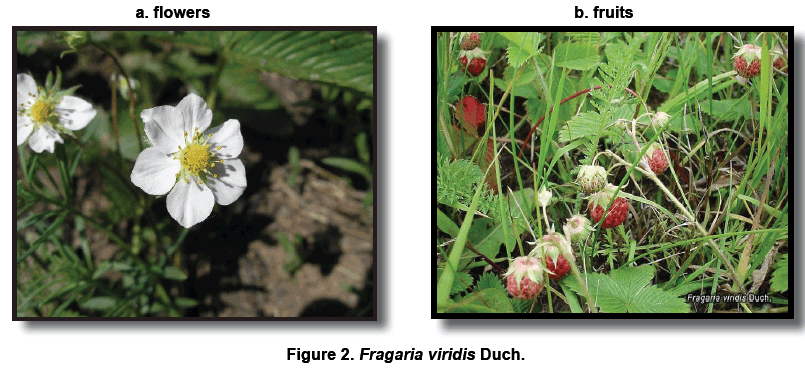
<p><font size="2" face="Verdana, Arial, Helvetica, sans-serif"> - Green strawberry    (Fragaria viridis Duch.) (<a href="/img/revistas/ctr/v35n3/f0201314.gif">Figure    2</a>) - sprouts, basically, on forest clearings of fresh and dry types, where    the stock of overground phytomass reaches 260 kg.ha<sup>-1</sup>. Fruit is a    valuable raw material; however, herb is used in folk medicine.    
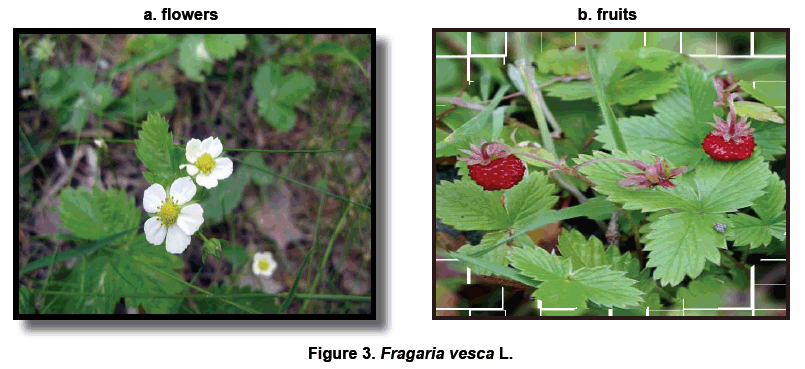
<br>       <br>   - Wild strawberry (Fragaria vesca L.) (<a href="/img/revistas/ctr/v35n3/f0301314.gif">Figure    3</a>) is found, mainly, in fresh and dry pine and birch forest, where the stock    of phytomass of leaves reaches 66 kg.ha<sup>-1</sup> in birch forest and 17    kg.ha<sup>-1</sup> in fresh pine forest. Fruit is used in official medicine    as diuretic, diaphoretic and as the substance improving the functioning of the    gastrointestinal tract; leaves are used in folk medicine.    
]]></body>
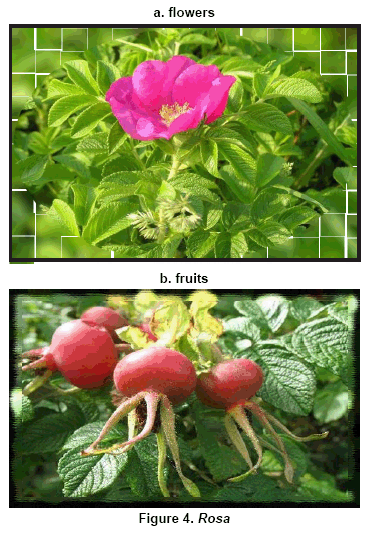
<body><![CDATA[<br>       <br>   - Dog-rose (Rosa canina L.) (<a href="#f4">Figure 4</a>) - it is rather an abundant    sort in undergrowth of pine and birch forests, productivity of its fruit reaches    12-15 kg.ha<sup>-1</sup> even in weakly fruitful years, 30 % - at a protective    covering of the sort. The fruit of the dog-rose is used in official medicine    with the purpose of preventive measures and treatment of hypovitaminosis of    ascorbic acid and of rutin.</font></p>     <p align="center"><font size="2" face="Verdana, Arial, Helvetica, sans-serif"><a name="f4"></a>    <br>   <img src="/img/revistas/ctr/v35n3/f0401314.gif" width="370" height="537">    </font></p>     
<p><font size="2" face="Verdana, Arial, Helvetica, sans-serif"> - Creeping thyme    (Thymus serpyllum L.) (<a href="#f5">Figure 5</a>) &#8211; is found, mainly,    on clearings and glades in dry site conditions, where its stock can vary from    46 to 150 kg.ha<sup>-1</sup>, rarely it can be found under the canopy of dry    and very dry pine forest. The herb of the given plant is widely used in official    pharmacopeia as antiphlogistic and bactericidal substance.</font></p>     <p align="center"><font size="2" face="Verdana, Arial, Helvetica, sans-serif"><a name="f5"></a>    <br>   <img src="/img/revistas/ctr/v35n3/f0501314.gif" width="442" height="333">    </font></p>     
<p><font size="2" face="Verdana, Arial, Helvetica, sans-serif"> Among the sorts    of medicinal herbs found in the region there are those, the number of which    are extremely small and they require protection. First of all, these are Adonis    vernalis, Vaccinium vitisidaea L., Valeriana officinalis L., Oxycoccus palustris    Pers., Nuphar lutea L. and others.    <br>       <br>   A number of plants are used in official medicine the following types can be    found in abundance in the region:    ]]></body>
<body><![CDATA[<br>   - Antennaria dioica (<a href="#f6">Figure 6</a>) reaches its maximum development    in dry and in very dry pine forest, where its stock forms 22-80 kg.ha<sup>-1</sup>.    This herb is used in official medicine as cholagogue substance.</font></p>     <p align="center"><font size="2" face="Verdana, Arial, Helvetica, sans-serif"><a name="f6"></a>    <br>   <img src="/img/revistas/ctr/v35n3/f0601314.gif" width="406" height="351">    </font></p>     
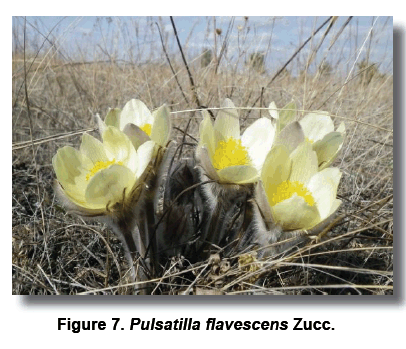
<p><font size="2" face="Verdana, Arial, Helvetica, sans-serif"> - Pulsatilla flavescens    Zucc. (<a href="#f7">Figure 7</a>) sprouts on glades and clearings in dry conditions,    its stock reaches 82-150 kg.ha<sup>-1</sup>, as well as in dry pine forest and    in thinned fresh pine forest, where its stock is considerably lower. The herb    of this plant is used for treatment of dynamic diseases of the nervous system,    of locomotorium, of upper respiratory tract.</font></p>     <p align="center"><font size="2" face="Verdana, Arial, Helvetica, sans-serif"><a name="f7"></a>    <br>   <img src="/img/revistas/ctr/v35n3/f0701314.gif" width="406" height="349">    </font></p>     
<p><font size="2" face="Verdana, Arial, Helvetica, sans-serif"> The use of plants    as medicinal raw material must be rational, in accordance with nature protection    principles. So, alongside with the revealing of biological resource, it is necessary    to determine the reserve which will be used. By biological resource we mean    the amount of raw material which is possible to store up on the area of the    plot assigned for stocking up without taking into account the necessity of regeneration    of populations of medicinal herbs; by the reserve we mean the amount of raw    material which is possible to store up on the same area, but on condition of    conservation of a part of species, providing normal renewal of the sort and    regeneration of populations (1).    <br>       <br>   Ex situ collections allow saving wild species, examining them in cultural environment,    and giving necessary recommendations to regulate the collection of plant raw    materials in nature. At the same time a number of medicinal crops such as Helichrysum    arenarium (L.) Moench., Plantago major L., Rosa majalis Herrm, Adonis vernalis    L., Valeriana offisinalis L. will require plantation cultivation to meet the    needs of pharmaceutical base development. Saving and restoration of natural    ecosystems is only possible when given a reasonable management based on scientific    and legal bases. People should not forget the importance of genetic resources    conservation not only for biological diversity and ecological balance, but also    for their use in practical breeding (8).    <br>   <strong>    ]]></body>
<body><![CDATA[<br>   Some Medicinal Plants endangered</strong>    <br>       <br>   According to the Decree of the Government of Republic of Kazakhstan of October    30, 2006 &laquo;List of rare and endangered species of plants&raquo; 387 species,    including 363 &#8211; Division of Magnoliaphyta, are protected. The most impressive    are the following species &#8211; Tulipa, Stipa, Allium, Jurinea, Ferula, Oxytropis,    Astragalus, Adonis and some others (9).    <br>       <br>   In this country there are over 6 000 species of plants, of which one tenth belongs    to the endangered species, more than 120 species are wild relatives of agricultural    plants, 70 species of 29 genera are forage crops, more than 700 species of medicinal    plants are mentioned in folk medicine and 263 plants - in the scientific (8).    <br>       <br>   Expeditionary examination showed the present state of natural vegetation funds    considering a significant change in species composition in natural cenoses,    reduction the area of medicinal plants and decreases the wild stocks of raw    materials (8).    <br>       <br>   The system of conservation of biodiversity of flora and vegetation in Republic    of Kazakhstan is through the creation of protected areas &#8211; national natural    reserves, national parks, state natural reserves, and some others. The total    area specially protected is currently 5678.7 thousand hectares, which include    10 state nature reserves-1612.0 thousand hectares; 11 State national natural    parks&#8211;2249.3 thousand hectares; four State natural reserve&#8211;1817.4    thousand hectares (10).    <br>       ]]></body>
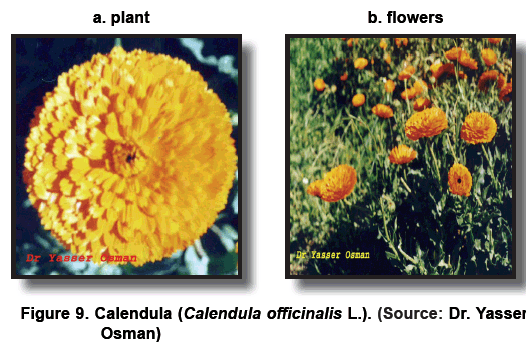
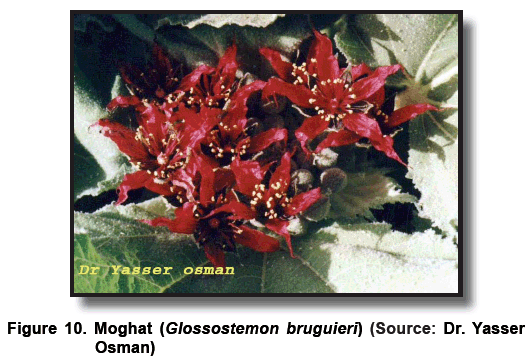
<body><![CDATA[<br>   <strong>Egypt    <br>       <br>   Medicinal Plants with Great Potential</strong>    <br>       <br>   Egypt flora includes more than 2000 plant species. Moreover 500 are useful or    potential use for medical purposes.     <br>   It also includes 13 pharmacopeia ones, 60 endemic ones and 529 species use for    medical purposes (11, 12).    <br>       <br>   Medicinal plants have been used as a source of remedies since ancient times    in Egypt. In recent years many searches interested in investigate the antibacterial    activity and the cytotoxicity of the organic extracts from some selected medicinal    plants of Egypt for example against plant fungal and bacterial pathogens. The    results of these investigations indicated the possible use of the plant extracts    in the control of causal agents of both human or plant diseases (13).    <br>       <br>   There are some aromatic plants that are classified inside of medicinal plants    for example (Anise - Black Cumin - Caraway &#8211; Celery &#8211; Coriander    (<a href="/img/revistas/ctr/v35n3/f0801314.gif">Figure 8</a>) - Cumin &#8211;    Fennel &#8211; Dill &#8211; Parsley), Foliage plants (Basil &#8211; Marjoram    &#8211; Mint &#8211; Oregano &#8211; Thyme), flowering plants (Chamomile &#8211;    Calendula (<a href="/img/revistas/ctr/v35n3/f0901314.gif">Figure 9</a>)    &#8211; Tagetes &#8211; Rossele), fruiting plants (Khella &#8211; Senna) and    roots plants [Liquorice &#8211; Moghat or Glossostemon bruguieri (<a href="/img/revistas/ctr/v35n3/f1001314.gif">Figure    10</a>) (13).    
]]></body>
<body><![CDATA[<br>       <br>   Looking for new possibilities of antifungal treatment or source of antifungal    substances is a major problem. Some medicinal plants exert strong antifungal    properties and could be conveniently used as a promising alternative source    for presently problematic antifungal treatment in many areas with respects to    their natural origin (14).    <br>       <br>   Antifungal activities of Mesembryanthemum crystallinum (Aizoaceae) (<a href="/img/revistas/ctr/v35n3/f1101314.gif">Figure    11</a>); Nicotiana glauca (Solanaceae), Moringa oleifera (Moringaceae), and    some others were investigated against dangerous pathogenic and toxinogenic fungi    (Fusarium solani, Fusarium oxysporum, Aspergillus flavus, Alternaria alternate,    Rhizoctnia solani, Alternaria solani, Pythium ultimum, Bipolaris oryzae, Rhizopus,    Chetomium and Mucor. The overall results provide promising base line information    for the potential use of the crude extracts of tested plants in the treatment    of fungal infections. An attempt has been made to highlight the promising plant    species for further investigation as leads for new drug development (15, 16,    17).    
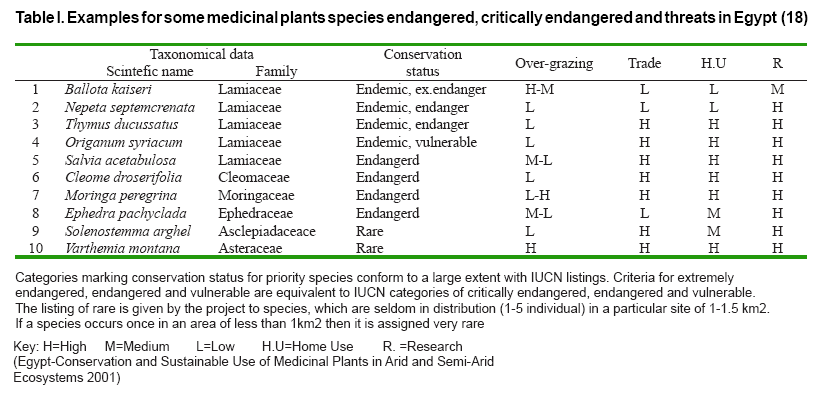
<br>       <br>   There are also new trends in medicinal plants researches such using laser radiation.    Use of lasers in the production of medicinal and aromatic plants can be considering    as modern applications all over the world. It may be no more than ten papers    were published dealing with this issue. In the case of Egypt, according to available    information, less than 10 studies were published (13).    <br>       <br>   <strong>Some Medicinal Plants endangered    <br>   </strong>    <br>   The Egyptian medicinal flora is about 342 species distributed in 13 places and    can be divided to four groups (very common 91 species, common 86 species, rear    95 species and very rear 70 species (18) <a href="/img/revistas/ctr/v35n3/t0101314.gif">Tabla    I</a>.    
]]></body>
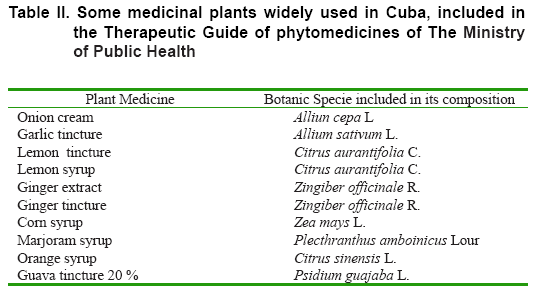
<body><![CDATA[<br>       <br>   <strong>Cuba    <br>       <br>   Medicinal Plants with Great Potential    <br>   </strong>    <br>   The Cuban botanist Juan Tomas Roig made the largest compilation about the use    of plants, especially medicinal plants, in Cuba.    <br>       <br>   Since pre-Columbian times there exist records on the knowledge and use of plants    among aboriginal Cubans: in medicine, nutrition, religion and construction.    Thereafter, with the arrival of Europeans, Africans and Asians to the island    the use of plants diversified. This cultural heritage has survived until our    days and has been transferred orally from one generation to another (19).    <br>       <br>   The Ministry of Public Health in Cuba has elaborated several Normative about    general specification of vegetable drugs and some methods and technological    process of fluids extract and tinctures with the aim of guide and orientated    the medicinal plant elaboration and standardization work. In 1992 was published    a Therapeutic Guide of phytomedicines having as a base some medicinal plant    researches made in Cuba and publication reports. In this Guide 233 phytomedicines    formulation for different uses are include (<a href="/img/revistas/ctr/v35n3/t0201314.gif">Table    II</a>) (20).    
]]></body>
<body><![CDATA[<br>       <br>   From <a href="/img/revistas/ctr/v35n3/t0201314.gif">Table II</a> some medicinal    plants were select to get inside about their used as medicine because some of    them are only used as food or condiment for the population around the world.    
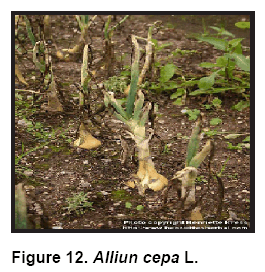
<br>       <br>   - Onion (Alliun cepa L.) (<a href="#f12">Figure 12</a>): It belongs to the family    Alliaceae. The bulb used as diuretic, to protect the small vase in the circulatory    system (21).</font></p>     <p align="center"><font size="2" face="Verdana, Arial, Helvetica, sans-serif"><a name="f12"></a>    <br>   <img src="/img/revistas/ctr/v35n3/f1201314.gif" width="265" height="272">    </font></p>     
<p><font size="2" face="Verdana, Arial, Helvetica, sans-serif"> - Ginger (Zingiber    officinale Rosc) (<a href="#f13">Figure 13</a>): This specie belongs to the    botanical family Zingiberaceae. Herb with aromatic and subterraneous stems.    It can be used as antispasmodic, antiemetic and tonic (nervous) (21).</font></p>     <p align="center"><font size="2" face="Verdana, Arial, Helvetica, sans-serif"><a name="f13"></a>    <br>   <img src="/img/revistas/ctr/v35n3/f1301314.gif" width="259" height="303">    </font></p>     
<p><font size="2" face="Verdana, Arial, Helvetica, sans-serif"> - Lemon [Citrus    aurantifolia (Christm.)] (<a href="#f14">Figure 14</a>): It belongs to the family    Rutaceae and it is a shrub. It protects the small vase, antispasmodic, diuretic,    antifungal and antibacterial ) (21).</font></p>     ]]></body>
<body><![CDATA[<p align="center"><font size="2" face="Verdana, Arial, Helvetica, sans-serif"><a name="f14"></a>    <br>   <img src="/img/revistas/ctr/v35n3/f1401314.gif" width="454" height="414">    </font></p>     
<p><font size="2" face="Verdana, Arial, Helvetica, sans-serif"> - Corn (Zea mays    L.) (<a href="#f15">Figure 15</a>): It belongs to the botanical family Poaceae.    Robust and erect herb until two meters of high, with dry fruits. The medicinal    use is as diuretic (21).</font></p>     <p align="center"><font size="2" face="Verdana, Arial, Helvetica, sans-serif"><a name="f15"></a>    <br>   <img src="/img/revistas/ctr/v35n3/f1501314.gif" width="439" height="411">    </font></p>     
<p><font size="2" face="Verdana, Arial, Helvetica, sans-serif"> - Marjoram (Plecthranthus    amboinicus (Lour.) Spren) (<a href="/img/revistas/ctr/v35n3/f1601314.gif">Figure    16</a>): This specie belongs to the botanical family Lamiaceae. It is an herb    with strong odor. Can be used against asthma, epilepsy, as a sedative (21).    
<br>       <br>   It is important that the population of every country of the planet has knowledge    of medicinal plants potential for the cure of many health problems and this    get more importance if those plants are used in the daily diet.    <br>       <br>   <strong>Some Medicinal Plants endangered</strong>    ]]></body>
<body><![CDATA[<br>       <br>   The floristic richness and high endemism of the Cuban archipelago is well known.    <br>       <br>   The Cuban vascular flora embraces 6,700 species (500 Pteridophytes and 6,200    Phanerophytes of which about     <br>   20 are Gymnosperms and the rest Angiosperms), grouped in 1,300 genera and 181    families. A figure of 51 % endemism has been reported thus making about 3,100    endemic species. Moreover, Cuban natural ecosystems have been strongly altered    during the last 200 years; about 16 % of its phanerogamic flora is threatened    and probably     <br>   2 % is already extinct (22).    <br>       <br>   Cuba has a great flora diversity typified by endemic dominance (51,4 %), floristic    elements inversion, microphilia, and micrantia, and a high vulnerability. If    together with all this join the existence of soils with a great edafic mosaic,    excellent climatic conditions for the development of a lot exotic species, and    a rich and complex cultural history that have contribute not only with a quantity    of species, but also with a diverse use of them, so it is possible to conclude    that Cuba has a great native and introduce vegetal wealth. This factors have    been conditioned the existence of an economic flora not well study, that in    the case of medicinal plants is particularly rich, in where since 2005 there    are species that were identified under some endangered category (critical endangered,    endangered, vulnerable and minor preoccupation) (22).    <br>       <br>   In Cuba there are medicinal species that are widely used by people, and some    of them are certificated by the Ministry of Public Health for they use as vegetable    medicine or as a base for the preparation of phytopharmacist. Almost all the    totality of medicinal species related for Cuba doesn&#8217;t have pharmacological    and toxicological studies that probe the properties that people said they have,    but in the last years the government has realize a great effort for the pharmacological    and toxicological evaluation of the species popularly referred as medicinal    plants in Cuba (23).    ]]></body>
<body><![CDATA[<br>       <br>   There are 17 species in Cuba (1,37 % of the total of medicinal species) that    are endangered and four of them are in critical endangered (<a href="/img/revistas/ctr/v35n3/t0301314.gif">Table    III</a>) and all this four species are endemic except one (Juniperus lucayana    Britton) (23).     
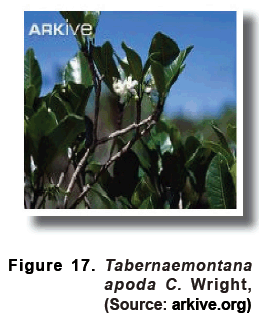
<br>   If we consider that in only 20 % of the total flora of the country have been    evaluated the endangered condition of the species (22), is highly probably that    the number of endangered ones increase in the future.    <br>       <br>   Tabernaemontana apoda C. Wright (<a href="#f17">Figure 17</a>): A small tree    or shrub, restricted to lowland areas and savannah. It has critical endagered,    since much of the habitat has been converted to agricultural land or pastures.</font></p>     <p align="center"><font size="2" face="Verdana, Arial, Helvetica, sans-serif"><a name="f17"></a>    <br>   <img src="/img/revistas/ctr/v35n3/f1701314.gif" width="259" height="321">    </font></p>     
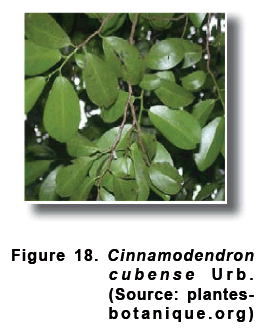
<p><font size="2" face="Verdana, Arial, Helvetica, sans-serif"> The genus is known    to contain ibogaine, conolidine and voacangine. Some preparations are used in    native medicine to treat eye injuries and as an anxiolytic and some others are    used to treat dementia in the elderly. Conolidine may be developed as a new    class of pain-killer (24).    <br>       <br>   Cinnamodendron cubense Urb. (<a href="#f18">Figure 18</a>): The genus is characterized    for aromatic perennifolios trees. Species of this family can be use for hypotension    control, cold, fiber and food condiment (25).</font></p>     ]]></body>
<body><![CDATA[<p align="center"><font face="Verdana, Arial, Helvetica, sans-serif"><a name="f18"></a>    <br>   <img src="/img/revistas/ctr/v35n3/f1801314.gif" width="262" height="330">    </font></p>     
<p><font face="Verdana, Arial, Helvetica, sans-serif"> <font size="2">Juniperus    lucayana Britton (<a href="#f19">Figure 19</a>): From the leaves of this plants    it is possible to extract oil with the composition of pinene (25&#8211;27 %),    limonene (23&#8211;27 %), sabinene (11-12 %) with small amounts of sesquiterpenes,    all this with medicinal properties (26).</font></font></p>     <p align="center"><font face="Verdana, Arial, Helvetica, sans-serif"><font size="2"><a name="f19"></a>    <br>   <img src="/img/revistas/ctr/v35n3/f1901314.gif" width="253" height="357">    </font></font></p>     
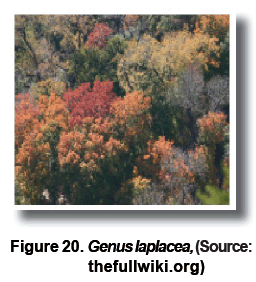
<p><font face="Verdana, Arial, Helvetica, sans-serif"><font size="2"> Laplacea    curtyana A. Rich (<a href="#f20">Figure 20</a>): It is threatened by habitat    loss. The juice that exudates by root, stem and leaves excision is diuretic    and have been considered as antisyphilitic (26).</font></font></p>     <p align="center"><font face="Verdana, Arial, Helvetica, sans-serif"><font size="2"><a name="f20"></a>    <br>   <img src="/img/revistas/ctr/v35n3/f2001314.gif" width="256" height="282">    </font></font></p>     
<p><font face="Verdana, Arial, Helvetica, sans-serif"><font size="2"> Through    this publication we are trying to get the attention of all scientific community    around the word showing how many medicinal plants are endangered and how many    plants are still unknown not only medicinal uses of some species, but also the    cultural and ecological aspects of their exploitation and conservation.    <br>       ]]></body>
<body><![CDATA[<br>   <strong>Renovation or conservation politic </strong>    <br>       <br>   Plants Genetic diversity is a key element for agriculture development. Plants    improvement, biotechnologist and researchers related with germplasm evaluation    trust the genetic variation of the local cultivars and the wild species to produced    or obtain a new cultivate variety that will better adapted and with higher yield.    However, it is of vital importance acquire and conserve a wide range of this    germplasm for future adaptation in relation with exploitation conditions, environmental    changes and sustainable agriculture development (27).    <br>       <br>   Phytogenetic resources are characterized as an important part of a total biodiversity    with an actual and potential relevancy in the useful plant improvement for socio    economic development of any country.    <br>       <br>   The obtainment of germplasm bank using biotechnological techniques became an    useful method for medicinal plant conservation in many countries.    <br>       <br>   It is essential for medicinal plant conservation to collect the wealth of each    country particularly that ones that have more exploitation perspectives so there    are three main reasons to continue the establishment germplasm bank of these    plants. These reasons are:    <br>       ]]></body>
<body><![CDATA[<br>   The necessity of obtain a greatest genetic variability, with the aim of select    the endangered or extinction species.    <br>   The necessity of guaranty the preservation of genetic resources available before    they disappear; Until now there is no evidence that in the three countries analyzed    in this paper exist a medicinal plant germplasm bank with endangered and critical    endangered medicinal plants species using biotechnological techniques.     <br>       <br>   Plant biotechnology represents one of a number of competing technological approaches    to address any agronomic problem in a particular ecosystem and in the particular    case of medicinal plant conservation it is a potential tool.    <br>       <br>   Basic knowledge on the complexity of the molecular organization of living organisms    and their interrelationships is far from its complete elucidation and limits    the number of characters that can be manipulated by genetic engineering. Identification    techniques, isolation and characterization of new genes to be transferred to    different crops to produce genetically modified plants (GMP) are subjected to    constant research. Plant genetic engineering now permits manipulating monogenic    characters while the productive characteristics of the crop species, of a quantitative    nature result in the expression of multiple genes (polygenic). Often, one isolated    gene does not have a great influence in the complete genome expression and this    reinforces the importance of conventional plant breeding assisted by molecular    markers (28).    <br>       <br>   The commercial viability of bringing medicinal plants into domestic cultivation    and the potential for increased use of modern biotechnologies are likely to    be strongly influenced by the popular perceptions of both herbs and biotechnology    (29).    <br>       <br>   Although there are a number of reviews published on micropropagation of medicinal    plants, they do not provide a factual status of this field where all kinds of    reports on differentiation of shoots, embryos from callus or regeneration of    shoot tips have been included in the absence of even formation of complete plant    leave alone their ex vitro growth in soil and this has a negative result in    conservation using this useful technique. In fact, most of the pharmaceutically    important medicinal plants have not been micropropagated not to mention clonally    or on large scales of commercial significance (30).</font></font></p>     ]]></body>
<body><![CDATA[<p>&nbsp;</p>     <p><font size="2" face="Verdana, Arial, Helvetica, sans-serif"><strong><font size="3">CONCLUSION</font></strong></font></p>     <p><font size="2" face="Verdana, Arial, Helvetica, sans-serif"> The factors that    affect differences species around the world are diverse: their higher esthetic    value and population reduction because of environment modification (climatic    changes) that has led to the destruction of a lot of habitat, urbanization,    mining, pollution, recreation, over population/land stress, overgrazing, over    exploitation or using of natural resources, deforestation, precarious agriculture.    <br>       <br>   Additional scientific investigations are required with the purpose of conservation    and receiving valuable medicinal raw material, without damaging natural populations    of sorts, including the use of biotechnology methods.</font></p>     <p>&nbsp;</p>     <p><font size="2" face="Verdana, Arial, Helvetica, sans-serif"><strong><font size="3">REFERENCES</font></strong></font></p>     <!-- ref --><p><font size="2" face="Verdana, Arial, Helvetica, sans-serif"> 1. AgriInfo.in.    Importance of Medicinal Plants [on line]. My Agriculture Information Bank. Horticulture.    2011. [Consultado 03/2013]. Disponible en: &lt;<a href="http://www.agriinfo.in/default.aspx?page=topic&superid=2&topicid=1408" target="_blank">http://www.agriinfo.in/default.aspx?page=topic&amp;superid=2&amp;topicid=1408</a>&gt;    .    <br>       ]]></body>
<body><![CDATA[<!-- ref --><br>   2. May, J. College of medicine: What is integrative health? British Medical    Journal, 2011, vol, 343. [Consultado 12/11/2012]. Disponible en: &lt;<a href="http://www.bmj.com/content/343/bmj.d4372.full" target="_blank">http://www.bmj.com/content/343/bmj.d4372.full</a>&gt;.    Doi:10.1136/bmj.d4372.    <br>       <!-- ref --><br>   3. Hoareau, L. and DaSilva, E. Medicinal plants: a re-emerging health AID. EJB    Electronic Journal of Biotechnology, 1999, vol. 2, no. 2, ISSN: 0717-3458.    <br>       <!-- ref --><br>   4. Aboelsoud, N. H. Herbal medicine in ancient Egypt. Journal of Medicinal Plants    Research, 2010, vol. 4, no. 2, pp. 082-086.    <br>       <!-- ref --><br>   5. Global Biodiversity Outlook 3. Secretariat of the convention of Biological    Diversity. Montreal, Quebec, Canada, 2010. 93 pp. ISPN 92-9225-220-8.    <br>       <!-- ref --><br>   6. Therese, L. Y.; Rim, S. H.; El-Ghadban, E. A. and Ibrahim, A. A. Rare Plants    Conserved by the national gene bank. National gene bank (N.G.B) &#8211; Agricultural    research center (A.R.C) &#8211; Ministry of agriculture and land reclamation.    Egypt. Cairo, 2012. 176 pp. ISBN 978-977-302-361-4.    <br>       ]]></body>
<body><![CDATA[<!-- ref --><br>   7. Melander, M. Endangered plants on the market in Havana City, Cuba. Degree    project in Biology. Biology Education Center, Department of Systematic Botany,    Uppsala University. Sweden. 2007. ISSN 1653-5634.    <br>       <!-- ref --><br>   8. Shtephan, G. Wild medical plants in the phytocenoses of the northern Kazakhstan.    Medical and Health Science Journal, 2012, vol. 13, pp. 128-132.    <br>       <!-- ref --><br>   9. Republic of Kazakhstan. The Fourth National Report on Progress in Implementation    of the Convention on Biological Diversity. Republic of Kazakhstan. Ministry    of Environmental Protection. Astana. 2009. 91 pp.    <br>       <!-- ref --><br>   10. Nyssanbayev, E. N. Current state of forestry in Kazakhstan and the main    priorities of further development. Materials of the International Scientific    and Practical Conference, dedicated to the 55 anniversary of the Kazakh Research    Institute of Forestry. Kazakh Agro Technical University, Schuchinsk, October,    12-13, 2013. 4-7 pp.    <br>       <!-- ref --><br>   11. Strategy of Medicinal and Aromatic Plants implementing in Egypt. Nature    Protect sector. Ministry of Egyptian Environmental Affair Agency (EEAA), Egypt,    2011. 50 pp.    <br>       ]]></body>
<body><![CDATA[<!-- ref --><br>   12. Abd el-ghan, M.; Abo el-kheir, M.; Abdel-dayem, M. and Abd El Hamid, M.    Vegetation analysis and soil characteristics of five common desert climbing    plants in Egypt. Turk J. Bot., 2011, vol. 35, pp. 561-580.    <br>       <!-- ref --><br>   13. Osman, Y. A. H.; Yaseen, E. M.; Farag, M. M. Antimicrobial Effect of Some    Essential Oils Mixtures. Journal of Applied Sciences Research, 2009, vol. 5,    no. 9, pp. 1265-1276.    <br>       <!-- ref --><br>   14. Abd-Ellatif, Sawsan; Abdel Rahman, Salwa M. and Deraz, Sahar F. Promising    antifungal effect of some folkloric medicinal plants collected from El-Hammam    Habitat, Egypt against dangerous pathogenic and toxinogenic fungi. ARPN Journal    of Agricultural and Biological Science, 2011, vol. 6, no. 9, pp. 25-32.    <br>       <!-- ref --><br>   15. Dwivedi, S. K. and Dwivedi, N. Antifungal activity of some plant extracts    against guava wilt pathogen. International Journal of Environmental Sciences,    2012, vol. 3, no. 1, pp. 412-420.    <br>       <!-- ref --><br>   16. Nashwa, S. M. A. and Abo-Elyousr, K. A. M. Evaluation of various plant extracts    against the early blight disease of tomato plants under greenhouse and field    condition. Plant Protect. Sci., 2012, vol. 48, no. 2, pp. 74-79.    <br>       ]]></body>
<body><![CDATA[<!-- ref --><br>   17. Jeff-Agboola, Y. A.; Onifade, A. K.; Akinyele, B. J. and Osho, I. B. In    vitro antifungal activities of essential oil from Nigerian medicinal plants    against toxigenic Aspeillusrg flavus. Journal of Medicinal Plants Research,    2012, vol. 6, no. 23, pp. 4048-4056.    <br>       <!-- ref --><br>   18. Batanouny, K. H. Encyclopedia of wild medicinal plants in Egypt. The Palm    press, 34 Mansour Muhamed St. Zamalek, Cairo 11211, Egypt. 2005. ISBN 977-5089-65-4.    <br>       <!-- ref --><br>   19. Boucourt, E.; L&oacute;pez, M.; Mart&iacute;nez, M. J.; Morej&oacute;n,    Z.; Victoria, M. C. and Costaguta, M. TRAMIL. Plantas Medicinales Caribe&ntilde;as    para la Atenci&oacute;n Primaria. La Habana: ECIMED. 2007. 117 pp. ISBN 978-959-212-250-5.    <br>       <!-- ref --><br>   20. Gonz&aacute;lez, M.; Remirez, D. and Jacobo, O. L. Antecedentes y situaci&oacute;n    reguladora de la medicina herbaria en Cuba. Bolet&iacute;n Latinoamericano y    del Caribe de Plantas Medicinales y Arom&aacute;ticas, 2007, vol. 6, no. 4,    pp. 118-124.    <br>       <!-- ref --><br>   21. Roig, J. T. Plantas medicinales, arom&aacute;ticas o venenosas de Cuba.    La Habana: Editorial Cient&iacute;fico T&eacute;cnica. 1988. 1125 pp.    <br>       ]]></body>
<body><![CDATA[<!-- ref --><br>   22. Beraza&iacute;n, R.; Areces, F.; Lazcano, J. L. and Gonz&aacute;lez, L.    R. Lista roja de la flora vascular cubana. Cuba. Editorial de Gij&oacute;n,    Jard&iacute;n Bot&aacute;nico Atl&aacute;ntico de Gij&oacute;n. 2005, pp. 25-26.    <br>       <br>   23. Fuentes, V. R. Las especies medicinales amenazadas en Cuba. Revista del    Jard&iacute;n Bot&aacute;nico Nacional, 2008, vol. 28, p. 77-81.    <br>       <!-- ref --><br>   24. Kam, T. S.; Pang, H. S.; Choo, Y. M. and Komiyama, K. Biologically active    ibogan and vallesamine derivatives from Tabernaemontana divaricata. Chemistry    and biodiversity, 2004, vol. 1, no. 4, pp. 646-656.    <br>       <!-- ref --><br>   25. Kubitzki, K. Canellaceae. En: Kubitzki, K.; Rohwer, J. G. and Bittrich,    V. (Editors). The Families and Genera of Vascular Plants. II. Flowering Plants    - Dicotyledons. Berl&iacute;n: Springer-Verlag. 1993. ISBN 3-540-55509-9.    <br>       <!-- ref --><br>   26. Adams, R. P.; Almirall, A. L. and Hogge, L. The volatile leaf oils of the    junipers of Cuba: Juniperus lucayana britton and Juniperus saxicola Britton    and Wilson. Flavour Fragr. Journal, 1987, vol. 2, pp. 33-36.    <br>       ]]></body>
<body><![CDATA[<!-- ref --><br>   27. Engels, J. M. M. and Tao, K. L. Genebank standards. Food and Agriculture    Organization of the United Nations. Rome: International Plant Genetic Resorces    Institute. 1994. 13 pp.    <br>       <!-- ref --><br>   28. Robentson, D. S. Understanding the relationship between quantitative genetics.    In: Helentjaris, T. and Burn, D. Development and Application of Molecular Markers    to Problems in Plant Genetics. Editorial. Cold Spring Habour Press, New York,    EUA. 1989.    <br>       <!-- ref --><br>   29. Canter, H.; Thomas, H. and Ernst, E. Bringing medicinal plants into cultivation:    opportunities and challenges for biotechnology. Trends in Biotechnology. 2005.    pp. 1-6.    <br>       <!-- ref --><br>   30. Chanturvedi, H. C.; Jain, M. and Kidwai, N. R. Cloning of medicinal plants    through tissue culture-A review. Indian J. of Experimental Biology, 2007, vol.    45, pp. 937-948.    </font></p>     <p>&nbsp;</p>     <p>&nbsp;</p>     ]]></body>
<body><![CDATA[<p><font size="2" face="Verdana, Arial, Helvetica, sans-serif">Recibido: 4 de    febrero de 2013    <br>   Aceptado: 29 de Julio de 2013</font></p>     <p>&nbsp;</p>     <p>&nbsp;</p>     <p><font size="2" face="Verdana, Arial, Helvetica, sans-serif"><em>PhD. Sandra    P&eacute;rez &Aacute;lvarez</em>, National Research Institute of Foresty, Agriculture    and livestock (INIFAP)-Experimental Campus Uruapan, ave: Latinoamericana No.    1101, Col. Revoluci&oacute;n, Uruapan, Michoac&aacute;n, M&eacute;xico. Email:    <a href="mailto:cossio.luiseduardo@inifap.gob.mx">cossio.luiseduardo@inifap.gob.mx</a></font></p>      ]]></body><back>
<ref-list>
<ref id="B1">
<label>1</label><nlm-citation citation-type="book">
<collab>AgriInfo.in</collab>
<source><![CDATA[Importance of Medicinal Plants]]></source>
<year>2011</year>
<publisher-name><![CDATA[My Agriculture Information Bank. Horticulture]]></publisher-name>
</nlm-citation>
</ref>
<ref id="B2">
<label>2</label><nlm-citation citation-type="journal">
<person-group person-group-type="author">
<name>
<surname><![CDATA[May]]></surname>
<given-names><![CDATA[J]]></given-names>
</name>
</person-group>
<article-title xml:lang="en"><![CDATA[College of medicine: What is integrative health]]></article-title>
<source><![CDATA[British Medical Journal]]></source>
<year>2011</year>
<volume>343</volume>
</nlm-citation>
</ref>
<ref id="B3">
<label>3</label><nlm-citation citation-type="journal">
<person-group person-group-type="author">
<name>
<surname><![CDATA[Hoareau]]></surname>
<given-names><![CDATA[L]]></given-names>
</name>
<name>
<surname><![CDATA[DaSilva]]></surname>
<given-names><![CDATA[E]]></given-names>
</name>
</person-group>
<article-title xml:lang="en"><![CDATA[Medicinal plants: a re-emerging health AID]]></article-title>
<source><![CDATA[EJB Electronic Journal of Biotechnology]]></source>
<year>1999</year>
<volume>2</volume>
<numero>2</numero>
<issue>2</issue>
</nlm-citation>
</ref>
<ref id="B4">
<label>4</label><nlm-citation citation-type="journal">
<person-group person-group-type="author">
<name>
<surname><![CDATA[Aboelsoud]]></surname>
<given-names><![CDATA[N. H]]></given-names>
</name>
</person-group>
<article-title xml:lang="en"><![CDATA[Herbal medicine in ancient Egypt]]></article-title>
<source><![CDATA[Journal of Medicinal Plants Research]]></source>
<year>2010</year>
<volume>4</volume>
<numero>2</numero>
<issue>2</issue>
<page-range>082-086</page-range></nlm-citation>
</ref>
<ref id="B5">
<label>5</label><nlm-citation citation-type="">
<collab>Global Biodiversity Outlook 3</collab>
<source><![CDATA[Secretariat of the convention of Biological Diversity]]></source>
<year>2010</year>
<page-range>93</page-range><publisher-loc><![CDATA[Quebec ]]></publisher-loc>
</nlm-citation>
</ref>
<ref id="B6">
<label>6</label><nlm-citation citation-type="book">
<person-group person-group-type="author">
<name>
<surname><![CDATA[Therese]]></surname>
<given-names><![CDATA[L. Y]]></given-names>
</name>
<name>
<surname><![CDATA[Rim]]></surname>
<given-names><![CDATA[S. H]]></given-names>
</name>
<name>
<surname><![CDATA[El-Ghadban]]></surname>
<given-names><![CDATA[E. A]]></given-names>
</name>
<name>
<surname><![CDATA[Ibrahim]]></surname>
<given-names><![CDATA[A. A]]></given-names>
</name>
</person-group>
<source><![CDATA[Rare Plants Conserved by the national gene bank]]></source>
<year>2012</year>
<page-range>176</page-range><publisher-loc><![CDATA[Egypt ]]></publisher-loc>
<publisher-name><![CDATA[National gene bank (N.G.B) - Agricultural research center (A.R.C) - Ministry of agriculture and land reclamation]]></publisher-name>
</nlm-citation>
</ref>
<ref id="B7">
<label>7</label><nlm-citation citation-type="book">
<person-group person-group-type="author">
<name>
<surname><![CDATA[Melander]]></surname>
<given-names><![CDATA[M]]></given-names>
</name>
</person-group>
<source><![CDATA[Endangered plants on the market in Havana City, Cuba. Degree project in Biology]]></source>
<year>2007</year>
<publisher-loc><![CDATA[Sweden ]]></publisher-loc>
<publisher-name><![CDATA[Biology Education Center, Department of Systematic Botany, Uppsala University]]></publisher-name>
</nlm-citation>
</ref>
<ref id="B8">
<label>8</label><nlm-citation citation-type="journal">
<person-group person-group-type="author">
<name>
<surname><![CDATA[Shtephan]]></surname>
<given-names><![CDATA[G]]></given-names>
</name>
</person-group>
<article-title xml:lang="en"><![CDATA[Wild medical plants in the phytocenoses of the northern Kazakhstan]]></article-title>
<source><![CDATA[Medical and Health Science Journal]]></source>
<year>2012</year>
<volume>13</volume>
<page-range>128-132</page-range></nlm-citation>
</ref>
<ref id="B9">
<label>9</label><nlm-citation citation-type="book">
<collab>Republic of Kazakhstan</collab>
<source><![CDATA[The Fourth National Report on Progress in Implementation of the Convention on Biological Diversity. Republic of Kazakhstan]]></source>
<year>2009</year>
<page-range>91</page-range><publisher-loc><![CDATA[Astana ]]></publisher-loc>
<publisher-name><![CDATA[Ministry of Environmental Protection]]></publisher-name>
</nlm-citation>
</ref>
<ref id="B10">
<label>10</label><nlm-citation citation-type="confpro">
<person-group person-group-type="author">
<name>
<surname><![CDATA[Nyssanbayev]]></surname>
<given-names><![CDATA[E. N]]></given-names>
</name>
</person-group>
<source><![CDATA[Current state of forestry in Kazakhstan and the main priorities of further development]]></source>
<year></year>
<conf-name><![CDATA[ Materials of the International Scientific and Practical Conference, dedicated to the 55 anniversary of the Kazakh Research Institute of Forestry]]></conf-name>
<conf-date>October, 12-13, 2013</conf-date>
<conf-loc>Schuchinsk </conf-loc>
<page-range>4-7</page-range></nlm-citation>
</ref>
<ref id="B11">
<label>11</label><nlm-citation citation-type="book">
<collab>Strategy of Medicinal and Aromatic Plants implementing in Egypt</collab>
<source><![CDATA[Nature Protect sector]]></source>
<year>2011</year>
<page-range>50</page-range><publisher-loc><![CDATA[Egypt ]]></publisher-loc>
<publisher-name><![CDATA[Ministry of Egyptian Environmental Affair Agency (EEAA)]]></publisher-name>
</nlm-citation>
</ref>
<ref id="B12">
<label>12</label><nlm-citation citation-type="journal">
<person-group person-group-type="author">
<name>
<surname><![CDATA[Abd el-ghan]]></surname>
<given-names><![CDATA[M]]></given-names>
</name>
<name>
<surname><![CDATA[Abo el-kheir]]></surname>
<given-names><![CDATA[M]]></given-names>
</name>
<name>
<surname><![CDATA[Abdel-dayem]]></surname>
<given-names><![CDATA[M]]></given-names>
</name>
<name>
<surname><![CDATA[Abd El Hamid]]></surname>
<given-names><![CDATA[M]]></given-names>
</name>
</person-group>
<article-title xml:lang="en"><![CDATA[Vegetation analysis and soil characteristics of five common desert climbing plants in Egypt]]></article-title>
<source><![CDATA[Turk J. Bot]]></source>
<year>2011</year>
<volume>35</volume>
<page-range>561-580</page-range></nlm-citation>
</ref>
<ref id="B13">
<label>13</label><nlm-citation citation-type="journal">
<person-group person-group-type="author">
<name>
<surname><![CDATA[Osman]]></surname>
<given-names><![CDATA[Y. A. H]]></given-names>
</name>
<name>
<surname><![CDATA[Yaseen]]></surname>
<given-names><![CDATA[E. M]]></given-names>
</name>
<name>
<surname><![CDATA[Farag]]></surname>
<given-names><![CDATA[M. M]]></given-names>
</name>
</person-group>
<article-title xml:lang="en"><![CDATA[Antimicrobial Effect of Some Essential Oils Mixtures]]></article-title>
<source><![CDATA[Journal of Applied Sciences Research]]></source>
<year>2009</year>
<volume>5</volume>
<numero>9</numero>
<issue>9</issue>
<page-range>1265-1276</page-range></nlm-citation>
</ref>
<ref id="B14">
<label>14</label><nlm-citation citation-type="journal">
<person-group person-group-type="author">
<name>
<surname><![CDATA[Abd-Ellatif]]></surname>
<given-names><![CDATA[Sawsan]]></given-names>
</name>
<name>
<surname><![CDATA[Abdel Rahman]]></surname>
<given-names><![CDATA[Salwa M]]></given-names>
</name>
<name>
<surname><![CDATA[Deraz]]></surname>
<given-names><![CDATA[Sahar F]]></given-names>
</name>
</person-group>
<article-title xml:lang="en"><![CDATA[Promising antifungal effect of some folkloric medicinal plants collected from El-Hammam Habitat, Egypt against dangerous pathogenic and toxinogenic fungi]]></article-title>
<source><![CDATA[ARPN Journal of Agricultural and Biological Science]]></source>
<year>2011</year>
<volume>6</volume>
<numero>9</numero>
<issue>9</issue>
<page-range>25-32</page-range></nlm-citation>
</ref>
<ref id="B15">
<label>15</label><nlm-citation citation-type="journal">
<person-group person-group-type="author">
<name>
<surname><![CDATA[Dwivedi]]></surname>
<given-names><![CDATA[S. K]]></given-names>
</name>
<name>
<surname><![CDATA[Dwivedi]]></surname>
<given-names><![CDATA[N]]></given-names>
</name>
</person-group>
<article-title xml:lang="en"><![CDATA[Antifungal activity of some plant extracts against guava wilt pathogen]]></article-title>
<source><![CDATA[International Journal of Environmental Sciences]]></source>
<year>2012</year>
<volume>3</volume>
<numero>1</numero>
<issue>1</issue>
<page-range>412-420</page-range></nlm-citation>
</ref>
<ref id="B16">
<label>16</label><nlm-citation citation-type="journal">
<person-group person-group-type="author">
<name>
<surname><![CDATA[Nashwa]]></surname>
<given-names><![CDATA[S. M. A]]></given-names>
</name>
<name>
<surname><![CDATA[Abo-Elyousr]]></surname>
<given-names><![CDATA[K. A. M]]></given-names>
</name>
</person-group>
<article-title xml:lang="en"><![CDATA[Evaluation of various plant extracts against the early blight disease of tomato plants under greenhouse and field condition]]></article-title>
<source><![CDATA[Plant Protect. Sci]]></source>
<year>2012</year>
<volume>48</volume>
<numero>2</numero>
<issue>2</issue>
<page-range>74-79</page-range></nlm-citation>
</ref>
<ref id="B17">
<label>17</label><nlm-citation citation-type="journal">
<person-group person-group-type="author">
<name>
<surname><![CDATA[Jeff-Agboola]]></surname>
<given-names><![CDATA[Y. A]]></given-names>
</name>
<name>
<surname><![CDATA[Onifade]]></surname>
<given-names><![CDATA[A. K]]></given-names>
</name>
<name>
<surname><![CDATA[Akinyele]]></surname>
<given-names><![CDATA[B. J]]></given-names>
</name>
<name>
<surname><![CDATA[Osho]]></surname>
<given-names><![CDATA[I. B]]></given-names>
</name>
</person-group>
<article-title xml:lang="en"><![CDATA[In vitro antifungal activities of essential oil from Nigerian medicinal plants against toxigenic Aspeillusrg flavus]]></article-title>
<source><![CDATA[Journal of Medicinal Plants Research]]></source>
<year>2012</year>
<volume>6</volume>
<numero>23</numero>
<issue>23</issue>
<page-range>4048-4056</page-range></nlm-citation>
</ref>
<ref id="B18">
<label>18</label><nlm-citation citation-type="book">
<person-group person-group-type="author">
<name>
<surname><![CDATA[Batanouny]]></surname>
<given-names><![CDATA[K. H]]></given-names>
</name>
</person-group>
<source><![CDATA[Encyclopedia of wild medicinal plants in Egypt]]></source>
<year>2005</year>
<publisher-loc><![CDATA[Zamalek ]]></publisher-loc>
<publisher-name><![CDATA[The Palm press, 34 Mansour Muhamed St]]></publisher-name>
</nlm-citation>
</ref>
<ref id="B19">
<label>19</label><nlm-citation citation-type="book">
<person-group person-group-type="author">
<name>
<surname><![CDATA[Boucourt]]></surname>
<given-names><![CDATA[E]]></given-names>
</name>
<name>
<surname><![CDATA[López]]></surname>
<given-names><![CDATA[M]]></given-names>
</name>
<name>
<surname><![CDATA[Martínez]]></surname>
<given-names><![CDATA[M. J]]></given-names>
</name>
<name>
<surname><![CDATA[Morejón]]></surname>
<given-names><![CDATA[Z]]></given-names>
</name>
<name>
<surname><![CDATA[Victoria]]></surname>
<given-names><![CDATA[M. C]]></given-names>
</name>
<name>
<surname><![CDATA[Costaguta]]></surname>
<given-names><![CDATA[M]]></given-names>
</name>
</person-group>
<source><![CDATA[TRAMIL. Plantas Medicinales Caribeñas para la Atención Primaria]]></source>
<year>2007</year>
<page-range>117</page-range><publisher-loc><![CDATA[La Habana ]]></publisher-loc>
<publisher-name><![CDATA[ECIMED]]></publisher-name>
</nlm-citation>
</ref>
<ref id="B20">
<label>20</label><nlm-citation citation-type="journal">
<person-group person-group-type="author">
<name>
<surname><![CDATA[González]]></surname>
<given-names><![CDATA[M]]></given-names>
</name>
<name>
<surname><![CDATA[Remirez]]></surname>
<given-names><![CDATA[D]]></given-names>
</name>
<name>
<surname><![CDATA[Jacobo]]></surname>
<given-names><![CDATA[O. L]]></given-names>
</name>
</person-group>
<article-title xml:lang="es"><![CDATA[Antecedentes y situación reguladora de la medicina herbaria en Cuba]]></article-title>
<source><![CDATA[Boletín Latinoamericano y del Caribe de Plantas Medicinales y Aromáticas]]></source>
<year>2007</year>
<volume>6</volume>
<numero>4</numero>
<issue>4</issue>
<page-range>118-124</page-range></nlm-citation>
</ref>
<ref id="B21">
<label>21</label><nlm-citation citation-type="book">
<person-group person-group-type="author">
<name>
<surname><![CDATA[Roig]]></surname>
<given-names><![CDATA[J. T]]></given-names>
</name>
</person-group>
<source><![CDATA[Plantas medicinales, aromáticas o venenosas de Cuba]]></source>
<year>1988</year>
<page-range>1125</page-range><publisher-loc><![CDATA[La Habana ]]></publisher-loc>
<publisher-name><![CDATA[Editorial Científico Técnica]]></publisher-name>
</nlm-citation>
</ref>
<ref id="B22">
<label>22</label><nlm-citation citation-type="book">
<person-group person-group-type="author">
<name>
<surname><![CDATA[Berazaín]]></surname>
<given-names><![CDATA[R]]></given-names>
</name>
<name>
<surname><![CDATA[Areces]]></surname>
<given-names><![CDATA[F]]></given-names>
</name>
<name>
<surname><![CDATA[Lazcano]]></surname>
<given-names><![CDATA[J. L]]></given-names>
</name>
<name>
<surname><![CDATA[González]]></surname>
<given-names><![CDATA[L. R]]></given-names>
</name>
</person-group>
<source><![CDATA[Lista roja de la flora vascular cubana]]></source>
<year>2005</year>
<page-range>25-26</page-range><publisher-loc><![CDATA[Cuba ]]></publisher-loc>
<publisher-name><![CDATA[Editorial de Gijón, Jardín Botánico Atlántico de Gijón]]></publisher-name>
</nlm-citation>
</ref>
<ref id="B23">
<label>23</label><nlm-citation citation-type="journal">
<person-group person-group-type="author">
<name>
<surname><![CDATA[Fuentes]]></surname>
<given-names><![CDATA[V. R]]></given-names>
</name>
</person-group>
<article-title xml:lang="es"><![CDATA[Las especies medicinales amenazadas en Cuba]]></article-title>
<source><![CDATA[Revista del Jardín Botánico Nacional]]></source>
<year>2008</year>
<volume>28</volume>
<page-range>77-81</page-range></nlm-citation>
</ref>
<ref id="B24">
<label>24</label><nlm-citation citation-type="journal">
<person-group person-group-type="author">
<name>
<surname><![CDATA[Kam]]></surname>
<given-names><![CDATA[T. S]]></given-names>
</name>
<name>
<surname><![CDATA[Pang]]></surname>
<given-names><![CDATA[H. S]]></given-names>
</name>
<name>
<surname><![CDATA[Choo]]></surname>
<given-names><![CDATA[Y. M]]></given-names>
</name>
<name>
<surname><![CDATA[Komiyama]]></surname>
<given-names><![CDATA[K]]></given-names>
</name>
</person-group>
<article-title xml:lang="en"><![CDATA[Biologically active ibogan and vallesamine derivatives from Tabernaemontana divaricata]]></article-title>
<source><![CDATA[Chemistry and biodiversity]]></source>
<year>2004</year>
<volume>1</volume>
<numero>4</numero>
<issue>4</issue>
<page-range>646-656</page-range></nlm-citation>
</ref>
<ref id="B25">
<label>25</label><nlm-citation citation-type="book">
<person-group person-group-type="author">
<name>
<surname><![CDATA[Kubitzki]]></surname>
<given-names><![CDATA[K]]></given-names>
</name>
</person-group>
<article-title xml:lang="en"><![CDATA[Canellaceae]]></article-title>
<person-group person-group-type="editor">
<name>
<surname><![CDATA[Kubitzki]]></surname>
<given-names><![CDATA[K]]></given-names>
</name>
<name>
<surname><![CDATA[Rohwer]]></surname>
<given-names><![CDATA[J. G]]></given-names>
</name>
<name>
<surname><![CDATA[Bittrich]]></surname>
<given-names><![CDATA[V]]></given-names>
</name>
</person-group>
<source><![CDATA[The Families and Genera of Vascular Plants. II. Flowering Plants - Dicotyledons]]></source>
<year>1993</year>
<publisher-loc><![CDATA[Berlín ]]></publisher-loc>
<publisher-name><![CDATA[Springer-Verlag]]></publisher-name>
</nlm-citation>
</ref>
<ref id="B26">
<label>26</label><nlm-citation citation-type="journal">
<person-group person-group-type="author">
<name>
<surname><![CDATA[Adams]]></surname>
<given-names><![CDATA[R. P]]></given-names>
</name>
<name>
<surname><![CDATA[Almirall]]></surname>
<given-names><![CDATA[A. L]]></given-names>
</name>
<name>
<surname><![CDATA[Hogge]]></surname>
<given-names><![CDATA[L]]></given-names>
</name>
</person-group>
<article-title xml:lang="en"><![CDATA[The volatile leaf oils of the junipers of Cuba: Juniperus lucayana britton and Juniperus saxicola Britton and Wilson]]></article-title>
<source><![CDATA[Flavour Fragr. Journal]]></source>
<year>1987</year>
<volume>2</volume>
<page-range>33-36</page-range></nlm-citation>
</ref>
<ref id="B27">
<label>27</label><nlm-citation citation-type="book">
<person-group person-group-type="author">
<name>
<surname><![CDATA[Engels]]></surname>
<given-names><![CDATA[J. M. M]]></given-names>
</name>
<name>
<surname><![CDATA[Tao]]></surname>
<given-names><![CDATA[K. L]]></given-names>
</name>
</person-group>
<source><![CDATA[Genebank standards. Food and Agriculture Organization of the United Nations]]></source>
<year>1994</year>
<page-range>13</page-range><publisher-loc><![CDATA[Rome ]]></publisher-loc>
<publisher-name><![CDATA[International Plant Genetic Resorces Institute]]></publisher-name>
</nlm-citation>
</ref>
<ref id="B28">
<label>28</label><nlm-citation citation-type="book">
<person-group person-group-type="author">
<name>
<surname><![CDATA[Robentson]]></surname>
<given-names><![CDATA[D. S]]></given-names>
</name>
</person-group>
<article-title xml:lang="en"><![CDATA[Understanding the relationship between quantitative genetics]]></article-title>
<person-group person-group-type="editor">
<name>
<surname><![CDATA[Helentjaris]]></surname>
<given-names><![CDATA[T]]></given-names>
</name>
<name>
<surname><![CDATA[Burn]]></surname>
<given-names><![CDATA[D]]></given-names>
</name>
</person-group>
<source><![CDATA[Development and Application of Molecular Markers to Problems in Plant Genetics]]></source>
<year>1989</year>
<publisher-loc><![CDATA[New York ]]></publisher-loc>
<publisher-name><![CDATA[Editorial. Cold Spring Habour Press]]></publisher-name>
</nlm-citation>
</ref>
<ref id="B29">
<label>29</label><nlm-citation citation-type="book">
<person-group person-group-type="author">
<name>
<surname><![CDATA[Canter]]></surname>
<given-names><![CDATA[H]]></given-names>
</name>
<name>
<surname><![CDATA[Thomas]]></surname>
<given-names><![CDATA[H]]></given-names>
</name>
<name>
<surname><![CDATA[Ernst]]></surname>
<given-names><![CDATA[E]]></given-names>
</name>
</person-group>
<source><![CDATA[Bringing medicinal plants into cultivation: opportunities and challenges for biotechnology]]></source>
<year>2005</year>
<page-range>1-6</page-range><publisher-name><![CDATA[Trends in Biotechnology]]></publisher-name>
</nlm-citation>
</ref>
<ref id="B30">
<label>30</label><nlm-citation citation-type="journal">
<person-group person-group-type="author">
<name>
<surname><![CDATA[Chanturvedi]]></surname>
<given-names><![CDATA[H. C]]></given-names>
</name>
<name>
<surname><![CDATA[Jain]]></surname>
<given-names><![CDATA[M]]></given-names>
</name>
<name>
<surname><![CDATA[Kidwai]]></surname>
<given-names><![CDATA[N. R]]></given-names>
</name>
</person-group>
<article-title xml:lang="en"><![CDATA[Cloning of medicinal plants through tissue culture-A review]]></article-title>
<source><![CDATA[Indian J. of Experimental Biology]]></source>
<year>2007</year>
<volume>45</volume>
<page-range>937-948</page-range></nlm-citation>
</ref>
</ref-list>
</back>
</article>