<?xml version="1.0" encoding="ISO-8859-1"?><article xmlns:mml="http://www.w3.org/1998/Math/MathML" xmlns:xlink="http://www.w3.org/1999/xlink" xmlns:xsi="http://www.w3.org/2001/XMLSchema-instance">
<front>
<journal-meta>
<journal-id>0258-5936</journal-id>
<journal-title><![CDATA[Cultivos Tropicales]]></journal-title>
<abbrev-journal-title><![CDATA[cultrop]]></abbrev-journal-title>
<issn>0258-5936</issn>
<publisher>
<publisher-name><![CDATA[Ediciones INCA]]></publisher-name>
</publisher>
</journal-meta>
<article-meta>
<article-id>S0258-59362015000300011</article-id>
<title-group>
<article-title xml:lang="es"><![CDATA[Efecto del estrés salino en la germinación y el crecimiento temprano de Phaseolus vulgaris L]]></article-title>
<article-title xml:lang="en"><![CDATA[Effect of salt stress on seed germination and seedlings growth of Phaseolus vulgaris L]]></article-title>
</title-group>
<contrib-group>
<contrib contrib-type="author">
<name>
<surname><![CDATA[Mena]]></surname>
<given-names><![CDATA[Eilyn]]></given-names>
</name>
<xref ref-type="aff" rid="A01"/>
</contrib>
<contrib contrib-type="author">
<name>
<surname><![CDATA[Leiva-Mora]]></surname>
<given-names><![CDATA[Michel]]></given-names>
</name>
<xref ref-type="aff" rid="A01"/>
</contrib>
<contrib contrib-type="author">
<name>
<surname><![CDATA[Dilhara Jayawardana]]></surname>
<given-names><![CDATA[Edirisinghage Kasuni]]></given-names>
</name>
<xref ref-type="aff" rid="A02"/>
</contrib>
<contrib contrib-type="author">
<name>
<surname><![CDATA[García]]></surname>
<given-names><![CDATA[Lourdes]]></given-names>
</name>
<xref ref-type="aff" rid="A01"/>
</contrib>
<contrib contrib-type="author">
<name>
<surname><![CDATA[Veitía]]></surname>
<given-names><![CDATA[Novisel]]></given-names>
</name>
<xref ref-type="aff" rid="A01"/>
</contrib>
<contrib contrib-type="author">
<name>
<surname><![CDATA[Bermúdez-Caraballoso]]></surname>
<given-names><![CDATA[Idalmis]]></given-names>
</name>
<xref ref-type="aff" rid="A01"/>
</contrib>
<contrib contrib-type="author">
<name>
<surname><![CDATA[Collado]]></surname>
<given-names><![CDATA[Raúl]]></given-names>
</name>
<xref ref-type="aff" rid="A01"/>
</contrib>
<contrib contrib-type="author">
<name>
<surname><![CDATA[Cárdenas Ortíz]]></surname>
<given-names><![CDATA[Rolando]]></given-names>
</name>
<xref ref-type="aff" rid="A03"/>
</contrib>
</contrib-group>
<aff id="A01">
<institution><![CDATA[,Instituto de Biotecnología de las Plantas (IBP) Universidad Central Marta Abreu de Las Villas ]]></institution>
<addr-line><![CDATA[Villa Clara ]]></addr-line>
<country>Cuba</country>
</aff>
<aff id="A02">
<institution><![CDATA[,Universidad Central Marta Abreu de Las Villas Facultad de Ciencias Agropecuarias ]]></institution>
<addr-line><![CDATA[Villa Clara ]]></addr-line>
<country>Cuba</country>
</aff>
<aff id="A03">
<institution><![CDATA[,Universidad Central Marta Abreu de Las Villas Department of Physics ]]></institution>
<addr-line><![CDATA[Villa Clara ]]></addr-line>
<country>Cuba</country>
</aff>
<pub-date pub-type="pub">
<day>00</day>
<month>09</month>
<year>2015</year>
</pub-date>
<pub-date pub-type="epub">
<day>00</day>
<month>09</month>
<year>2015</year>
</pub-date>
<volume>36</volume>
<numero>3</numero>
<fpage>71</fpage>
<lpage>74</lpage>
<copyright-statement/>
<copyright-year/>
<self-uri xlink:href="http://scielo.sld.cu/scielo.php?script=sci_arttext&amp;pid=S0258-59362015000300011&amp;lng=en&amp;nrm=iso"></self-uri><self-uri xlink:href="http://scielo.sld.cu/scielo.php?script=sci_abstract&amp;pid=S0258-59362015000300011&amp;lng=en&amp;nrm=iso"></self-uri><self-uri xlink:href="http://scielo.sld.cu/scielo.php?script=sci_pdf&amp;pid=S0258-59362015000300011&amp;lng=en&amp;nrm=iso"></self-uri><abstract abstract-type="short" xml:lang="es"><p><![CDATA[El frijol común (Phaseolus vulgaris L.) es una leguminosa alimenticia importante a nivel mundial. La salinidad induce pérdidas en el rendimiento del frijol común, especialmente en las zonas áridas, semiáridas y en las zonas de secano. El objetivo de este estudio se centró en la determinación de los efectos de estrés salino sobre la germinación de semillas y el crecimiento de plantas de Phaseolus vulgaris. El frijol común (color negro) cv. ICA Pijao se utilizó como material vegetal. El estrés salino se indujo poniendo las semillas de este cultivo en diferentes soluciones de NaCl: 50, 100, 150, 200, 250 y 300 mM y se utilizó agua desionizada estéril como control. Los resultados mostraron que el estrés por salinidad redujo tanto la germinación de semillas como el crecimiento de las plántulas a concentraciones salinas por encima de 150 mM. En consecuencia, los resultados refuerzan el papel de NaCl como un factor inductor de estrés y también la susceptibilidad de frijol común a la salinidad. Los parámetros evaluados en este trabajo pueden proporcionar nuevos criterios para apoyar a la selección in vitro en los programas de mejoramiento de frijol común para encontrar genotipos tolerantes a estrés salino]]></p></abstract>
<abstract abstract-type="short" xml:lang="en"><p><![CDATA[ABSTRACT Common bean (Phaseolus vulgaris L.) is an important food legume worldwide. Salinity induces losses in common bean yield, particularly in arid, semiarid and in non-irrigated areas. The objective of this study was focused on determining effects of salt stress on seed germination and seedling growth of Phaseolus vulgaris. The common black bean cv. ICA Pijao was used as plant material. Salt stress was induced putting the seeds of this crop in different solutions of NaCl: 50, 100, 150, 200, 250 and 300 mM and deionized sterile water was used like control. The results showed that salinity stress reduced both seed germination and seedlings growth at salt concentrations above 150 mM. Consequently, results strengthen the role of NaCl as a stress- inducing factor, and also the susceptibility of common bean to salinity. Parameters evaluated in this work may provide new criteria to support in vitro selection in common bean breeding programs to find salt stress tolerant genotypes]]></p></abstract>
<kwd-group>
<kwd lng="es"><![CDATA[in vitro]]></kwd>
<kwd lng="es"><![CDATA[estrés abiótico]]></kwd>
<kwd lng="es"><![CDATA[crecimiento]]></kwd>
<kwd lng="es"><![CDATA[frijol]]></kwd>
<kwd lng="es"><![CDATA[salinidad]]></kwd>
<kwd lng="en"><![CDATA[in vitro]]></kwd>
<kwd lng="en"><![CDATA[abiotic stress]]></kwd>
<kwd lng="en"><![CDATA[bean]]></kwd>
<kwd lng="en"><![CDATA[growth]]></kwd>
<kwd lng="en"><![CDATA[salinity]]></kwd>
</kwd-group>
</article-meta>
</front><body><![CDATA[ <p align="left"><font size="4" face="Verdana, Arial, Helvetica, sans-serif"><strong>Efecto    del estr&eacute;s salino en la germinaci&oacute;n y el crecimiento temprano    de <em>Phaseolus vulgaris</em> L. </strong></font></p>     <p align="left">&nbsp;</p>     <p align="left"><font size="3" face="Verdana, Arial, Helvetica, sans-serif"><strong>Effect    of salt stress on seed germination and seedlings growth of <em>Phaseolus vulgaris</em>    L. </strong></font></p>     <p align="left">&nbsp;</p>     <p align="left">&nbsp;</p>     <p align="left"><font size="2" face="Verdana, Arial, Helvetica, sans-serif"><strong>    Eilyn Mena,<sup>I</sup> Michel Leiva-Mora,<sup>I</sup> Edirisinghage Kasuni    Dilhara Jayawardana,<sup>I</sup><sup>I</sup> Lourdes Garc&iacute;a,<sup>I</sup>    Novisel Veit&iacute;a,<sup>I</sup> Idalmis Berm&uacute;dez-Caraballoso,<sup>I</sup>    Ra&uacute;l Collado,<sup>I </sup>Rolando C&aacute;rdenas Ort&iacute;z<sup>I</sup><sup>I</sup><sup>I</sup></strong></font></p>     <p><font size="2" face="Verdana, Arial, Helvetica, sans-serif"><sup>I</sup>Instituto    de Biotecnolog&iacute;a de las Plantas (IBP), Universidad Central “Marta Abreu”    de Las Villas. Carretera a Camajuan&iacute; km 5.5, Santa Clara, Villa Clara,    Cuba. CP 54 830.    <br>   <sup>II</sup></font><font size="2" face="Verdana, Arial, Helvetica, sans-serif">Facultad    de Ciencias Agropecuarias, Universidad Central “Marta Abreu” de Las Villas.    Carretera a Camajuan&iacute; km 5.5, Santa Clara, Villa Clara, Cuba.</font>    <br>   <font size="2" face="Verdana, Arial, Helvetica, sans-serif"><sup>I</sup><sup>II</sup>Planetary    Science Laboratory. Department of Physics, Universidad Central “Marta Abreu”    de Las Villas. Carretera a Camajuan&iacute; km 5.5, Santa Clara, Villa Clara,    Cuba.</font></p>     <p>&nbsp;</p>     ]]></body>
<body><![CDATA[<p>&nbsp;</p> <hr>     <p><font size="2" face="Verdana, Arial, Helvetica, sans-serif"><strong>RESUMEN</strong></font></p>     <p><font size="2" face="Verdana, Arial, Helvetica, sans-serif"> El frijol com&uacute;n    (<em>Phaseolus vulgaris</em> L.) es una leguminosa alimenticia importante a    nivel mundial. La salinidad induce p&eacute;rdidas en el rendimiento del frijol    com&uacute;n, especialmente en las zonas &aacute;ridas, semi&aacute;ridas y    en las zonas de secano. El objetivo de este estudio se centr&oacute; en la determinaci&oacute;n    de los efectos de estr&eacute;s salino sobre la germinaci&oacute;n de semillas    y el crecimiento de plantas de <em>Phaseolus vulgaris</em>. El frijol com&uacute;n    (color negro) cv. ICA Pijao se utiliz&oacute; como material vegetal. El estr&eacute;s    salino se indujo poniendo las semillas de este cultivo en diferentes soluciones    de NaCl: 50, 100, 150, 200, 250 y 300 mM y se utiliz&oacute; agua desionizada    est&eacute;ril como control. Los resultados mostraron que el estr&eacute;s por    salinidad redujo tanto la germinaci&oacute;n de semillas como el crecimiento    de las pl&aacute;ntulas a concentraciones salinas por encima de 150 mM. En consecuencia,    los resultados refuerzan el papel de NaCl como un factor inductor de estr&eacute;s    y tambi&eacute;n la susceptibilidad de frijol com&uacute;n a la salinidad. Los    par&aacute;metros evaluados en este trabajo pueden proporcionar nuevos criterios    para apoyar a la selecci&oacute;n <em>in vitro</em> en los programas de mejoramiento    de frijol com&uacute;n para encontrar genotipos tolerantes a estr&eacute;s salino.    </font></p>     <p><font size="2" face="Verdana, Arial, Helvetica, sans-serif"><strong>Palabras    clave:</strong> <em>in vitro</em>, estr&eacute;s abi&oacute;tico, crecimiento,    frijol, salinidad.</font></p> <hr>     <p><font size="2" face="Verdana, Arial, Helvetica, sans-serif"><strong>ABSTRACT</strong></font></p>     <p><font size="2" face="Verdana, Arial, Helvetica, sans-serif"> Common bean (<em>Phaseolus    vulgaris</em> L.) is an important food legume worldwide. Salinity induces losses    in common bean yield, particularly in arid, semiarid and in non-irrigated areas.    The objective of this study was focused on determining effects of salt stress    on seed germination and seedling growth of <em>Phaseolus vulgaris</em>. The    common black bean cv. ICA Pijao was used as plant material. Salt stress was    induced putting the seeds of this crop in different solutions of NaCl: 50, 100,    150, 200, 250 and 300 mM and deionized sterile water was used like control.    The results showed that salinity stress reduced both seed germination and seedlings    growth at salt concentrations above 150 mM. Consequently, results strengthen    the role of NaCl as a stress- inducing factor, and also the susceptibility of    common bean to salinity. Parameters evaluated in this work may provide new criteria    to support <em>in vitro</em> selection in common bean breeding programs to find    salt stress tolerant genotypes.</font></p>     <p><font size="2" face="Verdana, Arial, Helvetica, sans-serif"><strong>Key words:</strong>    <em>in vitro</em>, abiotic stress, bean, growth, salinity.</font></p> <hr>     <p>&nbsp;</p>     <p>&nbsp;</p>     <p><font size="3" face="Verdana, Arial, Helvetica, sans-serif"><strong>INTRODUCCI&Oacute;N</strong></font></p>     ]]></body>
<body><![CDATA[<p><font size="2" face="Verdana, Arial, Helvetica, sans-serif"> Dry common bean    (<em>Phaseolus vulgaris</em> L.) is consumed throughout the world. Bean is considered    as the fourth source of protein in America, and it is especially important in    the nutrition (1). In Cuba production of common beans in 2012 was 135, 000 tonnes.    <br>       <br>   Salt stress is an important constraint to world agricultural production. Salinity    limits plant growth and productivity (2). It inhibits plant growth because affects    important metabolic processes like photosynthesis, transpiration, cell growth    and seed germination, this is the most perceptible phase in salinity conditions,    because affect absorption of water (3).    <br>       <br>   A major problem of bean in Cuba is water stress caused by drought periods and    salinity, resulting in losses of yield. Salinity-resistant cultivars have been    developed in several breeding programs for crops like rice, sugarbeet, cotton,    and barley. In general, germination and seedling growth parameters are the most    viable criteria used for selecting salt tolerant crop plants; hence, percentage    of germination and seedling growth are important growth parameters to be studied    for cultivar selection (4). <em>In vitro</em> selection has emerged as a feasible    tool for developing stress-tolerant plants. In order to be able to use <em>in    vitro</em> selection, a better criteria and ecophysiological parameters associated    with salt tolerance are needed for support bean breeding. The aim of this work    was focused to determine <em>in vitro</em> effects of NaCl in <em>Phaseolus    vulgaris</em> L. seed germination and seedling growth, under salt stress. </font></p>     <p>&nbsp;</p>     <p><font size="3" face="Verdana, Arial, Helvetica, sans-serif"> <strong>MATERIALS    AND METHODS</strong></font></p>     <p><font size="2" face="Verdana, Arial, Helvetica, sans-serif"> The experiments    were carried out under <em>in vitro</em> controlled condition (natural light    and 28 &plusmn; 2 &deg;C). Mature seeds of Phaseolus vulgaris (black bean) cv.    ICA Pijao were surface disinfected with 70 % (<sup>v</sup>/<sub>v</sub>) ethanol    for two minutes, followed by ten minutes in 3 % sodium hypochlorite (<sup>v</sup>/<sub>v</sub>)    and rinsed with sterile water for three times. They were placed in sterile water    for 24 hours, until complete imbibition occurred.     <br>       <br>   NaCl was used as selective agent to induce salt stress. Seven treatments were    used, each with 10 repetitions: 0, 50, 100, 150, 200, 250 and 300 mM equivalent    to 0, -0.2, -0.4, -0.6, -0.8, -1.0 and -1.2 MPa respectively (5). One imbibed    seeds of Phaseolus vulgaris cv. ICA Pijao were placed in test tubes (2 cm of    wide and 15 cm of length) on a support, this structure avoid a direct contact    of solution with the seeds. Each tube contained 10 ml of NaCl solution or deionized    sterile water as control.     ]]></body>
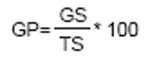
<body><![CDATA[<br>       <br>   Germination percentage (GP) was evaluated at 48 hours, according to following    <a href="#e1">equation</a>, where GS is number of germinated seeds (when the    radicula emerged around 2 mm) at the end of experiment and TS is number of total    seeds:</font></p>     <p align="center"><font size="2" face="Verdana, Arial, Helvetica, sans-serif"><a name="e1"></a></font></p>     <p align="center"><font size="2" face="Verdana, Arial, Helvetica, sans-serif"><img src="/img/revistas/ctr/v36n3/e0111315.gif" width="166" height="64">    
<br>   </font></p>     <p><font size="2" face="Verdana, Arial, Helvetica, sans-serif"> </font><font size="2" face="Verdana, Arial, Helvetica, sans-serif">    Growths parameters of germinated plants were measured at three and six days    after exposure of seeds to salt stress induced by NaCl. Variables associated    with growth were: stem length (cm) and root length (cm). Leaf area (LA) (cm<sup>2</sup>)    was determined using the equation (6), where L (length of leaf) and A (width    of leaf):     <br>       <br>   LA= 0,603+0,581 (L*A)    <br>       <br>   All data were analyzed statistically by Statistic Package for Social Science    (SPSS) version 19.00 for Windows. Experiments were set up in a completely randomized    design and each treatment had ten replicates, and they were repeated three times.    Significant differences among treatment means were calculated by the Kruskall-Wallis    and Mann-Whitney test at a probability level of 0,05. </font></p>     ]]></body>
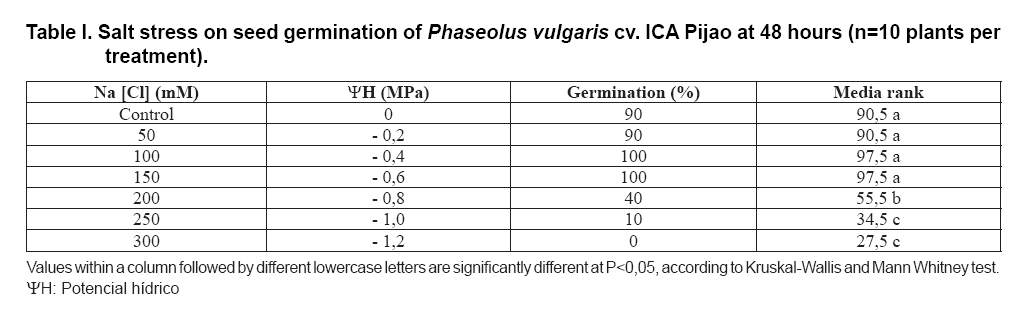
<body><![CDATA[<p>&nbsp;</p>     <p><font size="3" face="Verdana, Arial, Helvetica, sans-serif"> <strong>RESULTS    AND DISCUSSION</strong></font></p>     <p><font size="2" face="Verdana, Arial, Helvetica, sans-serif"> At 48 hours, seed    germination in control is lower because were used a little number of replica.    Germination was significantly reduced at 200 and 250 mM with regard to control    (<a href="/img/revistas/ctr/v36n3/t0111315.gif">Table I</a>). NaCl presence    stopped water absorption by the seeds of <em>Phaseolus vulgaris</em> cv. ICA    Pijao.    
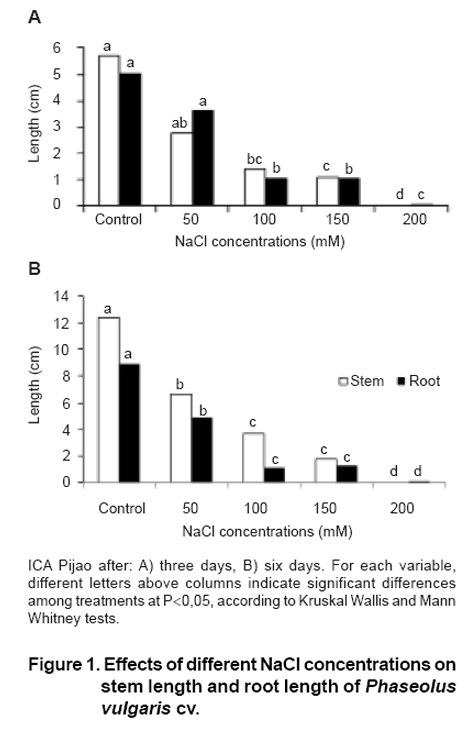
<br>       <br>   In correspondence with this, was evaluated the effect of five different levels    of salt (NaCl) on the germination of <em>Phaseolus vulgaris</em> L. seed and    observed that an increase in salinity induces a reduction in the percentage    of germinating and a delay in the initiation of the germination process (7).    Furthermore, other authors observed seed germination inhibition in <em>Vicia    faba</em> L. using NaCl at highest levels -0.9 and -1.2 MPa (8). In many cases    the plant response under salinity conditions depends on cultivar, and this support    genetical variability between them (9). <em>In vitro</em> salt stress induction    using NaCl of <em>Phaseolus vulgaris</em> seeds will facilitate the evaluation    of physiological parameters associated with germination that could be used to    discriminate salinity tolerance in <em>Phaseolus vulgaris</em> cultivars in    future experiments.     <br>       <br>   The growth (stem and root length) of <em>Phaseolus vulgaris</em> cv. ICA Pijao    after three (<a href="/img/revistas/ctr/v36n3/f0111315.gif">Figure 1A</a>)    and six (<a href="/img/revistas/ctr/v36n3/f0111315.gif">Figure 1B</a>)    days was lower in plants exposed to NaCl solution in comparison with plants    exposed to sterile water. Growth of plants at 200, 250 and 300 mM NaCl were    drastically affected after three and six days with regard to control. Seeds    that did not germinate produce no plants, means missing value. At six days,    roots with the apical end stunted and dark brown coloration was observed in    plants under salt stress. </font></p>     
<p><font size="2" face="Verdana, Arial, Helvetica, sans-serif">Similar results    have been obtained by others authors, where vegetative growth of some crops    is affected by salinity (10, 11). In previous research the root length in all    cultivars (cv. Lody, cv. Gina and cv. Tara) of <em>Phaseolus vulgaris</em> was    reduced as a result of the salt stress. The relative growth rates in the three    cultivars were almost similar under non-saline conditions but declined considerably    after salt treatment with 100 mM of NaCl (12). According to this, salinity at    200 mM NaCl reduced growth of stems and dry biomass of some <em>Vigna unguiculata</em>    L. cultivars (13).    <br>       <br>   In this experiment, roots tend to be more branched. Primary roots were short    with atrophic apical edges. However secondary roots were more thin and visible    since the concentration of NaCl increase until 200 mM. In this sense, other    researchers observed that salinity also produces a reduction in the stele diameter    of root, because the decrease in number and diameter of the xylem vessels (14).    Salt treatment decreased the percentage of pectin, but increased cellulose across    root zones of two soybean cultivars. Suggesting that salt presence may increase    cell wall rigidity, and thus, inhibiting root growth (15).    ]]></body>
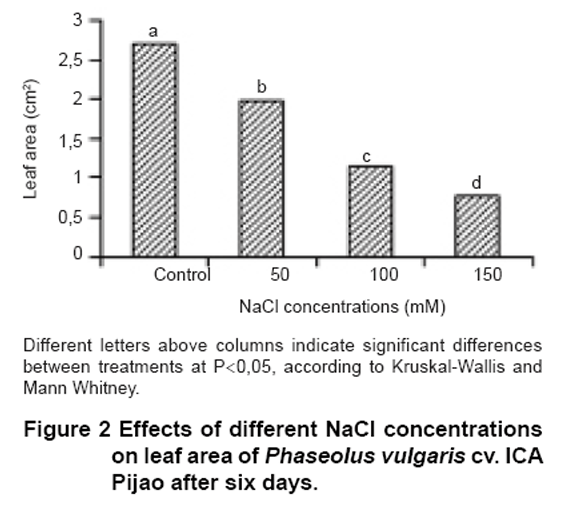
<body><![CDATA[<br>       <br>   High salinity produces in plant a physiological drought. According to this,    common bean duplicated the number of secondary and tertiary roots with modified    architecture in response to drought (6). A deep and extensive root system has    been advocated to increase productivity of food legumes under drought and salinity    conditions. Root length could be an important trait to assist <em>in vitro</em>    selection of salinity resistant varieties of beans with an improved capacity    to acquire water.     <br>       <br>   Leaf area of <em>Phaseolus vulgaris</em> cv. ICA Pijao after six days was significantly    reduced by salt stress in comparison with plants grown in sterile water (<a href="/img/revistas/ctr/v36n3/f0211315.gif">Figure    2</a>). Furthermore, leaflets were wrinkled and with a thicker texture compared    to the control. With higher concentrations of NaCl appeared necrotic spots in    leaf edges.</font></p>     
<p><font size="2" face="Verdana, Arial, Helvetica, sans-serif"> Other authors    inform that high concentrations of NaCl (120 and 240 mM) decreased the number    of leaves or leaf area in <em>Vicia faba</em>. In this case, decrease in leaf    area could be explained by the negative effect of salt on photosynthesis that    leads to the reduction of plant growth, leaf growth, and chlorophyll content    (16). The lower leaf areas per plant since concentration of NaCl increase indicate    adaptive response of P. vulgaris plants for controlling water losses under salinity    conditions. This factor may provide a selection criterion to find salt stress    resistance genotypes in bean breeding program.</font></p>     <p></p>     <p><font size="3" face="Verdana, Arial, Helvetica, sans-serif"> <strong>CONCLUSIONS    AND RECOMENDATIONS</strong></font></p>     <p><font size="2" face="Verdana, Arial, Helvetica, sans-serif"> The present study    confirms that <em>Phaseolus vulgaris</em> is susceptible to high concentrations    of NaCl. The results showed that salinity stress reduced both seed germination    and seedlings growth at salt concentrations above 150 mM. This variables may    be used to find salt stress resistance genotypes <em>in vitro</em> culture,    but more parameters like water content, fresh and dry weight, photosynthesis    activity, phytotoxicity, should be studied for have a better criteria in the    plant selection.</font></p>     <p></p>     <p><strong><font size="3" face="Verdana, Arial, Helvetica, sans-serif"> ACKNOWLEDGEMENTS    </font></strong></p>     ]]></body>
<body><![CDATA[<p><font size="2" face="Verdana, Arial, Helvetica, sans-serif"> The project was    jointly supported by Breeding National Program of <em>Phaseolus vulgaris</em>    L. in Plant Biotechnology Institute.</font></p>     <p>&nbsp;</p>     <p><font size="3" face="Verdana, Arial, Helvetica, sans-serif"><strong>BIBLIOGRAPHY</strong></font></p>     <!-- ref --><p><font size="2" face="Verdana, Arial, Helvetica, sans-serif">1. Romero, A.O.;    Dami&aacute;n, H.M.A.; Rivera, T.J.A.; B&aacute;ez, S.A.; Huerta, L.M. y Cabrera,    H.E. ‘‘The nutritional value of beans (<em>Phaseolus vulgaris</em> L.) and its    importance for feeding of rural communities in Puebla-Mexico’’, <em>International    Research Journal of Biological Sciences</em>, vol. 2, no. 8, 2013, pp. 59–65,    ISSN 2278-3202.    <br>       <!-- ref --><br>   2. Khan, M.H. y Panda, S.K. ‘‘Alterations in root lipid peroxidation and antioxidative    responses in two rice cultivars under NaCl-salinity stress’’, <em>Acta Physiologiae    Plantarum</em>, vol. 30, no. 1, 2007, pp. 81-89, ISSN 1861-1664, DOI 10.1007/s11738-007-0093-7.    <br>       <!-- ref --><br>   3. Meloni, D.A.; Gulotta, M.R.; Mart&iacute;nez, C.A. y Oliva, M.A. ‘‘The effects    of salt stress on growth, nitrate reduction and proline and glycinebetaine accumulation    in Prosopis alba’’, <em>Brazilian Journal of Plant Physiology</em>, vol. 16,    no. 1, 2004, pp. 39–46, ISSN 1677-0420.    <br>       <!-- ref --><br>   4. Mordi, P. y Zavareh, M. ‘‘Effects of salinity on germination and early seedling    growth of chickpea (<em>Cicer arietinum</em> L.) cultivars’’, <em>International    Journal of Farming and Allied Sciences</em>, vol. 2, no. 3, 2013, pp. 70-74,    ISSN 2322-4134.    <br>       <!-- ref --><br>   5. Sosa, L.; Llanes, A.; Reinoso, H.; Reginato, M. y Luna, V. ‘‘Osmotic and    specific ion effects on the germination of Prosopis strombulifera’’, <em>Annals    of Botany</em>, vol. 96, no. 2, 2005, pp. 261–267, ISSN 1095-8290, DOI 10.1093/aob/mci173.    <br>       <!-- ref --><br>   6. Barrios, A.N.; Ritchie, J. y Smucker, A.J. ‘‘El efecto de sequ&iacute;a en    el crecimiento, la fotos&iacute;ntesis y la intercepci&oacute;n de luz en frijol    com&uacute;n’’, <em>Agronom&iacute;a Mesoamericana</em>, vol. 9, no. 2, 1998,    pp. 01–08, ISSN 1659-1321.    <br>       <!-- ref --><br>   7. Cokkizgin, A. ‘‘Salinity stress in common bean (<em>Phaseolus vulgaris</em>    L.) seed germination’’, <em>Notulae Botanicae Horti Agrobotanici Cluj-Napoca</em>,    vol. 40, no. 1, 2012, pp. 177–182, ISSN 1842-4309.    <br>       <!-- ref --><br>   8. Abd El-Samad, H.M. y Shadadd, M.A.K. ‘‘The Response Strategy of Maize, Pea    and Broad Bean Plants to Different Osmotic Potential Stress’’, <em>Journal of    Stress Physiology &amp; Biochemistry</em>, vol. 9, no. 3, 2013, pp. 240-250,    ISSN 1997-0838.    <br>       <!-- ref --><br>   9. Asmare, H.A. y Ambo, E. ‘‘Impact of Salinity on Tolerance, Vigor, and Seedling    Relative Water Content of Haricot Bean (<em>Phaseolus Vulgaris</em> L.) Cultivars’’,    <em>Journal of Plant Sciences</em>, vol. 1, no. 3, 2013, pp. 22–27, ISSN 2331-0731,    DOI 10.11648/j.jps.20130103.11.    <br>       <!-- ref --><br>   10. Mart&iacute;nez, N.; L&oacute;pez, C.V.; Basurto, M. y P&eacute;rez, R.    ‘‘Efectos por salinidad en el desarrollo vegetativo’’, Tecnociencia Chihuahua,    vol. 5, 2011, pp. 156–161, ISSN 1870-6606.    <br>       <!-- ref --><br>   11. Younesi, O.; Baghbani, A. y Namdari, A. ‘‘The effects of Pseudomonas fluorescence    and Rhizobium meliloti co-inoculation on nodulation and mineral nutrient contents    in alfalfa (Medicago sativa) under salinity stress’’, <em>International Journal    of Agriculture and Crop Science</em>, vol. 5, no. 14, 2013, pp. 1500–1507, ISSN    2227-670X.    <br>       <!-- ref --><br>   12. Kaymakanova, M. y Stoeva, N. ‘‘Physiological reaction of bean plants (<em>Phaseolus    vulgaris</em> L.) to salt stress’’, <em>General and Applied Plant Physiology</em>,    vol. 34, no. 3–4, 2008, pp. 177-188, ISSN 1312-8221.    <br>       <!-- ref --><br>   13. Mahamadou, T.; Champion, A.; Diouf, D. y Our&egrave;ye, M. ‘‘NaCl Effects    on <em>in vitro</em> germination and growth of some senegalese cowpea (<em>Vigna    unguiculata</em> (L.) Walp.) cultivars’’, <em>ISRN Biotechnology</em>, 2013,    pp. 1-11, ISSN 2090-9403, DOI http://dx.doi.org/10.5402/2013/382417.    <br>       <!-- ref --><br>   14. Garz&oacute;n, P. y Garc&iacute;a, M. ‘‘Efecto del estr&eacute;s por NaCl    sobre la anatom&iacute;a radical y foliar en dos genotipos de Frijol (<em>Vigna    unguiculata</em> (L.) Walp.)’’, <em>Bioagro</em>, vol. 23, no. 3, 2011, pp.    153–160, ISSN 1316-3361.    <br>       <!-- ref --><br>   15. An, P.; Li, X.; Zheng, Y.; Matsuura, A.; Abe, J.; Eneji, A.E.; Tanimoto,    E. y Inanaga, S. ‘‘Effects of NaCl on Root Growth and Cell Wall Composition    of Two Soya bean Cultivars with Contrasting Salt Tolerance’’, <em>Journal of    Agronomy and Crop Science</em>, vol. 200, no. 3, 1 de junio de 2014, pp. 212-218,    ISSN 1439-037X, DOI 10.1111/jac.12060.    <br>       <!-- ref --><br>   16. Abdul Qados, A.M.S. ‘‘Effect of salt stress on plant growth and metabolism    of bean plant <em>Vicia faba</em> (L.)’’, <em>Journal of the Saudi Society of    Agricultural Sciences</em>, vol. 10, no. 1, enero de 2011, pp. 7-15, ISSN 1658-077X,    DOI 10.1016/j.jssas.2010.06.002.    </font></p>     <p>&nbsp;</p>     <p>&nbsp;</p>     <p><font size="2" face="Verdana, Arial, Helvetica, sans-serif">Recibido: 23 de    septiembre de 2014    <br>   Aceptado: 27 de enero de 2015</font></p>     <p>&nbsp;</p>     ]]></body>
<body><![CDATA[<p>&nbsp;</p>     <p><font size="2" face="Verdana, Arial, Helvetica, sans-serif"><em>Eilyn Mena</em>,    Instituto de Biotecnolog&iacute;a de las Plantas (IBP), Universidad Central    “Marta Abreu” de Las Villas. Carretera a Camajuan&iacute; km 5.5, Santa Clara,    Villa Clara, Cuba. CP 54 830. Email: <a href="mailto:eilyn@ibp.co.cu">eilyn@ibp.co.cu</a></font></p>      ]]></body><back>
<ref-list>
<ref id="B1">
<label>1</label><nlm-citation citation-type="journal">
<person-group person-group-type="author">
<name>
<surname><![CDATA[Romero]]></surname>
<given-names><![CDATA[A.O]]></given-names>
</name>
<name>
<surname><![CDATA[Damián]]></surname>
<given-names><![CDATA[H.M.A]]></given-names>
</name>
<name>
<surname><![CDATA[Rivera]]></surname>
<given-names><![CDATA[T.J.A]]></given-names>
</name>
<name>
<surname><![CDATA[Báez]]></surname>
<given-names><![CDATA[S.A]]></given-names>
</name>
<name>
<surname><![CDATA[Huerta]]></surname>
<given-names><![CDATA[L.M]]></given-names>
</name>
<name>
<surname><![CDATA[Cabrera]]></surname>
<given-names><![CDATA[H.E]]></given-names>
</name>
</person-group>
<article-title xml:lang="en"><![CDATA[&#8220;The nutritional value of beans (Phaseolus vulgaris L.) and its importance for feeding of rural communities in Puebla-Mexico&#8221;]]></article-title>
<source><![CDATA[International Research Journal of Biological Sciences]]></source>
<year>2013</year>
<volume>2</volume>
<numero>8</numero>
<issue>8</issue>
<page-range>59-65</page-range></nlm-citation>
</ref>
<ref id="B2">
<label>2</label><nlm-citation citation-type="journal">
<person-group person-group-type="author">
<name>
<surname><![CDATA[Khan]]></surname>
<given-names><![CDATA[M.H]]></given-names>
</name>
<name>
<surname><![CDATA[Panda]]></surname>
<given-names><![CDATA[S.K]]></given-names>
</name>
</person-group>
<article-title xml:lang="en"><![CDATA[&#8220;Alterations in root lipid peroxidation and antioxidative responses in two rice cultivars under NaCl-salinity stress&#8221;]]></article-title>
<source><![CDATA[Acta Physiologiae Plantarum]]></source>
<year>2007</year>
<volume>30</volume>
<numero>1</numero>
<issue>1</issue>
<page-range>81-89</page-range></nlm-citation>
</ref>
<ref id="B3">
<label>3</label><nlm-citation citation-type="journal">
<person-group person-group-type="author">
<name>
<surname><![CDATA[Meloni]]></surname>
<given-names><![CDATA[D.A]]></given-names>
</name>
<name>
<surname><![CDATA[Gulotta]]></surname>
<given-names><![CDATA[M.R]]></given-names>
</name>
<name>
<surname><![CDATA[Martínez]]></surname>
<given-names><![CDATA[C.A]]></given-names>
</name>
<name>
<surname><![CDATA[Oliva]]></surname>
<given-names><![CDATA[M.A]]></given-names>
</name>
</person-group>
<article-title xml:lang="en"><![CDATA[&#8220;The effects of salt stress on growth, nitrate reduction and proline and glycinebetaine accumulation in Prosopis alba&#8221;]]></article-title>
<source><![CDATA[Brazilian Journal of Plant Physiology]]></source>
<year>2004</year>
<volume>16</volume>
<numero>1</numero>
<issue>1</issue>
<page-range>39-46</page-range></nlm-citation>
</ref>
<ref id="B4">
<label>4</label><nlm-citation citation-type="journal">
<person-group person-group-type="author">
<name>
<surname><![CDATA[Mordi]]></surname>
<given-names><![CDATA[P]]></given-names>
</name>
<name>
<surname><![CDATA[Zavareh]]></surname>
<given-names><![CDATA[M]]></given-names>
</name>
</person-group>
<article-title xml:lang="en"><![CDATA[&#8220;Effects of salinity on germination and early seedling growth of chickpea (Cicer arietinum L.) cultivars&#8221;]]></article-title>
<source><![CDATA[International Journal of Farming and Allied Sciences]]></source>
<year>2013</year>
<volume>2</volume>
<numero>3</numero>
<issue>3</issue>
<page-range>70-74</page-range></nlm-citation>
</ref>
<ref id="B5">
<label>5</label><nlm-citation citation-type="journal">
<person-group person-group-type="author">
<name>
<surname><![CDATA[Sosa]]></surname>
<given-names><![CDATA[L]]></given-names>
</name>
<name>
<surname><![CDATA[Llanes]]></surname>
<given-names><![CDATA[A]]></given-names>
</name>
<name>
<surname><![CDATA[Reinoso]]></surname>
<given-names><![CDATA[H]]></given-names>
</name>
<name>
<surname><![CDATA[Reginato]]></surname>
<given-names><![CDATA[M]]></given-names>
</name>
<name>
<surname><![CDATA[Luna]]></surname>
<given-names><![CDATA[V]]></given-names>
</name>
</person-group>
<article-title xml:lang="en"><![CDATA[&#8220;Osmotic and specific ion effects on the germination of Prosopis strombulifera&#8221;]]></article-title>
<source><![CDATA[Annals of Botany]]></source>
<year>2005</year>
<volume>96</volume>
<numero>2</numero>
<issue>2</issue>
<page-range>261-267</page-range></nlm-citation>
</ref>
<ref id="B6">
<label>6</label><nlm-citation citation-type="journal">
<person-group person-group-type="author">
<name>
<surname><![CDATA[Barrios]]></surname>
<given-names><![CDATA[A.N]]></given-names>
</name>
<name>
<surname><![CDATA[Ritchie]]></surname>
<given-names><![CDATA[J]]></given-names>
</name>
<name>
<surname><![CDATA[Smucker]]></surname>
<given-names><![CDATA[A.J]]></given-names>
</name>
</person-group>
<article-title xml:lang="es"><![CDATA[&#8220;El efecto de sequía en el crecimiento, la fotosíntesis y la intercepción de luz en frijol común&#8221;]]></article-title>
<source><![CDATA[Agronomía Mesoamericana]]></source>
<year>1998</year>
<volume>9</volume>
<numero>2</numero>
<issue>2</issue>
<page-range>01-08</page-range></nlm-citation>
</ref>
<ref id="B7">
<label>7</label><nlm-citation citation-type="journal">
<person-group person-group-type="author">
<name>
<surname><![CDATA[Cokkizgin]]></surname>
<given-names><![CDATA[A]]></given-names>
</name>
</person-group>
<article-title xml:lang="en"><![CDATA[&#8220;Salinity stress in common bean (Phaseolus vulgaris L.) seed germination&#8221;]]></article-title>
<source><![CDATA[Notulae Botanicae Horti Agrobotanici Cluj-Napoca]]></source>
<year>2012</year>
<volume>40</volume>
<numero>1</numero>
<issue>1</issue>
<page-range>177-182</page-range></nlm-citation>
</ref>
<ref id="B8">
<label>8</label><nlm-citation citation-type="journal">
<person-group person-group-type="author">
<name>
<surname><![CDATA[Abd El-Samad]]></surname>
<given-names><![CDATA[H.M]]></given-names>
</name>
<name>
<surname><![CDATA[Shadadd]]></surname>
<given-names><![CDATA[M.A.K]]></given-names>
</name>
</person-group>
<article-title xml:lang="en"><![CDATA[&#8220;The Response Strategy of Maize, Pea and Broad Bean Plants to Different Osmotic Potential Stress&#8221;]]></article-title>
<source><![CDATA[Journal of Stress Physiology & Biochemistry]]></source>
<year>2013</year>
<volume>9</volume>
<numero>3</numero>
<issue>3</issue>
<page-range>240-250</page-range></nlm-citation>
</ref>
<ref id="B9">
<label>9</label><nlm-citation citation-type="journal">
<person-group person-group-type="author">
<name>
<surname><![CDATA[Asmare]]></surname>
<given-names><![CDATA[H.A]]></given-names>
</name>
<name>
<surname><![CDATA[Ambo]]></surname>
<given-names><![CDATA[E]]></given-names>
</name>
</person-group>
<article-title xml:lang="en"><![CDATA[&#8220;Impact of Salinity on Tolerance, Vigor, and Seedling Relative Water Content of Haricot Bean (Phaseolus Vulgaris L.) Cultivars&#8221;]]></article-title>
<source><![CDATA[Journal of Plant Sciences]]></source>
<year>2013</year>
<volume>1</volume>
<numero>3</numero>
<issue>3</issue>
<page-range>22-27</page-range></nlm-citation>
</ref>
<ref id="B10">
<label>10</label><nlm-citation citation-type="journal">
<person-group person-group-type="author">
<name>
<surname><![CDATA[Martínez]]></surname>
<given-names><![CDATA[N]]></given-names>
</name>
<name>
<surname><![CDATA[López]]></surname>
<given-names><![CDATA[C.V]]></given-names>
</name>
<name>
<surname><![CDATA[Basurto]]></surname>
<given-names><![CDATA[M]]></given-names>
</name>
<name>
<surname><![CDATA[Pérez]]></surname>
<given-names><![CDATA[R]]></given-names>
</name>
</person-group>
<article-title xml:lang="es"><![CDATA[&#8220;Efectos por salinidad en el desarrollo vegetativo&#8221;]]></article-title>
<source><![CDATA[Tecnociencia Chihuahua]]></source>
<year>2011</year>
<volume>5</volume>
<page-range>156-161</page-range></nlm-citation>
</ref>
<ref id="B11">
<label>11</label><nlm-citation citation-type="journal">
<person-group person-group-type="author">
<name>
<surname><![CDATA[Younesi]]></surname>
<given-names><![CDATA[O]]></given-names>
</name>
<name>
<surname><![CDATA[Baghbani]]></surname>
<given-names><![CDATA[A]]></given-names>
</name>
<name>
<surname><![CDATA[Namdari]]></surname>
<given-names><![CDATA[A]]></given-names>
</name>
</person-group>
<article-title xml:lang="en"><![CDATA[&#8220;The effects of Pseudomonas fluorescence and Rhizobium meliloti co-inoculation on nodulation and mineral nutrient contents in alfalfa (Medicago sativa) under salinity stress&#8221;]]></article-title>
<source><![CDATA[International Journal of Agriculture and Crop Science]]></source>
<year>2013</year>
<volume>5</volume>
<numero>14</numero>
<issue>14</issue>
<page-range>1500-1507</page-range></nlm-citation>
</ref>
<ref id="B12">
<label>12</label><nlm-citation citation-type="journal">
<person-group person-group-type="author">
<name>
<surname><![CDATA[Kaymakanova]]></surname>
<given-names><![CDATA[M]]></given-names>
</name>
<name>
<surname><![CDATA[Stoeva]]></surname>
<given-names><![CDATA[N]]></given-names>
</name>
</person-group>
<article-title xml:lang="en"><![CDATA[&#8220;Physiological reaction of bean plants (Phaseolus vulgaris L.) to salt stress&#8221;]]></article-title>
<source><![CDATA[General and Applied Plant Physiology]]></source>
<year>2008</year>
<volume>34</volume>
<numero>3-4</numero>
<issue>3-4</issue>
<page-range>177-188</page-range></nlm-citation>
</ref>
<ref id="B13">
<label>13</label><nlm-citation citation-type="journal">
<person-group person-group-type="author">
<name>
<surname><![CDATA[Mahamadou]]></surname>
<given-names><![CDATA[T]]></given-names>
</name>
<name>
<surname><![CDATA[Champion]]></surname>
<given-names><![CDATA[A]]></given-names>
</name>
<name>
<surname><![CDATA[Diouf]]></surname>
<given-names><![CDATA[D]]></given-names>
</name>
<name>
<surname><![CDATA[Ourèye]]></surname>
<given-names><![CDATA[M]]></given-names>
</name>
</person-group>
<article-title xml:lang="en"><![CDATA[&#8220;NaCl Effects on in vitro germination and growth of some senegalese cowpea (Vigna unguiculata (L.) Walp.) cultivars&#8221;]]></article-title>
<source><![CDATA[ISRN Biotechnology]]></source>
<year>2013</year>
<page-range>1-11</page-range></nlm-citation>
</ref>
<ref id="B14">
<label>14</label><nlm-citation citation-type="journal">
<person-group person-group-type="author">
<name>
<surname><![CDATA[Garzón]]></surname>
<given-names><![CDATA[P]]></given-names>
</name>
<name>
<surname><![CDATA[García]]></surname>
<given-names><![CDATA[M]]></given-names>
</name>
</person-group>
<article-title xml:lang="es"><![CDATA[&#8220;Efecto del estrés por NaCl sobre la anatomía radical y foliar en dos genotipos de Frijol (Vigna unguiculata (L.) Walp.)&#8221;]]></article-title>
<source><![CDATA[Bioagro]]></source>
<year>2011</year>
<volume>23</volume>
<numero>3</numero>
<issue>3</issue>
<page-range>153-160</page-range></nlm-citation>
</ref>
<ref id="B15">
<label>15</label><nlm-citation citation-type="journal">
<person-group person-group-type="author">
<name>
<surname><![CDATA[An]]></surname>
<given-names><![CDATA[P]]></given-names>
</name>
<name>
<surname><![CDATA[Li]]></surname>
<given-names><![CDATA[X]]></given-names>
</name>
<name>
<surname><![CDATA[Zheng]]></surname>
<given-names><![CDATA[Y]]></given-names>
</name>
<name>
<surname><![CDATA[Matsuura]]></surname>
<given-names><![CDATA[A]]></given-names>
</name>
<name>
<surname><![CDATA[Abe]]></surname>
<given-names><![CDATA[J]]></given-names>
</name>
<name>
<surname><![CDATA[Eneji]]></surname>
<given-names><![CDATA[A.E]]></given-names>
</name>
<name>
<surname><![CDATA[Tanimoto]]></surname>
<given-names><![CDATA[E]]></given-names>
</name>
<name>
<surname><![CDATA[Inanaga]]></surname>
<given-names><![CDATA[S]]></given-names>
</name>
</person-group>
<article-title xml:lang="en"><![CDATA[&#8220;Effects of NaCl on Root Growth and Cell Wall Composition of Two Soya bean Cultivars with Contrasting Salt Tolerance&#8221;]]></article-title>
<source><![CDATA[Journal of Agronomy and Crop Science]]></source>
<year>1 de</year>
<month> j</month>
<day>un</day>
<volume>200</volume>
<numero>3</numero>
<issue>3</issue>
<page-range>212-218</page-range></nlm-citation>
</ref>
<ref id="B16">
<label>16</label><nlm-citation citation-type="journal">
<person-group person-group-type="author">
<name>
<surname><![CDATA[Abdul Qados]]></surname>
<given-names><![CDATA[A.M.S]]></given-names>
</name>
</person-group>
<article-title xml:lang="en"><![CDATA[&#8220;Effect of salt stress on plant growth and metabolism of bean plant Vicia faba (L.)&#8221;]]></article-title>
<source><![CDATA[Journal of the Saudi Society of Agricultural Sciences]]></source>
<year>ener</year>
<month>o </month>
<day>de</day>
<volume>10</volume>
<numero>1</numero>
<issue>1</issue>
<page-range>7-15</page-range></nlm-citation>
</ref>
</ref-list>
</back>
</article>