<?xml version="1.0" encoding="ISO-8859-1"?><article xmlns:mml="http://www.w3.org/1998/Math/MathML" xmlns:xlink="http://www.w3.org/1999/xlink" xmlns:xsi="http://www.w3.org/2001/XMLSchema-instance">
<front>
<journal-meta>
<journal-id>0375-0760</journal-id>
<journal-title><![CDATA[Revista Cubana de Medicina Tropical]]></journal-title>
<abbrev-journal-title><![CDATA[Rev Cubana Med Trop]]></abbrev-journal-title>
<issn>0375-0760</issn>
<publisher>
<publisher-name><![CDATA[Centro Nacional de Información de Ciencias Médicas]]></publisher-name>
</publisher>
</journal-meta>
<article-meta>
<article-id>S0375-07601996000300006</article-id>
<title-group>
<article-title xml:lang="es"><![CDATA[Detección de Escherichia coli toxigénica (LT) mediante la reacción en cadena de la polimerasa]]></article-title>
</title-group>
<contrib-group>
<contrib contrib-type="author">
<name>
<surname><![CDATA[RAMÍREZ]]></surname>
<given-names><![CDATA[MARGARITA]]></given-names>
</name>
<xref ref-type="aff" rid="A01"/>
</contrib>
<contrib contrib-type="author">
<name>
<surname><![CDATA[MONTÉ]]></surname>
<given-names><![CDATA[RAÚL J]]></given-names>
</name>
<xref ref-type="aff" rid="A01"/>
</contrib>
<contrib contrib-type="author">
<name>
<surname><![CDATA[REGUE]]></surname>
<given-names><![CDATA[MIGUEL]]></given-names>
</name>
<xref ref-type="aff" rid="A02"/>
</contrib>
<contrib contrib-type="author">
<name>
<surname><![CDATA[BRAVO]]></surname>
<given-names><![CDATA[LAURA]]></given-names>
</name>
<xref ref-type="aff" rid="A01"/>
</contrib>
<contrib contrib-type="author">
<name>
<surname><![CDATA[MAESTRE]]></surname>
<given-names><![CDATA[JORGE L]]></given-names>
</name>
<xref ref-type="aff" rid="A01"/>
</contrib>
<contrib contrib-type="author">
<name>
<surname><![CDATA[GARCÍA]]></surname>
<given-names><![CDATA[BELKIS]]></given-names>
</name>
<xref ref-type="aff" rid="A01"/>
</contrib>
</contrib-group>
<aff id="A01">
<institution><![CDATA[,Instituto de Medicina Tropical Pedro Kourí  ]]></institution>
<addr-line><![CDATA[Ciudad de La Habana ]]></addr-line>
<country>Cuba</country>
</aff>
<aff id="A02">
<institution><![CDATA[,Facultad de Farmacia. Universidad de Barcelona.  ]]></institution>
<addr-line><![CDATA[ ]]></addr-line>
</aff>
<pub-date pub-type="pub">
<day>00</day>
<month>12</month>
<year>1996</year>
</pub-date>
<pub-date pub-type="epub">
<day>00</day>
<month>12</month>
<year>1996</year>
</pub-date>
<volume>48</volume>
<numero>3</numero>
<fpage>165</fpage>
<lpage>168</lpage>
<copyright-statement/>
<copyright-year/>
<self-uri xlink:href="http://scielo.sld.cu/scielo.php?script=sci_arttext&amp;pid=S0375-07601996000300006&amp;lng=en&amp;nrm=iso"></self-uri><self-uri xlink:href="http://scielo.sld.cu/scielo.php?script=sci_abstract&amp;pid=S0375-07601996000300006&amp;lng=en&amp;nrm=iso"></self-uri><self-uri xlink:href="http://scielo.sld.cu/scielo.php?script=sci_pdf&amp;pid=S0375-07601996000300006&amp;lng=en&amp;nrm=iso"></self-uri><abstract abstract-type="short" xml:lang="es"><p><![CDATA[Se describe en este trabajo la detección de Escherichia coli enterotoxigénica LT(+). Este método está basado en la amplificación de un fragmento de DNA de 400 pares de bases mediante la reacción en cadena de la polimerasa (PCR). Los oligonucleótidos fueron diseñados por los autores y los patrones característicos se observaron cuando las muestras fueron sometidas a una electroforesis en gel de agarosa al 2 %. La PCR tuvo resultados positivos con las cepa de colección Escherichia coli O:149 K: 88 (LT+) y con 20 cepas aisladas de pacientes con diarreas agudas. Se observaron resultados negativos con Escherichia coli O:101 K:99 NM (ST+), Vibrio cholerae 01 y Acromons hydrophila.]]></p></abstract>
<abstract abstract-type="short" xml:lang="en"><p><![CDATA[In this paper it is described the detection enteroxigenic Escherichia coli LT (+). This method is based on the amplification of a DNA fragment of 400 pairs of bases by polymerase chain reaction (PRC). The oligonuclotides were designed by the authors and the characteristic patterns were observed when the samples were submitted to an electrophoresis in an Agarose gel at 2 %. The PCR had positive results with the strains of Escherichia coli 0:149 K; 88 (LT+) collection and with 20 strains isolated from patients with acute diarrhea. Negative results were found in Escherichia coli 0:101 K:99 NM (ST+), Vibrio cholerae 01 and Aeromonas hydrophilia.]]></p></abstract>
<kwd-group>
<kwd lng="es"><![CDATA[ESCHERICHIA COLI]]></kwd>
<kwd lng="es"><![CDATA[REACCIÓN EN CADENA POR POLIMERASA]]></kwd>
<kwd lng="en"><![CDATA[ESCHERICHIA COLI]]></kwd>
<kwd lng="en"><![CDATA[POLYMERASE CHAIN REACTION]]></kwd>
</kwd-group>
</article-meta>
</front><body><![CDATA[ <P>Instituto de Medicina Tropical "Pedro Kour&iacute;" </P> <H2>Detecci&oacute;n de Escherichia coli toxig&eacute;nica (LT) mediante la reacci&oacute;n en cadena de la polimerasa</H2>     <P><A HREF="#autores"><I>Dra. MARGARITA RAM&Iacute;REZ,<SUP>1</SUP> Dr. RA&Uacute;L J. MONT&Eacute;,<SUP>2</SUP> Dr. MIGUEL REGUE <SUP>3</SUP>, Lic. LAURA BRAVO, <SUP>4</SUP> Dr. JORGE L. MAESTRE <SUP>5</SUP> y T&eacute;c. BELKIS GARC&Iacute;A<SUP>6</sup></I></A> </P> <H4>RESUMEN</H4>     <P>Se describe en este trabajo la detecci&oacute;n de <I>Escherichia coli</I> enterotoxig&eacute;nica LT(+). Este m&eacute;todo est&aacute; basado en la amplificaci&oacute;n de un fragmento de DNA de 400 pares de bases mediante la reacci&oacute;n en cadena de la polimerasa (PCR). Los oligonucle&oacute;tidos fueron dise&ntilde;ados por los autores y los patrones caracter&iacute;sticos se observaron cuando las muestras fueron sometidas a una electroforesis en gel de agarosa al 2 %. La PCR tuvo resultados positivos con las cepa de colecci&oacute;n <I>Escherichia coli</I> O:149 K: 88 (LT+) y con 20 cepas aisladas de pacientes con diarreas agudas. Se observaron resultados negativos con <I>Escherichia coli</I> O:101 K:99 NM (ST+), <I>Vibrio cholerae</I> 01 y <I>Acromons hydrophila.</I> </P>     <P>Palabras clave: <I>ESCHERICHIA COLI</I>/aislamiento y purificaci&oacute;n, REACCI&Oacute;N EN CADENA POR POLIMERASA. </P>     <P>Toxigenic <I>Escherichia coli</I> is a major cause of acute diarrhoea in children under five years old. Plasmid codify the genetic information for LT toxin.<SUP>1</SUP> Laboratory test for LT toxin identification are laborious and time consuming, making somehow to reconize the sources of infection.<SUP>2</SUP> </P>     <P>The polymerase chain reaction (PCR) is a porwerful techique used to amplying specific segments from small amounts of genomic and plasmid DNA.<SUP>3</SUP> </P>     <P>We report the detection of <I>Escherichia coli</I> (LT+) producing character, this methods is based on amplying 400 base pair DNA fragment PCR with primers designed by the authors yielded a characteristic pattern when amplified samples were subjected to electrophoresis on 2 % agarose gel. Suspension of 10<SUP>6</SUP> bacterial cells from each strains heated at 95 <SUP>o</SUP>C foe 10 min and used in the PCR amplification was done in 100 <FONT FACE=Symbol>m</FONT>L reaction mixture containing 10 mM Tris HCL pH 8,3; 50 mM KCL; 2,5 mM MgCl; 0,4 pmoles primers: 10 <FONT FACE=Symbol>m</FONT>L target samples; 2,5 <FONT FACE=Symbol>m</FONT> Taq polymerase. The thirty cicles PCR consisted of a rapid three steps process of denaturation (95 <SUP>o</SUP>C) for 60s, anneling (55 <SUP>o</SUP>C) for 90s and extention (72 <SUP>o</SUP>C) for 45s using a GENE Controller (Pharmacia).<SUP>4</SUP> Two primers employed to amplify the b400 bp segment which codifies the subnit B of <I>E. coli </I>(LT) with HPLC purification. </P>     <P>The oligonucleotide sequence are: </P>     <P>oligo P1: 5&amp;acute;d (CCCAATTCCAATTCAAATTATCA) 3' </P>     <P>OLIGO p2: 5' (CCC ATCCTACCATTACACACATCTC) 3' </P>     ]]></body>
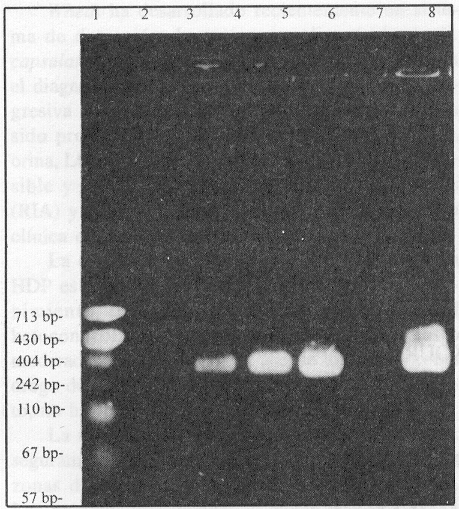
<body><![CDATA[<P>The PCR amplification was successful when collection strains Escherichia coli O: 149 K: 88 (LT) as wellas twenty strains of patients with diarrhea were (figure), but not <I>Aeromonas hydrophila</I>, and <I>Vibrio cholerae</I> 01. </P>     <P ALIGN="CENTER"><A HREF="/img/revistas/mtr/v48n3/f0106396.gif"><IMG SRC="/img/revistas/mtr/v48n3/f0106396.gif" BORDER=0 ALT="Figura 1"></A></P>     
<P>FIGURE . PCR to identify toxigenic <I>Escherichia coli</I> (LT+). Line 1: DNA size marker of base pair 57,67,110,247,157,190, (Hpa II digest of Bs+). Line 2: empty lane. Line 3: amplified segment of toxigenic <I>E. coli</I> O:149 K:88 (LT+). Lines 4,5,6: amplified segment of toxigenic <I>E. coli</I> (LT+) isolated from patients with diarrhea diseases. </P>     <P>The specifity of the PCR was corroborated through restriction enzymes analysis<SUP>5</SUP> for this purpose we used AccI and Hind II enzymes (CIGB) cleaved DNA at 90 bp and 180 bp. </P> <H4>SUMMARY</H4>     <P>In this paper it is described the detection enteroxigenic<I> Escherichia coli </I>LT (+). This method is based on the amplification of a DNA fragment of 400 pairs of bases by polymerase chain reaction (PRC). The oligonuclotides were designed by the authors and the characteristic patterns were observed when the samples were submitted to an electrophoresis in an Agarose gel at 2 %. The PCR had positive results with the strains of <I>Escherichia coli </I>0:149 K; 88 (LT+) collection and with 20 strains isolated from patients with acute diarrhea. Negative results were found in <I>Escherichia coli</I> 0:101 K:99 NM (ST+), <I>Vibrio cholerae</I> 01 and <I>Aeromonas hydrophilia</I>. </P>     <P>Key words: <I>ESCHERICHIA COLI</I>/isolation and purification; POLYMERASE CHAIN REACTION. </P> <H4>REFERENCES</H4> <OL>      <!-- ref --><LI>Echevarria P, Seriwatana J. Identification by DNA hybridization of enteroxigenic <I>Escherichia coli</I> study of villages in Thailand. J Infect Dis 1985;151:124-30.</LI>    <!-- ref --><LI>Echevarria P, Leksomboon U, Chaicumpa W. Identification by DNA hybridization of enterotoxigenic <I>E. coli</I> in homes of children with diarrhea. Lancet 1994;14:63-5.</LI>    <!-- ref --><LI>Saiki R, Celfand D. Primer direct enzymatic amplification of DNA with a termostable DNA polymerase. Sciences 1990;239:487--91.</LI>    <!-- ref --><LI>Olive MD. Detection of enterotoxigenic <I>E. coli</I> after polymerase chain reaction with termostable DNA polymerase J Clin Microbiol 1985;27:261-5.</LI>    <!-- ref --><LI>Jansen R, Ledley F. Production of discret high specific activity DNA probes using the polymerase chain reaction. Gene Annal Techn 1996;6:79-83.</LI>    </OL>      <P>Recibido: 10 de enero de 1996. Aprobado: 18 de mayo de 1996. </P>     <P>Dra. <I>Margarita Ram&iacute;rez</I>. Instituto de Medicina Tropical "Pedro Kour&iacute;". Apartado 601, Marianao 13, Ciudad de La Habana, Cuba. </P>     <P><SUP>1</sup>&nbsp;<A NAME="autores"></A>Especialista de I Grado en Microbiolog&iacute;a. Instituto de Medicina Tropical "Pedro Kour&iacute;" (IPK).     <BR> <SUP>2</SUP> Especialista de II Grado en Microbiolog&iacute;a. Investigador Auxiliar. IPK     <BR> <SUP>3</SUP> Dr. en Ciencias Biol&oacute;gicas. Facultad de Farmacia. Universidad de Barcelona.     <BR> <SUP>4</SUP> Licenciada en Ciencias Biol&oacute;gicas. Investigadora Auxiliar. IPK.     <BR> <SUP>5</SUP> Especialista de I Grado en Microbiolog&iacute;a. Investigador Auxiliar. IPK.     <BR> <SUP>6</SUP> T&eacute;cnica en Procesos Biol&oacute;gicos. IPK. </P>    ]]></body>
<body><![CDATA[ ]]></body><back>
<ref-list>
<ref id="B1">
<nlm-citation citation-type="journal">
<person-group person-group-type="author">
<name>
<surname><![CDATA[Echevarria]]></surname>
<given-names><![CDATA[P]]></given-names>
</name>
<name>
<surname><![CDATA[Seriwatana]]></surname>
<given-names><![CDATA[J]]></given-names>
</name>
</person-group>
<article-title xml:lang="en"><![CDATA[Identification by DNA hybridization of enteroxigenic Escherichia coli study of villages in Thailand]]></article-title>
<source><![CDATA[J Infect Dis]]></source>
<year>1985</year>
<volume>151</volume>
<page-range>124-30</page-range></nlm-citation>
</ref>
<ref id="B2">
<nlm-citation citation-type="journal">
<person-group person-group-type="author">
<name>
<surname><![CDATA[Echevarria]]></surname>
<given-names><![CDATA[P]]></given-names>
</name>
<name>
<surname><![CDATA[Leksomboon]]></surname>
<given-names><![CDATA[U]]></given-names>
</name>
<name>
<surname><![CDATA[Chaicumpa]]></surname>
<given-names><![CDATA[W]]></given-names>
</name>
</person-group>
<article-title xml:lang="en"><![CDATA[Identification by DNA hybridization of enterotoxigenic E: coli in homes of children with diarrhea]]></article-title>
<source><![CDATA[Lancet]]></source>
<year>1994</year>
<volume>14</volume>
<page-range>63-5</page-range></nlm-citation>
</ref>
<ref id="B3">
<nlm-citation citation-type="journal">
<person-group person-group-type="author">
<name>
<surname><![CDATA[Saiki]]></surname>
<given-names><![CDATA[R]]></given-names>
</name>
<name>
<surname><![CDATA[Celfand]]></surname>
<given-names><![CDATA[D]]></given-names>
</name>
</person-group>
<article-title xml:lang="en"><![CDATA[Primer direct enzymatic amplification of DNA with a termostable DNA polymerase]]></article-title>
<source><![CDATA[Sciences]]></source>
<year>1990</year>
<volume>239</volume>
<page-range>487--91</page-range></nlm-citation>
</ref>
<ref id="B4">
<nlm-citation citation-type="journal">
<person-group person-group-type="author">
<name>
<surname><![CDATA[Olive]]></surname>
<given-names><![CDATA[MD]]></given-names>
</name>
</person-group>
<article-title xml:lang="en"><![CDATA[Detection of enterotoxigenic E. coli after polymerase chain reaction with termostable DNA polymerase]]></article-title>
<source><![CDATA[J Clin Microbiol]]></source>
<year>1985</year>
<volume>27</volume>
<page-range>261-5</page-range></nlm-citation>
</ref>
<ref id="B5">
<nlm-citation citation-type="journal">
<person-group person-group-type="author">
<name>
<surname><![CDATA[Jansen]]></surname>
<given-names><![CDATA[R]]></given-names>
</name>
<name>
<surname><![CDATA[Ledley]]></surname>
<given-names><![CDATA[F]]></given-names>
</name>
</person-group>
<article-title xml:lang="en"><![CDATA[Production of discret high specific activity DNA probes using the polymerase chain reaction]]></article-title>
<source><![CDATA[Gene Annal Techn]]></source>
<year>1996</year>
<volume>6</volume>
<page-range>79-83</page-range></nlm-citation>
</ref>
</ref-list>
</back>
</article>
