<?xml version="1.0" encoding="ISO-8859-1"?><article xmlns:mml="http://www.w3.org/1998/Math/MathML" xmlns:xlink="http://www.w3.org/1999/xlink" xmlns:xsi="http://www.w3.org/2001/XMLSchema-instance">
<front>
<journal-meta>
<journal-id>0375-0760</journal-id>
<journal-title><![CDATA[Revista Cubana de Medicina Tropical]]></journal-title>
<abbrev-journal-title><![CDATA[Rev Cubana Med Trop]]></abbrev-journal-title>
<issn>0375-0760</issn>
<publisher>
<publisher-name><![CDATA[Centro Nacional de Información de Ciencias Médicas]]></publisher-name>
</publisher>
</journal-meta>
<article-meta>
<article-id>S0375-07601997000100007</article-id>
<title-group>
<article-title xml:lang="es"><![CDATA[Caracterización de cepas de Haemophilus influenzae mediante fermentación de azúcares]]></article-title>
</title-group>
<contrib-group>
<contrib contrib-type="author">
<name>
<surname><![CDATA[LLANES CABALLERO]]></surname>
<given-names><![CDATA[RAFAEL]]></given-names>
</name>
<xref ref-type="aff" rid="A01"/>
</contrib>
<contrib contrib-type="author">
<name>
<surname><![CDATA[AZAHARES ROMERO]]></surname>
<given-names><![CDATA[LUIS E.]]></given-names>
</name>
</contrib>
<contrib contrib-type="author">
<name>
<surname><![CDATA[PÉREZ MONRAS]]></surname>
<given-names><![CDATA[MIRIAM F.]]></given-names>
</name>
</contrib>
<contrib contrib-type="author">
<name>
<surname><![CDATA[MARTÍNEZ DÍAZ]]></surname>
<given-names><![CDATA[ALICIA]]></given-names>
</name>
</contrib>
</contrib-group>
<aff id="A01">
<institution><![CDATA[,Instituto de Medicina Tropical Pedro Kourí  ]]></institution>
<addr-line><![CDATA[Ciudad de La Habana ]]></addr-line>
<country>Cuba</country>
</aff>
<pub-date pub-type="pub">
<day>00</day>
<month>04</month>
<year>1997</year>
</pub-date>
<pub-date pub-type="epub">
<day>00</day>
<month>04</month>
<year>1997</year>
</pub-date>
<volume>49</volume>
<numero>1</numero>
<fpage>38</fpage>
<lpage>42</lpage>
<copyright-statement/>
<copyright-year/>
<self-uri xlink:href="http://scielo.sld.cu/scielo.php?script=sci_arttext&amp;pid=S0375-07601997000100007&amp;lng=en&amp;nrm=iso"></self-uri><self-uri xlink:href="http://scielo.sld.cu/scielo.php?script=sci_abstract&amp;pid=S0375-07601997000100007&amp;lng=en&amp;nrm=iso"></self-uri><self-uri xlink:href="http://scielo.sld.cu/scielo.php?script=sci_pdf&amp;pid=S0375-07601997000100007&amp;lng=en&amp;nrm=iso"></self-uri><abstract abstract-type="short" xml:lang="es"><p><![CDATA[Se caracterizaron 64 cepas de Haemophilus influenzae circulantes en Ciudad de La Habana durante 1 a, por el método de fermentación de azúcares, por primera vez en Cuba. El patrón fermentativo D fue el más frecuentemente encontrado. Los patrones D y G en conjunto constituyeron el 72 % del total de cepas estudiadas. La combinación de la fermentación de azúcares con el serotipaje y el biotipaje permitió una mayor diferenciación de las cepas (14 grupos). Los patrones A, B, C y F aparecieron en niños mayores de 6 meses y el G en el grupo de 6 a 18 meses. En la meningoencefalitis bacteriana predominaron los patrones D y G, existió una mayor heterogeneidad en las cepas aisladas de infecciones respiratorias agudas. Se señalan algunas ventajas de este método de subtipificación de cepas de Haemophilus influenzae como son: la sencillez, facilidad de realizar e interpretar y no requerir de un personal calificado ni de un laboratorio especializado para su ejecución.]]></p></abstract>
<abstract abstract-type="short" xml:lang="en"><p><![CDATA[64 Haemophilus influenzae strains circulating in Havana City during a year were characterized by the Carbohidrate fermentation method for the first time in Cuba. The fermentative pattern D was the most frequently found. Patterns D and G together were 72 % of the total of strains studied. The combination of the Carbohidrate fermentation with serotypping and biotyping allowed a greater differentiation of strains (14 groups). Patterns A, B, C and F appeared in children over 6 months of age, and pattern G in the group from 6 to 18. Patterns D and G predominated in the bacterial meningoencephalitis. A higher heterogeneity was observed among the strains isolated from acute respiratory infections. Some of the advantages of the Heaemophilus influenzae strains subtyping method are stressed, such as: simplicity, easiness to be applied and interpreted, and the fact that it is not necessary a qualified personnel or a specialized laboratory for its implementation.]]></p></abstract>
<kwd-group>
<kwd lng="es"><![CDATA[HAEMOPHILUS INFLUENZAE]]></kwd>
<kwd lng="es"><![CDATA[TECNICA DE TIPIFICACION BACTERIANA]]></kwd>
<kwd lng="es"><![CDATA[INFECCIONES POR HAEMOPHILUS]]></kwd>
<kwd lng="es"><![CDATA[ESTUDIOS PROSPECTIVOS]]></kwd>
<kwd lng="en"><![CDATA[HAEMOPHILUS INFLUENZE]]></kwd>
<kwd lng="en"><![CDATA[BACTERIAL TYPING TECHNIQUES]]></kwd>
<kwd lng="en"><![CDATA[HAEMOPHILUS INFECTIONS]]></kwd>
<kwd lng="en"><![CDATA[PROSPECTIVE STUDIES]]></kwd>
</kwd-group>
</article-meta>
</front><body><![CDATA[ <DIV ALIGN=right>     <P></DIV>Instituto de Medicina Tropical "Pedro Kour&iacute;"     <p></P> <H2>Caracterizaci&oacute;n de cepas de <I>Haemophilus influenzae </I>mediante fermentaci&oacute;n de az&uacute;cares</H2>     <P>Dr. RAFAEL LLANES CABALLERO, Dr. LUIS E. AZAHARES ROMERO, Dra. MIRIAM F. P&Eacute;REZ MONRAS y Dra. ALICIA MART&Iacute;NEZ D&Iacute;AZ </P> <H3>RESUMEN</H3>     <P>Se caracterizaron 64 cepas de <I>Haemophilus influenzae</I> circulantes en Ciudad de La Habana durante 1 a, por el m&eacute;todo de fermentaci&oacute;n de az&uacute;cares, por primera vez en Cuba. El patr&oacute;n fermentativo D fue el m&aacute;s frecuentemente encontrado. Los patrones D y G en conjunto constituyeron el 72 % del total de cepas estudiadas. La combinaci&oacute;n de la fermentaci&oacute;n de az&uacute;cares con el serotipaje y el biotipaje permiti&oacute; una mayor diferenciaci&oacute;n de las cepas (14 grupos). Los patrones A, B, C y F aparecieron en ni&ntilde;os mayores de 6 meses y el G en el grupo de 6 a 18 meses. En la meningoencefalitis bacteriana predominaron los patrones D y G, existi&oacute; una mayor heterogeneidad en las cepas aisladas de infecciones respiratorias agudas. Se se&ntilde;alan algunas ventajas de este m&eacute;todo de subtipificaci&oacute;n de cepas de <I>Haemophilus influenzae</I> como son: la sencillez, facilidad de realizar e interpretar y no requerir de un personal calificado ni de un laboratorio especializado para su ejecuci&oacute;n. </P>     <P><B>Descriptores DeCS:</b> <I>HAEMOPHILUS INFLUENZAE</I>/clasificaci&oacute;n; TECNICA DE TIPIFICACION BACTERIANA; INFECCIONES POR <I>HAEMOPHILUS;</I> ESTUDIOS PROSPECTIVOS. </P> <H3>INTRODUCCI&Oacute;N</H3>     <P><I>Haemophilus influenzae</i> constituye un pat&oacute;geno importante de numerosas infecciones que se presentan fundamentalmente en edades pedi&aacute;tricas,<SUP>1</SUP> el serotipo b (Hib) es uno de los causantes principales de meningitis purulenta y de infecciones severas del tracto respiratorio inferior.<SUP>2,3</SUP> </P>     <P><I>H. influenzae</i> requiere para su crecimiento de medios complejos que contienen nicotinamida adenina dinucle&oacute;tido (NAD o factor V) y hemina (factor X).<SUP>4</SUP> Su metabolismo es aerobio<SUP>5</SUP> o anaerobio facultativo<SUP>4</SUP> y es capaz de utilizar los hidratos de carbono como fuente de energ&iacute;a a trav&eacute;s de diferentes v&iacute;as.<SUP>6</SUP> </P>     <P>El espectro de descomposici&oacute;n de los hidratos de carbono, que se determina por la producci&oacute;n de &aacute;cido de los sustratos, se emplea como m&eacute;todo de tipificaci&oacute;n de numerosas bacterias.<SUP>7</SUP> Particularmente para <I>H. influenzae</I>, se establece la diferenciaci&oacute;n en patrones fermentativos, sobre la base de la utilizaci&oacute;n de fructosa, maltosa y xilosa,<SUP>8</SUP> este m&eacute;todo es &uacute;til para distinguir cepas del mismo serotipo y biotipo.<SUP>9</SUP> </P>     <P>Se realiz&oacute; el presente estudio con los objetivos siguientes: (I) caracterizar cepas de <I>H. influenzae</I> circulantes en Ciudad de La Habana durante 1 a con la utilizaci&oacute;n por primera vez en Cuba del m&eacute;todo de fermentaci&oacute;n de az&uacute;cares, (II) relacionar &eacute;ste con otros m&eacute;todos de tipificaci&oacute;n de las cepas y con algunos aspectos cl&iacute;nico-epidemiol&oacute;gicos de presentaci&oacute;n de la enfermedad. </P> <H3>M&Eacute;TODOS</H3>     ]]></body>
<body><![CDATA[<P>Se realiz&oacute; un estudio de tipo prospectivo en 64 cepas de <I>H. influenzae</I>, aisladas durante el per&iacute;odo comprendido entre junio de 1992 y mayo de 1993 de 64 pacientes (0 - 5 a), procedentes de todos los hospitales pedi&aacute;tricos de Ciudad de La Habana y que presentaban diversas infecciones: meningoencefalitis bacteriana (MEB), 36; infecciones respiratorias agudas (IRA), 23 y otras infecciones, 5 (bac-teriemia primaria, 3; osteomielitis, 1; vaginitis, 1). </P>     <P><I>Identificaci&oacute;n</i>. Las cepas se identificaron como <I>H. influenzae</I>, en base a sus caracter&iacute;sticas morfol&oacute;gicas, de coloraci&oacute;n y de agrupamiento por coloraci&oacute;n de Gram y de requerimiento de los factores V y X (discos, Oxoid).<SUP>4</SUP> </P>     <P><I>Serotipificaci&oacute;n</i>. Se realiz&oacute; aglutinaci&oacute;n con part&iacute;culas de l&aacute;tex (lat&eacute;x Hib IPK). Como control se utiliz&oacute; la cepa de referencia Eagan de Hib. </P>     <P><I>Biotipificaci&oacute;n</i>. Se evalu&oacute; la actividad ureasa, ornitina descarboxilasa y producci&oacute;n de indol, por el m&eacute;todo de Kilian.<SUP>4</SUP> Como controles se utilizaron las cepas de <I>Proteus vulgaris</I> ATCC 13315, <I>Escherichia coli</I> K99 y <I>Salmonela cerro</I> 18;74,723: SK 100158, donadas por el Laboratorio Nacional de Referencia de Enfermedades Diarreicas Agudas del Instituto de Medicina Tropical "Pedro Kour&iacute;" (IPK). </P>     <P><I>Fermentaci&oacute;n de az&uacute;cares. </i>Se emplearon los az&uacute;cares: D+ glucosa, D+ xilosa, fructosa, maltosa, lactosa y sacarosa (Merck) al 1 %, en medio l&iacute;quido (Base Rojo Fenol, Difco), suplementada con NAD y hemina (10 <FONT FACE=Symbol>m</FONT>g/mL) (Merck), en tubos de 25 x 125 mm con tubo de Durham, seg&uacute;n la metodolog&iacute;a de Roberts.<SUP>8</SUP> El in&oacute;culo se prepar&oacute; como suspensi&oacute;n densa del microorganismo en soluci&oacute;n salina fisiol&oacute;gica est&eacute;ril 0,9 %; a partir de cultivo puro de 18 a 24 h de incubaci&oacute;n. Como controles positivos se utilizaron las cepas de <I>E. coli</I> K99, <I>P. vulgaris</I> ATCC 13315, <I>S. cerro</I> 18;74,723: SK 10058 y <I>Streptococcus pneumoniae</I> serotipo 1. Como control negativo se emple&oacute; la base del medio de cultivo suplementada, sin a&ntilde;adir az&uacute;cares. Los caldos se incubaron a 35 <FONT FACE=Symbol>&amp;deg;</FONT>C, durante 24 h y hasta 7 d. </P>     <P>En una encuesta, se recogieron algunos datos del paciente, como la edad y el diagn&oacute;stico cl&iacute;nico. Los datos fueron procesados en una microcomputadoa IBM compatible, en una base de datos dise&ntilde;ada seg&uacute;n el sistema Epi Info 5.01, del CDC de Atlanta. </P> <H3>RESULTADOS</H3>     <P>El sistema de subtipificaci&oacute;n de <I>H. influenzae</I> basado en la fermentaci&oacute;n de az&uacute;cares, descrito por <I>Tiller</I><SUP>9</SUP> y modificado por <I>Roberts</I> y otros<SUP>8</SUP> aparece en la tabla 1. Nosotros encontramos un patr&oacute;n que no hab&iacute;a sido reportado previamente (fructosa negativa, maltosa positiva y xilosa positiva) al que denominamos G.     <BR> &nbsp; </P>     <P ALIGN="CENTER"><B>TABLA 1. </b>Patrones fermentativos de az&uacute;cares en <I>Haemophilus influenzae</i></P><I>     <P ALIGN="CENTER">&nbsp;</P></I>     ]]></body>
<body><![CDATA[<P ALIGN="CENTER">    <CENTER><TABLE BORDER CELLSPACING=1 BORDERCOLOR="#000000" CELLPADDING=4 WIDTH=296> <TR><TD WIDTH="25%" VALIGN="TOP">     <P>&nbsp;</TD> <TD WIDTH="75%" VALIGN="TOP" COLSPAN=3>     <P ALIGN="CENTER">Fermentaci&oacute;n de fermentativo</TD> </TR> <TR><TD WIDTH="25%" VALIGN="TOP">     <P ALIGN="CENTER">Patr&oacute;n</TD> <TD WIDTH="25%" VALIGN="TOP">     <P ALIGN="CENTER">Fructosa</TD> <TD WIDTH="25%" VALIGN="TOP">     <P ALIGN="CENTER">Maltosa</TD> <TD WIDTH="25%" VALIGN="TOP">     <P ALIGN="CENTER">Xilosa</TD> </TR> <TR><TD WIDTH="25%" VALIGN="TOP">     <P ALIGN="CENTER">A*</TD> <TD WIDTH="25%" VALIGN="TOP">     <P ALIGN="CENTER">+</TD> <TD WIDTH="25%" VALIGN="TOP">     ]]></body>
<body><![CDATA[<P ALIGN="CENTER">-</TD> <TD WIDTH="25%" VALIGN="TOP">     <P ALIGN="CENTER">+</TD> </TR> <TR><TD WIDTH="25%" VALIGN="TOP">     <P ALIGN="CENTER">B*</TD> <TD WIDTH="25%" VALIGN="TOP">     <P ALIGN="CENTER">+</TD> <TD WIDTH="25%" VALIGN="TOP">     <P ALIGN="CENTER">-</TD> <TD WIDTH="25%" VALIGN="TOP">     <P ALIGN="CENTER">-</TD> </TR> <TR><TD WIDTH="25%" VALIGN="TOP">     <P ALIGN="CENTER">C*</TD> <TD WIDTH="25%" VALIGN="TOP">     <P ALIGN="CENTER">-</TD> <TD WIDTH="25%" VALIGN="TOP">     <P ALIGN="CENTER">-</TD> <TD WIDTH="25%" VALIGN="TOP">     <P ALIGN="CENTER">+</TD> </TR> <TR><TD WIDTH="25%" VALIGN="TOP">     ]]></body>
<body><![CDATA[<P ALIGN="CENTER">D*</TD> <TD WIDTH="25%" VALIGN="TOP">     <P ALIGN="CENTER">+</TD> <TD WIDTH="25%" VALIGN="TOP">     <P ALIGN="CENTER">+</TD> <TD WIDTH="25%" VALIGN="TOP">     <P ALIGN="CENTER">+</TD> </TR> <TR><TD WIDTH="25%" VALIGN="TOP">     <P ALIGN="CENTER">E*</TD> <TD WIDTH="25%" VALIGN="TOP">     <P ALIGN="CENTER">-</TD> <TD WIDTH="25%" VALIGN="TOP">     <P ALIGN="CENTER">-</TD> <TD WIDTH="25%" VALIGN="TOP">     <P ALIGN="CENTER">-</TD> </TR> <TR><TD WIDTH="25%" VALIGN="TOP">     <P ALIGN="CENTER">F**</TD> <TD WIDTH="25%" VALIGN="TOP">     <P ALIGN="CENTER">+</TD> <TD WIDTH="25%" VALIGN="TOP">     ]]></body>
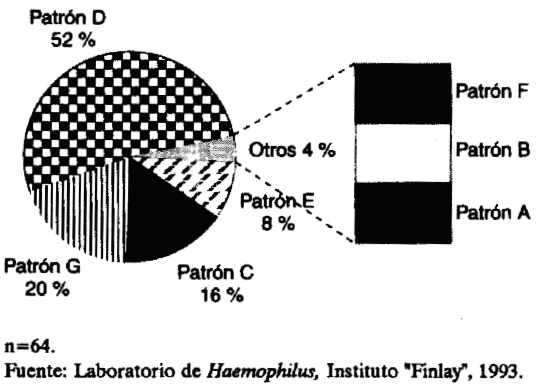
<body><![CDATA[<P ALIGN="CENTER">+</TD> <TD WIDTH="25%" VALIGN="TOP">     <P ALIGN="CENTER">-</TD> </TR> </TABLE> </CENTER>    <p></P>      <P ALIGN="CENTER">* <I>Tiller.</I><SUP>9 </SUP>** <I>Roberts</I> y otros.<SUP>8</sup></P>     <P ALIGN="CENTER">Fuente: Laboratorio de <I>Haemophilus</I>, Instituto "Finlay", 1993.</P>     <P>En nuestro estudio se observaron los 6 patrones descritos por <I>Roberts </I>y otros.<SUP>8</SUP> La habilidad para fermentar fructuosa, maltosa y xilosa (D), constituy&oacute; el patr&oacute;n m&aacute;s frecuente. Los patrones D y G en conjunto, representaron el 72 % del total de cepas estudiadas (figura). </P>     <P ALIGN="CENTER"><A HREF="/img/revistas/mtr/v49n1/f107197.gif"><IMG SRC="/img/revistas/mtr/v49n1/f107197.gif" BORDER=0 ALT="Figura"></A></P>     
<P ALIGN="CENTER"><B>FIGURA.</b> Distribuci&oacute;n de cepas seg&uacute;n los patrones fermentativos de az&uacute;cares.</P>     <P>Todas las cepas utilizaron en su metabolismo la glucosa, sin producir gas, pero ninguna ferment&oacute; la lactosa ni la sacarosa. </P>     <P>El 92 % de las cepas fue Hib y el 8 % no b; por otra parte, el 80, 17 y 3 % pertenec&iacute;an a los biotipos I, II y IV, respectivamente (datos no mostrados). </P>     ]]></body>
<body><![CDATA[<P>La combinaci&oacute;n de los patrones fermentativos con los serotipos y biotipos, posibilit&oacute; subdividir este microorganismo en 14 grupos (tabla 2).     <BR> &nbsp; </P>     <P ALIGN="CENTER"><B>TABLA 2.</b> Relaci&oacute;n entre patrones fermentativos y serotipos/biotipos</P>     <P ALIGN="CENTER">&nbsp;</P>     <P ALIGN="CENTER">    <CENTER><TABLE BORDER CELLSPACING=1 BORDERCOLOR="#000000" CELLPADDING=4 WIDTH=403> <TR><TD WIDTH="32%" VALIGN="TOP">     <P>&nbsp;</TD> <TD WIDTH="68%" VALIGN="TOP" COLSPAN=6>     <P ALIGN="CENTER">Serotipo/biotipo</TD> </TR> <TR><TD WIDTH="32%" VALIGN="TOP">     <P>Patr&oacute;n fermentativo</TD> <TD WIDTH="9%" VALIGN="TOP">     <P ALIGN="CENTER">b/I</TD> <TD WIDTH="9%" VALIGN="TOP">     ]]></body>
<body><![CDATA[<P ALIGN="CENTER">b/II</TD> <TD WIDTH="10%" VALIGN="TOP">     <P ALIGN="CENTER">b/IV</TD> <TD WIDTH="12%" VALIGN="TOP">     <P ALIGN="CENTER">no b/I</TD> <TD WIDTH="13%" VALIGN="TOP">     <P ALIGN="CENTER">no b/II</TD> <TD WIDTH="15%" VALIGN="TOP">     <P ALIGN="CENTER">no b/IV</TD> </TR> <TR><TD WIDTH="32%" VALIGN="TOP">     <P>A</TD> <TD WIDTH="9%" VALIGN="TOP">     <P ALIGN="CENTER">1</TD> <TD WIDTH="9%" VALIGN="TOP">     <P>&nbsp;</TD> <TD WIDTH="10%" VALIGN="TOP">     <P>&nbsp;</TD> <TD WIDTH="12%" VALIGN="TOP">     <P>&nbsp;</TD> <TD WIDTH="13%" VALIGN="TOP">     ]]></body>
<body><![CDATA[<P>&nbsp;</TD> <TD WIDTH="15%" VALIGN="TOP">     <P>&nbsp;</TD> </TR> <TR><TD WIDTH="32%" VALIGN="TOP">     <P>B</TD> <TD WIDTH="9%" VALIGN="TOP">     <P ALIGN="CENTER">1</TD> <TD WIDTH="9%" VALIGN="TOP">     <P>&nbsp;</TD> <TD WIDTH="10%" VALIGN="TOP">     <P>&nbsp;</TD> <TD WIDTH="12%" VALIGN="TOP">     <P>&nbsp;</TD> <TD WIDTH="13%" VALIGN="TOP">     <P>&nbsp;</TD> <TD WIDTH="15%" VALIGN="TOP">     <P>&nbsp;</TD> </TR> <TR><TD WIDTH="32%" VALIGN="TOP">     <P>C</TD> <TD WIDTH="9%" VALIGN="TOP">     ]]></body>
<body><![CDATA[<P ALIGN="CENTER">8</TD> <TD WIDTH="9%" VALIGN="TOP">     <P ALIGN="CENTER">2</TD> <TD WIDTH="10%" VALIGN="TOP">     <P>&nbsp;</TD> <TD WIDTH="12%" VALIGN="TOP">     <P>&nbsp;</TD> <TD WIDTH="13%" VALIGN="TOP">     <P>&nbsp;</TD> <TD WIDTH="15%" VALIGN="TOP">     <P>&nbsp;</TD> </TR> <TR><TD WIDTH="32%" VALIGN="TOP">     <P>D</TD> <TD WIDTH="9%" VALIGN="TOP">     <P ALIGN="CENTER">27</TD> <TD WIDTH="9%" VALIGN="TOP">     <P ALIGN="CENTER">4</TD> <TD WIDTH="10%" VALIGN="TOP">     <P>&nbsp;</TD> <TD WIDTH="12%" VALIGN="TOP">     ]]></body>
<body><![CDATA[<P ALIGN="CENTER">1</TD> <TD WIDTH="13%" VALIGN="TOP">     <P ALIGN="CENTER">1</TD> <TD WIDTH="15%" VALIGN="TOP">     <P>&nbsp;</TD> </TR> <TR><TD WIDTH="32%" VALIGN="TOP">     <P>E</TD> <TD WIDTH="9%" VALIGN="TOP">     <P>&nbsp;</TD> <TD WIDTH="9%" VALIGN="TOP">     <P ALIGN="CENTER">2</TD> <TD WIDTH="10%" VALIGN="TOP">     <P ALIGN="CENTER">1</TD> <TD WIDTH="12%" VALIGN="TOP">     <P>&nbsp;</TD> <TD WIDTH="13%" VALIGN="TOP">     <P ALIGN="CENTER">1</TD> <TD WIDTH="15%" VALIGN="TOP">     <P ALIGN="CENTER">1</TD> </TR> <TR><TD WIDTH="32%" VALIGN="TOP">     ]]></body>
<body><![CDATA[<P>F</TD> <TD WIDTH="9%" VALIGN="TOP">     <P>&nbsp;</TD> <TD WIDTH="9%" VALIGN="TOP">     <P>&nbsp;</TD> <TD WIDTH="10%" VALIGN="TOP">     <P>&nbsp;</TD> <TD WIDTH="12%" VALIGN="TOP">     <P>&nbsp;</TD> <TD WIDTH="13%" VALIGN="TOP">     <P ALIGN="CENTER">1</TD> <TD WIDTH="15%" VALIGN="TOP">     <P>&nbsp;</TD> </TR> <TR><TD WIDTH="32%" VALIGN="TOP">     <P>G</TD> <TD WIDTH="9%" VALIGN="TOP">     <P ALIGN="CENTER">13</TD> <TD WIDTH="9%" VALIGN="TOP">     <P>&nbsp;</TD> <TD WIDTH="10%" VALIGN="TOP">     ]]></body>
<body><![CDATA[<P>&nbsp;</TD> <TD WIDTH="12%" VALIGN="TOP">     <P>&nbsp;</TD> <TD WIDTH="13%" VALIGN="TOP">     <P>&nbsp;</TD> <TD WIDTH="15%" VALIGN="TOP">     <P>&nbsp;</TD> </TR> </TABLE> </CENTER>    <p></P>  <FONT SIZE=2>    <P ALIGN="CENTER">n=64. Fuente: Laboratorio <I>Haemophilus,</I> Instituto "Finlay", 1993.</P> </FONT>    <P>La relaci&oacute;n patr&oacute;n fermentativo de az&uacute;cares-edad del paciente (tabla 3), mostr&oacute; un predominio del patr&oacute;n D en todos los grupos etarios, el C apareci&oacute; en ni&ntilde;os mayores de 6 meses, al igual que el A, B y F. El patr&oacute;n G se manifest&oacute; en el grupo de 6 a 18 meses, con frecuencia relativa superior al resto (25,6 %).     <BR> &nbsp; </P>     <P ALIGN="CENTER"><B>TABLA 3.</b> Distribuci&oacute;n de cepas (No./%) seg&uacute;n la edad del paciente y patr&oacute;n fermentativo</P>     <P ALIGN="CENTER">&nbsp;</P>     ]]></body>
<body><![CDATA[<P ALIGN="CENTER">    <CENTER><TABLE BORDER CELLSPACING=1 BORDERCOLOR="#000000" CELLPADDING=4 WIDTH=296> <TR><TD WIDTH="39%" VALIGN="TOP">     <P>&nbsp;</TD> <TD WIDTH="61%" VALIGN="TOP" COLSPAN=3>     <P ALIGN="CENTER">Edad (meses)</TD> </TR> <TR><TD WIDTH="39%" VALIGN="TOP">     <P>Patr&oacute;n fermentativo</TD> <TD WIDTH="22%" VALIGN="TOP">     <P ALIGN="CENTER">&lt;6</TD> <TD WIDTH="22%" VALIGN="TOP">     <P ALIGN="CENTER">6-18</TD> <TD WIDTH="17%" VALIGN="TOP">     <P ALIGN="CENTER">18</TD> </TR> <TR><TD WIDTH="39%" VALIGN="TOP">     <P>A</TD> <TD WIDTH="22%" VALIGN="TOP">     <P ALIGN="CENTER">-</TD> <TD WIDTH="22%" VALIGN="TOP">     ]]></body>
<body><![CDATA[<P ALIGN="CENTER">1/2,3</TD> <TD WIDTH="17%" VALIGN="TOP">     <P ALIGN="CENTER">-</TD> </TR> <TR><TD WIDTH="39%" VALIGN="TOP">     <P>B</TD> <TD WIDTH="22%" VALIGN="TOP">     <P ALIGN="CENTER">-</TD> <TD WIDTH="22%" VALIGN="TOP">     <P ALIGN="CENTER">-</TD> <TD WIDTH="17%" VALIGN="TOP">     <P ALIGN="CENTER">1/7,1</TD> </TR> <TR><TD WIDTH="39%" VALIGN="TOP">     <P>C</TD> <TD WIDTH="22%" VALIGN="TOP">     <P ALIGN="CENTER">-</TD> <TD WIDTH="22%" VALIGN="TOP">     <P ALIGN="CENTER">8/18,6</TD> <TD WIDTH="17%" VALIGN="TOP">     <P ALIGN="CENTER">2/14,3</TD> </TR> <TR><TD WIDTH="39%" VALIGN="TOP">     ]]></body>
<body><![CDATA[<P>D</TD> <TD WIDTH="22%" VALIGN="TOP">     <P ALIGN="CENTER">4/57,1</TD> <TD WIDTH="22%" VALIGN="TOP">     <P ALIGN="CENTER">23/53,5</TD> <TD WIDTH="17%" VALIGN="TOP">     <P ALIGN="CENTER">6/42,9</TD> </TR> <TR><TD WIDTH="39%" VALIGN="TOP">     <P>E</TD> <TD WIDTH="22%" VALIGN="TOP">     <P ALIGN="CENTER">2/28,6</TD> <TD WIDTH="22%" VALIGN="TOP">     <P ALIGN="CENTER">-</TD> <TD WIDTH="17%" VALIGN="TOP">     <P ALIGN="CENTER">3/21,5</TD> </TR> <TR><TD WIDTH="39%" VALIGN="TOP">     <P>F</TD> <TD WIDTH="22%" VALIGN="TOP">     <P ALIGN="CENTER">-</TD> <TD WIDTH="22%" VALIGN="TOP">     ]]></body>
<body><![CDATA[<P ALIGN="CENTER">-</TD> <TD WIDTH="17%" VALIGN="TOP">     <P ALIGN="CENTER">1/7,1</TD> </TR> <TR><TD WIDTH="39%" VALIGN="TOP">     <P>G</TD> <TD WIDTH="22%" VALIGN="TOP">     <P ALIGN="CENTER">1/14,3</TD> <TD WIDTH="22%" VALIGN="TOP">     <P ALIGN="CENTER">11/25,6</TD> <TD WIDTH="17%" VALIGN="TOP">     <P ALIGN="CENTER">1/7,1</TD> </TR> <TR><TD WIDTH="39%" VALIGN="TOP">     <P>n=64</TD> <TD WIDTH="22%" VALIGN="TOP">     <P ALIGN="CENTER">n<SUB>1</SUB>=7</TD> <TD WIDTH="22%" VALIGN="TOP">     <P ALIGN="CENTER">n<SUB>2</SUB>=43</TD> <TD WIDTH="17%" VALIGN="TOP">     <P ALIGN="CENTER">n<SUB>8</SUB>=14</TD> </TR> </TABLE> </CENTER>    ]]></body>
<body><![CDATA[<p></P>  <FONT SIZE=2>    <P ALIGN="CENTER">Fuente: Laboratorio de <I>Haemophilus</I>, Instituto "Finlay", 1993.</P> </FONT>    <P>Al relacionar la tipificaci&oacute;n de <I>H. influenzae</I> seg&uacute;n patrones fermentativos de az&uacute;cares con el diagn&oacute;stico cl&iacute;nico (tabla 4), se evidenci&oacute; una heterogenicidad en las cepas aisladas de IRA; en este grupo, el predominio del patr&oacute;n D (39,1 %) fue relativamente inferior al grupo de MEB (55,6 %), los patrones E y F se asociaron s&oacute;lo a IRA, mientras que el A y el B lo hicieron s&oacute;lo a MEB. El patr&oacute;n fermentativo G predomin&oacute; en cepas aisladas de pacientes con MEB (27,9 %), respecto a aqu&eacute;llas recuperadas de IRA (13 %); en otras infecciones no se identific&oacute; este patr&oacute;n.     <BR> &nbsp; </P>     <P ALIGN="CENTER"><B>TABLA 4.</b> Distribuci&oacute;n de cepas (No./%) seg&uacute;n diagn&oacute;stico cl&iacute;nico y patr&oacute;n fermentativo</P>     <P ALIGN="CENTER">&nbsp;</P>     <P ALIGN="CENTER">    <CENTER><TABLE BORDER CELLSPACING=1 BORDERCOLOR="#000000" CELLPADDING=4 WIDTH=322> <TR><TD WIDTH="31%" VALIGN="TOP" ROWSPAN=2>     <P>Patr&oacute;n fermentativo</TD> <TD WIDTH="69%" VALIGN="TOP" COLSPAN=3>     <P ALIGN="CENTER">Diagn&oacute;stico cl&iacute;nico</TD> </TR> <TR><TD WIDTH="23%" VALIGN="TOP">     ]]></body>
<body><![CDATA[<P ALIGN="CENTER">MEB</TD> <TD WIDTH="23%" VALIGN="TOP">     <P ALIGN="CENTER">IRA</TD> <TD WIDTH="23%" VALIGN="TOP">     <P ALIGN="CENTER">Otros</TD> </TR> <TR><TD WIDTH="31%" VALIGN="TOP">     <P>A&nbsp;</TD> <TD WIDTH="23%" VALIGN="TOP">     <P ALIGN="CENTER">1/2,8</TD> <TD WIDTH="23%" VALIGN="TOP">     <P ALIGN="CENTER">-</TD> <TD WIDTH="23%" VALIGN="TOP">     <P ALIGN="CENTER">-</TD> </TR> <TR><TD WIDTH="31%" VALIGN="TOP">     <P>B</TD> <TD WIDTH="23%" VALIGN="TOP">     <P ALIGN="CENTER">1/2,8</TD> <TD WIDTH="23%" VALIGN="TOP">     <P ALIGN="CENTER">-</TD> <TD WIDTH="23%" VALIGN="TOP">     ]]></body>
<body><![CDATA[<P ALIGN="CENTER">-</TD> </TR> <TR><TD WIDTH="31%" VALIGN="TOP">     <P>C</TD> <TD WIDTH="23%" VALIGN="TOP">     <P ALIGN="CENTER">4/11,1</TD> <TD WIDTH="23%" VALIGN="TOP">     <P ALIGN="CENTER">5/21,8</TD> <TD WIDTH="23%" VALIGN="TOP">     <P ALIGN="CENTER">1/20</TD> </TR> <TR><TD WIDTH="31%" VALIGN="TOP">     <P>D</TD> <TD WIDTH="23%" VALIGN="TOP">     <P ALIGN="CENTER">20/55,6</TD> <TD WIDTH="23%" VALIGN="TOP">     <P ALIGN="CENTER">9/39,1</TD> <TD WIDTH="23%" VALIGN="TOP">     <P ALIGN="CENTER">4/80</TD> </TR> <TR><TD WIDTH="31%" VALIGN="TOP">     <P>E</TD> <TD WIDTH="23%" VALIGN="TOP">     ]]></body>
<body><![CDATA[<P ALIGN="CENTER">-</TD> <TD WIDTH="23%" VALIGN="TOP">     <P ALIGN="CENTER">5/21,7</TD> <TD WIDTH="23%" VALIGN="TOP">     <P ALIGN="CENTER">-</TD> </TR> <TR><TD WIDTH="31%" VALIGN="TOP">     <P>F</TD> <TD WIDTH="23%" VALIGN="TOP">     <P ALIGN="CENTER">-</TD> <TD WIDTH="23%" VALIGN="TOP">     <P ALIGN="CENTER">1/4,4</TD> <TD WIDTH="23%" VALIGN="TOP">     <P ALIGN="CENTER">-</TD> </TR> <TR><TD WIDTH="31%" VALIGN="TOP">     <P>G</TD> <TD WIDTH="23%" VALIGN="TOP">     <P ALIGN="CENTER">10/27,9</TD> <TD WIDTH="23%" VALIGN="TOP">     <P ALIGN="CENTER">3/13</TD> <TD WIDTH="23%" VALIGN="TOP">     ]]></body>
<body><![CDATA[<P ALIGN="CENTER">-</TD> </TR> <TR><TD WIDTH="31%" VALIGN="TOP">     <P>n=64</TD> <TD WIDTH="23%" VALIGN="TOP">     <P ALIGN="CENTER">n<SUB>1</SUB>=36</TD> <TD WIDTH="23%" VALIGN="TOP">     <P ALIGN="CENTER">n<SUB>2</SUB>=23</TD> <TD WIDTH="23%" VALIGN="TOP">     <P ALIGN="CENTER">n<SUB>8</SUB>=5</TD> </TR> </TABLE> </CENTER>    <p></P>  <FONT SIZE=2>    <P ALIGN="CENTER">Fuente: Laboratorio de <I>Haemophilus,</I> Instituto "Finlay", 1993.</P> </FONT><H3>DISCUSI&Oacute;N</H3>     <P>El serotipaje ha sido utilizado en los &uacute;ltimos 50 a para diferenciar las cepas de <I>H. influenzae.</I><SUP>10</SUP> El biotipaje fue introducido posteriormente con este mismo fin.<SUP>11</SUP> La utilidad de ambos m&eacute;todos en el laboratorio de microbiolog&iacute;a resulta limitada, dado el predominio estable de ciertos serotipos y biotipos en determinadas regiones geogr&aacute;ficas.<SUP>12</SUP> Existen otras t&eacute;cnicas m&aacute;s sensibles que el serotipaje y el biotipaje, que se emplean con fines epidemiol&oacute;gicos, como son el estudio de las prote&iacute;nas de membrana externa y los lipopolisac&aacute;ridos, el ribotipaje y el estudio isoenzim&aacute;tico;<SUP>12,13</SUP> sin embargo, estas t&eacute;cnicas son complejas, caras y no todos los laboratorios poseen el equipamento necesario para desarrollarlas.<SUP>4</SUP> </P>     <P>El subtipaje seg&uacute;n patrones fermentativos de az&uacute;cares ha sido propuesto como un m&eacute;todo que se debe utilizar junto con el serotipaje y el biotipaje de <I>H. influenzae</I>.<SUP>9</SUP> Esta combinaci&oacute;n permiti&oacute; ampliar la posibilidad de diferenciaci&oacute;n de las cepas estudiadas en 14 grupos; sin embargo, de haberse relacionado exclusivamente los serotipos y biotipos se habr&iacute;an podido subdividir las cepas en tan solo 6 grupos. </P>     <P><I>Roberts, </i>al relacionar la fermentaci&oacute;n de fructuosa, maltosa y xilosa con los biotipos, dividi&oacute; esta especie en 14 grupos y al incorporar a su estudio la determinaci&oacute;n de pl&aacute;smidos, esta posibilidad se increment&oacute; a 20 grupos diferentes.<SUP>8</SUP> </P>     ]]></body>
<body><![CDATA[<P><I>H. influenzae </i>fermenta de forma inconstante la fructuosa, maltosa y xilosa.<SUP>14</SUP> </P>     <P>Nuestros resultados est&aacute;n en correspondencia con lo reportado en la literatura en relaci&oacute;n con el predominio del patr&oacute;n fermentativo D.<SUP>8</SUP> Otros patrones han sido identificados con una frecuencia similar a la nuestra.<SUP>8,9</SUP> </P>     <P>Se conoce que todas las cepas de <I>H. influenzae</I> fermentan la glucosa sin producir gas<SUP>4</SUP> y que no utilizan la lactosa ni la sacarosa;<SUP>6</SUP> por otra parte, la fermentaci&oacute;n de lactosa y sacarosa pudiera emplearse como una prueba presuntiva para diferenciar especies del g&eacute;nero <I>Haemophilus</I>.<SUP>4,15</SUP> </P>     <P>Las edades tempranas constituyen el factor de riesgo m&aacute;s significativo de la enfermedad por <I>H. influenzae</I><SUP>16</SUP> y existe cierta asociaci&oacute;n de algunos serotipos y biotipos con determinados grupos etarios.<SUP>17</SUP> </P>     <P>No hemos encontrado, hasta el momento, trabajos previos que relacionen los patrones fermentativos de az&uacute;cares y la edad del paciente. </P>     <P>Existe coincidencia entre nuestros resultados y el obtenido por <I>Tiller</I>, en cuanto a la asociaci&oacute;n de los patrones A y B a MEB<SUP>9</SUP> y el E y F a IRA.<SUP>8</SUP> <I>Roberts</I> identific&oacute; el patr&oacute;n D s&oacute;lo a partir de IRA;<SUP>8 </SUP>nosotros, sin embargo, encontramos este &uacute;ltimo relacionado en mayor medida con MEB. </P>     <P>El estudio realizado permiti&oacute; caracterizar cepas de <I>H. influenzae</I> circulantes en Ciudad de La Habana durante 1 a por el m&eacute;todo de fermentaci&oacute;n de az&uacute;cares; &eacute;ste result&oacute; sencillo, de f&aacute;cil ejecuci&oacute;n e interpretaci&oacute;n y no requiri&oacute; de un personal calificado, ni de un laboratorio especializado para su ejecuci&oacute;n. Este m&eacute;todo permiti&oacute; una mayor capacidad discriminativa entre las cepas, al utilizarse junto al serotipaje y el biotipaje, por lo que pudiera constituir una herramienta &uacute;til en la caracterizaci&oacute;n de esta especie. </P> <H3>SUMMARY</H3>     <P>64 <I>Haemophilus influenzae</I> strains circulating in Havana City during a year were characterized by the Carbohidrate fermentation method for the first time in Cuba. The fermentative pattern D was the most frequently found. Patterns D and G together were 72 % of the total of strains studied. The combination of the Carbohidrate fermentation with serotypping and biotyping allowed a greater differentiation of strains (14 groups). Patterns A, B, C and F appeared in children over 6 months of age, and pattern G in the group from 6 to 18. Patterns D and G predominated in the bacterial meningoencephalitis. A higher heterogeneity was observed among the strains isolated from acute respiratory infections. Some of the advantages of the <I>Heaemophilus influenzae</I> strains subtyping method are stressed, such as: simplicity, easiness to be applied and interpreted, and the fact that it is not necessary a qualified personnel or a specialized laboratory for its implementation. </P>     <P><B>Subject headings:</b> <I>HAEMOPHILUS INFLUENZE</I>/classification; BACTERIAL TYPING TECHNIQUES; <I>HAEMOPHILUS</I> INFECTIONS; PROSPECTIVE STUDIES. </P> <H3>REFERENCIAS BIBLIOGR&Aacute;FICAS</H3> <OL>  <FONT SIZE=2>    <!-- ref --><LI>Jarosik GP, Hansen EJ. Identification of a new locus involved in expression of <I>Haemophilus influenzae</I> type b lipooligosaccharide. Infect Immun 1994;62:4861-7.</LI>    <!-- ref --><LI>Pasteur-M&eacute;rieux. Act-HIB. Vacuna contra el <I>Haemophilus influenzae</I> tipo b. Lyon;1993:1-51.</LI>    <!-- ref --><LI>Bishai WR, Howard NS, Winkelstein JA, Smith HO. Characterization and virulence analysis of catalase mutants of <I>Haemophilus influenzae</I>. Infect Immunol 1994;62:4855-60.</LI>    <!-- ref --><LI>Kilian M. <I>Haemophilus</I>. En: Ballows A, Hausler WJ, Shadomy HJ, eds. Manual of clinical microbiology. 5 ed. Washington DC: American Society for Microbiology, 1991:463-75.</LI>    <!-- ref --><LI>Joklik WC, Willett HP, Amos PB, Wilfert CN. Microbiology. 2 ed. Philadelphia: Appleton &amp; Lange, 1993:461-72.</LI>    <!-- ref --><LI>Kilian M, Biberstein E. <I>Haemophilus.</I> En: Krieg N, Holts JG, eds. Bergey's Manual of systematic bacteriology. Chicago: Williams and Wilkins, 1984:558-70.</LI>    <!-- ref --><LI>O'Brien M, Colwell R. Characterization test appropiate for numerical taxonomy studies. En: Colwell R, Grigorova R, eds. Methods in microbiology. London: Academic, 1987:44-5.</LI>    <!-- ref --><LI>Roberts MC, Bell TA, Sandstrom KI, Smith AL, Holmes KK. Characterization of <I>Haemophilus spp.</I> isolated from infant conjunctivitis. J Med Microbiol 1986;21:219-24.</LI>    <!-- ref --><LI>Tiller FW. Biochemical differentiation of <I>Haemophilus influenzae:</I> additional characterization of biotypes by carbohidrate fermentation patterns. Zentral BL Mikrobiol Hyg Sect IA, 1982;253:236-46.</LI>    <!-- ref --><LI>MacPhernon CFC, Heidelberg M, Alexander HE, Leidy G. The specific polysaccharides of types a,b,c,d,e, and f of <I>Haemophilus influenzae</I>. J Immunol 1946;52:207-19.</LI>    <!-- ref --><LI>Kilian M. A taxonomic study of the genus <I>Haemophilus</I> with the proposal of a new species. J Gen Microbiol 1976;93:9-62.</LI>    <!-- ref --><LI>Alphen L van. Distinct geographic distribution of subtypes of <I>Haemophilus influenzae</I> type b in Western Europe. J Infect Dis 1987;156:216-8.</LI>    <!-- ref --><LI>Smith-Vaugham HC, Sriprakash KS, Mathews JD, Kemp DJ. Long PCR-Ribotyping of nontypeable <I>Haemophilus influenzae.</I> J Clin Microbiol 1995;33:1192-5.</LI>    <!-- ref --><LI>Piatkin K, Krivoshein Y. Microbiolog&iacute;a. 2ed. Mosc&uacute;: Editorial MIR, 1986:354-7.</LI>    <!-- ref --><LI>Mazloum HA, Kilian M, Mohamed ZM, Said MD. Differentiation of <I>Haemophilus aegyptus</I> and <I>Haemophilus influenzae.</I> Act Pathol Microbiol Immunol Scand Sect B, 1982;90:109-12.</LI>    <!-- ref --><LI>Liu VC, Smith AL. Molecular epidemiology of <I>Haemophilus influenzae.</I> Antibiot Agents Chemother 1992;45:30-45.</LI>    <!-- ref --><LI>De Groot R, Dzoljic-Danilovic G, Klingeren B van, Goessens WHF, Neijens HJ. <I>Haemophilus influenzae</I>: mechanisms, clinical importance and consequences for therapy. En: De Groot R, ed. Antibiotic resistance in <I>Haemophilus influenzae.</I> Rotterdam: Sophia's University, 1993;45-75.</LI></font>    </OL>      <P>Recibido: 19 de enero de 1996. Aprobado: 11 de abril de 1996. </P>     <P>Dr. <I>Rafael Llanes Caballero.</I> Instituto de Medicina Tropical "Pedro Kour&iacute;". Apartado 601, Marianao 13, Ciudad de La Habana, Cuba.     <DIV ALIGN=right>    ]]></body>
<body><![CDATA[<p></P> </DIV>     ]]></body><back>
<ref-list>
<ref id="B1">
<nlm-citation citation-type="journal">
<person-group person-group-type="author">
<name>
<surname><![CDATA[Jarosik]]></surname>
<given-names><![CDATA[GP]]></given-names>
</name>
<name>
<surname><![CDATA[Hansen]]></surname>
<given-names><![CDATA[EJ]]></given-names>
</name>
</person-group>
<article-title xml:lang="en"><![CDATA[Identification of a new locus involved in expression of Haemophilus influenzae type b lipooligosaccharide]]></article-title>
<source><![CDATA[Infect Immun]]></source>
<year>1994</year>
<volume>62</volume>
<page-range>4861-7</page-range></nlm-citation>
</ref>
<ref id="B2">
<nlm-citation citation-type="">
<collab>Pasteur-Mérieux</collab>
<source><![CDATA[Act-HIB: Vacuna contra el Haemophilus influenzae tipo b.]]></source>
<year>1993</year>
<page-range>1-51</page-range><publisher-loc><![CDATA[Lyon ]]></publisher-loc>
</nlm-citation>
</ref>
<ref id="B3">
<nlm-citation citation-type="journal">
<person-group person-group-type="author">
<name>
<surname><![CDATA[Bishai]]></surname>
<given-names><![CDATA[WR]]></given-names>
</name>
<name>
<surname><![CDATA[Howard]]></surname>
<given-names><![CDATA[NS]]></given-names>
</name>
<name>
<surname><![CDATA[Winkelstein]]></surname>
<given-names><![CDATA[JA]]></given-names>
</name>
<name>
<surname><![CDATA[Smith]]></surname>
<given-names><![CDATA[HO]]></given-names>
</name>
</person-group>
<article-title xml:lang="en"><![CDATA[Characterization and virulence analysis of catalase mutants of Haemophilus influenzae]]></article-title>
<source><![CDATA[Infect Immunol]]></source>
<year>1994</year>
<volume>62</volume>
<page-range>4855-60</page-range></nlm-citation>
</ref>
<ref id="B4">
<nlm-citation citation-type="book">
<person-group person-group-type="author">
<name>
<surname><![CDATA[Kilian]]></surname>
<given-names><![CDATA[M]]></given-names>
</name>
</person-group>
<article-title xml:lang="en"><![CDATA[Haemophilus]]></article-title>
<person-group person-group-type="editor">
<name>
<surname><![CDATA[Ballows]]></surname>
<given-names><![CDATA[A]]></given-names>
</name>
<name>
<surname><![CDATA[Hausler]]></surname>
<given-names><![CDATA[WJ]]></given-names>
</name>
<name>
<surname><![CDATA[Shadomy]]></surname>
<given-names><![CDATA[HJ]]></given-names>
</name>
</person-group>
<source><![CDATA[Manual of clinical microbiology]]></source>
<year>1991</year>
<edition>5 ed</edition>
<page-range>463-75</page-range><publisher-loc><![CDATA[Washington DC ]]></publisher-loc>
<publisher-name><![CDATA[American Society for Microbiology]]></publisher-name>
</nlm-citation>
</ref>
<ref id="B5">
<nlm-citation citation-type="book">
<person-group person-group-type="author">
<name>
<surname><![CDATA[Joklik]]></surname>
<given-names><![CDATA[WC]]></given-names>
</name>
<name>
<surname><![CDATA[Willett]]></surname>
<given-names><![CDATA[HP]]></given-names>
</name>
<name>
<surname><![CDATA[Amos]]></surname>
<given-names><![CDATA[PB]]></given-names>
</name>
<name>
<surname><![CDATA[Wilfert]]></surname>
<given-names><![CDATA[CN]]></given-names>
</name>
</person-group>
<source><![CDATA[Microbiology]]></source>
<year>1993</year>
<edition>2 ed</edition>
<page-range>461-72</page-range><publisher-loc><![CDATA[Philadelphia ]]></publisher-loc>
<publisher-name><![CDATA[Appleton & Lange]]></publisher-name>
</nlm-citation>
</ref>
<ref id="B6">
<nlm-citation citation-type="book">
<person-group person-group-type="author">
<name>
<surname><![CDATA[Kilian]]></surname>
<given-names><![CDATA[M]]></given-names>
</name>
<name>
<surname><![CDATA[Biberstein]]></surname>
<given-names><![CDATA[E]]></given-names>
</name>
</person-group>
<article-title xml:lang="en"><![CDATA[Haemophilus]]></article-title>
<person-group person-group-type="editor">
<name>
<surname><![CDATA[Krieg]]></surname>
<given-names><![CDATA[N]]></given-names>
</name>
<name>
<surname><![CDATA[Holts]]></surname>
<given-names><![CDATA[JG]]></given-names>
</name>
</person-group>
<source><![CDATA[Bergey's Manual of systematic bacteriology]]></source>
<year>1984</year>
<page-range>558-70</page-range><publisher-loc><![CDATA[Chicago ]]></publisher-loc>
<publisher-name><![CDATA[Williams and Wilkins]]></publisher-name>
</nlm-citation>
</ref>
<ref id="B7">
<nlm-citation citation-type="book">
<person-group person-group-type="author">
<name>
<surname><![CDATA[O'Brien]]></surname>
<given-names><![CDATA[M]]></given-names>
</name>
<name>
<surname><![CDATA[Colwell]]></surname>
<given-names><![CDATA[R]]></given-names>
</name>
</person-group>
<article-title xml:lang="en"><![CDATA[Characterization test appropiate for numerical taxonomy studies]]></article-title>
<person-group person-group-type="editor">
<name>
<surname><![CDATA[Colwell]]></surname>
<given-names><![CDATA[R]]></given-names>
</name>
<name>
<surname><![CDATA[Grigorova]]></surname>
<given-names><![CDATA[R]]></given-names>
</name>
</person-group>
<source><![CDATA[Methods in microbiology]]></source>
<year>1987</year>
<page-range>44-5</page-range><publisher-loc><![CDATA[London ]]></publisher-loc>
<publisher-name><![CDATA[Academic]]></publisher-name>
</nlm-citation>
</ref>
<ref id="B8">
<nlm-citation citation-type="journal">
<person-group person-group-type="author">
<name>
<surname><![CDATA[Roberts]]></surname>
<given-names><![CDATA[MC]]></given-names>
</name>
<name>
<surname><![CDATA[Bell]]></surname>
<given-names><![CDATA[TA]]></given-names>
</name>
<name>
<surname><![CDATA[Sandstrom]]></surname>
<given-names><![CDATA[KI]]></given-names>
</name>
<name>
<surname><![CDATA[Smith]]></surname>
<given-names><![CDATA[AL]]></given-names>
</name>
<name>
<surname><![CDATA[Holmes]]></surname>
<given-names><![CDATA[KK]]></given-names>
</name>
</person-group>
<article-title xml:lang="en"><![CDATA[Characterization of Haemophilus spp: isolated from infant conjunctivitis]]></article-title>
<source><![CDATA[J Med Microbiol]]></source>
<year>1986</year>
<volume>21</volume>
<page-range>219-24</page-range></nlm-citation>
</ref>
<ref id="B9">
<nlm-citation citation-type="journal">
<person-group person-group-type="author">
<name>
<surname><![CDATA[Tiller]]></surname>
<given-names><![CDATA[FW]]></given-names>
</name>
</person-group>
<article-title xml:lang="en"><![CDATA[Biochemical differentiation of Haemophilus influenzae: additional characterization of biotypes by carbohidrate fermentation patterns.]]></article-title>
<source><![CDATA[Zentral BL Mikrobiol Hyg Sect IA]]></source>
<year>1982</year>
<volume>253</volume>
<page-range>236-46</page-range></nlm-citation>
</ref>
<ref id="B10">
<nlm-citation citation-type="journal">
<person-group person-group-type="author">
<name>
<surname><![CDATA[MacPhernon]]></surname>
<given-names><![CDATA[CFC]]></given-names>
</name>
<name>
<surname><![CDATA[Heidelberg]]></surname>
<given-names><![CDATA[M]]></given-names>
</name>
<name>
<surname><![CDATA[Alexander]]></surname>
<given-names><![CDATA[HE]]></given-names>
</name>
<name>
<surname><![CDATA[Leidy]]></surname>
<given-names><![CDATA[G]]></given-names>
</name>
</person-group>
<article-title xml:lang="en"><![CDATA[The specific polysaccharides of types a,b,c,d,e, and f of Haemophilus influenzae]]></article-title>
<source><![CDATA[J Immunol]]></source>
<year>1946</year>
<volume>52</volume>
<page-range>207-19</page-range></nlm-citation>
</ref>
<ref id="B11">
<nlm-citation citation-type="journal">
<person-group person-group-type="author">
<name>
<surname><![CDATA[Kilian]]></surname>
<given-names><![CDATA[M]]></given-names>
</name>
</person-group>
<article-title xml:lang="en"><![CDATA[A taxonomic study of the genus Haemophilus with the proposal of a new species]]></article-title>
<source><![CDATA[J Gen Microbiol]]></source>
<year>1976</year>
<volume>93</volume>
<page-range>9-62</page-range></nlm-citation>
</ref>
<ref id="B12">
<nlm-citation citation-type="journal">
<person-group person-group-type="author">
<name>
<surname><![CDATA[Alphen L]]></surname>
<given-names><![CDATA[van]]></given-names>
</name>
</person-group>
<article-title xml:lang="en"><![CDATA[Distinct geographic distribution of subtypes of Haemophilus influenzae type b in Western Europe]]></article-title>
<source><![CDATA[J Infect Dis]]></source>
<year>1987</year>
<volume>156</volume>
<page-range>216-8</page-range></nlm-citation>
</ref>
<ref id="B13">
<nlm-citation citation-type="journal">
<person-group person-group-type="author">
<name>
<surname><![CDATA[Smith-Vaugham]]></surname>
<given-names><![CDATA[HC]]></given-names>
</name>
<name>
<surname><![CDATA[Sriprakash]]></surname>
<given-names><![CDATA[KS]]></given-names>
</name>
<name>
<surname><![CDATA[Mathews]]></surname>
<given-names><![CDATA[JD]]></given-names>
</name>
<name>
<surname><![CDATA[Kemp]]></surname>
<given-names><![CDATA[DJ]]></given-names>
</name>
</person-group>
<article-title xml:lang="en"><![CDATA[Long PCR-Ribotyping of nontypeable Haemophilus influenzae]]></article-title>
<source><![CDATA[J Clin Microbiol]]></source>
<year>1995</year>
<volume>33</volume>
<page-range>1192-5</page-range></nlm-citation>
</ref>
<ref id="B14">
<nlm-citation citation-type="book">
<person-group person-group-type="author">
<name>
<surname><![CDATA[Piatkin]]></surname>
<given-names><![CDATA[K]]></given-names>
</name>
<name>
<surname><![CDATA[Krivoshein]]></surname>
<given-names><![CDATA[Y]]></given-names>
</name>
</person-group>
<source><![CDATA[Microbiología]]></source>
<year>1986</year>
<edition>2ed</edition>
<page-range>354-7.</page-range><publisher-loc><![CDATA[Moscú ]]></publisher-loc>
<publisher-name><![CDATA[Editorial MIR]]></publisher-name>
</nlm-citation>
</ref>
<ref id="B15">
<nlm-citation citation-type="journal">
<person-group person-group-type="author">
<name>
<surname><![CDATA[Mazloum]]></surname>
<given-names><![CDATA[HA]]></given-names>
</name>
<name>
<surname><![CDATA[Kilian]]></surname>
<given-names><![CDATA[M]]></given-names>
</name>
<name>
<surname><![CDATA[Mohamed]]></surname>
<given-names><![CDATA[ZM]]></given-names>
</name>
<name>
<surname><![CDATA[Said]]></surname>
<given-names><![CDATA[MD]]></given-names>
</name>
</person-group>
<article-title xml:lang="en"><![CDATA[Differentiation of Haemophilus aegyptus and Haemophilus influenzae]]></article-title>
<source><![CDATA[Act Pathol Microbiol Immunol Scand Sect B]]></source>
<year>1982</year>
<volume>90</volume>
<page-range>109-12</page-range></nlm-citation>
</ref>
<ref id="B16">
<nlm-citation citation-type="journal">
<person-group person-group-type="author">
<name>
<surname><![CDATA[Liu]]></surname>
<given-names><![CDATA[VC]]></given-names>
</name>
<name>
<surname><![CDATA[Smith]]></surname>
<given-names><![CDATA[AL]]></given-names>
</name>
</person-group>
<article-title xml:lang="en"><![CDATA[Molecular epidemiology of Haemophilus influenzae]]></article-title>
<source><![CDATA[Antibiot Agents Chemother]]></source>
<year>1992</year>
<volume>45</volume>
<page-range>30-45</page-range></nlm-citation>
</ref>
<ref id="B17">
<nlm-citation citation-type="book">
<person-group person-group-type="author">
<name>
<surname><![CDATA[De Groot]]></surname>
<given-names><![CDATA[R]]></given-names>
</name>
<name>
<surname><![CDATA[Dzoljic-Danilovic]]></surname>
<given-names><![CDATA[G]]></given-names>
</name>
<name>
<surname><![CDATA[Klingeren B]]></surname>
<given-names><![CDATA[van]]></given-names>
</name>
<name>
<surname><![CDATA[Goessens]]></surname>
<given-names><![CDATA[WHF]]></given-names>
</name>
<name>
<surname><![CDATA[Neijens]]></surname>
<given-names><![CDATA[HJ]]></given-names>
</name>
</person-group>
<article-title xml:lang="en"><![CDATA[Haemophilus influenzae: mechanisms, clinical importance and consequences for therapy]]></article-title>
<person-group person-group-type="editor">
<name>
<surname><![CDATA[De Groot]]></surname>
<given-names><![CDATA[R]]></given-names>
</name>
</person-group>
<source><![CDATA[Antibiotic resistance in Haemophilus influenzae]]></source>
<year>1993</year>
<page-range>45-75</page-range><publisher-loc><![CDATA[Rotterdam ]]></publisher-loc>
<publisher-name><![CDATA[Sophia's University]]></publisher-name>
</nlm-citation>
</ref>
</ref-list>
</back>
</article>
