<?xml version="1.0" encoding="ISO-8859-1"?><article xmlns:mml="http://www.w3.org/1998/Math/MathML" xmlns:xlink="http://www.w3.org/1999/xlink" xmlns:xsi="http://www.w3.org/2001/XMLSchema-instance">
<front>
<journal-meta>
<journal-id>0375-0760</journal-id>
<journal-title><![CDATA[Revista Cubana de Medicina Tropical]]></journal-title>
<abbrev-journal-title><![CDATA[Rev Cubana Med Trop]]></abbrev-journal-title>
<issn>0375-0760</issn>
<publisher>
<publisher-name><![CDATA[Centro Nacional de Información de Ciencias Médicas]]></publisher-name>
</publisher>
</journal-meta>
<article-meta>
<article-id>S0375-07601998000300009</article-id>
<title-group>
<article-title xml:lang="es"><![CDATA[Dermatitis causada por Hylesia metabus (Lepidoptera: Hemileucidae) en la región costera del Estado del Delta del Amacuro, Venezuela]]></article-title>
</title-group>
<contrib-group>
<contrib contrib-type="author">
<name>
<surname><![CDATA[Rodríguez-Acosta]]></surname>
<given-names><![CDATA[Alexis]]></given-names>
</name>
<xref ref-type="aff" rid="A01"/>
</contrib>
<contrib contrib-type="author">
<name>
<surname><![CDATA[Rubiano]]></surname>
<given-names><![CDATA[Hernando]]></given-names>
</name>
<xref ref-type="aff" rid="A02"/>
</contrib>
<contrib contrib-type="author">
<name>
<surname><![CDATA[Reyes]]></surname>
<given-names><![CDATA[Matías]]></given-names>
</name>
<xref ref-type="aff" rid="A01"/>
</contrib>
<contrib contrib-type="author">
<name>
<surname><![CDATA[Fernández]]></surname>
<given-names><![CDATA[Carmen Teresa]]></given-names>
</name>
<xref ref-type="aff" rid="A01"/>
</contrib>
</contrib-group>
<aff id="A01">
<institution><![CDATA[,Instituto de Medicina Tropical de la Universidad Central de Venezuela  ]]></institution>
<addr-line><![CDATA[Caracas ]]></addr-line>
<country>Venezuela</country>
</aff>
<aff id="A02">
<institution><![CDATA[,Empresa Exgeo C.A.  ]]></institution>
<addr-line><![CDATA[ ]]></addr-line>
</aff>
<pub-date pub-type="pub">
<day>00</day>
<month>12</month>
<year>1998</year>
</pub-date>
<pub-date pub-type="epub">
<day>00</day>
<month>12</month>
<year>1998</year>
</pub-date>
<volume>50</volume>
<numero>3</numero>
<fpage>215</fpage>
<lpage>217</lpage>
<copyright-statement/>
<copyright-year/>
<self-uri xlink:href="http://scielo.sld.cu/scielo.php?script=sci_arttext&amp;pid=S0375-07601998000300009&amp;lng=en&amp;nrm=iso"></self-uri><self-uri xlink:href="http://scielo.sld.cu/scielo.php?script=sci_abstract&amp;pid=S0375-07601998000300009&amp;lng=en&amp;nrm=iso"></self-uri><self-uri xlink:href="http://scielo.sld.cu/scielo.php?script=sci_pdf&amp;pid=S0375-07601998000300009&amp;lng=en&amp;nrm=iso"></self-uri><abstract abstract-type="short" xml:lang="es"><p><![CDATA[Se presentan 2 casos de una dermatitis intensa causada por la mariposa Hylesia metabus en un área que hasta el momento, no ha sido descrita como endémica para esta especie. Las dermatitits observadas en estos casos pueden describirse como pápulas generalizadas salientes, muy circunscritas, pruriginosas, comparables con la urticaria, eritematosas, edema de grado variable; así como una erupción monomorfa, consistente en pápulas pequeñas, duras, coronadas por una pequeña vesícula. Las lesiones descritas de los 2 pacientes evolucionaron con pápulas intensamente pruriginosas, durante una semana y al cabo de estos días los pacientes sanaron sin secuelas dermatológicas.]]></p></abstract>
<abstract abstract-type="short" xml:lang="en"><p><![CDATA[2 cases of acute dermatitis caused by butterfly Hylesia metabus in an area that so far has not been considered as endemic for this species were presented. The dermatitis observed in these individuals may be described as very circumscribed, pruriginous, erythematous generalized protruding papulas that may be compared with urticaria, and with a variable degree oedema. Monomorphic eruption consisting in small hard papulas crowned by a little vesicle was also present. The lesions of these 2 patients evoluted with intensely pruriginous papulas for a week and after that they healed without dermatological sequelae.]]></p></abstract>
<kwd-group>
<kwd lng="es"><![CDATA[DERMATITIS]]></kwd>
<kwd lng="es"><![CDATA[LEPIDOPTEROS]]></kwd>
<kwd lng="es"><![CDATA[VENEZUELA]]></kwd>
<kwd lng="en"><![CDATA[DERMATITIS]]></kwd>
<kwd lng="en"><![CDATA[LEPIDOPTERA]]></kwd>
<kwd lng="en"><![CDATA[VENEZUELA]]></kwd>
</kwd-group>
</article-meta>
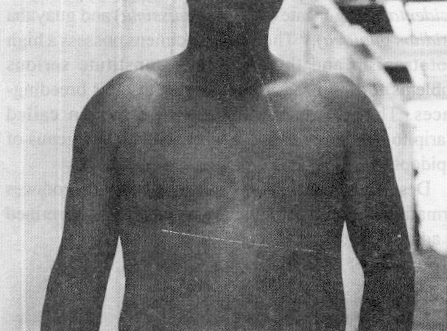
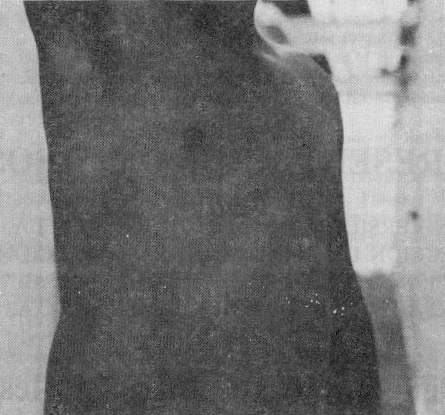
</front><body><![CDATA[ <H3>Presentaci&oacute;n de casos</H3>     <P>Universidad Central de Venezuela, Secci&oacute;n de inmunoqu&iacute;mica y secci&oacute;n de entomolog&iacute;a m&eacute;dica del Instituto de Medicina Tropical "F&eacute;lix Pifano" Departamento M&eacute;dico de Exgeo C.A. </P> <H2>Dermatitis causada por <I>Hylesia metabus</I> (Lepidoptera: Hemileucidae) en la regi&oacute;n costera del Estado del Delta del Amacuro, Venezuela</H2>     <P><A HREF="#autores"><I>Dr. Alexis Rodr&iacute;guez-Acosta,<SUP>1</SUP> Dr. Hernando Rubiano,<SUP>2</SUP> Lic. Mat&iacute;as Reyes<SUP>3</SUP> y Dra. Carmen Teresa Fern&aacute;ndez<SUP>4</sup></I></A></P> <H4>Resumen</H4>     <P>Se presentan 2 casos de una dermatitis intensa causada por la mariposa <I>Hylesia metabus</I> en un &aacute;rea que hasta el momento, no ha sido descrita como end&eacute;mica para esta especie. Las dermatitits observadas en estos casos pueden describirse como p&aacute;pulas generalizadas salientes, muy circunscritas, pruriginosas, comparables con la urticaria, eritematosas, edema de grado variable; as&iacute; como una erupci&oacute;n monomorfa, consistente en p&aacute;pulas peque&ntilde;as, duras, coronadas por una peque&ntilde;a ves&iacute;cula. Las lesiones descritas de los 2 pacientes evolucionaron con p&aacute;pulas intensamente pruriginosas, durante una semana y al cabo de estos d&iacute;as los pacientes sanaron sin secuelas dermatol&oacute;gicas. </P>     <P>Descriptores DeCS: DERMATITIS/etiolog&iacute;a; LEPIDOPTEROS; VENEZUELA. </P>     <P>Lepidopterism by <I>Hylesia</I> may have been restricted mainly to Suramerica, in the French Guayana,<SUP>1-3</SUP> Argentina,<SUP>4-6</SUP> Per&uacute;,<SUP>7</SUP> Brazil<SUP>8</SUP> and Venezuela.<SUP>9,10</SUP> <I>Hylesia metabus</I> is the species most common in Venezuela, presents in the swamp zones of the eastern country, particularly in Sucre, Monagas and Delta Amacuro States. These butterflies are extremely prolific, accomplishing ovipositions from 200 to 300 eggs that deposit them in any place, preferably in its host trees which are the mangrove (<I>Rhizophora mangle</I>), merey (<I>Anacardium occidentalis</I>), aguacate (<I>Persea gratissima</I>) and guayaba (<I>Psidium guajava</I>).<SUP>10</SUP> The adult specimens possess a high phototropism and therefore they constitute serious problems for the nearby populations to their breeding-places. The internationally known affection called "Caripito itch" is a dermatitis produced by this genus of Lepidoptera.<SUP>7,10</SUP> </P> <H4>Despite the fact that the caterpillar can also produces dermatitis, the most frequent accidents are determined by adults.</H4>     <P>The venomous appliance of the butterfly is constituted by hollow thorns disseminated between the hair of the abdomen, communicated with unicellular glands included in the epidermis. The accidents happen by a simple contact with the animal or with the hair detached during the fluttering and it is of high intensity when the butterfly is crushed on the skin. Generally, dermatitis and other manifestations produced by this genus take place in epidemic outbreaks, appearing throughout of the year when <I>Hylesia</I> abound in number. </P>     <P>This report describes two cases of intense dermatitis caused by <I>Hylesia metabus</I> in a non described area of geographical distribution in Venezuela. Puerto Coporito is a place located in the Ca&ntilde;o Macareo, north of Delta Amacuro State, Venezuela, At 0 meters of altitude; 85 % of humidity with a rainfall rate of 2 000 mm per year. </P> <H4>Clinical records</H4>     <P><I>Case 1.</i> On March 9, 1997 a warm calm day in Puerto Coporito, Ca&ntilde;o Macareo, north Delta Amacuro, a 32-year-old man was walking across the forest while on a oil exploration expedition. He was wearing only trousers. He had seen a number of butterflies in the trees, but suddenly one moved out quickly from the tree and put up on the chest patient. After 15 minutes he started to complain from burn sensation and itching and then an erythematous and pruriginous lesions appeared. At 24 hours after the contact, the patient consulted to us presenting erythemato, papulous and pruriginous lesions in anterior toraxic region, which covered nearly all skin of the pectoral region (figs. 1 and 2). </P>     <P ALIGN="CENTER"><A HREF="/img/revistas/mtr/v50n3/f0109398.gif"><IMG SRC="/img/revistas/mtr/v50n3/f0109398.gif" BORDER=0 WIDTH=184 HEIGHT=136 ALT="Figura 1"></A></P>     
]]></body>
<body><![CDATA[<P ALIGN="CENTER">Fig. 1. Anterior view of dermatitis produced by butterfly <I>Hylesia metabus.</i></P>     <P ALIGN="CENTER"><A HREF="/img/revistas/mtr/v50n3/f0209398.gif"><IMG SRC="/img/revistas/mtr/v50n3/f0209398.gif" BORDER=0 WIDTH=179 HEIGHT=167 ALT="Figura 2"></A></P>     
<P ALIGN="CENTER">Fig. 2. Lateral view of dermatitis produced by butterfly <I>Hylesia metabus.</i></P>     <P>The lesions evolved to intensely pruriginous papulas and the clinical picture, whose duration was of approximately one week then returned residual lesions. In the treatment systemic antihistamines, topical corticosteroids and cold compresses were used. </P>     <P><I>Case 2.</i> This case corresponden to a physician from the area, who was working in Mariusa, a palaphitic population in Delta Amacuro. A butterfly grubbed to him and put up on the left arm and hand, presenting a burn sensation, that it was supplanted by an evolution of erythemato, papulous and pruriginous lesions similar to the above case. The physician was treated with systemic antihistamines. </P> <H4>Discussion</H4>     <P>The dermatitis produced by <I>Hylesia metabus</I> can be grouped as generalized and projected papulas, very limited, pruriginous, erythematous and edema of variable degree, comparable to the nettle-rash. In other cases, are seen as a monomorphic eruption, consistent of small papulas, hard and crowned by a small vesicle.<SUP>11</SUP> We can see also, located lesions, very similar to contact eczematiform dermatitis, characterized by well delimited plates, in high relief red color. It is observed also rhinopharingitis manifestations, very similar to the allergic vasomotor rhinitis<SUP>9</SUP> and bronchial symptoms of asthmatiform type. It also has been observed ocular forms characterized by palpebral edema, congestion and conjuntival edema in occasions vesiculous that to be opened let ulcerations that heal in a variable time. </P>     <P>Our cases were restricted to a dermatitis symptomatology because the therapy was administrated quickly. However, the rash persisted for a week. The patients reported that these hairlets were detached easily and become airborne in light breezes or other disturbances. On contacting skin they penetrate readily, and their barbs ensure that many of them penetrate further. Therefore, skin entry results in a florid maculopapulovesicular dermatitis (figs. 1 and 2). </P> <H4>Summary</H4>     <P>2 cases of acute dermatitis caused by butterfly <I>Hylesia metabus</I> in an area that so far has not been considered as endemic for this species were presented. The dermatitis observed in these individuals may be described as very circumscribed, pruriginous, erythematous generalized protruding papulas that may be compared with urticaria, and with a variable degree oedema. Monomorphic eruption consisting in small hard papulas crowned by a little vesicle was also present. The lesions of these 2 patients evoluted with intensely pruriginous papulas for a week and after that they healed without dermatological sequelae. </P>     <P>Subject headings: DERMATITIS/etiology; LEPIDOPTERA; VENEZUELA. </P> <H4>Referencias Bibliogr&aacute;ficas</H4> <OL>      <!-- ref --><LI>Boy&eacute; R. La papillonite guyanaise. Bull Soc Pathol Exot 1932;25:1099-2007.</LI>    <!-- ref --><LI>Leger M, Mouzels P. Dermatoses prurigineuse determinee par des pappilons saturnidae du genre Hylesia. Bull Soc Pathol Exot 1918;11:104-107.</LI>    <!-- ref --><LI>Tisseuil J. Contribution a l’&eacute;tude de la papillonite guyanaise. Bull Soc Pathol Exot 1935;28:719-21.</LI>    <!-- ref --><LI>Dallas ED. Otro caso de dermitis extendida, producida por un lepid&oacute;ptero y notas sobre Hylesia nigricans Ber (Lepidoptera: Bombicidade). Anais. Buenos Aires: Universidad de Buenos Aires, 1993:469-74.</LI>    <!-- ref --><LI>Jorg ME. Nota previa sobre el principio activo urtigante de <I>Hylesia nigricans</I> (Lepidoptera: Hemileucidae) y las dermitis provocadas por el mismo. Anais. Buenos Aires: Universidad de Buenos Aires, 1993:482-95.</LI>    <!-- ref --><LI>Jorg ME. Dermatosis lepidopterianas (segunda nota). Anais. Jujuy: Universidad de Buenos Aires, 1993:1617-35.</LI>    <!-- ref --><LI>Allard HF, Allard HA. Venomous moths and butterflies. J Washington Acad Sci 1958;48:18-51.</LI>    <!-- ref --><LI>Moreno C, Cardoso JL, Carreri-Bruno GC, Domingos MF, Pinto RH, Carvalho, R. Surtos epidemicos de dermatite causada por mariposas do genero Hylesia<I> </I>(Lepidoptera: Hemileucidae) in S. Paulo State, Brazil. Rev Saud Publ 1993;217-220.</LI>    <!-- ref --><LI>Pifano F. Las dermatozoonosis en el area tropical, especialmente en Venezuela. Tesis de la C&aacute;tedra de Medicina Tropical. Universidad Central de Venezuela. Caracas, Venezuela. 1980;s.d:1-20.</LI>    <!-- ref --><LI>Vasquez LN. Problem&aacute;tica de la palometa Hylesia metabus Crammer en la regi&oacute;n nor-oriental venezolana. Mem. VCL. Entomol 1993;27.</LI>    <!-- ref --><LI>Arias H. Dermatitis por Hylesia nigricans<I>.</I> Arch Argent Dermatol 1981;31:171-80.</LI>    </OL>      <P>Recibido: 12 de mayo de 1997. Aprobado: 15 de septiembre de 1998.     <BR> Dr. <I>Alexis Rodr&iacute;guez-Acosta.</I> Apartado 47423. Caracas 1041. Venezuela. </P> <OL>      <LI><A NAME="autores"></A>Profesor Titular en Medicina Tropical. Instituto de Medicina Tropical de la Universidad Central de Venezuela.</LI>     <LI>M&eacute;dico de la Empresa Exgeo C.A.</LI>     <LI>Profesor Instructor. Instituto de Medicina Tropical de la Universidad Central de Venezuela.</LI>     <LI>Profesora Instructora. C&aacute;tedra de Medicina Tropical de la Universidad Central de Venezuela.</LI>    </OL>  <H5></H5>     ]]></body><back>
<ref-list>
<ref id="B1">
<nlm-citation citation-type="journal">
<person-group person-group-type="author">
<name>
<surname><![CDATA[Boyé]]></surname>
<given-names><![CDATA[R]]></given-names>
</name>
</person-group>
<article-title xml:lang="en"><![CDATA[La papillonite guyanaise]]></article-title>
<source><![CDATA[Bull Soc Pathol Exot]]></source>
<year>1932</year>
<volume>25</volume>
<page-range>1099-2007</page-range></nlm-citation>
</ref>
<ref id="B2">
<nlm-citation citation-type="journal">
<person-group person-group-type="author">
<name>
<surname><![CDATA[Leger]]></surname>
<given-names><![CDATA[M]]></given-names>
</name>
<name>
<surname><![CDATA[Mouzels]]></surname>
<given-names><![CDATA[P]]></given-names>
</name>
</person-group>
<article-title xml:lang="en"><![CDATA[Dermatoses prurigineuse determinee par des pappilons saturnidae du genre Hylesia]]></article-title>
<source><![CDATA[Bull Soc Pathol Exot]]></source>
<year>1918</year>
<volume>11</volume>
<page-range>104-107</page-range></nlm-citation>
</ref>
<ref id="B3">
<nlm-citation citation-type="journal">
<person-group person-group-type="author">
<name>
<surname><![CDATA[Tisseuil]]></surname>
<given-names><![CDATA[J]]></given-names>
</name>
</person-group>
<article-title xml:lang="en"><![CDATA[Contribution a l’étude de la papillonite guyanaise]]></article-title>
<source><![CDATA[Bull Soc Pathol Exot]]></source>
<year>1935</year>
<volume>28</volume>
<page-range>719-21</page-range></nlm-citation>
</ref>
<ref id="B4">
<nlm-citation citation-type="book">
<person-group person-group-type="author">
<name>
<surname><![CDATA[Dallas]]></surname>
<given-names><![CDATA[ED]]></given-names>
</name>
</person-group>
<source><![CDATA[Otro caso de dermitis extendida, producida por un lepidóptero y notas sobre Hylesia nigricans Ber (Lepidoptera: Bombicidade)]]></source>
<year>1993</year>
<page-range>469-74</page-range><publisher-loc><![CDATA[Buenos Aires ]]></publisher-loc>
<publisher-name><![CDATA[Universidad de Buenos Aires]]></publisher-name>
</nlm-citation>
</ref>
<ref id="B5">
<nlm-citation citation-type="book">
<person-group person-group-type="author">
<name>
<surname><![CDATA[Jorg]]></surname>
<given-names><![CDATA[ME]]></given-names>
</name>
</person-group>
<source><![CDATA[Nota previa sobre el principio activo urtigante de Hylesia nigricans (Lepidoptera: Hemileucidae) y las dermitis provocadas por el mismo]]></source>
<year>1993</year>
<page-range>482-95</page-range><publisher-loc><![CDATA[Buenos Aires ]]></publisher-loc>
<publisher-name><![CDATA[Universidad de Buenos Aires]]></publisher-name>
</nlm-citation>
</ref>
<ref id="B6">
<nlm-citation citation-type="book">
<person-group person-group-type="author">
<name>
<surname><![CDATA[Jorg]]></surname>
<given-names><![CDATA[ME]]></given-names>
</name>
</person-group>
<source><![CDATA[Dermatosis lepidopterianas (segunda nota)]]></source>
<year>1993</year>
<page-range>1617-35.</page-range><publisher-loc><![CDATA[Jujuy ]]></publisher-loc>
<publisher-name><![CDATA[Universidad de Buenos Aires]]></publisher-name>
</nlm-citation>
</ref>
<ref id="B7">
<nlm-citation citation-type="journal">
<person-group person-group-type="author">
<name>
<surname><![CDATA[Allard]]></surname>
<given-names><![CDATA[HF]]></given-names>
</name>
<name>
<surname><![CDATA[Allard]]></surname>
<given-names><![CDATA[HA]]></given-names>
</name>
</person-group>
<article-title xml:lang="en"><![CDATA[Venomous moths and butterflies]]></article-title>
<source><![CDATA[J Washington Acad Sci]]></source>
<year>1958</year>
<volume>48</volume>
<page-range>18-51</page-range></nlm-citation>
</ref>
<ref id="B8">
<nlm-citation citation-type="journal">
<person-group person-group-type="author">
<name>
<surname><![CDATA[Moreno]]></surname>
<given-names><![CDATA[C]]></given-names>
</name>
<name>
<surname><![CDATA[Cardoso]]></surname>
<given-names><![CDATA[JL]]></given-names>
</name>
<name>
<surname><![CDATA[Carreri-Bruno]]></surname>
<given-names><![CDATA[GC]]></given-names>
</name>
<name>
<surname><![CDATA[Domingos]]></surname>
<given-names><![CDATA[MF]]></given-names>
</name>
<name>
<surname><![CDATA[Pinto]]></surname>
<given-names><![CDATA[RH]]></given-names>
</name>
<name>
<surname><![CDATA[Carvalho]]></surname>
<given-names><![CDATA[R]]></given-names>
</name>
</person-group>
<article-title xml:lang="es"><![CDATA[Surtos epidemicos de dermatite causada por mariposas do genero Hylesia (Lepidoptera: Hemileucidae) in S. Paulo State, Brazil]]></article-title>
<source><![CDATA[Rev Saud Publ]]></source>
<year>1993</year>
<page-range>217-220</page-range></nlm-citation>
</ref>
<ref id="B9">
<nlm-citation citation-type="">
<person-group person-group-type="author">
<name>
<surname><![CDATA[Pifano]]></surname>
<given-names><![CDATA[F]]></given-names>
</name>
</person-group>
<source><![CDATA[Las dermatozoonosis en el area tropical, especialmente en Venezuela: Tesis de la Cátedra de Medicina Tropical]]></source>
<year>1980</year>
<page-range>1-20</page-range><publisher-loc><![CDATA[Caracas^eVenezuela Venezuela]]></publisher-loc>
</nlm-citation>
</ref>
<ref id="B10">
<nlm-citation citation-type="journal">
<person-group person-group-type="author">
<name>
<surname><![CDATA[Vasquez]]></surname>
<given-names><![CDATA[LN]]></given-names>
</name>
</person-group>
<article-title xml:lang="es"><![CDATA[Problemática de la palometa Hylesia metabus Crammer en la región nor-oriental venezolana. Mem. VCL]]></article-title>
<source><![CDATA[Entomol]]></source>
<year>1993</year>
<volume>27</volume>
</nlm-citation>
</ref>
<ref id="B11">
<nlm-citation citation-type="journal">
<person-group person-group-type="author">
<name>
<surname><![CDATA[Arias]]></surname>
<given-names><![CDATA[H]]></given-names>
</name>
</person-group>
<article-title xml:lang="es"><![CDATA[Dermatitis por Hylesia nigricans]]></article-title>
<source><![CDATA[Arch Argent Dermatol]]></source>
<year>1981</year>
<volume>31</volume>
<page-range>171-80</page-range></nlm-citation>
</ref>
</ref-list>
</back>
</article>
