<?xml version="1.0" encoding="ISO-8859-1"?><article xmlns:mml="http://www.w3.org/1998/Math/MathML" xmlns:xlink="http://www.w3.org/1999/xlink" xmlns:xsi="http://www.w3.org/2001/XMLSchema-instance">
<front>
<journal-meta>
<journal-id>0375-0760</journal-id>
<journal-title><![CDATA[Revista Cubana de Medicina Tropical]]></journal-title>
<abbrev-journal-title><![CDATA[Rev Cubana Med Trop]]></abbrev-journal-title>
<issn>0375-0760</issn>
<publisher>
<publisher-name><![CDATA[Centro Nacional de Información de Ciencias Médicas]]></publisher-name>
</publisher>
</journal-meta>
<article-meta>
<article-id>S0375-07601998000400008</article-id>
<title-group>
<article-title xml:lang="es"><![CDATA[Neuropatía epidémica: Hipótesis etiopatogénica]]></article-title>
</title-group>
<contrib-group>
<contrib contrib-type="author">
<name>
<surname><![CDATA[Más Lago]]></surname>
<given-names><![CDATA[Pedro]]></given-names>
</name>
<xref ref-type="aff" rid="A01"/>
</contrib>
</contrib-group>
<aff id="A01">
<institution><![CDATA[,Instituto de Medicina Tropical Pedro Kourí  ]]></institution>
<addr-line><![CDATA[Ciudad de La Habana ]]></addr-line>
<country>Cuba</country>
</aff>
<pub-date pub-type="pub">
<day>00</day>
<month>00</month>
<year>1998</year>
</pub-date>
<pub-date pub-type="epub">
<day>00</day>
<month>00</month>
<year>1998</year>
</pub-date>
<volume>50</volume>
<fpage>259</fpage>
<lpage>263</lpage>
<copyright-statement/>
<copyright-year/>
<self-uri xlink:href="http://scielo.sld.cu/scielo.php?script=sci_arttext&amp;pid=S0375-07601998000400008&amp;lng=en&amp;nrm=iso"></self-uri><self-uri xlink:href="http://scielo.sld.cu/scielo.php?script=sci_abstract&amp;pid=S0375-07601998000400008&amp;lng=en&amp;nrm=iso"></self-uri><self-uri xlink:href="http://scielo.sld.cu/scielo.php?script=sci_pdf&amp;pid=S0375-07601998000400008&amp;lng=en&amp;nrm=iso"></self-uri><abstract abstract-type="short" xml:lang="es"><p><![CDATA[Se formula una hipótesis etiopatogénica que toma en consideración los resultados más significativos de las investigaciones realizadas sobre la neuropatía y los últimos conocimientos acerca de las infecciones producidas por Enterovirus. La hipótesis permite dar una interpretación lógica a estos resultados. Los nuevos aspectos que plantea la hacen controvertida a la luz actual de los conocimientos de la patogenia por Enterovirus y necesita de más investigaciones que permitan su confirmación o no.]]></p></abstract>
<abstract abstract-type="short" xml:lang="en"><p><![CDATA[An etiopathogenic hypothesis is explained taking into consideration the most significant results of the research performed on neuropathy as well as the latest knowledge about the infections produced by Enterovirus. The hypothesis allows to make a logical interpretation of these results; however, the new aspects included make it controversial in the light of the present knowledge of pathogeny by Enterovirus. Further research is needed to confirm this hypothesis.]]></p></abstract>
<kwd-group>
<kwd lng="es"><![CDATA[NEURITIS]]></kwd>
<kwd lng="es"><![CDATA[ENTEROVIRUS]]></kwd>
<kwd lng="es"><![CDATA[CUBA]]></kwd>
<kwd lng="es"><![CDATA[BROTES DE ENFERMEDADES]]></kwd>
<kwd lng="en"><![CDATA[NEURITIS]]></kwd>
<kwd lng="en"><![CDATA[ENTEROVIRUS]]></kwd>
<kwd lng="en"><![CDATA[CUBA]]></kwd>
<kwd lng="en"><![CDATA[DISEASE OUTBREAKS]]></kwd>
</kwd-group>
</article-meta>
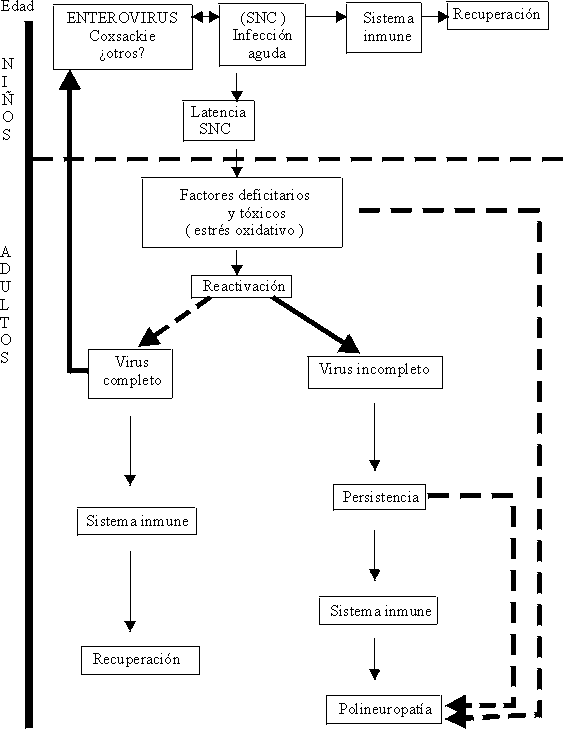
</front><body><![CDATA[   <h5>&nbsp; </h5>  <h3> COMUNICACI&Oacute;N BREVE</h3> INSTITUTO DE MEDICINA TROPICAL "PEDRO KOUR&Iacute;" <h2> Neuropat&iacute;a epid&eacute;mica. Hip&oacute;tesis etiopatog&eacute;nica</h2> <i><a href="#autores">Dr. Pedro M&aacute;s Lago<sup>1</sup></a></i> <h4> RESUMEN</h4> Se formula una hip&oacute;tesis etiopatog&eacute;nica que toma en consideraci&oacute;n los resultados m&aacute;s significativos de las investigaciones realizadas sobre la neuropat&iacute;a y los &uacute;ltimos conocimientos acerca de las infecciones producidas por<i> Enterovirus</i>. La hip&oacute;tesis permite dar una interpretaci&oacute;n l&oacute;gica a estos resultados. Los nuevos aspectos que plantea la hacen controvertida a la luz actual de los conocimientos de la patogenia por<i> Enterovirus </i>y necesita de m&aacute;s investigaciones que permitan su confirmaci&oacute;n o no.     <p>Descriptores DeCS: NEURITIS/ epidemiolog&iacute;a; NEURITIS/ etiolog&iacute;a; ENTEROVIRUS/ gen&eacute;tica; CUBA; BROTES DE ENFERMEDADES.     <p>En el curso de la epidemia de neuropat&iacute;a, ocurrida en Cuba en 1992/1993, enfermedad que se ha mantenido con una baja incidencia en los a&ntilde;os posteriores, se aislaron de l&iacute;quido cefalorraqu&iacute;deo (LCR) de pacientes, agentes virales que mostraron 2 tipos de efecto citopatog&eacute;nico (ECP): uno t&iacute;pico de<i> Enterovirus</i> en un reducido n&uacute;mero de casos y otro de efecto m&aacute;s ligero (ECP-L) en la mayor&iacute;a de los pacientes. Los estudios por neutralizaci&oacute;n e Inmunobloting mostraron que los virus con ECP de <i>Enterovirus</i> eran Coxsackie A9 (CA9), mientras que los productores de ECP-L est&aacute;n relacionados antig&eacute;nicamente con los virus CA9 y Coxsackie B4 (CB4).     <p>Teniendo en consideraci&oacute;n los resultados m&aacute;s significativos en las investigaciones toxicol&oacute;gicas, nutricionales, epidemiol&oacute;gicas, histopatol&oacute;gicas, inmunol&oacute;gicas y virol&oacute;gicas realizadas en el curso de la epidemia, as&iacute; como los nuevos conocimientos en las infecciones por<i> Enterovirus,</i> y los resultados de la caracterizaci&oacute;n de los virus aislados, hemos formulado una hip&oacute;tesis etiopatog&eacute;nica que permite integrar fisiopatol&oacute;gicamente los distintos resultados, la cual se presenta de forma esquem&aacute;tica en la figura. En ella planteamos que las infecciones primarias por<i> Enterovirus,</i> ocurridas fundamentalmente en los primeros a&ntilde;os de vida, afectan con frecuencia el sistema nervioso central (SNC), pudiendo dejar genomas o partes de &eacute;stos de forma latente en las c&eacute;lulas nerviosas. Transcurrido un per&iacute;odo dichos genomas pueden perder el estado de latencia motivado por factores extracelulares de naturaleza t&oacute;xica y/o deficitarios haciendo que &eacute;stos se expresen. La expresi&oacute;n y replicaci&oacute;n de estos &aacute;cidos nucleicos pueden producir part&iacute;culas virales completas y/o incompletas, portadoras de epitopes comunes con estructuras del SNC y con potencialidad para mediar un proceso de autoinmunidad. Las part&iacute;culas incompletas pueden producir una infecci&oacute;n persistente con la perpetuaci&oacute;n del est&iacute;mulo antig&eacute;nico o producir da&ntilde;o por s&iacute; solas.<sup>1</sup>     <center>     <A HREF="/img/revistas/mtr/v50s4/f0108498.gif"><IMG SRC="img/revistas/mtr/v50s1/f0108498.gif" ALT="Figura 1" VSPACE=10 BORDER=1 height=228 width=176></a>          
<br>     Fig. Hip&oacute;tesis patog&eacute;nica de la neuropat&iacute;a epid&eacute;mica.     <br>Tomado de : Referencia bibliogr&aacute;fica 1.</center>      <p><i>Kohne</i> en 1981<sup>2 </sup>y<i> Brahic </i>en 1985<sup>3 </sup>fueron los primeros que, mediante m&eacute;todos de hibridizaci&oacute;n, reportaron la presencia de ARN de <i>Enterovirus</i> en tejidos nerviosos de pacientes con esclerosis lateral amiotr&oacute;fica (ELA) y de controles. <i>Woodall</i> en 1994,<sup>4 </sup>utilizando la reacci&oacute;n en cadena de la polimerasa (RCP), conjuntamente con la hibridizaci&oacute;n, reporta la presencia de secuencias espec&iacute;ficas de<i> Enterovirus</i> en tejido de m&eacute;dula espinal en 73 % (8/11) de pacientes con enfermedad de las neuronas motoras. M&aacute;s tarde, en pacientes con s&iacute;ndrome pospoliomiel&iacute;tico (SPP) se ha confirmado, por t&eacute;cnicas de TR-RCP anidada, la presencia de secuencias de ARN de <i>Enterovirus</i> en tejidos de SNC y en LCR.<sup>5-7 </sup>No obstante, estos hallazgos no han sido relacionados con la patogenia del SPP, por haberse encontrado en otros procesos cr&oacute;nicos degenerativos del SNC e incluso en tejido nervioso de personas sin enfermedades del sistema nervioso (SN).<sup>3,7,8 </sup>La secuenciaci&oacute;n de los fragmentos de ARN encontrados en el SN de los pacientes con SPP, sugieren la ausencia de genomas virales completos y muestran, en algunos casos, mayor homolog&iacute;a con los virus Coxsackie.<sup>8 </sup>Otro hecho que apoya el estado de latencia de ARN de <i>Enterovirus</i> en el SNC est&aacute; dado por su frecuente hallazgo en personas fallecidas de enfermedades no relacionadas con el SN varios a&ntilde;os despu&eacute;s de haber padecido una poliomielitis aguda habi&eacute;ndose mantenido compensada despu&eacute;s.<sup>8</sup>     <p>De forma experimental se ha visto que despu&eacute;s de una infecci&oacute;n aguda en ratones inmunocompetentes se pueden mantener latentes los ARN del virus Sindbis durante largo tiempo, al cabo del cual pueden ser reactivados tratando los animales con suero inmune al virus.<sup>9 </sup>Al igual que el de los<i> Enterovirus,</i> el ARN del virus Sindbis es monocaternario y de sentido positivo. Otros ejemplos de latencia con reactivaci&oacute;n lo constituyen miembros de la familia Herpesviridae, aunque en estos casos se trata de virus ADN.     <p>En la tabla 1 hacemos una recopilaci&oacute;n de algunos resultados obtenidos por diferentes investigadores en la b&uacute;squeda de ARN de <i>Enterovirus </i>en tejido nervioso y LCR de pacientes con enfermedades cr&oacute;nicas degenerativas del SN y en pacientes controles con enfermedades no infecciosas del SN o que afectan otros &oacute;rganos. Es de inter&eacute;s destacar c&oacute;mo en los LCR de los controles, a pesar de constituir el grupo m&aacute;s numeroso, los resultados son negativos, mientras que en tejido nervioso, con menor n&uacute;mero de muestras, se obtienen resultados positivos en pacientes y controles. El an&aacute;lisis de estos datos sugieren que la presencia de ARN de <i>Enterovirus </i>en el SN puede constituir un hecho frecuente que sigue a una infecci&oacute;n primaria. Estos ARN podr&iacute;an mantenerse latentes durante mucho tiempo sin producir manifestaciones cl&iacute;nicas y su presencia en el LCR indicar replicaci&oacute;n y causa de enfermedad, pues la inestabilidad qu&iacute;mica de estas mol&eacute;culas har&iacute;an que ellas desaparecieran del LCR con relativa rapidez despu&eacute;s de una infecci&oacute;n aguda.     ]]></body>
<body><![CDATA[<p>TABLA 1. Investigaci&oacute;n de ARN de <i>Enterovirus</i> en grupos de enfermos y controles seg&uacute;n tipo de muestra     <center><table CELLPADDING=4 > <tr> <td VALIGN=TOP WIDTH="20%">&nbsp;</td>  <td VALIGN=TOP COLSPAN="2" WIDTH="40%">     <center>LCR</center> </td>  <td VALIGN=TOP COLSPAN="2" WIDTH="40%">     <center>Tejido nervioso</center> </td> </tr>  <tr> <td VALIGN=TOP WIDTH="20%">&nbsp;</td>  <td VALIGN=TOP WIDTH="20%">     <center>No.</center> </td>  <td VALIGN=TOP WIDTH="20%">     <center>Positivos</center> </td>  <td VALIGN=TOP WIDTH="20%">     <center>No.</center> </td>  <td VALIGN=TOP WIDTH="20%">     <center>Positivos</center> </td> </tr>  <tr> <td VALIGN=TOP WIDTH="20%">Enfermos</td>  <td VALIGN=TOP WIDTH="20%">     <center>58</center> </td>  <td VALIGN=TOP WIDTH="20%">     <center>13 (22,4 %)</center> </td>  <td VALIGN=TOP WIDTH="20%">     ]]></body>
<body><![CDATA[<center>31</center> </td>  <td VALIGN=TOP WIDTH="20%">     <center>7 (22,6 %)</center> </td> </tr>  <tr> <td VALIGN=TOP WIDTH="20%">Controles</td>  <td VALIGN=TOP WIDTH="20%">     <center>100&nbsp;</center> </td>  <td VALIGN=TOP WIDTH="20%">     <center>0 (0,0)</center> </td>  <td VALIGN=TOP WIDTH="20%">     <center>10</center> </td>  <td VALIGN=TOP WIDTH="20%">     <center>1 (10,0 %)</center> </td> </tr> </table></center>      <center>Tomado de: Referencia bibliogr&aacute;fica 1.     <br>Fuente: Referencias bibliogr&aacute;ficas 3, 5 y 7.</center>      <p>La reactivaci&oacute;n de genomas latentes de<i> Enterovirus</i> que den la informaci&oacute;n gen&eacute;tica para la s&iacute;ntesis de las prote&iacute;nas que codifican puede explicar la demostraci&oacute;n de ant&iacute;genos no estructurales de virus CA9 y CB4 en inmunocomplejos circulantes en pacientes con ELA,<sup>10</sup> as&iacute; como los ant&iacute;genos capaces de inducir la formaci&oacute;n de IgM espec&iacute;fica a Poliovirus en el LCR de pacientes con SPP.     <p>Todos los estudios epidemiol&oacute;gicos realizados en la neuropat&iacute;a epid&eacute;mica han puesto en evidencia el car&aacute;cter no transmisible de la enfermedad. La reactivaci&oacute;n de genomas o partes de &eacute;stos, capaces de replicarse dando una infecci&oacute;n persistente ser&iacute;a la explicaci&oacute;n m&aacute;s l&oacute;gica para la participaci&oacute;n de un agente viral en una enfermedad que no tiene car&aacute;cter contagioso. Tambi&eacute;n la reactivaci&oacute;n de esos ARN permitir&iacute;a explicar lo poco frecuente de la enfermedad en los menores de 15 a&ntilde;os, donde las infecciones por <i>Enterovirus</i> cursan por lo general de forma aguda. Esta explicaci&oacute;n para la patogenia de la neuropat&iacute;a epid&eacute;mica recuerda el SPP que se produce generalmente 15-25 a&ntilde;os despu&eacute;s de la infecci&oacute;n aguda.     ]]></body>
<body><![CDATA[<p>El an&aacute;lisis de la circulaci&oacute;n de los <i>Enterovirus </i>que han producido epidemias de meningoencefalitis viral en Cuba en los &uacute;ltimos 26 a&ntilde;os (tabla 2) se comporta como la cl&aacute;sicamente descrita "circulaci&oacute;n en oleadas" para estos virus. Es decir, ellos predominan 1 &oacute; 2 a&ntilde;os para desaparecer y reemerger a los 6-10 a&ntilde;os, per&iacute;odo necesario para que se acumule una poblaci&oacute;n susceptible.     <center>TABLA 2. Circulaci&oacute;n de <i>Enterovirus</i> epid&eacute;micos en Cuba en los &uacute;ltimos 26 a&ntilde;os</center>      <center><table CELLPADDING=4 > <tr> <td VALIGN=TOP WIDTH="17%">&nbsp;</td>  <td VALIGN=TOP COLSPAN="5" WIDTH="83%">     <center>A&ntilde;o</center> </td> </tr>  <tr> <td VALIGN=TOP WIDTH="17%">Virus&nbsp;</td>  <td VALIGN=TOP WIDTH="17%">     <center>1ro.</center> </td>  <td VALIGN=TOP WIDTH="17%">     <center>2do.</center> </td>  <td VALIGN=TOP WIDTH="17%">     <center>3ro.</center> </td>  <td VALIGN=TOP WIDTH="17%">     <center>4to.</center> </td>  <td VALIGN=TOP WIDTH="17%">     <center>5to.</center> </td> </tr>  <tr> <td VALIGN=TOP WIDTH="17%">ECHO 4</td>  <td VALIGN=TOP WIDTH="17%">     <center>1972</center> </td>  <td VALIGN=TOP WIDTH="17%">     ]]></body>
<body><![CDATA[<center>Pred.</center> </td>  <td VALIGN=TOP WIDTH="17%">     <center>No pred.</center> </td>  <td VALIGN=TOP WIDTH="17%">     <center>No</center> </td>  <td VALIGN=TOP WIDTH="17%">     <center>No</center> </td> </tr>  <tr> <td VALIGN=TOP WIDTH="17%">&nbsp;</td>  <td VALIGN=TOP WIDTH="17%">     <center>1986</center> </td>  <td VALIGN=TOP WIDTH="17%">     <center>Pred.</center> </td>  <td VALIGN=TOP WIDTH="17%">     <center>No pred.</center> </td>  <td VALIGN=TOP WIDTH="17%">     <center>No</center> </td>  <td VALIGN=TOP WIDTH="17%">     <center>No</center> </td> </tr>  <tr> <td VALIGN=TOP WIDTH="17%">ECHO 30</td>  <td VALIGN=TOP WIDTH="17%">     <center>1994</center> </td>  <td VALIGN=TOP WIDTH="17%">     ]]></body>
<body><![CDATA[<center>Pred.</center> </td>  <td VALIGN=TOP WIDTH="17%">     <center>No</center> </td>  <td VALIGN=TOP WIDTH="17%">     <center>No</center> </td>  <td VALIGN=TOP WIDTH="17%">     <center>No</center> </td> </tr>  <tr> <td VALIGN=TOP WIDTH="17%">CB5</td>  <td VALIGN=TOP WIDTH="17%">     <center>1976</center> </td>  <td VALIGN=TOP WIDTH="17%">     <center>Pred.</center> </td>  <td VALIGN=TOP WIDTH="17%">     <center>No</center> </td>  <td VALIGN=TOP WIDTH="17%">     <center>No</center> </td>  <td VALIGN=TOP WIDTH="17%">     <center>No</center> </td> </tr>  <tr> <td VALIGN=TOP WIDTH="17%">&nbsp;</td>  <td VALIGN=TOP WIDTH="17%">     <center>1995</center> </td>  <td VALIGN=TOP WIDTH="17%">     ]]></body>
<body><![CDATA[<center>Pred.</center> </td>  <td VALIGN=TOP WIDTH="17%">     <center>No</center> </td>  <td VALIGN=TOP WIDTH="17%">     <center>No</center> </td>  <td VALIGN=TOP WIDTH="17%">     <center>?</center> </td> </tr>  <tr> <td VALIGN=TOP WIDTH="17%">CA7</td>  <td VALIGN=TOP WIDTH="17%">     <center>1988</center> </td>  <td VALIGN=TOP WIDTH="17%">     <center>Pred.</center> </td>  <td VALIGN=TOP WIDTH="17%">     <center>No</center> </td>  <td VALIGN=TOP WIDTH="17%">     <center>No</center> </td>  <td VALIGN=TOP WIDTH="17%">     <center>No</center> </td> </tr>  <tr> <td VALIGN=TOP WIDTH="17%">CA16</td>  <td VALIGN=TOP WIDTH="17%">     <center>1989</center> </td>  <td VALIGN=TOP WIDTH="17%">     ]]></body>
<body><![CDATA[<center>No pred.</center> </td>  <td VALIGN=TOP WIDTH="17%">     <center>No</center> </td>  <td VALIGN=TOP WIDTH="17%">     <center>No</center> </td>  <td VALIGN=TOP WIDTH="17%">     <center>No</center> </td> </tr> </table></center>      <center>Pred: Predominan. No pred.: No predominan.</center>      <p>En el caso del virus CA9 aislado durante la epidemia de neuropat&iacute;a ha tenido un comportamiento distinto al de los otros <i>Enterovirus </i>(tabla 3). El virus CA9 circul&oacute; ampliamente en la poblaci&oacute;n durante los a&ntilde;os 1990/1991 produciendo una epidemia de meningoencefalitis.<sup>11 </sup>Esta gran circulaci&oacute;n dej&oacute; un alto porcentaje de la poblaci&oacute;n con inmunidad para este virus, como fue demostrado por distintos estudios serol&oacute;gicos.<sup>12,13 </sup>Esta inmunidad constituye una barrera que impide su circulaci&oacute;n y explica no haberse aislado en 1992. Sin embargo, a pesar de la alta inmunidad en la poblaci&oacute;n, el CA9 reemerge en 1993 asociado con los pacientes con neuropat&iacute;a. Este comportamiento epidemiol&oacute;gico irregular para un <i>Enterovirus,</i> el car&aacute;cter no transmisible de la enfermedad y su baja tasa en menores de 15 a&ntilde;os son factores que abogan por una reactivaci&oacute;n.     <p>TABLA 3. Circulaci&oacute;n de CA9 en Cuba, 1989-1993 (porcentaje del total de muestras investigadas)     <center><table CELLPADDING=4 > <tr> <td VALIGN=TOP WIDTH="17%">&nbsp;</td>  <td VALIGN=TOP WIDTH="17%">     <center>1989</center> </td>  <td VALIGN=TOP WIDTH="17%">     <center>1990</center> </td>  <td VALIGN=TOP WIDTH="17%">     ]]></body>
<body><![CDATA[<center>1991</center> </td>  <td VALIGN=TOP WIDTH="17%">     <center>1992</center> </td>  <td VALIGN=TOP WIDTH="17%">     <center>1993</center> </td> </tr>  <tr> <td VALIGN=TOP WIDTH="17%">Adultos</td>  <td VALIGN=TOP WIDTH="17%">     <center>0,0 %</center> </td>  <td VALIGN=TOP WIDTH="17%">     <center>5,0 %</center> </td>  <td VALIGN=TOP WIDTH="17%">     <center>3,0 %</center> </td>  <td VALIGN=TOP WIDTH="17%">     <center>0,0 %</center> </td>  <td VALIGN=TOP NOWRAP WIDTH="17%">     <center>80,0% ( ECPL)</center> </td> </tr>  <tr> <td VALIGN=TOP WIDTH="17%">(>15 a&ntilde;os)&nbsp;</td>  <td VALIGN=TOP WIDTH="17%">&nbsp;</td>  <td VALIGN=TOP WIDTH="17%">&nbsp;</td>  <td VALIGN=TOP WIDTH="17%">&nbsp;</td>  <td VALIGN=TOP WIDTH="17%">&nbsp;</td>  <td VALIGN=TOP WIDTH="17%">     <center>4,0 % (CA9)</center> </td> </tr>  <tr> <td VALIGN=TOP WIDTH="17%">Ni&ntilde;os</td>  <td VALIGN=TOP WIDTH="17%">     <center>0,0 %</center> </td>  <td VALIGN=TOP WIDTH="17%">     ]]></body>
<body><![CDATA[<center>15,0 %</center> </td>  <td VALIGN=TOP WIDTH="17%">     <center>11,9 %</center> </td>  <td VALIGN=TOP WIDTH="17%">     <center>0,5 % 4,9 %</center> </td>  <td VALIGN=TOP WIDTH="17%">&nbsp;</td> </tr>  <tr> <td VALIGN=TOP WIDTH="17%">(&lt;15 a&ntilde;os)</td>  <td VALIGN=TOP WIDTH="17%">&nbsp;</td>  <td VALIGN=TOP WIDTH="17%">&nbsp;</td>  <td VALIGN=TOP WIDTH="17%">&nbsp;</td>  <td VALIGN=TOP WIDTH="17%">&nbsp;</td>  <td VALIGN=TOP WIDTH="17%">&nbsp;</td> </tr> </table></center> Es conocido que carencias de selenio y vitamina E hacen incrementar la virulencia del virus Coxsackie B3 en forma experimental.<sup>14,15 </sup>Las cepas mutadas mantienen su virulencia al ser pasadas en ratones normales, sin embargo, ellas no modifican sus caracter&iacute;sticas antig&eacute;nicas. El CA9 aislado durante la epidemia de neuropat&iacute;a presenta modificaciones en sus prote&iacute;nas estructurales que le permiten escapar al sistema inmune y producir infecci&oacute;n persistente, no obstante, la circulaci&oacute;n de este virus mutado (transmisi&oacute;n de persona a persona) har&iacute;a que la neuropat&iacute;a se comportara epidemiol&oacute;gicamente como una enfermedad infecciosa y el n&uacute;mero de casos en menores de 15 a&ntilde;os podr&iacute;a ser mayor.     <p>En un trabajo de colaboraci&oacute;n con la Universidad de Carolina del Norte se ha logrado secuenciar el 90 % del genoma de una cepa de ECP-L aislada del LCR de un paciente con neuropat&iacute;a. Ella muestra gran homolog&iacute;a en su secuencia nucleot&iacute;dica con el CA9 del cual puede considerarse una nueva variante. Los cambios aminoac&iacute;dicos en distintas prote&iacute;nas codificadas en su genoma permiten explicar las caracter&iacute;sticas de estos virus, incluyendo sus relaciones con ant&iacute;genos del SNC.     <p>Por otro lado, la gran variedad de genotipos encontrados, incluso en una misma muestra de LCR (Fuente J, de la. Centro de Ingenier&iacute;a Gen&eacute;tica y Biotecnolog&iacute;a) no es el comportamiento habitual de un virus que produzca una epidemia donde la transmisi&oacute;n de persona a persona sea la forma de difusi&oacute;n de la enfermedad. La epidemiolog&iacute;a molecular se basa en la similitud gen&oacute;mica de las cepas circulantes.     <p>Esta hip&oacute;tesis permite dar una interpretaci&oacute;n l&oacute;gica a los resultados obtenidos en las diferentes investigaciones realizadas durante la epidemia. Los nuevos aspectos que plantea la hacen controvertida a la luz actual de los conocimientos de la patogenia por <i>Enterovirus </i>y necesita de m&aacute;s investigaciones que permitan su confirmaci&oacute;n o no. Tambi&eacute;n consideramos constituye un modelo para el estudio de otras patolog&iacute;as cr&oacute;nicas relacionadas con <i>Enterovirus.</i>     <p>Esta hip&oacute;tesis ha sido formulada basado en el an&aacute;lisis de diferentes resultados obtenidos por el siguiente colectivo de investigadores: Instituto de Medicina Tropical "Pedro Kour&iacute;", <i>Pedro M&aacute;s Lago, Mar&iacute;a Guadalupe Guzm&aacute;n, Jos&eacute; L. Pelegrino, Luis R. Sarmiento, Mayling &Aacute;lvarez, Virginia Cap&oacute;, Rosa E. Palomera, Jos&eacute; Lafert&eacute;, Licel Rodr&iacute;guez, Delfina Rosario, Mayra Mun&eacute;, Ivonne &Aacute;valos, Aida Castillo, Sonia Resik, Ana B. P&eacute;rez, Marit&eacute; Bello, Marta Mayra Comellas, Rosmari Rodr&iacute;guez, Valexys V&aacute;zquez, &Aacute;ngel Goyenechea, Antonio P&eacute;rez, Anselmo Otero, Gissel Garc&iacute;a, Alina Llop y Gustavo Kour&iacute;;</i> UNC Hospital<i>, Jean Handy, Melinda A. Beck y Quing Shi; </i>Univ. Med<i>.</i> New Jersey,<i> Thomas N. Denny.</i> <h4> SUMMARY</h4> An etiopathogenic hypothesis is explained taking into consideration the most significant results of the research performed on neuropathy as well as the latest knowledge about the infections produced by<i> Enterovirus</i>. The hypothesis allows to make a logical interpretation of these results; however, the new aspects included make it controversial in the light of the present knowledge of pathogeny by<i> Enterovirus.</i> Further research is needed to confirm this hypothesis.     <p>Subject headings: NEURITIS/epidemiology; NEURITIS/etiology; ENTEROVIRUS/genetics; CUBA; DISEASE OUTBREAKS. <h4> REFERENCIAS BIBLIOGR&Aacute;FICAS</h4>  <ol>     <!-- ref --><li> M&aacute;s LP, Guzm&aacute;n MG, Sarmiento L, P&eacute;rez AB, &Aacute;lvarez M, Cap&oacute; V, et al. Mecanismo de participaci&oacute;n de los Enterovirus en la neuropat&iacute;a epid&eacute;mica. Hip&oacute;tesis fisiopatol&oacute;gicas. Rev Cubana Med Trop 1997;49(3):186-95.    </li>      ]]></body>
<body><![CDATA[<!-- ref --><li> Kohne DE, Gibss CJ, White L. Virus detection by nucleic acid hybridization: examination of normal and ALS tissues for the presence of poliovirus. J Gen Virol 1981;56:223-33.    </li>      <!-- ref --><li> Brahic M, Smith RA, Gibbs CJ, Garroto RM, Tourtellotee WW, Cash E. Detection of Picornavirus sequences in nervous tissue of amyotrophic lateral sclerosis and control patients. Ann Neurol 1985;18:337-43.    </li>      <!-- ref --><li> Woodall CJ, Riding HM, Graaham DI, Clements GB. Sequences specific for enterovirus detected in spinal cord from patients with motor neurone disease. Br Med J 1994;308:1541-3.    </li>      <!-- ref --><li> Leparc I, Kopecka H, Fuchs F, Janatova I, Aymard M, Julien J. Search for poliovirus in specimens from patients with the post-polio syndrome. Ann NY Acad Sci 1995;753:233-6.    </li>      <!-- ref --><li> Leon-Monzon M, Dalakas MC. Detection of poliovirus antibodies and poliovirus genome in patients with the post-polio sindrome. Ann NY Acad Sci 1995;753:208-18.    </li>      ]]></body>
<body><![CDATA[<!-- ref --><li> Muir P, Nicholson F, Wharief MK, Thompson EJ, Cairns NJ, Lantos P, et al. Evidence for persistent enterovirus infection of the central nervous system in patients with previous paralytic poliomyelitis. Ann NY Acad Sci 1995;753:219-32.    </li>      <!-- ref --><li> Muir P, Nicholson F, Spencer GT, Ajetunmobi JF, Starkey WG, Khan M. Enterovirus infection of the central nervous system of humans: lacks of association with chronic neurological disease. J Gen Virol 1996;77:1469-76.    </li>      <!-- ref --><li> Levine B, Griffin DE. Persistence of viral RNA in mouse brains after recovering from acute Alphavirus encephalites. J Virol 1992;66:6429-35.    </li>      <!-- ref --><li> Bartfeld H, Dham C, Donnenfeld H, Ollar R, Masi M de, Kascsak R. Enteroviral related antigen in circulation immune complexes of amyotrophic lateral sclerosis patients. Int Virol 1989;30:202-12.    </li>      <!-- ref --><li> Bello M, M&aacute;s Lago P, Palomera R, Morier L, &Aacute;valos I, Acosta B, et al. Meningoencefalitis virales por Enterovirus en Cuba en el per&iacute;odo de 1990-1995. Rev Arg Microbiol 1997;29:76-183.    </li>      ]]></body>
<body><![CDATA[<!-- ref --><li> M&aacute;s LP, Balmaseda A, &Aacute;valos I, Castillo A, Guzm&aacute;n MG, Llop A, et al. Neuropat&iacute;a epid&eacute;mica cubana. Parte III: Anticuerpos neutralizantes a cepas aisladas y otros enterovirus en pacientes y personas sanas. Rev Cubana Med Trop 1995;47:21-5.    </li>      <!-- ref --><li> M&aacute;s LP, Pelegrino JL, Guzm&aacute;n MG, Comellas MM, Resik S, &Aacute;lvarez M, et al. Viral isolation from cases of epidemic neuropathy in Cuba. Arch Path Lab Med 1997;121:825-33.    </li>      <!-- ref --><li> Beck MA, Kolbeck PC, Rohr LH, Shi Q, Morris VC, Levander OA. Benign human enterovirus becomes virulent in selenium-deficient mice. J Med Virol 1994;43:166-70.    </li>      <li> . Vitamin E deficiency intensifies the myocardial injury of Coxsackievirus B3 infection in mice. J Nutr 1994;124:345-58.</li>     </ol> Recibido: 2 de septiembre de 1998. Aprobado: 15 de octubre de 1998.     <p>Dr<i>. Pedro M&aacute;s Lago.</i> Instituto de Medicina Tropical "Pedro Kour&iacute;". Apartado 601, Marianao 13, Ciudad de La Habana, Cuba.     <p><sup>1<a NAME="autores"></a></sup>Doctor en Ciencias M&eacute;dicas. Especialista de II Grado en Microbiolog&iacute;a. Investigador Titular. <h5> <a href="mtr09498.htm"></a></h5>      ]]></body>
<body><![CDATA[ ]]></body><back>
<ref-list>
<ref id="B1">
<nlm-citation citation-type="journal">
<person-group person-group-type="author">
<name>
<surname><![CDATA[Más]]></surname>
<given-names><![CDATA[LP]]></given-names>
</name>
<name>
<surname><![CDATA[Guzmán]]></surname>
<given-names><![CDATA[MG]]></given-names>
</name>
<name>
<surname><![CDATA[Sarmiento]]></surname>
<given-names><![CDATA[L]]></given-names>
</name>
<name>
<surname><![CDATA[Pérez]]></surname>
<given-names><![CDATA[AB]]></given-names>
</name>
<name>
<surname><![CDATA[Álvarez]]></surname>
<given-names><![CDATA[M]]></given-names>
</name>
<name>
<surname><![CDATA[Capó]]></surname>
<given-names><![CDATA[V]]></given-names>
</name>
</person-group>
<article-title xml:lang="es"><![CDATA[Mecanismo de participación de los Enterovirus en la neuropatía epidémica: Hipótesis fisiopatológicas]]></article-title>
<source><![CDATA[Rev Cubana Med Trop]]></source>
<year>1997</year>
<volume>49</volume>
<numero>3</numero>
<issue>3</issue>
<page-range>186-95</page-range></nlm-citation>
</ref>
<ref id="B2">
<nlm-citation citation-type="journal">
<person-group person-group-type="author">
<name>
<surname><![CDATA[Kohne]]></surname>
<given-names><![CDATA[DE]]></given-names>
</name>
<name>
<surname><![CDATA[Gibss]]></surname>
<given-names><![CDATA[CJ]]></given-names>
</name>
<name>
<surname><![CDATA[White]]></surname>
<given-names><![CDATA[L]]></given-names>
</name>
</person-group>
<article-title xml:lang="en"><![CDATA[Virus detection by nucleic acid hybridization: examination of normal and ALS tissues for the presence of poliovirus]]></article-title>
<source><![CDATA[J Gen Virol]]></source>
<year>1981</year>
<volume>56</volume>
<page-range>223-33</page-range></nlm-citation>
</ref>
<ref id="B3">
<nlm-citation citation-type="journal">
<person-group person-group-type="author">
<name>
<surname><![CDATA[Brahic]]></surname>
<given-names><![CDATA[M]]></given-names>
</name>
<name>
<surname><![CDATA[Smith]]></surname>
<given-names><![CDATA[RA]]></given-names>
</name>
<name>
<surname><![CDATA[Gibbs]]></surname>
<given-names><![CDATA[CJ]]></given-names>
</name>
<name>
<surname><![CDATA[Garroto]]></surname>
<given-names><![CDATA[RM]]></given-names>
</name>
<name>
<surname><![CDATA[Tourtellotee]]></surname>
<given-names><![CDATA[WW]]></given-names>
</name>
<name>
<surname><![CDATA[Cash]]></surname>
<given-names><![CDATA[E]]></given-names>
</name>
</person-group>
<article-title xml:lang="en"><![CDATA[Detection of Picornavirus sequences in nervous tissue of amyotrophic lateral sclerosis and control patients]]></article-title>
<source><![CDATA[Ann Neurol]]></source>
<year>1985</year>
<volume>18</volume>
<page-range>337-43</page-range></nlm-citation>
</ref>
<ref id="B4">
<nlm-citation citation-type="journal">
<person-group person-group-type="author">
<name>
<surname><![CDATA[Woodall]]></surname>
<given-names><![CDATA[CJ]]></given-names>
</name>
<name>
<surname><![CDATA[Riding]]></surname>
<given-names><![CDATA[HM]]></given-names>
</name>
<name>
<surname><![CDATA[Graaham]]></surname>
<given-names><![CDATA[DI]]></given-names>
</name>
<name>
<surname><![CDATA[Clements]]></surname>
<given-names><![CDATA[GB]]></given-names>
</name>
</person-group>
<article-title xml:lang="en"><![CDATA[Sequences specific for enterovirus detected in spinal cord from patients with motor neurone disease]]></article-title>
<source><![CDATA[Br Med J]]></source>
<year>1994</year>
<volume>308</volume>
<page-range>1541-3</page-range></nlm-citation>
</ref>
<ref id="B5">
<nlm-citation citation-type="journal">
<person-group person-group-type="author">
<name>
<surname><![CDATA[Leparc]]></surname>
<given-names><![CDATA[I]]></given-names>
</name>
<name>
<surname><![CDATA[Kopecka]]></surname>
<given-names><![CDATA[H]]></given-names>
</name>
<name>
<surname><![CDATA[Fuchs]]></surname>
<given-names><![CDATA[F]]></given-names>
</name>
<name>
<surname><![CDATA[Janatova]]></surname>
<given-names><![CDATA[I]]></given-names>
</name>
<name>
<surname><![CDATA[Aymard]]></surname>
<given-names><![CDATA[M]]></given-names>
</name>
<name>
<surname><![CDATA[Julien]]></surname>
<given-names><![CDATA[J]]></given-names>
</name>
</person-group>
<article-title xml:lang="en"><![CDATA[Search for poliovirus in specimens from patients with the post-polio syndrome]]></article-title>
<source><![CDATA[Ann NY Acad Sci]]></source>
<year>1995</year>
<volume>753</volume>
<page-range>233-6</page-range></nlm-citation>
</ref>
<ref id="B6">
<nlm-citation citation-type="journal">
<person-group person-group-type="author">
<name>
<surname><![CDATA[Leon-Monzon]]></surname>
<given-names><![CDATA[M]]></given-names>
</name>
<name>
<surname><![CDATA[Dalakas]]></surname>
<given-names><![CDATA[MC]]></given-names>
</name>
</person-group>
<article-title xml:lang="en"><![CDATA[Detection of poliovirus antibodies and poliovirus genome in patients with the post-polio sindrome]]></article-title>
<source><![CDATA[Ann NY Acad Sci]]></source>
<year>1995</year>
<volume>753</volume>
<page-range>208-18</page-range></nlm-citation>
</ref>
<ref id="B7">
<nlm-citation citation-type="journal">
<person-group person-group-type="author">
<name>
<surname><![CDATA[Muir]]></surname>
<given-names><![CDATA[P]]></given-names>
</name>
<name>
<surname><![CDATA[Nicholson]]></surname>
<given-names><![CDATA[F]]></given-names>
</name>
<name>
<surname><![CDATA[Wharief]]></surname>
<given-names><![CDATA[MK]]></given-names>
</name>
<name>
<surname><![CDATA[Thompson]]></surname>
<given-names><![CDATA[EJ]]></given-names>
</name>
<name>
<surname><![CDATA[Cairns]]></surname>
<given-names><![CDATA[NJ]]></given-names>
</name>
<name>
<surname><![CDATA[Lantos]]></surname>
<given-names><![CDATA[P]]></given-names>
</name>
</person-group>
<source><![CDATA[Ann NY Acad Sci]]></source>
<year>1995</year>
<volume>753</volume>
<page-range>219-32</page-range></nlm-citation>
</ref>
<ref id="B8">
<nlm-citation citation-type="journal">
<person-group person-group-type="author">
<name>
<surname><![CDATA[Muir]]></surname>
<given-names><![CDATA[P]]></given-names>
</name>
<name>
<surname><![CDATA[Nicholson]]></surname>
<given-names><![CDATA[F]]></given-names>
</name>
<name>
<surname><![CDATA[Spencer]]></surname>
<given-names><![CDATA[GT]]></given-names>
</name>
<name>
<surname><![CDATA[Ajetunmobi]]></surname>
<given-names><![CDATA[JF]]></given-names>
</name>
<name>
<surname><![CDATA[Starkey]]></surname>
<given-names><![CDATA[WG]]></given-names>
</name>
<name>
<surname><![CDATA[Khan]]></surname>
<given-names><![CDATA[M]]></given-names>
</name>
</person-group>
<article-title xml:lang="en"><![CDATA[Enterovirus infection of the central nervous system of humans: lacks of association with chronic neurological disease]]></article-title>
<source><![CDATA[J Gen Virol]]></source>
<year>1996</year>
<volume>77</volume>
<page-range>1469-76</page-range></nlm-citation>
</ref>
<ref id="B9">
<nlm-citation citation-type="journal">
<person-group person-group-type="author">
<name>
<surname><![CDATA[Levine]]></surname>
<given-names><![CDATA[B]]></given-names>
</name>
<name>
<surname><![CDATA[Griffin]]></surname>
<given-names><![CDATA[DE]]></given-names>
</name>
</person-group>
<article-title xml:lang="en"><![CDATA[Persistence of viral RNA in mouse brains after recovering from acute Alphavirus encephalites]]></article-title>
<source><![CDATA[J Virol]]></source>
<year>1992</year>
<volume>66</volume>
<page-range>6429-35</page-range></nlm-citation>
</ref>
<ref id="B10">
<nlm-citation citation-type="journal">
<person-group person-group-type="author">
<name>
<surname><![CDATA[Bartfeld]]></surname>
<given-names><![CDATA[H]]></given-names>
</name>
<name>
<surname><![CDATA[Dham]]></surname>
<given-names><![CDATA[C]]></given-names>
</name>
<name>
<surname><![CDATA[Donnenfeld]]></surname>
<given-names><![CDATA[H]]></given-names>
</name>
<name>
<surname><![CDATA[Ollar]]></surname>
<given-names><![CDATA[R]]></given-names>
</name>
<name>
<surname><![CDATA[Masi]]></surname>
<given-names><![CDATA[M de]]></given-names>
</name>
<name>
<surname><![CDATA[Kascsak]]></surname>
<given-names><![CDATA[R]]></given-names>
</name>
</person-group>
<article-title xml:lang="en"><![CDATA[Enteroviral related antigen in circulation immune complexes of amyotrophic lateral sclerosis patients]]></article-title>
<source><![CDATA[Int Virol]]></source>
<year>1989</year>
<volume>30</volume>
<page-range>202-12</page-range></nlm-citation>
</ref>
<ref id="B11">
<nlm-citation citation-type="journal">
<person-group person-group-type="author">
<name>
<surname><![CDATA[Bello]]></surname>
<given-names><![CDATA[M]]></given-names>
</name>
<name>
<surname><![CDATA[Más Lago]]></surname>
<given-names><![CDATA[P]]></given-names>
</name>
<name>
<surname><![CDATA[Palomera]]></surname>
<given-names><![CDATA[R]]></given-names>
</name>
<name>
<surname><![CDATA[Morier]]></surname>
<given-names><![CDATA[L]]></given-names>
</name>
<name>
<surname><![CDATA[Ávalos]]></surname>
<given-names><![CDATA[I]]></given-names>
</name>
<name>
<surname><![CDATA[Acosta]]></surname>
<given-names><![CDATA[B]]></given-names>
</name>
</person-group>
<article-title xml:lang="en"><![CDATA[Meningoencefalitis virales por Enterovirus en Cuba en el período de 1990-1995]]></article-title>
<source><![CDATA[Rev Arg Microbiol]]></source>
<year>1997</year>
<volume>29</volume>
<page-range>76-183</page-range></nlm-citation>
</ref>
<ref id="B12">
<nlm-citation citation-type="journal">
<person-group person-group-type="author">
<name>
<surname><![CDATA[Más]]></surname>
<given-names><![CDATA[LP]]></given-names>
</name>
<name>
<surname><![CDATA[Balmaseda]]></surname>
<given-names><![CDATA[A]]></given-names>
</name>
<name>
<surname><![CDATA[Ávalos]]></surname>
<given-names><![CDATA[I]]></given-names>
</name>
<name>
<surname><![CDATA[Castillo]]></surname>
<given-names><![CDATA[A]]></given-names>
</name>
<name>
<surname><![CDATA[Guzmán]]></surname>
<given-names><![CDATA[MG]]></given-names>
</name>
<name>
<surname><![CDATA[Llop]]></surname>
<given-names><![CDATA[A]]></given-names>
</name>
</person-group>
<article-title xml:lang="es"><![CDATA[Neuropatía epidémica cubana: Parte III: Anticuerpos neutralizantes a cepas aisladas y otros enterovirus en pacientes y personas sanas]]></article-title>
<source><![CDATA[Rev Cubana Med Trop]]></source>
<year>1995</year>
<volume>47</volume>
<page-range>21-5</page-range></nlm-citation>
</ref>
<ref id="B13">
<nlm-citation citation-type="journal">
<person-group person-group-type="author">
<name>
<surname><![CDATA[Más]]></surname>
<given-names><![CDATA[LP]]></given-names>
</name>
<name>
<surname><![CDATA[Pelegrino]]></surname>
<given-names><![CDATA[JL]]></given-names>
</name>
<name>
<surname><![CDATA[Guzmán]]></surname>
<given-names><![CDATA[MG]]></given-names>
</name>
<name>
<surname><![CDATA[Comellas]]></surname>
<given-names><![CDATA[MM]]></given-names>
</name>
<name>
<surname><![CDATA[Resik]]></surname>
<given-names><![CDATA[S]]></given-names>
</name>
<name>
<surname><![CDATA[Álvarez]]></surname>
<given-names><![CDATA[M]]></given-names>
</name>
</person-group>
<article-title xml:lang="en"><![CDATA[Viral isolation from cases of epidemic neuropathy in Cuba]]></article-title>
<source><![CDATA[Arch Path Lab Med]]></source>
<year>1997</year>
<volume>121</volume>
<page-range>825-33</page-range></nlm-citation>
</ref>
<ref id="B14">
<nlm-citation citation-type="journal">
<person-group person-group-type="author">
<name>
<surname><![CDATA[Beck]]></surname>
<given-names><![CDATA[MA]]></given-names>
</name>
<name>
<surname><![CDATA[Kolbeck]]></surname>
<given-names><![CDATA[PC]]></given-names>
</name>
<name>
<surname><![CDATA[Rohr]]></surname>
<given-names><![CDATA[LH]]></given-names>
</name>
<name>
<surname><![CDATA[Shi]]></surname>
<given-names><![CDATA[Q]]></given-names>
</name>
<name>
<surname><![CDATA[Morris]]></surname>
<given-names><![CDATA[VC]]></given-names>
</name>
<name>
<surname><![CDATA[Levander]]></surname>
<given-names><![CDATA[OA]]></given-names>
</name>
</person-group>
<article-title xml:lang="en"><![CDATA[Benign human enterovirus becomes virulent in selenium-deficient mice]]></article-title>
<source><![CDATA[J Med Virol]]></source>
<year>1994</year>
<volume>43</volume>
<page-range>166-70</page-range></nlm-citation>
</ref>
<ref id="B15">
<nlm-citation citation-type="journal">
<person-group person-group-type="author">
<name>
<surname><![CDATA[Beck]]></surname>
<given-names><![CDATA[MA]]></given-names>
</name>
<name>
<surname><![CDATA[Kolbeck]]></surname>
<given-names><![CDATA[PC]]></given-names>
</name>
<name>
<surname><![CDATA[Rohr]]></surname>
<given-names><![CDATA[LH]]></given-names>
</name>
<name>
<surname><![CDATA[Shi]]></surname>
<given-names><![CDATA[Q]]></given-names>
</name>
<name>
<surname><![CDATA[Morris]]></surname>
<given-names><![CDATA[VC]]></given-names>
</name>
<name>
<surname><![CDATA[Levander]]></surname>
<given-names><![CDATA[OA]]></given-names>
</name>
</person-group>
<article-title xml:lang="en"><![CDATA[Vitamin E deficiency intensifies the myocardial injury of Coxsackievirus B3 infection in mice]]></article-title>
<source><![CDATA[J Nutr]]></source>
<year>1994</year>
<volume>124</volume>
<page-range>345-58</page-range></nlm-citation>
</ref>
</ref-list>
</back>
</article>
