<?xml version="1.0" encoding="ISO-8859-1"?><article xmlns:mml="http://www.w3.org/1998/Math/MathML" xmlns:xlink="http://www.w3.org/1999/xlink" xmlns:xsi="http://www.w3.org/2001/XMLSchema-instance">
<front>
<journal-meta>
<journal-id>0375-0760</journal-id>
<journal-title><![CDATA[Revista Cubana de Medicina Tropical]]></journal-title>
<abbrev-journal-title><![CDATA[Rev Cubana Med Trop]]></abbrev-journal-title>
<issn>0375-0760</issn>
<publisher>
<publisher-name><![CDATA[Centro Nacional de Información de Ciencias Médicas]]></publisher-name>
</publisher>
</journal-meta>
<article-meta>
<article-id>S0375-07602009000100006</article-id>
<title-group>
<article-title xml:lang="en"><![CDATA[Modelling the evolution of Meningococcal disease in Cuba from 1998-2005]]></article-title>
<article-title xml:lang="es"><![CDATA[Diseño del modelo de la enfermedad meningocócica en Cuba en el período 1998-2005]]></article-title>
</title-group>
<contrib-group>
<contrib contrib-type="author">
<name>
<surname><![CDATA[Bilcke]]></surname>
<given-names><![CDATA[Joke]]></given-names>
</name>
<xref ref-type="aff" rid="A01"/>
</contrib>
<contrib contrib-type="author">
<name>
<surname><![CDATA[Pérez]]></surname>
<given-names><![CDATA[Antonio]]></given-names>
</name>
<xref ref-type="aff" rid="A02"/>
</contrib>
<contrib contrib-type="author">
<name>
<surname><![CDATA[Sanchez]]></surname>
<given-names><![CDATA[Lizet]]></given-names>
</name>
<xref ref-type="aff" rid="A02"/>
</contrib>
<contrib contrib-type="author">
<name>
<surname><![CDATA[Shkedy]]></surname>
<given-names><![CDATA[Ziv]]></given-names>
</name>
<xref ref-type="aff" rid="A01"/>
</contrib>
</contrib-group>
<aff id="A01">
<institution><![CDATA[,Center for Statistics Hasselt University ]]></institution>
<addr-line><![CDATA[Antwerp University ]]></addr-line>
<country>Belgium</country>
</aff>
<aff id="A02">
<institution><![CDATA[,. Instituto de Medicina Tropical Pedro Kourí.  ]]></institution>
<addr-line><![CDATA[Ciudad de La Habana ]]></addr-line>
<country>Cuba</country>
</aff>
<pub-date pub-type="pub">
<day>00</day>
<month>04</month>
<year>2009</year>
</pub-date>
<pub-date pub-type="epub">
<day>00</day>
<month>04</month>
<year>2009</year>
</pub-date>
<volume>61</volume>
<numero>1</numero>
<fpage>0</fpage>
<lpage>0</lpage>
<copyright-statement/>
<copyright-year/>
<self-uri xlink:href="http://scielo.sld.cu/scielo.php?script=sci_arttext&amp;pid=S0375-07602009000100006&amp;lng=en&amp;nrm=iso"></self-uri><self-uri xlink:href="http://scielo.sld.cu/scielo.php?script=sci_abstract&amp;pid=S0375-07602009000100006&amp;lng=en&amp;nrm=iso"></self-uri><self-uri xlink:href="http://scielo.sld.cu/scielo.php?script=sci_pdf&amp;pid=S0375-07602009000100006&amp;lng=en&amp;nrm=iso"></self-uri><abstract abstract-type="short" xml:lang="en"><p><![CDATA[INTRODUCTION: Bacterial meningitis is a life-threatening illness resulting from bacterial infection of the meninges. In Cuba there are about 500 cases of bacterial meningitis every year. Still a little part of these cases is caused by the bacteria N. meningitidis as meningococcal disease (clinical forms: meningitis, septicaemia or both), despite the disease being under vaccination control since 1989. OBJECTIVE: 1. to model how the number of new cases of Meningococcal disease in Cuba changes over time, and 2. to investigate if the models of evolution of meningitis over time can be improved by adding predictors. METHODS: general linear models with Poisson distribution are used. RESULTS: the number of new Meningococcal disease cases is modelled as a quadratic function over time with an elevated number of cases in summer compared to winter. Furthermore, the number of cases is age dependent, and the higher number of cases in the second half of 1999 can be partially explained by the decrease in number of H. influenzae meningitis cases after an immunisation program at that time. CONCLUSIONS: modelling the number of new Meningococcal disease cases indicated it is dependent on season and age. Other possible predictor variables should be explored further, so that the model can be improved for the purpose of prediction.]]></p></abstract>
<abstract abstract-type="short" xml:lang="es"><p><![CDATA[INTRODUCCIÓN: la meningitis bacteriana es una enfermedad letal que se deriva de la infección de las meninges por bacterias. En Cuba, existen alrededor de 500 casos de meningitis bacteriana todos los años. Sin embargo, una pequeña parte de estos casos es provocada por las bacterias Neisseria meningitidis como enfermedad meningocócica (formas clínicas: meningitis, septicemia, o ambas cosas), a pesar de que la enfermedad está comtemplada en el programa de control por vacunación desde 1989. OBJETIVOS: 1. modelar cómo varía el número de casos nuevos de la enfermedad meningocócica en Cuba en el transcurso del tiempo, 2. investigar si los modelos de evolución de la meningitis con el tiempo pueden mejorarse mediante la adición de predictores. MÉTODOS: se emplean modelos lineales generales con la distribución de Poisson. RESULTADOS: los nuevos casos de la enfermedad aparecen modelados en forma de función cuadrática en el tiempo, con un número elevado de casos en el verano en comparación con los surgidos en el invierno. Por otra parte, la cantidad de casos está en dependencia de la edad. El alto número de casos en la segunda mitad de 1989 podría explicarse parcialmente por el decrecimiento de los casos de meningitis por H. influenzae, tras el programa de inmunización llevado a cabo en ese tiempo. CONCLUSIONES: el modelo del número de nuevos casos de la enfermedad meningocócica indicó que depende de la estación del año y de la edad. Asimismo deben explorarse con mayor profundidad otras posibles variables predictivas, de manera que pueda mejorarse el modelo a los efectos de un pronóstico.]]></p></abstract>
<kwd-group>
<kwd lng="en"><![CDATA[Bacterial infection]]></kwd>
<kwd lng="en"><![CDATA[Haemophilus influenzae]]></kwd>
<kwd lng="en"><![CDATA[Neisseria meningitidis]]></kwd>
<kwd lng="en"><![CDATA[season]]></kwd>
<kwd lng="en"><![CDATA[Generalized Linear Models]]></kwd>
<kwd lng="es"><![CDATA[infección bacteriana]]></kwd>
<kwd lng="es"><![CDATA[Haemophilus influenzae]]></kwd>
<kwd lng="es"><![CDATA[Neisseria meningitidis]]></kwd>
<kwd lng="es"><![CDATA[estación del año]]></kwd>
<kwd lng="es"><![CDATA[modelos lineales generalizados]]></kwd>
</kwd-group>
</article-meta>
</front><body><![CDATA[ <DIV align="right">       <P><FONT face="Verdana" size="2"> <B>ART&Iacute;CULO ORIGINAL</B></FONT> </P>       <P>&nbsp; </P> </DIV>     <P>      <P><B><FONT face="Verdana" size="4">Modelling the evolution of Meningococcal disease    in Cuba from 1998-2005 </FONT></B>      <P>&nbsp;     <P>      <P><FONT face="Verdana" size="3"><B>Dise&ntilde;o del modelo de la enfermedad    meningoc&oacute;cica en Cuba en el per&iacute;odo 1998-2005</B></FONT>     <P>&nbsp;     <P>&nbsp;      ]]></body>
<body><![CDATA[<P>     <P>      <P>      <P><FONT face="Verdana" size="2"><B>Joke Bilcke<SUP>I</SUP>; Antonio P&eacute;rez<SUP>II</SUP>;    Lizet Sanchez<SUP>III</SUP>; Ziv Shkedy</B></FONT><B><FONT face="Verdana" size="2"><SUP>IV    </SUP></FONT></B>     <P><SUP></SUP><FONT face="Verdana" size="2"><SUP>I</SUP> Master of Science, Biostatistician,    Center for Statistics, Hasselt University, Agoralaan_building D 3590 Diepenbeek,    and Centre for Health Economics Research and Modelling of Infectious Diseases,    Antwerp University, Belgium. </FONT>     <BR>   <FONT face="Verdana" size="2"><SUP>II</SUP> Medical Doctor. PhD, Epidemiologist.    Instituto de Medicina Tropical &quot;Pedro Kour&iacute;&quot; (IPK). Ciudad    de La Habana, Cuba.    <BR>   </FONT><FONT face="Verdana" size="2"><SUP>III</SUP> Master of Science. PhD,    Epidemiologist. IPK. Ciudad de La Habana, Cuba.    <BR>   </FONT><FONT face="Verdana" size="2"><SUP>IV</SUP> Professor. PhD, Applied Mathematics.    Center for Statistics, Hasselt University, Belgium. </FONT>      <P>&nbsp;</P>     <P>&nbsp;</P> <HR size="1" noshade> <FONT size="2" face="Verdana"><B>ABSTRACT </B></FONT>      ]]></body>
<body><![CDATA[<P><FONT size="2" face="Verdana"><B>INTRODUCTION</B></FONT><FONT face="Verdana" size="2">:    Bacterial meningitis is a life-threatening illness resulting from bacterial    infection of the meninges. In Cuba there are about 500 cases of bacterial meningitis    every year. Still a little part of these cases is caused by the bacteria <I>N.    meningitidis</I> as meningococcal disease (clinical forms: meningitis, septicaemia    or both), despite the disease being under vaccination control since 1989.     <BR>   <B>OBJECTIVE</B>: 1. to model how the number of new cases of Meningococcal disease    in Cuba changes over time, and 2. to investigate if the models of evolution    of meningitis over time can be improved by adding predictors.<B>    <BR>   METHODS</B>: general linear models with Poisson distribution are used.     <BR>   <B>RESULTS</B>: the number of new Meningococcal disease cases is modelled as    a quadratic function over time with an elevated number of cases in summer compared    to winter. Furthermore, the number of cases is age dependent, and the higher    number of cases in the second half of 1999 can be partially explained by the    decrease in number of <I>H. influenzae </I>meningitis cases after an immunisation    program at that time.     <BR>   <B>CONCLUSIONS</B>: modelling the number of new Meningococcal disease cases    indicated it is dependent on season and age. Other possible predictor variables    should be explored further, so that the model can be improved for the purpose    of prediction. </FONT>      <P>      <P><FONT face="Verdana" size="2"><B>Key words</B>: Bacterial infection, <I>Haemophilus    influenzae</I>, <I>Neisseria meningitidis</I>, season, Generalized Linear Models.    </FONT> <HR size="1" noshade> <FONT size="2" face="Verdana"><B>RESUMEN </B></FONT>      <P><FONT size="2" face="Verdana"><B>INTRODUCCI&Oacute;N</B></FONT><FONT face="Verdana" size="2">:    la meningitis bacteriana es una enfermedad letal que se deriva de la infecci&oacute;n    de las meninges por bacterias. En Cuba, existen alrededor de 500 casos de meningitis    bacteriana todos los a&ntilde;os. Sin embargo, una peque&ntilde;a parte de estos    casos es provocada por las bacterias <I>Neisseria meningitidis</I> como enfermedad    meningoc&oacute;cica (formas cl&iacute;nicas: meningitis, septicemia, o ambas    cosas), a pesar de que la enfermedad est&aacute; comtemplada en el programa    de control por vacunaci&oacute;n desde 1989. <B>    <BR>   OBJETIVOS</B>: 1. modelar c&oacute;mo var&iacute;a el n&uacute;mero de casos    nuevos de la enfermedad meningoc&oacute;cica en Cuba en el transcurso del tiempo,    2. investigar si los modelos de evoluci&oacute;n de la meningitis con el tiempo    pueden mejorarse mediante la adici&oacute;n de predictores.     <BR>   <B>M&Eacute;TODOS</B>: se emplean modelos lineales generales con la distribuci&oacute;n    de Poisson.     ]]></body>
<body><![CDATA[<BR>   <B>RESULTADOS</B>: los nuevos casos de la enfermedad aparecen modelados en forma    de funci&oacute;n cuadr&aacute;tica en el tiempo, con un n&uacute;mero elevado    de casos en el verano en comparaci&oacute;n con los surgidos en el invierno.    Por otra parte, la cantidad de casos est&aacute; en dependencia de la edad.    El alto n&uacute;mero de casos en la segunda mitad de 1989 podr&iacute;a explicarse    parcialmente por el decrecimiento de los casos de meningitis por <I>H. influenzae,</I>    tras el programa de inmunizaci&oacute;n llevado a cabo en ese tiempo.     <BR>   <B>CONCLUSIONES</B>: el modelo del n&uacute;mero de nuevos casos de la enfermedad    meningoc&oacute;cica indic&oacute; que depende de la estaci&oacute;n del a&ntilde;o    y de la edad. Asimismo deben explorarse con mayor profundidad otras posibles    variables predictivas, de manera que pueda mejorarse el modelo a los efectos    de un pron&oacute;stico. </FONT>      <P>      <P><FONT face="Verdana" size="2"><B>Palabras clave:</B> infecci&oacute;n bacteriana,    <I>Haemophilus influenzae</I>, <I>Neisseria meningitidis</I>, estaci&oacute;n    del a&ntilde;o, modelos lineales generalizados. </FONT>  <HR size="1" noshade>     <p>&nbsp;</p>     <p>&nbsp;</p>     <P>     <P>      <P>      <P><B><FONT face="Verdana" size="3">INTRODUCCI&Oacute;N</FONT></B>     ]]></body>
<body><![CDATA[<P><FONT face="Verdana" size="2">Bacterial meningitis is a life-threatening illness    resulting from bacterial infection of the meninges, i.e. the membranes which    entirely encase the brain and the spinal cord, and/or the fluid between these    coverings (&quot;cerebrospinal fluid&quot;). The bacteria reside in the secretions    of nose and mouth and are transmitted by air. The number of carriers is often    much larger than the number of cases, i.e. more than 25 % of people can be carrier    without the presence of the disease. The incidence is about 4.5-10 cases per    100 000 persons a year, most of them being children younger than 5 years.<SUP>1,2</SUP>    </FONT>     <P><FONT face="Verdana" size="2">In Cuba there are about 500 cases of bacterial    meningitis every year. The three most important bacterias causing meningitis    and/or invasive infection are <I>Neisseria meningitidis </I>(&quot;Meningococcal    disease&quot;), <I>Streptococcus pneumoniae </I>(&quot;<EM>Pneumococcal meningitis</EM>&quot;)<I>    </I>and <I>Haemophilus influenzae </I>(&quot;<I>H. influenzae </I>meningitis&quot;).<SUP>3</SUP>    Only <EM>Pneumococcal meningitis</EM> is not yet under vaccination control. A vaccination    campaign for Meningococcal disease (only against serogroup B and C) was conducted    at 1989. It consisted of vaccinating all people under 20 years old. At 1991    a program started to vaccinate all infants under one year old.<SUP>4,5</SUP>    For <I>H. influenzae</I> meningites, a vaccination campaign and program was    started at 1999. The campaign consisted of vaccinating one year old children    with one dose during year 1999 (full vaccination consists of three doses of    the vaccine). The program started with vaccinating younger than one years old    with 1, 2 or 3 doses during 1999. From then on, all younger than one year old    children are vaccinated with 3 doses.<SUP>6</SUP> </FONT>     <P><FONT face="Verdana" size="2">The nationwide free health service and the National    Epidemiological Surveillance System in Cuba allows that meningitis or septicaemia    infections are very accurately reported. The data are sent to the Instituto    de Medicina Tropical &quot;Pedro Kour&iacute;&quot; (IPK) and have already been    used to get a first insight on the impact of the vaccination programs for Meningococcal    and <I>H. influenzae </I>meningitis.<SUP>4-6</SUP> However, until now, studies    on the temporal aspects of meningitis were predominantly descriptive. Incidence    densities are plotted over time, and summary statistics are calculated to test    for temporal patterns.<SUP>4,6-8</SUP> Although such exploratory studies provide    important information about the disease, there is a need to actually try to    describe the process generating the observed meningitis cases over time. In    case of Meningococcal disease, such data modelling would provide more detailed    insight in how the disease evolves when it is under vaccination control. Therefore    the first objective of this study is to model how the number of new cases of    Meningococcal disease in Cuba changes over time. </FONT>     <P><FONT face="Verdana" size="2">Furthermore there is a need to improve such time    model by adding important predictor variables, because this can make future    prediction possible. Predicting how the number of Meningococcal disease cases    will evolve over time, may allow deciding if for instance new boosters of vaccination    are needed. Some evidence already exists that the number of cases is affected    by age, with the disease occurring predominantly in young children.<SUP>1,2</SUP>    Moreover, Meningococcal disease seems to occur more frequently in fall, winter    and spring.<SUP>1-3,7</SUP> Also, the presence of one type of bacterial meningitis    might influence the occurrence of another type of bacterial meningitis. It can    be insightful to investigate this. Hence, the second objective of this study    is to investigate if the model of evolution of Meningococcal disease over time    can be improved by adding predictors, such as season, age and number of <I>H.    influenzae </I>meningitis cases. </FONT>      <P>&nbsp;     <P>      <P>     <P><FONT face="Verdana" size="2"><B><FONT size="3">METHODS</FONT></B></FONT>     <P><FONT face="Verdana" size="2"><B>Data collection </B></FONT>      <P><FONT face="Verdana" size="2">We used the data on Meningococcal disease reported    from 1998 to 2005 by a questionnaire to the National Epidemiological Surveillance    System. For each patient, date of disease acquisition, age and agent that caused    the meningitis were recorded (i.e. <I>N. meningitidis</I>, <I>H. influenzae</I>    or <I>S. pneumoniae</I>). In Cuba medical assistance is free, and hospital admission    is necessary for these health problems, which avoid cases not to be reported.<SUP>6</SUP>    </FONT>     ]]></body>
<body><![CDATA[<P>      <P><B><FONT face="Verdana" size="2">Data analysis </FONT></B>      <P><FONT face="Verdana" size="2">The number of Meningococcal disease cases was    grouped per quarter, so that the number of cases per quarter was sufficiently    large to be able to model them statistically. Winter was divided in two quarters,    with the first group of cases occurring between November and January, and the    second group of cases occurring between february and april. Third quarter (may    to july) and fourth quarter (august to october) correspond to summer. </FONT>     <P><FONT face="Verdana" size="2">For five Meningococcal disease cases, only the    year of disease acquisition was reported (which was for all of them 1998), so    that these data could not be included in the analysis. This means that the number    of cases in 1998 (quarter 1 to 5) was underestimated. The first quarter (january    1998) and the last quarter (november and december 2005) are underestimated,    because they contain cases of only one respectively two months, instead of three    months. </FONT>     <P><FONT face="Verdana" size="2">Five age groups (&lt;1, 1-4, 5-14, 15-64 and    &gt;64 years old) were considered in the analysis. </FONT>     <P>      <P><FONT face="Verdana" size="2"><I>Exploratory data analysis</I> </FONT>     <P><FONT face="Verdana" size="2">Descriptive statistics, the means of cases and    standard error (SE) were calculated and quarterly number of Meningococcal disease    cases were plotted over the different years to explore trends in time. Number    of cases were also plotted against time for the five different age groups to    investigate differences between these age groups. Finally, quarterly number    of Meningococcal disease cases were plotted together with quarterly number of    <I>H. influenzae </I>cases to compare differences and similarities of their    evolution over time. </FONT>     <P>      <P><FONT face="Verdana" size="2"><I>Modelling the number of Meningococcal disease    cases over time</I> </FONT>     ]]></body>
<body><![CDATA[<P><FONT face="Verdana" size="2">The number of new Meningococcal disease cases    in Cuba was modelled over time using a linear regression model. The model was    fitted with the GENMOD procedure in SAS. Because of count data, a Poisson distribution    was specified with a log link. However, for count data, Poisson is often too    simplistic: it assumes that the mean is equal to the variance although often    the variance is found to be larger (i.e. overdispersion). To explore overdispersion,    we looked if the deviance/df value differed substantially from one. If there    was some indication for overdispersion, we fitted the same model but specifying    a negative binomial distribution. </FONT>     <P><FONT face="Verdana" size="2">Negative binomial regression is an extension    of the Poisson regression model that has an extra parameter (the dispersion    parameter <I>k<SUP>-1</SUP></I>) and allows the variance to be different from    the mean. Estimating the dispersion parameter also helps to summarize the extent    of overdispersion: the greater <I>k<SUP>-1</SUP> </I>the greater the overdispersion    compared to the ordinary Poisson regression.<SUP>9</SUP> </FONT>     <P><FONT face="Verdana" size="2">Models were evaluated using plots of observed    and predicted values, and using the deviance statistic G&#178;. </FONT>     <P><FONT face="Verdana" size="2">The parametric linear regression model was fitted    using the time variable as a continuous covariate. The time variable goes from    quarter 1 (january 1998) to quarter 33 (november-december 2005). Quadratic and    cubic terms of the time variables were added and removed when shown not significant.    </FONT>     <P><FONT face="Verdana" size="2">To account for the seasonal cycles, a binary    variable was added to the model (0= winter and 1= summer).<SUP>10</SUP> </FONT>     <P><FONT face="Verdana" size="2">Next, the predictor variables &quot;age&quot;    and &quot;hicount&quot; (count of <I>H. influenzae</I> cases) were introduced    into the model, together with their quadratic terms all possible interactions    between the predictors. Then the model was simplified by removing one by one    non-significant 3-way interaction terms, next non-significant 2-way interaction    terms, and at last non-significant variables, which were not part of significant    2-way interaction terms. </FONT>     <P><FONT face="Verdana" size="2">The same procedure was used for modelling the    data without the data of the first and last quarter. The numbers of meningitis    cases of the first and last quarter are underestimated, and therefore we investigated    their impact. </FONT>     <P><FONT face="Verdana" size="2">Because of the very low number of cases in the    oldest age group, we also repeated the analysis with the two oldest age groups    grouped together.</FONT>     <P>&nbsp;      <P>     ]]></body>
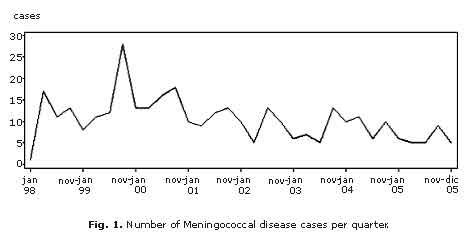
<body><![CDATA[<P>     <P><FONT face="Verdana" size="2"><B><FONT size="3">RESULTS</FONT></B></FONT>     <P><FONT face="Verdana" size="2"><I>Exploratory data analysis </I> </FONT>     <P><FONT face="Verdana" size="2">The mean number of quarterly Meningococcal disease    cases in Cuba is 10.3 <U>+</U> 0.9 (N= 33, variance= 25.1), with minimum 1 and    maximum 28. An elevated number of cases in the second half of 1999 and seasonal    cycle, more cases in summer, were observed (<A href="/img/revistas/mtr/v61n1/f0106109.jpg">fig.    1</A>). </FONT>      
<P align="center"><IMG src="/img/revistas/mtr/v61n1/f0106109.jpg" width="467" height="237">      
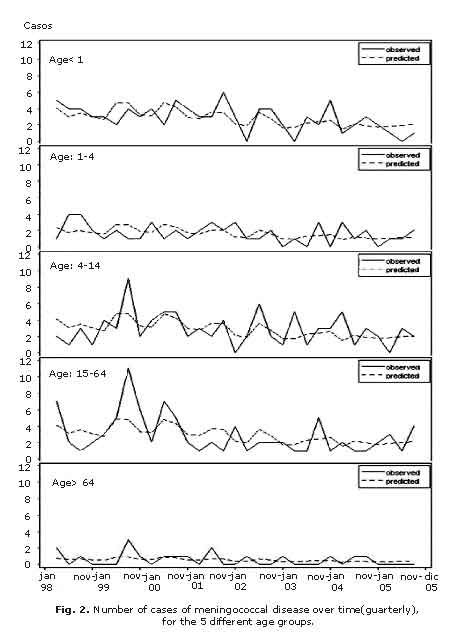
<P><FONT face="Verdana" size="2">The number of Meningococcal disease cases over    time differed by age groups (<A href="/img/revistas/mtr/v61n1/f0206109.jpg">fig.    2</A>). The mean number of cases, the increase in the second half of 1999 and    the amplitude of the seasonal oscillations seem to be age dependent. The mean    number of Meningococcal disease cases per quarter, per age group is 2.0 <U>+</U>    0.1 [N= 165 (= 33 quarters *5 age groups), variance= 3.4], with minimum 0 and    maximum 11. </FONT>      
<P align="center"><IMG src="/img/revistas/mtr/v61n1/f0206109.jpg" width="457" height="642">      
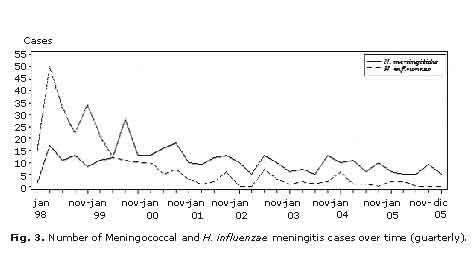
<P><FONT face="Verdana" size="2"><A href="/img/revistas/mtr/v61n1/f0306109.jpg">Figure    3</A> shows that the number of Meningococcal and <I>H. influenzae </I>meningitis    change very similarly over time, except for the period 1998-2000, before starting    <I>H. influenzae </I>vaccination. </FONT>      
<P align="center"><IMG src="/img/revistas/mtr/v61n1/f0306109.jpg" width="476" height="253">      
<P><FONT face="Verdana" size="2"><I>Generalized linear models for the number of    Meningococcal disease cases over time</I> </FONT>      ]]></body>
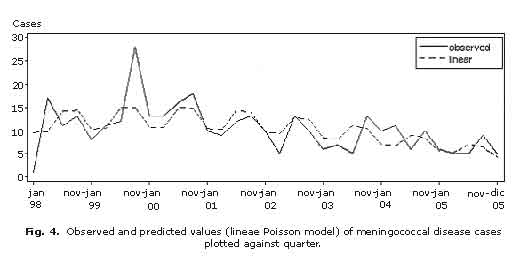
<body><![CDATA[<P><FONT face="Verdana" size="2">The evolution of Meningococcal disease was modelled    by a general linear model with Poisson distribution and log link function, as    a quadratic function over time, with an elevated number of cases in summer compared    to winter (<A href="/img/revistas/mtr/v61n1/f0406109.jpg">fig. 4</A>).    Let <I>Y (t)</I> be the number of Meningococcal disease cases, </FONT>      
<P>      <P><FONT face="Verdana" size="2"><I>Y (t) </I>~<I> Poisson </I>[<font face="Symbol">m</font><I>    (t)</I>]<I>,</I> </FONT>      <P>      <P><FONT face="Verdana" size="2">Here, <font face="Symbol">m</font><I> (t)</I>    is the mean number of Meningococcal disease cases at time <I>t. </I>The mean    structure of the model is given by<I> </I> </FONT>      <P>      <P><FONT face="Verdana" size="2">Log [<font face="Symbol">m </font>(t)]= 2.574    + 0.029 *time -0.002 *time&#178; -0.343 *season, </FONT>      <P>      <P><FONT face="Verdana" size="2">Here, season is an indicator variable which take    the value of 1 in the winter and 0 elsewhere and the time unit is the quarter    (the first quarter in 1988 is equal to 1). </FONT>     <P align="center"><IMG src="/img/revistas/mtr/v61n1/f0406109.jpg" width="520" height="259">      
]]></body>
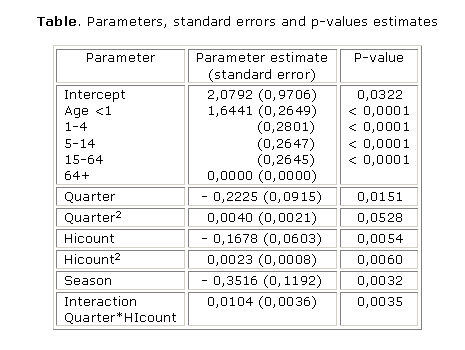
<body><![CDATA[<P><FONT face="Verdana" size="2">The cubic term of the quarter variable was not    significant and hence removed from the model. </FONT>     <P><FONT face="Verdana" size="2">However, the initial model did not fit the data    well (G&#178;= 45 df= 29) and therefore the mean structure was adjusted and    the quarterly number of new cases of <I>H. influenzae </I>meningitis was added    as a covariate to the model. The final model contained the variables time (linear    and quadratic terms) quarterly number of new cases of <I>H. influenzae </I>meningitis,    (linear and quadratic terms), season (winter or summer) and 2-way interaction    between time and quarterly number of new cases of <I>H. influenzae </I>meningitis    (G&#178;= 144, df= 144). <A href="/img/revistas/mtr/v61n1/t0106109.gif">Table</A>    present the parameter estimates for the final model. </FONT>      
<P align="center"><IMG src="/img/revistas/mtr/v61n1/t0106109.gif" width="465" height="350">      
<P><FONT face="Verdana" size="2">The G&#178;/df value of 1.0000 does not indicate    overdispersion. The estimated model indicates that the way the number of Meningococcal    disease cases changes over time, depends on the number of <I>H. influenzae </I>meningitis    cases. The mean number of cases is also different for each age group. The mean    number of cases per quarter is lowest for people older than 64, however it is    highest (almost 4 cases each quarter) in age groups &lt;1, 5-14 and 15-64. The    observed and predicted values for meningococcal cases over time are shown in    <A href="/img/revistas/mtr/v61n1/f0406109.jpg">figure 4</A>.</FONT>      
<P>&nbsp;     <P><FONT face="Verdana" size="3"><B>DISCUSSION</B></FONT>      <P><FONT face="Verdana" size="2">One of the advantages of the generalized linear    model with Poisson distribution is that the relationships between the predictors    and the number of Meningococcal disease cases are quantified, for instance we    get real estimates for mean number of cases in summer compared to winter. Moreover,    we get an assessment of goodness-of-fit of the model. This means we get an formal    measure about how good the number of Meningococcal disease cases is explained    by the predictors we thought to be important, i.e. about how important those    predictors really are. </FONT>     <P><FONT face="Verdana" size="2">A big disadvantage of our generalized linear    model with Poisson distribution, is that it is based on very few cases. Due    to adding age (a patient characteristic) as a categorical covariate in the model,    the data get stratified, and the number of cases per strata becomes smaller.    This is one of the drawbacks of the current dataset. It only consists of data    on patients with meningitis, hence each time we want to add a patient characteristic    as covariate, the data will be stratified further. The more strata, the less    patients per stratum, so that statistical analysis becomes more difficult (models    become less powerful) and in the end impossible. An alternative approach to    test for an extensive number of possible patient characteristics as predictors,    is to do a cross-sectional study and compare the characteristics of meningitis    patients with the ones of healthy people. </FONT>     <P><FONT face="Verdana" size="2">In contrast with this study, previous studies    showed an elevated number of Meningococcal disease cases in fall, winter and    spring.<SUP>1-3,7</SUP> It would be interesting to explore more deeply if and    which seasonal characteristics cause the elevated number of cases. Moreover,    maybe the oscillation pattern seen (fig. 1) is not due to seasonal oscillations.    A way to explore this could be to use an alternative approach to model the cycles    (without implying a seasonal cycle) such as the use of time series.<SUP>10</SUP>    </FONT>     <P><FONT face="Verdana" size="2">This study is also the first one to show a relationship    between meningitis cases caused by different bacteria's. The number of Meningococcal    disease cases was quite elevated at august-october 1999. This peak could be    partially explained by the decrease in number of <I>H. influenzae </I>meningitis    cases at the same time. However, recall that the data we used were scarce, and    the model fit was not very satisfactory so that this result should be interpreted    with care. From about may-july 2000 the two diseases evolve very similarly.    This suggests that the changes in cases over time from then on are not due to    bacteria specific characteristics, but rather to more general demographic and/or    temporal (e.g. weather) factors. </FONT>     ]]></body>
<body><![CDATA[<P><FONT face="Verdana" size="2">For the future, it would be interesting to improve    our regression model in order to be able to predict number of new Meningococcal    disease cases. At this moment, our model is not suitable because, 1. the goodness-of-fit    is to small, suggesting some important predictors are still missing, 2. the    model shows first an increasing than a decreasing number of cases in time. This    means that eventually, the number of cases will be predicted to be zero, i.e.    that the disease dies out. This may not be a good representation of reality.    Possibly, a model which models cycles around the same intercept over time could    be more realistic, and of more use for prediction purposes compared to our model    that fits the existing data from 1998 to 2005. </FONT>     <P><FONT face="Verdana" size="2">Moreover, our study shows that, when a vaccination    program is started for one bacterial type, it might be important to assess its    possible impact on other types of bacterial meningitis or invasive clinical    forms. </FONT>     <P><FONT face="Verdana" size="2">Also, it could be of interest to evaluate the    model using data from countries than Cuba (for instance Brazil or African countries    with a higher incidence of Meningococcal disease cases). </FONT>     <P>      <P>     <P>     <P>&nbsp;     <P><FONT size="3"><B><FONT face="Verdana">ACKNOWLEDGEMENT</FONT></B></FONT>      <P><FONT face="Verdana" size="2">We thank the department of Epidemiology of (IPK)    and the Center for Statistics (Hasselt University) for support and advice. Flemish    Interuniversity Council (VLIR) and the Centre for Statistics funded this project.    </FONT>     <P>&nbsp;      ]]></body>
<body><![CDATA[<P>      <P>      <P>      <P>      <P>      <P>      <P><B><FONT face="Verdana" size="3">REFERENCES</FONT> </B>     <P>      <!-- ref --><P><FONT face="Verdana" size="2">1. Griffiss McL. Meningococcal infections. In:    Wilson, editor. Harrison's principles of internal medicine. New York: Mc Graw-Hill;    1991. p. 590-9. </FONT>    <!-- ref --><P><FONT face="Verdana" size="2">2. Harter DH, Petersdorf RG. Bacterial meningitis    and brain abscess. In: Wilson, editor. Harrison's principles of internal medicine.    New York: Mc Graw-Hill; 1991. p. 2023-7. </FONT>    <!-- ref --><P><FONT face="Verdana" size="2">3. Dickinson FO, P&eacute;rez AE. Las meningoencefalitis    bacterianas en la poblaci&oacute;n infantile cubana: 1998-2000. Rev Cubana Pediatr.    2002;74(2):106-14. </FONT>    <!-- ref --><P><FONT face="Verdana" size="2">4. P&eacute;rez A, Dickinson F, Baly A, Martinez    R. The epidemiological impact of antimeningococcal B vaccination in Cuba. Mem    Inst Oswaldo Cruz. 1999;94(4):433-40. </FONT>    <!-- ref --><P><FONT face="Verdana" size="2">5. P&eacute;rez A, Dickinson F. Resultados del    programa nacional de inmunizaci&oacute;n antimeningoc&oacute;cica BC en menores    de 1 a&ntilde;o en Cuba. Rev Cubana Pediatr. 1998;70(3):133-40. </FONT>    <!-- ref --><P><FONT face="Verdana" size="2">6. Dickinson FO, P&eacute;rez AE, Galindo MA,    Quintana I. Impacto de la vacunaci&oacute;n contra Haemophilus influenzae tipo    b en Cuba. Rev Panam Salud Publica. 2001;10(3):169-73. </FONT>    <!-- ref --><P><FONT face="Verdana" size="2">7. Cordeira OR, Barreras RJ, Colls1 CP, Fernandez    AA. La estacionalidad de la enfermedad meningoc&oacute;cica en menores de 1    a&ntilde;o. Cuba, 1983-1990. Rev Cubana Med Trop. 1995;47(2):108-13. </FONT>    <!-- ref --><P><FONT face="Verdana" size="2">8. Dickinson FO, P&eacute;rez AE. Bacterial meningitis    in children and adolescents: an observational study based on the national surveillance    system. BMC Infect Dis. 2005;5:103. </FONT>    <!-- ref --><P><FONT face="Verdana" size="2">9. Agresti A. Categorical Data Analysis. New    York: John Wiley &amp; Sons; 2002. </FONT>    <!-- ref --><P><FONT face="Verdana" size="2">10. Kuhn L, Davidson, LL, Durkin MS. Use of poisson    regression and time series analysis for detecting changes over time in rates    of child injury following a prevention program. Am J Epidemiol. 1994;140(10):943-55.    </FONT>    <P>&nbsp;     <P>&nbsp;      ]]></body>
<body><![CDATA[<P>     <P>      <P>      <P><FONT face="Verdana" size="2">Recibido: 12 de mayo de 2008.     <BR>   Aprobado: 25 de agosto de 2008.</FONT>     <P>&nbsp;     <P>&nbsp;      <P>     <P>      <P><FONT face="Verdana" size="2">M.C. <I>Lizet S&aacute;nchez</I>. Instituto de    Medicina Tropical &quot;Pedro Kour&iacute;&quot;. AP 601, CP 11300, Ciudad de    La Habana, Cuba. Correo electr&oacute;nico: <U><FONT  COLOR="#0000ff"><a href="mailto:lsanchez@ipk.sld.cu">lsanchez@ipk.sld.cu</a></FONT></U>    </FONT>      ]]></body>
<body><![CDATA[ ]]></body><back>
<ref-list>
<ref id="B1">
<label>1</label><nlm-citation citation-type="book">
<person-group person-group-type="author">
<name>
<surname><![CDATA[Griffiss]]></surname>
<given-names><![CDATA[McL]]></given-names>
</name>
</person-group>
<article-title xml:lang="en"><![CDATA[Meningococcal infections]]></article-title>
<source><![CDATA[Harrison's principles of internal medicine]]></source>
<year>1991</year>
<page-range>590-9</page-range><publisher-loc><![CDATA[New York ]]></publisher-loc>
<publisher-name><![CDATA[Mc Graw-Hill]]></publisher-name>
</nlm-citation>
</ref>
<ref id="B2">
<label>2</label><nlm-citation citation-type="book">
<person-group person-group-type="author">
<name>
<surname><![CDATA[Harter]]></surname>
<given-names><![CDATA[DH]]></given-names>
</name>
<name>
<surname><![CDATA[Petersdorf]]></surname>
<given-names><![CDATA[RG]]></given-names>
</name>
</person-group>
<article-title xml:lang="en"><![CDATA[Bacterial meningitis and brain abscess]]></article-title>
<source><![CDATA[Harrison's principles of internal medicine]]></source>
<year>1991</year>
<page-range>2023-7</page-range><publisher-loc><![CDATA[New York ]]></publisher-loc>
<publisher-name><![CDATA[Mc Graw-Hill]]></publisher-name>
</nlm-citation>
</ref>
<ref id="B3">
<label>3</label><nlm-citation citation-type="journal">
<person-group person-group-type="author">
<name>
<surname><![CDATA[Dickinson]]></surname>
<given-names><![CDATA[FO]]></given-names>
</name>
<name>
<surname><![CDATA[Pérez]]></surname>
<given-names><![CDATA[AE]]></given-names>
</name>
</person-group>
<article-title xml:lang="es"><![CDATA[Las meningoencefalitis bacterianas en la población infantile cubana: 1998-2000]]></article-title>
<source><![CDATA[Rev Cubana Pediatr]]></source>
<year>2002</year>
<volume>74</volume>
<numero>2</numero>
<issue>2</issue>
<page-range>106-14</page-range></nlm-citation>
</ref>
<ref id="B4">
<label>4</label><nlm-citation citation-type="journal">
<person-group person-group-type="author">
<name>
<surname><![CDATA[Pérez]]></surname>
<given-names><![CDATA[A]]></given-names>
</name>
<name>
<surname><![CDATA[Dickinson]]></surname>
<given-names><![CDATA[F]]></given-names>
</name>
<name>
<surname><![CDATA[Baly]]></surname>
<given-names><![CDATA[A]]></given-names>
</name>
<name>
<surname><![CDATA[Martinez]]></surname>
<given-names><![CDATA[R]]></given-names>
</name>
</person-group>
<article-title xml:lang="en"><![CDATA[The epidemiological impact of antimeningococcal B vaccination in Cuba]]></article-title>
<source><![CDATA[Mem Inst Oswaldo Cruz]]></source>
<year>1999</year>
<volume>94</volume>
<numero>4</numero>
<issue>4</issue>
<page-range>433-40</page-range></nlm-citation>
</ref>
<ref id="B5">
<label>5</label><nlm-citation citation-type="journal">
<person-group person-group-type="author">
<name>
<surname><![CDATA[Pérez]]></surname>
<given-names><![CDATA[A]]></given-names>
</name>
<name>
<surname><![CDATA[Dickinson]]></surname>
<given-names><![CDATA[F]]></given-names>
</name>
</person-group>
<article-title xml:lang="es"><![CDATA[Resultados del programa nacional de inmunización antimeningocócica BC en menores de 1 año en Cuba]]></article-title>
<source><![CDATA[Rev Cubana Pediatr]]></source>
<year>1998</year>
<volume>70</volume>
<numero>3</numero>
<issue>3</issue>
<page-range>133-40</page-range></nlm-citation>
</ref>
<ref id="B6">
<label>6</label><nlm-citation citation-type="journal">
<person-group person-group-type="author">
<name>
<surname><![CDATA[Dickinson]]></surname>
<given-names><![CDATA[FO]]></given-names>
</name>
<name>
<surname><![CDATA[Pérez]]></surname>
<given-names><![CDATA[AE]]></given-names>
</name>
<name>
<surname><![CDATA[Galindo]]></surname>
<given-names><![CDATA[MA]]></given-names>
</name>
<name>
<surname><![CDATA[Quintana]]></surname>
<given-names><![CDATA[I]]></given-names>
</name>
</person-group>
<article-title xml:lang="es"><![CDATA[Impacto de la vacunación contra Haemophilus influenzae tipo b en Cuba]]></article-title>
<source><![CDATA[Rev Panam Salud Publica]]></source>
<year>2001</year>
<volume>10</volume>
<numero>3</numero>
<issue>3</issue>
<page-range>169-73</page-range></nlm-citation>
</ref>
<ref id="B7">
<label>7</label><nlm-citation citation-type="journal">
<person-group person-group-type="author">
<name>
<surname><![CDATA[Cordeira]]></surname>
<given-names><![CDATA[OR]]></given-names>
</name>
<name>
<surname><![CDATA[Barreras]]></surname>
<given-names><![CDATA[RJ]]></given-names>
</name>
<name>
<surname><![CDATA[Colls1]]></surname>
<given-names><![CDATA[CP]]></given-names>
</name>
<name>
<surname><![CDATA[Fernandez]]></surname>
<given-names><![CDATA[AA]]></given-names>
</name>
</person-group>
<article-title xml:lang="es"><![CDATA[La estacionalidad de la enfermedad meningocócica en menores de 1 año: Cuba, 1983-1990]]></article-title>
<source><![CDATA[Rev Cubana Med Trop]]></source>
<year>1995</year>
<volume>47</volume>
<numero>2</numero>
<issue>2</issue>
<page-range>108-13</page-range></nlm-citation>
</ref>
<ref id="B8">
<label>8</label><nlm-citation citation-type="journal">
<person-group person-group-type="author">
<name>
<surname><![CDATA[Dickinson]]></surname>
<given-names><![CDATA[FO]]></given-names>
</name>
<name>
<surname><![CDATA[Pérez]]></surname>
<given-names><![CDATA[AE]]></given-names>
</name>
</person-group>
<article-title xml:lang="en"><![CDATA[Bacterial meningitis in children and adolescents: an observational study based on the national surveillance system]]></article-title>
<source><![CDATA[BMC Infect Dis]]></source>
<year>2005</year>
<volume>5</volume>
<page-range>103</page-range></nlm-citation>
</ref>
<ref id="B9">
<label>9</label><nlm-citation citation-type="book">
<person-group person-group-type="author">
<name>
<surname><![CDATA[Agresti]]></surname>
<given-names><![CDATA[A]]></given-names>
</name>
</person-group>
<source><![CDATA[Categorical Data Analysis]]></source>
<year>2002</year>
<publisher-loc><![CDATA[New York ]]></publisher-loc>
<publisher-name><![CDATA[John Wiley & Sons]]></publisher-name>
</nlm-citation>
</ref>
<ref id="B10">
<label>10</label><nlm-citation citation-type="journal">
<person-group person-group-type="author">
<name>
<surname><![CDATA[Kuhn]]></surname>
<given-names><![CDATA[L]]></given-names>
</name>
<name>
<surname><![CDATA[Davidson]]></surname>
<given-names><![CDATA[LL]]></given-names>
</name>
<name>
<surname><![CDATA[Durkin]]></surname>
<given-names><![CDATA[MS]]></given-names>
</name>
</person-group>
<article-title xml:lang="en"><![CDATA[Use of poisson regression and time series analysis for detecting changes over time in rates of child injury following a prevention program]]></article-title>
<source><![CDATA[Am J Epidemiol]]></source>
<year>1994</year>
<volume>140</volume>
<numero>10</numero>
<issue>10</issue>
<page-range>943-55</page-range></nlm-citation>
</ref>
</ref-list>
</back>
</article>