<?xml version="1.0" encoding="ISO-8859-1"?><article xmlns:mml="http://www.w3.org/1998/Math/MathML" xmlns:xlink="http://www.w3.org/1999/xlink" xmlns:xsi="http://www.w3.org/2001/XMLSchema-instance">
<front>
<journal-meta>
<journal-id>0375-0760</journal-id>
<journal-title><![CDATA[Revista Cubana de Medicina Tropical]]></journal-title>
<abbrev-journal-title><![CDATA[Rev Cubana Med Trop]]></abbrev-journal-title>
<issn>0375-0760</issn>
<publisher>
<publisher-name><![CDATA[Centro Nacional de Información de Ciencias Médicas]]></publisher-name>
</publisher>
</journal-meta>
<article-meta>
<article-id>S0375-07602012000100003</article-id>
<title-group>
<article-title xml:lang="en"><![CDATA[Epidemiological analysis of eosinophilia and elevation of immunoglobulin E as a predictable and relative risk of enteroparasitosis]]></article-title>
<article-title xml:lang="es"><![CDATA[Análisis epidemiológico de eosinofilia y la elevación de inmunoglobulina E como riesgo relativo y predecible de enteroparasitosis]]></article-title>
</title-group>
<contrib-group>
<contrib contrib-type="author">
<name>
<surname><![CDATA[Vieira Silva]]></surname>
<given-names><![CDATA[Cyntia Cristina]]></given-names>
</name>
<xref ref-type="aff" rid="A01"/>
</contrib>
<contrib contrib-type="author">
<name>
<surname><![CDATA[Ribeiro Nogueira Ferraz]]></surname>
<given-names><![CDATA[Renato]]></given-names>
</name>
<xref ref-type="aff" rid="A01"/>
</contrib>
<contrib contrib-type="author">
<name>
<surname><![CDATA[Fornari]]></surname>
<given-names><![CDATA[João Victor]]></given-names>
</name>
<xref ref-type="aff" rid="A01"/>
</contrib>
<contrib contrib-type="author">
<name>
<surname><![CDATA[Sena Barnabe]]></surname>
<given-names><![CDATA[Anderson]]></given-names>
</name>
<xref ref-type="aff" rid="A01"/>
</contrib>
</contrib-group>
<aff id="A01">
<institution><![CDATA[,Universidade Nove de Julho  ]]></institution>
<addr-line><![CDATA[São Paulo ]]></addr-line>
<country>Brasil</country>
</aff>
<pub-date pub-type="pub">
<day>00</day>
<month>04</month>
<year>2012</year>
</pub-date>
<pub-date pub-type="epub">
<day>00</day>
<month>04</month>
<year>2012</year>
</pub-date>
<volume>64</volume>
<numero>1</numero>
<fpage>22</fpage>
<lpage>26</lpage>
<copyright-statement/>
<copyright-year/>
<self-uri xlink:href="http://scielo.sld.cu/scielo.php?script=sci_arttext&amp;pid=S0375-07602012000100003&amp;lng=en&amp;nrm=iso"></self-uri><self-uri xlink:href="http://scielo.sld.cu/scielo.php?script=sci_abstract&amp;pid=S0375-07602012000100003&amp;lng=en&amp;nrm=iso"></self-uri><self-uri xlink:href="http://scielo.sld.cu/scielo.php?script=sci_pdf&amp;pid=S0375-07602012000100003&amp;lng=en&amp;nrm=iso"></self-uri><abstract abstract-type="short" xml:lang="en"><p><![CDATA[Introduction: among the intestinal parasites, the helminthiasis occupies a prominent position in Brazil, since it worsens malnutrition and the gives rise to neurovegetative disorders. Helminths like Ascaris lumbricoides, Enterobius vermicularis, hookworm, Trichuris trichiura and Strongyloides stercoralis stand out due to several factors that modulate the immune response of individuals. Among the protozoa are Giardia lamblia, Entamoeba histolytica/E. dispar. Parasitic helminth antigens are important to stimulate the production of cytokines such as interleukin-4 and interleukin-5, which act through the induction of IgE synthesis and activation of eosinophils. Eosinophilia is usually detectable in pre-patent period of parasitism, initially linked to B lymphocytes, under the command of Th-2 lymphokines (IL-4 and IL-5), producing IgE in response to initial exposure to an antigen or allergen. Serum IgE high levels occur in tissue migration of larvae or harboring of parasites in tissues. Objective: to determine the presence of eosinophils and IgE elevation in children with intestinal parasites. Methods: high levels of IgE and eosinophils were observed in groups infected and not infected (allergic) to calculate the relative risk of intestinal parasites presumptive differentiated between protozoa and helminths and check what values of these indicators are observed in the epidemiological profile of the surveyed population. Results: the values obtained by calculating the relative risk for eosinophilia, compared with helminths and allergies was 11.71, but when examined by giardiasis compared with other diseases, the relative risk was 0.75. Since the comparison of helminths and giradiase, the relative risk was 27.33. Since IgE and its parameters were appropriate commit Helminth relative risk 0.39; Giardiasis had relative risk 8.18 and Helminths compared with giardiasis had 0.03. Conclusion: in this study it was possible to observe that helminthiasis is connected with cases of eosinophilia with alteration of IgE, which in turn contributes to the presence of IgE eosionofilia and has an effector response against helminths that provides the expulsion of its larvae.]]></p></abstract>
<abstract abstract-type="short" xml:lang="es"><p><![CDATA[Introducción: entre los parásitos intestinales, la helmintiasis ocupa un lugar destacado en Brasil, porque causa malnutrición y la instalación de cuadros de trastornos neurovegetativos. Helmintos como Ascaris lumbricoides, Enterobius vermicularis, anquilostoma, Trichuris trichiura y Strongyloides stercoralis se destacan debido a varios factores que modulan la respuesta inmune de los individuos. Entre los protozoos, los más destacados son Giardia lamblia y Entamoeba histolytica/E. dispar. Los antígenos de helmintos parásitos son importantes para estimular la producción de citocinas como la interleucina-4 e interleucina-5, que actúan a través de la inducción de la síntesis de IgE y la activación de los eosinófilos. La eosinofilia es detectable por lo general en el período pre-patente de parasitismo, inicialmente vinculada a los linfocitos B, bajo el mando de Th-2 linfocinas (IL-4 e IL-5), la producción de IgE en respuesta a la exposición inicial a un antígeno o alergeno. Los niveles séricos de IgE se producen en la migración de las larvas de los tejidos o la acogida de los parásitos en estos. Objetivo: determinar la presencia de eosinófilos y la elevación de IgE en niños con parásitos intestinales y cuantificar el riesgo relativo de estos parámetros biológicos. Methods: se observaron altos niveles de IgE y de eosinófilos en grupos infectados y no infectados (alergias) a fin de calcular el riesgo relativo (RR) de parásitos intestinales presuntamente diferenciados entre protozoos y helmintos, así como chequear qué valores de estos indicadores se observan en el perfil epidemiológico de la población estudiada. Resultados: los valores obtenidos mediante el cálculo del riesgo relativo para la eosinofilia, en comparación con helmintos y otras enfermedades fue 11,71, pero cuando se examina por la giardiasis en comparación con alergias resultó de 0,75. En la comparación de los helmintos y la giardiasis, el riesgo relativo fue de 27,33. Dado que la IgE y sus parámetros eran adecuados, entonces helmintos RR 0,39; giardiasis RR 8,18; y helmintos en comparación con giardiasis 0,03. Conclusión: con este estudio se pudo observar que las helmintiasis están relacionadas con casos de eosinofilia con alteración de la IgE; este último, que a su vez contribuye a la presencia de IgE eosionofilia y a tener una respuesta efectora frente a helmintos que causan la expulsión de sus larvas.]]></p></abstract>
<kwd-group>
<kwd lng="en"><![CDATA[epidemiology]]></kwd>
<kwd lng="en"><![CDATA[eosinophilia]]></kwd>
<kwd lng="en"><![CDATA[intestinal parasites]]></kwd>
<kwd lng="es"><![CDATA[epidemiología]]></kwd>
<kwd lng="es"><![CDATA[eosinofilia]]></kwd>
<kwd lng="es"><![CDATA[parásitos intestinales]]></kwd>
</kwd-group>
</article-meta>
</front><body><![CDATA[ <P align="right"> <font size="2" face="Verdana"><B>ART&Iacute;CULO ORIGINAL </B></font>     <P align="right"> <B>     <P>      <P><font size="4" face="Verdana">Epidemiological analysis of eosinophilia and    elevation of immunoglobulin E as a predictable and relative risk of enteroparasitosis</font>      <P>      <P><font size="3" face="Verdana">An&aacute;lisis epidemiol&oacute;gico de eosinofilia    y la elevaci&oacute;n de inmunoglobulina E como riesgo relativo y predecible    de enteroparasitosis</font>      <P>     <P> </B>      <P>      <P><b><font size="2" face="Verdana">Dra. Cyntia Cristina Vieira Silva, Dr. C.    Renato Ribeiro Nogueira Ferraz, Enf.<SUP> </SUP>Jo&atilde;o Victor Fornari,    Dr. C. Anderson Sena Barnabe </font></b>      ]]></body>
<body><![CDATA[<P><font size="2" face="Verdana"> Universidade Nove de Julho, S&atilde;o Paulo,    Brasil. </font>     <P>     <P>  <hr size="1" noshade> <font size="2" face="Verdana"><B>ABSTRACT </B></font>      <p><font size="2" face="Verdana"><B>Introduction</b>: among the intestinal parasites,    the helminthiasis occupies a prominent position in Brazil, since it worsens    malnutrition and the gives rise to neurovegetative disorders. Helminths like    <I>Ascaris lumbricoides,</I> <I>Enterobius vermicularis,</I> hookworm, <I>Trichuris    trichiura </I>and<I> Strongyloides stercoralis</I> stand out due to several    factors that modulate the immune response of individuals. Among the protozoa    are <I>Giardia lamblia</I>, <I>Entamoeba histolytica/E. dispar</I>. Parasitic    helminth antigens are important to stimulate the production of cytokines such    as interleukin-4 and interleukin-5, which act through the induction of IgE synthesis    and activation of eosinophils. Eosinophilia is usually detectable in pre-patent    period of parasitism, initially linked to B lymphocytes, under the command of    Th-2 lymphokines (IL-4 and IL-5), producing IgE in response to initial exposure    to an antigen or allergen. Serum IgE high levels occur in tissue migration of    larvae or harboring of parasites in tissues. <B>    <br>   Objective</B>: to determine the presence of eosinophils and IgE elevation in    children with intestinal parasites. <B>    <br>   Methods</B>: high levels of IgE and eosinophils were observed in groups infected    and not infected (allergic) to calculate the relative risk of intestinal parasites    presumptive differentiated between protozoa and helminths and check what values    of these indicators are observed in the epidemiological profile of the surveyed    population. <B>    <br>   Results</B>: the values obtained by calculating the relative risk for eosinophilia,    compared with helminths and allergies was 11.71, but when examined by giardiasis    compared with other diseases, the relative risk was 0.75. Since the comparison    of helminths and giradiase, the relative risk was 27.33. Since IgE and its parameters    were appropriate commit Helminth relative risk 0.39; Giardiasis had relative    risk 8.18 and Helminths compared with giardiasis had 0.03. <B>    <br>   Conclusion</B>: in this study it was possible to observe that helminthiasis    is connected with cases of eosinophilia with alteration of IgE, which in turn    contributes to the presence of IgE eosionofilia and has an effector response    against helminths that provides the expulsion of its larvae. </font> </p> <B></B>      <P>      <P><font size="2" face="Verdana"><B>Key words</B>: epidemiology, eosinophilia,    intestinal parasites. </font> <hr size="1" noshade> <font size="2" face="Verdana"><B>RESUMEN </B></font>      ]]></body>
<body><![CDATA[<P><font size="2" face="Verdana"><B>Introducci&oacute;n</b>: entre los par&aacute;sitos    intestinales, la helmintiasis ocupa un lugar destacado en Brasil, porque causa    malnutrici&oacute;n y la instalaci&oacute;n de cuadros de trastornos neurovegetativos.    Helmintos como<I> Ascaris lumbricoides</I>, <I>Enterobius vermicularis,</I>    anquilostoma, <I>Trichuris trichiura</I> y<I> Strongyloides stercoralis</I>    se destacan debido a varios factores que modulan la respuesta inmune de los    individuos. Entre los protozoos, los m&aacute;s destacados son <I>Giardia lamblia    </I>y <I>Entamoeba histolytica/E. dispar. </I>Los ant&iacute;genos de helmintos    par&aacute;sitos son importantes para estimular la producci&oacute;n de citocinas    como la interleucina-4 e interleucina-5, que act&uacute;an a trav&eacute;s de    la inducci&oacute;n de la s&iacute;ntesis de IgE y la activaci&oacute;n de los    eosin&oacute;filos. La eosinofilia es detectable por lo general en el per&iacute;odo    pre-patente de parasitismo, inicialmente vinculada a los linfocitos B, bajo    el mando de Th-2 linfocinas (IL-4 e IL-5), la producci&oacute;n de IgE en respuesta    a la exposici&oacute;n inicial a un ant&iacute;geno o alergeno. Los niveles    s&eacute;ricos de IgE se producen en la migraci&oacute;n de las larvas de los    tejidos o la acogida de los par&aacute;sitos en estos. <B>    <br>   Objetivo</B>: determinar la presencia de eosin&oacute;filos y la elevaci&oacute;n    de IgE en ni&ntilde;os con par&aacute;sitos intestinales y cuantificar el riesgo    relativo de estos par&aacute;metros biol&oacute;gicos. <B>    <br>   Methods</B>: se observaron altos niveles de IgE y de eosin&oacute;filos en grupos    infectados y no infectados (alergias) a fin de calcular el riesgo relativo (RR)    de par&aacute;sitos intestinales presuntamente diferenciados entre protozoos    y helmintos, as&iacute; como chequear qu&eacute; valores de estos indicadores    se observan en el perfil epidemiol&oacute;gico de la poblaci&oacute;n estudiada.    <B>    <br>   Resultados</B>: los valores obtenidos mediante el c&aacute;lculo del riesgo    relativo para la eosinofilia, en comparaci&oacute;n con helmintos y otras enfermedades    fue 11,71, pero cuando se examina por la giardiasis en comparaci&oacute;n con    alergias result&oacute; de 0,75. En la comparaci&oacute;n de los helmintos y    la giardiasis, el riesgo relativo fue de 27,33. Dado que la IgE y sus par&aacute;metros    eran adecuados, entonces helmintos RR 0,39; giardiasis RR 8,18; y helmintos    en comparaci&oacute;n con giardiasis 0,03. <B>    <br>   Conclusi&oacute;n</B>: con este estudio se pudo observar que las helmintiasis    est&aacute;n relacionadas con casos de eosinofilia con alteraci&oacute;n de    la IgE; este &uacute;ltimo, que a su vez contribuye a la presencia de IgE eosionofilia    y a tener una respuesta efectora frente a helmintos que causan la expulsi&oacute;n    de sus larvas. </font>      <P>      <P><font size="2" face="Verdana"><B>Palabras clave</B>: epidemiolog&iacute;a,    eosinofilia, par&aacute;sitos intestinales. </font> <hr size="1" noshade>     <p>&nbsp;</p>     <p>&nbsp;</p>     <P>      ]]></body>
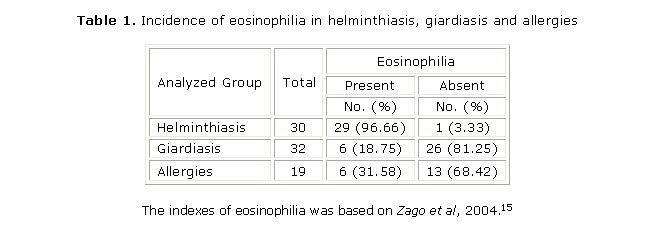
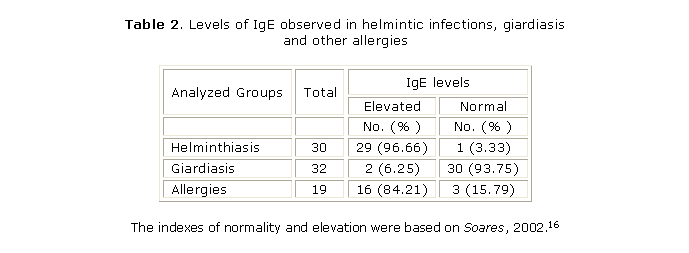
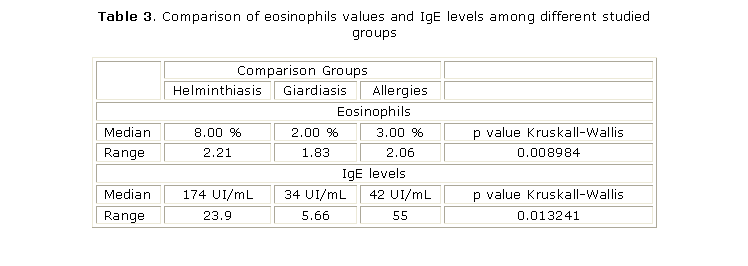
<body><![CDATA[<P>      <P><font size="3" face="Verdana"><B>INTRODUCTION</B> </font>      <P>      <P><font size="2" face="Verdana">Enteroparasitoses are a serious problem in public    health, especially in the third world countries,<SUP>1</SUP> and they provoke    frequent malnutrition and diarrhea, as well as physical and mental problems    in children.<SUP>2</SUP> Among the parasitic pathogens more frequently found    in human beings, there are the helminths <I>Ascaris lumbricoides, Enterobius    vermiculares, Ancylostoma duodenale, Strongyloides stercoralis </I>and<I> Trichuris    trichura</I>,<SUP>3</SUP> as well as the intestinal protozoa, such as <I>Giardia    lamblia</I>.<SUP>3</SUP> Transmitting these parasites to another host depend    on complex epidemiological cycles, on a great variety of beings and on the lack    of basic sanitation, making it difficult to control such diseases. These factors    demand social actions, as well as public health policies.<SUP>4</SUP> The epidemiological,    biological and immunological study of parasite diseases is necessary, in order    to contribute more application in early diagnosis and prevention of these diseases.    The immunological response caused by a parasite infection is complex and multiple,    due to the great metabolic diversity of these beings. Thus, there are consequences    of Th1 or Th2 responses, depending on the kind of parasite on the host. In accordance    with <i>Machado</i> <I>et al</I><SUP>5</SUP> giardiasis is a kind of parasite    infection that causes intense eosinophilia, as well as the helminths mentioned    above.<SUP>6</SUP> However, <I>Melo-Reis et al</I><SUP>7</SUP> do not agree    with this idea and state that the relation between eosinophilia (common in T2    responses) and protozoa is little described on the scientific literature; also,    they say it is important to emphasize that not all intestinal parasites especially    those that are on the intestinal light are able to induce to eosinophilia, what    would not make this biological parameter a good indicator of protozoa parasitosis.    On the other hand, in helminthiasis, the parasite antigens stimulate an intense    Th2 response, with production of interleukin-4 and interleukin-5, what induce    to the synthesis of Immunoglobulin E (IgE) and eosinophils activation.<SUP>8</SUP>    Eosinophilia is generally detectable in the prepatent period of parasitism,    that is, its detection occurs before helminths turn into adults and the occurrence    of parasite biological forms that can be detectable.<SUP>9</SUP> The function    of eosinophils is to destroy some helminths through cellular cytotoxicity that    depends on the antibody.<SUP>10</SUP> One of the mechanisms within this process    is the reaction started by IgE. Initially, B lymphocytes, directed by Th-2 lymphokine    (IL-4 e IL-5), produce IgE in response to the initial exposure to an antigen    or allergen.<SUP>11</SUP> In parasite infections, high IgE serum levels appear    on the tissue migration of larvae or parasite housing in tissues.<SUP>12</SUP>    </font>      <P><font size="2" face="Verdana">Eosinophilia and elevation of IgE, however, are    not initial indicators of parasitosis, because it occurs in other pathological    conditions(ex:allergies). There is no data on literature about serum values    of the indicators mentioned, regarding the epidemiological profile of people    in our society who suffer from parasitosis, but the occurrence and indication    of eosinophilia and IgE high levels in people with such pathologies is wide.    Thus, we propose a quantitative analysis on a sample of individuals believed    to have enteroparasitosis, of the relative risk (RR) in this condition, as well    as of the presence of eosinophilia and elevation of IgE. The aim of this study    was to compare<FONT  COLOR="#888888"> </FONT>eosinophils mean values and elevation of IgE in children    with and without parasitosis, obtaining reference values of these biological    indicators as a clue of the latency period of enteroparasitosis. Also, intend    evaluating the quantitative differences between these immunological indicators    regarding helminthiasis, protozoa diseases and other pathologies, analyzing    the RR values to the parasitic conditions and eosinophilia, as well as elevation    of IgE. </font>      <P>     <P>      <P><font size="3" face="Verdana"><B>METHODS</B> </font>      <P><font size="2" face="Verdana">This study approaches qualitatively and quantitatively,    carried out between June 2009 and June 2010. The sample in this research constituted    by 83 exams believed to have enteroparasitosis, performed at the Alpha Clin    lab, in S&atilde;o Paulo, Brazil. The variables observed were concentration    of eosinophils and of IgE, as well as diagnosis suspect of enteroparasitosis.    The data were evaluated through application of descriptive statistics of central    tendency, using standard deviation as a measure of dispersion. Besides the description    of the values of these indicators, it was performed a test of statistical hypothesis,    in which H0 was taken as a null hypothesis (there is no difference in the values    of eosinophils and IgE in cases of parasitosis and other pathologies), and H1    was taken as an alternative hypothesis (there are differences between the values    observed on the concentration of eosinophils and IgE and the condition of being    a carrier of intestinal helminthiasis). The values of eosinophilia and IgE were    individually submitted to a test Kruskall-Wallis between the groups with and    without parasitic infections. All the statistical tests were carried out considering    a significance level of p&lt; 0.05, and a confidence level of 95 % was established    as appropriate. In the analyses, we used EPI-INFO 2000 (Centers for Disease    Control and Prevention, a software of data tabulation in epidemiology. Available    in: <U><FONT  COLOR="#0000ff"><a href="http://www.cdc.gov/epiinfo" target="_blank">http://www.cdc.gov/epiinfo</a></FONT></U>).    The positive exams were diagnosed by sedimentation coproscopy techniques of    <I>Hofman</I>, <I>Pons</I> and <I>Janner</I>,<SUP>13 </SUP>and by the <I>Faust</I>    method.<SUP>14</SUP> Eosinophils concentration was analyzed by an automated    electrical impedance technique, spectrophotometry and optical dispersion (STKS<SUP>&#174;    </SUP>device), and its reference value in percentage ranged from 1.0 to 4.0.<SUP>15    </SUP>The analysis of IgE concentration was made by using an automated technique    based on quimioiluminecense (Acess device<SUP>&#174;</SUP>), with reference    values from 1.31 to 165.3 UI/mL.<SUP>16</SUP> Calculating the relative risk    between eosinophilia diagnosis and elevation of IgE with enteroparasitosis (exposed),    and eosinophilia and elevation of IgE without parasitosis (non-exposed) is going    to be made in a 2x2 table, following the models proposed by <i>Pereira</i> (2007),    as in the <a href="http:/img/revistas/mtr/v64n1/t0103112.gif">table 1</a> and <a href="http:/img/revistas/mtr/v64n1/t0203112.gif">2</a>.    The relative risk is going to be calculated according to the formula (A/A+B)/(C/C+D),    where A are the sick and B are the healthy within the exposed groups; and C    (sick) and D (healthy), within the non-exposed group.<SUP>17</SUP> </font>      <P><font size="2" face="Verdana">The variances in median of concentrations are    on <a href="/img/revistas/mtr/v64n1/t0303112.gif">table 3</a>. </font>      
]]></body>
<body><![CDATA[<P><font size="2" face="Verdana">Information that could identify the patients    or the laboratory where the exams were carried out was hidden. This work was    approved by the Ethics Committee in Research of the institution where it was    carried out, for it was in accordance with the policies stated by Resolution    196/96 of Conselho Nacional de Pesquisa (CNPq/Brasil). Also, for obtaining such    results, other causes of eosinophilia and IgE were excluded. Because of random    action, there is a variety of disorders associated with eosinophilia,<SUP>10</SUP>    corroborating <i>Melo-Reis</i> <I>et al</I>, who suggest there was no association    between giardiasis and eosinophilia.<SUP>7</SUP></font>      <P>      <P>      <P><font size="3" face="Verdana"><B>RESULTS</B> </font>      <P><font size="2" face="Verdana">The values obtained calculating RR to eosinophilia,    comparing helminthiasis to other pathologies, was 11.71. When comparing giardiasis    to allergies, RR was 0.75. Between helminthiasis and giardiasis, RR was 27.33.    </font>     <P><font size="2" face="Verdana">Besides, parameters of normality or IgE elevation    and their respective RR to the configurations helminths and other pathologies    were 0.39. Concerning giardiasis and allergies, RR was 8.18; and when helminthiasis    and giardiasis were compared, RR was 0.03. </font>      <P>     <P>      <P>      <P><font size="3" face="Verdana"><B>DISCUSSION</B> </font>      ]]></body>
<body><![CDATA[<P><font size="2" face="Verdana">Helminthiasis are well defined when we describe    cases of eosinophilia and IgE alteration. Eosinophils and IgE are part of the    effector response against helminths, what contributes to release the larvae.<SUP>18,19</SUP>    Comparing the medians of parasitosis carriers and non-carriers, Kruskall-Wallis    test showed, at the established levels, significantly greater relations between    the condition of a carrier and the elevated levels of eosinophils and IgE, with    the same parameters, in non-carriers of parasitosis. </font>      <P><font size="2" face="Verdana">A few works demonstrated that <I>Giardia lamblia</I>    is able to induce an immunological response with elevation of eosinophils.<SUP>7,10,11</SUP>    From the data presented in this work, we observed that patients with giardiasis    may present normal values of eosinophils, which confirmed <I>Melo-Reis</I>,<SUP>7</SUP>    <I>Fontenele</I> <I>et al</I>,<SUP>10</SUP> and <I>Ros&aacute;rio</I> <I>et    al</I>,<SUP>11</SUP> but contradicted <I>Machado</I> <I>et al</I>.<SUP>6</SUP>    </font>      <P><font size="2" face="Verdana">Analyzing RR, we noticed relevance in eosinophilia    as a remarkable factor of association (between the events &quot;pathology&quot;    and &quot;elevation of indicators&quot;): in helminthiasis and giardiasis, of    27.33 times; in helminthiasis and other pathologies, RR is 11.71 times; and    in giardiasis and in other pathologies, RR is only 0.75, which is higher than    1.0 and, thus, constitute a risk factor, in accordance with <i>Pereira</i>.<SUP>17</SUP>    The elevation of IgE did not show relevance between helminthiasis and giardiasis    (0.03), between helminths and other pathologies (0.39), but presented risk between    giardiasis and other pathologies (8.18). In its turn, IgE proved to be a better    indicator to giardiasis than to helminthiasis, partly confirming <I>Machado</I>    <I>et al</I>.<SUP>6 </SUP> </font>      <P><font size="2" face="Verdana">Regarding the hypotheses, we deny H0 and noticed    a more remarkable difference in the RR of these indicators between parasitosis    than in other diseases; however, we accept H1, in which there are statistical    differences of RR between helminthiasis carriers and the elevation in the mentioned    indicators. </font>     <P><font size="2" face="Verdana">Patients with parasitosis vary in their clinical    condition, as asymptomatic and symptomatic, altering the polymorphic form of    these diseases. They present diarrhea, weight loss, among other manifestation,    or they do not present any important symptomatology for a long time.<SUP>18    </SUP>Thus, eosinophilia is a highly important hematological parameter, and    it should be considered when approaching and assessing a patient who presents    it, for it suggests intestinal parasitosis, specifically prepatent helminthiasis.    Also, the association of this indicator with the condition of the carrier should    be observed. </font>     <P><font size="2" face="Verdana"> In this study, it was possible to observe that    helminthiases are associated with cases of eosinophilia. The values observed    can indicate helminth infections (RR) and they are very different from other    pathological conditions. This study is highly important for public health, for    enteroparasitoses are among its main problems. Their diagnosis depends on a    laboratorial structure and experienced professionals with biological information    regarding the immunological system. However, we accept that the number of individuals    in this study is not sufficient to a good analysis, although it is a good tool    for new researches on Immunology, parasite biology and public health.</font>     <P>      <P>      <P>      <P>      ]]></body>
<body><![CDATA[<P><font size="3" face="Verdana"><B>REFERENCES </B></font><font size="2" face="Verdana">    </font>      <!-- ref --><P><font size="2" face="Verdana">1. Ludwig KM, Frei F, &Aacute;lvares Filho F,    Ribeiro Paes JT. Correla&ccedil;&atilde;o entre condi&ccedil;&otilde;es de saneamento    b&aacute;sico e parasitoses intestinais na popula&ccedil;&atilde;o de Assis,    Estado de S&atilde;o Paulo. Rev Soc Bras Med Trop. 1999;32(5):547-55.     </font>     <!-- ref --><P><font size="2" face="Verdana">2. Ferreira CB, Mar&ccedil;al Junior O. Enteroparasitoses    em escolares do Distrito de Martin&eacute;sia, Uberl&acirc;ndia, MG: um estudo    piloto. Rev Soc Bras Med Trop. 1997;30(5):373-77.     </font>     <!-- ref --><P><font size="2" face="Verdana">3. Biscegli TS, Romeia J, Candido AC, Santos    JM, Candido ECA, Binottro AL. Estado nutricional e preval&ecirc;ncia de enteroparasitoses    em crian&ccedil;as matriculadas em creches. Rev Paulista Pediatri. 2009;27(3):289-95.        </font>     <!-- ref --><P><font size="2" face="Verdana">4. Ferreira MU, Ferreira CS, Monteiro CA. Tend&ecirc;ncia    secular de parasitoses intestinais na inf&acirc;ncia na cidade de S&atilde;o    Paulo (1984-1996). Rev Saude P&uacute;blica. 2000;34(6):73-82.     </font>     <!-- ref --><P><font size="2" face="Verdana">5. Fontes G, Oliveira KKL, Oliveira AKL, Rocha    EMM. Influ&ecirc;ncia do tratamento espec&iacute;fico na preval&ecirc;ncia de    enteroparasitoses e esquistossomose mans&ocirc;nica em escolares do munic&iacute;pio    de Barra de Santo Ant&ocirc;nio, AL. Rev Soc Bras Med Trop. 2003;36(1):625-8.        </font>     <!-- ref --><P><font size="2" face="Verdana">6. Machado RLD, Figueiredo MC, Frade AF, Kudo    MD, Sila Filho MG, P&oacute;voa MM. Compara&ccedil;&atilde;o de quatro m&eacute;todos    laboratoriais para diagn&oacute;stico da <I>Giardia lamblia</I> em fezes de    crian&ccedil;as residentes em Bel&eacute;m, Par&aacute;. Rev Soc Bras Med Trop.    2001;34(1):91-3.     </font>     <!-- ref --><P><font size="2" face="Verdana">7. Melo-Reis MPR. Correla&ccedil;&atilde;o entre    eosinofilia e protoparasitose por <I>Giardia lamblia</I> em crian&ccedil;as.    Rev Bras Anal Clin. 2007;39(3):237-9.     </font>     <!-- ref --><P><font size="2" face="Verdana">8. Medeiros D, Silva AR, Rizzo JA, Motta ME,    de Oliveira FHB, Sarinho ESC. N&iacute;vel s&eacute;rico de IgE total em alergia    respirat&oacute;ria: estudo em pacientes com alto risco de infec&ccedil;&atilde;o    por helmintos. J Pediatri. 2006;82(4):255-9.     </font>     <!-- ref --><P><font size="2" face="Verdana">9. Machado PRL, Arruda KL, Rodrigues MAG, Araujo    MME, Sales VSP. Mecanismo de Resposta Imune. Educ Medic Continuada<B>.</B> 2004;40(6):289-90.        </font>     <!-- ref --><P><font size="2" face="Verdana">10. Fontenele ALA, Carvalho PG, Ferreira CHA,    Gir&atilde;o AB, Teixeira MJ, Queiroz JAN. Avalia&ccedil;&atilde;o da dosagem    de interleucina-5 e imunoglobulina<B> </B>E<B> </B>em pacientes com giard&iacute;ase    com ou sem eosinofilia.<B> </B>Rev Bras Anal Clin. 2006;38(3):201-6.     </font>     <!-- ref --><P><font size="2" face="Verdana">11. Ros&aacute;rio NA, Carneiro MF, Ferreira    E, Baranski MC. N&iacute;veis de IgE total no soro, eosin&oacute;filos em crian&ccedil;as    com enteroparasitoses: efeito do tratamento anti-helm&iacute;ntico. J Pediatri.    2007;52(4):209-15.     </font>     <!-- ref --><P><font size="2" face="Verdana">12. Hoffman W, Pons JL, Janer JL. The sedimentation-concentration    methods in <I>Schistosoma mansoni</I>. Puerto Rico. J Pub Health. 1934;9<B>:</B>283-91.        </font>     <!-- ref --><P><font size="2" face="Verdana">13. Vallada EP. Manual de exames de Fezes Coprologia    e Parasitologia. Rio de Janeiro: Atheneu; 1988. p. 201.     </font>     <!-- ref --><P><font size="2" face="Verdana">14.<FONT COLOR="#0d0d0d"> Zago MA. Hematologia:    Fundamentos e Pr&aacute;tica. S&atilde;o Paulo: Atheneu; 2004. p. 1081.    </FONT></font>      <!-- ref --><P><font size="2" face="Verdana">15. Soares JLM. M&eacute;todos Diagn&oacute;sticos.    Rio de Janeiro:<FONT  COLOR="#ff0000"> </FONT>Artmed; 2002. p. 560.     </font>     <!-- ref --><P><font size="2" face="Verdana">16.<FONT COLOR="#ff0000"> </FONT>Pereira MG.    Epidemiologia-Teoria e Pr&aacute;tica. 11. ed. Rio de Janeiro: Guanabara Koogan;    2007. p. 596.     </font>     <!-- ref --><P><font size="2" face="Verdana">17. Gleich GJ.<B> </B>The eosinophils and bronchial    astma<B>:</B> current understanging. J Allergeny Clin Immunol. 1990;85(2):422-33.        </font>     <!-- ref --><P><font size="2" face="Verdana">18. Moqbel R. Exocytotic events in eosinophils    and mast cells. Clin Exp Allergy. 1999;29(10):1017-22.    </font>     <P>     <P>      <P>      ]]></body>
<body><![CDATA[<P><font size="2" face="Verdana">Recibido: 2 de marzo de 2011.     <br>   Aprobado: 10 de septiembre de 2011.</font>     <P>     <P>     <P><font size="2" face="Verdana"><I>Anderson Sena Barnabe</I>. Universidade Nove    de Julho, S&atilde;o Paulo, Brasil. Email: <U><FONT  COLOR="#0000ff"><a href="mailto:anderson@uninove.br">anderson@uninove.br</a></FONT></U>    </font>       ]]></body><back>
<ref-list>
<ref id="B1">
<label>1</label><nlm-citation citation-type="journal">
<person-group person-group-type="author">
<name>
<surname><![CDATA[Ludwig]]></surname>
<given-names><![CDATA[KM]]></given-names>
</name>
<name>
<surname><![CDATA[Frei]]></surname>
<given-names><![CDATA[F]]></given-names>
</name>
<name>
<surname><![CDATA[Álvares Filho]]></surname>
<given-names><![CDATA[F]]></given-names>
</name>
<name>
<surname><![CDATA[Ribeiro Paes]]></surname>
<given-names><![CDATA[JT]]></given-names>
</name>
</person-group>
<article-title xml:lang="pt"><![CDATA[Correlação entre condições de saneamento básico e parasitoses intestinais na população de Assis, Estado de São Paulo]]></article-title>
<source><![CDATA[Rev Soc Bras Med Trop.]]></source>
<year>1999</year>
<volume>32</volume>
<numero>5</numero>
<issue>5</issue>
<page-range>547-55</page-range></nlm-citation>
</ref>
<ref id="B2">
<label>2</label><nlm-citation citation-type="journal">
<person-group person-group-type="author">
<name>
<surname><![CDATA[Ferreira]]></surname>
<given-names><![CDATA[CB]]></given-names>
</name>
<name>
<surname><![CDATA[Marçal Junior]]></surname>
<given-names><![CDATA[O]]></given-names>
</name>
</person-group>
<article-title xml:lang="pt"><![CDATA[Enteroparasitoses em escolares do Distrito de Martinésia, Uberlândia, MG: um estudo piloto]]></article-title>
<source><![CDATA[Rev Soc Bras Med Trop.]]></source>
<year>1997</year>
<volume>30</volume>
<numero>5</numero>
<issue>5</issue>
<page-range>373-77</page-range></nlm-citation>
</ref>
<ref id="B3">
<label>3</label><nlm-citation citation-type="journal">
<person-group person-group-type="author">
<name>
<surname><![CDATA[Biscegli]]></surname>
<given-names><![CDATA[TS]]></given-names>
</name>
<name>
<surname><![CDATA[Romeia]]></surname>
<given-names><![CDATA[J]]></given-names>
</name>
<name>
<surname><![CDATA[Candido]]></surname>
<given-names><![CDATA[AC]]></given-names>
</name>
<name>
<surname><![CDATA[Santos]]></surname>
<given-names><![CDATA[JM]]></given-names>
</name>
<name>
<surname><![CDATA[Candido]]></surname>
<given-names><![CDATA[ECA]]></given-names>
</name>
<name>
<surname><![CDATA[Binottro]]></surname>
<given-names><![CDATA[AL]]></given-names>
</name>
</person-group>
<article-title xml:lang="pt"><![CDATA[Estado nutricional e prevalência de enteroparasitoses em crianças matriculadas em creches]]></article-title>
<source><![CDATA[Rev Paulista Pediatri.]]></source>
<year>2009</year>
<volume>27</volume>
<numero>3</numero>
<issue>3</issue>
<page-range>289-95</page-range></nlm-citation>
</ref>
<ref id="B4">
<label>4</label><nlm-citation citation-type="journal">
<person-group person-group-type="author">
<name>
<surname><![CDATA[Ferreira]]></surname>
<given-names><![CDATA[MU]]></given-names>
</name>
<name>
<surname><![CDATA[Ferreira]]></surname>
<given-names><![CDATA[CS]]></given-names>
</name>
<name>
<surname><![CDATA[Monteiro]]></surname>
<given-names><![CDATA[CA]]></given-names>
</name>
</person-group>
<article-title xml:lang="pt"><![CDATA[Tendência secular de parasitoses intestinais na infância na cidade de São Paulo (1984-1996)]]></article-title>
<source><![CDATA[Rev Saude Pública.]]></source>
<year>2000</year>
<volume>34</volume>
<numero>6</numero>
<issue>6</issue>
<page-range>73-82</page-range></nlm-citation>
</ref>
<ref id="B5">
<label>5</label><nlm-citation citation-type="journal">
<person-group person-group-type="author">
<name>
<surname><![CDATA[Fontes]]></surname>
<given-names><![CDATA[G]]></given-names>
</name>
<name>
<surname><![CDATA[Oliveira]]></surname>
<given-names><![CDATA[KKL]]></given-names>
</name>
<name>
<surname><![CDATA[Oliveira]]></surname>
<given-names><![CDATA[AKL]]></given-names>
</name>
<name>
<surname><![CDATA[Rocha]]></surname>
<given-names><![CDATA[EMM]]></given-names>
</name>
</person-group>
<article-title xml:lang="pt"><![CDATA[Influência do tratamento específico na prevalência de enteroparasitoses e esquistossomose mansônica em escolares do município de Barra de Santo Antônio, AL]]></article-title>
<source><![CDATA[Rev Soc Bras Med Trop.]]></source>
<year>2003</year>
<volume>36</volume>
<numero>1</numero>
<issue>1</issue>
<page-range>625-8</page-range></nlm-citation>
</ref>
<ref id="B6">
<label>6</label><nlm-citation citation-type="journal">
<person-group person-group-type="author">
<name>
<surname><![CDATA[Machado]]></surname>
<given-names><![CDATA[RLD]]></given-names>
</name>
<name>
<surname><![CDATA[Figueiredo]]></surname>
<given-names><![CDATA[MC]]></given-names>
</name>
<name>
<surname><![CDATA[Frade]]></surname>
<given-names><![CDATA[AF]]></given-names>
</name>
<name>
<surname><![CDATA[Kudo]]></surname>
<given-names><![CDATA[MD]]></given-names>
</name>
<name>
<surname><![CDATA[Sila Filho]]></surname>
<given-names><![CDATA[MG]]></given-names>
</name>
<name>
<surname><![CDATA[Póvoa]]></surname>
<given-names><![CDATA[MM]]></given-names>
</name>
</person-group>
<article-title xml:lang="pt"><![CDATA[Comparação de quatro métodos laboratoriais para diagnóstico da Giardia lamblia em fezes de crianças residentes em Belém, Pará]]></article-title>
<source><![CDATA[Rev Soc Bras Med Trop.]]></source>
<year>2001</year>
<volume>34</volume>
<numero>1</numero>
<issue>1</issue>
<page-range>91-3</page-range></nlm-citation>
</ref>
<ref id="B7">
<label>7</label><nlm-citation citation-type="journal">
<person-group person-group-type="author">
<name>
<surname><![CDATA[Melo-Reis]]></surname>
<given-names><![CDATA[MPR]]></given-names>
</name>
</person-group>
<article-title xml:lang="pt"><![CDATA[Correlação entre eosinofilia e protoparasitose por Giardia lamblia em crianças]]></article-title>
<source><![CDATA[Rev Bras Anal Clin.]]></source>
<year>2007</year>
<volume>39</volume>
<numero>3</numero>
<issue>3</issue>
<page-range>237-9</page-range></nlm-citation>
</ref>
<ref id="B8">
<label>8</label><nlm-citation citation-type="journal">
<person-group person-group-type="author">
<name>
<surname><![CDATA[Medeiros]]></surname>
<given-names><![CDATA[D]]></given-names>
</name>
<name>
<surname><![CDATA[Silva]]></surname>
<given-names><![CDATA[AR]]></given-names>
</name>
<name>
<surname><![CDATA[Rizzo]]></surname>
<given-names><![CDATA[JA]]></given-names>
</name>
<name>
<surname><![CDATA[Motta]]></surname>
<given-names><![CDATA[ME]]></given-names>
</name>
<name>
<surname><![CDATA[de Oliveira]]></surname>
<given-names><![CDATA[FHB]]></given-names>
</name>
<name>
<surname><![CDATA[Sarinho]]></surname>
<given-names><![CDATA[ESC]]></given-names>
</name>
</person-group>
<article-title xml:lang="pt"><![CDATA[Nível sérico de IgE total em alergia respiratória: estudo em pacientes com alto risco de infecção por helmintos]]></article-title>
<source><![CDATA[J Pediatri.]]></source>
<year>2006</year>
<volume>82</volume>
<numero>4</numero>
<issue>4</issue>
<page-range>255-9</page-range></nlm-citation>
</ref>
<ref id="B9">
<label>9</label><nlm-citation citation-type="journal">
<person-group person-group-type="author">
<name>
<surname><![CDATA[Machado]]></surname>
<given-names><![CDATA[PRL]]></given-names>
</name>
<name>
<surname><![CDATA[Arruda]]></surname>
<given-names><![CDATA[KL]]></given-names>
</name>
<name>
<surname><![CDATA[Rodrigues]]></surname>
<given-names><![CDATA[MAG]]></given-names>
</name>
<name>
<surname><![CDATA[Araujo]]></surname>
<given-names><![CDATA[MME]]></given-names>
</name>
<name>
<surname><![CDATA[Sales]]></surname>
<given-names><![CDATA[VSP]]></given-names>
</name>
</person-group>
<article-title xml:lang="pt"><![CDATA[Mecanismo de Resposta Imune]]></article-title>
<source><![CDATA[Educ Medic Continuada.]]></source>
<year>2004</year>
<volume>40</volume>
<numero>6</numero>
<issue>6</issue>
<page-range>289-90</page-range></nlm-citation>
</ref>
<ref id="B10">
<label>10</label><nlm-citation citation-type="journal">
<person-group person-group-type="author">
<name>
<surname><![CDATA[Fontenele]]></surname>
<given-names><![CDATA[ALA]]></given-names>
</name>
<name>
<surname><![CDATA[Carvalho]]></surname>
<given-names><![CDATA[PG]]></given-names>
</name>
<name>
<surname><![CDATA[Ferreira]]></surname>
<given-names><![CDATA[CHA]]></given-names>
</name>
<name>
<surname><![CDATA[Girão]]></surname>
<given-names><![CDATA[AB]]></given-names>
</name>
<name>
<surname><![CDATA[Teixeira]]></surname>
<given-names><![CDATA[MJ]]></given-names>
</name>
<name>
<surname><![CDATA[Queiroz]]></surname>
<given-names><![CDATA[JAN]]></given-names>
</name>
</person-group>
<article-title xml:lang="pt"><![CDATA[Avaliação da dosagem de interleucina-5 e imunoglobulina E em pacientes com giardíase com ou sem eosinofilia]]></article-title>
<source><![CDATA[Rev Bras Anal Clin.]]></source>
<year>2006</year>
<volume>38</volume>
<numero>3</numero>
<issue>3</issue>
<page-range>201-6</page-range></nlm-citation>
</ref>
<ref id="B11">
<label>11</label><nlm-citation citation-type="journal">
<person-group person-group-type="author">
<name>
<surname><![CDATA[Rosário]]></surname>
<given-names><![CDATA[NA]]></given-names>
</name>
<name>
<surname><![CDATA[Carneiro]]></surname>
<given-names><![CDATA[MF]]></given-names>
</name>
<name>
<surname><![CDATA[Ferreira]]></surname>
<given-names><![CDATA[E]]></given-names>
</name>
<name>
<surname><![CDATA[Baranski]]></surname>
<given-names><![CDATA[MC]]></given-names>
</name>
</person-group>
<article-title xml:lang="pt"><![CDATA[Níveis de IgE total no soro, eosinófilos em crianças com enteroparasitoses: efeito do tratamento anti-helmíntico]]></article-title>
<source><![CDATA[J Pediatri.]]></source>
<year>2007</year>
<volume>52</volume>
<numero>4</numero>
<issue>4</issue>
<page-range>209-15</page-range></nlm-citation>
</ref>
<ref id="B12">
<label>12</label><nlm-citation citation-type="journal">
<person-group person-group-type="author">
<name>
<surname><![CDATA[Hoffman]]></surname>
<given-names><![CDATA[W]]></given-names>
</name>
<name>
<surname><![CDATA[Pons]]></surname>
<given-names><![CDATA[JL]]></given-names>
</name>
<name>
<surname><![CDATA[Janer]]></surname>
<given-names><![CDATA[JL]]></given-names>
</name>
</person-group>
<article-title xml:lang="en"><![CDATA[The sedimentation-concentration methods in Schistosoma mansoni: Puerto Rico]]></article-title>
<source><![CDATA[J Pub Health.]]></source>
<year>1934</year>
<volume>9</volume>
<page-range>283-91</page-range></nlm-citation>
</ref>
<ref id="B13">
<label>13</label><nlm-citation citation-type="book">
<person-group person-group-type="author">
<name>
<surname><![CDATA[Vallada]]></surname>
<given-names><![CDATA[EP]]></given-names>
</name>
</person-group>
<source><![CDATA[Manual de exames de Fezes Coprologia e Parasitologia]]></source>
<year>1988</year>
<page-range>201</page-range><publisher-loc><![CDATA[Rio de Janeiro ]]></publisher-loc>
<publisher-name><![CDATA[Atheneu]]></publisher-name>
</nlm-citation>
</ref>
<ref id="B14">
<label>14</label><nlm-citation citation-type="book">
<person-group person-group-type="author">
<name>
<surname><![CDATA[Zago]]></surname>
<given-names><![CDATA[MA]]></given-names>
</name>
</person-group>
<source><![CDATA[Hematologia: Fundamentos e Prática]]></source>
<year>2004</year>
<page-range>1081</page-range><publisher-loc><![CDATA[São Paulo ]]></publisher-loc>
<publisher-name><![CDATA[Atheneu]]></publisher-name>
</nlm-citation>
</ref>
<ref id="B15">
<label>15</label><nlm-citation citation-type="book">
<person-group person-group-type="author">
<name>
<surname><![CDATA[Soares]]></surname>
<given-names><![CDATA[JLM]]></given-names>
</name>
</person-group>
<source><![CDATA[Métodos Diagnósticos]]></source>
<year>2002</year>
<page-range>560</page-range><publisher-loc><![CDATA[Rio de Janeiro ]]></publisher-loc>
<publisher-name><![CDATA[Artmed]]></publisher-name>
</nlm-citation>
</ref>
<ref id="B16">
<label>16</label><nlm-citation citation-type="book">
<person-group person-group-type="author">
<name>
<surname><![CDATA[Pereira]]></surname>
<given-names><![CDATA[MG]]></given-names>
</name>
</person-group>
<source><![CDATA[Epidemiologia-Teoria e Prática]]></source>
<year>2007</year>
<edition>11</edition>
<page-range>596</page-range><publisher-loc><![CDATA[Rio de Janeiro ]]></publisher-loc>
<publisher-name><![CDATA[Guanabara Koogan]]></publisher-name>
</nlm-citation>
</ref>
<ref id="B17">
<label>17</label><nlm-citation citation-type="journal">
<person-group person-group-type="author">
<name>
<surname><![CDATA[Gleich]]></surname>
<given-names><![CDATA[GJ]]></given-names>
</name>
</person-group>
<article-title xml:lang="en"><![CDATA[The eosinophils and bronchial astma: current understanging]]></article-title>
<source><![CDATA[J Allergeny Clin Immunol.]]></source>
<year>1990</year>
<volume>85</volume>
<numero>2</numero>
<issue>2</issue>
<page-range>422-33</page-range></nlm-citation>
</ref>
<ref id="B18">
<label>18</label><nlm-citation citation-type="journal">
<person-group person-group-type="author">
<name>
<surname><![CDATA[Moqbel]]></surname>
<given-names><![CDATA[R]]></given-names>
</name>
</person-group>
<article-title xml:lang="en"><![CDATA[Exocytotic events in eosinophils and mast cells]]></article-title>
<source><![CDATA[Clin Exp Allergy.]]></source>
<year>1999</year>
<volume>29</volume>
<numero>10</numero>
<issue>10</issue>
<page-range>1017-22</page-range></nlm-citation>
</ref>
</ref-list>
</back>
</article>