<?xml version="1.0" encoding="ISO-8859-1"?><article xmlns:mml="http://www.w3.org/1998/Math/MathML" xmlns:xlink="http://www.w3.org/1999/xlink" xmlns:xsi="http://www.w3.org/2001/XMLSchema-instance">
<front>
<journal-meta>
<journal-id>0375-0760</journal-id>
<journal-title><![CDATA[Revista Cubana de Medicina Tropical]]></journal-title>
<abbrev-journal-title><![CDATA[Rev Cubana Med Trop]]></abbrev-journal-title>
<issn>0375-0760</issn>
<publisher>
<publisher-name><![CDATA[Centro Nacional de Información de Ciencias Médicas]]></publisher-name>
</publisher>
</journal-meta>
<article-meta>
<article-id>S0375-07602012000200009</article-id>
<title-group>
<article-title xml:lang="es"><![CDATA[Culícidos de relevancia médico-veterinaria presentes en criaderos naturales de tres áreas de Camagüey, Cuba]]></article-title>
<article-title xml:lang="en"><![CDATA[Culicidae of medical-veterinary importance in natural breeding sites located in three areas of Camagüey province in Cuba]]></article-title>
</title-group>
<contrib-group>
<contrib contrib-type="author">
<name>
<surname><![CDATA[Diéguez Fernández]]></surname>
<given-names><![CDATA[Lorenzo]]></given-names>
</name>
<xref ref-type="aff" rid="A01"/>
</contrib>
<contrib contrib-type="author">
<name>
<surname><![CDATA[Vásquez Capote]]></surname>
<given-names><![CDATA[Raisa]]></given-names>
</name>
<xref ref-type="aff" rid="A02"/>
</contrib>
<contrib contrib-type="author">
<name>
<surname><![CDATA[Mentor Sarría]]></surname>
<given-names><![CDATA[Vivian Engracia]]></given-names>
</name>
<xref ref-type="aff" rid="A02"/>
</contrib>
<contrib contrib-type="author">
<name>
<surname><![CDATA[Díaz Martínez]]></surname>
<given-names><![CDATA[Ireté]]></given-names>
</name>
<xref ref-type="aff" rid="A02"/>
</contrib>
<contrib contrib-type="author">
<name>
<surname><![CDATA[Fimia Duarte]]></surname>
<given-names><![CDATA[Rigoberto]]></given-names>
</name>
<xref ref-type="aff" rid="A03"/>
</contrib>
</contrib-group>
<aff id="A01">
<institution><![CDATA[,Unidad Municipal de Higiene, Epidemiología y Microbiología de Camagüey  ]]></institution>
<addr-line><![CDATA[Camagüey ]]></addr-line>
<country>Cuba</country>
</aff>
<aff id="A02">
<institution><![CDATA[,Unidad Provincial de Vigilancia y Lucha Antivectorial de Camagüey  ]]></institution>
<addr-line><![CDATA[ ]]></addr-line>
</aff>
<aff id="A03">
<institution><![CDATA[,Centro Provincial de Higiene, Epidemiología y Microbiología de Villa Clara  ]]></institution>
<addr-line><![CDATA[ ]]></addr-line>
</aff>
<pub-date pub-type="pub">
<day>00</day>
<month>08</month>
<year>2012</year>
</pub-date>
<pub-date pub-type="epub">
<day>00</day>
<month>08</month>
<year>2012</year>
</pub-date>
<volume>64</volume>
<numero>2</numero>
<fpage>199</fpage>
<lpage>205</lpage>
<copyright-statement/>
<copyright-year/>
<self-uri xlink:href="http://scielo.sld.cu/scielo.php?script=sci_arttext&amp;pid=S0375-07602012000200009&amp;lng=en&amp;nrm=iso"></self-uri><self-uri xlink:href="http://scielo.sld.cu/scielo.php?script=sci_abstract&amp;pid=S0375-07602012000200009&amp;lng=en&amp;nrm=iso"></self-uri><self-uri xlink:href="http://scielo.sld.cu/scielo.php?script=sci_pdf&amp;pid=S0375-07602012000200009&amp;lng=en&amp;nrm=iso"></self-uri><abstract abstract-type="short" xml:lang="es"><p><![CDATA[Introducción: la malaria actualmente es un grave problema de salud pública, que afecta a casi la mitad de la población en más de 100 países, y que tiene un elevado riesgo de reintroducirse en Cuba. Objetivos: identificar las especies de culícidos presente en criaderos naturales de tres área del municipio Camagüey, con énfasis en los anofelinos. Métodos: se realizaron encuestas larvales entre mayo y junio de 2010 en el municipio Camagüey, en 66 criaderos naturales de Anopheles albimanus ubicados en 3 áreas de este municipio, siguiendo la metodología de la Organización Mundial de la Salud. Se determinaron los sitios de cría preferenciales de Anopheles albimanus y con que otras especies de culícidos se asoció. Resultados: presencia de culícidos en 28,78 % de los criaderos encuestados, y de ellos con Anopheles albimanus 63,51 %, especie que se colectó junto a Culex quinquefasciatus, Culex nigripalpus, Culex erraticus, Culex corniger, Psorophora confinnis, Psorophora howardii y Ochlerottatus scapularis, en cuerpos de agua poco contaminados como lagunas (58,34 %) y arroyos (25,0 %), y en otros con cierto nivel de polución como zanjas (8,33 %) y picas (8,33 %). Conclusiones: la presencia de especies de marcada relevancia médico-veterinaria con destaque para Anopheles albimanus en las áreas estudiadas, obliga a mantener un constante monitoreo de estas especies, para establecer estrategias integradas con énfasis en la lucha biológica, junto a la inserción de la participación comunitaria en el proceso y con ello, coadyuvar a evitar la aparición de casos o brotes epidémicos de malaria importada.]]></p></abstract>
<abstract abstract-type="short" xml:lang="en"><p><![CDATA[Introduction: malaria is a serious public health problem at present; it affects almost half of the population from over 100 countries and poses a high risk of reintroduction in Cuba. Objective: to identify the Culicidae species present in natural breeding sites located in three areas of Camagüey municipality, particularly anopheles. Methods: larval inspections were carried out in 66 natural breeding sites of Anopheles almimanus located in three areas of Camagüey municipality from May to June 2010, according the World Health Organization methodology. The preferential breeding sites of Anopheles albimanus and the association of this species with other Culicidae were ascertained. Results: presence of Culicidae in 28.78 % of inspected breeding sites, being Anopheles albimanus the prevailing one with 63.51 %. This species was captured together with Culex quinquefasciatus, Culex nigripalpus, Culex erraticus, Culex corniger, Psorophora confinnis, Psorophora howardii and Ochlerottatus scapularis, in low polluted water bodies such as lagoons(58.34 %) and streams(25 %), and in others more polluted such as ditches(8.33 %) and narrow trails (8.33 %). Conclusions: the existence of species of medical and veterinary importance, particularly Anopheles albimanus, in the studied areas calls for constant monitoring of these species in order to draw up integrated strategies focused on the biological fight, and the involvement of the community in this process to help in preventing the emergence of cases or epidemic outbreaks of imported malaria.]]></p></abstract>
<kwd-group>
<kwd lng="es"><![CDATA[sitios de cría]]></kwd>
<kwd lng="es"><![CDATA[Anopheles albimanus]]></kwd>
<kwd lng="es"><![CDATA[malaria]]></kwd>
<kwd lng="es"><![CDATA[Camagüey]]></kwd>
<kwd lng="en"><![CDATA[breeding sites]]></kwd>
<kwd lng="en"><![CDATA[Anopheles albimanus]]></kwd>
<kwd lng="en"><![CDATA[malaria]]></kwd>
<kwd lng="en"><![CDATA[Camagüey]]></kwd>
</kwd-group>
</article-meta>
</front><body><![CDATA[ <div align="right">       <p><font face="Verdana" size="2"><B>COMUNICACI&Oacute;N BREVE</B> </font></p>       <p>&nbsp; </p> </div>     <P>      <P><b><font face="Verdana" size="4">Cul&iacute;cidos de relevancia m&eacute;dico-veterinaria    presentes en criaderos naturales de tres &aacute;reas de Camag&uuml;ey, Cuba    </font></b><font face="Verdana" size="2"> </font>      <P>&nbsp;     <P><font face="Verdana" size="2"><B><font size="3">Culicidae of medical-veterinary    importance in natural breeding sites located in three areas of Camag&uuml;ey    province in Cuba </font></B></font>      <P>&nbsp;     <P>&nbsp;     <P>      ]]></body>
<body><![CDATA[<P><font face="Verdana" size="2"><b>MSc. Lorenzo Di&eacute;guez Fern&aacute;ndez,<SUP>I</SUP>    Lic. Raisa V&aacute;squez Capote,<sup>I</sup><sup>I</sup> Lic. Vivian Engracia    Mentor Sarr&iacute;a,<sup>I</sup><sup>I</sup> Lic. Iret&eacute; D&iacute;az    Mart&iacute;nez,<SUP>II</SUP> MSc. Rigoberto Fimia Duarte</b></font><b><font face="Verdana" size="2"><SUP>III</SUP></font></b>      <P><font face="Verdana" size="2"><SUP>I</sup> Unidad Municipal de Higiene, Epidemiolog&iacute;a    y Microbiolog&iacute;a de Camag&uuml;ey. Camag&uuml;ey, Cuba.    <br>   </font><font face="Verdana" size="2"><SUP>II</SUP> Unidad Provincial de Vigilancia    y Lucha Antivectorial de Camag&uuml;ey.    <br>   </font><font face="Verdana" size="2"><SUP>III</SUP> Centro Provincial de Higiene,    Epidemiolog&iacute;a y Microbiolog&iacute;a de Villa Clara.</font>     <P>&nbsp;     <P>&nbsp;  <hr size="1" noshade> <font face="Verdana" size="2"><B>RESUMEN</B></font>      <P><font face="Verdana" size="2"><B>Introducci&oacute;n</b>: la malaria actualmente    es un grave problema de salud p&uacute;blica, que afecta a casi la mitad de    la poblaci&oacute;n en m&aacute;s de 100 pa&iacute;ses, y que tiene un elevado    riesgo de reintroducirse en Cuba. <B>    <br>   Objetivos</B>: identificar las especies de cul&iacute;cidos presente en criaderos    naturales de tres &aacute;rea del municipio Camag&uuml;ey, con &eacute;nfasis    en los anofelinos. <B>    <br>   M&eacute;todos</B>: se realizaron encuestas larvales entre    mayo y junio de 2010 en el municipio Camag&uuml;ey, en 66 criaderos naturales    de <I>Anopheles albimanus</I> ubicados en 3 &aacute;reas de este municipio,    siguiendo la metodolog&iacute;a de la Organizaci&oacute;n Mundial de la Salud.    Se determinaron los sitios de cr&iacute;a preferenciales de <I>Anopheles albimanus    </I>y con que otras especies de cul&iacute;cidos se asoci&oacute;. <B>    <br>   Resultados</B>: presencia de cul&iacute;cidos en 28,78 % de los criaderos encuestados,    y de ellos con <I>Anopheles albimanus </I>63,51 %, especie que se colect&oacute;    junto a <I>Culex quinquefasciatus, Culex nigripalpus, Culex erraticus</I>, <I>Culex    corniger</I>, <I>Psorophora confinnis, Psorophora howardii </I>y<I> Ochlerottatus    scapularis</I>, en cuerpos de agua poco contaminados como lagunas (58,34 %)    y arroyos (25,0 %), y en otros con cierto nivel de poluci&oacute;n como zanjas    (8,33 %) y picas (8,33 %). <B>    ]]></body>
<body><![CDATA[<br>   Conclusiones</B>: la presencia de especies de marcada relevancia m&eacute;dico-veterinaria    con destaque para <I>Anopheles albimanus </I>en las &aacute;reas estudiadas,    obliga a mantener un constante monitoreo de estas especies, para establecer    estrategias integradas con &eacute;nfasis en la lucha biol&oacute;gica, junto    a la inserci&oacute;n de la participaci&oacute;n comunitaria en el proceso y    con ello, coadyuvar a evitar la aparici&oacute;n de casos o brotes epid&eacute;micos    de malaria importada. </font>  <B></B>      <P>      <P><font face="Verdana" size="2"><B>Palabras clave</B>: sitios de cr&iacute;a,    <I>Anopheles albimanus</I>, malaria, Camag&uuml;ey. </font> <hr size="1" noshade> <font face="Verdana" size="2"><B>ABSTRACT</B></font>      <P><font face="Verdana" size="2"><B>Introduction</b>: malaria is a serious public    health problem at present; it affects almost half of the population from over    100 countries and poses a high risk of reintroduction in Cuba. <B>    <br>   Objective</B>: to identify the Culicidae species present in natural breeding    sites located in three areas of Camag&uuml;ey municipality, particularly anopheles.    <B>    <br>   Methods</B>: larval inspections were carried out in 66 natural breeding sites    of <I>Anopheles almimanus</I> located in three areas of Camag&uuml;ey municipality    from May to June 2010, according the World Health Organization methodology.    The preferential breeding sites of <I>Anopheles albimanus</I> and the association    of this species with other Culicidae were ascertained. <B>    <br>   Results</B>: presence of Culicidae in 28.78 % of inspected breeding sites, being    <I>Anopheles albimanus</I> the prevailing one with 63.51 %. This species was    captured together with <I>Culex quinquefasciatus, Culex nigripalpus, Culex erraticus</I>,    <I>Culex corniger</I>, <I>Psorophora confinnis, Psorophora howardii </I>and<I>    Ochlerottatus scapularis</I>, in low polluted water bodies such as lagoons(58.34    %) and streams(25 %), and in others more polluted such as ditches(8.33 %) and    narrow trails (8.33 %). <B>    <br>   Conclusions</B>: the existence of species of medical and veterinary importance,    particularly <I>Anopheles albimanus,</I> in the studied areas calls for constant    monitoring of these species in order to draw up integrated strategies focused    on the biological fight, and the involvement of the community in this process    to help in preventing the emergence of cases or epidemic outbreaks of imported    malaria. </font>  <B></B>      <P>      <P><font face="Verdana" size="2"><B>Key words</B>: breeding sites, <I>Anopheles    albimanus</I>, malaria, Camag&uuml;ey. </font> <hr size="1" noshade>     ]]></body>
<body><![CDATA[<p>&nbsp;</p>    <P>&nbsp;      <P>      <P>      <P><font face="Verdana" size="2">La malaria actualmente es un grave problema de    salud p&uacute;blica, que afecta a casi la mitad de la poblaci&oacute;n en m&aacute;s    de 100 pa&iacute;ses.<SUP>1</SUP> Esta enfermedad es transmitida por mosquitos    del <I>Anopheles</I> de los que hay descritos alrededor de 380 especies, teniendo    una verdadera importancia epidemiol&oacute;gica por involucrase en la transmisi&oacute;n    cerca de 60.<SUP>2 </SUP> </font>     <P><font face="Verdana" size="2">En Cuba seis especies de anofelinos han sido    reportados hasta la fecha: <I>Anopheles </I>(<I>Nyssorhynchus</I>) <I>albimanus,    An. </I>(<I>Anopheles</I>) <I>vestitipennis, An. </I>(<I>Anopheles</I>) <I>crucians</I>,    <I>An. </I>(<I>Anopheles</I>) <I>atropos, An. </I>(<I>Anopheles</I>) <I>grabhamii    </I>y <I>An. </I>(<I>Anopheles</I>) <I>walkeri</I>,<SUP>3</SUP> con marcada    relevancia m&eacute;dica para los 3 primeros.<SUP>3-5 </SUP> </font>     <P><font face="Verdana" size="2">Con el resurgimiento de la malaria en la d&eacute;cada    de los noventa, varias especies fueron incriminadas como importantes transmisoras    de la enfermedad en las Am&eacute;ricas; tales son los casos de <I>An. darlingi,    An. nu&ntilde;eztovari, An. aquasalis </I>y <I>An. albimanus</I>, lo que renov&oacute;    el inter&eacute;s por conocer y profundizar en la biolog&iacute;a de estas especies.<SUP>6</SUP>    En el caso de Cuba, a pesar de que la malaria fue erradicada en 1967,<SUP>7</SUP>    no se est&aacute; exento de su reintroducci&oacute;n, debido a su recrudescencia    a nivel mundial, al incremento del arribo de personal nacional o extranjero    desde &aacute;reas end&eacute;micas de la enfermedad y, sobre todo, por la amplia    distribuci&oacute;n de <I>An. albimanus </I>en la isla, considerado el principal    vector.<SUP>8-10</SUP> Esta especie resulta ser la m&aacute;s numerosa en las    localidades en que se establece, lo cual coincide con estudios desarrollados    en Colombia en la costa del Pacifico, donde ha sido reconocida como la especie    dominante.<SUP>11</SUP> </font>     <P><font face="Verdana" size="2">Por lo antes expuesto, est&aacute; implementado    en la red nacional de vigilancia y lucha antivectorial el <I>Programa de Control    de otros Cul&iacute;cidos</I>, el cual tiene como principal objetivo mantener    bajo vigilancia especies de mosquitos pertenecientes a los g&eacute;neros <I>Anopheles</I>,    <I>Ochlerottatus</I> y <I>Gymnomettopa</I>, por transmitirle al hombre importantes    enfermedades y ser responsables adem&aacute;s de serias molestias p&uacute;blicas.    Este estudio consisti&oacute; en identificar las especies de cul&iacute;cidos,    presentes en criaderos naturales de 3 &aacute;reas del municipio Camag&uuml;ey,    con &eacute;nfasis en los anofelinos para una mejor implementaci&oacute;n de    las estrategias de control biol&oacute;gico. </font>     <P><font face="Verdana" size="2">El trabajo se realiz&oacute; en el municipio    Camag&uuml;ey perteneciente a la provincia de igual nombre, en cuerpos de agua    naturales ubicados en la parte suburbana de los territorios atendidos por las    &aacute;reas que se relacionan a continuaci&oacute;n, siguiendo siempre la metodolog&iacute;a    de la Organizaci&oacute;n Mundial de la Salud (OMS):<SUP>12</SUP> </font>     <P>      ]]></body>
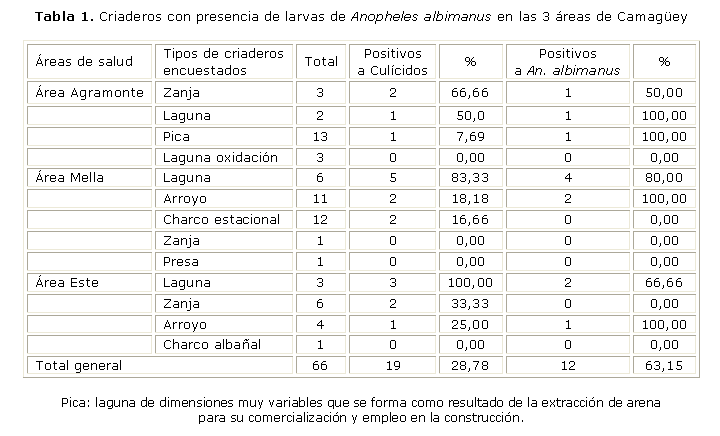
<body><![CDATA[<blockquote>       <p><font face="Verdana" size="2">- &Aacute;rea Agramonte: extensi&oacute;n territorial      de 4,5 km<SUP>2</SUP> y una poblaci&oacute;n estimada en 19 452 habitantes.      La parte suburbana ocupa un aproximado de 15 %.    <br>     </font><font face="Verdana" size="2">- &Aacute;rea Mella: extensi&oacute;n      territorial de 9,2 km<SUP>2 </SUP>y una poblaci&oacute;n estimada en 33 474      habitantes. La parte suburbana ocupa alrededor de 30 %.    <br>     </font><font face="Verdana" size="2">- &Aacute;rea Este: extensi&oacute;n      territorial de 11 km<SUP>2</SUP> y una poblaci&oacute;n estimada en 36 980      habitantes. La parte suburbana se aproxima a 45 %. </font> </p> </blockquote>     <P>      <P><font face="Verdana" size="2">Se priorizaron los criaderos permanentes como    lagunas naturales, de oxidaci&oacute;n, arroyos y zanjas. La clasificaci&oacute;n    del material biol&oacute;gico colectado se realiz&oacute; en el Laboratorio    de Entomolog&iacute;a M&eacute;dica Provincial, siguiendo el criterio de <I>Gonz&aacute;lez</I>.<SUP>3</SUP>    </font>     <P><font face="Verdana" size="2">Las encuestas larvales realizadas entre mayo    y junio de 2010, abarcaron 66 cuerpos de agua, cuya diversidad de sitios de    cr&iacute;a y distribuci&oacute;n por &aacute;reas se muestra en la <a href="/img/revistas/mtr/v64n2/t0109212.gif">tabla    1</a>. </font>      <P><font face="Verdana" size="2">Se report&oacute; la presencia de larvas de mosquitos    en 19 criaderos (28,78 %) y de ellos en 12 se colectaron larvas de <I>An. albimanus    </I>(63,51 %). Esta especie que resulta ser la m&aacute;s abundante dentro del    g&eacute;nero <I>Anopheles</I> en Cuba,<SUP>3</SUP> se colect&oacute; sobre    todo en cuerpos de agua poco contaminados como lagunas (58,34 %) y arroyos (25,0    %), as&iacute; como en zanjas (8,33 %) y picas (8,33 %), respectivamente, que    tienen altos grados de poluci&oacute;n. Este hecho coincide con observaciones    realizadas en &Aacute;frica, donde el mosquito se encontr&oacute; criando en    aguas con importantes valores de materia org&aacute;nica,<SUP>13 </SUP>o en    aguas limpias, semipoluidas o poluidas, pero siempre expuestas al sol.<SUP>14</SUP>    En este sentido, <I>Fleming</I><SUP>15</SUP> indic&oacute; que la especie puede    criar en los m&aacute;s diversos h&aacute;bitats, por lo que resulta muy frecuente    tanto en aguas costeras salobres como en aguas contaminadas. </font>     <P><font face="Verdana" size="2"><I>An. albimanus </I>ha sido encontrada asociada    con otras 51 especies de cul&iacute;cidos,<SUP>16</SUP> en el caso espec&iacute;fico    de Cuba, sus larvas seg&uacute;n <I>Gonz&aacute;lez</I><SUP>3 </SUP>se han relacionado    con <I>An. vestitipennis, Mansonia titillans, Culex nigripalpus, Cx. erraticus,    Cx. peccator, Cx. pilosus, Uranotaenia sapphirina, Ur. Iowii. Psorophora ciliata,    Ps. howardii </I>y <I>Ps. confinnis</I>. En nuestro estudio por su parte, <I>An.    albimanus</I> se colect&oacute; fundamentalmente junto a <I>Ps. confinnis </I>en    5 criaderos (45,45 %) y en 4 con <I>Cx. quinquefasciatus</I> y <I>Cx. nigripalpus    </I>(36,36 %), respectivamente (<a href="#tab2">tabla 2</a>).</font>     <P align="center">&nbsp;     ]]></body>
<body><![CDATA[<p class=MsoNormal align=center style=' text-align:center;line-height:normal'><b><span style='font-size:10.0pt; font-family:Verdana'>Tabla 2.</span></b><span style='font-size:10.0pt; font-family:Verdana'> Especies asociadas con <i>Anopheles albimanus</i> en los    criaderos encuestados en las 3 áreas de Camagüey<i> <a name="tab2"></a></i></span></p>       <div align="center">        <table width="580" border=1 cellpadding=0 cellspacing=3 class=MsoTableWeb1>     <tr>          <td width=94 valign=top style='width:70.6pt;padding:0cm 5.4pt 0cm 5.4pt'>&nbsp;          </td>         <td width=71 valign=top style='width:53.1pt;padding:0cm 5.4pt 0cm 5.4pt'>&nbsp;          </td>         <td width=675 colspan=7 style='width:506.45pt;padding:0cm 5.4pt 0cm 5.4pt'>                <p class=MsoNormal align=center style='   text-align:center;line-height:normal'><span style='font-size:10.0pt;   font-family:Verdana'>Especies de culícidos asociadas</span></p>         </td>       </tr>       <tr>          <td width=94 style='width:70.6pt;padding:0cm 5.4pt 0cm 5.4pt'>                <p class=MsoNormal style='line-height:   normal'><span style='font-size:10.0pt;font-family:Verdana'>Áreas de salud</span></p>         </td>         <td width=71 style='width:53.1pt;padding:0cm 5.4pt 0cm 5.4pt'>                <p class=MsoNormal style='line-height:   normal'><span style='font-size:10.0pt;font-family:Verdana'>Tipo de criadero</span></p>         </td>         <td width=129 style='width:96.65pt;padding:0cm 5.4pt 0cm 5.4pt'>                <p class=MsoNormal align=center style='   text-align:center;line-height:normal'><i><span style='font-size:10.0pt;   font-family:Verdana'>Culex quinquefasciatus</span></i></p>         </td>         <td width=77 style='width:57.4pt;padding:0cm 5.4pt 0cm 5.4pt'>                <p class=MsoNormal align=center style='   text-align:center;line-height:normal'><i><span style='font-size:10.0pt;   font-family:Verdana'>Culex erraticus</span></i></p>         </td>         <td width=93 style='width:69.8pt;padding:0cm 5.4pt 0cm 5.4pt'>                <p class=MsoNormal align=center style='   text-align:center;line-height:normal'><i><span style='font-size:10.0pt;   font-family:Verdana'>Culex nigripalpus</span></i></p>         </td>         <td width=71 style='width:53.4pt;padding:0cm 5.4pt 0cm 5.4pt'>                <p class=MsoNormal align=center style='   text-align:center;line-height:normal'><i><span style='font-size:10.0pt;   font-family:Verdana'>Culex corniger</span></i></p>         </td>         <td width=107 style='width:80.15pt;padding:0cm 5.4pt 0cm 5.4pt'>                <p class=MsoNormal align=center style='   text-align:center;line-height:normal'><i><span style='font-size:10.0pt;   font-family:Verdana'>Ochlerottatus scapularis</span></i></p>         </td>         <td width=92 style='width:68.85pt;padding:0cm 5.4pt 0cm 5.4pt'>                ]]></body>
<body><![CDATA[<p class=MsoNormal align=center style='   text-align:center;line-height:normal'><i><span style='font-size:10.0pt;   font-family:Verdana'>Psorophora confinnis</span></i></p>         </td>         <td width=91 style='width:68.2pt;padding:0cm 5.4pt 0cm 5.4pt'>                <p class=MsoNormal align=center style='   text-align:center;line-height:normal'><i><span style='font-size:10.0pt;   font-family:Verdana'>Psorophora howardii</span></i></p>         </td>       </tr>       <tr>          <td width=94 style='width:70.6pt;padding:0cm 5.4pt 0cm 5.4pt'>                <p class=MsoNormal style='line-height:   normal'><span style='font-size:10.0pt;font-family:Verdana'>Área Agramonte</span></p>         </td>         <td width=71 style='width:53.1pt;padding:0cm 5.4pt 0cm 5.4pt'>                <p class=MsoNormal style='line-height:   normal'><span style='font-size:10.0pt;font-family:Verdana'>P</span></p>               <p class=MsoNormal style='line-height:   normal'><span style='font-size:10.0pt;font-family:Verdana'>L</span></p>         </td>         <td width=129 style='width:96.65pt;padding:0cm 5.4pt 0cm 5.4pt'>&nbsp; </td>         <td width=77 style='width:57.4pt;padding:0cm 5.4pt 0cm 5.4pt'>                <p class=MsoNormal align=center style='   text-align:center;line-height:normal'><span style='font-size:10.0pt;   font-family:Verdana'>X</span></p>         </td>         <td width=93 style='width:69.8pt;padding:0cm 5.4pt 0cm 5.4pt'>     <div align="center"></div></td>         <td width=71 style='width:53.4pt;padding:0cm 5.4pt 0cm 5.4pt'>&nbsp; </td>         <td width=107 style='width:80.15pt;padding:0cm 5.4pt 0cm 5.4pt'>&nbsp; </td>         <td width=92 style='width:68.85pt;padding:0cm 5.4pt 0cm 5.4pt'>                <p class=MsoNormal align=center style='   text-align:center;line-height:normal'><span style='font-size:10.0pt;   font-family:Verdana'>X</span></p>         </td>         <td width=91 style='width:68.2pt;padding:0cm 5.4pt 0cm 5.4pt'>&nbsp; </td>       </tr>       <tr>          <td width=94 style='width:70.6pt;padding:0cm 5.4pt 0cm 5.4pt'>                <p class=MsoNormal style='line-height:   normal'><span style='font-size:10.0pt;font-family:Verdana'>Área Mella</span></p>         </td>         <td width=71 style='width:53.1pt;padding:0cm 5.4pt 0cm 5.4pt'>                <p class=MsoNormal style='line-height:   normal'><span style='font-size:10.0pt;font-family:Verdana'>A</span></p>               ]]></body>
<body><![CDATA[<p class=MsoNormal style='line-height:   normal'><span style='font-size:10.0pt;font-family:Verdana'>A</span></p>         </td>         <td width=129 style='width:96.65pt;padding:0cm 5.4pt 0cm 5.4pt'>                <p class=MsoNormal align=center style='   text-align:center;line-height:normal'><span style='font-size:10.0pt;   font-family:Verdana'>X</span></p>         </td>         <td width=77 style='width:57.4pt;padding:0cm 5.4pt 0cm 5.4pt'>&nbsp; </td>         <td width=93 style='width:69.8pt;padding:0cm 5.4pt 0cm 5.4pt'>     <div align="center"></div></td>         <td width=71 style='width:53.4pt;padding:0cm 5.4pt 0cm 5.4pt'>&nbsp; </td>         <td width=107 style='width:80.15pt;padding:0cm 5.4pt 0cm 5.4pt'>                <p class=MsoNormal align=center style='   text-align:center;line-height:normal'><span style='font-size:10.0pt;   font-family:Verdana'>X</span></p>         </td>         <td width=92 style='width:68.85pt;padding:0cm 5.4pt 0cm 5.4pt'>                <p class=MsoNormal align=center style='   text-align:center;line-height:normal'><span style='font-size:10.0pt;   font-family:Verdana'>X</span></p>         </td>         <td width=91 style='width:68.2pt;padding:0cm 5.4pt 0cm 5.4pt'>&nbsp; </td>       </tr>       <tr>          <td width=94 style='width:70.6pt;padding:0cm 5.4pt 0cm 5.4pt'>&nbsp; </td>         <td width=71 style='width:53.1pt;padding:0cm 5.4pt 0cm 5.4pt'>                <p class=MsoNormal style='line-height:   normal'><span style='font-size:10.0pt;font-family:Verdana'>L</span></p>         </td>         <td width=129 style='width:96.65pt;padding:0cm 5.4pt 0cm 5.4pt'>&nbsp; </td>         <td width=77 style='width:57.4pt;padding:0cm 5.4pt 0cm 5.4pt'>&nbsp; </td>         <td width=93 style='width:69.8pt;padding:0cm 5.4pt 0cm 5.4pt'>     <div align="center"></div></td>         <td width=71 style='width:53.4pt;padding:0cm 5.4pt 0cm 5.4pt'>&nbsp; </td>         <td width=107 style='width:80.15pt;padding:0cm 5.4pt 0cm 5.4pt'>&nbsp; </td>         <td width=92 style='width:68.85pt;padding:0cm 5.4pt 0cm 5.4pt'>                <p class=MsoNormal align=center style='   text-align:center;line-height:normal'><span style='font-size:10.0pt;   font-family:Verdana'>X</span></p>         </td>         <td width=91 style='width:68.2pt;padding:0cm 5.4pt 0cm 5.4pt'>&nbsp; </td>       </tr>       <tr>          <td width=94 style='width:70.6pt;padding:0cm 5.4pt 0cm 5.4pt'>&nbsp; </td>         <td width=71 style='width:53.1pt;padding:0cm 5.4pt 0cm 5.4pt'>                <p class=MsoNormal style='line-height:   normal'><span style='font-size:10.0pt;font-family:Verdana'>L</span></p>         </td>         <td width=129 style='width:96.65pt;padding:0cm 5.4pt 0cm 5.4pt'>&nbsp; </td>         <td width=77 style='width:57.4pt;padding:0cm 5.4pt 0cm 5.4pt'>&nbsp; </td>         <td width=93 style='width:69.8pt;padding:0cm 5.4pt 0cm 5.4pt'>     <div align="center"></div></td>         <td width=71 style='width:53.4pt;padding:0cm 5.4pt 0cm 5.4pt'>                ]]></body>
<body><![CDATA[<p class=MsoNormal align=center style='   text-align:center;line-height:normal'><span style='font-size:10.0pt;   font-family:Verdana'>X</span></p>         </td>         <td width=107 style='width:80.15pt;padding:0cm 5.4pt 0cm 5.4pt'>&nbsp; </td>         <td width=92 style='width:68.85pt;padding:0cm 5.4pt 0cm 5.4pt'>                <p class=MsoNormal align=center style='   text-align:center;line-height:normal'><span style='font-size:10.0pt;   font-family:Verdana'>X</span></p>         </td>         <td width=91 style='width:68.2pt;padding:0cm 5.4pt 0cm 5.4pt'>                <p class=MsoNormal align=center style='   text-align:center;line-height:normal'><span style='font-size:10.0pt;   font-family:Verdana'>X</span></p>         </td>       </tr>       <tr>          <td width=94 style='width:70.6pt;padding:0cm 5.4pt 0cm 5.4pt'>&nbsp; </td>         <td width=71 style='width:53.1pt;padding:0cm 5.4pt 0cm 5.4pt'>                <p class=MsoNormal style='line-height:   normal'><span style='font-size:10.0pt;font-family:Verdana'>L</span></p>         </td>         <td width=129 style='width:96.65pt;padding:0cm 5.4pt 0cm 5.4pt'>                <p class=MsoNormal align=center style='   text-align:center;line-height:normal'><span style='font-size:10.0pt;   font-family:Verdana'>X</span></p>         </td>         <td width=77 style='width:57.4pt;padding:0cm 5.4pt 0cm 5.4pt'>&nbsp; </td>         <td width=93 style='width:69.8pt;padding:0cm 5.4pt 0cm 5.4pt'>                <p class=MsoNormal align=center style='   text-align:center;line-height:normal'><span style='font-size:10.0pt;   font-family:Verdana'>X</span></p>         </td>         <td width=71 style='width:53.4pt;padding:0cm 5.4pt 0cm 5.4pt'>&nbsp; </td>         <td width=107 style='width:80.15pt;padding:0cm 5.4pt 0cm 5.4pt'>&nbsp; </td>         <td width=92 style='width:68.85pt;padding:0cm 5.4pt 0cm 5.4pt'>&nbsp; </td>         <td width=91 style='width:68.2pt;padding:0cm 5.4pt 0cm 5.4pt'>&nbsp; </td>       </tr>       <tr>          <td width=94 style='width:70.6pt;padding:0cm 5.4pt 0cm 5.4pt'>&nbsp; </td>         <td width=71 style='width:53.1pt;padding:0cm 5.4pt 0cm 5.4pt'>                <p class=MsoNormal style='line-height:   normal'><span style='font-size:10.0pt;font-family:Verdana'>L</span></p>         </td>         <td width=129 style='width:96.65pt;padding:0cm 5.4pt 0cm 5.4pt'>                <p class=MsoNormal align=center style='   text-align:center;line-height:normal'><span style='font-size:10.0pt;   font-family:Verdana'>X</span></p>         </td>         <td width=77 style='width:57.4pt;padding:0cm 5.4pt 0cm 5.4pt'>&nbsp; </td>         <td width=93 style='width:69.8pt;padding:0cm 5.4pt 0cm 5.4pt'>                <p class=MsoNormal align=center style='   text-align:center;line-height:normal'><span style='font-size:10.0pt;   font-family:Verdana'>X</span></p>         </td>         <td width=71 style='width:53.4pt;padding:0cm 5.4pt 0cm 5.4pt'>&nbsp; </td>         <td width=107 style='width:80.15pt;padding:0cm 5.4pt 0cm 5.4pt'>&nbsp; </td>         <td width=92 style='width:68.85pt;padding:0cm 5.4pt 0cm 5.4pt'>&nbsp; </td>         <td width=91 style='width:68.2pt;padding:0cm 5.4pt 0cm 5.4pt'>&nbsp; </td>       </tr>       <tr>          <td width=94 style='width:70.6pt;padding:0cm 5.4pt 0cm 5.4pt'>                <p class=MsoNormal style='line-height:   normal'><span style='font-size:10.0pt;font-family:Verdana'>Área Este</span></p>         </td>         <td width=71 style='width:53.1pt;padding:0cm 5.4pt 0cm 5.4pt'>                ]]></body>
<body><![CDATA[<p class=MsoNormal style='line-height:   normal'><span style='font-size:10.0pt;font-family:Verdana'>L</span></p>               <p class=MsoNormal style='line-height:   normal'><span style='font-size:10.0pt;font-family:Verdana'>L</span></p>         </td>         <td width=129 style='width:96.65pt;padding:0cm 5.4pt 0cm 5.4pt'>                <p class=MsoNormal align=center style='   text-align:center;line-height:normal'><span style='font-size:10.0pt;   font-family:Verdana'>X</span></p>         </td>         <td width=77 style='width:57.4pt;padding:0cm 5.4pt 0cm 5.4pt'>&nbsp; </td>         <td width=93 style='width:69.8pt;padding:0cm 5.4pt 0cm 5.4pt'>                <p class=MsoNormal align=center style='   text-align:center;line-height:normal'><span style='font-size:10.0pt;   font-family:Verdana'>X</span></p>         </td>         <td width=71 style='width:53.4pt;padding:0cm 5.4pt 0cm 5.4pt'>&nbsp; </td>         <td width=107 style='width:80.15pt;padding:0cm 5.4pt 0cm 5.4pt'>                <p class=MsoNormal align=center style='   text-align:center;line-height:normal'><span style='font-size:10.0pt;   font-family:Verdana'>X</span></p>         </td>         <td width=92 style='width:68.85pt;padding:0cm 5.4pt 0cm 5.4pt'>                <p class=MsoNormal align=center style='   text-align:center;line-height:normal'><span style='font-size:10.0pt;   font-family:Verdana'>X</span></p>         </td>         <td width=91 style='width:68.2pt;padding:0cm 5.4pt 0cm 5.4pt'>                <p class=MsoNormal align=center style='   text-align:center;line-height:normal'><span style='font-size:10.0pt;   font-family:Verdana'>X</span></p>         </td>       </tr>       <tr>          <td width=94 style='width:70.6pt;padding:0cm 5.4pt 0cm 5.4pt'>&nbsp; </td>         <td width=71 style='width:53.1pt;padding:0cm 5.4pt 0cm 5.4pt'>                <p class=MsoNormal style='line-height:   normal'><span style='font-size:10.0pt;font-family:Verdana'>A</span></p>         </td>         <td width=129 style='width:96.65pt;padding:0cm 5.4pt 0cm 5.4pt'>&nbsp; </td>         <td width=77 style='width:57.4pt;padding:0cm 5.4pt 0cm 5.4pt'>&nbsp; </td>         <td width=93 style='width:69.8pt;padding:0cm 5.4pt 0cm 5.4pt'>                <p class=MsoNormal align=center style='   text-align:center;line-height:normal'><span style='font-size:10.0pt;   font-family:Verdana'>X</span></p>         </td>         <td width=71 style='width:53.4pt;padding:0cm 5.4pt 0cm 5.4pt'>&nbsp; </td>         <td width=107 style='width:80.15pt;padding:0cm 5.4pt 0cm 5.4pt'>&nbsp; </td>         <td width=92 style='width:68.85pt;padding:0cm 5.4pt 0cm 5.4pt'>&nbsp; </td>         <td width=91 style='width:68.2pt;padding:0cm 5.4pt 0cm 5.4pt'>&nbsp; </td>       </tr>       <tr style='height:10.45pt'>          <td width=168 colspan=2 style='width:125.7pt;padding:0cm 5.4pt 0cm 5.4pt;   height:10.45pt'>                <p class=MsoNormal style='line-height:   normal'><span style='font-size:10.0pt;font-family:Verdana'>Total general</span></p>         </td>         <td width=129 style='width:96.65pt;padding:0cm 5.4pt 0cm 5.4pt;height:10.45pt'>                ]]></body>
<body><![CDATA[<p class=MsoNormal align=center style='   text-align:center;line-height:normal'><span style='font-size:10.0pt;   font-family:Verdana'>4</span></p>         </td>         <td width=77 style='width:57.4pt;padding:0cm 5.4pt 0cm 5.4pt;height:10.45pt'>                <p class=MsoNormal align=center style='   text-align:center;line-height:normal'><span style='font-size:10.0pt;   font-family:Verdana'>1</span></p>         </td>         <td width=93 style='width:69.8pt;padding:0cm 5.4pt 0cm 5.4pt;height:10.45pt'>                <p class=MsoNormal align=center style='   text-align:center;line-height:normal'><span style='font-size:10.0pt;   font-family:Verdana'>4</span></p>         </td>         <td width=71 style='width:53.4pt;padding:0cm 5.4pt 0cm 5.4pt;height:10.45pt'>                <p class=MsoNormal align=center style='   text-align:center;line-height:normal'><span style='font-size:10.0pt;   font-family:Verdana'>1</span></p>         </td>         <td width=107 style='width:80.15pt;padding:0cm 5.4pt 0cm 5.4pt;height:10.45pt'>                <p class=MsoNormal align=center style='   text-align:center;line-height:normal'><span style='font-size:10.0pt;   font-family:Verdana'>2</span></p>         </td>         <td width=92 style='width:68.85pt;padding:0cm 5.4pt 0cm 5.4pt;height:10.45pt'>                <p class=MsoNormal align=center style='   text-align:center;line-height:normal'><span style='font-size:10.0pt;   font-family:Verdana'>5</span></p>         </td>         <td width=91 style='width:68.2pt;padding:0cm 5.4pt 0cm 5.4pt;height:10.45pt'>                <p class=MsoNormal align=center style='   text-align:center;line-height:normal'><span style='font-size:10.0pt;   font-family:Verdana'>2</span></p>         </td>       </tr>       </table>         <br>   </div>     <p class=MsoNormal align=center style=' text-align:center;line-height:normal'><span style='font-size:9.0pt;font-family: Verdana'>P: pica (laguna de dimensiones muy variables que se forma como resultado    de la extracción de arena para su comercialización    <br>   y empleo en la construcción), L: laguna, A: arroyo.</span></p>     ]]></body>
<body><![CDATA[<P align="center">&nbsp;      <P><font face="Verdana" size="2">Atendiendo a la diversidad de la asociaci&oacute;n    interespec&iacute;fica observada, y a los diferentes requerimientos ecol&oacute;gicos    que disponen cada una de las especies involucradas, <I>An. albimanus</I> est&aacute;    explotando una gran variedad de h&aacute;bitats, lo que sin dudas le da mejores    posibilidades para su establecimiento y dispersi&oacute;n. </font>     <P><font face="Verdana" size="2">En conclusi&oacute;n, la presencia de especies    de marcada relevancia m&eacute;dico-veterinaria con destaque para <I>An. albimanus    </I>en las &aacute;reas estudiadas, obliga a mantener un constante monitoreo    de estas, para establecer estrategias integradas con &eacute;nfasis en la lucha    biol&oacute;gica, junto a la inserci&oacute;n de la participaci&oacute;n comunitaria    en el proceso y con ello, coadyuvar a evitar la aparici&oacute;n de casos o    brotes epid&eacute;micos de malaria importada.</font>     <P>&nbsp;      <P>      <P>      <P><font face="Verdana" size="3"><B>REFERENCIAS BIBLIOGR&Aacute;FICAS</B> </font>      <P>      <!-- ref --><P><font face="Verdana" size="2">1. Secretaria de Vigil&acirc;ncia em Sa&uacute;de.    Situa&ccedil;&atilde;o epidemiol&oacute;gica <FONT  COLOR="#221e1f">da mal&aacute;ria no Brasil. Bras&iacute;lia:</FONT> Minist&eacute;rio    da Sa&uacute;de<FONT  COLOR="#221e1f">; 2007.    </FONT></font>      ]]></body>
<body><![CDATA[<!-- ref --><P><font face="Verdana" size="2">2. da Gra&ccedil;a M, Portes T, Chedid J, do    Nascimento JC, Zeccer S, Silva LA. Anofelinos de Santa Catarina (Diptera: Culicidae),    Brasil. Rev Soc Brasileira Med Trop. 2010;43(2):156-60.     </font>     <!-- ref --><P><font face="Verdana" size="2">3. Gonz&aacute;lez R. Cul&iacute;cidos de Cuba.    La Habana: Editorial Cient&iacute;fico-T&eacute;cnica; 2006. p. 179.     </font>      <!-- ref --><P><font face="Verdana" size="2">4. PAHO. Pan American Health Organization: Biology    and ecology of <I>Anopheles albimanus </I>Wiedemann in Central America. Tech    Paper. 1996;43:44.     </font>     <!-- ref --><P><font face="Verdana" size="2">5. Loyola EG, Arredondo H, Rodr&iacute;guez MH,    Brown DN, Mar&iacute;n MA. <I>Anopheles vestitipennis </I>the probable vector    of <I>Plasmodium vivax </I>in the Lacandon forest of Chiapas M&eacute;xico.    Treans R Soc Trop Med Hyg. 1991;85(2):171-4.     </font>     <!-- ref --><P><font face="Verdana" size="2">6. <font color="#000000">Zimmerman RH.</font>    Ecology of malaria vectors in the Americas and future direction. Mem Inst Oswaldo    Cruz. 1992;87(Suppl 3):371-83.     </font>      ]]></body>
<body><![CDATA[<!-- ref --><P><font face="Verdana" size="2">7. OPS/OMS. Informe para certificaci&oacute;n    y registro de la erradicaci&oacute;n de la malaria en Cuba. La Habana: OPS/OMS;    1972. p. 114-6.     </font>     <!-- ref --><P><font face="Verdana" size="2">8. Marquetti MC, Navarro A, Bisset JA, Garc&iacute;a    FA. Estudio de la edad fisiol&oacute;gica de 2 poblaciones de <I>Anopheles</I>    (N), <I>albimanus</I> Wied. 1821 (Diptera: Culicidae) y su importancia en la    transmisi&oacute;n del paludismo. Rev Cubana Med Trop. 1991;43(3):174-7.     </font>     <!-- ref --><P><font face="Verdana" size="2">9. Rodr&iacute;guez R, Di&eacute;guez L, Roqueiro    L, Fern&aacute;ndez M, Navarro A. An&aacute;lisis de la actividad hematof&aacute;gica    y de la influencia ambiental sobre el principal vector de la malaria en Cuba:    <I>Anopheles albimanus</I>. Rev Cubana Med Trop. 1999;51(2):72-8.     </font>      <!-- ref --><P><font face="Verdana" size="2">10. Di&eacute;guez L, Rodr&iacute;guez R, Atienzar    E, Manso O, Basulto P, G&oacute;ngora N. </font><font face="Verdana" size="2">Observaciones    entomol&oacute;gicas en un brote de paludismo durante la etapa de vigilancia    intensiva en Albaisa, Camag&uuml;ey Rev Cubana Med Trop. 2002;54(2):118-26.        </font>      <!-- ref --><P><font face="Verdana" size="2">11. Guti&eacute;rrez LA, Naranjo N, Jaramillo    LM, Muskus C, Luckhart S, Conn JE, et al. Natural infectivity of Anopheles species    from the Pacific and Atlantic Regions of Colombia. Acta Tropica. 2008;107(2):99-105.        </font>      ]]></body>
<body><![CDATA[<!-- ref --><P><font face="Verdana" size="2">12. WHO. Manual on practical entomology in Malaria.    Part. II. Geneva: World Health Organization; 1975.     </font>     <!-- ref --><P> <font face="Verdana" size="2">13. Marquetti MC, Rojas L, Mohd B, Sulaiman H, Adamu  H. Identificaci&oacute;n de los sitios de cr&iacute;a de <I>Anopheles</I> sp.  durante parte de la estaci&oacute;n seca en el estado de Jigawa, Nigeria. Rev  Cubana Med Trop&#160; [serie en Internet]. 2007[citado&#160; 29 Ago 2011];59(2):166-8.  Disponible en: <FONT  COLOR="#000099"><font color="#000000"><a href="http://scielo.sld.cu/scielo.php?script=sci_arttext&pid=S0375-07602007000200015&lng=es" target="_blank">http://scielo.sld.cu/scielo.php?script=sci_arttext&amp;pid=S0375-07602007000200015&amp;lng=es</a></font>  </font></font>      <!-- ref --><P><font face="Verdana" size="2">14. Moreno S, Quintanar F, Ortega S, Gonz&aacute;lez    R, Hern&aacute;ndez M, Adan H, et al. Utilizaci&oacute;n de larvicidas biol&oacute;gicos    en control integral de los vectores de la Malaria y otras enfermedades en Accra    metropolitana, Ghana. LABIOFAM. 2010;1:84-9.     </font>     <!-- ref --><P><font face="Verdana" size="2">15. Fleming G. Biolog&iacute;a y Ecolog&iacute;a    de los vectores de la Malaria. Washington D.C.: Organizaci&oacute;n Panamericana    de la Salud; 1986. p. 54.     </font>     <!-- ref --><P><font face="Verdana" size="2">16. Faran ME. A Review of the <I>albimanus </I>section    of the subgenus <I>Nyssorhynchus </I>of <I>Anopheles</I>. Contrib Am Entomol    Inst. 1980;15:1-215.    </font>     <P>&nbsp;     ]]></body>
<body><![CDATA[<P>&nbsp;      <P><font face="Verdana" size="2">Recibido: 21 de octubre de 2011.     <br>   Aprobado: 10 de febrero de 2012. </font>      <P>&nbsp;     <P>&nbsp;     <P><font face="Verdana" size="2"><I>Lorenzo Di&eacute;guez Fern&aacute;ndez</I>.    Unidad Municipal de Higiene, Epidemiolog&iacute;a y Microbiolog&iacute;a de    Camag&uuml;ey. Departamento de Control de Vectores. Rep&uacute;blica No. 217.    e/General G&oacute;mez e Ignacio Agramonte. AP 5304. Camag&uuml;ey 3. CP 70300.    Camag&uuml;ey, Cuba. Correo electr&oacute;nico: <FONT  COLOR="#000099"><a href="mailto:lfdieguez@finlay.cmw.sld.cu">lfdieguez@finlay.cmw.sld.cu</a></FONT>    </font>       ]]></body><back>
<ref-list>
<ref id="B1">
<label>1</label><nlm-citation citation-type="book">
<collab>Secretaria de Vigilância em Saúde</collab>
<source><![CDATA[Situação epidemiológica da malária no Brasil]]></source>
<year>2007</year>
<publisher-loc><![CDATA[Brasília ]]></publisher-loc>
<publisher-name><![CDATA[Ministério da Saúde]]></publisher-name>
</nlm-citation>
</ref>
<ref id="B2">
<label>2</label><nlm-citation citation-type="journal">
<person-group person-group-type="author">
<name>
<surname><![CDATA[da Graça]]></surname>
<given-names><![CDATA[M]]></given-names>
</name>
<name>
<surname><![CDATA[Portes]]></surname>
<given-names><![CDATA[T]]></given-names>
</name>
<name>
<surname><![CDATA[Chedid]]></surname>
<given-names><![CDATA[J]]></given-names>
</name>
<name>
<surname><![CDATA[do Nascimento]]></surname>
<given-names><![CDATA[JC]]></given-names>
</name>
<name>
<surname><![CDATA[Zeccer]]></surname>
<given-names><![CDATA[S]]></given-names>
</name>
<name>
<surname><![CDATA[Silva]]></surname>
<given-names><![CDATA[LA]]></given-names>
</name>
</person-group>
<article-title xml:lang="pt"><![CDATA[Anofelinos de Santa Catarina (Diptera: Culicidae), Brasil]]></article-title>
<source><![CDATA[Rev Soc Brasileira Med Trop.]]></source>
<year>2010</year>
<volume>43</volume>
<numero>2</numero>
<issue>2</issue>
<page-range>156-60</page-range></nlm-citation>
</ref>
<ref id="B3">
<label>3</label><nlm-citation citation-type="book">
<person-group person-group-type="author">
<name>
<surname><![CDATA[González]]></surname>
<given-names><![CDATA[R]]></given-names>
</name>
</person-group>
<source><![CDATA[Culícidos de Cuba]]></source>
<year>2006</year>
<page-range>179</page-range><publisher-loc><![CDATA[La Habana ]]></publisher-loc>
<publisher-name><![CDATA[Editorial Científico-Técnica]]></publisher-name>
</nlm-citation>
</ref>
<ref id="B4">
<label>4</label><nlm-citation citation-type="journal">
<collab>PAHO</collab>
<article-title xml:lang="en"><![CDATA[Pan American Health Organization: Biology and ecology of Anopheles albimanus Wiedemann in Central America]]></article-title>
<source><![CDATA[Tech Paper.]]></source>
<year>1996</year>
<volume>43</volume>
<page-range>44</page-range></nlm-citation>
</ref>
<ref id="B5">
<label>5</label><nlm-citation citation-type="journal">
<person-group person-group-type="author">
<name>
<surname><![CDATA[Loyola]]></surname>
<given-names><![CDATA[EG]]></given-names>
</name>
<name>
<surname><![CDATA[Arredondo]]></surname>
<given-names><![CDATA[H]]></given-names>
</name>
<name>
<surname><![CDATA[Rodríguez]]></surname>
<given-names><![CDATA[MH]]></given-names>
</name>
<name>
<surname><![CDATA[Brown]]></surname>
<given-names><![CDATA[DN]]></given-names>
</name>
<name>
<surname><![CDATA[Marín]]></surname>
<given-names><![CDATA[MA]]></given-names>
</name>
</person-group>
<article-title xml:lang="en"><![CDATA[Anopheles vestitipennis the probable vector of Plasmodium vivax in the Lacandon forest of Chiapas México]]></article-title>
<source><![CDATA[Treans R Soc Trop Med Hyg]]></source>
<year>1991</year>
<volume>85</volume>
<numero>2</numero>
<issue>2</issue>
<page-range>171-4</page-range></nlm-citation>
</ref>
<ref id="B6">
<label>6</label><nlm-citation citation-type="journal">
<person-group person-group-type="author">
<name>
<surname><![CDATA[Zimmerman]]></surname>
<given-names><![CDATA[RH]]></given-names>
</name>
</person-group>
<article-title xml:lang="en"><![CDATA[Ecology of malaria vectors in the Americas and future direction]]></article-title>
<source><![CDATA[Mem Inst Oswaldo Cruz]]></source>
<year>1992</year>
<volume>87</volume>
<numero>^sSuppl 3</numero>
<issue>^sSuppl 3</issue>
<supplement>Suppl 3</supplement>
<page-range>371-83</page-range></nlm-citation>
</ref>
<ref id="B7">
<label>7</label><nlm-citation citation-type="book">
<collab>OPS/OMS</collab>
<source><![CDATA[Informe para certificación y registro de la erradicación de la malaria en Cuba]]></source>
<year>1972</year>
<page-range>114-6</page-range><publisher-loc><![CDATA[La Habana ]]></publisher-loc>
<publisher-name><![CDATA[OPS/OMS]]></publisher-name>
</nlm-citation>
</ref>
<ref id="B8">
<label>8</label><nlm-citation citation-type="journal">
<person-group person-group-type="author">
<name>
<surname><![CDATA[Marquetti]]></surname>
<given-names><![CDATA[MC]]></given-names>
</name>
<name>
<surname><![CDATA[Navarro]]></surname>
<given-names><![CDATA[A]]></given-names>
</name>
<name>
<surname><![CDATA[Bisset]]></surname>
<given-names><![CDATA[JA]]></given-names>
</name>
<name>
<surname><![CDATA[García]]></surname>
<given-names><![CDATA[FA]]></given-names>
</name>
</person-group>
<article-title xml:lang="es"><![CDATA[Estudio de la edad fisiológica de 2 poblaciones de Anopheles (N), albimanus Wied. 1821 (Diptera: Culicidae) y su importancia en la transmisión del paludismo]]></article-title>
<source><![CDATA[Rev Cubana Med Trop.]]></source>
<year>1991</year>
<volume>43</volume>
<numero>3</numero>
<issue>3</issue>
<page-range>174-7</page-range></nlm-citation>
</ref>
<ref id="B9">
<label>9</label><nlm-citation citation-type="journal">
<person-group person-group-type="author">
<name>
<surname><![CDATA[Rodríguez]]></surname>
<given-names><![CDATA[R]]></given-names>
</name>
<name>
<surname><![CDATA[Diéguez]]></surname>
<given-names><![CDATA[L]]></given-names>
</name>
<name>
<surname><![CDATA[Roqueiro]]></surname>
<given-names><![CDATA[L]]></given-names>
</name>
<name>
<surname><![CDATA[Fernández]]></surname>
<given-names><![CDATA[M]]></given-names>
</name>
<name>
<surname><![CDATA[Navarro]]></surname>
<given-names><![CDATA[A]]></given-names>
</name>
</person-group>
<article-title xml:lang="es"><![CDATA[Análisis de la actividad hematofágica y de la influencia ambiental sobre el principal vector de la malaria en Cuba: Anopheles albimanus]]></article-title>
<source><![CDATA[Rev Cubana Med Trop.]]></source>
<year>1999</year>
<volume>51</volume>
<numero>2</numero>
<issue>2</issue>
<page-range>72-8</page-range></nlm-citation>
</ref>
<ref id="B10">
<label>10</label><nlm-citation citation-type="journal">
<person-group person-group-type="author">
<name>
<surname><![CDATA[Diéguez]]></surname>
<given-names><![CDATA[L]]></given-names>
</name>
<name>
<surname><![CDATA[Rodríguez]]></surname>
<given-names><![CDATA[R]]></given-names>
</name>
<name>
<surname><![CDATA[Atienzar]]></surname>
<given-names><![CDATA[E]]></given-names>
</name>
<name>
<surname><![CDATA[Manso]]></surname>
<given-names><![CDATA[O]]></given-names>
</name>
<name>
<surname><![CDATA[Basulto]]></surname>
<given-names><![CDATA[P]]></given-names>
</name>
<name>
<surname><![CDATA[Góngora]]></surname>
<given-names><![CDATA[N]]></given-names>
</name>
</person-group>
<article-title xml:lang="es"><![CDATA[Observaciones entomológicas en un brote de paludismo durante la etapa de vigilancia intensiva en Albaisa, Camagüey]]></article-title>
<source><![CDATA[Rev Cubana Med Trop.]]></source>
<year>2002</year>
<volume>54</volume>
<numero>2</numero>
<issue>2</issue>
<page-range>118-26</page-range></nlm-citation>
</ref>
<ref id="B11">
<label>11</label><nlm-citation citation-type="journal">
<person-group person-group-type="author">
<name>
<surname><![CDATA[Gutiérrez]]></surname>
<given-names><![CDATA[LA]]></given-names>
</name>
<name>
<surname><![CDATA[Naranjo]]></surname>
<given-names><![CDATA[N]]></given-names>
</name>
<name>
<surname><![CDATA[Jaramillo]]></surname>
<given-names><![CDATA[LM]]></given-names>
</name>
<name>
<surname><![CDATA[Muskus]]></surname>
<given-names><![CDATA[C]]></given-names>
</name>
<name>
<surname><![CDATA[Luckhart]]></surname>
<given-names><![CDATA[S]]></given-names>
</name>
<name>
<surname><![CDATA[Conn]]></surname>
<given-names><![CDATA[JE]]></given-names>
</name>
</person-group>
<article-title xml:lang="en"><![CDATA[Natural infectivity of Anopheles species from the Pacific and Atlantic Regions of Colombia]]></article-title>
<source><![CDATA[Acta Tropica.]]></source>
<year>2008</year>
<volume>107</volume>
<numero>2</numero>
<issue>2</issue>
<page-range>99-105</page-range></nlm-citation>
</ref>
<ref id="B12">
<label>12</label><nlm-citation citation-type="book">
<collab>WHO</collab>
<source><![CDATA[Manual on practical entomology in Malaria. Part. II]]></source>
<year>1975</year>
<publisher-loc><![CDATA[Geneva ]]></publisher-loc>
<publisher-name><![CDATA[World Health Organization]]></publisher-name>
</nlm-citation>
</ref>
<ref id="B13">
<label>13</label><nlm-citation citation-type="journal">
<person-group person-group-type="author">
<name>
<surname><![CDATA[Marquetti]]></surname>
<given-names><![CDATA[MC]]></given-names>
</name>
<name>
<surname><![CDATA[Rojas]]></surname>
<given-names><![CDATA[L]]></given-names>
</name>
<name>
<surname><![CDATA[Mohd]]></surname>
<given-names><![CDATA[B]]></given-names>
</name>
<name>
<surname><![CDATA[Sulaiman]]></surname>
<given-names><![CDATA[H]]></given-names>
</name>
<name>
<surname><![CDATA[Adamu]]></surname>
<given-names><![CDATA[H]]></given-names>
</name>
</person-group>
<article-title xml:lang="es"><![CDATA[Identificación de los sitios de cría de Anopheles sp. durante parte de la estación seca en el estado de Jigawa, Nigeria]]></article-title>
<source><![CDATA[Rev Cubana Med Trop]]></source>
<year>2007</year>
<volume>59</volume>
<numero>2</numero>
<issue>2</issue>
<page-range>166-8</page-range></nlm-citation>
</ref>
<ref id="B14">
<label>14</label><nlm-citation citation-type="journal">
<person-group person-group-type="author">
<name>
<surname><![CDATA[Moreno]]></surname>
<given-names><![CDATA[S]]></given-names>
</name>
<name>
<surname><![CDATA[Quintanar]]></surname>
<given-names><![CDATA[F]]></given-names>
</name>
<name>
<surname><![CDATA[Ortega]]></surname>
<given-names><![CDATA[S]]></given-names>
</name>
<name>
<surname><![CDATA[González]]></surname>
<given-names><![CDATA[R]]></given-names>
</name>
<name>
<surname><![CDATA[Hernández]]></surname>
<given-names><![CDATA[M]]></given-names>
</name>
<name>
<surname><![CDATA[Adan]]></surname>
<given-names><![CDATA[H]]></given-names>
</name>
</person-group>
<article-title xml:lang="es"><![CDATA[Utilización de larvicidas biológicos en control integral de los vectores de la Malaria y otras enfermedades en Accra metropolitana, Ghana]]></article-title>
<source><![CDATA[LABIOFAM.]]></source>
<year>2010</year>
<volume>1</volume>
<page-range>84-9</page-range></nlm-citation>
</ref>
<ref id="B15">
<label>15</label><nlm-citation citation-type="book">
<person-group person-group-type="author">
<name>
<surname><![CDATA[Fleming]]></surname>
<given-names><![CDATA[G]]></given-names>
</name>
</person-group>
<source><![CDATA[Biología y Ecología de los vectores de la Malaria]]></source>
<year>1986</year>
<page-range>54</page-range><publisher-loc><![CDATA[Washington^eD.C D.C]]></publisher-loc>
<publisher-name><![CDATA[Organización Panamericana de la Salud]]></publisher-name>
</nlm-citation>
</ref>
<ref id="B16">
<label>16</label><nlm-citation citation-type="journal">
<person-group person-group-type="author">
<name>
<surname><![CDATA[Faran]]></surname>
<given-names><![CDATA[ME]]></given-names>
</name>
</person-group>
<article-title xml:lang="en"><![CDATA[A Review of the albimanus section of the subgenus Nyssorhynchus of Anopheles]]></article-title>
<source><![CDATA[Contrib Am Entomol Inst.]]></source>
<year>1980</year>
<volume>15</volume>
<page-range>1-215</page-range></nlm-citation>
</ref>
</ref-list>
</back>
</article>