<?xml version="1.0" encoding="ISO-8859-1"?><article xmlns:mml="http://www.w3.org/1998/Math/MathML" xmlns:xlink="http://www.w3.org/1999/xlink" xmlns:xsi="http://www.w3.org/2001/XMLSchema-instance">
<front>
<journal-meta>
<journal-id>0375-0760</journal-id>
<journal-title><![CDATA[Revista Cubana de Medicina Tropical]]></journal-title>
<abbrev-journal-title><![CDATA[Rev Cubana Med Trop]]></abbrev-journal-title>
<issn>0375-0760</issn>
<publisher>
<publisher-name><![CDATA[Centro Nacional de Información de Ciencias Médicas]]></publisher-name>
</publisher>
</journal-meta>
<article-meta>
<article-id>S0375-07602016000100010</article-id>
<title-group>
<article-title xml:lang="es"><![CDATA[Detección de beta exotoxinas en aislamientos de Bacillus thuringiensis nativos de Cuba]]></article-title>
<article-title xml:lang="en"><![CDATA[Detection of beta-exotoxins in isolates of Bacillus thuringiensis native to Cuba]]></article-title>
</title-group>
<contrib-group>
<contrib contrib-type="author">
<name>
<surname><![CDATA[González Rizo]]></surname>
<given-names><![CDATA[Aileen]]></given-names>
</name>
<xref ref-type="aff" rid="A01"/>
</contrib>
<contrib contrib-type="author">
<name>
<surname><![CDATA[Menéndez Díaz]]></surname>
<given-names><![CDATA[Zulema]]></given-names>
</name>
<xref ref-type="aff" rid="A01"/>
</contrib>
<contrib contrib-type="author">
<name>
<surname><![CDATA[García García]]></surname>
<given-names><![CDATA[Israel]]></given-names>
</name>
<xref ref-type="aff" rid="A01"/>
</contrib>
<contrib contrib-type="author">
<name>
<surname><![CDATA[Anaya Martínez]]></surname>
<given-names><![CDATA[Jorge]]></given-names>
</name>
<xref ref-type="aff" rid="A01"/>
</contrib>
<contrib contrib-type="author">
<name>
<surname><![CDATA[González Broche]]></surname>
<given-names><![CDATA[Raúl]]></given-names>
</name>
<xref ref-type="aff" rid="A01"/>
</contrib>
<contrib contrib-type="author">
<name>
<surname><![CDATA[Calderón Camacho]]></surname>
<given-names><![CDATA[Irma R]]></given-names>
</name>
<xref ref-type="aff" rid="A01"/>
</contrib>
<contrib contrib-type="author">
<name>
<surname><![CDATA[Baró Robaina]]></surname>
<given-names><![CDATA[Yamilé]]></given-names>
</name>
<xref ref-type="aff" rid="A02"/>
</contrib>
<contrib contrib-type="author">
<name>
<surname><![CDATA[Companioni Ibañez]]></surname>
<given-names><![CDATA[Ariamys]]></given-names>
</name>
<xref ref-type="aff" rid="A01"/>
</contrib>
<contrib contrib-type="author">
<name>
<surname><![CDATA[Gato Armas]]></surname>
<given-names><![CDATA[René]]></given-names>
</name>
<xref ref-type="aff" rid="A01"/>
</contrib>
</contrib-group>
<aff id="A01">
<institution><![CDATA[,Instituto de Medicina Tropical Pedro Kourí Departamento de Control de Vectores ]]></institution>
<addr-line><![CDATA[La Habana ]]></addr-line>
<country>Cuba</country>
</aff>
<aff id="A02">
<institution><![CDATA[,Instituto de Investigaciones de Sanidad vegetal  ]]></institution>
<addr-line><![CDATA[La Habana ]]></addr-line>
<country>Cuba</country>
</aff>
<pub-date pub-type="pub">
<day>00</day>
<month>04</month>
<year>2016</year>
</pub-date>
<pub-date pub-type="epub">
<day>00</day>
<month>04</month>
<year>2016</year>
</pub-date>
<volume>68</volume>
<numero>1</numero>
<fpage>0</fpage>
<lpage>0</lpage>
<copyright-statement/>
<copyright-year/>
<self-uri xlink:href="http://scielo.sld.cu/scielo.php?script=sci_arttext&amp;pid=S0375-07602016000100010&amp;lng=en&amp;nrm=iso"></self-uri><self-uri xlink:href="http://scielo.sld.cu/scielo.php?script=sci_abstract&amp;pid=S0375-07602016000100010&amp;lng=en&amp;nrm=iso"></self-uri><self-uri xlink:href="http://scielo.sld.cu/scielo.php?script=sci_pdf&amp;pid=S0375-07602016000100010&amp;lng=en&amp;nrm=iso"></self-uri><kwd-group>
<kwd lng="es"><![CDATA[Bacillus thuringiensis]]></kwd>
<kwd lng="es"><![CDATA[beta exotoxinas]]></kwd>
<kwd lng="es"><![CDATA[toxinas bacterianas]]></kwd>
<kwd lng="es"><![CDATA[bioensayos]]></kwd>
<kwd lng="es"><![CDATA[Aedes aegypti]]></kwd>
<kwd lng="en"><![CDATA[Bacillus thuringiensis]]></kwd>
<kwd lng="en"><![CDATA[beta-exotoxins]]></kwd>
<kwd lng="en"><![CDATA[bacterial toxins]]></kwd>
<kwd lng="en"><![CDATA[bioassays]]></kwd>
<kwd lng="en"><![CDATA[Aedes aegypti]]></kwd>
</kwd-group>
</article-meta>
</front><body><![CDATA[ <p align="right"> <font face="Verdana" size="2"><b>COMUNICACI&#211;N BREVE</b>    </font></p>     <p align="left">&nbsp; </p>     <p align="left"> <font face="Verdana" size="2"><b><font size="4">Detecci&#243;n    de beta exotoxinas en aislamientos de <i>Bacillus thuringiensis </i>nativos    de Cuba</font></b></font></p>     <p align="left">&nbsp;</p>     <p align="left"><font face="Verdana" size="3"><b>Detection of beta-exotoxins in    isolates of Bacillus thuringiensis native to Cuba</b></font></p>     <p align="left">&nbsp;</p>     <p align="left">&nbsp;</p>     <p align="left"><font face="Verdana" size="2"> <b>Aileen Gonz&#225;lez Rizo,<sup>I</sup>    Zulema Men&#233;ndez D&#237;az,<sup>I</sup> Israel Garc&#237;a Garc&#237;a,<sup>I</sup>    Jorge Anaya Mart&#237;nez,I Ra&#250;l Gonz&#225;lez Broche,<sup>I</sup> Irma    R Calder&#243;n Camacho,<sup>I</sup> Yamil&#233; Bar&#243; Robaina,<sup>II</sup>    Ariamys Companioni Iba&#241;ez,<sup>I</sup> Ren&#233; Gato Armas<sup>I</sup>    </b> </font></p>     <p align="left"> <font face="Verdana" size="2"><sup>I</sup> Departamento de Control    de Vectores. Instituto de Medicina Tropical &#8220;Pedro Kour&#237;&#8221;.    IPK. La Habana, Cuba. </font>    <br>   <font face="Verdana" size="2"><sup>II</sup> Instituto de Investigaciones de    Sanidad Vegetal, INISAV. La Habana, Cuba. </font></p>     ]]></body>
<body><![CDATA[<p align="left">&nbsp;</p>     <p align="left">&nbsp;</p> <hr>     <p align="left"><font face="Verdana" size="2"><b>RESUMEN</b> </font></p>     <p align="left"> <font face="Verdana" size="2"><b>Introducci&#243;n:</b> <i>Bacillus    thuringiensis </i> es una bacteria Gram positiva esporulada, conocida principalmente    por su patogenicidad contra insectos. Algunas cepas sintetizan metab&#243;litos    secundarios termoestables an&#225;logos de nucleosidos identificados como beta    exotoxinas. La organizaci&#243;n Mundial de la Salud ha recomendado que no se    utilicen cepas de <i>Bacillus thuringiensis </i>productoras de beta exotoxinas    para el control de insectos por su inespec&#237;fico rango de acci&#243;n y    su toxicidad contra c&#233;lulas de mam&#237;feros. <i> <br/>   </i> <b>Objetivo: </b> detectar mediante bioensayos la presencia de beta exotoxinas    en aislamientos cubanos de <i>Bacillus thuringiensis </i>con actividad entomopat&#243;gena    contra <i>Aedes aegypti</i> (Linneaus, 1762). <i> <br/>   </i> <b>M&#233;todos:</b> se colocaron huevos de <i>Aedes aegypti</i> en 500mL    de agua a 37 &#176;C hasta su eclosi&#243;n, se a&#241;adi&#243; 66 mg de harina    de pescado en 10 mL del sobrenadante del cultivo autoclaveado. Diariamente se    contaron los individuos vivos hasta los 7 d&#237;as. Los datos de mortalidad    fueron procesados estad&#237;sticamente mediante el an&#225;lisis de la varianza    de una v&#237;a (ANOVA) y comparaci&#243;n m&#250;ltiple de Tukey. Las diferencias    fueron consideradas estad&#237;sticamente significativas para p&lt; 0,05. Se    corrobor&#243; la presencia de beta exotoxinas de manera directa mediante espectofotometr&#237;a.    <i> <br/>   </i> <b>Resultados:</b> se detect&#243; la presencia de beta exotoxinas por    los dos m&#233;todos aplicados en un solo aislamiento (A51). <i> <br/>   </i> <b>Conclusiones:</b> la ausencia de beta exotoxinas en 11 aislamientos    con marcada actividad entomopat&#243;gena contra <i>Aedes aegypti </i>ratifica    su potencialidad para el desarrollo de nuevos biolarvicidas. </font></p>     <p align="left"> <font face="Verdana" size="2"><b>Palabras clave:</b> <i>Bacillus    thuringiensis</i>, beta exotoxinas, toxinas bacterianas, bioensayos, <i>Aedes    aegypti.</i></font></p> <hr>     <p align="left"><font face="Verdana" size="2"><b>ABSTRACT</b> </font></p>     <p align="left"> <font face="Verdana" size="2"><b>Introduction:</b> <i>Bacillus    thuringiensis</i> is a sporulated gram-positive bacterium, well known mainly    for its pathogenic action against insects. Some strains synthesize thermostable    nucleoside analog secondary metabolites identified as beta-exotoxins. The World    Health Organization has recommended that beta-exotoxin-producing <i>Bacillus    thuringiensis</i> strains not be used for insect control, due to their unspecific    range of action and their toxicity to mammalian cells.    <br>   <b>Objective:</b> detect by means of bioassays the presence of beta-exotoxins    in Cuban isolates of <i>Bacillus thuringiensis</i> with entomopathogenic activity    against <i>Aedes aegypti</i> (Linneaus, 1762).    <br>   <b>Methods: </b><i>aedes aegypti</i> eggs were put in 500 mL water at 37 &deg;C    until eclosion. Next, 66 mg fish flour were added to 10 mL of the supernatant    of the autoclaved culture. Living individuals were counted daily for 7 days.    Statistical processing of mortality data was conducted with one-way analysis    of variance (ANOVA) and Tukey's multiple comparison. The differences found were    considered to be statistically significant for p&lt; 0.05. The presence of beta-exotoxins    was directly confirmed by spectrophotometry.    <br>   <b>Results:</b> the presence of beta-exotoxins was detected by the two methods    applied in only one isolate (A51).    ]]></body>
<body><![CDATA[<br>   <b>Conclusions:</b> absence of beta-exotoxins in 11 isolates with marked entomopathogenic    activity against <i>Aedes aegypti</i> confirms their potential for the development    of new biolarvicides.    <br>   </font></p>     <p align="left"><font face="Verdana" size="2"><b>Key words:</b> <i>Bacillus thuringiensis</i>,    beta-exotoxins, bacterial toxins, bioassays, <i>Aedes aegypti</i></font>.    <br> </p> <hr>     <p align="left">&nbsp;</p>     <p align="left">&nbsp; </p>     <p align="left"> <font face="Verdana" size="2"><b><font size="3">INTRODUCCI&Oacute;N</font></b>    </font></p>     <p align="left"><font face="Verdana" size="2"> Las enfermedades trasmitidas por    vectores constituyen un grave problema a nivel mundial. La disminuci&#243;n    de su impacto en la sociedad depende de las intervenciones que se lleven a cabo    para el control de los vectores.<sup>1</sup> Formulaciones en base a <i>Bacillus    thuringiensis </i>son ampliamente utilizadas a escala mundial para el control    larvario de d&#237;pteros de importancia m&#233;dica.<sup>2</sup> Esta bacteria    Gram positiva esporulada, produce diversas toxinas pat&#243;genas contra insectos.    Se destacan las Cry y Cyt que son sintetizadas durante la fase de esporulaci&#243;n    y muestran toxicidad selectiva a nivel del orden de insectos. Sin embargo, durante    el crecimiento vegetativo algunas cepas secretan al medio metab&#243;litos secundarios,    termoestables an&#225;logos de nucleosidos con amplio rango de acci&#243;n,    identificados como beta exotoxinas.<sup>3,4</sup> En 1959 se detect&#243; actividad    t&#243;xica contra gran n&#250;mero de especies de insectos de los sobrenadantes    autoclaveados de cultivos de <i>Bacillus thuringiensis</i>.<sup>4 </sup>La organizaci&#243;n    Mundial de la Salud (OMS) ha recomendado que no se utilicen cepas de <i>Bacillus    thuringiensis </i>productoras de beta exotoxinas para el control de insectos,    o al menos que los productos comerciales se encuentren libres de ellas.<sup>4,5</sup>    </font></p>     <p align="left"><font face="Verdana" size="2"> Se han descrito varios m&#233;todos    para la detecci&#243;n de beta exotoxinas pero los fundamentales son la cromatograf&#237;a    l&#237;quida de alta resoluci&#243;n (HPLC, siglas en ingles) y los bioensayos    con larvas de <i>Musca domestica</i>.<sup>6-8</sup> </font></p>     <p align="left"><font face="Verdana" size="2"> El laboratorio de control biol&#243;gico    del Instituto &#8220;Pedro Kour&#237;&#8221; (IPK), La Habana, Cuba, cuenta    con numerosos aislamientos aut&#243;ctonos con elevada actividad entomopat&#243;gena    contra d&#237;pteros de importancia m&#233;dica.<sup>9,10</sup> El desarrollo    de nuevos biolarvicidas a partir de ellos depende, en gran medida, de que carezcan    de capacidad para sintetizar beta exotoxinas. Por lo que en este estudio nos    propusimos detectar mediante bioensayos la presencia de beta exotoxinas en aislamientos    cubanos de <i>Bacillus thuringiensis </i>con actividad entomopat&#243;gena contra    <i>Aedes aegypti</i> (Linneaus, 1762). </font></p>     ]]></body>
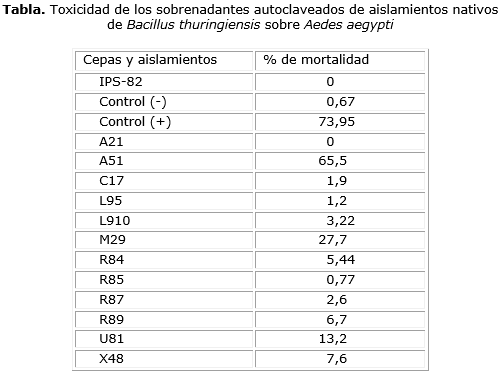
<body><![CDATA[<p align="left"><font face="Verdana" size="2"> Para lo cual se dise&#241;&#243;    un protocolo que incluy&#243; la centrifugaci&#243;n para eliminar las c&#233;lulas,    esporas y cristales de los cultivos y se autoclavearon para eliminar otros factores    de virulencia asumiendo que las beta exotoxinas son termoestables. Con el producto    final se realiz&#243; un bioensayo para determinar el efecto sobre <i>Aedes    aegypti.</i> </font></p>     <p align="left"> <font face="Verdana" size="2"><i>Bacillus thuringiensis: </i>    HD-1 y NRD-12, controles negativo y positivo de producci&#243;n de beta exotoxinas,    respectivamente (suministradas por el Instituto de Investigaciones de Sanidad    Vegetal INISAV, La Habana, Cuba). IPS-82 (est&#225;ndar Internacional, Instituto    Pasteur, Paris, Francia, <i>Bacillus thuringiensis </i>serotipo H-14). </font></p>     <p align="left"><font face="Verdana" size="2"> Aislamientos nativos: A21, A51,    C17, L95, L910, M29, R84, R85, R87, R89, U81, X48 pertenecientes a la colecci&#243;n    del laboratorio control biol&#243;gico del IPK. </font></p>     <p align="left"> <font face="Verdana" size="2"><i>Aedes aegypti: </i> Cepas Rockefeller,    suministrada por el CDC de San Juan, Puerto Rico </font></p>     <p align="left"><font face="Verdana" size="2">     <br>   Tanto las cepas controles como los aislamientos nativos fueron reactivadas en    caldo nutriente PH 7,0 por 24 h a 37 &#176;C agitaci&#243;n orbital a 150 rpm.    Se transfiri&#243; 2 mL del in&#243;culo a Erlenmeyers con 200 mL de caldo nutriente    suplementado con sales inorg&#225;nicas (MgSO<sub>4</sub> 12,5 mM; MnSO<sub>4</sub>    0,05 mM; FeSO<sub>4</sub> 1,2 mM; ZnSO<sub>4</sub> 1,2 mM; CaCl<sub>2</sub>    25 mM) y se incubaron 72 h en agitaci&#243;n orbital a 150 rpm 30 &#176;C. Se    centrifug&#243; 25 mL de este cultivo a 3000 rpm 4 &#176;C, hasta lograr una    completa clarificaci&#243;n. El precipitado se descart&#243; y el sobrenadante    se autoclave&#243; a 121 &#176;C por 20 min y conserv&#243; a -20 &#176;C. </font></p>     <p align="left"><font face="Verdana" size="2"> Se coloc&#243; 100 huevos de <i>Aedes    aegypti</i> (cepa Rockefeller) en 500mL de agua a 37 &#176;C y se verific&#243;    la eclosi&#243;n a las 4 h. Se a&#241;adi&#243; 66 mg de harina de pescado como    alimento, suspendidos en 10 mL del sobrenadante del cultivo autoclaveado. El    procedimiento se repiti&#243; durante 5 d&#237;as consecutivos. Las larvas fueron    introducidas en jaulas cuando alcanzaron el IV estadio. Diariamente se contaron    los individuos vivos seg&#250;n el desarrollo y se concluy&#243; el experimento    a los siete d&#237;as. Los bioensayos se repitieron cuatro veces en semanas    diferentes. Se calcul&#243; las medias de mortalidad y se compararon estad&#237;sticamente    mediante an&#225;lisis de varianza de una v&#237;a (ANOVA). Las diferencias    entre los grupos fueron analizadas mediante la prueba de Tukey, considerando    una p&lt; 0,05. </font></p>     <p align="left"><font face="Verdana" size="2"> Se determinaron los espectros de    absorci&#243;n de los cultivos clarificados y autoclaveados para corroborar    la presencia de beta exotoxinas, siguiendo el procedimiento descrito por Gal&#225;n    y col 1994<i>.</i><sup>11</sup> </font></p>     <p align="left"><font face="Verdana" size="2"> La cepa NRD-12 y el aislamiento    nativo A51 exhibieron una elevada toxicidad (73,95 % y 65,5 % de mortalidad    respectivamente) contra <i>Aedes aegypti</i>, (<a href="#tab1_10">tabla 1</a>),    lo cual result&#243; estad&#237;sticamente significativo con respecto al control    negativo y el resto de los aislamientos (ANOVA, F= 49,96 p&#706; 0,05).</font></p>     <p align="center"><a name="tab1_10"></a><img src="/img/revistas/mtr/v68n1/t0110116.gif" width="501" height="373"></p>     ]]></body>
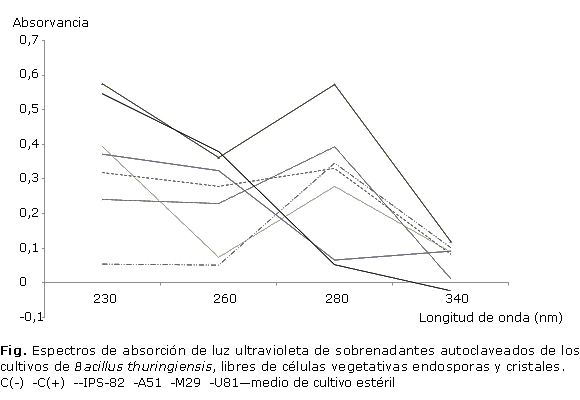
<body><![CDATA[<p align="left"><font face="Verdana" size="2">     <br>   En la <a href="#fig1_10">figura</a> se muestran los espectros de absorci&#243;n    para los sobrenadantes de los aislamientos que ocasionaron m&#225;s de un 10    % de mortalidad y los controles utilizados en el estudio. Al comparar los espectros    de absorci&#243;n se pudo determinar que solamente un aislamiento nativo con    toxicidad present&#243; picos cercanos a los del control positivo para esta    toxina, lo que ratifica los resultados obtenidos en los bioensayos<i>.</i></font></p>     <p align="center"><a name="fig1_10"></a><img src="/img/revistas/mtr/v68n1/f0110116.jpg" width="580" height="400"></p>     <p align="left"><font face="Verdana" size="2">     <br>   Aunque an&#225;lisis mediante HPLC es m&#225;s r&#225;pido y presumiblemente    m&#225;s reproducible,<sup>6,12</sup> no evidencia la acci&#243;n directa de    las beta exotoxinas sobre los insectos,13 adem&#225;s de ser necesario contar    con un patr&#243;n puro de beta exotoxina para el an&#225;lisis y de un equipamiento    que no se encuentra presente en muchos laboratorios<i>. </i>Por lo que tradicionalmente    se utilizan los bioensayos como m&#233;todo de referencia para detectar beta    exotoxinas en las cepas de <i>Bacillus thuringiensis</i>.<sup>8,14-17</sup>    </font></p>     <p align="left"><font face="Verdana" size="2"> En este trabajo se pudo determinar    la ausencia de beta exotoxinas en 11 aislamientos con marcada actividad entomopat&#243;gena    contra este vector, lo que permite ratificar su potencialidad para el desarrollo    de biolarvicidas. </font></p>     <p align="left">&nbsp; </p>     <p align="left"><font face="Verdana" size="2"><b><font size="3">REFERENCIAS BIBLIOGR&#193;FICAS</font></b>    </font></p>     <!-- ref --><p align="left"><font face="Verdana" size="2"> 1. WHO. Global Strategy for Dengue    Prevention and Control. 2012-2020. WHO library Cataloguing in Publication Data    ed. 2012.     </font></p>     ]]></body>
<body><![CDATA[<!-- ref --><p align="left"><font face="Verdana" size="2"> 2. Nartey R, Owusu-Dabo E, Kruppa    T, Baffour-Awuah S, Annan A, Oppong S et al. Use of <i>Bacillus thuringiensis    </i>var <i>israelensis</i>as a viable option in an Integrated Malaria Vector    Control programme in the Kumasi Metropolis, Ghana. Parasites <i>&amp;</i> Vectors    2013;6(116).     </font></p>     <!-- ref --><p align="left"><font face="Verdana" size="2"> 3. Palma L, Munoz D, Berry C, Murillo    J, Caballero P. <i>Bacillus thuringiensis </i>toxins: an overview of their biocidal    activity. Toxins (Basel). 2014;6(12):3296-325.     </font></p>     <!-- ref --><p align="left"><font face="Verdana" size="2"> 4. Liu X, Ruan L, Peng D, Li L,    Sun M, Yu Z. Thuringiensin: a thermostable secondary metabolite from <i>Bacillus    thuringiensis </i>with insecticidal activity against a wide range of insects.    Toxins (Basel). 2014;6(8):2229-38.     </font></p>     <p align="left"><font face="Verdana" size="2"> 5. WHO. World Health Organization.    Microbial Pest Control Agent: <i>Bacillus thuringiensis</i>. World Health Organization:    Geneva, Switzerland. 1999. </font></p>     <!-- ref --><p align="left"><font face="Verdana" size="2"> 6. Mac Innes TC, Bouwer G. An improved    bioassay for the detection of <i>Bacillus thuringiensis </i>beta-exotoxin. J    Invertebr Pathol. 2009;101(2):137-9.     </font></p>     <!-- ref --><p align="left"><font face="Verdana" size="2"> 7. Sauka DH, Perez MP, Lopez NN,    Onco MI, Berretta MF, Benintende GB. PCR-based prediction of type I beta-exotoxin    production in <i>Bacillus thuringiensis </i>strains. J Invertebr Pathol. 2014;122:28-31.        </font></p>     <!-- ref --><p align="left"><font face="Verdana" size="2"> 8. Hernandez CS, Ferre J, Larget-Thiery    I. Update on the detection of beta-exotoxin in <i>Bacillus thuringiensis </i>strains    by HPLC analysis. J Appl Microbiol. 2001;90(4):643-7.     </font></p>     <!-- ref --><p align="left"><font face="Verdana" size="2"> 9. Gonzalez A, Rodriguez G, Bruzon    RY, Diaz M, Companionis A, Menendez Z et al. Isolation and characterization    of entomopathogenic bacteria from soil samples from the western region of Cuba.    J Vector Ecol. 2013;38(1):46-52.     </font></p>     <!-- ref --><p align="left"><font face="Verdana" size="2"> 10. Gonzalez A, Diaz R, Diaz M,    Borrero Y, Bruzon RY, Carreras B et al. Characterization of <i>Bacillus thuringiensis    </i>soil isolates from Cuba, with insecticidal activity against mosquitoes.    Rev Biol Trop. 2011;59(3):1007-16.     </font></p>     <!-- ref --><p align="left"><font face="Verdana" size="2"> 11. Gal&#225;n W, K A. Uso de un    m&#233;todo sencillo para la detecci&#243;n de beta-exotoxina en cepas de <i>Bacillus    thuringiensi</i>s. South Western Entomologist 1994;19(4):385-90.     </font></p>     <!-- ref --><p align="left"><font face="Verdana" size="2"> 12. de Rijk TC, van Dam RC, Zomer    P, Boers EA, de Waard P, Mol HG. Development and validation of a confirmative    LC-MS/MS method for the determination of ss-exotoxin thuringiensin in plant    protection products and selected greenhouse crops. Anal Bioanal Chem. 2013;405(5):1631-39.        </font></p>     <!-- ref --><p align="left"><font face="Verdana" size="2"> 13. Gohar M, Perchat S. Sample    preparation for beta-exotoxin determination in <i>Bacillus thuringiensis </i>cultures    by reversed-phase high-performance liquid chromatography. Anal Biochem. 2001;298(1):112-7.        </font></p>     <!-- ref --><p align="left"><font face="Verdana" size="2"> 14. Swiecicka I, Bideshi DK, Federici    BA. Novels isolate of <i>Bacillus thuringiensis </i>subsp. <i>thuringiensis</i>    that produces a quasicuboidal crystal of Cry1Ab21 toxic to larvae of Trichoplusiani.    Appl Environ Microbiol. 2008;74(4):923-30.     </font></p>     <!-- ref --><p align="left"><font face="Verdana" size="2"> 15. Wellman-Desbiens E, Cote JC.    Screening of the insecticidal activity of <i>Bacillus thuringiensis </i>strains    against <i>Lygushesperus</i> (Hemiptera: Miridae) nymphal population. J Econ    Entomol. 2004;97(2):251-258.     </font></p>     <!-- ref --><p align="left"><font face="Verdana" size="2"> 16. Tsuchiya S, Kasaishi Y, Harada    H, Ichimatsu T, Saitoh H, Mizuki E et al. Assessment of the efficacy of Japanese    <i>Bacillus thuringiensis </i>isolates against the cigarette beetle, <i>Lasioderma</i>    <i>serricorne</i> (Coleoptera: Anobiidae). J Invertebr Pathol. 2002;81(2):122-6.        </font></p>     <!-- ref --><p align="left"><font face="Verdana" size="2"> 17. S&#225;nchez-Soto A, Saavedra-Gonz&#225;lez    GI, Ibarra JE, Salcedo-Hern&#225;ndez R, Barboza-Corona JE, Del Rinc&#243;n-Castro    MC. Detection of &#946;-exotoxin synthesis in <i>Bacillus thuringiensis</i>using    an easy bioassay with the nematode <i>Caenorhabditis elegans</i>. LETTERS IN    APPLIED MICROBIOLOGY 2015; Accepted Article', doi: 10.1111/lam.12493.     </font></p>     <p align="left">&nbsp;</p>     <p align="left">&nbsp;</p>     <p align="left"><font face="Verdana" size="2"><b>Recibido:</b> 2 de diciembre    de 2015<br/>   <b>Aprobado:</b> 26 de febrero de 2016</font></p>     <p align="left">&nbsp;</p>     <p align="left">&nbsp;</p>     <p align="left"> <font face="Verdana" size="2"><i>Aileen Gonz&#225;lez Rizo</i>.    Instituto de Medicina Tropical "Pedro Kour&#237;" Ave. Novia del Mediod&#237;a,    Km 6 &frac12;, La Lisa, La Habana, La Habana, Cuba. </font>    <br>   <font face="Verdana" size="2">Correo electr&#243;nico: <a href="mailto:aileen@ipk.sld.cu">aileen@ipk.sld.cu</a>    </font></p>      ]]></body><back>
<ref-list>
<ref id="B1">
<label>1</label><nlm-citation citation-type="book">
<collab>WHO</collab>
<source><![CDATA[Global Strategy for Dengue Prevention and Control: 2012-2020]]></source>
<year>2012</year>
<publisher-name><![CDATA[WHO library Cataloguing in Publication Data ed]]></publisher-name>
</nlm-citation>
</ref>
<ref id="B2">
<label>2</label><nlm-citation citation-type="journal">
<person-group person-group-type="author">
<name>
<surname><![CDATA[Nartey]]></surname>
<given-names><![CDATA[R]]></given-names>
</name>
<name>
<surname><![CDATA[Owusu-Dabo]]></surname>
<given-names><![CDATA[E]]></given-names>
</name>
<name>
<surname><![CDATA[Kruppa]]></surname>
<given-names><![CDATA[T]]></given-names>
</name>
<name>
<surname><![CDATA[Baffour-Awuah]]></surname>
<given-names><![CDATA[S]]></given-names>
</name>
<name>
<surname><![CDATA[Annan]]></surname>
<given-names><![CDATA[A]]></given-names>
</name>
<name>
<surname><![CDATA[Oppong]]></surname>
<given-names><![CDATA[S]]></given-names>
</name>
</person-group>
<article-title xml:lang="en"><![CDATA[Use of Bacillus thuringiensis var israelensisas a viable option in an Integrated Malaria Vector Control programme in the Kumasi Metropolis, Ghana]]></article-title>
<source><![CDATA[Parasites & Vectors]]></source>
<year>2013</year>
<volume>6</volume>
<numero>116</numero>
<issue>116</issue>
</nlm-citation>
</ref>
<ref id="B3">
<label>3</label><nlm-citation citation-type="journal">
<person-group person-group-type="author">
<name>
<surname><![CDATA[Palma]]></surname>
<given-names><![CDATA[L]]></given-names>
</name>
<name>
<surname><![CDATA[Munoz]]></surname>
<given-names><![CDATA[D]]></given-names>
</name>
<name>
<surname><![CDATA[Berry]]></surname>
<given-names><![CDATA[C]]></given-names>
</name>
<name>
<surname><![CDATA[Murillo]]></surname>
<given-names><![CDATA[J]]></given-names>
</name>
<name>
<surname><![CDATA[Caballero]]></surname>
<given-names><![CDATA[P]]></given-names>
</name>
</person-group>
<article-title xml:lang="en"><![CDATA[Bacillus thuringiensis toxins: an overview of their biocidal activity]]></article-title>
<source><![CDATA[Toxins (Basel)]]></source>
<year>2014</year>
<volume>6</volume>
<numero>12</numero>
<issue>12</issue>
<page-range>3296-325</page-range></nlm-citation>
</ref>
<ref id="B4">
<label>4</label><nlm-citation citation-type="journal">
<person-group person-group-type="author">
<name>
<surname><![CDATA[Liu]]></surname>
<given-names><![CDATA[X]]></given-names>
</name>
<name>
<surname><![CDATA[Ruan]]></surname>
<given-names><![CDATA[L]]></given-names>
</name>
<name>
<surname><![CDATA[Peng]]></surname>
<given-names><![CDATA[D]]></given-names>
</name>
<name>
<surname><![CDATA[Li]]></surname>
<given-names><![CDATA[L]]></given-names>
</name>
<name>
<surname><![CDATA[Sun]]></surname>
<given-names><![CDATA[M]]></given-names>
</name>
<name>
<surname><![CDATA[Yu]]></surname>
<given-names><![CDATA[Z]]></given-names>
</name>
</person-group>
<article-title xml:lang="en"><![CDATA[Thuringiensin: a thermostable secondary metabolite from Bacillus thuringiensis with insecticidal activity against a wide range of insects]]></article-title>
<source><![CDATA[Toxins (Basel)]]></source>
<year>2014</year>
<volume>6</volume>
<numero>8</numero>
<issue>8</issue>
<page-range>2229-38</page-range></nlm-citation>
</ref>
<ref id="B5">
<label>5</label><nlm-citation citation-type="book">
<collab>WHO. World Health Organization</collab>
<source><![CDATA[Microbial Pest Control Agent: Bacillus thuringiensis]]></source>
<year>1999</year>
<publisher-loc><![CDATA[Switzerland ]]></publisher-loc>
<publisher-name><![CDATA[World Health Organization]]></publisher-name>
</nlm-citation>
</ref>
<ref id="B6">
<label>6</label><nlm-citation citation-type="journal">
<person-group person-group-type="author">
<name>
<surname><![CDATA[Mac Innes]]></surname>
<given-names><![CDATA[TC]]></given-names>
</name>
<name>
<surname><![CDATA[Bouwer]]></surname>
<given-names><![CDATA[G]]></given-names>
</name>
</person-group>
<article-title xml:lang="en"><![CDATA[An improved bioassay for the detection of Bacillus thuringiensis beta-exotoxin]]></article-title>
<source><![CDATA[J Invertebr Pathol]]></source>
<year>2009</year>
<volume>101</volume>
<numero>2</numero>
<issue>2</issue>
<page-range>137-9</page-range></nlm-citation>
</ref>
<ref id="B7">
<label>7</label><nlm-citation citation-type="journal">
<person-group person-group-type="author">
<name>
<surname><![CDATA[Sauka]]></surname>
<given-names><![CDATA[DH]]></given-names>
</name>
<name>
<surname><![CDATA[Perez]]></surname>
<given-names><![CDATA[MP]]></given-names>
</name>
<name>
<surname><![CDATA[Lopez]]></surname>
<given-names><![CDATA[NN]]></given-names>
</name>
<name>
<surname><![CDATA[Onco]]></surname>
<given-names><![CDATA[MI]]></given-names>
</name>
<name>
<surname><![CDATA[Berretta]]></surname>
<given-names><![CDATA[MF]]></given-names>
</name>
<name>
<surname><![CDATA[Benintende]]></surname>
<given-names><![CDATA[GB]]></given-names>
</name>
</person-group>
<article-title xml:lang="en"><![CDATA[PCR-based prediction of type I beta-exotoxin production in Bacillus thuringiensis strains]]></article-title>
<source><![CDATA[J Invertebr Pathol]]></source>
<year>2014</year>
<volume>122</volume>
<page-range>28-31</page-range></nlm-citation>
</ref>
<ref id="B8">
<label>8</label><nlm-citation citation-type="journal">
<person-group person-group-type="author">
<name>
<surname><![CDATA[Hernandez]]></surname>
<given-names><![CDATA[CS]]></given-names>
</name>
<name>
<surname><![CDATA[Ferre]]></surname>
<given-names><![CDATA[J]]></given-names>
</name>
<name>
<surname><![CDATA[Larget-Thiery]]></surname>
<given-names><![CDATA[I]]></given-names>
</name>
</person-group>
<article-title xml:lang="en"><![CDATA[Update on the detection of beta-exotoxin in Bacillus thuringiensis strains by HPLC analysis]]></article-title>
<source><![CDATA[J Appl Microbiol]]></source>
<year>2001</year>
<volume>90</volume>
<numero>4</numero>
<issue>4</issue>
<page-range>643-7</page-range></nlm-citation>
</ref>
<ref id="B9">
<label>9</label><nlm-citation citation-type="journal">
<person-group person-group-type="author">
<name>
<surname><![CDATA[Gonzalez]]></surname>
<given-names><![CDATA[A]]></given-names>
</name>
<name>
<surname><![CDATA[Rodriguez]]></surname>
<given-names><![CDATA[G]]></given-names>
</name>
<name>
<surname><![CDATA[Bruzon]]></surname>
<given-names><![CDATA[RY]]></given-names>
</name>
<name>
<surname><![CDATA[Diaz]]></surname>
<given-names><![CDATA[M]]></given-names>
</name>
<name>
<surname><![CDATA[Companionis]]></surname>
<given-names><![CDATA[A]]></given-names>
</name>
<name>
<surname><![CDATA[Menendez]]></surname>
<given-names><![CDATA[Z]]></given-names>
</name>
</person-group>
<article-title xml:lang="en"><![CDATA[Isolation and characterization of entomopathogenic bacteria from soil samples from the western region of Cuba]]></article-title>
<source><![CDATA[J Vector Ecol]]></source>
<year>2013</year>
<volume>38</volume>
<numero>1</numero>
<issue>1</issue>
<page-range>46-52</page-range></nlm-citation>
</ref>
<ref id="B10">
<label>10</label><nlm-citation citation-type="journal">
<person-group person-group-type="author">
<name>
<surname><![CDATA[Gonzalez]]></surname>
<given-names><![CDATA[A]]></given-names>
</name>
<name>
<surname><![CDATA[Diaz]]></surname>
<given-names><![CDATA[R]]></given-names>
</name>
<name>
<surname><![CDATA[Diaz]]></surname>
<given-names><![CDATA[M]]></given-names>
</name>
<name>
<surname><![CDATA[Borrero]]></surname>
<given-names><![CDATA[Y]]></given-names>
</name>
<name>
<surname><![CDATA[Bruzon]]></surname>
<given-names><![CDATA[RY]]></given-names>
</name>
<name>
<surname><![CDATA[Carreras]]></surname>
<given-names><![CDATA[B]]></given-names>
</name>
</person-group>
<article-title xml:lang="en"><![CDATA[Characterization of Bacillus thuringiensis soil isolates from Cuba, with insecticidal activity against mosquitoes]]></article-title>
<source><![CDATA[Rev Biol Trop]]></source>
<year>2011</year>
<volume>59</volume>
<numero>3</numero>
<issue>3</issue>
<page-range>1007-16</page-range></nlm-citation>
</ref>
<ref id="B11">
<label>11</label><nlm-citation citation-type="journal">
<person-group person-group-type="author">
<name>
<surname><![CDATA[Galán]]></surname>
<given-names><![CDATA[WKA]]></given-names>
</name>
</person-group>
<article-title xml:lang="es"><![CDATA[Uso de un método sencillo para la detección de beta-exotoxina en cepas de Bacillus thuringiensis]]></article-title>
<source><![CDATA[South Western Entomologist]]></source>
<year>1994</year>
<volume>19</volume>
<numero>4</numero>
<issue>4</issue>
<page-range>385-90</page-range></nlm-citation>
</ref>
<ref id="B12">
<label>12</label><nlm-citation citation-type="journal">
<person-group person-group-type="author">
<name>
<surname><![CDATA[de Rijk]]></surname>
<given-names><![CDATA[TC]]></given-names>
</name>
<name>
<surname><![CDATA[van Dam]]></surname>
<given-names><![CDATA[RC]]></given-names>
</name>
<name>
<surname><![CDATA[Zomer]]></surname>
<given-names><![CDATA[P]]></given-names>
</name>
<name>
<surname><![CDATA[Boers]]></surname>
<given-names><![CDATA[EA]]></given-names>
</name>
<name>
<surname><![CDATA[de Waard]]></surname>
<given-names><![CDATA[P]]></given-names>
</name>
<name>
<surname><![CDATA[Mol]]></surname>
<given-names><![CDATA[HG]]></given-names>
</name>
</person-group>
<article-title xml:lang="en"><![CDATA[Development and validation of a confirmative LC-MS/MS method for the determination of ss-exotoxin thuringiensin in plant protection products and selected greenhouse crops]]></article-title>
<source><![CDATA[Anal Bioanal Chem]]></source>
<year>2013</year>
<volume>405</volume>
<numero>5</numero>
<issue>5</issue>
<page-range>1631-39</page-range></nlm-citation>
</ref>
<ref id="B13">
<label>13</label><nlm-citation citation-type="journal">
<person-group person-group-type="author">
<name>
<surname><![CDATA[Gohar]]></surname>
<given-names><![CDATA[M]]></given-names>
</name>
<name>
<surname><![CDATA[Perchat]]></surname>
<given-names><![CDATA[S]]></given-names>
</name>
</person-group>
<article-title xml:lang="en"><![CDATA[Sample preparation for beta-exotoxin determination in Bacillus thuringiensis cultures by reversed-phase high-performance liquid chromatography]]></article-title>
<source><![CDATA[Anal Biochem]]></source>
<year>2001</year>
<volume>298</volume>
<numero>1</numero>
<issue>1</issue>
<page-range>112-7</page-range></nlm-citation>
</ref>
<ref id="B14">
<label>14</label><nlm-citation citation-type="journal">
<person-group person-group-type="author">
<name>
<surname><![CDATA[Swiecicka]]></surname>
<given-names><![CDATA[I]]></given-names>
</name>
<name>
<surname><![CDATA[Bideshi]]></surname>
<given-names><![CDATA[DK]]></given-names>
</name>
<name>
<surname><![CDATA[Federici]]></surname>
<given-names><![CDATA[BA]]></given-names>
</name>
</person-group>
<article-title xml:lang="en"><![CDATA[Novels isolate of Bacillus thuringiensis subsp: thuringiensis that produces a quasicuboidal crystal of Cry1Ab21 toxic to larvae of Trichoplusiani]]></article-title>
<source><![CDATA[Appl Environ Microbiol]]></source>
<year>2008</year>
<volume>74</volume>
<numero>4</numero>
<issue>4</issue>
<page-range>923-30</page-range></nlm-citation>
</ref>
<ref id="B15">
<label>15</label><nlm-citation citation-type="journal">
<person-group person-group-type="author">
<name>
<surname><![CDATA[Wellman-Desbiens]]></surname>
<given-names><![CDATA[E]]></given-names>
</name>
<name>
<surname><![CDATA[Cote]]></surname>
<given-names><![CDATA[JC]]></given-names>
</name>
</person-group>
<article-title xml:lang="en"><![CDATA[Screening of the insecticidal activity of Bacillus thuringiensis strains against Lygushesperus (Hemiptera:Miridae) nymphal population]]></article-title>
<source><![CDATA[J Econ Entomol]]></source>
<year>2004</year>
<volume>97</volume>
<numero>2</numero>
<issue>2</issue>
<page-range>251-258</page-range></nlm-citation>
</ref>
<ref id="B16">
<label>16</label><nlm-citation citation-type="journal">
<person-group person-group-type="author">
<name>
<surname><![CDATA[Tsuchiya]]></surname>
<given-names><![CDATA[S]]></given-names>
</name>
<name>
<surname><![CDATA[Kasaishi]]></surname>
<given-names><![CDATA[Y]]></given-names>
</name>
<name>
<surname><![CDATA[Harada]]></surname>
<given-names><![CDATA[H]]></given-names>
</name>
<name>
<surname><![CDATA[Ichimatsu]]></surname>
<given-names><![CDATA[T]]></given-names>
</name>
<name>
<surname><![CDATA[Saitoh]]></surname>
<given-names><![CDATA[H]]></given-names>
</name>
<name>
<surname><![CDATA[Mizuki]]></surname>
<given-names><![CDATA[E]]></given-names>
</name>
</person-group>
<article-title xml:lang="en"><![CDATA[Assessment of the efficacy of Japanese Bacillus thuringiensis isolates against the cigarette beetle, Lasioderma serricorne (Coleoptera:Anobiidae)]]></article-title>
<source><![CDATA[J Invertebr Pathol]]></source>
<year>2002</year>
<volume>81</volume>
<numero>2</numero>
<issue>2</issue>
<page-range>122-6</page-range></nlm-citation>
</ref>
<ref id="B17">
<label>17</label><nlm-citation citation-type="journal">
<person-group person-group-type="author">
<name>
<surname><![CDATA[Sánchez-Soto]]></surname>
<given-names><![CDATA[A]]></given-names>
</name>
<name>
<surname><![CDATA[Saavedra-González]]></surname>
<given-names><![CDATA[GI]]></given-names>
</name>
<name>
<surname><![CDATA[Ibarra]]></surname>
<given-names><![CDATA[JE]]></given-names>
</name>
<name>
<surname><![CDATA[Salcedo-Hernández]]></surname>
<given-names><![CDATA[R]]></given-names>
</name>
<name>
<surname><![CDATA[Barboza-Corona]]></surname>
<given-names><![CDATA[JE]]></given-names>
</name>
<name>
<surname><![CDATA[Del Rincón-Castro]]></surname>
<given-names><![CDATA[MC]]></given-names>
</name>
</person-group>
<article-title xml:lang="en"><![CDATA[Detection of &#946;-exotoxin synthesis in Bacillus thuringiensisusing an easy bioassay with the nematode Caenorhabditis elegans]]></article-title>
<source><![CDATA[LETTERS IN APPLIED MICROBIOLOGY]]></source>
<year>2015</year>
</nlm-citation>
</ref>
</ref-list>
</back>
</article>