<?xml version="1.0" encoding="ISO-8859-1"?><article xmlns:mml="http://www.w3.org/1998/Math/MathML" xmlns:xlink="http://www.w3.org/1999/xlink" xmlns:xsi="http://www.w3.org/2001/XMLSchema-instance">
<front>
<journal-meta>
<journal-id>0375-0760</journal-id>
<journal-title><![CDATA[Revista Cubana de Medicina Tropical]]></journal-title>
<abbrev-journal-title><![CDATA[Rev Cubana Med Trop]]></abbrev-journal-title>
<issn>0375-0760</issn>
<publisher>
<publisher-name><![CDATA[Centro Nacional de Información de Ciencias Médicas]]></publisher-name>
</publisher>
</journal-meta>
<article-meta>
<article-id>S0375-07602016000300002</article-id>
<title-group>
<article-title xml:lang="en"><![CDATA[Ultrastructural remodelling of e ndoplasmic reticulum-derived membranes and hepatitis C virus morphogenesis in human liver samples]]></article-title>
<article-title xml:lang="es"><![CDATA[Modificación ultraestructural de las membranas derivadas del retículo endoplasmático y morfogénesis del virus de la hepatitis C en muestras de hígado humano]]></article-title>
</title-group>
<contrib-group>
<contrib contrib-type="author">
<name>
<surname><![CDATA[Falcón Cama]]></surname>
<given-names><![CDATA[Viviana]]></given-names>
</name>
<xref ref-type="aff" rid="A01"/>
</contrib>
<contrib contrib-type="author">
<name>
<surname><![CDATA[Acosta-Rivero]]></surname>
<given-names><![CDATA[Nelson]]></given-names>
</name>
<xref ref-type="aff" rid="A01"/>
</contrib>
<contrib contrib-type="author">
<name>
<surname><![CDATA[González Pozos]]></surname>
<given-names><![CDATA[Sirenia]]></given-names>
</name>
<xref ref-type="aff" rid="A02"/>
</contrib>
<contrib contrib-type="author">
<name>
<surname><![CDATA[Dueñas-Carrera]]></surname>
<given-names><![CDATA[Santiago]]></given-names>
</name>
<xref ref-type="aff" rid="A01"/>
</contrib>
<contrib contrib-type="author">
<name>
<surname><![CDATA[Acosta Medina]]></surname>
<given-names><![CDATA[Emilio]]></given-names>
</name>
<xref ref-type="aff" rid="A03"/>
</contrib>
<contrib contrib-type="author">
<name>
<surname><![CDATA[Kourí Flores]]></surname>
<given-names><![CDATA[Juan]]></given-names>
</name>
<xref ref-type="aff" rid="A02"/>
</contrib>
</contrib-group>
<aff id="A01">
<institution><![CDATA[,Centro de Ingeniería Genética y Biotecnología  ]]></institution>
<addr-line><![CDATA[Habana ]]></addr-line>
<country>Cuba</country>
</aff>
<aff id="A02">
<institution><![CDATA[,CINVESTAV-IPN  ]]></institution>
<addr-line><![CDATA[DF ]]></addr-line>
<country>México</country>
</aff>
<aff id="A03">
<institution><![CDATA[,Center for Advanced Study in Cuba  ]]></institution>
<addr-line><![CDATA[Habana ]]></addr-line>
<country>Cuba</country>
</aff>
<pub-date pub-type="pub">
<day>00</day>
<month>12</month>
<year>2016</year>
</pub-date>
<pub-date pub-type="epub">
<day>00</day>
<month>12</month>
<year>2016</year>
</pub-date>
<volume>68</volume>
<numero>3</numero>
<fpage>191</fpage>
<lpage>202</lpage>
<copyright-statement/>
<copyright-year/>
<self-uri xlink:href="http://scielo.sld.cu/scielo.php?script=sci_arttext&amp;pid=S0375-07602016000300002&amp;lng=en&amp;nrm=iso"></self-uri><self-uri xlink:href="http://scielo.sld.cu/scielo.php?script=sci_abstract&amp;pid=S0375-07602016000300002&amp;lng=en&amp;nrm=iso"></self-uri><self-uri xlink:href="http://scielo.sld.cu/scielo.php?script=sci_pdf&amp;pid=S0375-07602016000300002&amp;lng=en&amp;nrm=iso"></self-uri><kwd-group>
<kwd lng="en"><![CDATA[HCV]]></kwd>
<kwd lng="en"><![CDATA[morphogenesis]]></kwd>
<kwd lng="en"><![CDATA[viral replication]]></kwd>
<kwd lng="en"><![CDATA[liver biopsies]]></kwd>
<kwd lng="en"><![CDATA[viral assembly]]></kwd>
<kwd lng="es"><![CDATA[VHC]]></kwd>
<kwd lng="es"><![CDATA[morfogénesis]]></kwd>
<kwd lng="es"><![CDATA[replicación viral]]></kwd>
<kwd lng="es"><![CDATA[biopsias de hígado]]></kwd>
<kwd lng="es"><![CDATA[ensamblaje viral]]></kwd>
</kwd-group>
</article-meta>
</front><body><![CDATA[ <p align="right"><b><font face="Verdana, Arial, Helvetica, sans-serif" size="2">ART&Iacute;CULO    ORIGINAL</font></b></p>     <p>&nbsp;</p>     <p> <font face="Verdana, Arial, Helvetica, sans-serif" size="2"><b><font size="4">Ultrastructural    remodelling of e</font></b> <font size="4"><b> ndoplasmic reticulum-derived    membranes and hepatitis C virus morphogenesis in human liver samples </b></font></font></p>     <p>&nbsp;</p>     <p><font face="Verdana, Arial, Helvetica, sans-serif" size="2"><b> <font size="3">Modificaci&#243;n    ultraestructural de las membranas derivadas del ret&#237;culo endoplasm&#225;tico    y morfog&#233;nesis del virus de la hepatitis C en muestras </font><font face="Verdana, Arial, Helvetica, sans-serif" size="2"><b><font size="3">de    h&#237;gado</font></b></font><font size="3"> humano</font></b></font></p>     <p>&nbsp;</p>     <p>&nbsp;</p>     <p> <font face="Verdana, Arial, Helvetica, sans-serif" size="2"><b>Viviana Falc&#243;n    Cama,</b><b><sup>I</sup></b> <b> Nelson Acosta-Rivero,</b><b><sup>I</sup></b>    <b> Sirenia Gonz&#225;lez Pozos,</b><b><sup>II</sup></b> <b> Santiago Due&#241;as-Carrera</b><b>,</b><b><sup>I</sup></b>    <a><b>Emilio Acosta Medina</b></a><b>,<sup>III</sup></b> <b>Juan Kour</b><b>&#237;</b>    <b> Flores<sup>II</sup></b> </font></p>     <p> <font face="Verdana, Arial, Helvetica, sans-serif" size="2"><sup>I</sup> Centro    de Ingenier&#237;a Gen&#233;tica y Biotecnolog&#237;a. Habana, Cuba.     <br>   </font><font face="Verdana, Arial, Helvetica, sans-serif" size="2"><sup>II</sup>    CINVESTAV-IPN. M&#233;xico, DF, M&#233;xico.     ]]></body>
<body><![CDATA[<br>   </font><font face="Verdana, Arial, Helvetica, sans-serif" size="2"><sup>III</sup>    Center for Advanced Study in Cuba. Habana, Cuba. </font></p>     <p>&nbsp;</p>     <p>&nbsp;</p> <hr>     <p><font face="Verdana, Arial, Helvetica, sans-serif" size="2"><b>ABSTRACT</b></font></p>     <p><font face="Verdana, Arial, Helvetica, sans-serif" size="2"><b>Introduction:</b>    hepatitis C virus infection is considered as a leading cause of liver disease    worldwide. Despite recent advances in understanding the hepatitis C virus life    cycle using the highly replicative JFH1 strain in human hepatoma cells, little    is known about hepatitis C virus morphogenesis. Low levels of hepatitis C virus    assembly in this cell culture model as well as low levels and complexity of    hepatitis C virus particles in infected humans and chimpanzees have hampered    the study of hepatitis C virus morphogenesis in vivo.     <br>   <b>Objetivo: </b>to study the ultrastructural features and viral assembly events    in hepatocytes from HCV hepatitis C virus-infected patients.    <br>   <b>Methods:</b> liver needle biopsies samples of patients with hepatitis C virus    infection, specific antibodies against hepatitis C virus and transmission electron    microscopy and immunoelectron microscopy analyses were used in this study.    <br>   <b>Results:</b> ultrastructural studies in liver biopsies from hepatitis C virus-infected    patients revealed that hepatitis C virus infection was related with remodelling    of endoplasmic reticulum-derived membranes and with a variety of cytoplasmic    microenvironments in hepatocytes. Dilated endoplasmic reticulum and formation    of various membrane vesicles are features that have been associated with the    viral replication complex. Interestingly, hepatitis C virus-like particles and    core-like particles budding and assembly were observed near convoluted electron-dense    membranes and tubular structures. Particularly, hepatitis C virus structural    proteins localize to the endoplasmic reticulum.    <br>   <b>Conclusions:</b> these events indicate that hepatitis C virus nucleocapsids    and early virion assembly take place at endoplasmic reticulum membranes that    are associated with these cytoplasmic microenvironments in human hepatocytes.        <br>   </font></p>     ]]></body>
<body><![CDATA[<p><font face="Verdana, Arial, Helvetica, sans-serif" size="2"><b>Keywords:</b>    HCV; morphogenesis; viral replication; liver biopsies; viral assembly.</font>    <br> </p> <hr>     <p><font face="Verdana, Arial, Helvetica, sans-serif" size="2"><b>RESUMEN</b>    </font></p>     <p> <font face="Verdana, Arial, Helvetica, sans-serif" size="2"><b>Introducci&#243;n:</b>    la infecci&#243;n por el virus de la hepatitis C es una de las causas principales    de la enfermedad del h&#237;gado a nivel mundial. La utilizaci&#243;n de la    cepa del virus de la hepatitis C, JFH1 en cultivo de c&#233;lulas de hepatoma    ha permitido el avance de la comprensi&#243;n del ciclo de vida viral. No obstante,    se conoce poco sobre la morfog&#233;nesis del virus de la hepatitis C. Las dificultades    para detectar el ensamblaje viral en este modelo de cultivo celular, as&#237;    como los bajos niveles y complejidad de las part&#237;culas del virus de la    hepatitis C en pacientes y chimpanc&#233;s infectados limitan el estudio de    la morfog&#233;nesis viral.     <br>   </font><font face="Verdana, Arial, Helvetica, sans-serif" size="2"><b>Objetivo:</b>    estudiar las caracter&#237;sticas ultraestructurales y los eventos de ensamblaje    viral en hepatocitos de pacientes infectados con el virus de la hepatitis C.        <br>   </font><font face="Verdana, Arial, Helvetica, sans-serif" size="2"><b>M&#233;todos:    </b> se utilizaron muestras de biopsias de h&#237;gado de pacientes infectados,    anticuerpos espec&#237;ficos para el virus de la hepatitis C y t&#233;cnicas    de microscop&#237;a e inmunomicroscop&#237;a electr&#243;nica.     <br>   </font><font face="Verdana, Arial, Helvetica, sans-serif" size="2"><b>Resultados:    </b> la infecci&#243;n por el virus de la hepatitis C se relacion&#243; con    una modificaci&#243;n de las membranas derivadas del ret&#237;culo endoplasm&#225;tico    y con diferentes microambientes citoplasm&#225;ticos en los hepatocitos de individuos    infectados. La dilataci&#243;n del ret&#237;culo endoplasm&#225;tico y la formaci&#243;n    de diferentes ves&#237;culas de membrana son caracter&#237;sticas que se asocian    con los complejos de replicaci&#243;n viral. Resulta interesante destacar la    detecci&#243;n del ensamblaje de part&#237;culas semejantes a la c&#225;psida    y al virus de la hepatitis C cerca de complejos de membrana con alta densidad    electr&#243;nica y estructuras tubulares. Las prote&#237;nas estructurales del    virus de la hepatitis C se detectaron en el ret&#237;culo endoplasm&#225;tico    .     <br>   </font><font face="Verdana, Arial, Helvetica, sans-serif" size="2"><b>Conclusiones:    </b> estos eventos sugieren que el proceso temprano de ensamblaje de las nucleoc&#225;psidas    y del viri&#243;n ocurre en las membranas del ret&#237;culo endoplasm&#225;tico    que se asocian con estos microambientes citoplasm&#225;ticos en los hepatocitos    humanos. </font></p>     <p> <font face="Verdana, Arial, Helvetica, sans-serif" size="2"><b>Palabras clave</b>:    VHC; morfog&#233;nesis; replicaci&#243;n viral; biopsias de h&#237;gado; ensamblaje    viral. </font></p> <hr>     <p>&nbsp; </p>     ]]></body>
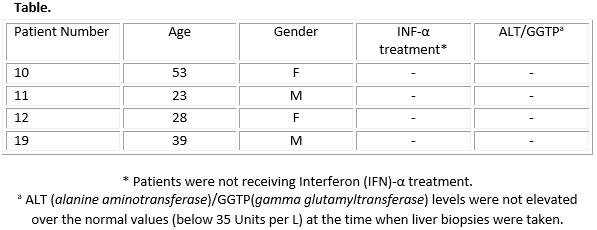
<body><![CDATA[<p>&nbsp;</p>     <p><font face="Verdana, Arial, Helvetica, sans-serif" size="2"><b><font size="3">INTRODUCTION</font></b>    </font></p>     <p><font face="Verdana, Arial, Helvetica, sans-serif" size="2"> Hepatitis C virus    (HCV) infection is a major health problem (130-170 million people are estimated    to be chronically infected) and is considered as a leading cause of liver disease    worldwide.<sup>1</sup> Most of infected persons develop chronic disease (70-80    %) that can progress to cirrhosis, hepatocellular carcinoma (HCC) and liver    failure.<sup>1</sup> In addition, it is predicted that the prevalence of HCV-related    cirrhosis and HCC will considerably increase in the next decade.<sup>2</sup>    HCV was first identified in 1989 using molecular biology techniques from sera    of experimentally infected chimpanzees.<sup>3</sup> HCV is an enveloped positive-strand    RNA virus classified as the type member of the Hepacivirus Genus in the family    Flaviviridae.<sup>4</sup> The HCV genome is a 9.6 kb single-stranded positive    sense RNA that contains a single open reading frame (ORF) encoding a polyprotein    of 3 010-3 030 amino acids (aa) residues.<sup>5</sup> The ORF is flanked by    5&#180;- and 3&#180;-terminal no translated regions (NTRs) important for viral    RNA translation and replication. The 5&#180;-NTR contains an internal ribosome    entry site (IRES) allowing translation of the RNA genome in the absence of a    cap structure.<sup>6</sup> Upon its synthesis in the endoplasmic reticulum (ER),    the HCV polyprotein is co- and post-translationally processed by cellular and    viral proteases into at least 10 mature cleavage products, including the structural    (core, E1 and E2) and the non-structural (NS) proteins (p7, NS2, NS3, NS4A,    NS4B, NS5A and NS5B). Core, E1, E2, p7 and NS2 are primarily involved in HCV    assembly while NS3 to NS5B are primarily involved in viral RNA replication.<sup>5</sup>    HCV isolates show substantial genetic diversity and have been grouped into seven    genotypes and several subtypes. HCV subtypes are epidemiologically distinct,    with differences in risk group targeting and geographical distributions. Globally,    genotypes 1 and 3 are the most common (46 % and 22 %, respectively).<sup>4</sup>    </font></p>     <p><font face="Verdana, Arial, Helvetica, sans-serif" size="2"> A major advance    in HCV research occurred in 2005 with the discovery that the highly replicative    HCV JFH1 strain (genotype 2a) was capable of producing infectious virions from    selected hepatoma cell lines in culture.<sup>7-9</sup> Ultrastructural studies    from HCV cell culture systems disclosed that HCV induces a microenvironment,    called the "membranous web" (MW), promoting viral replication.<sup>10</sup>    However, JFH1 is an unusual HCV strain allowing few assembly events per infected    cell (in Huh7-derived hepatoma cells), thus hampering a better knowledge of    the HCV assembly, morphogenesis and virion structure.<sup>11,12</sup> In addition,    little is known about HCV morphogenesis in the liver of virus infected persons.    So, the goal of this work was to study the ultrastructural features and viral    assembly events in hepatocytes from HCV-infected patients. </font></p>     <p>&nbsp;</p>     <p align="left"> <font size="3"><b><font face="Verdana, Arial, Helvetica, sans-serif">METHODS</font></b></font></p>     <p><font face="Verdana, Arial, Helvetica, sans-serif" size="2">    <br>   PATIENTS AND SAMPLES </font></p>     <p><font face="Verdana, Arial, Helvetica, sans-serif" size="2"> Liver needle biopsies    from patients analysed in this study have been previously illustrated.<sup>13,14</sup>    Briefly, four patients with HCV infection hospitalized for hepatitis in the    Institute of Gastroenterology, Havana, Cuba, were recruited after informed consent    in writing was obtained (<a href="/img/revistas/mtr/v68n3/t0102316.gif">table</a>). Liver needle biopsy    samples were taken at the time of routine diagnostic biopsy from all patients.    They were selected based upon they were serologically positive to third-generation    HCV enzyme immunoassays (Tecnosuma International, Havana, Cuba) and that the    anti-HCV positive sera were confirmed by Ortho HCV 2.0 ELISA (Ortho Diagnostic    Systems, Rariton, NJ). They also showed positive detection of HCV RNA in the    liver by in situ hybridization.<sup>14</sup> </font></p>     <p><font face="Verdana, Arial, Helvetica, sans-serif" size="2">     ]]></body>
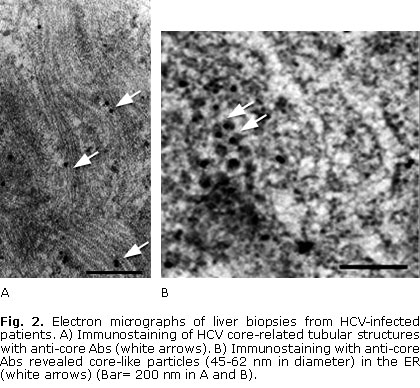
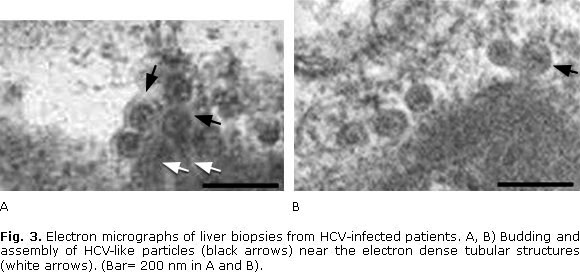
<body><![CDATA[<br>   ANTIBODIES </font></p>     <p><font face="Verdana, Arial, Helvetica, sans-serif" size="2"> Anti-core (CBSS-HepC.1)    and anti-E1 (CBSS-HepC.2) mouse monoclonal antibodies (mAbs) have been described    before.<sup>13,14</sup></font></p>     <p><font face="Verdana, Arial, Helvetica, sans-serif" size="2">     <br>   TRANSMISSION ELECTRON MICROSCOPY</font></p>     <p><font face="Verdana, Arial, Helvetica, sans-serif" size="2"> Hepatic tissue    samples were prepared for transmission electron microscopy as previously described.<sup>13,14</sup>    Briefly, hepatic tissue samples were fixed for 1 h at 4 _C in 1 % (v/v) glutaraldehyde    and 4 % (v/v) paraformaldehyde, rinsed in 0.1M sodium cacodylate (pH 7.4), post-fixed    for 1 h at 4_C in 1 % OsO4, and dehydrated in increasing concentrations of ethanol.    The embedding was done, as previously described with minor modifications.<sup>13</sup>    In brief, ultrathin sections (400-500_AA) made with an ultramicrotome (NOVA,    LKB) were placed on 400 mesh grids, stained with saturated uranyl acetate and    lead citrate, and examined with a JEOL/JEM 2000 transmission electron microscope    (JEOL, Japan). </font></p> <font face="Verdana, Arial, Helvetica, sans-serif" size="2">     <br> IMMUNOELECTRON MICROSCOPY</font>      <p><font face="Verdana, Arial, Helvetica, sans-serif" size="2">  Samples of hepatic    tissue were fixed with 4 % (v/v) paraformaldehyde containing 0.2 % (v/v) glutaraldehyde    in 0.1 M phosphate buffer (pH 7.3) at 4 _C for 3 h and washed with 0.1 M phosphate    buffer, pH 7.3. Fixed cells were dehydrated as described above, embedded in    Lowicryl, and polymerized by exposure to ultraviolet light at room temperature    (RT) for 72 h. Ultrathin sections of liver biopsies were incubated with either    anti-core (CBSSHepC.1) or anti-E1 (CBSS-HepC.2) mAbs in phosphate buffer, for    45 min at RT. The sections were rinsed three times for 30 min at RT with 0.1    % bovine serum albumin in phosphate-buffered saline, pH 7.3 (BSA-PBS), and incubated    for 1 h at RT with gold-labeled (15 nm) anti-mouse IgG (Amersham, UK) diluted    1:100 in BSA-PBS. As control the primary antibody was substituted by normal    mouse serum. All sections were stained and analysed with a transmission electron    microscope, as mentioned above. </font></p>     <p>&nbsp;</p>     <p> <font face="Verdana, Arial, Helvetica, sans-serif" size="2"><b><font size="3">RESULTS</font></b>    </font></p>     <p><font face="Verdana, Arial, Helvetica, sans-serif" size="2"> Ultrastructural    studies in liver biopsies from HCV-infected patients revealed that HCV infection    was related with remodelling of ER-derived membranes and with a variety of cytoplasmic    microenvironments in hepatocytes (<a href="/img/revistas/mtr/v68n3/f0102316.jpg">Fig. 1</a>, <a href="#fig2">2</a>    and <a href="/img/revistas/mtr/v68n3/f0302316.jpg">3</a>). Ultrastructural features included dilated    ER, formation of various membrane vesicles, convoluted electron-dense membranes    and HCV-related tubular structures (<a href="/img/revistas/mtr/v68n3/f0102316.jpg">Fig. 1</a> and <a href="/img/revistas/mtr/v68n3/f0202316.jpg">2</a>).    Particularly, HCV structural proteins localized to the ER membranes (<a href="/img/revistas/mtr/v68n3/f0102316.jpg">Fig.    1</a>, B and <a href="#fig2">2,</a> B).</font></p>     ]]></body>
<body><![CDATA[<p align="center"><img src="/img/revistas/mtr/v68n3/f0202316.jpg" width="420" height="388"><a name="fig2"></a></p>     <p><font face="Verdana, Arial, Helvetica, sans-serif" size="2"> In addition, electron-dense    ER membranes (that were immunolabelled with anti-E1 antibodies) displaying adhesion    through their cytosolic sides, were observed in hepatocytes of HCV-infected    patients (<a href="/img/revistas/mtr/v68n3/f0102316.jpg">Fig. 1</a>, B). Interestingly, both tubular    structures and core-like particles were immunolabelled with anti-HCV core antibodies    in hepatocytes (<a href="#fig2">Fig. 2</a>, A, B). Remarkably, budding of HCV-like    particles suggesting viral assembly in ER membranes and near the tubular structures    were shown in these liver samples (<a href="#fig2">Fig. 2</a> and <a href="/img/revistas/mtr/v68n3/f0302316.jpg">3</a>).    Specially, enveloped particles with diameters between 68-80 nm, and electron-dense    internal icosahedral-like capsids (diameters 25-35 nm) were observed (<a href="/img/revistas/mtr/v68n3/f0302316.jpg">Fig.    3</a>). </font></p>     <p>&nbsp;</p>     <p> <font face="Verdana, Arial, Helvetica, sans-serif" size="2"><b><font size="3">DISCUSSION</font></b>    </font></p>     <p><font face="Verdana, Arial, Helvetica, sans-serif" size="2">     <br>   ULTRASTRUCTURAL REMODELLING OF ER-DERIVED MEMBRANES IN HEPATOCYTES DURING HCV    INFECTION </font></p>     <p><font face="Verdana, Arial, Helvetica, sans-serif" size="2"> To replicate its    genome in <i>in vitro</i> systems, HCV alters ER-derived membranes to create    in the cytoplasm a microenvironment, called the MW.<sup>15 </sup>The main constituents    of the MW are single and predominantly double membrane vesicles (SMVs and DMVs).<sup>16,17</sup>    At later time points of HCV infection in cell culture, double-membrane tubules    and multi-membrane vesicles (MMVs) appear, the latter presumably reflecting    a stress induced host cell response.<sup>17</sup> Results from this work and    previous evidences suggest that HCV infection remodels ER-derived membranes    in hepatocytes of HCV-infected patients to create in the cytoplasm a variety    of microenvironments promoting viral replication and morphogenesis (<a href="/img/revistas/mtr/v68n3/f0102316.jpg">Fig.    1</a>, <a href="#fig2">2</a>, <a href="/img/revistas/mtr/v68n3/f0302316.jpg">3</a>).<sup>13</sup> Notably,    dilated ER and a variety of membrane vesicles are similar to those observed    in vitro. </font></p>     <p><font face="Verdana, Arial, Helvetica, sans-serif" size="2"> Several viral    and host factors have been shown to be involved in MW formation. Biochemical    and ultrastructural evidences indicate that both the MW and DMVs originate from    the ER, with the outer membrane of DMVs connected by a neck to the ER membrane.<sup>13,17</sup>    In addition, NS4B has been shown to induce the formation of SMVs accumulations    while NS5A induced DMVs.<sup>15,17</sup> On the other hand, a number of host    factors have been reported to contribute to the MW and DMVs formation, including    nuclear pore complex (NPC) proteins, nuclear transport factors (NTFs), the autophagy    pathway, and phosphatidylinositol 4-kinase III&#945; (PI4KIII&#945;).<sup>18-20</sup>    Interestingly, NS5A and NS5B have been shown to interact with PI4KIII&#945;    stimulating its activity. As a result, increased HCV replication and phosphatidylinositol    4-phosphate (PI4P) levels in the MW have been observed<sup>18</sup> (<a href="/img/revistas/mtr/v68n3/f0402316.jpg">Fig.    4</a>). </font></p>     <p><font face="Verdana, Arial, Helvetica, sans-serif" size="2">     <br>   HCV ASSEMBLY AND MORPHOGENESIS </font></p>     ]]></body>
<body><![CDATA[<p><font face="Verdana, Arial, Helvetica, sans-serif" size="2"> Although it has    been suggested that HCV core function to encapsidate the viral genome within    a nucleocapsid particle, little is known about the<i>in vivo</i> assembly pathway    of the HCV nucleocapsid and virion.<sup>12</sup> The main model that has been    used to investigate HCV morphogenesis is based on the HCV JFH1 strain in human    hepatoma cells.<sup>8</sup> However, it has not been possible to observe the    virion morphogenesis in this model because of the low levels of HCV assembly.<sup>11,21</sup>    In addition, the low levels and complexity of HCV particles in patient samples    and in the chimpanzee model have hampered a better knowledge of the HCV assembly,    morphogenesis and virion structure <i>in vivo</i>. </font></p>     <p><font face="Verdana, Arial, Helvetica, sans-serif" size="2"> The HCV core protein    has been shown to induce the formation of convoluted ER membranes and HCV core-related    tubular structures in cell culture, which have been associated with budding    of nucleocapsids.<sup>21-23</sup> HCV-related tubular structures have also been    observed in hepatocytes from HCV-infected humans and chimpanzees.<sup>24,25</sup>    It is interesting to note that HCV-immunolabelled electron-dense ER membranes    from hepatocytes of HCV-infected patients are similar to those found in the    ER budding sites of HCV core particles in cells expressing the HCV structural    proteins (<a href="/img/revistas/mtr/v68n3/f0102316.jpg">Fig. 1</a>, B).<sup>23</sup> In addition, detection    of core protein, budding core-like particles and HCV-like particles in ER membranes    and near the tubular structures suggest they are related with early assembly    of HCV (<a href="#fig2">Fig. 2</a>, <a href="/img/revistas/mtr/v68n3/f0302316.jpg">3</a> and <a href="/img/revistas/mtr/v68n3/f0402316.jpg">4</a>).    Notably, the observed enveloped particles (68-80 nm) with internal icosahedral-like    capsids (diameters 25-35 nm) are similar to HCV core particles assembled in    ER membranes of recombinant cells expressing the HCV structural proteins.<sup>26</sup>    Additional experimental evidences from human HCV-infected livers have shown    that HCV core, envelope proteins and HCV RNA localize mainly to ER membranes    in perinuclear areas of hepatocytes<sup>13,14,24</sup> (<a href="/img/revistas/mtr/v68n3/f0402316.jpg">Fig.    4</a>). These experimental evidences indicate that ER membranes are the sites    of HCV nucleocapsid and early virion assembly in hepatocytes from HCV-infected    patients. </font></p>     <p><font face="Verdana, Arial, Helvetica, sans-serif" size="2"> On the other way    around, viral assembly has been related to HCV core interaction with lipid droplets    (LDs) (formed either toward the cytosolic (cLDs) or luminal (luLDs) side of    ER membranes) in JFH1 infected cells.<sup>27</sup> Processing of HCV core on    ER membranes by the SSP has been reported to be required for both core localization    to cLDs and virus production.<sup>28</sup> It is thought that HCV RNA replication    and assembly occur in distinct membranous compartments (MW and ER, respectively).    So, cLDs have been proposed to play a central role in the coordination of viral    RNA synthesis and virion morphogenesis in the JFH1 cell culture model, by physically    associating replication and assembly sites.<sup>29</sup> In addition, LDs have    been proposed as the site of HCV nucleocapsid assembly (11). Localization of    HCV core and NS5A to cLDs and virus production is supported by diacylglycerol    acyltransferase-1 (DGAT-1), an enzyme involved in triglyceride synthesis and    luLDs maturation.<sup>30,31</sup> In addition, heat shock cognate protein 70    (hsc70) and proteins associated with LDs, such as Rab18 and Tail-Interacting    Protein 47 (TIP47), have been shown to colocalizes with HCV proteins promoting    the interaction between sites of viral replication and LDs and the production    of infectious virus particles.<sup>30,32,33</sup> Moreover, viral double-stranded    RNA has been found surrounding cLDs.<sup>34</sup> Especially, NS5A has been    suggested to be involved in the recruitment of the HCV replicase around cLDs    and to deliver the HCV genome RNA to core protein<sup>35</sup> (<a href="/img/revistas/mtr/v68n3/f0402316.jpg">Fig.    4</a>). </font></p>     <p><font face="Verdana, Arial, Helvetica, sans-serif" size="2"> Nonetheless, it    has been proposed that core protein must be retrieved from the surface of cLDs    to move to the site of virus budding. Thus, a strong association of HCV core    with cLDs has been related with reduced assembly of infectious particles.<sup>27</sup>    On the other hand, interaction of NS2 with E1-E2, p7, NS3 and NS5A has been    shown to be essential for the migration of E1-E2 heterodimer, core protein and    the NS3-NS4A enzyme complex at the virion assembly site (<a href="/img/revistas/mtr/v68n3/f0402316.jpg">Fig.    4</a>).<sup>36</sup> In addition, rearrangement of E1E2 heterodimer complexes    during the assembly of HCV particles has been suggested to yield a trimeric    form of the E1E2 heterodimer.<sup>37</sup> It is interesting to note that most    studies suggesting a role of cLDs in virion assembly have used the JFH1 strain    that produce scarce viral assembly events. Consequently, JFH1 chimeras carrying    the structural region of different HCV strains have shown increased virus assembly    and HCV core localization to ER membranes.<sup>21,38</sup> Interestingly, 10    unusual amino acids in the JFH1 core sequence have been shown to affect viral    assembly.<sup>21</sup> By replacing these 10 residues in the JFH1 core with    the most conserved residues, a significant increase in viral assembly and production    was observed.<sup>21</sup> Remarkably, this modified core protein mostly localized    to the ER membranes showing increased ability to multimerize and to self-assemble    into viral particles. Moreover, both E2 and NS5A colocalised with the modified    JFH1 core on ER membranes suggesting that the early assembly events occurred    at ER membranes distant to cLDs.<sup>21</sup> This is similar to the ultrastructural    findings in hepatocytes from human livers infected with HCV genotype 1b (<a href="/img/revistas/mtr/v68n3/f0102316.jpg">Fig.    1</a>, <a href="#fig2">2</a> and <a href="/img/revistas/mtr/v68n3/f0302316.jpg">3</a>).<sup>13,14</sup>    Note that colocalization of HCV core with lipid droplets has been difficult    to detect in hepatocytes of HCV-infected patients.<sup>13</sup> Taken together,    these experimental evidences indicate that HCV infection, both in cell culture    and in infected persons, alters the lipid metabolism to induce substantial remodelling    of ER membranes in hepatocytes (<a href="/img/revistas/mtr/v68n3/f0402316.jpg">Fig. 4</a>). Accordingly,    HCV infection generates in the cell cytoplasm a variety of microenvironments    promoting viral replication and morphogenesis. Ultrastructural features of the    MW are similar in the HCV cell culture system and hepatocytes of infected individuals.    However, differences are observed in microenviroments promoting HCV morphogenesis    among cells infected with the JFH1 strain, those infected with chimeric HCV    and hepatocytes from HCV-infected persons. Particularly, convoluted electron-dense    membranes and HCV related tubular structures are related with HCV morphogenesis    in hepatocytes of HCV-infected patients (<a href="/img/revistas/mtr/v68n3/f0402316.jpg">Fig. 4</a>).    </font></p>     <p>&nbsp;</p>     <p><font face="Verdana, Arial, Helvetica, sans-serif" size="2">CONCLUSIONS </font></p>     <p><font face="Verdana, Arial, Helvetica, sans-serif" size="2"> Taken together,    these experimental evidences indicate that HCV infection, both in cell culture    systems and in humans, alters the lipid metabolism to induce substantial remodelling    of ER membranes in hepatocytes. Accordingly, HCV generates a variety of microenvironments    in the cell cytoplasm promoting viral replication and morphogenesis. Ultrastructural    features of the MW are similar in the HCV cell culture system and hepatocytes    of infected individuals. However, differences are observed in microenviroments    promoting HCV morphogenesis among cells infected with the JFH1 strain, those    infected with chimeric HCV and hepatocytes from HCV-infected persons. Particularly,    convoluted electron-dense membranes and HCV related tubular structures are associated    with HCV morphogenesis in hepatocytes of HCV-infected patients.</font></p>     <p>&nbsp;</p>     <p><b><font face="Verdana, Arial, Helvetica, sans-serif" size="3">Conflicts of    interest</font></b></p>     <p><font face="Verdana, Arial, Helvetica, sans-serif" size="2">The authors of    the present paper hereby declare that there were no conflicts of interest.</font>    ]]></body>
<body><![CDATA[<br> </p>     <p>&nbsp;</p>     <p> <font face="Verdana, Arial, Helvetica, sans-serif" size="2"><b><font size="3">Acknowledments</font></b>    </font></p>     <p><font face="Verdana, Arial, Helvetica, sans-serif" size="2"> We would like    to express our gratitude to Jesus Seone and Nilda Tamayo for their excellent    technical assistance. The study was supported by the Center for Genetic Engineering    and Biotechnology, Havana, Cuba. </font></p>     <p>&nbsp;</p>     <p> <font face="Verdana, Arial, Helvetica, sans-serif" size="2"><b><font size="3">REFERENCES</font></b>    </font></p>     <!-- ref --><p><font face="Verdana, Arial, Helvetica, sans-serif" size="2">1. Mohd Hanafiah    K, Groeger J, Flaxman AD, Wiersma ST. Global epidemiology of hepatitis C virus    infection: new estimates of age-specific antibody to HCV seroprevalence. Hepatology.    2013;57:1333-42.     </font></p>     <!-- ref --><p><font face="Verdana, Arial, Helvetica, sans-serif" size="2"> 2. Kanwal F, Hoang    T, Kramer JR, Asch SM, Goetz MB, Zeringue A, et al. Increasing prevalence of    HCC and cirrhosis in patients with chronic hepatitis C virus infection. Gastroenterology.    2011;140:1182-8.     </font></p>     ]]></body>
<body><![CDATA[<!-- ref --><p><font face="Verdana, Arial, Helvetica, sans-serif" size="2"> 3. Choo QL, Kuo    G, Weiner AJ, Overby LR, Bradley DW, Houghton M. Isolation of a cDNA clone derived    from a blood-borne non-A, non-B viral hepatitis genome. Science. 1989;244(4902):359-62.        </font></p>     <!-- ref --><p><font face="Verdana, Arial, Helvetica, sans-serif" size="2"> 4. Simmonds P.    The origin of hepatitis C virus. Curr Top Microbiol Immunol. 2013;369:1-15.        </font></p>     <!-- ref --><p><font face="Verdana, Arial, Helvetica, sans-serif" size="2"> 5. Moradpour D,    Penin F. Hepatitis C virus proteins: from structure to function. Curr Top Microbiol    Immunol. 2013;369:113-42.     </font></p>     <!-- ref --><p><font face="Verdana, Arial, Helvetica, sans-serif" size="2"> 6. Niepmann M.    Hepatitis C virus RNA translation. Curr Top Microbiol Immunol. 2013;369:143-66.        </font></p>     <!-- ref --><p><font face="Verdana, Arial, Helvetica, sans-serif" size="2"> 7. Lindenbach    BD, Evans MJ, Syder AJ, Wolk B, Tellinghuisen TL, Liu CC, et al. Complete replication    of hepatitis C virus in cell culture. Science. 2005;309:623-6.     </font></p>     ]]></body>
<body><![CDATA[<!-- ref --><p><font face="Verdana, Arial, Helvetica, sans-serif" size="2"> 8. Wakita T, Pietschmann    T, Kato T, Date T, Miyamoto M, Zhao Z, et al. Production of infectious hepatitis    C virus in tissue culture from a cloned viral genome. Nat Med. 2005;11:791-6.        </font></p>     <!-- ref --><p><font face="Verdana, Arial, Helvetica, sans-serif" size="2"> 9. Zhong J, Gastaminza    P, Cheng G, Kapadia S, Kato T, Burton DR, et al. Robust hepatitis C virus infection    in vitro. Proc Natl Acad Sci, USA. 2005;102:9294-9.     </font></p>     <!-- ref --><p><font face="Verdana, Arial, Helvetica, sans-serif" size="2"> 10. Lohmann V.    Hepatitis C Virus RNA Replication. Curr Top Microbiol Immunol. 2013;369:167-98.        </font></p>     <!-- ref --><p><font face="Verdana, Arial, Helvetica, sans-serif" size="2"> 11. Bartenschlager    R, Penin F, Lohmann V, Andre P. Assembly of infectious hepatitis C virus particles.    Trends Microbiol. 2011;19(2):95-103.     </font></p>     <!-- ref --><p><font face="Verdana, Arial, Helvetica, sans-serif" size="2"> 12. Lindenbach    BD. Virion Assembly and Release. Curr Top Microbiol Immunol. 2013;369:199-218.        </font></p>     ]]></body>
<body><![CDATA[<!-- ref --><p><font face="Verdana, Arial, Helvetica, sans-serif" size="2"> 13. Falc&#243;n    V, Acosta-Rivero N, Chinea G, Gavilondo J, de la Rosa MC, Menendez I, et al.    Ultrastructural evidences of HCV infection in hepatocytes of chronically HCV-infected    patients. Biochem Biophys Res Commun. 2003;305(4):1085-90.     </font></p>     <!-- ref --><p><font face="Verdana, Arial, Helvetica, sans-serif" size="2"> 14. Falc&#243;n    V, Acosta-Rivero N, Shibayama M, Luna-Munoz J, Miranda-Sanchez M, de la Rosa    MC, et al. Evidences of hepatitis C virus replication in hepatocytes and peripheral    blood monocuclear cells from patients negative for viral RNA in serum. Am J    Infect Dis. 2005;1(1):34-42.     </font></p>     <!-- ref --><p><font face="Verdana, Arial, Helvetica, sans-serif" size="2"> 15. Gosert R,    Egger D, Lohmann V, Bartenschlager R, Blum HE, Bienz K, et al. Identification    of the hepatitis C virus RNA replication complex in Huh-7 cells harboring subgenomic    replicons. J Virol. 2003;77:5487-92.     </font></p>     <!-- ref --><p><font face="Verdana, Arial, Helvetica, sans-serif" size="2"> 16. Ferraris P,    Blanchard E, Roingeard P. Ultrastructural and biochemical analyses of hepatitis    C virus-associated host cell membranes. J Gen Virol. 2010;91:2230-7.     </font></p>     <!-- ref --><p><font face="Verdana, Arial, Helvetica, sans-serif" size="2"> 17. Romero-Brey    I, Merz A, Chiramel A, Lee JY, Chlanda P, Haselman U, et al. Three-dimensional    architecture and biogenesis of membrane structures associated with hepatitis    C virus replication. PLoS Pathog. 2012;8(12):e1003056.     </font></p>     ]]></body>
<body><![CDATA[<!-- ref --><p><font face="Verdana, Arial, Helvetica, sans-serif" size="2"> 18. Berger KL,    Kelly SM, Jordan TX, Tartell MA, Randall G. Hepatitis C virus stimulates the    phosphatidylinositol 4-kinase III alpha-dependent phosphatidylinositol 4-phosphate    production that is essential for its replication. J Virol. 2011;85:8870-83.        </font></p>     <!-- ref --><p><font face="Verdana, Arial, Helvetica, sans-serif" size="2"> 19. Dreux M, Garaigorta    U, Boyd B, Decembre E, Chung J, Whitten-Bauer C, et al. Short range exosomal    transfer of viral RNA from infected cells to plasmacytoid dendritic cells triggers    innate immunity. Cell Host Microbe. 2012;12(4):558-70.     </font></p>     <!-- ref --><p><font face="Verdana, Arial, Helvetica, sans-serif" size="2"> 20. Neveu G, Barouch-Bentov    R, Ziv-Av A, Gerber D, Jacob Y, Einav S. Identification and targeting of an    interaction between a tyrosine motif within hepatitis C virus core protein and    AP2M1 essential for viral assembly. PLOS Pathog. 2012;8:e1002845.     </font></p>     <!-- ref --><p><font face="Verdana, Arial, Helvetica, sans-serif" size="2"> 21. Etienne L,    Blanchard E, Boyer A, Desvignes V, Gaillard J, Meunier JC, et al. The Replacement    of 10 Non-Conserved Residues in the Core Protein of JFH-1 Hepatitis C Virus    Improves Its Assembly and Secretion. PLoS One. 2015;10(9):e0137182.     </font></p>     <!-- ref --><p><font face="Verdana, Arial, Helvetica, sans-serif" size="2"> 22. Ait-Goughoulte    M, Hourioux C, Patient R, Trassard S, Brand D, Roingeard P. Core protein cleavage    by signal peptide peptidase is required for hepatitis C virus-like particle    assembly. J Gen Virol. 2006;87:855-60.     </font></p>     ]]></body>
<body><![CDATA[<!-- ref --><p><font face="Verdana, Arial, Helvetica, sans-serif" size="2"> 23. Blanchard    E, Hourioux C, Brand D, Ait-Goughoulte M, Moreau A, Trassard S, et al. Hepatitis    C viruslike particle budding: role of the core protein and importance of its    Asp111. J Virol. 2003;77:10131-8.     </font></p>     <!-- ref --><p><font face="Verdana, Arial, Helvetica, sans-serif" size="2"> 24. De Vos R,    Verslype C, Depla E, Fevery J, Van Damme B, Desmet V, et al. Ultrastructural    visualization of hepatitis C virus components in human and primate liver biopsies.    J Hepatol. 2002;37:370-9.     </font></p>     <!-- ref --><p><font face="Verdana, Arial, Helvetica, sans-serif" size="2"> 25. Shimizu JK,    Weiner AJ, Rosenblatt J, Wong DC, Shapiro M, Popkin T, et al. Early events in    hepatitis C virus infection of chimpanzees. Proc Natl Acad Sci, USA. 1990;87:6441-4.        </font></p>     <!-- ref --><p><font face="Verdana, Arial, Helvetica, sans-serif" size="2"> 26. Blanchard    E, Brand D, Trassard S, Goudeau A, Roingeard P. Hepatitis C virus-like particle    morphogenesis. J Virol. 2002;76:4073-9.     </font></p>     <!-- ref --><p><font face="Verdana, Arial, Helvetica, sans-serif" size="2"> 27. Shavinskaya    A, Boulant S, Penin F, McLauchlan J, Bartenschlager R. The lipid droplet binding    domain of hepatitis C virus core protein is a major determinant for efficient    virus assembly. J Biol Chem. 2007;282:37158-69.     </font></p>     ]]></body>
<body><![CDATA[<!-- ref --><p><font face="Verdana, Arial, Helvetica, sans-serif" size="2"> 28. Targett-Adams    P, Hope G, Boulant S, McLauchlan J. Maturation of hepatitis C virus core protein    by signal peptide peptidase is required for virus production. J Biol Chem. 2008;283:16850-9.        </font></p>     <!-- ref --><p><font face="Verdana, Arial, Helvetica, sans-serif" size="2"> 29. Bartenschlager    R, Cosset F, Lohmann V. Hepatitis C virus replication cycle. J Hepatol. 2010;53:583-5.        </font></p>     <!-- ref --><p><font face="Verdana, Arial, Helvetica, sans-serif" size="2"> 30. Camus G, Herker    E, Modi AA, Haas JT, Ramage HR, Farese RV, et al. Diacylglycerol acyltransferase-1    localizes hepatitis C virus NS5A protein to lipid droplets and enhances NS5A    interaction with the viral capsid core. J Biol Chem. 2013;288:9915-23.     </font></p>     <!-- ref --><p><font face="Verdana, Arial, Helvetica, sans-serif" size="2"> 31. Herker E,    Harris C, Hernandez C, Carpentier A, Kaehlcke K, Rosenberg AR, et al. Efficient    hepatitis C virus particle formation requires diacylglycerol acyltransferase-1.    Nat Med. 2010;16:1295-8.     </font></p>     <!-- ref --><p><font face="Verdana, Arial, Helvetica, sans-serif" size="2"> 32. Parent R,    Qu X, Petit MA, Beretta L. The heat shock cognate protein 70 is associated with    hepatitis C virus particles and modulates virus infectivity. Hepatology. 2009;49:1798-809.        </font></p>     ]]></body>
<body><![CDATA[<!-- ref --><p><font face="Verdana, Arial, Helvetica, sans-serif" size="2"> 33. Vogt DA, Camus    G, Herker E, Webster BR, Tsou CL, Greene WC, et al. Lipid droplet-binding protein    TIP47 regulates hepatitis C Virus RNA replication through interaction with the    viral NS5A protein. PLoS Pathog. 2013;9:e1003302.     </font></p>     <!-- ref --><p><font face="Verdana, Arial, Helvetica, sans-serif" size="2"> 34. Targett-Adams    P, Boulant S, McLauchlan J. Visualization of double-stranded RNA in cells supporting    hepatitis C virus RNA replication. J Virol. 2008;82:2182-95.     </font></p>     <!-- ref --><p><font face="Verdana, Arial, Helvetica, sans-serif" size="2"> 35. Moradpour    D, Brass V, Penin F. Function follows form: the structure of the N-terminal    domain of HCV NS5A. Hepatology. 2005;42:732-5.     </font></p>     <!-- ref --><p><font face="Verdana, Arial, Helvetica, sans-serif" size="2"> 36. Stapleford    KA, Lindenbach BD. Hepatitis C Virus NS2 Coordinates Virus Particle Assembly    through Physical Interactions with the E1-E2 Glycoprotein and NS3-NS4A Enzyme    Complexes. J Virol. 2011;85:1706-17.     </font></p>     <!-- ref --><p><font face="Verdana, Arial, Helvetica, sans-serif" size="2"> 37. Lehner R,    Lian J, Quiroga AD. Lumenal lipid metabolism: implications for lipoprotein assembly.    Arterioscler Thromb Vasc Biol. 2012;32:1087-93.     </font></p>     ]]></body>
<body><![CDATA[<!-- ref --><p><font face="Verdana, Arial, Helvetica, sans-serif" size="2"> 38. Galli A, Scheel    TKH, Prentoe JC, Mikkelsen LS, Gottwein JM, Bukh J. Analysis of hepatitis C    virus core/NS5A protein co-localization using novel cell culture systems expressing    core-NS2 and NS5A of genotypes 1-7. J Gen Virol. 2013;94:2221-35.     </font></p>     <p>&nbsp; </p>     <p>&nbsp;</p>     <p><font face="Verdana, Arial, Helvetica, sans-serif" size="2">Recibido: 18 de    enero de 2016.    <br>   Aceptado: 4 de abril de 2016.</font></p>     <p>&nbsp;</p>     <p>&nbsp;</p>      ]]></body><back>
<ref-list>
<ref id="B1">
<label>1</label><nlm-citation citation-type="journal">
<person-group person-group-type="author">
<name>
<surname><![CDATA[Mohd Hanafiah]]></surname>
<given-names><![CDATA[K]]></given-names>
</name>
<name>
<surname><![CDATA[Groeger]]></surname>
<given-names><![CDATA[J]]></given-names>
</name>
<name>
<surname><![CDATA[Flaxman]]></surname>
<given-names><![CDATA[AD]]></given-names>
</name>
<name>
<surname><![CDATA[Wiersma]]></surname>
<given-names><![CDATA[ST]]></given-names>
</name>
</person-group>
<article-title xml:lang="en"><![CDATA[Global epidemiology of hepatitis C virus infection: new estimates of age-specific antibody to HCV seroprevalence]]></article-title>
<source><![CDATA[Hepatology]]></source>
<year>2013</year>
<volume>57</volume>
<page-range>1333-42</page-range></nlm-citation>
</ref>
<ref id="B2">
<label>2</label><nlm-citation citation-type="journal">
<person-group person-group-type="author">
<name>
<surname><![CDATA[Kanwal]]></surname>
<given-names><![CDATA[F]]></given-names>
</name>
<name>
<surname><![CDATA[Hoang]]></surname>
<given-names><![CDATA[T]]></given-names>
</name>
<name>
<surname><![CDATA[Kramer]]></surname>
<given-names><![CDATA[JR]]></given-names>
</name>
<name>
<surname><![CDATA[Asch]]></surname>
<given-names><![CDATA[SM]]></given-names>
</name>
<name>
<surname><![CDATA[Goetz]]></surname>
<given-names><![CDATA[MB]]></given-names>
</name>
<name>
<surname><![CDATA[Zeringue]]></surname>
<given-names><![CDATA[A]]></given-names>
</name>
</person-group>
<article-title xml:lang="en"><![CDATA[Increasing prevalence of HCC and cirrhosis in patients with chronic hepatitis C virus infection]]></article-title>
<source><![CDATA[Gastroenterology]]></source>
<year>2011</year>
<volume>140</volume>
<page-range>1182-8</page-range></nlm-citation>
</ref>
<ref id="B3">
<label>3</label><nlm-citation citation-type="journal">
<person-group person-group-type="author">
<name>
<surname><![CDATA[Choo]]></surname>
<given-names><![CDATA[QL]]></given-names>
</name>
<name>
<surname><![CDATA[Kuo]]></surname>
<given-names><![CDATA[G]]></given-names>
</name>
<name>
<surname><![CDATA[Weiner]]></surname>
<given-names><![CDATA[AJ]]></given-names>
</name>
<name>
<surname><![CDATA[Overby]]></surname>
<given-names><![CDATA[LR]]></given-names>
</name>
<name>
<surname><![CDATA[Bradley]]></surname>
<given-names><![CDATA[DW]]></given-names>
</name>
<name>
<surname><![CDATA[Houghton]]></surname>
<given-names><![CDATA[M]]></given-names>
</name>
</person-group>
<article-title xml:lang="en"><![CDATA[Isolation of a cDNA clone derived from a blood-borne non-A, non-B viral hepatitis genome]]></article-title>
<source><![CDATA[Science]]></source>
<year>1989</year>
<volume>244</volume>
<numero>4902</numero>
<issue>4902</issue>
<page-range>359-62</page-range></nlm-citation>
</ref>
<ref id="B4">
<label>4</label><nlm-citation citation-type="journal">
<person-group person-group-type="author">
<name>
<surname><![CDATA[Simmonds]]></surname>
<given-names><![CDATA[P]]></given-names>
</name>
</person-group>
<article-title xml:lang="en"><![CDATA[The origin of hepatitis C virus]]></article-title>
<source><![CDATA[Curr Top Microbiol Immunol]]></source>
<year>2013</year>
<volume>369</volume>
<page-range>1-15</page-range></nlm-citation>
</ref>
<ref id="B5">
<label>5</label><nlm-citation citation-type="journal">
<person-group person-group-type="author">
<name>
<surname><![CDATA[Moradpour]]></surname>
<given-names><![CDATA[D]]></given-names>
</name>
<name>
<surname><![CDATA[Penin]]></surname>
<given-names><![CDATA[F]]></given-names>
</name>
</person-group>
<article-title xml:lang="en"><![CDATA[Hepatitis C virus proteins: from structure to function]]></article-title>
<source><![CDATA[Curr Top Microbiol Immunol]]></source>
<year>2013</year>
<volume>369</volume>
<page-range>113-42</page-range></nlm-citation>
</ref>
<ref id="B6">
<label>6</label><nlm-citation citation-type="journal">
<person-group person-group-type="author">
<name>
<surname><![CDATA[Niepmann]]></surname>
<given-names><![CDATA[M]]></given-names>
</name>
</person-group>
<article-title xml:lang="en"><![CDATA[Hepatitis C virus RNA translation]]></article-title>
<source><![CDATA[Curr Top Microbiol Immunol]]></source>
<year>2013</year>
<volume>369</volume>
<page-range>143-66</page-range></nlm-citation>
</ref>
<ref id="B7">
<label>7</label><nlm-citation citation-type="journal">
<person-group person-group-type="author">
<name>
<surname><![CDATA[Lindenbach]]></surname>
<given-names><![CDATA[BD]]></given-names>
</name>
<name>
<surname><![CDATA[Evans]]></surname>
<given-names><![CDATA[MJ]]></given-names>
</name>
<name>
<surname><![CDATA[Syder]]></surname>
<given-names><![CDATA[AJ]]></given-names>
</name>
<name>
<surname><![CDATA[Wolk]]></surname>
<given-names><![CDATA[B]]></given-names>
</name>
<name>
<surname><![CDATA[Tellinghuisen]]></surname>
<given-names><![CDATA[TL]]></given-names>
</name>
<name>
<surname><![CDATA[Liu]]></surname>
<given-names><![CDATA[CC]]></given-names>
</name>
</person-group>
<article-title xml:lang="en"><![CDATA[Complete replication of hepatitis C virus in cell culture]]></article-title>
<source><![CDATA[Science]]></source>
<year>2005</year>
<volume>309</volume>
<page-range>623-6</page-range></nlm-citation>
</ref>
<ref id="B8">
<label>8</label><nlm-citation citation-type="journal">
<person-group person-group-type="author">
<name>
<surname><![CDATA[Wakita]]></surname>
<given-names><![CDATA[T]]></given-names>
</name>
<name>
<surname><![CDATA[Pietschmann]]></surname>
<given-names><![CDATA[T]]></given-names>
</name>
<name>
<surname><![CDATA[Kato]]></surname>
<given-names><![CDATA[T]]></given-names>
</name>
<name>
<surname><![CDATA[Date]]></surname>
<given-names><![CDATA[T]]></given-names>
</name>
<name>
<surname><![CDATA[Miyamoto]]></surname>
<given-names><![CDATA[M]]></given-names>
</name>
<name>
<surname><![CDATA[Zhao]]></surname>
<given-names><![CDATA[Z]]></given-names>
</name>
</person-group>
<article-title xml:lang="en"><![CDATA[Production of infectious hepatitis C virus in tissue culture from a cloned viral genome]]></article-title>
<source><![CDATA[Nat Med]]></source>
<year>2005</year>
<volume>11</volume>
<page-range>791-6</page-range></nlm-citation>
</ref>
<ref id="B9">
<label>9</label><nlm-citation citation-type="journal">
<person-group person-group-type="author">
<name>
<surname><![CDATA[Zhong]]></surname>
<given-names><![CDATA[J]]></given-names>
</name>
<name>
<surname><![CDATA[Gastaminza]]></surname>
<given-names><![CDATA[P]]></given-names>
</name>
<name>
<surname><![CDATA[Cheng]]></surname>
<given-names><![CDATA[G]]></given-names>
</name>
<name>
<surname><![CDATA[Kapadia]]></surname>
<given-names><![CDATA[S]]></given-names>
</name>
<name>
<surname><![CDATA[Kato]]></surname>
<given-names><![CDATA[T]]></given-names>
</name>
<name>
<surname><![CDATA[Burton]]></surname>
<given-names><![CDATA[DR]]></given-names>
</name>
</person-group>
<article-title xml:lang="en"><![CDATA[Robust hepatitis C virus infection in vitro]]></article-title>
<source><![CDATA[Proc Natl Acad Sci, USA]]></source>
<year>2005</year>
<volume>102</volume>
<page-range>9294-9</page-range></nlm-citation>
</ref>
<ref id="B10">
<label>10</label><nlm-citation citation-type="journal">
<person-group person-group-type="author">
<name>
<surname><![CDATA[Lohmann]]></surname>
<given-names><![CDATA[V]]></given-names>
</name>
</person-group>
<article-title xml:lang="en"><![CDATA[Hepatitis C Virus RNA Replication]]></article-title>
<source><![CDATA[Curr Top Microbiol Immunol]]></source>
<year>2013</year>
<volume>369</volume>
<page-range>167-98</page-range></nlm-citation>
</ref>
<ref id="B11">
<label>11</label><nlm-citation citation-type="journal">
<person-group person-group-type="author">
<name>
<surname><![CDATA[Bartenschlager]]></surname>
<given-names><![CDATA[R]]></given-names>
</name>
<name>
<surname><![CDATA[Penin]]></surname>
<given-names><![CDATA[F]]></given-names>
</name>
<name>
<surname><![CDATA[Lohmann]]></surname>
<given-names><![CDATA[V]]></given-names>
</name>
<name>
<surname><![CDATA[Andre]]></surname>
<given-names><![CDATA[P]]></given-names>
</name>
</person-group>
<article-title xml:lang="en"><![CDATA[Assembly of infectious hepatitis C virus particles]]></article-title>
<source><![CDATA[Trends Microbiol]]></source>
<year>2011</year>
<volume>19</volume>
<numero>2</numero>
<issue>2</issue>
<page-range>95-103</page-range></nlm-citation>
</ref>
<ref id="B12">
<label>12</label><nlm-citation citation-type="journal">
<person-group person-group-type="author">
<name>
<surname><![CDATA[Lindenbach]]></surname>
<given-names><![CDATA[BD]]></given-names>
</name>
</person-group>
<article-title xml:lang="en"><![CDATA[Virion Assembly and Release]]></article-title>
<source><![CDATA[Curr Top Microbiol Immunol]]></source>
<year>2013</year>
<volume>369</volume>
<page-range>199-218</page-range></nlm-citation>
</ref>
<ref id="B13">
<label>13</label><nlm-citation citation-type="journal">
<person-group person-group-type="author">
<name>
<surname><![CDATA[Falcón]]></surname>
<given-names><![CDATA[V]]></given-names>
</name>
<name>
<surname><![CDATA[Acosta-Rivero]]></surname>
<given-names><![CDATA[N]]></given-names>
</name>
<name>
<surname><![CDATA[Chinea]]></surname>
<given-names><![CDATA[G]]></given-names>
</name>
<name>
<surname><![CDATA[Gavilondo]]></surname>
<given-names><![CDATA[J]]></given-names>
</name>
<name>
<surname><![CDATA[de la Rosa]]></surname>
<given-names><![CDATA[MC]]></given-names>
</name>
<name>
<surname><![CDATA[Menendez]]></surname>
<given-names><![CDATA[I]]></given-names>
</name>
</person-group>
<article-title xml:lang="en"><![CDATA[Ultrastructural evidences of HCV infection in hepatocytes of chronically HCV-infected patients]]></article-title>
<source><![CDATA[Biochem Biophys Res Commun]]></source>
<year>2003</year>
<volume>305</volume>
<numero>4</numero>
<issue>4</issue>
<page-range>1085-90</page-range></nlm-citation>
</ref>
<ref id="B14">
<label>14</label><nlm-citation citation-type="journal">
<person-group person-group-type="author">
<name>
<surname><![CDATA[Falcón]]></surname>
<given-names><![CDATA[V]]></given-names>
</name>
<name>
<surname><![CDATA[Acosta-Rivero]]></surname>
<given-names><![CDATA[N]]></given-names>
</name>
<name>
<surname><![CDATA[Shibayama]]></surname>
<given-names><![CDATA[M]]></given-names>
</name>
<name>
<surname><![CDATA[Luna-Munoz]]></surname>
<given-names><![CDATA[J]]></given-names>
</name>
<name>
<surname><![CDATA[Miranda-Sanchez]]></surname>
<given-names><![CDATA[M]]></given-names>
</name>
<name>
<surname><![CDATA[de la Rosa]]></surname>
<given-names><![CDATA[MC]]></given-names>
</name>
</person-group>
<article-title xml:lang="en"><![CDATA[Evidences of hepatitis C virus replication in hepatocytes and peripheral blood monocuclear cells from patients negative for viral RNA in serum]]></article-title>
<source><![CDATA[Am J Infect Dis]]></source>
<year>2005</year>
<volume>1</volume>
<numero>1</numero>
<issue>1</issue>
<page-range>34-42</page-range></nlm-citation>
</ref>
<ref id="B15">
<label>15</label><nlm-citation citation-type="journal">
<person-group person-group-type="author">
<name>
<surname><![CDATA[Gosert]]></surname>
<given-names><![CDATA[R]]></given-names>
</name>
<name>
<surname><![CDATA[Egger]]></surname>
<given-names><![CDATA[D]]></given-names>
</name>
<name>
<surname><![CDATA[Lohmann]]></surname>
<given-names><![CDATA[V]]></given-names>
</name>
<name>
<surname><![CDATA[Bartenschlager]]></surname>
<given-names><![CDATA[R]]></given-names>
</name>
<name>
<surname><![CDATA[Blum]]></surname>
<given-names><![CDATA[HE]]></given-names>
</name>
<name>
<surname><![CDATA[Bienz]]></surname>
<given-names><![CDATA[K]]></given-names>
</name>
</person-group>
<article-title xml:lang="en"><![CDATA[Identification of the hepatitis C virus RNA replication complex in Huh-7 cells harboring subgenomic replicons]]></article-title>
<source><![CDATA[J Virol]]></source>
<year>2003</year>
<volume>77</volume>
<page-range>5487-92</page-range></nlm-citation>
</ref>
<ref id="B16">
<label>16</label><nlm-citation citation-type="journal">
<person-group person-group-type="author">
<name>
<surname><![CDATA[Ferraris]]></surname>
<given-names><![CDATA[P]]></given-names>
</name>
<name>
<surname><![CDATA[Blanchard]]></surname>
<given-names><![CDATA[E]]></given-names>
</name>
<name>
<surname><![CDATA[Roingeard]]></surname>
<given-names><![CDATA[P]]></given-names>
</name>
</person-group>
<article-title xml:lang="en"><![CDATA[Ultrastructural and biochemical analyses of hepatitis C virus-associated host cell membranes]]></article-title>
<source><![CDATA[J Gen Virol]]></source>
<year>2010</year>
<volume>91</volume>
<page-range>2230-7</page-range></nlm-citation>
</ref>
<ref id="B17">
<label>17</label><nlm-citation citation-type="journal">
<person-group person-group-type="author">
<name>
<surname><![CDATA[Romero-Brey]]></surname>
<given-names><![CDATA[I]]></given-names>
</name>
<name>
<surname><![CDATA[Merz]]></surname>
<given-names><![CDATA[A]]></given-names>
</name>
<name>
<surname><![CDATA[Chiramel]]></surname>
<given-names><![CDATA[A]]></given-names>
</name>
<name>
<surname><![CDATA[Lee]]></surname>
<given-names><![CDATA[JY]]></given-names>
</name>
<name>
<surname><![CDATA[Chlanda]]></surname>
<given-names><![CDATA[P]]></given-names>
</name>
<name>
<surname><![CDATA[Haselman]]></surname>
<given-names><![CDATA[U]]></given-names>
</name>
</person-group>
<article-title xml:lang="en"><![CDATA[Three-dimensional architecture and biogenesis of membrane structures associated with hepatitis C virus replication]]></article-title>
<source><![CDATA[PLoS Pathog]]></source>
<year>2012</year>
<volume>8</volume>
<numero>12</numero>
<issue>12</issue>
<page-range>e1003056</page-range></nlm-citation>
</ref>
<ref id="B18">
<label>18</label><nlm-citation citation-type="journal">
<person-group person-group-type="author">
<name>
<surname><![CDATA[Berger]]></surname>
<given-names><![CDATA[KL]]></given-names>
</name>
<name>
<surname><![CDATA[Kelly]]></surname>
<given-names><![CDATA[SM]]></given-names>
</name>
<name>
<surname><![CDATA[Jordan]]></surname>
<given-names><![CDATA[TX]]></given-names>
</name>
<name>
<surname><![CDATA[Tartell]]></surname>
<given-names><![CDATA[MA]]></given-names>
</name>
<name>
<surname><![CDATA[Randall]]></surname>
<given-names><![CDATA[G]]></given-names>
</name>
</person-group>
<article-title xml:lang="en"><![CDATA[Hepatitis C virus stimulates the phosphatidylinositol 4-kinase III alpha-dependent phosphatidylinositol 4-phosphate production that is essential for its replication]]></article-title>
<source><![CDATA[J Virol]]></source>
<year>2011</year>
<volume>85</volume>
<page-range>8870-83</page-range></nlm-citation>
</ref>
<ref id="B19">
<label>19</label><nlm-citation citation-type="journal">
<person-group person-group-type="author">
<name>
<surname><![CDATA[Dreux]]></surname>
<given-names><![CDATA[M]]></given-names>
</name>
<name>
<surname><![CDATA[Garaigorta]]></surname>
<given-names><![CDATA[U]]></given-names>
</name>
<name>
<surname><![CDATA[Boyd]]></surname>
<given-names><![CDATA[B]]></given-names>
</name>
<name>
<surname><![CDATA[Decembre]]></surname>
<given-names><![CDATA[E]]></given-names>
</name>
<name>
<surname><![CDATA[Chung]]></surname>
<given-names><![CDATA[J]]></given-names>
</name>
<name>
<surname><![CDATA[Whitten-Bauer]]></surname>
<given-names><![CDATA[C]]></given-names>
</name>
</person-group>
<article-title xml:lang="en"><![CDATA[Short range exosomal transfer of viral RNA from infected cells to plasmacytoid dendritic cells triggers innate immunity]]></article-title>
<source><![CDATA[Cell Host Microbe]]></source>
<year>2012</year>
<volume>12</volume>
<numero>4</numero>
<issue>4</issue>
<page-range>558-70</page-range></nlm-citation>
</ref>
<ref id="B20">
<label>20</label><nlm-citation citation-type="journal">
<person-group person-group-type="author">
<name>
<surname><![CDATA[Neveu]]></surname>
<given-names><![CDATA[G]]></given-names>
</name>
<name>
<surname><![CDATA[Barouch-Bentov]]></surname>
<given-names><![CDATA[R]]></given-names>
</name>
<name>
<surname><![CDATA[Ziv-Av]]></surname>
<given-names><![CDATA[A]]></given-names>
</name>
<name>
<surname><![CDATA[Gerber]]></surname>
<given-names><![CDATA[D]]></given-names>
</name>
<name>
<surname><![CDATA[Jacob]]></surname>
<given-names><![CDATA[Y]]></given-names>
</name>
<name>
<surname><![CDATA[Einav]]></surname>
<given-names><![CDATA[S]]></given-names>
</name>
</person-group>
<article-title xml:lang="en"><![CDATA[Identification and targeting of an interaction between a tyrosine motif within hepatitis C virus core protein and AP2M1 essential for viral assembly]]></article-title>
<source><![CDATA[PLOS Pathog]]></source>
<year>2012</year>
<volume>8</volume>
<page-range>e1002845</page-range></nlm-citation>
</ref>
<ref id="B21">
<label>21</label><nlm-citation citation-type="journal">
<person-group person-group-type="author">
<name>
<surname><![CDATA[Etienne]]></surname>
<given-names><![CDATA[L]]></given-names>
</name>
<name>
<surname><![CDATA[Blanchard]]></surname>
<given-names><![CDATA[E]]></given-names>
</name>
<name>
<surname><![CDATA[Boyer]]></surname>
<given-names><![CDATA[A]]></given-names>
</name>
<name>
<surname><![CDATA[Desvignes]]></surname>
<given-names><![CDATA[V]]></given-names>
</name>
<name>
<surname><![CDATA[Gaillard]]></surname>
<given-names><![CDATA[J]]></given-names>
</name>
<name>
<surname><![CDATA[Meunier]]></surname>
<given-names><![CDATA[JC]]></given-names>
</name>
</person-group>
<article-title xml:lang="en"><![CDATA[The Replacement of 10 Non-Conserved Residues in the Core Protein of JFH-1 Hepatitis C Virus Improves Its Assembly and Secretion]]></article-title>
<source><![CDATA[PLoS One]]></source>
<year>2015</year>
<volume>10</volume>
<numero>9</numero>
<issue>9</issue>
<page-range>e0137182</page-range></nlm-citation>
</ref>
<ref id="B22">
<label>22</label><nlm-citation citation-type="journal">
<person-group person-group-type="author">
<name>
<surname><![CDATA[Ait-Goughoulte]]></surname>
<given-names><![CDATA[M]]></given-names>
</name>
<name>
<surname><![CDATA[Hourioux]]></surname>
<given-names><![CDATA[C]]></given-names>
</name>
<name>
<surname><![CDATA[Patient]]></surname>
<given-names><![CDATA[R]]></given-names>
</name>
<name>
<surname><![CDATA[Trassard]]></surname>
<given-names><![CDATA[S]]></given-names>
</name>
<name>
<surname><![CDATA[Brand]]></surname>
<given-names><![CDATA[D]]></given-names>
</name>
<name>
<surname><![CDATA[Roingeard]]></surname>
<given-names><![CDATA[P]]></given-names>
</name>
</person-group>
<article-title xml:lang="en"><![CDATA[Core protein cleavage by signal peptide peptidase is required for hepatitis C virus-like particle assembly]]></article-title>
<source><![CDATA[J Gen Virol]]></source>
<year>2006</year>
<volume>87</volume>
<page-range>855-60</page-range></nlm-citation>
</ref>
<ref id="B23">
<label>23</label><nlm-citation citation-type="journal">
<person-group person-group-type="author">
<name>
<surname><![CDATA[Blanchard]]></surname>
<given-names><![CDATA[E]]></given-names>
</name>
<name>
<surname><![CDATA[Hourioux]]></surname>
<given-names><![CDATA[C]]></given-names>
</name>
<name>
<surname><![CDATA[Brand]]></surname>
<given-names><![CDATA[D]]></given-names>
</name>
<name>
<surname><![CDATA[Ait-Goughoulte]]></surname>
<given-names><![CDATA[M]]></given-names>
</name>
<name>
<surname><![CDATA[Moreau]]></surname>
<given-names><![CDATA[A]]></given-names>
</name>
<name>
<surname><![CDATA[Trassard]]></surname>
<given-names><![CDATA[S]]></given-names>
</name>
</person-group>
<article-title xml:lang="en"><![CDATA[Hepatitis C viruslike particle budding: role of the core protein and importance of its Asp111]]></article-title>
<source><![CDATA[J Virol]]></source>
<year>2003</year>
<volume>77</volume>
<page-range>10131-8</page-range></nlm-citation>
</ref>
<ref id="B24">
<label>24</label><nlm-citation citation-type="journal">
<person-group person-group-type="author">
<name>
<surname><![CDATA[De Vos]]></surname>
<given-names><![CDATA[R]]></given-names>
</name>
<name>
<surname><![CDATA[Verslype]]></surname>
<given-names><![CDATA[C]]></given-names>
</name>
<name>
<surname><![CDATA[Depla]]></surname>
<given-names><![CDATA[E]]></given-names>
</name>
<name>
<surname><![CDATA[Fevery]]></surname>
<given-names><![CDATA[J]]></given-names>
</name>
<name>
<surname><![CDATA[Van Damme]]></surname>
<given-names><![CDATA[B]]></given-names>
</name>
<name>
<surname><![CDATA[Desmet]]></surname>
<given-names><![CDATA[V]]></given-names>
</name>
</person-group>
<article-title xml:lang="en"><![CDATA[Ultrastructural visualization of hepatitis C virus components in human and primate liver biopsies]]></article-title>
<source><![CDATA[J Hepatol]]></source>
<year>2002</year>
<volume>37</volume>
<page-range>370-9</page-range></nlm-citation>
</ref>
<ref id="B25">
<label>25</label><nlm-citation citation-type="journal">
<person-group person-group-type="author">
<name>
<surname><![CDATA[Shimizu]]></surname>
<given-names><![CDATA[JK]]></given-names>
</name>
<name>
<surname><![CDATA[Weiner]]></surname>
<given-names><![CDATA[AJ]]></given-names>
</name>
<name>
<surname><![CDATA[Rosenblatt]]></surname>
<given-names><![CDATA[J]]></given-names>
</name>
<name>
<surname><![CDATA[Wong]]></surname>
<given-names><![CDATA[DC]]></given-names>
</name>
<name>
<surname><![CDATA[Shapiro]]></surname>
<given-names><![CDATA[M]]></given-names>
</name>
<name>
<surname><![CDATA[Popkin]]></surname>
<given-names><![CDATA[T]]></given-names>
</name>
</person-group>
<article-title xml:lang="en"><![CDATA[Early events in hepatitis C virus infection of chimpanzees]]></article-title>
<source><![CDATA[Proc Natl Acad Sci, USA]]></source>
<year>1990</year>
<volume>87</volume>
<page-range>6441-4</page-range></nlm-citation>
</ref>
<ref id="B26">
<label>26</label><nlm-citation citation-type="journal">
<person-group person-group-type="author">
<name>
<surname><![CDATA[Blanchard]]></surname>
<given-names><![CDATA[E]]></given-names>
</name>
<name>
<surname><![CDATA[Brand]]></surname>
<given-names><![CDATA[D]]></given-names>
</name>
<name>
<surname><![CDATA[Trassard]]></surname>
<given-names><![CDATA[S]]></given-names>
</name>
<name>
<surname><![CDATA[Goudeau]]></surname>
<given-names><![CDATA[A]]></given-names>
</name>
<name>
<surname><![CDATA[Roingeard]]></surname>
<given-names><![CDATA[P]]></given-names>
</name>
</person-group>
<article-title xml:lang="en"><![CDATA[Hepatitis C virus-like particle morphogenesis]]></article-title>
<source><![CDATA[J Virol]]></source>
<year>2002</year>
<volume>76</volume>
<page-range>4073-9</page-range></nlm-citation>
</ref>
<ref id="B27">
<label>27</label><nlm-citation citation-type="journal">
<person-group person-group-type="author">
<name>
<surname><![CDATA[Shavinskaya]]></surname>
<given-names><![CDATA[A]]></given-names>
</name>
<name>
<surname><![CDATA[Boulant]]></surname>
<given-names><![CDATA[S]]></given-names>
</name>
<name>
<surname><![CDATA[Penin]]></surname>
<given-names><![CDATA[F]]></given-names>
</name>
<name>
<surname><![CDATA[McLauchlan]]></surname>
<given-names><![CDATA[J]]></given-names>
</name>
<name>
<surname><![CDATA[Bartenschlager]]></surname>
<given-names><![CDATA[R]]></given-names>
</name>
</person-group>
<article-title xml:lang="en"><![CDATA[The lipid droplet binding domain of hepatitis C virus core protein is a major determinant for efficient virus assembly]]></article-title>
<source><![CDATA[J Biol Chem]]></source>
<year>2007</year>
<volume>282</volume>
<page-range>37158-69</page-range></nlm-citation>
</ref>
<ref id="B28">
<label>28</label><nlm-citation citation-type="journal">
<person-group person-group-type="author">
<name>
<surname><![CDATA[Targett-Adams]]></surname>
<given-names><![CDATA[P]]></given-names>
</name>
<name>
<surname><![CDATA[Hope]]></surname>
<given-names><![CDATA[G]]></given-names>
</name>
<name>
<surname><![CDATA[Boulant]]></surname>
<given-names><![CDATA[S]]></given-names>
</name>
<name>
<surname><![CDATA[McLauchlan]]></surname>
<given-names><![CDATA[J]]></given-names>
</name>
</person-group>
<article-title xml:lang="en"><![CDATA[Maturation of hepatitis C virus core protein by signal peptide peptidase is required for virus production]]></article-title>
<source><![CDATA[J Biol Chem]]></source>
<year>2008</year>
<volume>283</volume>
<page-range>16850-9</page-range></nlm-citation>
</ref>
<ref id="B29">
<label>29</label><nlm-citation citation-type="journal">
<person-group person-group-type="author">
<name>
<surname><![CDATA[Bartenschlager]]></surname>
<given-names><![CDATA[R]]></given-names>
</name>
<name>
<surname><![CDATA[Cosset]]></surname>
<given-names><![CDATA[F]]></given-names>
</name>
<name>
<surname><![CDATA[Lohmann]]></surname>
<given-names><![CDATA[V]]></given-names>
</name>
</person-group>
<article-title xml:lang="en"><![CDATA[Hepatitis C virus replication cycle]]></article-title>
<source><![CDATA[J Hepatol]]></source>
<year>2010</year>
<volume>53</volume>
<page-range>583-5</page-range></nlm-citation>
</ref>
<ref id="B30">
<label>30</label><nlm-citation citation-type="journal">
<person-group person-group-type="author">
<name>
<surname><![CDATA[Camus]]></surname>
<given-names><![CDATA[G]]></given-names>
</name>
<name>
<surname><![CDATA[Herker]]></surname>
<given-names><![CDATA[E]]></given-names>
</name>
<name>
<surname><![CDATA[Modi]]></surname>
<given-names><![CDATA[AA]]></given-names>
</name>
<name>
<surname><![CDATA[Haas]]></surname>
<given-names><![CDATA[JT]]></given-names>
</name>
<name>
<surname><![CDATA[Ramage]]></surname>
<given-names><![CDATA[HR]]></given-names>
</name>
<name>
<surname><![CDATA[Farese]]></surname>
<given-names><![CDATA[RV]]></given-names>
</name>
</person-group>
<article-title xml:lang="en"><![CDATA[Diacylglycerol acyltransferase-1 localizes hepatitis C virus NS5A protein to lipid droplets and enhances NS5A interaction with the viral capsid core]]></article-title>
<source><![CDATA[J Biol Chem]]></source>
<year>2013</year>
<volume>288</volume>
<page-range>9915-23</page-range></nlm-citation>
</ref>
<ref id="B31">
<label>31</label><nlm-citation citation-type="journal">
<person-group person-group-type="author">
<name>
<surname><![CDATA[Herker]]></surname>
<given-names><![CDATA[E]]></given-names>
</name>
<name>
<surname><![CDATA[Harris]]></surname>
<given-names><![CDATA[C]]></given-names>
</name>
<name>
<surname><![CDATA[Hernandez]]></surname>
<given-names><![CDATA[C]]></given-names>
</name>
<name>
<surname><![CDATA[Carpentier]]></surname>
<given-names><![CDATA[A]]></given-names>
</name>
<name>
<surname><![CDATA[Kaehlcke]]></surname>
<given-names><![CDATA[K]]></given-names>
</name>
<name>
<surname><![CDATA[Rosenberg]]></surname>
<given-names><![CDATA[AR]]></given-names>
</name>
</person-group>
<article-title xml:lang="en"><![CDATA[Efficient hepatitis C virus particle formation requires diacylglycerol acyltransferase-1]]></article-title>
<source><![CDATA[Nat Med]]></source>
<year>2010</year>
<volume>16</volume>
<page-range>1295-8</page-range></nlm-citation>
</ref>
<ref id="B32">
<label>32</label><nlm-citation citation-type="journal">
<person-group person-group-type="author">
<name>
<surname><![CDATA[Parent]]></surname>
<given-names><![CDATA[R]]></given-names>
</name>
<name>
<surname><![CDATA[Qu]]></surname>
<given-names><![CDATA[X]]></given-names>
</name>
<name>
<surname><![CDATA[Petit]]></surname>
<given-names><![CDATA[MA]]></given-names>
</name>
<name>
<surname><![CDATA[Beretta]]></surname>
<given-names><![CDATA[L]]></given-names>
</name>
</person-group>
<article-title xml:lang="en"><![CDATA[The heat shock cognate protein 70 is associated with hepatitis C virus particles and modulates virus infectivity]]></article-title>
<source><![CDATA[Hepatology]]></source>
<year>2009</year>
<volume>49</volume>
<page-range>1798-809</page-range></nlm-citation>
</ref>
<ref id="B33">
<label>33</label><nlm-citation citation-type="journal">
<person-group person-group-type="author">
<name>
<surname><![CDATA[Vogt]]></surname>
<given-names><![CDATA[DA]]></given-names>
</name>
<name>
<surname><![CDATA[Camus]]></surname>
<given-names><![CDATA[G]]></given-names>
</name>
<name>
<surname><![CDATA[Herker]]></surname>
<given-names><![CDATA[E]]></given-names>
</name>
<name>
<surname><![CDATA[Webster]]></surname>
<given-names><![CDATA[BR]]></given-names>
</name>
<name>
<surname><![CDATA[Tsou]]></surname>
<given-names><![CDATA[CL]]></given-names>
</name>
<name>
<surname><![CDATA[Greene]]></surname>
<given-names><![CDATA[WC]]></given-names>
</name>
</person-group>
<article-title xml:lang="en"><![CDATA[Lipid droplet-binding protein TIP47 regulates hepatitis C Virus RNA replication through interaction with the viral NS5A protein]]></article-title>
<source><![CDATA[PLoS Pathog]]></source>
<year>2013</year>
<volume>9</volume>
<page-range>e1003302</page-range></nlm-citation>
</ref>
<ref id="B34">
<label>34</label><nlm-citation citation-type="journal">
<person-group person-group-type="author">
<name>
<surname><![CDATA[Targett-Adams]]></surname>
<given-names><![CDATA[P]]></given-names>
</name>
<name>
<surname><![CDATA[Boulant]]></surname>
<given-names><![CDATA[S]]></given-names>
</name>
<name>
<surname><![CDATA[McLauchlan]]></surname>
<given-names><![CDATA[J]]></given-names>
</name>
</person-group>
<article-title xml:lang="en"><![CDATA[Visualization of double-stranded RNA in cells supporting hepatitis C virus RNA replication]]></article-title>
<source><![CDATA[J Virol]]></source>
<year>2008</year>
<volume>82</volume>
<page-range>2182-95</page-range></nlm-citation>
</ref>
<ref id="B35">
<label>35</label><nlm-citation citation-type="journal">
<person-group person-group-type="author">
<name>
<surname><![CDATA[Moradpour]]></surname>
<given-names><![CDATA[D]]></given-names>
</name>
<name>
<surname><![CDATA[Brass]]></surname>
<given-names><![CDATA[V]]></given-names>
</name>
<name>
<surname><![CDATA[Penin]]></surname>
<given-names><![CDATA[F]]></given-names>
</name>
</person-group>
<article-title xml:lang="en"><![CDATA[Function follows form: the structure of the N-terminal domain of HCV NS5A]]></article-title>
<source><![CDATA[Hepatology]]></source>
<year>2005</year>
<volume>42</volume>
<page-range>732-5</page-range></nlm-citation>
</ref>
<ref id="B36">
<label>36</label><nlm-citation citation-type="journal">
<person-group person-group-type="author">
<name>
<surname><![CDATA[Stapleford]]></surname>
<given-names><![CDATA[KA]]></given-names>
</name>
<name>
<surname><![CDATA[Lindenbach]]></surname>
<given-names><![CDATA[BD]]></given-names>
</name>
</person-group>
<article-title xml:lang="en"><![CDATA[Hepatitis C Virus NS2 Coordinates Virus Particle Assembly through Physical Interactions with the E1-E2 Glycoprotein and NS3-NS4A Enzyme Complexes]]></article-title>
<source><![CDATA[J Virol]]></source>
<year>2011</year>
<volume>85</volume>
<page-range>1706-17</page-range></nlm-citation>
</ref>
<ref id="B37">
<label>37</label><nlm-citation citation-type="journal">
<person-group person-group-type="author">
<name>
<surname><![CDATA[Lehner]]></surname>
<given-names><![CDATA[R]]></given-names>
</name>
<name>
<surname><![CDATA[Lian]]></surname>
<given-names><![CDATA[J]]></given-names>
</name>
<name>
<surname><![CDATA[Quiroga]]></surname>
<given-names><![CDATA[AD]]></given-names>
</name>
</person-group>
<article-title xml:lang="en"><![CDATA[Lumenal lipid metabolism: implications for lipoprotein assembly]]></article-title>
<source><![CDATA[Arterioscler Thromb Vasc Biol]]></source>
<year>2012</year>
<volume>32</volume>
<page-range>1087-93</page-range></nlm-citation>
</ref>
<ref id="B38">
<label>38</label><nlm-citation citation-type="journal">
<person-group person-group-type="author">
<name>
<surname><![CDATA[Galli]]></surname>
<given-names><![CDATA[A]]></given-names>
</name>
<name>
<surname><![CDATA[Scheel]]></surname>
<given-names><![CDATA[TKH]]></given-names>
</name>
<name>
<surname><![CDATA[Prentoe]]></surname>
<given-names><![CDATA[JC]]></given-names>
</name>
<name>
<surname><![CDATA[Mikkelsen]]></surname>
<given-names><![CDATA[LS]]></given-names>
</name>
<name>
<surname><![CDATA[Gottwein]]></surname>
<given-names><![CDATA[JM]]></given-names>
</name>
<name>
<surname><![CDATA[Bukh]]></surname>
<given-names><![CDATA[J]]></given-names>
</name>
</person-group>
<article-title xml:lang="en"><![CDATA[Analysis of hepatitis C virus core/NS5A protein co-localization using novel cell culture systems expressing core-NS2 and NS5A of genotypes 1-7]]></article-title>
<source><![CDATA[J Gen Virol]]></source>
<year>2013</year>
<volume>94</volume>
<page-range>2221-35</page-range></nlm-citation>
</ref>
</ref-list>
</back>
</article>