<?xml version="1.0" encoding="ISO-8859-1"?><article xmlns:mml="http://www.w3.org/1998/Math/MathML" xmlns:xlink="http://www.w3.org/1999/xlink" xmlns:xsi="http://www.w3.org/2001/XMLSchema-instance">
<front>
<journal-meta>
<journal-id>0864-0289</journal-id>
<journal-title><![CDATA[Revista Cubana de Hematología, Inmunología y Hemoterapia]]></journal-title>
<abbrev-journal-title><![CDATA[Rev Cubana Hematol Inmunol Hemoter]]></abbrev-journal-title>
<issn>0864-0289</issn>
<publisher>
<publisher-name><![CDATA[Centro Nacional de Información de Ciencias MédicasEditorial Ciencias Médicas]]></publisher-name>
</publisher>
</journal-meta>
<article-meta>
<article-id>S0864-02892000000100004</article-id>
<title-group>
<article-title xml:lang="es"><![CDATA[Estudio molecular del gen MLL en 30 pacientes con leucemias agudas]]></article-title>
<article-title xml:lang="en"><![CDATA[Molecular study of MLL gen in 30 patients with acute leukemias]]></article-title>
</title-group>
<contrib-group>
<contrib contrib-type="author">
<name>
<surname><![CDATA[Levón Herrera]]></surname>
<given-names><![CDATA[Raquel]]></given-names>
</name>
<xref ref-type="aff" rid="A01"/>
</contrib>
<contrib contrib-type="author">
<name>
<surname><![CDATA[González Otero]]></surname>
<given-names><![CDATA[Alejandro]]></given-names>
</name>
</contrib>
<contrib contrib-type="author">
<name>
<surname><![CDATA[Espinosa Martínez]]></surname>
<given-names><![CDATA[Edgardo]]></given-names>
</name>
</contrib>
<contrib contrib-type="author">
<name>
<surname><![CDATA[Hernández Ramírez]]></surname>
<given-names><![CDATA[Porfirio]]></given-names>
</name>
</contrib>
<contrib contrib-type="author">
<name>
<surname><![CDATA[Martínez Antuña]]></surname>
<given-names><![CDATA[Gisela]]></given-names>
</name>
</contrib>
</contrib-group>
<aff id="A01">
<institution><![CDATA[,Instituto de Hematología e Inmunología  ]]></institution>
<addr-line><![CDATA[Ciudad de La Habana ]]></addr-line>
<country>Cuba</country>
</aff>
<pub-date pub-type="pub">
<day>00</day>
<month>04</month>
<year>2000</year>
</pub-date>
<pub-date pub-type="epub">
<day>00</day>
<month>04</month>
<year>2000</year>
</pub-date>
<volume>16</volume>
<numero>1</numero>
<fpage>38</fpage>
<lpage>44</lpage>
<copyright-statement/>
<copyright-year/>
<self-uri xlink:href="http://scielo.sld.cu/scielo.php?script=sci_arttext&amp;pid=S0864-02892000000100004&amp;lng=en&amp;nrm=iso"></self-uri><self-uri xlink:href="http://scielo.sld.cu/scielo.php?script=sci_abstract&amp;pid=S0864-02892000000100004&amp;lng=en&amp;nrm=iso"></self-uri><self-uri xlink:href="http://scielo.sld.cu/scielo.php?script=sci_pdf&amp;pid=S0864-02892000000100004&amp;lng=en&amp;nrm=iso"></self-uri><abstract abstract-type="short" xml:lang="es"><p><![CDATA[Los reordenamientos del gen MLL en la banda cromosómica 11q23 son frecuentes en leucemias agudas (LA) en niños y en las LA secundarias desarrolladas después de la terapia con inhibidores de la enzima topoisomerasa II. En menor medida también se aprecia en adultos con LA. La presencia de estos reordenamientos se considera un indicador de mal pronóstico asociado con resultados clínicos desfavorables, por ello es muy importante realizar su determinación en las LA. En este trabajo mostramos los resultados preliminares de la introducción del estudio del gen MLL en nuestro país mediante la técnica de Southern. Analizamos ADN de 30 pacientes con LA, incluidos niños y adultos, que en el momento del estudio se encontraban al debut o en recaída. El estudio molecular se realizó con la sonda FA4, que es un inserto genómico del gen MLL. Sólo uno de los 30 pacientes mostró bandas de reordenamiento con 2 enzimas de restricción diferentes, el resto mostró el gen MLL en configuración germinal. Es interesante destacar que el paciente con el reordenamiento era un niño con leucemia mieloblástica aguda subtipo M5b, lo cual concuerda con la literatura, donde se describe que estos reordenamientos están estrechamente correlacionados con los subtipos mielomonocítico (M4) y monocítico (M5) de leucemia mieloide aguda (LMA)]]></p></abstract>
<abstract abstract-type="short" xml:lang="en"><p><![CDATA[Rearrangements of MLL gen in llq23 chromosomal band are frequents in childhood type of acute leukemia (AL) and in secondary AL, developed after therapy with II topoisomerase enzyme. To a lesser extent also is seen in adults with AL. Presence of theses rearrangements is considered to be a worse prognosis indicator, associated with unfavourable clinical results, that is why it is very important to carry our its assessment in AL. In this paper authors present preliminary results from introduction of study on MLL gen in our country through Southern technique. DNA from 30 patients was analized, including children and adults, that at the very moment when study was performed, they were in the onset or in relapse. Molecular study was carried out using FA4 probe, which is a genomic insertion of MLL gen. Only one out of 30 patients, presented rearrangement band with 2 distinct restriction enzymes, remainder showed MLL gen in germinal form. It is interesting to underline that patient with rearrangement was a child presenting subtype M5b acute myeloblastic leukemia, which agree with literature showing that these rearrangements are closely correlated to subtype myelomonocytic (M4) and monocytic (M5) of acute myeloid leukemia (AML)]]></p></abstract>
<kwd-group>
<kwd lng="es"><![CDATA[REORDENAMIENTO GENICO]]></kwd>
<kwd lng="es"><![CDATA[ENFERMEDADES HEMATOLOGICAS]]></kwd>
<kwd lng="es"><![CDATA[LEUCEMIA LINFOCITICA]]></kwd>
<kwd lng="en"><![CDATA[GENE REARRANGEMENT]]></kwd>
<kwd lng="en"><![CDATA[HEMATOLOGIC DISEASES]]></kwd>
<kwd lng="en"><![CDATA[LEUKEMIA, LYMPHOCYTIC]]></kwd>
</kwd-group>
</article-meta>
</front><body><![CDATA[ <h3> Art&iacute;culos Originales</h3>Instituto de Hematolog&iacute;a e Inmunolog&iacute;a  <h2> Estudio molecular del gen MLL en 30 pacientes con leucemias agudas</h2><i><a href="x">Lic.  Raquel Lev&oacute;n Herrera, Dr. Alejandro Gonz&aacute;lez Otero, Dr. Edgardo  Espinosa Mart&iacute;nez, Dr. Porfirio Hern&aacute;ndez Ram&iacute;rez y Lic.  Gisela Mart&iacute;nez Antu&ntilde;a</a></i> <h4> RESUMEN</h4>Los reordenamientos  del gen MLL en la banda cromos&oacute;mica 11q23 son frecuentes en leucemias agudas  (LA) en ni&ntilde;os y en las LA secundarias desarrolladas despu&eacute;s de la  terapia con inhibidores de la enzima topoisomerasa II. En menor medida tambi&eacute;n  se aprecia en adultos con LA. La presencia de estos reordenamientos se considera  un indicador de mal pron&oacute;stico asociado con resultados cl&iacute;nicos  desfavorables, por ello es muy importante realizar su determinaci&oacute;n en  las LA. En este trabajo mostramos los resultados preliminares de la introducci&oacute;n  del estudio del gen MLL en nuestro pa&iacute;s mediante la t&eacute;cnica de Southern.  Analizamos ADN de 30 pacientes con LA, incluidos ni&ntilde;os y adultos, que en  el momento del estudio se encontraban al debut o en reca&iacute;da. El estudio  molecular se realiz&oacute; con la sonda FA4, que es un inserto gen&oacute;mico  del gen MLL. S&oacute;lo uno de los 30 pacientes mostr&oacute; bandas de reordenamiento  con 2 enzimas de restricci&oacute;n diferentes, el resto mostr&oacute; el gen  MLL en configuraci&oacute;n germinal. Es interesante destacar que el paciente  con el reordenamiento era un ni&ntilde;o con leucemia mielobl&aacute;stica aguda  subtipo M5b, lo cual concuerda con la literatura, donde se describe que estos  reordenamientos est&aacute;n estrechamente correlacionados con los subtipos mielomonoc&iacute;tico  (M4) y monoc&iacute;tico (M5) de leucemia mieloide aguda (LMA).     <p><i>Descriptores  DeCS:</i> REORDENAMIENTO GENICO; ENFERMEDADES HEMATOLOGICAS; LEUCEMIA LINFOCITICA.      <p>Las c&eacute;lulas malignas de muchos pacientes que padecen de leucemia, linfoma  u otro neoplasma hematol&oacute;gico, presentan anormalidades cromos&oacute;micas  adquiridas en forma clonal, que muchas veces est&aacute;n estrechamente o &uacute;nicamente  asociadas con subtipos cl&iacute;nicamente distintos de leucemia o linfoma, y  que influyen en la respuesta temprana al tratamiento.     <p>La detecci&oacute;n de  estas anormalidades recurrentes, puede ser &uacute;til para establecer el diagn&oacute;stico  correcto, para el seguimiento de la enfermedad y en algunos casos tienen valor  pron&oacute;stico. Por otra parte, estas anormalidades pueden brindar tambi&eacute;n  informaci&oacute;n sobre la patog&eacute;nesis de la enfermedad.     <p>En este trabajo  estudiamos el gen MLL (del ingl&eacute;s <i>meloid-lymphoidleukemia</i> o <i>mix-lineage-leukemia</i>),  tambi&eacute;n conocido como ALL-1 HRX o Htrx-1, por su homolog&iacute;a con el  gen <i>Trithorax</i> de <i>Drosophila</i>. La alteraci&oacute;n de este gen es  un evento patog&eacute;nico recurrente en leucemias con aberraciones en la banda  cromos&oacute;mica 11q23 (translocaciones rec&iacute;procas, deleciones intersticiales,  duplicaciones parciales, inversiones u otras) que se caracteriza por una extrema  diversidad, ya que se observa con un gran n&uacute;mero de parejas cromos&oacute;micas  diferentes (al menos 25) y en una gran variedad de leucemias, entre las que se  incluyen la leucemia mieloide aguda (LMA), la leucemia linfoide aguda (LLA), la  leucemia mieloide cr&oacute;nica en crisis bl&aacute;stica (LMCcb), las leucemias  agudas (LA) secundarias inducidas por tratamiento con inhibidores de la enzima  topoisomerasa II y otras entidades como la enfermedad de Hodgkin, los linfomas  no hodgkinianos y los s&iacute;ndromes mielo-displ&aacute;sicos (SMD).<sup>1-6</sup>  En todas estas enfermedades, como consecuencia de las diferentes translocaciones,  el gen MLL se une a distintos genes y origina un nuevo gen h&iacute;brido o quim&eacute;rico.      <p>Este gen codifica una prote&iacute;na de 431 kD que se localiza en estructuras  nucleares y se expresa en muchos &oacute;rganos y tejidos humanos, incluyendo  cerebro, cerebelo, corteza cerebral, cord&oacute;n espinal, colon, h&iacute;gado,  bazo, timo, am&iacute;gdalas, ri&ntilde;&oacute;n, coraz&oacute;n, gl&aacute;ndula  tiroides, pulm&oacute;n, test&iacute;culos y m&uacute;sculo esquel&eacute;tico.<sup>7,8</sup>      <p>Se ha demostrado que el gen MLL es un factor de transcripci&oacute;n activo  durante el per&iacute;odo embrionario que est&aacute; involucrado en la regulaci&oacute;n  de los genes Hox, los cuales est&aacute;n implicados tanto en el patr&oacute;n  de desarrollo como en la diferenciaci&oacute;n hematopoy&eacute;tica.<sup>7,9</sup>      <p>Las leucemias agudas con alteraciones cromos&oacute;micas en 11q23, que involucran  al gen MLL, tienen caracter&iacute;sticas biol&oacute;gicas inusuales y manifestaciones  cl&iacute;nicas agresivas que les confieren un peor pron&oacute;stico.<sup>10,11</sup>  Son particularmente frecuen-tes en ni&ntilde;os menores de un a&ntilde;o, con  una incidencia del 75 % o m&aacute;s en la LA infantil, mientras que en ni&ntilde;os  mayores de un a&ntilde;o y en adultos su incidencia es del 5 %.<sup>9,12</sup>  Tambi&eacute;n est&aacute;n asociadas con indicadores de alto riesgo de fallo  al tratamiento como: gran masa tumoral, demostrada por hiperleucocitosis (>100x10<sup>9</sup>/L);  infiltraci&oacute;n extramedular frecuente, con hepato-esplenomegalia y toma del  sistema nervioso central. Se originan en una c&eacute;lula mul-tipotente com&uacute;n,  de ah&iacute; que pueden ser de derivaci&oacute;n mieloide o linfoide y la evoluci&oacute;n  cl&iacute;nicohematol&oacute;gica es muy desfavorable, ya que estas leucemias  responden pobremente a la terapia convencional y est&aacute;n asociadas con un  riesgo incrementado de reca&iacute;da cuando se comparan con leucemias similares  que carecen de anormalidades en MLL.<sup>13,14</sup>     <p>Estas caracter&iacute;sticas  nos motivaron a introducir en nuestro pa&iacute;s el estudio molecular de este  gen mediante la t&eacute;cnica de <i>Southern blot</i>, para usarla como un indicador  de pron&oacute;stico en las LA, y por lo tanto, como una gu&iacute;a para que  el hemat&oacute;logo adopte, oportunamente, las estrategias terap&eacute;uticas  m&aacute;s adecuadas con este subgrupo de pacientes. En el presente trabajo mostramos  los resultados preliminares de dicho estudio. <h4> M&Eacute;TODOS</h4><h4> Pacientes</h4>Iniciamos  el estudio con ADNs criopreservados, obtenidos a partir de pacientes con LA que  en el momento de la toma de la muestra se encontraban al debut o en reca&iacute;da.  Posteriormente, el estudio se ha seguido realizando a pacientes con LA reci&eacute;n  diagnosticados.     <p>Se estudi&oacute; un total de 30 pacientes con diagn&oacute;stico  de LA, de los cuales 27 (90 %) eran ni&ntilde;os (18 LLA, 5 LMA, 2 LA h&iacute;bridas  y 2 LA indiferenciadas) en edades que oscilaron entre 0,9 y 14 a&ntilde;os, con  un promedio de 5,9 a&ntilde;os, y 3 casos (10 %) eran adultos (2 LMA y 1 LA h&iacute;brida)  con edades entre 23 y 27 a&ntilde;os y un promedio de 25,6 a&ntilde;os. En el  momento del estudio, 22 se encontraban al debut y 8 en reca&iacute;da.     ]]></body>
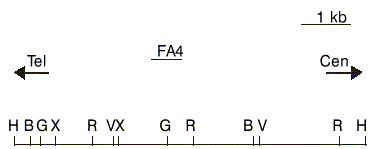
<body><![CDATA[<p>De las  18 LLA estudiadas, 17 eran de estirpe B y una era de estirpe T. Las 7 LMA estudiadas  se distribuyeron seg&uacute;n la clasificaci&oacute;n FAB de la siguiente forma:  3 M2, 1 M4, 2 M5 y 1 M7. <h4> T&eacute;cnica de <i>SOUTHERN BLOT</i></h4>El ADN  se obtuvo a partir de leuco-citos de muestras de m&eacute;dula &oacute;sea o sangre  perif&eacute;rica seg&uacute;n el m&eacute;todo convencional.<sup>15</sup> Ocho  microgramos de ADN de alto peso molecular fueron digeridos con las siguientes  enzimas de restricci&oacute;n: Hind III, Bam HI, Eco RI y BGI II; sometidos a  electroforesis en geles de agarosa al 1 %; desnaturalizados por 20 minutos en  NaOH 0,4 N; transferidos con una soluci&oacute;n 10x SSPE a filtros de nylon cargados  positivamente del tipo Hybond-<sup>TM</sup>-N+ (Amersham International plc), fijados  al filtro durante 2 horas en horno a 80 <font face="Symbol,Times">&deg;</font>C  y prehibridados al menos por 2 horas a 65 <font face="Symbol,Times">&deg;</font>C  en una soluci&oacute;n que contiene los b&uacute;fferes 5xSSPE, 5xBFP, 0,5 % SDS  y 3 mg/mL de ADN de esperma de salm&oacute;n desnaturalizado. A continuaci&oacute;n  fueron hibridados durante toda la noche, en la misma soluci&oacute;n, con una  sonda de ADN marcada previamente por el m&eacute;todo de <i>nick translation</i>.<sup>15</sup>  Dicha sonda fue donada gentilmente por el Dr. <i>G.Cimino</i> de la Universidad  <i>La Sapienza</i> de Roma, y es un inserto gen&oacute;mico de 480 pb del <i>locus  </i>MLL<sup>9</sup> que nos permite explorar una regi&oacute;n de 13,7 kb entre  2 sitios de restricci&oacute;n para la enzima Hind III. Esta sonda designada como  FA4 est&aacute; localizada entre los exones 8 y 9 del gen MLL (fig. 1).     <center>      <p><a href="/img/revistas/hih/v16n1/f0104100.gif"><img SRC="/img/revistas/hih/v16n1/f0104100.gif" ALT="FIG. 1. Mapa de restricción parcial del locus MLL con la localización de la sonda FA4 usada" BORDER=1 height=81 width=204></a>      
<br>FIG. 1. Mapa de restricci&oacute;n parcial del locus MLL con la localizaci&oacute;n  de la sonda FA4 usada</center>    <p>Los filtros fueron lavados 2 veces durante 5  minutos en 2xSSPE a temperatura ambiente y posteriormente fueron lavados en una  soluci&oacute;n 0,2xSSPE; 0,1 % SDS durante 30 minutos a 65 <font face="Symbol,Times">&deg;</font>C  y expuestos a autorradiograf&iacute;a con placas de rayos X del tipo Hiperfilm  -MP (Amersham International plc) y con pantalla intensificadora a -70 <font face="Symbol,Times">&deg;</font>C  por una semana antes de realizar el revelado. <h4> RESULTADOS</h4>En la tabla  se muestran algunos datos cl&iacute;nicos y los resultados del estudio molecular  de los pacientes. S&oacute;lo uno de los 30 pacientes (3,3 %) mostr&oacute; una  banda de reordenamiento al menos en 2 digestiones con 2 enzimas diferentes (Hind  III y Bam HI), lo cual excluye la posibilidad de existencia de una digesti&oacute;n  parcial o de un polimorfismo en la longitud de los fragmentos de restricci&oacute;n  (RFLP). Los casos restantes mostraron el gen MLL en configuraci&oacute;n germinal  con las diferentes enzimas utilizadas.     <p>En la figura 2 se observan los patrones  de restricci&oacute;n representativos del estudio molecular del gen MLL con las  enzimas Bam HI y BgI II y en la figura 3 se pueden ver adem&aacute;s con las enzimas  Hind III y Eco RI.     <center>TABLA. <i>Resultados del estudio molecular del gen  MLL</i></center>    <center><table CELLPADDING=5 > <tr> <td VALIGN=TOP WIDTH="11%">&nbsp;</td><td VALIGN=TOP WIDTH="11%">      <center>Edad</center></td><td VALIGN=TOP WIDTH="11%">&nbsp;</td><td VALIGN=TOP WIDTH="11%">&nbsp;</td><td VALIGN=TOP WIDTH="11%">&nbsp;</td><td VALIGN=TOP COLSPAN="4" WIDTH="44%">      <center>Gen MLL</center></td></tr> <tr> <td VALIGN=TOP WIDTH="11%">No.&nbsp;</td><td VALIGN=TOP WIDTH="11%">      ]]></body>
<body><![CDATA[<center>(a&ntilde;os)</center></td><td VALIGN=TOP WIDTH="11%">     <center>Sexo</center></td><td VALIGN=TOP WIDTH="11%">      <center>Diagn&oacute;stico</center></td><td VALIGN=TOP WIDTH="11%">     <center>Estadio</center></td><td VALIGN=TOP WIDTH="11%">      <center>H</center></td><td VALIGN=TOP WIDTH="11%">     <center>B</center></td><td VALIGN=TOP WIDTH="11%">      <center>E</center></td><td VALIGN=TOP WIDTH="11%">     <center>Bg</center></td></tr>  <tr> <td VALIGN=TOP WIDTH="11%">     <center>1</center></td><td VALIGN=TOP WIDTH="11%">      <center>3</center></td><td VALIGN=TOP WIDTH="11%">     ]]></body>
<body><![CDATA[<center>M</center></td><td VALIGN=TOP WIDTH="11%">      <center>LLA-B</center></td><td VALIGN=TOP WIDTH="11%">     <center>Rec</center></td><td VALIGN=TOP WIDTH="11%">      <center>ND</center></td><td VALIGN=TOP WIDTH="11%">     <center>G</center></td><td VALIGN=TOP WIDTH="11%">      <center>ND</center></td><td VALIGN=TOP WIDTH="11%">     <center>G</center></td></tr>  <tr> <td VALIGN=TOP WIDTH="11%">     <center>2</center></td><td VALIGN=TOP WIDTH="11%">      <center>6</center></td><td VALIGN=TOP WIDTH="11%">     <center>M</center></td><td VALIGN=TOP WIDTH="11%">      ]]></body>
<body><![CDATA[<center>LLA-B</center></td><td VALIGN=TOP WIDTH="11%">     <center>Debut</center></td><td VALIGN=TOP WIDTH="11%">      <center>ND</center></td><td VALIGN=TOP WIDTH="11%">     <center>G</center></td><td VALIGN=TOP WIDTH="11%">      <center>ND</center></td><td VALIGN=TOP WIDTH="11%">     <center>NU</center></td></tr>  <tr> <td VALIGN=TOP WIDTH="11%">     <center>3</center></td><td VALIGN=TOP WIDTH="11%">      <center>3</center></td><td VALIGN=TOP WIDTH="11%">     <center>F</center></td><td VALIGN=TOP WIDTH="11%">      <center>LA-ind</center></td><td VALIGN=TOP WIDTH="11%">     ]]></body>
<body><![CDATA[<center>Rec</center></td><td VALIGN=TOP WIDTH="11%">      <center>ND</center></td><td VALIGN=TOP WIDTH="11%">     <center>G</center></td><td VALIGN=TOP WIDTH="11%">      <center>ND</center></td><td VALIGN=TOP WIDTH="11%">     <center>NU</center></td></tr>  <tr> <td VALIGN=TOP WIDTH="11%">     <center>4</center></td><td VALIGN=TOP WIDTH="11%">      <center>4</center></td><td VALIGN=TOP WIDTH="11%">     <center>F</center></td><td VALIGN=TOP WIDTH="11%">      <center>LA-hib</center></td><td VALIGN=TOP WIDTH="11%">     <center>Debut</center></td><td VALIGN=TOP WIDTH="11%">      ]]></body>
<body><![CDATA[<center>ND</center></td><td VALIGN=TOP WIDTH="11%">     <center>G</center></td><td VALIGN=TOP WIDTH="11%">      <center>ND</center></td><td VALIGN=TOP WIDTH="11%">     <center>G</center></td></tr>  <tr> <td VALIGN=TOP WIDTH="11%">     <center>5</center></td><td VALIGN=TOP WIDTH="11%">      <center>2</center></td><td VALIGN=TOP WIDTH="11%">     <center>M</center></td><td VALIGN=TOP WIDTH="11%">      <center>LA-hib</center></td><td VALIGN=TOP WIDTH="11%">     <center>Debut</center></td><td VALIGN=TOP WIDTH="11%">      <center>G</center></td><td VALIGN=TOP WIDTH="11%">     ]]></body>
<body><![CDATA[<center>G</center></td><td VALIGN=TOP WIDTH="11%">      <center>G</center></td><td VALIGN=TOP WIDTH="11%">     <center>G</center></td></tr>  <tr> <td VALIGN=TOP WIDTH="11%">     <center>6</center></td><td VALIGN=TOP WIDTH="11%">      <center>12</center></td><td VALIGN=TOP WIDTH="11%">     <center>M</center></td><td VALIGN=TOP WIDTH="11%">      <center>LLA-T</center></td><td VALIGN=TOP WIDTH="11%">     <center>Debut</center></td><td VALIGN=TOP WIDTH="11%">      <center>ND</center></td><td VALIGN=TOP WIDTH="11%">     <center>G</center></td><td VALIGN=TOP WIDTH="11%">      ]]></body>
<body><![CDATA[<center>ND</center></td><td VALIGN=TOP WIDTH="11%">     <center>G</center></td></tr>  <tr> <td VALIGN=TOP WIDTH="11%">     <center>7</center></td><td VALIGN=TOP WIDTH="11%">      <center>1</center></td><td VALIGN=TOP WIDTH="11%">     <center>M</center></td><td VALIGN=TOP WIDTH="11%">      <center>LLA-B</center></td><td VALIGN=TOP WIDTH="11%">     <center>Debut</center></td><td VALIGN=TOP WIDTH="11%">      <center>G</center></td><td VALIGN=TOP WIDTH="11%">     <center>G</center></td><td VALIGN=TOP WIDTH="11%">      <center>G</center></td><td VALIGN=TOP WIDTH="11%">     ]]></body>
<body><![CDATA[<center>G</center></td></tr>  <tr> <td VALIGN=TOP WIDTH="11%">     <center>8</center></td><td VALIGN=TOP WIDTH="11%">      <center>2</center></td><td VALIGN=TOP WIDTH="11%">     <center>M</center></td><td VALIGN=TOP WIDTH="11%">      <center>LLA-B</center></td><td VALIGN=TOP WIDTH="11%">     <center>Rec</center></td><td VALIGN=TOP WIDTH="11%">      <center>ND</center></td><td VALIGN=TOP WIDTH="11%">     <center>G</center></td><td VALIGN=TOP WIDTH="11%">      <center>ND</center></td><td VALIGN=TOP WIDTH="11%">     <center>G</center></td></tr>  <tr> <td VALIGN=TOP WIDTH="11%">     ]]></body>
<body><![CDATA[<center>9</center></td><td VALIGN=TOP WIDTH="11%">      <center>9</center></td><td VALIGN=TOP WIDTH="11%">     <center>F</center></td><td VALIGN=TOP WIDTH="11%">      <center>LMA-M7</center></td><td VALIGN=TOP WIDTH="11%">     <center>Debut</center></td><td VALIGN=TOP WIDTH="11%">      <center>G</center></td><td VALIGN=TOP WIDTH="11%">     <center>G</center></td><td VALIGN=TOP WIDTH="11%">      <center>G</center></td><td VALIGN=TOP WIDTH="11%">     <center>G</center></td></tr>  <tr> <td VALIGN=TOP WIDTH="11%">     <center>10</center></td><td VALIGN=TOP WIDTH="11%">      ]]></body>
<body><![CDATA[<center>5</center></td><td VALIGN=TOP WIDTH="11%">     <center>F</center></td><td VALIGN=TOP WIDTH="11%">      <center>LLA-B</center></td><td VALIGN=TOP WIDTH="11%">     <center>Rec</center></td><td VALIGN=TOP WIDTH="11%">      <center>G</center></td><td VALIGN=TOP WIDTH="11%">     <center>G</center></td><td VALIGN=TOP WIDTH="11%">      <center>G</center></td><td VALIGN=TOP WIDTH="11%">     <center>G</center></td></tr>  <tr> <td VALIGN=TOP WIDTH="11%">     <center>11</center></td><td VALIGN=TOP WIDTH="11%">      <center>27</center></td><td VALIGN=TOP WIDTH="11%">     ]]></body>
<body><![CDATA[<center>M</center></td><td VALIGN=TOP WIDTH="11%">      <center>LA-hib</center></td><td VALIGN=TOP WIDTH="11%">     <center>Rec</center></td><td VALIGN=TOP WIDTH="11%">      <center>ND</center></td><td VALIGN=TOP WIDTH="11%">     <center>G</center></td><td VALIGN=TOP WIDTH="11%">      <center>ND</center></td><td VALIGN=TOP WIDTH="11%">     <center>G</center></td></tr>  <tr> <td VALIGN=TOP WIDTH="11%">     <center>12</center></td><td VALIGN=TOP WIDTH="11%">      <center>5</center></td><td VALIGN=TOP WIDTH="11%">     <center>M</center></td><td VALIGN=TOP WIDTH="11%">      ]]></body>
<body><![CDATA[<center>LLA-B</center></td><td VALIGN=TOP WIDTH="11%">     <center>Debut</center></td><td VALIGN=TOP WIDTH="11%">      <center>ND</center></td><td VALIGN=TOP WIDTH="11%">     <center>NU</center></td><td VALIGN=TOP WIDTH="11%">      <center>ND</center></td><td VALIGN=TOP WIDTH="11%">     <center>G</center></td></tr>  <tr> <td VALIGN=TOP WIDTH="11%">     <center>13</center></td><td VALIGN=TOP WIDTH="11%">      <center>7</center></td><td VALIGN=TOP WIDTH="11%">     <center>M</center></td><td VALIGN=TOP WIDTH="11%">      <center>LLA-B</center></td><td VALIGN=TOP WIDTH="11%">     ]]></body>
<body><![CDATA[<center>Debut</center></td><td VALIGN=TOP WIDTH="11%">      <center>ND</center></td><td VALIGN=TOP WIDTH="11%">     <center>G</center></td><td VALIGN=TOP WIDTH="11%">      <center>ND</center></td><td VALIGN=TOP WIDTH="11%">     <center>G</center></td></tr>  <tr> <td VALIGN=TOP WIDTH="11%">     <center>14</center></td><td VALIGN=TOP WIDTH="11%">      <center>5</center></td><td VALIGN=TOP WIDTH="11%">     <center>M</center></td><td VALIGN=TOP WIDTH="11%">      <center>LLA-B</center></td><td VALIGN=TOP WIDTH="11%">     <center>Debut</center></td><td VALIGN=TOP WIDTH="11%">      ]]></body>
<body><![CDATA[<center>ND</center></td><td VALIGN=TOP WIDTH="11%">     <center>G</center></td><td VALIGN=TOP WIDTH="11%">      <center>G</center></td><td VALIGN=TOP WIDTH="11%">     <center>G</center></td></tr>  <tr> <td VALIGN=TOP WIDTH="11%">     <center>15</center></td><td VALIGN=TOP WIDTH="11%">      <center>12</center></td><td VALIGN=TOP WIDTH="11%">     <center>F</center></td><td VALIGN=TOP WIDTH="11%">      <center>LLA-B</center></td><td VALIGN=TOP WIDTH="11%">     <center>Rec</center></td><td VALIGN=TOP WIDTH="11%">      <center>G</center></td><td VALIGN=TOP WIDTH="11%">     ]]></body>
<body><![CDATA[<center>G</center></td><td VALIGN=TOP WIDTH="11%">      <center>G</center></td><td VALIGN=TOP WIDTH="11%">     <center>G</center></td></tr>  <tr> <td VALIGN=TOP WIDTH="11%">     <center>16</center></td><td VALIGN=TOP WIDTH="11%">      <center>8</center></td><td VALIGN=TOP WIDTH="11%">     <center>M</center></td><td VALIGN=TOP WIDTH="11%">      <center>LLA-B</center></td><td VALIGN=TOP WIDTH="11%">     <center>Debut</center></td><td VALIGN=TOP WIDTH="11%">      <center>G</center></td><td VALIGN=TOP WIDTH="11%">     <center>G</center></td><td VALIGN=TOP WIDTH="11%">      ]]></body>
<body><![CDATA[<center>G</center></td><td VALIGN=TOP WIDTH="11%">     <center>G</center></td></tr>  <tr> <td VALIGN=TOP WIDTH="11%">     <center>17</center></td><td VALIGN=TOP WIDTH="11%">      <center>5</center></td><td VALIGN=TOP WIDTH="11%">     <center>M</center></td><td VALIGN=TOP WIDTH="11%">      <center>LMA-M5b</center></td><td VALIGN=TOP WIDTH="11%">     <center>Debut</center></td><td VALIGN=TOP WIDTH="11%">      <center>R</center></td><td VALIGN=TOP WIDTH="11%">     <center>R</center></td><td VALIGN=TOP WIDTH="11%">      <center>G</center></td><td VALIGN=TOP WIDTH="11%">     ]]></body>
<body><![CDATA[<center>G</center></td></tr>  <tr> <td VALIGN=TOP WIDTH="11%">     <center>18</center></td><td VALIGN=TOP WIDTH="11%">      <center>23</center></td><td VALIGN=TOP WIDTH="11%">     <center>M</center></td><td VALIGN=TOP WIDTH="11%">      <center>LMA-M2</center></td><td VALIGN=TOP WIDTH="11%">     <center>Rec</center></td><td VALIGN=TOP WIDTH="11%">      <center>G</center></td><td VALIGN=TOP WIDTH="11%">     <center>G</center></td><td VALIGN=TOP WIDTH="11%">      <center>G</center></td><td VALIGN=TOP WIDTH="11%">     <center>G</center></td></tr>  <tr> <td VALIGN=TOP WIDTH="11%">     ]]></body>
<body><![CDATA[<center>19</center></td><td VALIGN=TOP WIDTH="11%">      <center>0,9</center></td><td VALIGN=TOP WIDTH="11%">     <center>M</center></td><td VALIGN=TOP WIDTH="11%">      <center>LMA-M2</center></td><td VALIGN=TOP WIDTH="11%">     <center>Debut</center></td><td VALIGN=TOP WIDTH="11%">      <center>G</center></td><td VALIGN=TOP WIDTH="11%">     <center>G</center></td><td VALIGN=TOP WIDTH="11%">      <center>G</center></td><td VALIGN=TOP WIDTH="11%">     <center>G</center></td></tr>  <tr> <td VALIGN=TOP WIDTH="11%">     <center>20</center></td><td VALIGN=TOP WIDTH="11%">      ]]></body>
<body><![CDATA[<center>12</center></td><td VALIGN=TOP WIDTH="11%">     <center>F</center></td><td VALIGN=TOP WIDTH="11%">      <center>LLA-B</center></td><td VALIGN=TOP WIDTH="11%">     <center>Debut</center></td><td VALIGN=TOP WIDTH="11%">      <center>G</center></td><td VALIGN=TOP WIDTH="11%">     <center>G</center></td><td VALIGN=TOP WIDTH="11%">      <center>G</center></td><td VALIGN=TOP WIDTH="11%">     <center>G</center></td></tr>  <tr> <td VALIGN=TOP WIDTH="11%">     <center>21</center></td><td VALIGN=TOP WIDTH="11%">      <center>10</center></td><td VALIGN=TOP WIDTH="11%">     ]]></body>
<body><![CDATA[<center>F</center></td><td VALIGN=TOP WIDTH="11%">      <center>LLA-B</center></td><td VALIGN=TOP WIDTH="11%">     <center>Debut</center></td><td VALIGN=TOP WIDTH="11%">      <center>G</center></td><td VALIGN=TOP WIDTH="11%">     <center>G</center></td><td VALIGN=TOP WIDTH="11%">      <center>G</center></td><td VALIGN=TOP WIDTH="11%">     <center>G</center></td></tr>  <tr> <td VALIGN=TOP WIDTH="11%">     <center>22</center></td><td VALIGN=TOP WIDTH="11%">      <center>3</center></td><td VALIGN=TOP WIDTH="11%">     <center>F</center></td><td VALIGN=TOP WIDTH="11%">      ]]></body>
<body><![CDATA[<center>LLA-B</center></td><td VALIGN=TOP WIDTH="11%">     <center>Rec</center></td><td VALIGN=TOP WIDTH="11%">      <center>ND</center></td><td VALIGN=TOP WIDTH="11%">     <center>G</center></td><td VALIGN=TOP WIDTH="11%">      <center>G</center></td><td VALIGN=TOP WIDTH="11%">     <center>G</center></td></tr>  <tr> <td VALIGN=TOP WIDTH="11%">     <center>23</center></td><td VALIGN=TOP WIDTH="11%">      <center>7</center></td><td VALIGN=TOP WIDTH="11%">     <center>F</center></td><td VALIGN=TOP WIDTH="11%">      <center>LLA-B</center></td><td VALIGN=TOP WIDTH="11%">     ]]></body>
<body><![CDATA[<center>Debut</center></td><td VALIGN=TOP WIDTH="11%">      <center>ND</center></td><td VALIGN=TOP WIDTH="11%">     <center>G</center></td><td VALIGN=TOP WIDTH="11%">      <center>ND</center></td><td VALIGN=TOP WIDTH="11%">     <center>G</center></td></tr>  <tr> <td VALIGN=TOP WIDTH="11%">     <center>24</center></td><td VALIGN=TOP WIDTH="11%">      <center>2</center></td><td VALIGN=TOP WIDTH="11%">     <center>F</center></td><td VALIGN=TOP WIDTH="11%">      <center>LLA-B</center></td><td VALIGN=TOP WIDTH="11%">     <center>Debut</center></td><td VALIGN=TOP WIDTH="11%">      ]]></body>
<body><![CDATA[<center>ND</center></td><td VALIGN=TOP WIDTH="11%">     <center>G</center></td><td VALIGN=TOP WIDTH="11%">      <center>ND</center></td><td VALIGN=TOP WIDTH="11%">     <center>G</center></td></tr>  <tr> <td VALIGN=TOP WIDTH="11%">     <center>25</center></td><td VALIGN=TOP WIDTH="11%">      <center>1</center></td><td VALIGN=TOP WIDTH="11%">     <center>M</center></td><td VALIGN=TOP WIDTH="11%">      <center>LMA-M5b</center></td><td VALIGN=TOP WIDTH="11%">     <center>Debut</center></td><td VALIGN=TOP WIDTH="11%">      <center>ND</center></td><td VALIGN=TOP WIDTH="11%">     ]]></body>
<body><![CDATA[<center>G</center></td><td VALIGN=TOP WIDTH="11%">      <center>ND</center></td><td VALIGN=TOP WIDTH="11%">     <center>NU</center></td></tr>  <tr> <td VALIGN=TOP WIDTH="11%">     <center>26</center></td><td VALIGN=TOP WIDTH="11%">      <center>8</center></td><td VALIGN=TOP WIDTH="11%">     <center>F</center></td><td VALIGN=TOP WIDTH="11%">      <center>LLA-B</center></td><td VALIGN=TOP WIDTH="11%">     <center>Debut</center></td><td VALIGN=TOP WIDTH="11%">      <center>G</center></td><td VALIGN=TOP WIDTH="11%">     <center>G</center></td><td VALIGN=TOP WIDTH="11%">      ]]></body>
<body><![CDATA[<center>G</center></td><td VALIGN=TOP WIDTH="11%">     <center>G</center></td></tr>  <tr> <td VALIGN=TOP WIDTH="11%">     <center>27</center></td><td VALIGN=TOP WIDTH="11%">      <center>14</center></td><td VALIGN=TOP WIDTH="11%">     <center>F</center></td><td VALIGN=TOP WIDTH="11%">      <center>LMA-M2</center></td><td VALIGN=TOP WIDTH="11%">     <center>Debut</center></td><td VALIGN=TOP WIDTH="11%">      <center>G</center></td><td VALIGN=TOP WIDTH="11%">     <center>G</center></td><td VALIGN=TOP WIDTH="11%">      <center>G</center></td><td VALIGN=TOP WIDTH="11%">     ]]></body>
<body><![CDATA[<center>G</center></td></tr>  <tr> <td VALIGN=TOP WIDTH="11%">     <center>28</center></td><td VALIGN=TOP WIDTH="11%">      <center>2</center></td><td VALIGN=TOP WIDTH="11%">     <center>F</center></td><td VALIGN=TOP WIDTH="11%">      <center>LLA-B</center></td><td VALIGN=TOP WIDTH="11%">     <center>Debut</center></td><td VALIGN=TOP WIDTH="11%">      <center>G</center></td><td VALIGN=TOP WIDTH="11%">     <center>G</center></td><td VALIGN=TOP WIDTH="11%">      <center>G</center></td><td VALIGN=TOP WIDTH="11%">     <center>G</center></td></tr>  <tr> <td VALIGN=TOP WIDTH="11%">     ]]></body>
<body><![CDATA[<center>29</center></td><td VALIGN=TOP WIDTH="11%">      <center>27</center></td><td VALIGN=TOP WIDTH="11%">     <center>M</center></td><td VALIGN=TOP WIDTH="11%">      <center>LMA-M4</center></td><td VALIGN=TOP WIDTH="11%">     <center>Debut</center></td><td VALIGN=TOP WIDTH="11%">      <center>G</center></td><td VALIGN=TOP WIDTH="11%">     <center>G</center></td><td VALIGN=TOP WIDTH="11%">      <center>G</center></td><td VALIGN=TOP WIDTH="11%">     <center>G</center></td></tr>  <tr> <td VALIGN=TOP WIDTH="11%">     <center>30</center></td><td VALIGN=TOP WIDTH="11%">      ]]></body>
<body><![CDATA[<center>9</center></td><td VALIGN=TOP WIDTH="11%">     <center>M</center></td><td VALIGN=TOP WIDTH="11%">      <center>LA-ind</center></td><td VALIGN=TOP WIDTH="11%">     <center>Debut</center></td><td VALIGN=TOP WIDTH="11%">      <center>G</center></td><td VALIGN=TOP WIDTH="11%">     <center>G</center></td><td VALIGN=TOP WIDTH="11%">      <center>G</center></td><td VALIGN=TOP WIDTH="11%">     <center>G</center></td></tr>  </table></center>    <center>     <p>H: Hind III; B: Bam HI; E: Eco RI; Bg: Bgl II; G:  germinal; ind: indiferenciado; ND: no determinado; hib: h&iacute;brida; R: reordenado;  NU: no &uacute;til.     ]]></body>
<body><![CDATA[<br>&nbsp;     <br>&nbsp;     <p><a href="/img/revistas/hih/v16n1/f0204100.jpg"><img SRC="/img/revistas/hih/v16n1/f0204100.jpg" ALT="FIG. 2. Patrones de restricción representativos con las enzimas Bam HI y Bgl II. La flecha" BORDER=1 height=154 width=239></a>      
<br>FIG. 2. Patrones de restricci&oacute;n representativos con las enzimas Bam  HI y Bgl II. La flecha indica la banda     <br>de reordenamiento.     <p><a href="/img/revistas/hih/v16n1/f0304100.jpg"><img SRC="/img/revistas/hih/v16n1/f0304100.jpg" ALT="FIG. 3. Patrones de restricción representativos con las enzimas Eco RI, Bam HI e Hind III." BORDER=1 height=130 width=254></a>      
<br>FIG. 3. Patrones de restricci&oacute;n representativos con las enzimas Eco  RI, Bam HI e Hind III.</center><h4> DISCUSI&Oacute;N</h4>La frecuencia total del  reordenamiento del gen MLL encontrada por nosotros (3,3 %) es muy similar a la  obtenida por un grupo de investigadores argentinos (Hospital Garrahan, Buenos  Aires) que encontraron en un total de 577 pacientes con leucemia aguda (453 LLA  y 124 LMA), 23 pacientes con alteraci&oacute;n molecular en la banda 11q23, lo  que representa el 3,9 % del total de pacientes estudiados.<sup>16</sup>     <p>Es  interesante destacar que el paciente con reordenamiento del gen MLL (No. 17) era  un ni&ntilde;o con una LMA subtipo M5, lo cual concuerda con la literatura, donde  se se&ntilde;ala que estos reordenamientos est&aacute;n estrechamente correlacionados  con los subtipos mielomonoc&iacute;tico (M4) y monoc&iacute;tico (M5) de LMA.<sup>1,4,5</sup>      <p>Era de esperarse la ausencia de reordenamiento en la LLA tipo T (No. 6) y en  las LMA subtipo M2 (Nos. 18, 19 y 27), ya que la alteraci&oacute;n de este gen  en estos tipos de leucemia es inusual.<sup>5,6,12,14,17,18</sup>     <p>Las LA con  MLL reordenado y mal pron&oacute;stico en ocasiones suelen ser indiferenciadas  o h&iacute;bridas.<sup>5,19</sup> En nuestros pacientes incluidos en estas categor&iacute;as,  sin embargo, no se detect&oacute; reordenamiento del gen MLL (Nos. 3 y 30) y (Nos.  4,5,11), respectivamente.     ]]></body>
<body><![CDATA[<p>Consideramos que es de gran importancia disponer  de esta t&eacute;cnica, ya que nos permite determinar la presencia de reordenamientos  del gen MLL incluso en pacientes donde existen alteraciones submicrosc&oacute;picas  en dicha regi&oacute;n y que tienen un cariotipo aparentemente normal.<sup>11</sup>  Dicha presencia constituye siempre un indicador de muy mal pron&oacute;stico en  pacientes afectados por LA, independientemente de la edad o la estirpe celular  de la leucemia.<sup>5</sup> En un modelo multivariado desarrollado por <i>Cimino</i>  y otros<sup>11</sup> para consignar mejor la relevancia cl&iacute;nica y pron&oacute;stica  de la configuraci&oacute;n del gen MLL, que incluy&oacute; otros factores de riesgo  conocidos como edad, sexo, conteos leucocitarios y morfolog&iacute;a; el estado  del gen MLL fue un marcador pron&oacute;stico independiente de sobrevida libre  de eventos y su lesi&oacute;n gen&eacute;tica mostr&oacute; ser la variable m&aacute;s  importante que afecta negativamente el pron&oacute;stico. Esto reafirma la necesidad  de incluir este factor en los esquemas de clasificaci&oacute;n de riesgo en las  LA y de tener en cuenta su influencia en la elecci&oacute;n de estrategias de  tratamiento adaptadas al riesgo en este subtipo de leucemia.<sup>6,9-11,20,21</sup>  <h4> AGRADECIMIENTOS</h4>Agradecemos al Dr. <i>G.Cimino</i> de la Universidad  <i>La Sapienza</i> de Roma por habernos suministrado la sonda necesaria para la  realizaci&oacute;n de este trabajo. <h4> DISCUSI&Oacute;N</h4>La frecuencia total  del reordenamiento del gen MLL encontrada por nosotros (3,3 %) es muy similar  a la obtenida por un grupo de investigadores argentinos (Hospital Garrahan, Buenos  Aires) que encontraron en un total de 577 pacientes con leucemia aguda (453 LLA  y 124 LMA), 23 pacientes con alteraci&oacute;n molecular en la banda 11q23, lo  que representa el 3,9 % del total de pacientes estudiados.<sup>16</sup>     <p>Es  interesante destacar que el paciente con reordenamiento del gen MLL (No. 17) era  un ni&ntilde;o con una LMA subtipo M5, lo cual concuerda con la literatura, donde  se se&ntilde;ala que estos reordenamientos est&aacute;n estrechamente correlacionados  con los subtipos mielomonoc&iacute;tico (M4) y monoc&iacute;tico (M5) de LMA.<sup>1,4,5</sup>      <p>Era de esperarse la ausencia de reordenamiento en la LLA tipo T (No. 6) y en  las LMA subtipo M2 (Nos. 18, 19 y 27), ya que la alteraci&oacute;n de este gen  en estos tipos de leucemia es inusual.<sup>5,6,12,14,17,18</sup>     <p>Las LA con  MLL reordenado y mal pron&oacute;stico en ocasiones suelen ser indiferenciadas  o h&iacute;bridas.<sup>5,19</sup> En nuestros pacientes incluidos en estas categor&iacute;as,  sin embargo, no se detect&oacute; reordenamiento del gen MLL (Nos. 3 y 30 y Nos.  4,5,11), respectivamente.     <p>Consideramos que es de gran importancia disponer  de esta t&eacute;cnica, ya que nos permite determinar la presencia de reordenamientos  del gen MLL incluso en pacientes donde existen alteraciones submicrosc&oacute;picas  en dicha regi&oacute;n y que tienen un cariotipo aparentemente normal.<sup>11</sup>  Dicha presencia constituye siempre un indicador de muy mal pron&oacute;stico en  pacientes afectados por LA, independientemente de la edad o la estirpe celular  de la leucemia.<sup>5</sup> En un modelo multivariado desarrollado por <i>Cimino</i>  y otros<sup>11</sup> para consignar mejor la relevancia cl&iacute;nica y pron&oacute;stica  de la configuraci&oacute;n del gen MLL, que incluy&oacute; otros factores de riesgo  conocidos como edad, sexo, conteos leucocitarios y morfolog&iacute;a; el estado  del gen MLL fue un marcador pron&oacute;stico independiente de sobrevida libre  de eventos y su lesi&oacute;n gen&eacute;tica mostr&oacute; ser la variable m&aacute;s  importante que afecta negativamente el pron&oacute;stico. Esto reafirma la necesidad  de incluir este factor en los esquemas de clasificaci&oacute;n de riesgo en las  LA y de tener en cuenta su influencia en la elecci&oacute;n de estrategias de  tratamiento adaptadas al riesgo en este subtipo de leucemia.<sup>6,9-11,20,21</sup>  <h4> AGRADECIMIENTOS</h4>Agradecemos al Dr. <i>G.Cimino</i> de la Universidad  <i>La Sapienza</i> de Roma por habernos suministrado la sonda necesaria para la  realizaci&oacute;n de este trabajo. <h4> SUMMARY</h4>Rearrangements of MLL gen  in llq23 chromosomal band are frequents in childhood type of acute leukemia (AL)  and in secondary AL, developed after therapy with II topoisomerase enzyme. To  a lesser extent also is seen in adults with AL. Presence of theses rearrangements  is considered to be a worse prognosis indicator, associated with unfavourable  clinical results, that is why it is very important to carry our its assessment  in AL. In this paper authors present preliminary results from introduction of  study on MLL gen in our country through Southern technique. DNA from 30 patients  was analized, including children and adults, that at the very moment when study  was performed, they were in the onset or in relapse. Molecular study was carried  out using FA4 probe, which is a genomic insertion of MLL gen. Only one out of  30 patients, presented rearrangement band with 2 distinct restriction enzymes,  remainder showed MLL gen in germinal form. It is interesting to underline that  patient with rearrangement was a child presenting subtype M5b acute myeloblastic  leukemia, which agree with literature showing that these rearrangements are closely  correlated to subtype myelomonocytic (M4) and monocytic (M5) of acute myeloid  leukemia (AML).     <p><i>Subject headings:</i> GENE REARRANGEMENT; HEMATOLOGIC DISEASES;  LEUKEMIA, LYMPHOCYTIC.     <br>&nbsp; <h4> REFERENCIAS BIBLIOGR&Aacute;FICAS</h4>    <!-- ref --><P>  1. Kearney L, Bower M, Gibbons B, Das S, Chaplin T, Nacheva E, et al. Chromosome  11q23 translocations in both infant and adult acute leukemias are detected by  in situ hibridization with a yeast artificial chromosome. Blood 1992;80:1659-65.<!-- ref --><P>  2. Hunger SP, Thachuk DC, Amylon MD, Link MP, Canroll AJ, Welborn JL, et al. HRX  involvement in de novo and secundary leukemias with diverse chromosome 11q23 abnormalities.  Blood 1993;81:3197-203.<!-- ref --><P> 3. Kobayashi H, Espinosa R, Thirman MJ, Gill HJ,  Fernald AA, D&iacute;az MO, et al. Heterogeneity of breakpoints of 11q23 rearrangements  in hematologic malignancies identified with fluorescence in situ hibridization.  Blood 1993;82:547-58.<!-- ref --><P> 4. Paul HB, Chen SS, Smith FO, Arthur DC, Dumor PH,  Bernstein ID. Molecular rearrangements o MLL gen are present in most cases of  infant acute leukemia and are stongly correlated with monocytic (M5) or Myelomonocytic  (M4) phenotypes. J Clin Invest 1994;93:429-37.<P> 5. LeBeau MM, Larson RA.  Cytogenetic and neoplasia. En: Hoffman R, Benz EJ, Shattil SJ. Hematology. Basic  principles and practice. 2 ed. New York:Chrchill Livingstone, 1995:878-94.</P>    <!-- ref --><P>  6. Hern&aacute;ndez P. Alteraciones moleculares en las leucemias agudas. Rev Cubana  Hematol Inmunol Hemoter 1995;11:75-113.<!-- ref --><P> 7. Yagi H, Deguchi K, Aono A, Toni  Y, Kishimoto T, Komari T. Growth disturbance in fetal liver hematopoiesis of MLL  mutant mice. Blood 1998;92:108-17.<!-- ref --><P> 8. Butler LH, Slany R, Cui X, Cleary  ML, Mason DY. The HRX protooncogene product is widely expressed in human tissues  and localizes to nuclear structures. Blood 1997;89:3361-70.<!-- ref --><P> 9. Cimino G,  LoCoco F, Biondi A, Elia L, Luciano A, Croce CM, et al. ALL-1 gene at chromosome  11q23 is consistently altered in acute leukemia of early infancy. Blood 1993;82:544-6.<!-- ref --><P>  10. Chen SC, Sorensen PHB, Domer PH, Reaman GH, Korsmeyer SJ, Heerema NA, et al.  Molecular rearrangements on chromosome 11q23 predominate in infant acute lymphoblastic  leukemia and are associated with specific biologic variables and poor outcome.  Blood 1993;81:2386-93.<!-- ref --><P> 11. Cimino G, Rapanotti MC. Prognostic relevance  of ALL-1 gene rearrangements in acute leukemias. Leukemia 1995;9:391-5.<!-- ref --><P>  12. Raimondi SC. Current status of cytogentic research in childhood acute lymphoblastic  leukemia. Blood 1993;81:2237-44.<!-- ref --><P> 13. Kaneko Y, Maseki T, Takasaki N, Sakurai  M, Hayashi Y, Nakazawa S, et al. Clinical and hematological characteristics in  acute leukemia with 11q23 translocation. Blood 1986;67:484-7.<P> 14. Raimondi  SC, Frestedt JL, Pui CH, Downing JRm Head DR, Keasey JH, et al. Acute lymphoblastic  leukemias with deletion of 11q23 or a novel inversion (11) (p13q23) lack MLL gene  rearrangements and have favorable clinical features. Blood 1995;86:1881-6.</P>    <!-- ref --><P>  15. Maniatisatis F, Fristsh EF, Sambrook J. Molecular cloning: a laboratory manual.  New York:Laboratory Cold Spring Harber, 1982.<P> 16. Felice M, Zubizarreta  P, Alfaro E, Chantada G, Gallego M, Babalardo E, et al. 11q23 rearrangements in  childhood acute leukemias. Analysis of 23 patients observed in a single institution  [abstract]. Blood 1996;88(Suppl 1 10 Pt 2):3345A.</P>    <!-- ref --><P> 17. Lukens JN. Classification  and differenciation of the acute leukemias. En: Lee GR, Bithel TC, Forester J,  Athens JW, Lukens JN. Wintrobe's clinical hematology. 9 ed. Pennsylvania:Lea and  Febiger, 1993:1873-91.<!-- ref --><P> 18. Collins SJ. Pathobiology of AML. En: Hoffman  R, Benz EJ. Shattil SJ. Hematology. Basic principles and practice. 2 ed. New York:Churchill  Livingstone, 1995:983-91.<!-- ref --><P> 19. Poirel H, Rack K. Incidence and characterization  of MLL gen (11q23) rearrangements in acute myeloid leukemia M1 and M5. Blood 1996;87:2496-505.<!-- ref --><P>  20. Rubnitz JE, Behm FG, Cursio Brint AM, Pinheiro VRP. Molecular analysis of  t(11;19)breakpoints in childhood acute leukemias. Blood 1996;87:4804-8.<!-- ref --><P>  21. Look AT. Pathobiology of ALL. En: Hoffman R, Benz EJ, Shattil SJ. Hematology.  Basic principles and practice. 2 ed. New York: Churchill Livingstone, 1995:992-1052.Recibido:  2 de abril de 1999. Aprobado: 27 de agosto de 1999.     <br>Lic. <i>Raquel Lev&oacute;n  Herrera</i>. Instituto de Hematolog&iacute;a e Inmunolog&iacute;a. Apartado 8070,  CP 10800, Ciudad de La Habana, Cuba. Tel&eacute;f: (537) 578268. Fax: (537) 338979.  e mail:<a href="mailto:ihidir@hematol.sld.cu">ihidir@hematol.sld.cu</a>             ]]></body>
<body><![CDATA[ ]]></body><back>
<ref-list>
<ref id="B1">
<label>1</label><nlm-citation citation-type="journal">
<person-group person-group-type="author">
<name>
<surname><![CDATA[Kearney]]></surname>
<given-names><![CDATA[L]]></given-names>
</name>
<name>
<surname><![CDATA[Bower]]></surname>
<given-names><![CDATA[M]]></given-names>
</name>
<name>
<surname><![CDATA[Gibbons]]></surname>
<given-names><![CDATA[B]]></given-names>
</name>
<name>
<surname><![CDATA[Das]]></surname>
<given-names><![CDATA[S]]></given-names>
</name>
<name>
<surname><![CDATA[Chaplin]]></surname>
<given-names><![CDATA[T]]></given-names>
</name>
<name>
<surname><![CDATA[Nacheva]]></surname>
<given-names><![CDATA[E]]></given-names>
</name>
</person-group>
<article-title xml:lang="en"><![CDATA[Chromosome 11q23 translocations in both infant and adult acute leukemias are detected by in situ hibridization with a yeast artificial chromosome]]></article-title>
<source><![CDATA[Blood]]></source>
<year>1992</year>
<volume>80</volume>
<page-range>1659-65</page-range></nlm-citation>
</ref>
<ref id="B2">
<label>2</label><nlm-citation citation-type="journal">
<person-group person-group-type="author">
<name>
<surname><![CDATA[Hunger]]></surname>
<given-names><![CDATA[SP]]></given-names>
</name>
<name>
<surname><![CDATA[Thachuk]]></surname>
<given-names><![CDATA[DC]]></given-names>
</name>
<name>
<surname><![CDATA[Amylon]]></surname>
<given-names><![CDATA[MD]]></given-names>
</name>
<name>
<surname><![CDATA[Link]]></surname>
<given-names><![CDATA[MP]]></given-names>
</name>
<name>
<surname><![CDATA[Canroll]]></surname>
<given-names><![CDATA[AJ]]></given-names>
</name>
<name>
<surname><![CDATA[Welborn]]></surname>
<given-names><![CDATA[JL]]></given-names>
</name>
</person-group>
<article-title xml:lang="en"><![CDATA[HRX involvement in de novo and secundary leukemias with diverse chromosome 11q23 abnormalities]]></article-title>
<source><![CDATA[Blood]]></source>
<year>1993</year>
<volume>81</volume>
<page-range>3197-203</page-range></nlm-citation>
</ref>
<ref id="B3">
<label>3</label><nlm-citation citation-type="journal">
<person-group person-group-type="author">
<name>
<surname><![CDATA[Kobayashi]]></surname>
<given-names><![CDATA[H]]></given-names>
</name>
<name>
<surname><![CDATA[Espinosa]]></surname>
<given-names><![CDATA[R]]></given-names>
</name>
<name>
<surname><![CDATA[Thirman]]></surname>
<given-names><![CDATA[MJ]]></given-names>
</name>
<name>
<surname><![CDATA[Gill]]></surname>
<given-names><![CDATA[HJ]]></given-names>
</name>
<name>
<surname><![CDATA[Fernald]]></surname>
<given-names><![CDATA[AA]]></given-names>
</name>
<name>
<surname><![CDATA[Díaz]]></surname>
<given-names><![CDATA[MO]]></given-names>
</name>
</person-group>
<article-title xml:lang="en"><![CDATA[Heterogeneity of breakpoints of 11q23 rearrangements in hematologic malignancies identified with fluorescence in situ hibridization]]></article-title>
<source><![CDATA[Blood]]></source>
<year>1993</year>
<volume>82</volume>
<page-range>547-58</page-range></nlm-citation>
</ref>
<ref id="B4">
<label>4</label><nlm-citation citation-type="journal">
<person-group person-group-type="author">
<name>
<surname><![CDATA[Paul]]></surname>
<given-names><![CDATA[HB]]></given-names>
</name>
<name>
<surname><![CDATA[Chen]]></surname>
<given-names><![CDATA[SS]]></given-names>
</name>
<name>
<surname><![CDATA[Smith]]></surname>
<given-names><![CDATA[FO]]></given-names>
</name>
<name>
<surname><![CDATA[Arthur]]></surname>
<given-names><![CDATA[DC]]></given-names>
</name>
<name>
<surname><![CDATA[Dumor]]></surname>
<given-names><![CDATA[PH]]></given-names>
</name>
<name>
<surname><![CDATA[Bernstein]]></surname>
<given-names><![CDATA[ID]]></given-names>
</name>
</person-group>
<article-title xml:lang="en"><![CDATA[Molecular rearrangements o MLL gen are present in most cases of infant acute leukemia and are stongly correlated with monocytic (M5) or Myelomonocytic (M4) phenotypes]]></article-title>
<source><![CDATA[J Clin Invest]]></source>
<year>1994</year>
<volume>93</volume>
<page-range>429-37</page-range></nlm-citation>
</ref>
<ref id="B5">
<nlm-citation citation-type="book">
<person-group person-group-type="author">
<name>
<surname><![CDATA[LeBeau]]></surname>
<given-names><![CDATA[MM]]></given-names>
</name>
<name>
<surname><![CDATA[Larson]]></surname>
<given-names><![CDATA[RA]]></given-names>
</name>
</person-group>
<article-title xml:lang="en"><![CDATA[Cytogenetic and neoplasia]]></article-title>
<person-group person-group-type="editor">
<name>
<surname><![CDATA[Hoffman]]></surname>
<given-names><![CDATA[R]]></given-names>
</name>
</person-group>
<source><![CDATA[Hematology: Basic principles and practice]]></source>
<year>1995</year>
<edition>2</edition>
<page-range>878-94</page-range><publisher-name><![CDATA[Chrchill Livingstone]]></publisher-name>
</nlm-citation>
</ref>
<ref id="B6">
<label>6</label><nlm-citation citation-type="journal">
<person-group person-group-type="author">
<name>
<surname><![CDATA[Hernández]]></surname>
<given-names><![CDATA[P]]></given-names>
</name>
</person-group>
<article-title xml:lang="es"><![CDATA[Alteraciones moleculares en las leucemias agudas]]></article-title>
<source><![CDATA[Rev Cubana Hematol Inmunol Hemoter]]></source>
<year>1995</year>
<volume>11</volume>
<page-range>75-113</page-range></nlm-citation>
</ref>
<ref id="B7">
<label>7</label><nlm-citation citation-type="journal">
<person-group person-group-type="author">
<name>
<surname><![CDATA[Yagi]]></surname>
<given-names><![CDATA[H]]></given-names>
</name>
<name>
<surname><![CDATA[Deguchi]]></surname>
<given-names><![CDATA[K]]></given-names>
</name>
<name>
<surname><![CDATA[Aono]]></surname>
<given-names><![CDATA[A]]></given-names>
</name>
<name>
<surname><![CDATA[Toni]]></surname>
<given-names><![CDATA[Y]]></given-names>
</name>
<name>
<surname><![CDATA[Kishimoto]]></surname>
<given-names><![CDATA[T]]></given-names>
</name>
<name>
<surname><![CDATA[Komari]]></surname>
<given-names><![CDATA[T]]></given-names>
</name>
</person-group>
<article-title xml:lang="en"><![CDATA[Growth disturbance in fetal liver hematopoiesis of MLL mutant mice]]></article-title>
<source><![CDATA[Blood]]></source>
<year>1998</year>
<volume>92</volume>
<page-range>108-17</page-range></nlm-citation>
</ref>
<ref id="B8">
<label>8</label><nlm-citation citation-type="journal">
<person-group person-group-type="author">
<name>
<surname><![CDATA[Butler]]></surname>
<given-names><![CDATA[LH]]></given-names>
</name>
<name>
<surname><![CDATA[Slany]]></surname>
<given-names><![CDATA[R]]></given-names>
</name>
<name>
<surname><![CDATA[Cui]]></surname>
<given-names><![CDATA[X]]></given-names>
</name>
<name>
<surname><![CDATA[Cleary]]></surname>
<given-names><![CDATA[ML]]></given-names>
</name>
<name>
<surname><![CDATA[Mason]]></surname>
<given-names><![CDATA[DY]]></given-names>
</name>
</person-group>
<article-title xml:lang="en"><![CDATA[The HRX protooncogene product is widely expressed in human tissues and localizes to nuclear structures]]></article-title>
<source><![CDATA[Blood]]></source>
<year>1997</year>
<volume>89</volume>
<page-range>3361-70</page-range></nlm-citation>
</ref>
<ref id="B9">
<label>9</label><nlm-citation citation-type="journal">
<person-group person-group-type="author">
<name>
<surname><![CDATA[Cimino]]></surname>
<given-names><![CDATA[G]]></given-names>
</name>
<name>
<surname><![CDATA[LoCoco]]></surname>
<given-names><![CDATA[F]]></given-names>
</name>
<name>
<surname><![CDATA[Biondi]]></surname>
<given-names><![CDATA[A]]></given-names>
</name>
<name>
<surname><![CDATA[Elia]]></surname>
<given-names><![CDATA[L]]></given-names>
</name>
<name>
<surname><![CDATA[Luciano]]></surname>
<given-names><![CDATA[A]]></given-names>
</name>
<name>
<surname><![CDATA[Croce]]></surname>
<given-names><![CDATA[CM]]></given-names>
</name>
</person-group>
<article-title xml:lang="en"><![CDATA[ALL-1 gene at chromosome 11q23 is consistently altered in acute leukemia of early infancy]]></article-title>
<source><![CDATA[Blood]]></source>
<year>1993</year>
<volume>82</volume>
<page-range>544-6</page-range></nlm-citation>
</ref>
<ref id="B10">
<label>10</label><nlm-citation citation-type="journal">
<person-group person-group-type="author">
<name>
<surname><![CDATA[Chen]]></surname>
<given-names><![CDATA[SC]]></given-names>
</name>
<name>
<surname><![CDATA[Sorensen]]></surname>
<given-names><![CDATA[PHB]]></given-names>
</name>
<name>
<surname><![CDATA[Domer]]></surname>
<given-names><![CDATA[PH]]></given-names>
</name>
<name>
<surname><![CDATA[Reaman]]></surname>
<given-names><![CDATA[GH]]></given-names>
</name>
<name>
<surname><![CDATA[Korsmeyer]]></surname>
<given-names><![CDATA[SJ]]></given-names>
</name>
<name>
<surname><![CDATA[Heerema]]></surname>
<given-names><![CDATA[NA]]></given-names>
</name>
</person-group>
<article-title xml:lang="en"><![CDATA[Molecular rearrangements on chromosome 11q23 predominate in infant acute lymphoblastic leukemia and are associated with specific biologic variables and poor outcome]]></article-title>
<source><![CDATA[Blood]]></source>
<year>1993</year>
<volume>81</volume>
<page-range>2386-93</page-range></nlm-citation>
</ref>
<ref id="B11">
<label>11</label><nlm-citation citation-type="journal">
<person-group person-group-type="author">
<name>
<surname><![CDATA[Cimino]]></surname>
<given-names><![CDATA[G]]></given-names>
</name>
<name>
<surname><![CDATA[Rapanotti]]></surname>
<given-names><![CDATA[MC]]></given-names>
</name>
</person-group>
<article-title xml:lang="en"><![CDATA[Prognostic relevance of ALL-1 gene rearrangements in acute leukemias]]></article-title>
<source><![CDATA[Leukemia]]></source>
<year>1995</year>
<volume>9</volume>
<page-range>391-5</page-range></nlm-citation>
</ref>
<ref id="B12">
<label>12</label><nlm-citation citation-type="journal">
<person-group person-group-type="author">
<name>
<surname><![CDATA[Raimondi]]></surname>
<given-names><![CDATA[SC]]></given-names>
</name>
</person-group>
<article-title xml:lang="en"><![CDATA[Current status of cytogentic research in childhood acute lymphoblastic leukemia]]></article-title>
<source><![CDATA[Blood]]></source>
<year>1993</year>
<volume>81</volume>
<page-range>2237-44</page-range></nlm-citation>
</ref>
<ref id="B13">
<label>13</label><nlm-citation citation-type="journal">
<person-group person-group-type="author">
<name>
<surname><![CDATA[Kaneko]]></surname>
<given-names><![CDATA[Y]]></given-names>
</name>
<name>
<surname><![CDATA[Maseki]]></surname>
<given-names><![CDATA[T]]></given-names>
</name>
<name>
<surname><![CDATA[Takasaki]]></surname>
<given-names><![CDATA[N]]></given-names>
</name>
<name>
<surname><![CDATA[Sakurai]]></surname>
<given-names><![CDATA[M]]></given-names>
</name>
<name>
<surname><![CDATA[Hayashi]]></surname>
<given-names><![CDATA[Y]]></given-names>
</name>
<name>
<surname><![CDATA[Nakazawa]]></surname>
<given-names><![CDATA[S]]></given-names>
</name>
</person-group>
<article-title xml:lang="en"><![CDATA[Clinical and hematological characteristics in acute leukemia with 11q23 translocation]]></article-title>
<source><![CDATA[Blood]]></source>
<year>1986</year>
<volume>67</volume>
<page-range>484-7</page-range></nlm-citation>
</ref>
<ref id="B14">
<label>14</label><nlm-citation citation-type="journal">
<person-group person-group-type="author">
<name>
<surname><![CDATA[Raimondi]]></surname>
<given-names><![CDATA[SC]]></given-names>
</name>
<name>
<surname><![CDATA[Frestedt]]></surname>
<given-names><![CDATA[JL]]></given-names>
</name>
<name>
<surname><![CDATA[Pui]]></surname>
<given-names><![CDATA[CH]]></given-names>
</name>
<name>
<surname><![CDATA[Downing]]></surname>
<given-names><![CDATA[JRm]]></given-names>
</name>
</person-group>
<article-title xml:lang="en"><![CDATA[Acute lymphoblastic leukemias with deletion of 11q23 or a novel inversion (11) (p13q23) lack MLL gene rearrangements and have favorable clinical features: ]]></article-title>
<source><![CDATA[Blood]]></source>
<year>1995</year>
<volume>86</volume>
<page-range>1881-6</page-range></nlm-citation>
</ref>
<ref id="B15">
<nlm-citation citation-type="">
<person-group person-group-type="author">
<name>
<surname><![CDATA[Maniatisatis]]></surname>
<given-names><![CDATA[F]]></given-names>
</name>
<name>
<surname><![CDATA[Fristsh]]></surname>
<given-names><![CDATA[EF]]></given-names>
</name>
<name>
<surname><![CDATA[Sambrook]]></surname>
<given-names><![CDATA[J]]></given-names>
</name>
</person-group>
<source><![CDATA[Molecular cloning: a laboratory manual]]></source>
<year>1982</year>
</nlm-citation>
</ref>
<ref id="B16">
<label>16</label><nlm-citation citation-type="journal">
<person-group person-group-type="author">
<name>
<surname><![CDATA[Felice]]></surname>
<given-names><![CDATA[M]]></given-names>
</name>
<name>
<surname><![CDATA[Zubizarreta]]></surname>
<given-names><![CDATA[P]]></given-names>
</name>
<name>
<surname><![CDATA[Alfaro]]></surname>
<given-names><![CDATA[E]]></given-names>
</name>
<name>
<surname><![CDATA[Chantada]]></surname>
<given-names><![CDATA[G]]></given-names>
</name>
<name>
<surname><![CDATA[Gallego]]></surname>
<given-names><![CDATA[M]]></given-names>
</name>
<name>
<surname><![CDATA[Babalardo]]></surname>
<given-names><![CDATA[E]]></given-names>
</name>
</person-group>
<article-title xml:lang="en"><![CDATA[11q23 rearrangements in childhood acute leukemias: Analysis of 23 patients observed in a single institution]]></article-title>
<source><![CDATA[Blood]]></source>
<year>1996</year>
<volume>88</volume>
<numero>Suppl 1 10</numero>
<issue>Suppl 1 10</issue>
<page-range>3345A</page-range></nlm-citation>
</ref>
<ref id="B17">
<nlm-citation citation-type="">
<person-group person-group-type="author">
<name>
<surname><![CDATA[Lukens]]></surname>
<given-names><![CDATA[JN]]></given-names>
</name>
</person-group>
<article-title xml:lang="en"><![CDATA[Classification and differenciation of the acute leukemias]]></article-title>
<person-group person-group-type="editor">
<name>
<surname><![CDATA[Lee]]></surname>
<given-names><![CDATA[GR]]></given-names>
</name>
<name>
<surname><![CDATA[Bithel]]></surname>
<given-names><![CDATA[TC]]></given-names>
</name>
<name>
<surname><![CDATA[Forester]]></surname>
<given-names><![CDATA[J]]></given-names>
</name>
<name>
<surname><![CDATA[Athens]]></surname>
<given-names><![CDATA[JW]]></given-names>
</name>
<name>
<surname><![CDATA[Lukens]]></surname>
<given-names><![CDATA[JN]]></given-names>
</name>
</person-group>
<source><![CDATA[Wintrobe's clinical hematology]]></source>
<year>1993</year>
<edition>9</edition>
<page-range>1873-91</page-range></nlm-citation>
</ref>
<ref id="B18">
<nlm-citation citation-type="book">
<person-group person-group-type="author">
<name>
<surname><![CDATA[Collins]]></surname>
<given-names><![CDATA[SJ]]></given-names>
</name>
</person-group>
<article-title xml:lang="en"><![CDATA[Pathobiology of AML]]></article-title>
<person-group person-group-type="editor">
<name>
<surname><![CDATA[Hoffman]]></surname>
<given-names><![CDATA[R]]></given-names>
</name>
<name>
<surname><![CDATA[Benz]]></surname>
<given-names><![CDATA[EJ]]></given-names>
</name>
<name>
<surname><![CDATA[Shattil]]></surname>
<given-names><![CDATA[SJ]]></given-names>
</name>
</person-group>
<source><![CDATA[Hematology: Basic principles and practice]]></source>
<year>1995</year>
<edition>2</edition>
<page-range>983-91</page-range><publisher-name><![CDATA[Churchill Livingstone]]></publisher-name>
</nlm-citation>
</ref>
<ref id="B19">
<label>19</label><nlm-citation citation-type="journal">
<person-group person-group-type="author">
<name>
<surname><![CDATA[Poirel]]></surname>
<given-names><![CDATA[H]]></given-names>
</name>
<name>
<surname><![CDATA[Rack]]></surname>
<given-names><![CDATA[K]]></given-names>
</name>
</person-group>
<article-title xml:lang="en"><![CDATA[Incidence and characterization of MLL gen (11q23) rearrangements in acute myeloid leukemia M1 and M5]]></article-title>
<source><![CDATA[Blood]]></source>
<year>1996</year>
<volume>87</volume>
<page-range>2496-505</page-range></nlm-citation>
</ref>
<ref id="B20">
<label>20</label><nlm-citation citation-type="journal">
<person-group person-group-type="author">
<name>
<surname><![CDATA[Rubnitz]]></surname>
<given-names><![CDATA[JE]]></given-names>
</name>
<name>
<surname><![CDATA[Behm]]></surname>
<given-names><![CDATA[FG]]></given-names>
</name>
<name>
<surname><![CDATA[Cursio Brint]]></surname>
<given-names><![CDATA[AM]]></given-names>
</name>
<name>
<surname><![CDATA[Pinheiro]]></surname>
<given-names><![CDATA[VRP]]></given-names>
</name>
</person-group>
<article-title xml:lang="en"><![CDATA[Molecular analysis of t(11;19)breakpoints in childhood acute leukemias]]></article-title>
<source><![CDATA[Blood]]></source>
<year>1996</year>
<volume>87</volume>
<page-range>4804-8</page-range></nlm-citation>
</ref>
<ref id="B21">
<nlm-citation citation-type="book">
<person-group person-group-type="author">
<name>
<surname><![CDATA[Look]]></surname>
<given-names><![CDATA[AT]]></given-names>
</name>
</person-group>
<article-title xml:lang="en"><![CDATA[Pathobiology of ALL]]></article-title>
<person-group person-group-type="editor">
<name>
<surname><![CDATA[Hoffman]]></surname>
<given-names><![CDATA[R]]></given-names>
</name>
<name>
<surname><![CDATA[Benz]]></surname>
<given-names><![CDATA[EJ]]></given-names>
</name>
<name>
<surname><![CDATA[Shattil]]></surname>
<given-names><![CDATA[SJ]]></given-names>
</name>
</person-group>
<source><![CDATA[Hematology: Basic principles and practice]]></source>
<year>1995</year>
<edition>2</edition>
<page-range>992-1052</page-range><publisher-name><![CDATA[Churchill Livingstone]]></publisher-name>
</nlm-citation>
</ref>
</ref-list>
</back>
</article>
