<?xml version="1.0" encoding="ISO-8859-1"?><article xmlns:mml="http://www.w3.org/1998/Math/MathML" xmlns:xlink="http://www.w3.org/1999/xlink" xmlns:xsi="http://www.w3.org/2001/XMLSchema-instance">
<front>
<journal-meta>
<journal-id>0864-0289</journal-id>
<journal-title><![CDATA[Revista Cubana de Hematología, Inmunología y Hemoterapia]]></journal-title>
<abbrev-journal-title><![CDATA[Rev Cubana Hematol Inmunol Hemoter]]></abbrev-journal-title>
<issn>0864-0289</issn>
<publisher>
<publisher-name><![CDATA[Centro Nacional de Información de Ciencias MédicasEditorial Ciencias Médicas]]></publisher-name>
</publisher>
</journal-meta>
<article-meta>
<article-id>S0864-02892010000200004</article-id>
<title-group>
<article-title xml:lang="es"><![CDATA[Detección de anticuerpos contra los antígenos de diferenciación tumoral proteinasa 3 (PR3) y mieloperoxidasa (MPO) en la leucemia promielocítica]]></article-title>
<article-title xml:lang="en"><![CDATA[Detection of antibodies to antigens of proteinase 3 (PR3) tumor differentiations and myeloperoxidase (MPO) in cases of promyelocytic leukemia]]></article-title>
</title-group>
<contrib-group>
<contrib contrib-type="author">
<name>
<surname><![CDATA[Arce Hernández]]></surname>
<given-names><![CDATA[Ada A.]]></given-names>
</name>
<xref ref-type="aff" rid="A01"/>
</contrib>
<contrib contrib-type="author">
<name>
<surname><![CDATA[Villaescusa Blanco]]></surname>
<given-names><![CDATA[Rinaldo]]></given-names>
</name>
<xref ref-type="aff" rid="A01"/>
</contrib>
<contrib contrib-type="author">
<name>
<surname><![CDATA[Guerreiro Hernández]]></surname>
<given-names><![CDATA[Ana M.]]></given-names>
</name>
<xref ref-type="aff" rid="A01"/>
</contrib>
<contrib contrib-type="author">
<name>
<surname><![CDATA[Merlín Linares]]></surname>
<given-names><![CDATA[Julio C.]]></given-names>
</name>
<xref ref-type="aff" rid="A01"/>
</contrib>
<contrib contrib-type="author">
<name>
<surname><![CDATA[Socarrás Ferrer]]></surname>
<given-names><![CDATA[Beatriz]]></given-names>
</name>
<xref ref-type="aff" rid="A01"/>
</contrib>
<contrib contrib-type="author">
<name>
<surname><![CDATA[del Valle Pérez]]></surname>
<given-names><![CDATA[Lázaro O.]]></given-names>
</name>
<xref ref-type="aff" rid="A01"/>
</contrib>
<contrib contrib-type="author">
<name>
<surname><![CDATA[Macías Abraham]]></surname>
<given-names><![CDATA[Consuelo]]></given-names>
</name>
<xref ref-type="aff" rid="A01"/>
</contrib>
<contrib contrib-type="author">
<name>
<surname><![CDATA[Lam Díaz]]></surname>
<given-names><![CDATA[Rosa M.]]></given-names>
</name>
<xref ref-type="aff" rid="A01"/>
</contrib>
<contrib contrib-type="author">
<name>
<surname><![CDATA[Hernández Ramírez]]></surname>
<given-names><![CDATA[Porfirio]]></given-names>
</name>
<xref ref-type="aff" rid="A01"/>
</contrib>
</contrib-group>
<aff id="A01">
<institution><![CDATA[,Instituto de Hematología e Inmunología  ]]></institution>
<addr-line><![CDATA[Ciudad de La Habana ]]></addr-line>
<country>Cuba</country>
</aff>
<pub-date pub-type="pub">
<day>00</day>
<month>08</month>
<year>2010</year>
</pub-date>
<pub-date pub-type="epub">
<day>00</day>
<month>08</month>
<year>2010</year>
</pub-date>
<volume>26</volume>
<numero>2</numero>
<fpage>23</fpage>
<lpage>27</lpage>
<copyright-statement/>
<copyright-year/>
<self-uri xlink:href="http://scielo.sld.cu/scielo.php?script=sci_arttext&amp;pid=S0864-02892010000200004&amp;lng=en&amp;nrm=iso"></self-uri><self-uri xlink:href="http://scielo.sld.cu/scielo.php?script=sci_abstract&amp;pid=S0864-02892010000200004&amp;lng=en&amp;nrm=iso"></self-uri><self-uri xlink:href="http://scielo.sld.cu/scielo.php?script=sci_pdf&amp;pid=S0864-02892010000200004&amp;lng=en&amp;nrm=iso"></self-uri><abstract abstract-type="short" xml:lang="es"><p><![CDATA[La leucemia promielocítica (LPM) subtipo M3 representa del 5-15 % en la clasificación FAB de las leucemias mieloides agudas (LMA). Está asociada con características genéticas únicas que incluyen la translocación recíproca t(15;17)(q22;q12). El mecanismo por el que ocurre la t(15;17) no se conoce. Las leucemias de estirpe mieloide expresan diversos antígenos de diferenciación tumoral como son la proteinasa 3 (PR 3) y la mieloperoxidasa (MPO) que se encuentran sobreexpresados en el promielocito. Se plantea que participan en la maduración y en la regulación de la división celular. Existe poca información acerca de la respuesta inmune de pacientes con LPM dirigida contra las células tumorales. En nuestro trabajo se detectó la presencia de anticuerpos contra los antígenos de diferenciación tumoral PR3 y MPO en diferentes fases del tratamiento de la enfermedad, mediante inmunofluorescencia indirecta. Los anticuerpos anti PR3 y anti MPO se detectaron en aquellos pacientes sin tratar y en fase de inducción, no así en la consolidación y mantenimiento, de ahí su posible utilidad como marcadores de diferenciación celular.]]></p></abstract>
<abstract abstract-type="short" xml:lang="en"><p><![CDATA[ABSTRACT Promyelocytic leukemia (PML) subtype M3 represents the 5-15 % in the FAB classification of acute myeloid leukemias (AML). It is associated with the unique genetic features including the reciprocal t-translocation (15;17) (q22;q12). The mechanism of t is unknown. The myeloid leukemias express different tumoral differentiation antigens such as the proteinase 3 (PR 3) and myeloperoxidase (MPO) which are over-expressed in promyelocyte. It is involved in maturation and regulation of cell division. There is scarce information on the immune response of patients with PLM against tumor cells. In our paper we detected presence of antibodies to RP3 and MPO tumor differentiation antigens in different phases of disease treatment by indirect immunofluorescence. Anti-MPO and anti-PR3 antibodies were detected in those patients without treatment and in induction phase but not in the consolidation and maintenance, thus its potential usefulness as cellular differentiation markers.]]></p></abstract>
<kwd-group>
<kwd lng="es"><![CDATA[antígenos de diferenciación tumoral]]></kwd>
<kwd lng="es"><![CDATA[leucemia promielocítica]]></kwd>
<kwd lng="es"><![CDATA[mieloperoxidasa]]></kwd>
<kwd lng="es"><![CDATA[proteinasa 3]]></kwd>
<kwd lng="en"><![CDATA[Tumoral differentiation antigens]]></kwd>
<kwd lng="en"><![CDATA[promyelocytic leukemia]]></kwd>
<kwd lng="en"><![CDATA[myeloperoxidase]]></kwd>
<kwd lng="en"><![CDATA[proteinase-3]]></kwd>
</kwd-group>
</article-meta>
</front><body><![CDATA[ <P ALIGN="RIGHT"><FONT FACE="Verdana, Arial, Helvetica, sans-serif" SIZE="2"><B>ART&Iacute;CULO  ORIGINAL</B></FONT></P>    <P>&nbsp;</P>    <P><FONT FACE="Verdana, Arial, Helvetica, sans-serif" SIZE="4"><B>Detecci&oacute;n  de anticuerpos contra los ant&iacute;genos de diferenciaci&oacute;n tumoral proteinasa  3 (PR3) y mieloperoxidasa (MPO) en la leucemia promieloc&iacute;tica</B></FONT></P>    <P>&nbsp;</P>    <P><strong><font size="3" face="Verdana, Arial, Helvetica, sans-serif">Detection  of antibodies to antigens of proteinase 3 (PR3) tumor differentiations and myeloperoxidase  (MPO) in cases of promyelocytic leukemia</font></strong></P>    <P>&nbsp;</P>    <P>&nbsp;</P><B>      <P><FONT FACE="Verdana, Arial, Helvetica, sans-serif" SIZE="2">Lic. Ada A. Arce  Hern&aacute;ndez<SUP>I</SUP>; DrC. Rinaldo Villaescusa Blanco<SUP>I</SUP>; Lic.  Ana M. Guerreiro Hern&aacute;ndez<SUP>I</SUP>; Lic. Julio C. Merl&iacute;n Linares<SUP>I</SUP>;  Lic. Beatriz Socarr&aacute;s Ferrer<SUP>I</SUP>; Lic. L&aacute;zaro O. del Valle  P&eacute;rez<SUP>I</SUP>; DraC. Consuelo Mac&iacute;as Abraham<SUP>I</SUP>; Dra.  Rosa M. Lam D&iacute;az<SUP>I</SUP>; Prof. Porfirio Hern&aacute;ndez Ram&iacute;rez<SUP>I</SUP></FONT></B>      <P><FONT FACE="Verdana, Arial, Helvetica, sans-serif" SIZE="2"><SUP>I</SUP>Instituto    de Hematolog&iacute;a e Inmunolog&iacute;a. Ciudad de La Habana, Cuba.</FONT>     <P>    ]]></body>
<body><![CDATA[<P>    <P><hr size="1" noshade>    <P><FONT FACE="Verdana, Arial, Helvetica, sans-serif" SIZE="2"><B>RESUMEN</B></FONT></P>    <P><FONT FACE="Verdana, Arial, Helvetica, sans-serif" SIZE="2">La  leucemia promieloc&iacute;tica (LPM) subtipo M<SUB>3</SUB> representa del 5-15  % en la clasificaci&oacute;n FAB de las leucemias mieloides agudas (LMA). Est&aacute;  asociada con caracter&iacute;sticas gen&eacute;ticas &uacute;nicas que incluyen  la translocaci&oacute;n rec&iacute;proca t(15;17)(q22;q12). El mecanismo por el  que ocurre la t(15;17) no se conoce. Las leucemias de estirpe mieloide expresan  diversos ant&iacute;genos de diferenciaci&oacute;n tumoral como son la proteinasa  3 (PR 3) y la mieloperoxidasa (MPO) que se encuentran sobreexpresados en el promielocito.  Se plantea que participan en la maduraci&oacute;n y en la regulaci&oacute;n de  la divisi&oacute;n celular. Existe poca informaci&oacute;n acerca de la respuesta  inmune de pacientes con LPM dirigida contra las c&eacute;lulas tumorales. En nuestro  trabajo se detect&oacute; la presencia de anticuerpos contra los ant&iacute;genos  de diferenciaci&oacute;n tumoral PR3 y MPO en diferentes fases del tratamiento  de la enfermedad, mediante inmunofluorescencia indirecta. Los anticuerpos anti  PR3 y anti MPO se detectaron en aquellos pacientes sin tratar y en fase de inducci&oacute;n,  no as&iacute; en la consolidaci&oacute;n y mantenimiento, de ah&iacute; su posible  utilidad como marcadores de diferenciaci&oacute;n celular. </FONT></P>    <P><FONT FACE="Verdana, Arial, Helvetica, sans-serif" SIZE="2"><I>Palabras  clave</I>: ant&iacute;genos de diferenciaci&oacute;n tumoral, leucemia promieloc&iacute;tica,  mieloperoxidasa, proteinasa 3. <hr size="1" noshade></FONT>     <P><FONT FACE="Verdana, Arial, Helvetica, sans-serif" SIZE="2"><B>ABSTRACT</B>  </FONT>    <P>     <p><font size="2" face="Verdana, Arial, Helvetica, sans-serif">Promyelocytic  leukemia (PML) subtype M3 represents the 5-15 % in the FAB classification of acute  myeloid leukemias (AML). It is associated with the unique genetic features including  the reciprocal t-translocation (15;17) (q22;q12). The mechanism of t is unknown.  The myeloid leukemias express different tumoral differentiation antigens such  as the proteinase 3 (PR 3) and myeloperoxidase (MPO) which are over-expressed  in promyelocyte. It is involved in maturation and regulation of cell division.  There is scarce information on the immune response of patients with PLM against  tumor cells. In our paper we detected presence of antibodies to RP3 and MPO tumor  differentiation antigens in different phases of disease treatment by indirect  immunofluorescence. Anti-MPO and anti-PR3 antibodies were detected in those patients  without treatment and in induction phase but not in the consolidation and maintenance,  thus its potential usefulness as cellular differentiation markers.</font></p>    <p><font size="2" face="Verdana, Arial, Helvetica, sans-serif"><em>Key  words</em>: Tumoral differentiation antigens, promyelocytic leukemia, myeloperoxidase,  proteinase-3.</font><FONT FACE="Verdana, Arial, Helvetica, sans-serif" SIZE="2"><hr size="1" noshade></FONT>    <P>&nbsp;</P><FONT FACE="Verdana, Arial, Helvetica, sans-serif" SIZE="2">    ]]></body>
<body><![CDATA[<P>&nbsp;</P>    <P><B><FONT SIZE="3">INTRODUCCI&Oacute;N</FONT></B></P></FONT><B>      <P>     <P> </B>     <P><FONT FACE="Verdana, Arial, Helvetica, sans-serif" SIZE="2">La  leucemia promieloc&iacute;tica (LPM) ha devenido la enfermedad m&aacute;s curable  de todos los subtipos de LMA.<SUP>1</SUP> Los tratamientos actuales que combinan  el &aacute;cido trans retinoico (ATRA), el tri&oacute;xido de ars&eacute;nico  y las antraciclinas, resultan en una sobrevida a largo plazo y la cura potencial  del 70 al 80 % de los pacientes.<SUP>2-4</SUP> Entre los ant&iacute;genos de diferenciaci&oacute;n  tumoral presentes en la LPM se destacan la proteinasa 3 (PR3) y la mieloperoxidasa  (MPO), prote&iacute;na estrictamente mieloide, los que se encuentran sobreexpresados  en el citoplasma en el estadio de promielocito<SUP>5,6</SUP> y se plantea que  participan en la maduraci&oacute;n y en la regulaci&oacute;n de la divisi&oacute;n  celular.<SUP>7</SUP> Dichas prote&iacute;nas de diferenciaci&oacute;n tumoral  son una fuente de ant&iacute;genos espec&iacute;ficos asociados con el tumor y  resultan una diana potencial de la respuesta inmune. Teniendo en cuenta la escasa  informaci&oacute;n acerca de la respuesta inmune dirigida contra las c&eacute;lulas  tumorales en estos pacientes, nos propusimos la b&uacute;squeda de la posible  presencia de anticuerpos anti PR3 y anti MPO en diferentes fases del tratamiento  de diferenciaci&oacute;n en la LPM.</FONT>    <P>     <P><FONT FACE="Verdana, Arial, Helvetica, sans-serif" SIZE="2"><B><FONT SIZE="3">M&Eacute;TODOS</FONT></B></FONT>      <P><FONT FACE="Verdana, Arial, Helvetica, sans-serif" SIZE="2">Se estudiaron 19  pacientes provenientes de los servicios de cl&iacute;nica de adultos y pedi&aacute;trica  del Instituto de Hematolog&iacute;a e Inmunolog&iacute;a, con diagn&oacute;stico  de LMA-M3, de acuerdo con el criterio morfol&oacute;gico y citoqu&iacute;mico  establecido en la clasificaci&oacute;n FAB.</FONT>     <P><FONT FACE="Verdana, Arial, Helvetica, sans-serif" SIZE="2">La  detecci&oacute;n de los anticuerpos anti PR3 y anti MPO en el suero de los pacientes  con LPM se realiz&oacute; mediante inmunofluorescencia indirecta empleando como  sustrato neutr&oacute;filos obtenidos a partir de individuos sanos.<SUP>8</SUP>  Como controles positivos se utilizaron sueros de enfermos con vasculitis y como  controles negativos, sueros de donantes sanos.</FONT>     <P>    ]]></body>
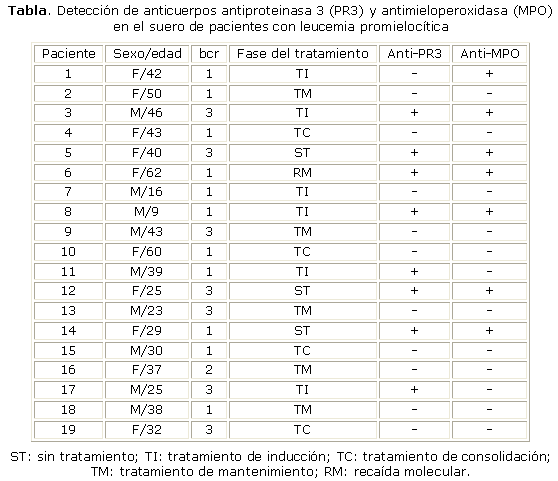
<body><![CDATA[<P><FONT FACE="Verdana, Arial, Helvetica, sans-serif" SIZE="2"><B><FONT SIZE="3">RESULTADOS</FONT></B></FONT>      <P><FONT FACE="Verdana, Arial, Helvetica, sans-serif" SIZE="2">Se demostr&oacute;    la presencia de anticuerpos anti PR3 en 8 enfermos con LPM y de anti MPO en    7, fundamentalmente en la fase de inducci&oacute;n, y en 3 pacientes sin tratamiento;    no as&iacute; en las fases de tratamiento de consolidaci&oacute;n y mantenimiento    (<a href="#t1">tabla</a>).</FONT>      <P ALIGN="CENTER"><A HREF="#tab1"><IMG SRC="/img/revistas/hih/v26n2/t0104210.gif" WIDTH="558" HEIGHT="481" BORDER="0"></A><a name="t1"></a>     
<P>    <P><B><FONT FACE="Verdana, Arial, Helvetica, sans-serif" SIZE="3">DISCUSI&Oacute;N</FONT></B>      <P><FONT FACE="Verdana, Arial, Helvetica, sans-serif" SIZE="2">Las leucemias de  estirpe mieloide expresan un n&uacute;mero de ant&iacute;genos de diferenciaci&oacute;n  tumoral asociados con la formaci&oacute;n de gr&aacute;nulos citoplasm&aacute;ticos  entre los que se encuentra la PR3, una serin proteasa neutral de 26 kDa aumentada  significativamente en la etapa de promielocito de la diferenciaci&oacute;n mieloide.  Su expresi&oacute;n est&aacute; mediada por factores de transcripci&oacute;n como  el PU.1 implicado en la deficiente diferenciaci&oacute;n de las c&eacute;lulas  leuc&eacute;micas.<SUP>9</SUP> La PR3 participa en el mantenimiento del fenotipo  leuc&eacute;mico deteniendo la divisi&oacute;n celular.<SUP>7</SUP></FONT>     <P><FONT FACE="Verdana, Arial, Helvetica, sans-serif" SIZE="2">La  MPO es una prote&iacute;na exclusiva de la serie mieloide que es sintetizada en  fases muy tempranas de la diferenciaci&oacute;n mieloide y constituye el componente  principal de los gr&aacute;nulos azurof&iacute;licos del neutr&oacute;filo.<SUP>10,11</SUP>  La expresi&oacute;n de la MPO, al igual que la PR3, est&aacute; aumentada en los  promielocitos de pacientes con LPM y participa en la maduraci&oacute;n y en la  regulaci&oacute;n de la divisi&oacute;n celular.</FONT>     <P><FONT FACE="Verdana, Arial, Helvetica, sans-serif" SIZE="2">Las  prote&iacute;nas de diferenciaci&oacute;n tumoral, PR3 y MPO, representan una  fuente de ant&iacute;genos espec&iacute;ficos asociados con el tumor y una diana  potencial de la respuesta inmune. En nuestro estudio se detect&oacute; la presencia  de anticuerpos contra la PR3 y MPO en diferentes fases del tratamiento de diferenciaci&oacute;n.  Los anticuerpos se detectaron en aquellos pacientes sin tratar y en fase de inducci&oacute;n,  no as&iacute; en la de consolidaci&oacute;n y mantenimiento, de ah&iacute; su  posible utilidad como marcadores de la expresi&oacute;n de ant&iacute;genos de  diferenciaci&oacute;n tumoral en la c&eacute;lula leuc&eacute;mica. La no presencia  de los ant&iacute;genos tumorales puede provocar la disminuci&oacute;n en la s&iacute;ntesis  de anticuerpos espec&iacute;ficos en estos pacientes. No se demostr&oacute; correlaci&oacute;n  entre las diferentes isoformas del complejo de fusi&oacute;n PML-RARa, bcr1, bcr2,  bcr3 y la presencia de anticuerpos espec&iacute;ficos anti PR3 y anti MPO. </FONT>      <P><FONT FACE="Verdana, Arial, Helvetica, sans-serif" SIZE="2">Resultar&iacute;a  de inter&eacute;s profundizar en la evaluaci&oacute;n de la respuesta inmune en  la LPM con el aumento del n&uacute;mero de pacientes, as&iacute; como el estudio  longitudinal que permita establecer un posible efecto favorecedor de los anticuerpos  estudiados en la diferenciaci&oacute;n celular.</FONT>    <P>     ]]></body>
<body><![CDATA[<P><FONT FACE="Verdana, Arial, Helvetica, sans-serif" SIZE="2"><B><FONT SIZE="3">REFERENCIAS  BIBLIOGR&Aacute;FICAS</FONT> </B> </FONT>     <!-- ref --><P><FONT FACE="Verdana, Arial, Helvetica, sans-serif" SIZE="2">1.  Avvisati G, Lo Coco F, Mandelli F. Acute promyelocytic leukemia: Clinical and  morphologic features and prognostic factors. Sem Hematol 2001;38:4-12. </FONT>    <!-- ref --><P><FONT FACE="Verdana, Arial, Helvetica, sans-serif" SIZE="2">2. Degos L, Wang  ZY. All trans retinoic acid in acute promyelocytic leukemia. Oncogene 2001;20:7140-5.  </FONT>    <!-- ref --><P><FONT FACE="Verdana, Arial, Helvetica, sans-serif" SIZE="2">3. Jing  Y. The PML-RAR alpha fusion protein and targeted therapy for acute promyelocytic  leukemia. Leuk Lymphoma 2004;45:639-48.</FONT>    <!-- ref --><P><FONT FACE="Verdana, Arial, Helvetica, sans-serif" SIZE="2">4.  Tallman MS. What is the role of arsenic in newly diagnosed APL? Best Practice  and Research Clinical Haematology 2008;21:659-66.</FONT>    <!-- ref --><P><FONT FACE="Verdana, Arial, Helvetica, sans-serif" SIZE="2">5.  Chen T, Meier R, Ziemiecki A, Fey MF, Tobler A. Myeloblastin/proteinase 3 belongs  to the negatively regulated primary response genes expressed during in vitro myeloid  differentiation. Biochem Byophys Res Commun 1994;200:1130-5. </FONT>    <!-- ref --><P><FONT FACE="Verdana, Arial, Helvetica, sans-serif" SIZE="2">6.  Muller-Berst N, Minowada J, Tsuji-Takayama K. The phylogeny of proteinase 3/ myeloblastin,  the autoantigen in Wegener's granulomatosis and myeloperoxidase as shown by immunohistochemical  studies on human leukemic cell lines. Clin Immunol Immunopathol 1994;70:51-9.  </FONT>    <!-- ref --><P><FONT FACE="Verdana, Arial, Helvetica, sans-serif" SIZE="2">7. Bories  D, Raynal MC, Solomon DH, Darzynkiewics Z, Cayre YE. Down-regulation of a serine  protease, myeloblastin, causes growth arrest and differentiation of promyelocytic  leukemia cells. Cell 1989;59:959. </FONT>    <!-- ref --><P><FONT FACE="Verdana, Arial, Helvetica, sans-serif" SIZE="2">8.  Franseen CF, Stegeman CA, Kallenberg CG. Antiproteinase 3 and antimyeloperoxidase  associated vasculitis. Kidney Int 2000;57:2195-2206. </FONT>    <!-- ref --><P><FONT FACE="Verdana, Arial, Helvetica, sans-serif" SIZE="2">9.  Zhang P, Nelson E, Radomska HS. Induction of granulocytic differentiation by 2  pathways. Blood 2002;99:4406-12. </FONT>    <!-- ref --><P><FONT FACE="Verdana, Arial, Helvetica, sans-serif" SIZE="2">10.  Borregaard N, Cowland JB. Granules of the human neutrophilic polymorphonuclear  leukocyte. Blood 1997;89:3503-21. </FONT>    <!-- ref --><P><FONT FACE="Verdana, Arial, Helvetica, sans-serif" SIZE="2">11.  Heslop HE, Freda K, Molldrem S, Molldrem JJ. Immunotherapy of hematologic malignancy.  Hematology 2003;1:331-51.</FONT>    <P>    <P>     <P><FONT FACE="Verdana, Arial, Helvetica, sans-serif" SIZE="2">Recibido:  28 de enero de 2010.    <BR>Aprobado: 2 de febrero de 2010.</FONT>     <P>    <P>    <P><FONT FACE="Verdana, Arial, Helvetica, sans-serif" SIZE="2">Lic.  <I>Ada A. Arce Hern&aacute;ndez</I>. Instituto de Hematolog&iacute;a e Inmunolog&iacute;a.  Apartado 8070, CP 10800. Ciudad de La Habana, Cuba. Tel (537) 643 8695, 643 8268,  Fax (537) 644 2334. e-mail: <U><FONT  COLOR="#0000ff"><A HREF="mailto:ihidir@hemato.sld.cu">ihidir@hemato.sld.cu</A></FONT></U>  <I>Website</I>: <U><FONT FACE="Verdana, Arial, Helvetica, sans-serif" SIZE="2"><U><FONT FACE="Verdana, Arial, Helvetica, sans-serif" SIZE="2"><U><FONT COLOR="#0000ff"><A HREF="http://www.sld.cu/sitios/ihi" TARGET="_blank">http://www.sld.cu/sitios/ihi</A></FONT></U></FONT></U></FONT></U>  </FONT>       ]]></body><back>
<ref-list>
<ref id="B1">
<label>1</label><nlm-citation citation-type="journal">
<person-group person-group-type="author">
<name>
<surname><![CDATA[Avvisati]]></surname>
<given-names><![CDATA[G]]></given-names>
</name>
<name>
<surname><![CDATA[Lo Coco]]></surname>
<given-names><![CDATA[F]]></given-names>
</name>
<name>
<surname><![CDATA[Mandelli]]></surname>
<given-names><![CDATA[F]]></given-names>
</name>
</person-group>
<article-title xml:lang="en"><![CDATA[Acute promyelocytic leukemia: Clinical and morphologic features and prognostic factors]]></article-title>
<source><![CDATA[Sem Hematol]]></source>
<year>2001</year>
<volume>38</volume>
<page-range>4-12</page-range></nlm-citation>
</ref>
<ref id="B2">
<label>2</label><nlm-citation citation-type="journal">
<person-group person-group-type="author">
<name>
<surname><![CDATA[Degos]]></surname>
<given-names><![CDATA[L]]></given-names>
</name>
<name>
<surname><![CDATA[Wang]]></surname>
<given-names><![CDATA[ZY]]></given-names>
</name>
</person-group>
<article-title xml:lang="en"><![CDATA[All trans retinoic acid in acute promyelocytic leukemia]]></article-title>
<source><![CDATA[Oncogene]]></source>
<year>2001</year>
<volume>20</volume>
<page-range>7140-5</page-range></nlm-citation>
</ref>
<ref id="B3">
<label>3</label><nlm-citation citation-type="journal">
<person-group person-group-type="author">
<name>
<surname><![CDATA[Jing]]></surname>
<given-names><![CDATA[Y]]></given-names>
</name>
</person-group>
<article-title xml:lang="en"><![CDATA[The PML-RAR alpha fusion protein and targeted therapy for acute promyelocytic leukemia]]></article-title>
<source><![CDATA[Leuk Lymphoma]]></source>
<year>2004</year>
<volume>45</volume>
<page-range>639-48</page-range></nlm-citation>
</ref>
<ref id="B4">
<label>4</label><nlm-citation citation-type="journal">
<person-group person-group-type="author">
<name>
<surname><![CDATA[Tallman]]></surname>
<given-names><![CDATA[MS.]]></given-names>
</name>
</person-group>
<article-title xml:lang="en"><![CDATA[What is the role of arsenic in newly diagnosed APL?]]></article-title>
<source><![CDATA[Best Practice and Research Clinical Haematology]]></source>
<year>2008</year>
<volume>21</volume>
<page-range>659-66</page-range></nlm-citation>
</ref>
<ref id="B5">
<label>5</label><nlm-citation citation-type="journal">
<person-group person-group-type="author">
<name>
<surname><![CDATA[Chen]]></surname>
<given-names><![CDATA[T]]></given-names>
</name>
<name>
<surname><![CDATA[Meier]]></surname>
<given-names><![CDATA[R]]></given-names>
</name>
<name>
<surname><![CDATA[Ziemiecki]]></surname>
<given-names><![CDATA[A]]></given-names>
</name>
<name>
<surname><![CDATA[Fey]]></surname>
<given-names><![CDATA[MF]]></given-names>
</name>
<name>
<surname><![CDATA[Tobler]]></surname>
<given-names><![CDATA[A]]></given-names>
</name>
</person-group>
<article-title xml:lang="en"><![CDATA[Myeloblastin/proteinase 3 belongs to the negatively regulated primary response genes expressed during in vitro myeloid differentiation]]></article-title>
<source><![CDATA[Biochem Byophys Res Commun]]></source>
<year>1994</year>
<volume>200</volume>
<page-range>1130-5</page-range></nlm-citation>
</ref>
<ref id="B6">
<label>6</label><nlm-citation citation-type="journal">
<person-group person-group-type="author">
<name>
<surname><![CDATA[Muller-Berst]]></surname>
<given-names><![CDATA[N]]></given-names>
</name>
<name>
<surname><![CDATA[Minowada]]></surname>
<given-names><![CDATA[J]]></given-names>
</name>
<name>
<surname><![CDATA[Tsuji-Takayama]]></surname>
<given-names><![CDATA[K]]></given-names>
</name>
</person-group>
<article-title xml:lang="en"><![CDATA[The phylogeny of proteinase 3/ myeloblastin, the autoantigen in Wegener's granulomatosis and myeloperoxidase as shown by immunohistochemical studies on human leukemic cell lines]]></article-title>
<source><![CDATA[Clin Immunol Immunopathol]]></source>
<year>1994</year>
<volume>70</volume>
<page-range>51-9</page-range></nlm-citation>
</ref>
<ref id="B7">
<label>7</label><nlm-citation citation-type="journal">
<person-group person-group-type="author">
<name>
<surname><![CDATA[Bories]]></surname>
<given-names><![CDATA[D]]></given-names>
</name>
<name>
<surname><![CDATA[Raynal]]></surname>
<given-names><![CDATA[MC]]></given-names>
</name>
<name>
<surname><![CDATA[Solomon]]></surname>
<given-names><![CDATA[DH]]></given-names>
</name>
<name>
<surname><![CDATA[Darzynkiewics]]></surname>
<given-names><![CDATA[Z]]></given-names>
</name>
<name>
<surname><![CDATA[Cayre]]></surname>
<given-names><![CDATA[YE]]></given-names>
</name>
</person-group>
<article-title xml:lang="en"><![CDATA[Down-regulation of a serine protease, myeloblastin, causes growth arrest and differentiation of promyelocytic leukemia cells]]></article-title>
<source><![CDATA[Cell]]></source>
<year>1989</year>
<volume>59</volume>
<page-range>959</page-range></nlm-citation>
</ref>
<ref id="B8">
<label>8</label><nlm-citation citation-type="journal">
<person-group person-group-type="author">
<name>
<surname><![CDATA[Franseen]]></surname>
<given-names><![CDATA[CF]]></given-names>
</name>
<name>
<surname><![CDATA[Stegeman]]></surname>
<given-names><![CDATA[CA]]></given-names>
</name>
<name>
<surname><![CDATA[Kallenberg]]></surname>
<given-names><![CDATA[CG]]></given-names>
</name>
</person-group>
<article-title xml:lang="en"><![CDATA[Antiproteinase 3 and antimyeloperoxidase associated vasculitis]]></article-title>
<source><![CDATA[Kidney Int]]></source>
<year>2000</year>
<volume>57</volume>
<page-range>2195-2206</page-range></nlm-citation>
</ref>
<ref id="B9">
<label>9</label><nlm-citation citation-type="journal">
<person-group person-group-type="author">
<name>
<surname><![CDATA[Zhang]]></surname>
<given-names><![CDATA[P]]></given-names>
</name>
<name>
<surname><![CDATA[Nelson]]></surname>
<given-names><![CDATA[E]]></given-names>
</name>
<name>
<surname><![CDATA[Radomska]]></surname>
<given-names><![CDATA[HS]]></given-names>
</name>
</person-group>
<article-title xml:lang="en"><![CDATA[Induction of granulocytic differentiation by 2 pathways]]></article-title>
<source><![CDATA[Blood]]></source>
<year>2002</year>
<volume>99</volume>
<page-range>4406-12</page-range></nlm-citation>
</ref>
<ref id="B10">
<label>10</label><nlm-citation citation-type="journal">
<person-group person-group-type="author">
<name>
<surname><![CDATA[Borregaard]]></surname>
<given-names><![CDATA[N]]></given-names>
</name>
<name>
<surname><![CDATA[Cowland]]></surname>
<given-names><![CDATA[JB]]></given-names>
</name>
</person-group>
<article-title xml:lang="en"><![CDATA[Granules of the human neutrophilic polymorphonuclear leukocyte]]></article-title>
<source><![CDATA[Blood]]></source>
<year>1997</year>
<volume>89</volume>
<page-range>3503-21</page-range></nlm-citation>
</ref>
<ref id="B11">
<label>11</label><nlm-citation citation-type="journal">
<person-group person-group-type="author">
<name>
<surname><![CDATA[Heslop]]></surname>
<given-names><![CDATA[HE]]></given-names>
</name>
<name>
<surname><![CDATA[Freda]]></surname>
<given-names><![CDATA[K]]></given-names>
</name>
<name>
<surname><![CDATA[Molldrem]]></surname>
<given-names><![CDATA[S]]></given-names>
</name>
<name>
<surname><![CDATA[Molldrem]]></surname>
<given-names><![CDATA[JJ]]></given-names>
</name>
</person-group>
<article-title xml:lang="en"><![CDATA[Immunotherapy of hematologic malignancy]]></article-title>
<source><![CDATA[Hematology]]></source>
<year>2003</year>
<volume>1</volume>
<page-range>331-51</page-range></nlm-citation>
</ref>
</ref-list>
</back>
</article>
